SINGLE CELL PROTEIN
AYUSH MISHRA
DEPARTMENT OF APPLIED AGRICULTURE
FOOD SCIENCE AND TECHNOLOGY
CENTRAL UNIVERSITY OF PUNJAB, BATHINDA
INTRODUCTION
 Single-cell proteins (SCP) refers to edible unicellular microorganisms.
 The biomass or protein extract from pure or mixed cultures of algae, yeasts,
fungi or bacteria
 It is used as an ingredient or a substitute for protein-rich foods.
 It is suitable for human & animal feeds.
 Agricultural waste are used as starter/media for microbial growth.
 Max Delbrück and his colleagues found out the high value of surplus
brewer’s yeast as a feeding supplement for animals
[SOURCE – VECTORSTOCK]
PRODUCTION PROCESS
 Single-cell proteins develop when microbes ferment waste materials. E.g -
wood, straw, cannery, and food processing wastes, residues from alcohol
production, hydrocarbons, or human and animal excreta
 The problem with extracting single-cell proteins from the wastes is the dilution
and cost. They are found in very low concentrations, usually less than 5%.
 Engineers have developed ways to increase the concentrations including
centrifugation, flotation, precipitation, coagulation, and filtration, or the use of
semi-permeable membranes
 The single-cell protein must be dehydrated to approximately 10% moisture
content and/or acidified to aid in storage and prevent spoilage.
 The methods to increase the concentrations to adequate levels and the de-
watering process require equipment that is expensive and not always suitable
for small-scale operations.
 It is economically prudent to feed the product locally and soon after it is
produced
INDUSTRIAL PRODUCTION TECHNIQUES
[SOURCE – RESEARCH GATE]
DIFFERENT PROCESSING TECHNIQUE
 PRUTEEN PROCESS AND SYMBA PROCESS
[SOURCE – INDUSTRIALBIOTECHNOLOGY] [SOURCE – INDUSTRIALBIOTECHNOLOGY]
PRUTEEN PROCESS
 Attempts to develop methanol based processes were made in Europe, the
former society union, Japan and the USA.
 They involved bacterial species (Hyphomicrobium, Methylococcus,
Methylophilus and Methylotrophus),
 yeasts (Candida boidinii, Pichia angusta and P.pastorn)
 filamentous fungi (Gliocladium deliquescans, paecilomyces variotii and
Trichoderma linganus).
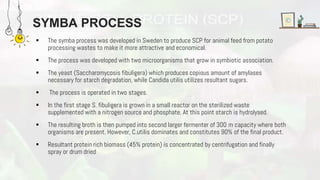
SYMBA PROCESS
 The symba process was developed in Sweden to produce SCP for animal feed from potato
processing wastes to make it more attractive and economical.
 The process was developed with two microorganisms that grow in symbiotic association.
 The yeast (Saccharomycosis fibuligera) which produces copious amount of amylases
necessary for starch degradation, while Candida utilis utilizes resultant sugars.
 The process is operated in two stages.
 In the first stage S. fibuligera is grown in a small reactor on the sterilized waste
supplemented with a nitrogen source and phosphate. At this point starch is hydrolysed.
 The resulting broth is then pumped into second larger fermenter of 300 m capacity where both
organisms are present. However, C.utilis dominates and constitutes 90% of the final product.
 Resultant protein rich biomass (45% protein) is concentrated by centrifugation and finally
spray or drum dried
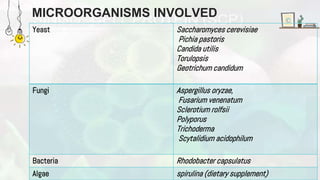
MICROORGANISMS INVOLVED
Yeast Saccharomyces cerevisiae
Pichia pastoris
Candida utilis
Torulopsis
Geotrichum candidum
Fungi Aspergillus oryzae,
Fusarium venenatum
Sclerotium rolfsii
Polyporus
Trichoderma
Scytalidium acidophilum
Bacteria Rhodobacter capsulatus
Algae spirulina (dietary supplement)
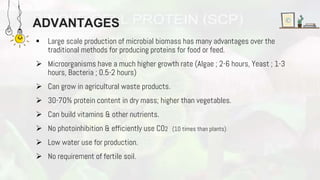
ADVANTAGES
 Large scale production of microbial biomass has many advantages over the
traditional methods for producing proteins for food or feed.
 Microorganisms have a much higher growth rate (Algae ; 2-6 hours, Yeast ; 1-3
hours, Bacteria ; 0.5-2 hours)
 Can grow in agricultural waste products.
 30-70% protein content in dry mass; higher than vegetables.
 Can build vitamins & other nutrients.
 No photoinhibition & efficiently use CO2 (10 times than plants)
 Low water use for production.
 No requirement of fertile soil.
DISADVANTAGES
 Ingestion of purine compounds arising from RNA breakdown leads to increase
plasma levels of uricacid which can cause gout and kidney stone.
 Algae and yeast contain nondigestable cellulose cellwall; thus it should be
broken up in order to liberate the cell interior and allow complete digestion.
 Some exhibits unpleasant colour and flavors.
 Some yeast and fungal proteins tend to be defficient in methionine.
CONCLUSION
 From the above analysis and data the SCP is going to replace all the
agricultural products and foods in near future. By 2050, world population may
reach 9 billion where agriculture will not be able to meet demand.
REFERENCES
 Tilman, David (1999-05-25). "Global environmental impacts of agricultural
expansion: The need for sustainable and efficient practices“
 Vermeulen, Sonja J.; Campbell, Bruce M.; Ingram, John S.I. (2012-01-01).
"Climate Change and Food Systems".
 Ugalde, U. O.; Castrillo, J. I. (2002). Applied mycology and biotechnology.
Volume 2
 H. W. Doelle (1994). Microbial Process Development
THANK YOU

Single cell protein

  • 1.
    SINGLE CELL PROTEIN AYUSHMISHRA DEPARTMENT OF APPLIED AGRICULTURE FOOD SCIENCE AND TECHNOLOGY CENTRAL UNIVERSITY OF PUNJAB, BATHINDA
  • 2.
    INTRODUCTION  Single-cell proteins(SCP) refers to edible unicellular microorganisms.  The biomass or protein extract from pure or mixed cultures of algae, yeasts, fungi or bacteria  It is used as an ingredient or a substitute for protein-rich foods.  It is suitable for human & animal feeds.  Agricultural waste are used as starter/media for microbial growth.  Max Delbrück and his colleagues found out the high value of surplus brewer’s yeast as a feeding supplement for animals [SOURCE – VECTORSTOCK]
  • 3.
    PRODUCTION PROCESS  Single-cellproteins develop when microbes ferment waste materials. E.g - wood, straw, cannery, and food processing wastes, residues from alcohol production, hydrocarbons, or human and animal excreta  The problem with extracting single-cell proteins from the wastes is the dilution and cost. They are found in very low concentrations, usually less than 5%.  Engineers have developed ways to increase the concentrations including centrifugation, flotation, precipitation, coagulation, and filtration, or the use of semi-permeable membranes
  • 4.
     The single-cellprotein must be dehydrated to approximately 10% moisture content and/or acidified to aid in storage and prevent spoilage.  The methods to increase the concentrations to adequate levels and the de- watering process require equipment that is expensive and not always suitable for small-scale operations.  It is economically prudent to feed the product locally and soon after it is produced
  • 5.
  • 6.
    DIFFERENT PROCESSING TECHNIQUE PRUTEEN PROCESS AND SYMBA PROCESS [SOURCE – INDUSTRIALBIOTECHNOLOGY] [SOURCE – INDUSTRIALBIOTECHNOLOGY]
  • 7.
    PRUTEEN PROCESS  Attemptsto develop methanol based processes were made in Europe, the former society union, Japan and the USA.  They involved bacterial species (Hyphomicrobium, Methylococcus, Methylophilus and Methylotrophus),  yeasts (Candida boidinii, Pichia angusta and P.pastorn)  filamentous fungi (Gliocladium deliquescans, paecilomyces variotii and Trichoderma linganus).
  • 8.
    SYMBA PROCESS  Thesymba process was developed in Sweden to produce SCP for animal feed from potato processing wastes to make it more attractive and economical.  The process was developed with two microorganisms that grow in symbiotic association.  The yeast (Saccharomycosis fibuligera) which produces copious amount of amylases necessary for starch degradation, while Candida utilis utilizes resultant sugars.  The process is operated in two stages.  In the first stage S. fibuligera is grown in a small reactor on the sterilized waste supplemented with a nitrogen source and phosphate. At this point starch is hydrolysed.  The resulting broth is then pumped into second larger fermenter of 300 m capacity where both organisms are present. However, C.utilis dominates and constitutes 90% of the final product.  Resultant protein rich biomass (45% protein) is concentrated by centrifugation and finally spray or drum dried
  • 9.
    MICROORGANISMS INVOLVED Yeast Saccharomycescerevisiae Pichia pastoris Candida utilis Torulopsis Geotrichum candidum Fungi Aspergillus oryzae, Fusarium venenatum Sclerotium rolfsii Polyporus Trichoderma Scytalidium acidophilum Bacteria Rhodobacter capsulatus Algae spirulina (dietary supplement)
  • 10.
    ADVANTAGES  Large scaleproduction of microbial biomass has many advantages over the traditional methods for producing proteins for food or feed.  Microorganisms have a much higher growth rate (Algae ; 2-6 hours, Yeast ; 1-3 hours, Bacteria ; 0.5-2 hours)  Can grow in agricultural waste products.  30-70% protein content in dry mass; higher than vegetables.  Can build vitamins & other nutrients.  No photoinhibition & efficiently use CO2 (10 times than plants)  Low water use for production.  No requirement of fertile soil.
  • 11.
    DISADVANTAGES  Ingestion ofpurine compounds arising from RNA breakdown leads to increase plasma levels of uricacid which can cause gout and kidney stone.  Algae and yeast contain nondigestable cellulose cellwall; thus it should be broken up in order to liberate the cell interior and allow complete digestion.  Some exhibits unpleasant colour and flavors.  Some yeast and fungal proteins tend to be defficient in methionine.
  • 12.
    CONCLUSION  From theabove analysis and data the SCP is going to replace all the agricultural products and foods in near future. By 2050, world population may reach 9 billion where agriculture will not be able to meet demand.
  • 13.
    REFERENCES  Tilman, David(1999-05-25). "Global environmental impacts of agricultural expansion: The need for sustainable and efficient practices“  Vermeulen, Sonja J.; Campbell, Bruce M.; Ingram, John S.I. (2012-01-01). "Climate Change and Food Systems".  Ugalde, U. O.; Castrillo, J. I. (2002). Applied mycology and biotechnology. Volume 2  H. W. Doelle (1994). Microbial Process Development
  • 14.