Cherubim Curayag
BSEd – Bio Sci 3
SEXUAL REPRODUCTION
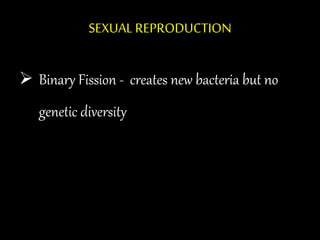
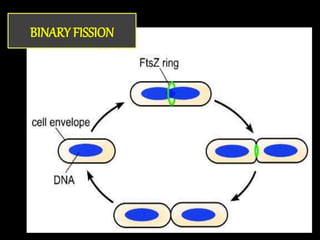
 Binary Fission - creates new bacteria but no
genetic diversity
single DNA molecule replicates and both
copies attach to the cell membrane.
The cell membrane begins to grow
between the two DNA molecules
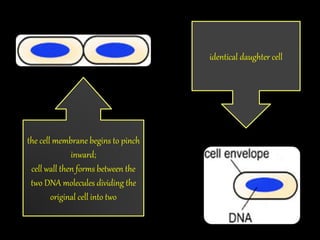
the cell membrane begins to pinch
inward;
cell wall then forms between the
two DNA molecules dividing the
original cell into two
identical daughter cell
BINARY FISSION
SEXUAL REPRODUCTION
Sex in bacteria differs somewhat from what we consider
sex in eukaryotes. It involves the PLASMID, which has
several important characteristics:
 A plasmid is a loop of DNA. Plasmids can multiply
autonomously within the cell. Thus we may find from zero to
many of one or more plasmids in each cell.
SEXUAL REPRODUCTION
 Many plasmids can insert into the DNA of the nucleus, and
detach from it. In doing so, the plasmid may leave part of
the plasmid DNA behind, and take some of the nuclear
DNA with it.
SEXUAL REPRODUCTION
 plasmids can transfer from cell to cell. The cells need not be
of the same bacterial 'species'.
BACTERIAL RECOMBINATION:
 Conjugation
 Transformation
 Transduction
CONJUGATION
 one bacterium connects itself to another
through a protein tube structure called a
PILUS. Genes are transferred from one
bacterium to the other through this tube.
TRANSFORMATION
 the bacterium binds the DNA and transports it
across the bacterial cell membrane. The new
DNA is then incorporated into the bacterial
cell's DNA.
TRANSDUCTION
 involves the exchanging of bacterial DNA
through bacteriophages.
BACTERIOPHAGES
• viruses that infect bacteria. There are two types
of transduction: generalized and specialized
transduction.
The End 

Bacterial Reproduction