International Journal of Research in Engineering and Science (IJRES)
ISSN (Online): 2320-9364, ISSN (Print): 2320-9356
www.ijres.org Volume 2 Issue 4 ǁ April. 2014 ǁ PP.06-09
www.ijres.org 6 | Page
Driver Alertness On Android With Face And Eye Ball
Movements
Ms.K.Kowsalya1
, Ms.P.Aileen Chris2
PG Scholar,Department of CSE, Karpagam University, Coimbatore,India
Assistant Professor,Department of CSE, Karpagam University, Coimbatore,India
Abstract— Drowsiness is a big problem while in driving specially in long and continues driving. This is a main
cause for accidents. Maximum accidents found by the driver’s ignorance of seeing the road and focus on other
thing that will divert the concentration. This project used to find sleepy drivers and lazy driver by monitoring
them periodically. Main objective of the project to develop entire system in to smart phone and make it as user
friendly to the driver and try to support the system on Smartphone have the Android Operating System. There
are major things are considered for measure the fatigue level when monitoring driver, Eye movement driver.
Smartphone camera capture the drives image, A Dynamic decision making used for find the drivers fatigue
level. When driver reaches threshold level of fatigue, then alert is triggered to avoid accident and awake the
driver. If driver ignores the alert and continue with drowsy driving, the alert system takes further steps to stop
the vehicle. It may be find nearest coffee shop to refresh driver and also if he need other choices to refresh the
map will help them.GPS and Navigation Service of the Android phones used for assist the driver to overcome
his drowsy driver.
Keywords—Global positioning System (GPS),Red-Green-Blue(RGB)
I. INTRODUCTION
Sleep is a neurobiological need with predictable patterns of sleepiness and wakefulness. Sleepiness
results from the sleep component of the circadian cycle of sleep and wakefulness, restriction of sleep, and/or
interruption or fragmentation of sleep. The loss of one night's sleep can lead to extreme short-term sleepiness,
while habitually restricting sleep by 1 or 2 hours a night can lead to chronic sleepiness. Sleeping is the most
effective way to reduce sleepiness. Sleepiness causes auto crashes because it impairs performance and can
ultimately lead to the inability to resist falling asleep at the wheel. Critical aspects of driving impairment
associated with sleepiness are reaction time, vigilance, attention, and information processing. Subjective and
objective tools are available to approximate or detect sleepiness. However, unlike the situation with alcohol-
related crashes, no blood, breath, or other measurable test is currently available to quantify levels of sleepiness at
the crash site. although evidence is limited or inferential, chronic predisposing factors and acute situational factors
recognized as increasing the risk of drowsy driving and related crashes.
II. SCOPE EXISITING SYSTEM
The actions that were the most predictive of drowsiness by decreasing in drowsy states were
(smile), (outer brow raise), (frown),(chin raise), and (nose wrinkle). (lid tighten), (nostril compress),
(brow lower), and (jaw drop). The high predictive ability of the blink/eye closure measure was
expected. Mostly all the systems are expecting the external hardware to process the driver sleepiness.
III. PROPOSED SYSTEM
The proposed system for identify the drivers sleepiness is hardware free environment. The primary
approach is monitor the driver and using Smartphone camera and extracts the information from them for
sleepiness detection. Fatigue driver detection module installed in the Smartphone and it will find the driver
when he feels too drowsy and alert him.
Driver Alertness On Android With Face And Eye Ball Movements
www.ijres.org 7 | Page
IV. SYSTEM ARCHITECTURE
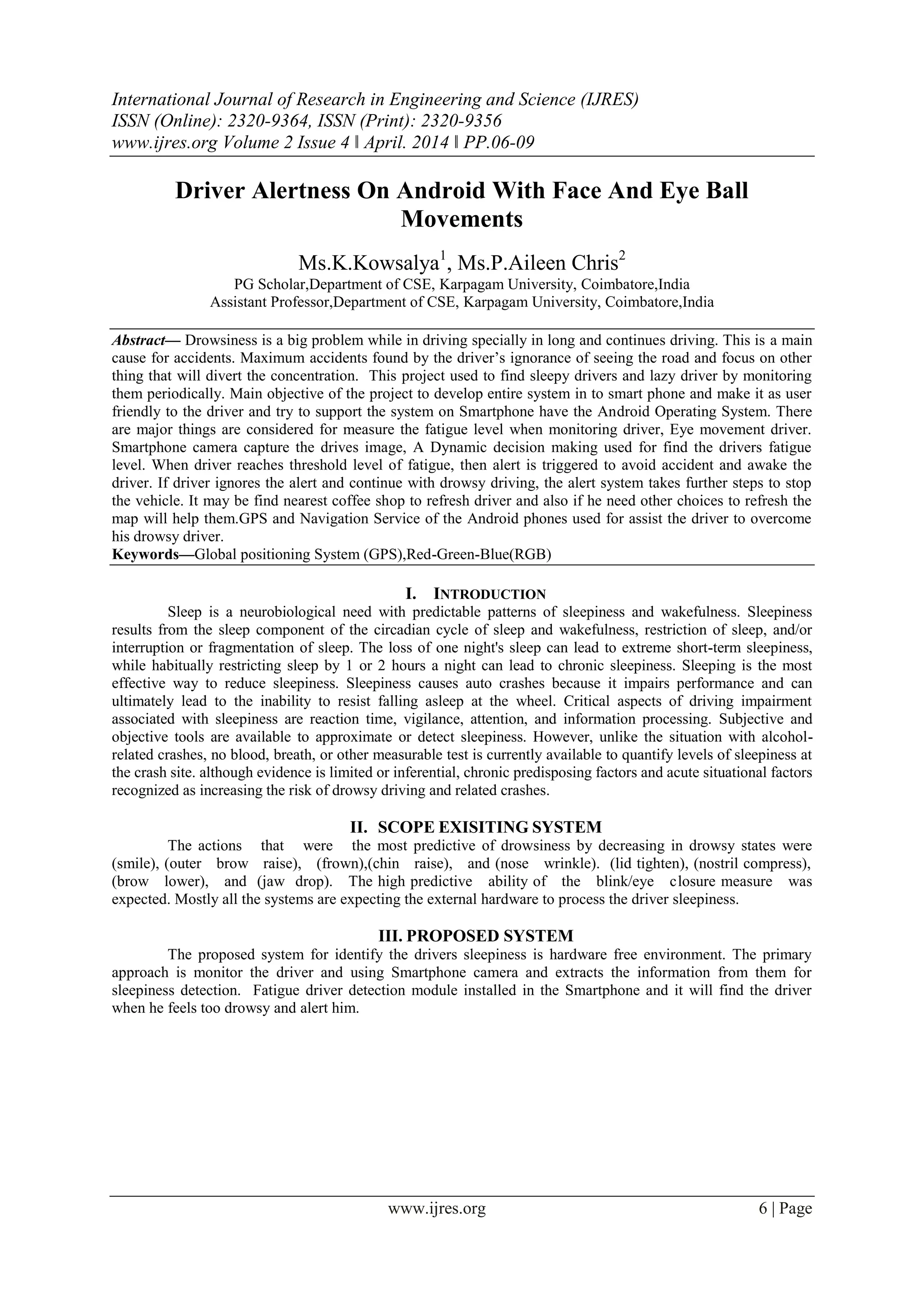
A smart phone is placed on the driver seat dashboard to capture the driver image. The web parametersare
updated to find the best match in the imageusing the Procrustes algorithm. In the first step, the features points for
eyes and nose are defined. The feature profiles are trained on the desktop computer and stored in the smartphone
for the shape model matching. A profile points are initialized at the centric of the image. Normally, RGB color
model in which red, green, and blue colors are added together in various ways to reproduce an image in webcam.
A. Abbreviations and Acronyms
National Centre on Sleep Disorders Research - NCSDR
National Institutes of Health, and the National Highway
Traffic Safety Administration - NHTSA
Sleep Apnea Syndrome – SAS
General Procreates Analysis – GPA
Photo Plethysmo Gram – PPG
Photoplethysmogram Variability – PPGV
Electroencephalography – EEG
Electrooculography – EOG
Galvanic Skin Response – GSR
Blink Frequency – BF
Heart Rate Variability – HRV
Blink Rate – BR
Average Closure – AC
PERCLOUS – PC
Global Positioning System – GPS
B. Units
 Here face size is measured with accuracy values.
20,30,50 in order of detection it will be 0,2,3.
Mahalanobis distance measures the similarity between the profile points and the image points in for the
RGB color spaces as in,
(1)
Next, the transformation T is calculated using the processes algorithm. The transformation T includes
translation, uniform scaling, and orientation. The translation of the profile points from the origin to new points is
calculated. Next, the transformation T is calculated using the Procrustes algorithm. The transformation T
includes translation, uniform scaling, and orientation. The translation of the profile points from the origin to new
points is calculated as,
( xm , ym ) = ( x - xi , y - yi ) (2)
Here xm and ym are representation of the mean point of the picture moving and it will used for the
transition of the eye state. The whole system is programmed in Android platform. Briefly, Android is a software
stack for mobile application devices consists of an operating system, middleware, and a set of key applications .
The system is coded using an Android development kit including a development platform and a development
board designed by Huins Inc. in South Korea because the development board provides several common data
transmission serial ports for development purposes. The ports are Ethernet, UART, Debug, and Debugging JTA.
In addition ,the development board supports Wi-Fi communication, GPS, and a three-axis accelerometer and is
able to support the development platform runs in Linux Kernel version 2.6.29 and SDK version 2.1 (Éclair).
Driver Alertness On Android With Face And Eye Ball Movements
www.ijres.org 8 | Page
V. Information fusion
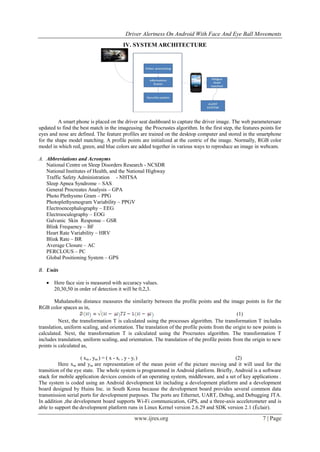
Image is captured from android mobile phone and it wills pre process for detecting the eye movement.
The model parameter sari updated to find the best match in the image using the Procreates algorithm. In the first
step, the features points for eyes and nose are defined. The feature profiles are trained on the desktop computer
and stored in the Smartphone for the shape model matching. Approve file points are initialize data the centric of
the image.
Fig .2. Video processing
VI. Procrustes Algorithm
Procrustes analysis is a form of statistical shape analysis used to analyse the distribution of a set of
shapes. The name procrustes refers to a bandit from Greek mythology who made his victims fit his bed either by
stretching their limbs or cutting them off.To compare the shape of two or more objects, the objects must be first
optimally "superimposed". Procrustes superimposition (PS) is performed by optimally translating, rotating and
uniformly scaling the objects. In other words, both the placement in space and the size of the objects are freely
adjusted. The aim is to obtain a similar placement and size, by minimizing a measure of shape difference called
the Procrustes distance between the objects. This is sometimes called full, as opposed to partial PS, in which
scaling is not performed but the size of the objects is preserved. Notice that, after full PS, the objects will
exactly coincide if their shape is identical. For instance, with full PS two spheres with different radius will
always coincide, because they have exactly the same shape. Conversely, with partial PS they will never
coincide. This implies that, by the strict definition of the term shape in geometry, shape analysis should be
performed using full PS. A statistical analysis based on partial PS is not a pure shape analysis as it is not only
sensitive to shape differences, but also to size differences. Both full and partial PS will never manage to
perfectly match two objects with different shape, such as a cube and a sphere, or a right hand and a left hand.
VII. Alert system
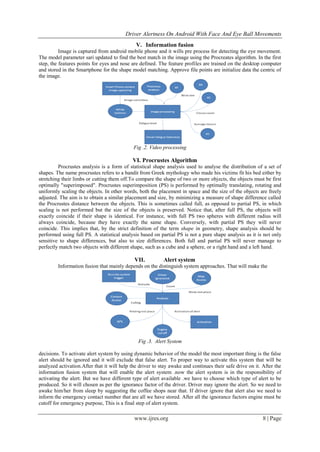
Information fusion that mainly depends on the distinguish system approaches. That will make the
Fig .3. Alert System
decisions. To activate alert system by using dynamic behavior of the model the most important thing is the false
alert should be ignored and it will exclude that false alert. To proper way to activate this system that will be
analyzed activation.After that it will help the driver to stay awake and continues their safe drive on it. After the
information fusion system that will enable the alert system .now the alert system is in the responsibility of
activating the alert. But we have different type of alert available .we have to choose which type of alert to be
produced. So it will chosen as per the ignorance factor of the driver. Driver may ignore the alert. So we need to
awake him/her from sleep by suggesting the coffee shops near that. If driver ignore that alert also we need to
inform the emergency contact number that are all we have stored. After all the ignorance factors engine must be
cutoff for emergency purpose, This is a final step of alert system.
Driver Alertness On Android With Face And Eye Ball Movements
www.ijres.org 9 | Page
VIII. Result
The graph shows the difference in the detection on while driver wearing eye glass and without that.
gives the accurate x-axis shows face size and y-axis shows accuracy of the sleepiness detection. In general the
prediction is depends on the image captured by the system and behave of the driver.Image quality is very
important than the system performance so high resolution picture is required for best processing but it will decay
the performance of the system so we limit the image
0
50
100
0 20 30 50 100
Whitout
glass
With glass
Fig .4 . The prediction value of correctness
So detection may be little fuzzy. And also this system is best for who having the normal eye. if he or she
powered, they need to wear power glass it will delay the positioning of the eye.
IX. Conclusion
In this paper the proposed model is detect the if driver feels sleepy, and also monitor the lazy drivers
activity then alert. Using facial features of a driver. The Eye moment is by using face detection frames. That
helps to information fusion to generate the alert. This will awake the driver and concentrate on the road to reach
the destination safely. This proposed approach is used to monitor the driver system automatically and alert
them when we needed and help them to drive safely. This approach provides an extra hardware free
environment and works like an mobile application. This application that support lower level to upper level
configuration android smart phones and also processing accuracy it depends upon the performance of the
android smart phones.
X. Future Works
In future the security system that not make only alert to the user. That will be including for more
option to suggest the driver to take rest or refresh him. This will comes under the following process. Alert the
system with extra feature of awake the driver. If driver ignores alert find that and contact the emergency number
to inform he/she going to sleep. Safe stop when driver fatigue is crossed the threshold level. The Processing of
the eye ball movement only have the functionality of driver have normal eyes, If he/she wearing glass or
sunglasses it will not so need to include that functionality also. Process the mood of the driver for driving
behavior, If he/she continuously ignore the alert the control the fuel flow to the engine and make then to hard
stop.
REFERENCES
[1] Mr. Swapnil V. Deshmukh , Ms.Dipeeka P. Radake, Mr. Kapil N. Hande,” Driver fatigue Detection Using Sensor Network”,
Swapnil V. Desh et al. / International Journal of Engineering Science and Technology (IJEST)
[2] Petr Bouchner, Roman Piekník, Stanislav Novotný, Jan Pěkný, Michal Hajný, Claudia Borzová,” Fatigue Of Car Drivers -
Detection And Classification Based On The Experiments On Car Simulators”, Proceedings of the 6th WSEAS International
Conference on Simulation, Modeling and Optimization, Lisbon, Portugal, September 22-24, 2006”.
[3] Boon-Giin Lee and Wan-Young Chung ,“A Smartphone-Based Driver Safety Monitoring System Using Data Fusion”, Sensors
2012 , 12, 17536-17552; doi:10.3390/s121217536.
[4] Ronald R. Knipling, Walter W. Wierwille,” Vehicle-Based Drowsy Driver Detection:Current Status and Future Prospects”,
IVHS America Fourth Annual Meeting, Atlanta, GA, April 17-20, 1994.
[5] Azim Eskandarian, Riaz A Sayed,“Analysis of Driver Impairment, Fatigue, and Drowsiness and an Unobtrusive Vehicle-Based
Detection Scheme”, First International Conference on Traffic Accidents University of Tehran
[6] Mahesh M. Bundele, Rahul Banerjee, “Detection of Fatigue of Vehicular Driver using Skin Conductance and Oximetry Pulse: A
Neural Network Approach”,MDC2009 Proceedings of the iiWAS2009.
[7] Luis M. Bergasa, Associate Member, IEEE , Jesús Nuevo,Miguel A. Sotelo,Member, IEEE , Rafael Barea, and María Elena
Lopez,” Real-Time System for Monitoring Driver Vigilance”, Ieee Transactions On Intelligent Transportation Systems, Vol. 7,
No. 1, March 2006.
[8] Toshiaki Kasukabe,Masatake Hiraoka,Osami Yamamoto,Muneo Yamada,”Delvelopment of system for Comprehensively
Measuring Driving ability for Elderly Safe Driving”,MVA2009 IAPR Conference on Machine vision Applications, May 20-
22,2009 Yokohama JAPAN.

Driver Alertness On Android With Face And Eye Ball Movements

  • 1.
    International Journal ofResearch in Engineering and Science (IJRES) ISSN (Online): 2320-9364, ISSN (Print): 2320-9356 www.ijres.org Volume 2 Issue 4 ǁ April. 2014 ǁ PP.06-09 www.ijres.org 6 | Page Driver Alertness On Android With Face And Eye Ball Movements Ms.K.Kowsalya1 , Ms.P.Aileen Chris2 PG Scholar,Department of CSE, Karpagam University, Coimbatore,India Assistant Professor,Department of CSE, Karpagam University, Coimbatore,India Abstract— Drowsiness is a big problem while in driving specially in long and continues driving. This is a main cause for accidents. Maximum accidents found by the driver’s ignorance of seeing the road and focus on other thing that will divert the concentration. This project used to find sleepy drivers and lazy driver by monitoring them periodically. Main objective of the project to develop entire system in to smart phone and make it as user friendly to the driver and try to support the system on Smartphone have the Android Operating System. There are major things are considered for measure the fatigue level when monitoring driver, Eye movement driver. Smartphone camera capture the drives image, A Dynamic decision making used for find the drivers fatigue level. When driver reaches threshold level of fatigue, then alert is triggered to avoid accident and awake the driver. If driver ignores the alert and continue with drowsy driving, the alert system takes further steps to stop the vehicle. It may be find nearest coffee shop to refresh driver and also if he need other choices to refresh the map will help them.GPS and Navigation Service of the Android phones used for assist the driver to overcome his drowsy driver. Keywords—Global positioning System (GPS),Red-Green-Blue(RGB) I. INTRODUCTION Sleep is a neurobiological need with predictable patterns of sleepiness and wakefulness. Sleepiness results from the sleep component of the circadian cycle of sleep and wakefulness, restriction of sleep, and/or interruption or fragmentation of sleep. The loss of one night's sleep can lead to extreme short-term sleepiness, while habitually restricting sleep by 1 or 2 hours a night can lead to chronic sleepiness. Sleeping is the most effective way to reduce sleepiness. Sleepiness causes auto crashes because it impairs performance and can ultimately lead to the inability to resist falling asleep at the wheel. Critical aspects of driving impairment associated with sleepiness are reaction time, vigilance, attention, and information processing. Subjective and objective tools are available to approximate or detect sleepiness. However, unlike the situation with alcohol- related crashes, no blood, breath, or other measurable test is currently available to quantify levels of sleepiness at the crash site. although evidence is limited or inferential, chronic predisposing factors and acute situational factors recognized as increasing the risk of drowsy driving and related crashes. II. SCOPE EXISITING SYSTEM The actions that were the most predictive of drowsiness by decreasing in drowsy states were (smile), (outer brow raise), (frown),(chin raise), and (nose wrinkle). (lid tighten), (nostril compress), (brow lower), and (jaw drop). The high predictive ability of the blink/eye closure measure was expected. Mostly all the systems are expecting the external hardware to process the driver sleepiness. III. PROPOSED SYSTEM The proposed system for identify the drivers sleepiness is hardware free environment. The primary approach is monitor the driver and using Smartphone camera and extracts the information from them for sleepiness detection. Fatigue driver detection module installed in the Smartphone and it will find the driver when he feels too drowsy and alert him.
  • 2.
    Driver Alertness OnAndroid With Face And Eye Ball Movements www.ijres.org 7 | Page IV. SYSTEM ARCHITECTURE A smart phone is placed on the driver seat dashboard to capture the driver image. The web parametersare updated to find the best match in the imageusing the Procrustes algorithm. In the first step, the features points for eyes and nose are defined. The feature profiles are trained on the desktop computer and stored in the smartphone for the shape model matching. A profile points are initialized at the centric of the image. Normally, RGB color model in which red, green, and blue colors are added together in various ways to reproduce an image in webcam. A. Abbreviations and Acronyms National Centre on Sleep Disorders Research - NCSDR National Institutes of Health, and the National Highway Traffic Safety Administration - NHTSA Sleep Apnea Syndrome – SAS General Procreates Analysis – GPA Photo Plethysmo Gram – PPG Photoplethysmogram Variability – PPGV Electroencephalography – EEG Electrooculography – EOG Galvanic Skin Response – GSR Blink Frequency – BF Heart Rate Variability – HRV Blink Rate – BR Average Closure – AC PERCLOUS – PC Global Positioning System – GPS B. Units  Here face size is measured with accuracy values. 20,30,50 in order of detection it will be 0,2,3. Mahalanobis distance measures the similarity between the profile points and the image points in for the RGB color spaces as in, (1) Next, the transformation T is calculated using the processes algorithm. The transformation T includes translation, uniform scaling, and orientation. The translation of the profile points from the origin to new points is calculated. Next, the transformation T is calculated using the Procrustes algorithm. The transformation T includes translation, uniform scaling, and orientation. The translation of the profile points from the origin to new points is calculated as, ( xm , ym ) = ( x - xi , y - yi ) (2) Here xm and ym are representation of the mean point of the picture moving and it will used for the transition of the eye state. The whole system is programmed in Android platform. Briefly, Android is a software stack for mobile application devices consists of an operating system, middleware, and a set of key applications . The system is coded using an Android development kit including a development platform and a development board designed by Huins Inc. in South Korea because the development board provides several common data transmission serial ports for development purposes. The ports are Ethernet, UART, Debug, and Debugging JTA. In addition ,the development board supports Wi-Fi communication, GPS, and a three-axis accelerometer and is able to support the development platform runs in Linux Kernel version 2.6.29 and SDK version 2.1 (Éclair).
  • 3.
    Driver Alertness OnAndroid With Face And Eye Ball Movements www.ijres.org 8 | Page V. Information fusion Image is captured from android mobile phone and it wills pre process for detecting the eye movement. The model parameter sari updated to find the best match in the image using the Procreates algorithm. In the first step, the features points for eyes and nose are defined. The feature profiles are trained on the desktop computer and stored in the Smartphone for the shape model matching. Approve file points are initialize data the centric of the image. Fig .2. Video processing VI. Procrustes Algorithm Procrustes analysis is a form of statistical shape analysis used to analyse the distribution of a set of shapes. The name procrustes refers to a bandit from Greek mythology who made his victims fit his bed either by stretching their limbs or cutting them off.To compare the shape of two or more objects, the objects must be first optimally "superimposed". Procrustes superimposition (PS) is performed by optimally translating, rotating and uniformly scaling the objects. In other words, both the placement in space and the size of the objects are freely adjusted. The aim is to obtain a similar placement and size, by minimizing a measure of shape difference called the Procrustes distance between the objects. This is sometimes called full, as opposed to partial PS, in which scaling is not performed but the size of the objects is preserved. Notice that, after full PS, the objects will exactly coincide if their shape is identical. For instance, with full PS two spheres with different radius will always coincide, because they have exactly the same shape. Conversely, with partial PS they will never coincide. This implies that, by the strict definition of the term shape in geometry, shape analysis should be performed using full PS. A statistical analysis based on partial PS is not a pure shape analysis as it is not only sensitive to shape differences, but also to size differences. Both full and partial PS will never manage to perfectly match two objects with different shape, such as a cube and a sphere, or a right hand and a left hand. VII. Alert system Information fusion that mainly depends on the distinguish system approaches. That will make the Fig .3. Alert System decisions. To activate alert system by using dynamic behavior of the model the most important thing is the false alert should be ignored and it will exclude that false alert. To proper way to activate this system that will be analyzed activation.After that it will help the driver to stay awake and continues their safe drive on it. After the information fusion system that will enable the alert system .now the alert system is in the responsibility of activating the alert. But we have different type of alert available .we have to choose which type of alert to be produced. So it will chosen as per the ignorance factor of the driver. Driver may ignore the alert. So we need to awake him/her from sleep by suggesting the coffee shops near that. If driver ignore that alert also we need to inform the emergency contact number that are all we have stored. After all the ignorance factors engine must be cutoff for emergency purpose, This is a final step of alert system.
  • 4.
    Driver Alertness OnAndroid With Face And Eye Ball Movements www.ijres.org 9 | Page VIII. Result The graph shows the difference in the detection on while driver wearing eye glass and without that. gives the accurate x-axis shows face size and y-axis shows accuracy of the sleepiness detection. In general the prediction is depends on the image captured by the system and behave of the driver.Image quality is very important than the system performance so high resolution picture is required for best processing but it will decay the performance of the system so we limit the image 0 50 100 0 20 30 50 100 Whitout glass With glass Fig .4 . The prediction value of correctness So detection may be little fuzzy. And also this system is best for who having the normal eye. if he or she powered, they need to wear power glass it will delay the positioning of the eye. IX. Conclusion In this paper the proposed model is detect the if driver feels sleepy, and also monitor the lazy drivers activity then alert. Using facial features of a driver. The Eye moment is by using face detection frames. That helps to information fusion to generate the alert. This will awake the driver and concentrate on the road to reach the destination safely. This proposed approach is used to monitor the driver system automatically and alert them when we needed and help them to drive safely. This approach provides an extra hardware free environment and works like an mobile application. This application that support lower level to upper level configuration android smart phones and also processing accuracy it depends upon the performance of the android smart phones. X. Future Works In future the security system that not make only alert to the user. That will be including for more option to suggest the driver to take rest or refresh him. This will comes under the following process. Alert the system with extra feature of awake the driver. If driver ignores alert find that and contact the emergency number to inform he/she going to sleep. Safe stop when driver fatigue is crossed the threshold level. The Processing of the eye ball movement only have the functionality of driver have normal eyes, If he/she wearing glass or sunglasses it will not so need to include that functionality also. Process the mood of the driver for driving behavior, If he/she continuously ignore the alert the control the fuel flow to the engine and make then to hard stop. REFERENCES [1] Mr. Swapnil V. Deshmukh , Ms.Dipeeka P. Radake, Mr. Kapil N. Hande,” Driver fatigue Detection Using Sensor Network”, Swapnil V. Desh et al. / International Journal of Engineering Science and Technology (IJEST) [2] Petr Bouchner, Roman Piekník, Stanislav Novotný, Jan Pěkný, Michal Hajný, Claudia Borzová,” Fatigue Of Car Drivers - Detection And Classification Based On The Experiments On Car Simulators”, Proceedings of the 6th WSEAS International Conference on Simulation, Modeling and Optimization, Lisbon, Portugal, September 22-24, 2006”. [3] Boon-Giin Lee and Wan-Young Chung ,“A Smartphone-Based Driver Safety Monitoring System Using Data Fusion”, Sensors 2012 , 12, 17536-17552; doi:10.3390/s121217536. [4] Ronald R. Knipling, Walter W. Wierwille,” Vehicle-Based Drowsy Driver Detection:Current Status and Future Prospects”, IVHS America Fourth Annual Meeting, Atlanta, GA, April 17-20, 1994. [5] Azim Eskandarian, Riaz A Sayed,“Analysis of Driver Impairment, Fatigue, and Drowsiness and an Unobtrusive Vehicle-Based Detection Scheme”, First International Conference on Traffic Accidents University of Tehran [6] Mahesh M. Bundele, Rahul Banerjee, “Detection of Fatigue of Vehicular Driver using Skin Conductance and Oximetry Pulse: A Neural Network Approach”,MDC2009 Proceedings of the iiWAS2009. [7] Luis M. Bergasa, Associate Member, IEEE , Jesús Nuevo,Miguel A. Sotelo,Member, IEEE , Rafael Barea, and María Elena Lopez,” Real-Time System for Monitoring Driver Vigilance”, Ieee Transactions On Intelligent Transportation Systems, Vol. 7, No. 1, March 2006. [8] Toshiaki Kasukabe,Masatake Hiraoka,Osami Yamamoto,Muneo Yamada,”Delvelopment of system for Comprehensively Measuring Driving ability for Elderly Safe Driving”,MVA2009 IAPR Conference on Machine vision Applications, May 20- 22,2009 Yokohama JAPAN.