DENTAL
AUXILIARIES
Dr. ZAHEER
PROF
DEPT OF PUBLIC HEALTH DENTISTRY
NAVODAYA DENTAL COLLEGE AND HOSPITAL
TARGET STUDENTS : 3RD & 4TH BDS
TYPES OF DENTAL PERSONNEL
*DENTIST
*DENTAL AUXILIARY
A DENTIST
Is a person who is permitted to practice dentistry
under the laws of the relevant state, province,
territory, or nation.
REQUIREMENTS
Completion of a specified period of professional
education in an approved institution.
Demonstration of competence, and
Evidence of satisfactory personal qualities
DENTALAUXILIARY
DEFINITION:
Is a generic term for all persons who assist
the dentist in treating patients.
Is a person who is given responsibility by
a dentist so that he or she can help the dentist
render dental care but who is not himself or
herself qualified with a dental degree [Slack].
CLASSIFICATION
I. Depending on whether they carry out any
intra-oral procedures in direct treatment of
patients.
- OPERATING AUXILIARY
- NON-OPERATING AUXILIARY
II. WHO Classification [New Delhi - 1967]
- NON-OPERATING AUXILIARY
a. Clinical
b. Laboratory
- OPERATING AUXILIARY
CLINICALAUXILIARY:
This is a person who assists the professional in his
clinical work. But does not carry out any
independent procedures in the oral cavity.
LABORATORY AUXILIARY:
This is a person who assists the professional by
carrying out certain technical laboratory procedure.
OPERATING AUXILIARY
This is a person, who not being a professional is
permitted to carry out certain treatment
procedures in the mouth under the direction and
supervision of a professional.
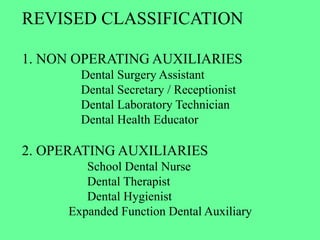
REVISED CLASSIFICATION
1. NON OPERATING AUXILIARIES
Dental Surgery Assistant
Dental Secretary / Receptionist
Dental Laboratory Technician
Dental Health Educator
2. OPERATING AUXILIARIES
School Dental Nurse
Dental Therapist
Dental Hygienist
Expanded Function Dental Auxiliary
DENTALASSISTANT
DEFINITION
Is a non operating auxiliary who assists the
dentists or dental hygienists in treating
patients, but who is not legally permitted to
treat patient independently
HISTORY
The employment of dental assistants
usually women, dates back to the late 19th
century .
The first dental assistant was hired in 1885
by Dr C. Edmund Kells of New Orleans.
Kells hired a woman as a “ lady in attendance” so
that female patients could respectably come to his
office.
Dental assistants continued to serve as office
helpers until World War II, when there was a
crucial shortage of labor to meet dental care
demands of dental service.
Thus in the armed forces, assistants were trained
to work at chair side in an attempt to increase
productivity.
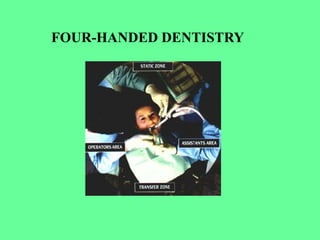
FOUR-HANDED DENTISTRY
The expert committee on Auxiliary Dental Personnel
of the World Health Organization lists these duties:
1. reception of the patient
2. preparation of the patient for any treatment
he or she may need
3. preparation and provision of all necessary
facilities, such as mouthwashes, napkins.
4. sterilization, care and preparation of
instruments.
5.Preparation and mixing of restorative
materials, including both filling and impression
materials.
6.Care of the patient after treatment until he or
she leaves, including clearing away of
instruments and preparation of instruments for
reuse.
7. Preparation of the surgery for the next patient.
8. Assistance with x-ray work and the
processing and mounting of x-rays.
9. Instruction of the patient, where necessary, in
the correct use of the toothbrush.
10. After care of persons who have had general
anesthesia.
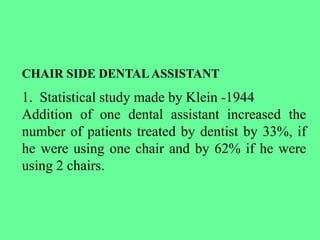
CHAIR SIDE DENTALASSISTANT
1. Statistical study made by Klein -1944
Addition of one dental assistant increased the
number of patients treated by dentist by 33%, if
he were using one chair and by 62% if he were
using 2 chairs.
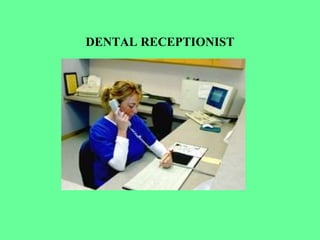
DENTAL RECEPTIONIST
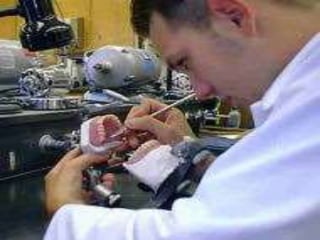
DENTAL LABORATORY TECHNICIANS
 Professionally trained auxiliaries in the dental field.
 Dental laboratory technicians are a non-operating auxiliary
who fulfills the prescriptions provided by dentist regarding
the extra oral construction & repair of oral appliances.
 Is a non-operating auxiliary who has also been known as
dental mechanics.
As per the “Indian dentist act of 1948” dental mechanic is a
person who makes or repair dentures & dental appliance.
HISTORY
 In UK the dental laboratory technician became
distinguishable from the dentist in 1921 after the
dentist act had been passed as law.
 Since then only qualified dentists are permitted
to work directly with patients.
Dental Laboratory Technicians - Training
Apprenticeship has traditionally been the means of
recruiting men for this field, and the work is done
by men rather than by women originally,
apprenticeship was carried out in the dental office,
the dentist teaching the technician and retaining
him in the office later as an employee
 Schools for the dental laboratory technicians
now exist with curricula covering as much as 2
years.
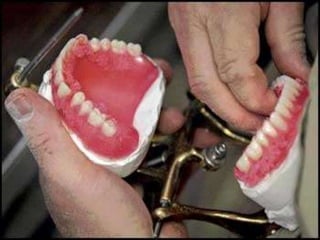
DENTURIST
Denturist is a term applied to those laboratory
technicians who are permitted in some states in
the U.S. and elsewhere to fabricate denture for
the patients without a dentist’s prescription.
ADA defines Denturism “as the fitting and
dispensing of dentures illegally to the public”.
Tasmania, a state in Australia, was the first place
where technicians were legally permitted to
provide a prosthetic service.
Denmark uses the term ‘Denturist’ to describe a
special category of dental technician who sits at
an examination, to enable him to prescribe, make
& fit removable dentures without supervision.
In the state of Maine, denturists are permitted to
take impressions and fit dentures but only under
the direction of a dentist.
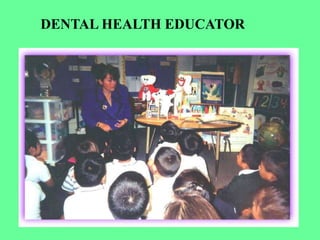
DENTAL HEALTH EDUCATOR
Operating auxiliaries
SCHOOL DENTAL NURSE
DEFINITION
This is a person, who is permitted to diagnose
dental disease & to plan & carry out certain
specified preventive & treatment measures,
including some operative procedures in the
treatment of dental caries & periodontal disease in
defined groups of people, usually school children.
BACKGROUND
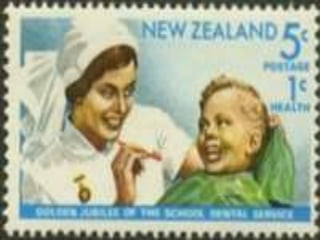
The dental nurse scheme was established in
Wellington, New Zealand in 1921.
This was due to the extensive dental disease found
in army recruits during world war I [1914-1916].
The man who influenced its formation was T.A
Hunter, a founder of New Zealand dental
association & a pioneer in the establishment of
dental school in New Zealand.
The stimuli for the program were the
extensive dental disease found in army
recruits during World War I & government
intended to do something about this problem.
Dentists were in short supply at that time &
treatment of young children was not as
accepted in dental practice as it is now.
When the service began care was offered only
to younger school-aged children. But eligibility
now extends to all pre-school aged children &
all children in primary & intermediate school [2
1/2 – 13 1/2 years of age].
In Britain the 1st operating auxiliaries based on
New Zealand school dental nurse model
graduated in 1962.
They were generally known as ‘New Cross’
auxiliaries, because the training school is located
in New Cross area of south London.
In Saskatchewan a Canadian province & only
place in North America where someone other than
a dentist may legally drill & fill the teeth, the
nurses receive direct supervision during 1st 2
months & then work with a more experienced
dental nurses for the 3rd month.
If their performance is found to be satisfactory,
then they work without direct supervision.
DUTIES OF NEW ZEALAND DENTAL NURSE
 Oral examination
 Prophylaxis
 Topical fluoride application
 Advice on dietary fluoride supplements
 Administration of local anaesthesia
Cavity preparation and placement of amalgam
filling in primary and permanent teeth.
Pulp capping
Extraction of primary teeth
Individual patient instruction in toothbrushing
and oral hygiene
Classroom and parent teacher dental health
education.
Referral of patient to private practioners for
more complex services.
TRAINING OF NEW ZEALAND DENTAL NURSE
In this country, young women are given a 2-
year training course at one of 3 training schools
of dental nurses.
After the successful completion, they are taken
into government services as
Full-time dental nurses in the school system.
Each dental nurse then becomes responsible for
approximately 500 children for whom she is
expected to provide dental care at 6 month
interval.
SUPERVISION OF NEW ZEALAND DENTAL NURSE
The work of dental nurse is performed under the
general supervision of a district principal dental
officer, who delegates certain of his
responsibilities to a dental nurse inspector.
The principal dental officer visits the school dental
clinic perhaps once every 6 weeks, the dental nurse
inspector twice as often.
NEW TRAINING SCHOOLS FOR DENTAL NURSES
The New Zealand school dental nurse plan has
attracted the attention of dental organization all
over the world.
Other countries & jurisdictions that have adopted
similar programs, with modification to suit the
local environment, include Canada, Britain,
SriLanka, Hong Kong & Indonesia.
Auxiliaries.ppt

Auxiliaries.ppt

  • 1.
    DENTAL AUXILIARIES Dr. ZAHEER PROF DEPT OFPUBLIC HEALTH DENTISTRY NAVODAYA DENTAL COLLEGE AND HOSPITAL TARGET STUDENTS : 3RD & 4TH BDS
  • 3.
    TYPES OF DENTALPERSONNEL *DENTIST *DENTAL AUXILIARY A DENTIST Is a person who is permitted to practice dentistry under the laws of the relevant state, province, territory, or nation.
  • 4.
    REQUIREMENTS Completion of aspecified period of professional education in an approved institution. Demonstration of competence, and Evidence of satisfactory personal qualities
  • 5.
    DENTALAUXILIARY DEFINITION: Is a genericterm for all persons who assist the dentist in treating patients. Is a person who is given responsibility by a dentist so that he or she can help the dentist render dental care but who is not himself or herself qualified with a dental degree [Slack].
  • 6.
    CLASSIFICATION I. Depending onwhether they carry out any intra-oral procedures in direct treatment of patients. - OPERATING AUXILIARY - NON-OPERATING AUXILIARY II. WHO Classification [New Delhi - 1967] - NON-OPERATING AUXILIARY a. Clinical b. Laboratory - OPERATING AUXILIARY
  • 7.
    CLINICALAUXILIARY: This is aperson who assists the professional in his clinical work. But does not carry out any independent procedures in the oral cavity. LABORATORY AUXILIARY: This is a person who assists the professional by carrying out certain technical laboratory procedure.
  • 8.
    OPERATING AUXILIARY This isa person, who not being a professional is permitted to carry out certain treatment procedures in the mouth under the direction and supervision of a professional.
  • 9.
    REVISED CLASSIFICATION 1. NONOPERATING AUXILIARIES Dental Surgery Assistant Dental Secretary / Receptionist Dental Laboratory Technician Dental Health Educator 2. OPERATING AUXILIARIES School Dental Nurse Dental Therapist Dental Hygienist Expanded Function Dental Auxiliary
  • 10.
    DENTALASSISTANT DEFINITION Is a nonoperating auxiliary who assists the dentists or dental hygienists in treating patients, but who is not legally permitted to treat patient independently
  • 12.
    HISTORY The employment ofdental assistants usually women, dates back to the late 19th century . The first dental assistant was hired in 1885 by Dr C. Edmund Kells of New Orleans.
  • 13.
    Kells hired awoman as a “ lady in attendance” so that female patients could respectably come to his office. Dental assistants continued to serve as office helpers until World War II, when there was a crucial shortage of labor to meet dental care demands of dental service. Thus in the armed forces, assistants were trained to work at chair side in an attempt to increase productivity.
  • 14.
  • 15.
    The expert committeeon Auxiliary Dental Personnel of the World Health Organization lists these duties: 1. reception of the patient 2. preparation of the patient for any treatment he or she may need 3. preparation and provision of all necessary facilities, such as mouthwashes, napkins.
  • 16.
    4. sterilization, careand preparation of instruments. 5.Preparation and mixing of restorative materials, including both filling and impression materials. 6.Care of the patient after treatment until he or she leaves, including clearing away of instruments and preparation of instruments for reuse.
  • 17.
    7. Preparation ofthe surgery for the next patient. 8. Assistance with x-ray work and the processing and mounting of x-rays. 9. Instruction of the patient, where necessary, in the correct use of the toothbrush. 10. After care of persons who have had general anesthesia.
  • 18.
    CHAIR SIDE DENTALASSISTANT 1.Statistical study made by Klein -1944 Addition of one dental assistant increased the number of patients treated by dentist by 33%, if he were using one chair and by 62% if he were using 2 chairs.
  • 19.
  • 20.
    DENTAL LABORATORY TECHNICIANS Professionally trained auxiliaries in the dental field.  Dental laboratory technicians are a non-operating auxiliary who fulfills the prescriptions provided by dentist regarding the extra oral construction & repair of oral appliances.  Is a non-operating auxiliary who has also been known as dental mechanics. As per the “Indian dentist act of 1948” dental mechanic is a person who makes or repair dentures & dental appliance.
  • 22.
    HISTORY  In UKthe dental laboratory technician became distinguishable from the dentist in 1921 after the dentist act had been passed as law.  Since then only qualified dentists are permitted to work directly with patients.
  • 23.
    Dental Laboratory Technicians- Training Apprenticeship has traditionally been the means of recruiting men for this field, and the work is done by men rather than by women originally, apprenticeship was carried out in the dental office, the dentist teaching the technician and retaining him in the office later as an employee  Schools for the dental laboratory technicians now exist with curricula covering as much as 2 years.
  • 24.
    DENTURIST Denturist is aterm applied to those laboratory technicians who are permitted in some states in the U.S. and elsewhere to fabricate denture for the patients without a dentist’s prescription. ADA defines Denturism “as the fitting and dispensing of dentures illegally to the public”.
  • 26.
    Tasmania, a statein Australia, was the first place where technicians were legally permitted to provide a prosthetic service. Denmark uses the term ‘Denturist’ to describe a special category of dental technician who sits at an examination, to enable him to prescribe, make & fit removable dentures without supervision. In the state of Maine, denturists are permitted to take impressions and fit dentures but only under the direction of a dentist.
  • 27.
  • 28.
  • 29.
    SCHOOL DENTAL NURSE DEFINITION Thisis a person, who is permitted to diagnose dental disease & to plan & carry out certain specified preventive & treatment measures, including some operative procedures in the treatment of dental caries & periodontal disease in defined groups of people, usually school children.
  • 31.
    BACKGROUND The dental nursescheme was established in Wellington, New Zealand in 1921. This was due to the extensive dental disease found in army recruits during world war I [1914-1916]. The man who influenced its formation was T.A Hunter, a founder of New Zealand dental association & a pioneer in the establishment of dental school in New Zealand.
  • 32.
    The stimuli forthe program were the extensive dental disease found in army recruits during World War I & government intended to do something about this problem. Dentists were in short supply at that time & treatment of young children was not as accepted in dental practice as it is now.
  • 33.
    When the servicebegan care was offered only to younger school-aged children. But eligibility now extends to all pre-school aged children & all children in primary & intermediate school [2 1/2 – 13 1/2 years of age]. In Britain the 1st operating auxiliaries based on New Zealand school dental nurse model graduated in 1962.
  • 34.
    They were generallyknown as ‘New Cross’ auxiliaries, because the training school is located in New Cross area of south London. In Saskatchewan a Canadian province & only place in North America where someone other than a dentist may legally drill & fill the teeth, the nurses receive direct supervision during 1st 2 months & then work with a more experienced dental nurses for the 3rd month. If their performance is found to be satisfactory, then they work without direct supervision.
  • 35.
    DUTIES OF NEWZEALAND DENTAL NURSE  Oral examination  Prophylaxis  Topical fluoride application  Advice on dietary fluoride supplements  Administration of local anaesthesia
  • 36.
    Cavity preparation andplacement of amalgam filling in primary and permanent teeth. Pulp capping Extraction of primary teeth Individual patient instruction in toothbrushing and oral hygiene Classroom and parent teacher dental health education. Referral of patient to private practioners for more complex services.
  • 37.
    TRAINING OF NEWZEALAND DENTAL NURSE In this country, young women are given a 2- year training course at one of 3 training schools of dental nurses. After the successful completion, they are taken into government services as Full-time dental nurses in the school system.
  • 38.
    Each dental nursethen becomes responsible for approximately 500 children for whom she is expected to provide dental care at 6 month interval.
  • 39.
    SUPERVISION OF NEWZEALAND DENTAL NURSE The work of dental nurse is performed under the general supervision of a district principal dental officer, who delegates certain of his responsibilities to a dental nurse inspector. The principal dental officer visits the school dental clinic perhaps once every 6 weeks, the dental nurse inspector twice as often.
  • 40.
    NEW TRAINING SCHOOLSFOR DENTAL NURSES The New Zealand school dental nurse plan has attracted the attention of dental organization all over the world. Other countries & jurisdictions that have adopted similar programs, with modification to suit the local environment, include Canada, Britain, SriLanka, Hong Kong & Indonesia.