DENTAL AUXILIARIES 
Presented by : 
Amatunnoor Zainab 
IV BDS
CONTENTS 
• INTRODUCTION 
• CLASSIFICATION 
• DENTAL AUXILIARIES 
• FRONTIER AUXILIARIES 
• NEW AUXILIARY TYPES 
• DEGREES OF SUPERVISION OF AUXILIARIES 
• CONCLUSION
INTRODUCTION 
DEFINITION OF DENTAL AUXILIARY : 
A dental auxiliary is a person who is given responsibility by a 
dentist so that he or she can help the dentist render dental care , 
but who is not himself or herself qualified with a dental degree. 
•The duties undertaken by dental auxiliaries range from simple 
task of sorting instruments to complex procedures which form a 
part of the treatment of patients.
CLASSIFICATION 
• CLASSIFICATION BY WHO (1967) 
1. NON- OPERATING AUXILIARIES : 
a) Clinical : Who helps in clinical work but does not carry out any 
independent procedures in the oral cavity. 
b) Laboratory : Who assists the professional by carrying out 
certain technical laboratory procedures. 
2. OPERATING AUXILIARY : 
This is the person who , not being a professional is permitted to 
carry out certain treatment procedures in the mouth under the 
direction and supervision of a professional.
REVISED CLASSIFICATION : 
1.NON-OPERATING AUXILIARIES : 
•Dental surgery assistant. 
•Dental secretary / receptionist. 
•Dental laboratory technician. 
•Dental health educator. 
2. OPERATING AUXILIARIES : 
•School dental nurse. 
•Dental therapist. 
•Dental hygienist. 
•Expanded function dental auxiliaries.
DENTAL SURGERY ASSISTANT 
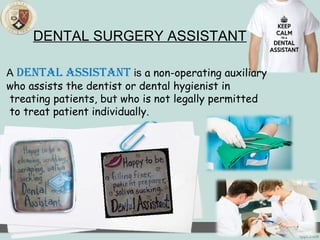
A DENTAL ASSISTANT is a non-operating auxiliary 
who assists the dentist or dental hygienist in 
treating patients, but who is not legally permitted 
to treat patient individually.
DENTAL SECRETARY / 
RECEPTIONIST 
This is a person who assists the dentist 
with his secretarial work and patient 
reception duties.
DENTAL LABORATORY TECHNICIAN 
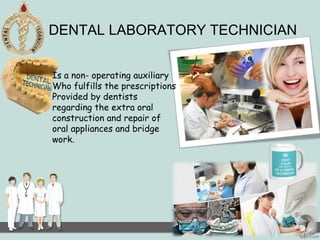
Is a non- operating auxiliary 
Who fulfills the prescriptions 
Provided by dentists 
regarding the extra oral 
construction and repair of 
oral appliances and bridge 
work.
DUTIES : 
• Casting of models from impressions made by the dentist. 
• Fabrication of dentures, splints, orthodontic appliances, inlays, 
crowns & special trays.
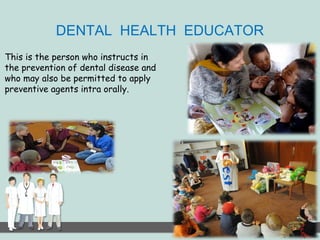
DENTAL HEALTH EDUCATOR 
This is the person who instructs in 
the prevention of dental disease and 
who may also be permitted to apply 
preventive agents intra orally.
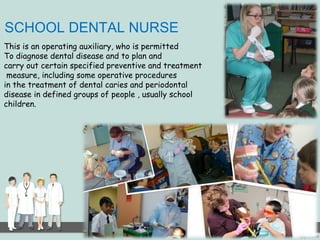
SCHOOL DENTAL NURSE 
This is an operating auxiliary, who is permitted 
To diagnose dental disease and to plan and 
carry out certain specified preventive and treatment 
measure, including some operative procedures 
in the treatment of dental caries and periodontal 
disease in defined groups of people , usually school 
children.
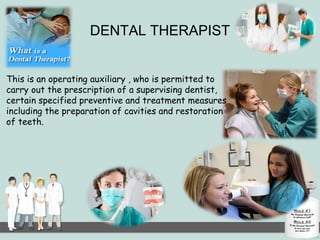
DENTAL THERAPIST 
This is an operating auxiliary , who is permitted to 
carry out the prescription of a supervising dentist, 
certain specified preventive and treatment measures 
including the preparation of cavities and restoration 
of teeth.
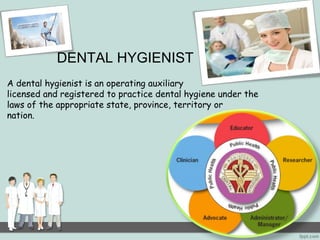
DENTAL HYGIENIST 
A dental hygienist is an operating auxiliary 
licensed and registered to practice dental hygiene under the 
laws of the appropriate state, province, territory or 
nation.
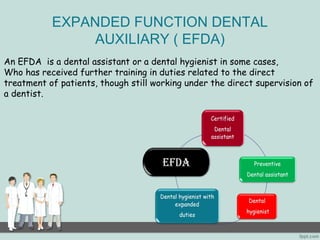
EXPANDED FUNCTION DENTAL 
AUXILIARY ( EFDA) 
An EFDA is a dental assistant or a dental hygienist in some cases, 
Who has received further training in duties related to the direct 
treatment of patients, though still working under the direct supervision of 
a dentist.
FRONTIER AUXILIARIES 
Nurses and dental assistants can provide valuable dental service 
with minimum of training in areas distant to dental offices. 
Simple dental prophylaxis can be performed , basic dental-health 
education can be provided, dental first-aid can be rendered in 
cases with pain and patients can be referred to the nearest dentist 
more intelligently than would be possibly by untrained people. 
They can also organize fluoride rinse programs and perform 
simple denture repairs.
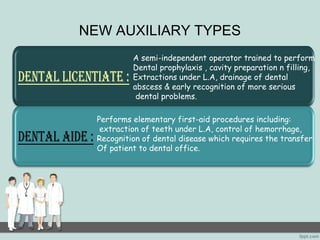
NEW AUXILIARY TYPES 
A semi-independent operator trained to perform 
Dental prophylaxis , cavity preparation n filling, 
Extractions under L.A, drainage of dental 
abscess & early recognition of more serious 
dental problems. 
Performs elementary first-aid procedures including: 
extraction of teeth under L.A, control of hemorrhage, 
Recognition of dental disease which requires the transfer 
Of patient to dental office.
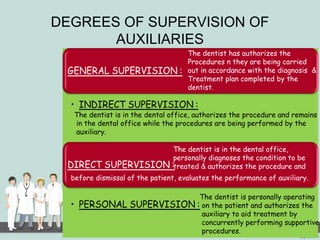
DEGREES OF SUPERVISION OF 
AUXILIARIES 
The dentist has authorizes the 
Procedures n they are being carried 
out in accordance with the diagnosis & 
Treatment plan completed by the 
dentist. 
The dentist is in the dental office, authorizes the procedure and remains 
in the dental office while the procedures are being performed by the 
auxiliary. 
The dentist is in the dental office, 
personally diagnoses the condition to be 
treated & authorizes the procedure and 
before dismissal of the patient, evaluates the performance of auxiliary. 
The dentist is personally operating 
on the patient and authorizes the 
auxiliary to aid treatment by 
concurrently performing supportive 
procedures.
CONCLUSION 
India is the 7th largest country of the world. The 
population has risen from 850 million in 1990 to 1.2 
billion in 2011. At this point of time, it is worth-while to 
asses the ability of the ability of the dental work force 
in India to adequately and efficiently provide dental 
care to a population growing in size n diversity. The need 
of the hour is to develop an effective dental care 
delivery system which is equitably distributed, with a 
well-qualifies , dedicated work force
REFERENCES 
• ESSENTIALS OF PUBLIC HEALTH DENTISTRY. 
SOBEN PETER 
• JOURNAL OF AMERICAN DENTAL ASSOCIATION. 
• ENCYCLOPEDIA BRITANNICA.
Wanna treat the patient 
successfully ?? 
Then be patient all the time !! 
THANK YOU !!

Dental auxiliary

  • 2.
    DENTAL AUXILIARIES Presentedby : Amatunnoor Zainab IV BDS
  • 3.
    CONTENTS • INTRODUCTION • CLASSIFICATION • DENTAL AUXILIARIES • FRONTIER AUXILIARIES • NEW AUXILIARY TYPES • DEGREES OF SUPERVISION OF AUXILIARIES • CONCLUSION
  • 4.
    INTRODUCTION DEFINITION OFDENTAL AUXILIARY : A dental auxiliary is a person who is given responsibility by a dentist so that he or she can help the dentist render dental care , but who is not himself or herself qualified with a dental degree. •The duties undertaken by dental auxiliaries range from simple task of sorting instruments to complex procedures which form a part of the treatment of patients.
  • 5.
    CLASSIFICATION • CLASSIFICATIONBY WHO (1967) 1. NON- OPERATING AUXILIARIES : a) Clinical : Who helps in clinical work but does not carry out any independent procedures in the oral cavity. b) Laboratory : Who assists the professional by carrying out certain technical laboratory procedures. 2. OPERATING AUXILIARY : This is the person who , not being a professional is permitted to carry out certain treatment procedures in the mouth under the direction and supervision of a professional.
  • 6.
    REVISED CLASSIFICATION : 1.NON-OPERATING AUXILIARIES : •Dental surgery assistant. •Dental secretary / receptionist. •Dental laboratory technician. •Dental health educator. 2. OPERATING AUXILIARIES : •School dental nurse. •Dental therapist. •Dental hygienist. •Expanded function dental auxiliaries.
  • 7.
    DENTAL SURGERY ASSISTANT A DENTAL ASSISTANT is a non-operating auxiliary who assists the dentist or dental hygienist in treating patients, but who is not legally permitted to treat patient individually.
  • 8.
    DENTAL SECRETARY / RECEPTIONIST This is a person who assists the dentist with his secretarial work and patient reception duties.
  • 9.
    DENTAL LABORATORY TECHNICIAN Is a non- operating auxiliary Who fulfills the prescriptions Provided by dentists regarding the extra oral construction and repair of oral appliances and bridge work.
  • 10.
    DUTIES : •Casting of models from impressions made by the dentist. • Fabrication of dentures, splints, orthodontic appliances, inlays, crowns & special trays.
  • 11.
    DENTAL HEALTH EDUCATOR This is the person who instructs in the prevention of dental disease and who may also be permitted to apply preventive agents intra orally.
  • 12.
    SCHOOL DENTAL NURSE This is an operating auxiliary, who is permitted To diagnose dental disease and to plan and carry out certain specified preventive and treatment measure, including some operative procedures in the treatment of dental caries and periodontal disease in defined groups of people , usually school children.
  • 13.
    DENTAL THERAPIST Thisis an operating auxiliary , who is permitted to carry out the prescription of a supervising dentist, certain specified preventive and treatment measures including the preparation of cavities and restoration of teeth.
  • 14.
    DENTAL HYGIENIST Adental hygienist is an operating auxiliary licensed and registered to practice dental hygiene under the laws of the appropriate state, province, territory or nation.
  • 15.
    EXPANDED FUNCTION DENTAL AUXILIARY ( EFDA) An EFDA is a dental assistant or a dental hygienist in some cases, Who has received further training in duties related to the direct treatment of patients, though still working under the direct supervision of a dentist.
  • 16.
    FRONTIER AUXILIARIES Nursesand dental assistants can provide valuable dental service with minimum of training in areas distant to dental offices. Simple dental prophylaxis can be performed , basic dental-health education can be provided, dental first-aid can be rendered in cases with pain and patients can be referred to the nearest dentist more intelligently than would be possibly by untrained people. They can also organize fluoride rinse programs and perform simple denture repairs.
  • 17.
    NEW AUXILIARY TYPES A semi-independent operator trained to perform Dental prophylaxis , cavity preparation n filling, Extractions under L.A, drainage of dental abscess & early recognition of more serious dental problems. Performs elementary first-aid procedures including: extraction of teeth under L.A, control of hemorrhage, Recognition of dental disease which requires the transfer Of patient to dental office.
  • 18.
    DEGREES OF SUPERVISIONOF AUXILIARIES The dentist has authorizes the Procedures n they are being carried out in accordance with the diagnosis & Treatment plan completed by the dentist. The dentist is in the dental office, authorizes the procedure and remains in the dental office while the procedures are being performed by the auxiliary. The dentist is in the dental office, personally diagnoses the condition to be treated & authorizes the procedure and before dismissal of the patient, evaluates the performance of auxiliary. The dentist is personally operating on the patient and authorizes the auxiliary to aid treatment by concurrently performing supportive procedures.
  • 19.
    CONCLUSION India isthe 7th largest country of the world. The population has risen from 850 million in 1990 to 1.2 billion in 2011. At this point of time, it is worth-while to asses the ability of the ability of the dental work force in India to adequately and efficiently provide dental care to a population growing in size n diversity. The need of the hour is to develop an effective dental care delivery system which is equitably distributed, with a well-qualifies , dedicated work force
  • 20.
    REFERENCES • ESSENTIALSOF PUBLIC HEALTH DENTISTRY. SOBEN PETER • JOURNAL OF AMERICAN DENTAL ASSOCIATION. • ENCYCLOPEDIA BRITANNICA.
  • 21.
    Wanna treat thepatient successfully ?? Then be patient all the time !! THANK YOU !!