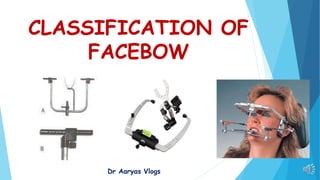
CLASSIFICATION OF
FACEBOW
Dr Aaryas Vlogs
DEFINITIONS
A caliper-like device which is used to record the relationship of the
maxillae and/or mandible to the temporomandibular joints
(SNOW- 1802)
facebow fas bo: an instrument used to record the spatial
relationship of the maxillary arch to some anatomic reference
point or points and then transfer this relationship to an
articulator; it orients the dental cast in the same relationship to
the opening axis of the articulator; customarily the anatomic
references are the mandibular transverse horizontal axis and one
other selected anterior reference point (GPT 9)
Dr Aaryas Vlogs
CLASSIFICATION
Face bow
Arbitrary Kinematic
Facia type Ear piece type
Dr Aaryas Vlogs
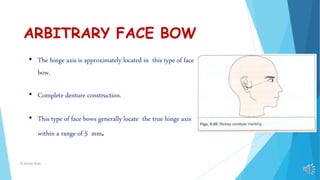
ARBITRARY FACE BOW
• The hinge axis is approximately located in this type of face
bow.
• Complete denture construction.
• This type of face bows generally locate the true hinge axis
within a range of 5 mm.
Dr Aaryas Vlogs
Dr Aaryas Vlogs
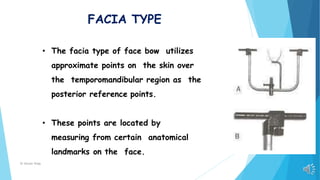
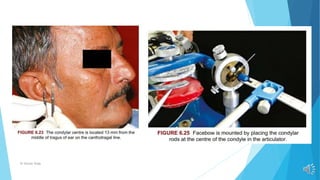
FACIA TYPE
• The facia type of face bow utilizes
approximate points on the skin over
the temporomandibular region as the
posterior reference points.
• These points are located by
measuring from certain anatomical
landmarks on the face.
Dr Aaryas Vlogs
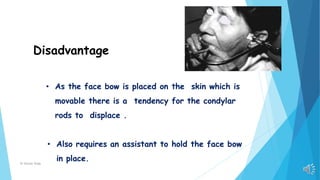
Disadvantage
• As the face bow is placed on the skin which is
movable there is a tendency for the condylar
rods to displace .
• Also requires an assistant to hold the face bow
in place.
Dr Aaryas Vlogs
Dr Aaryas Vlogs
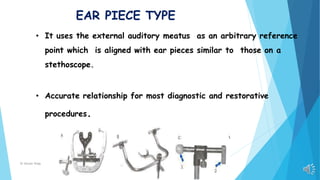
EAR PIECE TYPE
• It uses the external auditory meatus as an arbitrary reference
point which is aligned with ear pieces similar to those on a
stethoscope.
• Accurate relationship for most diagnostic and restorative
procedures.
Dr Aaryas Vlogs
Dr Aaryas Vlogs
Advantage
• Simple to use.
• Do not require measurements on face
• As accurate as other face bows.
• It provides an average anatomic dimension between the
external auditory meatus and horizontal axis of mandible
Dr Aaryas Vlogs
Disadvantage
• An error of 0.2 mm from the axis can be
expected, when coupled with the use of a thick
inter occlusal record made at an increased
vertical dimension.
• This factor can lead to considerable inaccuracy.
Dr Aaryas Vlogs
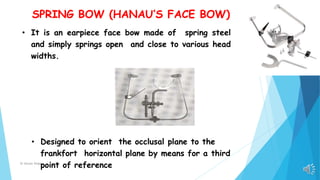
SPRING BOW (HANAU’S FACE BOW)
• It is an earpiece face bow made of spring steel
and simply springs open and close to various head
widths.
• Designed to orient the occlusal plane to the
frankfort horizontal plane by means for a third
point of reference
Dr Aaryas Vlogs
Features
• Autoclavable
• Self Centering
• Comfortable
• Rapid
Dr Aaryas Vlogs
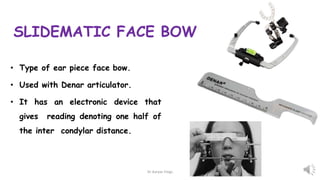
SLIDEMATIC FACE BOW
Dr Aaryas Vlogs
• Type of ear piece face bow.
• Used with Denar articulator.
• It has an electronic device that
gives reading denoting one half of
the inter condylar distance.
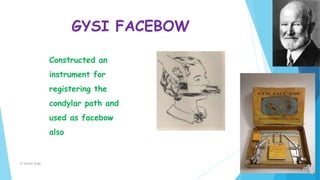
GYSI FACEBOW
Constructed an
instrument for
registering the
condylar path and
used as facebow
also
Dr Aaryas Vlogs
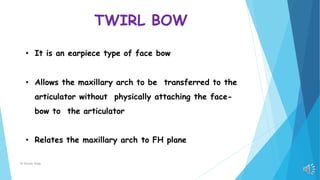
TWIRL BOW
• It is an earpiece type of face bow
• Allows the maxillary arch to be transferred to the
articulator without physically attaching the face-
bow to the articulator
• Relates the maxillary arch to FH plane
Dr Aaryas Vlogs
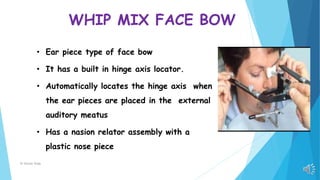
WHIP MIX FACE BOW
• Ear piece type of face bow
• It has a built in hinge axis locator.
• Automatically locates the hinge axis when
the ear pieces are placed in the external
auditory meatus
• Has a nasion relator assembly with a
plastic nose piece
Dr Aaryas Vlogs
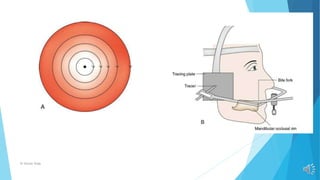
KINEMATIC FACE BOW:
ACTUAL VALUE/ HINGE AXIS
• Used to determine and locate the exact hinge axis
points.
• Hinge axis of the mandible can be determined by a
clutch i.e., A segmented impression tray like device
attached onto the mandibular teeth with a suitable
rigid material such as impression plaster.
Dr Aaryas Vlogs
Kinematic facebow
• The kinematic face bow allows
for the precise determination of
the patient's hinge axis
(terminal hinge axis).
Dr Aaryas Vlogs
Dr Aaryas Vlogs
Dr Aaryas Vlogs
Dr Aaryas Vlogs
Dr Aaryas Vlogs
Thanks for watching………

Classification of facebow

  • 1.
  • 2.
    DEFINITIONS A caliper-like devicewhich is used to record the relationship of the maxillae and/or mandible to the temporomandibular joints (SNOW- 1802)
  • 3.
    facebow fas bo:an instrument used to record the spatial relationship of the maxillary arch to some anatomic reference point or points and then transfer this relationship to an articulator; it orients the dental cast in the same relationship to the opening axis of the articulator; customarily the anatomic references are the mandibular transverse horizontal axis and one other selected anterior reference point (GPT 9) Dr Aaryas Vlogs
  • 4.
  • 5.
  • 6.
    ARBITRARY FACE BOW •The hinge axis is approximately located in this type of face bow. • Complete denture construction. • This type of face bows generally locate the true hinge axis within a range of 5 mm. Dr Aaryas Vlogs
  • 7.
  • 8.
    FACIA TYPE • Thefacia type of face bow utilizes approximate points on the skin over the temporomandibular region as the posterior reference points. • These points are located by measuring from certain anatomical landmarks on the face. Dr Aaryas Vlogs
  • 9.
    Disadvantage • As theface bow is placed on the skin which is movable there is a tendency for the condylar rods to displace . • Also requires an assistant to hold the face bow in place. Dr Aaryas Vlogs
  • 10.
  • 11.
    EAR PIECE TYPE •It uses the external auditory meatus as an arbitrary reference point which is aligned with ear pieces similar to those on a stethoscope. • Accurate relationship for most diagnostic and restorative procedures. Dr Aaryas Vlogs
  • 12.
  • 13.
    Advantage • Simple touse. • Do not require measurements on face • As accurate as other face bows. • It provides an average anatomic dimension between the external auditory meatus and horizontal axis of mandible Dr Aaryas Vlogs
  • 14.
    Disadvantage • An errorof 0.2 mm from the axis can be expected, when coupled with the use of a thick inter occlusal record made at an increased vertical dimension. • This factor can lead to considerable inaccuracy. Dr Aaryas Vlogs
  • 15.
    SPRING BOW (HANAU’SFACE BOW) • It is an earpiece face bow made of spring steel and simply springs open and close to various head widths. • Designed to orient the occlusal plane to the frankfort horizontal plane by means for a third point of reference Dr Aaryas Vlogs
  • 16.
    Features • Autoclavable • SelfCentering • Comfortable • Rapid Dr Aaryas Vlogs
  • 17.
    SLIDEMATIC FACE BOW DrAaryas Vlogs • Type of ear piece face bow. • Used with Denar articulator. • It has an electronic device that gives reading denoting one half of the inter condylar distance.
  • 18.
    GYSI FACEBOW Constructed an instrumentfor registering the condylar path and used as facebow also Dr Aaryas Vlogs
  • 19.
    TWIRL BOW • Itis an earpiece type of face bow • Allows the maxillary arch to be transferred to the articulator without physically attaching the face- bow to the articulator • Relates the maxillary arch to FH plane Dr Aaryas Vlogs
  • 20.
    WHIP MIX FACEBOW • Ear piece type of face bow • It has a built in hinge axis locator. • Automatically locates the hinge axis when the ear pieces are placed in the external auditory meatus • Has a nasion relator assembly with a plastic nose piece Dr Aaryas Vlogs
  • 21.
    KINEMATIC FACE BOW: ACTUALVALUE/ HINGE AXIS • Used to determine and locate the exact hinge axis points. • Hinge axis of the mandible can be determined by a clutch i.e., A segmented impression tray like device attached onto the mandibular teeth with a suitable rigid material such as impression plaster. Dr Aaryas Vlogs
  • 22.
    Kinematic facebow • Thekinematic face bow allows for the precise determination of the patient's hinge axis (terminal hinge axis). Dr Aaryas Vlogs
  • 23.
  • 24.
  • 25.
  • 26.
  • 27.