ATTRITION
DR PRIYA C
I MDS
DEPARTMENT OF CONSERVATIVE DENTISTRY & ENDODONTICS
INTRODUCTION
• It is defined as the mechanical wear of the incisal or occlusal
surface as a result of functional or parafunctional movements of
mandible (tooth to tooth contacts) – Sturdevant.
• It also includes the proximal surface wear at the contact area
because of the physiologic tooth movement
• Is a continuous, age dependent process, which is usually
physiological and seen in both deciduous and permanent
dentition.
CLASSIFICATION
Broca’s classification of attrition :-
• Type I : - Enamel worn out without obliteration of cusp and
exposure of dentinal tubules.
• Type II :- cusp worn out and exposure of dentin
• Type III :- appreciable amount of crown has worn out.
• Type IV :- most of the crown has worn out and wear has
extended to the neck of the tooth.
Based on the area of loss of tooth structure it can also be divided
• a) Proximal surface attrition
• b) Occluding surface attrition
Proximal surface attrition :
• Widening of proximal contact areas.
• Decreased mesio - distal width of teeth.
• Interproximal space will be increased.
Occluding surface attrition :
• Loss, flattening, faceting and /or reverse cusping of
occluding elements.
• Loss of vertical dimension of tooth.
• Cheek biting and gingival irritation occurs.
Predisposing factors
• chewing tobacco
• Nail biting habits
• Bruxism, clenching
• Some are Occupational like tailoring and those occupation in which persons are exposed
to an atmosphere of abrasive dust.
Clinical manifestation
• It begins as a small polished facet on a cusp tip or ridge or a slight flattening of incisal
edge.
• Gradual reduction of cusp height & flattening of occlusal inclined plane with aging.
• Tooth sensitivity
• TMJ problem elicited especially due to overclosure
• In some older patients, the enamel of
the cusp tips or incisal edges is worn off,
resulting in cupped-out areas because
the exposed dentin, softer dentin wears
faster than surrounding enamel. [ reverse
cusping ]
• Advanced attrition – enamel may get
worn away which results in an extrinsic
yellow or brown staining of exposed
dentin from food or tobacco.
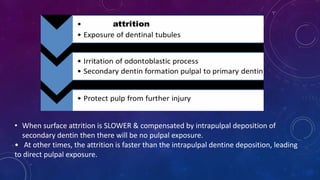
• When surface attrition is SLOWER & compensated by intrapulpal deposition of
secondary dentin then there will be no pulpal exposure.
• At other times, the attrition is faster than the intrapulpal dentine deposition, leading
to direct pulpal exposure.
MANAGEMENT OF ATTRITION.
• Patients should be educated about harmful effects of nail biting, tobacco chewing,
stress & bruxism.
• In patients having Para-functional activities, notably bruxism, occlusal splints
should be recommended.
• Sharp cusps and edges should be smoothened and occlusal facet should be filled
with composites.
• Desensitizing agents and tooth pastes to be used in patients having sensitivity
• Pulpally involved teeth should be advised endodontic therapy /extraction
depending upon their restorability .
• Bonded porcelain veneers have been used to treat incisal wear.
Soft splints
THANK YOU

Attrition by Dr PC.pptx

  • 1.
    ATTRITION DR PRIYA C IMDS DEPARTMENT OF CONSERVATIVE DENTISTRY & ENDODONTICS
  • 2.
    INTRODUCTION • It isdefined as the mechanical wear of the incisal or occlusal surface as a result of functional or parafunctional movements of mandible (tooth to tooth contacts) – Sturdevant. • It also includes the proximal surface wear at the contact area because of the physiologic tooth movement • Is a continuous, age dependent process, which is usually physiological and seen in both deciduous and permanent dentition.
  • 3.
    CLASSIFICATION Broca’s classification ofattrition :- • Type I : - Enamel worn out without obliteration of cusp and exposure of dentinal tubules. • Type II :- cusp worn out and exposure of dentin • Type III :- appreciable amount of crown has worn out. • Type IV :- most of the crown has worn out and wear has extended to the neck of the tooth.
  • 4.
    Based on thearea of loss of tooth structure it can also be divided • a) Proximal surface attrition • b) Occluding surface attrition Proximal surface attrition : • Widening of proximal contact areas. • Decreased mesio - distal width of teeth. • Interproximal space will be increased. Occluding surface attrition : • Loss, flattening, faceting and /or reverse cusping of occluding elements. • Loss of vertical dimension of tooth. • Cheek biting and gingival irritation occurs.
  • 5.
    Predisposing factors • chewingtobacco • Nail biting habits • Bruxism, clenching • Some are Occupational like tailoring and those occupation in which persons are exposed to an atmosphere of abrasive dust. Clinical manifestation • It begins as a small polished facet on a cusp tip or ridge or a slight flattening of incisal edge. • Gradual reduction of cusp height & flattening of occlusal inclined plane with aging. • Tooth sensitivity • TMJ problem elicited especially due to overclosure
  • 6.
    • In someolder patients, the enamel of the cusp tips or incisal edges is worn off, resulting in cupped-out areas because the exposed dentin, softer dentin wears faster than surrounding enamel. [ reverse cusping ] • Advanced attrition – enamel may get worn away which results in an extrinsic yellow or brown staining of exposed dentin from food or tobacco.
  • 7.
    • When surfaceattrition is SLOWER & compensated by intrapulpal deposition of secondary dentin then there will be no pulpal exposure. • At other times, the attrition is faster than the intrapulpal dentine deposition, leading to direct pulpal exposure.
  • 8.
    MANAGEMENT OF ATTRITION. •Patients should be educated about harmful effects of nail biting, tobacco chewing, stress & bruxism. • In patients having Para-functional activities, notably bruxism, occlusal splints should be recommended. • Sharp cusps and edges should be smoothened and occlusal facet should be filled with composites. • Desensitizing agents and tooth pastes to be used in patients having sensitivity • Pulpally involved teeth should be advised endodontic therapy /extraction depending upon their restorability . • Bonded porcelain veneers have been used to treat incisal wear. Soft splints
  • 9.