DENTAL MANPOWER
&
DENTAL AUXILIARY
PERSONNEL
INTRODUCTION
• Dental auxiliary is the person who assist
the dentist in treating patients.
• In Britain, they have been known as
“dental ancillaries”
• Auxiliary means, being helpful, subsidiary;
where as ancillary means subservient,
subordinate.
DENTIST
“A dentist is a person licensed to practice
dentistry under the law of appropriate state,
province, territory or nation.”
• QUALIFICATIONS:
1.Competion of an approved period of professional
education in an approved institution.
2.Demonstration of competence
3.Evidence of satisfactory personal qualities.
DENTAL
AUXILIARY/ANCILLARY
• DEFINITON:
“A dental auxiliary is a person who is
given responsibility by a dentist so
that he or she can help the dentist
render dental care, but who is not
himself or herself qualified with a
dental degree.”
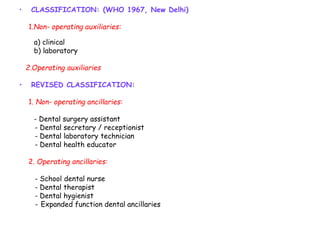
• CLASSIFICATION: (WHO 1967, New Delhi)
1.Non- operating auxiliaries:
a) clinical
b) laboratory
2.Operating auxiliaries
• REVISED CLASSIFICATION:
1. Non- operating ancillaries:
- Dental surgery assistant
- Dental secretary / receptionist
- Dental laboratory technician
- Dental health educator
2. Operating ancillaries:
- School dental nurse
- Dental therapist
- Dental hygienist
- Expanded function dental ancillaries
• DENTAL SURGERY ASSISTANT:
- Is an non-operating auxiliary who assist the
dentist or dental hygienist in treating
patients, but who is not legally permitted
treat patient independently.
- Dr. Edmund Kells, New Orleans 1885 – ‘Lady
in attendance’
- various names:
a) Dental assistant
b) Chair side dental assistant
c) Dental nurse
• DUTIES:
1. Reception of the patient
2. Preparation of the patient for any treatment.
3. Preparation & provision of all necessary facilities ( mouth
washes, napkins )
4. Sterilization , care & preparation of instruments.
5. Preparation & mixing of restorative materials.
6. Care of the patient after treatment until they leave.
7. Preparation of the surgery for next patient.
8. Assistant with x-ray works.
9. Presentation of documents for filing.
10. Instruction of the patient about correct use of tooth brush.
11. Aftercare of patients received G.A
• DENTAL SECRETARY/
RECEPTIONIST:
“This is a person who assist the dentist
with his secretarial work & patient
reception duties.”
• DENTAL LABORATORY TECHNICIAN:
- Is who fulfils the prescriptions provided by
dentists regarding the extra oral
construction & repair of oral appliances &
bridge work.
- Also called as dental mechanics, who makes or
repairs denture & dental appliances.
- They receive their training at dental school or
technical college for a period of 2 years.
• FUNCTIONS:
1. Casting of models from impressions
2. Fabrication of dentures, splints, orthodontic
appliances, inlays, on lays & special trays.
• In U.S they were called as Denturist, to
fabricate dentures directly without a
dentist’s prescription, may be licensed or
registered. Their craft is called
“denturism.”
• Denturism is fitting & dispensing of
dentures illegally to the public.
• DENTAL HEALTH EDUCATOR:
“This is a person who instructs in the
prevention of dental disease & who may
also be permitted to apply preventive
agents intra orally.”
• SCHOOL DENTAL NURSE:
“ This is a person who is permitted to
diagnose dental disease & to plan &carry
out certain specified preventive &
treatment measure, including some
operative procedures in the treatment
of dental caries & periodontal disease in
defined groups of people, usually school
children.”
• This scheme was established in Wellington, New
Zealand in1921.
• T.A. Hunter – Founder, NZ Dental Association
• The training extends to over a period of 2 years to
cover both reversible &irreversible procedures.
• After training nurses are assigned to a school where
she is employed by the govt to provide regular dental
care of between 450 & 700 children.
• The dental nurse inspector who is delegated certain
responsibilities visits these school dental clinics
twice.
• DUTIES:
Oral examination
1. Prophylaxis
2. Topical fluoride application
3. Advice on dietary fluoride supplements
4. Administration of L.A.
5. Cavity preparation & placement of amalgam filling in primary &
permanent teeth.
6. Pulp capping
7. Extraction of primary teeth
8. Individual patient instruction in tooth brushing & oral hygiene.
9. Classroom & parent –teacher dental health education.
10. Referral of patient to private practitioners for complex
services.
DENTAL THERAPIST
• “This is a person who is permitted to
carry out to the prescription of a
supervising dentist, certain specified
preventive & treatment measures
including the preparation of cavities
& restoration of teeth.”
• The auxiliaries based on the New Zealand type of
graduated in1962 from Erstwhile training school in
the New Cross area of London known as “New Cross
Auxiliaries”
• They are trained for about 2 years includes
1. clinical caries diagnosis
2. cavity preparation in primary & permanent teeth
3. vital pulpotomies under rubber dam in deciduous
teeth under L.A
4. little training about interpretation of x-ray
DENTAL HYGIENIST
• “Is an operating auxiliary licensed & registered to
practice dental hygiene under laws of appropriate state,
province, territory or nation.”
• They work under supervision of dentists.
• Dr. Fones trained Mrs. Irene Newman on prophylaxis.
QUALIFICATIONS:
1. Completion of an approved period of education in an
approved institution.
2. Demonstration of competence
3. Demonstration of satisfactory personal qualities.
• FUNCTIONS:
1. Cleaning of mouths & teeth with particular
attention to calculus & stains.
2. Topical application of fluoride, sealants &
other prophylactic solutions.
3. Screening or preliminary examination of
patients as individuals or in groups
4. Instructions in oral hygiene.
5. Resource- work in the field of dental health.
EXPANDED FUNCTION
DENTAL AUXILIARY
• OTHER NAMES:
Expanded function
1. dental assistant
2. dental hygienist
3. dental techno therapist.
• Duties (Reversible Procedures)
1. Placing & removing rubber dams
2. Placing & removing temporary restorations
3. Placing & removing matrix bands
4. Condensing & carving amalgam restoration
5. Placing of acrylic restoration in prepared
teeth
6. Applying the final finish & polish to the
previously listed restorations
• FOUR LEVELS OF TRAINING AND
QUALIFICATION :
1. Certified dental assistant
2. Preventive dental assistant
3. Dental hygienist
4. Dental hygienist with expanded
duties.
FRONTIER AUXILIARIES
• Simple dental prophylaxis
• Basic dental health education
• Dental first aid
• Referral to the nearest dentist
NEW AUXILIARY TYPE
• WHO has suggested 2 new types of
dental auxiliaries,
1. The dental licentiate
2. The dental aid
Dental Licentiate
• Training – 2 years
• Duties
• Prophylaxis
• Cavity preparation and restoration of
primary and permanent teeth
• Extraction under LA
• Drainage of abscess
• Early recognition of serious dental
conditions
Dental aide
• Extraction of teeth under LA
• Control of hemorrhage
• Referral care
DEGREES OF SUPERVISION
ADA 1975
1. General
2. Indirect
3. Direct
4. Personal
DENTAL MANPOWER PLANNING
1.Analysis of existing situation.
a) Dental health needs & demands for services
b) Dental health manpower supply
c) Utilization of dental health manpower.
2.Policy formulation
a) Dental health manpower planning
b) Incentives & controls
c) Levels of decision making
• Dental health needs & demands for
services:
1. Met demand
2. Identified but unmet need
3. Unidentified need
• DEMANDS FOR DENTAL SERVICES:
1. Sources of data
2. Sampling problem
3. Frequency rather than type
4. Difficulty of recall
5. Blaming the deviant
6. Type of services
• FACTORS AFFECTING UTILIZATION:
1. Sociodemographic factors
2. Age
3. Sex
4. Education
5. Socioeconomic status
6. Income
7. Occupation
8. Residence
9. Socio cultural factors
10. Socio- psychological factors
11. Organizational factors
12. Economic factors
Supply of dental health manpower:
1. Supply of dentist
2. Growth trends in the supply of dental
manpower
3. Productivity of dentist
The utilization of dental health manpower
Policy formulation:
a) Dental health manpower planning
1.Supply & demand model
2.Functional analysis model
3.Target setting approach model
b) Incentives & controls
c) Levels of decision making
CONCLUSION
• The practice of dentistry involves a
personal relationship between the
dentist, dental auxiliaries & patients
who elect to seek professional
service from them within the walls of
the office.
Dental Auxillaries.ppt

Dental Auxillaries.ppt

  • 2.
  • 3.
    INTRODUCTION • Dental auxiliaryis the person who assist the dentist in treating patients. • In Britain, they have been known as “dental ancillaries” • Auxiliary means, being helpful, subsidiary; where as ancillary means subservient, subordinate.
  • 4.
    DENTIST “A dentist isa person licensed to practice dentistry under the law of appropriate state, province, territory or nation.” • QUALIFICATIONS: 1.Competion of an approved period of professional education in an approved institution. 2.Demonstration of competence 3.Evidence of satisfactory personal qualities.
  • 5.
    DENTAL AUXILIARY/ANCILLARY • DEFINITON: “A dentalauxiliary is a person who is given responsibility by a dentist so that he or she can help the dentist render dental care, but who is not himself or herself qualified with a dental degree.”
  • 6.
    • CLASSIFICATION: (WHO1967, New Delhi) 1.Non- operating auxiliaries: a) clinical b) laboratory 2.Operating auxiliaries • REVISED CLASSIFICATION: 1. Non- operating ancillaries: - Dental surgery assistant - Dental secretary / receptionist - Dental laboratory technician - Dental health educator 2. Operating ancillaries: - School dental nurse - Dental therapist - Dental hygienist - Expanded function dental ancillaries
  • 7.
    • DENTAL SURGERYASSISTANT: - Is an non-operating auxiliary who assist the dentist or dental hygienist in treating patients, but who is not legally permitted treat patient independently. - Dr. Edmund Kells, New Orleans 1885 – ‘Lady in attendance’ - various names: a) Dental assistant b) Chair side dental assistant c) Dental nurse
  • 8.
    • DUTIES: 1. Receptionof the patient 2. Preparation of the patient for any treatment. 3. Preparation & provision of all necessary facilities ( mouth washes, napkins ) 4. Sterilization , care & preparation of instruments. 5. Preparation & mixing of restorative materials. 6. Care of the patient after treatment until they leave. 7. Preparation of the surgery for next patient. 8. Assistant with x-ray works. 9. Presentation of documents for filing. 10. Instruction of the patient about correct use of tooth brush. 11. Aftercare of patients received G.A
  • 9.
    • DENTAL SECRETARY/ RECEPTIONIST: “Thisis a person who assist the dentist with his secretarial work & patient reception duties.”
  • 10.
    • DENTAL LABORATORYTECHNICIAN: - Is who fulfils the prescriptions provided by dentists regarding the extra oral construction & repair of oral appliances & bridge work. - Also called as dental mechanics, who makes or repairs denture & dental appliances. - They receive their training at dental school or technical college for a period of 2 years.
  • 11.
    • FUNCTIONS: 1. Castingof models from impressions 2. Fabrication of dentures, splints, orthodontic appliances, inlays, on lays & special trays. • In U.S they were called as Denturist, to fabricate dentures directly without a dentist’s prescription, may be licensed or registered. Their craft is called “denturism.” • Denturism is fitting & dispensing of dentures illegally to the public.
  • 12.
    • DENTAL HEALTHEDUCATOR: “This is a person who instructs in the prevention of dental disease & who may also be permitted to apply preventive agents intra orally.”
  • 13.
    • SCHOOL DENTALNURSE: “ This is a person who is permitted to diagnose dental disease & to plan &carry out certain specified preventive & treatment measure, including some operative procedures in the treatment of dental caries & periodontal disease in defined groups of people, usually school children.”
  • 14.
    • This schemewas established in Wellington, New Zealand in1921. • T.A. Hunter – Founder, NZ Dental Association • The training extends to over a period of 2 years to cover both reversible &irreversible procedures. • After training nurses are assigned to a school where she is employed by the govt to provide regular dental care of between 450 & 700 children. • The dental nurse inspector who is delegated certain responsibilities visits these school dental clinics twice.
  • 15.
    • DUTIES: Oral examination 1.Prophylaxis 2. Topical fluoride application 3. Advice on dietary fluoride supplements 4. Administration of L.A. 5. Cavity preparation & placement of amalgam filling in primary & permanent teeth. 6. Pulp capping 7. Extraction of primary teeth 8. Individual patient instruction in tooth brushing & oral hygiene. 9. Classroom & parent –teacher dental health education. 10. Referral of patient to private practitioners for complex services.
  • 16.
    DENTAL THERAPIST • “Thisis a person who is permitted to carry out to the prescription of a supervising dentist, certain specified preventive & treatment measures including the preparation of cavities & restoration of teeth.”
  • 17.
    • The auxiliariesbased on the New Zealand type of graduated in1962 from Erstwhile training school in the New Cross area of London known as “New Cross Auxiliaries” • They are trained for about 2 years includes 1. clinical caries diagnosis 2. cavity preparation in primary & permanent teeth 3. vital pulpotomies under rubber dam in deciduous teeth under L.A 4. little training about interpretation of x-ray
  • 18.
    DENTAL HYGIENIST • “Isan operating auxiliary licensed & registered to practice dental hygiene under laws of appropriate state, province, territory or nation.” • They work under supervision of dentists. • Dr. Fones trained Mrs. Irene Newman on prophylaxis. QUALIFICATIONS: 1. Completion of an approved period of education in an approved institution. 2. Demonstration of competence 3. Demonstration of satisfactory personal qualities.
  • 19.
    • FUNCTIONS: 1. Cleaningof mouths & teeth with particular attention to calculus & stains. 2. Topical application of fluoride, sealants & other prophylactic solutions. 3. Screening or preliminary examination of patients as individuals or in groups 4. Instructions in oral hygiene. 5. Resource- work in the field of dental health.
  • 20.
    EXPANDED FUNCTION DENTAL AUXILIARY •OTHER NAMES: Expanded function 1. dental assistant 2. dental hygienist 3. dental techno therapist.
  • 21.
    • Duties (ReversibleProcedures) 1. Placing & removing rubber dams 2. Placing & removing temporary restorations 3. Placing & removing matrix bands 4. Condensing & carving amalgam restoration 5. Placing of acrylic restoration in prepared teeth 6. Applying the final finish & polish to the previously listed restorations
  • 22.
    • FOUR LEVELSOF TRAINING AND QUALIFICATION : 1. Certified dental assistant 2. Preventive dental assistant 3. Dental hygienist 4. Dental hygienist with expanded duties.
  • 23.
    FRONTIER AUXILIARIES • Simpledental prophylaxis • Basic dental health education • Dental first aid • Referral to the nearest dentist
  • 24.
    NEW AUXILIARY TYPE •WHO has suggested 2 new types of dental auxiliaries, 1. The dental licentiate 2. The dental aid
  • 25.
    Dental Licentiate • Training– 2 years • Duties • Prophylaxis • Cavity preparation and restoration of primary and permanent teeth • Extraction under LA • Drainage of abscess • Early recognition of serious dental conditions
  • 26.
    Dental aide • Extractionof teeth under LA • Control of hemorrhage • Referral care
  • 27.
    DEGREES OF SUPERVISION ADA1975 1. General 2. Indirect 3. Direct 4. Personal
  • 28.
    DENTAL MANPOWER PLANNING 1.Analysisof existing situation. a) Dental health needs & demands for services b) Dental health manpower supply c) Utilization of dental health manpower. 2.Policy formulation a) Dental health manpower planning b) Incentives & controls c) Levels of decision making
  • 29.
    • Dental healthneeds & demands for services: 1. Met demand 2. Identified but unmet need 3. Unidentified need • DEMANDS FOR DENTAL SERVICES: 1. Sources of data 2. Sampling problem 3. Frequency rather than type 4. Difficulty of recall 5. Blaming the deviant 6. Type of services
  • 30.
    • FACTORS AFFECTINGUTILIZATION: 1. Sociodemographic factors 2. Age 3. Sex 4. Education 5. Socioeconomic status 6. Income 7. Occupation 8. Residence 9. Socio cultural factors 10. Socio- psychological factors 11. Organizational factors 12. Economic factors
  • 31.
    Supply of dentalhealth manpower: 1. Supply of dentist 2. Growth trends in the supply of dental manpower 3. Productivity of dentist The utilization of dental health manpower
  • 32.
    Policy formulation: a) Dentalhealth manpower planning 1.Supply & demand model 2.Functional analysis model 3.Target setting approach model b) Incentives & controls c) Levels of decision making
  • 33.
    CONCLUSION • The practiceof dentistry involves a personal relationship between the dentist, dental auxiliaries & patients who elect to seek professional service from them within the walls of the office.