Space regaining
 Enisha Agarwal
 Roll no. -38
 3rd/2nd
 batch D
Space regaining
 The process of gaining space lost by drifting of
adjacent teeth following premature loss of deciduous
teeth
 Considerations for the treatment include
 The alignment and space needs for other teeth in arch
 The relationship of teeth to denture base
 The transverse and sagittal dental relationship
 The vertical relationship
 The profile of soft tissue
 Diagnostic aids –
 study models, radiograph of periapical structures ,
 clinical assessment of facial symmetry,
 cephalometric analysis
Dental and Skeletal
Relations
 Clinical assessment is done
1. determine the skeletal and facial pattern
2. To evaluate face type and growth trend
3. Assessment of the soft tissue profile
4. To evaluate skeletal, sagittal, transverse and vertical relationship
5. estimation of rotation, slipped contacts and faciolingual
displacement of teeth from arch circumference
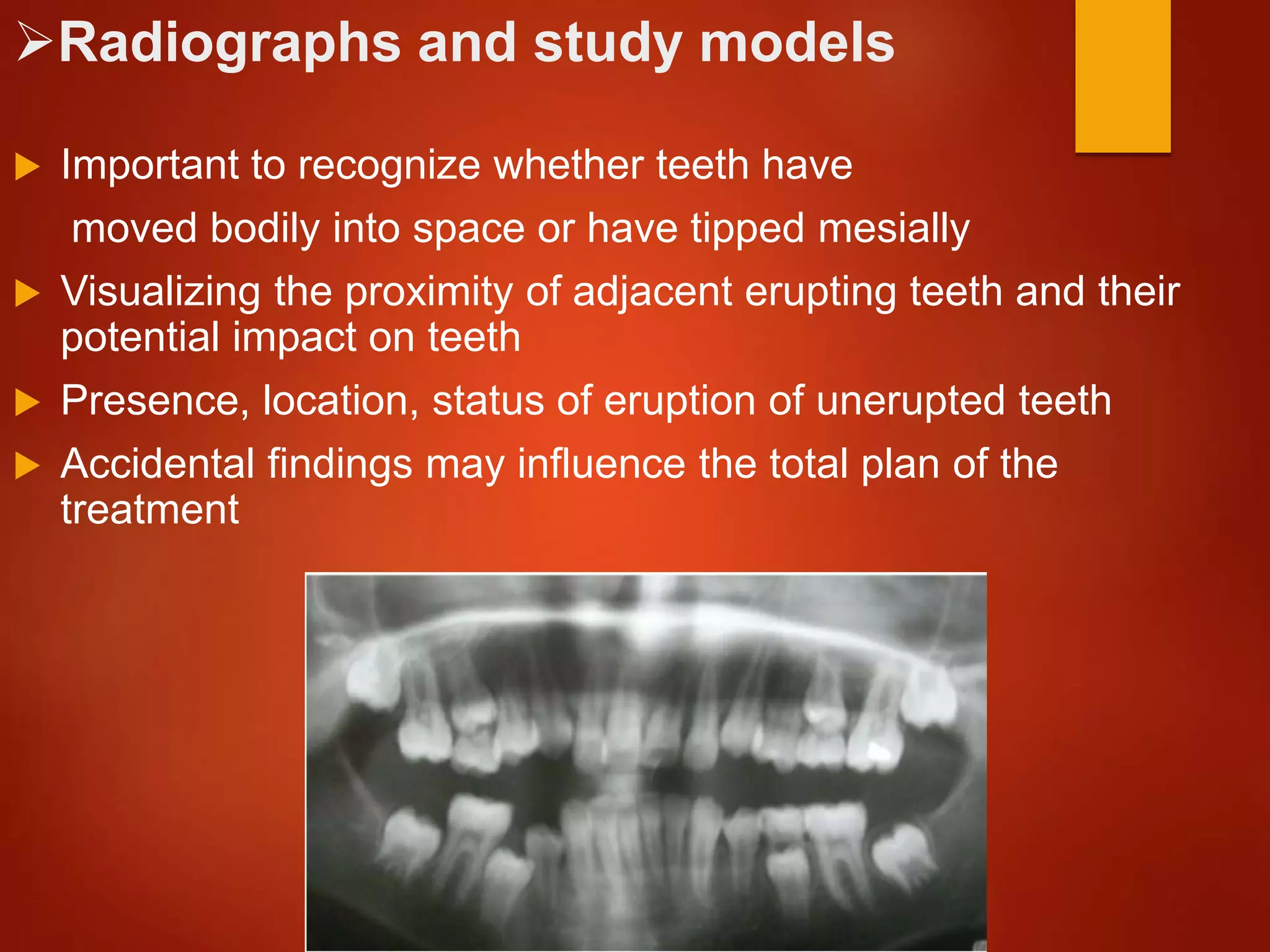
Radiographs and study models
 Important to recognize whether teeth have
moved bodily into space or have tipped mesially
 Visualizing the proximity of adjacent erupting teeth and their
potential impact on teeth
 Presence, location, status of eruption of unerupted teeth
 Accidental findings may influence the total plan of the
treatment
 Moyer’s Mixed dentition analysis-
it will give an estimation of the amount of space to be
regained
 Anchorage considerations
 Timing of distalization –
If child is treated before the age of 9 yrs the root of
1st permanent molar has not completed its growth
and orthodontic tipping and bodily movement to
normalise its position is easier
the age ranging between 7-10 yrs is best time for
bodily movement or tipping to recover lost arch
space
Commonly used appliances
 Mandibular Arch
1. Active open coil space regainer
2. Hotz lingual arch
3. Lip bumper
4. Gerber space maintainer
5. Free end loop space regainer
6. Split saddle /split block
7. Sling shot space regainer
8. Jack screw or expansion screw
9. Anterior space regainer
 Maxillary arch
1. Kloehn head gear
2. Pendulum appliance
3. Fixed sectional arch appliance
Active Open coil space regainer
 A reciprocal active space regainer
used to regain lost space due to
premature loss of 2nd deciduous
molar
 The first molar tend to migrate
mesially
 Such situation may exist unilaterally
or bilaterally
 For the purpose of anchorage,
erupted first premolar is essential
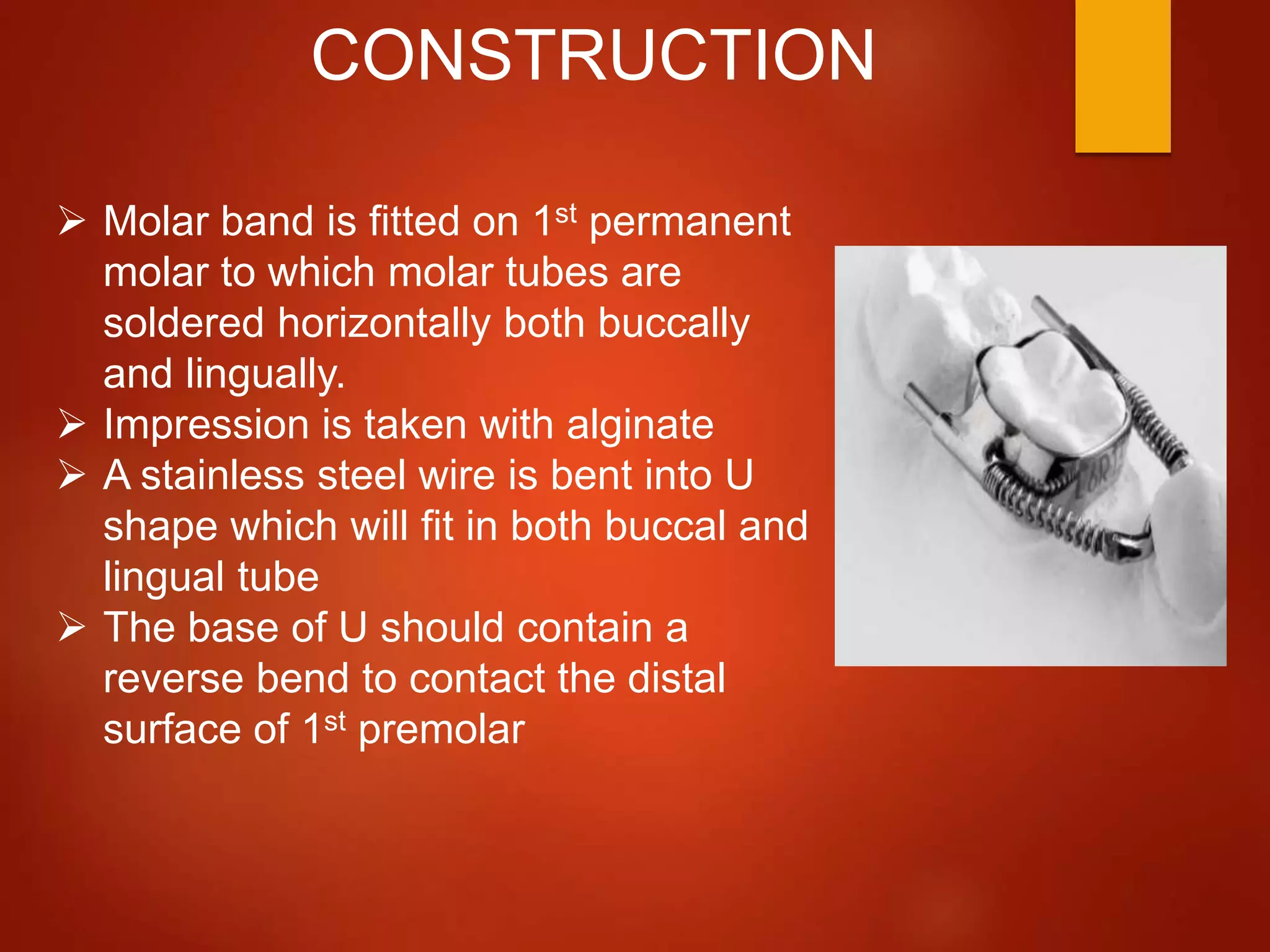
CONSTRUCTION
 Molar band is fitted on 1st permanent
molar to which molar tubes are
soldered horizontally both buccally
and lingually.
 Impression is taken with alginate
 A stainless steel wire is bent into U
shape which will fit in both buccal and
lingual tube
 The base of U should contain a
reverse bend to contact the distal
surface of 1st premolar
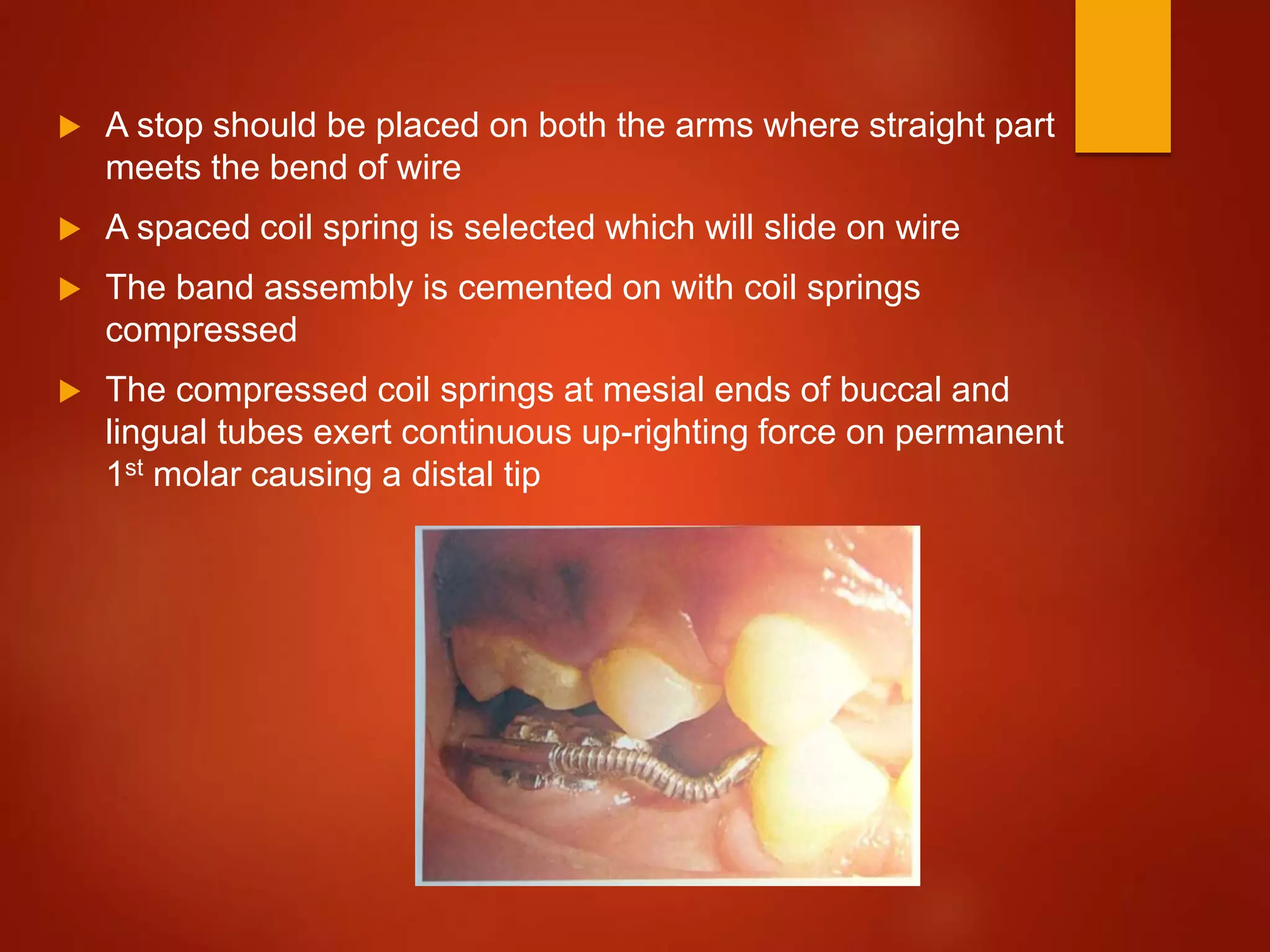
 A stop should be placed on both the arms where straight part
meets the bend of wire
 A spaced coil spring is selected which will slide on wire
 The band assembly is cemented on with coil springs
compressed
 The compressed coil springs at mesial ends of buccal and
lingual tubes exert continuous up-righting force on permanent
1st molar causing a distal tip
Gerber space maintainer
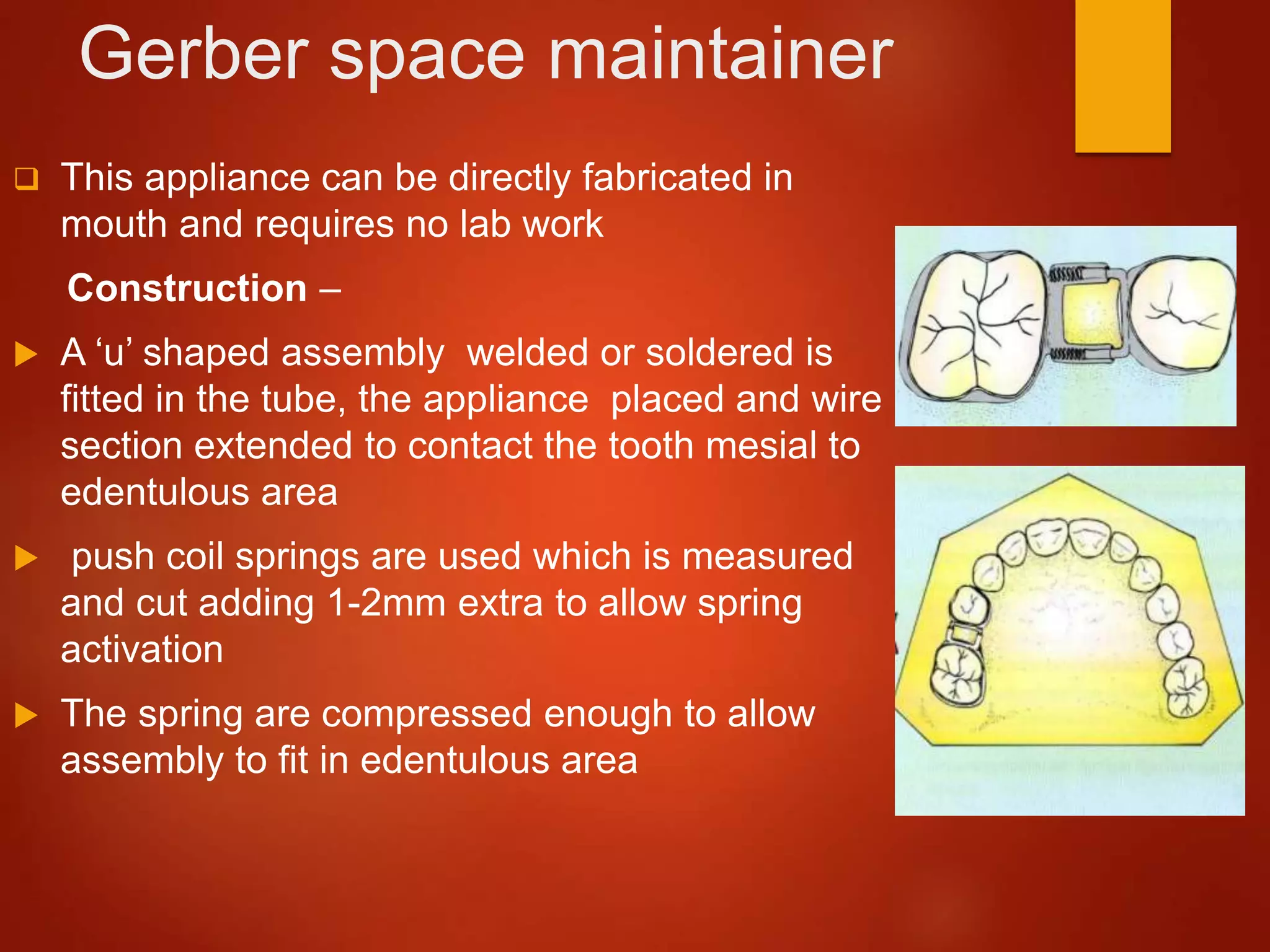
 This appliance can be directly fabricated in
mouth and requires no lab work
Construction –
 A ‘u’ shaped assembly welded or soldered is
fitted in the tube, the appliance placed and wire
section extended to contact the tooth mesial to
edentulous area
 push coil springs are used which is measured
and cut adding 1-2mm extra to allow spring
activation
 The spring are compressed enough to allow
assembly to fit in edentulous area
Hotz lingual Arch
 It is best suited for a situation where lower 1st
permanent molar has drifted mesially, but the
premolar or cuspid has not
 There must be an x-ray evidence of sufficient space
between first molar and developing second molar
 Anchorage for movement is achieved as arch
contacts all the teeth
Indications
 Unilateral or bilateral loss of space in the arch due to
mesial migration of the first molars
 To maintain integrity of the arch where deciduous teeth
have been lost
 To utilize leeway space to resolve the minor crowding
 Can also be used to expand a collapsed arch
 Molar bands
 0.036” lingual arch wire
well adapted to lingual
arch with incisor segment
resting on cingulum of
anterior teeth
 U loop
 Closed vertical loop
Components
Lip bumper
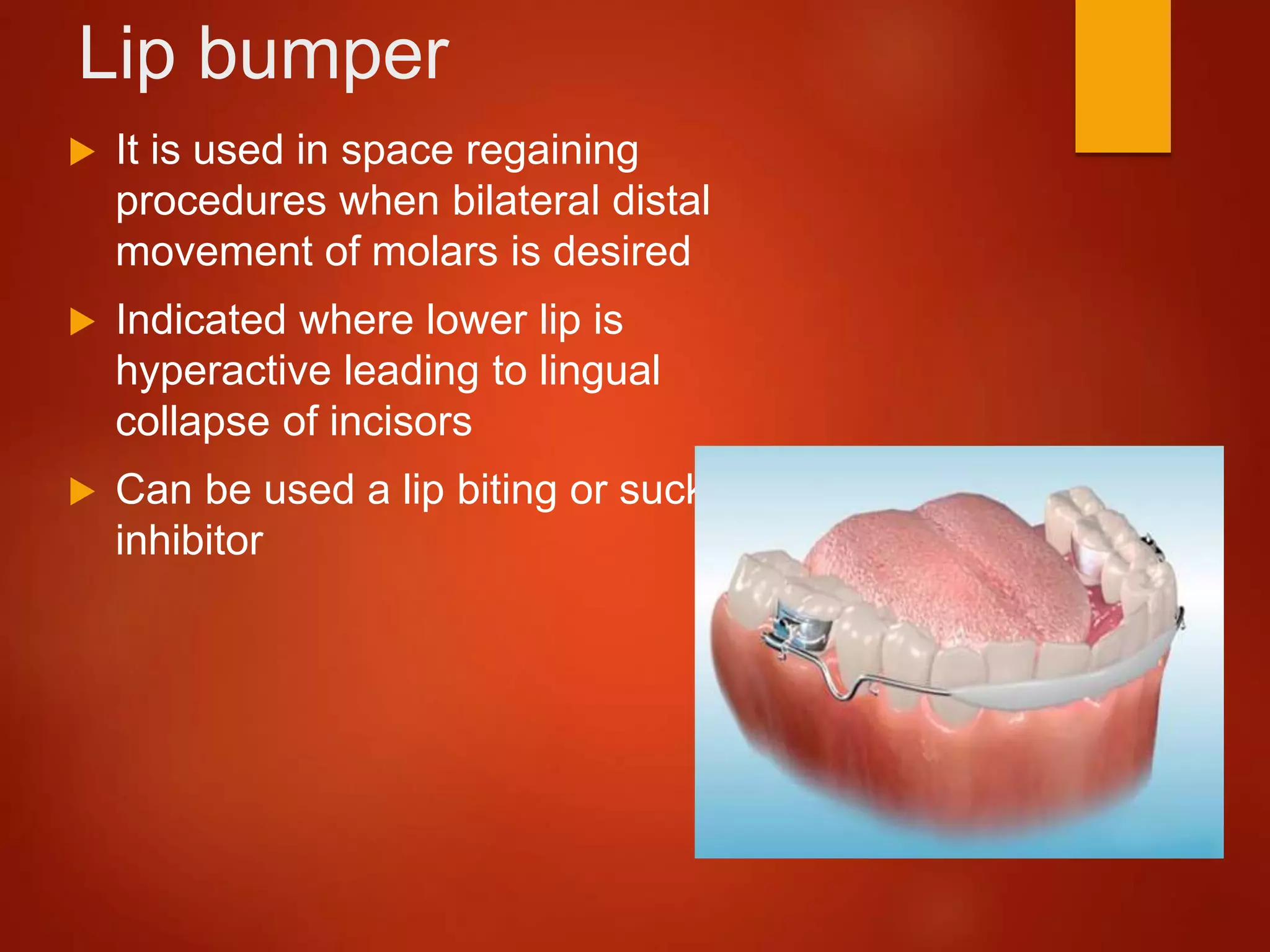
 It is used in space regaining
procedures when bilateral distal
movement of molars is desired
 Indicated where lower lip is
hyperactive leading to lingual
collapse of incisors
 Can be used a lip biting or sucking
inhibitor
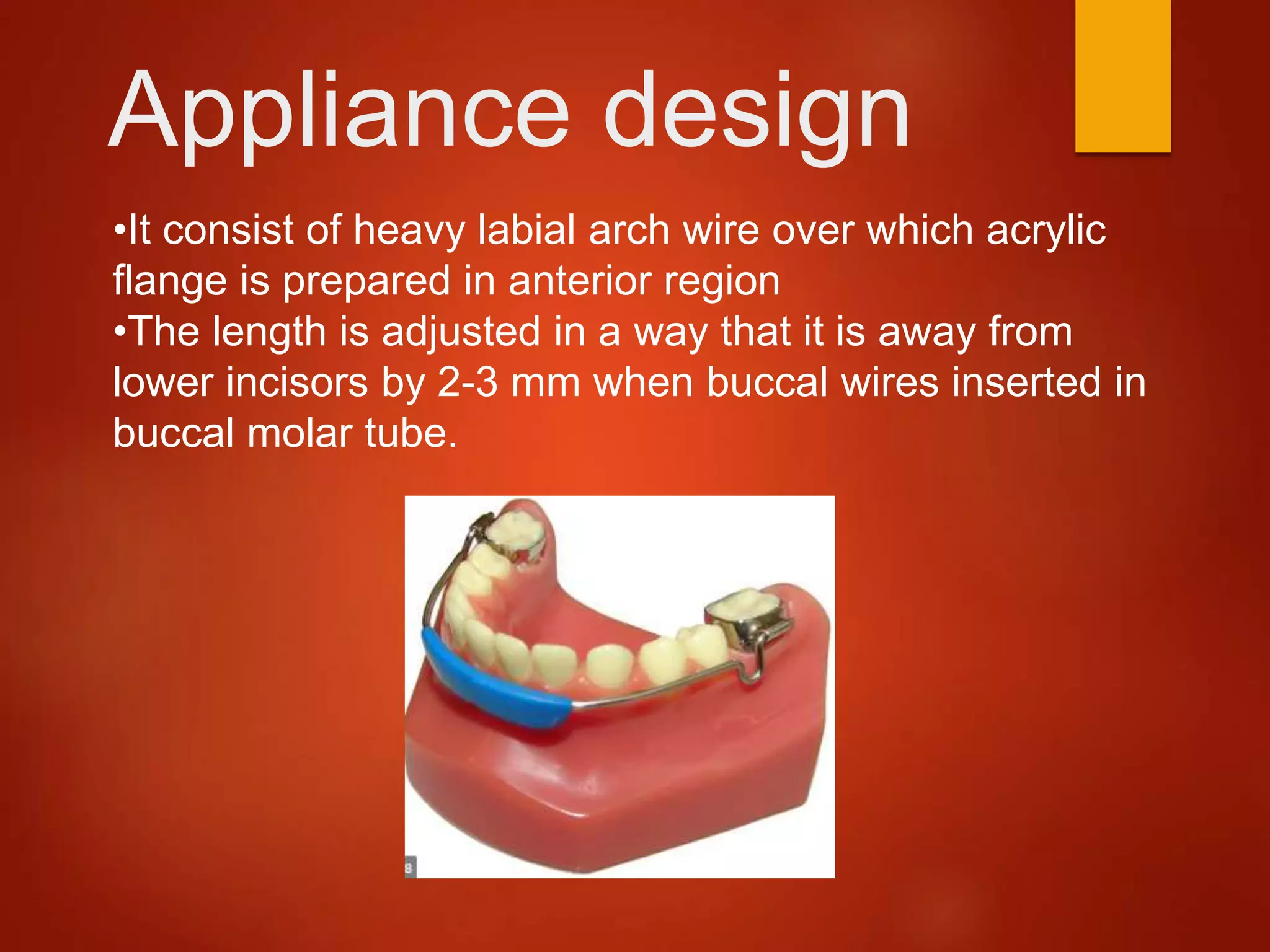
Appliance design
•It consist of heavy labial arch wire over which acrylic
flange is prepared in anterior region
•The length is adjusted in a way that it is away from
lower incisors by 2-3 mm when buccal wires inserted in
buccal molar tube.
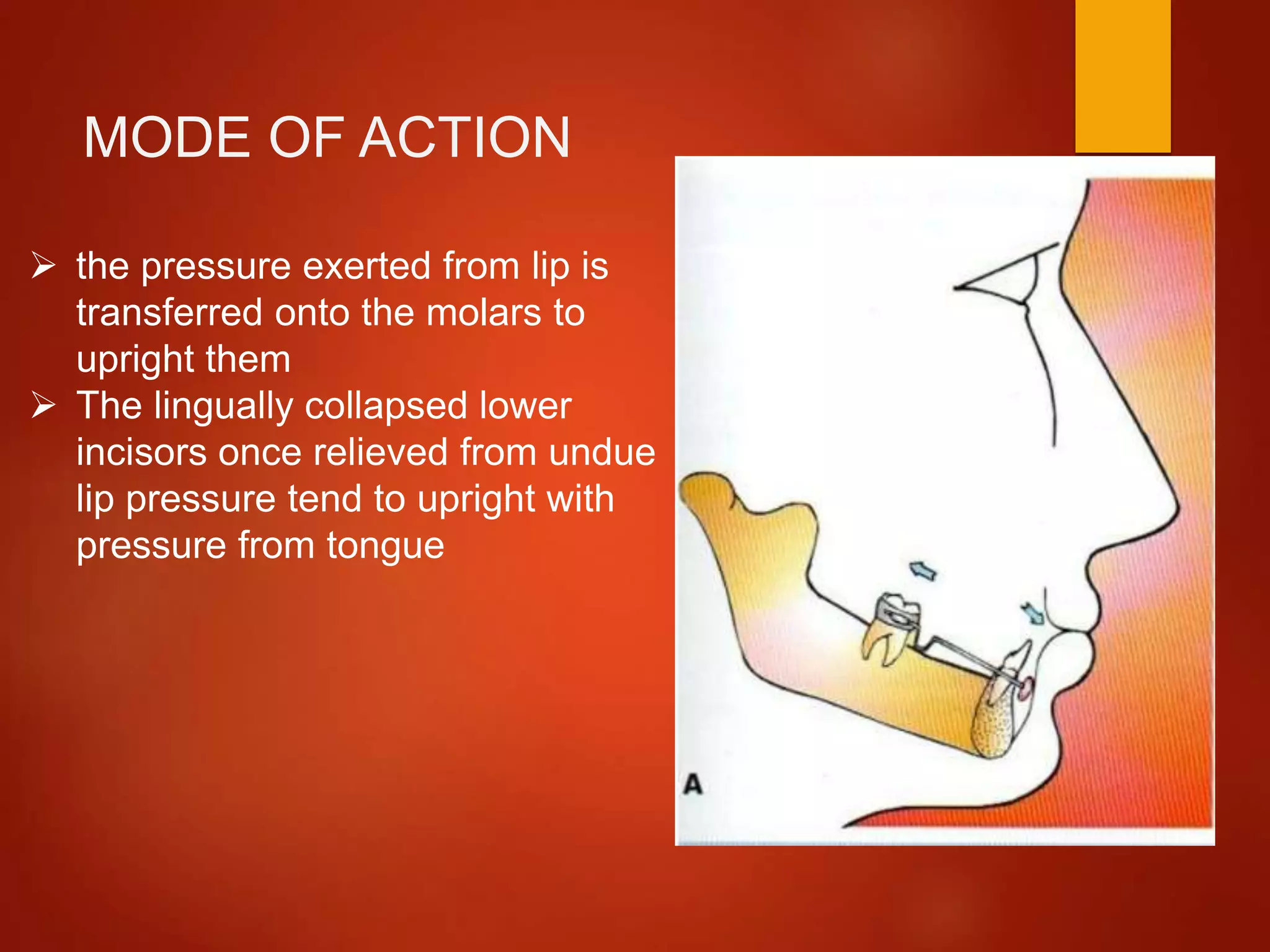
 the pressure exerted from lip is
transferred onto the molars to
upright them
 The lingually collapsed lower
incisors once relieved from undue
lip pressure tend to upright with
pressure from tongue
MODE OF ACTION
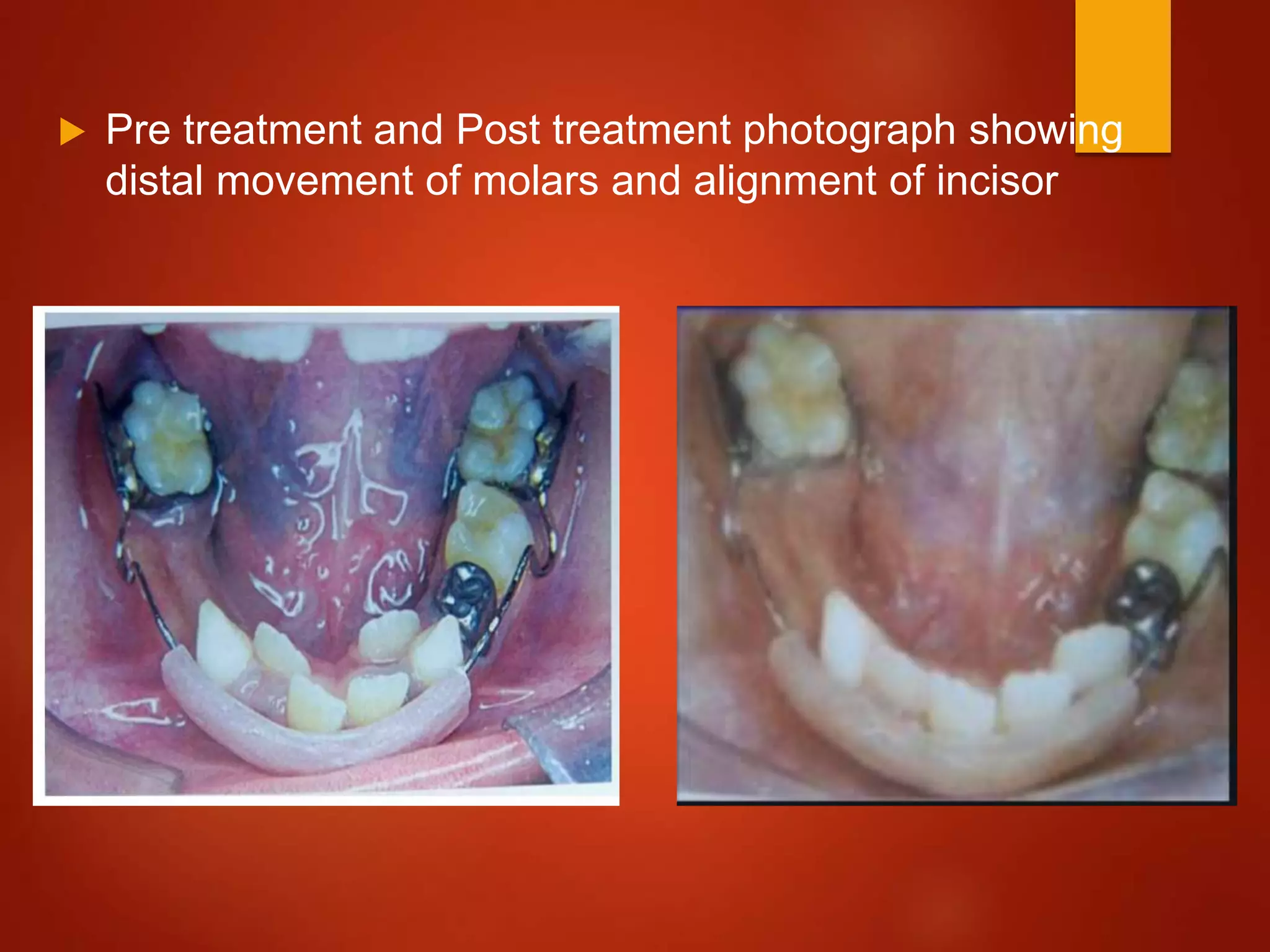
 Pre treatment and Post treatment photograph showing
distal movement of molars and alignment of incisor
Free end loop space regainer
 It utilizes a labial arch wire for
stability and retention, and body of
acrylic resin and active spring.
 the uprighting spring has helical
which is activated to exert the force
close to gingival margin of tooth
 it would require activation in 2-3
weeks until distal movement is
achieved.
Split block/split saddle
 In this functional part of appliance
consists of an acrylic block that is
split bucco-lingually and joined by
0.025 wire in form of a buccal and
lingual loop
 The appliance activated by periodic
spreading of the loops
 The activator block split with disc
after appliance has been processed.
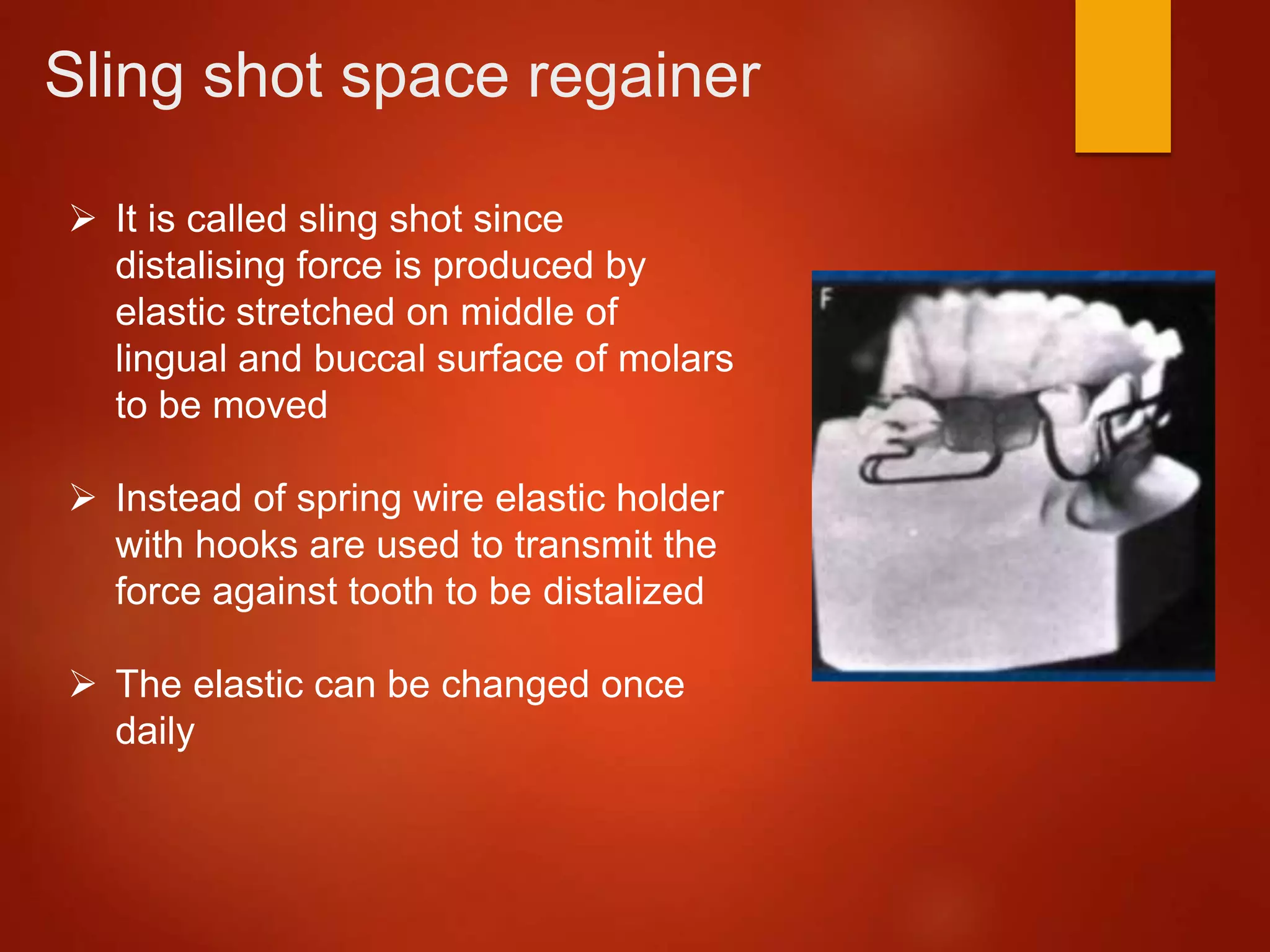
Sling shot space regainer
 It is called sling shot since
distalising force is produced by
elastic stretched on middle of
lingual and buccal surface of molars
to be moved
 Instead of spring wire elastic holder
with hooks are used to transmit the
force against tooth to be distalized
 The elastic can be changed once
daily
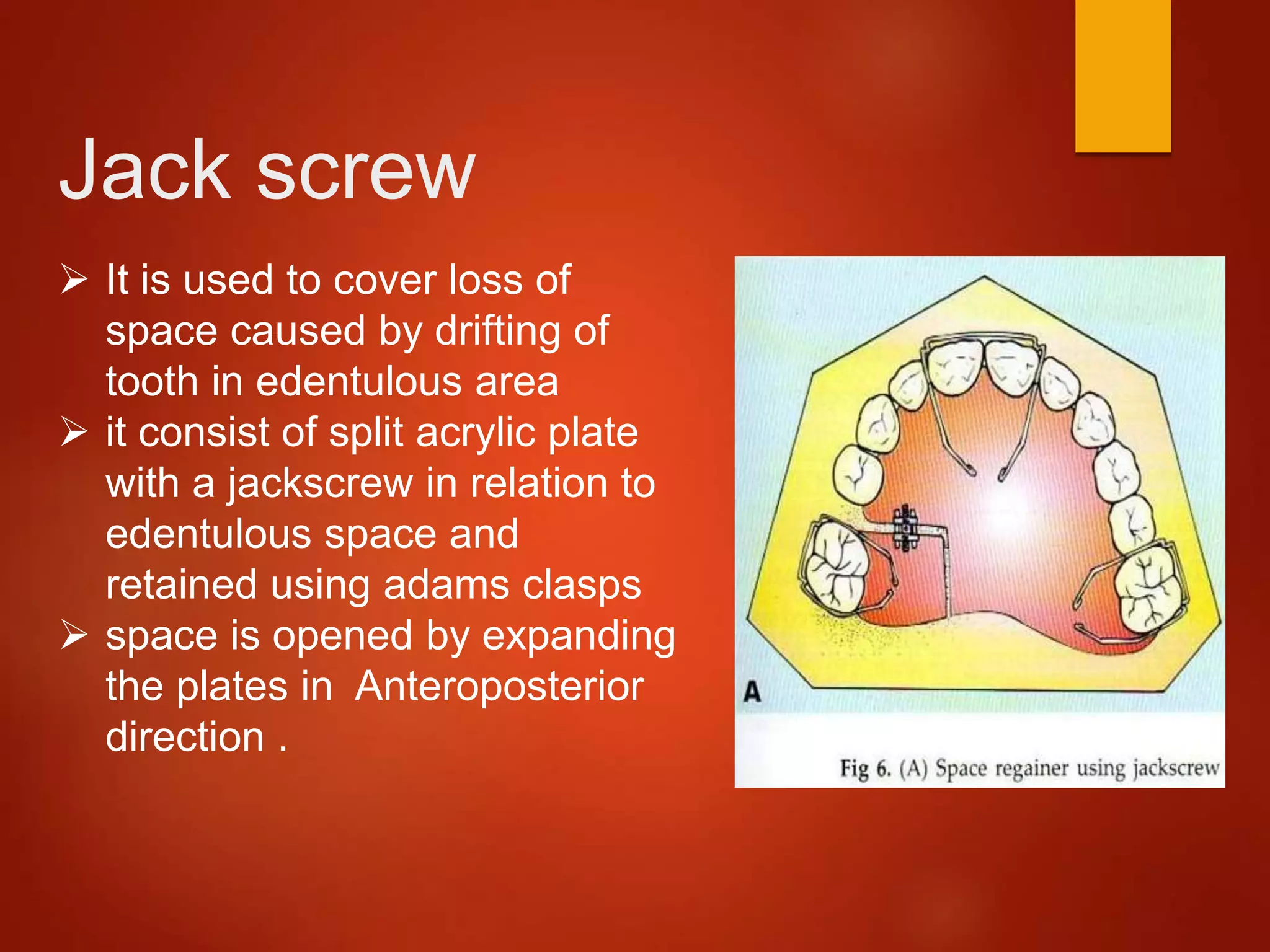
Jack screw
 It is used to cover loss of
space caused by drifting of
tooth in edentulous area
 it consist of split acrylic plate
with a jackscrew in relation to
edentulous space and
retained using adams clasps
 space is opened by expanding
the plates in Anteroposterior
direction .
Sectional arch technique
 Upto 4 millimeters of space can be regained by
this technique
 It can be bonded type or banded buccal tube or
the molar and the bracket such as medium
siamese twin edgewise bracket on mesial
segment
 A sectional wire with increased arch length stops
mesial to tube of molar and distal to bracket of
anterior segment will be activated to upright
mesially tipped molar
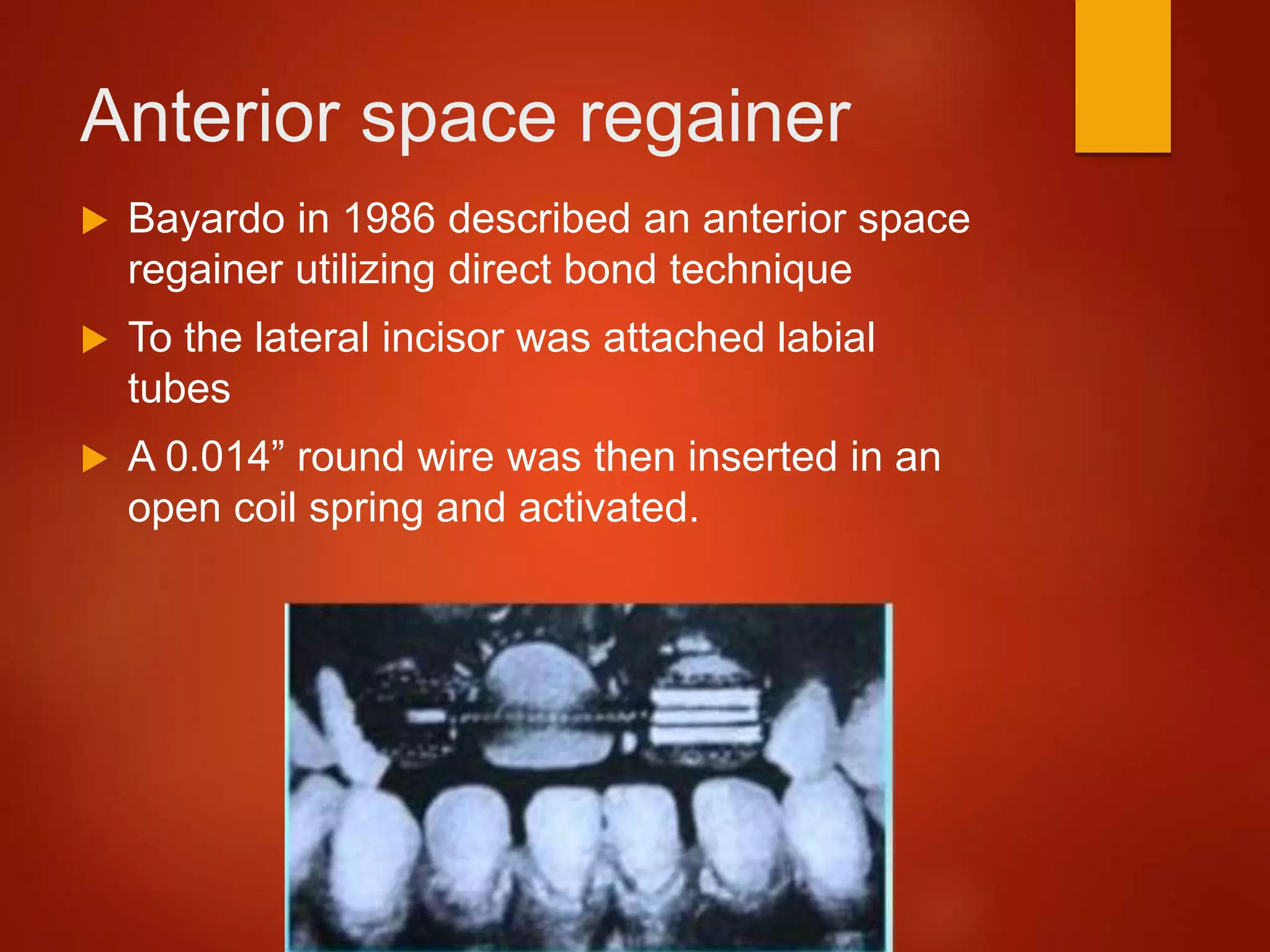
Anterior space regainer
 Bayardo in 1986 described an anterior space
regainer utilizing direct bond technique
 To the lateral incisor was attached labial
tubes
 A 0.014” round wire was then inserted in an
open coil spring and activated.
Klohen head gear
 Used to restrain the growth of maxilla
 It has removable type of cervical face
bow which has outer and inner bow
 Inner bow housed in round tubes
attached on first molars
 The outer bow attached to cervical neck
strap that has calibrated elastic module
for exerting the force.
 The appliance worn for 12-14hrs/24hrs
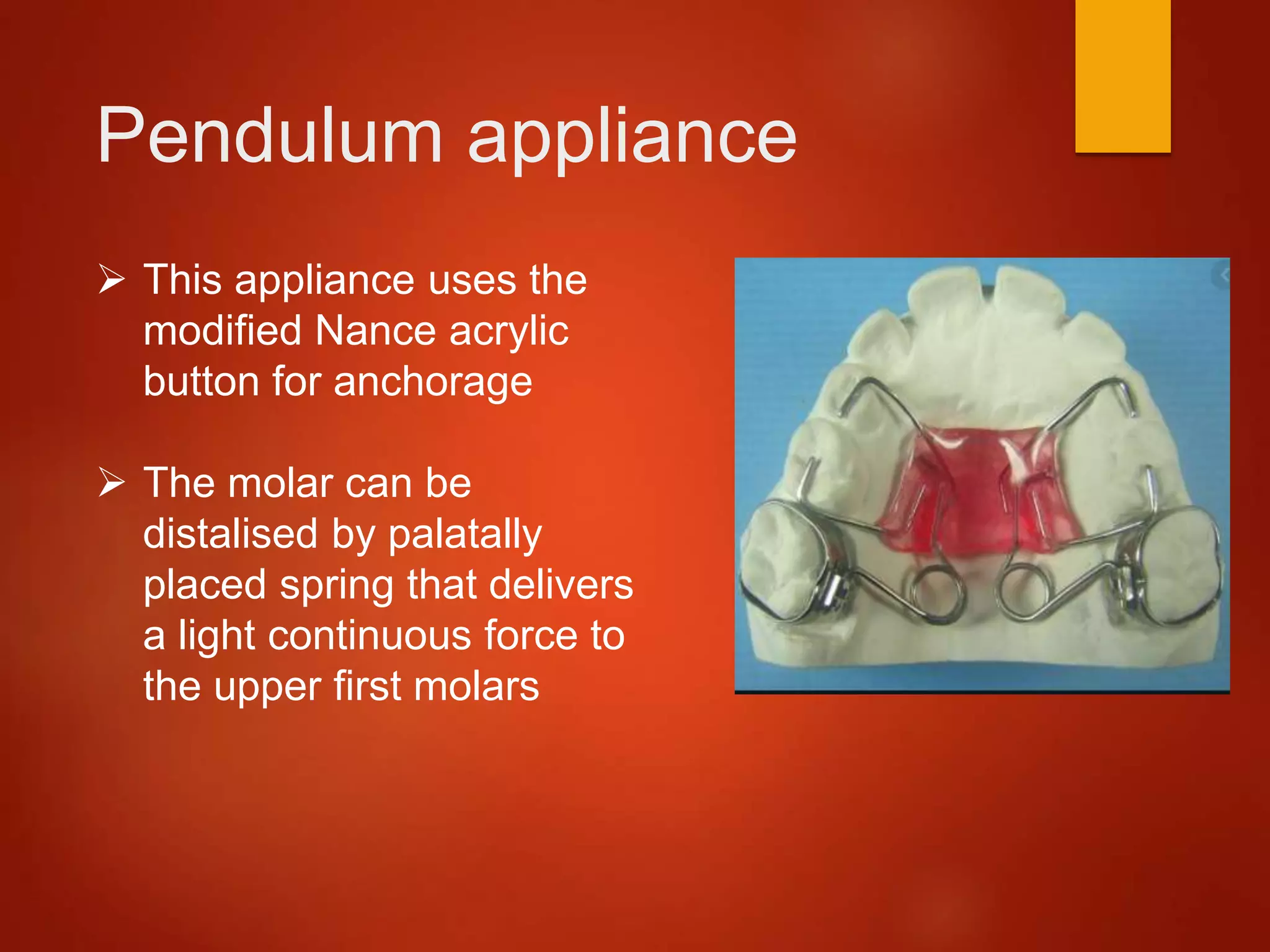
Pendulum appliance
 This appliance uses the
modified Nance acrylic
button for anchorage
 The molar can be
distalised by palatally
placed spring that delivers
a light continuous force to
the upper first molars
Reference
 Paediatric Dentistry by Shobha Tandon
 Orthodontics, The Art and Science by S.I. Bhalaji
 Textbook of Pediatric Dentistry by Nikhil Marwah
 Textbook of orthodontics by Gurkeerat singh
THANK YOU

Space regaining procedure in pediatric dentistry

  • 1.
    Space regaining  EnishaAgarwal  Roll no. -38  3rd/2nd  batch D
  • 2.
    Space regaining  Theprocess of gaining space lost by drifting of adjacent teeth following premature loss of deciduous teeth
  • 3.
     Considerations forthe treatment include  The alignment and space needs for other teeth in arch  The relationship of teeth to denture base  The transverse and sagittal dental relationship  The vertical relationship  The profile of soft tissue  Diagnostic aids –  study models, radiograph of periapical structures ,  clinical assessment of facial symmetry,  cephalometric analysis
  • 4.
    Dental and Skeletal Relations Clinical assessment is done 1. determine the skeletal and facial pattern 2. To evaluate face type and growth trend 3. Assessment of the soft tissue profile 4. To evaluate skeletal, sagittal, transverse and vertical relationship 5. estimation of rotation, slipped contacts and faciolingual displacement of teeth from arch circumference
  • 5.
    Radiographs and studymodels  Important to recognize whether teeth have moved bodily into space or have tipped mesially  Visualizing the proximity of adjacent erupting teeth and their potential impact on teeth  Presence, location, status of eruption of unerupted teeth  Accidental findings may influence the total plan of the treatment
  • 6.
     Moyer’s Mixeddentition analysis- it will give an estimation of the amount of space to be regained  Anchorage considerations  Timing of distalization – If child is treated before the age of 9 yrs the root of 1st permanent molar has not completed its growth and orthodontic tipping and bodily movement to normalise its position is easier the age ranging between 7-10 yrs is best time for bodily movement or tipping to recover lost arch space
  • 7.
    Commonly used appliances Mandibular Arch 1. Active open coil space regainer 2. Hotz lingual arch 3. Lip bumper 4. Gerber space maintainer 5. Free end loop space regainer 6. Split saddle /split block 7. Sling shot space regainer 8. Jack screw or expansion screw 9. Anterior space regainer  Maxillary arch 1. Kloehn head gear 2. Pendulum appliance 3. Fixed sectional arch appliance
  • 8.
    Active Open coilspace regainer  A reciprocal active space regainer used to regain lost space due to premature loss of 2nd deciduous molar  The first molar tend to migrate mesially  Such situation may exist unilaterally or bilaterally  For the purpose of anchorage, erupted first premolar is essential
  • 9.
    CONSTRUCTION  Molar bandis fitted on 1st permanent molar to which molar tubes are soldered horizontally both buccally and lingually.  Impression is taken with alginate  A stainless steel wire is bent into U shape which will fit in both buccal and lingual tube  The base of U should contain a reverse bend to contact the distal surface of 1st premolar
  • 10.
     A stopshould be placed on both the arms where straight part meets the bend of wire  A spaced coil spring is selected which will slide on wire  The band assembly is cemented on with coil springs compressed  The compressed coil springs at mesial ends of buccal and lingual tubes exert continuous up-righting force on permanent 1st molar causing a distal tip
  • 12.
    Gerber space maintainer This appliance can be directly fabricated in mouth and requires no lab work Construction –  A ‘u’ shaped assembly welded or soldered is fitted in the tube, the appliance placed and wire section extended to contact the tooth mesial to edentulous area  push coil springs are used which is measured and cut adding 1-2mm extra to allow spring activation  The spring are compressed enough to allow assembly to fit in edentulous area
  • 13.
    Hotz lingual Arch It is best suited for a situation where lower 1st permanent molar has drifted mesially, but the premolar or cuspid has not  There must be an x-ray evidence of sufficient space between first molar and developing second molar  Anchorage for movement is achieved as arch contacts all the teeth
  • 14.
    Indications  Unilateral orbilateral loss of space in the arch due to mesial migration of the first molars  To maintain integrity of the arch where deciduous teeth have been lost  To utilize leeway space to resolve the minor crowding  Can also be used to expand a collapsed arch
  • 15.
     Molar bands 0.036” lingual arch wire well adapted to lingual arch with incisor segment resting on cingulum of anterior teeth  U loop  Closed vertical loop Components
  • 16.
    Lip bumper  Itis used in space regaining procedures when bilateral distal movement of molars is desired  Indicated where lower lip is hyperactive leading to lingual collapse of incisors  Can be used a lip biting or sucking inhibitor
  • 17.
    Appliance design •It consistof heavy labial arch wire over which acrylic flange is prepared in anterior region •The length is adjusted in a way that it is away from lower incisors by 2-3 mm when buccal wires inserted in buccal molar tube.
  • 18.
     the pressureexerted from lip is transferred onto the molars to upright them  The lingually collapsed lower incisors once relieved from undue lip pressure tend to upright with pressure from tongue MODE OF ACTION
  • 19.
     Pre treatmentand Post treatment photograph showing distal movement of molars and alignment of incisor
  • 20.
    Free end loopspace regainer  It utilizes a labial arch wire for stability and retention, and body of acrylic resin and active spring.  the uprighting spring has helical which is activated to exert the force close to gingival margin of tooth  it would require activation in 2-3 weeks until distal movement is achieved.
  • 21.
    Split block/split saddle In this functional part of appliance consists of an acrylic block that is split bucco-lingually and joined by 0.025 wire in form of a buccal and lingual loop  The appliance activated by periodic spreading of the loops  The activator block split with disc after appliance has been processed.
  • 22.
    Sling shot spaceregainer  It is called sling shot since distalising force is produced by elastic stretched on middle of lingual and buccal surface of molars to be moved  Instead of spring wire elastic holder with hooks are used to transmit the force against tooth to be distalized  The elastic can be changed once daily
  • 23.
    Jack screw  Itis used to cover loss of space caused by drifting of tooth in edentulous area  it consist of split acrylic plate with a jackscrew in relation to edentulous space and retained using adams clasps  space is opened by expanding the plates in Anteroposterior direction .
  • 24.
    Sectional arch technique Upto 4 millimeters of space can be regained by this technique  It can be bonded type or banded buccal tube or the molar and the bracket such as medium siamese twin edgewise bracket on mesial segment  A sectional wire with increased arch length stops mesial to tube of molar and distal to bracket of anterior segment will be activated to upright mesially tipped molar
  • 25.
    Anterior space regainer Bayardo in 1986 described an anterior space regainer utilizing direct bond technique  To the lateral incisor was attached labial tubes  A 0.014” round wire was then inserted in an open coil spring and activated.
  • 26.
    Klohen head gear Used to restrain the growth of maxilla  It has removable type of cervical face bow which has outer and inner bow  Inner bow housed in round tubes attached on first molars  The outer bow attached to cervical neck strap that has calibrated elastic module for exerting the force.  The appliance worn for 12-14hrs/24hrs
  • 27.
    Pendulum appliance  Thisappliance uses the modified Nance acrylic button for anchorage  The molar can be distalised by palatally placed spring that delivers a light continuous force to the upper first molars
  • 28.
    Reference  Paediatric Dentistryby Shobha Tandon  Orthodontics, The Art and Science by S.I. Bhalaji  Textbook of Pediatric Dentistry by Nikhil Marwah  Textbook of orthodontics by Gurkeerat singh
  • 29.