AVR PROJECT REPORT
AUTOMATIC ROOM LIGHT CONTROLLER WITH
BIDIRECTIONAL VISITOR COUNTER
Submitted by:
 Mafaz Ahmed 1882-F12
Abstract:
This Project “Automatic Room Light Controller with Bidirectional
Visitor Counter” is reliable that takes over the task of controlling the room lights
as well us counting number of persons/visitors in the room very accurately. When
somebody enters into the room then the counter is incremented by one and the
light in the room will be switched ON and when any one leaves the room then the
counter is decremented by one. The light will be only switched OFF until all the
persons in the room go out. The total number of persons inside the room is also
displayed on the LCD. Whenever a person enter a room, he or she have to enter a
password using a keypad interfaced with the microcontroller. Only those enter
the room who know the password.
INTRODUCTION:
The objective of this project is to make a controller based
model to count number of persons visiting particular room and accordingly light
up the room. Here we can use sensor and can know present number of persons.
In today’s world, there is a continuous need for automatic appliances. With the
increase in standard of living, there is a sense of urgency for
developing circuits that would ease the complexity of life. Also if at all one wants
to know the number of people present in room so as not to have congestion, this
circuit proves to be helpful.
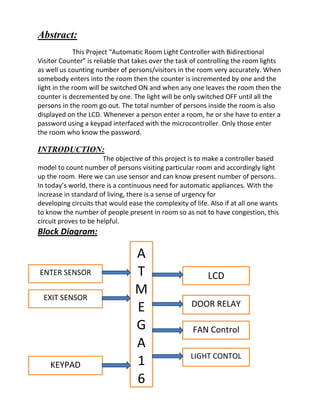
Block Diagram:
A
T
M
E
G
A
1
6
ENTER SENSOR
EXIT SENSOR
KEYPAD
LCD
DOOR RELAY
FAN Control
LIGHT CONTOL
LIST OF COMPONENTS:
 Microcontroller – ATMEGA16
 Infrared Sensor
 Preset – 4.7K
 Reset button switch
 Diode – IN4148
 Transistor – TIP41
 LCD 16x2
 Keypad
 LED’s
 IC-LM324
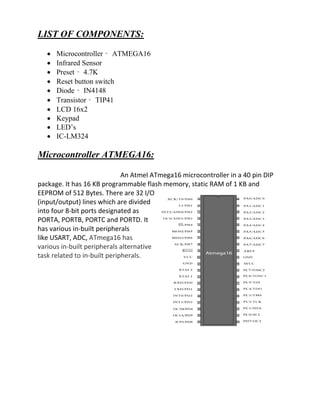
Microcontroller ATMEGA16:
An Atmel ATmega16 microcontroller in a 40 pin DIP
package. It has 16 KB programmable flash memory, static RAM of 1 KB and
EEPROM of 512 Bytes. There are 32 I/O
(input/output) lines which are divided
into four 8-bit ports designated as
PORTA, PORTB, PORTC and PORTD. It
has various in-built peripherals
like USART, ADC, ATmega16 has
various in-built peripherals alternative
task related to in-built peripherals.
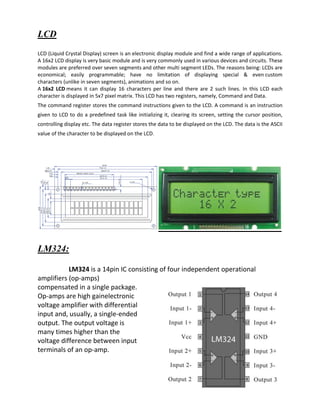
LCD
LCD (Liquid Crystal Display) screen is an electronic display module and find a wide range of applications.
A 16x2 LCD display is very basic module and is very commonly used in various devices and circuits. These
modules are preferred over seven segments and other multi segment LEDs. The reasons being: LCDs are
economical; easily programmable; have no limitation of displaying special & even custom
characters (unlike in seven segments), animations and so on.
A 16x2 LCD means it can display 16 characters per line and there are 2 such lines. In this LCD each
character is displayed in 5x7 pixel matrix. This LCD has two registers, namely, Command and Data.
The command register stores the command instructions given to the LCD. A command is an instruction
given to LCD to do a predefined task like initializing it, clearing its screen, setting the cursor position,
controlling display etc. The data register stores the data to be displayed on the LCD. The data is the ASCII
value of the character to be displayed on the LCD.
LM324:
LM324 is a 14pin IC consisting of four independent operational
amplifiers (op-amps)
compensated in a single package.
Op-amps are high gainelectronic
voltage amplifier with differential
input and, usually, a single-ended
output. The output voltage is
many times higher than the
voltage difference between input
terminals of an op-amp.
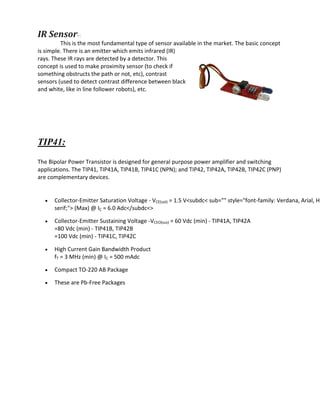
IR Sensor-:
This is the most fundamental type of sensor available in the market. The basic concept
is simple. There is an emitter which emits infrared (IR)
rays. These IR rays are detected by a detector. This
concept is used to make proximity sensor (to check if
something obstructs the path or not, etc), contrast
sensors (used to detect contrast difference between black
and white, like in line follower robots), etc.
TIP41:
The Bipolar Power Transistor is designed for general purpose power amplifier and switching
applications. The TIP41, TIP41A, TIP41B, TIP41C (NPN); and TIP42, TIP42A, TIP42B, TIP42C (PNP)
are complementary devices.
 Collector-Emitter Saturation Voltage - VCE(sat) = 1.5 V<subdc< sub="" style="font-family: Verdana, Arial, He
serif;"> (Max) @ IC = 6.0 Adc</subdc<>
 Collector-Emitter Sustaining Voltage -VCEO(sus) = 60 Vdc (min) - TIP41A, TIP42A
=80 Vdc (min) - TIP41B, TIP42B
=100 Vdc (min) - TIP41C, TIP42C
 High Current Gain Bandwidth Product
fT = 3 MHz (min) @ IC = 500 mAdc
 Compact TO-220 AB Package
 These are Pb-Free Packages
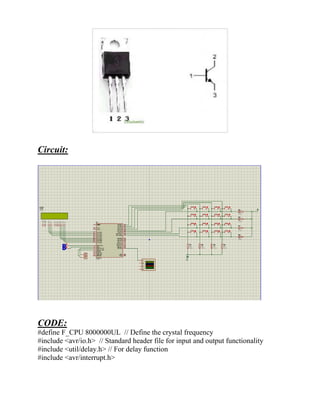
Circuit:
CODE:
#define F_CPU 8000000UL // Define the crystal frequency
#include <avr/io.h> // Standard header file for input and output functionality
#include <util/delay.h> // For delay function
#include <avr/interrupt.h>
#define LCD_PRT PORTA //LCD DATA PORT
#define LCD_DDR DDRA //LCD DATA DDR
#define LCD_PIN PINA//LCD DATA PIN
#define LCD_RS 0 //LCD RS
#define LCD_RW 1 //LCD RW
#define LCD_EN 2 //LCD EN //Enable/disable pin for
LCD
#define KEY_PRT PORTC
#define KEY_DDR DDRC
#define KEY_PIN PINC
char ROW=0, COL=0;
char keypad[4][3]= {'1','2','3',
'4','5','6',
'7','8','9',
'*','0','#' };
unsigned char cnt=0;
ISR (TIMER2_OVF_vect)
{if(cnt==0){OCR2 =255;}
if(cnt>=1){OCR2 =191;}
if(cnt>=3){OCR2=127;}
if(cnt>=5){OCR2=0;} }
void lcdcmd(unsigned char cmnd)
{ // LCD command function
LCD_PRT = (LCD_PRT & 0x0F) | (cmnd & 0xF0);
LCD_PRT &= ~ (1<<LCD_RS); //RS = 0 for command
LCD_PRT &= ~ (1<<LCD_RW) ; //RW = 0 for write
LCD_PRT |= (1<<LCD_EN); //EN = 1 for H-to-L
_delay_us (50) ; //wait to make EN wider
LCD_PRT &= ~ (1<<LCD_EN); //EN = 0 for H-to-L
_delay_us(50) ; //wait
LCD_PRT = (LCD_PRT & 0x0F) | (cmnd << 4);
LCD_PRT |= (1<<LCD_EN); //EN = 1 for H-to-L
_delay_us (1) ; //wait to make EN wider
LCD_PRT &= ~ (1<<LCD_EN); } //EN = 0 for H-to-L
void lcddata(unsigned char data) // LCD Data function
{
LCD_PRT = (LCD_PRT & 0X0F) | (data & 0XF0);
LCD_PRT |= (1<<LCD_RS); //RS = 1 for data
LCD_PRT &= ~ (1<<LCD_RW) ; //RW = 0 for write
LCD_PRT |= (1<<LCD_EN); //EN = 1 for H-to-L
_delay_us(50) ;
LCD_PRT &= ~ (1<<LCD_EN) ;
LCD_PRT = (LCD_PRT & 0x0F) | (data<<4);
LCD_PRT |= (1<<LCD_EN);
_delay_us(50);
LCD_PRT &= ~ (1<<LCD_EN);
}
void lcd_init()
{
LCD_DDR = 0xFF;
LCD_PRT &=~(1<<LCD_EN);
_delay_us(2000);
lcdcmd(0x33);
_delay_us (100);
lcdcmd(0x32);
_delay_us (100);
lcdcmd(0x28);
_delay_us (100);
lcdcmd(0x0E);
_delay_us(100);
lcdcmd(0x01);
_delay_us(2000);
lcdcmd(0x06);
_delay_us(100);
}
void lcd_gotoxy (unsigned char x, unsigned char y)
{ //Table 12-5
unsigned char firstCharAdr[]={0x80,0xC0,0x94,0xD4};
lcdcmd(firstCharAdr[ y-1]+x-1);
_delay_us(100) ;
}
void lcd_string(unsigned char *str) //function to show string on LCD
{ unsigned char i = 0;
while (str[ i] !=0)
{lcddata(str[ i] );
i++;
}
}
//look up table for keypad function
char key_pad() // key pad function
{
while(1)
{
KEY_PRT=0x7E;
//MAKE FIRST ROW IN KEYPAD TO ZERO
// MAKE ALL COL'S AS HIGH
if((KEY_PIN&0x10)==0){while((KEY_PIN&0x10)==
0);ROW=1;COL=1;break;}
if((KEY_PIN&0x20)==0){while((KEY_PIN&0x20)==
0);ROW=1;COL=2;break;}
if((KEY_PIN&0x40)==0){while((KEY_PIN&0x40)==
0);ROW=1;COL=3;break;}
KEY_PRT=0x7D;
//MAKE SECOND ROW IN KEYPAD TO ZERO
// MAKE ALL COL'S AS HIGH
if((KEY_PIN&0x10)==0){while((KEY_PIN&0x10)==
0);ROW=2;COL=1;break;}
if((KEY_PIN&0x20)==0){while((KEY_PIN&0x20)==
0);ROW=2;COL=2;break;}
if((KEY_PIN&0x40)==0){while((KEY_PIN&0x40)==
0);ROW=2;COL=3;break;}
KEY_PRT=0x7B;
//MAKE THIRD ROW IN KEYPAD TO ZERO
// MAKE ALL COL'S AS HIGH
if((KEY_PIN&0x10)==0){while((KEY_PIN&0x10)==
0);ROW=3;COL=1;break;}
if((KEY_PIN&0x20)==0){while((KEY_PIN&0x20)==
0);ROW=3;COL=2;break;}
if((KEY_PIN&0x40)==0){while((KEY_PIN&0x40)==
0);ROW=3;COL=3;break;}
KEY_PRT=0x77;
//MAKE 4TH ROW IN KEYPAD TO ZERO
// MAKE ALL COL'S AS HIGH
if((KEY_PIN&0x10)==0){while((KEY_PIN&0x10)==
0);ROW=4;COL=1;break;}
if((KEY_PIN&0x20)==0){while((KEY_PIN&0x20)==
0);ROW=4;COL=2;break;}
if((KEY_PIN&0x40)==0){while((KEY_PIN&0x40)==
0);ROW=4;COL=3;break;}
}
return keypad[ROW-1][COL-1];
}
unsigned char ps[]="ENTER PASSWARD";
unsigned char un[]="UNLOCKED";
unsigned char lo[]="LOCKED";
unsigned char wr[]="WRONG PASSWARD";
unsigned char ea[]="ENTER AGAIN";
unsigned char passward[]={'4','6','2','2'};
unsigned char user[4];
unsigned char d;
void enter(){lcd_init();
lcd_gotoxy(2,1);
lcd_string(ps);
lcdcmd(0xC6);
for(d=0;d<4;d++)
{ user[d]=key_pad(); lcddata(user[d]);}
_delay_ms(100);
if((user[0]==passward[0])&&(user[1]==passward[1])&&(user[2]==passward[2])&
&(user[3]==passward[3]))
{ lcd_init(); lcd_gotoxy(5,1); lcd_string("WELCOME");
PORTB|=(1<<2);
while(1){if(PINB &
0x02){cnt++;PORTB&=~(1<<2);if(cnt>0){PORTB|=(1<<3);}_delay_ms(200);bre
ak;}}}
else
{lcd_init();
lcd_gotoxy(3,1);
lcd_string(wr); _delay_ms(500);}
}
void exit()
{PORTB|=(1<<2);
while(1){if(PINB & 0x01){cnt--;
PORTB&=~(1<<2);lcd_init();lcd_gotoxy(5,1);lcd_string("GOOD
BY");if(cnt<=0)PORTB&=~(1<<3);
_delay_ms(1000);while(PINB & 0x01);break;}
}
}
unsigned char count=0;
int main(void) //main function
{
DDRD |= (1<<7); //PB3 as output
OCR2 = 255;
TCCR2 = 0x76;;
TIMSK |= (1<<TOIE2) ;
sei( );
DDRB=0x0C; // PB 0,1 input and PB.2 ,PB.3
KEY_DDR=0x0F;
while(1)
{ lcd_init();
lcd_gotoxy(5,1);
lcd_string("Count=");
count=cnt&0x0F;
count=count|0x30;
lcddata(count);
while(1){if(PINB & 0x01){enter();break;}if(PINB &
0x02){exit();break;}}
//while(1){if(PINB & 0x01){enter();break;}if(PINB &
0x02){exit();break;}}
_delay_ms(100);
}
return 0;}
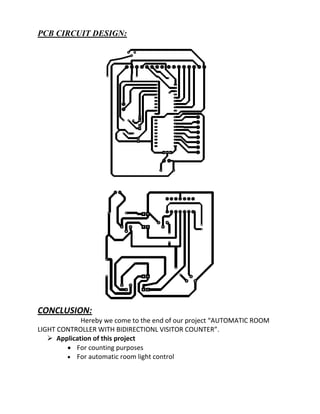
PCB CIRCUIT DESIGN:
CONCLUSION:
Hereby we come to the end of our project “AUTOMATIC ROOM
LIGHT CONTROLLER WITH BIDIRECTIONL VISITOR COUNTER”.
 Application of this project
 For counting purposes
 For automatic room light control
 Advantages of this project
 Low cost
 Easy to use
 Implement in single door
 Future Expansion
 By using this circuit and proper power supply we can implement
various applications such as fans, tube lights, etc.
 By modifying this circuit and using two relays we can achieve a task
of opening and closing the door
Reference:
 . http://www.engineersgarage.com/electronic-components/lm324n-datasheet
 http://www.engineersgarage.com/electronic-components/atmega16-
microcontroller

Automatic room light controller with visible counter

  • 1.
    AVR PROJECT REPORT AUTOMATICROOM LIGHT CONTROLLER WITH BIDIRECTIONAL VISITOR COUNTER Submitted by:  Mafaz Ahmed 1882-F12
  • 2.
    Abstract: This Project “AutomaticRoom Light Controller with Bidirectional Visitor Counter” is reliable that takes over the task of controlling the room lights as well us counting number of persons/visitors in the room very accurately. When somebody enters into the room then the counter is incremented by one and the light in the room will be switched ON and when any one leaves the room then the counter is decremented by one. The light will be only switched OFF until all the persons in the room go out. The total number of persons inside the room is also displayed on the LCD. Whenever a person enter a room, he or she have to enter a password using a keypad interfaced with the microcontroller. Only those enter the room who know the password. INTRODUCTION: The objective of this project is to make a controller based model to count number of persons visiting particular room and accordingly light up the room. Here we can use sensor and can know present number of persons. In today’s world, there is a continuous need for automatic appliances. With the increase in standard of living, there is a sense of urgency for developing circuits that would ease the complexity of life. Also if at all one wants to know the number of people present in room so as not to have congestion, this circuit proves to be helpful. Block Diagram: A T M E G A 1 6 ENTER SENSOR EXIT SENSOR KEYPAD LCD DOOR RELAY FAN Control LIGHT CONTOL
  • 3.
    LIST OF COMPONENTS: Microcontroller – ATMEGA16  Infrared Sensor  Preset – 4.7K  Reset button switch  Diode – IN4148  Transistor – TIP41  LCD 16x2  Keypad  LED’s  IC-LM324 Microcontroller ATMEGA16: An Atmel ATmega16 microcontroller in a 40 pin DIP package. It has 16 KB programmable flash memory, static RAM of 1 KB and EEPROM of 512 Bytes. There are 32 I/O (input/output) lines which are divided into four 8-bit ports designated as PORTA, PORTB, PORTC and PORTD. It has various in-built peripherals like USART, ADC, ATmega16 has various in-built peripherals alternative task related to in-built peripherals.
  • 4.
    LCD LCD (Liquid CrystalDisplay) screen is an electronic display module and find a wide range of applications. A 16x2 LCD display is very basic module and is very commonly used in various devices and circuits. These modules are preferred over seven segments and other multi segment LEDs. The reasons being: LCDs are economical; easily programmable; have no limitation of displaying special & even custom characters (unlike in seven segments), animations and so on. A 16x2 LCD means it can display 16 characters per line and there are 2 such lines. In this LCD each character is displayed in 5x7 pixel matrix. This LCD has two registers, namely, Command and Data. The command register stores the command instructions given to the LCD. A command is an instruction given to LCD to do a predefined task like initializing it, clearing its screen, setting the cursor position, controlling display etc. The data register stores the data to be displayed on the LCD. The data is the ASCII value of the character to be displayed on the LCD. LM324: LM324 is a 14pin IC consisting of four independent operational amplifiers (op-amps) compensated in a single package. Op-amps are high gainelectronic voltage amplifier with differential input and, usually, a single-ended output. The output voltage is many times higher than the voltage difference between input terminals of an op-amp.
  • 5.
    IR Sensor-: This isthe most fundamental type of sensor available in the market. The basic concept is simple. There is an emitter which emits infrared (IR) rays. These IR rays are detected by a detector. This concept is used to make proximity sensor (to check if something obstructs the path or not, etc), contrast sensors (used to detect contrast difference between black and white, like in line follower robots), etc. TIP41: The Bipolar Power Transistor is designed for general purpose power amplifier and switching applications. The TIP41, TIP41A, TIP41B, TIP41C (NPN); and TIP42, TIP42A, TIP42B, TIP42C (PNP) are complementary devices.  Collector-Emitter Saturation Voltage - VCE(sat) = 1.5 V<subdc< sub="" style="font-family: Verdana, Arial, He serif;"> (Max) @ IC = 6.0 Adc</subdc<>  Collector-Emitter Sustaining Voltage -VCEO(sus) = 60 Vdc (min) - TIP41A, TIP42A =80 Vdc (min) - TIP41B, TIP42B =100 Vdc (min) - TIP41C, TIP42C  High Current Gain Bandwidth Product fT = 3 MHz (min) @ IC = 500 mAdc  Compact TO-220 AB Package  These are Pb-Free Packages
  • 6.
    Circuit: CODE: #define F_CPU 8000000UL// Define the crystal frequency #include <avr/io.h> // Standard header file for input and output functionality #include <util/delay.h> // For delay function #include <avr/interrupt.h>
  • 7.
    #define LCD_PRT PORTA//LCD DATA PORT #define LCD_DDR DDRA //LCD DATA DDR #define LCD_PIN PINA//LCD DATA PIN #define LCD_RS 0 //LCD RS #define LCD_RW 1 //LCD RW #define LCD_EN 2 //LCD EN //Enable/disable pin for LCD #define KEY_PRT PORTC #define KEY_DDR DDRC #define KEY_PIN PINC char ROW=0, COL=0; char keypad[4][3]= {'1','2','3', '4','5','6', '7','8','9', '*','0','#' }; unsigned char cnt=0; ISR (TIMER2_OVF_vect) {if(cnt==0){OCR2 =255;} if(cnt>=1){OCR2 =191;} if(cnt>=3){OCR2=127;} if(cnt>=5){OCR2=0;} } void lcdcmd(unsigned char cmnd) { // LCD command function LCD_PRT = (LCD_PRT & 0x0F) | (cmnd & 0xF0); LCD_PRT &= ~ (1<<LCD_RS); //RS = 0 for command LCD_PRT &= ~ (1<<LCD_RW) ; //RW = 0 for write LCD_PRT |= (1<<LCD_EN); //EN = 1 for H-to-L _delay_us (50) ; //wait to make EN wider LCD_PRT &= ~ (1<<LCD_EN); //EN = 0 for H-to-L _delay_us(50) ; //wait LCD_PRT = (LCD_PRT & 0x0F) | (cmnd << 4); LCD_PRT |= (1<<LCD_EN); //EN = 1 for H-to-L _delay_us (1) ; //wait to make EN wider LCD_PRT &= ~ (1<<LCD_EN); } //EN = 0 for H-to-L void lcddata(unsigned char data) // LCD Data function { LCD_PRT = (LCD_PRT & 0X0F) | (data & 0XF0); LCD_PRT |= (1<<LCD_RS); //RS = 1 for data LCD_PRT &= ~ (1<<LCD_RW) ; //RW = 0 for write LCD_PRT |= (1<<LCD_EN); //EN = 1 for H-to-L
  • 8.
    _delay_us(50) ; LCD_PRT &=~ (1<<LCD_EN) ; LCD_PRT = (LCD_PRT & 0x0F) | (data<<4); LCD_PRT |= (1<<LCD_EN); _delay_us(50); LCD_PRT &= ~ (1<<LCD_EN); } void lcd_init() { LCD_DDR = 0xFF; LCD_PRT &=~(1<<LCD_EN); _delay_us(2000); lcdcmd(0x33); _delay_us (100); lcdcmd(0x32); _delay_us (100); lcdcmd(0x28); _delay_us (100); lcdcmd(0x0E); _delay_us(100); lcdcmd(0x01); _delay_us(2000); lcdcmd(0x06); _delay_us(100); } void lcd_gotoxy (unsigned char x, unsigned char y) { //Table 12-5 unsigned char firstCharAdr[]={0x80,0xC0,0x94,0xD4}; lcdcmd(firstCharAdr[ y-1]+x-1); _delay_us(100) ; } void lcd_string(unsigned char *str) //function to show string on LCD { unsigned char i = 0; while (str[ i] !=0) {lcddata(str[ i] ); i++; } } //look up table for keypad function
  • 9.
    char key_pad() //key pad function { while(1) { KEY_PRT=0x7E; //MAKE FIRST ROW IN KEYPAD TO ZERO // MAKE ALL COL'S AS HIGH if((KEY_PIN&0x10)==0){while((KEY_PIN&0x10)== 0);ROW=1;COL=1;break;} if((KEY_PIN&0x20)==0){while((KEY_PIN&0x20)== 0);ROW=1;COL=2;break;} if((KEY_PIN&0x40)==0){while((KEY_PIN&0x40)== 0);ROW=1;COL=3;break;} KEY_PRT=0x7D; //MAKE SECOND ROW IN KEYPAD TO ZERO // MAKE ALL COL'S AS HIGH if((KEY_PIN&0x10)==0){while((KEY_PIN&0x10)== 0);ROW=2;COL=1;break;} if((KEY_PIN&0x20)==0){while((KEY_PIN&0x20)== 0);ROW=2;COL=2;break;} if((KEY_PIN&0x40)==0){while((KEY_PIN&0x40)== 0);ROW=2;COL=3;break;} KEY_PRT=0x7B; //MAKE THIRD ROW IN KEYPAD TO ZERO // MAKE ALL COL'S AS HIGH if((KEY_PIN&0x10)==0){while((KEY_PIN&0x10)== 0);ROW=3;COL=1;break;} if((KEY_PIN&0x20)==0){while((KEY_PIN&0x20)== 0);ROW=3;COL=2;break;} if((KEY_PIN&0x40)==0){while((KEY_PIN&0x40)== 0);ROW=3;COL=3;break;} KEY_PRT=0x77; //MAKE 4TH ROW IN KEYPAD TO ZERO // MAKE ALL COL'S AS HIGH if((KEY_PIN&0x10)==0){while((KEY_PIN&0x10)== 0);ROW=4;COL=1;break;} if((KEY_PIN&0x20)==0){while((KEY_PIN&0x20)== 0);ROW=4;COL=2;break;}
  • 10.
    if((KEY_PIN&0x40)==0){while((KEY_PIN&0x40)== 0);ROW=4;COL=3;break;} } return keypad[ROW-1][COL-1]; } unsigned charps[]="ENTER PASSWARD"; unsigned char un[]="UNLOCKED"; unsigned char lo[]="LOCKED"; unsigned char wr[]="WRONG PASSWARD"; unsigned char ea[]="ENTER AGAIN"; unsigned char passward[]={'4','6','2','2'}; unsigned char user[4]; unsigned char d; void enter(){lcd_init(); lcd_gotoxy(2,1); lcd_string(ps); lcdcmd(0xC6); for(d=0;d<4;d++) { user[d]=key_pad(); lcddata(user[d]);} _delay_ms(100); if((user[0]==passward[0])&&(user[1]==passward[1])&&(user[2]==passward[2])& &(user[3]==passward[3])) { lcd_init(); lcd_gotoxy(5,1); lcd_string("WELCOME"); PORTB|=(1<<2); while(1){if(PINB & 0x02){cnt++;PORTB&=~(1<<2);if(cnt>0){PORTB|=(1<<3);}_delay_ms(200);bre ak;}}} else {lcd_init(); lcd_gotoxy(3,1); lcd_string(wr); _delay_ms(500);} } void exit() {PORTB|=(1<<2); while(1){if(PINB & 0x01){cnt--; PORTB&=~(1<<2);lcd_init();lcd_gotoxy(5,1);lcd_string("GOOD BY");if(cnt<=0)PORTB&=~(1<<3); _delay_ms(1000);while(PINB & 0x01);break;}
  • 11.
    } } unsigned char count=0; intmain(void) //main function { DDRD |= (1<<7); //PB3 as output OCR2 = 255; TCCR2 = 0x76;; TIMSK |= (1<<TOIE2) ; sei( ); DDRB=0x0C; // PB 0,1 input and PB.2 ,PB.3 KEY_DDR=0x0F; while(1) { lcd_init(); lcd_gotoxy(5,1); lcd_string("Count="); count=cnt&0x0F; count=count|0x30; lcddata(count); while(1){if(PINB & 0x01){enter();break;}if(PINB & 0x02){exit();break;}} //while(1){if(PINB & 0x01){enter();break;}if(PINB & 0x02){exit();break;}} _delay_ms(100); } return 0;}
  • 12.
    PCB CIRCUIT DESIGN: CONCLUSION: Herebywe come to the end of our project “AUTOMATIC ROOM LIGHT CONTROLLER WITH BIDIRECTIONL VISITOR COUNTER”.  Application of this project  For counting purposes  For automatic room light control
  • 13.
     Advantages ofthis project  Low cost  Easy to use  Implement in single door  Future Expansion  By using this circuit and proper power supply we can implement various applications such as fans, tube lights, etc.  By modifying this circuit and using two relays we can achieve a task of opening and closing the door Reference:  . http://www.engineersgarage.com/electronic-components/lm324n-datasheet  http://www.engineersgarage.com/electronic-components/atmega16- microcontroller