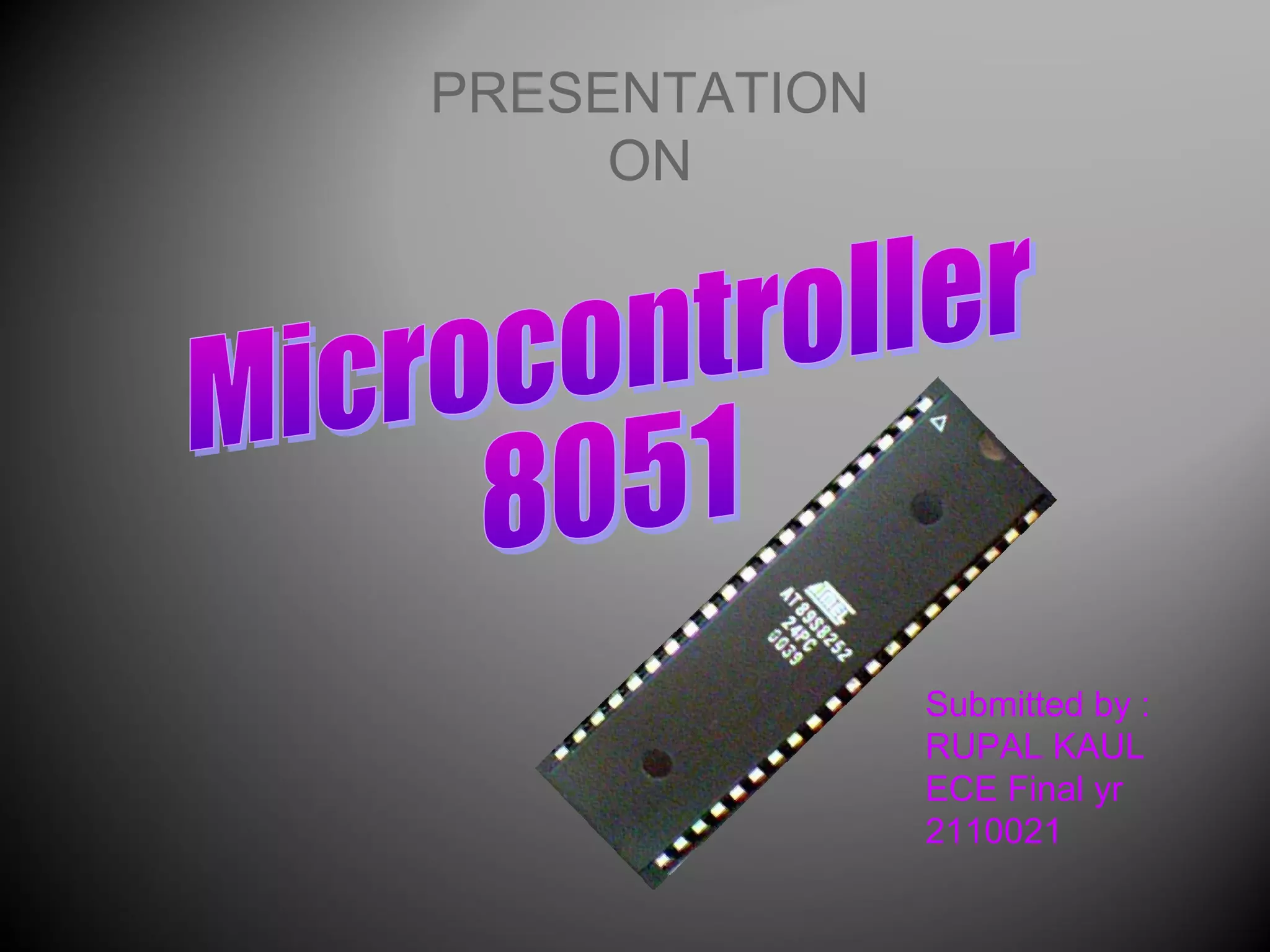


PRESENTATION
ON
Submitted by :
RUPAL KAUL
ECE Final yr
2110021
 The microprocessor is the core of computer
systems.
 Nowadays many communication, digital
entertainment, portable devices, are controlled
by them.
 A designer should know what types of
components he needs, ways to reduce
production costs and product reliable.
 CPU: Central Processing Unit
 I/O: Input /Output
 Bus: Address bus & Data bus
 Memory: RAM & ROM
 Timer
 Interrupt
 Serial Port
 Parallel Port
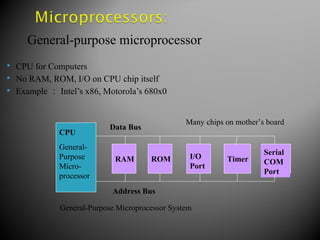
CPU
General-
Purpose
Micro-
processor
RAM ROM I/O
Port
Timer
Serial
COM
Port
Data Bus
Address Bus
General-Purpose Microprocessor System
 CPU for Computers
 No RAM, ROM, I/O on CPU chip itself
 Example : Intel’s x86, Motorola’s 680x0
Many chips on mother’s board
General-purpose microprocessor
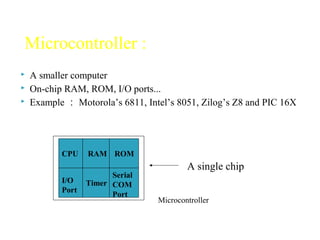
RAM ROM
I/O
Port
Timer
Serial
COM
Port
Microcontroller
CPU
 A smaller computer
 On-chip RAM, ROM, I/O ports...
 Example : Motorola’s 6811, Intel’s 8051, Zilog’s Z8 and PIC 16X
A single chip
Microcontroller :
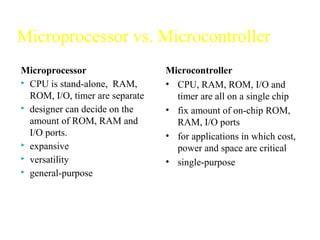
Microprocessor
 CPU is stand-alone, RAM,
ROM, I/O, timer are separate
 designer can decide on the
amount of ROM, RAM and
I/O ports.
 expansive
 versatility
 general-purpose
Microcontroller
• CPU, RAM, ROM, I/O and
timer are all on a single chip
• fix amount of on-chip ROM,
RAM, I/O ports
• for applications in which cost,
power and space are critical
• single-purpose
Microprocessor vs. Microcontroller
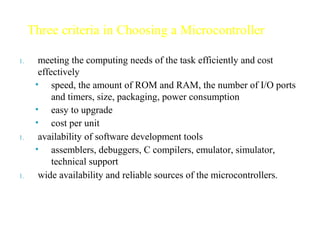
1. meeting the computing needs of the task efficiently and cost
effectively
• speed, the amount of ROM and RAM, the number of I/O ports
and timers, size, packaging, power consumption
• easy to upgrade
• cost per unit
1. availability of software development tools
• assemblers, debuggers, C compilers, emulator, simulator,
technical support
1. wide availability and reliable sources of the microcontrollers.
Three criteria in Choosing a Microcontroller
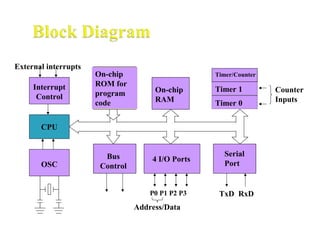
CPU
On-chip
RAM
On-chip
ROM for
program
code
4 I/O Ports
Timer 0
Serial
PortOSC
Interrupt
Control
External interrupts
Timer 1
Timer/Counter
Bus
Control
TxD RxDP0 P1 P2 P3
Address/Data
Counter
Inputs
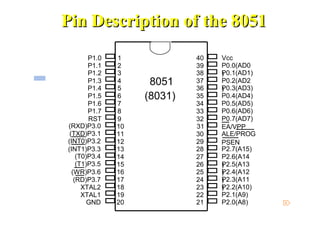
Pin Description of the 8051Pin Description of the 8051
1
2
3
4
5
6
7
8
9
10
11
12
13
14
15
16
17
18
19
20
40
39
38
37
36
35
34
33
32
31
30
29
28
27
26
25
24
23
22
21
P1.0
P1.1
P1.2
P1.3
P1.4
P1.5
P1.6
P1.7
RST
(RXD)P3.0
(TXD)P3.1
(T0)P3.4
(T1)P3.5
XTAL2
XTAL1
GND
(INT0)P3.2
(INT1)P3.3
(RD)P3.7
(WR)P3.6
Vcc
P0.0(AD0
)P0.1(AD1)
P0.2(AD2
)P0.3(AD3)
P0.4(AD4)
P0.5(AD5)
P0.6(AD6)
P0.7(AD7)
EA/VPP
ALE/PROG
PSEN
P2.7(A15)
P2.6(A14
)P2.5(A13
)P2.4(A12
)P2.3(A11
)P2.2(A10)
P2.1(A9)
P2.0(A8)
8051
(8031)

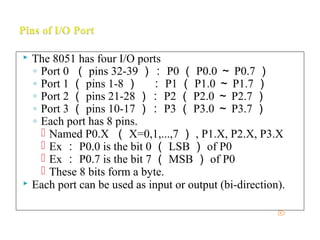
 The 8051 has four I/O ports
◦ Port 0 ( pins 32-39 ): P0 ( P0.0 ~ P0.7 )
◦ Port 1 ( pins 1-8 ) : P1 ( P1.0 ~ P1.7 )
◦ Port 2 ( pins 21-28 ): P2 ( P2.0 ~ P2.7 )
◦ Port 3 ( pins 10-17 ): P3 ( P3.0 ~ P3.7 )
◦ Each port has 8 pins.
 Named P0.X ( X=0,1,...,7 ) , P1.X, P2.X, P3.X
 Ex : P0.0 is the bit 0 ( LSB ) of P0
 Ex : P0.7 is the bit 7 ( MSB ) of P0
 These 8 bits form a byte.
 Each port can be used as input or output (bi-direction).

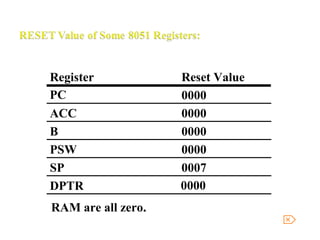
0000DPTR
0007SP
0000PSW
0000B
0000ACC
0000PC
Reset ValueRegister
RAM are all zero..

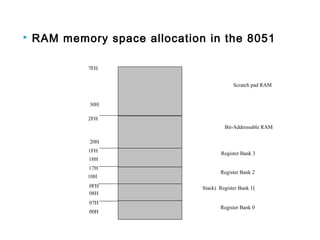
 RAM memory space allocation in the 8051
7FH
30H
2FH
20H
1FH
17H
10H
0FH
07H
08H
18H
00H
Register Bank 0
)Stack) Register Bank 1
Register Bank 2
Register Bank 3
Bit-Addressable RAM
Scratch pad RAM
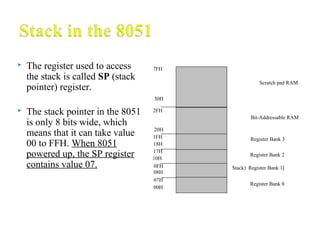
 The register used to access
the stack is called SP (stack
pointer) register.
 The stack pointer in the 8051
is only 8 bits wide, which
means that it can take value
00 to FFH. When 8051
powered up, the SP register
contains value 07.
7FH
30H
2FH
20H
1FH
17H
10H
0FH
07H
08H
18H
00H
Register Bank 0
)Stack) Register Bank 1
Register Bank 2
Register Bank 3
Bit-Addressable RAM
Scratch pad RAM
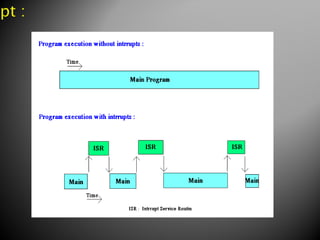
 Interrupt is an internal or external event that
suspends a program and transfers the control to an
event handler or ISR to handle the event.
 After the service is over the control is back to the
suspended program to resume the execution, The
microcontroller in a embedded system connects
many devices and need to handle service requests
from devices all the time.
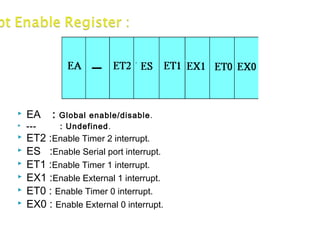
 EA : Global enable/disable.
 --- : Undefined.
 ET2 :Enable Timer 2 interrupt.
 ES :Enable Serial port interrupt.
 ET1 :Enable Timer 1 interrupt.
 EX1 :Enable External 1 interrupt.
 ET0 : Enable Timer 0 interrupt.
 EX0 : Enable External 0 interrupt.
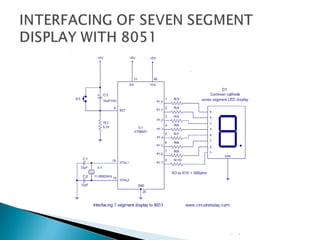
 The seven elements of the display can be lit in different
combinations to represent the Arabic numerals.
 In a simple LED package, typically all of the cathodes
)negative terminals) or all of the anodes )positive
terminals) of the segment LEDs are connected and
brought out to a common pin; this is referred to as a
"common cathode" or "common anode" device.
 Multiple-digit LED displays as used in pocket calculators
and similar devices used multiplexed displays to reduce
the number of I/O pins required to control the display.
.
.
..
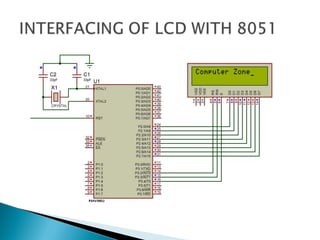
 A liquid crystal display (LCD) is a flat panel
display, electronic visual display, or video display that
uses the light modulating properties of liquid crystals.
Liquid crystals do not emit light directly.
 Each pixel of an LCD typically consists of a layer
of molecules aligned between two
transparent electrodes, and two polarizing filters, the
axes of transmission of which are (in most of the cases)
perpendicular to each other.
..
 Telecom
 Automotive applications
 Domestic applications
 Robotics
 Aerospace applications
 Medical equipment
 Defense systems
Sunday, September 29, 2013Mahdi Hassanpour
THANKYOU
Sunday, September 29, 2013Mahdi Hassanpour

8051 microcontroller training (2) (sahil gupta 9068557926)

  • 1.
    PRESENTATION ON Submitted by : RUPALKAUL ECE Final yr 2110021
  • 2.
     The microprocessoris the core of computer systems.  Nowadays many communication, digital entertainment, portable devices, are controlled by them.  A designer should know what types of components he needs, ways to reduce production costs and product reliable.
  • 3.
     CPU: CentralProcessing Unit  I/O: Input /Output  Bus: Address bus & Data bus  Memory: RAM & ROM  Timer  Interrupt  Serial Port  Parallel Port
  • 4.
    CPU General- Purpose Micro- processor RAM ROM I/O Port Timer Serial COM Port DataBus Address Bus General-Purpose Microprocessor System  CPU for Computers  No RAM, ROM, I/O on CPU chip itself  Example : Intel’s x86, Motorola’s 680x0 Many chips on mother’s board General-purpose microprocessor
  • 5.
    RAM ROM I/O Port Timer Serial COM Port Microcontroller CPU  Asmaller computer  On-chip RAM, ROM, I/O ports...  Example : Motorola’s 6811, Intel’s 8051, Zilog’s Z8 and PIC 16X A single chip Microcontroller :
  • 6.
    Microprocessor  CPU isstand-alone, RAM, ROM, I/O, timer are separate  designer can decide on the amount of ROM, RAM and I/O ports.  expansive  versatility  general-purpose Microcontroller • CPU, RAM, ROM, I/O and timer are all on a single chip • fix amount of on-chip ROM, RAM, I/O ports • for applications in which cost, power and space are critical • single-purpose Microprocessor vs. Microcontroller
  • 7.
    1. meeting thecomputing needs of the task efficiently and cost effectively • speed, the amount of ROM and RAM, the number of I/O ports and timers, size, packaging, power consumption • easy to upgrade • cost per unit 1. availability of software development tools • assemblers, debuggers, C compilers, emulator, simulator, technical support 1. wide availability and reliable sources of the microcontrollers. Three criteria in Choosing a Microcontroller
  • 8.
    CPU On-chip RAM On-chip ROM for program code 4 I/OPorts Timer 0 Serial PortOSC Interrupt Control External interrupts Timer 1 Timer/Counter Bus Control TxD RxDP0 P1 P2 P3 Address/Data Counter Inputs
  • 9.
    Pin Description ofthe 8051Pin Description of the 8051 1 2 3 4 5 6 7 8 9 10 11 12 13 14 15 16 17 18 19 20 40 39 38 37 36 35 34 33 32 31 30 29 28 27 26 25 24 23 22 21 P1.0 P1.1 P1.2 P1.3 P1.4 P1.5 P1.6 P1.7 RST (RXD)P3.0 (TXD)P3.1 (T0)P3.4 (T1)P3.5 XTAL2 XTAL1 GND (INT0)P3.2 (INT1)P3.3 (RD)P3.7 (WR)P3.6 Vcc P0.0(AD0 )P0.1(AD1) P0.2(AD2 )P0.3(AD3) P0.4(AD4) P0.5(AD5) P0.6(AD6) P0.7(AD7) EA/VPP ALE/PROG PSEN P2.7(A15) P2.6(A14 )P2.5(A13 )P2.4(A12 )P2.3(A11 )P2.2(A10) P2.1(A9) P2.0(A8) 8051 (8031) 
  • 10.
     The 8051has four I/O ports ◦ Port 0 ( pins 32-39 ): P0 ( P0.0 ~ P0.7 ) ◦ Port 1 ( pins 1-8 ) : P1 ( P1.0 ~ P1.7 ) ◦ Port 2 ( pins 21-28 ): P2 ( P2.0 ~ P2.7 ) ◦ Port 3 ( pins 10-17 ): P3 ( P3.0 ~ P3.7 ) ◦ Each port has 8 pins.  Named P0.X ( X=0,1,...,7 ) , P1.X, P2.X, P3.X  Ex : P0.0 is the bit 0 ( LSB ) of P0  Ex : P0.7 is the bit 7 ( MSB ) of P0  These 8 bits form a byte.  Each port can be used as input or output (bi-direction). 
  • 11.
  • 12.
     RAM memoryspace allocation in the 8051 7FH 30H 2FH 20H 1FH 17H 10H 0FH 07H 08H 18H 00H Register Bank 0 )Stack) Register Bank 1 Register Bank 2 Register Bank 3 Bit-Addressable RAM Scratch pad RAM
  • 13.
     The registerused to access the stack is called SP (stack pointer) register.  The stack pointer in the 8051 is only 8 bits wide, which means that it can take value 00 to FFH. When 8051 powered up, the SP register contains value 07. 7FH 30H 2FH 20H 1FH 17H 10H 0FH 07H 08H 18H 00H Register Bank 0 )Stack) Register Bank 1 Register Bank 2 Register Bank 3 Bit-Addressable RAM Scratch pad RAM
  • 14.
     Interrupt isan internal or external event that suspends a program and transfers the control to an event handler or ISR to handle the event.  After the service is over the control is back to the suspended program to resume the execution, The microcontroller in a embedded system connects many devices and need to handle service requests from devices all the time.
  • 16.
     EA :Global enable/disable.  --- : Undefined.  ET2 :Enable Timer 2 interrupt.  ES :Enable Serial port interrupt.  ET1 :Enable Timer 1 interrupt.  EX1 :Enable External 1 interrupt.  ET0 : Enable Timer 0 interrupt.  EX0 : Enable External 0 interrupt.
  • 17.
     The sevenelements of the display can be lit in different combinations to represent the Arabic numerals.  In a simple LED package, typically all of the cathodes )negative terminals) or all of the anodes )positive terminals) of the segment LEDs are connected and brought out to a common pin; this is referred to as a "common cathode" or "common anode" device.  Multiple-digit LED displays as used in pocket calculators and similar devices used multiplexed displays to reduce the number of I/O pins required to control the display. . .
  • 18.
  • 19.
     A liquid crystaldisplay (LCD) is a flat panel display, electronic visual display, or video display that uses the light modulating properties of liquid crystals. Liquid crystals do not emit light directly.  Each pixel of an LCD typically consists of a layer of molecules aligned between two transparent electrodes, and two polarizing filters, the axes of transmission of which are (in most of the cases) perpendicular to each other. ..
  • 21.
     Telecom  Automotiveapplications  Domestic applications  Robotics  Aerospace applications  Medical equipment  Defense systems Sunday, September 29, 2013Mahdi Hassanpour
  • 22.
    THANKYOU Sunday, September 29,2013Mahdi Hassanpour

Editor's Notes

  • #5 Intel’s x86: 8086,8088,80386,80486, Pentium Motorola’s 680x0: 68000, 68010, 68020,68030,6040
  • #7 versatility 多用途的 : any number of applications for PC
  • #11 Program is to read data from P0 and then send data to P1