A Project
on
Automatic Room Light
Controller With Bi-directional
Visitor Counter
By

Kushal Sarkar, Roll No. : 47
Lotish Gupta, Roll No. : 48
Niladri Dutta, Roll No.: 57
2nd year, B.Tech
Of
Department of Electronics and Communication Engineering

SIR J.C. BOSE SCHOOL OF ENGINEERING
Supreme Knowledge Foundation Group of Institutions
Contents
Introduction
Automatic Room Light Controller With
Bi-directional Visitor Counter
In today’s world, there is a continuous need for
automatic appliances. The objective of this project is
to make a controller based model to count number of
persons visiting particular room and accordingly light
up the room automatically. Here we can use sensor
and can know present number of persons.
Aim of our Project
The aim of our project is to make a controller
which can sense if any person enters the room
and it lights up the room automatically and
also counts how many person are entering the
room or going out of it. It is made to unwanted
prevent electric power waste in schools,
colleges, offices and houses. This whole
process is operated totally automatically by its
sensors.
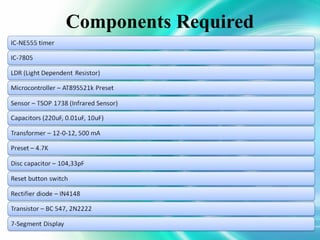
Components Required
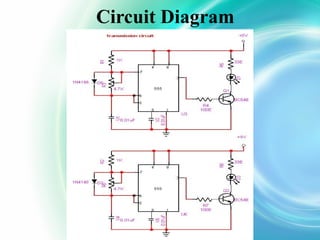
Circuit Diagram
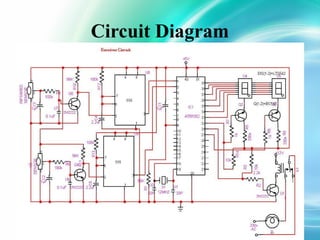
Circuit Diagram
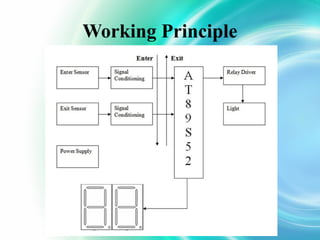
Working Principle
Working Principal
Working Principal
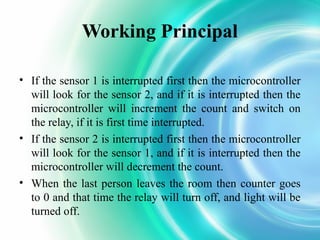
• If the sensor 1 is interrupted first then the microcontroller
will look for the sensor 2, and if it is interrupted then the
microcontroller will increment the count and switch on
the relay, if it is first time interrupted.
• If the sensor 2 is interrupted first then the microcontroller
will look for the sensor 1, and if it is interrupted then the
microcontroller will decrement the count.
• When the last person leaves the room then counter goes
to 0 and that time the relay will turn off, and light will be
turned off.
Advantages of Automatic Room
light controller
– Low cost
– Easy to use
– Can be implemented in single door
– Can be used for counting purposes
– Can be used for automatic room light control
Disadvantages
• It is used only when one person cuts the rays of
the sensor hence cannot be used when two or more
persons cross the door simultaneously.
• When anybody is inside the room and we need to switch
off the power then we’ve to do it manually. So, in this
case we fail to automatically control the light.
• In seven segment display board we can count up to a
certain no of people entering into the room. If the no of
body entering the room is greater than the maximum
limit of the display board then we fail to count it.
Other Applications
• For counting purposes
• For automatic room light control
Conclusion
The theme of this project when merged with certain
established technologies can be quite effective in
number of countries like Germany, France & Japan
etc. which control the train. This Project is useful in
developing countries and this project has a bright
future. This project helps us to control the light of a
room automatically and counts the number of
persons/visitors entering and leaving the room. By
using this circuit and proper power supply we can
implement various applications such as fans, tube
lights etc.
Bibliography
•

Reference Books:

•

E BALAGURUSAMY, “Programming in ANSI C”, Tata McGraw Hill, May 2010.

•

MUHAMMAD ALI, MAZID JANICE, GILLISPIE MAZIDI, “The
8051microcontroller and embedded systems”, Pearson Education, April 2009.

•

Websites:

•

www.datasheets4u.com

•

www.datasheetcatalog.com

•

www.8051.com
Acknowledgement
• We deem it a pleasure to acknowledge our deep sense of gratitude to
our Language Laboratory teacher, Mrs. Srima Nandi, Assistant
Professor, Dept. of Humanities & Social Sciences, Sir J. C. Bose
School of Engineering, Supreme Knowledge foundation Group of
Institutions (SKFGI), West Bengal, who directed and guided us with
her timely advice which eased the task of completing this Project.
• We wish to reciprocate in full measures the kindness shown by Mr.
Aritra Acharyya, Assistant Professor, Dept. of Electronics &
Communication Engineering, Sir J. C. Bose School of Engineering,
Supreme Knowledge foundation Group of Institutions (SKFGI),
West Bengal, who encouraged and inspired us in successfully
completing Project.
Any queries…. ????

Automatic room light controller with bidirectional visitor counter

  • 1.
    A Project on Automatic RoomLight Controller With Bi-directional Visitor Counter By Kushal Sarkar, Roll No. : 47 Lotish Gupta, Roll No. : 48 Niladri Dutta, Roll No.: 57 2nd year, B.Tech Of Department of Electronics and Communication Engineering SIR J.C. BOSE SCHOOL OF ENGINEERING Supreme Knowledge Foundation Group of Institutions
  • 2.
  • 3.
    Introduction Automatic Room LightController With Bi-directional Visitor Counter In today’s world, there is a continuous need for automatic appliances. The objective of this project is to make a controller based model to count number of persons visiting particular room and accordingly light up the room automatically. Here we can use sensor and can know present number of persons.
  • 4.
    Aim of ourProject The aim of our project is to make a controller which can sense if any person enters the room and it lights up the room automatically and also counts how many person are entering the room or going out of it. It is made to unwanted prevent electric power waste in schools, colleges, offices and houses. This whole process is operated totally automatically by its sensors.
  • 5.
  • 6.
  • 7.
  • 8.
  • 9.
  • 10.
    Working Principal • Ifthe sensor 1 is interrupted first then the microcontroller will look for the sensor 2, and if it is interrupted then the microcontroller will increment the count and switch on the relay, if it is first time interrupted. • If the sensor 2 is interrupted first then the microcontroller will look for the sensor 1, and if it is interrupted then the microcontroller will decrement the count. • When the last person leaves the room then counter goes to 0 and that time the relay will turn off, and light will be turned off.
  • 11.
    Advantages of AutomaticRoom light controller – Low cost – Easy to use – Can be implemented in single door – Can be used for counting purposes – Can be used for automatic room light control
  • 12.
    Disadvantages • It isused only when one person cuts the rays of the sensor hence cannot be used when two or more persons cross the door simultaneously. • When anybody is inside the room and we need to switch off the power then we’ve to do it manually. So, in this case we fail to automatically control the light. • In seven segment display board we can count up to a certain no of people entering into the room. If the no of body entering the room is greater than the maximum limit of the display board then we fail to count it.
  • 13.
    Other Applications • Forcounting purposes • For automatic room light control
  • 14.
    Conclusion The theme ofthis project when merged with certain established technologies can be quite effective in number of countries like Germany, France & Japan etc. which control the train. This Project is useful in developing countries and this project has a bright future. This project helps us to control the light of a room automatically and counts the number of persons/visitors entering and leaving the room. By using this circuit and proper power supply we can implement various applications such as fans, tube lights etc.
  • 15.
    Bibliography • Reference Books: • E BALAGURUSAMY,“Programming in ANSI C”, Tata McGraw Hill, May 2010. • MUHAMMAD ALI, MAZID JANICE, GILLISPIE MAZIDI, “The 8051microcontroller and embedded systems”, Pearson Education, April 2009. • Websites: • www.datasheets4u.com • www.datasheetcatalog.com • www.8051.com
  • 16.
    Acknowledgement • We deemit a pleasure to acknowledge our deep sense of gratitude to our Language Laboratory teacher, Mrs. Srima Nandi, Assistant Professor, Dept. of Humanities & Social Sciences, Sir J. C. Bose School of Engineering, Supreme Knowledge foundation Group of Institutions (SKFGI), West Bengal, who directed and guided us with her timely advice which eased the task of completing this Project. • We wish to reciprocate in full measures the kindness shown by Mr. Aritra Acharyya, Assistant Professor, Dept. of Electronics & Communication Engineering, Sir J. C. Bose School of Engineering, Supreme Knowledge foundation Group of Institutions (SKFGI), West Bengal, who encouraged and inspired us in successfully completing Project.
  • 18.