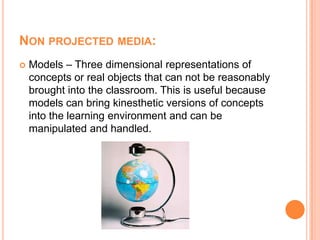
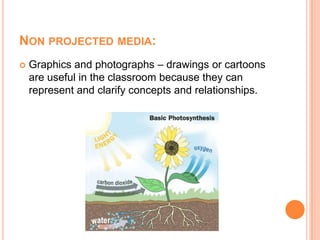
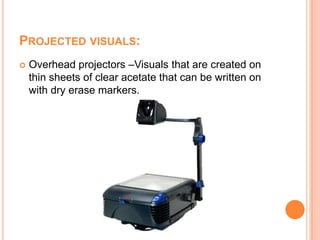
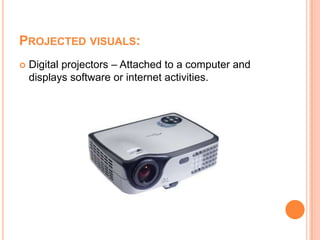
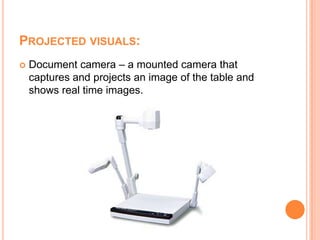
The document discusses different types of audio visual technologies used in schools. It describes broadcast, narrowcast, and cablecast video technologies as well as recorded video tapes. It defines visual literacy as the ability to accurately interpret visuals needed to function in society, and explains that it is learned through teaching and learning experiences. The document outlines different types of non-projected media like real objects, models, and print materials that can be brought into the classroom. It also discusses projected visuals such as overhead projectors, digital projectors, and document cameras. In closing, it notes how recorded video, non-projected media, and projected media could be implemented in the classroom.