SUBMITTED TO:-
Dr. Hemantlata Sharma,
Dept. Of Education, M.D.U.
SUBMITTED BY: -
Gunjan Verma,
Ph.D - 704
 INTRODUCTION.
COMPONENTS OF ATTITUDE.
ATTITUDE SCALE.
DIMENSIONS OF ATTITUDE
SCALE.
THURSTONE SCALE.
LIKERT SCALE.
CONCLUSION.
REFERENCES.
 The word attitude has been derived from
Latin word ‘Aptus’. Which means ability.
 Attitude is an established way of thinking or
feeling reflected in a person’s behaviour
towards others.
 It is a tendency to respond positively or
negatively towards a certain idea, object,
person or situation.
 In influences a person’s choices of action.
 It is what a person believes in or what a
person feels.
 Attitude can not be
measured in absolute
terms.
It can be observed in
terms of opinion
which can be elicited
from an individual’s
overt behaviour- both
verbal and non verbal.
 Eysnck(1972), “An attitude is normally
defined as a perceptual orientation &
response readiness in relation to a particular
object or class of objects”.
 Frank Freeman,“ An attitude is a
dispositional readiness to respond to certain
situations, persons or objects in a consistent
manner which has been learned and becomes
one’s typical mode of response” .
Attitudes are learnt.
Attitudes have referents.
Attitudes are social learning.
Attitudes are effective.
Attitudes vary in intensity.
Attitudes have a time dimension.
Attitudes are evolutions.
Attitudes are adopted also.
Attitudes are formed due to the process of
differentiation.
Some attitudes are formed due to some shock or
tragedy.
Attitudes are inferred.
Attitudes are complex.
Attitudes have a duration factor.
 It has three components:-
 Affective component:- The feelings or
emotions towards objects.
Ex- I am scared of spiders.
 Behavioural component:-the way the
attitude we have influences how we act or
behave.
Ex- I will avoid spiders and scream if i see
one.
 COGNITIVE
COMPONENT:-
This involves a
person’s belief /
knowledge about
an attitude
object.
Ex- I believe
spiders are
dangerous.
o This model is also
known as ABC
model of attitude.
 The word ‘scale’ come from the Latin
word scala, meaning a ladder or flight of
steps, a scale represents a series of ordered
steps at fixed intervals used as a standard of
measurement.
 An attitude scale is a special type of
questionnaire designed to produce scores
indicating the intensity and direction (for or
against) of a person’s feelings about an
object or event.
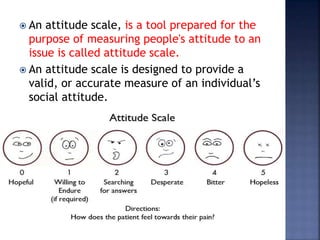
 An attitude scale, is a tool prepared for the
purpose of measuring people's attitude to an
issue is called attitude scale.
 An attitude scale is designed to provide a
valid, or accurate measure of an individual’s
social attitude.
Direction
DegreeIntensity
 DIRECTION: -
 It is a positive or
negative feeling
about something .
 It is an important
aspect of attitude.
 Ex- I like horses.
(Positive direction).
 I don’t like horses
(Negative direction.)
 It describes the amount of liking or disliking
attached to an attitude.
 Students may have different degrees of
liking, which can be measured from a
moderate to strong to very strong.
 The idea of degree can be applied to the
negative feelings towards an object also.
 It shows strength of feeling.
 At a high degree of intensity, some given kind
of behaviour is motivated.
 Also the comparison of strength of one
attitude to another may determine which
one becomes the basis of action.
 Ex – I am crazy about horses.
 This example shows high intensity of
attitude.
 Behaviour – she eats ice-cream.
 Affective reaction- she likes eating ice-
cream.
 Self – report – she tells us that she likes
eating ice-cream.
 Peer – report – her friends tells us.
 Physiological measure – heart rate.
 People may conceal their attitudes and
express socially acceptable opinions.
Ex- Politicians kissing a baby.
Is this behaviour a true affection towards
infants?
 It is the first formal method designed to measure
attitude.
 It was developed by Louis Leon thurstone in
1928.
 It is also known as method of equal appearing
interval.
 It is made up of statements about the particular
issues.
 consists of statements which have a range of
weights from high (usually 11) to low (usually 1).
 Subjects select the attitudinal statements they
agree with most.
 Selection of statement: -
1) 60 short statements regarding the issue
under study was collected. (historically,
130). Statements were short,
straightforward and unambiguous.
2) These statements should express opinions
not facts.
3) Statements should express all shades of
attitude from extremely favourable,
through neutral , to extremely non-
favourable.
 For this example, statements about same
sex marriage: -
 It’s should be against the law.
 There’s absolutely nothing wrong with it.
 Marriage is between a man and a woman.
 It should be a sin.
 It’s perfectly appropriate for two consenting
adults.
 It should be legalized.
 It can harm children.
 Same sex couples should have the same legal
rights as a male/female couple.
 It’s just horrible. It can’t do any harm.
 Selected statements were mimeographed on
separate slips of paper .
 Statements were sent out to about 30
judges( thurstone sent out to 300 judges) for
sorting into 11 or 9 piles. Each statement
should be put in one of the 11 or 9 piles.
 Categories starting from extremely
favourable to extremely unfavourable.
 After the judges have categorized the
statements, a frequency table to each
statement is drawn separately, showing the
number of judges put it in different
categories.
 For each statement, compute the Median and
the Interquartile Range.
 Median - is the value above and below which
50% of the ratings fall.
 The first quartile (Q1) - is the value below
which 25% of the cases fall and above which
75% of the cases fall - in other words, the
25th percentile.
 The median is the 50th percentile.
 The third quartile, Q3, is the 75th
percentile. The Interquartile Range is the
difference between third and first quartile,
or Q3 - Q1.
 If the judges cannot rate the item on its
favourability or show a high degree of
variability in their judgments, the item is
eliminated.
 The percentage of judges who placed each
statement in the different category
constitutes the basic data for computing the
scale value of a statement.
 The Median position (50th percentile or 2nd
quartile) assigned by the judges to the
statement is called the scale value of
statement.
 So, let’s assume that the average ratings
among our judges are as below:
 It’s should be against the law- 1.7
 There’s absolutely nothing wrong with it- 6.8
 Marriage is between a man and a woman-
2.4
 It should be a sin- 1.3
 It’s perfectly appropriate for two consenting
adults - 8.4
 It should be legalized - 9.1
 Arranged in random order and administered.
 Respondents tick mark the statements with
which they agree and leave the rest.
 The weights (favourability rating) for the
checked statements are summed and divided
by the number of statements checked.
 Example- the respondent selected #2, #3, #5-
his score will be- 6.8+ 2.4 + 8.4 / 3 = 5.8
 The most popular attitude scale type.
 It was given by Rensis Likert (1932).
 It is also known as Summated rating scale.
 Respondents indicate the extent to which
they endorse the statements (e.g., agree
/ disagree).
 Collect statement:-
This process does not require the
categorization of items by a group of judges.
Items (50 – 60) are selected on the basis of
the response of subjects to whom they are
administered in the course of developing the
test.
The statements are arranged randomly and a
have a five point rating scale- ‘strongly
agree’ , ‘agree’, ‘uncertain’, ‘Disagree’ ,
‘Strongly Disagree’.
After the respondents have finished with the list,
the statements are evaluated for the selection or
rejection in the final draft.
The list is printed and sent out to a sample of
about 200 members of the population concerned.
The criteria for this test is only ‘internal
consistency’.
o The number of favourable and unfavourable
statements should be approximately equal.
o The sum of the statements credits
represents the score of an individual.
Those statements for which the t-ratio is equal or greater
than 1.96 are suitable for selection.
Significance of difference is tested by t-ratio.
The mean scores and variances of each statement in the
top and bottom piles are computed separately.
Top 25 percent and bottom 25 percent scripts are taken
out.
Scripts are arranged in descending order of total scores.
Then top 10 to 15 favourable and
unfavourable statements are selected and
arranged randomly to shape the final
draft.
All the statements are sorted out and
arranged in descending order of numerical
value of t.
Final script administered.
Tick mark each of the statements.
Award marks- 1, 2, 3, 4, 5. ( reverse marks for reversal
items).
The sum of the scores of a respondent represents his
total score which can be interpreted in terms of
empirically established norms.
Thurstone scale Likert scale
 There is agreement or
disagreement among
a large number of
statement.
 Time consuming,
tiring and dissuading.
 Require judges.
 Usually five point
scale.
 Easy to explain and
develop.
 No need of judges.
 Designed to improve
the level of
measurement in
social research.
 Pathak, R.P (2012). Measurment and
Evaluation In Education. Noida: Dorling
Kindersley.
 Kochaar, S.K (2009). Guidance and
Counselling in Colleges and Universities.
New Delhi: Sterling Publishers Pvt. Ltd.
 Aggrawal, J.C (2011). Educational,
Vocational Guidance and Counselling. New
Delhi: Doaba House.
 Attitudes and Behaviour by Saul Mcleed,
2014.
Attitude scale

Attitude scale

  • 1.
    SUBMITTED TO:- Dr. HemantlataSharma, Dept. Of Education, M.D.U. SUBMITTED BY: - Gunjan Verma, Ph.D - 704
  • 2.
     INTRODUCTION. COMPONENTS OFATTITUDE. ATTITUDE SCALE. DIMENSIONS OF ATTITUDE SCALE. THURSTONE SCALE. LIKERT SCALE. CONCLUSION. REFERENCES.
  • 3.
     The wordattitude has been derived from Latin word ‘Aptus’. Which means ability.  Attitude is an established way of thinking or feeling reflected in a person’s behaviour towards others.  It is a tendency to respond positively or negatively towards a certain idea, object, person or situation.  In influences a person’s choices of action.  It is what a person believes in or what a person feels.
  • 4.
     Attitude cannot be measured in absolute terms. It can be observed in terms of opinion which can be elicited from an individual’s overt behaviour- both verbal and non verbal.
  • 5.
     Eysnck(1972), “Anattitude is normally defined as a perceptual orientation & response readiness in relation to a particular object or class of objects”.  Frank Freeman,“ An attitude is a dispositional readiness to respond to certain situations, persons or objects in a consistent manner which has been learned and becomes one’s typical mode of response” .
  • 6.
    Attitudes are learnt. Attitudeshave referents. Attitudes are social learning. Attitudes are effective. Attitudes vary in intensity. Attitudes have a time dimension. Attitudes are evolutions.
  • 7.
    Attitudes are adoptedalso. Attitudes are formed due to the process of differentiation. Some attitudes are formed due to some shock or tragedy. Attitudes are inferred. Attitudes are complex. Attitudes have a duration factor.
  • 8.
     It hasthree components:-  Affective component:- The feelings or emotions towards objects. Ex- I am scared of spiders.  Behavioural component:-the way the attitude we have influences how we act or behave. Ex- I will avoid spiders and scream if i see one.
  • 9.
     COGNITIVE COMPONENT:- This involvesa person’s belief / knowledge about an attitude object. Ex- I believe spiders are dangerous. o This model is also known as ABC model of attitude.
  • 10.
     The word‘scale’ come from the Latin word scala, meaning a ladder or flight of steps, a scale represents a series of ordered steps at fixed intervals used as a standard of measurement.  An attitude scale is a special type of questionnaire designed to produce scores indicating the intensity and direction (for or against) of a person’s feelings about an object or event.
  • 11.
     An attitudescale, is a tool prepared for the purpose of measuring people's attitude to an issue is called attitude scale.  An attitude scale is designed to provide a valid, or accurate measure of an individual’s social attitude.
  • 12.
  • 13.
     DIRECTION: - It is a positive or negative feeling about something .  It is an important aspect of attitude.  Ex- I like horses. (Positive direction).  I don’t like horses (Negative direction.)
  • 14.
     It describesthe amount of liking or disliking attached to an attitude.  Students may have different degrees of liking, which can be measured from a moderate to strong to very strong.  The idea of degree can be applied to the negative feelings towards an object also.
  • 15.
     It showsstrength of feeling.  At a high degree of intensity, some given kind of behaviour is motivated.  Also the comparison of strength of one attitude to another may determine which one becomes the basis of action.  Ex – I am crazy about horses.  This example shows high intensity of attitude.
  • 16.
     Behaviour –she eats ice-cream.  Affective reaction- she likes eating ice- cream.  Self – report – she tells us that she likes eating ice-cream.  Peer – report – her friends tells us.  Physiological measure – heart rate.  People may conceal their attitudes and express socially acceptable opinions. Ex- Politicians kissing a baby. Is this behaviour a true affection towards infants?
  • 17.
     It isthe first formal method designed to measure attitude.  It was developed by Louis Leon thurstone in 1928.  It is also known as method of equal appearing interval.  It is made up of statements about the particular issues.  consists of statements which have a range of weights from high (usually 11) to low (usually 1).  Subjects select the attitudinal statements they agree with most.
  • 18.
     Selection ofstatement: - 1) 60 short statements regarding the issue under study was collected. (historically, 130). Statements were short, straightforward and unambiguous. 2) These statements should express opinions not facts. 3) Statements should express all shades of attitude from extremely favourable, through neutral , to extremely non- favourable.
  • 19.
     For thisexample, statements about same sex marriage: -  It’s should be against the law.  There’s absolutely nothing wrong with it.  Marriage is between a man and a woman.  It should be a sin.  It’s perfectly appropriate for two consenting adults.  It should be legalized.  It can harm children.  Same sex couples should have the same legal rights as a male/female couple.  It’s just horrible. It can’t do any harm.
  • 20.
     Selected statementswere mimeographed on separate slips of paper .  Statements were sent out to about 30 judges( thurstone sent out to 300 judges) for sorting into 11 or 9 piles. Each statement should be put in one of the 11 or 9 piles.
  • 21.
     Categories startingfrom extremely favourable to extremely unfavourable.
  • 22.
     After thejudges have categorized the statements, a frequency table to each statement is drawn separately, showing the number of judges put it in different categories.
  • 23.
     For eachstatement, compute the Median and the Interquartile Range.  Median - is the value above and below which 50% of the ratings fall.  The first quartile (Q1) - is the value below which 25% of the cases fall and above which 75% of the cases fall - in other words, the 25th percentile.  The median is the 50th percentile.  The third quartile, Q3, is the 75th percentile. The Interquartile Range is the difference between third and first quartile, or Q3 - Q1.
  • 24.
     If thejudges cannot rate the item on its favourability or show a high degree of variability in their judgments, the item is eliminated.  The percentage of judges who placed each statement in the different category constitutes the basic data for computing the scale value of a statement.  The Median position (50th percentile or 2nd quartile) assigned by the judges to the statement is called the scale value of statement.
  • 25.
     So, let’sassume that the average ratings among our judges are as below:  It’s should be against the law- 1.7  There’s absolutely nothing wrong with it- 6.8  Marriage is between a man and a woman- 2.4  It should be a sin- 1.3  It’s perfectly appropriate for two consenting adults - 8.4  It should be legalized - 9.1
  • 26.
     Arranged inrandom order and administered.  Respondents tick mark the statements with which they agree and leave the rest.  The weights (favourability rating) for the checked statements are summed and divided by the number of statements checked.  Example- the respondent selected #2, #3, #5- his score will be- 6.8+ 2.4 + 8.4 / 3 = 5.8
  • 28.
     The mostpopular attitude scale type.  It was given by Rensis Likert (1932).  It is also known as Summated rating scale.  Respondents indicate the extent to which they endorse the statements (e.g., agree / disagree).
  • 29.
     Collect statement:- Thisprocess does not require the categorization of items by a group of judges. Items (50 – 60) are selected on the basis of the response of subjects to whom they are administered in the course of developing the test. The statements are arranged randomly and a have a five point rating scale- ‘strongly agree’ , ‘agree’, ‘uncertain’, ‘Disagree’ , ‘Strongly Disagree’.
  • 30.
    After the respondentshave finished with the list, the statements are evaluated for the selection or rejection in the final draft. The list is printed and sent out to a sample of about 200 members of the population concerned. The criteria for this test is only ‘internal consistency’.
  • 31.
    o The numberof favourable and unfavourable statements should be approximately equal. o The sum of the statements credits represents the score of an individual.
  • 32.
    Those statements forwhich the t-ratio is equal or greater than 1.96 are suitable for selection. Significance of difference is tested by t-ratio. The mean scores and variances of each statement in the top and bottom piles are computed separately. Top 25 percent and bottom 25 percent scripts are taken out. Scripts are arranged in descending order of total scores.
  • 33.
    Then top 10to 15 favourable and unfavourable statements are selected and arranged randomly to shape the final draft. All the statements are sorted out and arranged in descending order of numerical value of t.
  • 34.
    Final script administered. Tickmark each of the statements. Award marks- 1, 2, 3, 4, 5. ( reverse marks for reversal items). The sum of the scores of a respondent represents his total score which can be interpreted in terms of empirically established norms.
  • 37.
    Thurstone scale Likertscale  There is agreement or disagreement among a large number of statement.  Time consuming, tiring and dissuading.  Require judges.  Usually five point scale.  Easy to explain and develop.  No need of judges.  Designed to improve the level of measurement in social research.
  • 38.
     Pathak, R.P(2012). Measurment and Evaluation In Education. Noida: Dorling Kindersley.  Kochaar, S.K (2009). Guidance and Counselling in Colleges and Universities. New Delhi: Sterling Publishers Pvt. Ltd.  Aggrawal, J.C (2011). Educational, Vocational Guidance and Counselling. New Delhi: Doaba House.  Attitudes and Behaviour by Saul Mcleed, 2014.