ASSESSMENT OF ATTITUDES
Introduction.
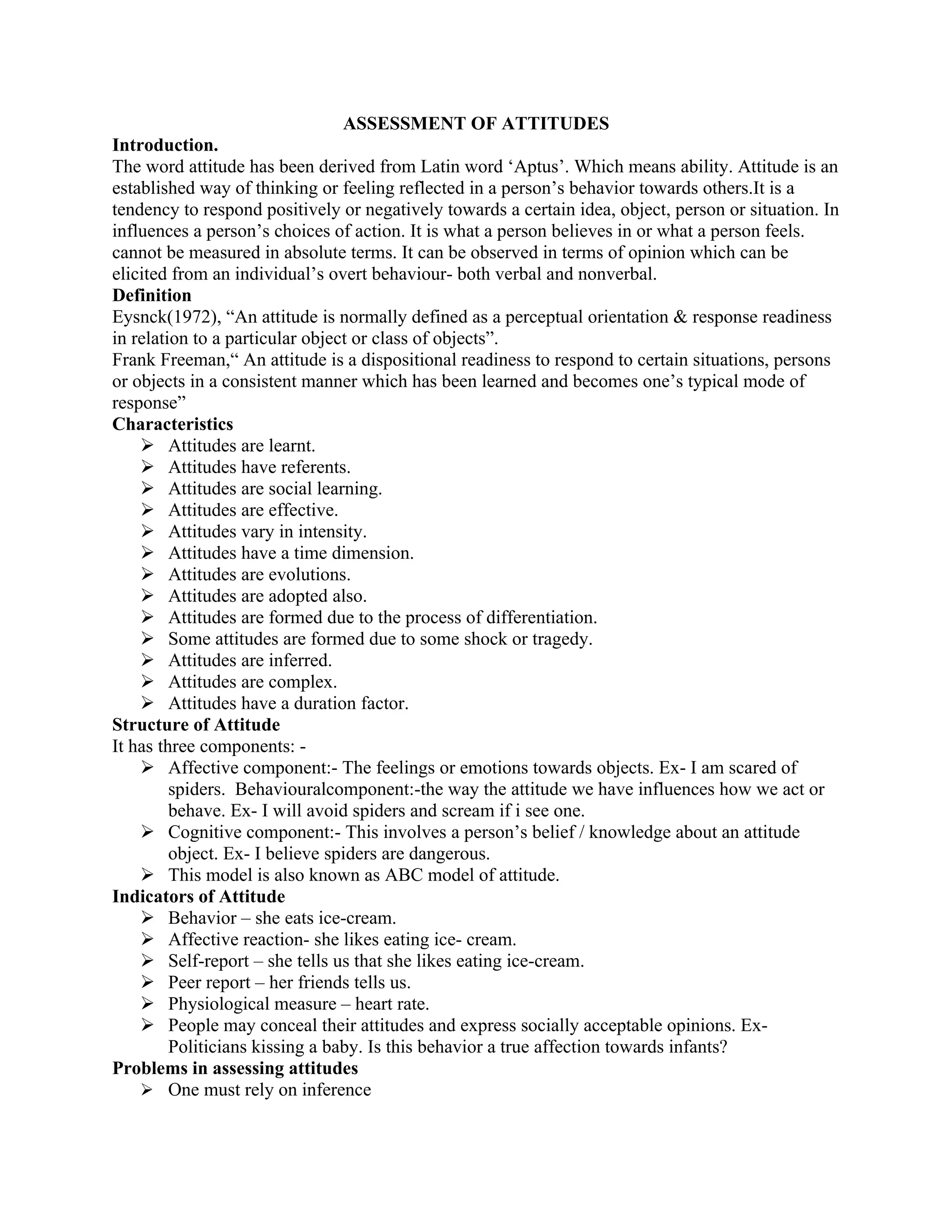
The word attitude has been derived from Latin word ‘Aptus’. Which means ability. Attitude is an
established way of thinking or feeling reflected in a person’s behavior towards others.It is a
tendency to respond positively or negatively towards a certain idea, object, person or situation. In
influences a person’s choices of action. It is what a person believes in or what a person feels.
cannot be measured in absolute terms. It can be observed in terms of opinion which can be
elicited from an individual’s overt behaviour- both verbal and nonverbal.
Definition
Eysnck(1972), “An attitude is normally defined as a perceptual orientation & response readiness
in relation to a particular object or class of objects”.
Frank Freeman,“ An attitude is a dispositional readiness to respond to certain situations, persons
or objects in a consistent manner which has been learned and becomes one’s typical mode of
response”
Characteristics
 Attitudes are learnt.
 Attitudes have referents.
 Attitudes are social learning.
 Attitudes are effective.
 Attitudes vary in intensity.
 Attitudes have a time dimension.
 Attitudes are evolutions.
 Attitudes are adopted also.
 Attitudes are formed due to the process of differentiation.
 Some attitudes are formed due to some shock or tragedy.
 Attitudes are inferred.
 Attitudes are complex.
 Attitudes have a duration factor.
Structure of Attitude
It has three components: -
 Affective component:- The feelings or emotions towards objects. Ex- I am scared of
spiders. Behaviouralcomponent:-the way the attitude we have influences how we act or
behave. Ex- I will avoid spiders and scream if i see one.
 Cognitive component:- This involves a person’s belief / knowledge about an attitude
object. Ex- I believe spiders are dangerous.
 This model is also known as ABC model of attitude.
Indicators of Attitude
 Behavior – she eats ice-cream.
 Affective reaction- she likes eating ice- cream.
 Self-report – she tells us that she likes eating ice-cream.
 Peer report – her friends tells us.
 Physiological measure – heart rate.
 People may conceal their attitudes and express socially acceptable opinions. Ex-
Politicians kissing a baby. Is this behavior a true affection towards infants?
Problems in assessing attitudes
 One must rely on inference
 An attitude has many facets e.g. feelings, beliefs, values
 An attitude has many manifestations e.g. behaviors, verbal responses
 Behaviors, beliefs and feelings will not always match
 An attitude can fluctuate
 There is often lack of agreement on the nature or desirability of certain attitudes
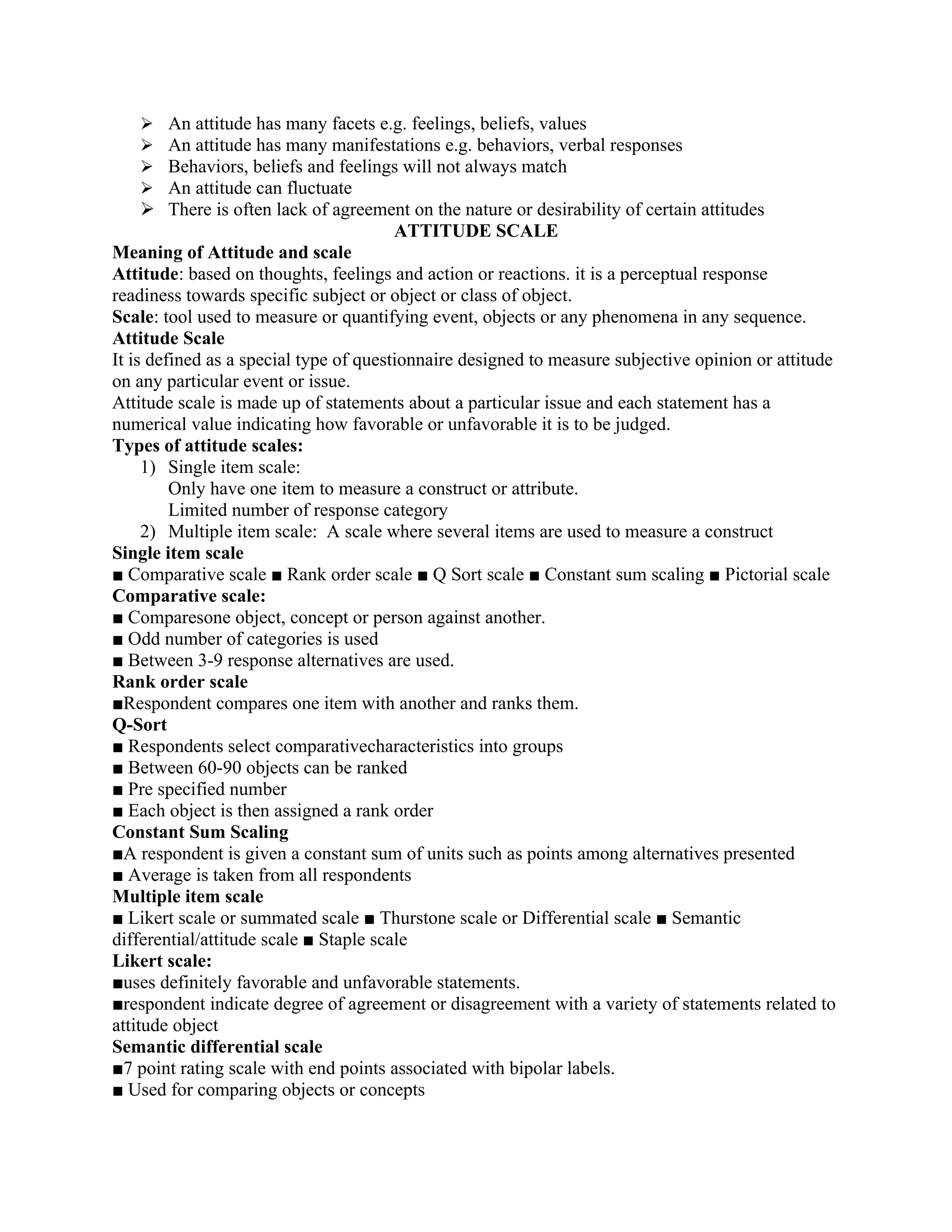
ATTITUDE SCALE
Meaning of Attitude and scale
Attitude: based on thoughts, feelings and action or reactions. it is a perceptual response
readiness towards specific subject or object or class of object.
Scale: tool used to measure or quantifying event, objects or any phenomena in any sequence.
Attitude Scale
It is defined as a special type of questionnaire designed to measure subjective opinion or attitude
on any particular event or issue.
Attitude scale is made up of statements about a particular issue and each statement has a
numerical value indicating how favorable or unfavorable it is to be judged.
Types of attitude scales:
1) Single item scale:
Only have one item to measure a construct or attribute.
Limited number of response category
2) Multiple item scale: A scale where several items are used to measure a construct
Single item scale
■ Comparative scale ■ Rank order scale ■ Q Sort scale ■ Constant sum scaling ■ Pictorial scale
Comparative scale:
■ Comparesone object, concept or person against another.
■ Odd number of categories is used
■ Between 3-9 response alternatives are used.
Rank order scale
■Respondent compares one item with another and ranks them.
Q-Sort
■ Respondents select comparativecharacteristics into groups
■ Between 60-90 objects can be ranked
■ Pre specified number
■ Each object is then assigned a rank order
Constant Sum Scaling
■A respondent is given a constant sum of units such as points among alternatives presented
■ Average is taken from all respondents
Multiple item scale
■ Likert scale or summated scale ■ Thurstone scale or Differential scale ■ Semantic
differential/attitude scale ■ Staple scale
Likert scale:
■uses definitely favorable and unfavorable statements.
■respondent indicate degree of agreement or disagreement with a variety of statements related to
attitude object
Semantic differential scale
■7 point rating scale with end points associated with bipolar labels.
■ Used for comparing objects or concepts
Stapel scale
■ Unipolarrating scale with 10 categories without a neutral point
■ No need to pre-test adjectives
Conclusion:
■ Attitude scaleis a tool which provides a quantitative measurement of attitudes, opinions or
values by summarizing numerical scores based on people’s responses to sets of statements.
■ Categorized as single item scale having only one item to measure a construct and multiple item
scale having several items to measure an attribute.
■ Various types of attitude scales used for scaling opinions or values of people are likert scale,
differential scale, Q-sort scale, rank order, comparative scale.
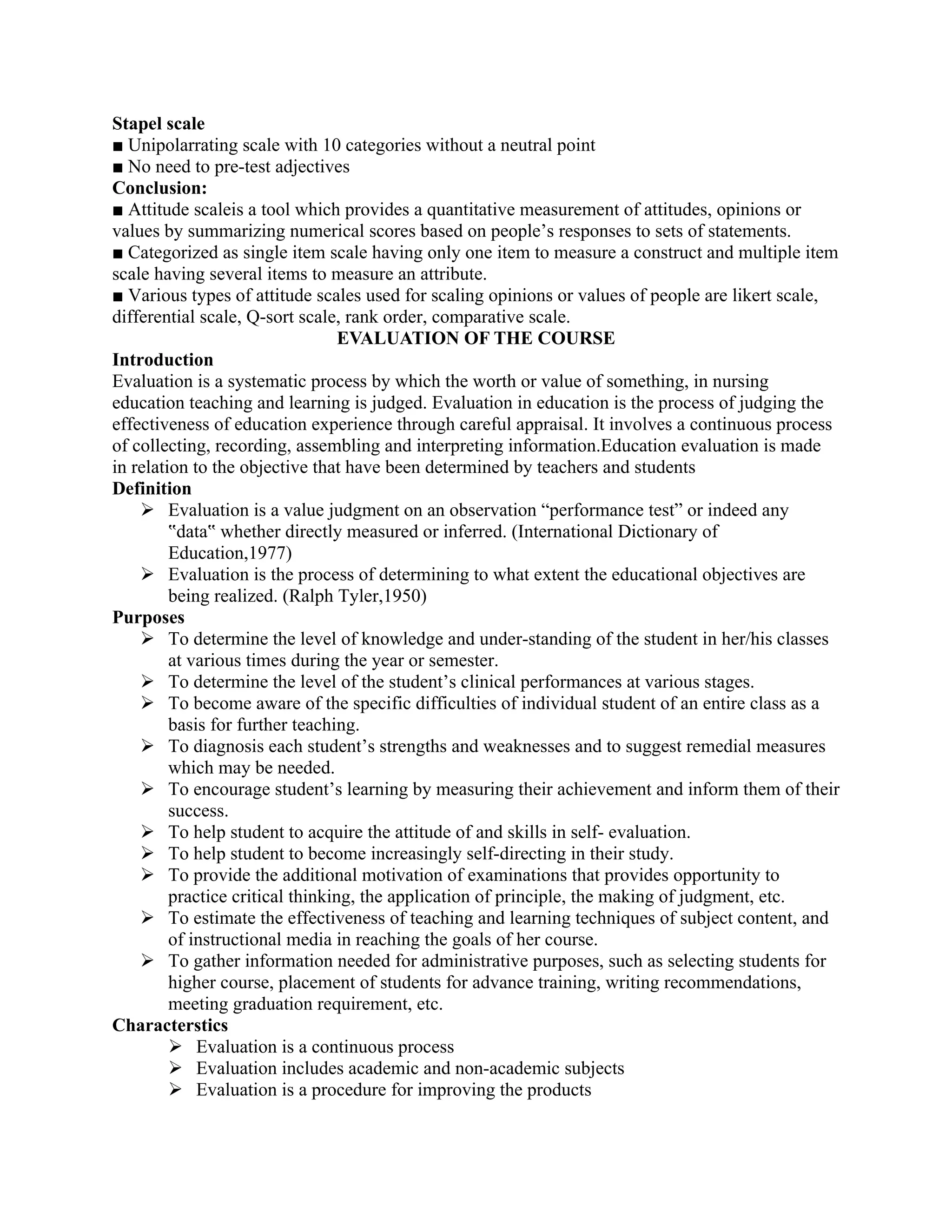
EVALUATION OF THE COURSE
Introduction
Evaluation is a systematic process by which the worth or value of something, in nursing
education teaching and learning is judged. Evaluation in education is the process of judging the
effectiveness of education experience through careful appraisal. It involves a continuous process
of collecting, recording, assembling and interpreting information.Education evaluation is made
in relation to the objective that have been determined by teachers and students
Definition
 Evaluation is a value judgment on an observation “performance test” or indeed any
data whether directly measured or inferred. (International Dictionary of
‟ ‟
Education,1977)
 Evaluation is the process of determining to what extent the educational objectives are
being realized. (Ralph Tyler,1950)
Purposes
 To determine the level of knowledge and under-standing of the student in her/his classes
at various times during the year or semester.
 To determine the level of the student’s clinical performances at various stages.
 To become aware of the specific difficulties of individual student of an entire class as a
basis for further teaching.
 To diagnosis each student’s strengths and weaknesses and to suggest remedial measures
which may be needed.
 To encourage student’s learning by measuring their achievement and inform them of their
success.
 To help student to acquire the attitude of and skills in self- evaluation.
 To help student to become increasingly self-directing in their study.
 To provide the additional motivation of examinations that provides opportunity to
practice critical thinking, the application of principle, the making of judgment, etc.
 To estimate the effectiveness of teaching and learning techniques of subject content, and
of instructional media in reaching the goals of her course.
 To gather information needed for administrative purposes, such as selecting students for
higher course, placement of students for advance training, writing recommendations,
meeting graduation requirement, etc.
Characterstics
 Evaluation is a continuous process
 Evaluation includes academic and non-academic subjects
 Evaluation is a procedure for improving the products
 Evaluation discovers the needs of an individual and designing learning experience
that will solve these needs
 Evaluation in terms of purposes
 Correlation between the education system and the system of evaluation
 Evaluation is a complex process
Components of evaluation
 Specifying learning outcomes.
 Collection of evidence about students growth
 Analysis and interpretations of growth/performance of students.
 Diagnostic appraisal (Indicating the level of performance)
 Redefining and readjusting the instructional objectives on the basis feedback.
Principles of evaluation
 Considering, the interrelationship between objectives, instruction or learning experiences
and evaluation.
 Determining and clarifying what is to be evaluation.
 Selecting evaluation techniques in terms of objectives to be served.
 Combining a variety of evaluation techniques for comprehensive evaluation.
 Knowing the strength and limitations of various evaluation techniques.
 Taking evaluation as a mean to an end, not an end in itself.
Types of evaluation
Formative evaluation
The term “formative denotes the ongoing or systemic assessment of student achievement while
‟
the term, course or program in progress. Formative evaluation is used to monitor learning
progress during instruction and to provide continuous feedback to both student and teacher
concerning learning success and failure. Feedback to student reinforces learning and feedback to
teacher provides information for modifying instruction.
 Formative evaluation is done during an instructional programme.
 It is focus on molecular analysis.
 It is cause seeking.
 It is interested in the broader experiences of the program users.
 Formative evaluations design is exploratory and flexible.
 It tends to ignore local effects of particular programme.
 It seeks to identify influential variables.
 It requires analysis of instruction material for mapping the structure of the learning tasks
and actual teaching of course for a certain period.
Summative evaluation
The term “summative” refers to assigning a grade for student’s achievement at end of a term,
course or programme. Summative evaluation typically comes at the end of a course of
instruction. It is designed to determine the extent to which the instructional objective have been
achieved and is used primarily for assigning course grade or certifying student mastery of the
intended learning outcome.
 There should be some instructional programme before summative evaluation.
 Summative evaluation should check whether there has been learning or not.
 It tends to use of well-defined evaluation designs.
 Summative evaluation focuses on analysis.
 It provides descriptive analysis.
 It is concerned with broad range of issues.
 Its instrument is valid and reliable.
 It tends to stress local effects.
Difference between formative and summative evaluations
Characteristics Formative Summative
Purpose To monitor progress of
students by getting feed back
To check final status of
students
Content focus Detailed Narrow Scope General Broad Scope
Methods Daily assignment,
observation
Tests, projects
Frequency Daily Weekly, quarterly, yearly etc.
Classification of Evaluation Techniques
• Quantitative Techniques • Qualitative Techniques
Quantitative Techniques
These are mainly used in educational evaluation. These are highly valid and reliable. They
possess all three characteristics of a criterion test which includes appropriateness, effectiveness
and practical ability.
The quantitative test can be classified into three types:
1. Oral technique: Oral techniques of evaluation are used as lower level in organizing and
teaching activities. The oral questions, debate and drama are used for this purpose.
2. Written techniques: these include the written questions that are asked and student has to
write their answers. The written test are most effective than oral test. The written test is usually
essay type and objective type test.
3. Practical technique: in practical technique type of evaluation some work is assigned to the
student to accomplish it such techniques are used to assess the skills. This technique is used in
science, medical, nursing and engineering etc.
Qualitative techniques
These techniques are used in schools and colleges for internal assessment. These techniques are
subjective and less reliable, but they are used for assessing the affective objectives. These
techniques are classified into five categories:
1.Cumulative record: these records are prepared in schools and colleges foe each student. The
cumulative records of the students include educational progress results of tests, attendance, and
participation in games, extra-curricular activities and physical health. The cumulative record of
the students provides the awareness about their progress and weakness to teachers and parents.
2. Anecdotal records: this type of records maintains the description of significant event and
performance of student. The interest and learning of the students can be assessed with help of
such records.
3. Observation technique: it is used in all the stages of education but most useful in evaluating
the small children at primary level.it is used for evaluating cognitive, affective and psychomotor
objectives.
4. Check list: this is used for evaluating interest, attitude, and values of students. It includes
certain statement of yes or no type; the student has to check either of two.
5. Rating scale: the rating scale is used for assessing the attitude of students towards teaching
and subjects. It is used for higher classes because it requires the power of judgment of students.
The statement of scales is concern with the specific objectives and learning
Conclusion
Evaluation is a value judgment on an observation “performance test” or indeed any data
‟ ‟
whether directly measured or inferred. Through this lesson plan students will be able to learn
about the types of evaluation, its characteristics, and principles of evaluation.

ATTITUDE SCALE.docx education notes for nursing students

  • 1.
    ASSESSMENT OF ATTITUDES Introduction. Theword attitude has been derived from Latin word ‘Aptus’. Which means ability. Attitude is an established way of thinking or feeling reflected in a person’s behavior towards others.It is a tendency to respond positively or negatively towards a certain idea, object, person or situation. In influences a person’s choices of action. It is what a person believes in or what a person feels. cannot be measured in absolute terms. It can be observed in terms of opinion which can be elicited from an individual’s overt behaviour- both verbal and nonverbal. Definition Eysnck(1972), “An attitude is normally defined as a perceptual orientation & response readiness in relation to a particular object or class of objects”. Frank Freeman,“ An attitude is a dispositional readiness to respond to certain situations, persons or objects in a consistent manner which has been learned and becomes one’s typical mode of response” Characteristics  Attitudes are learnt.  Attitudes have referents.  Attitudes are social learning.  Attitudes are effective.  Attitudes vary in intensity.  Attitudes have a time dimension.  Attitudes are evolutions.  Attitudes are adopted also.  Attitudes are formed due to the process of differentiation.  Some attitudes are formed due to some shock or tragedy.  Attitudes are inferred.  Attitudes are complex.  Attitudes have a duration factor. Structure of Attitude It has three components: -  Affective component:- The feelings or emotions towards objects. Ex- I am scared of spiders. Behaviouralcomponent:-the way the attitude we have influences how we act or behave. Ex- I will avoid spiders and scream if i see one.  Cognitive component:- This involves a person’s belief / knowledge about an attitude object. Ex- I believe spiders are dangerous.  This model is also known as ABC model of attitude. Indicators of Attitude  Behavior – she eats ice-cream.  Affective reaction- she likes eating ice- cream.  Self-report – she tells us that she likes eating ice-cream.  Peer report – her friends tells us.  Physiological measure – heart rate.  People may conceal their attitudes and express socially acceptable opinions. Ex- Politicians kissing a baby. Is this behavior a true affection towards infants? Problems in assessing attitudes  One must rely on inference
  • 2.
     An attitudehas many facets e.g. feelings, beliefs, values  An attitude has many manifestations e.g. behaviors, verbal responses  Behaviors, beliefs and feelings will not always match  An attitude can fluctuate  There is often lack of agreement on the nature or desirability of certain attitudes ATTITUDE SCALE Meaning of Attitude and scale Attitude: based on thoughts, feelings and action or reactions. it is a perceptual response readiness towards specific subject or object or class of object. Scale: tool used to measure or quantifying event, objects or any phenomena in any sequence. Attitude Scale It is defined as a special type of questionnaire designed to measure subjective opinion or attitude on any particular event or issue. Attitude scale is made up of statements about a particular issue and each statement has a numerical value indicating how favorable or unfavorable it is to be judged. Types of attitude scales: 1) Single item scale: Only have one item to measure a construct or attribute. Limited number of response category 2) Multiple item scale: A scale where several items are used to measure a construct Single item scale ■ Comparative scale ■ Rank order scale ■ Q Sort scale ■ Constant sum scaling ■ Pictorial scale Comparative scale: ■ Comparesone object, concept or person against another. ■ Odd number of categories is used ■ Between 3-9 response alternatives are used. Rank order scale ■Respondent compares one item with another and ranks them. Q-Sort ■ Respondents select comparativecharacteristics into groups ■ Between 60-90 objects can be ranked ■ Pre specified number ■ Each object is then assigned a rank order Constant Sum Scaling ■A respondent is given a constant sum of units such as points among alternatives presented ■ Average is taken from all respondents Multiple item scale ■ Likert scale or summated scale ■ Thurstone scale or Differential scale ■ Semantic differential/attitude scale ■ Staple scale Likert scale: ■uses definitely favorable and unfavorable statements. ■respondent indicate degree of agreement or disagreement with a variety of statements related to attitude object Semantic differential scale ■7 point rating scale with end points associated with bipolar labels. ■ Used for comparing objects or concepts
  • 3.
    Stapel scale ■ Unipolarratingscale with 10 categories without a neutral point ■ No need to pre-test adjectives Conclusion: ■ Attitude scaleis a tool which provides a quantitative measurement of attitudes, opinions or values by summarizing numerical scores based on people’s responses to sets of statements. ■ Categorized as single item scale having only one item to measure a construct and multiple item scale having several items to measure an attribute. ■ Various types of attitude scales used for scaling opinions or values of people are likert scale, differential scale, Q-sort scale, rank order, comparative scale. EVALUATION OF THE COURSE Introduction Evaluation is a systematic process by which the worth or value of something, in nursing education teaching and learning is judged. Evaluation in education is the process of judging the effectiveness of education experience through careful appraisal. It involves a continuous process of collecting, recording, assembling and interpreting information.Education evaluation is made in relation to the objective that have been determined by teachers and students Definition  Evaluation is a value judgment on an observation “performance test” or indeed any data whether directly measured or inferred. (International Dictionary of ‟ ‟ Education,1977)  Evaluation is the process of determining to what extent the educational objectives are being realized. (Ralph Tyler,1950) Purposes  To determine the level of knowledge and under-standing of the student in her/his classes at various times during the year or semester.  To determine the level of the student’s clinical performances at various stages.  To become aware of the specific difficulties of individual student of an entire class as a basis for further teaching.  To diagnosis each student’s strengths and weaknesses and to suggest remedial measures which may be needed.  To encourage student’s learning by measuring their achievement and inform them of their success.  To help student to acquire the attitude of and skills in self- evaluation.  To help student to become increasingly self-directing in their study.  To provide the additional motivation of examinations that provides opportunity to practice critical thinking, the application of principle, the making of judgment, etc.  To estimate the effectiveness of teaching and learning techniques of subject content, and of instructional media in reaching the goals of her course.  To gather information needed for administrative purposes, such as selecting students for higher course, placement of students for advance training, writing recommendations, meeting graduation requirement, etc. Characterstics  Evaluation is a continuous process  Evaluation includes academic and non-academic subjects  Evaluation is a procedure for improving the products
  • 4.
     Evaluation discoversthe needs of an individual and designing learning experience that will solve these needs  Evaluation in terms of purposes  Correlation between the education system and the system of evaluation  Evaluation is a complex process Components of evaluation  Specifying learning outcomes.  Collection of evidence about students growth  Analysis and interpretations of growth/performance of students.  Diagnostic appraisal (Indicating the level of performance)  Redefining and readjusting the instructional objectives on the basis feedback. Principles of evaluation  Considering, the interrelationship between objectives, instruction or learning experiences and evaluation.  Determining and clarifying what is to be evaluation.  Selecting evaluation techniques in terms of objectives to be served.  Combining a variety of evaluation techniques for comprehensive evaluation.  Knowing the strength and limitations of various evaluation techniques.  Taking evaluation as a mean to an end, not an end in itself. Types of evaluation Formative evaluation The term “formative denotes the ongoing or systemic assessment of student achievement while ‟ the term, course or program in progress. Formative evaluation is used to monitor learning progress during instruction and to provide continuous feedback to both student and teacher concerning learning success and failure. Feedback to student reinforces learning and feedback to teacher provides information for modifying instruction.  Formative evaluation is done during an instructional programme.  It is focus on molecular analysis.  It is cause seeking.  It is interested in the broader experiences of the program users.  Formative evaluations design is exploratory and flexible.  It tends to ignore local effects of particular programme.  It seeks to identify influential variables.  It requires analysis of instruction material for mapping the structure of the learning tasks and actual teaching of course for a certain period. Summative evaluation The term “summative” refers to assigning a grade for student’s achievement at end of a term, course or programme. Summative evaluation typically comes at the end of a course of instruction. It is designed to determine the extent to which the instructional objective have been achieved and is used primarily for assigning course grade or certifying student mastery of the intended learning outcome.  There should be some instructional programme before summative evaluation.  Summative evaluation should check whether there has been learning or not.  It tends to use of well-defined evaluation designs.  Summative evaluation focuses on analysis.  It provides descriptive analysis.
  • 5.
     It isconcerned with broad range of issues.  Its instrument is valid and reliable.  It tends to stress local effects. Difference between formative and summative evaluations Characteristics Formative Summative Purpose To monitor progress of students by getting feed back To check final status of students Content focus Detailed Narrow Scope General Broad Scope Methods Daily assignment, observation Tests, projects Frequency Daily Weekly, quarterly, yearly etc. Classification of Evaluation Techniques • Quantitative Techniques • Qualitative Techniques Quantitative Techniques These are mainly used in educational evaluation. These are highly valid and reliable. They possess all three characteristics of a criterion test which includes appropriateness, effectiveness and practical ability. The quantitative test can be classified into three types: 1. Oral technique: Oral techniques of evaluation are used as lower level in organizing and teaching activities. The oral questions, debate and drama are used for this purpose. 2. Written techniques: these include the written questions that are asked and student has to write their answers. The written test are most effective than oral test. The written test is usually essay type and objective type test. 3. Practical technique: in practical technique type of evaluation some work is assigned to the student to accomplish it such techniques are used to assess the skills. This technique is used in science, medical, nursing and engineering etc. Qualitative techniques These techniques are used in schools and colleges for internal assessment. These techniques are subjective and less reliable, but they are used for assessing the affective objectives. These techniques are classified into five categories: 1.Cumulative record: these records are prepared in schools and colleges foe each student. The cumulative records of the students include educational progress results of tests, attendance, and participation in games, extra-curricular activities and physical health. The cumulative record of the students provides the awareness about their progress and weakness to teachers and parents. 2. Anecdotal records: this type of records maintains the description of significant event and performance of student. The interest and learning of the students can be assessed with help of such records. 3. Observation technique: it is used in all the stages of education but most useful in evaluating the small children at primary level.it is used for evaluating cognitive, affective and psychomotor objectives. 4. Check list: this is used for evaluating interest, attitude, and values of students. It includes certain statement of yes or no type; the student has to check either of two. 5. Rating scale: the rating scale is used for assessing the attitude of students towards teaching and subjects. It is used for higher classes because it requires the power of judgment of students. The statement of scales is concern with the specific objectives and learning Conclusion
  • 6.
    Evaluation is avalue judgment on an observation “performance test” or indeed any data ‟ ‟ whether directly measured or inferred. Through this lesson plan students will be able to learn about the types of evaluation, its characteristics, and principles of evaluation.