 The original idea for the likert scale is found in
Rensis Likert’s 1932 article in Archive of
psychology titled “ A technique for the
measurement of Attitudes”.
 Likert-type or frequency scales use fixed
choice response formats and are designed to
measure attitudes or opinions
• It is a psychometric scale commonly
involved in research that employs
questionnaires.
• It is the most widely used approach to
scaling responses in survey research.
• Likert scales are a non-comparative scaling
technique and are one-dimensional in
nature.
• When responding to a Likert questionnaire
item respondents specify their level of
agreement or disagreement on a symmetric
agree-disagree scale for a series of
statements.
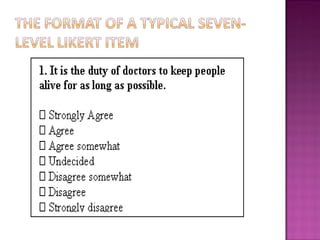
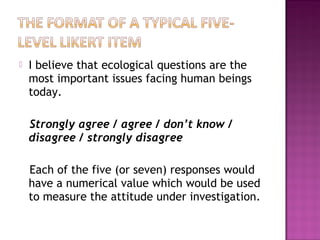
 I believe that ecological questions are the
most important issues facing human beings
today.
Strongly agree / agree / don’t know /
disagree / strongly disagree
Each of the five (or seven) responses would
have a numerical value which would be used
to measure the attitude under investigation.
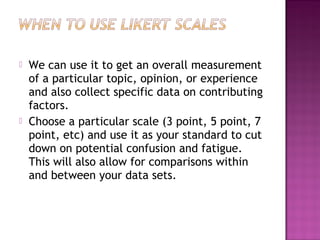
 We can use it to get an overall measurement
of a particular topic, opinion, or experience
and also collect specific data on contributing
factors.
 Choose a particular scale (3 point, 5 point, 7
point, etc) and use it as your standard to cut
down on potential confusion and fatigue.
This will also allow for comparisons within
and between your data sets.
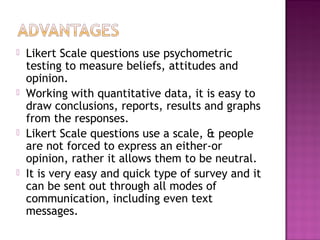
 Likert Scale questions use psychometric
testing to measure beliefs, attitudes and
opinion.
 Working with quantitative data, it is easy to
draw conclusions, reports, results and graphs
from the responses.
 Likert Scale questions use a scale, & people
are not forced to express an either-or
opinion, rather it allows them to be neutral.
 It is very easy and quick type of survey and it
can be sent out through all modes of
communication, including even text
messages.
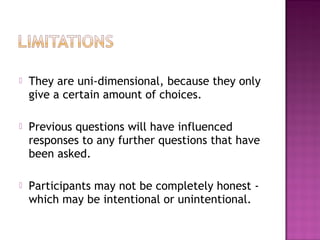
 They are uni-dimensional, because they only
give a certain amount of choices.
 Previous questions will have influenced
responses to any further questions that have
been asked.
 Participants may not be completely honest -
which may be intentional or unintentional.
 Participants may base answers on feelings
toward surveyor or subject.
 Scale requires a great deal of decision-
making.
 can take a long time to analyze the data
THANK YOU

Likert Scale

  • 2.
     The originalidea for the likert scale is found in Rensis Likert’s 1932 article in Archive of psychology titled “ A technique for the measurement of Attitudes”.  Likert-type or frequency scales use fixed choice response formats and are designed to measure attitudes or opinions
  • 3.
    • It isa psychometric scale commonly involved in research that employs questionnaires. • It is the most widely used approach to scaling responses in survey research. • Likert scales are a non-comparative scaling technique and are one-dimensional in nature. • When responding to a Likert questionnaire item respondents specify their level of agreement or disagreement on a symmetric agree-disagree scale for a series of statements.
  • 5.
     I believethat ecological questions are the most important issues facing human beings today. Strongly agree / agree / don’t know / disagree / strongly disagree Each of the five (or seven) responses would have a numerical value which would be used to measure the attitude under investigation.
  • 6.
     We canuse it to get an overall measurement of a particular topic, opinion, or experience and also collect specific data on contributing factors.  Choose a particular scale (3 point, 5 point, 7 point, etc) and use it as your standard to cut down on potential confusion and fatigue. This will also allow for comparisons within and between your data sets.
  • 7.
     Likert Scalequestions use psychometric testing to measure beliefs, attitudes and opinion.  Working with quantitative data, it is easy to draw conclusions, reports, results and graphs from the responses.  Likert Scale questions use a scale, & people are not forced to express an either-or opinion, rather it allows them to be neutral.  It is very easy and quick type of survey and it can be sent out through all modes of communication, including even text messages.
  • 8.
     They areuni-dimensional, because they only give a certain amount of choices.  Previous questions will have influenced responses to any further questions that have been asked.  Participants may not be completely honest - which may be intentional or unintentional.
  • 9.
     Participants maybase answers on feelings toward surveyor or subject.  Scale requires a great deal of decision- making.  can take a long time to analyze the data
  • 10.