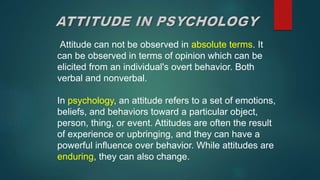
Attitude can not be observed in absolute terms. It
can be observed in terms of opinion which can be
elicited from an individual's overt behavior. Both
verbal and nonverbal.
In psychology, an attitude refers to a set of emotions,
beliefs, and behaviors toward a particular object,
person, thing, or event. Attitudes are often the result
of experience or upbringing, and they can have a
powerful influence over behavior. While attitudes are
enduring, they can also change.
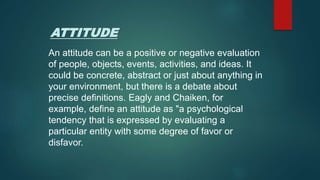
An attitude can be a positive or negative evaluation
of people, objects, events, activities, and ideas. It
could be concrete, abstract or just about anything in
your environment, but there is a debate about
precise definitions. Eagly and Chaiken, for
example, define an attitude as "a psychological
tendency that is expressed by evaluating a
particular entity with some degree of favor or
disfavor.
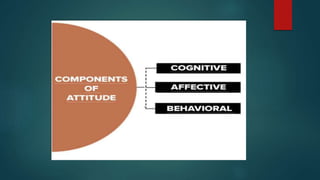
ATTITUDE
COMPONENTS
OF
ATTITUDE
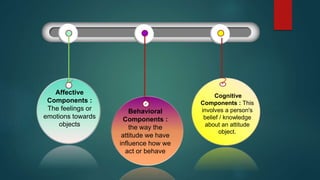
Cognitive
Components : This
involves a person's
belief / knowledge
about an attitude
object.
Behavioral
Components :
the way the
attitude we have
influence how we
act or behave
Affective
Components :
The feelings or
emotions towards
objects
 Psychological assessment is a process that involves checking
the integration of information from multiple sources, such as
tests of normal and abnormal personality, tests of ability or
intelligence, tests of interests or attitudes, as well as
information from personal interviews .
 Process of testing that uses a combination of techniques to
help arrive at some hypotheses about a person and their
behavior, personality and capabilities. Psychological
assessment is also referred to as psychological testing, or
performing a psychological battery on a person.
 A psychological assessment can include numerous components such as
norm-referenced psychological tests, informal tests and surveys, interview
information, school or medical records, medical evaluation and observational
data. A psychologist determines what information to use based on the specific
questions being asked. For example, assessments can be used to determine
if a person has a learning disorder, is competent to stand trial or has a
traumatic brain injury. They can also be used to determine if a person would
be a good manager or how well they may work with a team
 Together, testing and assessment allows a psychologist to see the full
picture of a person's strengths and limitations.
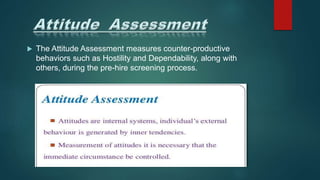
 The Attitude Assessment measures counter-productive
behaviors such as Hostility and Dependability, along with
others, during the pre-hire screening process.
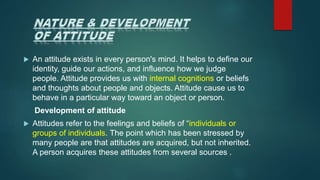
 An attitude exists in every person's mind. It helps to define our
identity, guide our actions, and influence how we judge
people. Attitude provides us with internal cognitions or beliefs
and thoughts about people and objects. Attitude cause us to
behave in a particular way toward an object or person.
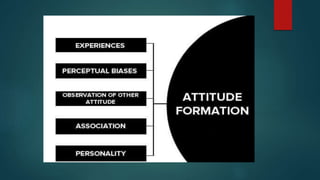
Development of attitude
 Attitudes refer to the feelings and beliefs of “individuals or
groups of individuals. The point which has been stressed by
many people are that attitudes are acquired, but not inherited.
A person acquires these attitudes from several sources .
Define:
A attitude scale is design to provide a valid or accurate measure
of an individual’s social attitude .However anyone how has
every faked an attitude scales known there are short comings in
these self report case of attitudes. Attitude measurement
depends upon attitude scale .
 Attitude scale :
 Attitude scale use to assess the attitude of belief of an
individual.
 Attitude scale is designed to measure attitudes of a subject or
group of subjects towards issues ,institution and group of
people.
Characteristics of attitude scales :
 it provide for quantitative measure of a uni-
dimensional scale of continuum.
 It uses statements from extreme positive to extreme
negative position.
 Attitude scale uses five point scale these are:
 Strongly agree(SA),Agree(A) ,Undecided(U)
,Disagree(D) ,Strongly disagree(SD).
Purpose:
 In educational research these scales are used
especially for finding the attitudes of a person
on issue like co-education ,religious education
,democracy in schools etc depending upon the
need of the situation .
Measuring :
 Ranking :
 Ranking tasks requires that the respondent rank order a small number of objects in
overall performance on the basis of some characteristics or stimulus.
 Rating:
 Rating asks the respondent to estimate the magnitude of a character or quality, that an
object possess. The respondent’s position on a scale is where he or she would rate an
object .Or also known as numerical values of a opinion statement or object.
 Sorting:
 Sorting might present the respondent with several objects or concepts typed on cards
into a number of piles or other wise classify the concept.
 Choice:
 Choice is selecting between two or more alternatives in another type of attitude
measurement .It is assumed that the chosen object is preferred over the other.
Limitations:
 An individual may conceal his real attitude and
express socially acceptable opinion only.
 A person may really not know how to feel about a
social issue.
 A person may not be able to express his attitude
towards a situation in abstract .
 It is unlike that a statement are of equal values in or
against.
Scaling of attitude
 Scaling of attitude consist of following objectives:
 Nominal Scale
 This is a very simple scale. It is made up of assignment of facts or choice
to various alternative categories which are usually drained as well
collectively exclusive. These scales are just numerical and are the least
confining of all the scales. Instances of Nominal Scale are – debit card
numbers, bank account numbers, employee id numbers etc. It is simple
and mostly used when relationship between two variables is to be studied.
 Ordinal Scale
 Ordinal scales are the simplest attitude measuring scale used in
marketing research . It is more athletic than a nominal scale in that the
numbers possess the property of rank order. The ranking of certain product
attributes or benefits as consider major by the respondents is obtained
through the scale.
Interval Scale
 Herein the distance between the various categories unlike in
Nominal, or numbers unlike in Ordinal, are equal in case of Interval
Scales. The Interval Scales are also known as Rating Scales. An
Interval Scale has an arbitrary Zero point with further numbers
placed at equal intervals. A very good example of Interval Scale is a
Thermometer.
Ratio Scale
 Ratio Scales are not widely used in marketing research unless a
base item is made available for comparison. In the above example
of Interval scale, a score of 4 in one quality does not necessarily
mean that the respondent is twice more satisfied than the
respondent who marks 2 on the scale. A Ratio scale has a natural
zero point and further numbers are placed at equally appearing
intervals. For example scales for measuring physical quantities like -
length, weight, etc.
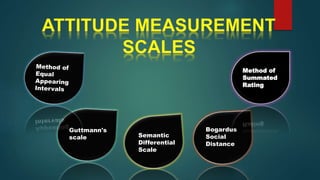
Semantic
Differential
Scale
Bogardus
Social
Distance
Guttmann's
scale
Method of
Summated
Rating
 Originally developed by Thurstone and Chave (1929)
The intervals into which the statements are sorted or rated
are equal sorted or rated are equal.
The attitude of the judge does not influence the sorting of
the statements into the various intervals.
Step -I
Collection of Statements:
A large number of statements ( about 100 to 200)
showing both favorable and unfavorable attitude in
varying degrees towards the psychological object, are
written or collected by the researcher from different
sources.
Criteria For Writing Statements
Edward 1957
Avoid statements that refer to the past rather than the present..
Avoid factual statements.
Avoid statements that may be interpreted in more than
one way.
Avoid statements that are irrelevant to the psychological
object under consideration.
Avoid statements that are likely to be endorsed by almost
everyone or almost no one.
Select statements that are believed to cover the entire
range of the effective scale of interest.
Keep the language of the statements simple, clear and
direct.
Statement should be short, rarely exceeding 20 words.
Each statement should contain only one complete
thought.
Statements containing universals such as all, always,
none or never often introduce ambiguity and should be
avoided.
Words such as only, just, merely and others and others
of a similar nature should be used with care and
moderation in writing statements.
Whenever possible, statements should be in the form of
simple sentences.
Avoid words that may not be understood by those who
are to be given the complete by scale.
Avoid the use of double negatives.
Step-II
Sorting Of the Statements
In the second step, the statements are sent to the experts or
judges for classification on an 11-point continuum,
According to favourableness or unfavourableness of each
statement towards the unfavourableness of each statement
towards researcher psychological object under study.
The researcher proceeds as follows :
Each statement is printed on separate
sheets/cards.
Each judge is then given 11 cards on which letters
A to K (or numbers 1 to 11) are written.
These cards/envelops are arranged before the judges in a
manner that ‘A’ is kept at the extreme left and ‘K’ is kept at the
extreme right.
Statements that seem to express the most unfavorable feelings
about the object of attitude are to be placed on the
card/envelope ‘A’.
Statements that seem to express the most favorable feelings
about the object of attitude are to be placed on the card ‘K’.
Statements that express neither favorable nor unfavorable
feelings about the object of attitude are to be placed in the
middle ‘F’ card that is described as the neutral card.
The cards lettered from ‘G’ to ‘K’ represent various degrees of
favorableness and the cards from ‘E’ to ‘A’ represent various
degrees of unfavorableness.
Step-IV
Split-half technique is used.
Step-V
By correlating the average attitude scores with
actual behavior of the subjects.
Advantages:
Easy to administer
Require minimum instructions
Disadvantages:
Time consuming
Expensive to construct
Not as much diagnostic value as a Likert scale
Values depend on the attitudes of original judges
The original idea for the Likert scale is found in Rensis Likert’s
1932 article in Archive of psychology titled “ A technique for the
measurement of Attitudes”.
 Likert-type or frequency scales use fixed choice response
formats and are designed to measure attitudes or opinions
 It is a psychometric scale commonly involved in research that
employs questionnaires.
 It is the most widely used approach to scaling responses in
survey research.
 Likert scales are a non-comparative scaling technique and
are one-dimensional in nature.
 When responding to a Likert questionnaire item respondents
specify their level of agreement or disagreement on a
symmetric agree-disagree scale for a series of statements.
I believe that ecological questions are the most important
issues facing human beings today. Strongly agree / agree /
don’t know / disagree / strongly disagree Each of the five (or
seven) responses would have a numerical value which would
be used to measure the attitude under investigation.
We can use it to get an overall measurement of a particular
topic, opinion, or experience and also collect specific data on
contributing factors.
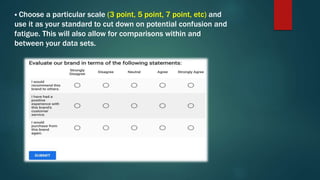
 Choose a particular scale (3 point, 5 point, 7 point, etc) and
use it as your standard to cut down on potential confusion and
fatigue. This will also allow for comparisons within and
between your data sets.
Advantages
Likert Scale questions use psychometric testing to measure
beliefs, attitudes and opinion.
Working with quantitative data, it is easy to draw
conclusions, reports, results and graphs from the responses.
Likert Scale questions use a scale, & people are not forced
to express an either-or opinion, rather it allows them to be
neutral.
It is very easy and quick type of survey and it can be sent
out through all modes of communication, including even text
messages.
Limitations
They are uni-dimensional, because they only give a certain amount of
choices.
 Previous questions will have influenced responses to any further
questions that have been asked.
 Participants may not be completely honest - which may be
intentional or unintentional.
Participants may base answers on feelings toward surveyor or
subject.
 Scale requires a great deal of decision- making.
can take a long time to analyze the data
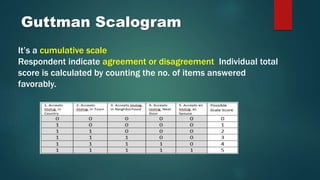
Guttman Scalogram
It’s a cumulative scale
Respondent indicate agreement or disagreement Individual total
score is calculated by counting the no. of items answered
favorably.
Superior to Likert and Thurston
Is unidimensional scale
clear meaning
Advantages
Disadvantages
Analytical complexity
Difficult to find items which have a perfect cumulative pattern.
Semantic differential scale:
 A survey scale that asks people to rate
product, company, brand or any other “Entity”.
 In psychology, it is used to measure emotions,
feelings and attitudes.
 Invented by an American Psychologist,
Charles Egerton Osgood.
 Charles gave three scales EPA:
 Evolution (E): It includes adjectives like
“good-bad”
 Potency (P): includes adjectives like “strong-
weak”
 Activity (A): Adjectives like “active-passive”
EPA studies are usually numbered 3-2-1-0-1-
2-3, where 0 is labeled ‘neutral,’ 1 ‘slightly,’
2 ‘quite,’ and 3 ‘extremely’.
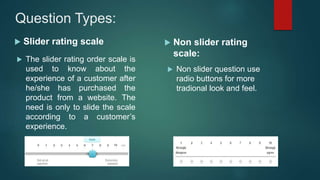
Question Types:
 Slider rating scale
 The slider rating order scale is
used to know about the
experience of a customer after
he/she has purchased the
product from a website. The
need is only to slide the scale
according to a customer’s
experience.
 Non slider rating
scale:
 Non slider question use
radio buttons for more
tradional look and feel.
Open minded questions:
In this type the client or respondent is given freedom to
express his/her feelings about the product, brand,
organization or services in form of comments or
suggestions
Ordering:
The ordering question offers the scope of parameters that
the respondent feelings are best or worst according to the
experiences.
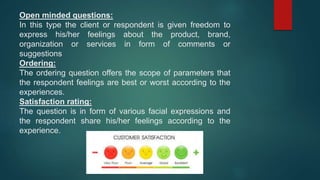
Satisfaction rating:
The question is in form of various facial expressions and
the respondent share his/her feelings according to the
experience.
Advantages:
 Easy to understand the scale and rate correctly.
 Another advantage is it’s versatility. Can be used
both in customer satisfaction surveys and scientific
behavioral surveys.
 Less time consuming.
Disadvantages:
 One of the major disadvantages is the lack of
standardization.
 Neutral responses are often difficult to interpret.
 Semantic differential scale is often subjective. This is
because they depend, almost entirely, on the
judgment and interpretation of the researcher.
Bogardus Social Distance Scale:
 Bogardus social distance scale is defined as
a scale that measures varying degrees of closeness
in people towards other members of diverse social.
 Bogardus Social Distance test was introduced by
Emory Bogardus in 1924 and was named after him.
 Also used to measure prejudice of other society
groups.
 Consists of series of questions:
 Would you be willing to marry a member of this group? (1.0)
 Would you be willing to have a member of this group as your close
personal friend? (2.0)
 Would you be willing to have a member of this group as your
neighbor? (3.0)
 Would you be willing to have a member of this group as your colleague
at work? (4.0)
 Would you be willing to have a member of this group as a citizen of
your country? (5.0)
 Would you be willing to have a member of this group visit your country
as a non-citizen? (6.0)
 Would you be willing to have a member of this group be excluded from
associating with your country in any way? (7.0
Characteristics:
 The Bogardus social distance scale is a variation of the
Guttmann scale because any agreement with a statement is
an assumption of agreement with any statements preceding
the selection.
 The Bogardus social distance scale uses a 7 point social
distance scale to track empathy between 2 social groups.
 The option with the rating scale 1.0 measures the proximity to
a certain individual and the option with the rating scale as 7.0
measures the distance between to that individual
Uses:
 Traditional use:
 Use to measure social distance
between tow social groups.
 Use to measure the distance
between already existing
communities and migrating
communities.
 A research was made where found
that the social distance between
Canadians migrating to US was
lowest while it was highest between
Muslims and Hindus
 Modern use:
 Today the Bogardus
Social Distance scale is
being used in work
environment where the
social distance prejudice
is being measured
between existing
employees of an
organization and
incoming employees.
Advantages:
 Less cumbersome to construct and easy to
administer.
 It is consider to be more reliable.
 The scale attempts to measure respondent’s degree
of warmth, intimacy, indifference, or hostility to
particular social relationships.
Disadvantages:
 Its nature is one-dimensional and collects data
accordingly.
• Bogardus scale does not measure the degree of
performance of a group over other.
• Each member could response on the basis of their
perception of other group in question. But since the
rating does not allow delving into the reason for
selecting that rating it is impossible to measure
validity.
Selection of appropriate scale
Various techniques are used for attitude measurement.
Each has some strengths and some limitations.
All techniques are not suitable for all purposes.
Selection of attitude scale
depends on following factors
1. State or stage of project undertaken
2. Size of project
3. Costs involved
4. Preparation of the required instruments and implementations
5. The validity and reliability of method
Which method for what?
Thurstone's scale, Q-sort and the Semantic differential
scale are preferred for preliminary investigation
The Likert scale is used for item analysis.
For particular attributes the semantic differential scale is
very appropriate
the semantic differential is simple in concept and results obtained are comparable
with more complex, one dimensional method.
The semantic differential is simple in concept and results obtained
are comparable with more complex, one dimensional method.
Hence it is widely used.
Issues in attitude measurement
When we go for measurement of attitudes or any other parameter, one
has to clearly sort out the following:
• "what" has to be measured?
• "who" is to be measured?
• the accuracy expected in the measurement
• the affordable costs
• the choices available in the measurement/data collection techniques.
In attitude measurement, the researcher is basically interested in measuring the
"state of mind" of the respondent .
It may have factors such as awareness, attitudes and decision processes.
Their verification is difficult and it is impossible to measure every attribute of the
process under consideration.
The projective techniques try to uncover the information from the respondent in
an indirect way. But they are non disguised methods.
This procedure requires proficient investigators.
The third major problem in attitude measurement is the choices in data collection and
measurement techniques.
 Two types of methods are used:
Questionnaire methods and Observational methods
 Usually, questionnaires are used for measuring the attitudes.
 last major issue for a managerial researcher here relates to the costs
and accuracy desired in the measurement.
Assumptions
According to Frerman (1965) there are three assumption
upon attitude scale;
 The scale should deal with a controversial question
 An individual’s feelings and insights are regard to the
question will determine his responses to various
statements
 The statements can be scaled regarding the degree
to which the favor is opposed to question under
consideration assumptions.
Characteristics of attitude scale
 It provides for quantitative measure on a unidimensional scale of continuum.
 It uses statements from the extreme positive position to extreme negative position.
 It generally uses a five-point scale as: Strongly agree (SA), Agree(A), Undecided(U),
Disagree (D) and Strongly disagree (SD). The individual gets the score as the sum of
item credits.
 It is usually standardized and norms are worked out
 It disguises the attitude object rather than directly asking about the attitude on the
subject
Purpose
In educational research, these scales are used
especially for finding the attitudes of persons on issues
like co-education, religions education, democracy in
schools etc.
Some Attitude Scales Methods of measuring attitudes indirectly,
used for research purposes are; Thurstone Technique, Likert’s
Method of summated Rating and Guttman’s scale.
 Bowling, A. (1997). Research Methods in Health. Buckingham: Open
University Press.
 Burns, N., & Grove, S. K. (1997). The Practice of Nursing Research
Conduct, Critique, & Utilization. Philadelphia: W.B. Saunders and Co.
 Jamieson, S. (2004). Likert scales: how to (ab) use them. Medical
Education, 38(12), 1217-1218.
 Likert, R. (1932). A Technique for the Measurement of Attitudes. Archives
of Psychology, 140, 1–55.
 Paulhus, D. L. (1984). Two-component models of socially desirable
responding. Journal of personality and social psychology, 46(3), 598.
 www.yourarticlelibrary.com
 www.psychologydiscussion.net
[Appropriate attitude measurement scale]. (n.d.). 1.
http://www.education2research.com
[Attitude measurement and scales]. (n.d.).
http://egyankosh.ac.in
Fousiya ,O.(2016, Aug 29)."Tools for assessing effective
domains ";education. http://www.slideshare.net
•Relationships between the Thurstone and Rasch approaches to item
scaling. Applied Psychological Measurement, 2, 449-460.
•Andrich, D. & Luo, G. (1993) A hyperbolic cosine model for unfolding
dichotomous single-stimulus responses. Applied Psychological
Measurement, 17, 253-276.
•Babbie, E., 'The Practice of Social Research', 10th edition, Wadsworth,
Thomson Learning Inc., ISBN 0-534-62029-9
•Edwards, A. L. Techniques of attitude scale construction. New York:
Appleton-Century- Crofts, 1957.
•Guilford, J. P. Psychometric methods. New York: McGraw-Hill, 1954.
•Krus, D.J., & Kennedy, P.H. (1977) Normal scaling of dominance matrices:
The domain-referenced model. Educational and Psychological
Measurement, 37, 189-193
•Thurstone, L. L. (1927a) A Law of comparative judgment. Psychological
Review, 34, 273-286.
 Attitude Measurement Scales

Attitude Measurement Scales

  • 4.
    Attitude can notbe observed in absolute terms. It can be observed in terms of opinion which can be elicited from an individual's overt behavior. Both verbal and nonverbal. In psychology, an attitude refers to a set of emotions, beliefs, and behaviors toward a particular object, person, thing, or event. Attitudes are often the result of experience or upbringing, and they can have a powerful influence over behavior. While attitudes are enduring, they can also change.
  • 5.
    An attitude canbe a positive or negative evaluation of people, objects, events, activities, and ideas. It could be concrete, abstract or just about anything in your environment, but there is a debate about precise definitions. Eagly and Chaiken, for example, define an attitude as "a psychological tendency that is expressed by evaluating a particular entity with some degree of favor or disfavor. ATTITUDE
  • 6.
  • 8.
    Cognitive Components : This involvesa person's belief / knowledge about an attitude object. Behavioral Components : the way the attitude we have influence how we act or behave Affective Components : The feelings or emotions towards objects
  • 9.
     Psychological assessmentis a process that involves checking the integration of information from multiple sources, such as tests of normal and abnormal personality, tests of ability or intelligence, tests of interests or attitudes, as well as information from personal interviews .  Process of testing that uses a combination of techniques to help arrive at some hypotheses about a person and their behavior, personality and capabilities. Psychological assessment is also referred to as psychological testing, or performing a psychological battery on a person.
  • 10.
     A psychologicalassessment can include numerous components such as norm-referenced psychological tests, informal tests and surveys, interview information, school or medical records, medical evaluation and observational data. A psychologist determines what information to use based on the specific questions being asked. For example, assessments can be used to determine if a person has a learning disorder, is competent to stand trial or has a traumatic brain injury. They can also be used to determine if a person would be a good manager or how well they may work with a team  Together, testing and assessment allows a psychologist to see the full picture of a person's strengths and limitations.
  • 11.
     The AttitudeAssessment measures counter-productive behaviors such as Hostility and Dependability, along with others, during the pre-hire screening process.
  • 12.
     An attitudeexists in every person's mind. It helps to define our identity, guide our actions, and influence how we judge people. Attitude provides us with internal cognitions or beliefs and thoughts about people and objects. Attitude cause us to behave in a particular way toward an object or person. Development of attitude  Attitudes refer to the feelings and beliefs of “individuals or groups of individuals. The point which has been stressed by many people are that attitudes are acquired, but not inherited. A person acquires these attitudes from several sources .
  • 15.
    Define: A attitude scaleis design to provide a valid or accurate measure of an individual’s social attitude .However anyone how has every faked an attitude scales known there are short comings in these self report case of attitudes. Attitude measurement depends upon attitude scale .  Attitude scale :  Attitude scale use to assess the attitude of belief of an individual.  Attitude scale is designed to measure attitudes of a subject or group of subjects towards issues ,institution and group of people.
  • 16.
    Characteristics of attitudescales :  it provide for quantitative measure of a uni- dimensional scale of continuum.  It uses statements from extreme positive to extreme negative position.  Attitude scale uses five point scale these are:  Strongly agree(SA),Agree(A) ,Undecided(U) ,Disagree(D) ,Strongly disagree(SD).
  • 17.
    Purpose:  In educationalresearch these scales are used especially for finding the attitudes of a person on issue like co-education ,religious education ,democracy in schools etc depending upon the need of the situation .
  • 18.
    Measuring :  Ranking:  Ranking tasks requires that the respondent rank order a small number of objects in overall performance on the basis of some characteristics or stimulus.  Rating:  Rating asks the respondent to estimate the magnitude of a character or quality, that an object possess. The respondent’s position on a scale is where he or she would rate an object .Or also known as numerical values of a opinion statement or object.  Sorting:  Sorting might present the respondent with several objects or concepts typed on cards into a number of piles or other wise classify the concept.  Choice:  Choice is selecting between two or more alternatives in another type of attitude measurement .It is assumed that the chosen object is preferred over the other.
  • 19.
    Limitations:  An individualmay conceal his real attitude and express socially acceptable opinion only.  A person may really not know how to feel about a social issue.  A person may not be able to express his attitude towards a situation in abstract .  It is unlike that a statement are of equal values in or against.
  • 20.
    Scaling of attitude Scaling of attitude consist of following objectives:  Nominal Scale  This is a very simple scale. It is made up of assignment of facts or choice to various alternative categories which are usually drained as well collectively exclusive. These scales are just numerical and are the least confining of all the scales. Instances of Nominal Scale are – debit card numbers, bank account numbers, employee id numbers etc. It is simple and mostly used when relationship between two variables is to be studied.  Ordinal Scale  Ordinal scales are the simplest attitude measuring scale used in marketing research . It is more athletic than a nominal scale in that the numbers possess the property of rank order. The ranking of certain product attributes or benefits as consider major by the respondents is obtained through the scale.
  • 21.
    Interval Scale  Hereinthe distance between the various categories unlike in Nominal, or numbers unlike in Ordinal, are equal in case of Interval Scales. The Interval Scales are also known as Rating Scales. An Interval Scale has an arbitrary Zero point with further numbers placed at equal intervals. A very good example of Interval Scale is a Thermometer. Ratio Scale  Ratio Scales are not widely used in marketing research unless a base item is made available for comparison. In the above example of Interval scale, a score of 4 in one quality does not necessarily mean that the respondent is twice more satisfied than the respondent who marks 2 on the scale. A Ratio scale has a natural zero point and further numbers are placed at equally appearing intervals. For example scales for measuring physical quantities like - length, weight, etc.
  • 22.
  • 23.
     Originally developedby Thurstone and Chave (1929) The intervals into which the statements are sorted or rated are equal sorted or rated are equal. The attitude of the judge does not influence the sorting of the statements into the various intervals.
  • 24.
    Step -I Collection ofStatements: A large number of statements ( about 100 to 200) showing both favorable and unfavorable attitude in varying degrees towards the psychological object, are written or collected by the researcher from different sources.
  • 25.
    Criteria For WritingStatements Edward 1957 Avoid statements that refer to the past rather than the present.. Avoid factual statements. Avoid statements that may be interpreted in more than one way. Avoid statements that are irrelevant to the psychological object under consideration. Avoid statements that are likely to be endorsed by almost everyone or almost no one. Select statements that are believed to cover the entire range of the effective scale of interest. Keep the language of the statements simple, clear and direct.
  • 26.
    Statement should beshort, rarely exceeding 20 words. Each statement should contain only one complete thought. Statements containing universals such as all, always, none or never often introduce ambiguity and should be avoided. Words such as only, just, merely and others and others of a similar nature should be used with care and moderation in writing statements. Whenever possible, statements should be in the form of simple sentences. Avoid words that may not be understood by those who are to be given the complete by scale. Avoid the use of double negatives.
  • 27.
    Step-II Sorting Of theStatements In the second step, the statements are sent to the experts or judges for classification on an 11-point continuum, According to favourableness or unfavourableness of each statement towards the unfavourableness of each statement towards researcher psychological object under study. The researcher proceeds as follows : Each statement is printed on separate sheets/cards. Each judge is then given 11 cards on which letters A to K (or numbers 1 to 11) are written.
  • 28.
    These cards/envelops arearranged before the judges in a manner that ‘A’ is kept at the extreme left and ‘K’ is kept at the extreme right. Statements that seem to express the most unfavorable feelings about the object of attitude are to be placed on the card/envelope ‘A’. Statements that seem to express the most favorable feelings about the object of attitude are to be placed on the card ‘K’. Statements that express neither favorable nor unfavorable feelings about the object of attitude are to be placed in the middle ‘F’ card that is described as the neutral card. The cards lettered from ‘G’ to ‘K’ represent various degrees of favorableness and the cards from ‘E’ to ‘A’ represent various degrees of unfavorableness.
  • 29.
    Step-IV Split-half technique isused. Step-V By correlating the average attitude scores with actual behavior of the subjects.
  • 30.
    Advantages: Easy to administer Requireminimum instructions Disadvantages: Time consuming Expensive to construct Not as much diagnostic value as a Likert scale Values depend on the attitudes of original judges
  • 31.
    The original ideafor the Likert scale is found in Rensis Likert’s 1932 article in Archive of psychology titled “ A technique for the measurement of Attitudes”.  Likert-type or frequency scales use fixed choice response formats and are designed to measure attitudes or opinions  It is a psychometric scale commonly involved in research that employs questionnaires.  It is the most widely used approach to scaling responses in survey research.  Likert scales are a non-comparative scaling technique and are one-dimensional in nature.
  • 32.
     When respondingto a Likert questionnaire item respondents specify their level of agreement or disagreement on a symmetric agree-disagree scale for a series of statements. I believe that ecological questions are the most important issues facing human beings today. Strongly agree / agree / don’t know / disagree / strongly disagree Each of the five (or seven) responses would have a numerical value which would be used to measure the attitude under investigation. We can use it to get an overall measurement of a particular topic, opinion, or experience and also collect specific data on contributing factors.
  • 33.
     Choose aparticular scale (3 point, 5 point, 7 point, etc) and use it as your standard to cut down on potential confusion and fatigue. This will also allow for comparisons within and between your data sets.
  • 34.
    Advantages Likert Scale questionsuse psychometric testing to measure beliefs, attitudes and opinion. Working with quantitative data, it is easy to draw conclusions, reports, results and graphs from the responses. Likert Scale questions use a scale, & people are not forced to express an either-or opinion, rather it allows them to be neutral. It is very easy and quick type of survey and it can be sent out through all modes of communication, including even text messages.
  • 35.
    Limitations They are uni-dimensional,because they only give a certain amount of choices.  Previous questions will have influenced responses to any further questions that have been asked.  Participants may not be completely honest - which may be intentional or unintentional. Participants may base answers on feelings toward surveyor or subject.  Scale requires a great deal of decision- making. can take a long time to analyze the data
  • 36.
    Guttman Scalogram It’s acumulative scale Respondent indicate agreement or disagreement Individual total score is calculated by counting the no. of items answered favorably.
  • 37.
    Superior to Likertand Thurston Is unidimensional scale clear meaning Advantages Disadvantages Analytical complexity Difficult to find items which have a perfect cumulative pattern.
  • 38.
    Semantic differential scale: A survey scale that asks people to rate product, company, brand or any other “Entity”.  In psychology, it is used to measure emotions, feelings and attitudes.  Invented by an American Psychologist, Charles Egerton Osgood.
  • 39.
     Charles gavethree scales EPA:  Evolution (E): It includes adjectives like “good-bad”  Potency (P): includes adjectives like “strong- weak”  Activity (A): Adjectives like “active-passive” EPA studies are usually numbered 3-2-1-0-1- 2-3, where 0 is labeled ‘neutral,’ 1 ‘slightly,’ 2 ‘quite,’ and 3 ‘extremely’.
  • 40.
    Question Types:  Sliderrating scale  The slider rating order scale is used to know about the experience of a customer after he/she has purchased the product from a website. The need is only to slide the scale according to a customer’s experience.  Non slider rating scale:  Non slider question use radio buttons for more tradional look and feel.
  • 41.
    Open minded questions: Inthis type the client or respondent is given freedom to express his/her feelings about the product, brand, organization or services in form of comments or suggestions Ordering: The ordering question offers the scope of parameters that the respondent feelings are best or worst according to the experiences. Satisfaction rating: The question is in form of various facial expressions and the respondent share his/her feelings according to the experience.
  • 42.
    Advantages:  Easy tounderstand the scale and rate correctly.  Another advantage is it’s versatility. Can be used both in customer satisfaction surveys and scientific behavioral surveys.  Less time consuming.
  • 43.
    Disadvantages:  One ofthe major disadvantages is the lack of standardization.  Neutral responses are often difficult to interpret.  Semantic differential scale is often subjective. This is because they depend, almost entirely, on the judgment and interpretation of the researcher.
  • 44.
    Bogardus Social DistanceScale:  Bogardus social distance scale is defined as a scale that measures varying degrees of closeness in people towards other members of diverse social.  Bogardus Social Distance test was introduced by Emory Bogardus in 1924 and was named after him.  Also used to measure prejudice of other society groups.
  • 45.
     Consists ofseries of questions:  Would you be willing to marry a member of this group? (1.0)  Would you be willing to have a member of this group as your close personal friend? (2.0)  Would you be willing to have a member of this group as your neighbor? (3.0)  Would you be willing to have a member of this group as your colleague at work? (4.0)  Would you be willing to have a member of this group as a citizen of your country? (5.0)  Would you be willing to have a member of this group visit your country as a non-citizen? (6.0)  Would you be willing to have a member of this group be excluded from associating with your country in any way? (7.0
  • 46.
    Characteristics:  The Bogardussocial distance scale is a variation of the Guttmann scale because any agreement with a statement is an assumption of agreement with any statements preceding the selection.  The Bogardus social distance scale uses a 7 point social distance scale to track empathy between 2 social groups.  The option with the rating scale 1.0 measures the proximity to a certain individual and the option with the rating scale as 7.0 measures the distance between to that individual
  • 47.
    Uses:  Traditional use: Use to measure social distance between tow social groups.  Use to measure the distance between already existing communities and migrating communities.  A research was made where found that the social distance between Canadians migrating to US was lowest while it was highest between Muslims and Hindus  Modern use:  Today the Bogardus Social Distance scale is being used in work environment where the social distance prejudice is being measured between existing employees of an organization and incoming employees.
  • 48.
    Advantages:  Less cumbersometo construct and easy to administer.  It is consider to be more reliable.  The scale attempts to measure respondent’s degree of warmth, intimacy, indifference, or hostility to particular social relationships.
  • 49.
    Disadvantages:  Its natureis one-dimensional and collects data accordingly. • Bogardus scale does not measure the degree of performance of a group over other. • Each member could response on the basis of their perception of other group in question. But since the rating does not allow delving into the reason for selecting that rating it is impossible to measure validity.
  • 50.
    Selection of appropriatescale Various techniques are used for attitude measurement. Each has some strengths and some limitations. All techniques are not suitable for all purposes. Selection of attitude scale depends on following factors 1. State or stage of project undertaken 2. Size of project 3. Costs involved 4. Preparation of the required instruments and implementations 5. The validity and reliability of method
  • 51.
    Which method forwhat? Thurstone's scale, Q-sort and the Semantic differential scale are preferred for preliminary investigation The Likert scale is used for item analysis. For particular attributes the semantic differential scale is very appropriate the semantic differential is simple in concept and results obtained are comparable with more complex, one dimensional method. The semantic differential is simple in concept and results obtained are comparable with more complex, one dimensional method. Hence it is widely used.
  • 52.
    Issues in attitudemeasurement When we go for measurement of attitudes or any other parameter, one has to clearly sort out the following: • "what" has to be measured? • "who" is to be measured? • the accuracy expected in the measurement • the affordable costs • the choices available in the measurement/data collection techniques.
  • 53.
    In attitude measurement,the researcher is basically interested in measuring the "state of mind" of the respondent . It may have factors such as awareness, attitudes and decision processes. Their verification is difficult and it is impossible to measure every attribute of the process under consideration. The projective techniques try to uncover the information from the respondent in an indirect way. But they are non disguised methods. This procedure requires proficient investigators.
  • 54.
    The third majorproblem in attitude measurement is the choices in data collection and measurement techniques.  Two types of methods are used: Questionnaire methods and Observational methods  Usually, questionnaires are used for measuring the attitudes.  last major issue for a managerial researcher here relates to the costs and accuracy desired in the measurement.
  • 55.
    Assumptions According to Frerman(1965) there are three assumption upon attitude scale;  The scale should deal with a controversial question  An individual’s feelings and insights are regard to the question will determine his responses to various statements  The statements can be scaled regarding the degree to which the favor is opposed to question under consideration assumptions.
  • 56.
    Characteristics of attitudescale  It provides for quantitative measure on a unidimensional scale of continuum.  It uses statements from the extreme positive position to extreme negative position.  It generally uses a five-point scale as: Strongly agree (SA), Agree(A), Undecided(U), Disagree (D) and Strongly disagree (SD). The individual gets the score as the sum of item credits.  It is usually standardized and norms are worked out  It disguises the attitude object rather than directly asking about the attitude on the subject
  • 57.
    Purpose In educational research,these scales are used especially for finding the attitudes of persons on issues like co-education, religions education, democracy in schools etc. Some Attitude Scales Methods of measuring attitudes indirectly, used for research purposes are; Thurstone Technique, Likert’s Method of summated Rating and Guttman’s scale.
  • 58.
     Bowling, A.(1997). Research Methods in Health. Buckingham: Open University Press.  Burns, N., & Grove, S. K. (1997). The Practice of Nursing Research Conduct, Critique, & Utilization. Philadelphia: W.B. Saunders and Co.  Jamieson, S. (2004). Likert scales: how to (ab) use them. Medical Education, 38(12), 1217-1218.  Likert, R. (1932). A Technique for the Measurement of Attitudes. Archives of Psychology, 140, 1–55.  Paulhus, D. L. (1984). Two-component models of socially desirable responding. Journal of personality and social psychology, 46(3), 598.  www.yourarticlelibrary.com  www.psychologydiscussion.net
  • 59.
    [Appropriate attitude measurementscale]. (n.d.). 1. http://www.education2research.com [Attitude measurement and scales]. (n.d.). http://egyankosh.ac.in Fousiya ,O.(2016, Aug 29)."Tools for assessing effective domains ";education. http://www.slideshare.net
  • 60.
    •Relationships between theThurstone and Rasch approaches to item scaling. Applied Psychological Measurement, 2, 449-460. •Andrich, D. & Luo, G. (1993) A hyperbolic cosine model for unfolding dichotomous single-stimulus responses. Applied Psychological Measurement, 17, 253-276. •Babbie, E., 'The Practice of Social Research', 10th edition, Wadsworth, Thomson Learning Inc., ISBN 0-534-62029-9 •Edwards, A. L. Techniques of attitude scale construction. New York: Appleton-Century- Crofts, 1957. •Guilford, J. P. Psychometric methods. New York: McGraw-Hill, 1954. •Krus, D.J., & Kennedy, P.H. (1977) Normal scaling of dominance matrices: The domain-referenced model. Educational and Psychological Measurement, 37, 189-193 •Thurstone, L. L. (1927a) A Law of comparative judgment. Psychological Review, 34, 273-286.