PRESENTATION
BY
KARPAGAM SIGAPPI A L
RESEARCH
METHODOLOGY
SCALES
A Scale is a tool or mechanism by which
individuals are distinguished as to how they differ
from one another on the variables of interest to our
study.
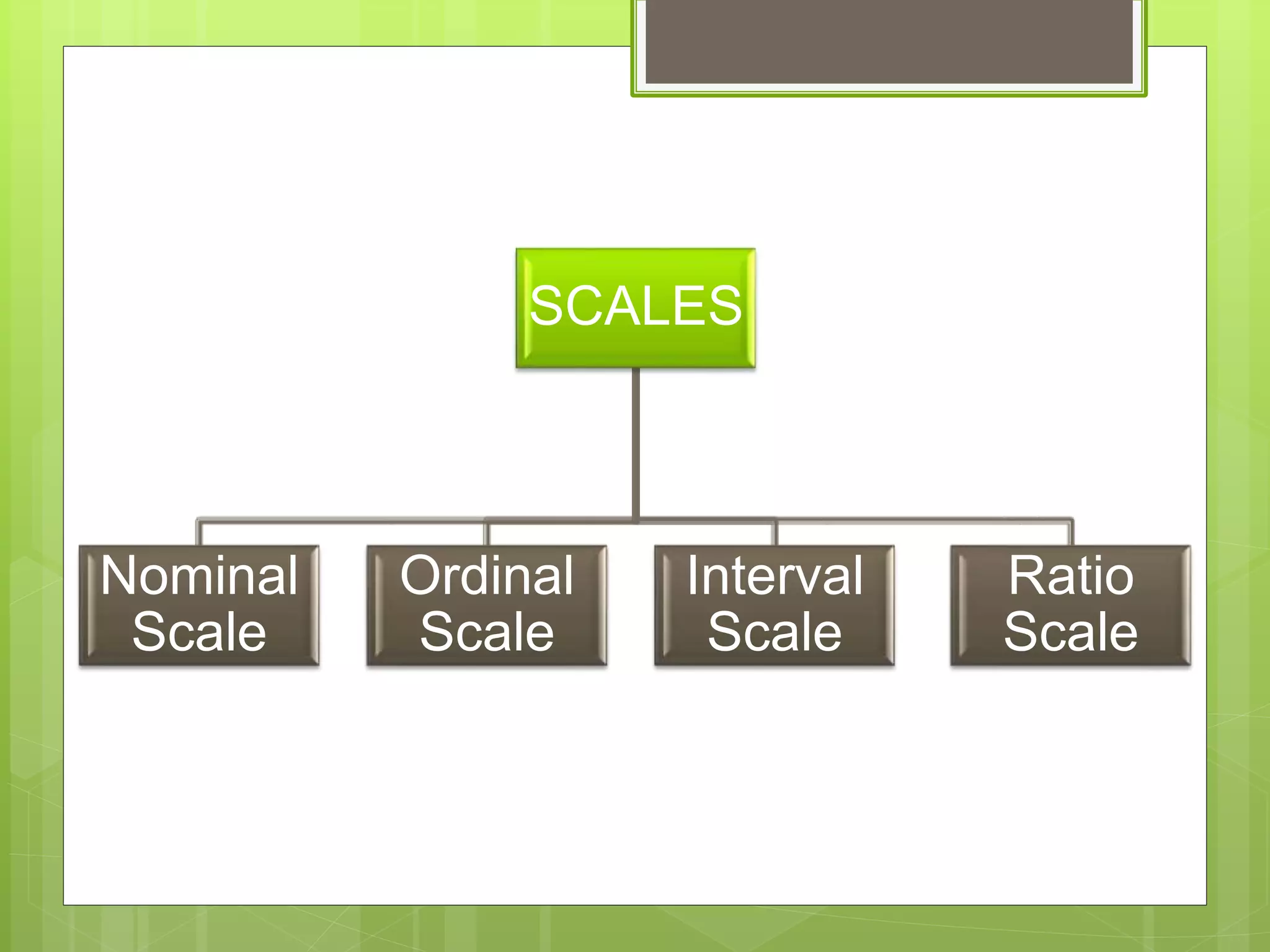
SCALES
Nominal
Scale
Ordinal
Scale
Interval
Scale
Ratio
Scale
NOMINAL SCALE
A nominal scale is one that allows the researcher to
assign subjects to certain categories or groups.
For example: Your department
-Production
-Sales
-Accounting
-Personnel
-R&D
-Others (specify)
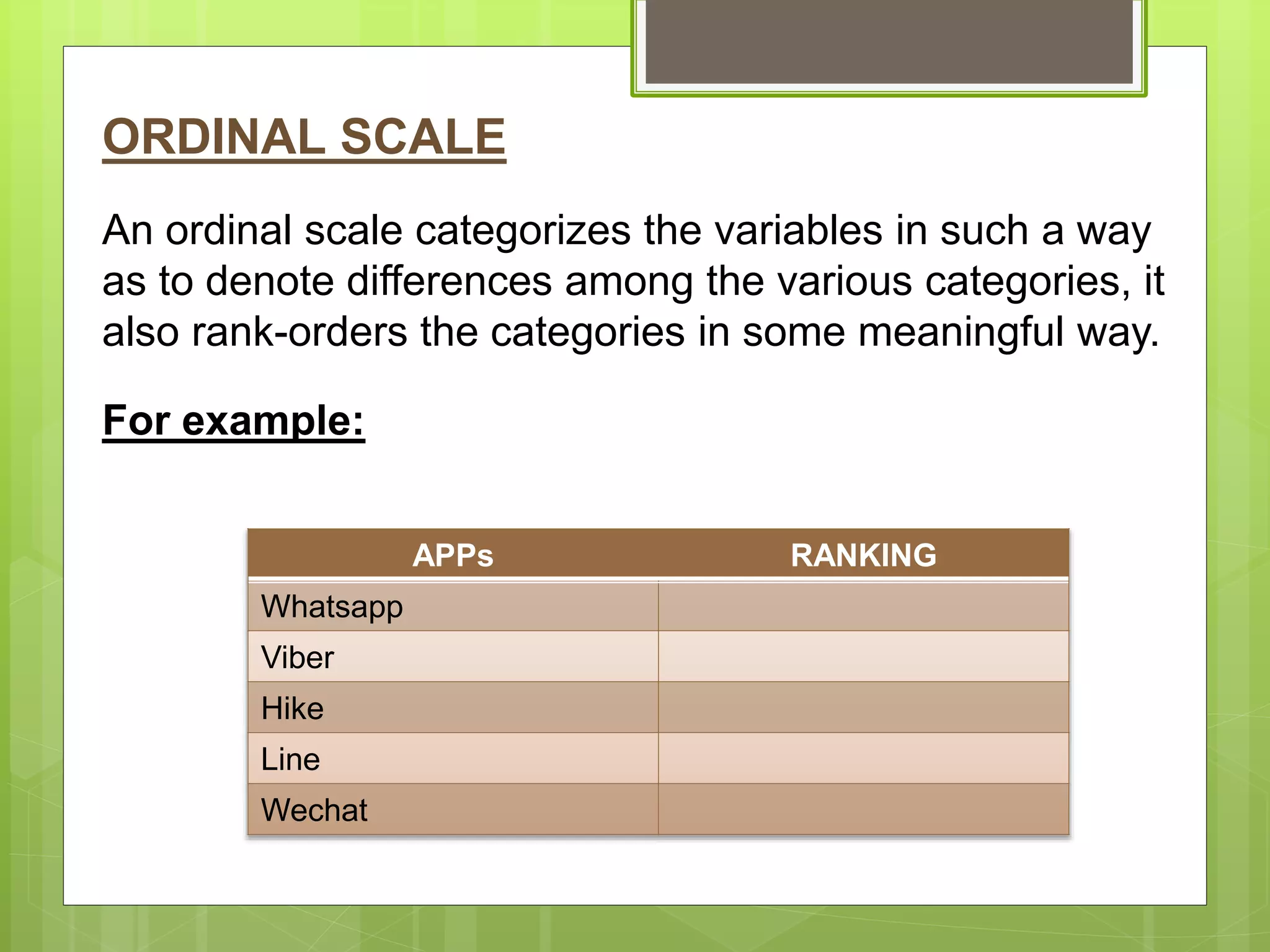
ORDINAL SCALE
An ordinal scale categorizes the variables in such a way
as to denote differences among the various categories, it
also rank-orders the categories in some meaningful way.
For example:
APPs RANKING
Whatsapp
Viber
Hike
Line
Wechat
INTERVAL SCALE
An interval scale allows to perform certain arithmetical
operations on the data collected from the respondents.
For example:
Strongl
y
Disagr
ee
Disagr
ee
Neither
agree
nor
Disagre
e
Agre
e
Strongl
y Agree
• My job offers me a chance
to test myself and my
abilities
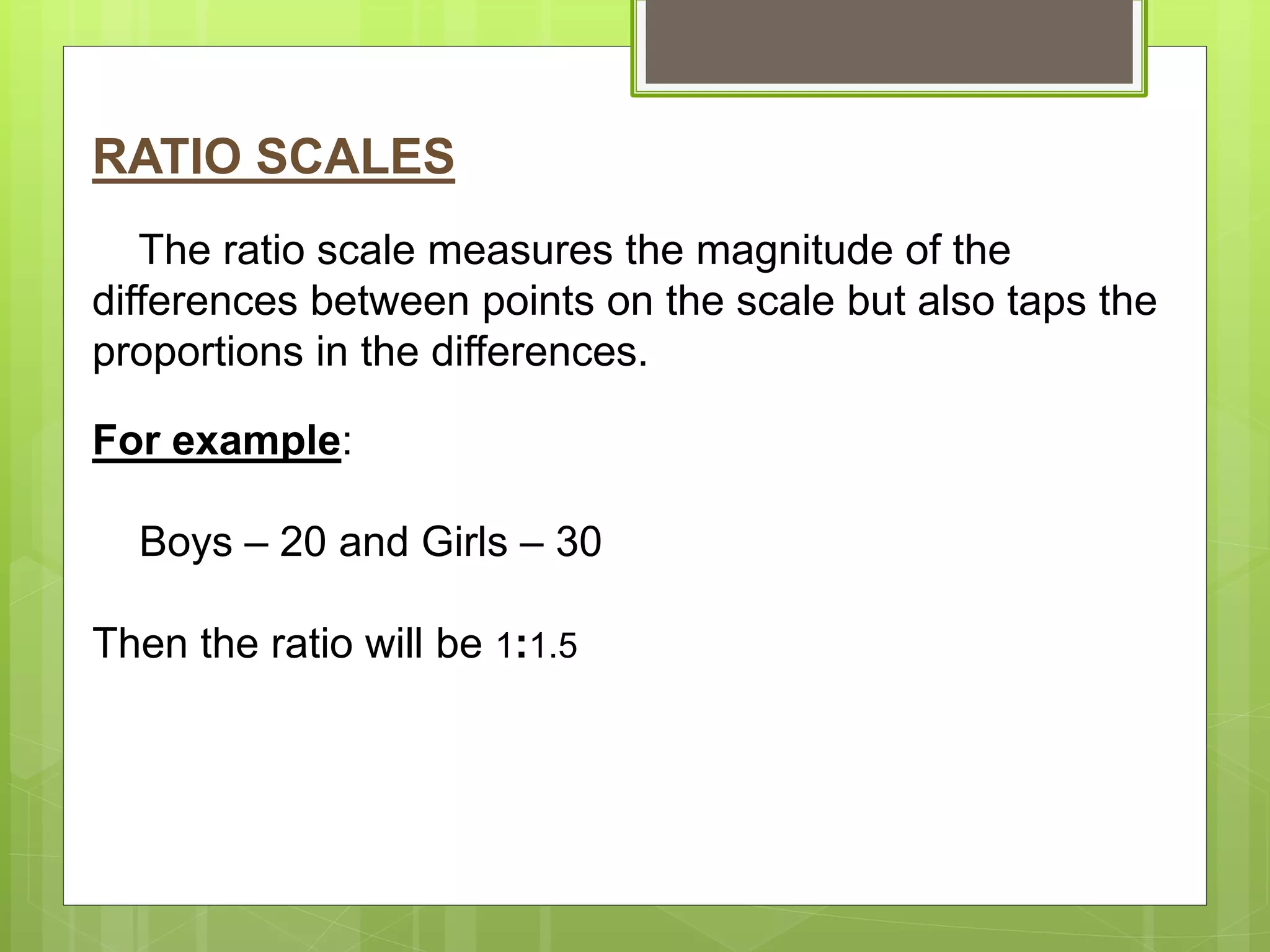
RATIO SCALES
The ratio scale measures the magnitude of the
differences between points on the scale but also taps the
proportions in the differences.
For example:
Boys – 20 and Girls – 30
Then the ratio will be 1:1.5
Dichotomous scale
• to elicit yes or no answer
For example: Do you own a car? o Yes o
No
Category scale
• for multiple items to elicit a single response
For example: your caste
o OC o BC o MBC o ST o
Others
Semantic differential scale
• several bipolar attributes are identified
• respondents are asked to indicate their attitudes
For example: Courageous Timid
Honest
Dishonest
Numerical scale
• The scale provides number on a five-point or seven
point
• with bipolar adjectives at end
For example: Honest [7 6 5 4 3 2 1 ] Dishonest
Stapel scale
• it measures both the direction and intensity of the
attitude
For example:
state how you would rate your supervisor’s abilities
with respect to each of the characteristics mentioned
below
+3 +2 +1 product innovation -1 -2 -3
+3 +2 +1 interpersonal skills -1 -2 -3
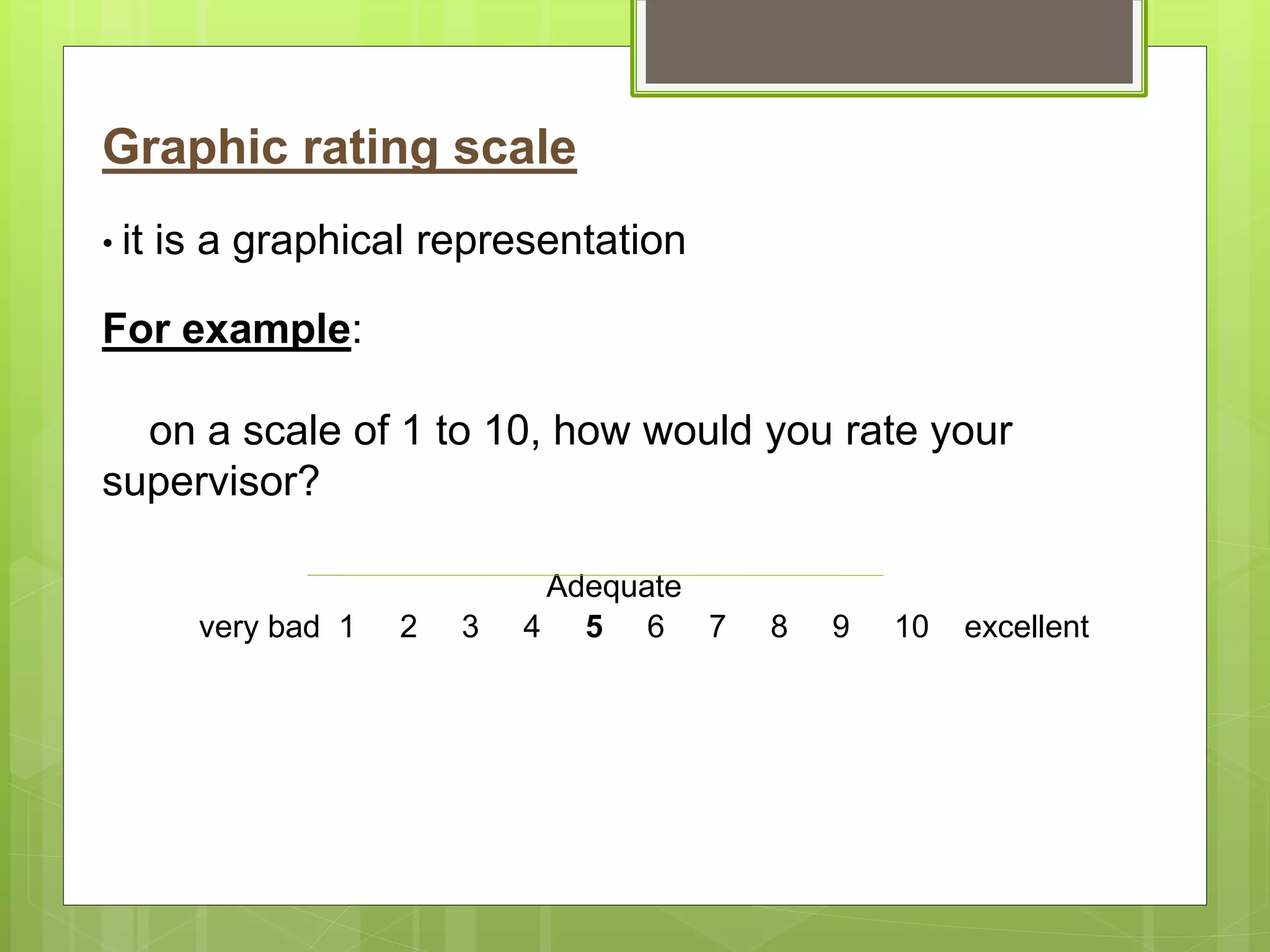
Graphic rating scale
• it is a graphical representation
For example:
on a scale of 1 to 10, how would you rate your
supervisor?
Adequate
very bad 1 2 3 4 5 6 7 8 9 10 excellent
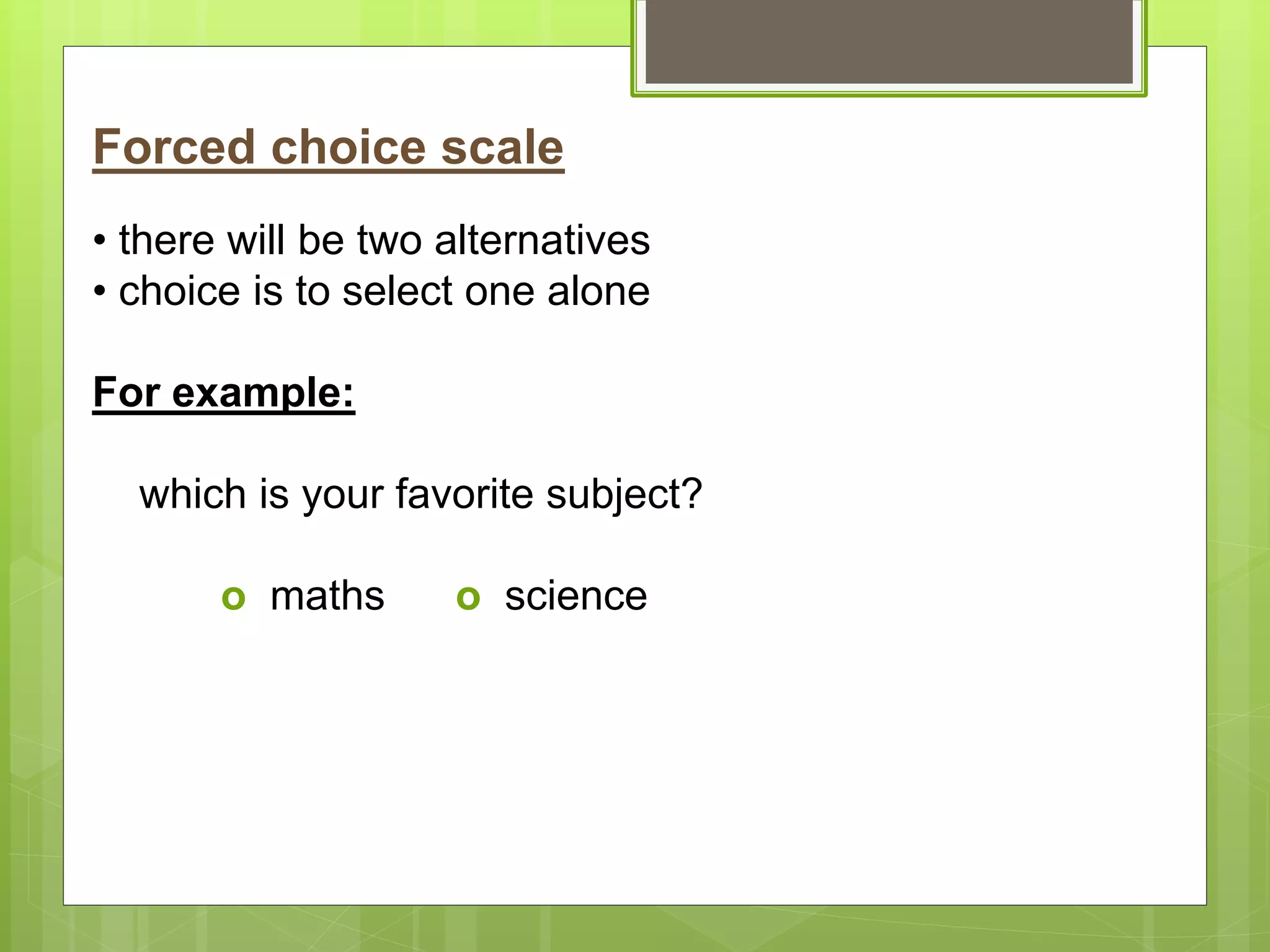
Forced choice scale
• there will be two alternatives
• choice is to select one alone
For example:
which is your favorite subject?
o maths o science
69%
31%
whatsapp users
0
100
200
300 251
88 103
50
hike viber we chat line
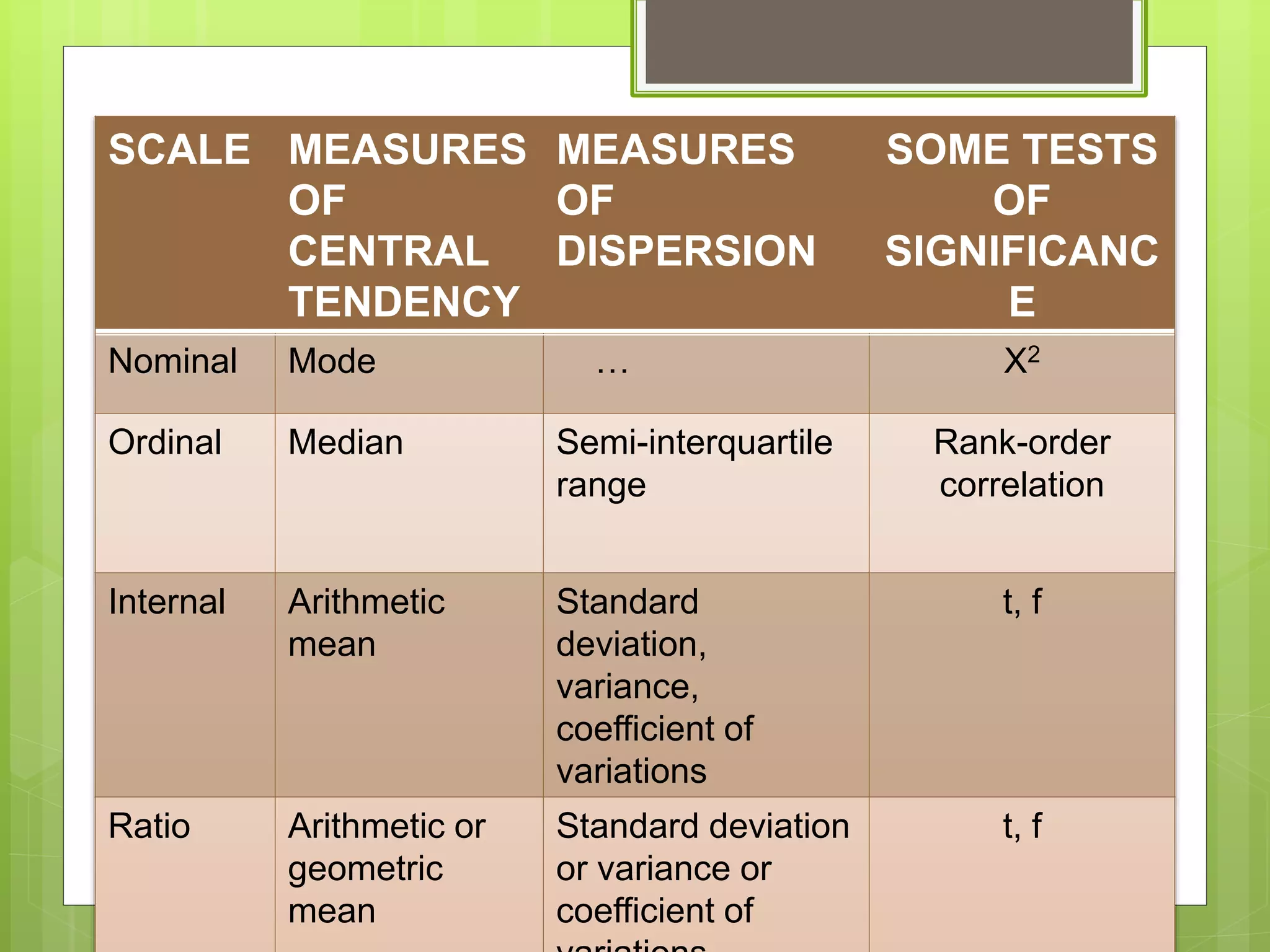
SCALE MEASURES
OF
CENTRAL
TENDENCY
MEASURES
OF
DISPERSION
SOME TESTS
OF
SIGNIFICANC
E
Nominal Mode … X2
Ordinal Median Semi-interquartile
range
Rank-order
correlation
Internal Arithmetic
mean
Standard
deviation,
variance,
coefficient of
variations
t, f
Ratio Arithmetic or
geometric
mean
Standard deviation
or variance or
coefficient of
t, f
Research Methodology - types of scale

Research Methodology - types of scale

  • 1.
    PRESENTATION BY KARPAGAM SIGAPPI AL RESEARCH METHODOLOGY
  • 2.
    SCALES A Scale isa tool or mechanism by which individuals are distinguished as to how they differ from one another on the variables of interest to our study.
  • 3.
  • 4.
    NOMINAL SCALE A nominalscale is one that allows the researcher to assign subjects to certain categories or groups. For example: Your department -Production -Sales -Accounting -Personnel -R&D -Others (specify)
  • 5.
    ORDINAL SCALE An ordinalscale categorizes the variables in such a way as to denote differences among the various categories, it also rank-orders the categories in some meaningful way. For example: APPs RANKING Whatsapp Viber Hike Line Wechat
  • 6.
    INTERVAL SCALE An intervalscale allows to perform certain arithmetical operations on the data collected from the respondents. For example: Strongl y Disagr ee Disagr ee Neither agree nor Disagre e Agre e Strongl y Agree • My job offers me a chance to test myself and my abilities
  • 7.
    RATIO SCALES The ratioscale measures the magnitude of the differences between points on the scale but also taps the proportions in the differences. For example: Boys – 20 and Girls – 30 Then the ratio will be 1:1.5
  • 8.
    Dichotomous scale • toelicit yes or no answer For example: Do you own a car? o Yes o No Category scale • for multiple items to elicit a single response For example: your caste o OC o BC o MBC o ST o Others
  • 9.
    Semantic differential scale •several bipolar attributes are identified • respondents are asked to indicate their attitudes For example: Courageous Timid Honest Dishonest Numerical scale • The scale provides number on a five-point or seven point • with bipolar adjectives at end For example: Honest [7 6 5 4 3 2 1 ] Dishonest
  • 10.
    Stapel scale • itmeasures both the direction and intensity of the attitude For example: state how you would rate your supervisor’s abilities with respect to each of the characteristics mentioned below +3 +2 +1 product innovation -1 -2 -3 +3 +2 +1 interpersonal skills -1 -2 -3
  • 11.
    Graphic rating scale •it is a graphical representation For example: on a scale of 1 to 10, how would you rate your supervisor? Adequate very bad 1 2 3 4 5 6 7 8 9 10 excellent
  • 12.
    Forced choice scale •there will be two alternatives • choice is to select one alone For example: which is your favorite subject? o maths o science
  • 13.
  • 14.
  • 15.
    SCALE MEASURES OF CENTRAL TENDENCY MEASURES OF DISPERSION SOME TESTS OF SIGNIFICANC E NominalMode … X2 Ordinal Median Semi-interquartile range Rank-order correlation Internal Arithmetic mean Standard deviation, variance, coefficient of variations t, f Ratio Arithmetic or geometric mean Standard deviation or variance or coefficient of t, f