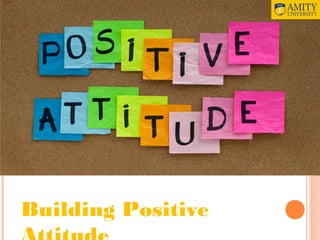
Building Positive
TEAM MEMBERS
Siddhartha Mukherjee
Malsawm Tluangi
Saloni Bansal
Trishya Varghise
Prernit Dua
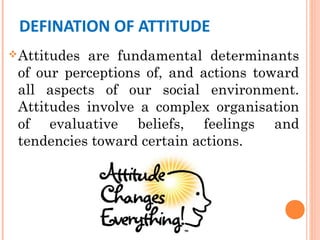
DEFINATION OF ATTITUDE
Attitudes are fundamental determinants
of our perceptions of, and actions toward
all aspects of our social environment.
Attitudes involve a complex organisation
of evaluative beliefs, feelings and
tendencies toward certain actions.
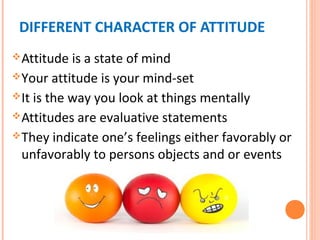
DIFFERENT CHARACTER OF ATTITUDE
Attitude is a state of mind
Your attitude is your mind-set
It is the way you look at things mentally
Attitudes are evaluative statements
They indicate one’s feelings either favorably or
unfavorably to persons objects and or events
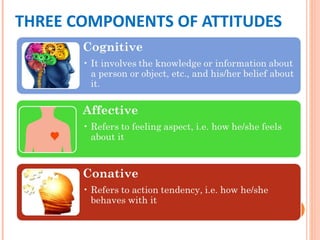
THREE COMPONENTS OF ATTITUDES
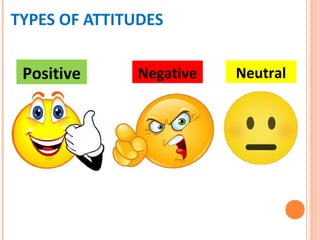
TYPES OF ATTITUDES
Positive Negative Neutral
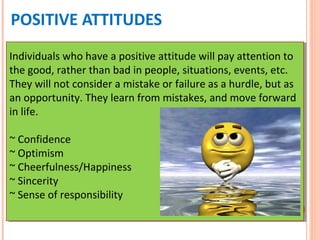
POSITIVE ATTITUDES
Individuals who have a positive attitude will pay attention to
the good, rather than bad in people, situations, events, etc.
They will not consider a mistake or failure as a hurdle, but as
an opportunity. They learn from mistakes, and move forward
in life.
~ Confidence
~ Optimism
~ Cheerfulness/Happiness
~ Sincerity
~ Sense of responsibility
Individuals who have a positive attitude will pay attention to
the good, rather than bad in people, situations, events, etc.
They will not consider a mistake or failure as a hurdle, but as
an opportunity. They learn from mistakes, and move forward
in life.
~ Confidence
~ Optimism
~ Cheerfulness/Happiness
~ Sincerity
~ Sense of responsibility
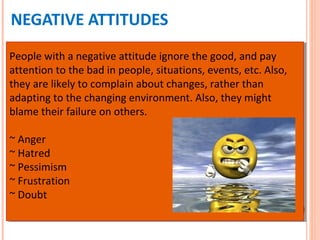
NEGATIVE ATTITUDES
People with a negative attitude ignore the good, and pay
attention to the bad in people, situations, events, etc. Also,
they are likely to complain about changes, rather than
adapting to the changing environment. Also, they might
blame their failure on others.
~ Anger
~ Hatred
~ Pessimism
~ Frustration
~ Doubt
People with a negative attitude ignore the good, and pay
attention to the bad in people, situations, events, etc. Also,
they are likely to complain about changes, rather than
adapting to the changing environment. Also, they might
blame their failure on others.
~ Anger
~ Hatred
~ Pessimism
~ Frustration
~ Doubt
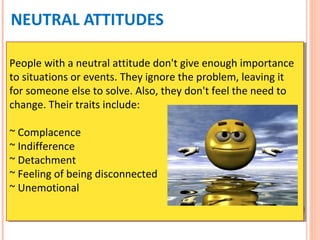
NEUTRAL ATTITUDES
People with a neutral attitude don't give enough importance
to situations or events. They ignore the problem, leaving it
for someone else to solve. Also, they don't feel the need to
change. Their traits include:
~ Complacence
~ Indifference
~ Detachment
~ Feeling of being disconnected
~ Unemotional
People with a neutral attitude don't give enough importance
to situations or events. They ignore the problem, leaving it
for someone else to solve. Also, they don't feel the need to
change. Their traits include:
~ Complacence
~ Indifference
~ Detachment
~ Feeling of being disconnected
~ Unemotional
LEARNING FROM ATTITUDE
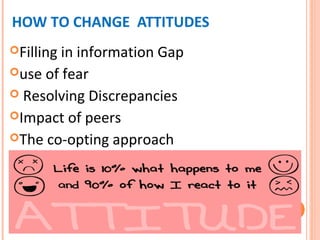
HOW TO CHANGE ATTITUDES
Filling in information Gap
use of fear
 Resolving Discrepancies
Impact of peers
The co-opting approach
THANK YOU

Building positive attitude

  • 1.
  • 2.
    TEAM MEMBERS Siddhartha Mukherjee MalsawmTluangi Saloni Bansal Trishya Varghise Prernit Dua
  • 3.
    DEFINATION OF ATTITUDE Attitudesare fundamental determinants of our perceptions of, and actions toward all aspects of our social environment. Attitudes involve a complex organisation of evaluative beliefs, feelings and tendencies toward certain actions.
  • 4.
    DIFFERENT CHARACTER OFATTITUDE Attitude is a state of mind Your attitude is your mind-set It is the way you look at things mentally Attitudes are evaluative statements They indicate one’s feelings either favorably or unfavorably to persons objects and or events
  • 5.
  • 6.
  • 7.
    POSITIVE ATTITUDES Individuals whohave a positive attitude will pay attention to the good, rather than bad in people, situations, events, etc. They will not consider a mistake or failure as a hurdle, but as an opportunity. They learn from mistakes, and move forward in life. ~ Confidence ~ Optimism ~ Cheerfulness/Happiness ~ Sincerity ~ Sense of responsibility Individuals who have a positive attitude will pay attention to the good, rather than bad in people, situations, events, etc. They will not consider a mistake or failure as a hurdle, but as an opportunity. They learn from mistakes, and move forward in life. ~ Confidence ~ Optimism ~ Cheerfulness/Happiness ~ Sincerity ~ Sense of responsibility
  • 8.
    NEGATIVE ATTITUDES People witha negative attitude ignore the good, and pay attention to the bad in people, situations, events, etc. Also, they are likely to complain about changes, rather than adapting to the changing environment. Also, they might blame their failure on others. ~ Anger ~ Hatred ~ Pessimism ~ Frustration ~ Doubt People with a negative attitude ignore the good, and pay attention to the bad in people, situations, events, etc. Also, they are likely to complain about changes, rather than adapting to the changing environment. Also, they might blame their failure on others. ~ Anger ~ Hatred ~ Pessimism ~ Frustration ~ Doubt
  • 9.
    NEUTRAL ATTITUDES People witha neutral attitude don't give enough importance to situations or events. They ignore the problem, leaving it for someone else to solve. Also, they don't feel the need to change. Their traits include: ~ Complacence ~ Indifference ~ Detachment ~ Feeling of being disconnected ~ Unemotional People with a neutral attitude don't give enough importance to situations or events. They ignore the problem, leaving it for someone else to solve. Also, they don't feel the need to change. Their traits include: ~ Complacence ~ Indifference ~ Detachment ~ Feeling of being disconnected ~ Unemotional
  • 10.
  • 11.
    HOW TO CHANGEATTITUDES Filling in information Gap use of fear  Resolving Discrepancies Impact of peers The co-opting approach
  • 12.