ATROPHIC RHINITIS
Dr Williams C S
Assistant professor
ATROPHIC RHINITIS
Definition:
Atrophic rhinitis is defined as a chronic nasal disease
characterised by progressive atrophy of the nasal mucosa
along with the underlying bone of the turbinates.
There is also associated presence of viscid secretion which
rapidly dries up forming foul smelling thick crusts.
This fetid odor is also known as ozaena.
The nasal cavity is also abnormally patent and there is the
sensation of nasal congestion.
The patient is fortunately unaware of the stench emitting
from the nose as this disorder is associated with merciful
anosmia.
ATROPHIC RHINITIS
Aetiology:
The etiology of this problem still remains obscure.
Numerous pathogens have been associated with this
condition, the most important of them are
1. Klebsiella ozaenae, 2. Bacillus mucosus, 3. Coccobacillus
foetidus ozaenae, 4. Diptheroid bacilli and 5. Peudomonas
These organisms despite being isolated from the nose of
diseased patients have not categorically been proved as the
cause for the same.
Common in females.
ATROPHIC RHINITIS
Other possible factors which could predispose to this
disease are:
Primary Atrophic Rhinitis :
1. Nutritional deficiencies
2. Endocrine imbalances (Disease is known to
worsen with pregnancy / menstruation)
3. Heredity (Autosomal dominant pattern of
inheritance identified)
4. Autoimmune disease
5. Iron deficiency anemia
Atrophic rhinitis
• Secondary
– Complication of sinus surgery (89%)
– Complication of radiation (2.5%)
– Following nasal trauma (1%)
– Sequela of granulomatous diseases (1%)
• Sarcoid
• Leprosy
• Rhinoscleroma
– Sequlae of other infectious processes
• Tuberculosis
• Syphilis
ATROPHIC RHINITIS
Pathology:
1. Metaplasia of ciliated columnar nasal epithelium
into squamous epithelium.
2. There is a decrease in the number and size of
compound alveolar glands.
3. Dilated capillaries are also seen.
Pathologically atrophic rhinitis has been divided into two
types:
Type I:
is characterised by the presence of endarteritis and
periarteritis of the terminal arterioles.
This could be caused by chronic infections.
These patients benefit from the vasodilator effects of
oestrogen therapy.
Type II:
is characterised by vasodilatation of the capillaries, these
patients may worsen with estrogen therapy.
Majority of patients with atrophic rhinitis belong to type I
category.
Atrophic Rhinitis
• Clinical Features
– Usually Females
– Ozena, i.e. foul odour
– Extensive nasal crusting
– Nasal obstruction
– Epistaxis when crust is removed.
– Enlargement of the nasal cavity
– Resorption or absence of turbinates
– Squamous metaplasia of nasal mucosa
PHYSICAL FINDINGS
• Crusting – 100% Present
• Nasal mucosa looks pale
• Inferior Turbinates
– 62% Partial atrophy
– 37% Total atrophy
• Middle Turbinates
– 57% Atrophy
• Discharge
– 52% Present
• SeptumS- 10% Perforations, Nasal saddle deformity
• Roomy nasal cavities.
• Obstruction of ET results in Middle Ear Effusion, which
.
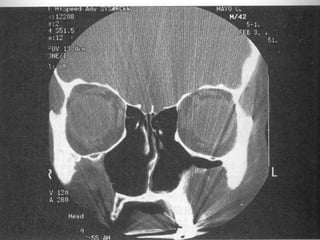
Radiographic Findings
1. Mucoperiosteal thickening of the paranasal sinuses.
2. Loss of definition of the OMC secondary to resorption of the ethmoid bulla and
uncinate process.
3. Hypoplasia of the maxillary sinuses.
4. Enlargement of the nasal cavities with erosion and bowing of the lateral nasal
wall.
5. Bony resorption and mucosal atrophy of the inferior and middle turbinates.
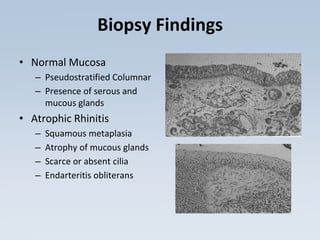
Biopsy Findings
• Normal Mucosa
– Pseudostratified Columnar
– Presence of serous and
mucous glands
• Atrophic Rhinitis
– Squamous metaplasia
– Atrophy of mucous glands
– Scarce or absent cilia
– Endarteritis obliterans
Current Therapies
• Goals of therapy
– Restore nasal hydration
– Minimize crusting and debris
• Therapy options
– Topical therapy
– Saline irrigations
– Antibiotic irrigations
– Systemic antibiotics
– Implants to fill nasal volume
– Closure of the nostrils
MANAGEMENT
1. Alkaline nasal irrigation - The patient must be asked to
douche the nose atleast twice a day with a solution
prepared with:
Sodium bicarbonate - 28.4 g
Sodium diborate - 28.4 g
Sodium chloride - 56.7 g
mixed in 280 ml of luke warm water.
2. 25% glucose in glycerin- Inhibits the growth of
proteolytic organisms responsible for foul smeling.
Systemic therapy
• Oral antibiotics
– Tetracycline
– Ciprofloxacin
– Aminoglycosides
– Streptomycin injections 1 gm for 10 days.
– Kemicetine antiozaena solution, - Chloromycetin, estradiol and vitamin D2.
• Medication avoidance
– Vasoconstrictors
– Topical steroids *
• Other
– Vitamin A (12,500 to 15,000 Units daily)
– Potassium Iodide (promotes and liquefy nasal secretions)
– Vasodilators
– Iron therapy
– Estradiol nasal spray- increase vascularity of nasal mucosa and regenerate
seromucinous glands
Surgical therapies
• Young’s procedure
Both the nostrils are completely closed within
the nasal vestibule with flaps.
• Open again after 6 months or later.
• Modified Young procedure
• Nostrils are partially closed that avoid the
discomfort of nasal obstruction
• Lauten Slanger’s operation
• Fracture the lateral wall and displace the
THANK YOU.! ! !

Atrophic Rhinitis.pptx

  • 1.
    ATROPHIC RHINITIS Dr WilliamsC S Assistant professor
  • 2.
    ATROPHIC RHINITIS Definition: Atrophic rhinitisis defined as a chronic nasal disease characterised by progressive atrophy of the nasal mucosa along with the underlying bone of the turbinates. There is also associated presence of viscid secretion which rapidly dries up forming foul smelling thick crusts. This fetid odor is also known as ozaena. The nasal cavity is also abnormally patent and there is the sensation of nasal congestion. The patient is fortunately unaware of the stench emitting from the nose as this disorder is associated with merciful anosmia.
  • 3.
    ATROPHIC RHINITIS Aetiology: The etiologyof this problem still remains obscure. Numerous pathogens have been associated with this condition, the most important of them are 1. Klebsiella ozaenae, 2. Bacillus mucosus, 3. Coccobacillus foetidus ozaenae, 4. Diptheroid bacilli and 5. Peudomonas These organisms despite being isolated from the nose of diseased patients have not categorically been proved as the cause for the same. Common in females.
  • 4.
    ATROPHIC RHINITIS Other possiblefactors which could predispose to this disease are: Primary Atrophic Rhinitis : 1. Nutritional deficiencies 2. Endocrine imbalances (Disease is known to worsen with pregnancy / menstruation) 3. Heredity (Autosomal dominant pattern of inheritance identified) 4. Autoimmune disease 5. Iron deficiency anemia
  • 5.
    Atrophic rhinitis • Secondary –Complication of sinus surgery (89%) – Complication of radiation (2.5%) – Following nasal trauma (1%) – Sequela of granulomatous diseases (1%) • Sarcoid • Leprosy • Rhinoscleroma – Sequlae of other infectious processes • Tuberculosis • Syphilis
  • 6.
    ATROPHIC RHINITIS Pathology: 1. Metaplasiaof ciliated columnar nasal epithelium into squamous epithelium. 2. There is a decrease in the number and size of compound alveolar glands. 3. Dilated capillaries are also seen.
  • 7.
    Pathologically atrophic rhinitishas been divided into two types: Type I: is characterised by the presence of endarteritis and periarteritis of the terminal arterioles. This could be caused by chronic infections. These patients benefit from the vasodilator effects of oestrogen therapy. Type II: is characterised by vasodilatation of the capillaries, these patients may worsen with estrogen therapy. Majority of patients with atrophic rhinitis belong to type I category.
  • 8.
    Atrophic Rhinitis • ClinicalFeatures – Usually Females – Ozena, i.e. foul odour – Extensive nasal crusting – Nasal obstruction – Epistaxis when crust is removed. – Enlargement of the nasal cavity – Resorption or absence of turbinates – Squamous metaplasia of nasal mucosa
  • 9.
    PHYSICAL FINDINGS • Crusting– 100% Present • Nasal mucosa looks pale • Inferior Turbinates – 62% Partial atrophy – 37% Total atrophy • Middle Turbinates – 57% Atrophy • Discharge – 52% Present • SeptumS- 10% Perforations, Nasal saddle deformity • Roomy nasal cavities. • Obstruction of ET results in Middle Ear Effusion, which .
  • 11.
    Radiographic Findings 1. Mucoperiostealthickening of the paranasal sinuses. 2. Loss of definition of the OMC secondary to resorption of the ethmoid bulla and uncinate process. 3. Hypoplasia of the maxillary sinuses. 4. Enlargement of the nasal cavities with erosion and bowing of the lateral nasal wall. 5. Bony resorption and mucosal atrophy of the inferior and middle turbinates.
  • 13.
    Biopsy Findings • NormalMucosa – Pseudostratified Columnar – Presence of serous and mucous glands • Atrophic Rhinitis – Squamous metaplasia – Atrophy of mucous glands – Scarce or absent cilia – Endarteritis obliterans
  • 14.
    Current Therapies • Goalsof therapy – Restore nasal hydration – Minimize crusting and debris • Therapy options – Topical therapy – Saline irrigations – Antibiotic irrigations – Systemic antibiotics – Implants to fill nasal volume – Closure of the nostrils
  • 15.
    MANAGEMENT 1. Alkaline nasalirrigation - The patient must be asked to douche the nose atleast twice a day with a solution prepared with: Sodium bicarbonate - 28.4 g Sodium diborate - 28.4 g Sodium chloride - 56.7 g mixed in 280 ml of luke warm water. 2. 25% glucose in glycerin- Inhibits the growth of proteolytic organisms responsible for foul smeling.
  • 16.
    Systemic therapy • Oralantibiotics – Tetracycline – Ciprofloxacin – Aminoglycosides – Streptomycin injections 1 gm for 10 days. – Kemicetine antiozaena solution, - Chloromycetin, estradiol and vitamin D2. • Medication avoidance – Vasoconstrictors – Topical steroids * • Other – Vitamin A (12,500 to 15,000 Units daily) – Potassium Iodide (promotes and liquefy nasal secretions) – Vasodilators – Iron therapy – Estradiol nasal spray- increase vascularity of nasal mucosa and regenerate seromucinous glands
  • 17.
    Surgical therapies • Young’sprocedure Both the nostrils are completely closed within the nasal vestibule with flaps. • Open again after 6 months or later. • Modified Young procedure • Nostrils are partially closed that avoid the discomfort of nasal obstruction • Lauten Slanger’s operation • Fracture the lateral wall and displace the
  • 18.