Prepared by:
Sobhan sabzi
 Acute Rhinitis can be –
•Viral
•Bacterial
•Irritative type
1) Common cold (Coryza)
 etiology : Several viruses (adeno virus,
picorna virus and its sub-groups sucha s
rhinovirus, coxsackie, and ECHO)
 Clinical features : Nasal stiffness,
rhinorrhoea, sneezing, low grade fever,
secondary bacterial invasion may occur.
 Treatment : Bed rest, Plenty of fluids,
Antihistaminics, Nasal decongestants,
Analgesics, Antibiotics.
Complications :
 Sinusitis, pharyngitis, tonsillitis,
bronchitis, pneumonia and otitis
media.
Influenzal rhinitis - Influenza
viruses A, B or C.
c/f are similar to common cold
Rhinitis associated with
exanthemas. Measles, rubella,
chickenpox.
precede exanthemas by 2-3 days
 Diphtheritic rhinitis :
• Primary
• Secondary to faucial diphtheria
• May occur in acute or chronic form
• Greyish membrane is seen covering the inferior
turbinate and the floor of nose; membrane is tenacious
and its removal causes bleeding
 Treatment : Isolation of the patient, systemic
penicillin and diphtheria antitoxin.
 Chronic non-specific inflammations of
nose include :
1. Chronic simple rhinitis
2. Hypertrophic rhinitis
3. Atrophic rhinitis
4. Rhinitis sicca
5. Rhinitis caseosa.
 etiology : Predisposing factors
a. Persistence of nasal infection due to sinusitis,
tonsillitis, and adenoids.
b. Chronic irritation from dust, smoke, cigarette
smoking, snuff.
c. Nasal obstruction.
d. Vasomotor rhinitis
e. Endocrinal or metabolic factors, e.g.
hypothyroidism.
a. Pathology : Hyperemia and edema of
mucous membrane, Hypertrophy of
seromucinous glands, increase in goblet
cells.
 Clinical features :
a. Nasal obstruction
b. Nasal discharge. It may be mucoid or
mucopurulent. Postnasal drip.
c. Headache
d. Swollen turbinates – They pit on pressure,
shrink with application of vasoconstrictor
drops (this differentiates the condition from
hypertrophic rhinitis).
 Treatment :
a. Treat the predisposing factor.
b. Nasal irrigations with alkaline solution.
c. Nasal decongestants.
d. Antibiotics help to clear nasal infection.
 Characterized by thickening of mucosa,
submucosa, seromucinous glands,
periosteum and bone.
etiology :
 Recurrent nasal infections
 Chronic sinusitis
 Chronic irritation of nasal mucosa.
Symptoms :
 Nasal obstruction
 Nasal discharge : thick
and sticky.
 Headache
 Heaviness of head
 Transient anosmia.
Signs :
 Hypertrophy of
turbinates
 Turbinal mucosa is
thick, does not pit on
pressure, little
shrinkage with
vasoconstrictor drugs
due to underlying
fibrosis.
 Maximum changes in
the inferior turbiante.
 Mulberry appearance
of inferior turbiante.
Treatment :
 Discover the cause and remove it.
 Reduction in size of turbinates by
a. Liner cauterisation
b. Submucosal diathermy
c. Cryosurgery of turbinates
d. Partial or total turbinectomy
e. Submucous resection of turbinates bone.
f. Lasers
 Chronic inflammation of nose
characterized by atrophy of nasal mucosa
and turbinate bones.
Primary atrophic rhinitis :
 etiology : Exact cause is not known,
Various theories regarding its causation
are:
a. Hereditary factors
b. Endocrinal disturbances : Starts puberty,
involves females more than males, tends to
cease after menopause.
c. Racial factors – White.
d. Nutritional deficiency : Deficiency of
vitamin A, D or iron.
e. Infective : Klebsiella ozaenae, (Perez
bacillus), diphtheroids, P.vulgaris, Esch.
Coli, Staphylococci and Streptococci but
they are all considered to be secondary
invaders.
f. Autoimmune process : The body reacts by
a destructive process to the antigens
released from the nasal mucosa.
Pathology :
 Ciliated columnar epithelium is
replaced by stratified squamous type.
 Atrophy of seromucinous glands,
venous sinusoids and nerve elements.
 Obliterative endarteritis.
 The bone of turbinates undergoes
resorption.
 Paranasal sinuses are small.
 Type 1: charecterised by endarteritis and
periarteritis of terminal arterioles
-result of chronic infection
- benefits from vasodilator effect of
oestrogen therapy
 Type 2: vasodilatation of capillaries
- which might be made worse by
oestrogen therapy
Clinical features :
 Commonly seen in females and starts around
puberty.
 Foul smell from the nose.
 Marked anosmia (merciful anosmia)
 Nasal obstruction
 Epistaxis when the crusts are removed.
 Nasal cavity full of greenish or greyish black dry
crusts.
 Nasal cavities appear roomy.
 Nasal mucosa appear pale.
 Septal perforation and dermatitis of nasal vestibule.
 Nose shows saddle deformity.
Prognosis :
 Disease persists for years
Treatment :
1. Medical :
a. Nasal irrigation and removal of crusts.
b. 25% glucose in glycerine. – Inhibits the growth
of proteolytic organisms which are responsible
for foul smell.
c. Local antibiotics – KemicetineTM
antiozaena
solution contains chloromycetin, oestradiol and
vitamin D2.
d. Oestradiol spray – increase vascularity of
nasal mucosa and regeneration of
seromucinous glands.
e. Placental extract injected submucosally.
f. Systemic use of streptomycin – reducing
crusting and odour. Effective against
Klebsiella organisms.
2. Surgical :
a. Young’s operation – Both the nostrils are closed
completely just within the nasal vestibule by raising
flaps. They are opened after 6 months or later.
Modified young’s operation - Aims to partially close
the nostrils.
a. Narrowing the nasal cavities. Among the
techniques followed, some are :
 Submucosal injection to teflon paste.
 Insertion of fat, cartilage, bone or teflon strips
under the mucoperiosteum of the floor and lateral
wall of nose and the mucoperichondrium of the
septum.
 Section and medial displacement of lateral wall of
nose.
SECONDARY ATROPHIC RHINITIS :
 Specific infections like syphilis, lupus,
leprosy and rhinoscleroma.
 Longstanding purulent sinusitis,
radiotherapy or nose or excessive
surgical removal of turbinates.
UNILATERAL ATROPHIC RHINITIS :
 Extreme deviation of nasal septum.
 Atrophic rhinitis on the wider side.
 Crust-forming disease
 Seen in patients who work in hot, dry and
dusty surroundings.
 Confined to the anterior third of nose.
 The ciliated columnar epithelium undergoes
squamous metaplasia.
 Atrophy of seromucinous glands (Crusts,
epistaxis, septal perforation).
Treatment :
 Bland ointment or an antibiotic and steroid.
 Nasal douche.
ALLERGIC
RHINITIS
 IgE – mediated immunologic response
to nasal mucosa to air-borne allergens.
 Two clinical types
1. Seasonal. Symptoms appear in or around a
particular season.
2. Perennial. Symptoms are present throughout
the year
AETIOLOGY :
 Inhalant allergens – Pollen from the
trees and grasses, mold spores, house
dust, debris from insects or house mite
are common offenders.
 Genetic predisposition
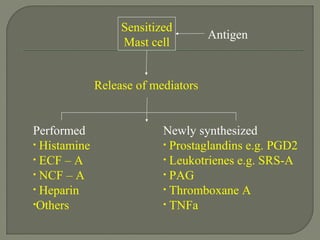
Sensitized
Mast cell
Antigen
Release of mediators
Performed
• Histamine
• ECF – A
• NCF – A
• Heparin
•Others
Newly synthesized
• Prostaglandins e.g. PGD2
• Leukotrienes e.g. SRS-A
• PAG
• Thromboxane A
• TNFa
 Clinically allergic response occurs in
2 phases :
1. Acute or early phase : Within 5-30 min,
sneezing, rhinorrhea nasal blockage
and/or bronchospasm. Due to release of
vasoactive amines like histamine.
2. Late or delayed phase : 2-8 hours after
exposure to allergen without additional
exposure. Due to infiltration of
inflammatory cells eosinophils, neutrophils,
basophil, monocytes and CD4+ T cells at
the site of antigen deposition.
 No age or sex predilection
 Symptoms of seasonal nasal allergy.
 Paroxysmal sneezing, 10-20 sneezes at a
time, nasal obstruction, watery nasal
discharge and itching in the nose.
 Symptoms of perennial allergy.
 Frequent colds, persistently stuffy nose, loss
of sense of smell due to mucosal edema,
postnasal drip, chronic cough.
 Signs of allergy may be seen in the nose,
eyes, pharynx or larynx.
Nasal signs :
• Transverse nasal crease
• Allergic salute
• Pale and edematous nasal mucosa
• Thin, watery or mucoid discharge
Diagnosis :
• Detailed history and physical examination.
Investigations :
1. Total and differential count. Peripheral
eosinophilia.
2. Nasal smear shows large number of
eosinophils.
3. Skin tests. Prick, scratch and intradermal
tests.
4. Radioallergosorbent test (RAST). Measures
specific IgE antibody concentration in the
patient’s serum.
5. Nasal provocation test.
Complications :
1. Recurrent sinusitis.
2. Nasal polyp
3. Serous otitis media
4. Bronchial asthma.
Treatment :
1. Avoidance of allergen.
2. Treatment with drugs.
a. Antihistaminics
b. Corticosteorids
Oral corticosteorids
Use should be limited to acute episodes
Several systemic side effects
Topical steroids such as beclomethasone
dipropionate, budesonide, flunisolide acetate,
fluticasone are used as aerosols, very effective
in the control of symptoms.
Fewer systemic side effects.
c. Sodium chromoglycate
Stabilizes the mast cells and prevents them
from degraulation.
2% solution for nasal drops or spray or as an
aerosol powder.
3. Immunotherapy
Allergen is given in gradually increasing
doses till the maintenance dose is reached.
Immunotherapy suppresses the formation
of IgE.
 Non-allergic rhinitis but clinically
simulating nasal allergy.
 Condition usually persists throughout
the year.
Pathogenesis :
 Parasympathetic stimulation causes
vasodilation and engorgement. Over activity
of parasympathetic system also causes
excessive secretion from the nasal glands.
 Autonomic nervous system is under the
control of hypothalamus therefore emotions
play a great role in vasomotor rhinitis.
 Nasal mucosa is also hyper-reactive and
responds to several non-specific stimuli e.g.
change in temperature, humidity.
Symptoms :
 Paroxysmal sneezing. In the morning.
 Excessive rhinorrhoea. Profuse and watery.
 Nasal obstruction
 Postnasal drip.
Signs :
 Nasal mucosa over the turbinates is
generally congested and hypertrophic.
Complications :
 Nasal polypi, hypertrophic rhinitis and
sinusitis.
TREATMENT :
Medical :
1. Avoidance of physical factors which
provoke symptoms.
2. Antihistaminics and oral nasal
decongestants.
3. Topical steroids.
4. Systemic steroids – for a short time in
very severe cases.
5. Psychological factors should be
removed.
Surgical :
1. Nasal obstruction can be relieved by
measures which reduce the size of
nasal turbinates.
2. Excessive rhinorrhoea, relived by
sectioning the parasympathetic
secretomotor fibres to nose (vidian
neurectomy).
Other forms of non-allergic rhinitis :
1. Drug-induced rhinitis : Several
antihypertensive drugs. Some
anticholinesterase drugs e.g. neostigmine.
Contraceptive pills because of oestrogens.
2. Rhinitis medicamentosa :Topical
decongestant nasal drops cause rebound
phenomenon.Their excessive use causes
rhinitis.Treated by withdrawal of nasal
drops, short course of systemic steroid.
3. Rhinitis of pregnancy : Due to hormonal
changes. Local measures such as limited
use of nasal drops.
4. Honeymoon rhinitis
5. Emotional rhinitis : due to several
emotional stimuli.
6. Rhinitis due to hypothyroidism :
Predominance of parasympathetic activity.
7. Non air-flow rhinitis : Seen in patients of
laryngoectomy and tracheostomy.
Thank you

Acute and chronic rhinitis

  • 1.
  • 2.
     Acute Rhinitiscan be – •Viral •Bacterial •Irritative type
  • 3.
    1) Common cold(Coryza)  etiology : Several viruses (adeno virus, picorna virus and its sub-groups sucha s rhinovirus, coxsackie, and ECHO)  Clinical features : Nasal stiffness, rhinorrhoea, sneezing, low grade fever, secondary bacterial invasion may occur.  Treatment : Bed rest, Plenty of fluids, Antihistaminics, Nasal decongestants, Analgesics, Antibiotics.
  • 4.
    Complications :  Sinusitis,pharyngitis, tonsillitis, bronchitis, pneumonia and otitis media.
  • 5.
    Influenzal rhinitis -Influenza viruses A, B or C. c/f are similar to common cold
  • 6.
    Rhinitis associated with exanthemas.Measles, rubella, chickenpox. precede exanthemas by 2-3 days
  • 7.
     Diphtheritic rhinitis: • Primary • Secondary to faucial diphtheria • May occur in acute or chronic form • Greyish membrane is seen covering the inferior turbinate and the floor of nose; membrane is tenacious and its removal causes bleeding  Treatment : Isolation of the patient, systemic penicillin and diphtheria antitoxin.
  • 8.
     Chronic non-specificinflammations of nose include : 1. Chronic simple rhinitis 2. Hypertrophic rhinitis 3. Atrophic rhinitis 4. Rhinitis sicca 5. Rhinitis caseosa.
  • 9.
     etiology :Predisposing factors a. Persistence of nasal infection due to sinusitis, tonsillitis, and adenoids. b. Chronic irritation from dust, smoke, cigarette smoking, snuff. c. Nasal obstruction. d. Vasomotor rhinitis e. Endocrinal or metabolic factors, e.g. hypothyroidism. a. Pathology : Hyperemia and edema of mucous membrane, Hypertrophy of seromucinous glands, increase in goblet cells.
  • 10.
     Clinical features: a. Nasal obstruction b. Nasal discharge. It may be mucoid or mucopurulent. Postnasal drip. c. Headache d. Swollen turbinates – They pit on pressure, shrink with application of vasoconstrictor drops (this differentiates the condition from hypertrophic rhinitis).
  • 11.
     Treatment : a.Treat the predisposing factor. b. Nasal irrigations with alkaline solution. c. Nasal decongestants. d. Antibiotics help to clear nasal infection.
  • 12.
     Characterized bythickening of mucosa, submucosa, seromucinous glands, periosteum and bone. etiology :  Recurrent nasal infections  Chronic sinusitis  Chronic irritation of nasal mucosa.
  • 13.
    Symptoms :  Nasalobstruction  Nasal discharge : thick and sticky.  Headache  Heaviness of head  Transient anosmia. Signs :  Hypertrophy of turbinates  Turbinal mucosa is thick, does not pit on pressure, little shrinkage with vasoconstrictor drugs due to underlying fibrosis.  Maximum changes in the inferior turbiante.  Mulberry appearance of inferior turbiante.
  • 14.
    Treatment :  Discoverthe cause and remove it.  Reduction in size of turbinates by a. Liner cauterisation b. Submucosal diathermy c. Cryosurgery of turbinates d. Partial or total turbinectomy e. Submucous resection of turbinates bone. f. Lasers
  • 15.
     Chronic inflammationof nose characterized by atrophy of nasal mucosa and turbinate bones. Primary atrophic rhinitis :  etiology : Exact cause is not known, Various theories regarding its causation are: a. Hereditary factors b. Endocrinal disturbances : Starts puberty, involves females more than males, tends to cease after menopause.
  • 16.
    c. Racial factors– White. d. Nutritional deficiency : Deficiency of vitamin A, D or iron. e. Infective : Klebsiella ozaenae, (Perez bacillus), diphtheroids, P.vulgaris, Esch. Coli, Staphylococci and Streptococci but they are all considered to be secondary invaders. f. Autoimmune process : The body reacts by a destructive process to the antigens released from the nasal mucosa.
  • 17.
    Pathology :  Ciliatedcolumnar epithelium is replaced by stratified squamous type.  Atrophy of seromucinous glands, venous sinusoids and nerve elements.  Obliterative endarteritis.  The bone of turbinates undergoes resorption.  Paranasal sinuses are small.
  • 18.
     Type 1:charecterised by endarteritis and periarteritis of terminal arterioles -result of chronic infection - benefits from vasodilator effect of oestrogen therapy  Type 2: vasodilatation of capillaries - which might be made worse by oestrogen therapy
  • 19.
    Clinical features : Commonly seen in females and starts around puberty.  Foul smell from the nose.  Marked anosmia (merciful anosmia)  Nasal obstruction  Epistaxis when the crusts are removed.  Nasal cavity full of greenish or greyish black dry crusts.  Nasal cavities appear roomy.  Nasal mucosa appear pale.  Septal perforation and dermatitis of nasal vestibule.  Nose shows saddle deformity.
  • 20.
    Prognosis :  Diseasepersists for years Treatment : 1. Medical : a. Nasal irrigation and removal of crusts. b. 25% glucose in glycerine. – Inhibits the growth of proteolytic organisms which are responsible for foul smell. c. Local antibiotics – KemicetineTM antiozaena solution contains chloromycetin, oestradiol and vitamin D2.
  • 21.
    d. Oestradiol spray– increase vascularity of nasal mucosa and regeneration of seromucinous glands. e. Placental extract injected submucosally. f. Systemic use of streptomycin – reducing crusting and odour. Effective against Klebsiella organisms.
  • 22.
    2. Surgical : a.Young’s operation – Both the nostrils are closed completely just within the nasal vestibule by raising flaps. They are opened after 6 months or later. Modified young’s operation - Aims to partially close the nostrils. a. Narrowing the nasal cavities. Among the techniques followed, some are :  Submucosal injection to teflon paste.  Insertion of fat, cartilage, bone or teflon strips under the mucoperiosteum of the floor and lateral wall of nose and the mucoperichondrium of the septum.  Section and medial displacement of lateral wall of nose.
  • 23.
    SECONDARY ATROPHIC RHINITIS:  Specific infections like syphilis, lupus, leprosy and rhinoscleroma.  Longstanding purulent sinusitis, radiotherapy or nose or excessive surgical removal of turbinates. UNILATERAL ATROPHIC RHINITIS :  Extreme deviation of nasal septum.  Atrophic rhinitis on the wider side.
  • 24.
     Crust-forming disease Seen in patients who work in hot, dry and dusty surroundings.  Confined to the anterior third of nose.  The ciliated columnar epithelium undergoes squamous metaplasia.  Atrophy of seromucinous glands (Crusts, epistaxis, septal perforation). Treatment :  Bland ointment or an antibiotic and steroid.  Nasal douche.
  • 25.
  • 26.
     IgE –mediated immunologic response to nasal mucosa to air-borne allergens.  Two clinical types 1. Seasonal. Symptoms appear in or around a particular season. 2. Perennial. Symptoms are present throughout the year
  • 27.
    AETIOLOGY :  Inhalantallergens – Pollen from the trees and grasses, mold spores, house dust, debris from insects or house mite are common offenders.  Genetic predisposition
  • 28.
    Sensitized Mast cell Antigen Release ofmediators Performed • Histamine • ECF – A • NCF – A • Heparin •Others Newly synthesized • Prostaglandins e.g. PGD2 • Leukotrienes e.g. SRS-A • PAG • Thromboxane A • TNFa
  • 29.
     Clinically allergicresponse occurs in 2 phases : 1. Acute or early phase : Within 5-30 min, sneezing, rhinorrhea nasal blockage and/or bronchospasm. Due to release of vasoactive amines like histamine. 2. Late or delayed phase : 2-8 hours after exposure to allergen without additional exposure. Due to infiltration of inflammatory cells eosinophils, neutrophils, basophil, monocytes and CD4+ T cells at the site of antigen deposition.
  • 30.
     No ageor sex predilection  Symptoms of seasonal nasal allergy.  Paroxysmal sneezing, 10-20 sneezes at a time, nasal obstruction, watery nasal discharge and itching in the nose.  Symptoms of perennial allergy.  Frequent colds, persistently stuffy nose, loss of sense of smell due to mucosal edema, postnasal drip, chronic cough.  Signs of allergy may be seen in the nose, eyes, pharynx or larynx.
  • 31.
    Nasal signs : •Transverse nasal crease • Allergic salute • Pale and edematous nasal mucosa • Thin, watery or mucoid discharge Diagnosis : • Detailed history and physical examination.
  • 32.
    Investigations : 1. Totaland differential count. Peripheral eosinophilia. 2. Nasal smear shows large number of eosinophils. 3. Skin tests. Prick, scratch and intradermal tests. 4. Radioallergosorbent test (RAST). Measures specific IgE antibody concentration in the patient’s serum. 5. Nasal provocation test.
  • 33.
    Complications : 1. Recurrentsinusitis. 2. Nasal polyp 3. Serous otitis media 4. Bronchial asthma.
  • 34.
    Treatment : 1. Avoidanceof allergen. 2. Treatment with drugs. a. Antihistaminics b. Corticosteorids Oral corticosteorids Use should be limited to acute episodes Several systemic side effects Topical steroids such as beclomethasone dipropionate, budesonide, flunisolide acetate, fluticasone are used as aerosols, very effective in the control of symptoms. Fewer systemic side effects.
  • 35.
    c. Sodium chromoglycate Stabilizesthe mast cells and prevents them from degraulation. 2% solution for nasal drops or spray or as an aerosol powder. 3. Immunotherapy Allergen is given in gradually increasing doses till the maintenance dose is reached. Immunotherapy suppresses the formation of IgE.
  • 36.
     Non-allergic rhinitisbut clinically simulating nasal allergy.  Condition usually persists throughout the year.
  • 37.
    Pathogenesis :  Parasympatheticstimulation causes vasodilation and engorgement. Over activity of parasympathetic system also causes excessive secretion from the nasal glands.  Autonomic nervous system is under the control of hypothalamus therefore emotions play a great role in vasomotor rhinitis.  Nasal mucosa is also hyper-reactive and responds to several non-specific stimuli e.g. change in temperature, humidity.
  • 38.
    Symptoms :  Paroxysmalsneezing. In the morning.  Excessive rhinorrhoea. Profuse and watery.  Nasal obstruction  Postnasal drip. Signs :  Nasal mucosa over the turbinates is generally congested and hypertrophic. Complications :  Nasal polypi, hypertrophic rhinitis and sinusitis.
  • 39.
    TREATMENT : Medical : 1.Avoidance of physical factors which provoke symptoms. 2. Antihistaminics and oral nasal decongestants. 3. Topical steroids. 4. Systemic steroids – for a short time in very severe cases. 5. Psychological factors should be removed.
  • 40.
    Surgical : 1. Nasalobstruction can be relieved by measures which reduce the size of nasal turbinates. 2. Excessive rhinorrhoea, relived by sectioning the parasympathetic secretomotor fibres to nose (vidian neurectomy).
  • 41.
    Other forms ofnon-allergic rhinitis : 1. Drug-induced rhinitis : Several antihypertensive drugs. Some anticholinesterase drugs e.g. neostigmine. Contraceptive pills because of oestrogens. 2. Rhinitis medicamentosa :Topical decongestant nasal drops cause rebound phenomenon.Their excessive use causes rhinitis.Treated by withdrawal of nasal drops, short course of systemic steroid.
  • 42.
    3. Rhinitis ofpregnancy : Due to hormonal changes. Local measures such as limited use of nasal drops. 4. Honeymoon rhinitis 5. Emotional rhinitis : due to several emotional stimuli. 6. Rhinitis due to hypothyroidism : Predominance of parasympathetic activity. 7. Non air-flow rhinitis : Seen in patients of laryngoectomy and tracheostomy.
  • 43.