Atrophic Rhinitis
Prof. Dr. Krishna Koirala
Questions
• Define Atrophic Rhinitis. What is the hallmark of
this condition? Write down its types.
• Write down the clinical features and
investigations of atrophic rhinitis.
• Discuss the medical and surgical treatment of
atrophic rhinitis.
• PBQ
• Defined as chronic inflammation of nose
characterized by progressive atrophy of
nasal mucosa, including the glands,
turbinate bones and the nerve elements
supplying the nose
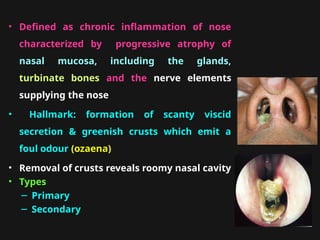
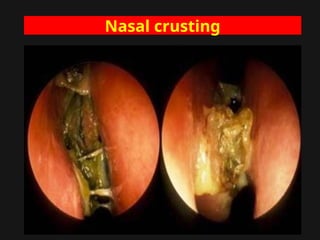
• Hallmark: formation of scanty viscid
secretion & greenish crusts which emit a
foul odour (ozaena)
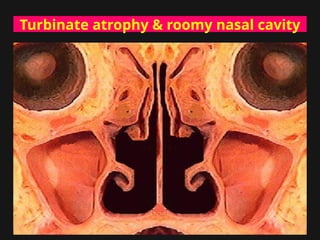
• Removal of crusts reveals roomy nasal cavity
• Types
− Primary
− Secondary
Primary Atrophic rhinitis
• Etiology:
− Hereditary : autosomal inheritance in 30% cases
− Developmental: congenital roomy nasal cavity, poor
pneumatization of maxillary antrum
− Endocrine : Seen during puberty, menopause,
menstruation (symptoms aggravate due to estrogen
deficiency)
− Racial : More in American Negroes & Latin (yellow race)
− Nutritional deficiency : Iron, Vitamin A, Vitamin D
• Infection : Klebsiella ozaenae (Perez & Abel bacillus),
Coccobacillus foetides ozaena, Bacillus mucosus,
Diphtheroids, Haemophilus influenzae
• Autoimmune : Viral infection / malnutrition / immune
deficiency trigger destructive autoimmune process on
nasal mucosa
• Autonomic Imbalance : Reflex Sympathetic Dystrophy
Syndrome (R.S.D.S.) causes vasodilatation & hyperemic
decalcification of turbinates followed by vasoconstriction
• Surfactant deficiency in nasal secretion
− Ciliary dysfunction + stasis of nasal secretions
Secondary Atrophic Rhinitis
• Long-standing purulent sinusitis
• Iatrogenic:
−Radical turbinectomy, post - RT
• Granulomatous lesions:
−Tuberculosis, syphilis, leprosy, rhinoscleroma
• Deviated nasal septum (atrophy in wider nasal
cavity)
Symptoms
• Nasal obstruction
• Greenish -yellow nasal discharge
• Offensive smell (ozaena) due to anaerobic
infection, experienced by relatives but not
by the patient (Merciful anosmia)
• Bleeding on crust removal
Signs
• Roomy nasal cavity with atrophy of mucosa
& turbinates
• Greenish-yellow nasal discharge with crust
formation (begins from posteriorly)
• Foul smell (fetor)
• Nasal Myiasis may be present
Nasal crusting
Turbinate atrophy & roomy nasal cavity
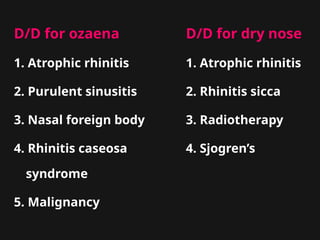
D/D for ozaena D/D for dry nose
1. Atrophic rhinitis 1. Atrophic rhinitis
2. Purulent sinusitis 2. Rhinitis sicca
3. Nasal foreign body 3. Radiotherapy
4. Rhinitis caseosa 4. Sjogren’s
syndrome
5. Malignancy
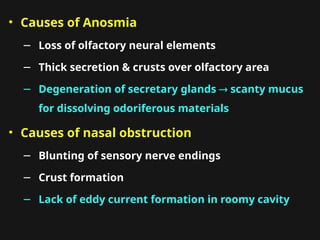
• Causes of Anosmia
− Loss of olfactory neural elements
− Thick secretion & crusts over olfactory area
− Degeneration of secretary glands  scanty mucus
for dissolving odoriferous materials
• Causes of nasal obstruction
− Blunting of sensory nerve endings
− Crust formation
− Lack of eddy current formation in roomy cavity
Pathology
• Accumulation of lymphocytes & plasma cells
• Metaplasia from ciliated columnar to squamous
epithelium
• Ciliary destruction & decrease in number & size of nasal
glands
• Bone resorption
• Type I: Endarteritis & periarteritis of terminal
arterioles :benefit from vasodilator effect of
estrogen therapy
• Type II: Dilated capillaries : worsened by estrogen
Specific Investigations
• Saccharine test : nasal muco- ciliary
clearance time
• Serum iron & protein levels: malnutrition
• Culture & sensitivity of nasal discharge
• X-ray P.N.S. : maxillary sinusitis
C.T. Scan Nose and P.N.S.
• Mucosal thickening
• Resorption of ethmoid
bulla & uncinate process
• Hypoplasia of maxillary
sinuses
• Roomy nasal cavities
• Erosion & bowing of
lateral nasal wall
• Atrophy of turbinates
• Chest X-ray: T.B., bronchiectasis, lung abscess
• Serology for syphilis: V.D.R.L., T.P.H.A., T.P.I.
• Sputum for AFB, Mantoux test: T.B.
• Nasal smear study: leprosy
• Complement fixation test & biopsy:
Rhinoscleroma
Medical
Treatment
• Douching  alkaline nasal douche
• Oestradiol nasal spray (1%) /Placental extract
injection (increase the vascularity of nasal mucosa,
regenerates the submucosal glands)
• Glucose (25%) in glycerin nasal drops
• Streptomycin injection /Rifampicin tablet : Effective
against Klebsiella
• Kemicetine anti-ozaena nasal solution : contains
chloramphenicol, estradiol dipropionate, Vit D, propylene glycol
• Mandl’s nasal paint (Potassium Iodide & estradiol)
• Potassium Iodide orally (liquifies the crusts)
Alkaline Nasal Douche
Sodium bicarbonate (28.4g)  loosens nasal crusts
Sodium biborate (28.4g)  Antiseptic
Sodium chloride (56.7g)  makes solution isotonic
• Mixed in 280 ml of warm water to make the solution
• 5 cm long no.8 infant feeding tube fitted in 20 ml
plastic syringe
• Syringe the nasal cavity by bending forward & keep
saying K, K, K … to close nasopharyngeal isthmus
• Done twice daily till all crusts disappear
Surgical Treatment
Aim of Surgery
• Decrease trauma of air turbulence (decrease the
roomy cavity)
−Young , Modified Young ,Lautenslager's ,Wilson ,
Sublabial implants ,Vestibuloplasty
• Increase nasal secretions
−Parotid duct implantation into maxillary sinus
• Increase vascularity of nasal mucosa
−Cervical sympathectomy
−Nasal implantation of maxillary sinus mucosa
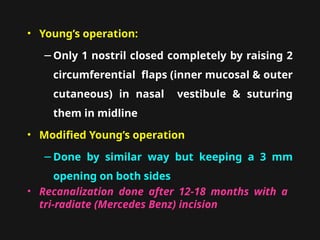
• Young’s operation:
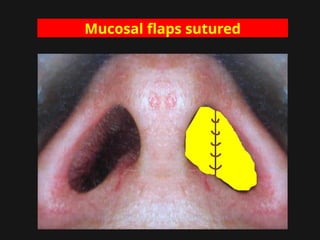
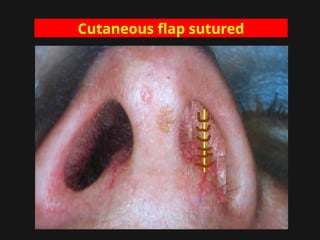
−Only 1 nostril closed completely by raising 2
circumferential flaps (inner mucosal & outer
cutaneous) in nasal vestibule & suturing
them in midline
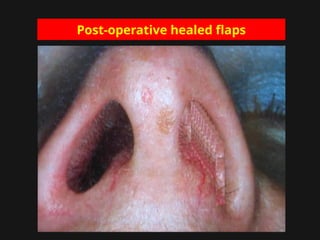
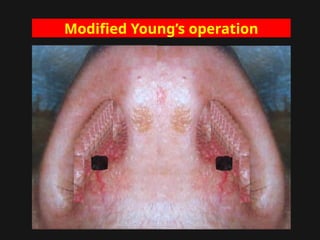
• Modified Young’s operation
−Done by similar way but keeping a 3 mm
opening on both sides
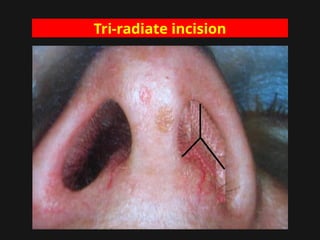
• Recanalization done after 12-18 months with a
tri-radiate (Mercedes Benz) incision
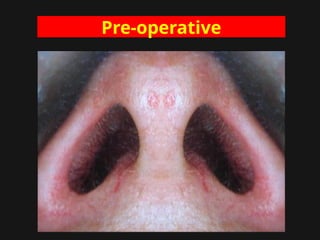
Pre-operative
Mucosal flaps sutured
Cutaneous flap sutured
Post-operative healed flaps
Tri-radiate incision
Modified Young’s operation
Advantages of Modified Young
operation
• Progress of disease can be monitored with
2.7 mm nasal endoscope
• Glucose in glycerin drops can be instilled
• Both nostrils can be operated at one sitting
• Nasal breathing preserved
• No complaints of de-nasal voice
• Better cosmetic result
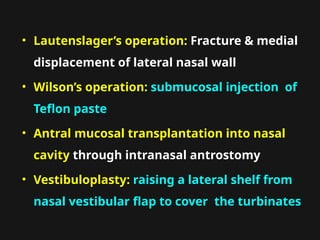
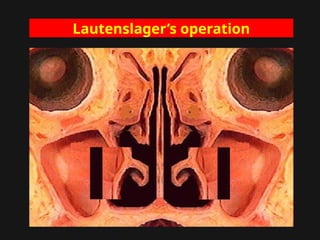
• Lautenslager’s operation: Fracture & medial
displacement of lateral nasal wall
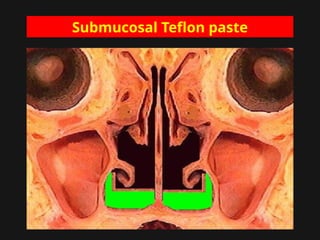
• Wilson’s operation: submucosal injection of
Teflon paste
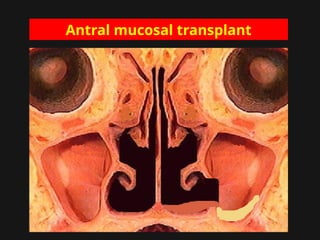
• Antral mucosal transplantation into nasal
cavity through intranasal antrostomy
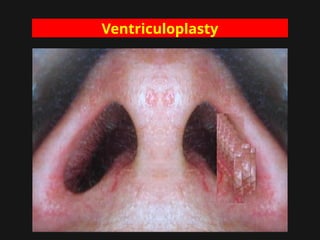
• Vestibuloplasty: raising a lateral shelf from
nasal vestibular flap to cover the turbinates
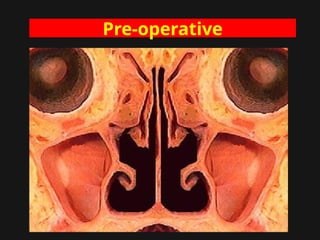
Pre-operative
Lautenslager’s operation
Submucosal Teflon paste
Antral mucosal transplant
Ventriculoplasty
• Sympathectomy
−Stellate ganglion block /cervical chain block
• Sublabial implantation
−Placental bits, bone, cartilage, fat, acrylic
resin, teflon, Silastic
• Parotid duct implantation into maxillary
sinus : Wittmack’s operation
Action of Placental extract
• Progesterone leads to hyperplasia of nasal
mucosa & glandular secretion
• Estrogen leads to vasodilatation
• Biogenic stimulator of metabolic & regenerative
process
• Intra-placental serum boosts up immunity
• Mechanical narrowing of nasal passage

Atrophic rhinitis.ppt by Dr. Krishna Koirala

  • 1.
  • 2.
    Questions • Define AtrophicRhinitis. What is the hallmark of this condition? Write down its types. • Write down the clinical features and investigations of atrophic rhinitis. • Discuss the medical and surgical treatment of atrophic rhinitis. • PBQ
  • 3.
    • Defined aschronic inflammation of nose characterized by progressive atrophy of nasal mucosa, including the glands, turbinate bones and the nerve elements supplying the nose • Hallmark: formation of scanty viscid secretion & greenish crusts which emit a foul odour (ozaena) • Removal of crusts reveals roomy nasal cavity • Types − Primary − Secondary
  • 4.
    Primary Atrophic rhinitis •Etiology: − Hereditary : autosomal inheritance in 30% cases − Developmental: congenital roomy nasal cavity, poor pneumatization of maxillary antrum − Endocrine : Seen during puberty, menopause, menstruation (symptoms aggravate due to estrogen deficiency) − Racial : More in American Negroes & Latin (yellow race) − Nutritional deficiency : Iron, Vitamin A, Vitamin D
  • 5.
    • Infection :Klebsiella ozaenae (Perez & Abel bacillus), Coccobacillus foetides ozaena, Bacillus mucosus, Diphtheroids, Haemophilus influenzae • Autoimmune : Viral infection / malnutrition / immune deficiency trigger destructive autoimmune process on nasal mucosa • Autonomic Imbalance : Reflex Sympathetic Dystrophy Syndrome (R.S.D.S.) causes vasodilatation & hyperemic decalcification of turbinates followed by vasoconstriction • Surfactant deficiency in nasal secretion − Ciliary dysfunction + stasis of nasal secretions
  • 6.
    Secondary Atrophic Rhinitis •Long-standing purulent sinusitis • Iatrogenic: −Radical turbinectomy, post - RT • Granulomatous lesions: −Tuberculosis, syphilis, leprosy, rhinoscleroma • Deviated nasal septum (atrophy in wider nasal cavity)
  • 7.
    Symptoms • Nasal obstruction •Greenish -yellow nasal discharge • Offensive smell (ozaena) due to anaerobic infection, experienced by relatives but not by the patient (Merciful anosmia) • Bleeding on crust removal
  • 8.
    Signs • Roomy nasalcavity with atrophy of mucosa & turbinates • Greenish-yellow nasal discharge with crust formation (begins from posteriorly) • Foul smell (fetor) • Nasal Myiasis may be present
  • 9.
  • 10.
    Turbinate atrophy &roomy nasal cavity
  • 11.
    D/D for ozaenaD/D for dry nose 1. Atrophic rhinitis 1. Atrophic rhinitis 2. Purulent sinusitis 2. Rhinitis sicca 3. Nasal foreign body 3. Radiotherapy 4. Rhinitis caseosa 4. Sjogren’s syndrome 5. Malignancy
  • 12.
    • Causes ofAnosmia − Loss of olfactory neural elements − Thick secretion & crusts over olfactory area − Degeneration of secretary glands  scanty mucus for dissolving odoriferous materials • Causes of nasal obstruction − Blunting of sensory nerve endings − Crust formation − Lack of eddy current formation in roomy cavity
  • 13.
    Pathology • Accumulation oflymphocytes & plasma cells • Metaplasia from ciliated columnar to squamous epithelium • Ciliary destruction & decrease in number & size of nasal glands • Bone resorption • Type I: Endarteritis & periarteritis of terminal arterioles :benefit from vasodilator effect of estrogen therapy • Type II: Dilated capillaries : worsened by estrogen
  • 14.
    Specific Investigations • Saccharinetest : nasal muco- ciliary clearance time • Serum iron & protein levels: malnutrition • Culture & sensitivity of nasal discharge • X-ray P.N.S. : maxillary sinusitis
  • 15.
    C.T. Scan Noseand P.N.S. • Mucosal thickening • Resorption of ethmoid bulla & uncinate process • Hypoplasia of maxillary sinuses • Roomy nasal cavities • Erosion & bowing of lateral nasal wall • Atrophy of turbinates
  • 16.
    • Chest X-ray:T.B., bronchiectasis, lung abscess • Serology for syphilis: V.D.R.L., T.P.H.A., T.P.I. • Sputum for AFB, Mantoux test: T.B. • Nasal smear study: leprosy • Complement fixation test & biopsy: Rhinoscleroma
  • 17.
  • 18.
    • Douching alkaline nasal douche • Oestradiol nasal spray (1%) /Placental extract injection (increase the vascularity of nasal mucosa, regenerates the submucosal glands) • Glucose (25%) in glycerin nasal drops • Streptomycin injection /Rifampicin tablet : Effective against Klebsiella • Kemicetine anti-ozaena nasal solution : contains chloramphenicol, estradiol dipropionate, Vit D, propylene glycol • Mandl’s nasal paint (Potassium Iodide & estradiol) • Potassium Iodide orally (liquifies the crusts)
  • 19.
    Alkaline Nasal Douche Sodiumbicarbonate (28.4g)  loosens nasal crusts Sodium biborate (28.4g)  Antiseptic Sodium chloride (56.7g)  makes solution isotonic • Mixed in 280 ml of warm water to make the solution • 5 cm long no.8 infant feeding tube fitted in 20 ml plastic syringe • Syringe the nasal cavity by bending forward & keep saying K, K, K … to close nasopharyngeal isthmus • Done twice daily till all crusts disappear
  • 20.
  • 21.
    Aim of Surgery •Decrease trauma of air turbulence (decrease the roomy cavity) −Young , Modified Young ,Lautenslager's ,Wilson , Sublabial implants ,Vestibuloplasty • Increase nasal secretions −Parotid duct implantation into maxillary sinus • Increase vascularity of nasal mucosa −Cervical sympathectomy −Nasal implantation of maxillary sinus mucosa
  • 22.
    • Young’s operation: −Only1 nostril closed completely by raising 2 circumferential flaps (inner mucosal & outer cutaneous) in nasal vestibule & suturing them in midline • Modified Young’s operation −Done by similar way but keeping a 3 mm opening on both sides • Recanalization done after 12-18 months with a tri-radiate (Mercedes Benz) incision
  • 23.
  • 24.
  • 25.
  • 26.
  • 27.
  • 28.
  • 29.
    Advantages of ModifiedYoung operation • Progress of disease can be monitored with 2.7 mm nasal endoscope • Glucose in glycerin drops can be instilled • Both nostrils can be operated at one sitting • Nasal breathing preserved • No complaints of de-nasal voice • Better cosmetic result
  • 30.
    • Lautenslager’s operation:Fracture & medial displacement of lateral nasal wall • Wilson’s operation: submucosal injection of Teflon paste • Antral mucosal transplantation into nasal cavity through intranasal antrostomy • Vestibuloplasty: raising a lateral shelf from nasal vestibular flap to cover the turbinates
  • 31.
  • 32.
  • 33.
  • 34.
  • 35.
  • 36.
    • Sympathectomy −Stellate ganglionblock /cervical chain block • Sublabial implantation −Placental bits, bone, cartilage, fat, acrylic resin, teflon, Silastic • Parotid duct implantation into maxillary sinus : Wittmack’s operation
  • 37.
    Action of Placentalextract • Progesterone leads to hyperplasia of nasal mucosa & glandular secretion • Estrogen leads to vasodilatation • Biogenic stimulator of metabolic & regenerative process • Intra-placental serum boosts up immunity • Mechanical narrowing of nasal passage