NASAL CYCLE
BY : S . ABIHARINI
ROLL NO 02
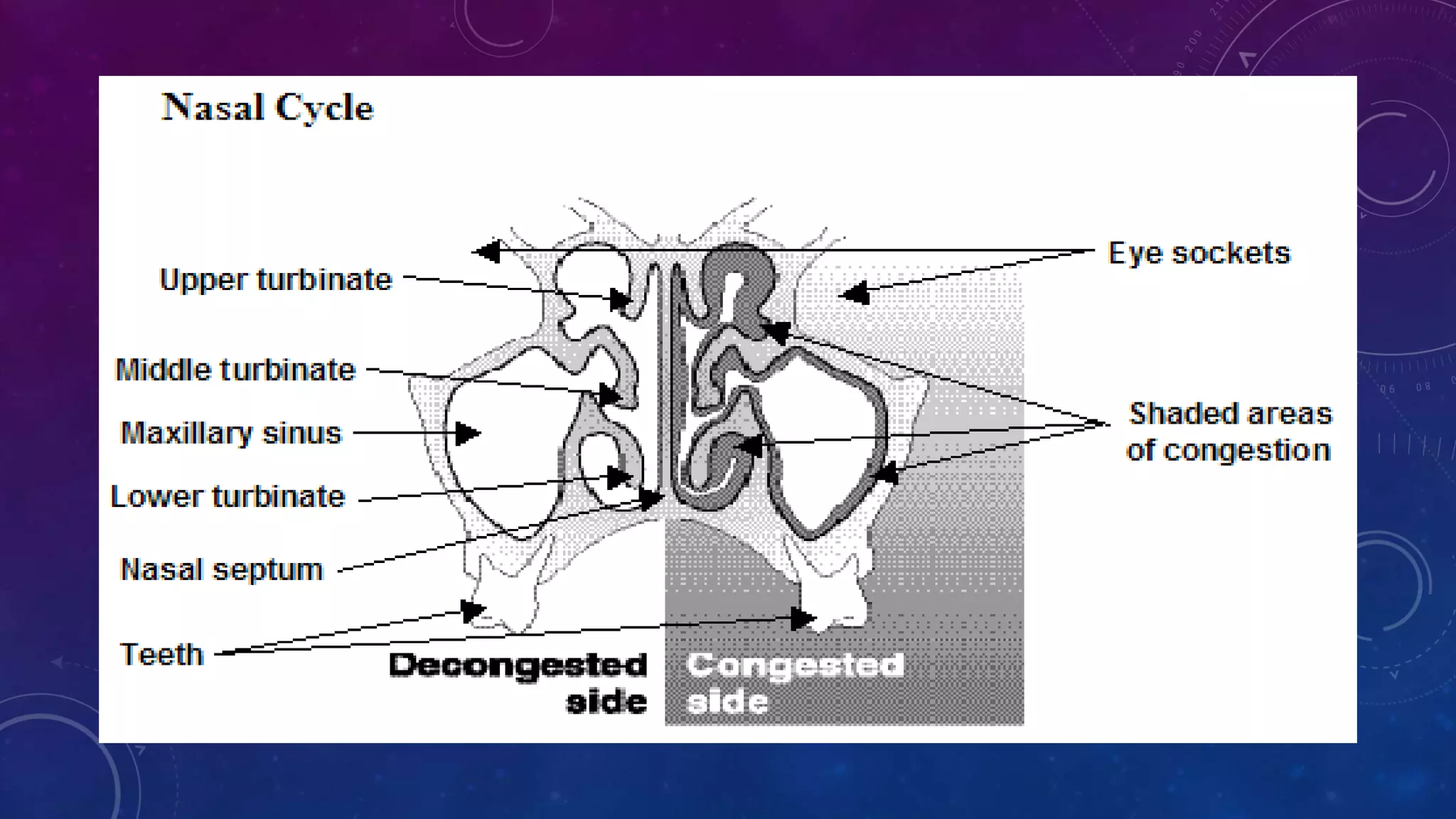
Nasal mucosa undergoes rhythmic cyclical
congestion and decongestion of venous
sinusoids of inferior turbinates and
anterior nasal septum .
Reflex periodic alteration in nasal airflow
resistance between two nasal cavities .
Regulated by autonomic nervous system .
 Each cycle lasts for 2 to 12 hours and at
an average for 2 to 4 hours .
 When one nasal chamber is working ,
total nasal respiration equal to that of
both nasal chambers , carried out by it .
Pattern of nasal dominance altered by :
• Pressure of a crutch in axilla due to
reflex reversal of nostril dominance .
• Pressure on thorax while sitting
• Pressure in hemithorax while lying down
on the side leads to reduced patency of
ipsilateral nostril and increased patency
of opposite nostril .
• Decreased airflow in ipsilateral nostril
• Increased airflow in contra lateral nostril
• Pattern starts to change in a minute and
equalizes in both nostrils about 4th min
and reaches peak in 17 min .
 Can be demonstrated in over 80% of the
adults .
 Difficult to demonstrate in children .
 Nasal secretions are also cyclical with an
increase in secretion in the side with
greater airflow .
Factor modifying nasal cycle :
 Temperature and humidity of surrounding
air
 Head position
 Body temperature
 Physical activity
 Emotional and psychological status
 Hypothyroidism and hyperthyroidism
 Nasal decongestants and anti hypertensives
 Allergy
 Infection
 Pregnancy
Benefits for breathing :
It has been shown that the cilia of the
congested side suspend their motility
until that side decongests. Thus the
cycle ensures that one side of the
nose is always moist, to facilitate
humidification, which is one of the
three functions of the nose, the other
two being filtration and warming of
Benefits for olfaction :
Some odor chemicals bind with
olfactory receptors easily, even under
conditions of high airflow, and other
odors need more time, under low airflow
conditions, to bind with receptors. With
high airflow on one side and low airflow
on the other side, the olfactory center
detects a greater range of smells.
Nasal cycle

Nasal cycle

  • 1.
    NASAL CYCLE BY :S . ABIHARINI ROLL NO 02
  • 2.
    Nasal mucosa undergoesrhythmic cyclical congestion and decongestion of venous sinusoids of inferior turbinates and anterior nasal septum . Reflex periodic alteration in nasal airflow resistance between two nasal cavities . Regulated by autonomic nervous system .
  • 3.
     Each cyclelasts for 2 to 12 hours and at an average for 2 to 4 hours .  When one nasal chamber is working , total nasal respiration equal to that of both nasal chambers , carried out by it .
  • 5.
    Pattern of nasaldominance altered by : • Pressure of a crutch in axilla due to reflex reversal of nostril dominance . • Pressure on thorax while sitting • Pressure in hemithorax while lying down on the side leads to reduced patency of ipsilateral nostril and increased patency of opposite nostril .
  • 7.
    • Decreased airflowin ipsilateral nostril • Increased airflow in contra lateral nostril • Pattern starts to change in a minute and equalizes in both nostrils about 4th min and reaches peak in 17 min .
  • 8.
     Can bedemonstrated in over 80% of the adults .  Difficult to demonstrate in children .  Nasal secretions are also cyclical with an increase in secretion in the side with greater airflow .
  • 9.
    Factor modifying nasalcycle :  Temperature and humidity of surrounding air  Head position  Body temperature  Physical activity  Emotional and psychological status  Hypothyroidism and hyperthyroidism  Nasal decongestants and anti hypertensives
  • 10.
  • 11.
    Benefits for breathing: It has been shown that the cilia of the congested side suspend their motility until that side decongests. Thus the cycle ensures that one side of the nose is always moist, to facilitate humidification, which is one of the three functions of the nose, the other two being filtration and warming of
  • 12.
    Benefits for olfaction: Some odor chemicals bind with olfactory receptors easily, even under conditions of high airflow, and other odors need more time, under low airflow conditions, to bind with receptors. With high airflow on one side and low airflow on the other side, the olfactory center detects a greater range of smells.