• H.B.3.A.1 Develop and use models to explain how
chemical reactions among ATP, ADP, and inorganic
phosphate act to transfer chemical energy within cells.
• B-3.3 Recognize the overall structure of adenosine
triphosphate (ATP)---namely, adenine, the sugar ribose,
and three phosphate groups ---and summarize its
function including the ATP-ADP [adenosine
diphosphate] cycle
ATP: The Cell’s Currency
 Life processes require a constant supply of energy.
 Cells use energy that is stored in the bonds of certain
organic molecules.
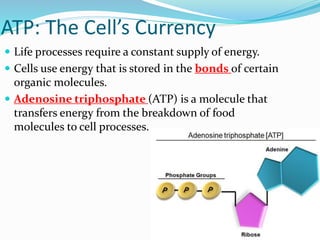
 Adenosine triphosphate (ATP) is a molecule that
transfers energy from the breakdown of food
molecules to cell processes.
ATP: Structure
 Adenosine triphosphate (ATP) is the most important
biological molecule that supplies energy to the cell.
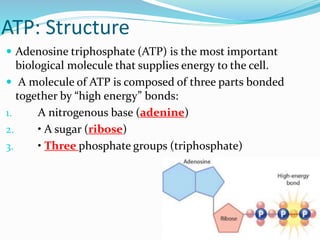
 A molecule of ATP is composed of three parts bonded
together by “high energy” bonds:
1. A nitrogenous base (adenine)
2. • A sugar (ribose)
3. • Three phosphate groups (triphosphate)
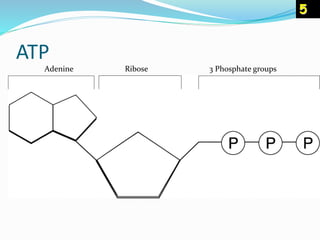
ATP
Adenine Ribose 3 Phosphate groups
5
Where does ATP come from?
 ATP comes indirectly from the food that we eat.
 Molecules of carbohydrates (glucose) and lipids are
broken down through the process of cellular
respiration to produce ATP.
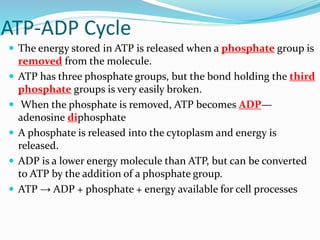
ATP-ADP Cycle
 The energy stored in ATP is released when a phosphate group is
removed from the molecule.
 ATP has three phosphate groups, but the bond holding the third
phosphate groups is very easily broken.
 When the phosphate is removed, ATP becomes ADP—
adenosine diphosphate
 A phosphate is released into the cytoplasm and energy is
released.
 ADP is a lower energy molecule than ATP, but can be converted
to ATP by the addition of a phosphate group.
 ATP → ADP + phosphate + energy available for cell processes
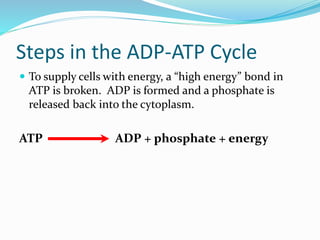
Steps in the ADP-ATP Cycle
 To supply cells with energy, a “high energy” bond in
ATP is broken. ADP is formed and a phosphate is
released back into the cytoplasm.
ATP ADP + phosphate + energy
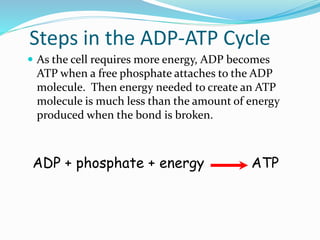
Steps in the ADP-ATP Cycle
 As the cell requires more energy, ADP becomes
ATP when a free phosphate attaches to the ADP
molecule. Then energy needed to create an ATP
molecule is much less than the amount of energy
produced when the bond is broken.
ADP + phosphate + energy ATP
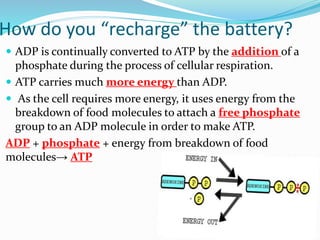
How do you “recharge” the battery?
 ADP is continually converted to ATP by the addition of a
phosphate during the process of cellular respiration.
 ATP carries much more energy than ADP.
 As the cell requires more energy, it uses energy from the
breakdown of food molecules to attach a free phosphate
group to an ADP molecule in order to make ATP.
ADP + phosphate + energy from breakdown of food
molecules→ ATP
When is ATP used?
 ATP is consumed in the cell by energy-requiring
processes and can be generated by energy-releasing
processes.
 In this way ATP transfers energy between separate
biochemical reactions in the cell.
 ATP is the main energy source for the majority of cellular
functions.
 This includes the production of organic molecules,
including DNA and, and proteins.
 ATP also plays a critical role in the transport of organic
molecules across cell membranes, for example during
exocytosis and endocytosis
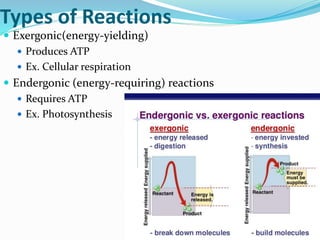
Types of Reactions
 Exergonic(energy-yielding)
 Produces ATP
 Ex. Cellular respiration
 Endergonic (energy-requiring) reactions
 Requires ATP
 Ex. Photosynthesis
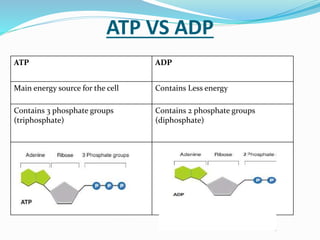
ATP VS ADP
ATP ADP
Main energy source for the cell Contains Less energy
Contains 3 phosphate groups
(triphosphate)
Contains 2 phosphate groups
(diphosphate)

ATP_ppt.pptx

  • 1.
    • H.B.3.A.1 Developand use models to explain how chemical reactions among ATP, ADP, and inorganic phosphate act to transfer chemical energy within cells. • B-3.3 Recognize the overall structure of adenosine triphosphate (ATP)---namely, adenine, the sugar ribose, and three phosphate groups ---and summarize its function including the ATP-ADP [adenosine diphosphate] cycle
  • 2.
    ATP: The Cell’sCurrency  Life processes require a constant supply of energy.  Cells use energy that is stored in the bonds of certain organic molecules.  Adenosine triphosphate (ATP) is a molecule that transfers energy from the breakdown of food molecules to cell processes.
  • 3.
    ATP: Structure  Adenosinetriphosphate (ATP) is the most important biological molecule that supplies energy to the cell.  A molecule of ATP is composed of three parts bonded together by “high energy” bonds: 1. A nitrogenous base (adenine) 2. • A sugar (ribose) 3. • Three phosphate groups (triphosphate)
  • 4.
    ATP Adenine Ribose 3Phosphate groups 5
  • 5.
    Where does ATPcome from?  ATP comes indirectly from the food that we eat.  Molecules of carbohydrates (glucose) and lipids are broken down through the process of cellular respiration to produce ATP.
  • 6.
    ATP-ADP Cycle  Theenergy stored in ATP is released when a phosphate group is removed from the molecule.  ATP has three phosphate groups, but the bond holding the third phosphate groups is very easily broken.  When the phosphate is removed, ATP becomes ADP— adenosine diphosphate  A phosphate is released into the cytoplasm and energy is released.  ADP is a lower energy molecule than ATP, but can be converted to ATP by the addition of a phosphate group.  ATP → ADP + phosphate + energy available for cell processes
  • 7.
    Steps in theADP-ATP Cycle  To supply cells with energy, a “high energy” bond in ATP is broken. ADP is formed and a phosphate is released back into the cytoplasm. ATP ADP + phosphate + energy
  • 8.
    Steps in theADP-ATP Cycle  As the cell requires more energy, ADP becomes ATP when a free phosphate attaches to the ADP molecule. Then energy needed to create an ATP molecule is much less than the amount of energy produced when the bond is broken. ADP + phosphate + energy ATP
  • 10.
    How do you“recharge” the battery?  ADP is continually converted to ATP by the addition of a phosphate during the process of cellular respiration.  ATP carries much more energy than ADP.  As the cell requires more energy, it uses energy from the breakdown of food molecules to attach a free phosphate group to an ADP molecule in order to make ATP. ADP + phosphate + energy from breakdown of food molecules→ ATP
  • 11.
    When is ATPused?  ATP is consumed in the cell by energy-requiring processes and can be generated by energy-releasing processes.  In this way ATP transfers energy between separate biochemical reactions in the cell.  ATP is the main energy source for the majority of cellular functions.  This includes the production of organic molecules, including DNA and, and proteins.  ATP also plays a critical role in the transport of organic molecules across cell membranes, for example during exocytosis and endocytosis
  • 12.
    Types of Reactions Exergonic(energy-yielding)  Produces ATP  Ex. Cellular respiration  Endergonic (energy-requiring) reactions  Requires ATP  Ex. Photosynthesis
  • 13.
    ATP VS ADP ATPADP Main energy source for the cell Contains Less energy Contains 3 phosphate groups (triphosphate) Contains 2 phosphate groups (diphosphate)