ENERGETICS
FORMATION AND ROLE OF ATP,
CREATININE PHOSPHATE AND
BMR.
Miss. Gayatri K.
Bahatkar
Energetics
Energy Currency of the Cell
■ All living things including plants, animals, birds, insects, humans need
energy for the proper functioning of cells, tissues and other organ
systems. As we are aware that green plants, obtain their energy from
the sunlight, and animals get their energy by feeding on these plants.
Energy acts as a source of fuel. We, humans, gain energy from the food
we eat, but how are the energy produced and stored in our body.
What is ATP-Adenosine Triphosphate?
■ ATP – Adenosine triphosphate is called the energy currency of the cell.
■ It is the organic compound composed of the phosphate groups,
adenine, and the sugar ribose. These molecules provide energy for
various biochemical processes in the body. Therefore, it is called
“Energy Currency of the Cell”. These ATP molecules are synthesized by
Mitochondria, therefore it is called powerhouse of the cell.
■ The ATP molecule was discovered in the year 1929 by German chemist
Karl Lohmann. Later in the year 1948, Scottish biochemist Alexander
Todd was the first person to synthesized the ATP molecule.
■ ATP – the energy-carrying molecules are found in the cells of all living
things. These organic molecules function by capturing the chemical
energy obtained from the digested food molecules and are later
released for different cellular processes
Structure of ATP molecule
■ ATP – Adenosine triphosphate is a nucleotide, which is mainly composed of the molecule
adenosine and three phosphate groups. It is soluble in water and has a high energy
content, which is primarily due to the presence of two phosphoanhydride bonds
connected to the three phosphate groups.
■ The triphosphate tail of ATP is the actual power source which the cell taps. The available
energy is contained in the bonds between the phosphates and is released when they are
broken or split into molecules. This occurs through the addition of a water molecule
(hydrolysis). Usually, only the outer phosphate group is removed from ATP to yield energy;
when this occurs, ATP – Adenosine triphosphate is converted into ADP – adenosine
diphosphate, it is the form of the nucleotide having only two phosphates.
■ ATP molecules are largely composed of three essential components.
■ The pentose sugar molecule i.e. ribose sugar.
■ Nitrogen base- Adenine, attached to the first carbon of this sugar molecule.
■ The three phosphate groups which are attached in a chain to the 5th carbon of the
pentose sugar. The phosphoryl groups, starting with the group closest to the ribose sugar,
are referred to as the alpha, beta, and gamma phosphates. These phosphates play an
important role in the activity of ATP.
Formation of ATP
■ It is highly endothermic for ADP to condense with inorganic phosphate to produce ATP. In the
primary particles, there is an ATP synthetase located on the inner surface of the crista
membrane. ATP is hydrolyzed by primary particles to phosphate and ADP.
■ ATP synthetase contains three equivalent catalytic sites in its multi-subunit structure.
■ During any particular moment, each site of the reaction is in a different state:
■ Phosphate and ADP are bound to one site
■ ADP and phosphate are catalyzed to form ADP and phosphate, and water is emitted as a by-
product
■ ATP is being discharged from one site, ready for ADP and phosphate to enter
■ As photons enter through the stalk of the primary particle that spans the crista membrane, ATP
synthetase rotates, causing every site, in turn, to proceed to the next step in the reaction.
■ It is the availability of ADP that controls electron transport and substrate oxidation
■ The stalk of the primary particle may not be able to cross the stalk of ADP if the empty site does
not possess ADP for binding. Therefore, the ATP synthetase central portion cannot be rotated. The
outcome is a build-up of protons in the crista space, which, in turn, prevents electron transport
oxidation). (and thus substrate
How is Energy Produced by the ATP molecules?
■ The three phosphate groups present in this ATP molecule are called high energy
bonds as they are involved in the liberation of a huge amount of energy when they
are broken. This molecule provides energy for various life processes without which
life cannot exist.
■ It is used by various enzymes and structural proteins in cellular processes like
biosynthetic reactions, cell divisions, etc. This “energy currency of the cell” is
produced during cellular respiration where a digested simple molecule of food is
utilized.
■ Once after the energy is produced by the ATP molecules, they are stored in its bonds
which are later utilized by the cells by breaking the bonds whenever require
Functions and role of ATP
■ Different molecules are transported across cell membranes by ATP, which performs
a variety of functions within the cell.
■ As well as providing energy for muscle contraction,
■ ATP also supplies energy for blood circulation, locomotion, and other bodily
functions. In addition to energy production,
■ ATP is required for the synthesis of the thousands of types of
macromolecules required for the survival of the cell.
■ Adenosine triphosphate works as a switch for controlling chemical
reactions and sending messages.
Metabolic Processes Rely on ATP Molecules
■ It is possible to recycle ATP molecules after every reaction.
■ Exergonic as well as endergonic processes are powered by ATP molecules.
■ A neurotransmitter and extracellular signaling molecule, ATP is used by
both the central nervous system and the peripheral nervous system.
■ Unlike other sources of energy, it can be directly utilized in different
metabolic processes. Energy from other chemical sources has to be
converted into ATP before it can be used.
■ In metabolism, fermentative reactions, photosynthesis,
photophosphorylation, cellular divisions, protein synthesis, endocytosis,
aerobic respiration, exocytosis, and motility all occur.
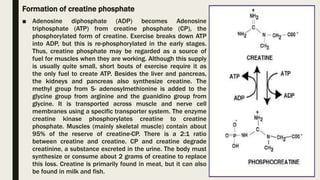
Formation of creatine phosphate
■ Adenosine diphosphate (ADP) becomes Adenosine
triphosphate (ATP) from creatine phosphate (CP), the
phosphorylated form of creatine. Exercise breaks down ATP
into ADP, but this is re-phosphorylated in the early stages.
Thus, creatine phosphate may be regarded as a source of
fuel for muscles when they are working. Although this supply
is usually quite small, short bouts of exercise require it as
the only fuel to create ATP. Besides the liver and pancreas,
the kidneys and pancreas also synthesize creatine. The
methyl group from S- adenosylmethionine is added to the
glycine group from arginine and the guanidino group from
glycine. It is transported across muscle and nerve cell
membranes using a specific transporter system. The enzyme
creatine kinase phosphorylates creatine to creatine
phosphate. Muscles (mainly skeletal muscle) contain about
95% of the reserve of creatine-CP. There is a 2:1 ratio
between creatine and creatine. CP and creatine degrade
creatinine, a substance excreted in the urine. The body must
synthesize or consume about 2 grams of creatine to replace
this loss. Creatine is primarily found in meat, but it can also
be found in milk and fish.
Role of creatine phosphate
■ Muscle cells store phosphate in creatine phosphate, the major phosphate-storing
molecule.
■ Resting muscle is dominated by creatine phosphate, which is five times as
concentrated as ATP.
■ In times of acute energy need, creatine kinase phosphorylates ADP to ATP using
creatine phosphate.
■ In addition to Spermatozoa and photoreceptor cells, Creatine Phosphate appears to
be crucial to the eye. Brain phosphates may serve as an equally crucial source of
stabilizing energy.
■ It has long been known that high-energy phosphates contribute to maintaining
membrane potentials, releasing neurotransmitters, maintaining calcium
homeostasis, apoptosis, migration, and survival of neurons.
■ Cofactors such as creatine are required by enzymes such as adenylate kinase.
BMR (Basal Metabolic Rate)
■ At rest, an endothermic animal’s basal metabolic rate (BMR) indicates the amount of energy she
expends per unit of time. This is measured in units of energy per unit time, such as watts
(joules/second) and milliliters of oxygen per minute or joules per kilogram per hour (h.kg). A set
of strict criteria must be met to ensure proper measurement. Physically undisturbed, in a
thermally neutral environment, and not actively digesting food are the requirements for
appropriate post-absorptive states. Animals that have brady metabolic rates, such as fish and
reptiles, are called standard metabolic rates (SMRS). A metabolism rate is measured at the
same temperature as BMR, but documentation of the temperature is required.
■ BMR is therefore a variant of standard Metabolic rate measurements that do not consider
temperature information, a practice that has caused problems defining “standard” metabolic
rates for many mammals. A body’s metabolism is comprised of the processes necessary to
function. At rest, the person’s body requires a certain amount of energy to function. This is called
the basal metabolic rate. The body goes through several processes to breathe, circulate blood,
regulate body temperature, produce cells, and function the brain and nerves. A person’s basal
metabolic rate determines how many calories they burn each day and whether they maintain,
gain, or lose weight. Around 60 to 75 percent of an individual's daily calorie expenditure comes
from their basal metabolic rate. Several factors affect it. As a human reaches the 20th birthday,
his or her body mass usually decreases by 1-2% per decade. However, individual variance can be
significant.
■ When a person is awake, BMR is measured in very limited conditions. BMR
measurements require that the sympathetic nervous system of the individual not be
stimulated, which means they need to be completely restless. A more common
measurement is the resting metabolic rate (RMR) since there are fewer strict criteria.
Indirect calorimetry can be used to measure BMR, and direct calorimetry can be used
to measure it directly. Estimate the age, height, and weight using an equation based
on the factors of sex, weight, and height. Researchers studying energy metabolism
have confirmed the validity of the respiratory quotient (RQ), one metric measuring
carbohydrate, fat, and protein composition as well as their conversion into energy
substrates that can be used by the body.
■ The production of heat by the body is called thermogenesis, and the amount of energy
it expends can be measured. When one gets older, and as lean body mass decreases
(as happens with aging), the body's metabolic rate (BMR) decreases. Growing muscle
increases BMR. When adjusted for fat-free body mass, aerobic fitness level was found
not to be related to BMR. Although aerobic fitness level comes from cardiovascular
exercise, it does not influence BMR. Despite this, anaerobic exercise does increase
resting energy expenditure (see "aerobic vs. anaerobic exercise") illnesses, previously
consumed foods and beverages, environmental temperatures, and stress levels can
also influence your overall energy expenditure and your basal metabolic rate.
FACTORS THAT AFFECT BMR
■ Age – BMR higher in youth. Lean body mass declines with age; physical activity
can offset this effect.
■ Height – tall people have larger surface area.
■ Growth – children & pregnant women have higher BMR’s
■ Body composition – more lean tissue, higher BMR
■ Fever – raises BMR
■ Stress
■ Environmental temperature
■ Fasting/starvation, lowers BMR
■ Malnutrition, lowers BMR
■ Thyroxine – regulates BMR
Normal Value for BMR
■ Since BMR is affected by body surface area, it is usually expressed in kilocalories per
hour/square meter of body surface. Body surface area is calculated using the formula
■ A = W 0.425 × H 0.725× 71.84
■ A = area in sq cm,
■ H = height in centimeters and W = weight in kilograms.
■ The BMR is then calculated from the values of oxygen consumption, calorific value and
surface area.
■ NORMAL VALUE FOR BMR
■ For adult men normal value for BMR is 34-37 kcal/square meter/hour, and
■ For adult women, 30-35 kcal/Sq.m./hour.
■ For easier calculations, BMR for an adult is fixed as 24 kcal/ kg body weight/day.
References
1. Ankur Chaudhari; Pharmaguideline; formation and role of ATP, Creatinine
Phosphate; And BMR
2. https://www.biologyonline.com/tutorials/biological-energy-adp-atp
3. https://byjus.com/biology/energy-currency-of-the -cell/
4. https://gbsleiden.com/bioenergetics/
5. https://www.brainkart.com/article/basal-metabolic-rate-%28BMR%29-the-
minimum-energy-expenditure-for-the-body-to-exist_19947/
THANK YOU

Energetics.pptx

  • 1.
    ENERGETICS FORMATION AND ROLEOF ATP, CREATININE PHOSPHATE AND BMR. Miss. Gayatri K. Bahatkar
  • 2.
    Energetics Energy Currency ofthe Cell ■ All living things including plants, animals, birds, insects, humans need energy for the proper functioning of cells, tissues and other organ systems. As we are aware that green plants, obtain their energy from the sunlight, and animals get their energy by feeding on these plants. Energy acts as a source of fuel. We, humans, gain energy from the food we eat, but how are the energy produced and stored in our body.
  • 3.
    What is ATP-AdenosineTriphosphate? ■ ATP – Adenosine triphosphate is called the energy currency of the cell. ■ It is the organic compound composed of the phosphate groups, adenine, and the sugar ribose. These molecules provide energy for various biochemical processes in the body. Therefore, it is called “Energy Currency of the Cell”. These ATP molecules are synthesized by Mitochondria, therefore it is called powerhouse of the cell. ■ The ATP molecule was discovered in the year 1929 by German chemist Karl Lohmann. Later in the year 1948, Scottish biochemist Alexander Todd was the first person to synthesized the ATP molecule. ■ ATP – the energy-carrying molecules are found in the cells of all living things. These organic molecules function by capturing the chemical energy obtained from the digested food molecules and are later released for different cellular processes
  • 4.
    Structure of ATPmolecule ■ ATP – Adenosine triphosphate is a nucleotide, which is mainly composed of the molecule adenosine and three phosphate groups. It is soluble in water and has a high energy content, which is primarily due to the presence of two phosphoanhydride bonds connected to the three phosphate groups. ■ The triphosphate tail of ATP is the actual power source which the cell taps. The available energy is contained in the bonds between the phosphates and is released when they are broken or split into molecules. This occurs through the addition of a water molecule (hydrolysis). Usually, only the outer phosphate group is removed from ATP to yield energy; when this occurs, ATP – Adenosine triphosphate is converted into ADP – adenosine diphosphate, it is the form of the nucleotide having only two phosphates. ■ ATP molecules are largely composed of three essential components. ■ The pentose sugar molecule i.e. ribose sugar. ■ Nitrogen base- Adenine, attached to the first carbon of this sugar molecule. ■ The three phosphate groups which are attached in a chain to the 5th carbon of the pentose sugar. The phosphoryl groups, starting with the group closest to the ribose sugar, are referred to as the alpha, beta, and gamma phosphates. These phosphates play an important role in the activity of ATP.
  • 6.
    Formation of ATP ■It is highly endothermic for ADP to condense with inorganic phosphate to produce ATP. In the primary particles, there is an ATP synthetase located on the inner surface of the crista membrane. ATP is hydrolyzed by primary particles to phosphate and ADP. ■ ATP synthetase contains three equivalent catalytic sites in its multi-subunit structure. ■ During any particular moment, each site of the reaction is in a different state: ■ Phosphate and ADP are bound to one site ■ ADP and phosphate are catalyzed to form ADP and phosphate, and water is emitted as a by- product ■ ATP is being discharged from one site, ready for ADP and phosphate to enter ■ As photons enter through the stalk of the primary particle that spans the crista membrane, ATP synthetase rotates, causing every site, in turn, to proceed to the next step in the reaction. ■ It is the availability of ADP that controls electron transport and substrate oxidation ■ The stalk of the primary particle may not be able to cross the stalk of ADP if the empty site does not possess ADP for binding. Therefore, the ATP synthetase central portion cannot be rotated. The outcome is a build-up of protons in the crista space, which, in turn, prevents electron transport oxidation). (and thus substrate
  • 8.
    How is EnergyProduced by the ATP molecules? ■ The three phosphate groups present in this ATP molecule are called high energy bonds as they are involved in the liberation of a huge amount of energy when they are broken. This molecule provides energy for various life processes without which life cannot exist. ■ It is used by various enzymes and structural proteins in cellular processes like biosynthetic reactions, cell divisions, etc. This “energy currency of the cell” is produced during cellular respiration where a digested simple molecule of food is utilized. ■ Once after the energy is produced by the ATP molecules, they are stored in its bonds which are later utilized by the cells by breaking the bonds whenever require Functions and role of ATP ■ Different molecules are transported across cell membranes by ATP, which performs a variety of functions within the cell. ■ As well as providing energy for muscle contraction, ■ ATP also supplies energy for blood circulation, locomotion, and other bodily functions. In addition to energy production,
  • 9.
    ■ ATP isrequired for the synthesis of the thousands of types of macromolecules required for the survival of the cell. ■ Adenosine triphosphate works as a switch for controlling chemical reactions and sending messages. Metabolic Processes Rely on ATP Molecules ■ It is possible to recycle ATP molecules after every reaction. ■ Exergonic as well as endergonic processes are powered by ATP molecules. ■ A neurotransmitter and extracellular signaling molecule, ATP is used by both the central nervous system and the peripheral nervous system. ■ Unlike other sources of energy, it can be directly utilized in different metabolic processes. Energy from other chemical sources has to be converted into ATP before it can be used. ■ In metabolism, fermentative reactions, photosynthesis, photophosphorylation, cellular divisions, protein synthesis, endocytosis, aerobic respiration, exocytosis, and motility all occur.
  • 11.
    Formation of creatinephosphate ■ Adenosine diphosphate (ADP) becomes Adenosine triphosphate (ATP) from creatine phosphate (CP), the phosphorylated form of creatine. Exercise breaks down ATP into ADP, but this is re-phosphorylated in the early stages. Thus, creatine phosphate may be regarded as a source of fuel for muscles when they are working. Although this supply is usually quite small, short bouts of exercise require it as the only fuel to create ATP. Besides the liver and pancreas, the kidneys and pancreas also synthesize creatine. The methyl group from S- adenosylmethionine is added to the glycine group from arginine and the guanidino group from glycine. It is transported across muscle and nerve cell membranes using a specific transporter system. The enzyme creatine kinase phosphorylates creatine to creatine phosphate. Muscles (mainly skeletal muscle) contain about 95% of the reserve of creatine-CP. There is a 2:1 ratio between creatine and creatine. CP and creatine degrade creatinine, a substance excreted in the urine. The body must synthesize or consume about 2 grams of creatine to replace this loss. Creatine is primarily found in meat, but it can also be found in milk and fish.
  • 12.
    Role of creatinephosphate ■ Muscle cells store phosphate in creatine phosphate, the major phosphate-storing molecule. ■ Resting muscle is dominated by creatine phosphate, which is five times as concentrated as ATP. ■ In times of acute energy need, creatine kinase phosphorylates ADP to ATP using creatine phosphate. ■ In addition to Spermatozoa and photoreceptor cells, Creatine Phosphate appears to be crucial to the eye. Brain phosphates may serve as an equally crucial source of stabilizing energy. ■ It has long been known that high-energy phosphates contribute to maintaining membrane potentials, releasing neurotransmitters, maintaining calcium homeostasis, apoptosis, migration, and survival of neurons. ■ Cofactors such as creatine are required by enzymes such as adenylate kinase.
  • 13.
    BMR (Basal MetabolicRate) ■ At rest, an endothermic animal’s basal metabolic rate (BMR) indicates the amount of energy she expends per unit of time. This is measured in units of energy per unit time, such as watts (joules/second) and milliliters of oxygen per minute or joules per kilogram per hour (h.kg). A set of strict criteria must be met to ensure proper measurement. Physically undisturbed, in a thermally neutral environment, and not actively digesting food are the requirements for appropriate post-absorptive states. Animals that have brady metabolic rates, such as fish and reptiles, are called standard metabolic rates (SMRS). A metabolism rate is measured at the same temperature as BMR, but documentation of the temperature is required. ■ BMR is therefore a variant of standard Metabolic rate measurements that do not consider temperature information, a practice that has caused problems defining “standard” metabolic rates for many mammals. A body’s metabolism is comprised of the processes necessary to function. At rest, the person’s body requires a certain amount of energy to function. This is called the basal metabolic rate. The body goes through several processes to breathe, circulate blood, regulate body temperature, produce cells, and function the brain and nerves. A person’s basal metabolic rate determines how many calories they burn each day and whether they maintain, gain, or lose weight. Around 60 to 75 percent of an individual's daily calorie expenditure comes from their basal metabolic rate. Several factors affect it. As a human reaches the 20th birthday, his or her body mass usually decreases by 1-2% per decade. However, individual variance can be significant.
  • 14.
    ■ When aperson is awake, BMR is measured in very limited conditions. BMR measurements require that the sympathetic nervous system of the individual not be stimulated, which means they need to be completely restless. A more common measurement is the resting metabolic rate (RMR) since there are fewer strict criteria. Indirect calorimetry can be used to measure BMR, and direct calorimetry can be used to measure it directly. Estimate the age, height, and weight using an equation based on the factors of sex, weight, and height. Researchers studying energy metabolism have confirmed the validity of the respiratory quotient (RQ), one metric measuring carbohydrate, fat, and protein composition as well as their conversion into energy substrates that can be used by the body. ■ The production of heat by the body is called thermogenesis, and the amount of energy it expends can be measured. When one gets older, and as lean body mass decreases (as happens with aging), the body's metabolic rate (BMR) decreases. Growing muscle increases BMR. When adjusted for fat-free body mass, aerobic fitness level was found not to be related to BMR. Although aerobic fitness level comes from cardiovascular exercise, it does not influence BMR. Despite this, anaerobic exercise does increase resting energy expenditure (see "aerobic vs. anaerobic exercise") illnesses, previously consumed foods and beverages, environmental temperatures, and stress levels can also influence your overall energy expenditure and your basal metabolic rate.
  • 16.
    FACTORS THAT AFFECTBMR ■ Age – BMR higher in youth. Lean body mass declines with age; physical activity can offset this effect. ■ Height – tall people have larger surface area. ■ Growth – children & pregnant women have higher BMR’s ■ Body composition – more lean tissue, higher BMR ■ Fever – raises BMR ■ Stress ■ Environmental temperature ■ Fasting/starvation, lowers BMR ■ Malnutrition, lowers BMR ■ Thyroxine – regulates BMR
  • 17.
    Normal Value forBMR ■ Since BMR is affected by body surface area, it is usually expressed in kilocalories per hour/square meter of body surface. Body surface area is calculated using the formula ■ A = W 0.425 × H 0.725× 71.84 ■ A = area in sq cm, ■ H = height in centimeters and W = weight in kilograms. ■ The BMR is then calculated from the values of oxygen consumption, calorific value and surface area. ■ NORMAL VALUE FOR BMR ■ For adult men normal value for BMR is 34-37 kcal/square meter/hour, and ■ For adult women, 30-35 kcal/Sq.m./hour. ■ For easier calculations, BMR for an adult is fixed as 24 kcal/ kg body weight/day.
  • 18.
    References 1. Ankur Chaudhari;Pharmaguideline; formation and role of ATP, Creatinine Phosphate; And BMR 2. https://www.biologyonline.com/tutorials/biological-energy-adp-atp 3. https://byjus.com/biology/energy-currency-of-the -cell/ 4. https://gbsleiden.com/bioenergetics/ 5. https://www.brainkart.com/article/basal-metabolic-rate-%28BMR%29-the- minimum-energy-expenditure-for-the-body-to-exist_19947/
  • 19.