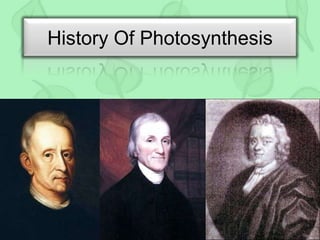
History Of Photosynthesis
What does Photosynthesis
Means?
Site Of Photosynthesis
Light & Dark Reaction
Goal Of Photosynthesis
Investigating Photosynthesis
•Many Scientists Have Contributed
To Understanding Photosynthesis
•Early Research Focused On The
Overall Process
•Later Researchers Investigated The
Detailed Chemical Pathways
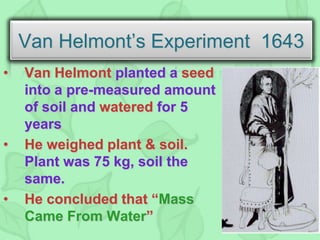
Van Helmont’s Experiment 1643
• Van Helmont planted a seed
into a pre-measured amount
of soil and watered for 5
years
• He weighed plant & soil.
Plant was 75 kg, soil the
same.
• He concluded that “Mass
Came From Water”
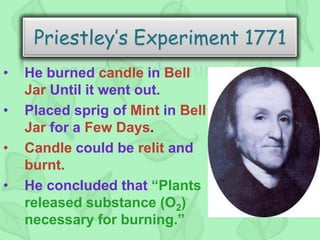
Priestley’s Experiment 1771
• He burned candle in Bell
Jar Until it went out.
• Placed sprig of Mint in Bell
Jar for a Few Days.
• Candle could be relit and
burnt.
• He concluded that “Plants
released substance (O2)
necessary for burning.”
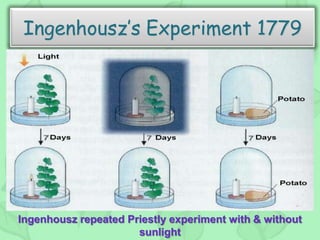
Ingenhousz’s Experiment 1779
Ingenhousz repeated Priestly experiment with & without
sunlight
Results of Ingenhousz’s
Experiment
• He showed that Priestley‟s
results occurred only in the
presence of Sunlight.
• “Light was necessary for
plants to produce the
„Burning Gas‟ or Oxygen.”
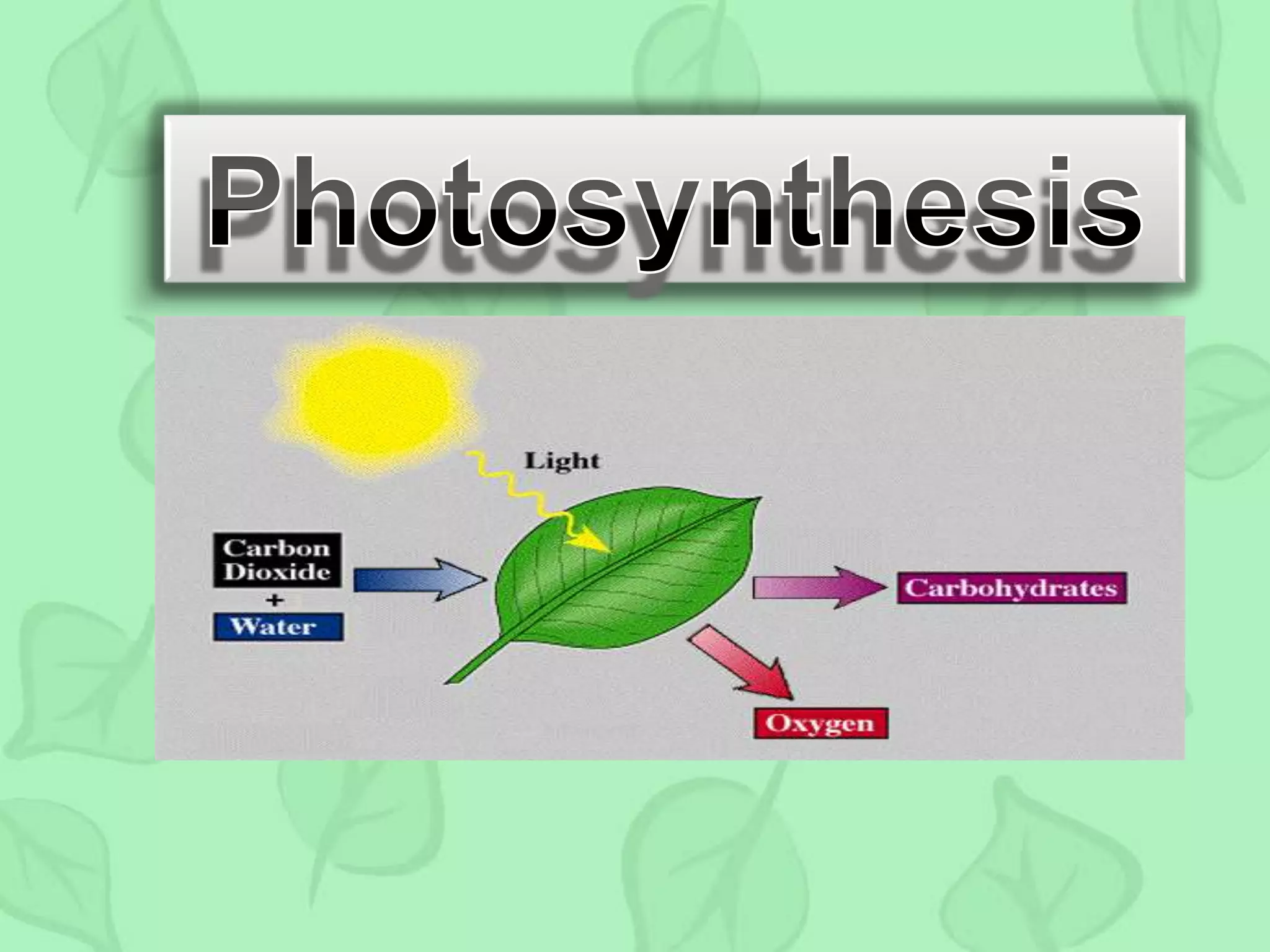
What does Photosynthesis means?
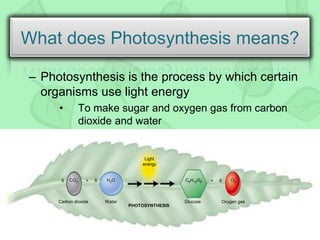
– Photosynthesis is the process by which certain
organisms use light energy
• To make sugar and oxygen gas from carbon
dioxide and water
Light
energy
PHOTOSYNTHESIS
6 CO2 6+ H2O
Carbon dioxide Water
C6H12O6 6+ O2
Glucose Oxygen gas
• Photosynthesis is a chemical process in
which energy from light is harvested to
provide carbohydrates.
• It is the major path through which Carbon
reenters the biosphere (from CO2).
• Photosynthesis is also the major source
of Oxygen in the earth's atmosphere
What does Photosynthesis means?
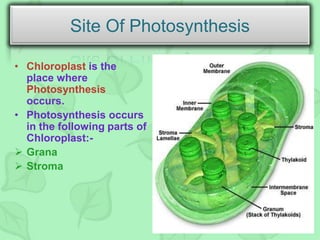
• Chloroplast is the
place where
Photosynthesis
occurs.
• Photosynthesis occurs
in the following parts of
Chloroplast:-
 Grana
 Stroma
Site Of Photosynthesis
Grana:- They are sac like structures
present in the chloroplast. The light
reaction takes place in grana.
Stroma:- They are the spaces
surrounding the Grana. They are site for
dark reaction. They are aqueous &
contain RNA, DNA & Ribosomes.
Grana & Stroma
The capturing of light energy occurs within
the chloroplasts, primarily located in the
mesophyll cells of the leaf.
The major light absorbing pigments on
thylakoid membrane is chlorophyll.
Light Harvesting Pigments
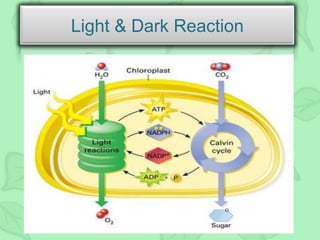
Light & Dark Reaction
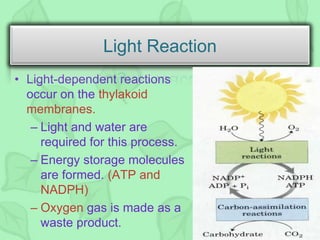
• Light-dependent reactions
occur on the thylakoid
membranes.
– Light and water are
required for this process.
– Energy storage molecules
are formed. (ATP and
NADPH)
– Oxygen gas is made as a
waste product.
Light Reaction
• New electron need to be taken from
water to allow the process to continue.
• 4 electrons are removed from 2 water
molecule leaving 4H+ ion and 2 oxygen
atom.
• The 2 oxygen atom from O2 gas that is
released into the air to be consumed by
the heterotrophs and used in cellular
respiration.
Oxygen Production
• From the chlorophyll , electrons are
passed from one molecule to another
down an electron transport chain.
• The light energy electrons end up at
the electron carrier molecule NADP+
• Converting it into NADPH.
• This energy storing molecule will be
used in dark reaction.
Electron Transport
ATP and NADPH, generated by light
reaction are used to fix and reduce CO2
to form carbohydrate.
ATP + NADPH +H++ CO2 C6H12O6
Enzymes and intermediates of the cycle
are located in the chloroplast stroma.
Dark Reaction (Calvin Cycle)
• From the splitting of water, the H+ ions
left behind create a difference in charge
across the photosynthesis membrane.
• The inside of the membrane is positive
and outside is negative.
• A proton pump called ATPsynthase
make ATP (to be used in dark reaction)
by attaching H+ ions to ADP.
• This process is called Chemiosmosis.
Formation Of ATP
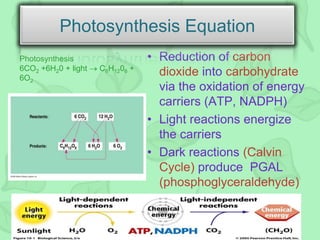
• Reduction of carbon
dioxide into carbohydrate
via the oxidation of energy
carriers (ATP, NADPH)
• Light reactions energize
the carriers
• Dark reactions (Calvin
Cycle) produce PGAL
(phosphoglyceraldehyde)
Photosynthesis
6CO2 +6H20 + light C6H1206 +
6O2
Photosynthesis Equation
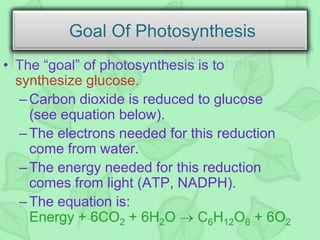
• The “goal” of photosynthesis is to
synthesize glucose.
–Carbon dioxide is reduced to glucose
(see equation below).
–The electrons needed for this reduction
come from water.
–The energy needed for this reduction
comes from light (ATP, NADPH).
–The equation is:
Energy + 6CO2 + 6H2O C6H12O6 + 6O2
Goal Of Photosynthesis
• Photosynthesis does NOT supply
energy to the cell. Photosynthesis
USES light energy to make organic
compounds.
• To get energy for the cell, plant cells
must use cellular respiration to break
down glucose and make ATP.
Important Note On Photosynthesis
Photosynthesis

Photosynthesis

  • 2.
  • 3.
    History Of Photosynthesis Whatdoes Photosynthesis Means? Site Of Photosynthesis Light & Dark Reaction Goal Of Photosynthesis
  • 4.
    Investigating Photosynthesis •Many ScientistsHave Contributed To Understanding Photosynthesis •Early Research Focused On The Overall Process •Later Researchers Investigated The Detailed Chemical Pathways
  • 5.
    Van Helmont’s Experiment1643 • Van Helmont planted a seed into a pre-measured amount of soil and watered for 5 years • He weighed plant & soil. Plant was 75 kg, soil the same. • He concluded that “Mass Came From Water”
  • 6.
    Priestley’s Experiment 1771 •He burned candle in Bell Jar Until it went out. • Placed sprig of Mint in Bell Jar for a Few Days. • Candle could be relit and burnt. • He concluded that “Plants released substance (O2) necessary for burning.”
  • 7.
    Ingenhousz’s Experiment 1779 Ingenhouszrepeated Priestly experiment with & without sunlight
  • 8.
    Results of Ingenhousz’s Experiment •He showed that Priestley‟s results occurred only in the presence of Sunlight. • “Light was necessary for plants to produce the „Burning Gas‟ or Oxygen.”
  • 9.
    What does Photosynthesismeans? – Photosynthesis is the process by which certain organisms use light energy • To make sugar and oxygen gas from carbon dioxide and water Light energy PHOTOSYNTHESIS 6 CO2 6+ H2O Carbon dioxide Water C6H12O6 6+ O2 Glucose Oxygen gas
  • 10.
    • Photosynthesis isa chemical process in which energy from light is harvested to provide carbohydrates. • It is the major path through which Carbon reenters the biosphere (from CO2). • Photosynthesis is also the major source of Oxygen in the earth's atmosphere What does Photosynthesis means?
  • 11.
    • Chloroplast isthe place where Photosynthesis occurs. • Photosynthesis occurs in the following parts of Chloroplast:-  Grana  Stroma Site Of Photosynthesis
  • 12.
    Grana:- They aresac like structures present in the chloroplast. The light reaction takes place in grana. Stroma:- They are the spaces surrounding the Grana. They are site for dark reaction. They are aqueous & contain RNA, DNA & Ribosomes. Grana & Stroma
  • 13.
    The capturing oflight energy occurs within the chloroplasts, primarily located in the mesophyll cells of the leaf. The major light absorbing pigments on thylakoid membrane is chlorophyll. Light Harvesting Pigments
  • 14.
    Light & DarkReaction
  • 15.
    • Light-dependent reactions occuron the thylakoid membranes. – Light and water are required for this process. – Energy storage molecules are formed. (ATP and NADPH) – Oxygen gas is made as a waste product. Light Reaction
  • 16.
    • New electronneed to be taken from water to allow the process to continue. • 4 electrons are removed from 2 water molecule leaving 4H+ ion and 2 oxygen atom. • The 2 oxygen atom from O2 gas that is released into the air to be consumed by the heterotrophs and used in cellular respiration. Oxygen Production
  • 17.
    • From thechlorophyll , electrons are passed from one molecule to another down an electron transport chain. • The light energy electrons end up at the electron carrier molecule NADP+ • Converting it into NADPH. • This energy storing molecule will be used in dark reaction. Electron Transport
  • 18.
    ATP and NADPH,generated by light reaction are used to fix and reduce CO2 to form carbohydrate. ATP + NADPH +H++ CO2 C6H12O6 Enzymes and intermediates of the cycle are located in the chloroplast stroma. Dark Reaction (Calvin Cycle)
  • 19.
    • From thesplitting of water, the H+ ions left behind create a difference in charge across the photosynthesis membrane. • The inside of the membrane is positive and outside is negative. • A proton pump called ATPsynthase make ATP (to be used in dark reaction) by attaching H+ ions to ADP. • This process is called Chemiosmosis. Formation Of ATP
  • 20.
    • Reduction ofcarbon dioxide into carbohydrate via the oxidation of energy carriers (ATP, NADPH) • Light reactions energize the carriers • Dark reactions (Calvin Cycle) produce PGAL (phosphoglyceraldehyde) Photosynthesis 6CO2 +6H20 + light C6H1206 + 6O2 Photosynthesis Equation
  • 21.
    • The “goal”of photosynthesis is to synthesize glucose. –Carbon dioxide is reduced to glucose (see equation below). –The electrons needed for this reduction come from water. –The energy needed for this reduction comes from light (ATP, NADPH). –The equation is: Energy + 6CO2 + 6H2O C6H12O6 + 6O2 Goal Of Photosynthesis
  • 22.
    • Photosynthesis doesNOT supply energy to the cell. Photosynthesis USES light energy to make organic compounds. • To get energy for the cell, plant cells must use cellular respiration to break down glucose and make ATP. Important Note On Photosynthesis