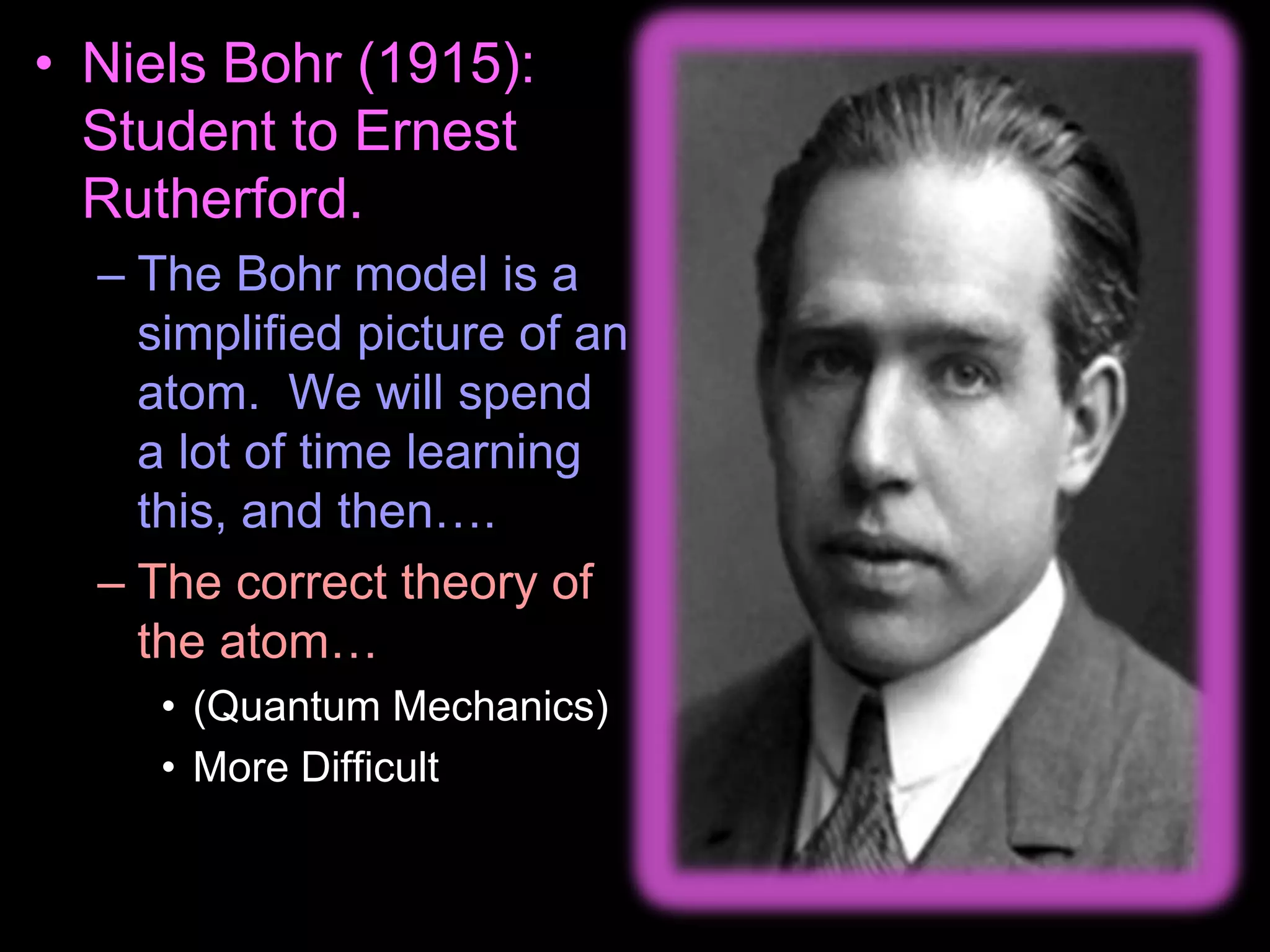
• Niels Bohr (1915):
Student to Ernest
Rutherford.
– The Bohr model is a
simplified picture of an
atom. We will spend
a lot of time learning
this, and then….
– The correct theory of
the atom…
• (Quantum Mechanics)
• More Difficult
• RED SLIDE: These are notes that are very
important and should be recorded in your
science journal.
Copyright © 2010 Ryan P. Murphy
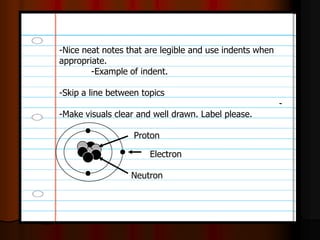
-Nice neat notes that are legible and use indents when
appropriate.
-Example of indent.
-Skip a line between topics
-
-Make visuals clear and well drawn. Label please.
Neutron
Proton
Electron
• RED SLIDE: These are notes that are very
important and should be recorded in your
science journal.
• BLACK SLIDE: Pay attention, follow
directions, complete projects as described
and answer required questions neatly.
Copyright © 2010 Ryan P. Murphy
• http://sciencepowerpoint.com
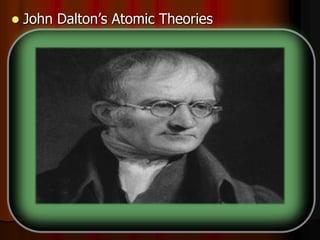
 John Dalton’s Atomic Theories
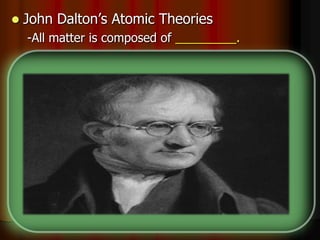
-All matter is composed of _________.
-Atoms cannot be made or __________.
-All atoms of the same element are _________.
-Different elements have different types of _____.
-Chemical reactions occur when atoms are
____________.
-Compounds are formed from atoms of the
elements.
 John Dalton’s Atomic Theories
-All matter is composed of _________.
-Atoms cannot be made or __________.
-All atoms of the same element are _________.
-Different elements have different types of _____.
-Chemical reactions occur when atoms are
____________.
-Compounds are formed from atoms of the
elements.
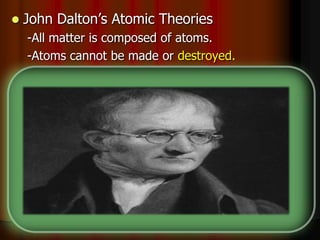
 John Dalton’s Atomic Theories
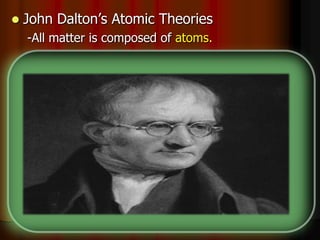
-All matter is composed of atoms.
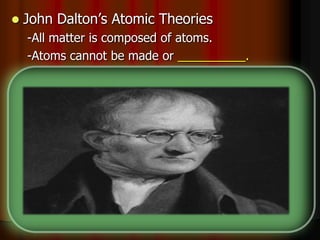
-Atoms cannot be made or __________.
-All atoms of the same element are _________.
-Different elements have different types of _____.
-Chemical reactions occur when atoms are
____________.
-Compounds are formed from atoms of the
elements.
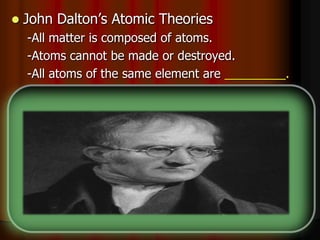
 John Dalton’s Atomic Theories
-All matter is composed of atoms.
-Atoms cannot be made or __________.
-All atoms of the same element are _________.
-Different elements have different types of _____.
-Chemical reactions occur when atoms are
____________.
-Compounds are formed from atoms of the
elements.
 John Dalton’s Atomic Theories
-All matter is composed of atoms.
-Atoms cannot be made or destroyed.
-All atoms of the same element are _________.
-Different elements have different types of _____.
-Chemical reactions occur when atoms are
____________.
-Compounds are formed from atoms of the
elements.
 John Dalton’s Atomic Theories
-All matter is composed of atoms.
-Atoms cannot be made or destroyed.
-All atoms of the same element are _________.
-Different elements have different types of _____.
-Chemical reactions occur when atoms are
____________.
-Compounds are formed from atoms of the
elements.
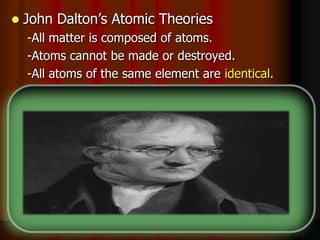
 John Dalton’s Atomic Theories
-All matter is composed of atoms.
-Atoms cannot be made or destroyed.
-All atoms of the same element are identical.
-Different elements have different types of _____.
-Chemical reactions occur when atoms are
____________.
-Compounds are formed from atoms of the
elements.
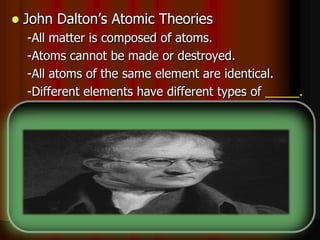
 John Dalton’s Atomic Theories
-All matter is composed of atoms.
-Atoms cannot be made or destroyed.
-All atoms of the same element are identical.
-Different elements have different types of _____.
-Chemical reactions occur when atoms are
____________.
-Compounds are formed from atoms of the
elements.
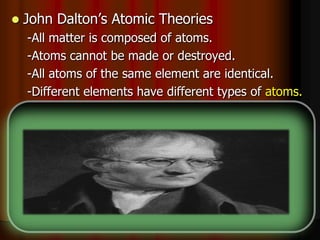
 John Dalton’s Atomic Theories
-All matter is composed of atoms.
-Atoms cannot be made or destroyed.
-All atoms of the same element are identical.
-Different elements have different types of atoms.
-Chemical reactions occur when atoms are
____________.
-Compounds are formed from atoms of the
elements.
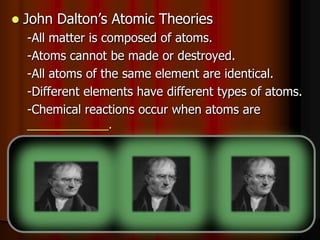
 John Dalton’s Atomic Theories
-All matter is composed of atoms.
-Atoms cannot be made or destroyed.
-All atoms of the same element are identical.
-Different elements have different types of atoms.
-Chemical reactions occur when atoms are
____________.
-Compounds are formed from atoms of the
elements.
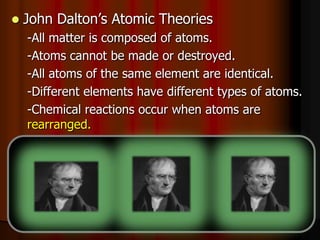
 John Dalton’s Atomic Theories
-All matter is composed of atoms.
-Atoms cannot be made or destroyed.
-All atoms of the same element are identical.
-Different elements have different types of atoms.
-Chemical reactions occur when atoms are
rearranged.
-Compounds are formed from atoms of the
elements.
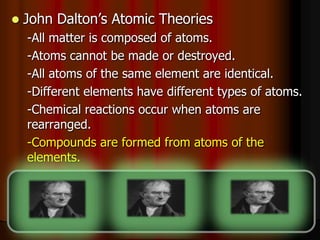
 John Dalton’s Atomic Theories
-All matter is composed of atoms.
-Atoms cannot be made or destroyed.
-All atoms of the same element are identical.
-Different elements have different types of atoms.
-Chemical reactions occur when atoms are
rearranged.
-Compounds are formed from atoms of the
elements.
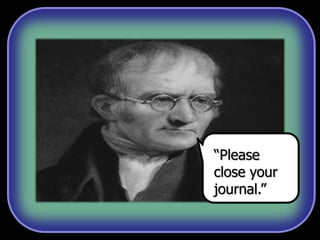
“Please
close your
journal.”
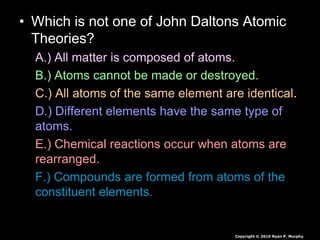
• Which is not one of John Daltons Atomic
Theories?
A.) All matter is composed of atoms.
B.) Atoms cannot be made or destroyed.
C.) All atoms of the same element are identical.
D.) Different elements have the same type of
atoms.
E.) Chemical reactions occur when atoms are
rearranged.
F.) Compounds are formed from atoms of the
constituent elements.
Copyright © 2010 Ryan P. Murphy
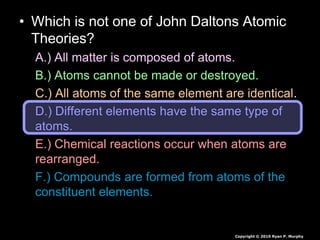
• Which is not one of John Daltons Atomic
Theories?
A.) All matter is composed of atoms.
B.) Atoms cannot be made or destroyed.
C.) All atoms of the same element are identical.
D.) Different elements have the same type of
atoms.
E.) Chemical reactions occur when atoms are
rearranged.
F.) Compounds are formed from atoms of the
constituent elements.
Copyright © 2010 Ryan P. Murphy
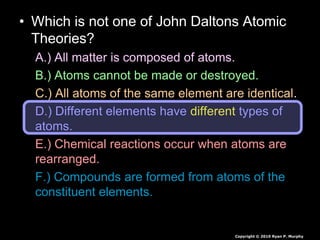
• Which is not one of John Daltons Atomic
Theories?
A.) All matter is composed of atoms.
B.) Atoms cannot be made or destroyed.
C.) All atoms of the same element are identical.
D.) Different elements have different types of
atoms.
E.) Chemical reactions occur when atoms are
rearranged.
F.) Compounds are formed from atoms of the
constituent elements.
Copyright © 2010 Ryan P. Murphy
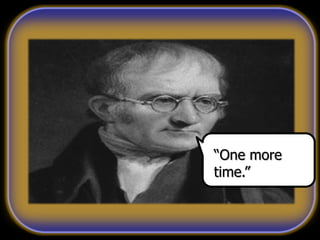
“One more
time.”
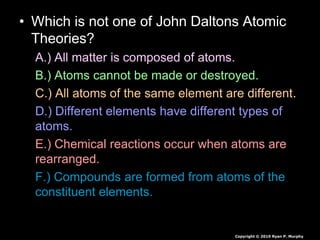
• Which is not one of John Daltons Atomic
Theories?
A.) All matter is composed of atoms.
B.) Atoms cannot be made or destroyed.
C.) All atoms of the same element are different.
D.) Different elements have different types of
atoms.
E.) Chemical reactions occur when atoms are
rearranged.
F.) Compounds are formed from atoms of the
constituent elements.
Copyright © 2010 Ryan P. Murphy
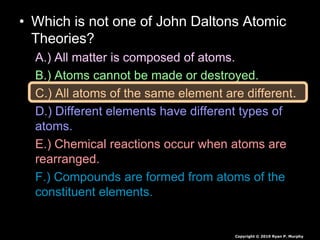
• Which is not one of John Daltons Atomic
Theories?
A.) All matter is composed of atoms.
B.) Atoms cannot be made or destroyed.
C.) All atoms of the same element are different.
D.) Different elements have different types of
atoms.
E.) Chemical reactions occur when atoms are
rearranged.
F.) Compounds are formed from atoms of the
constituent elements.
Copyright © 2010 Ryan P. Murphy
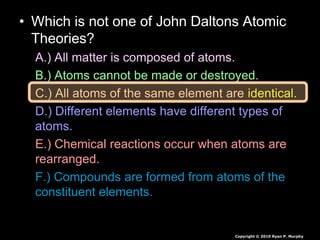
• Which is not one of John Daltons Atomic
Theories?
A.) All matter is composed of atoms.
B.) Atoms cannot be made or destroyed.
C.) All atoms of the same element are identical.
D.) Different elements have different types of
atoms.
E.) Chemical reactions occur when atoms are
rearranged.
F.) Compounds are formed from atoms of the
constituent elements.
Copyright © 2010 Ryan P. Murphy
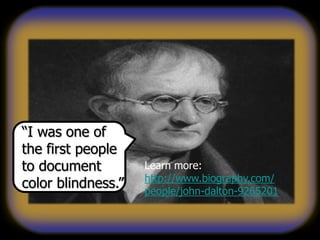
“I was one of
the first people
to document
color blindness.”
Learn more:
http://www.biography.com/
people/john-dalton-9265201
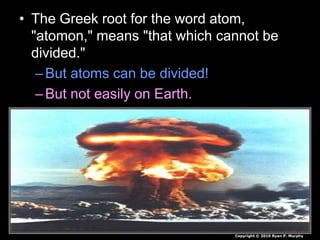
• The Greek root for the word atom,
"atomon," means "that which cannot be
divided."
Copyright © 2010 Ryan P. Murphy
• The Greek root for the word atom,
"atomon," means "that which cannot be
divided."
–But atoms can be divided!
Copyright © 2010 Ryan P. Murphy
• The Greek root for the word atom,
"atomon," means "that which cannot be
divided."
–But atoms can be divided!
–But not easily on Earth.
Copyright © 2010 Ryan P. Murphy
• The Greek root for the word atom,
"atomon," means "that which cannot be
divided."
–But atoms can be divided!
–But not easily on Earth.
Copyright © 2010 Ryan P. Murphy
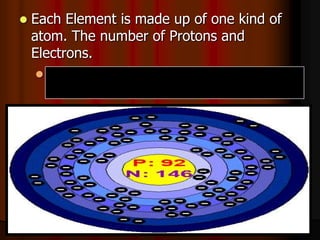
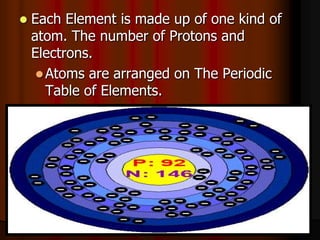
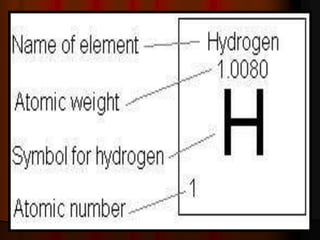
 Each Element is made up of one kind of
atom. The number of Protons and
Electrons.
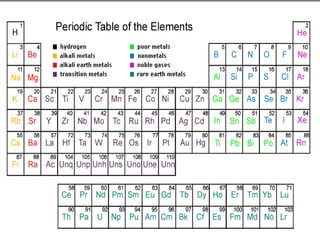
Atoms are arranged on The Periodic
Table of Elements.
 Each Element is made up of one kind of
atom. The number of Protons and
Electrons.
Atoms are arranged on The Periodic
Table of Elements.
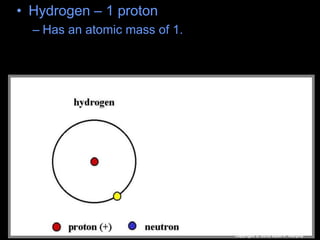
• Hydrogen – 1 proton
– Has an atomic mass of 1.
Copyright © 2010 Ryan P. Murphy
• Hydrogen – 1 proton
– Has an atomic mass of 1.
Copyright © 2010 Ryan P. Murphy
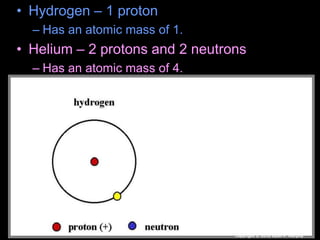
• Hydrogen – 1 proton
– Has an atomic mass of 1.
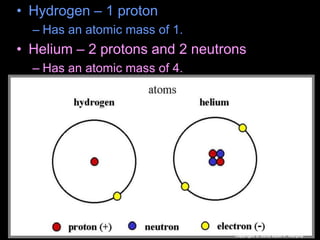
• Helium – 2 protons and 2 neutrons
– Has an atomic mass of 4.
Copyright © 2010 Ryan P. Murphy
• Hydrogen – 1 proton
– Has an atomic mass of 1.
• Helium – 2 protons and 2 neutrons
– Has an atomic mass of 4.
Copyright © 2010 Ryan P. Murphy
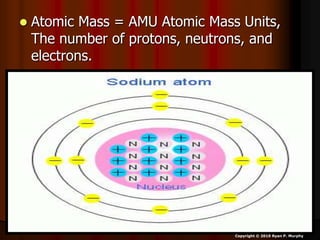
 Atomic Mass = AMU Atomic Mass Units,
The number of protons, neutrons, and
electrons.
Copyright © 2010 Ryan P. Murphy
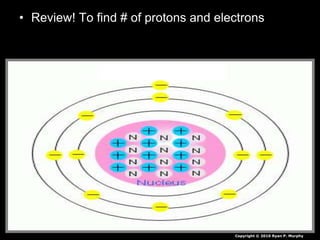
• Review! To find # of protons and electrons
Copyright © 2010 Ryan P. Murphy
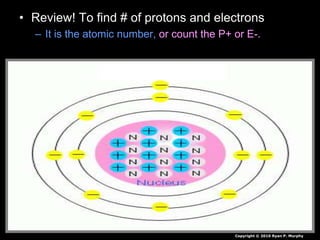
• Review! To find # of protons and electrons
– It is the atomic number, or count the P+ or E-.
Copyright © 2010 Ryan P. Murphy
• Review! To find # of protons and electrons
– It is the atomic number, or count the P+ or E-.
Copyright © 2010 Ryan P. Murphy
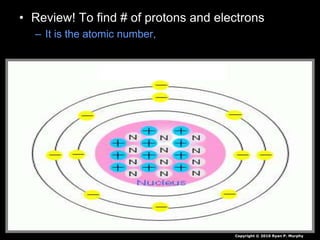
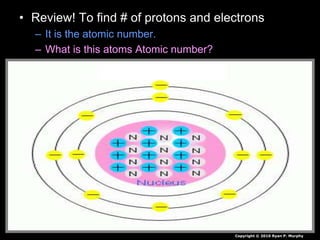
• Review! To find # of protons and electrons
– It is the atomic number.
– What is this atoms Atomic number?
Copyright © 2010 Ryan P. Murphy
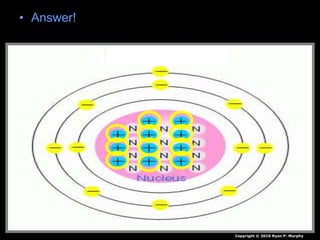
• Answer!
Copyright © 2010 Ryan P. Murphy
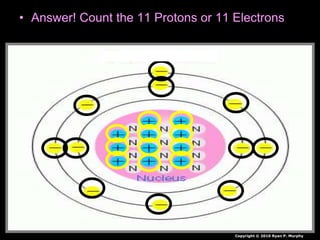
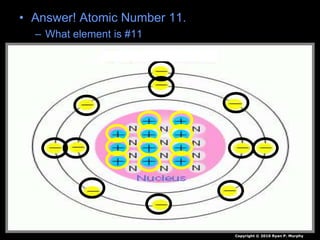
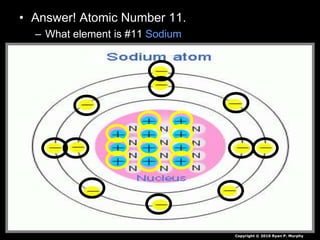
• Answer! Count the 11 Protons or 11 Electrons
Copyright © 2010 Ryan P. Murphy
• Answer! Atomic Number 11.
– What element is #11
Copyright © 2010 Ryan P. Murphy
• Answer! Atomic Number 11.
– What element is #11 Sodium
Copyright © 2010 Ryan P. Murphy
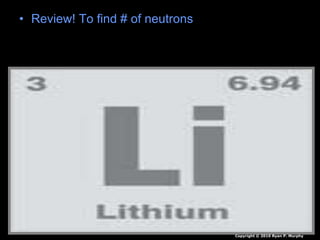
• Review! To find # of neutrons
Copyright © 2010 Ryan P. Murphy
• Review! To find # of neutrons
– Subtract the atomic number from the atomic mass to
determine the difference.
Copyright © 2010 Ryan P. Murphy
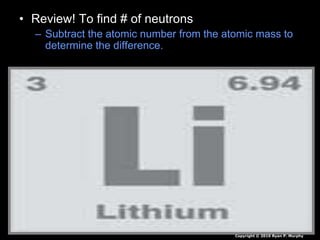
• Review! To find # of neutrons
– Subtract the atomic number from the atomic mass to
determine the difference.
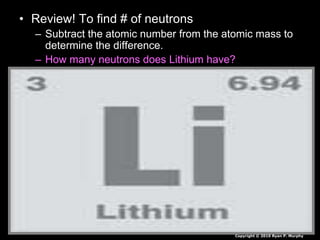
– How many neutrons does Lithium have?
Copyright © 2010 Ryan P. Murphy
• Review! To find # of neutrons
– Subtract the atomic number from the atomic mass to
determine the difference.
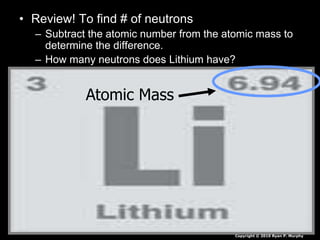
– How many neutrons does Lithium have?
Atomic Mass
Copyright © 2010 Ryan P. Murphy
• Review! To find # of neutrons
– Subtract the atomic number from the atomic mass to
determine the difference.
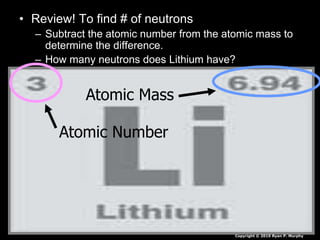
– How many neutrons does Lithium have?
Atomic Mass
Atomic Number
Copyright © 2010 Ryan P. Murphy
• Review! To find # of neutrons
– Subtract the atomic number from the atomic mass to
determine the difference.
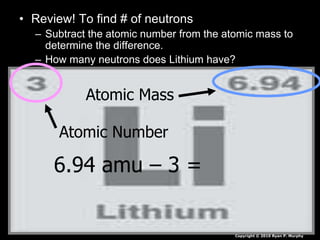
– How many neutrons does Lithium have?
Atomic Mass
Atomic Number
6.94 amu – 3 =
Copyright © 2010 Ryan P. Murphy
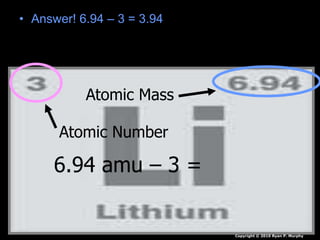
• Answer! 6.94 – 3 = 3.94
Atomic Mass
Atomic Number
6.94 amu – 3 =
Copyright © 2010 Ryan P. Murphy
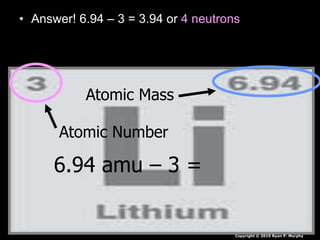
• Answer! 6.94 – 3 = 3.94 or 4 neutrons
Atomic Mass
Atomic Number
6.94 amu – 3 =
Copyright © 2010 Ryan P. Murphy
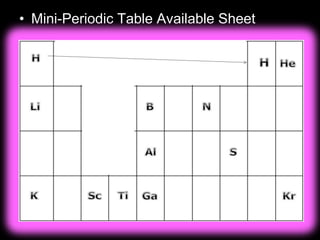
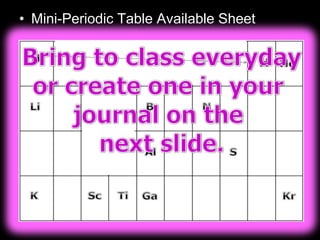
• Mini-Periodic Table Available Sheet
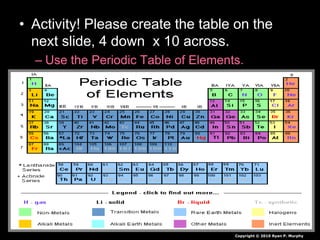
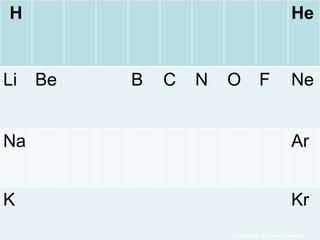
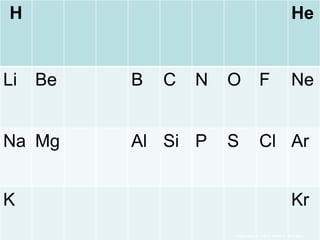
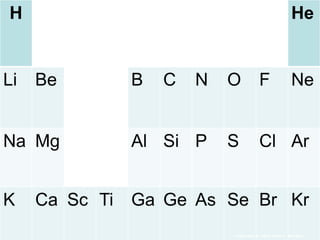
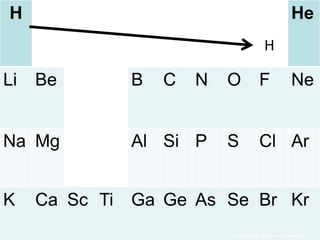
• Activity! Please create the table on the
next slide, 4 down x 10 across.
– Use the Periodic Table of Elements.
Copyright © 2010 Ryan P. Murphy
H He
Copyright © 2010 Ryan P. Murphy
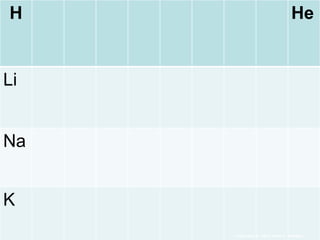
H He
Li
Na
K
Copyright © 2010 Ryan P. Murphy
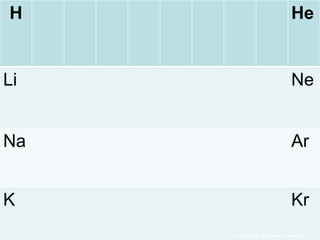
H He
Li Ne
Na Ar
K Kr
Copyright © 2010 Ryan P. Murphy
H He
Li Be B C N O F Ne
Na Ar
K Kr
Copyright © 2010 Ryan P. Murphy
H He
Li Be B C N O F Ne
Na Mg Al Si P S Cl Ar
K Kr
Copyright © 2010 Ryan P. Murphy
H He
Li Be B C N O F Ne
Na Mg Al Si P S Cl Ar
K Ca Sc Ti Ga Ge As Se Br Kr
Copyright © 2010 Ryan P. Murphy
H He
Li Be B C N O F Ne
Na Mg Al Si P S Cl Ar
K Ca Sc Ti Ga Ge As Se Br Kr
Copyright © 2010 Ryan P. Murphy
H
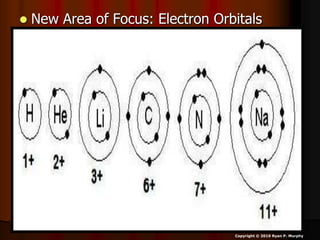
 New Area of Focus: Electron Orbitals
Copyright © 2010 Ryan P. Murphy
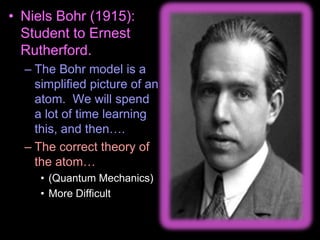
• Niels Bohr (1915):
Student to Ernest
Rutherford.
– The Bohr model is a
simplified picture of an
atom. We will spend
a lot of time learning
this, and then….
– The correct theory of
the atom…
• (Quantum Mechanics)
• More Difficult
• Niels Bohr (1915):
Student to Ernest
Rutherford.
– The Bohr model is a
simplified picture of an
atom. We will spend
a lot of time learning
this, and then….
– The correct theory of
the atom…
• (Quantum Mechanics)
• More Difficult
Learn more
http://chemed.chem.pu
rdue.edu/genchem/hist
ory/bohr.html
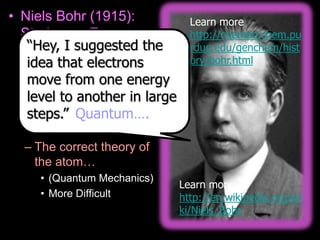
“Hey, I suggested the
idea that electrons
move from one energy
level to another in large
steps.”.-Quantum….
Learn more:
http://en.wikipedia.org/wi
ki/Niels_Bohr
• Video Link! Electron Orbitals
– http://www.youtube.com/watch?v=rNM21emk
MJo
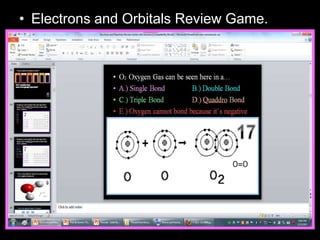
• Electrons and Orbitals Review Game.
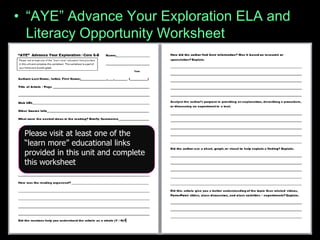
• “AYE” Advance Your Exploration ELA and
Literacy Opportunity Worksheet
– Visit some of the many provided links or..
– Articles can be found at (w/ membership to
NABT and NSTA)
• http://www.nabt.org/websites/institution/index.php?p=
1
• http://learningcenter.nsta.org/browse_journals.aspx?j
ournal=tst
Please visit at least one of the
“learn more” educational links
provided in this unit and complete
this worksheet
• “AYE” Advance Your Exploration ELA and
Literacy Opportunity Worksheet
– Visit some of the many provided links or..
– Articles can be found at (w/ membership to and
NSTA)
• http://www.sciencedaily.com/
• http://www.sciencemag.org/
• http://learningcenter.nsta.org/browse_journals.aspx?jo
urnal=tst
• http://sciencepowerpoint.com
http://sciencepowerpoint.com/Atoms_Periodic_Table_of_Elements_Unit.html
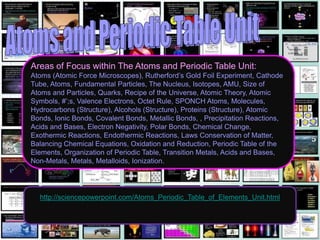
Areas of Focus within The Atoms and Periodic Table Unit:
Atoms (Atomic Force Microscopes), Rutherford’s Gold Foil Experiment, Cathode
Tube, Atoms, Fundamental Particles, The Nucleus, Isotopes, AMU, Size of
Atoms and Particles, Quarks, Recipe of the Universe, Atomic Theory, Atomic
Symbols, #’;s, Valence Electrons, Octet Rule, SPONCH Atoms, Molecules,
Hydrocarbons (Structure), Alcohols (Structure), Proteins (Structure), Atomic
Bonds, Ionic Bonds, Covalent Bonds, Metallic Bonds, , Precipitation Reactions,
Acids and Bases, Electron Negativity, Polar Bonds, Chemical Change,
Exothermic Reactions, Endothermic Reactions, Laws Conservation of Matter,
Balancing Chemical Equations, Oxidation and Reduction, Periodic Table of the
Elements, Organization of Periodic Table, Transition Metals, Acids and Bases,
Non-Metals, Metals, Metalloids, Ionization.
• This PowerPoint roadmap is one small part of
my Atoms and Periodic Table Unit.
• This unit includes a four part 2000+ slide
PowerPoint roadmap.
• 13 page bundled homework that chronologically
follows slideshow
• 14 pages of unit notes with visuals.
• 3 PowerPoint review games.
• Activity sheets, rubrics, advice page, curriculum
guide, materials list, and much more.
• http://sciencepowerpoint.com
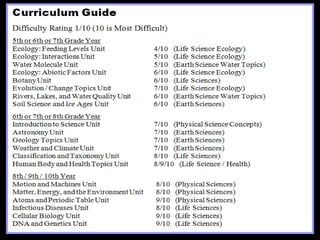
• Please visit the links below to learn more
about each of the units in this curriculum
– These units take me about four years to complete
with my students in grades 5-10.
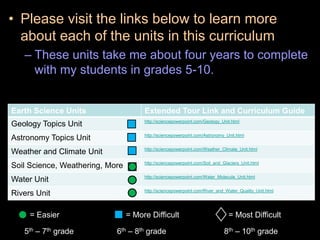
Earth Science Units Extended Tour Link and Curriculum Guide
Geology Topics Unit http://sciencepowerpoint.com/Geology_Unit.html
Astronomy Topics Unit http://sciencepowerpoint.com/Astronomy_Unit.html
Weather and Climate Unit http://sciencepowerpoint.com/Weather_Climate_Unit.html
Soil Science, Weathering, More http://sciencepowerpoint.com/Soil_and_Glaciers_Unit.html
Water Unit http://sciencepowerpoint.com/Water_Molecule_Unit.html
Rivers Unit http://sciencepowerpoint.com/River_and_Water_Quality_Unit.html
= Easier = More Difficult = Most Difficult
5th – 7th grade 6th – 8th grade 8th – 10th grade
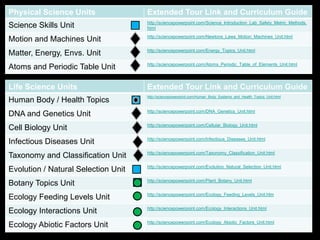
Physical Science Units Extended Tour Link and Curriculum Guide
Science Skills Unit http://sciencepowerpoint.com/Science_Introduction_Lab_Safety_Metric_Methods.
html
Motion and Machines Unit http://sciencepowerpoint.com/Newtons_Laws_Motion_Machines_Unit.html
Matter, Energy, Envs. Unit http://sciencepowerpoint.com/Energy_Topics_Unit.html
Atoms and Periodic Table Unit http://sciencepowerpoint.com/Atoms_Periodic_Table_of_Elements_Unit.html
Life Science Units Extended Tour Link and Curriculum Guide
Human Body / Health Topics
http://sciencepowerpoint.com/Human_Body_Systems_and_Health_Topics_Unit.html
DNA and Genetics Unit http://sciencepowerpoint.com/DNA_Genetics_Unit.html
Cell Biology Unit http://sciencepowerpoint.com/Cellular_Biology_Unit.html
Infectious Diseases Unit http://sciencepowerpoint.com/Infectious_Diseases_Unit.html
Taxonomy and Classification Unit http://sciencepowerpoint.com/Taxonomy_Classification_Unit.html
Evolution / Natural Selection Unit http://sciencepowerpoint.com/Evolution_Natural_Selection_Unit.html
Botany Topics Unit http://sciencepowerpoint.com/Plant_Botany_Unit.html
Ecology Feeding Levels Unit http://sciencepowerpoint.com/Ecology_Feeding_Levels_Unit.htm
Ecology Interactions Unit http://sciencepowerpoint.com/Ecology_Interactions_Unit.html
Ecology Abiotic Factors Unit http://sciencepowerpoint.com/Ecology_Abiotic_Factors_Unit.html
• http://sciencepowerpoint.com
• The entire four year curriculum can be found at...
http://sciencepowerpoint.com/ Please feel free to
contact me with any questions you may have.
Thank you for your interest in this curriculum.
Sincerely,
Ryan Murphy M.Ed
www.sciencepowerpoint@gmail.com

Atomic Theory, Physical Science Lesson PowerPoint

  • 1.
    • Niels Bohr(1915): Student to Ernest Rutherford. – The Bohr model is a simplified picture of an atom. We will spend a lot of time learning this, and then…. – The correct theory of the atom… • (Quantum Mechanics) • More Difficult
  • 3.
    • RED SLIDE:These are notes that are very important and should be recorded in your science journal. Copyright © 2010 Ryan P. Murphy
  • 4.
    -Nice neat notesthat are legible and use indents when appropriate. -Example of indent. -Skip a line between topics - -Make visuals clear and well drawn. Label please. Neutron Proton Electron
  • 5.
    • RED SLIDE:These are notes that are very important and should be recorded in your science journal. • BLACK SLIDE: Pay attention, follow directions, complete projects as described and answer required questions neatly. Copyright © 2010 Ryan P. Murphy
  • 6.
  • 8.
     John Dalton’sAtomic Theories -All matter is composed of _________. -Atoms cannot be made or __________. -All atoms of the same element are _________. -Different elements have different types of _____. -Chemical reactions occur when atoms are ____________. -Compounds are formed from atoms of the elements.
  • 9.
     John Dalton’sAtomic Theories -All matter is composed of _________. -Atoms cannot be made or __________. -All atoms of the same element are _________. -Different elements have different types of _____. -Chemical reactions occur when atoms are ____________. -Compounds are formed from atoms of the elements.
  • 10.
     John Dalton’sAtomic Theories -All matter is composed of atoms. -Atoms cannot be made or __________. -All atoms of the same element are _________. -Different elements have different types of _____. -Chemical reactions occur when atoms are ____________. -Compounds are formed from atoms of the elements.
  • 11.
     John Dalton’sAtomic Theories -All matter is composed of atoms. -Atoms cannot be made or __________. -All atoms of the same element are _________. -Different elements have different types of _____. -Chemical reactions occur when atoms are ____________. -Compounds are formed from atoms of the elements.
  • 12.
     John Dalton’sAtomic Theories -All matter is composed of atoms. -Atoms cannot be made or destroyed. -All atoms of the same element are _________. -Different elements have different types of _____. -Chemical reactions occur when atoms are ____________. -Compounds are formed from atoms of the elements.
  • 13.
     John Dalton’sAtomic Theories -All matter is composed of atoms. -Atoms cannot be made or destroyed. -All atoms of the same element are _________. -Different elements have different types of _____. -Chemical reactions occur when atoms are ____________. -Compounds are formed from atoms of the elements.
  • 14.
     John Dalton’sAtomic Theories -All matter is composed of atoms. -Atoms cannot be made or destroyed. -All atoms of the same element are identical. -Different elements have different types of _____. -Chemical reactions occur when atoms are ____________. -Compounds are formed from atoms of the elements.
  • 15.
     John Dalton’sAtomic Theories -All matter is composed of atoms. -Atoms cannot be made or destroyed. -All atoms of the same element are identical. -Different elements have different types of _____. -Chemical reactions occur when atoms are ____________. -Compounds are formed from atoms of the elements.
  • 16.
     John Dalton’sAtomic Theories -All matter is composed of atoms. -Atoms cannot be made or destroyed. -All atoms of the same element are identical. -Different elements have different types of atoms. -Chemical reactions occur when atoms are ____________. -Compounds are formed from atoms of the elements.
  • 17.
     John Dalton’sAtomic Theories -All matter is composed of atoms. -Atoms cannot be made or destroyed. -All atoms of the same element are identical. -Different elements have different types of atoms. -Chemical reactions occur when atoms are ____________. -Compounds are formed from atoms of the elements.
  • 18.
     John Dalton’sAtomic Theories -All matter is composed of atoms. -Atoms cannot be made or destroyed. -All atoms of the same element are identical. -Different elements have different types of atoms. -Chemical reactions occur when atoms are rearranged. -Compounds are formed from atoms of the elements.
  • 19.
     John Dalton’sAtomic Theories -All matter is composed of atoms. -Atoms cannot be made or destroyed. -All atoms of the same element are identical. -Different elements have different types of atoms. -Chemical reactions occur when atoms are rearranged. -Compounds are formed from atoms of the elements.
  • 20.
  • 21.
    • Which isnot one of John Daltons Atomic Theories? A.) All matter is composed of atoms. B.) Atoms cannot be made or destroyed. C.) All atoms of the same element are identical. D.) Different elements have the same type of atoms. E.) Chemical reactions occur when atoms are rearranged. F.) Compounds are formed from atoms of the constituent elements. Copyright © 2010 Ryan P. Murphy
  • 22.
    • Which isnot one of John Daltons Atomic Theories? A.) All matter is composed of atoms. B.) Atoms cannot be made or destroyed. C.) All atoms of the same element are identical. D.) Different elements have the same type of atoms. E.) Chemical reactions occur when atoms are rearranged. F.) Compounds are formed from atoms of the constituent elements. Copyright © 2010 Ryan P. Murphy
  • 23.
    • Which isnot one of John Daltons Atomic Theories? A.) All matter is composed of atoms. B.) Atoms cannot be made or destroyed. C.) All atoms of the same element are identical. D.) Different elements have different types of atoms. E.) Chemical reactions occur when atoms are rearranged. F.) Compounds are formed from atoms of the constituent elements. Copyright © 2010 Ryan P. Murphy
  • 24.
  • 25.
    • Which isnot one of John Daltons Atomic Theories? A.) All matter is composed of atoms. B.) Atoms cannot be made or destroyed. C.) All atoms of the same element are different. D.) Different elements have different types of atoms. E.) Chemical reactions occur when atoms are rearranged. F.) Compounds are formed from atoms of the constituent elements. Copyright © 2010 Ryan P. Murphy
  • 26.
    • Which isnot one of John Daltons Atomic Theories? A.) All matter is composed of atoms. B.) Atoms cannot be made or destroyed. C.) All atoms of the same element are different. D.) Different elements have different types of atoms. E.) Chemical reactions occur when atoms are rearranged. F.) Compounds are formed from atoms of the constituent elements. Copyright © 2010 Ryan P. Murphy
  • 27.
    • Which isnot one of John Daltons Atomic Theories? A.) All matter is composed of atoms. B.) Atoms cannot be made or destroyed. C.) All atoms of the same element are identical. D.) Different elements have different types of atoms. E.) Chemical reactions occur when atoms are rearranged. F.) Compounds are formed from atoms of the constituent elements. Copyright © 2010 Ryan P. Murphy
  • 28.
    “I was oneof the first people to document color blindness.” Learn more: http://www.biography.com/ people/john-dalton-9265201
  • 29.
    • The Greekroot for the word atom, "atomon," means "that which cannot be divided." Copyright © 2010 Ryan P. Murphy
  • 30.
    • The Greekroot for the word atom, "atomon," means "that which cannot be divided." –But atoms can be divided! Copyright © 2010 Ryan P. Murphy
  • 31.
    • The Greekroot for the word atom, "atomon," means "that which cannot be divided." –But atoms can be divided! –But not easily on Earth. Copyright © 2010 Ryan P. Murphy
  • 32.
    • The Greekroot for the word atom, "atomon," means "that which cannot be divided." –But atoms can be divided! –But not easily on Earth. Copyright © 2010 Ryan P. Murphy
  • 33.
     Each Elementis made up of one kind of atom. The number of Protons and Electrons. Atoms are arranged on The Periodic Table of Elements.
  • 34.
     Each Elementis made up of one kind of atom. The number of Protons and Electrons. Atoms are arranged on The Periodic Table of Elements.
  • 37.
    • Hydrogen –1 proton – Has an atomic mass of 1. Copyright © 2010 Ryan P. Murphy
  • 38.
    • Hydrogen –1 proton – Has an atomic mass of 1. Copyright © 2010 Ryan P. Murphy
  • 39.
    • Hydrogen –1 proton – Has an atomic mass of 1. • Helium – 2 protons and 2 neutrons – Has an atomic mass of 4. Copyright © 2010 Ryan P. Murphy
  • 40.
    • Hydrogen –1 proton – Has an atomic mass of 1. • Helium – 2 protons and 2 neutrons – Has an atomic mass of 4. Copyright © 2010 Ryan P. Murphy
  • 41.
     Atomic Mass= AMU Atomic Mass Units, The number of protons, neutrons, and electrons. Copyright © 2010 Ryan P. Murphy
  • 42.
    • Review! Tofind # of protons and electrons Copyright © 2010 Ryan P. Murphy
  • 43.
    • Review! Tofind # of protons and electrons – It is the atomic number, or count the P+ or E-. Copyright © 2010 Ryan P. Murphy
  • 44.
    • Review! Tofind # of protons and electrons – It is the atomic number, or count the P+ or E-. Copyright © 2010 Ryan P. Murphy
  • 45.
    • Review! Tofind # of protons and electrons – It is the atomic number. – What is this atoms Atomic number? Copyright © 2010 Ryan P. Murphy
  • 46.
    • Answer! Copyright ©2010 Ryan P. Murphy
  • 47.
    • Answer! Countthe 11 Protons or 11 Electrons Copyright © 2010 Ryan P. Murphy
  • 48.
    • Answer! AtomicNumber 11. – What element is #11 Copyright © 2010 Ryan P. Murphy
  • 49.
    • Answer! AtomicNumber 11. – What element is #11 Sodium Copyright © 2010 Ryan P. Murphy
  • 50.
    • Review! Tofind # of neutrons Copyright © 2010 Ryan P. Murphy
  • 51.
    • Review! Tofind # of neutrons – Subtract the atomic number from the atomic mass to determine the difference. Copyright © 2010 Ryan P. Murphy
  • 52.
    • Review! Tofind # of neutrons – Subtract the atomic number from the atomic mass to determine the difference. – How many neutrons does Lithium have? Copyright © 2010 Ryan P. Murphy
  • 53.
    • Review! Tofind # of neutrons – Subtract the atomic number from the atomic mass to determine the difference. – How many neutrons does Lithium have? Atomic Mass Copyright © 2010 Ryan P. Murphy
  • 54.
    • Review! Tofind # of neutrons – Subtract the atomic number from the atomic mass to determine the difference. – How many neutrons does Lithium have? Atomic Mass Atomic Number Copyright © 2010 Ryan P. Murphy
  • 55.
    • Review! Tofind # of neutrons – Subtract the atomic number from the atomic mass to determine the difference. – How many neutrons does Lithium have? Atomic Mass Atomic Number 6.94 amu – 3 = Copyright © 2010 Ryan P. Murphy
  • 56.
    • Answer! 6.94– 3 = 3.94 Atomic Mass Atomic Number 6.94 amu – 3 = Copyright © 2010 Ryan P. Murphy
  • 57.
    • Answer! 6.94– 3 = 3.94 or 4 neutrons Atomic Mass Atomic Number 6.94 amu – 3 = Copyright © 2010 Ryan P. Murphy
  • 58.
    • Mini-Periodic TableAvailable Sheet
  • 59.
    • Mini-Periodic TableAvailable Sheet
  • 60.
    • Activity! Pleasecreate the table on the next slide, 4 down x 10 across. – Use the Periodic Table of Elements. Copyright © 2010 Ryan P. Murphy
  • 61.
    H He Copyright ©2010 Ryan P. Murphy
  • 62.
    H He Li Na K Copyright ©2010 Ryan P. Murphy
  • 63.
    H He Li Ne NaAr K Kr Copyright © 2010 Ryan P. Murphy
  • 64.
    H He Li BeB C N O F Ne Na Ar K Kr Copyright © 2010 Ryan P. Murphy
  • 65.
    H He Li BeB C N O F Ne Na Mg Al Si P S Cl Ar K Kr Copyright © 2010 Ryan P. Murphy
  • 66.
    H He Li BeB C N O F Ne Na Mg Al Si P S Cl Ar K Ca Sc Ti Ga Ge As Se Br Kr Copyright © 2010 Ryan P. Murphy
  • 67.
    H He Li BeB C N O F Ne Na Mg Al Si P S Cl Ar K Ca Sc Ti Ga Ge As Se Br Kr Copyright © 2010 Ryan P. Murphy H
  • 68.
     New Areaof Focus: Electron Orbitals Copyright © 2010 Ryan P. Murphy
  • 69.
    • Niels Bohr(1915): Student to Ernest Rutherford. – The Bohr model is a simplified picture of an atom. We will spend a lot of time learning this, and then…. – The correct theory of the atom… • (Quantum Mechanics) • More Difficult
  • 70.
    • Niels Bohr(1915): Student to Ernest Rutherford. – The Bohr model is a simplified picture of an atom. We will spend a lot of time learning this, and then…. – The correct theory of the atom… • (Quantum Mechanics) • More Difficult Learn more http://chemed.chem.pu rdue.edu/genchem/hist ory/bohr.html “Hey, I suggested the idea that electrons move from one energy level to another in large steps.”.-Quantum…. Learn more: http://en.wikipedia.org/wi ki/Niels_Bohr
  • 71.
    • Video Link!Electron Orbitals – http://www.youtube.com/watch?v=rNM21emk MJo
  • 72.
    • Electrons andOrbitals Review Game.
  • 73.
    • “AYE” AdvanceYour Exploration ELA and Literacy Opportunity Worksheet – Visit some of the many provided links or.. – Articles can be found at (w/ membership to NABT and NSTA) • http://www.nabt.org/websites/institution/index.php?p= 1 • http://learningcenter.nsta.org/browse_journals.aspx?j ournal=tst Please visit at least one of the “learn more” educational links provided in this unit and complete this worksheet
  • 74.
    • “AYE” AdvanceYour Exploration ELA and Literacy Opportunity Worksheet – Visit some of the many provided links or.. – Articles can be found at (w/ membership to and NSTA) • http://www.sciencedaily.com/ • http://www.sciencemag.org/ • http://learningcenter.nsta.org/browse_journals.aspx?jo urnal=tst
  • 76.
  • 78.
    http://sciencepowerpoint.com/Atoms_Periodic_Table_of_Elements_Unit.html Areas of Focuswithin The Atoms and Periodic Table Unit: Atoms (Atomic Force Microscopes), Rutherford’s Gold Foil Experiment, Cathode Tube, Atoms, Fundamental Particles, The Nucleus, Isotopes, AMU, Size of Atoms and Particles, Quarks, Recipe of the Universe, Atomic Theory, Atomic Symbols, #’;s, Valence Electrons, Octet Rule, SPONCH Atoms, Molecules, Hydrocarbons (Structure), Alcohols (Structure), Proteins (Structure), Atomic Bonds, Ionic Bonds, Covalent Bonds, Metallic Bonds, , Precipitation Reactions, Acids and Bases, Electron Negativity, Polar Bonds, Chemical Change, Exothermic Reactions, Endothermic Reactions, Laws Conservation of Matter, Balancing Chemical Equations, Oxidation and Reduction, Periodic Table of the Elements, Organization of Periodic Table, Transition Metals, Acids and Bases, Non-Metals, Metals, Metalloids, Ionization.
  • 84.
    • This PowerPointroadmap is one small part of my Atoms and Periodic Table Unit. • This unit includes a four part 2000+ slide PowerPoint roadmap. • 13 page bundled homework that chronologically follows slideshow • 14 pages of unit notes with visuals. • 3 PowerPoint review games. • Activity sheets, rubrics, advice page, curriculum guide, materials list, and much more. • http://sciencepowerpoint.com
  • 86.
    • Please visitthe links below to learn more about each of the units in this curriculum – These units take me about four years to complete with my students in grades 5-10. Earth Science Units Extended Tour Link and Curriculum Guide Geology Topics Unit http://sciencepowerpoint.com/Geology_Unit.html Astronomy Topics Unit http://sciencepowerpoint.com/Astronomy_Unit.html Weather and Climate Unit http://sciencepowerpoint.com/Weather_Climate_Unit.html Soil Science, Weathering, More http://sciencepowerpoint.com/Soil_and_Glaciers_Unit.html Water Unit http://sciencepowerpoint.com/Water_Molecule_Unit.html Rivers Unit http://sciencepowerpoint.com/River_and_Water_Quality_Unit.html = Easier = More Difficult = Most Difficult 5th – 7th grade 6th – 8th grade 8th – 10th grade
  • 87.
    Physical Science UnitsExtended Tour Link and Curriculum Guide Science Skills Unit http://sciencepowerpoint.com/Science_Introduction_Lab_Safety_Metric_Methods. html Motion and Machines Unit http://sciencepowerpoint.com/Newtons_Laws_Motion_Machines_Unit.html Matter, Energy, Envs. Unit http://sciencepowerpoint.com/Energy_Topics_Unit.html Atoms and Periodic Table Unit http://sciencepowerpoint.com/Atoms_Periodic_Table_of_Elements_Unit.html Life Science Units Extended Tour Link and Curriculum Guide Human Body / Health Topics http://sciencepowerpoint.com/Human_Body_Systems_and_Health_Topics_Unit.html DNA and Genetics Unit http://sciencepowerpoint.com/DNA_Genetics_Unit.html Cell Biology Unit http://sciencepowerpoint.com/Cellular_Biology_Unit.html Infectious Diseases Unit http://sciencepowerpoint.com/Infectious_Diseases_Unit.html Taxonomy and Classification Unit http://sciencepowerpoint.com/Taxonomy_Classification_Unit.html Evolution / Natural Selection Unit http://sciencepowerpoint.com/Evolution_Natural_Selection_Unit.html Botany Topics Unit http://sciencepowerpoint.com/Plant_Botany_Unit.html Ecology Feeding Levels Unit http://sciencepowerpoint.com/Ecology_Feeding_Levels_Unit.htm Ecology Interactions Unit http://sciencepowerpoint.com/Ecology_Interactions_Unit.html Ecology Abiotic Factors Unit http://sciencepowerpoint.com/Ecology_Abiotic_Factors_Unit.html
  • 88.
  • 89.
    • The entirefour year curriculum can be found at... http://sciencepowerpoint.com/ Please feel free to contact me with any questions you may have. Thank you for your interest in this curriculum. Sincerely, Ryan Murphy M.Ed www.sciencepowerpoint@gmail.com