RECAP
3 REACTIONS THAT LED TO THE
FORAMTION OF THE ELEMENTS:
• NUCLEOSYNTHESIS
• FUSION
• NEUTRON CAPTURE REACTION
• REACTION REQUIRED A CERTAIN AMOUNT
OF ENERGY TO PROCEED
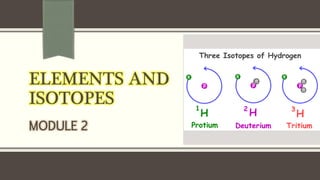
ELEMENTS AND
ISOTOPES
MODULE 2
1. Describe how elements heavier than iron are formed.
2. Describe how isotopes are formed;
3. Discuss the significance of isotopes to mass number; and
4. Solve problems on percent abundance of elements.
LEARNING OBJECTIVES:
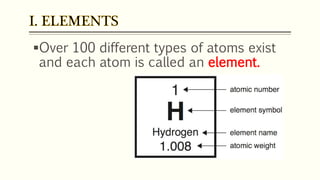
Over 100 different types of atoms exist
and each atom is called an element.
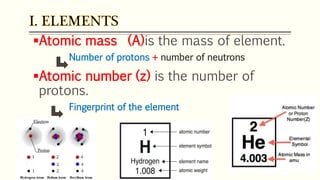
Atomic mass (A)is the mass of element.
Number of protons + number of neutrons
Atomic number (z) is the number of
protons.
Fingerprint of the element
An element can have different
number of electrons or
neutrons but always has the
same number of protons.
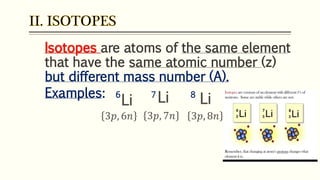
Isotopes are atoms of the same element
that have the same atomic number (z)
but different mass number (A).
Examples: 6 7 8
Li Li Li
3𝑝, 6𝑛 3𝑝, 7𝑛 3𝑝, 8𝑛
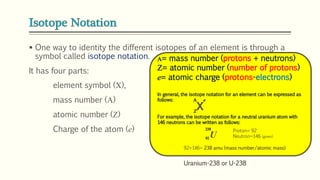
 One way to identity the different isotopes of an element is through a
symbol called isotope notation.
It has four parts:
element symbol (X),
mass number (A)
atomic number (Z)
Charge of the atom (e)
x
U
Proton= 92
Neutron=146 (given)
92+146= 238 amu (mass number/atomic mass)
Uranium-238 or U-238
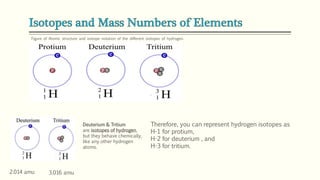
Deuterium & Tritium
are isotopes of hydrogen,
but they behave chemically,
like any other hydrogen
atoms.
Figure of Atomic structure and isotope notation of the different isotopes of hydrogen.
2.014 amu 3.016 amu
Therefore, you can represent hydrogen isotopes as
H-1 for protium,
H-2 for deuterium , and
H-3 for tritium.
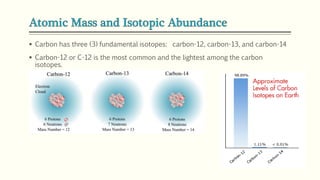
 Carbon has three (3) fundamental isotopes: carbon-12, carbon-13, and carbon-14
 Carbon-12 or C-12 is the most common and the lightest among the carbon
isotopes.
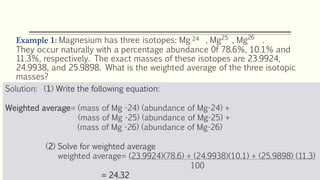
Example 1: Magnesium has three isotopes: Mg , Mg , Mg .
They occur naturally with a percentage abundance 0f 78.6%, 10.1% and
11.3%, respectively. The exact masses of these isotopes are 23.9924,
24.9938, and 25.9898. What is the weighted average of the three isotopic
masses?
24 25 26
Solution: (1) Write the following equation:
Weighted average= (mass of Mg -24) (abundance of Mg-24) +
(mass of Mg -25) (abundance of Mg-25) +
(mass of Mg -26) (abundance of Mg-26)
(2) Solve for weighted average
weighted average= (23.9924)(78.6) + (24.9938)(10.1) + (25.9898) (11.3)
100
= 24.32
Thank you!
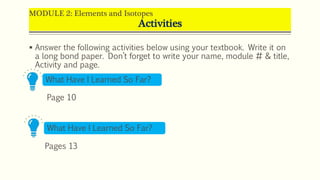
MODULE 2: Elements and Isotopes
Activities
 Answer the following activities below using your textbook. Write it on
a long bond paper. Don’t forget to write your name, module # & title,
Activity and page.
What Have I Learned So Far?
Page 10
What Have I Learned So Far?
Pages 13
Elements and isotopes

Elements and isotopes

  • 1.
    RECAP 3 REACTIONS THATLED TO THE FORAMTION OF THE ELEMENTS: • NUCLEOSYNTHESIS • FUSION • NEUTRON CAPTURE REACTION • REACTION REQUIRED A CERTAIN AMOUNT OF ENERGY TO PROCEED
  • 2.
  • 3.
    1. Describe howelements heavier than iron are formed. 2. Describe how isotopes are formed; 3. Discuss the significance of isotopes to mass number; and 4. Solve problems on percent abundance of elements. LEARNING OBJECTIVES:
  • 5.
    Over 100 differenttypes of atoms exist and each atom is called an element.
  • 6.
    Atomic mass (A)isthe mass of element. Number of protons + number of neutrons Atomic number (z) is the number of protons. Fingerprint of the element
  • 7.
    An element canhave different number of electrons or neutrons but always has the same number of protons.
  • 8.
    Isotopes are atomsof the same element that have the same atomic number (z) but different mass number (A). Examples: 6 7 8 Li Li Li 3𝑝, 6𝑛 3𝑝, 7𝑛 3𝑝, 8𝑛
  • 9.
     One wayto identity the different isotopes of an element is through a symbol called isotope notation. It has four parts: element symbol (X), mass number (A) atomic number (Z) Charge of the atom (e) x U Proton= 92 Neutron=146 (given) 92+146= 238 amu (mass number/atomic mass) Uranium-238 or U-238
  • 10.
    Deuterium & Tritium areisotopes of hydrogen, but they behave chemically, like any other hydrogen atoms. Figure of Atomic structure and isotope notation of the different isotopes of hydrogen. 2.014 amu 3.016 amu Therefore, you can represent hydrogen isotopes as H-1 for protium, H-2 for deuterium , and H-3 for tritium.
  • 11.
     Carbon hasthree (3) fundamental isotopes: carbon-12, carbon-13, and carbon-14  Carbon-12 or C-12 is the most common and the lightest among the carbon isotopes.
  • 12.
    Example 1: Magnesiumhas three isotopes: Mg , Mg , Mg . They occur naturally with a percentage abundance 0f 78.6%, 10.1% and 11.3%, respectively. The exact masses of these isotopes are 23.9924, 24.9938, and 25.9898. What is the weighted average of the three isotopic masses? 24 25 26 Solution: (1) Write the following equation: Weighted average= (mass of Mg -24) (abundance of Mg-24) + (mass of Mg -25) (abundance of Mg-25) + (mass of Mg -26) (abundance of Mg-26) (2) Solve for weighted average weighted average= (23.9924)(78.6) + (24.9938)(10.1) + (25.9898) (11.3) 100 = 24.32
  • 13.
  • 14.
    MODULE 2: Elementsand Isotopes Activities  Answer the following activities below using your textbook. Write it on a long bond paper. Don’t forget to write your name, module # & title, Activity and page. What Have I Learned So Far? Page 10 What Have I Learned So Far? Pages 13

Editor's Notes

  • #3 NOTE: To change the image on this slide, select the picture and delete it. Then click the Pictures icon in the placeholder to insert your own image.