Before you start learning this topic, I want you to recall your learnings
from your Junior High School Chemistry. Do this simple activity to
embark you into understanding an atom.
1.I want you to give at least (5) five words/phrase to describe an atom.
Place the five words inside the box provided below.
2. I want you to think of an ordinary object that could represent the
model of an atom. What could represent the internal parts of the
atom? Explain why you think of such object that relates to the atom.
In your own idea, how important it is to
know and understand the different models
and structure of an atom?
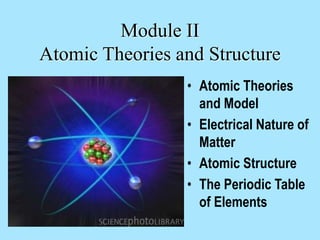
Module II
Atomic Theories and Structure
• Atomic Theories
and Model
• Electrical Nature of
Matter
• Atomic Structure
• The Periodic Table
of Elements
Learning Objectives:
At the end of the lesson, you (student) should
be able to:
1. Identify the different postulates of Dalton’s
Atomic Theory.
2. Describe the three governing laws that
supports the nature of the atom.
Let’s Take a Trip Through
Time!
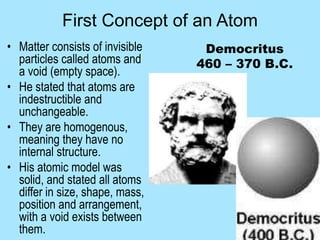
First Concept of an Atom
• Matter consists of invisible
particles called atoms and
a void (empty space).
• He stated that atoms are
indestructible and
unchangeable.
• They are homogenous,
meaning they have no
internal structure.
• His atomic model was
solid, and stated all atoms
differ in size, shape, mass,
position and arrangement,
with a void exists between
them.
Democritus
460 – 370 B.C.
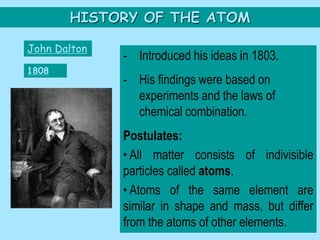
HISTORY OF THE ATOM
1808
John Dalton
- Introduced his ideas in 1803.
- His findings were based on
experiments and the laws of
chemical combination.
Postulates:
• All matter consists of indivisible
particles called atoms.
• Atoms of the same element are
similar in shape and mass, but differ
from the atoms of other elements.
Postulates of Dalton’s Theory
• Atoms cannot be created or destroyed.
• Atoms of different elements may combine with
each other in a fixed, simple, whole number ratios
to form compound atoms.
• Atoms of same element can combine in more than
one ratio to form two or more compounds.
• The atom is the smallest unit of matter that can
take part in a chemical reaction.
• The indivisibility of an atom was proved wrong: an
atom can be further subdivided into protons,
neutrons and electrons. However an atom is the
smallest particle that takes part in chemical
reactions.
• According to Dalton, the atoms of same element are
similar in all respects. However, atoms of some
elements vary in their masses and densities. These
atoms of different masses are called isotopes. For
example, chlorine has two isotopes with mass
numbers 35 and 37.
Drawbacks of Dalton's Atomic Theory
• Dalton also claimed that atoms of different elements are
different in all respects. This has been proven wrong in
certain cases: argon and calcium atoms each have an
atomic mass of 40 amu. These atoms are known as
isobars.
• According to Dalton, atoms of different elements combine
in simple whole number ratios to form compounds. This is
not observed in complex organic compounds like sugar
(C12H22O11).
• The theory fails to explain the existence of allotropes; it
does not account for differences in properties of charcoal,
graphite, diamond, fullerene.
Drawbacks of Dalton's Atomic Theory
• The atomic theory explains the laws of chemical
combination (the Law of Constant Composition and
the Law of Multiple Proportions).
• Dalton was the first person to recognize a workable
distinction between the fundamental particle of an
element (atom) and that of a compound (molecule).
Merits of Dalton's Atomic Theory
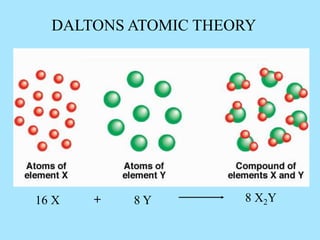
8 X2Y
16 X 8 Y
+
DALTONS ATOMIC THEORY
Fundamental Chemical Laws
1. Law of Conservation of Mass (Lavoisier):
– Mass is neither created nor destroyed in a
chemical reaction.
- In other words, the mass of any one element
at the beginning of a reaction will equal the
mass of that element at the end of the
reaction.
- If we account for all reactants and products in
a chemical reaction, the total mass will be
the same at any point in time in any closed
system. 14
Fundamental Chemical Laws
2. Law of Definite Proportion (Proust):
– A given compound always contains exactly the
same proportion of elements by mass.
– according to this law, every sample of a
particular compound has a fixed ratio of
elements meaning the same elements in the
same proportions by mass
– The implication of the law of definite
proportion is that no matter the source of the
elements or the amount of the compound, the
ratio of elements must be constant to form the
compound. 15
Fundamental Chemical Laws
3. Law of Multiple Proportions (Dalton):
- Elements can combine in different ways to
form different chemical compounds, whose mass
ratios are simple whole-number multiplies of each
other.
- If two elements form more than one
compound between them, the mass ratios of the
second element that combine with a fixed mass of
the first element will always be the ratios of small
whole numbers.
16
Fundamental Chemical Laws
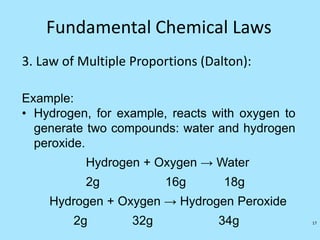
3. Law of Multiple Proportions (Dalton):
Example:
• Hydrogen, for example, reacts with oxygen to
generate two compounds: water and hydrogen
peroxide.
Hydrogen + Oxygen → Water
2g 16g 18g
Hydrogen + Oxygen → Hydrogen Peroxide
2g 32g 34g 17
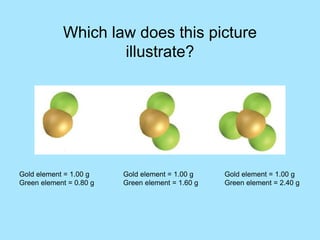
Which law does this picture
illustrate?
Gold element = 1.00 g
Green element = 0.80 g
Gold element = 1.00 g
Green element = 2.40 g
Gold element = 1.00 g
Green element = 1.60 g
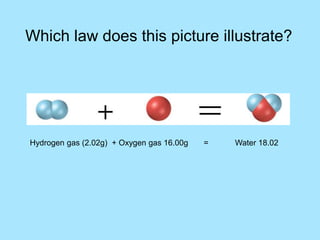
Hydrogen gas (2.02g) + Oxygen gas 16.00g = Water 18.02
Which law does this picture illustrate?
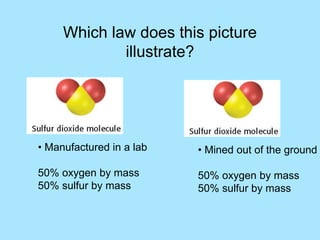
Which law does this picture
illustrate?
• Manufactured in a lab
50% oxygen by mass
50% sulfur by mass
• Mined out of the ground
50% oxygen by mass
50% sulfur by mass
Lesson-2.1-Daltons-Atomic-Theory-revised (1).ppt

Lesson-2.1-Daltons-Atomic-Theory-revised (1).ppt

  • 2.
    Before you startlearning this topic, I want you to recall your learnings from your Junior High School Chemistry. Do this simple activity to embark you into understanding an atom. 1.I want you to give at least (5) five words/phrase to describe an atom. Place the five words inside the box provided below. 2. I want you to think of an ordinary object that could represent the model of an atom. What could represent the internal parts of the atom? Explain why you think of such object that relates to the atom.
  • 3.
    In your ownidea, how important it is to know and understand the different models and structure of an atom?
  • 4.
    Module II Atomic Theoriesand Structure • Atomic Theories and Model • Electrical Nature of Matter • Atomic Structure • The Periodic Table of Elements
  • 5.
    Learning Objectives: At theend of the lesson, you (student) should be able to: 1. Identify the different postulates of Dalton’s Atomic Theory. 2. Describe the three governing laws that supports the nature of the atom.
  • 6.
    Let’s Take aTrip Through Time!
  • 7.
    First Concept ofan Atom • Matter consists of invisible particles called atoms and a void (empty space). • He stated that atoms are indestructible and unchangeable. • They are homogenous, meaning they have no internal structure. • His atomic model was solid, and stated all atoms differ in size, shape, mass, position and arrangement, with a void exists between them. Democritus 460 – 370 B.C.
  • 8.
    HISTORY OF THEATOM 1808 John Dalton - Introduced his ideas in 1803. - His findings were based on experiments and the laws of chemical combination. Postulates: • All matter consists of indivisible particles called atoms. • Atoms of the same element are similar in shape and mass, but differ from the atoms of other elements.
  • 9.
    Postulates of Dalton’sTheory • Atoms cannot be created or destroyed. • Atoms of different elements may combine with each other in a fixed, simple, whole number ratios to form compound atoms. • Atoms of same element can combine in more than one ratio to form two or more compounds. • The atom is the smallest unit of matter that can take part in a chemical reaction.
  • 10.
    • The indivisibilityof an atom was proved wrong: an atom can be further subdivided into protons, neutrons and electrons. However an atom is the smallest particle that takes part in chemical reactions. • According to Dalton, the atoms of same element are similar in all respects. However, atoms of some elements vary in their masses and densities. These atoms of different masses are called isotopes. For example, chlorine has two isotopes with mass numbers 35 and 37. Drawbacks of Dalton's Atomic Theory
  • 11.
    • Dalton alsoclaimed that atoms of different elements are different in all respects. This has been proven wrong in certain cases: argon and calcium atoms each have an atomic mass of 40 amu. These atoms are known as isobars. • According to Dalton, atoms of different elements combine in simple whole number ratios to form compounds. This is not observed in complex organic compounds like sugar (C12H22O11). • The theory fails to explain the existence of allotropes; it does not account for differences in properties of charcoal, graphite, diamond, fullerene. Drawbacks of Dalton's Atomic Theory
  • 12.
    • The atomictheory explains the laws of chemical combination (the Law of Constant Composition and the Law of Multiple Proportions). • Dalton was the first person to recognize a workable distinction between the fundamental particle of an element (atom) and that of a compound (molecule). Merits of Dalton's Atomic Theory
  • 13.
    8 X2Y 16 X8 Y + DALTONS ATOMIC THEORY
  • 14.
    Fundamental Chemical Laws 1.Law of Conservation of Mass (Lavoisier): – Mass is neither created nor destroyed in a chemical reaction. - In other words, the mass of any one element at the beginning of a reaction will equal the mass of that element at the end of the reaction. - If we account for all reactants and products in a chemical reaction, the total mass will be the same at any point in time in any closed system. 14
  • 15.
    Fundamental Chemical Laws 2.Law of Definite Proportion (Proust): – A given compound always contains exactly the same proportion of elements by mass. – according to this law, every sample of a particular compound has a fixed ratio of elements meaning the same elements in the same proportions by mass – The implication of the law of definite proportion is that no matter the source of the elements or the amount of the compound, the ratio of elements must be constant to form the compound. 15
  • 16.
    Fundamental Chemical Laws 3.Law of Multiple Proportions (Dalton): - Elements can combine in different ways to form different chemical compounds, whose mass ratios are simple whole-number multiplies of each other. - If two elements form more than one compound between them, the mass ratios of the second element that combine with a fixed mass of the first element will always be the ratios of small whole numbers. 16
  • 17.
    Fundamental Chemical Laws 3.Law of Multiple Proportions (Dalton): Example: • Hydrogen, for example, reacts with oxygen to generate two compounds: water and hydrogen peroxide. Hydrogen + Oxygen → Water 2g 16g 18g Hydrogen + Oxygen → Hydrogen Peroxide 2g 32g 34g 17
  • 18.
    Which law doesthis picture illustrate? Gold element = 1.00 g Green element = 0.80 g Gold element = 1.00 g Green element = 2.40 g Gold element = 1.00 g Green element = 1.60 g
  • 19.
    Hydrogen gas (2.02g)+ Oxygen gas 16.00g = Water 18.02 Which law does this picture illustrate?
  • 20.
    Which law doesthis picture illustrate? • Manufactured in a lab 50% oxygen by mass 50% sulfur by mass • Mined out of the ground 50% oxygen by mass 50% sulfur by mass