Gen. Chemistry for
Teachers
THE DEVELOPMENT
OF ATOMIC THEORY
The learners should be able to:
1. describe the basic laws of
chemical change
2. solve problems involving the
basic laws
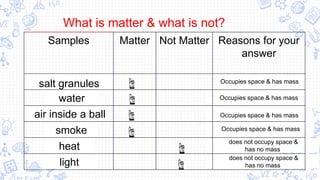
does not occupy space &
has no mass
does not occupy space &
has no mass
Occupies space & has mass
salt granules Occupies space & has mass
What is matter & what is not?
Samples Matter Not Matter Reasons for your
answer
water
air inside a ball
smoke
heat
light
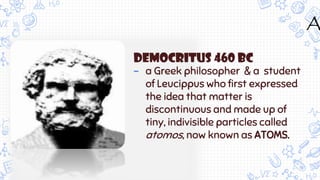
Democritus 460 BC
- a Greek philosopher & a student
of Leucippus who first expressed
the idea that matter is
discontinuous and made up of
tiny, indivisible particles called
atomos, now known as ATOMS.
A
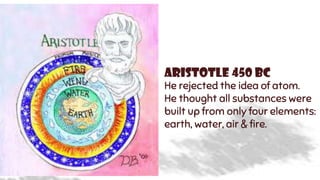
ARISTOTLE 450 BC
He rejected the idea of atom.
He thought all substances were
built up from only four elements:
earth, water, air & fire.
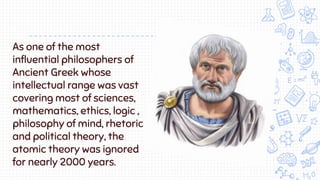
As one of the most
influential philosophers of
Ancient Greek whose
intellectual range was vast
covering most of sciences,
mathematics, ethics, logic ,
philosophy of mind, rhetoric
and political theory, the
atomic theory was ignored
for nearly 2000 years.

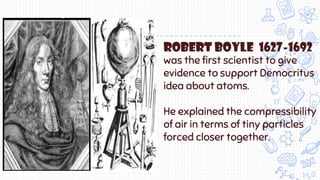
Robert boyle 1627-1692
was the first scientist to give
evidence to support Democritus
idea about atoms.
He explained the compressibility
of air in terms of tiny particles
forced closer together.
ACTIVITY: IT’S ALL ABOUT LAWS……
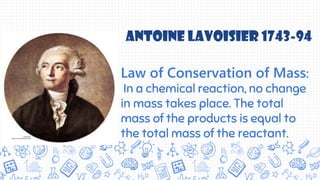
Law of Conservation of Mass:
In a chemical reaction, no change
in mass takes place. The total
mass of the products is equal to
the total mass of the reactant.
Antoine Lavoisier 1743-94
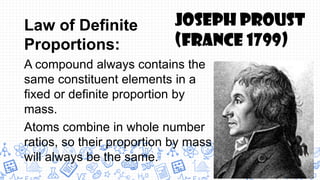
Law of Definite
Proportions:
A compound always contains the
same constituent elements in a
fixed or definite proportion by
mass.
Atoms combine in whole number
ratios, so their proportion by mass
will always be the same.
Joseph Proust
(France 1799)
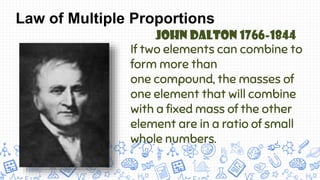
John Dalton 1766-1844
If two elements can combine to
form more than
one compound, the masses of
one element that will combine
with a fixed mass of the other
element are in a ratio of small
whole numbers.
Law of Multiple Proportions
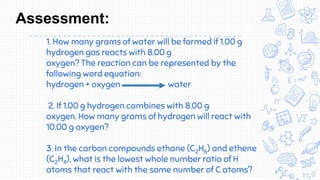
1. How many grams of water will be formed if 1.00 g
hydrogen gas reacts with 8.00 g
oxygen? The reaction can be represented by the
following word equation:
hydrogen + oxygen water
2. If 1.00 g hydrogen combines with 8.00 g
oxygen. How many grams of hydrogen will react with
10.00 g oxygen?
3. In the carbon compounds ethane (C2H6) and ethene
(C2H4), what is the lowest whole number ratio of H
atoms that react with the same number of C atoms?
Assessment:
Assignment:
What the different atomic theories proposed
by:
-Dalton
-Thomson
-Rutherford
-Bohr
-Schrodinger
- Heisenberg
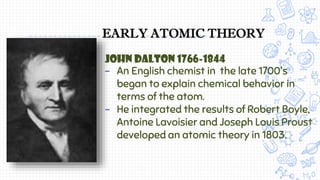
John Dalton 1766-1844
- An English chemist in the late 1700's
began to explain chemical behavior in
terms of the atom.
- He integrated the results of Robert Boyle,
Antoine Lavoisier and Joseph Louis Proust
developed an atomic theory in 1803.
EARLY ATOMIC THEORY
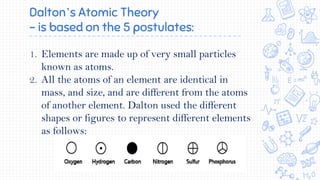
Dalton’s Atomic Theory
- is based on the 5 postulates:
1. Elements are made up of very small particles
known as atoms.
2. All the atoms of an element are identical in
mass, and size, and are different from the atoms
of another element. Dalton used the different
shapes or figures to represent different elements
as follows:
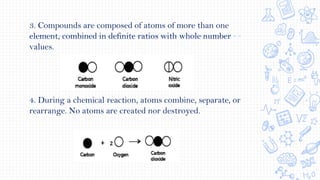
3. Compounds are composed of atoms of more than one
element, combined in definite ratios with whole number
values.
4. During a chemical reaction, atoms combine, separate, or
rearrange. No atoms are created nor destroyed.
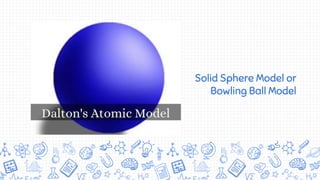
Solid Sphere Model or
Bowling Ball Model
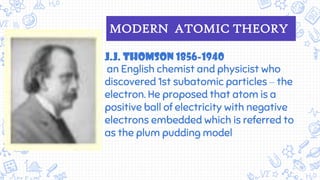
J.J. Thomson 1856-1940
an English chemist and physicist who
discovered 1st subatomic particles – the
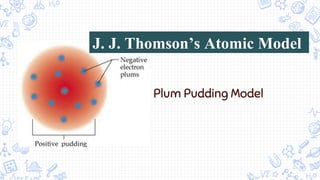
electron. He proposed that atom is a
positive ball of electricity with negative
electrons embedded which is referred to
as the plum pudding model
MODERN ATOMIC THEORY
Plum Pudding Model
J. J. Thomson’s Atomic Model
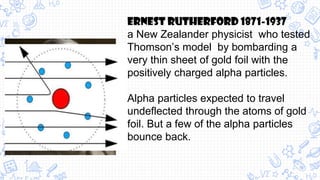
Ernest Rutherford 1871-1937
a New Zealander physicist who tested
Thomson’s model by bombarding a
very thin sheet of gold foil with the
positively charged alpha particles.
Alpha particles expected to travel
undeflected through the atoms of gold
foil. But a few of the alpha particles
bounce back.
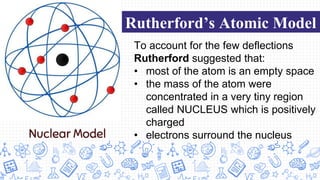
To account for the few deflections
Rutherford suggested that:
• most of the atom is an empty space
• the mass of the atom were
concentrated in a very tiny region
called NUCLEUS which is positively
charged
• electrons surround the nucleus
Nuclear Model
Rutherford’s Atomic Model
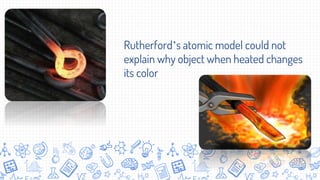
Rutherford’s atomic model could not
explain why object when heated changes
its color
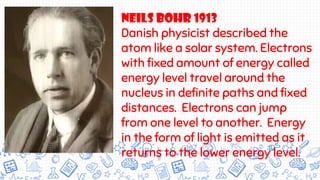
Neils Bohr 1913
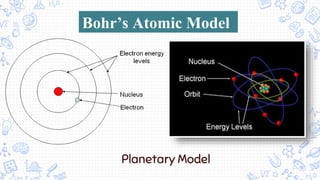
Danish physicist described the
atom like a solar system. Electrons
with fixed amount of energy called
energy level travel around the
nucleus in definite paths and fixed
distances. Electrons can jump
from one level to another. Energy
in the form of light is emitted as it
returns to the lower energy level.
Bohr’s Atomic Model
Planetary Model
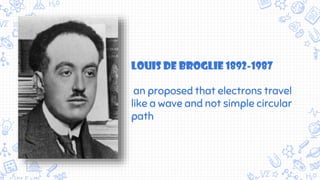
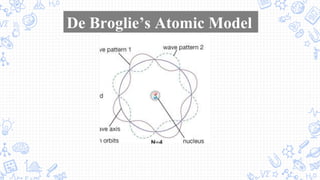
Louis de Broglie 1892-1987
an proposed that electrons travel
like a wave and not simple circular
path
De Broglie’s Atomic Model
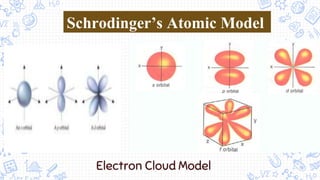
video
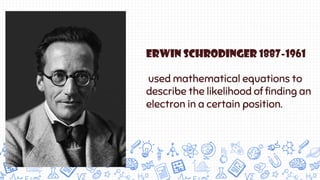
Erwin schrodinger 1887-1961
used mathematical equations to
describe the likelihood of finding an
electron in a certain position.
De Broglie’s Atomic Model
Schrodinger’s Atomic Model
Electron Cloud Model
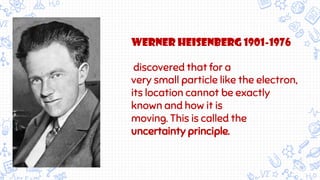
werner Heisenberg 1901-1976
discovered that for a
very small particle like the electron,
its location cannot be exactly
known and how it is
moving. This is called the
uncertainty principle.
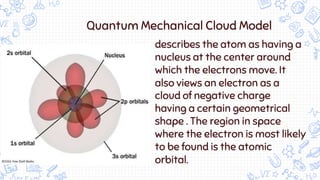
Quantum Mechanical Cloud Model
describes the atom as having a
nucleus at the center around
which the electrons move. It
also views an electron as a
cloud of negative charge
having a certain geometrical
shape . The region in space
where the electron is most likely
to be found is the atomic
orbital.
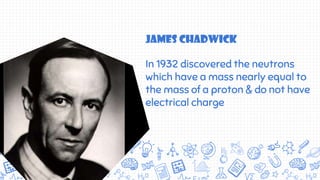
James chadwick
In 1932 discovered the neutrons
which have a mass nearly equal to
the mass of a proton & do not have
electrical charge
Modern Theory of the Atom
• Atoms are composed of three main subatomic
particles: the electron, proton, and neutron.
• Most of the mass of the atom is concentrated in
the nucleus of the atom.
• The protons and neutrons are located within the
nucleus, while the electrons exist outside of the
nucleus.
• In stable atoms, the number of protons is equal
to the number of electrons.
Big concept
References:
https://www.slideshare.net/sheylyn3/the-development-of-the-atomic-
theory?qid=021ebd7a-8a03-4dc1-b6e8-e62eb06a86fc&v=&b=&from_ search=1
www.abcte.org
https://www.teacherph.com/general-chemistry-1-teaching-guide/
atom - Copy.pptx

atom - Copy.pptx

  • 1.
  • 2.
  • 3.
    The learners shouldbe able to: 1. describe the basic laws of chemical change 2. solve problems involving the basic laws
  • 4.
    does not occupyspace & has no mass does not occupy space & has no mass Occupies space & has mass Occupies space & has mass Occupies space & has mass salt granules Occupies space & has mass What is matter & what is not? Samples Matter Not Matter Reasons for your answer water air inside a ball smoke heat light
  • 5.
    Democritus 460 BC -a Greek philosopher & a student of Leucippus who first expressed the idea that matter is discontinuous and made up of tiny, indivisible particles called atomos, now known as ATOMS. A
  • 6.
    ARISTOTLE 450 BC Herejected the idea of atom. He thought all substances were built up from only four elements: earth, water, air & fire.
  • 7.
    As one ofthe most influential philosophers of Ancient Greek whose intellectual range was vast covering most of sciences, mathematics, ethics, logic , philosophy of mind, rhetoric and political theory, the atomic theory was ignored for nearly 2000 years.
  • 8.
    Robert boyle 1627-1692 wasthe first scientist to give evidence to support Democritus idea about atoms. He explained the compressibility of air in terms of tiny particles forced closer together.
  • 9.
    ACTIVITY: IT’S ALLABOUT LAWS……
  • 10.
    Law of Conservationof Mass: In a chemical reaction, no change in mass takes place. The total mass of the products is equal to the total mass of the reactant. Antoine Lavoisier 1743-94
  • 11.
    Law of Definite Proportions: Acompound always contains the same constituent elements in a fixed or definite proportion by mass. Atoms combine in whole number ratios, so their proportion by mass will always be the same. Joseph Proust (France 1799)
  • 12.
    John Dalton 1766-1844 Iftwo elements can combine to form more than one compound, the masses of one element that will combine with a fixed mass of the other element are in a ratio of small whole numbers. Law of Multiple Proportions
  • 13.
    1. How manygrams of water will be formed if 1.00 g hydrogen gas reacts with 8.00 g oxygen? The reaction can be represented by the following word equation: hydrogen + oxygen water 2. If 1.00 g hydrogen combines with 8.00 g oxygen. How many grams of hydrogen will react with 10.00 g oxygen? 3. In the carbon compounds ethane (C2H6) and ethene (C2H4), what is the lowest whole number ratio of H atoms that react with the same number of C atoms? Assessment:
  • 14.
    Assignment: What the differentatomic theories proposed by: -Dalton -Thomson -Rutherford -Bohr -Schrodinger - Heisenberg
  • 15.
    John Dalton 1766-1844 -An English chemist in the late 1700's began to explain chemical behavior in terms of the atom. - He integrated the results of Robert Boyle, Antoine Lavoisier and Joseph Louis Proust developed an atomic theory in 1803. EARLY ATOMIC THEORY
  • 16.
    Dalton’s Atomic Theory -is based on the 5 postulates: 1. Elements are made up of very small particles known as atoms. 2. All the atoms of an element are identical in mass, and size, and are different from the atoms of another element. Dalton used the different shapes or figures to represent different elements as follows:
  • 17.
    3. Compounds arecomposed of atoms of more than one element, combined in definite ratios with whole number values. 4. During a chemical reaction, atoms combine, separate, or rearrange. No atoms are created nor destroyed.
  • 18.
    Solid Sphere Modelor Bowling Ball Model
  • 19.
    J.J. Thomson 1856-1940 anEnglish chemist and physicist who discovered 1st subatomic particles – the electron. He proposed that atom is a positive ball of electricity with negative electrons embedded which is referred to as the plum pudding model MODERN ATOMIC THEORY
  • 20.
    Plum Pudding Model J.J. Thomson’s Atomic Model
  • 21.
    Ernest Rutherford 1871-1937 aNew Zealander physicist who tested Thomson’s model by bombarding a very thin sheet of gold foil with the positively charged alpha particles. Alpha particles expected to travel undeflected through the atoms of gold foil. But a few of the alpha particles bounce back.
  • 22.
    To account forthe few deflections Rutherford suggested that: • most of the atom is an empty space • the mass of the atom were concentrated in a very tiny region called NUCLEUS which is positively charged • electrons surround the nucleus Nuclear Model Rutherford’s Atomic Model
  • 23.
    Rutherford’s atomic modelcould not explain why object when heated changes its color
  • 24.
    Neils Bohr 1913 Danishphysicist described the atom like a solar system. Electrons with fixed amount of energy called energy level travel around the nucleus in definite paths and fixed distances. Electrons can jump from one level to another. Energy in the form of light is emitted as it returns to the lower energy level.
  • 25.
  • 26.
    Louis de Broglie1892-1987 an proposed that electrons travel like a wave and not simple circular path
  • 27.
  • 28.
    Erwin schrodinger 1887-1961 usedmathematical equations to describe the likelihood of finding an electron in a certain position.
  • 29.
  • 30.
  • 31.
    werner Heisenberg 1901-1976 discoveredthat for a very small particle like the electron, its location cannot be exactly known and how it is moving. This is called the uncertainty principle.
  • 32.
    Quantum Mechanical CloudModel describes the atom as having a nucleus at the center around which the electrons move. It also views an electron as a cloud of negative charge having a certain geometrical shape . The region in space where the electron is most likely to be found is the atomic orbital.
  • 33.
    James chadwick In 1932discovered the neutrons which have a mass nearly equal to the mass of a proton & do not have electrical charge
  • 34.
    Modern Theory ofthe Atom • Atoms are composed of three main subatomic particles: the electron, proton, and neutron. • Most of the mass of the atom is concentrated in the nucleus of the atom. • The protons and neutrons are located within the nucleus, while the electrons exist outside of the nucleus. • In stable atoms, the number of protons is equal to the number of electrons.
  • 35.
  • 36.

Editor's Notes