AP Phys B
Test Review
Modern Physics
5/9/2008
Overview
 Basics
 Photoelectric Effect
 Bohr Model of the atom
• Energy Transitions
 Nuclear Physics
Basics
 Quantization: the idea that light and
matter come in discreet, indivisible
packets
• Wave-particle duality in light and matter
• Matter behaves both as a wave and as a
particle.
Energy of a photon
 Blackbody radiation
• Ultraviolet catastrophe
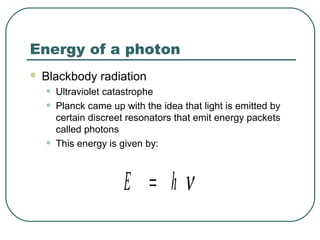
• Planck came up with the idea that light is emitted by
certain discreet resonators that emit energy packets
called photons
• This energy is given by:
E h= ν
Photoelectric Effect Schematic
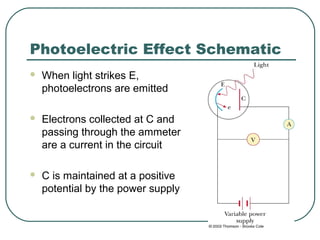
 When light strikes E,
photoelectrons are emitted
 Electrons collected at C and
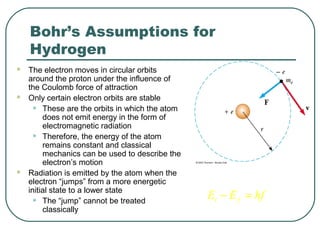
passing through the ammeter
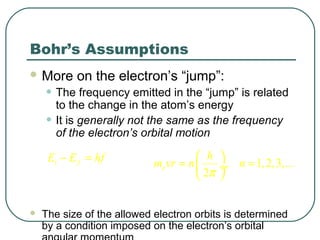
are a current in the circuit
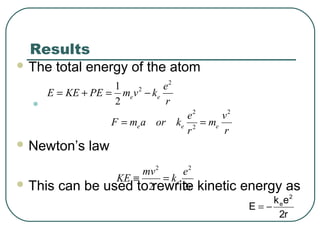
 C is maintained at a positive
potential by the power supply
Photoelectric Current/Voltage
Graph
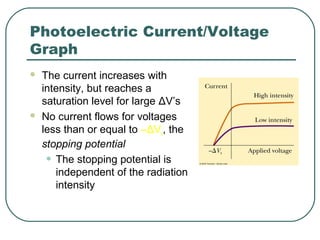
 The current increases with
intensity, but reaches a
saturation level for large ΔV’s
 No current flows for voltages
less than or equal to –ΔVs, the
stopping potential
• The stopping potential is
independent of the radiation
intensity
Features Not Explained by
Classical Physics/Wave Theory
 No electrons are emitted if the incident light
frequency is below some cutoff frequency that is
characteristic of the material being illuminated
 The maximum kinetic energy of the photoelectrons is
independent of the light intensity
 The maximum kinetic energy of the photoelectrons
increases with increasing light frequency
 Electrons are emitted from the surface almost
instantaneously, even at low intensities
Einstein’s Explanation
 A tiny packet of light energy, called a photon, would
be emitted when a quantized oscillator jumped from
one energy level to the next lower one
• Extended Planck’s idea of quantization to
electromagnetic radiation
 The photon’s energy would be E = hƒ
 Each photon can give all its energy to an electron in
the metal
 The maximum kinetic energy of the liberated
photoelectron is
KE = hƒ – Φ
Explanation of Classical
“Problems”
 The effect is not observed below a certain cutoff
frequency since the photon energy must be greater
than or equal to the work function
• Without this, electrons are not emitted, regardless
of the intensity of the light
 The maximum KE depends only on the frequency
and the work function, not on the intensity
 The maximum KE increases with increasing
frequency
 The effect is instantaneous since there is a one-to-
one interaction between the photon and the electron
Verification of Einstein’s Theory
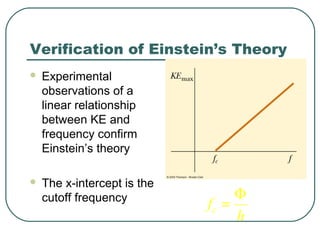
 Experimental
observations of a
linear relationship
between KE and
frequency confirm
Einstein’s theory
 The x-intercept is the
cutoff frequency
cf
h
Φ
=
27.4 X-Rays
 Electromagnetic radiation with short
wavelengths
• Wavelengths less than for ultraviolet
• Wavelengths are typically about 0.1 nm
• X-rays have the ability to penetrate most
materials with relative ease
 Discovered and named by Roentgen in
1895
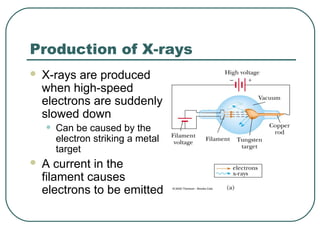
Production of X-rays
 X-rays are produced
when high-speed
electrons are suddenly
slowed down
• Can be caused by the
electron striking a metal
target
 A current in the
filament causes
electrons to be emitted
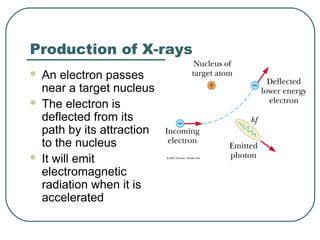
Production of X-rays
 An electron passes
near a target nucleus
 The electron is
deflected from its
path by its attraction
to the nucleus
 It will emit
electromagnetic
radiation when it is
accelerated
27.8 Photons and
Electromagnetic Waves
 Light has a dual nature. It exhibits both wave
and particle characteristics
• Applies to all electromagnetic radiation
 The photoelectric effect and Compton
scattering offer evidence for the particle nature
of light
• When light and matter interact, light behaves as if it
were composed of particles
 Interference and diffraction offer evidence of
the wave nature of light
28.9 Wave Properties of
Particles
 In 1924, Louis de Broglie postulated that because
photons have wave and particle characteristics,
perhaps all forms of matter have both properties
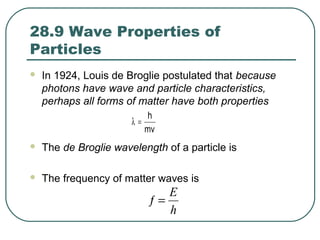
 The de Broglie wavelength of a particle is
 The frequency of matter waves is
mv
h
=λ
h
E
=ƒ
The Davisson-Germer
Experiment
 They scattered low-energy electrons from a
nickel target
 The wavelength of the electrons calculated
from the diffraction data agreed with the
expected de Broglie wavelength
 This confirmed the wave nature of electrons
 Other experimenters have confirmed the wave
nature of other particles
27.10 The Wave Function
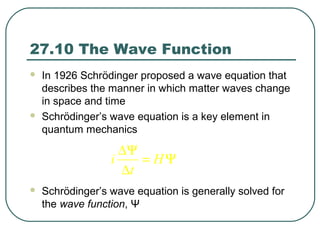
 In 1926 Schrödinger proposed a wave equation that
describes the manner in which matter waves change
in space and time
 Schrödinger’s wave equation is a key element in
quantum mechanics
 Schrödinger’s wave equation is generally solved for
the wave function, Ψ
i H
t
∆Ψ
= Ψ
∆
The Wave Function
 The wave function depends on the
particle’s position and the time
 The value of |Ψ|2
at some location at a
given time is proportional to the
probability of finding the particle at that
location at that time
27.11 The Uncertainty Principle
 When measurements are made, the
experimenter is always faced with
experimental uncertainties in the
measurements
• Classical mechanics offers no fundamental
barrier to ultimate refinements in
measurements
• Classical mechanics would allow for
measurements with arbitrarily small
uncertainties
The Uncertainty Principle
 Quantum mechanics predicts that a barrier to
measurements with ultimately small
uncertainties does exist
 In 1927 Heisenberg introduced the uncertainty
principle
• If a measurement of position of a particle is made
with precision Δx and a simultaneous measurement
of linear momentum is made with precision Δp, then
the product of the two uncertainties can never be
smaller than h/4π
The Uncertainty Principle
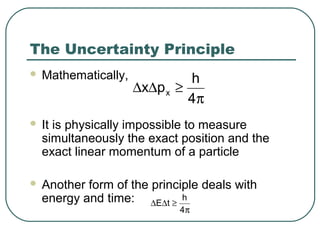
 Mathematically,
 It is physically impossible to measure
simultaneously the exact position and the
exact linear momentum of a particle
 Another form of the principle deals with
energy and time:
π
≥∆∆
4
h
px x
π
≥∆∆
4
h
tE
Early Models of the Atom
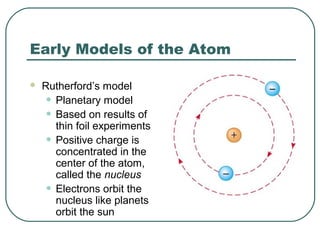
 Rutherford’s model
• Planetary model
• Based on results of
thin foil experiments
• Positive charge is
concentrated in the
center of the atom,
called the nucleus
• Electrons orbit the
nucleus like planets
orbit the sun
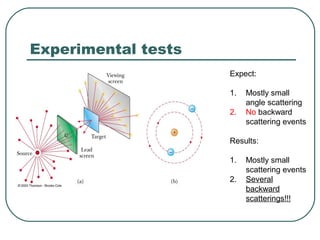
Experimental tests
Expect:
1. Mostly small
angle scattering
2. No backward
scattering events
Results:
1. Mostly small
scattering events
2. Several
backward
scatterings!!!
Difficulties with the Rutherford
Model
 Atoms emit certain discrete characteristic
frequencies of electromagnetic radiation
• The Rutherford model is unable to explain this
phenomena
 Rutherford’s electrons are undergoing a centripetal
acceleration and so should radiate electromagnetic
waves of the same frequency
• The radius should steadily decrease as this
radiation is given off
• The electron should eventually spiral into the
nucleus
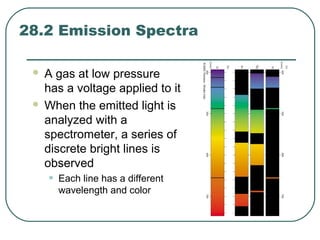
28.2 Emission Spectra
 A gas at low pressure
has a voltage applied to it
 When the emitted light is
analyzed with a
spectrometer, a series of
discrete bright lines is
observed
• Each line has a different
wavelength and color
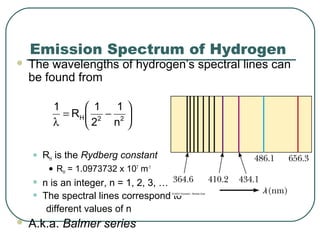
Emission Spectrum of Hydrogen
 The wavelengths of hydrogen’s spectral lines can
be found from
• RH is the Rydberg constant
• RH = 1.0973732 x 10⁷
m-1
• n is an integer, n = 1, 2, 3, …
• The spectral lines correspond to
different values of n
 A.k.a. Balmer series






−=
λ 22H
n
1
2
1
R
1
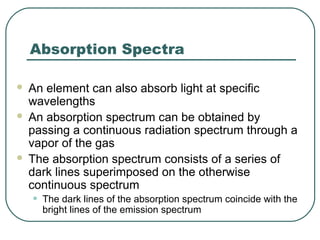
Absorption Spectra
 An element can also absorb light at specific
wavelengths
 An absorption spectrum can be obtained by
passing a continuous radiation spectrum through a
vapor of the gas
 The absorption spectrum consists of a series of
dark lines superimposed on the otherwise
continuous spectrum
• The dark lines of the absorption spectrum coincide with the
bright lines of the emission spectrum
28.3 The Bohr Theory of
Hydrogen
 In 1913 Bohr provided an explanation of
atomic spectra that includes some features of
the currently accepted theory
 His model includes both classical and non-
classical ideas
 His model included an attempt to explain why
the atom was stable
Bohr’s Assumptions for
Hydrogen
 The electron moves in circular orbits
around the proton under the influence of
the Coulomb force of attraction
 Only certain electron orbits are stable
• These are the orbits in which the atom
does not emit energy in the form of
electromagnetic radiation
• Therefore, the energy of the atom
remains constant and classical
mechanics can be used to describe the
electron’s motion
 Radiation is emitted by the atom when the
electron “jumps” from a more energetic
initial state to a lower state
• The “jump” cannot be treated
classically
i fE E hf− =
Bohr’s Assumptions
 More on the electron’s “jump”:
• The frequency emitted in the “jump” is related
to the change in the atom’s energy
• It is generally not the same as the frequency
of the electron’s orbital motion
 The size of the allowed electron orbits is determined
by a condition imposed on the electron’s orbital
i fE E hf− = , 1,2,3,...
2
e
h
m vr n n
π
 
= = ÷
 
Results
 The total energy of the atom
•
 Newton’s law
 This can be used to rewrite kinetic energy as
2
21
2
e e
e
E KE PE m v k
r
= + = −
r2
ek
E
2
e
−=
2 2
2e e e
e v
F m a or k m
r r
= =
2 2
2 2
e
mv e
KE k
r
≡ =
Bohr Radius
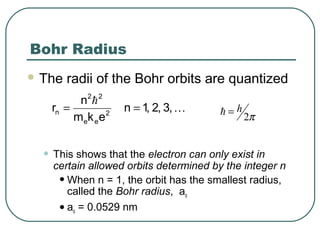
 The radii of the Bohr orbits are quantized
• This shows that the electron can only exist in
certain allowed orbits determined by the integer n
•When n = 1, the orbit has the smallest radius,
called the Bohr radius, ao
•ao = 0.0529 nm


,3,2,1n
ekm
n
r 2
ee
22
n ==
2
h
π=
Radii and Energy of Orbits
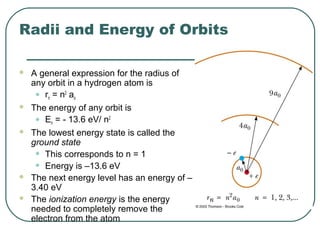
 A general expression for the radius of
any orbit in a hydrogen atom is
• rn = n2
ao
 The energy of any orbit is
• En = - 13.6 eV/ n2
 The lowest energy state is called the
ground state
• This corresponds to n = 1
• Energy is –13.6 eV
 The next energy level has an energy of –
3.40 eV
 The ionization energy is the energy
needed to completely remove the
electron from the atom
Energy Level Diagram
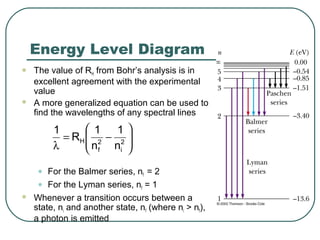
 The value of RH from Bohr’s analysis is in
excellent agreement with the experimental
value
 A more generalized equation can be used to
find the wavelengths of any spectral lines
• For the Balmer series, nf = 2
• For the Lyman series, nf = 1
 Whenever a transition occurs between a
state, ni and another state, nf (where ni > nf),
a photon is emitted






−=
λ 2
i
2
f
H
n
1
n
1
R
1
Quantum Number Summary
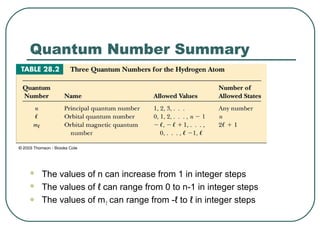
 The values of n can increase from 1 in integer steps
 The values of ℓ can range from 0 to n-1 in integer steps
 The values of mℓ can range from -ℓ to ℓ in integer steps
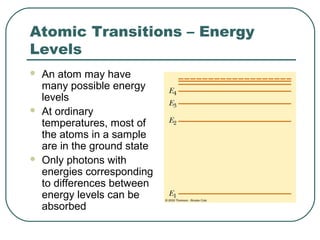
Atomic Transitions – Energy
Levels
 An atom may have
many possible energy
levels
 At ordinary
temperatures, most of
the atoms in a sample
are in the ground state
 Only photons with
energies corresponding
to differences between
energy levels can be
absorbed
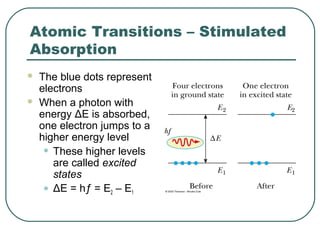
Atomic Transitions – Stimulated
Absorption
 The blue dots represent
electrons
 When a photon with
energy ΔE is absorbed,
one electron jumps to a
higher energy level
• These higher levels
are called excited
states
• ΔE = hƒ = E2 – E1
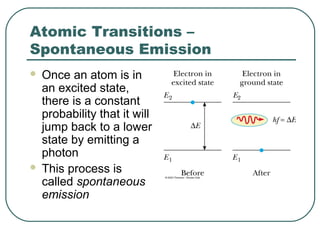
Atomic Transitions –
Spontaneous Emission
 Once an atom is in
an excited state,
there is a constant
probability that it will
jump back to a lower
state by emitting a
photon
 This process is
called spontaneous
emission
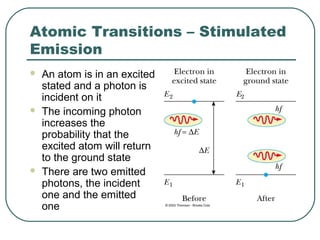
Atomic Transitions – Stimulated
Emission
 An atom is in an excited
stated and a photon is
incident on it
 The incoming photon
increases the
probability that the
excited atom will return
to the ground state
 There are two emitted
photons, the incident
one and the emitted
one
29.1 Some Properties of Nuclei
 All nuclei are composed of protons and neutrons
• Exception is ordinary hydrogen with just a proton
 The atomic number, Z, equals the number of
protons in the nucleus
 The neutron number, N, is the number of neutrons
in the nucleus
 The mass number, A, is the number of nucleons in
the nucleus
• A = Z + N
• Nucleon is a generic term used to refer to either a proton or
a neutron
• The mass number is not the same as the mass
Charge and mass
Charge:
 The electron has a single negative charge, -e (e = 1.60217733 x 10⁻¹⁹
C)
 The proton has a single positive charge, +e
• Thus, charge of a nucleus is equal to Ze
 The neutron has no charge
• Makes it difficult to detect
Mass:
 It is convenient to use atomic mass units, u, to express masses
• 1 u = 1.660559 x 10⁻²⁷
kg
 Mass can also be expressed in MeV/c2
• 1 u = 931.494 MeV/c2
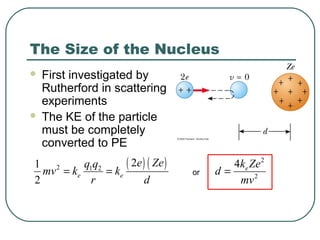
The Size of the Nucleus
 First investigated by
Rutherford in scattering
experiments
 The KE of the particle
must be completely
converted to PE
2
2
4 ek Ze
d
mv
=
( ) ( )2 1 2
21
2
e e
e Zeq q
mv k k
r d
= = or
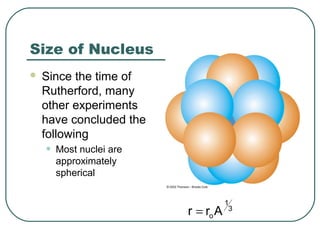
Size of Nucleus
 Since the time of
Rutherford, many
other experiments
have concluded the
following
• Most nuclei are
approximately
spherical
3
1
oArr =
Density of Nuclei
 The volume of the nucleus (assumed to be
spherical) is directly proportional to the total
number of nucleons
 This suggests that all nuclei have nearly the
same density
 Nucleons combine to form a nucleus as
though they were tightly packed spheres
Nuclear Stability
 There are very large repulsive electrostatic forces
between protons
• These forces should cause the nucleus to fly apart
 The nuclei are stable because of the presence of
another, short-range force, called the nuclear (or
strong) force
• This is an attractive force that acts between all nuclear
particles
• The nuclear attractive force is stronger than the Coulomb
repulsive force at the short ranges within the nucleus
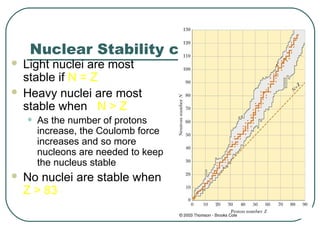
Nuclear Stability chart
 Light nuclei are most
stable if N = Z
 Heavy nuclei are most
stable when N > Z
• As the number of protons
increase, the Coulomb force
increases and so more
nucleons are needed to keep
the nucleus stable
 No nuclei are stable when
Z > 83
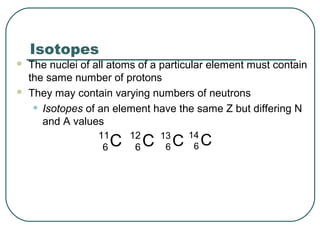
Isotopes
 The nuclei of all atoms of a particular element must contain
the same number of protons
 They may contain varying numbers of neutrons
• Isotopes of an element have the same Z but differing N
and A values
C11
6
C14
6C13
6C12
6
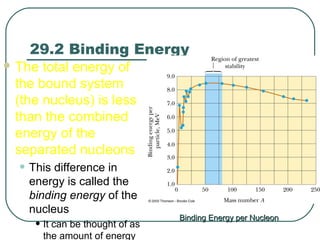
29.2 Binding Energy
 The total energy of
the bound system
(the nucleus) is less
than the combined
energy of the
separated nucleons
• This difference in
energy is called the
binding energy of the
nucleus
• It can be thought of as
the amount of energy
Binding Energy per NucleonBinding Energy per Nucleon
Binding Energy Notes
 Except for light nuclei, the binding energy is
about 8 MeV per nucleon
 The curve peaks in the vicinity of A = 60
• Nuclei with mass numbers greater than or less than 60
are not as strongly bound as those near the middle of
the periodic table
 The curve is slowly varying at A > 40
• This suggests that the nuclear force saturates
• A particular nucleon can interact with only a limited
number of other nucleons
29.3 Radioactivity
 Radioactivity is the spontaneous
emission of radiation
 Experiments suggested that radioactivity
was the result of the decay, or
disintegration, of unstable nuclei
 Three types of radiation can be emitted
• Alpha particles
• The particles are 4
He nuclei
• Beta particles
• The particles are either electrons or positrons
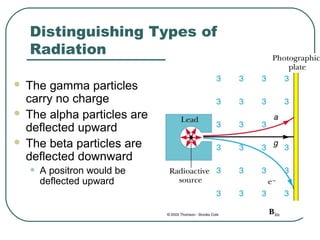
Distinguishing Types of
Radiation
 The gamma particles
carry no charge
 The alpha particles are
deflected upward
 The beta particles are
deflected downward
• A positron would be
deflected upward
Penetrating Ability of Particles
 Alpha particles
• Barely penetrate a piece of paper
 Beta particles
• Can penetrate a few mm of aluminum
 Gamma rays
• Can penetrate several cm of lead
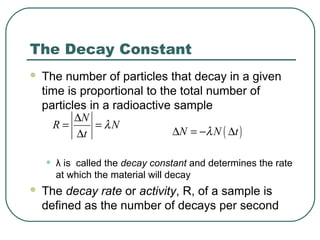
The Decay Constant
 The number of particles that decay in a given
time is proportional to the total number of
particles in a radioactive sample
• λ is called the decay constant and determines the rate
at which the material will decay
 The decay rate or activity, R, of a sample is
defined as the number of decays per second
N
R N
t
λ
∆
= =
∆ ( )N N tλ∆ = − ∆
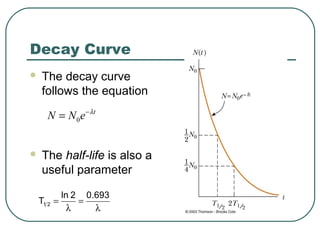
Decay Curve
 The decay curve
follows the equation
 The half-life is also a
useful parameter
λ
=
λ
=
693.02ln
T 21
0
t
N N e λ−
=
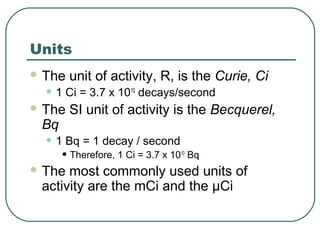
Units
 The unit of activity, R, is the Curie, Ci
• 1 Ci = 3.7 x 10¹⁰
decays/second
 The SI unit of activity is the Becquerel,
Bq
• 1 Bq = 1 decay / second
• Therefore, 1 Ci = 3.7 x 10¹⁰
Bq
 The most commonly used units of
activity are the mCi and the µCi
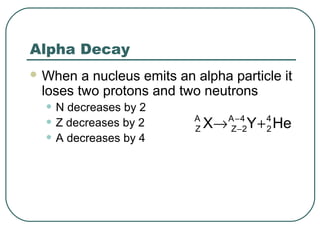
Alpha Decay
 When a nucleus emits an alpha particle it
loses two protons and two neutrons
• N decreases by 2
• Z decreases by 2
• A decreases by 4
HeYX 4
2
4A
2Z
A
Z +→ −
−
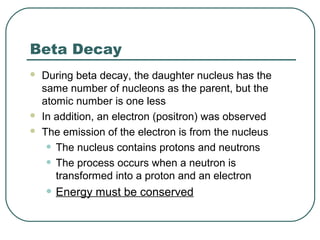
Beta Decay
 During beta decay, the daughter nucleus has the
same number of nucleons as the parent, but the
atomic number is one less
 In addition, an electron (positron) was observed
 The emission of the electron is from the nucleus
• The nucleus contains protons and neutrons
• The process occurs when a neutron is
transformed into a proton and an electron
• Energy must be conserved
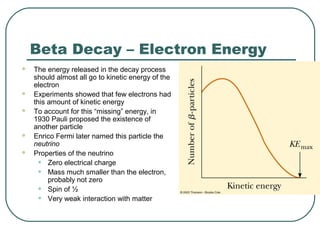
Beta Decay – Electron Energy
 The energy released in the decay process
should almost all go to kinetic energy of the
electron
 Experiments showed that few electrons had
this amount of kinetic energy
 To account for this “missing” energy, in
1930 Pauli proposed the existence of
another particle
 Enrico Fermi later named this particle the
neutrino
 Properties of the neutrino
• Zero electrical charge
• Mass much smaller than the electron,
probably not zero
• Spin of ½
• Very weak interaction with matter
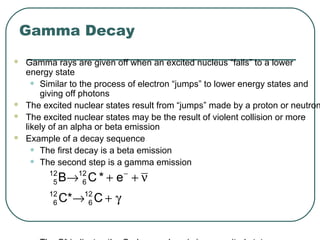
Gamma Decay
 Gamma rays are given off when an excited nucleus “falls” to a lower
energy state
• Similar to the process of electron “jumps” to lower energy states and
giving off photons
 The excited nuclear states result from “jumps” made by a proton or neutron
 The excited nuclear states may be the result of violent collision or more
likely of an alpha or beta emission
 Example of a decay sequence
• The first decay is a beta emission
• The second step is a gamma emission
γ+→
ν++→ −
C*C
e*CB
12
6
12
6
12
6
12
5

ap-physics-b-review-modern-physics

  • 1.
    AP Phys B TestReview Modern Physics 5/9/2008
  • 2.
    Overview  Basics  PhotoelectricEffect  Bohr Model of the atom • Energy Transitions  Nuclear Physics
  • 3.
    Basics  Quantization: theidea that light and matter come in discreet, indivisible packets • Wave-particle duality in light and matter • Matter behaves both as a wave and as a particle.
  • 4.
    Energy of aphoton  Blackbody radiation • Ultraviolet catastrophe • Planck came up with the idea that light is emitted by certain discreet resonators that emit energy packets called photons • This energy is given by: E h= ν
  • 5.
    Photoelectric Effect Schematic When light strikes E, photoelectrons are emitted  Electrons collected at C and passing through the ammeter are a current in the circuit  C is maintained at a positive potential by the power supply
  • 6.
    Photoelectric Current/Voltage Graph  Thecurrent increases with intensity, but reaches a saturation level for large ΔV’s  No current flows for voltages less than or equal to –ΔVs, the stopping potential • The stopping potential is independent of the radiation intensity
  • 7.
    Features Not Explainedby Classical Physics/Wave Theory  No electrons are emitted if the incident light frequency is below some cutoff frequency that is characteristic of the material being illuminated  The maximum kinetic energy of the photoelectrons is independent of the light intensity  The maximum kinetic energy of the photoelectrons increases with increasing light frequency  Electrons are emitted from the surface almost instantaneously, even at low intensities
  • 8.
    Einstein’s Explanation  Atiny packet of light energy, called a photon, would be emitted when a quantized oscillator jumped from one energy level to the next lower one • Extended Planck’s idea of quantization to electromagnetic radiation  The photon’s energy would be E = hƒ  Each photon can give all its energy to an electron in the metal  The maximum kinetic energy of the liberated photoelectron is KE = hƒ – Φ
  • 9.
    Explanation of Classical “Problems” The effect is not observed below a certain cutoff frequency since the photon energy must be greater than or equal to the work function • Without this, electrons are not emitted, regardless of the intensity of the light  The maximum KE depends only on the frequency and the work function, not on the intensity  The maximum KE increases with increasing frequency  The effect is instantaneous since there is a one-to- one interaction between the photon and the electron
  • 10.
    Verification of Einstein’sTheory  Experimental observations of a linear relationship between KE and frequency confirm Einstein’s theory  The x-intercept is the cutoff frequency cf h Φ =
  • 11.
    27.4 X-Rays  Electromagneticradiation with short wavelengths • Wavelengths less than for ultraviolet • Wavelengths are typically about 0.1 nm • X-rays have the ability to penetrate most materials with relative ease  Discovered and named by Roentgen in 1895
  • 12.
    Production of X-rays X-rays are produced when high-speed electrons are suddenly slowed down • Can be caused by the electron striking a metal target  A current in the filament causes electrons to be emitted
  • 13.
    Production of X-rays An electron passes near a target nucleus  The electron is deflected from its path by its attraction to the nucleus  It will emit electromagnetic radiation when it is accelerated
  • 14.
    27.8 Photons and ElectromagneticWaves  Light has a dual nature. It exhibits both wave and particle characteristics • Applies to all electromagnetic radiation  The photoelectric effect and Compton scattering offer evidence for the particle nature of light • When light and matter interact, light behaves as if it were composed of particles  Interference and diffraction offer evidence of the wave nature of light
  • 15.
    28.9 Wave Propertiesof Particles  In 1924, Louis de Broglie postulated that because photons have wave and particle characteristics, perhaps all forms of matter have both properties  The de Broglie wavelength of a particle is  The frequency of matter waves is mv h =λ h E =ƒ
  • 16.
    The Davisson-Germer Experiment  Theyscattered low-energy electrons from a nickel target  The wavelength of the electrons calculated from the diffraction data agreed with the expected de Broglie wavelength  This confirmed the wave nature of electrons  Other experimenters have confirmed the wave nature of other particles
  • 17.
    27.10 The WaveFunction  In 1926 Schrödinger proposed a wave equation that describes the manner in which matter waves change in space and time  Schrödinger’s wave equation is a key element in quantum mechanics  Schrödinger’s wave equation is generally solved for the wave function, Ψ i H t ∆Ψ = Ψ ∆
  • 18.
    The Wave Function The wave function depends on the particle’s position and the time  The value of |Ψ|2 at some location at a given time is proportional to the probability of finding the particle at that location at that time
  • 19.
    27.11 The UncertaintyPrinciple  When measurements are made, the experimenter is always faced with experimental uncertainties in the measurements • Classical mechanics offers no fundamental barrier to ultimate refinements in measurements • Classical mechanics would allow for measurements with arbitrarily small uncertainties
  • 20.
    The Uncertainty Principle Quantum mechanics predicts that a barrier to measurements with ultimately small uncertainties does exist  In 1927 Heisenberg introduced the uncertainty principle • If a measurement of position of a particle is made with precision Δx and a simultaneous measurement of linear momentum is made with precision Δp, then the product of the two uncertainties can never be smaller than h/4π
  • 21.
    The Uncertainty Principle Mathematically,  It is physically impossible to measure simultaneously the exact position and the exact linear momentum of a particle  Another form of the principle deals with energy and time: π ≥∆∆ 4 h px x π ≥∆∆ 4 h tE
  • 22.
    Early Models ofthe Atom  Rutherford’s model • Planetary model • Based on results of thin foil experiments • Positive charge is concentrated in the center of the atom, called the nucleus • Electrons orbit the nucleus like planets orbit the sun
  • 23.
    Experimental tests Expect: 1. Mostlysmall angle scattering 2. No backward scattering events Results: 1. Mostly small scattering events 2. Several backward scatterings!!!
  • 24.
    Difficulties with theRutherford Model  Atoms emit certain discrete characteristic frequencies of electromagnetic radiation • The Rutherford model is unable to explain this phenomena  Rutherford’s electrons are undergoing a centripetal acceleration and so should radiate electromagnetic waves of the same frequency • The radius should steadily decrease as this radiation is given off • The electron should eventually spiral into the nucleus
  • 25.
    28.2 Emission Spectra A gas at low pressure has a voltage applied to it  When the emitted light is analyzed with a spectrometer, a series of discrete bright lines is observed • Each line has a different wavelength and color
  • 26.
    Emission Spectrum ofHydrogen  The wavelengths of hydrogen’s spectral lines can be found from • RH is the Rydberg constant • RH = 1.0973732 x 10⁷ m-1 • n is an integer, n = 1, 2, 3, … • The spectral lines correspond to different values of n  A.k.a. Balmer series       −= λ 22H n 1 2 1 R 1
  • 27.
    Absorption Spectra  Anelement can also absorb light at specific wavelengths  An absorption spectrum can be obtained by passing a continuous radiation spectrum through a vapor of the gas  The absorption spectrum consists of a series of dark lines superimposed on the otherwise continuous spectrum • The dark lines of the absorption spectrum coincide with the bright lines of the emission spectrum
  • 28.
    28.3 The BohrTheory of Hydrogen  In 1913 Bohr provided an explanation of atomic spectra that includes some features of the currently accepted theory  His model includes both classical and non- classical ideas  His model included an attempt to explain why the atom was stable
  • 29.
    Bohr’s Assumptions for Hydrogen The electron moves in circular orbits around the proton under the influence of the Coulomb force of attraction  Only certain electron orbits are stable • These are the orbits in which the atom does not emit energy in the form of electromagnetic radiation • Therefore, the energy of the atom remains constant and classical mechanics can be used to describe the electron’s motion  Radiation is emitted by the atom when the electron “jumps” from a more energetic initial state to a lower state • The “jump” cannot be treated classically i fE E hf− =
  • 30.
    Bohr’s Assumptions  Moreon the electron’s “jump”: • The frequency emitted in the “jump” is related to the change in the atom’s energy • It is generally not the same as the frequency of the electron’s orbital motion  The size of the allowed electron orbits is determined by a condition imposed on the electron’s orbital i fE E hf− = , 1,2,3,... 2 e h m vr n n π   = = ÷  
  • 31.
    Results  The totalenergy of the atom •  Newton’s law  This can be used to rewrite kinetic energy as 2 21 2 e e e E KE PE m v k r = + = − r2 ek E 2 e −= 2 2 2e e e e v F m a or k m r r = = 2 2 2 2 e mv e KE k r ≡ =
  • 32.
    Bohr Radius  Theradii of the Bohr orbits are quantized • This shows that the electron can only exist in certain allowed orbits determined by the integer n •When n = 1, the orbit has the smallest radius, called the Bohr radius, ao •ao = 0.0529 nm   ,3,2,1n ekm n r 2 ee 22 n == 2 h π=
  • 33.
    Radii and Energyof Orbits  A general expression for the radius of any orbit in a hydrogen atom is • rn = n2 ao  The energy of any orbit is • En = - 13.6 eV/ n2  The lowest energy state is called the ground state • This corresponds to n = 1 • Energy is –13.6 eV  The next energy level has an energy of – 3.40 eV  The ionization energy is the energy needed to completely remove the electron from the atom
  • 34.
    Energy Level Diagram The value of RH from Bohr’s analysis is in excellent agreement with the experimental value  A more generalized equation can be used to find the wavelengths of any spectral lines • For the Balmer series, nf = 2 • For the Lyman series, nf = 1  Whenever a transition occurs between a state, ni and another state, nf (where ni > nf), a photon is emitted       −= λ 2 i 2 f H n 1 n 1 R 1
  • 35.
    Quantum Number Summary The values of n can increase from 1 in integer steps  The values of ℓ can range from 0 to n-1 in integer steps  The values of mℓ can range from -ℓ to ℓ in integer steps
  • 36.
    Atomic Transitions –Energy Levels  An atom may have many possible energy levels  At ordinary temperatures, most of the atoms in a sample are in the ground state  Only photons with energies corresponding to differences between energy levels can be absorbed
  • 37.
    Atomic Transitions –Stimulated Absorption  The blue dots represent electrons  When a photon with energy ΔE is absorbed, one electron jumps to a higher energy level • These higher levels are called excited states • ΔE = hƒ = E2 – E1
  • 38.
    Atomic Transitions – SpontaneousEmission  Once an atom is in an excited state, there is a constant probability that it will jump back to a lower state by emitting a photon  This process is called spontaneous emission
  • 39.
    Atomic Transitions –Stimulated Emission  An atom is in an excited stated and a photon is incident on it  The incoming photon increases the probability that the excited atom will return to the ground state  There are two emitted photons, the incident one and the emitted one
  • 40.
    29.1 Some Propertiesof Nuclei  All nuclei are composed of protons and neutrons • Exception is ordinary hydrogen with just a proton  The atomic number, Z, equals the number of protons in the nucleus  The neutron number, N, is the number of neutrons in the nucleus  The mass number, A, is the number of nucleons in the nucleus • A = Z + N • Nucleon is a generic term used to refer to either a proton or a neutron • The mass number is not the same as the mass
  • 41.
    Charge and mass Charge: The electron has a single negative charge, -e (e = 1.60217733 x 10⁻¹⁹ C)  The proton has a single positive charge, +e • Thus, charge of a nucleus is equal to Ze  The neutron has no charge • Makes it difficult to detect Mass:  It is convenient to use atomic mass units, u, to express masses • 1 u = 1.660559 x 10⁻²⁷ kg  Mass can also be expressed in MeV/c2 • 1 u = 931.494 MeV/c2
  • 42.
    The Size ofthe Nucleus  First investigated by Rutherford in scattering experiments  The KE of the particle must be completely converted to PE 2 2 4 ek Ze d mv = ( ) ( )2 1 2 21 2 e e e Zeq q mv k k r d = = or
  • 43.
    Size of Nucleus Since the time of Rutherford, many other experiments have concluded the following • Most nuclei are approximately spherical 3 1 oArr =
  • 44.
    Density of Nuclei The volume of the nucleus (assumed to be spherical) is directly proportional to the total number of nucleons  This suggests that all nuclei have nearly the same density  Nucleons combine to form a nucleus as though they were tightly packed spheres
  • 45.
    Nuclear Stability  Thereare very large repulsive electrostatic forces between protons • These forces should cause the nucleus to fly apart  The nuclei are stable because of the presence of another, short-range force, called the nuclear (or strong) force • This is an attractive force that acts between all nuclear particles • The nuclear attractive force is stronger than the Coulomb repulsive force at the short ranges within the nucleus
  • 46.
    Nuclear Stability chart Light nuclei are most stable if N = Z  Heavy nuclei are most stable when N > Z • As the number of protons increase, the Coulomb force increases and so more nucleons are needed to keep the nucleus stable  No nuclei are stable when Z > 83
  • 47.
    Isotopes  The nucleiof all atoms of a particular element must contain the same number of protons  They may contain varying numbers of neutrons • Isotopes of an element have the same Z but differing N and A values C11 6 C14 6C13 6C12 6
  • 48.
    29.2 Binding Energy The total energy of the bound system (the nucleus) is less than the combined energy of the separated nucleons • This difference in energy is called the binding energy of the nucleus • It can be thought of as the amount of energy Binding Energy per NucleonBinding Energy per Nucleon
  • 49.
    Binding Energy Notes Except for light nuclei, the binding energy is about 8 MeV per nucleon  The curve peaks in the vicinity of A = 60 • Nuclei with mass numbers greater than or less than 60 are not as strongly bound as those near the middle of the periodic table  The curve is slowly varying at A > 40 • This suggests that the nuclear force saturates • A particular nucleon can interact with only a limited number of other nucleons
  • 50.
    29.3 Radioactivity  Radioactivityis the spontaneous emission of radiation  Experiments suggested that radioactivity was the result of the decay, or disintegration, of unstable nuclei  Three types of radiation can be emitted • Alpha particles • The particles are 4 He nuclei • Beta particles • The particles are either electrons or positrons
  • 51.
    Distinguishing Types of Radiation The gamma particles carry no charge  The alpha particles are deflected upward  The beta particles are deflected downward • A positron would be deflected upward
  • 52.
    Penetrating Ability ofParticles  Alpha particles • Barely penetrate a piece of paper  Beta particles • Can penetrate a few mm of aluminum  Gamma rays • Can penetrate several cm of lead
  • 53.
    The Decay Constant The number of particles that decay in a given time is proportional to the total number of particles in a radioactive sample • λ is called the decay constant and determines the rate at which the material will decay  The decay rate or activity, R, of a sample is defined as the number of decays per second N R N t λ ∆ = = ∆ ( )N N tλ∆ = − ∆
  • 54.
    Decay Curve  Thedecay curve follows the equation  The half-life is also a useful parameter λ = λ = 693.02ln T 21 0 t N N e λ− =
  • 55.
    Units  The unitof activity, R, is the Curie, Ci • 1 Ci = 3.7 x 10¹⁰ decays/second  The SI unit of activity is the Becquerel, Bq • 1 Bq = 1 decay / second • Therefore, 1 Ci = 3.7 x 10¹⁰ Bq  The most commonly used units of activity are the mCi and the µCi
  • 56.
    Alpha Decay  Whena nucleus emits an alpha particle it loses two protons and two neutrons • N decreases by 2 • Z decreases by 2 • A decreases by 4 HeYX 4 2 4A 2Z A Z +→ − −
  • 57.
    Beta Decay  Duringbeta decay, the daughter nucleus has the same number of nucleons as the parent, but the atomic number is one less  In addition, an electron (positron) was observed  The emission of the electron is from the nucleus • The nucleus contains protons and neutrons • The process occurs when a neutron is transformed into a proton and an electron • Energy must be conserved
  • 58.
    Beta Decay –Electron Energy  The energy released in the decay process should almost all go to kinetic energy of the electron  Experiments showed that few electrons had this amount of kinetic energy  To account for this “missing” energy, in 1930 Pauli proposed the existence of another particle  Enrico Fermi later named this particle the neutrino  Properties of the neutrino • Zero electrical charge • Mass much smaller than the electron, probably not zero • Spin of ½ • Very weak interaction with matter
  • 59.
    Gamma Decay  Gammarays are given off when an excited nucleus “falls” to a lower energy state • Similar to the process of electron “jumps” to lower energy states and giving off photons  The excited nuclear states result from “jumps” made by a proton or neutron  The excited nuclear states may be the result of violent collision or more likely of an alpha or beta emission  Example of a decay sequence • The first decay is a beta emission • The second step is a gamma emission γ+→ ν++→ − C*C e*CB 12 6 12 6 12 6 12 5