Atomic Structure
The atom Def: the smallest particle of an element that retains its identity in a chemical reaction. Atoms are tiny!  If you lined up 100,000,000 copper atoms side by side,  they would produce a line only 1 cm long.
Initial Thoughts Democritus – atoms are indivisible and indestructible Dalton modified this theory through research.  He determined that: 1.elements are composed of tiny indivisible particles called atoms 2.atoms of the same element are identical 3.atoms can combine to form compounds 4.chemical reactions occur when atoms are separated from their compounds Thompson was the first to discover that atoms contain subatomic particles
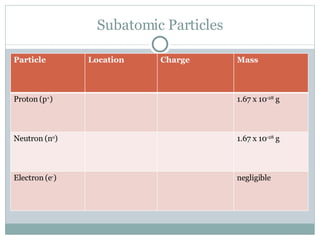
Subatomic Particles Particle Location Charge Mass Proton (p + ) 1.67 x 10 -28  g Neutron (n o ) 1.67 x 10 -28  g Electron (e - ) negligible
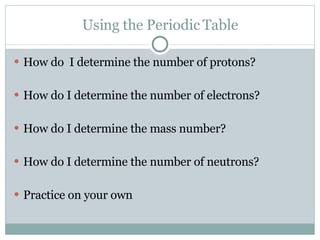
Using the Periodic Table How do  I determine the number of protons? How do I determine the number of electrons? How do I determine the mass number? How do I determine the number of neutrons? Practice on your own
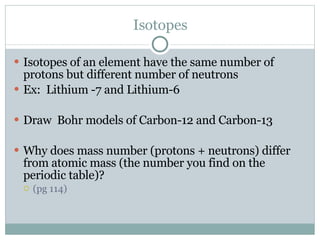
Isotopes Isotopes of an element have the same number of protons but different number of neutrons Ex:  Lithium -7 and Lithium-6 Draw  Bohr models of Carbon-12 and Carbon-13 Why does mass number (protons + neutrons) differ from atomic mass (the number you find on the periodic table)? (pg 114)
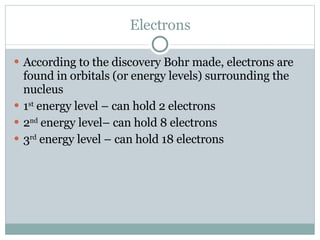
Electrons According to the discovery Bohr made, electrons are found in orbitals (or energy levels) surrounding the nucleus 1 st  energy level – can hold 2 electrons 2 nd  energy level– can hold 8 electrons 3 rd  energy level – can hold 18 electrons
Valence Electrons The number of valence electrons can be determined by looking at the Roman Numeral at the top of each group (or family) or the periodic table. The number of valence electrons can give us hints about the reactivity of that element Metals lose valence electrons to form cations Non-metals gain valence electrons to form anions Pg 162
Rutherford’s Gold Foil Experiment Proposed that: the atom is mostly empty space the nucleus is concentrated in the center of the atom Think of a dime in the middle of football field Demo 1
In-class assessment You have the next 2o-25 minutes to complete an open notebook quiz.
HW Section 4.1  review worksheet – due Thursday Section 4.2 review worksheet – due Friday

Atomic Structure

  • 1.
  • 2.
    The atom Def:the smallest particle of an element that retains its identity in a chemical reaction. Atoms are tiny! If you lined up 100,000,000 copper atoms side by side, they would produce a line only 1 cm long.
  • 3.
    Initial Thoughts Democritus– atoms are indivisible and indestructible Dalton modified this theory through research. He determined that: 1.elements are composed of tiny indivisible particles called atoms 2.atoms of the same element are identical 3.atoms can combine to form compounds 4.chemical reactions occur when atoms are separated from their compounds Thompson was the first to discover that atoms contain subatomic particles
  • 4.
    Subatomic Particles ParticleLocation Charge Mass Proton (p + ) 1.67 x 10 -28 g Neutron (n o ) 1.67 x 10 -28 g Electron (e - ) negligible
  • 5.
    Using the PeriodicTable How do I determine the number of protons? How do I determine the number of electrons? How do I determine the mass number? How do I determine the number of neutrons? Practice on your own
  • 6.
    Isotopes Isotopes ofan element have the same number of protons but different number of neutrons Ex: Lithium -7 and Lithium-6 Draw Bohr models of Carbon-12 and Carbon-13 Why does mass number (protons + neutrons) differ from atomic mass (the number you find on the periodic table)? (pg 114)
  • 7.
    Electrons According tothe discovery Bohr made, electrons are found in orbitals (or energy levels) surrounding the nucleus 1 st energy level – can hold 2 electrons 2 nd energy level– can hold 8 electrons 3 rd energy level – can hold 18 electrons
  • 8.
    Valence Electrons Thenumber of valence electrons can be determined by looking at the Roman Numeral at the top of each group (or family) or the periodic table. The number of valence electrons can give us hints about the reactivity of that element Metals lose valence electrons to form cations Non-metals gain valence electrons to form anions Pg 162
  • 9.
    Rutherford’s Gold FoilExperiment Proposed that: the atom is mostly empty space the nucleus is concentrated in the center of the atom Think of a dime in the middle of football field Demo 1
  • 10.
    In-class assessment Youhave the next 2o-25 minutes to complete an open notebook quiz.
  • 11.
    HW Section 4.1 review worksheet – due Thursday Section 4.2 review worksheet – due Friday