
STRUCTURE OF  ATOM
OutlineWhat is Atom ?The Structure of AtomThomson’s ModelRutherford’s ModelBohr’s Model of AtomValencyAtomic Number & Mass Number
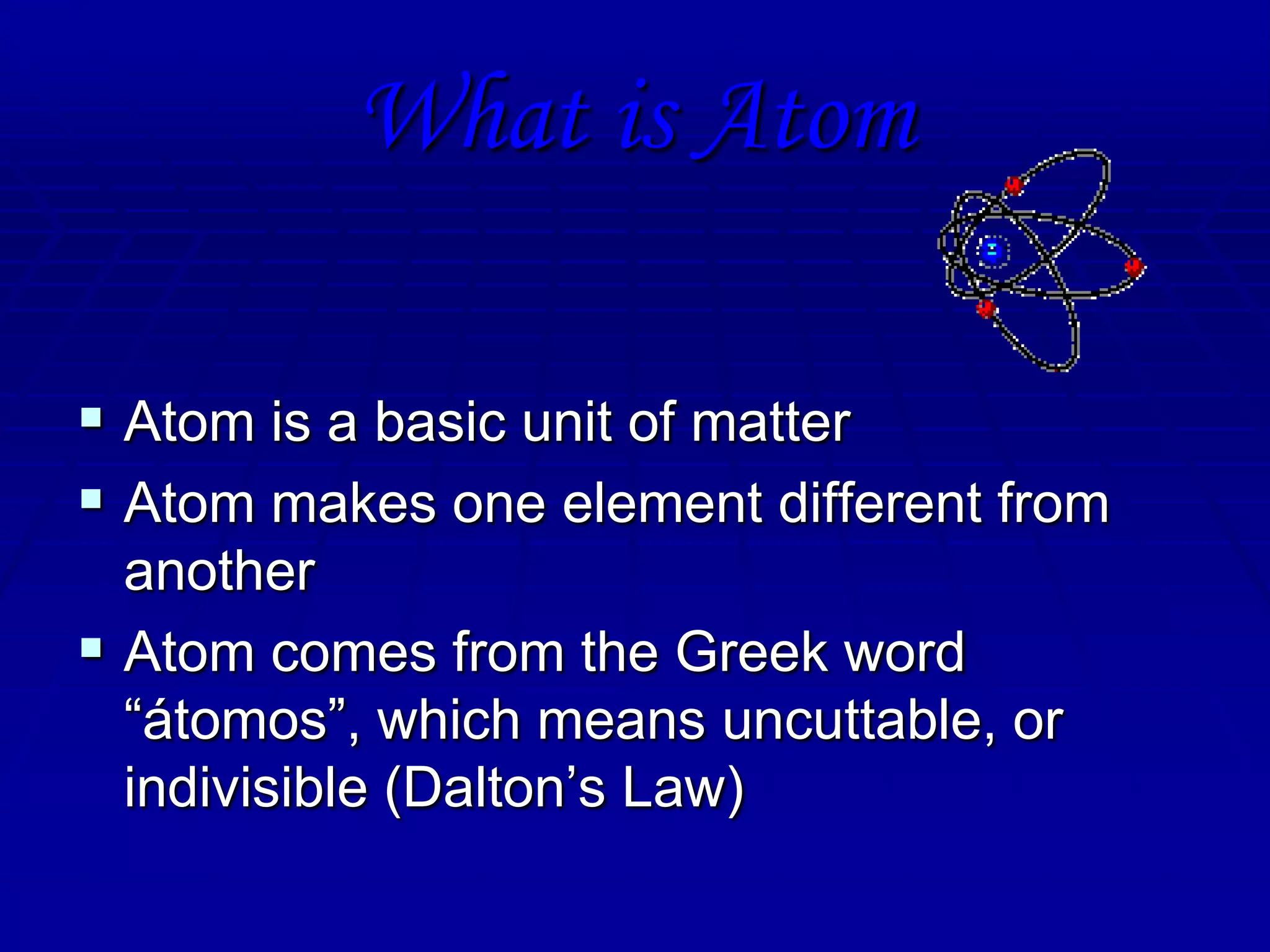
What is AtomAtom is a basic unit of matterAtom makes one element different from anotherAtom comes from the Greek word “átomos”, which means uncuttable, or indivisible (Dalton’s Law)
Structure of AtomDiscovery of two fundamental particles –Electrons & ProtonsProtons   – Positively Charged ionsElectrons – Negatively Charged ionsFailure of Dalton’s atomic theory (Atom’s are indivisible)Three models for structure of Atom
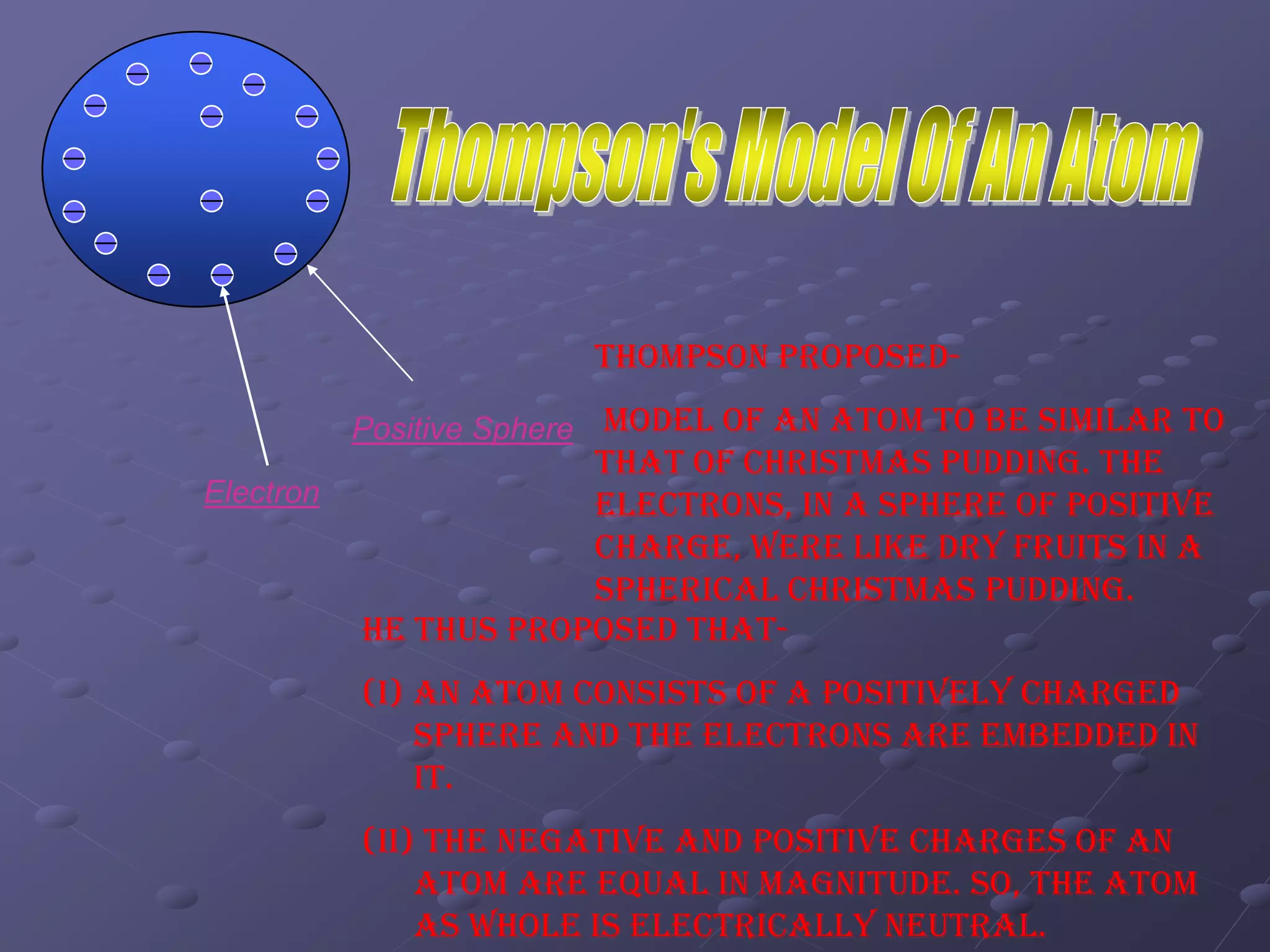
Thompson's Model Of An AtomThompson proposed- Model of an atom to be similar to that of Christmas pudding. The electrons, in a sphere of positive charge, were like dry fruits in a spherical Christmas pudding.Positive SphereElectronHe thus proposed that-(i) An atom consists of a positively charged sphere and the electrons are embedded in it.(ii) The negative and positive charges of an atom are equal in magnitude. So, the atom as whole is electrically neutral.
Rutherford's Model of an Atom Observation:Conclusion:Experiment:  Rutherford selected a gold foil as thinner layer as possible (nearly about 1000 Atoms thick)He selected Alpha particles which are doubly charged HELIUM  ion.It was expected that Alpha particles could be deflected by the sub-atomic particles in the gold atoms, as alpha particles were much heavier than proton. He did not expected to see a large deflection.Most of the space inside the atom is empty because most of the alpha particles passed through without getting deflected.Very few particles were deflected from their path indicating that positive charge of the atom occupies very little space.There is positively charged centre in an atom called nucleus in well define orbits.  The size of the nucleus is very small as compare to size of atoms.Most of the fast moving alpha particles past straight through the gold foil.Some of the alpha particles were deflected by the foil by small angles.Surprisingly 1 out of every 12000 particles appear to rebound. The gold foil experiment was conducted under the supervision of Rutherford at the University of Manchester in 1909 by scientist Hans Geiger and undergraduate student Ernest Marsden. Rutherford, chair of the Manchester physics department at the time of the experiment, is given primary credit for the experiment, as the theories that resulted are primarily his work. Rutherford's gold foil experiment is also sometimes referred to as the Geiger-Marsden experiment.
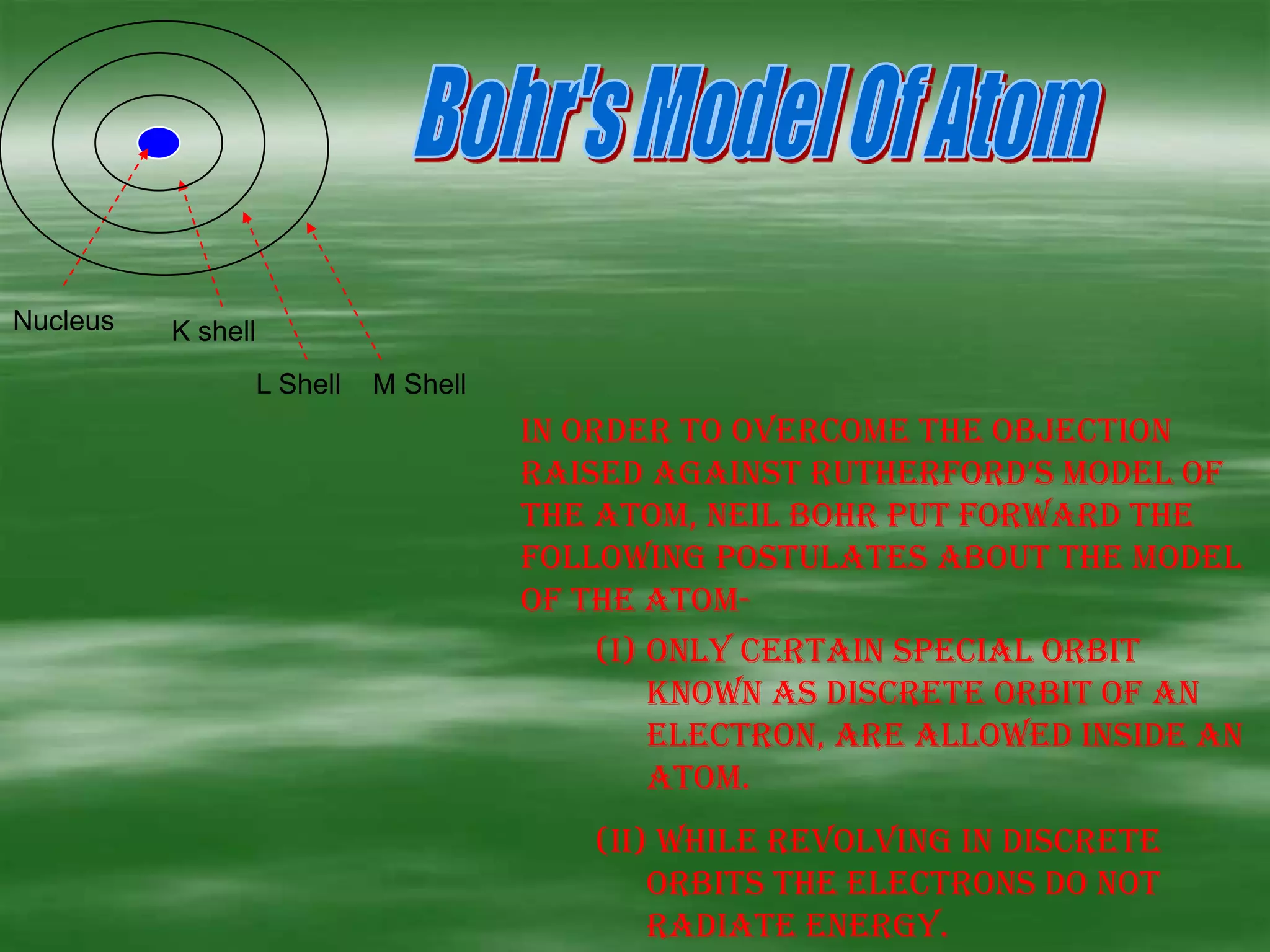
Bohr's Model Of AtomNucleusK shellL ShellM ShellIn order to overcome the objection raised against Rutherford’s model of  the atom, Neil Bohr put forward the following postulates about the model of the atom-  Only certain special orbit known as discrete orbit of an electron, are allowed inside an atom.(ii) While revolving in discrete orbits the electrons do not radiate energy.
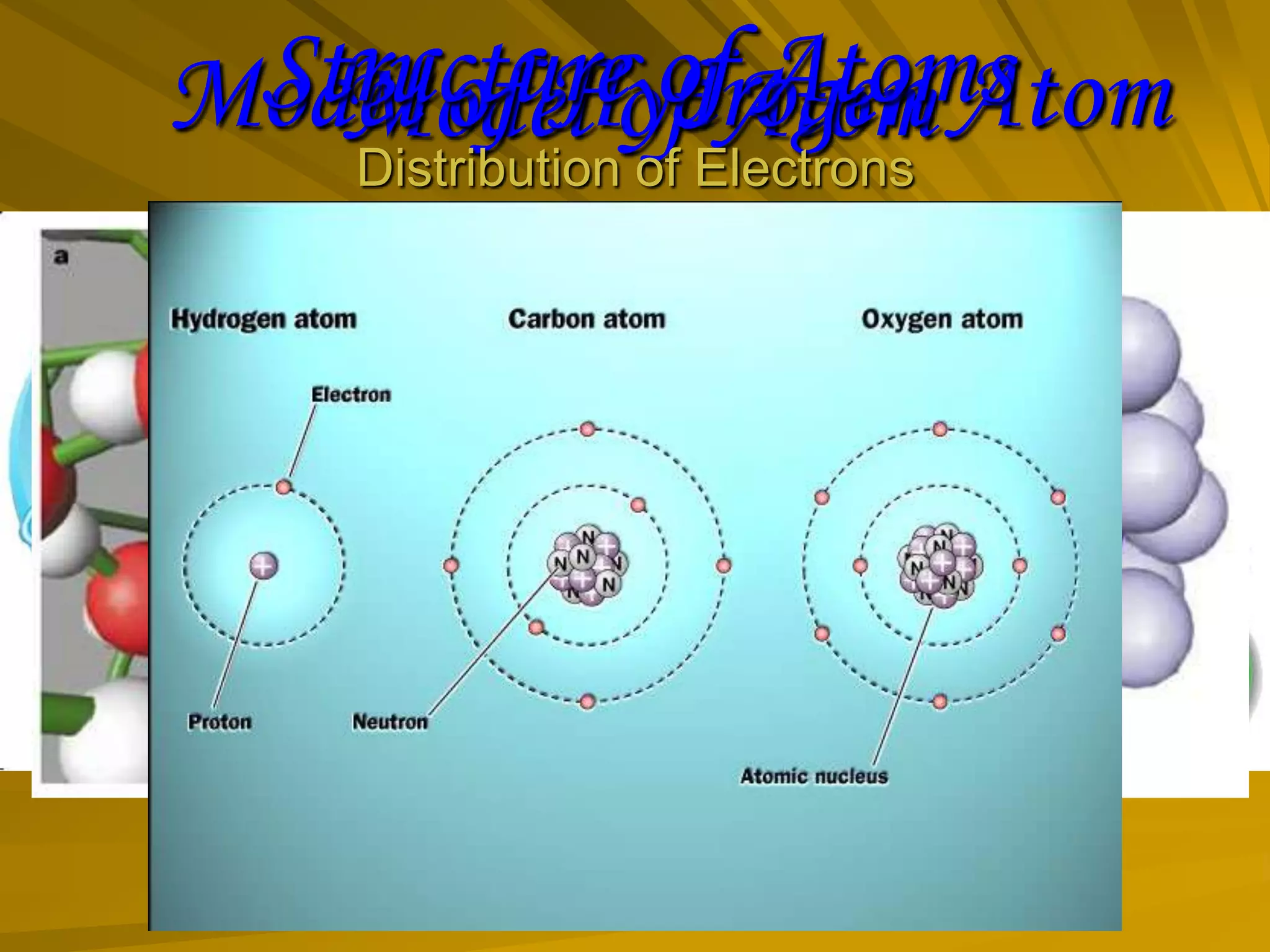
Model of Hydrogen AtomStructure of AtomsDistribution of ElectronsModel of Atom
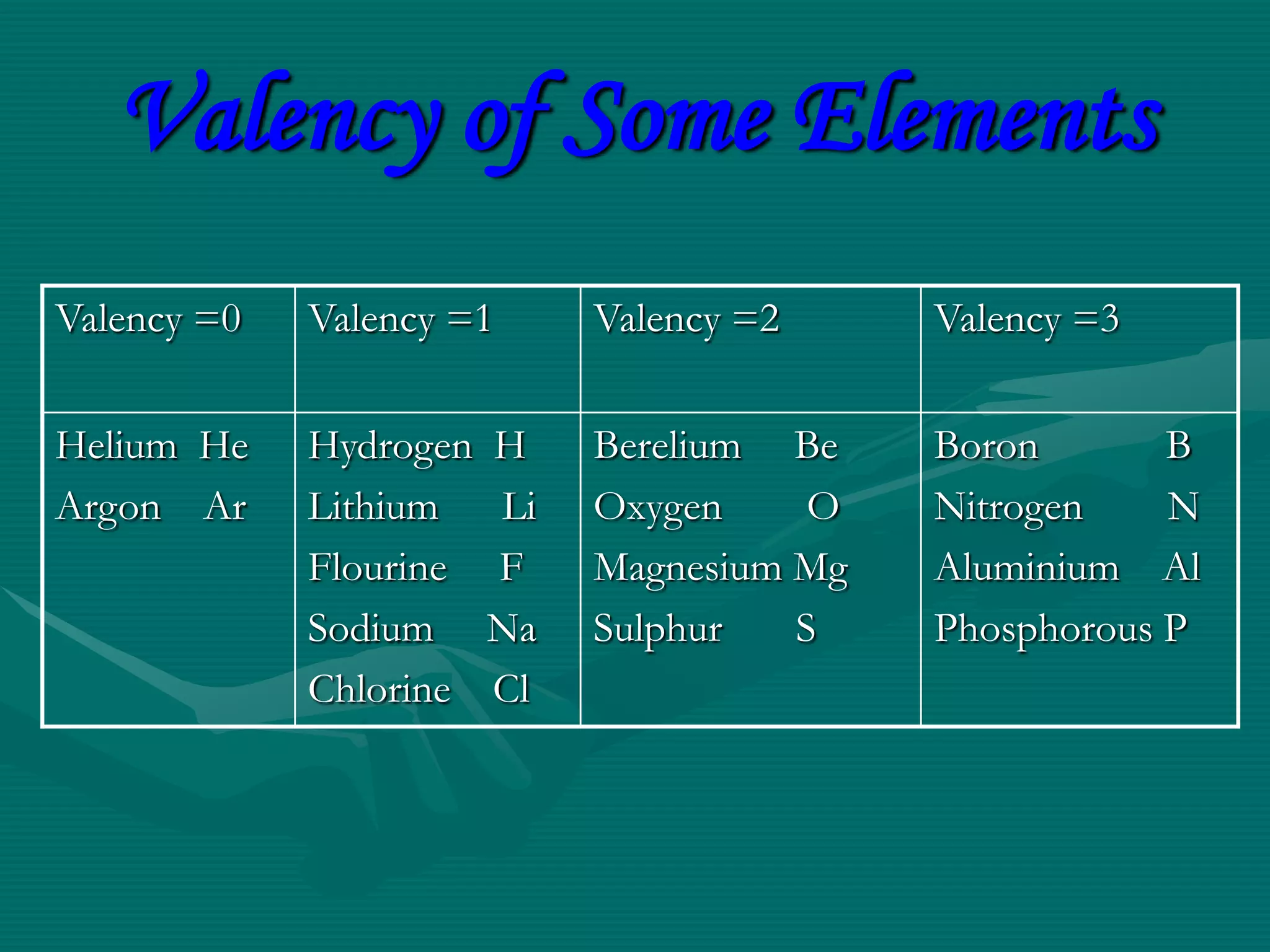
ValencyIs the Combining Capacity of an ElementDetermines how the atoms of one element combines with the atoms of another or same element to form a chemical compoundDepends on the how the electrons are arranged in the outermost shellBohr-Bury Scheme – Outermost shell of an atom can accommodate a max of 8 electronsIs either equal to the number of electrons in the outermost shell or number of electrons required to complete 8 electrons in the outermost shell
Valency of Some Elements
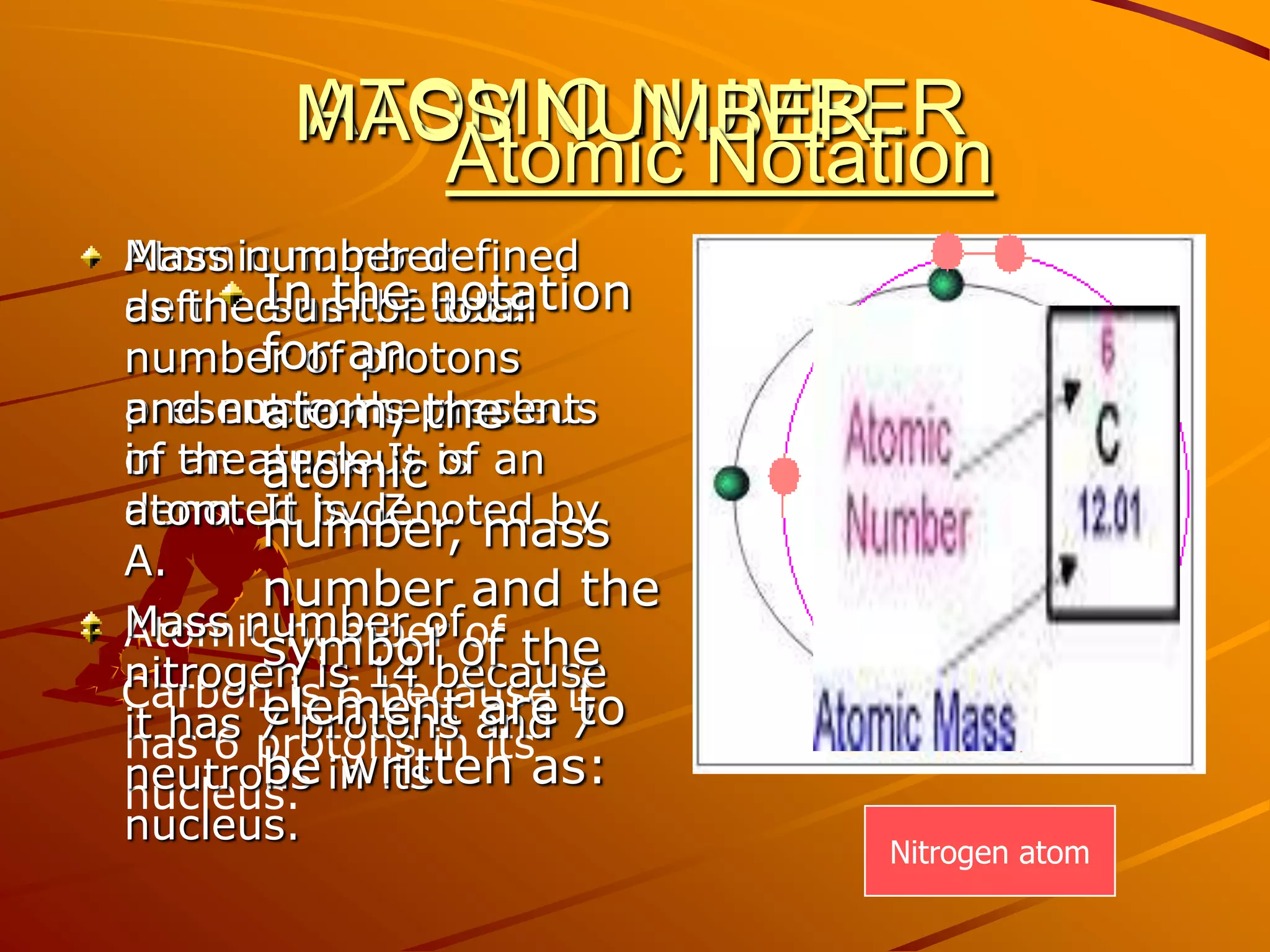
ATOMIC NUMBERAtomic number defined as the total number of protons present in the nucleus of an atom. It is denoted by Z.Atomic number of    Carbon is 6 because it has 6 protons in its nucleus.MASS NUMBERAtomic NotationMass number defined as the sum of total number of protons and nucleons present in the nucleus of an atom. It is denoted by A.Mass number of nitrogen is 14 because it has 7 protons and 7 neutrons in its nucleus.In the notation for an atom, the atomic number, mass number and the symbol of the element are to be written as:Nitrogen atom
THANK YOU

S T R U C T U R E O F A T O M

  • 1.
  • 2.
    OutlineWhat is Atom?The Structure of AtomThomson’s ModelRutherford’s ModelBohr’s Model of AtomValencyAtomic Number & Mass Number
  • 3.
    What is AtomAtomis a basic unit of matterAtom makes one element different from anotherAtom comes from the Greek word “átomos”, which means uncuttable, or indivisible (Dalton’s Law)
  • 4.
    Structure of AtomDiscoveryof two fundamental particles –Electrons & ProtonsProtons – Positively Charged ionsElectrons – Negatively Charged ionsFailure of Dalton’s atomic theory (Atom’s are indivisible)Three models for structure of Atom
  • 5.
    Thompson's Model OfAn AtomThompson proposed- Model of an atom to be similar to that of Christmas pudding. The electrons, in a sphere of positive charge, were like dry fruits in a spherical Christmas pudding.Positive SphereElectronHe thus proposed that-(i) An atom consists of a positively charged sphere and the electrons are embedded in it.(ii) The negative and positive charges of an atom are equal in magnitude. So, the atom as whole is electrically neutral.
  • 6.
    Rutherford's Model ofan Atom Observation:Conclusion:Experiment: Rutherford selected a gold foil as thinner layer as possible (nearly about 1000 Atoms thick)He selected Alpha particles which are doubly charged HELIUM ion.It was expected that Alpha particles could be deflected by the sub-atomic particles in the gold atoms, as alpha particles were much heavier than proton. He did not expected to see a large deflection.Most of the space inside the atom is empty because most of the alpha particles passed through without getting deflected.Very few particles were deflected from their path indicating that positive charge of the atom occupies very little space.There is positively charged centre in an atom called nucleus in well define orbits. The size of the nucleus is very small as compare to size of atoms.Most of the fast moving alpha particles past straight through the gold foil.Some of the alpha particles were deflected by the foil by small angles.Surprisingly 1 out of every 12000 particles appear to rebound. The gold foil experiment was conducted under the supervision of Rutherford at the University of Manchester in 1909 by scientist Hans Geiger and undergraduate student Ernest Marsden. Rutherford, chair of the Manchester physics department at the time of the experiment, is given primary credit for the experiment, as the theories that resulted are primarily his work. Rutherford's gold foil experiment is also sometimes referred to as the Geiger-Marsden experiment.
  • 7.
    Bohr's Model OfAtomNucleusK shellL ShellM ShellIn order to overcome the objection raised against Rutherford’s model of the atom, Neil Bohr put forward the following postulates about the model of the atom- Only certain special orbit known as discrete orbit of an electron, are allowed inside an atom.(ii) While revolving in discrete orbits the electrons do not radiate energy.
  • 8.
    Model of HydrogenAtomStructure of AtomsDistribution of ElectronsModel of Atom
  • 9.
    ValencyIs the CombiningCapacity of an ElementDetermines how the atoms of one element combines with the atoms of another or same element to form a chemical compoundDepends on the how the electrons are arranged in the outermost shellBohr-Bury Scheme – Outermost shell of an atom can accommodate a max of 8 electronsIs either equal to the number of electrons in the outermost shell or number of electrons required to complete 8 electrons in the outermost shell
  • 10.
  • 11.
    ATOMIC NUMBERAtomic numberdefined as the total number of protons present in the nucleus of an atom. It is denoted by Z.Atomic number of Carbon is 6 because it has 6 protons in its nucleus.MASS NUMBERAtomic NotationMass number defined as the sum of total number of protons and nucleons present in the nucleus of an atom. It is denoted by A.Mass number of nitrogen is 14 because it has 7 protons and 7 neutrons in its nucleus.In the notation for an atom, the atomic number, mass number and the symbol of the element are to be written as:Nitrogen atom
  • 12.