1
SHEMELIS WESIN
CHEMISTRY TEACHER
2
WESIN
“USE YOUR KNOWLEDGE
WISELY
FOR NEXT GENERATION
FOR NEXT
GENERATION
3
EXERCISE
SUMMARY
SHORT NOTE
PRICE 56 .00 ETB
CHAPTER ONE
1. ELECTRON STRUCTURE OF ATOMS
LEARNING OBJECTIVES:
Electromagnetic Radiation is energy and light. We will learn how to use it to explore atomic structure.
Bohr’s Theory of atomic structure is the beginning of quantum theory and describes electrons as residing in very
particular "quantized" energy levels within the atom.
o Shells, Sub-shells and Orbital’s are the backbone of the organizational structure of electrons in the atom
o Electron Configurations use shells, sub-shells and orbital to describe the relative electronic organization within
the atom.
Periodicity
o Of electron configurations relate to periodicity of physical and chemical properties.
o Of valence shell configurations relate directly to relative reactivity.
We know that an element is defined by the number of protons it contains. Now we will learn how electrons and
their particular arrangement within an atom can affect how that atom reacts, chemically and physically.
ELECTROMAGNETIC RADIATION:
What is it, why is it important to our discussion about atoms and the arrangement of their electrons?
Electromagnetic radiation is energy – we describe it as a wave – visible light is only a small portion of the
electromagnetic spectrum. Each type of energy (x-rays, gamma-rays, microwaves, radiowaves) as well as each
type of light (red, blue, green) has different wave characteristics. The characteristics which distinguish different
types of light are the electromagnetic radiations
o wavelength
o frequency and
o Energy.
4
Wavelength – the distance between two peaks (or two troughs) of the wave.
Frequency – the number of wavelengths passing a given point in one second.
o The longer the wavelength, the more time it takes for a full wave to pass a given point (or the fewer waves pass
the point in a given time). Since frequency is wavelengths per second, as the wavelength becomes longer the
frequency decreases, and vice versa.
Energy -- is directly proportional to the frequency-- if the frequency increases, so does the energy of the
radiation and vice versa.
5
When atoms are excited by energy (such as heat) – they emit energy in the form of light (sometimes colored
light) and different atoms emit different energies.
What causes the emission of light?
o electron transitions from higher to lower energy levels, which we will learn about when we discuss the structure
of the atom.
Why do different atoms emit different light?
o each atom is unique and contains its own unique electron structure in which the energies of the levels mentioned
above differ.
How does the emission of light relate to electron structure?
o since each atom has a unique electron structure with differing levels of energy, the energy of the transitions
between those levels will also be unique.
These energy spectra are how scientists explore the universe today--to learn the content of stars, whether the
universe is expanding, etc.
Bohr’s Theory:
When white light is passed through a prism, it is separated into its components of the spectrum, or the "rainbow"
of colors. What, then, is white light made of? This "rainbow" is called a continuous spectrum, as shown below
(look familiar?):
6
When atoms are excited they emit light--but not as a continuous spectrum. The light is emitted as a specific
pattern of visible, colored lines which is particular to each element. Hence these line spectra can be used to
identify individual elements. The hydrogen line spectrum is shown below:
Why do elements not emit a continuous spectra and why does each element emit a particular set of lines which
make up its line specturm?
The answer lies in Bohr's Theory of the Atom and its structure. Bohr found that:
electrons move in particular 'orbits' within the atom--meaning electrons have particular places or levels within
the atom,
electrons have certain allowed energy values,
the closer the electron is to the nucleus, the lower the energy (the more negative the value or the value is toward
the bottom of the number scale . . . -4, -3, -2, -1, 0, 1, 2, 3, 4, . . . .),
when electrons are excited, they gain (or absorb) energy and move to a higher level (farther away from the
nucleus),
when electrons give off light, they emit energy and move to a lower level (closer to the nucleus),
Following are two graphics which show this effect:
7
8
When electrons are excited they absorb energy and move to a higher energy level (gold arrow). When they emit
light, they move to a lower energy level. Violet light (violet arrow) is produced when electrons move from level
6 to level 2. Blue light (blue arrow) is produced when electrons move from level 5 to level 2. Green light (green
arrow) is produced when electrons move from level 4 to level 2. Red light (red arrow) is produced when
electrons move from level 3 to level 2. This series of lines which is the visible hydrogen line spectrum is called
the Balmer series. The energies of these emissions just happen to be in the visible range so we can see the
colors. There are many other transitions which occur, but since they are not in the visible range we cannot see
them. Some have wavelengths less than 400 nm and some have wavelengths greater than 750 nm (remember,
the visible range is very limited, only 400-750 nm).
SHELLS, SUBSHELLS, ORBITALS:
Visualize the atom as an onion with different levels of structure and sub-structure, all of which make up electron
energy levels – each major energy level is designated by a number (called the quantum number):
Major Shell
o The major shell is the major layer of the onion--the large, thick peels which make you cry when you chop them.
o The major shells are designated by numbers which have integral values of 1, 2, 3, etc.
o These numbers are designated as the major shell quantum numbers, n.
 n = 1 designates the first major shell, the one closest to the nucleus and the one with the lowest (most negative)
energy;
 n = 2 designates the second major shell, a little further from the nucleus;
 n = 3 designates the third major shell, etc.
o The major shell is the primary influence on the energy of the electron.
 The electron "assumes" the energy of the major shell in which it resides.
 The closer the (negative) electron is to the (positive) nucleus, the stronger the attraction will be, and the harder
the electron is to remove. So an electron in shell n=1 will be very hard to remove while an electron in shell n=4
would be much easier to remove.
o Major shells contain subshells which are a substructure within the major shell. The number of the subshells is
the same as the quantum number of the major shell,
 For example, major shell n = 1 has one subshell (specifically, an 's' subshell); n = 2 has two subshells (an 's' and
a 'p' subshell), n = 3 has three subshells (s, p, and d subshells), and n = 4 has four subshells (s, p, d and f).
Subshell
o The subshells are a substructure within the major shells--imagine each onion skin or peel containing another set
of peels within each major peel
o The subshells are designated by letters s, p, d, f (these letters are terms which originated from the field of
spectroscopy).
 s, p, d, and f are different types of subshells which have different properties which we will learn about soon.
 These subshells contain a further substructure, which are sets of orbitals which have the same energy.
Orbitals
o Each subshell is further structured into orbitals.
s subshells have one orbital
p subshells have three, equal energy orbitals
d subshells have five, equal energy orbitals
f subshells have seven, equal energy orbitals
o each orbital can accommodate a maximum of two electrons, and
o each orbital takes on the characteristics of its subshell and major shell.
 s subshell orbitals (there is only one per major shell) are spherical,
 p subshell orbitals (there are three of them per major shell) are dumbell shaped and directed along the x, y and z
axis,
 d subshell orbitals (there are five of them per major shell) have a different shape [I only want you to recognize s
and p shapes]
.
9
Although the major shell primarily determines the energy of an electron, there are minor differences between the
energies of the subshells within any major shell, particularly in an atom with more than one electron (actually,
any atom other than hydrogen):
o s subshells are the lowest energy subshell within a shell
o p subshells are next lowest
o d subshells are higher than p subshells
o f subshells are higher than d subshells
10
Once we have many electrons (which means many shells and subshells) in an atom, we begin to see some
overlap of subshells--particularly, the s subshell from the fourth level (4s) overlaps with the d subshell from the
third level (3d) such as shown below:
11
Shapes of the subshells:
For many reasons, we cannot define exactly where an electron is within an atom. We must, instead, define the
volume which will most likely contain electron density. Consequently, the shapes of those volumes which can
contain electron density are somewhat "fuzzy". We can depict volumes of high electron density (many dots) or
volumes of low electron density (few dots), as shown in the diagrams below.
s subshell orbitals are always spherical--like beach balls
p subshell orbitals are dumbbell shaped
o all three p orbitals within any p subshell are the same except for their orientation on the x,y,z axes
d subshell orbitals have different shapes, as do f subshell orbitals. I have included a diagram of the d subshell
orbitals for your information, but I only want you to know the shapes of the s and p subshell orbitals
Cross-sections of an s-subshell orbital
12
A spherical s subshell orbital with high (very blue)
and decreasing (less blue) electron density
All s subshell orbitals are spherical, the main difference
between different major shells is in the size of the sphere
13
electron density model p subshell orbitals
d subshell orbitals
Electron Configurations are a particular arrangement or distribution of electrons among different subshells and
shells within an atom.
Pattern:
14
1s2
2s2
2p6
3s2
3p6
4s2
3d10
4p6
5s2
4d10
5p6
6s2
5d10
6p6
lower energy higher energy
strongest held e-
less tightly held e-
You can see this pattern emerging from the energy levels in the diagrams above.
Symbols:
the letters refer to the type of subshell s, p, d or f
the coefficients (numbers) to the left of each letter represent which major shell 1, 2, 3, etc.
the subscript numbers represent the number of electrons present in the subshell
Pauli Exclusion Principle: an orbital can contain no more than two electrons and those two electrons must be
paired, in other words, they must have opposite spin (usually indicated by one up-arrow and one down-arrow, as
we will see shortly).
Hund’s Rule: in a subshell where there are multiple orbitals with the same energy, electrons will enter the each
orbital singly until all orbitals are half filled before pairing with other electrons in the subshell.
Orbital Diagrams: For ground state electron configurations, electrons enter the electron configuration (orbital
diagram) pattern beginning at the lowest energy and filling the pattern to the highest energy while obeying the
Pauli Exclusion Principle and Hund’s Rule.
Examples: Orbital Diagrams or Electron Configurations for: H, He Row 1
Orbital Diagrams or Electron Configurations for: Li, Be, B, N, F, Ne Row 2
Below are shown electronic configurations for the above elements in three forms of symbolism:
I Complete Electron Configuration
II Shorthand Electron Configuration
III Shorthand Valence Electron Configuration
I II III
Periodic Table Row 1:
1H 1H 1s1
1H 1s1
1s
2He  2He 1s2
2He 1s2
1s
Periodic Table Row 2:
3Li  3Li 1s2
2s1
3Li [He] 2s1
1s 2s
4Be   4Be 1s2
2s2
4Be [He] 2s2
1s 2s
15
5B   5B 1s2
2s2
2p1
5B [He] 2s2
2p1
1s 2s 2p
6C  6C 1s2
2s2
2p2
6C [He] 2s2
2p2
1s 2s 2p
7N 7N 1s2
2s2
2p3
7N [He] 2s2
2p3
1s 2s 2p
8O   8O 1s2
2s2
2p4
8O [He] 2s2
2p4
1s 2s 2p
9F    9F 1s2
2s2
2p5
9F [He] 2s2
2p5
1s 2s 2p
10Ne    10Ne 1s2
2s2
2p6
10Ne [He] 2s2
2p6
1s 2s 2p
Please Notice:
o When filling a set of orbitals in the same subshell which have equivalent energies (such as the p subshell orbitals
in nitrogen), each electron occupies a different orbital until the set of three orbitals is half-filled, then, and only
then, do the electrons occupy the orbitals doubly and then only in the paired state (one arrow up, the other arrow
down).
o The complete electron configuration pattern (I) shows all electrons in the atom as arrows entered into the
appropriate orbitals, in the appropriate state (up or down)
o The shorthand electron configuration pattern (II) shows the number of all electrons in the atom as grouped
superscripts of each subshell--it does not show the relative position or structure of electrons within a subshell.
 Please notice the blue letters in (II), they are the inner core electrons which have the same configuration for all
elements in the second row (and also happen to be the same configuration of the previous noble gas, He)
.
o The valence electrons are very special--they are the electrons in the outer most major shell. It is these electrons,
and their structure, which primarily determine the chemical reactivity of atoms, as we shall soon see.
 Notice that in the valence electron configuration patterns (III) of row 2 elements, the inner core electrons (in
blue) are represented by the noble gas element at the end of row 1, which has the exact same configuration of
electrons as those of the inner core.
 For row 3 elements, the inner core electrons are represented by the noble gas element at the end of row 2, as you
shall see--read further!
Periodic Table Row 3:
11Na    11Na 1s2
2s2
2p6
3s1
11Na [Ne] 3s1
1s 2s 2p 3s
12Mg   12Mg 1s2
2s2
2p6
3s2
12Mg [Ne] 3s2
1s 2s 2p 3s
13Al   13Al 1s2
2s2
2p6
3s2
3p1
13Al [Ne] 3s2
3p1
1s 2s 2p 3s 3p
16
14Si     14Si 1s2
2s2
2p6
3s2
3p2
14Si [Ne] 3s2
3p2
1s 2s 2p 3s 3p
15P    15P 1s2
2s2
2p6
3s2
3p3
15P [Ne] 3s2
3p3
1s 2s 2p 3s 3p
16S    16S 1s2
2s2
2p6
3s2
3p4
16S [Ne] 3s2
3p4
1s 2s 2p 3s 3p
17Cl    17Cl 1s2
2s2
2p6
3s2
3p5
17Cl [Ne] 3s2
3p5
1s 2s 2p 3s 3p
18Ar   18Ar 1s2
2s2
2p6
3s2
3p6
18Ar [Ne] 3s2
3p6
1s 2s 2p 3s 3p
Once again, please notice that the configurations in blue are the inner or core electrons (represented by the noble
gas element of that configuration, Ne for row 3 elements) and the configurations in pink are the valence
electrons. The electron configurations of the valence electrons are very important.
Now, let's compare the electron configurations (complete and valence) of elements in a group, say, group IA:
3Li -

3Li [He] 2s1
1s 2s
11Na   11Na [Ne] 3s1
1s 2s 2p 3s
19K     19K [Ar] 4s1
1s 2s 2p 3s 3p 4s
Well, I think you can see the pattern. Within a group, elements have very similar valence electron
configurations--same number of electrons in the same type of subshells but the only difference is in the major
shell. What other similarities do elements in the same group exhibit? (see chapter four on the periodic table)
PERIODICITY:
Notice that in the orbital diagrams above the outer electrons of elements in the same group are similar: the same
number of electrons, in the same types of orbitals but in different major shells.
This type of periodicity can be used to quickly determine the electron configuration or orbital diagram of any
element based upon its position in the periodic table.
Valence Electrons and Valence Shells:
o the most important electrons in an atom are those on the outer-most edge of the atom (the outer major shell) –
they come into contact with other atoms first and participate fully in reactions – they are the valence electrons
o valence shells contain the valence electrons
Examples:
17
10Ne 1s2
2s2
2p6 valence shell containing the maximum number of electrons
11Na 1s2
2s2
2p6
3s1 valence shell containing one valence electron
13Al 1s2
2s2
2p6
3s2
3p1 valence shell containing three valence electrons
NOTE:
s-block Group IA and IIA
valence electrons are in the ns subshell where 'n' denotes the major shell or row
p-block Group IIIA - VIIIA
valence electrons are in the ns and np subshell where 'n' denotes the major shell or row
d-block Group IB - VIIIB (Transition Metals)
valence electrons are in the ns and (n-1)d subshell
f-block Inner Transition Metals sometimes called the lanthanides & the actinides
valence electrons are in the ns and (n-2)d subshell
PERIODIC PROPERTIES:
Many physical properties depend upon the electronic properties of the atoms. Since the valence electronic
structures are periodic, those physical properties also reflect that periodicity. Properties such as atomic and ionic
radii and ionization energy are periodic and can be predicted based upon an atoms relative position in the
periodic table.
Atomic Size
o atoms increase in size as the number of shells increase—in other words, as the valence electrons occupy larger
shells
 the atoms become larger going down a group
o atoms decrease in size as electrons are added to the same shell—in other words, the atoms become smaller
across the periodic table from left to right, due to the contraction effect
 as more electrons and protons are added to the same shell (as you move from atoms on the left to atoms on the
right), the attraction between positive and negative increases and the size of the shell is contracted
Ionic Size
o positive ions are smaller than the atoms from which they are derived
 the greater the size of the positive charge, the smaller size of the ion relative to the atom
o negative ions are larger than the atoms from which they are derived
 the greater the size of the negative charge, the larger the size of the ion relative to the atom
o a series of isoelectronic ions (different ions with the same number of electrons) such as those below, are not the
same size
18
Ionization Energy
o ionization energy is the energy required to remove an electron in the formation of an ion—the more difficult it is
to remove an electron, the greater the ionization energy
o smaller atoms have greater ionization energy since the valence electrons are closer to the nucleus and more
strongly attracted and, therefore, more difficult to remove
o ionization energy increases going up a group and across a row in the periodic table
CHAPTER2
ELEMENTS AND ATOMS: MENDELEEV'S FIRST PERIODIC TABLE
Dmitrii Mendeleev (1834-1907; see photo in Chemical Achievers at the Chemical Heritage Foundation) was
born in Tobolsk, in Western Siberia. His chief contribution to chemistry was the establishment of the periodic
system of elements. Mendeleev was one of a number of independent discoverers of the periodic law in the
1860s--that number ranging from one [Leicester 1948] to six [van Spronsen 1969] depending on the criteria one
adopts. Mendeleev's formulation was clearly superior in several respects to the work of contemporary classifiers:
it was the clearest, most consistent, and most systematic formulation, and Mendeleev made several testable
predictions based on it. It was not, however, free from error. Scientists, even great scientists, trying to see further
than others have in the past, do not always see the whole picture clearly. As noted below, Mendeleev himself
corrected some of the errors within a few years; others persisted well into the 20th
century.
This table and the accompanying observations were first presented to the Russian Chemical Society in March
1869. (Actually, Mendeleev was ill, and his colleague Nikolai Menshutkin presented his paper [Menschutkin
1934].) The paper was published in the first volume of the new society's journal. That same year, a German
abstract of the paper, consisting of the table and eight comments, was published in Zeitschrift für Chemie. The
German abstract was the vehicle by which Mendeleev's ideas reached chemists working in Western Europe. An
English translation of that German abstract is presented here. View a manuscript draft of the table.
On the Relationship of the Properties of the Elements to their Atomic Weights
D. Mendelejeff, Zeitschrift für Chemie 12, 405-406 (1869); translation by Carmen Giunta
By ordering the elements according to increasing atomic weight in vertical rows so that the horizontal rows
contain analogous elements,[1] still ordered by increasing atomic weight, one obtains the following
arrangement, from which a few general conclusions may be derived.
Ti=50 Zr=90 ?[2]=180
V=51 Nb=94 Ta=182
Cr=52 Mo=96 W=186
Mn=55 Rh=104,4[3] Pt=197,4[4]
Fe=56 Ru=104,4 Ir=198
Ni=Co=59 Pd=106,6 Os=199
H=1[5] Cu=63,4 Ag=108 Hg=200
Be=9,4 Mg=24 Zn=65,2 Cd=112
B=11 Al=27,4 ?[6]=68 Ur=116[7] Au=197?
C=12 Si=28 ?[8]=70 Sn=118
N=14 P=31 As=75 Sb=122 Bi=210?
O=16 S=32 Se=79,4 Te=128?
F=19 Cl=35,5 Br=80 J=127[9]
19
Li=7 Na=23 K=39 Rb=85,4 Cs=133 Tl=204
Ca=40 Sr=87,6 Ba=137 Pb=207
?[10]=45 Ce=92[11]
?Er=56 La=94
?Yt=60 Di=95
?In=75,6
Th=118?
1. The elements, if arranged according to their atomic weights, exhibit an evident stepwise variation[12] of
properties.
2. Chemically analogous elements have either similar atomic weights[13] (Pt, Ir, Os), or weights which increase by
equal increments (K, Rb, Cs).[14]
3. The arrangement according to atomic weight corresponds to the valence[15] of the element and to a certain
extent the difference in chemical behavior, for example Li, Be, B, C, N, O, F.
4. The elements distributed most widely in nature have small atomic weights[16], and all such elements are marked
by the distinctness of their behavior. They are, therefore, the representative elements; and so the lightest element
H is rightly chosen as the most representative.
5. The magnitude of the atomic weight determines the properties of the element. Therefore, in the study of
compounds, not only the quantities and properties of the elements and their reciprocal behavior is to be taken
into consideration, but also the atomic weight of the elements. Thus the compounds of S and Tl [sic--Te was
intended], Cl and J, display not only analogies, but also striking differences.[17]
6. One can predict the discovery of many new elements, for example analogues of Si and Al with atomic weights
of 65-75.[18]
7. A few atomic weights will probably require correction; for example Te cannot have the atomic weight 128, but
rather 123-126.[19]
8. From the above table, some new analogies between elements are revealed. Thus Bo (?) [sic--apparently Ur was
intended] appears as an analogue of Bo and Al, as is well known to have been long established experimentally.
Notes
[1]The principle of periodicity is apparent in this first sentence: repetition of chemical properties in a series of
elements arranged by atomic weight. Note also the cosmetic difference between Mendeleev's layout and that of
modern tables, which order the elements in horizontal rows such that families of elements appear in vertical
columns. Mendeleev would use the latter sort of layout before long [Mendeleev 1871].
[2]This table contains several implicit predictions of unknown elements. Mendeleev soon retreated from this
prediction of a heavier analogue of titanium and zirconium. His later tables [Mendeleev 1871] erroneously
placed lanthanum in this spot. This original prediction was actually borne out in 1923 with the discovery of
hafnium.
[3]Rhodium (Rh) is misplaced. It belongs between ruthenium (Ru) and palladium (Pd). Technetium (Tc), the
element which belongs between ruthenium and molybdenum (Mo) has no stable isotopes and was not
synthesized until 1937.
[4]Most of the elements in this column are slightly out of order. After tungsten (W) should come rhenium (Re),
which was not yet discovered, followed by osmium (Os), iridium (Ir), platinum (Pt), gold (Au), mercury (Hg),
thallium (Tl), lead (Pb), and bismuth (Bi). Bismuth, however, is placed correctly insofar as it completes the row
beginning with nitrogen (N). At this time, lead was frequently miscategorized, placed among elements which
form compounds with one atom of oxygen (PbO analogous to CaO, for example); however, lead also forms a
compound with two atoms of oxygen (PbO2 analogous to CO2) and it belongs in the same group as carbon (C).
Similarly, thallium was often placed among elements which form compounds with one atom of chlorine (TlCl
20
analogous to NaCl, for example); however, thallium also forms a compound with three atoms of chlorine (TlCl3
analogous to BCl3) and it belongs in the same group as boron (B).
[5]The classification of hydrogen has been an issue throughout the history of periodic systems. Some tables
place hydrogen with the alkali metals (lithium, sodium, etc.), some with the halogens (fluorine, chlorine, etc.),
some with both, and some in a box of its own detached from the main body of the table. Mendeleev's original
table did none of the above, placing it in the same row as copper, silver, and mercury.
[6]The prediction of an unknown analogue of aluminum was borne out by the discovery in 1875 of gallium
(atomic weight = 70), the first of Mendeleev's predictions to be so confirmed. [Lecoq de Boisbaudran 1877]
[7]Uranium (standard symbol U) is misplaced. Its atomic weight is actually more than double the value given
here. The element which belongs between cadmium (Cd) and tin (Sn) is indium (In), and Mendeleev put indium
there in the next version of his table [Mendeleev 1871]. The proper place for uranium, however, would not be
found until the 1940s.
[8]The prediction of an unknown analogue of silicon was borne out by the discovery in 1886 of germanium
(atomic weight = 73). [Winkler 1886]
[9]In German publications, J is frequently used instead of I as the chemical symbol for iodine (Jod, in German).
Iodine is placed correctly after tellurium (i.e., with the halogens) despite having a lower atomic weight than
tellurium. See comment 7 after the table.
[10]The prediction of an unknown element following calcium is a weak version of Mendeleev's subsequent
prediction of the element we now know as scandium, discovered in 1879 [Nilson 1879]. In Mendeleev's 1871
table [Mendeleev 1871] the missing element is correctly placed between calcium and titanium, and as an
analogue of yttrium. That the 1869 prediction is flawed can be seen from the fact that every other entry in the
bottom reaches of the table is wrong. (See next note.) Still, the prediction deserves more credit than van
Spronsen gave it [van Spronsen 1969, p. 220]: "That the element next to calcium later proved to be scandium,
was fortuitous; Mendeleev cannot be said to have already foreseen this element in 1869."
[11]The elements placed in the last four rows of the table puzzled Mendeleev, as is apparent from the glut of
question marks and the fact that several are out of order according to their assigned atomic weights. Many of
these elements were rare and poorly characterized at the time. Didymium appeared in many lists of elements at
this time, but it was later proved to consist of two elements, praseodymium and neodymium. The atomic weights
of erbium, yttrium (standard symbol Y), indium, cerium, lanthanum, and thorium are wrong. The
interdependence of atomic weights and chemical formulas that plagued determinations of atomic weight since
the time of Dalton was still problematic for these elements. Most of them elements (erbium, yttrium, cerium,
lanthanum, and the component elements of didymium) belong to the family of rare earths, a group whose
classification would present problems for many years to come. (Thorium belongs to the group of elements
immediately below most of the rare earths.) Many of the rare earths were not yet discovered, and (as already
noted) the atomic weights of the known elements were not well determined. The chemical properties of the rare
earths are so similar that they were difficult to distinguish and to separate. Mendeleev made some progress with
these elements in the next couple of years. His 1871 table [Mendeleev 1871] has correct weights for yttrium,
indium, cerium, and thorium, and correct classification for yttrium and indium.
[12]Translator's note: In his 1889 Faraday lecture [Mendeleev 1889], Mendeleev used the word "periodicity"
rather than the phrase "stepwise variation" in translating this sentence from his 1869 paper. "Periodicity" is
certainly an appropriate term to describe the cyclic repetition in properties evident in this arrangement. It is
worth noting, however, that the German words read in 1869 by Western European scientists (stufenweise
Abänderung) lack the implication of repetition inherent in the term periodicity. --CJG
[13]Groups of similar elements with consecutive atomic weights are a little-emphasized part of classification
systems from Mendeleev's time and before (cf. Newlands 1864) to the present.
21
[14]The existence of a very regular progression in atomic weight among elements with similar chemical
behavior had attracted the attention of chemists almost from the time they began to measure atomic weights
[Döbereiner 1829]. The triad of elements Mendeleev cites here includes two (rubidium and cesium) discovered
in the early 1860s. Mendeleev's table, however, goes beyond strictly regular isolated triads of elements to a
systematic classification (albeit not always correct) of all known elements.
[15]The valence of an element is essentially the number of bonds that element can make when it forms
compounds with other elements. An atom of hydrogen, for example, can make just one bond, so its valence is
one; we call it monovalent. An atom of oxygen can bond with two atoms of hydrogen, so its valence is two.
Some elements, particularly heavier elements, have more than one characteristic valence. (For example, lead has
valence 2 and 4; thallium has valence 1 and 3. See note 4 above.) The elements in the cited series have valences
1, 2, 3, 4, 3, 2, and 1 respectively.
[16]Mendeleev is correct in this observation. The two lightest elements, hydrogen and helium (the latter as yet
unknown) are the most common elements in the universe, making up the bulk of stars. Oxygen and silicon are
the most common elements in the earth's crust. Iron is the heaviest element among the most abundant elements
in the stars and the earth's crust.
[17]Although the chemical behavior of elements in the same family is similar, it is not identical: there are
differences due to the difference in atomic weight. For example, both chlorine and iodine form compounds with
one atom of hydrogen: HCl and HI. These compounds are similar, in that they are both corrosive gases which
dissolve readily in water. But they differ in that HI has, for example, a higher boiling point and melting point
than HCl (typical of the heavier of a pair of related compounds).
[18]In later publications [Mendeleev 1871] Mendeleev went into considerable detail regarding the properties of
predicted elements. The success of these predictions played a part in establishing the periodic system, although
apparently not the primary part. [Brush 1996] See Scerri & Worrall 2001 for a discussion of prediction and
accommodation in the periodic table.
[19]Mendeleev went on to incorporate this "correction" in his 1871 table [Mendeleev 1871], listing the atomic
weight of tellurium as 125. But the "correction" is erroneous. Mendeleev was right to put tellurium in the same
group with sulfur and oxygen; however, strict order of atomic weights according to the best information he had
available would have required iodine (127) to come before tellurium (128). He was suspicious of this apparent
inversion of atomic weight order; as it happens, the atomic weights Mendeleev had available to him agree with
the currently accepted values.
While his suggestion to change that of tellurium was wrong, his classification was correct and his faith in the
regularity of the periodic system was only slightly misplaced. The natural order of the elements is not quite one
of increasing atomic weight, but one of increasing atomic number. In 1913, a discovery by Henry Moseley made
the atomic number more than simply a rank order for the elements [Moseley 1913, 1914]. The atomic number is
the same as the quantity of positive charge in the nucleus of an atom. The periodic system contains a few
"inversions" of atomic weight, but no inversions of atomic number.
References
Stephen G. Brush, "The Reception of Mendeleev's Periodic Law in America and Britain," Isis 87 595-628
(1996)
Johann Döbereiner, Poggendorf's Annalen der Physik und Chemie 15, 301-307 (1829); translated as "An
Attempt to Group Elementary Substances according to Their Analogies," in Henry M. Leicester & Herbert S.
Klickstein, eds., A Source Book in Chemistry, 1400-1900 (Cambridge,
About the Authors
are single-author textbooks. Why this one stands out—and, we would argue, why this textbook might be
preferable—is that the author team is composed of chemistry faculty who
22
David W. Ball
John W. Hill
Rhonda J. Scott
CHAPTER 4
COVALENT BONDING AND SIMPLE MOLECULAR COMPOUNDS
Cholesterol (C27H46O), a compound that is sometimes in the news, is a white, waxy solid produced in the
liver of every animal, including humans. It is important for building cell membranes and in producing
certain hormones (chemicals that regulate cellular activity in the body). As such, it is necessary for life, but
why is cholesterol the object of attention?
Besides producing cholesterol, we also ingest some whenever we eat meat or other animal-based food
products. People who eat such products in large quantities, or whose metabolisms are unable to handle
excess amounts, may experience an unhealthy buildup of cholesterol in their blood. Deposits of cholesterol,
called plaque, may form on blood vessel walls, eventually blocking the arteries and preventing the delivery
of oxygen to body tissues. Heart attacks, strokes, and other circulatory problems can result.
Most medical professionals recommend diets that minimize the amount of ingested cholesterol as a way of
preventing heart attacks and strokes. Tests are available to measure cholesterol in the blood, and there are
several drugs capable of lowering cholesterol levels.
Figure 4.1 A Molecular Model of Cholesterol
discussed ionic bonding, which results from the transfer of electrons among atoms or groups of atoms. In
this chapter, we will consider another type of bonding—covalent bonding. We will examine how atoms
share electrons to form these bonds, and we will begin to explore how the resulting compounds, such as
cholesterol, are different from ionic compounds.
4.1 Covalent Bonds
Learning Objective
1. Describe how a covalent bond forms.
You have already seen examples of substances that contain covalent bonds. One substance mentioned in was
water (H2O). You can tell from its formula that it is not an ionic compound; it is not composed of a metal
and a nonmetal. Consequently, its properties are different from those of ionic compounds.
Electron Sharing
23
described how electrons can be transferred from one atom to another so that both atoms have an energy-
stable outer electron shell. Because most filled electron shells have eight electrons in them, chemists called
this tendency the octet rule. But there is another way an atom can achieve a full valence shell: atoms can
share electrons.
This concept can be illustrated by using two hydrogen atoms, each of which has a single electron in its
valence shell. (For small atoms such as hydrogen atoms, the valence shell will be the first shell, which holds
only two electrons.) We can represent the two individual hydrogen atoms as follows:
In contrast, when two hydrogen atoms get close enough together to share their electrons, they can be
represented as follows:
By sharing their valence electrons, both hydrogen atoms now have two electrons in their respective valence
shells. Because each valence shell is now filled, this arrangement is more stable than when the two atoms are
separate. The sharing of electrons between atoms is called a covalent bond, and the two electrons that join
atoms in a covalent bond are called a bonding pair of electrons. A discrete group of atoms connected by
covalent bonds is called a molecule—the smallest part of a compound that retains the chemical identity of
that compound.
24
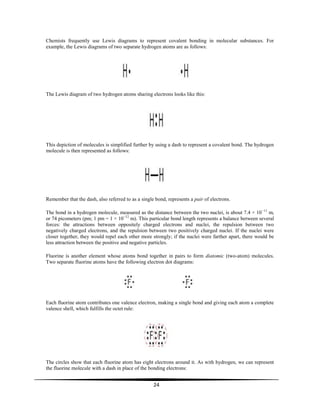
Chemists frequently use Lewis diagrams to represent covalent bonding in molecular substances. For
example, the Lewis diagrams of two separate hydrogen atoms are as follows:
The Lewis diagram of two hydrogen atoms sharing electrons looks like this:
This depiction of molecules is simplified further by using a dash to represent a covalent bond. The hydrogen
molecule is then represented as follows:
Remember that the dash, also referred to as a single bond, represents a pair of electrons.
The bond in a hydrogen molecule, measured as the distance between the two nuclei, is about 7.4 × 10⁻¹¹
m,
or 74 picometers (pm; 1 pm = 1 × 10⁻¹²
m). This particular bond length represents a balance between several
forces: the attractions between oppositely charged electrons and nuclei, the repulsion between two
negatively charged electrons, and the repulsion between two positively charged nuclei. If the nuclei were
closer together, they would repel each other more strongly; if the nuclei were farther apart, there would be
less attraction between the positive and negative particles.
Fluorine is another element whose atoms bond together in pairs to form diatomic (two-atom) molecules.
Two separate fluorine atoms have the following electron dot diagrams:
Each fluorine atom contributes one valence electron, making a single bond and giving each atom a complete
valence shell, which fulfills the octet rule:
The circles show that each fluorine atom has eight electrons around it. As with hydrogen, we can represent
the fluorine molecule with a dash in place of the bonding electrons:
25
Each fluorine atom has six electrons, or three pairs of electrons, that are not participating in the covalent
bond. Rather than being shared, they are considered to belong to a single atom. These are called
nonbonding pairs (or lone pairs) of electrons.
Covalent Bonds between Different Atoms
Now that we have looked at electron sharing between atoms of the same element, let us look at covalent
bond formation between atoms of different elements. Consider a molecule composed of one hydrogen atom
and one fluorine atom:
Each atom needs one additional electron to complete its valence shell. By each contributing one electron,
they make the following molecule:
In this molecule, the hydrogen atom does not have nonbonding electrons, while the fluorine atom has six
nonbonding electrons (three lone electron pairs). The circles show how the valence electron shells are filled
for both atoms.
Example 1
Draw the Lewis diagram for each compound.
1. a molecule composed of two chlorine atoms
2. a molecule composed of a hydrogen atom and a bromine atom
Solution
1. Chlorine has the same valence shell electron configuration as fluorine, so the Lewis diagram for a molecule
composed of two chlorine atoms is similar to the one for fluorine:
2. Bromine has the same valence shell electron configuration as fluorine, so the Lewis diagram for a molecule
composed of a hydrogen atom and a bromine atom is similar to that for hydrogen and fluorine:
26
Skill-Building Exercise
Draw the Lewis diagram for each compound.
1. a molecule composed of one chlorine atom and one fluorine atom
2. a molecule composed of one hydrogen atom and one iodine atom
Larger molecules are constructed in a similar fashion, with some atoms participating in more than one
covalent bond. For example, water, with two hydrogen atoms and one oxygen atom, and methane (CH4),
with one carbon atom and four hydrogen atoms, can be represented as follows:
Atoms typically form a characteristic number of covalent bonds in compounds. shows the number of
covalent bonds various atoms typically form.
Figure 4.2 How Many Covalent Bonds Are Formed?
In molecules, there is a pattern to the number of covalent bonds that different atoms can form. Each block
with a number indicates the number of covalent bonds formed by that atom in neutral compounds.
Concept Review Exercises
1. How is a covalent bond formed between two atoms?
2. How does covalent bonding allow atoms in group 6A to satisfy the octet rule?
Answers
1. Covalent bonds are formed by two atoms sharing electrons.
2. The atoms in group 6A make two covalent bonds.
Key Takeaway
27
A covalent bond is formed between two atoms by sharing electrons.
Exercises
1. Define covalent bond.
2. What is electron sharing?
3. Draw the Lewis diagram for the covalent bond in the Br2 molecule.
4. Draw the Lewis diagram for the covalent bond in the I2 molecule.
5. Draw the Lewis diagram for the covalent bond in the HCl molecule.
6. Draw the Lewis diagram for the covalent bond in the HI molecule.
7. What is the difference between a molecule and a formula unit?
8. Why do hydrogen atoms not follow the octet rule when they form covalent bonds?
9. Draw the Lewis diagram for the covalent bonding in H2S. How many bonding electrons and nonbonding
electrons are in the molecule?
10. Draw the Lewis diagram for the covalent bonding in NI3. How many bonding electrons and nonbonding
electrons are in the molecule?
11. Draw the Lewis diagram for the covalent bonding in CF4. How many bonding electrons and nonbonding
electrons are in the molecule?
12. Draw the Lewis diagram for the covalent bonding in PCl3. How many bonding electrons and nonbonding
electrons are in the molecule?
13. How many covalent bonds does a hydrogen atom typically form? Why?
14. How many covalent bonds does an oxygen atom typically form? Why?
15. Tellurium atoms make covalent bonds. How many covalent bonds would a tellurium atom make? Predict the
formula of a compound between tellurium and hydrogen.
16. Tin atoms make covalent bonds. How many covalent bonds would a tin atom make? Predict the formula of a
compound between tin and hydrogen.
17. Astatine is a synthetic element, made one atom at a time in huge ―atom-smasher‖ machines. It is in the
halogen group on the periodic table. How many covalent bonds would an atom of this element form?
18. There have been reports that atoms of element 116 were made by smashing smaller atoms together. Using
the periodic table, determine what column element 116 would be in and suggest how many covalent bonds
an atom of this element would form.
Answers
1. A covalent bond is formed when two atoms share electrons.
2.
3.
4.
5.
6.
7. A molecule is a discrete combination of atoms; a formula unit is the lowest ratio of ions in a crystal.
8.
9.
bonding electrons: 4; nonbonding electrons: 4
28
10.
11.
bonding electrons: 8; nonbonding electrons: 24
12.
13. Hydrogen atoms form only one covalent bond because they have only one valence electron to pair.
14.
15. two; H2Te
16.
17. one
18.
4.2 Covalent Compounds: Formulas and Names
Learning Objectives
1. Determine the chemical formula of a simple covalent compound from its name.
2. Determine the name of a simple covalent compound from its chemical formula.
What elements make covalent bonds? Covalent bonds form when two or more nonmetals combine. For
example, both hydrogen and oxygen are nonmetals, and when they combine to make water, they do so by
forming covalent bonds. Nonmetal atoms in polyatomic ions are joined by covalent bonds, but the ion as a
whole participates in ionic bonding. For example, ammonium chloride has ionic bonds between a
polyatomic ion, NH4
+
, and Cl−
ions, but within the ammonium ion, the nitrogen and hydrogen atoms are
connected by covalent bonds:
Example 2
Is each compound formed from ionic bonds, covalent bonds, or both?
1. Na2O
2. Na3PO4
3. N2O4
Solution
1. The elements in Na2O are a metal and a nonmetal, which form ionic bonds.
2. Because sodium is a metal and we recognize the formula for the phosphate ion (see ), we know that this
compound is ionic. However, polyatomic ions are held together by covalent bonds, so this compound
contains both ionic and covalent bonds.
3. The elements in N2O4 are both nonmetals, rather than a metal and a nonmetal. Therefore, the atoms form
covalent bonds.
29
Skill-Building Exercise
Is each compound are formed from ionic bonds, covalent bonds, or both?
1. Ba(OH)2
2. F2
3. PCl3
The chemical formulas for covalent compounds are referred to as molecular formulas because these
compounds exist as separate, discrete molecules. Typically, a molecular formula begins with the nonmetal
that is closest to the lower left corner of the periodic table, except that hydrogen is almost never written first
(H2O is the prominent exception). Then the other nonmetal symbols are listed. Numerical subscripts are used
if there is more than one of a particular atom. For example, we have already seen CH4, the molecular
formula for methane.
Naming binary (two-element) covalent compounds is similar to naming simple ionic compounds. The first
element in the formula is simply listed using the name of the element. The second element is named by
taking the stem of the element name and adding the suffix -ide. A system of numerical prefixes is used to
specify the number of atoms in a molecule. lists these numerical prefixes. Normally, no prefix is added to
the first element’s name if there is only one atom of the first element in a molecule. If the second element is
oxygen, the trailing vowel is usually omitted from the end of a polysyllabic prefix but not a monosyllabic
one (that is, we would say ―monoxide‖ rather than ―monooxide‖ and ―trioxide‖ rather than ―troxide‖).
Table 4.1 Numerical Prefixes for Naming Binary Covalent Compounds
Number of Atoms in Compound Prefix on the Name of the Element
1 mono-*
2 di-
3 tri-
4 tetra-
5 penta-
6 hexa-
7 hepta-
8 octa-
9 nona-
10 deca-
*This prefix is not used for the first element’s name.
Let us practice by naming the compound whose molecular formula is CCl4. The name begins with the name
of the first element—carbon. The second element, chlorine, becomes chloride, and we attach the correct
numerical prefix (―tetra-‖) to indicate that the molecule contains four chlorine atoms. Putting these pieces
together gives the name carbon tetrachloride for this compound.
30
Example 3
Write the molecular formula for each compound.
1. chlorine trifluoride
2. phosphorus pentachloride
3. sulfur dioxide
4. dinitrogen pentoxide
Solution
If there is no numerical prefix on the first element’s name, we can assume that there is only one atom of that
element in a molecule.
1. ClF3
2. PCl5
3. SO2
4. N2O5 (The di- prefix on nitrogen indicates that two nitrogen atoms are present.)
Skill-Building Exercise
Write the molecular formula for each compound.
1. nitrogen dioxide
2. dioxygen difluoride
3. sulfur hexafluoride
4. selenium monoxide
Note
Because it is so unreactive, sulfur hexafluoride is used as a spark suppressant in electrical devices such as
transformers.
Example 4
Write the name for each compound.
1. BrF5
2. S2F2
3. CO
Solution
1. bromine pentafluoride
2. disulfur difluoride
3. carbon monoxide
Skill-Building Exercise
Write the name for each compound.
1. CF4
31
2. SeCl2
3. SO3
For some simple covalent compounds, we use common names rather than systematic names. We have
already encountered these compounds, but we list them here explicitly:
H2O: water
NH3: ammonia
CH4: methane
Methane is the simplest organic compound. Organic compounds are compounds with carbon atoms and are
named by a separate nomenclature system that we will introduce in .
Concept Review Exercises
1. How do you recognize a covalent compound?
2. What are the rules for writing the molecular formula of a simple covalent compound?
3. What are the rules for naming a simple covalent compound?
Answers
1. A covalent compound is usually composed of two or more nonmetal elements.
2. It is just like an ionic compound except that the element further down and to the left on the periodic table is
listed first and is named with the element name.
3. Name the first element first and then the second element by using the stem of the element name plus the
suffix -ide. Use numerical prefixes if there is more than one atom of the first element; always use numerical
prefixes for the number of atoms of the second element.
Key Takeaways
The chemical formula of a simple covalent compound can be determined from its name.
The name of a simple covalent compound can be determined from its chemical formula.
Exercises
1. Identify whether each compound has covalent bonds.
1. NaI
2. Na2CO3
3. N2O
4. SiO2
2. Identify whether each compound has covalent bonds.
1. C2H6
2. C6H5Cl
3. KC2H3O2
4. Ca(OH)2
3. Identify whether each compound has ionic bonds, covalent bonds, or both.
1. Na3PO4
2. K2O
3. COCl2
4. CoCl2
4. Identify whether each compound has ionic bonds, covalent bonds, or both.
1. FeCl3
2. Fe(NO3)3
32
3. (NH2)2CO
4. SO3
5. Which is the correct molecular formula—H4Si or SiH4? Explain.
6. Which is the correct molecular formula—SF6 or F6S? Explain.
7. Write the name for each covalent compound.
1. SiF4
2. NO2
3. CS2
4. P2O5
8. Write the name for each covalent compound.
1. CO
2. S2O3
3. BF3
4. GeS2
9. Write the formula for each covalent compound.
1. iodine trichloride
2. disulfur dibromide
3. arsenic trioxide
4. xenon hexafluoride
10. Write the formula for each covalent compound.
1. boron trichloride
2. carbon dioxide
3. tetraphosphorus decoxide
4. germanium dichloride
11. Write two covalent compounds that have common rather than systematic names.
12. What is the name of the simplest organic compound? What would its name be if it followed the
nomenclature for binary covalent compounds?
Answers
1.
1. no
2. yes
3. yes
4. yes
2.
3.
1. both
2. ionic
3. covalent
4. ionic
4.
5. SiH4; except for water, hydrogen is almost never listed first in a covalent compound.
6.
7.
1. silicon tetrafluoride
2. nitrogen dioxide
3. carbon disulfide
4. diphosphorus pentoxide
8.
9.
1. ICl3
2. S2Br2
3. AsO3
4. XeF6
33
10.
11. H2O and NH3 (water and ammonia) (answers will vary)
12.
4.3 Multiple Covalent Bonds
Learning Objective
1. Recognize molecules that are likely to have multiple covalent bonds.
In many molecules, the octet rule would not be satisfied if each pair of bonded atoms shares two electrons.
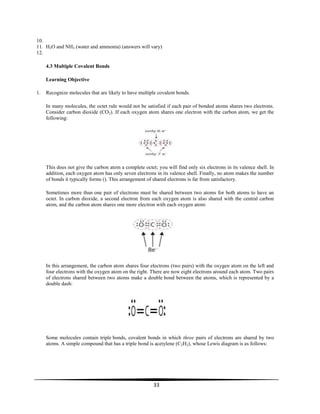
Consider carbon dioxide (CO2). If each oxygen atom shares one electron with the carbon atom, we get the
following:
This does not give the carbon atom a complete octet; you will find only six electrons in its valence shell. In
addition, each oxygen atom has only seven electrons in its valence shell. Finally, no atom makes the number
of bonds it typically forms (). This arrangement of shared electrons is far from satisfactory.
Sometimes more than one pair of electrons must be shared between two atoms for both atoms to have an
octet. In carbon dioxide, a second electron from each oxygen atom is also shared with the central carbon
atom, and the carbon atom shares one more electron with each oxygen atom:
In this arrangement, the carbon atom shares four electrons (two pairs) with the oxygen atom on the left and
four electrons with the oxygen atom on the right. There are now eight electrons around each atom. Two pairs
of electrons shared between two atoms make a double bond between the atoms, which is represented by a
double dash:
Some molecules contain triple bonds, covalent bonds in which three pairs of electrons are shared by two
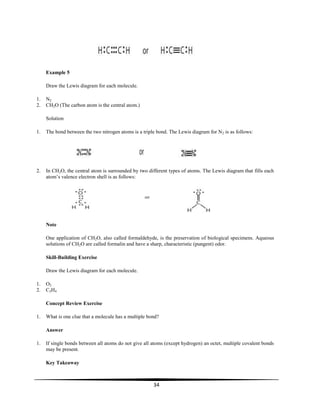
atoms. A simple compound that has a triple bond is acetylene (C2H2), whose Lewis diagram is as follows:
34
Example 5
Draw the Lewis diagram for each molecule.
1. N2
2. CH2O (The carbon atom is the central atom.)
Solution
1. The bond between the two nitrogen atoms is a triple bond. The Lewis diagram for N2 is as follows:
2. In CH2O, the central atom is surrounded by two different types of atoms. The Lewis diagram that fills each
atom’s valence electron shell is as follows:
Note
One application of CH2O, also called formaldehyde, is the preservation of biological specimens. Aqueous
solutions of CH2O are called formalin and have a sharp, characteristic (pungent) odor.
Skill-Building Exercise
Draw the Lewis diagram for each molecule.
1. O2
2. C2H4
Concept Review Exercise
1. What is one clue that a molecule has a multiple bond?
Answer
1. If single bonds between all atoms do not give all atoms (except hydrogen) an octet, multiple covalent bonds
may be present.
Key Takeaway
35
Some molecules must have multiple covalent bonds between atoms to satisfy the octet rule.
Exercises
1. Each molecule contains multiple bonds. Draw the Lewis diagram for each. The first element is the central
atom.
1. CS2
2. C2F4
3. COCl2
2. Each molecule contains double bonds. Draw the Lewis diagram for each. Assume that the first element is the
central atom, unless otherwise noted.
1. N2
2. HCN (The carbon atom is the central atom.)
3. POCl (The phosphorus atom is the central atom.)
3. Explain why hydrogen atoms do not form double bonds.
4. Why is it incorrect to draw a double bond in the Lewis diagram for MgO?
Answers
1.
1.
2.
3.
2.
3. Hydrogen can accept only one more electron; multiple bonds require more than one electron pair to be
shared.
4.4 Characteristics of Covalent Bonds
Learning Objective
1. Compare covalent bonds in terms of bond length and bond polarity.
Covalent bonds have certain characteristics that depend on the identities of the atoms participating in the
bond. Two characteristics are bond length and bond polarity.
Bond Length
In , we stated that the covalent bond in the hydrogen molecule (H2) has a certain length (about 7.4 × 10⁻¹¹
m). Other covalent bonds also have known bond lengths, which are dependent on both the identities of the
atoms in the bond and whether the bonds are single, double, or triple bonds. lists the approximate bond
lengths for some single covalent bonds. The exact bond length may vary depending on the identity of the
molecule but will be close to the value given in the table.
Table 4.2 Approximate Bond Lengths of Some Single Bonds
36
Bond Length (× 10−12
m)
H–H 74
H–C 110
H–N 100
H–O 97
H–I 161
C–C 154
C–N 147
C–O 143
N–N 145
O–O 145
compares the lengths of single covalent bonds with those of double and triple bonds between the same
atoms. Without exception, as the number of covalent bonds between two atoms increases, the bond length
decreases. With more electrons between the two nuclei, the nuclei can get closer together before the
internuclear repulsion is strong enough to balance the attraction.
Table 4.3 Comparison of Bond Lengths for Single and Multiple Bonds
Bond Length (× 10−12
m)
C–C 154
C=C 134
C≡C 120
C–N 147
C=N 128
C≡N 116
C–O 143
C=O 120
C≡O 113
N–N 145
N=N 123
N≡N 110
O–O 145
37
Bond Length (× 10−12
m)
O=O 121
Electronegativity and Bond Polarity
Although we defined covalent bonding as electron sharing, the electrons in a covalent bond are not always
shared equally by the two bonded atoms. Unless the bond connects two atoms of the same element, there
will always be one atom that attracts the electrons in the bond more strongly than the other atom does, as
shown in . When such an imbalance occurs, there is a resulting buildup of some negative charge (called a
partial negative charge and designated δ−) on one side of the bond and some positive charge (designated δ+)
on the other side of the bond. A covalent bond that has an unequal sharing of electrons, as in part (b) of , is
called a polar covalent bond. A covalent bond that has an equal sharing of electrons (part (a) of ) is called a
nonpolar covalent bond.
Figure 4.3 Polar versus Nonpolar Covalent Bonds
(a) The electrons in the covalent bond are equally shared by both hydrogen atoms. This is a nonpolar
covalent bond. (b) The fluorine atom attracts the electrons in the bond more than the hydrogen atom does,
leading to an imbalance in the electron distribution. This is a polar covalent bond.
Any covalent bond between atoms of different elements is a polar bond, but the degree of polarity varies
widely. Some bonds between different elements are only minimally polar, while others are strongly polar.
Ionic bonds can be considered the ultimate in polarity, with electrons being transferred rather than shared.
To judge the relative polarity of a covalent bond, chemists use electronegativity, which is a relative measure
of how strongly an atom attracts electrons when it forms a covalent bond. There are various numerical scales
for rating electronegativity. shows one of the most popular—the Pauling scale. The polarity of a covalent
bond can be judged by determining the difference in the electronegativities of the two atoms making the
bond. The greater the difference in electronegativities, the greater the imbalance of electron sharing in the
bond. Although there are no hard and fast rules, the general rule is if the difference in electronegativities is
38
less than about 0.4, the bond is considered nonpolar; if the difference is greater than 0.4, the bond is
considered polar. If the difference in electronegativities is large enough (generally greater than about 1.8),
the resulting compound is considered ionic rather than covalent. An electronegativity difference of zero, of
course, indicates a nonpolar covalent bond.
Figure 4.4 Electronegativities of Various Elements
A popular scale for electronegativities has the value for fluorine atoms set at 4.0, the highest value.
Looking Closer: Linus Pauling
Arguably the most influential chemist of the 20th century, Linus Pauling (1901–94) is the only person to
have won two individual (that is, unshared) Nobel Prizes. In the 1930s, Pauling used new mathematical
theories to enunciate some fundamental principles of the chemical bond. His 1939 book The Nature of the
Chemical Bond is one of the most significant books ever published in chemistry.
By 1935, Pauling’s interest turned to biological molecules, and he was awarded the 1954 Nobel Prize in
Chemistry for his work on protein structure. (He was very close to discovering the double helix structure of
DNA when James Watson and James Crick announced their own discovery of its structure in 1953.) He was
later awarded the 1962 Nobel Peace Prize for his efforts to ban the testing of nuclear weapons.
39
In his later years, Pauling became convinced that large doses of vitamin C would prevent disease, including
the common cold. Most clinical research failed to show a connection, but Pauling continued to take large
doses daily. He died in 1994, having spent a lifetime establishing a scientific legacy that few will ever equal.
Linus Pauling was one of the most influential chemists of the 20th century.
Example 6
Describe the electronegativity difference between each pair of atoms and the resulting polarity (or bond
type).
1. C and H
2. H and H
3. Na and Cl
4. O and H
Solution
1. Carbon has an electronegativity of 2.5, while the value for hydrogen is 2.1. The difference is 0.3, which is
rather small. The C–H bond is therefore considered nonpolar.
2. Both hydrogen atoms have the same electronegativity value—2.1. The difference is zero, so the bond is
nonpolar.
3. Sodium’s electronegativity is 0.9, while chlorine’s is 3.0. The difference is 2.1, which is rather high, and so
sodium and chlorine form an ionic compound.
4. With 2.1 for hydrogen and 3.5 for oxygen, the electronegativity difference is 1.4. We would expect a very
polar bond, but not so polar that the O–H bond is considered ionic.
Skill-Building Exercise
Describe the electronegativity difference between each pair of atoms and the resulting polarity (or bond
type).
1. C and O
2. K and Br
3. N and N
4. Cs and F
When a molecule’s bonds are polar, the molecule as a whole can display an uneven distribution of charge,
depending on how the individual bonds are oriented. For example, the orientation of the two O–H bonds in a
water molecule () is bent: one end of the molecule has a partial positive charge, and the other end has a
partial negative charge. In short, the molecule itself is polar. The polarity of water has an enormous impact
on its physical and chemical properties. (For example, the boiling point of water [100°C] is high for such a
small molecule and is due to the fact that polar molecules attract each other strongly.) In contrast, while the
two C=O bonds in carbon dioxide are polar, they lie directly opposite each other and so cancel each other’s
effects. Thus, carbon dioxide molecules are nonpolar overall. This lack of polarity influences some of
carbon dioxide’s properties. (For example, carbon dioxide becomes a gas at −77°C, almost 200° lower than
the temperature at which water boils.)
Figure 4.5 Physical Properties and Polarity
40
The physical properties of water and carbon dioxide are affected by their polarities.
Concept Review Exercises
1. What is the name for the distance between two atoms in a covalent bond?
2. What does the electronegativity of an atom indicate?
3. What type of bond is formed between two atoms if the difference in electronegativities is small? Medium?
Large?
Answers
1. bond length
2. Electronegativity is a qualitative measure of how much an atom attracts electrons in a covalent bond.
3. nonpolar; polar; ionic
Key Takeaways
Covalent bonds between different atoms have different bond lengths.
Covalent bonds can be polar or nonpolar, depending on the electronegativity difference between the atoms
involved.
Exercises
1. Which is longer—a C–H bond or a C–O bond? (Refer to .)
2. Which is shorter—an N–H bond or a C–H bond? (Refer to .)
3. A nanometer is 10−9
m. Using the data in and , determine the length of each bond in nanometers.
1. a C–O bond
2. a C=O bond
3. an H–N bond
4. a C≡N bond
4. An angstrom (Å) is defined as 10−10
m. Using and , determine the length of each bond in angstroms.
1. a C–C bond
2. a C=C bond
3. an N≡N bond
4. an H–O bond
5. Refer to Exercise 3. Why is the nanometer unit useful as a unit for expressing bond lengths?
6. Refer to Exercise 4. Why is the angstrom unit useful as a unit for expressing bond lengths?
7. Using , determine which atom in each pair has the higher electronegativity.
1. H or C
2. O or Br
3. Na or Rb
4. I or Cl
8. Using , determine which atom in each pair has the lower electronegativity.
1. Mg or O
2. S or F
41
3. Al or Ga
4. O or I
9. Will the electrons be shared equally or unequally across each covalent bond? If unequally, to which atom are
the electrons more strongly drawn?
1. a C–O bond
2. an F–F bond
3. an S–N bond
4. an I–Cl bond
10. Will the electrons be shared equally or unequally across each covalent bond? If unequally, to which atom are
the electrons more strongly drawn?
1. a C–C bond
2. a S–Cl bond
3. an O–H bond
4. an H–H bond
Answers
1. A C–O bond is longer.
2.
3.
1. 0.143 nm
2. 0.120 nm
3. 0.100 nm
4. 0.116 nm
4.
5. Actual bond lengths are very small, so the nanometer unit makes the expression of length easier to
understand.
6.
7.
1. C
2. O
3. Na
4. Cl
8.
9.
1. unequally toward the O
2. equally
3. unequally toward the N
4. unequally toward the Cl
10.
4.5 Characteristics of Molecules
Learning Objectives
1. Determine the molecular mass of a molecule.
2. Predict the general shape of a simple covalent molecule.
Unlike the ions in ionic compounds, which are arranged in lattices called crystals, molecules of covalent
compounds exist as discrete units with a characteristic mass and a certain three-dimensional shape.
Molecular Mass
42
The mass of a molecule—the molecular mass (sometimes called the molecular weight)—is simply the sum
of the masses of its atoms. As with formula masses, it is important that you keep track of the number of
atoms of each element in the molecular formula to obtain the correct molecular mass. (For more information
about formula masses, see , .)
Example 7
What is the molecular mass of each covalent compound?
1. H2O
2. C6H6
3. NO2
4. N2O5
Solution
Use the masses of the atoms from the periodic table in .
1. The molecular formula H2O indicates that there are two hydrogen atoms and one oxygen atom in each
molecule. Summing the masses of these atoms,
2 H: 2 × 1.01 = 2.02 u
1 O: + 16.00 u
Total: 18.02 u
2. The molecular mass of H2O is 18.02 u.
3.
6 C: 6 × 12.01 = 72.06 u
6 H: 6 × 1.01 = + 6.06 u
Total: 78.12 u
4. The molecular mass of C6H6 is 78.12 u.
5.
1 N: 14.01 u
2 O: 2 × 16.00 = + 32.00 u
Total: 46.01 u
6. The molecular mass of NO2 is 46.01 u.
7.
2 N: 2 × 14.01 = 28.02 u
43
5 O: 5 × 16.00 = + 80.00 u
Total: 108.02 u
8. The molecular mass of N2O5 is 108.02 u. (Note that the two different nitrogen and oxygen compounds in
these examples have different molecular masses.)
Skill-Building Exercise
What is the molecular mass of each covalent compound?
1. C2H2
2. CO
3. CO2
4. BF3
Molecular Shape: VSEPR Theory
Unlike ionic compounds, with their extended crystal lattices, covalent molecules are discrete units with
specific three-dimensional shapes. The shape of a molecule is determined by the fact that covalent bonds,
which are composed of negatively charged electrons, tend to repel one another. This concept is called the
valence shell electron pair repulsion (VSEPR) theory. For example, the two covalent bonds in BeCl2 stay as
far from each other as possible, ending up 180° apart from each other. The result is a linear molecule:
The three covalent bonds in BF3 repel each other to form 120° angles in a plane, in a shape called trigonal
planar:
The molecules BeCl2 and BF3 actually violate the octet rule; however, such exceptions are rare and will not
be discussed in this text.
Note
Try sticking three toothpicks into a marshmallow or a gumdrop and see if you can find different positions
where your ―bonds‖ are farther apart than the planar 120° orientation.
44
The four covalent bonds in CCl4 arrange themselves three dimensionally, pointing toward the corner of a
tetrahedron and making bond angles of 109.5°:
Molecules with lone electron pairs around the central atom have a shape based on the position of the atoms,
not the electron pairs. For example, NH3 has one lone electron pair and three bonded electron pairs. These
four electron pairs repel each other and adopt a tetrahedral arrangement:
However, the shape of the molecule is described in terms of the positions of the atoms, not the lone electron
pairs. Thus, NH3 is said to have a pyramidal shape, not a tetrahedral one. Similarly, H2O has two lone pairs
of electrons around the central oxygen atom, in addition to the two bonded pairs:
Although the four electron pairs adopt a tetrahedral arrangement due to repulsion, the shape of the molecule
is described by the positions of the atoms only. The shape of H2O is bent.
In determining the shapes of molecules, it is useful to first determine the Lewis diagram for a molecule. The
shapes of molecules with multiple bonds are determined by treating the multiple bonds as one bond. Thus,
CH2O has a shape similar to that of BF3:
Example 8
Describe the shape of each molecule.
1. PCl3
2. CO2
45
Solution
1. The Lewis diagram for PCl3 is as follows:
The four electron pairs arrange themselves tetrahedrally, but the lone electron pair is not considered in
describing the molecular shape. Like NH3, this molecule is pyramidal.
2. The Lewis diagram for CO2 is as follows:
The multiple bonds are treated as one group. Thus, CO2 has only two groups of electrons that repel each
other. They will direct themselves 180° apart from each other, so CO2 molecules are linear.
Skill-Building Exercise
Describe the shape of each molecule.
1. CBr4
2. BCl3
Concept Review Exercises
1. How do you determine the molecular mass of a covalent compound?
2. How do you determine the shape of a molecule?
Answers
1. The molecular mass is the sum of the masses of the atoms in the formula.
2. The shape of a molecule is determined by the position of the atoms, which in turn is determined by the
repulsion of the bonded and lone electron pairs around the central atom.
Key Takeaways
A molecule has a certain mass, called the molecular mass.
Simple molecules have geometries that can be determined from VSEPR theory.
Exercises
46
1. What is the molecular mass of each compound?
1. H2S
2. N2O4
3. ICl3
4. HCl
2. What is the molecular mass of each compound?
1. O2F2
2. CCl4
3. C6H6
4. SO3
3. Aspirin (C9H8O4) is a covalent compound. What is its molecular mass?
4. Cholesterol (C27H46O) is a biologically important compound. What is its molecular mass?
5. What is the shape of each molecule?
1. H2S
2. COCl2
3. SO2
6. What is the shape of each molecule?
1. NBr3
2. SF2
3. SiH4
7. Predict the shape of nitrous oxide (N2O), which is used as an anesthetic. A nitrogen atom is in the center of
this three-atom molecule.
8. Predict the shape of acetylene (C2H2), which has the two carbon atoms in the middle of the molecule with a
triple bond. What generalization can you make about the shapes of molecules that have more than one
central atom?
Answers
1.
1. 34.62 u
2. 92.02 u
3. 233.25 u
4. 36.46 u
2.
3. 180.17 u
4.
5.
1. bent
2. trigonal planar
3. bent
6.
7. bent
8.
4.6 Introduction to Organic Chemistry
Learning Objectives
1. Define organic chemistry.
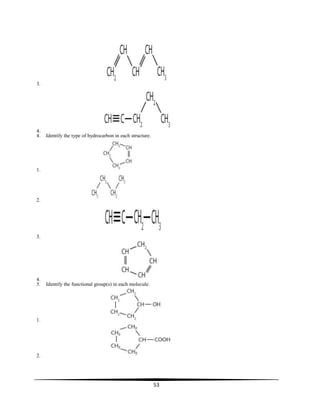
2. Identify organic molecules as alkanes, alkenes, alkynes, alcohols, or carboxylic acids.
When methane was mentioned at the end of , we described it as the simplest organic compound. In this
section, we introduce organic chemistry more formally.
47
Organic chemistry is the study of the chemistry of carbon compounds. Carbon is singled out because it has a
chemical diversity unrivaled by any other chemical element. Its diversity is based on the following:
Carbon atoms bond reasonably strongly with other carbon atoms.
Carbon atoms bond reasonably strongly with atoms of other elements.
Carbon atoms make a large number of covalent bonds (four).
Curiously, elemental carbon is not particularly abundant. It does not even appear in the list of the most
common elements in Earth’s crust. (See in .) Nevertheless, all living things consist of organic compounds.
Most organic chemicals are covalent compounds, which is why we introduce organic chemistry here. By
convention, compounds containing carbonate ions and bicarbonate ions, as well as carbon dioxide and
carbon monoxide, are not considered part of organic chemistry, even though they contain carbon.
The simplest organic compounds are the hydrocarbons, compounds composed of carbon and hydrogen
atoms only. Some hydrocarbons have only single bonds and appear as a chain (which can be a straight chain
or can have branches) of carbon atoms also bonded to hydrogen atoms. These hydrocarbons are called
alkanes (saturated hydrocarbons). Each alkane has a characteristic, systematic name depending on the
number of carbon atoms in the molecule. These names consist of a stem that indicates the number of carbon
atoms in the chain plus the ending -ane. The stem meth- means one carbon atom, so methane is an alkane
with one carbon atom. Similarly, the stem eth- means two carbon atoms; ethane is an alkane with two carbon
atoms. Continuing, the stem prop- means three carbon atoms, so propane is an alkane with three carbon
atoms. gives the formulas and the molecular models of the three simplest alkanes. (For more information
about alkanes, see .)
Figure 4.6 Formulas and Molecular Models of the Three Simplest Alkanes
The three smallest alkanes are methane, ethane, and propane.
Some hydrocarbons have one or more carbon–carbon double bonds (denoted C=C). These hydrocarbons are
called alkenes. shows the formulas and the molecular models of the two simplest alkenes. Note that the
names of alkenes have the same stem as the alkane with the same number of carbon atoms in its chain but
have the ending -ene. Thus, ethene is an alkene with two carbon atoms per molecule, and propene is a
compound with three carbon atoms and one double bond.
Figure 4.7 Formulas and Molecular Models of the Two Simplest Alkenes
Ethene is commonly called ethylene, while propene is commonly called propylene.
48
Alkynes are hydrocarbons with a carbon–carbon triple bond (denoted C≡C) as part of their carbon skeleton.
shows the formulas and the molecular models of the two simplest alkynes and their systematic names. The
names for alkynes have the same stems as for alkanes but with the ending -yne. (For more information about
alkenes and alkynes, see .)
Figure 4.8 Formulas and Molecular Models of the Two Simplest Alkynes
Ethyne is more commonly called acetylene.
Note
The compound acetylene, with its carbon–carbon triple bond, was introduced in and is an alkyne.
To Your Health: Saturated and Unsaturated Fats
Hydrocarbons are not the only compounds that can have carbon–carbon double bonds. A group of
compounds called fats can have them as well, and their presence or absence in the human diet is becoming
increasingly correlated with health issues.
Fats are combinations of long-chain organic compounds (fatty acids) and glycerol (C3H8O3). (For more
information on fats, see , .) The long carbon chains can have either all single bonds, in which case the fat is
classified as saturated, or one or more double bonds, in which case it is a monounsaturated or a
polyunsaturated fat, respectively. Saturated fats are typically solids at room temperature; beef fat (tallow) is
one example. Mono- or polyunsaturated fats are likely to be liquids at room temperature and are often called
oils. Olive oil, flaxseed oil, and many fish oils are mono- or polyunsaturated fats.
Studies have linked higher amounts of saturated fats in people’s diets with a greater likelihood of developing
heart disease, high cholesterol, and other diet-related diseases. In contrast, increases in unsaturated fats
(either mono- or polyunsaturated) have been linked to a lower incidence of certain diseases. Thus, there have
been an increasing number of recommendations by government bodies and health associations to decrease
the proportion of saturated fat and increase the proportion of unsaturated fat in the diet. Most of these
organizations also recommend decreasing the total amount of fat in the diet.
Recently, certain fats called trans fats have been implicated in the presence of heart disease. These are fats
from animal sources and are also produced when liquid oils are exposed to partial hydrogenation, an
industrial process that increases their saturation. Trans fats are used in many prepared and fried foods.
Because they bring with them the health risks that naturally occurring saturated fats do, there has been some
effort to better quantify the presence of trans fats in food products. US law now requires that food labels list
the amount of trans fat in each serving.
Since 1992, the US Department of Agriculture has been promoting a food pyramid that gives a simple,
visual picture of how much of what kind of foods make up a good, balanced diet. It recommends eating as
few fats as possible. Although nutritionists recognize that some fat is necessary (and largely unavoidable,
even by strict vegetarians), they emphasize that a large proportion of any fat, saturated or unsaturated, in the
49
diet is unhealthy. Even so, a difference as simple as the difference between a single and double carbon–
carbon bond can have a significant impact on health.
The food pyramid has suggestions for the number of daily servings of each type of food.
The carbon–carbon double and triple bonds are examples of functional groups in organic chemistry. A
functional group is a specific structural arrangement of atoms or bonds that imparts a characteristic chemical
reactivity to a molecule. Alkanes have no functional group. A carbon–carbon double bond is considered a
functional group because carbon–carbon double bonds chemically react in specific ways that differ from
reactions of alkanes (for example, under certain circumstances, alkenes react with water); a carbon–carbon
triple bond also undergoes certain specific chemical reactions. In the remainder of this section, we introduce
two other common functional groups.
If an OH group (also called a hydroxyl group) is substituted for a hydrogen atom in a hydrocarbon molecule,
the compound is an alcohol. Alcohols are named using the parent hydrocarbon name but with the final -e
dropped and the suffix -ol attached. The two simplest alcohols are methanol and ethanol. shows their
formulas along with a molecular model of each.
Figure 4.9 The Two Simplest Organic Alcohol Compounds
Alcohols have an OH functional group in the molecule.
Note
Cholesterol, described in the chapter-opening essay, has an alcohol functional group, as its name implies.
Note
Ethanol (also called ethyl alcohol) is the alcohol in alcoholic beverages. Other alcohols include methanol (or
methyl alcohol), which is used as a solvent and a cleaner, and isopropyl alcohol (or rubbing alcohol), which
50
is used as a medicinal disinfectant. Neither methanol nor isopropyl alcohol should be ingested, as they are
toxic even in small quantities.
Another important family of organic compounds has a carboxyl group, in which a carbon atom is double-
bonded to an oxygen atom and to an OH group. Compounds with a carboxyl functional group are called
carboxylic acids, and their names end in -oic acid. shows the formulas and the molecular models of the two
simplest carboxylic acids, perhaps best known by the common names formic acid and acetic acid. The
carboxyl group is sometimes written in molecules as COOH.
Figure 4.10 The Two Smallest Organic Acids
The two smallest carboxylic acids are formic acid (found in the stingers of ants) and acetic acid (found in
vinegar).
Many organic compounds are considerably more complex than the examples described here. Many
compounds, such as cholesterol discussed in the chapter-opening essay, contain more than one functional
group. The formal names can also be quite complex. In through , we will examine the characteristics and
chemistry of other important organic compounds and functional groups.
Example 9
Identify the functional group(s) in each molecule as a double bond, a triple bond, an alcohol, or a carboxyl.
1. CH3CH2CH2CH2OH
2.
3.
4.
51
Solution
1. This molecule has an alcohol functional group.
2. This molecule has a double bond and a carboxyl functional group.
3. This molecule has an alcohol functional group.
4. This molecule has a double bond and a carboxyl functional group.
Skill-Building Exercise
Identify the functional group(s) in each molecule as a double bond, a triple bond, an alcohol, or a carboxyl.
1.
2.
3.
4.
Career Focus: Forensic Chemist
The main job of a forensic chemist is to identify unknown materials and their origins. Although forensic
chemists are most closely associated in the public mind with crime labs, they are employed in pursuits as
52
diverse as tracing evolutionary patterns in living organisms, identifying environmental contaminants, and
determining the origin of manufactured chemicals.
In a crime lab, the forensic chemist has the job of identifying the evidence so that a crime can be solved. The
unknown samples may consist of almost anything—for example, paint chips, blood, glass, cloth fibers,
drugs, or human remains. The forensic chemist subjects them to a variety of chemical and instrumental tests
to discover what the samples are. Sometimes these samples are extremely small, but sophisticated forensic
labs have state-of-the-art equipment capable of identifying the smallest amount of unknown sample.
Another aspect of a forensic chemist’s job is testifying in court. Judges and juries need to be informed about
the results of forensic analyses, and it is the forensic chemist’s job to explain those results. Good public-
speaking skills, along with a broad background in chemistry, are necessary to be a successful forensic
chemist.
Concept Review Exercises
1. What is organic chemistry?
2. What is a functional group? Give at least two examples of functional groups.
Answers
1. Organic chemistry is the study of the chemistry of carbon compounds.
2. A functional group is a specific structural arrangement of atoms or bonds that imparts a characteristic
chemical reactivity to the molecule; alcohol group and carboxylic group (answers will vary).
Key Takeaways
Organic chemistry is the study of the chemistry of carbon compounds.
Organic molecules can be classified according to the types of elements and bonds in the molecules.
Exercises
1. Give three reasons why carbon is the central element in organic chemistry.
2. Are organic compounds based more on ionic bonding or covalent bonding? Explain.
3. Identify the type of hydrocarbon in each structure.
1.
2.
53
3.
4.
4. Identify the type of hydrocarbon in each structure.
1.
2.
3.
4.
5. Identify the functional group(s) in each molecule.
1.
2.
54
3.
4.
6. Identify the functional group(s) in each molecule.
1.
2.
3.
4.
7. How many functional groups described in this section contain carbon and hydrogen atoms only? Name
them.
8. What is the difference in the ways the two oxygen atoms in the carboxyl group are bonded to the carbon
atom?
Answers
1. Carbon atoms bond reasonably strongly with other carbon atoms. Carbon atoms bond reasonably strongly
with atoms of other elements. Carbon atoms make a large number of covalent bonds (four).
2.
3.
1. alkane
2. alkene
3. alkene
4. alkyne
4.
5.
1. alcohol
2. carboxyl
3. alcohol
55
4. carbon-carbon double bond and carbon-carbon triple bond
6.
7. two; carbon-carbon double bonds and carbon-carbon triple bonds
8.
4.7 End-of-Chapter Material
Chapter Summary
To ensure that you understand the material in this chapter, you should review the meanings of the following
bold terms in the following summary and ask yourself how they relate to the topics in the chapter.
Atoms can share pairs of valence electrons to obtain a valence shell octet. This sharing of electrons is a
covalent bond. A species formed from covalently bonded atoms is a molecule and is represented by a
molecular formula, which gives the number of atoms of each type in the molecule. The two electrons
shared in a covalent bond are called a bonding pair of electrons. The electrons that do not participate in
covalent bonds are called nonbonding pairs (or lone pairs) of electrons. A covalent bond consisting of one
pair of shared electrons is called a single bond.
Covalent bonds occur between nonmetal atoms. Naming simple covalent compounds follows simple rules
similar to those for ionic compounds. However, for covalent compounds, numerical prefixes are used as
necessary to specify the number of atoms of each element in the compound.
In some cases, more than one pair of electrons is shared to satisfy the octet rule. Two pairs of electrons are
shared by two atoms to make a double bond. Three pairs of atoms are shared to make a triple bond. Single,
double, and triple covalent bonds may be represented by one, two, or three dashes, respectively, between the
symbols of the atoms.
The distance between two covalently bonded atoms is the bond length. Bond lengths depend on the types of
atoms participating in the bond as well as the number of electron pairs being shared. A covalent bond can be
a polar covalent bond if the electron sharing between the two atoms is unequal. If the sharing is equal, the
bond is a nonpolar covalent bond. Because the strength of an atom’s attraction for electrons in a bond is
rated by the atom’s electronegativity, the difference in the two atoms’ electronegativities indicates how
polar a covalent bond between those atoms will be.
The mass of a molecule is called its molecular mass and is the sum of the masses of the atoms in the
molecule. The shape of a molecule can be predicted using valence shell electron pair repulsion (VSEPR),
which uses the fact that the negative electrons in covalent bonds repel each other as much as possible.
Organic chemistry is the chemistry of carbon compounds. Carbon forms covalent bonds with other carbon
atoms and with the atoms of many other elements. The simplest organic compounds are hydrocarbons,
which consist solely of carbon and hydrogen. Hydrocarbons containing only single bonds are called alkanes
(saturated hydrocarbons). Hydrocarbons containing carbon–carbon double bonds are alkenes, while
hydrocarbons with carbon–carbon triple bonds are alkynes. Carbon-carbon double and triple bonds are
examples of functional groups, atoms or bonds that impart a characteristic chemical function to the
molecule. Other functional groups include the alcohol functional group (OH) and the carboxyl functional
group (COOH). They are the characteristic functional group in organic compounds called alcohols and
carboxylic acids.
Additional Exercises
1. An atomic mass unit equals 1.661 × 10⁻²⁴
g. What is the mass in grams of each molecule of (a) H2S (b) N2O4
(c) ICl3 (d) NCl3?
56
2. An atomic mass unit equals 1.661 × 10⁻²⁴
g. What is the mass in grams of (a) O2F2 (b) CCl4 (c) C6H6 (d)
SO3?
3. An atomic mass unit equals 1.661 × 10⁻²⁴
g. What is the mass in grams of 5.00 × 10²²
molecules of C9H8O4?
4. An atomic mass unit equals 1.661 × 10⁻²⁴
g. What is the mass in grams of 1.885 × 10²⁰
molecules of
C27H46O?
5. Acetic acid has the following structure:
This molecule can lose a hydrogen ion (H+
) and the resulting anion can combine with other cations, such as
Na+
:
Name this ionic compound.
6. Formic acid (HCOOH) loses a hydrogen ion to make the formate ion (HCOO−
). Write the formula for each
ionic compound: potassium formate, calcium formate, and ferric formate.
7. Cyanogen has the formula C2N2. Propose a bonding scheme that gives each atom the correct number of
covalent bonds. (Hint: the two carbon atoms are in the center of a linear molecule.)
8. The molecular formula C3H6 represents not only propene, a compound with a carbon–carbon double bond,
but also a molecule that has all single bonds. Draw the molecule with formula C3H6 that has all single bonds.
9. How many carbon–carbon single bonds, linked together, are needed to make a carbon chain that is 1.000 cm
long?
10. How many carbon–carbon double bonds, linked together, are needed to make a carbon chain that is 1.000
cm long?
11. In addition to themselves, what other atoms can carbon atoms bond with and make covalent bonds that are
nonpolar (or as nonpolar as possible)?
12. What is the greatest possible electronegativity difference between any two atoms? Use to find the answer.
13. Acetaminophen, a popular painkiller, has the following structure:
Name the recognizable functional groups in this molecule. Do you think there are other groups of atoms in
this molecule that might qualify as functional groups?
14. Glutamic acid is the parent compound of monosodium glutamate (known as MSG), which is used as a flavor
enhancer. Glutamic acid has the following structure:
57
Name the functional groups you recognize in this molecule. Do you think there are other groups of atoms in
this molecule that might qualify as functional groups?
Answers
1. 1a: 5.75 × 10⁻²³
g; 1b: 1.53 × 10⁻²²
g; 1c: 3.88 × 10⁻²²
g; 1d: 6.06 × 10⁻²³
g
2.
3. 14.96 g
4.
5. sodium acetate
6.
7. N≡C–C≡N
8.
9. 6.49 × 10⁷
bonds
10.
11. Hydrogen atoms make relatively nonpolar bonds with carbon atoms.
12.
13. alcohol; the N–H group, the ring with double bonds, and the C=O are also likely functional groups.
CHAPTER 5
INTRODUCTION TO CHEMICAL REACTIONS
Although yeast has been used for thousands of years, its true nature has been known only for the last two
centuries. Yeasts are single-celled fungi. About 1,000 species are recognized, but the most common species
is Saccharomyces cerevisiae, which is used in bread making. Other species are used for the fermentation of
alcoholic beverages. Some species can cause infections in humans.
Yeasts live primarily on sugars, such as glucose (C6H12O6). They convert glucose into carbon dioxide (CO2)
and ethanol (C2H5OH) in a chemical transformation that is represented as follows:
C6H12O6 → 2CO2 (g) + 2C2H5OH (ℓ)
Bread making depends on the production of carbon dioxide. The gas, which is produced in tiny pockets in
bread dough, acts as a leavening agent: it expands during baking and makes the bread rise. Leavened bread
is softer, lighter, and easier to eat and chew than unleavened bread. The other major use of yeast,
fermentation, depends on the production of ethanol, which results from the same chemical transformation.
Some alcoholic beverages, such as champagne, can also be carbonated using the carbon dioxide produced by
the yeast.
Yeast is among the simplest life forms on Earth, yet it is absolutely necessary for at least two major food
industries. Without yeast to turn dough into bread and juice into wine, these foods and food industries would
not exist today.
5.1 The Law of Conservation of Matter
58
Learning Objectives
1. Correctly define a law as it pertains to science.
2. State the law of conservation of matter.
In science, a law is a general statement that explains a large number of observations. Before being accepted,
a law must be verified many times under many conditions. Laws are therefore considered the highest form
of scientific knowledge and are generally thought to be inviolable. Scientific laws form the core of scientific
knowledge.
One scientific law that provides the foundation for understanding in chemistry is the
law of conservation of matter. It states that in any given system that is closed to the transfer of matter (in and
out), the amount of matter in the system stays constant. A concise way of expressing this law is to say that
the amount of matter in a system is conserved.
What does this mean for chemistry? In any chemical change, one or more initial substances change into a
different substance or substances. Both the initial and final substances are composed of atoms because all
matter is composed of atoms. According to the law of conservation of matter, matter is neither created nor
destroyed, so we must have the same number and type of atoms after the chemical change as were present
before the chemical change.
Before looking at explicit examples of the law of conservation of matter, we need to examine the method
chemists use to represent chemical changes.
Concept Review Exercises
1. What is the law of conservation of matter?
2. How does the law of conservation of matter apply to chemistry?
Answers
1. The law of conservation of matter states that in any given system that is closed to the transfer of matter, the
amount of matter in the system stays constant
2. The law of conservation of matter says that in chemical reactions, the total mass of the products must equal
the total mass of the reactants.
Key Takeaway
The amount of matter in a closed system is conserved.
Exercises
1. Express the law of conservation of matter in your own words.
2. Explain why the concept of conservation of matter is considered a scientific law.
Answer
1. Matter may not be created or destroyed.
2.
5.2 Chemical Equations
59
Learning Objectives
1. Define chemical reaction.
2. Use a balanced chemical equation to represent a chemical reaction.
Water (H2O) is composed of hydrogen and oxygen. Suppose we imagine a process in which we take some
elemental hydrogen (H2) and elemental oxygen (O2) and let them react to make water. The statement
hydrogen and oxygen react to make water
is one way to represent that process, which is called a chemical reaction. shows a rather dramatic example of
this very reaction.
Figure 5.1 The Formation of Water
Hydrogen and oxygen combine to form water. Here, the hydrogen gas in the zeppelin SS Hindenburg reacts
with oxygen in the air to make water.
To simplify the writing of reactions, we use formulas instead of names when we describe a reaction. We can
also use symbols to represent other words in the reaction. A plus sign connects the initial substances (and
final substances, if there is more than one), and an arrow (→) represents the chemical change:
H2 + O2 → H2O
This statement is one example of a chemical equation, an abbreviated way of using symbols to represent a
chemical change. The substances on the left side of the arrow are called reactants, and the substances on the
right side of the arrow are called products. It is not uncommon to include a phase label with each formula—
(s) for solid, (ℓ) for liquid, (g) for gas, and (aq) for a substance dissolved in water, also known as an aqueous
solution. If we included phase labels for the reactants and products, under normal environmental conditions,
the reaction would be as follows:
H2(g) + O2(g) → H2O(ℓ)
Note
Chemical equations can also be used to describe physical changes. We will see examples of this soon.
This equation is still not complete because it does not satisfy the law of conservation of matter. Count the
number of atoms of each element on each side of the arrow. On the reactant side, there are two H atoms and
two O atoms; on the product side, there are two H atoms and only one oxygen atom. The equation is not
balanced because the number of oxygen atoms on each side is not the same ().
60
Figure 5.2 Balanced—Yes or No?
By counting the atoms of each element, we can see that the reaction is not balanced as written.
To make this chemical equation conform to the law of conservation of matter, we must revise the amounts of
the reactants and the products as necessary to get the same number of atoms of a given element on each side.
Because every substance has a characteristic chemical formula, we cannot change the chemical formulas of
the individual substances. For example, we cannot change the formula for elemental oxygen to O. However,
we can assume that different numbers of reactant molecules or product molecules may be involved. For
instance, perhaps two water molecules are produced, not just one:
H2(g) + O2(g) → 2H2O(ℓ)
The 2 preceding the formula for water is called a coefficient. It implies that two water molecules are formed.
There are now two oxygen atoms on each side of the equation.
Note
This point is so important that we should repeat it. You cannot change the formula of a chemical substance
to balance a chemical reaction! You must use the proper chemical formula of the substance.
Unfortunately, by inserting the coefficient 2 in front of the formula for water, we have also changed the
number of hydrogen atoms on the product side as well. As a result, we no longer have the same number of
hydrogen atoms on each side. This can be easily fixed, however, by putting a coefficient of 2 in front of the
diatomic hydrogen reactant:
2H2(g) + O2(g) → 2H2O(ℓ)
Now we have four hydrogen atoms and two oxygen atoms on each side of the equation. The law of
conservation of matter is satisfied because we now have the same number of atoms of each element in the
reactants and in the products. We say that the reaction is balanced (). The diatomic oxygen has a coefficient
of 1, which typically is not written but assumed in balanced chemical equations.
Figure 5.3 Balanced—Yes or No?
By counting the atoms of each element, we can see that the reaction is now balanced.
Proper chemical equations should be balanced. Writing balanced reactions is a chemist’s way of
acknowledging the law of conservation of matter.
61
Example 1
Is each chemical equation balanced?
1. 2Na(s) + O2(g) → 2Na2O(s)
2. CH4(g) + 2O2(g) → CO2(g) + 2H2O(ℓ)
3. AgNO3(aq) + 2KCl(aq) → AgCl(s) + KNO3(aq)
Solution
1. By counting, we find two sodium atoms and two oxygen atoms in the reactants and four sodium atoms and
two oxygen atoms in the products. This equation is not balanced.
2. The reactants have one carbon atom, four hydrogen atoms, and four oxygen atoms. The products have one
carbon atom, four hydrogen atoms, and four oxygen atoms. This equation is balanced.
3. The reactants have one silver atom, one nitrogen atom, three oxygen atoms, two potassium atoms, and two
chlorine atoms. The products have one silver atom, one chlorine atom, one potassium atom, one nitrogen
atom, and three oxygen atoms. Because there are different numbers of chlorine and potassium atoms, this
equation is not balanced.
Skill-Building Exercise
Is each chemical equation balanced?
1. 2Hg(ℓ) + O2(g) → Hg2O2(s)
2. C2H4(g) + 2O2(g) → 2CO2(g) + 2H2O(ℓ)
3. Mg(NO3)2(s) + 2Li(s) → Mg(s) + 2LiNO3(s)
How does one balance a chemical equation, starting with the correct formulas of the reactants and products?
Basically, a back-and-forth approach is adopted, counting the number of atoms of one element on one side,
checking the number of atoms of that element on the other side, and changing a coefficient if necessary.
Then check another element, going back and forth from one side of the equation to another, until each
element has the same number of atoms on both sides of the arrow. In many cases, it does not matter which
element is balanced first and which is balanced last, as long as all elements have the same number of atoms
on each side of the equation.
For example, to balance the equation
CH4 + Cl2 → CCl4 + HCl
we might choose to count the carbon atoms first, finding that both sides are balanced with one carbon atom.
The reactant side has four hydrogen atoms, so the product side must also have four hydrogen atoms. We fix
this by putting a 4 in front of the HCl:
CH4 + Cl2 → CCl4 + 4HCl
Now each side has four hydrogen atoms. The product side has a total of eight chlorine atoms (four from the
CCl4 and four from the four molecules of HCl), so we need eight chlorine atoms as reactants. Because
elemental chlorine is a diatomic molecule, we need four chlorine molecules to get a total of eight chlorine
atoms. We add another 4 in front of the Cl2 reactant:
CH4 + 4Cl2 → CCl4 + 4HCl
62
Now we check: each side has one carbon atom, four hydrogen atoms, and eight chlorine atoms. The
chemical equation is balanced.
Concept Review Exercises
1. What are the parts of a chemical equation?
2. Explain why chemical equations need to be balanced.
Answers
1. reactants and products
2. Chemical equations need to be balanced to satisfy the law of conservation of matter.
Key Takeaways
Chemical reactions are represented by chemical equations that list reactants and products.
Proper chemical equations are balanced; the same number of each element’s atoms appears on each side of
the equation.
Exercises
1. Write a chemical equation to express the fact that hydrogen gas and solid iodine react to make gaseous
hydrogen iodide. Make sure the equation satisfies the law of conservation of matter.
2. Write a chemical equation to express the fact that sodium metal and chlorine gas react to make solid sodium
chloride. Make sure the equation satisfies the law of conservation of matter.
3. Write an equation expressing the fact that hydrogen gas and fluorine gas react to make gaseous hydrogen
fluoride. Make sure the equation satisfies the law of conservation of matter.
4. Write an equation expressing the fact that solid potassium and fluorine gas react to make solid potassium
fluoride. Make sure the equation satisfies the law of conservation of matter.
5. Mercury reacts with oxygen to make mercury(II) oxide. Write a balanced chemical equation that
summarizes this reaction.
6. Octane (C8H18) reacts with oxygen to make carbon dioxide and water. Write a balanced chemical equation
that summarizes this reaction.
7. Propyl alcohol (C3H7OH) reacts with oxygen to make carbon dioxide and water. Write a balanced chemical
equation that summarizes this reaction.
8. Sulfuric acid reacts with iron metal to make iron(III) sulfate and hydrogen gas. Write a balanced chemical
equation that summarizes this reaction.
9. Balance each equation.
1. MgCl2 + K → KCl + Mg
2. C6H12O6 + O2 → CO2 + H2O
3. NaN3 → Na + N2 (This is the reaction used to inflate airbags in cars.)
10. Balance each equation.
1. NH4NO3 → N2O + H2O
2. TiBr4 + H2O → TiO2 + HBr
3. C3H5N3O9 → CO2 + N2 + O2 + H2O (This reaction represents the decomposition of nitroglycerine.)
11. Balance each equation.
1. NH3 + O2 → NO + H2O
2. Li + N2 → Li3N
3. AuCl → Au + AuCl3
12. Balance each equation.
1. NaOH + H3PO4 → Na3PO4 + H2O
2. N2H4 + Cl2 → N2 + HCl
3. Na2S + H2S → NaSH
63
13. Chromium(III) oxide reacts with carbon tetrachloride to make chromium(III) chloride and phosgene
(COCl2). Write the balanced chemical equation for this reaction.
14. The reaction that occurs when an Alka-Seltzer tablet is dropped into a glass of water has sodium bicarbonate
reacting with citric acid (H3C6H5O7) to make carbon dioxide, water, and sodium citrate (Na3C6H5O7). Write
the balanced chemical equation for this reaction.
15. When sodium hydrogen carbonate is used to extinguish a kitchen fire, it decomposes into sodium carbonate,
water, and carbon dioxide. Write a balanced chemical equation for this reaction.
16. Elemental bromine gas can be generated by reacting sodium bromide with elemental chlorine. The other
product is sodium chloride. Write a balanced chemical equation for this reaction.
Answers
1. H2(g) + I2(s) → 2HI(g)
2.
3. H2(g) + F2(g) → 2HF(g)
4.
5. 2Hg + O2 → 2HgO
6.
7. 2C3H7OH + 9O2 → 6CO2 + 8H2O
8.
9.
1. MgCl2 + 2K → 2KCl + Mg
2. C6H12O6 + 6O2 → 6CO2 + 6H2O
3. 2NaN3 → 2Na + 3N2
10.
11.
1. 4NH3 + 5O2 → 4NO + 6H2O
2. 6Li + N2 → 2Li3N
3. 3AuCl → 2Au + AuCl3
12.
13. Cr2O3 + 3CCl4 → 2CrCl3 + 3COCl2
14.
15. 2NaHCO3 → Na2CO3 + CO2 + H2O
16.
5.3 Quantitative Relationships Based on Chemical Equations
Learning Objective
1. Calculate the amount of one substance that will react with or be produced from a given amount of another
substance.
A balanced chemical equation not only describes some of the chemical properties of substances—by
showing us what substances react with what other substances to make what products—but also shows
numerical relationships between the reactants and the products. The study of these numerical relationships is
called stoichiometry. The stoichiometry of chemical equations revolves around the coefficients in the
balanced chemical equation because these coefficients determine the molecular ratio in which reactants react
and products are made.
Note
The word stoichiometry is pronounced ―stow-eh-key-OM-et-tree.‖ It is of mixed Greek and English origins,
meaning roughly ―measure of an element.‖
64
Looking Closer: Stoichiometry in Cooking
Let us consider a stoichiometry analogy from the kitchen. A recipe that makes 1 dozen biscuits needs 2 cups
of flour, 1 egg, 4 tablespoons of shortening, 1 teaspoon of salt, 1 teaspoon of baking soda, and 1 cup of milk.
If we were to write this as a chemical equation, we would write
2 c flour + 1 egg + 4 tbsp shortening + 1 tsp salt + 1 tsp baking soda + 1 c milk → 12 biscuits
(Unlike true chemical reactions, this one has all 1 coefficients written explicitly—partly because of the many
different units here.) This equation gives us ratios of how much of what reactants are needed to make how
much of what product. Two cups of flour, when combined with the proper amounts of the other ingredients,
will yield 12 biscuits. One teaspoon of baking soda (when also combined with the right amounts of the other
ingredients) will make 12 biscuits. One egg must be combined with 1 cup of milk to yield the product food.
Other relationships can also be expressed.
We can use the ratios we derive from the equation for predictive purposes. For instance, if we have 4 cups of
flour, how many biscuits can we make if we have enough of the other ingredients? It should be apparent that
we can make a double recipe of 24 biscuits.
But how would we find this answer formally, that is, mathematically? We would set up a conversion factor,
much like we did in . Because 2 cups of flour make 12 biscuits, we can set up an equivalency ratio:
12 biscuits2 c flour
We then can use this ratio in a formal conversion of flour to biscuits:
4c flour×12 biscuits2c flour=24 biscuits
Similarly, by constructing similar ratios, we can determine how many biscuits we can make from any
amount of ingredient.
When you are doubling or halving a recipe, you are doing a type of stoichiometry. Applying these ideas to
chemical reactions should not be difficult if you use recipes when you cook.
A recipe shows how much of each ingredient is needed for the proper reaction to take place.
Consider the following balanced chemical equation:
2C2H2 + 5O2 → 4CO2 + 2H2O
65
The coefficients on the chemical formulas give the ratios in which the reactants combine and the products
form. Thus, we can make the following statements and construct the following ratios:
Statement from the Balanced Chemical Reaction Ratio
Inverse
Ratio
two C2H2 molecules react with five O2 molecules 2C2H25O2 5O22C2H2
two C2H2 molecules react to make four CO2 molecules 2C2H24CO2 4CO22C2H2
five O2 molecules react to make two H2O molecules 5O22H2O 2H2O5O2
four CO2 molecules are made at the same time as two H2O
molecules
2H2O4CO2 4CO22H2O
Other relationships are possible; in fact, 12 different conversion factors can be constructed from this
balanced chemical equation. In each ratio, the unit is assumed to be molecules because that is how we are
interpreting the chemical equation.
Any of these fractions can be used as a conversion factor to relate an amount of one substance to an amount
of another substance. For example, suppose we want to know how many CO2 molecules are formed when 26
molecules of C2H2 are reacted. As usual with a conversion problem, we start with the amount we are
given—26C2H2—and multiply it by a conversion factor that cancels out our original unit and introduces the
unit we are converting to—in this case, CO2. That conversion factor is 4CO22C2H2, which is composed of
terms that come directly from the balanced chemical equation. Thus, we have
26C2H2×4CO22C2H2
The molecules of C2H2 cancel, and we are left with molecules of CO2. Multiplying through, we get
26C2H2×4CO22C2H2= 52CO2
Thus, 52 molecules of CO2 are formed.
This application of stoichiometry is extremely powerful in its predictive ability, as long as we begin with a
balanced chemical equation. Without a balanced chemical equation, the predictions made by simple
stoichiometric calculations will be incorrect.
Example 2
Start with this balanced chemical equation.
KMnO4 + 8HCl + 5FeCl2 → 5 FeCl3 + MnCl2 + 4H2O + KCl
1. Verify that the equation is indeed balanced.
2. Give 2 ratios that give the relationship between HCl and FeCl3.
Solution
1. Each side has 1 K atom and 1 Mn atom. The 8 molecules of HCl yield 8 H atoms, and the 4 molecules of
H2O also yield 8 H atoms, so the H atoms are balanced. The Fe atoms are balanced, as we count 5 Fe atoms
from 5 FeCl2 reactants and 5 FeCl3 products. As for Cl, on the reactant side, there are 8 Cl atoms from HCl
66
and 10 Cl atoms from the 5 FeCl2 formula units, for a total of 18 Cl atoms. On the product side, there are 15
Cl atoms from the 5 FeCl3 formula units, 2 from the MnCl2 formula unit, and 1 from the KCl formula unit.
This is a total of 18 Cl atoms in the products, so the Cl atoms are balanced. All the elements are balanced, so
the entire chemical equation is balanced.
2. Because the balanced chemical equation tells us that 8 HCl molecules react to make 5 FeCl3 formula units,
we have the following 2 ratios: 8HCl5FeCl3 and 5FeCl38HCl. There are a total of 42 possible ratios. Can
you find the other 40 relationships?
Skill-Building Exercise
Start with this balanced chemical equation.
2KMnO4+3CH2=CH2+4H2O→2MnO2+3HOCH2CH2OH+2KOH
1. Verify that the equation is balanced.
2. Give 2 ratios that give the relationship between KMnO4 and CH2=CH2. (A total of 30 relationships can be
constructed from this chemical equation. Can you find the other 28?)
Concept Review Exercises
1. Explain how stoichiometric ratios are constructed from a chemical equation.
2. Why is it necessary for a chemical equation to be balanced before it can be used to construct conversion
factors?
Answers
1. Stoichiometric ratios are made using the coefficients of the substances in the balanced chemical equation.
2. A balanced chemical equation is necessary so one can construct the proper stoichiometric ratios.
Key Takeaway
A balanced chemical equation gives the ratios in which molecules of substances react and are produced in a
chemical reaction.
Exercises
1. Balance this equation and write every stoichiometric ratio you can from it.
NH4NO3 → N2O + H2O
2. Balance this equation and write every stoichiometric ratio you can from it.
N2 + H2 → NH3
3. Balance this equation and write every stoichiometric ratio you can from it.
Fe2O3 + C → Fe + CO2
4. Balance this equation and write every stoichiometric ratio you can from it.
Fe2O3 + CO → Fe + CO2
67
5. Balance this equation and determine how many molecules of CO2 are formed if 15 molecules of C6H6 are
reacted.
C6H6 + O2 → CO2 + H2O
6. Balance this equation and determine how many molecules of Ag2CO3(s) are produced if 20 molecules of
Na2CO3 are reacted.
Na2CO3(aq) + AgNO3(aq) → NaNO3(aq) + Ag2CO3(s)
7. Copper metal reacts with nitric acid according to this equation:
3Cu(s) + 8HNO3(aq) → 3Cu(NO3)2(aq) + 2NO(g) + 4H2O(ℓ)
1. Verify that this equation is balanced.
2. How many Cu atoms will react if 488 molecules of aqueous HNO3 are reacted?
8. Gold metal reacts with a combination of nitric acid and hydrochloric acid according to this equation:
Au(s) + 3HNO3(aq) + 4HCl(aq) → HAuCl4(aq) + 3NO2(g) + 3H2O(ℓ)
1. Verify that this equation is balanced.
2. How many Au atoms react with 639 molecules of aqueous HNO3?
9. Sulfur can be formed by reacting sulfur dioxide with hydrogen sulfide at high temperatures according to this
equation:
SO2(g) + 2H2S(g) → 3S(g) + 2H2O(g)
1. Verify that this equation is balanced.
2. How many S atoms will be formed from by reacting 1,078 molecules of H2S?
10. Nitric acid is made by reacting nitrogen dioxide with water:
3NO2(g) + H2O(ℓ) → 2HNO3(aq) + NO(g)
1. Verify that this equation is balanced.
2. How many molecules of NO will be formed by reacting 2,268 molecules of NO2?
Answers
1. NH4NO3 → N2O + 2H2O; the stoichiometric ratios are 1NH4NO31N2O, 1NH4NO32H2O, 1N2O2H2O, and
their reciprocals.
2.
3. 2Fe2O3 + 3C → 4Fe + 3CO2; the stoichiometric ratios are 2Fe2O33C, 2Fe2O34Fe, 2Fe2O33CO2, 3C4Fe,
3C3CO2, 4Fe3CO2, and their reciprocals.
4.
5. 2C6H6 + 15O2 → 12CO2 + 6H2O; 90 molecules
6.
7.
1. It is balanced.
2. 183 atoms
8.
9.
1. It is balanced.
68
2. 1,617 atoms
5.4 Some Types of Chemical Reactions
Learning Objective
1. Classify a given chemical reaction into a variety of types.
Although there are untold millions of possible chemical reactions, most can be classified into a small
number of general reaction types. Classifying reactions has two purposes: it helps us to recognize
similarities among them, and it enables us to predict the products of certain reactions. A particular reaction
may fall into more than one of the categories that we will define in this book.
A combination (composition) reaction is a chemical reaction that makes a single substance from two or more
reactants. There may be more than one molecule of product in the balanced chemical equation, but there is
only one substance produced.
For example, the equation
4Fe + 3O2 → 2Fe2O3
is a combination reaction that produces Fe2O3 from its constituent elements—Fe and O2. Combination
reactions do not have to combine elements, however. The chemical equation
Fe2O3 + 3SO3 → Fe2(SO4)3
shows a combination reaction in which Fe2O3 combines with three molecules of SO3 to make Fe2(SO4)3.
Example 3
Which equations are combination reactions?
1. Co(s) + Cl2(g) → CoCl2(s)
2. CO(g) + Cl2(g) → COCl2(g)
3. N2H4(ℓ) + O2(g) → N2(g) + 2H2O(ℓ)
Solution
1. This is a combination reaction.
2. This is a combination reaction. (The compound COCl2 is called phosgene and, in the past, was used as a
gassing agent in chemical warfare.)
3. This is not a combination reaction.
Skill-Building Exercise
Which equations are combination reactions?
69
1. P4(s) + 6Cl2(g) → 4PCl3(g)
2. SO3(ℓ) + H2O(ℓ) → H2SO4(ℓ)
3. NaOH(s) + HCl(g) → NaCl(s) + H2O(ℓ)
A decomposition reaction is the reverse of a combination reaction. In a decomposition reaction, a single
substance is converted into two or more products. There may be more than one molecule of the reactant, but
there is only one substance initially. For example, the equation
2NaHCO3(s) → Na2CO3(s) + CO2(g) + H2O(ℓ)
is a decomposition reaction that occurs when NaHCO3 is exposed to heat. Another example is the
decomposition of KClO3:
2KClO3(s) → 2KCl(s) + 3O2(g)
This reaction was once commonly used to generate small amounts of oxygen in the chemistry lab.
Note
The decomposition reaction of NaHCO3 is the reaction that occurs when baking soda is poured on a small
kitchen fire. The intent is that the H2O and CO2 produced by the decomposition will smother the flames.
A combustion reaction occurs when a substance combines with molecular oxygen to make oxygen-
containing compounds of other elements in the reaction. One example is the burning of acetylene (C2H2) in
torches:
2C2H2 + 5O2 → 4CO2 + 2H2O
Oxygen (in its elemental form) is a crucial reactant in combustion reactions, and it is also present in the
products.
Note
Energy in the form of heat is usually given off as a product in a combustion reaction as well.
Example 4
Identify each type of reaction.
1. 2K(s) + S(s) + 2O2(g) → K2SO4(s)
2. (NH4)2Cr2O7(s) → N2(g) + Cr2O3(s) + 4H2O(ℓ)
3. CH4(g) + 2O2(g) → CO2(g) + 2H2O(ℓ)
Solution
1. Multiple reactants are combining to make a single product, so this reaction is a combination reaction.
2. A single substance reacts to make several products, so we have a decomposition reaction.
3. Oxygen reacts with a compound to make carbon dioxide (an oxide of carbon) and water (an oxide of
hydrogen). This is a combustion reaction.
Skill-Building Exercise
70
Identify each type of reaction.
1. C2H5OH + 3O2 → 2CO2 + 3H2O
2. 2Ca(s) + O2(g) → 2CaO(s)
3. CaCO3(s) → CaO(s) + CO2(g)
Concept Review Exercises
1. What is the difference between a combination reaction and a combustion reaction?
2. Give the distinguishing characteristic(s) of a decomposition reaction.
3. How do we recognize a combustion reaction?
Answers
1. A combination reaction produces a certain substance; a combustion reaction is a vigorous reaction, usually a
combination with oxygen, that is accompanied by the production of light and/or heat.
2. In a decomposition reaction, a single substance reacts to make multiple substances as products.
3. A combustion reaction is typically a vigorous reaction accompanied by light and/or heat, usually because of
reaction with oxygen.
Key Takeaway
There are several recognizable types of chemical reactions: combination, decomposition, and combustion
reactions are examples.
Exercises
1. Identify each type of reaction.
1. C6H5CH3 + 9O2 → 7CO2 + 4H2O
2. 2NaHCO3 → Na2CO3 + H2O + CO2
3. C + 2H2 → CH4
2. Identify each type of reaction.
1. P4O10 + 6H2O → 4H3PO4
2. FeO + SO3 → FeSO4
3. CaCO3(s) → CO2(g) + CaO(s)
3. Identify each type of reaction.
1. 2NH4NO3(s) → 2N2(g) + 4H2O(g) + O2(g)
2. Hg(ℓ) + ½O2 (g) → HgO(s)
3. CH2CH2(g) + Br2(ℓ) → CH2BrCH2Br
4. Identify each type of reaction.
1. Ti(s) + O2(g) → TiO2(s)
2. H2SO3(aq) → H2O(ℓ) + SO2(g)
3. 3O2(g) → 2O3(g)
Answers
1.
1. combustion
2. decomposition
3. combination
2.
3.
1. decomposition
71
2. combustion or combination
3. combination
4.
5.5 Oxidation-Reduction (Redox) Reactions
Learning Objective
1. Identify a chemical reaction as an oxidation-reduction reaction.
Figure 5.4 Zinc Metal plus Hydrochloric Acid
It is fairly obvious that zinc metal reacts with aqueous hydrochloric acid! The bubbles are hydrogen gas.
When zinc metal is submerged into a quantity of aqueous HCl, the following reaction occurs ():
Zn(s) + 2HCl(aq) → H2(g) + ZnCl2(aq)
This is one example of what is sometimes called a single replacement reaction because Zn replaces H in
combination with Cl.
Because some of the substances in this reaction are aqueous, we can separate them into ions:
Zn(s) + 2H+
(aq) + 2Cl−
(aq) → H2(g) + Zn2+
(aq) + 2Cl−
(aq)
Viewed this way, the net reaction seems to be a charge transfer between zinc and hydrogen atoms. (There is
no net change experienced by the chloride ion.) In fact, electrons are being transferred from the zinc atoms
to the hydrogen atoms (which ultimately make a molecule of diatomic hydrogen), changing the charges on
both elements.
To understand electron-transfer reactions like the one between zinc metal and hydrogen ions, chemists
separate them into two parts: one part focuses on the loss of electrons, and one part focuses on the gain of
electrons. The loss of electrons is called oxidation. The gain of electrons is called reduction. Because any
loss of electrons by one substance must be accompanied by a gain in electrons by something else, oxidation
and reduction always occur together. As such, electron-transfer reactions are also called oxidation-
reduction reactions, or simply redox reactions. The atom that loses electrons is oxidized, and the atom that
gains electrons is reduced. Also, because we can think of the species being oxidized as causing the
72
reduction, the species being oxidized is called the reducing agent, and the species being reduced is called the
oxidizing agent.
Note
Because batteries are used as sources of electricity (that is, of electrons), all batteries are based on redox
reactions.
Although the two reactions occur together, it can be helpful to write the oxidation and reduction reactions
separately as half reactions. In half reactions, we include only the reactant being oxidized or reduced, the
corresponding product species, any other species needed to balance the half reaction, and the electrons being
transferred. Electrons that are lost are written as products; electrons that are gained are written as reactants.
For example, in our earlier equation, now written without the chloride ions,
Zn(s) + 2H+
(aq) → Zn2+
(aq) + H2(g)
zinc atoms are oxidized to Zn2+
. The half reaction for the oxidation reaction, omitting phase labels, is as
follows:
Zn → Zn2+
+ 2e−
This half reaction is balanced in terms of the number of zinc atoms, and it also shows the two electrons that
are needed as products to account for the zinc atom losing two negative charges to become a 2+ ion. With
half reactions, there is one more item to balance: the overall charge on each side of the reaction. If you check
each side of this reaction, you will note that both sides have a zero net charge.
Hydrogen is reduced in the reaction. The balanced reduction half reaction is as follows:
2H+
+ 2e−
→ H2
There are two hydrogen atoms on each side, and the two electrons written as reactants serve to neutralize the
2+ charge on the reactant hydrogen ions. Again, the overall charge on both sides is zero.
The overall reaction is simply the combination of the two half reactions and is shown by adding them
together.
Because we have two electrons on each side of the equation, they can be canceled. This is the key criterion
for a balanced redox reaction: the electrons have to cancel exactly. If we check the charge on both sides of
the equation, we see they are the same—2+. (In reality, this positive charge is balanced by the negative
charges of the chloride ions, which are not included in this reaction because chlorine does not participate in
the charge transfer.)
Redox reactions are often balanced by balancing each individual half reaction and then combining the two
balanced half reactions. Sometimes a half reaction must have all of its coefficients multiplied by some
integer for all the electrons to cancel. The following example demonstrates this process.
73
Example 5
Write and balance the redox reaction that has silver ions and aluminum metal as reactants and silver metal
and aluminum ions as products.
Solution
We start by using symbols of the elements and ions to represent the reaction:
Ag+
+ Al → Ag + Al3+
The equation looks balanced as it is written. However, when we compare the overall charges on each side of
the equation, we find a charge of +1 on the left but a charge of +3 on the right. This equation is not properly
balanced. To balance it, let us write the two half reactions. Silver ions are reduced, and it takes one electron
to change Ag+
to Ag:
Ag+
+ e−
→ Ag
Aluminum is oxidized, losing three electrons to change from Al to Al3+
:
Al → Al3+
+ 3e−
To combine these two half reactions and cancel out all the electrons, we need to multiply the silver reduction
reaction by 3:
Now the equation is balanced, not only in terms of elements but also in terms of charge.
Skill-Building Exercise
1. Write and balance the redox reaction that has calcium ions and potassium metal as reactants and calcium
metal and potassium ions as products.
Note
Potassium has been used as a reducing agent to obtain various metals in their elemental form.
To Your Health: Redox Reactions and Pacemaker Batteries
All batteries use redox reactions to supply electricity because electricity is basically a stream of electrons
being transferred from one substance to another. Pacemakers—surgically implanted devices for regulating a
person’s heartbeat—are powered by tiny batteries, so the proper operation of a pacemaker depends on a
redox reaction.
Pacemakers used to be powered by NiCad batteries, in which nickel and cadmium (hence the name of the
battery) react with water according to this redox reaction:
74
Cd(s) + 2NiOOH(s) + 2H2O(ℓ) → Cd(OH)2(s) + 2Ni(OH)2(s)
The cadmium is oxidized, while the nickel atoms in NiOOH are reduced. Except for the water, all the
substances in this reaction are solids, allowing NiCad batteries to be recharged hundreds of times before they
stop operating. Unfortunately, NiCad batteries are fairly heavy batteries to be carrying around in a
pacemaker. Today, the lighter lithium/iodine battery is used instead. The iodine is dissolved in a solid
polymer support, and the overall redox reaction is as follows:
2Li(s) + I2(s) → 2LiI(s)
Lithium is oxidized, and iodine is reduced. Although the lithium/iodine battery cannot be recharged, one of
its advantages is that it lasts up to 10 years. Thus, a person with a pacemaker does not have to worry about
periodic recharging; about once per decade a person requires minor surgery to replace the pacemaker/battery
unit. Lithium/iodine batteries are also used to power calculators and watches.
A small button battery like this is used to power a watch, pacemaker, or calculator.
Oxidation and reduction can also be defined in terms of changes in composition. The original meaning of
oxidation was ―adding oxygen,‖ so when oxygen is added to a molecule, the molecule is being oxidized. The
reverse is true for reduction: if a molecule loses oxygen atoms, the molecule is being reduced. For example,
the acetaldehyde (CH3CHO) molecule takes on an oxygen atom to become acetic acid (CH3COOH).
2CH3CHO + O2 → 2CH3COOH
Thus, acetaldehyde is being oxidized.
Similarly, oxidation and reduction can be defined in terms of the gain or loss of hydrogen atoms. If a
molecule adds hydrogen atoms, it is being reduced. If a molecule loses hydrogen atoms, the molecule is
being oxidized. For example, in the conversion of acetaldehyde into ethanol (CH3CH2OH), hydrogen atoms
are added to acetaldehyde, so the acetaldehyde is being reduced:
CH3CHO + H2 → CH3CH2OH
Example 6
In each conversion, indicate whether oxidation or reduction is occurring.
1. N2 → NH3
2. CH3CH2OHCH3 → CH3COCH3
3. HCHO → HCOOH
Solution
1. Hydrogen is being added to the original reactant molecule, so reduction is occurring.
2. Hydrogen is being removed from the original reactant molecule, so oxidation is occurring.
75
3. Oxygen is being added to the original reactant molecule, so oxidation is occurring.
Skill-Building Exercise
In each conversion, indicate whether oxidation or reduction is occurring.
1. CH4 → CO2 + H2O
2. NO2 → N2
3. CH2=CH2 → CH3CH3
Concept Review Exercises
1. Give two different definitions for oxidation and reduction.
2. Give an example of each definition of oxidation and reduction.
Answers
1. Oxidation is the loss of electrons or the addition of oxygen; reduction is the gain of electrons or the addition
of hydrogen.
2. Zn → Zn2+
+2e−
(oxidation); C2H4 + H2 → C2H6 (reduction) (answers will vary)
Key Takeaways
Chemical reactions in which electrons are transferred are called oxidation-reduction, or redox, reactions.
Oxidation is the loss of electrons.
Reduction is the gain of electrons.
Oxidation and reduction always occur together, even though they can be written as separate chemical
equations.
Exercises
1. Which reactions are redox reactions? For those that are redox reactions, identify the oxidizing and reducing
agents.
1. NaOH + HCl → H2O + NaCl
2. 3Mg + 2AlCl3 → 2Al + 3MgCl2
3. H2O2 + H2 → 2H2O
4. KCl + AgNO3 → AgCl + KNO3
2. Which reactions are redox reactions? For those that are redox reactions, identify the oxidizing and reducing
agents.
1. 3Cu + 8HNO3 → 3Cu(NO3)2 + 2NO + 4H2O
2. 2C2H6 + 7O2 → 4CO2 + 6H2O
3. 2NaHCO3 → Na2CO3 + CO2 + H2O
4. 2K + 2H2O → 2KOH + H2
3. Balance each redox reaction by writing appropriate half reactions and combining them to cancel the
electrons.
1. Ca(s) + H+
(aq) → Ca2+
(aq) + H2(g)
2. I−
(aq) + Br2(ℓ) → Br−
(aq) + I2(s)
4. Balance each redox reaction by writing appropriate half reactions and combining them to cancel the
electrons.
1. Fe(s) + Sn4+
(aq) → Fe3+
(aq) + Sn2+
(aq)
2. Pb(s) + Pb4+
(aq) → Pb2+
(aq) (Hint: both half reactions will start with the same reactant.)
76
Answers
1.
1. no
2. yes; oxidizing agent: AlCl3; reducing agent: Mg
3. yes; oxidizing agent: H2O2; reducing agent: H2
4. no
2.
3.
1. Ca → Ca2+
+ 2e−
2H+
+ 2e−
→ H2
Combined: Ca + 2H+
→ Ca2+
+ H2
2. Br2 + 2e−
→ 2Br−
2I−
→ I2 + 2e−
Combined: Br2 + 2I−
→ 2Br−
+ I
5.6 Redox Reactions in Organic Chemistry and Biochemistry
Learning Objective
1. Identify oxidation-reduction reactions with organic compounds.
Oxidation-reduction reactions are of central importance in organic chemistry and biochemistry. The burning
of fuels that provides the energy to maintain our civilization and the metabolism of foods that furnish the
energy that keeps us alive both involve redox reactions.
Figure 5.5 The Burning of Natural Gas
The burning of natural gas is not only a combustion reaction but also a redox reaction. Similar reactions
include the burning of gasoline and coal. These are also redox reactions.
All combustion reactions are also redox reactions. A typical combustion reaction is the burning of methane,
the principal component of natural gas ().
CH4 + 2O2 → CO2 + 2H2O
77
In respiration, the biochemical process by which the oxygen we inhale in air oxidizes foodstuffs to carbon
dioxide and water, redox reactions provide energy to living cells. A typical respiratory reaction is the
oxidation of glucose (C6H12O6), the simple sugar we encountered in the chapter-opening essay that makes up
the diet of yeast:
C6H12O6 + 6O2 → 6CO2 + 6H2O
Organic chemists use a variety of redox reactions. For example, potassium dichromate (K2Cr2O7) is a
common oxidizing agent that can be used to oxidize alcohols (symbolized by the general formula ROH).
The product of the reaction depends on the location of the OH functional group in the alcohol molecule, the
relative proportions of alcohol and the dichromate ion, and reaction conditions such as temperature. If the
OH group is attached to a terminal carbon atom and the product is distilled off as it forms, the product is an
aldehyde, which has a terminal carbonyl group (C=O) and is often written as RCHO. One example is the
reaction used by the Breathalyzer to detect ethyl alcohol (C2H5OH) in a person’s breath:
3C2H5OH + Cr2O7
2−
+ 8H+
→ 3CH3CHO + 2Cr3+
+ 7H2O
If the product acetaldehyde (CH3CHO) is not removed as it forms, it is further oxidized to acetic acid
(CH3COOH). In this case, the overall reaction is as follows:
3C2H5OH + 2Cr2O7
2−
+ 16H+
→ 3CH3COOH + 4Cr3+
+ 11H2O
In this reaction, the chromium atom is reduced from Cr2O7
2−
to Cr3+
, and the ethanol is oxidized to acetic
acid.
When the OH group of the alcohol is bonded to an interior carbon atom, the oxidation of an alcohol will
produce a ketone. (The formulas of ketones are often written as RCOR, and the carbon–oxygen bond is a
double bond.) The simplest ketone is derived from 2-propanol (CH3CHOHCH3). It is the common solvent
acetone [(CH3)2CO], which is used in varnishes, lacquers, rubber cement, and nail polish remover. Acetone
can be formed by the following redox reaction:
3CH3CHOHCH3 + Cr2O7
2−
+ 8H+
→ 3(CH3)2CO + 2Cr3+
+ 7H2O
As we have just seen, aldehydes and ketones can be formed by the oxidation of alcohols. Conversely,
aldehydes and ketones can be reduced to alcohols. Reduction of the carbonyl group is important in living
organisms. For example, in anaerobic metabolism, in which biochemical processes take place in the absence
of oxygen, pyruvic acid (CH3COCOOH) is reduced to lactic acid (CH3CHOHCOOH) in the muscles.
CH3COCOOH → CH3CHOHCOOH
(Pyruvic acid is both a carboxylic acid and a ketone; only the ketone group is reduced.) The buildup of lactic
acid during vigorous exercise is responsible in large part for the fatigue that we experience.
In food chemistry, the substances known as antioxidants are reducing agents. Ascorbic acid (vitamin C;
C6H8O6) is thought to retard potentially damaging oxidation of living cells. In the process, it is oxidized to
dehydroascorbic acid (C6H6O6). In the stomach, ascorbic acid reduces the nitrite ion (NO2
−
) to nitric oxide
(NO):
C6H8O6 + 2H+
+ 2NO2
−
→ C6H6O6 + 2H2O + 2NO
If this reaction did not occur, nitrite ions from foods would oxidize the iron in hemoglobin, destroying its
ability to carry oxygen.
78
Tocopherol (vitamin E) is also an antioxidant. In the body, vitamin E is thought to act by scavenging
harmful by-products of metabolism, such as the highly reactive molecular fragments called free radicals. In
foods, vitamin E acts to prevent fats from being oxidized and thus becoming rancid. Vitamin C is also a
good antioxidant ().
Figure 5.6 Citrus Fruits
Citrus fruits, such as oranges, lemons, and limes, are good sources of vitamin C, which is an antioxidant.
Finally, and of greatest importance, green plants carry out the redox reaction that makes possible almost all
life on Earth. They do this through a process called photosynthesis, in which carbon dioxide and water are
converted to glucose (C6H12O6). The synthesis of glucose requires a variety of proteins called enzymes and a
green pigment called chlorophyll that converts sunlight into chemical energy (). The overall change that
occurs is as follows:
6CO2 + 6H2O → C6H12O6 + 6O2
Figure 5.7 Life on Earth
Photosynthesis is the fundamental process by which plants use sunlight to convert carbon dioxide and water
into glucose and oxygen. Then plants make more complex carbohydrates. It is the ultimate source of all food
on Earth, and it is a redox reaction.
In this reaction, carbon dioxide is reduced to glucose, and water is oxidized to oxygen gas. Other reactions
convert the glucose to more complex carbohydrates, plant proteins, and oils.
Concept Review Exercise
1. Give some biochemical examples of oxidation and reduction reactions.
Answer
79
1. photosynthesis and antioxidants in foods (answers will vary)
Key Takeaway
Redox reactions are common in organic and biological chemistry, including the combustion of organic
chemicals, respiration, and photosynthesis.
Exercises
1. A typical respiratory reaction discussed in the text is the oxidation of glucose (C6H12O6):
C6H12O6 + 6O2 → 6CO2 + 6H2O
Is this a redox reaction? If so, what are the oxidizing and reducing agents?
2. The major net reaction in photosynthesis is as follows:
6CO2 + 6H2O → C6H12O6 + 6O2
Is this a redox reaction? If so, what are the oxidizing and reducing agents?
3. What would be the ultimate organic product if CH3CH2CH2OH were to react with a solution of K2Cr2O7?
4. What would be the ultimate organic product if CH3CH2CH2OH were to react with a solution of K2Cr2O7?
5. What would be the final organic product if CH3CH2CHOHCH3 were to react with a solution of K2Cr2O7?
6. What would be the major organic product if CH3CH2CHOHCH2CH3 were to react with a solution of
K2Cr2O7?
7. What alcohol is produced in the reduction of acetone [(CH3)2CO]?
8. What alcohol is produced in the reduction of propanal (CH3CH2CHO)?
Answers
1. yes; oxidizing agent: O2; reducing agent: C6H12O6
2.
3. CH3CH2COOH
4.
5. CH3CH2C(O)CH3, where the carbon is double bonded to the oxygen
6.
7. CH3CHOHCH3, or isopropyl alcohol
8.
5.7 End-of-Chapter Material
Chapter Summary
To ensure that you understand the material in this chapter, you should review the meanings of the following
bold terms in the following summary and ask yourself how they relate to the topics in the chapter.
Scientific laws are general statements that apply to a wide variety of circumstances. One important law in
chemistry is the law of conservation of matter, which states that in any closed system, the amount of
matter stays constant.
80
Chemical equations are used to represent chemical reactions. Reactants change chemically into products.
The law of conservation of matter requires that a proper chemical equation be balanced. Coefficients are
used to show the relative numbers of reactant and product molecules.
In stoichiometry, quantities of reactants and/or products can be related to each other using the balanced
chemical equation. The coefficients in a balanced chemical reaction are used to devise the proper ratios that
relate the number of molecules of one substance to the number of molecules of another substance.
Chemical reactions can be classified by type. Combination reactions (also called composition reactions)
make a substance from other substances. Decomposition reactions break one substance down into multiple
substances. Combustion reactions combine molecular oxygen with the atoms of another reactant.
Oxidation reactions are reactions in which an atom loses an electron. Reduction reactions are reactions in
which an atom gains an electron. These two processes always occur together, so they are collectively
referred to as oxidation-reduction (or redox) reactions. The species being oxidized it called the reducing
agent, while the species being reduced is the oxidizing agent. Alternate definitions of oxidation and
reduction focus on the gain or loss of oxygen atoms, or the loss or gain of hydrogen atoms. Redox reactions
are easily balanced if the overall reaction is first separated into half reactions, which are individually
balanced.
Oxidation-reduction reactions are common in organic and biological chemistry. Respiration, the process by
which we inhale and metabolize oxygen, is a series of redox reactions. In the absence of oxygen, redox
reactions still occur in a process called anaerobic metabolism. Antioxidants such as ascorbic acid also play
a part in the human diet, acting as reducing agents in various biochemical reactions. Photosynthesis, the
process by which plants convert water and carbon dioxide to glucose, is also based on redox reactions.
Additional Exercises
1. Isooctane (C8H18) is used as a standard for comparing gasoline performance. Write a balanced chemical
equation for the combustion of isooctane.
2. Heptane (C7H16), like isooctane (see Exercise 1), is also used as a standard for determining gasoline
performance. Write a balanced chemical equation for the combustion of heptane.
3. What is the difference between a combination reaction and a redox reaction? Are all combination reactions
also redox reactions? Are all redox reactions also combination reactions?
4. Are combustion reactions always redox reactions as well? Explain.
5. A friend argues that the equation
Fe2+
+ Na → Fe + Na+
is balanced because each side has one iron atom and one sodium atom. Explain why your friend is incorrect.
6. Some antacids contain aluminum hydroxide [Al(OH)3]. This compound reacts with excess hydrochloric acid
(HCl) in the stomach to neutralize it. If the products of this reaction are water and aluminum chloride, what
is the balanced chemical equation for this reaction?
7. Sulfuric acid is made in a three-step process: (1) the combustion of elemental sulfur to produce sulfur
dioxide, (2) the continued reaction of sulfur dioxide with oxygen to produce sulfur trioxide, and (3) the
reaction of sulfur trioxide with water to make sulfuric acid (H2SO4). Write balanced chemical equations for
all three reactions.
8. If the products of glucose metabolism are carbon dioxide and water, what is the balanced chemical equation
for the overall process? What is the stoichiometric ratio between the number of CO2 molecules made to the
number of H2O molecules made?
9. Historically, the first true battery was the Leclanché cell, named after its discoverer, Georges Leclanché. It
was based on the following reaction:
81
Zn(s) + Cu2+
(aq) → Zn2+
(aq) + Cu(s)
Identify what is being oxidized, what is being reduced, and the respective reducing and oxidizing agents.
Answers
1. 2C8H18 + 25O2 → 16CO2 + 18H2O
2.
3. A combination reaction makes a new substance from more than one reactant; a redox reaction rearranges
electrons. Not all combination reactions are redox reactions, and not all redox reactions are combination
reactions.
4.
5. Your friend is incorrect because the number of electrons transferring is not balanced.
6.
7. (1) S + O2 → SO2; (2) 2SO2 + O2 → 2SO3; (3) SO3 + H2O → H2SO4
8.
9. oxidized and reducing agent: Zn; reduced and oxidizing agent: Cu2+
The bread-making industry depends on a chemical reaction performed by yeast.
Chemical change is a central concept in chemistry. The goal of chemists is to know how and why a substance
changes in the presence of another substance or even by itself. Because there are tens of millions of known
substances, there are a huge number of possible chemical reactions. In this chapter, we will find that many of
these reactions can be classified into a small number of categ ories according to certain share
CHAPTER 6
QUANTITIES IN CHEMICAL REACTIONS
When the disengaged gasses are carefully examined, they are found to weigh 113.7 grs.; these are of two
kinds, viz. 144 cubical inches of carbonic acid gas, weighing 100 grs. and 380 cubical inches of a very
light gas, weighing only 13.7 grs.…and, when the water which has passed over into the bottle [labeled] H is
carefully examined, it is found to have lost 85.7 grs. of its weight. Thus, in this experiment, 85.7 grs. of
water, joined to 28 grs. of charcoal, have combined in such a way as to form 100 grs. of carbonic acid, and
13.7 grs. of a particular gas capable of being burnt. (Bold emphasis added.)
In this paragraph from the Elements of Chemistry, Antoine Lavoisier (1743–94) is explaining an experiment
in which he was trying to demonstrate that water is not an element but instead is composed of hydrogen (the
gas ―capable of being burnt‖) and oxygen. This is a historical account of a groundbreaking experiment and
illustrates the importance of amounts in chemistry. Lavoisier was pointing out that the initial total mass of
82
water and charcoal, 85.7 g plus 28 g, equals the final total mass of carbonic acid and the particular gas, 100 g
plus 13.7 g. In this way, he was illustrating the law of conservation of matter, which was introduced in . It is
another way of saying that amounts matter.
Amounts do matter and in a variety of circumstances. The chapter-opening essay in tells the story of a nurse
who mistakenly read ―2–3 mg‖ as ―23 mg‖ and administered the higher and potentially fatal dose of
morphine to a child. Food scientists who work in test kitchens must keep track of specific amounts of
ingredients as they develop new products for us to eat. Quality control technicians measure amounts of
substances in manufactured products to ensure that the products meet company or government standards.
Supermarkets routinely weigh meat and produce and charge consumers by the ounce or the pound.
So far, we have talked about chemical reactions in terms of individual atoms and molecules. Although this
works, most of the reactions occurring around us involve much larger amounts of chemicals. Even a tiny
sample of a substance will contain millions, billions, or a hundred billion billions of atoms and molecules.
How do we compare amounts of substances to each other in chemical terms when it is so difficult to count to
a hundred billion billion?
Actually, there are ways to do this, which we will explore in this chapter. In doing so, we will increase our
understanding of stoichiometry, which is the study of the numerical relationships between the reactants and
the products in a balanced chemical reaction.
Next
6.1 The Mole
Learning Objective
1. Define the mole unit.
shows that we need 2 hydrogen atoms and 1 oxygen atom to make 1 water molecule. If we want to make 2
water molecules, we will need 4 hydrogen atoms and 2 oxygen atoms. If we want to make 5 molecules of
water, we need 10 hydrogen atoms and 5 oxygen atoms. The ratio of atoms we will need to make any
number of water molecules is the same: 2 hydrogen atoms to 1 oxygen atom.
Figure 6.1 Water Molecules
83
The ratio of hydrogen atoms to oxygen atoms used to make water molecules is always 2:1, no matter how
many water molecules are being made.
One problem we have, however, is that it is extremely difficult, if not impossible, to organize atoms one at a
time. As stated in the introduction, we deal with billions of atoms at a time. How can we keep track of so
many atoms (and molecules) at a time? We do it by using mass rather than by counting individual atoms.
A hydrogen atom has a mass of approximately 1 u. An oxygen atom has a mass of approximately 16 u. The
ratio of the mass of an oxygen atom to the mass of a hydrogen atom is therefore approximately 16:1.
If we have 2 atoms of each element, the ratio of their masses is approximately 32:2, which reduces to 16:1—
the same ratio. If we have 12 atoms of each element, the ratio of their total masses is approximately (12 ×
16):(12 × 1), or 192:12, which also reduces to 16:1. If we have 100 atoms of each element, the ratio of the
masses is approximately 1,600:100, which again reduces to 16:1. As long as we have equal numbers of
hydrogen and oxygen atoms, the ratio of the masses will always be 16:1.
The same consistency is seen when ratios of the masses of other elements are compared. For example, the
ratio of the masses of silicon atoms to equal numbers of hydrogen atoms is always approximately 28:1,
while the ratio of the masses of calcium atoms to equal numbers of lithium atoms is approximately 40:7.
So we have established that the masses of atoms are constant with respect to each other, as long as we have
the same number of each type of atom. Consider a more macroscopic example. If a sample contains 40 g of
Ca, this sample has the same number of atoms as there are in a sample of 7 g of Li. What we need, then, is a
number that represents a convenient quantity of atoms so we can relate macroscopic quantities of
substances. Clearly even 12 atoms are too few because atoms themselves are so small. We need a number
that represents billions and billions of atoms.
Chemists use the term mole to represent a large number of atoms or molecules. Just as a dozen implies 12
things, a mole (mol) represents 6.022 × 10²³
things. The number 6.022 × 10²³
, called Avogadro’s number
after the 19th-century chemist Amedeo Avogadro, is the number we use in chemistry to represent
macroscopic amounts of atoms and molecules. Thus, if we have 6.022 × 10²³
O atoms, we say we have 1
mol of O atoms. If we have 2 mol of Na atoms, we have 2 × (6.022 × 1023
) Na atoms, or 1.2044 × 1024
Na
atoms. Similarly, if we have 0.5 mol of benzene (C6H6) molecules, we have 0.5 × (6.022 × 1023
) C6H6
molecules, or 3.011 × 10²³
C6H6 molecules.
84
Note
A mole represents a very large number! If 1 mol of quarters were stacked in a column, it could stretch back
and forth between Earth and the sun 6.8 billion times.
Notice that we are applying the mole unit to different types of chemical entities. In these examples, we cited
moles of atoms and moles of molecules. The word mole represents a number of things—6.022 × 10²³
of
them—but does not by itself specify what ―they‖ are. They can be atoms, formula units (of ionic
compounds), or molecules. That information still needs to be specified.
Because 1 H2 molecule contains 2 H atoms, 1 mol of H2 molecules (6.022 × 10²³
molecules) has 2 mol of H
atoms. Using formulas to indicate how many atoms of each element we have in a substance, we can relate
the number of moles of molecules to the number of moles of atoms. For example, in 1 mol of ethanol
(C2H6O), we can construct the following relationships ():
Table 6.1 Molecular Relationships
1 Molecule of
C2H6O Has
1 Mol of
C2H6O Has
Molecular Relationships
2 C atoms
2 mol of C
atoms
2 mol C atoms1 mol C2H6O molecules or
1 mol C2H6O molecules2 mol C atoms
6 H atoms
6 mol of H
atoms
6 mol H atoms1 mol C2H6O molecules or
1 mol C2H6O molecules6 mol H atoms
1 O atom
1 mol of O
atoms
1 mol O atoms1 mol C2H6O molecules or
1 mol C2H6O molecules1 mol O atoms
The following example illustrates how we can use these relationships as conversion factors.
Example 1
If a sample consists of 2.5 mol of ethanol (C2H6O), how many moles of carbon atoms, hydrogen atoms, and
oxygen atoms does it have?
Solution
Using the relationships in , we apply the appropriate conversion factor for each element:
Note how the unit mol C2H6O molecules cancels algebraically. Similar equations can be constructed for
determining the number of H and O atoms:
85
2.5 mol C2H6O molecules×6 mol H atoms1 mol C2H6O molecules=15 mol H atoms
2.5 mol C2H6O molecules×1 mol O atoms1 mol C2H6O molecules=2.5 mol O atoms
Skill-Building Exercise
1. If a sample contains 6.75 mol of Na2SO4, how many moles of sodium atoms, sulfur atoms, and oxygen
atoms does it have?
The fact that 1 mol equals 6.022 × 10²³
items can also be used as a conversion factor.
Example 2
How many formula units are present in 2.34 mol of NaCl? How many ions are in 2.34 mol?
Solution
Typically in a problem like this, we start with what we are given and apply the appropriate conversion
factor. Here, we are given a quantity of 2.34 mol of NaCl, to which we can apply the definition of a mole as
a conversion factor:
2.34 mol NaCl×6.022×10²³ NaCl units1 mol NaCl=1.41×1024 NaCl units
Because there are two ions per formula unit, there are
1.41×1024 NaCl units×2 ionsNaCl units=2.82×1024 ions
in the sample.
Skill-Building Exercise
1. How many molecules are present in 16.02 mol of C4H10? How many atoms are in 16.02 mol?
Concept Review Exercise
1. What is a mole?
Answer
1. A mole is 6.022 × 10²³
things.
Key Takeaway
A mole is 6.022 × 10²³
things.
Exercises
1. How many dozens are in 1 mol? Express your answer in proper scientific notation.
2. A gross is a dozen dozen, or 144 things. How many gross are in 1 mol? Express your answer in proper
scientific notation.
3. How many moles of each type of atom are in 1.0 mol of C6H12O6?
86
4. How many moles of each type of atom are in 1.0 mol of K2Cr2O7?
5. How many moles of each type of atom are in 2.58 mol of Na2SO4?
6. How many moles of each type of atom are in 0.683 mol of C34H32FeN4O4? (This is the formula of heme, a
component of hemoglobin.)
7. How many molecules are in 16.8 mol of H2O?
8. How many formula units are in 0.778 mol of iron(III) nitrate?
9. A sample of gold contains 7.02 × 1024
atoms. How many moles of gold is this?
10. A flask of mercury contains 3.77 × 10²²
atoms. How many moles of mercury are in the flask?
11. An intravenous solution of normal saline may contain 1.72 mol of sodium chloride (NaCl). How many
sodium and chlorine atoms are present in the solution?
12. A lethal dose of arsenic is 1.00 × 10²¹
atoms. How many moles of arsenic is this?
Answers
1. 5.018 × 10²²
dozens
2.
3. 6.0 mol of C atoms, 12.0 mol of H atoms, and 6.0 mol of O atoms
4.
5. 5.16 mol of Na atoms, 2.58 mol of S atoms, and 10.32 mol of O atoms
6.
7. 1.012 × 1025
molecules
8.
9. 11.7 mol
10.
11. 1.04 × 1024
Na atoms and 1.04 × 1024
Cl atoms
12.
6.2 Atomic and Molar Masses
Learning Objective
1. Learn how the masses of moles of atoms and molecules are expressed.
Now that we have introduced the mole and practiced using it as a conversion factor, we ask the obvious
question: why is the mole that particular number of things? Why is it 6.022 × 10²³
and not 1 × 10²³
or even
1 × 10²⁰
?
The number in a mole, Avogadro’s number, is related to the relative sizes of the atomic mass unit and gram
mass units. Whereas one hydrogen atom has a mass of approximately 1 u, 1 mol of H atoms has a mass of
approximately 1 gram. And whereas one sodium atom has an approximate mass of 23 u, 1 mol of Na atoms
has an approximate mass of 23 grams.
One mole of a substance has the same mass in grams that one atom or molecule has in atomic mass units.
The numbers in the periodic table that we identified as the atomic masses of the atoms not only tell us the
mass of one atom in u but also tell us the mass of 1 mol of atoms in grams.
Note
One mole of a substance has the same mass in grams that one atom or molecule has in atomic mass units.
Example 3
What is the mass of each quantity?
87
1. 1 mol of Al atoms
2. 2 mol of U atoms
Solution
1. One mole of Al atoms has a mass in grams that is numerically equivalent to the atomic mass of aluminum.
The periodic table shows that the atomic mass (rounded to two decimal points) of Al is 26.98, so 1 mol of Al
atoms has a mass of 26.98 g.
2. According to the periodic table, 1 mol of U has a mass of 238.03 g, so the mass of 2 mol is twice that, or
476.06 g.
Skill-Building Exercise
What is the mass of each quantity?
1. 1 mol of Au atoms
2. 5 mol of Br atoms
The mole concept can be extended to masses of formula units and molecules as well. The mass of 1 mol of
molecules (or formula units) in grams is numerically equivalent to the mass of one molecule (or formula
unit) in atomic mass units. For example, a single molecule of O2 has a mass of 32.00 u, and 1 mol of O2
molecules has a mass of 32.00 g. As with atomic mass unit–based masses, to obtain the mass of 1 mol of a
substance, we simply sum the masses of the individual atoms in the formula of that substance. The mass of 1
mol of a substance is referred to as its molar mass, whether the substance is an element, an ionic compound,
or a covalent compound.
Example 4
What is the mass of 1 mol of each substance?
1. NaCl
2. bilirubin (C33H36N4O6), the principal pigment present in bile (a liver secretion)
Solution
1. Summing the molar masses of the atoms in the NaCl formula unit gives
1 Na molar mass:
23.00
g
1 Cl molar mass:
35.45
g
Total:
58.45
g
2. The mass of 1 mol of NaCl is 58.45 g.
88
3. Multiplying the molar mass of each atom by the number of atoms of that type in bilirubin’s formula and
adding the results, we get
33 C molar mass: 33 × 12.01 g
396.33
g
36 H molar mass: 36 × 1.01 = 36.36 g
4 N molar mass: 4 × 14.00 = 56.00 g
6 O molar mass: 6 × 16.00 = 96.00 g
Total:
584.69
g
4. The mass of 1 mol of bilirubin is 584.69 g.
Skill-Building Exercise
What is the mass of 1 mol of each substance?
1. barium sulfate (BaSO4), used to take X rays of the gastrointestional tract
2. adenosine (C10H13N5O4), a component of cell nuclei crucial for cell division
Be careful when counting atoms. In formulas with polyatomic ions in parentheses, the subscript outside the
parentheses is applied to every atom inside the parentheses. For example, the molar mass of Ba(OH)2
requires the sum of 1 mass of Ba, 2 masses of O, and 2 masses of H:
1 Ba molar mass: 1 × 137.33 g =
137.33
g
2 O molar mass: 2 × 16.00 g = 32.00 g
2 H molar mass: 2 × 1.01 g = 2.02 g
Total:
171.35
g
Because molar mass is defined as the mass for 1 mol of a substance, we can refer to molar mass as grams per
mole (g/mol). The division sign (/) implies ―per,‖ and ―1‖ is implied in the denominator. Thus, the molar
mass of bilirubin can be expressed as 584.05 g/mol, which is read as ―five hundred eighty four point zero
five grams per mole.‖
Concept Review Exercises
1. How are molar masses of the elements determined?
2. How are molar masses of compounds determined?
Answers
1. Molar masses of the elements are the same numeric value as the masses of a single atom in atomic mass
units but in units of grams instead.
89
2. Molar masses of compounds are calculated by adding the molar masses of their atoms.
Key Takeaway
The mass of moles of atoms and molecules is expressed in units of grams.
Exercises
1. What is the molar mass of Si? What is the molar mass of U?
2. What is the molar mass of Mn? What is the molar mass of Mg?
3. What is the molar mass of FeCl2? What is the molar mass of FeCl3?
4. What is the molar mass of C6H6? What is the molar mass of C6H5CH3?
5. What is the molar mass of (NH4)2S? What is the molar mass of Ca(OH)2?
6. What is the molar mass of (NH4)3PO4? What is the molar mass of Sr(HCO3)2?
7. Aspirin (C9H8O4) is an analgesic (painkiller) and antipyretic (fever reducer). What is the molar mass of
aspirin?
8. Ibuprofen (C13H18O2) is an analgesic (painkiller). What is the molar mass of ibuprofen?
9. Morphine (C17H19NO3) is a narcotic painkiller. What is the mass of 1 mol of morphine?
10. Heroin (C21H23NO5) is a narcotic drug that is a derivative of morphine. What is the mass of 1 mol of heroin?
Answers
1. 28.09 g/mol; 238.00 g/mol
2.
3. 126.75 g/mol; 162.20 g/mol
4.
5. 68.15 g/mol; 74.10 g/mol
6.
7. 180.17 g/mol
8.
9. 285.36 g
10.
6.3 Mole-Mass Conversions
Learning Objective
1. Convert quantities between mass units and mole units.
Example 3 in stated that the mass of 2 mol of U is twice the molar mass of uranium. Such a straightforward
exercise does not require any formal mathematical treatment. Many questions concerning mass are not so
straightforward, however, and require some mathematical manipulations.
The simplest type of manipulation using molar mass as a conversion factor is a mole-mass conversion (or its
reverse, a mass-mole conversion). In such a conversion, we use the molar mass of a substance as a
conversion factor to convert mole units into mass units (or, conversely, mass units into mole units).
We established that 1 mol of Al has a mass of 26.98 g (Example 3 in ). Stated mathematically,
1 mol Al = 26.98 g Al
We can divide both sides of this expression by either side to get one of two possible conversion factors:
90
1 mol Al26.98 g Al and 26.98 g Al1 mol Al
The first conversion factor can be used to convert from mass to moles, and the second converts from moles
to mass. Both can be used to solve problems that would be hard to do ―by eye.‖
Note
The algebra skills we are using here are the same skills that we used in to perform unit conversions.
Example 5
What is the mass of 3.987 mol of Al?
Solution
The first step in a conversion problem is to decide what conversion factor to use. Because we are starting
with mole units, we want a conversion factor that will cancel the mole unit and introduce the unit for mass in
the numerator. Therefore, we should use the 26.98 g Al1 mol Al conversion factor. We start with the given
quantity and multiply by the conversion factor:
3.987 mol Al×26.98 g Al1 mol Al
Note that the mol units cancel algebraically. (The quantity 3.987 mol is understood to be in the numerator of
a fraction that has 1 in the unwritten denominator.) Canceling and solving gives
3.987 mol Al×    26.98 g Al1 mol Al=107.6 g Al
Our final answer is expressed to four significant figures.
Skill-Building Exercise
1. How many moles are present in 100.0 g of Al? (Hint: you will have to use the other conversion factor we
obtained for aluminum.)
Conversions like this are possible for any substance, as long as the proper atomic mass, formula mass, or
molar mass is known (or can be determined) and expressed in grams per mole. is a chart for determining
what conversion factor is needed, and is a flow diagram for the steps needed to perform a conversion.
Figure 6.2 A Simple Flowchart for Converting between Mass and Moles of a Substance
91
It takes one mathematical step to convert from moles to mass or from mass to moles.
Figure 6.3 A Flowchart Illustrating the Steps in Performing a Unit Conversion
When performing many unit conversions, the same logical steps can be taken.
Example 6
A biochemist needs 0.00655 mol of bilirubin (C33H36N4O6) for an experiment. How many grams of bilirubin
will that be?
Solution
To convert from moles to mass, we need the molar mass of bilirubin, which we can determine from its
chemical formula:
33 C molar mass: 33 × 12.01 g =
396.33
g
36 H molar mass: 36 × 1.01 g = 36.36 g
4 N molar mass: 4 × 14.00 g = 56.00 g
6 O molar mass: 6 × 16.00 g = 96.00 g
Total:
584.69
g
The molar mass of bilirubin is 584.69 g. (We did this calculation in Example 4 in .) Using the relationship
1 mol bilirubin = 584.69 g bilirubin
we can construct the appropriate conversion factor for determining how many grams there are in 0.00655
mol. Following the steps from :
0.00655 mol bilirubin×    584.69 g bilirubin mol bilirubin=3.83 g bilirubin
The mol bilirubin unit cancels. The biochemist needs 3.83 g of bilirubin.
Skill-Building Exercise
1. A chemist needs 457.8 g of KMnO4 to make a solution. How many moles of KMnO4 is that?
92
To Your Health: Minerals
For our bodies to function properly, we need to ingest certain substances from our diets. Among our dietary
needs are minerals, the noncarbon elements our body uses for a variety of functions, such developing bone
or ensuring proper nerve transmission.
The US Department of Agriculture has established some recommendations for the RDIs of various minerals.
The accompanying table lists the RDIs for minerals, both in mass and moles, assuming a 2,000-calorie daily
diet.
Mineral Male (age 19–30 y) Female (age 19–30 y)
Ca 1,000 mg 0.025 mol 1,000 mg 0.025 mol
Cr 35 µg 6.7 × 10⁻⁷
mol 25 µg 4.8 × 10⁻⁷
mol
Cu 900 µg 1.4 × 10⁻⁵
mol 900 µg 1.4 × 10⁻⁵
mol
F 4 mg 2.1 × 10⁻⁴
mol 3 mg 1.5 × 10⁻⁴
mol
I 150 µg 1.2 × 10⁻⁶
mol 150 µg 1.2 × 10⁻⁶
mol
Fe 8 mg 1.4 × 10⁻⁴
mol 18 mg 3.2 × 10⁻⁴
mol
K 3,500 mg 9.0 × 10⁻²
mol 3,500 mg 9.0 × 10⁻²
mol
Mg 400 mg 1.6 × 10⁻²
mol 310 mg 1.3 × 10⁻²
mol
Mn 2.3 mg 4.2 × 10⁻⁵
mol 1.8 mg 3.3 × 10⁻⁵
mol
Mo 45 mg 4.7 × 10⁻⁷
mol 45 mg 4.7 × 10⁻⁷
mol
Na 2,400 mg 1.0 × 10⁻¹
mol 2,400 mg 1.0 × 10⁻¹
mol
P 700 mg 2.3 × 10⁻²
mol 700 mg 2.3 × 10⁻²
mol
Se 55 µg 7.0 × 10⁻⁷
mol 55 µg 7.0 × 10⁻⁷
mol
Zn 11 mg 1.7 × 10⁻⁴
mol 8 mg 1.2 × 10⁻⁴
mol
This table illustrates several things. First, the needs of men and women for some minerals are different. The
extreme case is for iron; women need over twice as much as men do. In all other cases where there is a
different RDI, men need more than women.
Second, the amounts of the various minerals needed on a daily basis vary widely—both on a mass scale and
a molar scale. The average person needs 0.1 mol of Na a day, which is about 2.5 g. On the other hand, a
person needs only about 25–35 µg of Cr per day, which is under one millionth of a mole. As small as this
amount is, a deficiency of chromium in the diet can lead to diabetes-like symptoms or neurological
problems, especially in the extremities (hands and feet). For some minerals, the body does not require much
to keep itself operating properly.
Although a properly balanced diet will provide all the necessary minerals, some people take dietary
supplements. However, too much of a good thing, even minerals, is not good. Exposure to too much
chromium, for example, causes a skin irritation, and certain forms of chromium are known to cause cancer
(as presented in the movie Erin Brockovich).
93
Concept Review Exercises
1. What relationship is needed to perform mole-mass conversions?
2. What information determines which conversion factor is used in a mole-mass conversion?
Answers
1. The atomic or molar mass is needed for a mole-mass conversion.
2. The unit of the initial quantity determines which conversion factor is used.
Key Takeaway
It is possible to convert between moles of material and mass of material.
Exercises
1. What is the mass of 8.603 mol of Fe metal?
2. What is the mass of 0.552 mol of Ag metal?
3. What is the mass of 6.24 × 10⁴
mol of Cl2 gas?
4. What is the mass of 0.661 mol of O2 gas?
5. What is the mass of 20.77 mol of CaCO3?
6. What is the mass of 9.02 × 10⁻³
mol of the hormone epinephrine (C9H13NO3)?
7. How many moles are present in 977.4 g of NaHCO3?
8. How many moles of erythromycin (C37H67NO13), a widely used antibiotic, are in 1.00 × 10³
g of the
substance?
9. Cortisone (C21H28O5) is a synthetic steroid that is used as an anti-inflammatory drug. How many moles of
cortisone are present in one 10.0 mg tablet?
10. Recent research suggests that the daily ingestion of 85 mg of aspirin (also known as acetylsalicylic acid,
C9H8O4) will reduce a person’s risk of heart disease. How many moles of aspirin is that?
Answers
1. 480.5 g
2.
3. 4.42 × 10⁶
g
4.
5. 2,079 g
6.
7. 11.63 mol
8.
9. 2.77 × 10⁻⁵
mol
10.
6.4 Mole-Mole Relationships in Chemical Reactions
Learning Objective
1. Use a balanced chemical reaction to determine molar relationships between the substances.
In , you learned to balance chemical equations by comparing the numbers of each type of atom in the
reactants and products. The coefficients in front of the chemical formulas represent the numbers of
molecules or formula units (depending on the type of substance). Here, we will extend the meaning of the
coefficients in a chemical equation.
94
Consider the simple chemical equation
2H2 + O2 → 2H2O
The convention for writing balanced chemical equations is to use the lowest whole-number ratio for the
coefficients. However, the equation is balanced as long as the coefficients are in a 2:1:2 ratio. For example,
this equation is also balanced if we write it as
4H2 + 2O2 → 4H2O
The ratio of the coefficients is 4:2:4, which reduces to 2:1:2. The equation is also balanced if we were to
write it as
22H2 + 11O2 → 22H2O
because 22:11:22 also reduces to 2:1:2.
Suppose we want to use larger numbers. Consider the following coefficients:
12.044 × 10²³
H2 + 6.022 × 10²³
O2 → 12.044 × 10²³
H2O
These coefficients also have the ratio 2:1:2 (check it and see), so this equation is balanced. But 6.022 × 10²³
is 1 mol, while 12.044 × 10²³
is 2 mol (and the number is written that way to make this more obvious), so we
can simplify this version of the equation by writing it as
2 mol H2 + 1 mol O2 → 2 mol H2O
We can leave out the word mol and not write the 1 coefficient (as is our habit), so the final form of the
equation, still balanced, is
2H2 + O2 → 2H2O
Now we interpret the coefficients as referring to molar amounts, not individual molecules. The lesson?
Balanced chemical equations are balanced not only at the molecular level but also in terms of molar
amounts of reactants and products. Thus, we can read this reaction as ―two moles of hydrogen react with
one mole of oxygen to produce two moles of water.‖
By the same token, the ratios we constructed in can also be constructed in terms of moles rather than
molecules. For the reaction in which hydrogen and oxygen combine to make water, for example, we can
construct the following ratios:
2 mol H21 mol O2 or 1 mol O22 mol H2
2 mol H2O1 mol O2 or 1 mol O22 mol H2O
2 mol H22 mol H2O or 2 mol H2O2 mol H2
We can use these ratios to determine what amount of a substance, in moles, will react with or produce a
given number of moles of a different substance. The study of the numerical relationships between the
reactants and the products in balanced chemical reactions is called stoichiometry.
Example 7
95
How many moles of oxygen react with hydrogen to produce 27.6 mol of H2O? The balanced equation is as
follows:
2H2 + O2 → 2H2O
Solution
Because we are dealing with quantities of H2O and O2, we will use a ratio that relates those two substances.
Because we are given an amount of H2O and want to determine an amount of O2, we will use the ratio that
has H2O in the denominator (so it cancels) and O2 in the numerator (so it is introduced in the answer). Thus,
27.6 mol H2O×1 mol O22 mol H2O=13.8 mol O2
To produce 27.6 mol of H2O, 13.8 mol of O2 react.
Skill-Building Exercise
1. Using 2H2 + O2 → 2H2O, how many moles of hydrogen react with 3.07 mol of oxygen to produce H2O?
Concept Review Exercise
1. How do we relate molar amounts of substances in chemical reactions?
Answer
1. Amounts of substances in chemical reactions are related by their coefficients in the balanced chemical
equation.
Key Takeaway
The balanced chemical reaction can be used to determine molar relationships between substances.
Exercises
1. List the molar ratios you can derive from this balanced chemical equation:
NH3 + 2O2 → HNO3 + H2O
2. List the molar ratios you can derive from this balanced chemical equation
2C2H2 + 5O2 → 4CO2 + 2H2O
3. Given the following balanced chemical equation,
6NaOH + 3Cl2 → NaClO3 + 5NaCl + 3H2O
how many moles of NaCl can be formed if 3.77 mol of NaOH were to react?
4. Given the following balanced chemical equation,
96
C5H12 + 8O2 → 5CO2 + 6H2O
how many moles of H2O can be formed if 0.0652 mol of C5H12 were to react?
5. Balance the following unbalanced equation and determine how many moles of H2O are produced when 1.65
mol of NH3 react.
NH3 + O2 → N2 + H2O
6. Trinitrotoluene [C6H2(NO2)2CH3], also known as TNT, is formed by reacting nitric acid (HNO3) with
toluene (C6H5CH3):
HNO3 + C6H5CH3 → C6H2(NO2)2CH3 + H2O
Balance the equation and determine how many moles of TNT are produced when 4.903 mol of HNO3 react.
7. Chemical reactions are balanced in terms of molecules and in terms of moles. Are they balanced in terms of
dozens? Defend your answer.
8. Explain how a chemical reaction balanced in terms of moles satisfies the law of conservation of matter.
Answers
1. 1 mol NH3:2 mol O2:1 mol HNO3:1 mol H2O
2.
3. 3.14 mol
4.
5. 4NH3 + 3O2 → 2N2 + 6H2O; 2.48 mol
6.
7. Yes, they are still balanced.
8.
Next
6.5 Mole-Mass and Mass-Mass Problems
Learning Objective
1. Convert from mass or moles of one substance to mass or moles of another substance in a chemical reaction.
We have established that a balanced chemical equation is balanced in terms of moles as well as atoms or
molecules. We have used balanced equations to set up ratios, now in terms of moles of materials, that we
can use as conversion factors to answer stoichiometric questions, such as how many moles of substance A
react with so many moles of reactant B. We can extend this technique even further. Recall that we can relate
a molar amount to a mass amount using molar mass. We can use that ability to answer stoichiometry
questions in terms of the masses of a particular substance, in addition to moles. We do this using the
following sequence:
97
Collectively, these conversions are called mole-mass calculations.
As an example, consider the balanced chemical equation
Fe2O3 + 3SO3 → Fe2(SO4)3
If we have 3.59 mol of Fe2O3, how many grams of SO3 can react with it? Using the mole-mass calculation
sequence, we can determine the required mass of SO3 in two steps. First, we construct the appropriate molar
ratio, determined from the balanced chemical equation, to calculate the number of moles of SO3 needed.
Then using the molar mass of SO3 as a conversion factor, we determine the mass that this number of moles
of SO3 has.
The first step resembles the exercises we did in . As usual, we start with the quantity we were given:
3.59 mol Fe2O3×3 mol SO31 mol Fe2O3=10.77 mol SO3
The mol Fe2O3 units cancel, leaving mol SO3 unit. Now, we take this answer and convert it to grams of SO3,
using the molar mass of SO3 as the conversion factor:
10.77 mol SO3×80.06 g SO31 mol SO3=862 g SO3
Our final answer is expressed to three significant figures. Thus, in a two-step process, we find that 862 g of
SO3 will react with 3.59 mol of Fe2O3. Many problems of this type can be answered in this manner.
The same two-step problem can also be worked out in a single line, rather than as two separate steps, as
follows:
98
We get exactly the same answer when combining all the math steps together as we do when we calculate one
step at a time.
Example 8
How many grams of CO2 are produced if 2.09 mol of HCl are reacted according to this balanced chemical
equation?
CaCO3 + 2HCl → CaCl2 + CO2 + H2O
Solution
Our strategy will be to convert from moles of HCl to moles of CO2 and then from moles of CO2 to grams of
CO2. We will need the molar mass of CO2, which is 44.01 g/mol. Performing these two conversions in a
single-line gives 46.0 g of CO2:
The molar ratio between CO2 and HCl comes from the balanced chemical equation.
Skill-Building Exercise
1. How many grams of glucose (C6H12O6) are produced if 17.3 mol of H2O are reacted according to this
balanced chemical equation?
6CO2 + 6H2O → C6H12O6 + 6O2
It is a small step from mole-mass calculations to mass-mass calculations. If we start with a known mass of
one substance in a chemical reaction (instead of a known number of moles), we can calculate the
corresponding masses of other substances in the reaction. The first step in this case is to convert the known
mass into moles, using the substance’s molar mass as the conversion factor. Then—and only then—we use
the balanced chemical equation to construct a conversion factor to convert that quantity to moles of another
substance, which in turn can be converted to a corresponding mass. Sequentially, the process is as follows:
99
This three-part process can be carried out in three discrete steps or combined into a single calculation that
contains three conversion factors. The following example illustrates both techniques.
Example 9
Methane can react with elemental chlorine to make carbon tetrachloride (CCl4). The balanced chemical
equation is as follows:
CH4 + 4Cl2 → CCl4 + 4HCl
How many grams of HCl are produced by the reaction of 100.0 g of CH4?
Solution
First, let us work the problem in stepwise fashion. We begin by converting the mass of CH4 to moles of CH4,
using the molar mass of CH4 (16.05 g/mol) as the conversion factor:
100.0 g CH4×1 mol CH416.05 g CH4=6.231 mol CH4
Note that we inverted the molar mass so that the gram units cancel, giving us an answer in moles. Next, we
use the balanced chemical equation to determine the ratio of moles CH4 and moles HCl and convert our first
result into moles of HCl:
6.231 mol CH4×4 mol HCl1 mol CH4=24.92 mol HCl
Finally, we use the molar mass of HCl (36.46 g/mol) as a conversion factor to calculate the mass of 24.92
mol of HCl:
24.92 mol HCl×36.46 g HCl1 mol HCl=908.5 g HCl
100
In each step, we have limited the answer to the proper number of significant figures. If desired, we can do all
three conversions on a single line:
100.0 g CH4×1 mol CH416.05 g CH4×4 mol HCl1 mol CH4×36.46 g HCl1 mol HCl=908.7 g HCl
This final answer is slightly different from our first answer because only the final answer is restricted to the
proper number of significant figures. In the first answer, we limited each intermediate quantity to the proper
number of significant figures. As you can see, both answers are essentially the same.
Skill-Building Exercise
1. The oxidation of propanal (CH3CH2CHO) to propionic acid (CH3CH2COOH) has the following chemical
equation:
CH3CH2CHO + 2K2Cr2O7 → CH3CH2COOH + other products
How many grams of propionic acid are produced by the reaction of 135.8 g of K2Cr2O7?
Concept Review Exercises
1. What is the general sequence of conversions for a mole-mass calculation?
2. What is the general sequence of conversions for a mass-mass calculation?
Answers
1. mol first substance → mol second substance → mass second substance
2. mass first substance → mol first substance → mol second substance → mass second substance
To Your Health: The Synthesis of Taxol
Taxol is a powerful anticancer drug that was originally extracted from the Pacific yew tree (Taxus
brevifolia). As you can see from the accompanying figure, taxol is a very complicated molecule, with a
molecular formula of C47H51NO14. Isolating taxol from its natural source presents certain challenges, mainly
that the Pacific yew is a slow-growing tree, and the equivalent of six trees must be harvested to provide
enough taxol to treat a single patient. Although related species of yew trees also produce taxol in small
amounts, there is significant interest in synthesizing this complex molecule in the laboratory.
After a 20-year effort, two research groups announced the complete laboratory synthesis of taxol in 1994.
However, each synthesis required over 30 separate chemical reactions, with an overall efficiency of less than
0.05%. To put this in perspective, to obtain a single 300 mg dose of taxol, you would have to begin with 600
g of starting material. To treat the 26,000 women who are diagnosed with ovarian cancer each year with one
dose, almost 16,000 kg (over 17 tons) of starting material must be converted to taxol. Taxol is also used to
treat breast cancer, with which 200,000 women in the United States are diagnosed every year. This only
increases the amount of starting material needed.
Clearly, there is intense interest in increasing the overall efficiency of the taxol synthesis. An improved
synthesis not only will be easier but also will produce less waste materials, which will allow more people to
take advantage of this potentially life-saving drug.
Figure 6.4 The Structure of the Cancer Drug Taxol
101
Because of the complexity of the molecule, hydrogen atoms are not shown, but they are present on every
atom to give the atom the correct number of covalent bonds (four bonds for each carbon atom).
Key Takeaway
A balanced chemical equation can be used to relate masses or moles of different substances in a reaction.
Exercises
1. Given the following unbalanced chemical equation,
H3PO4 + NaOH → H2O + Na3PO4
what mass of H2O is produced by the reaction of 2.35 mol of H3PO4?
2. Given the following unbalanced chemical equation,
C2H6 + Br2 → C2H4Br2 + HBr
what mass of HBr is produced if 0.884 mol of C2H6 is reacted?
3. Certain fats are used to make soap, the first step being to react the fat with water to make glycerol (also
known as glycerin) and compounds called fatty acids. One example is as follows:
C3H5(OOC(CH2)14CH3)3a fat+3H2O→C3H5(OH)3glycerol+3CH3(CH2)14COOHfatty acid
How many moles of glycerol can be made from the reaction of 1,000.0 g of C3H5(OOC(CH2)14CH3)3?
4. Photosynthesis in plants leads to the general overall reaction for producing glucose (C6H12O6):
6CO2 + 6H2O → C6H12O6 + 6O2
How many moles of glucose can be made from the reaction of 544 g of CO2?
5. Precipitation reactions, in which a solid (called a precipitate) is a product, are commonly used to remove
certain ions from solution. One such reaction is as follows:
Ba(NO3)2(aq) + Na2SO4(aq) → BaSO4(s) + 2NaNO3(aq)
102
How many grams of Na2SO4 are needed to precipitate all the barium ions produced by 43.9 g of Ba(NO3)2?
6. Nitroglycerin [C3H5(ONO2)3] is made by reacting nitric acid (HNO3) with glycerol [C3H5(OH)3] according
to this reaction:
C3H5(OH)3 + 3HNO3 → C3H5(ONO2)3 + 3H2O
If 87.4 g of HNO3 are reacted with excess glycerol, what mass of nitroglycerin can be made?
7. Antacids are bases that neutralize acids in the digestive tract. Magnesium hydroxide [Mg(OH)2] is one such
antacid. It reacts with hydrochloric acid in the stomach according to the following reaction:
Mg(OH)2 + 2HCl → MgCl2 + 2H2O
How many grams of HCl can a 200 mg dose of Mg(OH)2 neutralize?
8. Acid rain is caused by the reaction of nonmetal oxides with water in the atmosphere. One such reaction
involves nitrogen dioxide (NO2) and produces nitric acid (HNO3):
3NO2 + H2O → 2HNO3 + NO
If 1.82 × 10¹³
g of NO2 enter the atmosphere every year due to human activities, potentially how many
grams of HNO3 can be produced annually?
9. A simplified version of the processing of iron ore into iron metal is as follows:
2Fe2O3 + 3C → 4Fe + 3CO2
How many grams of C are needed to produce 1.00 × 10⁹
g of Fe?
10. The SS Hindenburg contained about 5.33 × 10⁵
g of H2 gas when it burned at Lakehurst, New Jersey, in
1937. The chemical reaction is as follows:
2H2 + O2 → 2H2O
How many grams of H2O were produced?
Answers
1. 127 g
2.
3. 1.236 mol
4.
5. 23.9 g
6.
7. 0.251 g
8.
9. 1.61 × 10⁸
g
10.
6.6 End-of-Chapter Material
103
Chapter Summary
To ensure that you understand the material in this chapter, you should review the meanings of the following
bold terms in the following summary and ask yourself how they relate to the topics in the chapter.
Chemical reactions relate quantities of reactants and products. Chemists use the mole unit to represent 6.022
× 1023
things, whether the things are atoms of elements or molecules of compounds. This number, called
Avogadro’s number, is important because this number of atoms or molecules has the same mass in grams
as one atom or molecule has in atomic mass units. Molar masses of substances can be determined by
summing the appropriate masses from the periodic table; the final molar mass will have units of grams.
Because one mole of a substance will have a certain mass, we can use that relationship to construct
conversion factors that will convert a mole amount into a mass amount, or vice versa. Such mole-mass
conversions typically take one algebraic step.
Chemical reactions list reactants and products in molar amounts, not just molecular amounts. We can use the
coefficients of a balanced chemical equation to relate moles of one substance in the reaction to moles of
other substances (stoichiometry). In a mole-mass calculation, we relate the number of moles of one
substance to the mass of another substance. In a mass-mass calculation, we relate the mass of one substance
to the mass of another substance.
Additional Exercises
1. If the average male has a body mass of 70 kg, of which 60% is water, how many moles of water are in an
average male?
2. If the average female is 60.0 kg and contains 0.00174% iron, how many moles of iron are in an average
female?
3. How many moles of each element are present in 2.67 mol of each compound?
1. HCl
2. H2SO4
3. Al(NO3)3
4. Ga2(SO4)3
4. How many moles of each element are present in 0.00445 mol of each compound?
1. HCl
2. H2SO4
3. Al2(CO3)3
4. Ga2(SO4)3
5. What is the mass of one hydrogen atom in grams? What is the mass of one oxygen atom in grams? Do these
masses have a 1:16 ratio, as expected?
6. What is the mass of one sodium atom in grams?
7. If 6.63 × 10⁻⁶
mol of a compound has a mass of 2.151 mg, what is the molar mass of the compound?
8. Hemoglobin (molar mass is approximately 64,000 g/mol) is the major component of red blood cells that
transports oxygen and carbon dioxide in the body. How many moles are in 0.034 g of hemoglobin?
Answers
1. 2,330 mol
2.
3.
1. 2.67 mol of H and 2.67 mol of Cl
2. 5.34 mol of H, 2.67 mol of S, and 10.68 mol of O
3. 2.67 mol of Al, 8.01 mol of N, and 24.03 mol of O
4. 5.34 mol of Ga, 8.01 mol of S, and 32.04 mol of O
4.
104
5. H = 1.66 × 10⁻²⁴
g and O = 2.66 × 10⁻²³
g; yes, they are in a 1:16 ratio.
6.
7. 324 g/mol
8.
CHAPTER 7
ENERGY AND CHEMICAL PROCESSES
Metabolism, which we will study in , is the collective term for the chemical reactions that occur in cells and
provide energy to keep cells alive. Some of the energy from metabolism is in the form of heat, and some
animals use this heat to regulate their body temperatures. Such warm-blooded animals are called
endotherms. In endotherms, problems with metabolism can lead to fluctuations in body temperature. When
humans get sick, for instance, our body temperatures can rise higher than normal; we develop a fever. When
food is scarce (especially in winter), some endotherms go into a state of controlled decreased metabolism
called hibernation. During hibernation, the body temperatures of these endotherms actually decrease. In hot
weather or when feverish, endotherms will pant or sweat to rid their bodies of excess heat.
Table 7.1 Average Body Temperatures of Selected Endotherms
Endotherm Body Temperature (°F) Body Temperature (°C)
bird up to 110 up to 43.5
cat 101.5 38.6
dog 102 38.9
horse 100.0 37.8
human 98.6 37.0
pig 102.5 39.2
Ectotherms, sometimes called cold-blooded animals, do not use the energy of metabolism to regulate body
temperature. Instead, they depend on external energy sources, such as sunlight. Fish, for example, will seek
out water of different temperatures to regulate body temperature. The amount of energy available is directly
related to the metabolic rate of the animal. When energy is scarce, ectotherms may also hibernate.
The connection between metabolism and body temperature is a reminder that energy and chemical reactions
are intimately related. A basic understanding of this relationship is especially important when those chemical
reactions occur within our own bodies.
Energy is a vital component of the world around us. Nearly every physical and chemical process, including
all the chemical reactions discussed in previous chapters, occurs with a simultaneous energy change. In this
chapter, we will explore the nature of energy and how energy and chemistry are related.
7.1 Energy and Its Units
Learning Objective
1. Define energy and heat.
Energy is the ability to do work. You can understand what this means by thinking about yourself when you
feel ―energetic.‖ You feel ready to go—to jump up and get something done. When you have a lot of energy,
you can perform a lot of work. By contrast, if you do not feel energetic, you have very little desire to do
much of anything. This description is not only applicable to you but also to all physical and chemical
processes. The quantity of work that can be done is related to the quantity of energy available to do it.
105
Energy can be transferred from one object to another if the objects have different temperatures. The transfer
of energy due to temperature differences is called heat. For example, if you hold an ice cube in your hand,
the ice cube slowly melts as energy in the form of heat is transferred from your hand to the ice. As your hand
loses energy, it starts to feel cold.
Because of their interrelationships, energy, work, and heat have the same units. The SI unit of energy, work,
and heat is the joule (J). A joule is a tiny amount of energy. For example, it takes about 4 J to warm 1 mL of
H2O by 1°C. Many processes occur with energy changes in thousands of joules, so the kilojoule (kJ) is also
common.
Another unit of energy, used widely in the health professions and everyday life, is the calorie (cal). The
calorie was initially defined as the amount of energy needed to warm 1 g of H2O by 1°C, but in modern
times, the calorie is related directly to the joule, as follows:
1 cal = 4.184 J
We can use this relationship to convert quantities of energy, work, or heat from one unit to another.
The calorie is used in nutrition to express the energy content of foods. However, because a calorie is a rather
small quantity, nutritional energies are usually expressed in kilocalories (kcal), also called Calories
(capitalized; Cal). For example, a candy bar may provide 120 Cal (nutritional calories) of energy, which is
equal to 120,000 cal. shows an example. Proteins and carbohydrates supply 4 kcal/g, while fat supplies 9
kcal/g.
Figure 7.1 Nutritional Energy
The energy values of foods are reported in kilocalories, also called Calories.
Note
Although the joule is the proper SI unit for energy, we will use the calorie or the kilocalorie (or Calorie) in
this chapter because they are widely used by health professionals.
Example 1
The energy content of a single serving of bread is 70.0 Cal. What is the energy content in calories? In
joules?
Solution
106
This is a simple conversion-factor problem. Using the relationship 1 Cal = 1,000 cal, we can answer the first
question with a one-step conversion:
70.0  Cal×1,000 cal1  Cal= 70,000 cal
Then we convert calories into joules
70,000  cal  ×    4.184 J1  cal=293,000 J
and then kilojoules
293,000  J×1 kJ1,000  J=293 kJ
The energy content of bread comes mostly from carbohydrates.
Skill-Building Exercise
1. The energy content of one cup of honey is 1,030 Cal. What is its energy content in calories and joules?
To Your Health: Energy Expenditures
Most health professionals agree that exercise is a valuable component of a healthy lifestyle. Exercise not
only strengthens the body and develops muscle tone but also expends energy. After obtaining energy from
the foods we eat, we need to expend that energy somehow, or our bodies will store it in unhealthy ways.
Like the energy content in food, the energy expenditures of exercise are also reported in kilocalories, usually
kilocalories per hour of exercise. These expenditures vary widely, from about 440 kcal/h for walking at a
speed of 4 mph to 1,870 kcal/h for mountain biking at 20 mph. lists the energy expenditure for a variety of
exercises.
Table 7.2 Energy Expenditure of a 180-Pound Person during Selected Exercises
Exercise Energy Expended (kcal/h)
aerobics, low-level 325
basketball 940
bike riding, 20 mph 830
golfing, with cart 220
golfing, carrying clubs 425
jogging, 7.5 mph 950
racquetball 740
skiing, downhill 520
soccer 680
walking upstairs 1,200
107
Exercise Energy Expended (kcal/h)
yoga 280
Because some forms of exercise use more energy than others, anyone considering a specific exercise
regimen should consult with his or her physician first.
Concept Review Exercises
1. What is the relationship between energy and heat?
2. What units are used to express energy and heat?
Answers
1. Heat is the exchange of energy from one part of the universe to another. Heat and energy have the same
units.
2. Joules and calories are the units of energy and heat.
Key Takeaways
Energy is the ability to do work.
Heat is the transfer of energy due to temperature differences.
Energy and heat are expressed in units of joules.
Exercises
1. Define energy.
2. What is heat?
3. What is the relationship between a calorie and a joule? Which unit is larger?
4. What is the relationship between a calorie and a kilocalorie? Which unit is larger?
5. Express 1,265 cal in kilocalories and in joules.
6. Express 9,043.3 J in calories and in kilocalories.
7. One kilocalorie equals how many kilojoules?
8. One kilojoule equals how many kilocalories?
9. Many nutrition experts say that an average person needs 2,000 Cal per day from his or her diet. How many
joules is this?
10. Baby formula typically has 20.0 Cal per ounce. How many ounces of formula should a baby drink per day if
the RDI is 850 Cal?
Answers
1. Energy is the ability to do work.
2.
3. 1 cal = 4.184 J; the calorie is larger.
4.
5. 1.265 kcal; 5,293 J
6.
7. 1 kcal = 4.184 kJ
8.
9. 8.4 × 10⁶
J
10.
108
7.2 Heat
Learning Objective
1. Relate heat transfer to temperature change.
Heat is a familiar manifestation of energy. When we touch a hot object, energy flows from the hot object
into our fingers, and we perceive that incoming energy as the object being ―hot.‖ Conversely, when we hold
an ice cube in our palms, energy flows from our hand into the ice cube, and we perceive that loss of energy
as ―cold.‖ In both cases, the temperature of the object is different from the temperature of our hand, so we
can conclude that differences in temperatures are the ultimate cause of heat transfer.
Suppose we consider the transfer of heat from the opposite perspective—namely, what happens to a system
that gains or loses heat? Generally, the system’s temperature changes. (We will address a few exceptions
later.) The greater the original temperature difference, the greater the transfer of heat, and the greater the
ultimate temperature change. The relationship between the amount of heat transferred and the temperature
change can be written as
heat ∝ ΔT
where ∝ means ―is proportional to‖ and ΔT is the change in temperature of the system. Any change in a
variable is always defined as ―the final value minus the initial value‖ of the variable, so ΔT is Tfinal − Tinitial.
In addition, the greater the mass of an object, the more heat is needed to change its temperature. We can
include a variable representing mass (m) to the proportionality as follows:
heat ∝ mΔT
To change this proportionality into an equality, we include a proportionality constant. The proportionality
constant is called the specific heat, symbolized by c:
heat = mcΔT
Every substance has a characteristic specific heat, which is reported in units of cal/g·°C or cal/g·K,
depending on the units used to express ΔT. The specific heat of a substance is the amount of energy that
must be transferred to or from 1 g of that substance to change its temperature by 1°. lists the specific heats
for various materials.
Table 7.3 Specific Heats of Selected Substances
Substance c (cal/g·°C)
aluminum (Al) 0.215
aluminum oxide (Al2O3) 0.305
benzene (C6H6) 0.251
copper (Cu) 0.092
ethanol (C2H6O) 0.578
hexane (C6H14) 0.394
109
Substance c (cal/g·°C)
hydrogen (H2) 3.419
ice [H2O(s)] 0.492
iron (Fe) 0.108
iron(III) oxide (Fe2O3) 0.156
mercury (Hg) 0.033
oxygen (O2) 0.219
sodium chloride (NaCl) 0.207
steam [H2O(g)] 0.488
water [H2O(ℓ)] 1.00
Note
The proportionality constant c is sometimes referred to as the specific heat capacity or (incorrectly) the heat
capacity.
The direction of heat flow is not shown in heat = mcΔT. If energy goes into an object, the total energy of the
object increases, and the values of heat ΔT are positive. If energy is coming out of an object, the total energy
of the object decreases, and the values of heat and ΔT are negative.
Example 2
What quantity of heat is transferred when a 150.0 g block of iron metal is heated from 25.0°C to 73.3°C?
What is the direction of heat flow?
Solution
We can use heat = mcΔT to determine the amount of heat, but first we need to determine ΔT. Because the
final temperature of the iron is 73.3°C and the initial temperature is 25.0°C, ΔT is as follows:
ΔT = Tfinal − Tinitial = 73.3°C − 25.0°C = 48.3°C
The mass is given as 150.0 g, and gives the specific heat of iron as 0.108 cal/g·°C. Substitute the known
values into heat = mcΔT and solve for amount of heat:
heat=(150.0 g)⎛⎝0.108 cal g⋅°C⎞⎠(48.3°C) = 782 cal
Note how the gram and °C units cancel algebraically, leaving only the calorie unit, which is a unit of heat.
Because the temperature of the iron increases, energy (as heat) must be flowing into the metal.
Skill-Building Exercise
1. What quantity of heat is transferred when a 295.5 g block of aluminum metal is cooled from 128.0°C to
22.5°C? What is the direction of heat flow?
110
Example 3
A 10.3 g sample of a reddish-brown metal gave off 71.7 cal of heat as its temperature decreased from 97.5°C
to 22.0°C. What is the specific heat of the metal? Can you identify the metal from the data in ?
Solution
The question gives us the heat, the final and initial temperatures, and the mass of the sample. The value of
ΔT is as follows:
ΔT = Tfinal − Tinitial = 22.0°C − 97.5°C = −75.5°C
If the sample gives off 71.7 cal, it loses energy (as heat), so the value of heat is written as a negative number,
−71.7 cal. Substitute the known values into heat = mcΔT and solve for c:
−71.7 cal = (10.3 g)(c)(−75.5°C)
c=−71.7 cal(10.3 g)(−75.5°C)
c = 0.0923 cal/g·°C
This value for specific heat is very close to that given for copper in .
Skill-Building Exercise
1. A 10.7 g crystal of sodium chloride (NaCl) had an initial temperature of 37.0°C. What is the final
temperature of the crystal if 147 cal of heat were supplied to it?
Concept Review Exercise
1. Describe the relationship between heat transfer and the temperature change of an object.
Answer
1. Heat is equal to the product of the mass, the change in temperature, and a proportionality constant called the
specific heat.
Key Takeaway
Heat transfer is related to temperature change.
Exercises
1. A pot of water is set on a hot burner of a stove. What is the direction of heat flow?
2. Some uncooked macaroni is added to a pot of boiling water. What is the direction of heat flow?
3. How much energy in calories is required to heat 150 g of H2O from 0°C to 100°C?
4. How much energy in calories is required to heat 125 g of Fe from 25°C to 150°C?
5. If 250 cal of heat were added to 43.8 g of Al at 22.5°C, what is the final temperature of the aluminum?
6. If 195 cal of heat were added to 33.2 g of Hg at 56.2°C, what is the final temperature of the mercury?
7. A sample of copper absorbs 145 cal of energy, and its temperature rises from 37.8°C to 41.7°C. What is the
mass of the copper?
111
8. A large, single crystal of sodium chloride absorbs 98.0 cal of heat. If its temperature rises from 22.0°C to
29.7°C, what is the mass of the NaCl crystal?
9. If 1.00 g of each substance in were to absorb 100 cal of heat, which substance would experience the largest
temperature change?
10. If 1.00 g of each substance in were to absorb 100 cal of heat, which substance would experience the smallest
temperature change?
11. Determine the heat capacity of a substance if 23.6 g of the substance gives off 199 cal of heat when its
temperature changes from 37.9°C to 20.9°C.
12. What is the heat capacity of gold if a 250 g sample needs 133 cal of energy to increase its temperature from
23.0°C to 40.1°C?
Answers
1. Heat flows into the pot of water.
2.
3. 15,000 cal
4.
5. 49.0°C
6.
7. 404 g
8.
9. Mercury would experience the largest temperature change.
10.
11. 0.496 cal/g·°C
12.
7.3 Phase Changes
Learning Objective
1. Determine the heat associated with a phase change.
Depending on the surrounding conditions, normal matter usually exists as one of three phases: solid, liquid,
or gas.
A phase change is a physical process in which a substance goes from one phase to another. Usually the
change occurs when adding or removing heat at a particular temperature, known as the melting point or the
boiling point of the substance. The melting point is the temperature at which the substance goes from a solid
to a liquid (or from a liquid to a solid). The boiling point is the temperature at which a substance goes from a
liquid to a gas (or from a gas to a liquid). The nature of the phase change depends on the direction of the
heat transfer. Heat going into a substance changes it from a solid to a liquid or a liquid to a gas. Removing
heat from a substance changes a gas to a liquid or a liquid to a solid.
Two key points are worth emphasizing. First, at a substance’s melting point or boiling point, two phases can
exist simultaneously. Take water (H2O) as an example. On the Celsius scale, H2O has a melting point of 0°C
and a boiling point of 100°C. At 0°C, both the solid and liquid phases of H2O can coexist. However, if heat
is added, some of the solid H2O will melt and turn into liquid H2O. If heat is removed, the opposite happens:
some of the liquid H2O turns into solid H2O. A similar process can occur at 100°C: adding heat increases the
amount of gaseous H2O, while removing heat increases the amount of liquid H2O ().
Figure 7.2 The Boiling Point of Water
112
At the boiling point of H2O, liquid water and gaseous steam have the same temperature of 100°C.
Note
Water is a good substance to use as an example because many people are already familiar with it. Other
substances have melting points and boiling points as well.
Second, the temperature of a substance does not change as the substance goes from one phase to another. In
other words, phase changes are isothermal (isothermal means ―constant temperature‖). Again, consider H2O
as an example. Solid water (ice) can exist at 0°C. If heat is added to ice at 0°C, some of the solid changes
phase to make liquid, which is also at 0°C. Remember, the solid and liquid phases of H2O can coexist at
0°C. Only after all of the solid has melted into liquid does the addition of heat change the temperature of the
substance.
For each phase change of a substance, there is a characteristic quantity of heat needed to perform the phase
change per gram (or per mole) of material. The heat of fusion (ΔHfus) is the amount of heat per gram (or per
mole) required for a phase change that occurs at the melting point. The heat of vaporization (ΔHvap) is the
amount of heat per gram (or per mole) required for a phase change that occurs at the boiling point. If you
know the total number of grams or moles of material, you can use the ΔHfus or the ΔHvap to determine the
total heat being transferred for melting or solidification using these expressions:
heat = n × ΔHfus (where n is the number of moles) or heat = m × ΔHfus (where m is the mass in grams)
For the boiling or condensation, use these expressions:
heat = n × ΔHvap (where n is the number of moles) or heat = m × ΔHvap (where m is the mass in grams)
Remember that a phase change depends on the direction of the heat transfer. If heat transfers in, solids
become liquids, and liquids become solids at the melting and boiling points, respectively. If heat transfers
out, liquids solidify, and gases condense into liquids.
Example 4
How much heat is necessary to melt 55.8 g of ice (solid H2O) at 0°C? The heat of fusion of H2O is 79.9
cal/g.
Solution
We can use the relationship between heat and the heat of fusion to determine how many joules of heat are
needed to melt this ice:
heat = m × ΔHfus
113
heat = (55.8 g)(79.9 cal g)=4,460 cal
Skill-Building Exercise
1. How much heat is necessary to vaporize 685 g of H2O at 100°C? The heat of vaporization of H2O is 540
cal/g.
lists the heats of fusion and vaporization for some common substances. Note the units on these quantities;
when you use these values in problem solving, make sure that the other variables in your calculation are
expressed in units consistent with the units in the specific heats or the heats of fusion and vaporization.
Table 7.4 Heats of Fusion and Vaporization for Selected Substances
Substance ΔHfus (cal/g) ΔHvap (cal/g)
aluminum (Al) 94.0 2,602
gold (Au) 15.3 409
iron (Fe) 63.2 1,504
water (H2O) 79.9 540
sodium chloride (NaCl) 123.5 691
ethanol (C2H5OH) 45.2 200.3
benzene (C6H6) 30.4 94.1
Looking Closer: Sublimation
There is also a phase change where a solid goes directly to a gas:
solid → gas
This phase change is called sublimation. Each substance has a characteristic heat of sublimation associated
with this process. For example, the heat of sublimation (ΔHsub) of H2O is 620 cal/g.
We encounter sublimation in several ways. You may already be familiar with dry ice, which is simply solid
carbon dioxide (CO2). At −78.5°C (−109°F), solid carbon dioxide sublimes, changing directly from the solid
phase to the gas phase:
CO2(s) −→−−−−78.5°C CO2(g)
Solid carbon dioxide is called dry ice because it does not pass through the liquid phase. Instead, it does
directly to the gas phase. (Carbon dioxide can exist as liquid but only under high pressure.) Dry ice has
many practical uses, including the long-term preservation of medical samples.
Even at temperatures below 0°C, solid H2O will slowly sublime. For example, a thin layer of snow or frost
on the ground may slowly disappear as the solid H2O sublimes, even though the outside temperature may be
below the freezing point of water. Similarly, ice cubes in a freezer may get smaller over time. Although
frozen, the solid water slowly sublimes, redepositing on the colder cooling elements of the freezer, which
114
necessitates periodic defrosting. (Frost-free freezers minimize this redeposition.) Lowering the temperature
in a freezer will reduce the need to defrost as often.
Under similar circumstances, water will also sublime from frozen foods (e.g., meats or vegetables), giving
them an unattractive, mottled appearance called freezer burn. It is not really a ―burn,‖ and the food has not
necessarily gone bad, although it looks unappetizing. Freezer burn can be minimized by lowering a freezer’s
temperature and by wrapping foods tightly so water does not have any space to sublime into.
Concept Review Exercises
1. Explain what happens when heat flows into or out of a substance at its melting point or boiling point.
2. How does the amount of heat required for a phase change relate to the mass of the substance?
Answers
1. The energy goes into changing the phase, not the temperature.
2. The amount of heat is a constant per gram of substance.
Key Takeaway
There is an energy change associated with any phase change.
Exercises
1. How much energy is needed to melt 43.8 g of Au at its melting point of 1,064°C?
2. How much energy is given off when 563.8 g of NaCl solidifies at its freezing point of 801°C?
3. What mass of ice can be melted by 558 cal of energy?
4. How much ethanol (C2H5OH) in grams can freeze at its freezing point if 1,225 cal of heat are removed?
5. What is the heat of vaporization of a substance if 10,776 cal are required to vaporize 5.05 g? Express your
final answer in joules per gram.
6. If 1,650 cal of heat are required to vaporize a sample that has a heat of vaporization of 137 cal/g, what is the
mass of the sample?
7. What is the heat of fusion of water in calories per mole?
8. What is the heat of vaporization of benzene (C6H6) in calories per mole?
9. What is the heat of vaporization of gold in calories per mole?
10. What is the heat of fusion of iron in calories per mole?
Answers
1. 670 cal
2.
3. 6.98 g
4.
5. 8,930 J/g
6.
7. 1,440 cal/mol
8.
9. 80,600 cal/mol
10.
7.4 Bond Energies and Chemical Reactions
115
Learning Objectives
1. Define bond energy.
2. Determine if a chemical process is exothermic or endothermic.
What happens when you take a basketball, place it halfway up a playground slide, and then let it go? The
basketball rolls down the slide. What happens if you do it again? Does the basketball roll down the slide? It
should.
If you were to perform this experiment over and over again, do you think the basketball would ever roll up
the slide? Probably not. Why not? Well, for starters, in all of our experience, the basketball has always
moved to a lower position when given the opportunity. The gravitational attraction of Earth exerts a force on
the basketball, and given the chance, the basketball will move down. We say that the basketball is going to a
lower gravitational potential energy. The basketball can move up the slide, but only if someone exerts some
effort (that is, work) on the basketball. A general statement, based on countless observations over centuries
of study, is that all objects tend to move spontaneously to a position of minimum energy unless acted on by
some other force or object.
A similar statement can be made about atoms in compounds. Atoms bond together to form compounds
because in doing so they attain lower energies than they possess as individual atoms. A quantity of energy,
equal to the difference between the energies of the bonded atoms and the energies of the separated atoms, is
released, usually as heat. That is, the bonded atoms have a lower energy than the individual atoms do. When
atoms combine to make a compound, energy is always given off, and the compound has a lower overall
energy. In making compounds, atoms act like a basketball on a playground slide; they move in the direction
of decreasing energy.
We can reverse the process, just as with the basketball. If we put energy into a molecule, we can cause its
bonds to break, separating a molecule into individual atoms. Bonds between certain specific elements
usually have a characteristic energy, called the bond energy, that is needed to break the bond. The same
amount of energy was liberated when the atoms made the chemical bond in the first place. The term bond
energy is usually used to describe the strength of interactions between atoms that make covalent bonds. For
atoms in ionic compounds attracted by opposite charges, the term lattice energy is used. For now, we will
deal with covalent bonds in molecules.
Although each molecule has its own characteristic bond energy, some generalizations are possible. For
example, although the exact value of a C–H bond energy depends on the particular molecule, all C–H bonds
have a bond energy of roughly the same value because they are all C–H bonds. It takes roughly 100 kcal of
energy to break 1 mol of C–H bonds, so we speak of the bond energy of a C–H bond as being about 100
kcal/mol. A C–C bond has an approximate bond energy of 80 kcal/mol, while a C=C has a bond energy of
about 145 kcal/mol. lists the approximate bond energies of various covalent bonds.
Table 7.5 Approximate Bond Energies
Bond Bond Energy (kcal/mol)
C–H 100
C–O 86
C=O 190
C–N 70
C–C 85
116
Bond Bond Energy (kcal/mol)
C=C 145
C≡C 200
N–H 93
H–H 105
When a chemical reaction occurs, the atoms in the reactants rearrange their chemical bonds to make
products. The new arrangement of bonds does not have the same total energy as the bonds in the reactants.
Therefore, when chemical reactions occur, there will always be an accompanying energy change.
In some reactions, the energy of the products is lower than the energy of the reactants. Thus, in the course of
the reaction, the substances lose energy to the surrounding environment. Such reactions are exothermic and
can be represented by an energy-level diagram like the one in . In most cases, the energy is given off as heat
(although a few reactions give off energy as light).
Figure 7.3 Exothermic Reactions
For an exothermic chemical reaction, energy is given off as reactants are converted to products.
In chemical reactions where the products have a higher energy than the reactants, the reactants must absorb
energy from their environment to react. These reactions are endothermic and can be represented by an
energy-level diagram like the one shown in .
Figure 7.4 Endothermic Reactions
For an endothermic chemical reaction, energy is absorbed as reactants are converted to products.
Exothermic and endothermic reactions can be thought of as having energy as either a product of the reaction
or a reactant. Exothermic reactions give off energy, so energy is a product. Endothermic reactions require
energy, so energy is a reactant.
117
Example 5
Is each chemical reaction exothermic or endothermic?
1. 2H2(g) + O2(g) → 2H2O(ℓ) + 135 kcal
2. N2(g) + O2(g) + 45 kcal → 2NO(g)
Solution
1. Because energy is a product, energy is given off by the reaction. Therefore, this reaction is exothermic.
2. Because energy is a reactant, energy is absorbed by the reaction. Therefore, this reaction is endothermic.
Skill-Building Exercise
Is each chemical reaction exothermic or endothermic?
1. H2(g) + F2(g) → 2HF (g) + 130 kcal
2. 2C(s) + H2(g) + 5.3 kcal → C2H2(g)
Concept Review Exercises
1. What is the connection between energy and chemical bonds?
2. Why does energy change during the course of a chemical reaction?
Answers
1. Chemical bonds have a certain energy that is dependent on the elements in the bond and the number of
bonds between the atoms.
2. Energy changes because bonds rearrange to make new bonds with different energies.
Key Takeaways
Atoms are held together by a certain amount of energy called bond energy.
Chemical processes are labeled as exothermic or endothermic based on whether they give off or absorb
energy, respectively.
Exercises
1. Using the data in , calculate the energy of one C–H bond (as opposed to 1 mol of C–H bonds).
2. Using the data in , calculate the energy of one C=C bond (as opposed to 1 mol of C=C bonds).
3. Is a bond-breaking process exothermic or endothermic?
4. Is a bond-making process exothermic or endothermic?
5. Is each chemical reaction exothermic or endothermic?
1. 2SnCl2(s) + 33 kcal → Sn(s) + SnCl4(s)
2. CH4(g) + 2O2(g) → CO2(g) + 2H2O(ℓ) + 213 kcal
6. Is each chemical reaction exothermic or endothermic?
1. C2H4(g) + H2(g) → C2H6(g) + 137 kJ
2. C(s, graphite) + 1.9 kJ → C(s, diamond)
Answers
1. 1.661 × 10⁻¹⁹
cal
118
2.
3. endothermic
4.
5.
1. endothermic
2. exothermic
6.
7.5 The Energy of Biochemical Reactions
Learning Objective
1. Relate the concept of energy change to chemical reactions that occur in the body.
The chemistry of the human body, or any living organism, is very complex. Even so, the chemical reactions
found in the human body follow the same principles of energy that other chemical reactions follow.
Where does the energy that powers our bodies come from? The details are complex, but we can look at some
simple processes at the heart of cellular activity.
An important reaction that provides energy for our bodies is the oxidation of glucose (C6H12O6):
C6H12O6(s) + 6O2(g) → 6CO2(g) + 6H2O(ℓ) + 670 kcal
Considering that 1 mol of C6H12O6(s) has a volume of about 115 mL, we can see that glucose is a compact
source of energy.
Glucose and other sugars are examples of carbohydrates, which are one of the three main dietary
components of a human diet. All carbohydrates supply approximately 4 kcal/g. You can verify that by taking
the heat of reaction for glucose oxidation and dividing it by its molar mass. Proteins, the building blocks of
structural tissues like muscle and skin, also supply about 4 kcal/g. Other important energy sources for the
body are fats, which are largely hydrocarbon chains. Fats provide even more energy per gram, about 9
kcal/g. A detailed discussion of carbohydrates and fats and their chemistry in the body is found in and .
Another important reaction is the conversion of adenosine triphosphate (ATP) to adenosine diphosphate
(ADP), which is shown in . Under physiological conditions, the breaking of an O–P bond and the formation
of an O–P and two O–H bonds gives off about 7.5 kcal/mol of ATP. This may not seem like much energy,
especially compared to the amount of energy given off when glucose reacts. It is enough energy, however, to
fuel other biochemically important chemical reactions in our cells.
Figure 7.5 ATP to ADP
The conversion of ATP (top) to ADP (bottom) provides energy for the cells of the body.
119
Note
Even complex biological reactions must obey the basic rules of chemistry.
Career Focus: Dietitian
A dietitian is a nutrition expert who communicates food-related information to the general public. In doing
so, dietitians promote the general well-being among the population and help individuals recover from
nutritionally related illnesses.
Our diet does not just supply us with energy. We also get vitamins, minerals, and even water from what we
eat. Eating too much, too little, or not enough of the right foods can lead to a variety of problems. Dietitians
are trained to make specific dietary recommendations to address particular issues relating to health. For
example, a dietitian might work with a person to develop an overall diet that would help that person lose
weight or control diabetes. Hospitals employ dietitians in planning menus for patients, and many dietitians
work with community organizations to improve the eating habits of large groups of people.
Concept Review Exercise
1. What is the energy content per gram of proteins, carbohydrates, and fats?
Answer
1. proteins and carbohydrates: 4 kcal/g; fats: 9 kcal/g
Key Takeaway
Energy to power the human body comes from chemical reactions.
Exercises
1. An 8 oz serving of whole milk has 8.0 g of fat, 8.0 g of protein, and 13 g of carbohydrates. Approximately
how many kilocalories does it contain?
2. A serving of potato chips has 160 kcal. If the chips have 15 g of carbohydrates and 2.0 g of protein, about
how many grams of fat are in a serving of potato chips?
3. The average body temperature of a person is 37°C, while the average surrounding temperature is 22°C. Is
overall human metabolism exothermic or endothermic?
4. Cold-blooded animals absorb heat from the environment for part of the energy they need to survive. Is this
an exothermic or an endothermic process?
5. If the reaction ATP → ADP gives off 7.5 kcal/mol, then the reverse process, ADP → ATP requires 7.5
kcal/mol to proceed. How many moles of ADP can be converted to ATP using the energy from 1 serving of
potato chips (see Exercise 2)?
6. If the oxidation of glucose yields 670 kcal of energy per mole of glucose oxidized, how many servings of
potato chips (see Exercise 2) are needed to provide the same amount of energy?
Answers
1. 156 kcal
2.
3. exothermic
4.
5. 21.3 mol
120
6.
7.6 End-of-Chapter Material
Chapter Summary
To ensure that you understand the material in this chapter, you should review the meanings of the following
bold terms in the following summary and ask yourself how they relate to the topics in the chapter.
Energy is the ability to do work. The transfer of energy from one place to another is heat. Heat and energy
are measured in units of joules, calories, or kilocalories (equal to 1,000 calories). The amount of heat gained
or lost when the temperature of an object changes can be related to its mass and a constant called the
specific heat of the substance.
The transfer of energy can also cause a substance to change from one phase to another. During the transition,
called a phase change, heat is either added or lost. Despite the fact that heat is going into or coming out of a
substance during a phase change, the temperature of the substance does not change until the phase change is
complete; that is, phase changes are isothermal. Analogous to specific heat, a constant called the heat of
fusion of a substance describes how much heat must be transferred for a substance to melt or solidify (that
is, to change between solid and liquid phases), while the heat of vaporization describes the amount of heat
transferred in a boiling or condensation process (that is, to change between liquid and gas phases).
Every chemical change is accompanied by an energy change. This is because the interaction between atoms
bonding to each other has a certain bond energy, the energy required to break the bond (called lattice
energy for ionic compounds), and the bond energies of the reactants will not be the same as the bond
energies of the products. Reactions that give off energy are called exothermic, while reactions that absorb
energy are called endothermic. Energy-level diagrams can be used to illustrate the energy changes that
accompany chemical reactions.
Even complex biochemical reactions have to follow the rules of simple chemistry, including rules involving
energy change. Reactions of carbohydrates and proteins provide our bodies with about 4 kcal of energy
per gram, while fats provide about 9 kcal per gram.
Additional Exercises
1. Sulfur dioxide (SO2) is a pollutant gas that is one cause of acid rain. It is oxidized in the atmosphere to sulfur
trioxide (SO3), which then combines with water to make sulfuric acid (H2SO4).
1. Write the balanced reaction for the oxidation of SO2 to make SO3. (The other reactant is diatomic oxygen.)
2. When 1 mol of SO2 reacts to make SO3, 23.6 kcal of energy are given off. If 100 lb (1 lb = 454 g) of SO2
were converted to SO3, what would be the total energy change?
2. Ammonia (NH3) is made by the direct combination of H2 and N2 gases according to this reaction:
N2(g) + 3H2(g) → 2NH3(g) + 22.0 kcal
1. Is this reaction endothermic or exothermic?
2. What is the overall energy change if 1,500 g of N2 are reacted to make ammonia?
3. A 5.69 g sample of iron metal was heated in boiling water to 99.8°C. Then it was dropped into a beaker
containing 100.0 g of H2O at 22.6°C. Assuming that the water gained all the heat lost by the iron, what is the
final temperature of the H2O and Fe?
4. A 5.69 g sample of copper metal was heated in boiling water to 99.8°C. Then it was dropped into a beaker
containing 100.0 g of H2O at 22.6°C. Assuming that the water gained all the heat lost by the copper, what is
the final temperature of the H2O and Cu?
121
5. When 1 g of steam condenses, 540 cal of energy is released. How many grams of ice can be melted with 540
cal?
6. When 1 g of water freezes, 79.9 cal of energy is released. How many grams of water can be boiled with 79.9
cal?
7. The change in energy is +65.3 kJ for each mole of calcium hydroxide [Ca(OH)2] according to the following
reaction:
Ca(OH)2(s) → CaO(s) + H2O(g)
How many grams of Ca(OH)2 could be reacted if 575 kJ of energy were available?
8. The thermite reaction gives off so much energy that the elemental iron formed as a product is typically
produced in the liquid state:
2Al(s) + Fe2O3(s) → Al2O3(s) + 2Fe(ℓ) + 204 kcal
How much heat will be given off if 250 g of Fe are to be produced?
9. A normal adult male requires 2,500 kcal per day to maintain his metabolism.
1. Nutritionists recommend that no more than 30% of the calories in a person’s diet come from fat. At 9 kcal/g,
what is the maximum mass of fat an adult male should consume daily?
2. At 4 kcal/g each, how many grams of protein and carbohydrates should an adult male consume daily?
10. A normal adult male requires 2,500 kcal per day to maintain his metabolism.
1. At 9 kcal/g, what mass of fat would provide that many kilocalories if the diet was composed of nothing but
fats?
2. At 4 kcal/g each, what mass of protein and/or carbohydrates is needed to provide that many kilocalories?
11. The volume of the world’s oceans is approximately 1.34 × 1024
cm3
.
1. How much energy would be needed to increase the temperature of the world’s oceans by 1°C? Assume that
the heat capacity of the oceans is the same as pure water.
2. If Earth receives 6.0 × 10²²
J of energy per day from the sun, how many days would it take to warm the
oceans by 1°C, assuming all the energy went into warming the water?
12. Does a substance that has a small specific heat require a small or large amount of energy to change
temperature? Explain.
13. Some biology textbooks represent the conversion of adenosine triphosphate (ATP) to adenosine diphosphate
(ADP) and phosphate ions as follows:
ATP → ADP + phosphate + energy
What is wrong with this reaction?
14. Assuming that energy changes are additive, how much energy is required to change 15.0 g of ice at −15°C to
15.0 g of steam at 115°C? (Hint: you will have five processes to consider.)
Answers
1.
1. 2SO2 + O2 → 2SO3
2. 16,700 kcal
2.
3. about 23.1°C
4.
5. 6.76 g
6.
122
7. 652 g
8.
9.
1. 83.3 g
2. 438 g
10.
11.
1. 1.34 × 1024
cal
2. 93 days
12.
13. A reactant is missing: H2O is missing.
14.
CHAPTER 8
SOLIDS, LIQUIDS, AND GASES
We normally experience carbon dioxide (CO2) as a gas, but if it were cooled down to about −78°C, it would
become a solid. The everyday term for solid carbon dioxide is dry ice.
Why ―dry‖ ice? Solid carbon dioxide is called dry ice because it converts from a solid to a gas directly,
without going through the liquid phase, in a process called sublimation. Thus, there is no messy liquid phase
to worry about. Although it is a novelty, dry ice has some potential dangers. Because it is so cold, it can
freeze living tissues very quickly, so people handling dry ice should wear special protective gloves. The cold
carbon dioxide gas is also heavier than air (because it is cold and more dense), so people in the presence of
dry ice should be in a well-ventilated area.
Dry ice has several common uses. Because it is so cold, it is used as a refrigerant to keep other things cold or
frozen (e.g., meats or ice cream). In the medical field, dry ice is used to preserve medical specimens, blood
products, and drugs. It also has dermatological applications (e.g., freezing off warts). Organs for transplant
are kept cool with dry ice until the recipient of the new organ is ready for surgery. In this respect, carbon
dioxide is much like water—more than one phase of the same substance has significant uses in the real
world.
Most of us are familiar with the three phases of matter: solid, liquid, and gas. Indeed, we addressed the
energy changes involved in phase changes in . The picture on this page shows the substance we are probably
most familiar with as having those three phases: water. In everyday life, we commonly come in contact with
water as a solid (ice), as a liquid, and as a gas (steam). All we have to do is change the conditions of the
substance—typically temperature—and we can change the phase from solid to liquid to gas and back again.
Under the proper conditions of temperature and pressure, many substances—not only water—can experience
the three different phases (). An understanding of the phases of matter is important for our understanding of
all matter. In this chapter, we will explore the three phases of matter.
Figure 8.1 Water
123
Water is probably the most familiar substance that commonly exhibits in all three phases. However, many
substances will exhibit the solid, liquid, and gas phases under certain conditions. For example, in clouds,
liquid water exists as tiny droplets condensed from water vapor in the air.
8.1 Intermolecular Interactions
Learning Objectives
1. Define phase.
2. Identify the types of interactions between molecules.
A phase is a certain form of matter that includes a specific set of physical properties. That is, the atoms, the
molecules, or the ions that make up the phase do so in a consistent manner throughout the phase. As
mentioned in , science recognizes three stable phases: the solid phase, in which individual particles can be
thought of as in contact and held in place; the liquid phase, in which individual particles are in contact but
moving with respect to each other; and the gas phase, in which individual particles are separated from each
other by relatively large distances. Not all substances will readily exhibit all phases. For example, carbon
dioxide does not exhibit a liquid phase unless the pressure is greater than about six times normal
atmospheric pressure. Other substances, especially complex organic molecules, may decompose at higher
temperatures, rather than becoming a liquid or a gas.
Note
For many substances, there are different arrangements the particles can take in the solid phase, depending on
temperature and pressure.
Which phase a substance adopts depends on the pressure and the temperature it experiences. Of these two
conditions, temperature variations are more obviously related to the phase of a substance. When it is very
cold, H2O exists in the solid form as ice. When it is warmer, the liquid phase of H2O is present. At even
higher temperatures, H2O boils and becomes steam.
Pressure changes can also affect the presence of a particular phase (as we indicated for carbon dioxide), but
its effects are less obvious most of the time. We will mostly focus on the temperature effects on phases,
mentioning pressure effects only when they are important. Most chemical substances follow the same
pattern of phases when going from a low temperature to a high temperature: the solid phase, then the liquid
phase, and then the gas phase. However, the temperatures at which these phases are present differ for all
substances and can be rather extreme. shows the temperature ranges for solid, liquid, and gas phases for
three substances. As you can see, there is extreme variability in the temperature ranges.
Table 8.1 Temperature Ranges for the Three Phases of Various Substances
124
Substance Solid Phase Below
Liquid Phase
Above
Gas Phase Above
hydrogen (H2) −259°C −259°C −253°C
water (H2O) 0°C 0°C 100°C
sodium chloride (NaCl) 801°C 801°C 1413°C
The melting point of a substance is the temperature that separates a solid and a liquid. The boiling
point of a substance is the temperature that separates a liquid and a gas.
What accounts for this variability? Why do some substances become liquids at very low temperatures, while
others require very high temperatures before they become liquids? It all depends on the strength of the
intermolecular interactions between the particles of substances. (Although ionic compounds are not
composed of discrete molecules, we will still use the term intermolecular to include interactions between the
ions in such compounds.) Substances that experience strong intermolecular interactions require higher
temperatures to become liquids and, finally, gases. Substances that experience weak intermolecular
interactions do not need much energy (as measured by temperature) to become liquids and gases and will
exhibit these phases at lower temperatures.
Substances with the highest melting and boiling points have covalent network bonding. This type of
intermolecular interaction is actually a covalent bond. (For more information about covalent bonding, see .)
In these substances, all the atoms in a sample are covalently bonded to other atoms; in effect, the entire
sample is essentially one large molecule. Many of these substances are solid over a large temperature range
because it takes a lot of energy to disrupt all the covalent bonds at once. One example of a substance that
shows covalent network bonding is diamond (), which is a form of pure carbon. At temperatures over
3,500°C, diamond finally vaporizes into gas-phase atoms.
Figure 8.2 Diamond
Diamond, a form of pure carbon, has covalent network bonding. It takes a very high temperature—over
3,500°C—for diamond to leave the solid state.
Source: Photo © Thinkstock
The strongest force between any two particles is the ionic bond, in which two ions of opposing charge are
attracted to each other. (For more information about ionic bonding, see .) Thus, ionic interactions between
particles are another type of intermolecular interaction. Substances that contain ionic interactions are
relatively strongly held together, so these substances typically have high melting and boiling points. Sodium
chloride () is an example of a substance whose particles experience ionic interactions ().
Figure 8.3 Sodium Chloride
125
Solid NaCl is held together by ionic interactions.
Many substances that experience covalent bonding exist as discrete molecules. In many molecules, the
electrons that are shared in a covalent bond are not shared equally between the two atoms in the bond.
Typically, one of the atoms attracts the electrons more strongly than the other, leading to an unequal sharing
of electrons in the bond. This idea is illustrated in , which shows a diagram of the covalent bond in hydrogen
fluoride (HF). The fluorine atom attracts the electrons in the bond more than the hydrogen atom does. The
result is an unequal distribution of electrons in the bond, favoring the fluorine side of the covalent bond.
Because of this unequal distribution, the fluorine side of the covalent bond actually takes on a partial
negative charge (indicated by the δ− in ), while the hydrogen side of the bond, being electron deficient, takes
on a partial positive charge (indicated by the δ+ in ). A covalent bond that has an unequal sharing of
electrons is called a polar covalent bond. (A covalent bond that has an equal sharing of electrons, as in a
covalent bond with the same atom on each side, is called a nonpolar covalent bond.) A molecule with a net
unequal distribution of electrons in its covalent bonds is a polar molecule. HF is an example of a polar
molecule.
Figure 8.4 Polar Covalent Bonds
The electrons in the HF molecule are not equally shared by the two atoms in the bond. Because the fluorine
atom has nine protons in its nucleus, it attracts the negatively charged electrons in the bond more than the
hydrogen atom does with its one proton in its nucleus. Thus, electrons are more strongly attracted to the
fluorine atom, leading to an imbalance in the electron distribution between the atoms. The fluorine side of
the bond picks up a partial overall negative charge (represented by the δ− in the diagram), while the
hydrogen side of the bond has an overall partial positive charge (represented by the δ+ in the diagram). Such
a bond is called a polar covalent bond.
The charge separation in a polar covalent bond is not as extreme as is found in ionic compounds, but there is
a related result: oppositely charged ends of different molecules will attract each other. This type of
intermolecular interaction is called a dipole-dipole interaction. Many molecules with polar covalent bonds
experience dipole-dipole interactions. The covalent bonds in some molecules are oriented in space in such a
way that the bonds in the molecules cancel each other out. The individual bonds are polar, but the overall
molecule is not polar; rather, the molecule is nonpolar. Such molecules experience little or no dipole-dipole
interactions. Carbon dioxide (CO2) and carbon tetrachloride (CCl4) are examples of such molecules ().
Figure 8.5 Nonpolar Molecules
126
Although the individual bonds in both CO2 and CCl4 are polar, their effects cancel out because of the spatial
orientation of the bonds in each molecule. As a result, such molecules experience little or no dipole-dipole
interaction.
The H–F, O–H, and N–H bonds are strongly polar; in molecules that have these bonds, particularly strong
dipole-dipole interactions (as strong as 10% of a true covalent bond) can occur. Because of this strong
interaction, hydrogen bonding is used to describe this dipole-dipole interaction. The physical properties of
water, which has two O–H bonds, are strongly affected by the presence of hydrogen bonding between water
molecules. shows how molecules experiencing hydrogen bonding can interact.
Figure 8.6 Hydrogen Bonding between Water Molecules
The presence of hydrogen bonding in molecules like water can have a large impact on the physical
properties of a substance.
Finally, there are forces between all molecules that are caused by electrons being in different places in a
molecule at any one time, which sets up a temporary separation of charge that disappears almost as soon as
it appears. These are very weak intermolecular interactions and are called
dispersion forces (or London forces). (An alternate name is London dispersion forces.) Molecules that
experience no other type of intermolecular interaction will at least experience dispersion forces. Substances
that experience only dispersion forces are typically soft in the solid phase and have relatively low melting
points. Because dispersion forces are caused by the instantaneous distribution of electrons in a molecule,
larger molecules with a large number of electrons can experience substantial dispersion forces. Examples
include waxes, which are long hydrocarbon chains that are solids at room temperature because the molecules
have so many electrons. The resulting dispersion forces between these molecules make them assume the
solid phase at normal temperatures.
The phase that a substance adopts depends on the type and magnitude of the intermolecular interactions the
particles of a substance experience. If the intermolecular interactions are relatively strong, then a large
amount of energy—in terms of temperature—is necessary for a substance to change phases. If the
127
intermolecular interactions are weak, a low temperature is all that is necessary to move a substance out of
the solid phase.
Example 1
What intermolecular forces besides dispersion forces, if any, exist in each substance? Are any of these
substances solids at room temperature?
1. potassium chloride (KCl)
2. ethanol (C2H5OH)
3. bromine (Br2)
Solution
1. Potassium chloride is composed of ions, so the intermolecular interaction in potassium chloride is ionic
forces. Because ionic interactions are strong, it might be expected that potassium chloride is a solid at room
temperature.
2. Ethanol has a hydrogen atom attached to an oxygen atom, so it would experience hydrogen bonding. If the
hydrogen bonding is strong enough, ethanol might be a solid at room temperature, but it is difficult to know
for certain. (Ethanol is actually a liquid at room temperature.)
3. Elemental bromine has two bromine atoms covalently bonded to each other. Because the atoms on either
side of the covalent bond are the same, the electrons in the covalent bond are shared equally, and the bond is
a nonpolar covalent bond. Thus, diatomic bromine does not have any intermolecular forces other than
dispersion forces. It is unlikely to be a solid at room temperature unless the dispersion forces are strong
enough. Bromine is a liquid at room temperature.
Skill-Building Exercise
What intermolecular forces besides dispersion forces, if any, exist in each substance? Are any of these
substances solids at room temperature?
1. methylamine (CH3NH2)
2. calcium sulfate (CaSO4)
3. carbon monoxide (CO)
Concept Review Exercise
1. What types of intermolecular interactions can exist in compounds?
Answer
1. polar and nonpolar covalent bonding, ionic bonding, dispersion forces, dipole-dipole interactions, and
hydrogen bonding
Key Takeaways
A phase is a form of matter that has the same physical properties throughout.
Molecules interact with each other through various forces: ionic and covalent bonds, dipole-dipole
interactions, hydrogen bonding, and dispersion forces.
Exercises
128
1. List the three common phases in the order you are likely to find them—from lowest temperature to highest
temperature.
2. List the three common phases in the order they exist from lowest energy to highest energy.
3. List these intermolecular interactions from weakest to strongest: London forces, hydrogen bonding, and
ionic interactions.
4. List these intermolecular interactions from weakest to strongest: covalent network bonding, dipole-dipole
interactions, and dispersion forces.
5. What type of intermolecular interaction is predominate in each substance?
1. water (H2O)
2. sodium sulfate (Na2SO4)
3. decane (C10H22)
6. What type of intermolecular interaction is predominate in each substance?
1. diamond (C, crystal)
2. helium (He)
3. ammonia (NH3)
7. Explain how a molecule like carbon dioxide (CO2) can have polar covalent bonds but be nonpolar overall.
8. Sulfur dioxide (SO2) has a formula similar to that of carbon dioxide (see Exercise 7) but is a polar molecule
overall. What can you conclude about the shape of the SO2 molecule?
9. What are some of the physical properties of substances that experience covalent network bonding?
10. What are some of the physical properties of substances that experience only dispersion forces?
Answers
1. solid, liquid, and gas
2.
3. London forces, hydrogen bonding, and ionic interactions
4.
5.
1. hydrogen bonding
2. ionic interactions
3. dispersion forces
6.
7. The two covalent bonds are oriented in such a way that their dipoles cancel out.
8.
9. very hard, high melting point
10.
8.2 Solids and Liquids
Learning Objective
1. Describe the solid and liquid phases.
Solids and liquids are collectively called condensed phases because their particles are in virtual contact. The
two states share little else, however.
Solids
In the solid state, the individual particles of a substance are in fixed positions with respect to each other
because there is not enough thermal energy to overcome the intermolecular interactions between the
particles. As a result, solids have a definite shape and volume. Most solids are hard, but some (like waxes)
are relatively soft. Many solids composed of ions can also be quite brittle.
Figure 8.7 Crystalline Arrangement
129
Some large crystals look the way they do because of the regular arrangement of atoms (ions) in their crystal
structure.
© Thinkstock
Solids usually have their constituent particles arranged in a regular, three-dimensional array of alternating
positive and negative ions called a crystal. The effect of this regular arrangement of particles is sometimes
visible macroscopically, as shown in . Some solids, especially those composed of large molecules, cannot
easily organize their particles in such regular crystals and exist as amorphous (literally, ―without form‖)
solids. Glass is one example of an amorphous solid.
Liquids
If the particles of a substance have enough energy to partially overcome intermolecular interactions, then the
particles can move about each other while remaining in contact. This describes the liquid state. In a liquid,
the particles are still in close contact, so liquids have a definite volume. However, because the particles can
move about each other rather freely, a liquid has no definite shape and takes a shape dictated by its
container.
Gases
If the particles of a substance have enough energy to completely overcome intermolecular interactions, then
the particles can separate from each other and move about randomly in space. This describes the gas state,
which we will consider further in . Like liquids, gases have no definite shape, but unlike solids and liquids,
gases have no definite volume either. The change from solid to liquid usually does not significantly change
the volume of a substance. However, the change from a liquid to a gas significantly increases the volume of
a substance, by a factor of 1,000 or more. shows the differences among solids, liquids, and gases at the
molecular level, while lists the different characteristics of these states.
Figure 8.8 A Representation of the Solid, Liquid, and Gas States
130
A solid has definite volume and shape, a liquid has a definite volume but no definite shape, and a gas has
neither a definite volume nor shape.
Table 8.2 Characteristics of the Three States of Matter
Characteristic Solid Liquid Gas
shape definite indefinite indefinite
volume definite definite indefinite
relative intermolecular
interaction strength
strong moderate weak
relative particle positions
in contact and
fixed in place
in contact but
not fixed
not in contact,
random positions
Example 2
What state or states of matter does each statement, describe?
1. This state has a definite volume.
2. This state has no definite shape.
3. This state allows the individual particles to move about while remaining in contact.
Solution
1. This statement describes either the liquid state or the solid state.
2. This statement describes either the liquid state or the gas state.
3. This statement describes the liquid state.
Skill-Building Exercise
What state or states of matter does each statement describe?
1. This state has individual particles in a fixed position with regard to each other.
2. This state has individual particles far apart from each other in space.
131
3. This state has a definite shape.
Concept Review Exercise
1. How do the strengths of intermolecular interactions in solids and liquids differ?
Answer
1. Solids have stronger intermolecular interactions than liquids do.
Looking Closer: Water, the Most Important Liquid
Earth is the only known body in our solar system that has liquid water existing freely on its surface. That is a
good thing because life on Earth would not be possible without the presence of liquid water.
Water has several properties that make it a unique substance among substances. It is an excellent solvent; it
dissolves many other substances and allows those substances to react when in solution. In fact, water is
sometimes called the universal solvent because of this ability. Water has unusually high melting and boiling
points (0°C and 100°C, respectively) for such a small molecule. The boiling points for similar-sized
molecules, such as methane (BP = −162°C) and ammonia (BP = −33°C), are more than 100° lower. Though
a liquid at normal temperatures, water molecules experience a relatively strong intermolecular interaction
that allows them to maintain the liquid phase at higher temperatures than expected.
Unlike most substances, the solid form of water is less dense than its liquid form, which allows ice to float
on water. In colder weather, lakes and rivers freeze from the top, allowing animals and plants to continue to
live underneath. Water also requires an unusually large amount of energy to change temperature. While 100
J of energy will change the temperature of 1 g of Fe by 230°C, this same amount of energy will change the
temperature of 1 g of H2O by only 100°C. Thus, water changes its temperature slowly as heat is added or
removed. This has a major impact on weather, as storm systems like hurricanes can be impacted by the
amount of heat that ocean water can store.
Water’s influence on the world around us is affected by these properties. Isn’t it fascinating that such a small
molecule can have such a big impact?
Key Takeaway
Solids and liquids are phases that have their own unique properties.
Exercises
1. What are the general properties of solids?
2. What are the general properties of liquids
3. What are the general properties of gases?
4. What phase or phases have a definite volume? What phase or phases do not have a definite volume?
5. Name a common substance that forms a crystal in its solid state.
6. Name a common substance that forms an amorphous solid in its solid state.
7. Are substances with strong intermolecular interactions likely to be solids at higher or lower temperatures?
Explain.
8. Are substances with weak intermolecular interactions likely to be liquids at higher or lower temperatures?
Explain.
9. State two similarities between the solid and liquid states.
10. State two differences between the solid and liquid states.
132
11. If individual particles are moving around with respect to each other, a substance may be in either the
_______ or ________ state but probably not in the _______ state.
12. If individual particles are in contact with each other, a substance may be in either the ______ or _______
state but probably not in the ______ state.
Answers
1. hard, specific volume and shape, high density, cannot be compressed
2.
3. variable volume and shape, low density, compressible
4.
5. sodium chloride (answers will vary)
6.
7. At higher temperatures, their intermolecular interactions are strong enough to hold the particles in place.
8.
9. high density; definite volume
10.
11. liquid; gas; solid
12.
8.3 Gases and Pressure
Learning Objective
1. Describe the gas phase.
The gas phase is unique among the three states of matter in that there are some simple models we can use to
predict the physical behavior of all gases—independent of their identities. We cannot do this for the solid
and liquid states. In fact, the development of this understanding of the behavior of gases represents the
historical dividing point between alchemy and modern chemistry. Initial advances in the understanding of
gas behavior were made in the mid 1600s by Robert Boyle, an English scientist who founded the Royal
Society (one of the world’s oldest scientific organizations).
How is it that we can model all gases independent of their chemical identity? The answer is in a group of
statements called the kinetic theory of gases:
Gases are composed of tiny particles that are separated by large distances.
Gas particles are constantly moving, experiencing collisions with other gas particles and the walls of their
container.
The velocity of gas particles is related to the temperature of a gas.
Gas particles do not experience any force of attraction or repulsion with each other.
Did you notice that none of these statements relates to the identity of the gas? This means that all gases
should behave similarly. A gas that follows these statements perfectly is called an ideal gas. Most gases
show slight deviations from these statements and are called real gases. However, the existence of real gases
does not diminish the importance of the kinetic theory of gases.
One of the statements of the kinetic theory mentions collisions. As gas particles are constantly moving, they
are also constantly colliding with each other and with the walls of their container. There are forces involved
as gas particles bounce off the container walls (). The force generated by gas particles divided by the area of
the container walls yields pressure. Pressure is a property we can measure for a gas, but we typically do not
consider pressure for solids or liquids.
133
Figure 8.9 Gas Pressure
Pressure is what results when gas particles rebound off the walls of their container.
The basic unit of pressure is the newton per square meter (N/m2
). This combined unit is redefined as a pascal
(Pa). One pascal is not a very large amount of pressure. A more useful unit of pressure is the bar, which is
100,000 Pa (1 bar = 100,000 Pa). Other common units of pressure are the atmosphere (atm), which was
originally defined as the average pressure of Earth’s atmosphere at sea level; and
mmHg (millimeters of mercury), which is the pressure generated by a column of mercury 1 mm high. The
unit millimeters of mercury is also called a torr, named after the Italian scientist Evangelista Torricelli, who
invented the barometer in the mid-1600s. A more precise definition of atmosphere, in terms of torr, is that
there are exactly 760 torr in 1 atm. A bar equals 1.01325 atm. Given all the relationships between these
pressure units, the ability to convert from one pressure unit to another is a useful skill.
Example 3
Write a conversion factor to determine how many atmospheres are in 1,547 mmHg.
Solution
Because 1 mmHg equals 1 torr, the given pressure is also equal to 1,547 torr. Because there are 760 torr in 1
atm, we can use this conversion factor to do the mathematical conversion:
1,547 torr×1 atm760 torr=2.04 atm
Note how the torr units cancel algebraically.
Skill-Building Exercise
1. Write a conversion factor to determine how many millimeters of mercury are in 9.65 atm.
The kinetic theory also states that there is no interaction between individual gas particles. Although we know
that there are, in fact, intermolecular interactions in real gases, the kinetic theory assumes that gas particles
are so far apart that the individual particles don’t ―feel‖ each other. Thus, we can treat gas particles as tiny
bits of matter whose identity isn’t important to certain physical properties.
Concept Review Exercise
134
1. What is pressure, and what units do we use to express it?
Answer
1. Pressure is the force per unit area; its units can be pascals, torr, millimeters of mercury, or atmospheres.
Key Takeaway
The gas phase has certain general properties characteristic of that phase.
Exercises
1. What is the kinetic theory of gases?
2. According to the kinetic theory of gases, the individual gas particles are (always, frequently, never) moving.
3. Why does a gas exert pressure?
4. Why does the kinetic theory of gases allow us to presume that all gases will show similar behavior?
5. Arrange the following pressure quantities in order from smallest to largest: 1 mmHg, 1 Pa, and 1 atm.
6. Which unit of pressure is larger—the torr or the atmosphere?
7. How many torr are there in 1.56 atm?
8. Convert 760 torr into pascals.
9. Blood pressures are expressed in millimeters of mercury. What would be the blood pressure in atmospheres
if a patient’s systolic blood pressure is 120 mmHg and the diastolic blood pressure is 82 mmHg? (In
medicine, such a blood pressure would be reported as ―120/82,‖ spoken as ―one hundred twenty over eighty-
two.‖)
10. In weather forecasting, barometric pressure is expressed in inches of mercury (in. Hg), where there are
exactly 25.4 mmHg in every 1 in. Hg. What is the barometric pressure in millimeters of mercury if the
barometric pressure is reported as 30.21 in. Hg?
Answers
1. Gases are composed of tiny particles that are separated by large distances. Gas particles are constantly
moving, experiencing collisions with other gas particles and the walls of their container. The velocity of gas
particles is related to the temperature of a gas. Gas particles do not experience any force of attraction or
repulsion with each other.
2.
3. A gas exerts pressure as its particles rebound off the walls of its container.
4.
5. 1 Pa, 1 mmHg, and 1 atm
6.
7. 1,190 torr
8.
9. 0.158 atm; 0.108 atm
8.4 Gas Laws
Learning Objective
1. Predict the properties of gases using the gas laws.
Experience has shown that several properties of a gas can be related to each other under certain conditions.
The properties are pressure (P), volume (V), temperature (T, in kelvins), and amount of material expressed in
moles (n). What we find is that a sample of gas cannot have any random values for these properties. Instead,
only certain values, dictated by some simple mathematical relationships, will occur.
135
Boyle’s Law
The first simple relationship, referred to as a gas law, is between the pressure of a gas and its volume. If the
amount of gas in a sample and its temperature are kept constant, then as the pressure of a gas is increased,
the volume of the gas decreases proportionately. Mathematically, this is written as
P∝1V
where the ―∝‖ symbol means ―is proportional to.‖ This is one form of Boyle’s law, which relates the
pressure of a gas to its volume.
A more useful form of Boyle’s law involves a change in conditions of a gas. For a given amount of gas at a
constant temperature, if we know the initial pressure and volume of a gas sample and the pressure or volume
changes, we can calculate what the new volume or pressure will be. That form of Boyle’s law is written
PiVi = PfVf
where the subscript i refers to initial conditions and the subscript f refers to final conditions.
To use PiVi = PfVf, you need to know any three of the variables so that you can algebraically calculate the
fourth variable. Also, the pressure quantities must have the same units, as must the two volume quantities. If
the two similar variables don’t have the same variables, one value must be converted to the other value’s
unit.
Example 4
What happens to the volume of a gas if its pressure is increased? Assume all other conditions remain the
same.
Solution
If the pressure of a gas is increased, the volume decreases in response.
Skill-Building Exercise
1. What happens to the pressure of a gas if its volume is increased? Assume all other conditions remain the
same.
Example 5
If a sample of gas has an initial pressure of 1.56 atm and an initial volume of 7.02 L, what is the final
volume if the pressure is reduced to 0.987 atm? Assume that the amount and the temperature of the gas
remain constant.
Solution
The key in problems like this is to be able to identify which quantities represent which variables from the
relevant equation. The way the question is worded, you should be able to tell that 1.56 atm is Pi, 7.02 L is Vi,
and 0.987 atm is Pf. What we are looking for is the final volume—Vf. Therefore, substituting these values
into PiVi = PfVf:
(1.56 atm)(7.02 L) = (0.987 atm) × Vf
136
The expression has atmospheres on both sides of the equation, so they cancel algebraically:
(1.56)(7.02 L) = (0.987) × Vf
Now we divide both sides of the expression by 0.987 to isolate Vf, the quantity we are seeking:
(1.56)(7.02 L)0.987=Vf
Performing the multiplication and division, we get the value of Vf, which is 11.1 L. The volume increases.
This should make sense because the pressure decreases, so pressure and volume are inversely related.
Skill-Building Exercise
1. If a sample of gas has an initial pressure of 3.66 atm and an initial volume of 11.8 L, what is the final
pressure if the volume is reduced to 5.09 L? Assume that the amount and the temperature of the gas remain
constant.
If the units of similar quantities are not the same, one of them must be converted to the other quantity’s units
for the calculation to work out properly. It does not matter which quantity is converted to a different unit; the
only thing that matters is that the conversion and subsequent algebra are performed properly. The following
example illustrates this process.
Example 6
If a sample of gas has an initial pressure of 1.56 atm and an initial volume of 7.02 L, what is the final
volume if the pressure is changed to 1,775 torr? Does the answer make sense? Assume that the amount and
the temperature of the gas remain constant.
Solution
This example is similar to Example 5, except now the final pressure is expressed in torr. For the math to
work out properly, one of the pressure values must be converted to the other unit. Let us change the initial
pressure to torr:
1.56 atm×760 torr1 atm=1,190 torr
Now we can use Boyle’s law:
(1,190 torr)(7.02 L) = (1,775 torr) × Vf
Torr cancels algebraically from both sides of the equation, leaving
(1,190)(7.02 L) = (1,775) × Vf
Now we divide both sides of the equation by 1,775 to isolate Vf on one side. Solving for the final volume,
Vf=(1,190)(7.02 L)1,775=4.71 L
Because the pressure increases, it makes sense that the volume decreases.
Note
137
The answer for the final volume is essentially the same if we converted the 1,775 torr to atmospheres:
1,775 torr×1 atm760 torr=2.336 atm. Using Boyle’s law: (1.56 atm)(7.02 L) = (2.335 atm) × Vf;
Vf=(1.56 atm)(7.02 L)2.336 atm=4.69 L.
Skill-Building Exercise
1. If a sample of gas has an initial pressure of 375 torr and an initial volume of 7.02 L, what is the final
pressure if the volume is changed to 4,577 mL? Does the answer make sense? Assume that amount and the
temperature of the gas remain constant.
To Your Health: Breathing
Breathing certainly is a major contribution to your health! Without breathing, we could not survive.
Curiously, the act of breathing itself is little more than an application of Boyle’s law.
The lungs are a series of ever-narrowing tubes that end in a myriad of tiny sacs called alveoli. It is in the
alveoli that oxygen from the air transfers to the bloodstream and carbon dioxide from the bloodstream
transfers to the lungs for exhalation. For air to move in and out of the lungs, the pressure inside the lungs
must change, forcing the lungs to change volume—just as predicted by Boyle’s law.
The pressure change is caused by the diaphragm, a muscle that covers the bottom of the lungs. When the
diaphragm moves down, it expands the size of our lungs. When this happens, the air pressure inside our
lungs decreases slightly. This causes new air to rush in, and we inhale. The pressure decrease is slight—only
3 torr, or about 0.4% of an atmosphere. We inhale only 0.5–1.0 L of air per normal breath.
Exhaling air requires that we relax the diaphragm, which pushes against the lungs and slightly decreases the
volume of the lungs. This slightly increases the pressure of the air in the lungs, and air is forced out; we
exhale. Only 1–2 torr of extra pressure is needed to exhale. So with every breath, our own bodies are
performing an experimental test of Boyle’s law.
Charles’s Law
Another simple gas law relates the volume of a gas to its temperature. Experiments indicate that as the
temperature of a gas sample is increased, its volume increases as long as the pressure and the amount of gas
remain constant. The way to write this mathematically is
V ∝ T
At this point, the concept of temperature must be clarified. Although the Kelvin scale is the preferred
temperature scale, the Celsius scale is also a common temperature scale used in science. The Celsius scale is
based on the melting and boiling points of water and is actually the common temperature scale used by most
countries around the world (except for the United States, which still uses the Fahrenheit scale). The value of
a Celsius temperature is directly related to its Kelvin value by a simple expression:
Kelvin temperature = Celsius temperature + 273
Thus, it is easy to convert from one temperature scale to another.
Note
138
The Kelvin scale is sometimes referred to as the absolute scale because the zero point on the Kelvin scale is
at absolute zero, the coldest possible temperature. On the other temperature scales, absolute zero is −260°C
or −459°F.
The expression relating a gas volume to its temperature begs the following question: to which temperature
scale is the volume of a gas related? The answer is that gas volumes are directly related to the Kelvin
temperature. Therefore, the temperature of a gas sample should always be expressed in (or converted to) a
Kelvin temperature.
Example 7
What happens to the volume of a gas if its temperature is decreased? Assume that all other conditions
remain constant.
Solution
If the temperature of a gas sample is decreased, the volume decreases as well.
Skill-Building Exercise
1. What happens to the temperature of a gas if its volume is increased? Assume that all other conditions remain
constant.
As with Boyle’s law, the relationship between volume and temperature can be expressed in terms of initial
and final values of volume and temperature, as follows:
ViTi=VfTf
where Vi and Ti are the initial volume and temperature, and Vf and Tf are the final volume and temperature.
This is Charles’s law. The restriction on its use is that the pressure of the gas and the amount of gas must
remain constant. (Charles’s law is sometimes referred to as Gay-Lussac’s law, after the scientist who
promoted Charles’s work.)
Example 8
A gas sample at 20°C has an initial volume of 20.0 L. What is its volume if the temperature is changed to
60°C? Does the answer make sense? Assume that the pressure and the amount of the gas remain constant.
Solution
Although the temperatures are given in degrees Celsius, we must convert them to the kelvins before we can
use Charles’s law. Thus,
20°C + 273 = 293 K = Ti 60°C + 273 = 333 K = Tf
Now we can substitute these values into Charles’s law, along with the initial volume of 20.0 L:
20.0 L293 K=Vf333 K
Multiplying the 333 K to the other side of the equation, we see that our temperature units will cancel:
139
(333 K)(20.0 L)293 K=Vf
Solving for the final volume, Vf = 22.7 L. So, as the temperature is increased, the volume increases. This
makes sense because volume is directly proportional to the absolute temperature (as long as the pressure and
the amount of the remain constant).
Skill-Building Exercise
1. A gas sample at 35°C has an initial volume of 5.06 L. What is its volume if the temperature is changed to
−35°C? Does the answer make sense? Assume that the pressure and the amount of the gas remain constant.
Combined Gas Law
Other gas laws can be constructed, but we will focus on only two more. The combined gas law brings
Boyle’s and Charles’s laws together to relate pressure, volume, and temperature changes of a gas sample:
PiViTi=PfVfTf
To apply this gas law, the amount of gas should remain constant. As with the other gas laws, the temperature
must be expressed in kelvins, and the units on the similar quantities should be the same. Because of the
dependence on three quantities at the same time, it is difficult to tell in advance what will happen to one
property of a gas sample as two other properties change. The best way to know is to work it out
mathematically.
Example 9
A sample of gas has Pi = 1.50 atm, Vi = 10.5 L, and Ti = 300 K. What is the final volume if Pf = 0.750 atm
and Tf = 350 K?
Solution
Using the combined gas law, substitute for five of the quantities:
(1.50 atm)(10.5 L)300 K=(0.750 atm)(Vf)350 K
We algebraically rearrange this expression to isolate Vf on one side of the equation:
Vf=(1.50 atm)(10.5 L)(350 K)(300 K)(0.750 atm)=24.5 L
Note how all the units cancel except the unit for volume.
Skill-Building Exercise
1. A sample of gas has Pi = 0.768 atm, Vi = 10.5 L, and Ti = 300 K. What is the final pressure if Vf = 7.85 L and
Tf = 250 K?
Example 10
A balloon containing a sample of gas has a temperature of 22°C and a pressure of 1.09 atm in an airport in
Cleveland. The balloon has a volume of 1,070 mL. The balloon is transported by plane to Denver, where the
temperature is 11°C and the pressure is 655 torr. What is the new volume of the balloon?
140
Solution
The first task is to convert all quantities to the proper and consistent units. The temperatures must be
expressed in kelvins, and the pressure units are different so one of the quantities must be converted. Let us
convert the atmospheres to torr:
22°C + 273 = 295 K = Ti 11°C + 273 = 284 K = Tf
1.09 atm×760 torr1 atm=828 torr = Pi
Now we can substitute the quantities into the combined has law:
(828 torr)(1,070 mL)295 K=(655 torr)×Vf284 K
To solve for Vf, we multiply the 284 K in the denominator of the right side into the numerator on the left,
and we divide 655 torr in the numerator of the right side into the denominator on the left:
(828 torr)(1,070 mL)(284 K)(295 K)(655 torr)=Vf
Notice that torr and kelvins cancel, as they are found in both the numerator and denominator. The only unit
that remains is milliliters, which is a unit of volume. So Vf = 1,300 mL. The overall change is that the
volume of the balloon has increased by 230 mL.
Skill-Building Exercise
1. A balloon used to lift weather instruments into the atmosphere contains gas having a volume of 1,150 L on
the ground, where the pressure is 0.977 atm and the temperature is 18°C. Aloft, this gas has a pressure of
6.88 torr and a temperature of −15°C. What is the new volume of the gas?
The Ideal Gas Law
So far, the gas laws we have used have focused on changing one or more properties of the gas, such as its
volume, pressure, or temperature. There is one gas law that relates all the independent properties of a gas
under any particular condition, rather than a change in conditions. This gas law is called the ideal gas law.
The formula of this law is as follows:
PV = nRT
In this equation, P is pressure, V is volume, n is amount of moles, and T is temperature. R is called the
ideal gas law constant and is a proportionality constant that relates the values of pressure, volume, amount,
and temperature of a gas sample. The variables in this equation do not have the subscripts i and f to indicate
an initial condition and a final condition. The ideal gas law relates the four independent properties of a gas
under any conditions.
The value of R depends on what units are used to express the other quantities. If volume is expressed in liters
and pressure in atmospheres, then the proper value of R is as follows:
R=0.08205 L⋅atmmol⋅K
This may seem like a strange unit, but that is what is required for the units to work out algebraically.
Example 11
141
What is the volume in liters of 1.45 mol of N2 gas at 298 K and 3.995 atm?
Solution
Using the ideal gas law where P = 3.995 atm, n = 1.45, and T = 298,
(3.995 atm)×V=(1.45 mol)(0.08205 L⋅atmmol⋅K)(298 K)
On the right side, the moles and kelvins cancel. Also, because atmospheres appear in the numerator on both
sides of the equation, they also cancel. The only remaining unit is liters, a unit of volume. So
3.995 × V = (1.45)(0.08205)(298) L
Dividing both sides of the equation by 3.995 and evaluating, we get V = 8.87 L. Note that the conditions of
the gas are not changing. Rather, the ideal gas law allows us to determine what the fourth property of a gas
(here, volume) must be if three other properties (here, amount, pressure, and temperature) are known.
Skill-Building Exercise
1. What is the pressure of a sample of CO2 gas if 0.557 mol is held in a 20.0 L container at 451 K?
For convenience, scientists have selected 273 K (0°C) and 1.00 atm pressure as a set of standard conditions
for gases. This combination of conditions is called standard temperature and pressure (STP). Under these
conditions, 1 mol of any gas has about the same volume. We can use the ideal gas law to determine the
volume of 1 mol of gas at STP:
(1.00 atm)×V=(1.00 mol)(0.08205 L⋅atmmol⋅K)(273 K)
This volume is 22.4 L. Because this volume is independent of the identity of a gas, the idea that 1 mol of gas
has a volume of 22.4 L at STP makes a convenient conversion factor:
1 mol gas = 22.4 L (at STP)
Example 12
Cyclopropane (C3H6) is a gas that formerly was used as an anesthetic. How many moles of gas are there in a
100.0 L sample if the gas is at STP?
Solution
We can set up a simple, one-step conversion that relates moles and liters:
100.0 L C3H6×1 mol22.4 L=4.46 mol C3H6
There are almost 4.5 mol of gas in 100.0 L.
Note
Because of its flammability, cyclopropane is no longer used as an anesthetic gas.
Skill-Building Exercise
142
1. Freon is a trade name for a series of fluorine- and chlorine-containing gases that formerly were used in
refrigeration systems. What volume does 8.75 mol of Freon have at STP?
Note
Many gases known as Freon are no longer used because their presence in the atmosphere destroys the ozone
layer, which protects us from ultraviolet light from the sun.
Career Focus: Respiratory Therapist
Certain diseases—such as emphysema, lung cancer, and severe asthma—primarily affect the lungs.
Respiratory therapists help patients with breathing-related problems. They can evaluate, help diagnose, and
treat breathing disorders and even help provide emergency assistance in acute illness where breathing is
compromised.
Most respiratory therapists must complete at least two years of college and earn an associate’s degree,
although therapists can assume more responsibility if they have a college degree. Therapists must also pass
state or national certification exams. Once certified, respiratory therapists can work in hospitals, doctor’s
offices, nursing homes, or patient’s homes. Therapists work with equipment such as oxygen tanks and
respirators, may sometimes dispense medication to aid in breathing, perform tests, and educate patients in
breathing exercises and other therapy.
Because respiratory therapists work directly with patients, the ability to work well with others is a must for
this career. It is an important job because it deals with one of the most crucial functions of the body.
Concept Review Exercises
1. What properties do the gas laws help us predict?
2. What makes the ideal gas law different from the other gas laws?
Answers
1. Gas laws relate four properties: pressure, volume, temperature, and number of moles.
2. The ideal gas law does not require that the properties of a gas change.
Key Takeaway
The physical properties of gases are predictable using mathematical formulas known as gas laws.
Exercises
1. What conditions of a gas sample should remain constant for Boyle’s law to be used?
2. What conditions of a gas sample should remain constant for Charles’s law to be used?
3. Does the identity of a gas matter when using Boyle’s law? Why or why not?
4. Does the identity of a gas matter when using Charles’s law? Why or why not?
5. A sample of nitrogen gas is confined to a balloon that has a volume of 1.88 L and a pressure of 1.334 atm.
What will be the volume of the balloon if the pressure is changed to 0.662 atm? Assume that the temperature
and the amount of the gas remain constant.
6. A sample of helium gas in a piston has a volume of 86.4 mL under a pressure of 447 torr. What will be the
volume of the helium if the pressure on the piston is increased to 1,240 torr? Assume that the temperature
and the amount of the gas remain constant.
143
7. If a gas has an initial pressure of 24,650 Pa and an initial volume of 376 mL, what is the final volume if the
pressure of the gas is changed to 775 torr? Assume that the amount and the temperature of the gas remain
constant.
8. A gas sample has an initial volume of 0.9550 L and an initial pressure of 564.5 torr. What would the final
pressure of the gas be if the volume is changed to 587.0 mL? Assume that the amount and the temperature of
the gas remain constant.
9. A person draws a normal breath of about 1.00 L. If the initial temperature of the air is 18°C and the air
warms to 37°C, what is the new volume of the air? Assume that the pressure and amount of the gas remain
constant.
10. A person draws a normal breath of about 1.00 L. If the initial temperature of the air is −10°C and the air
warms to 37°C, what is the new volume of the air? Assume that the pressure and the amount of the gas
remain constant.
11. An air/gas vapor mix in an automobile cylinder has an initial temperature of 450 K and a volume of 12.7
cm3
. The gas mix is heated to 565°C. If pressure and amount are held constant, what is the final volume of
the gas in cubic centimeters?
12. Given the following conditions for a gas: Vi = 0.665 L, Ti = 23.6°C, Vf = 1.034 L. What is Tf in degrees
Celsius and kelvins?
13. Assuming the amount remains the same, what must be the final volume of a gas that has an initial volume of
387 mL, an initial pressure of 456 torr, an initial temperature of 65.0°C, a final pressure of 1.00 atm, and a
final temperature of 300 K?
14. When the nozzle of a spray can is depressed, 0.15 mL of gas expands to 0.44 mL, and its pressure drops
from 788 torr to 1.00 atm. If the initial temperature of the gas is 22.0°C, what is the final temperature of the
gas?
15. Use the ideal gas law to show that 1 mol of a gas at STP has a volume of about 22.4 L.
16. Use a standard conversion factor to determine a value of the ideal gas law constant R that has units of
L·torr/mol·K.
17. How many moles of gas are there in a 27.6 L sample at 298 K and a pressure of 1.44 atm?
18. How many moles of gas are there in a 0.066 L sample at 298 K and a pressure of 0.154 atm?
19. A 0.334 mol sample of carbon dioxide gas is confined to a volume of 20.0 L and has a pressure of 0.555
atm. What is the temperature of the carbon dioxide in kelvins and degrees Celsius?
20. What must V be for a gas sample if n = 4.55 mol, P = 7.32 atm, and T = 285 K?
21. What is the pressure of 0.0456 mol of Ne gas contained in a 7.50 L volume at 29°C?
22. What is the pressure of 1.00 mol of Ar gas that has a volume of 843.0 mL and a temperature of −86.0°C?
Answers
1. temperature and amount of the gas
2.
3. The identity does not matter because the variables of Boyle’s law do not identify the gas.
4.
5. 3.89 L
6.
7. 92.1 mL
8.
9. 1.07 L
10.
11. 23.7 cm3
12.
13. 206 mL
14.
15. The ideal gas law confirms that 22.4 L equals 1 mol.
16.
17. 1.63 mol
18.
19. 405 K; 132°C
144
20.
21. 0.151 atm
22.
8.5 End-of-Chapter Material
Chapter Summary
To ensure that you understand the material in this chapter, you should review the meanings of the following
bold terms in the following summary and ask yourself how they relate to the topics in the chapter.
A phase is a certain form of matter that has the same physical properties throughout. Three phases are
common: the solid, the liquid, and the gas phase. What determines the phase of a substance? Generally, the
strength of the intermolecular interactions determines whether a substance is a solid, liquid, or gas under
any particular conditions. Covalent network bonding is a very strong form of intermolecular interaction.
Diamond is one example of a substance that has this intermolecular interaction. Ionic interactions, the
forces of attraction due to oppositely charged ions, are also relatively strong. Covalent bonds are another
type of interaction within molecules, but if the bonds are polar covalent bonds, then the unequal sharing of
electrons can cause charge imbalances within molecules that cause interactions between molecules. These
molecules are described as polar, and these interactions are called dipole-dipole interactions. A certain
rather strong type of dipole-dipole interaction, involving a hydrogen atom, is called hydrogen bonding. On
the other hand, equal sharing of electrons forms nonpolar covalent bonds, and the interactions between
different molecules is less because the molecules are nonpolar. All substances have very weak dispersion
forces (also called London forces) caused by the movement of electrons within the bonds themselves.
In the solid phase, intermolecular interactions are so strong that they hold the individual atoms or molecules
in place. In many solids, the regular three-dimensional arrangement of particles makes a crystal. In other
solids, the irregular arrangement of particles makes an amorphous solid. In liquids, the intermolecular
interactions are strong enough to keep the particles of substance together but not in place. Thus, the particles
are free to move over each other but still remain in contact.
In gases, the intermolecular interactions are weak enough that the individual particles are separated from
each other in space. The kinetic theory of gases is a collection of statements that describe the fundamental
behavior of all gases. Among other properties, gases exert a pressure on their container. Pressure is
measured using units like pascal, bar, atmosphere, or mmHg (also called a torr).
There are several simple relationships between the variables used to describe a quantity of gas. These
relationships are called gas laws. Boyle’s law relates the pressure and volume of a gas, while Charles’s law
relates the volume and absolute temperature of a gas. The combined gas law relates the volume, pressure,
and absolute temperature of a gas sample. All of these gas laws allow us to understand the changing
conditions of a gas. The ideal gas law relates the pressure, volume, amount, and absolute temperature of a
gas under any conditions. These four variables are related to the ideal gas law constant, which is the
proportionality constant used to calculate the conditions of a gas. Because the conditions of a gas can
change, a set of benchmark conditions called standard temperature and pressure (STP) is defined.
Standard temperature is 0ºC, and standard pressure is 1.00 atm.
Additional Exercises
1. How many grams of oxygen gas are needed to fill a 25.0 L container at 0.966 atm and 22°C?
2. A breath of air is about 1.00 L in volume. If the pressure is 1.00 atm and the temperature is 37°C, what mass
of air is contained in each breath? Use an average molar mass of 28.8 g/mol for air.
3. The balanced chemical equation for the combustion of propane is as follows:
145
C3H8(g) + 5O2(g) → 3CO2(g) + 4H2O(ℓ)
1. If 100.0 g of propane are combusted, how many moles of oxygen gas are necessary for the reaction to occur?
2. At STP, how many liters of oxygen gas would that be?
4. The equation for the formation of ammonia gas (NH3) is as follows:
N2(g) + 3H2(g) → 2NH3(g)
At 500°C and 1.00 atm, 10.0 L of N2 gas are reacted to make ammonia.
1. If the pressures and temperatures of H2 and NH3 were the same as those of N2, what volume of H2 would be
needed to react with N2, and what volume of NH3 gas would be produced?
2. Compare your answers to the balanced chemical equation. Can you devise a ―shortcut‖ method to answer
Exercise 4a?
5. At 20°C, 1 g of liquid H2O has a volume of 1.002 mL. What volume will 1 g of water vapor occupy at 20°C
if its pressure is 17.54 mmHg? By what factor has the water expanded in going from the liquid phase to the
gas phase?
6. At 100°C, 1 g of liquid H2O has a volume of 1.043 mL. What volume will 1 g of steam occupy at 100°C if
its pressure is 760.0 mmHg? By what factor has the water expanded in going from the liquid phase to the gas
phase?
7. Predict whether NaCl or NaI will have the higher melting point. Explain. (Hint: consider the relative
strengths of the intermolecular interactions of the two compounds.)
8. Predict whether CH4 or CH3OH will have the lower boiling point. Explain. (Hint: consider the relative
strengths of the intermolecular interactions of the two compounds.)
9. A standard automobile tire has a volume of about 3.2 ft3
(where 1 ft3
equals 28.32 L). Tires are typically
inflated to an absolute pressure of 45.0 pounds per square inch (psi), where 1 atm equals 14.7 psi. Using this
information with the ideal gas law, determine the number of moles of air needed to fill a tire if the air
temperature is 18.0°C.
10. Another gas law, Amontons’s law, relates pressure and temperature under conditions of constant amount and
volume:
PiTi=PfTf
If an automobile tire (see Exercise 9) is inflated to 45.0 psi at 18.0°C, what will be its pressure if the
operating temperature (i.e., the temperature the tire reaches when the automobile is on the road) is 45.0°C?
Assume that the volume and the amount of the gas remain constant.
Answers
1. 31.9 g
2.
3.
1. 11.4 mol
2. 255 L
4.
5. 57.81 L; an expansion of 57,700 times
6.
7. NaCl; with smaller anions, NaCl likely experiences stronger ionic bonding.
8.
9. 11.6 mol
CHAPTER 9
146
SOLUTIONS
If you watch any of the medical dramas on television, you may have heard a doctor (actually an actor) call for an
intravenous solution of ―Ringer’s lactate‖ (or ―lactated Ringer’s‖). So what is Ringer’s lactate?
Intravenous (IV) solutions are administered for two main reasons: (1) to introduce necessary substances into the
bloodstream, such as ions for proper body function, sugar and other food substances for energy, or drugs to treat
a medical condition, and (2) to increase the volume of the bloodstream. Many people with acute or long-term
medical conditions have received some type of an IV solution.
One basic IV solution, called a normal saline solution, is simply a dilute solution of NaCl dissolved in water.
Normal saline is 9.0 g of NaCl dissolved in each liter of solution. (The reason for this particular concentration is
explained in .)
Ringer’s lactate is a normal saline solution that also has small amounts of potassium and calcium ions mixed in.
In addition, it contains about 2.5 g of lactate ions (C3H5O3
−
) per liter of solution. The liver metabolizes lactate
ions into bicarbonate (HCO3
−
) ions, which help maintain the acid-base balance of blood. (Acids and bases are
discussed in .) Many medical problems, such as heart attacks and shock, affect the acid-base balance of blood,
and the presence of lactate in the IV solution eases problems caused by this imbalance.
Physicians can select from a range of premade IV solutions, in accordance with a patient’s particular needs.
Ringer’s lactate is commonly used when a patient’s blood volume must be increased quickly. Another frequently
used IV solution, called D5W, is a 5% solution of dextrose (a form of sugar) in water.
Solutions are all around us. Air, for example, is a solution. If you live near a lake, a river, or an ocean, that body
of water is not pure H2O but most probably a solution. Much of what we drink—for example, soda, coffee, tea,
and milk—is at least in part a solution. Solutions are a large part of everyday life.
A lot of the chemistry occurring around us happens in solution. In fact, much of the chemistry that occurs in our
own bodies takes place in solution, and many solutions—such as the Ringer’s lactate IV solution—are important
for our health. In our understanding of chemistry, we need to understand a little bit about solutions. In this
chapter, you will learn about the special characteristics of solutions, how solutions are characterized, and some
of their properties.
9.1 Solutions
Learning Objective
1. Understand what causes solutions to form.
A solution is another name for a homogeneous mixture. defined a mixture as a material composed of two or
more substances. In a solution, the combination is so intimate that the different substances cannot be
differentiated by sight, even with a microscope. Compare, for example, a mixture of salt and pepper and another
mixture consisting of salt and water. In the first mixture, we can readily see individual grains of salt and the
flecks of pepper. A mixture of salt and pepper is not a solution. However, in the second mixture, no matter how
carefully we look, we cannot see two different substances. Salt dissolved in water is a solution.
The major component of a solution, called the solvent, is typically the same phase as the solution itself. Each
minor component of a solution (and there may be more than one) is called the solute. In most of the solutions we
will describe in this textbook, there will be no ambiguity about whether a component is the solvent or the
solute.) For example, in a solution of salt in water, the solute is salt, and solvent is water.
147
Solutions come in all phases, and the solvent and the solute do not have to be in the same phase to form a
solution (such as salt and water). For example, air is a gaseous solution of about 80% nitrogen and about 20%
oxygen, with some other gases present in much smaller amounts. An alloy is a solid solution consisting of a
metal (like iron) with some other metals or nonmetals dissolved in it. Steel, an alloy of iron and carbon and
small amounts of other metals, is an example of a solid solution. Lists some common types of solutions, with
examples of each.
Table 9.1 Types of Solutions
Solvent Phase Solute Phase Example
gas gas air
liquid gas carbonated beverages
liquid liquid ethanol (C2H5OH) in H2O (alcoholic beverages)
liquid solid saltwater
solid gas H2 gas absorbed by Pd metal
solid liquid Hg(ℓ) in dental fillings
solid solid steel alloys
What causes a solution to form? The simple answer is that the solvent and the solute must have similar
intermolecular interactions. When this is the case, the individual particles of solvent and solute can easily mix so
intimately that each particle of solute is surrounded by particles of solute, forming a solution. However, if two
substances have very different intermolecular interactions, large amounts of energy are required to force their
individual particles to mix intimately, so a solution does not form.
This process leads to a simple rule of thumb: like dissolves like. Solvents that are very polar will dissolve solutes
that are very polar or even ionic. Solvents that are nonpolar will dissolve nonpolar solutes. Thus water, being
polar, is a good solvent for ionic compounds and polar solutes like ethanol (C2H5OH). However, water does not
dissolve nonpolar solutes, such as many oils and greases ().
Figure 9.1 Solubility
Because of different intermolecular interactions, oil (on top) and water (bottom, colored red) do not dissolve in
each other.
148
We use the word soluble to describe a solute that dissolves in a particular solvent, and the word insoluble for a
solute that does not dissolve in a solvent. Thus, we say that sodium chloride is soluble in water but insoluble in
hexane (C6H14). If the solute and the solvent are both liquids and soluble in any proportion, we use the word
miscible, and the word immiscible if they are not.
Example 1
Water is considered a polar solvent. Which substances should dissolve in water?
1. methanol (CH3OH)
2. sodium sulfate (Na2SO4)
3. octane (C8H18)
Solution
Because water is polar, substances that are polar or ionic will dissolve in it.
1. Because of the OH group in methanol, we expect its molecules to be polar. Thus, we expect it to be soluble in
water. As both water and methanol are liquids, the word miscible can be used in place of soluble.
2. Sodium sulfate is an ionic compound, so we expect it to be soluble in water.
3. Like other hydrocarbons, octane is nonpolar, so we expect that it would not be soluble in water.
Skill-Building Exercise
Toluene (C6H5CH3) is widely used in industry as a nonpolar solvent. Which substances should dissolve in
toluene?
1. water (H2O)
2. sodium sulfate (Na2SO4)
3. octane (C8H18)
Concept Review Exercises
1. What causes a solution to form?
2. How the phrase like does dissolves like relate to solutions?
Answers
1. Solutions form because a solute and a solvent have similar intermolecular interactions.
2. It means that substances with similar intermolecular interactions will dissolve in each other.
Key Takeaway
Solutions form because a solute and a solvent experience similar intermolecular interactions.
Exercises
1. Define solution.
2. Give several examples of solutions.
3. What is the difference between a solvent and a solute?
149
4. Can a solution have more than one solute in it? Can you give an example?
5. Does a solution have to be a liquid? Give several examples to support your answer.
6. Give at least two examples of solutions found in the human body.
7. Which substances will probably be soluble in water, a very polar solvent?
1. sodium nitrate (NaNO3)
2. hexane (C6H14)
3. isopropyl alcohol [(CH3)2CHOH]
4. benzene (C6H6)
8. Which substances will probably be soluble in toluene (C6H5CH3), a nonpolar solvent?
1. sodium nitrate (NaNO3)
2. hexane (C6H14)
3. isopropyl alcohol [(CH3)2CHOH]
4. benzene (C6H6)
9. The solubility of alcohols in water varies with the length of carbon chain. For example, ethanol (CH3CH2OH) is
soluble in water in any ratio, while only 0.0008 mL of heptanol (CH3CH2CH2CH2CH2CH2CH2OH) will dissolve
in 100 mL of water. Propose an explanation for this behavior.
10. Dimethyl sulfoxide [(CH3)2SO] is a polar liquid. Based on the information in Exercise 9, which do you think
will be more soluble in it—ethanol or heptanol?
Answers
1. a homogeneous mixture
2.
3. A solvent is the majority component of a solution; a solute is the minority component of a solution.
4.
5. A solution does not have to be liquid; air is a gaseous solution, while some alloys are solid solutions (answers
will vary).
6.
7.
1. probably soluble
2. probably not soluble
3. probably soluble
4. probably not soluble
8.
9. Small alcohol molecules have strong polar intermolecular interactions, so they dissolve in water. In large alcohol
molecules, the nonpolar end overwhelms the polar end, so they do not dissolve very well in water.
10.
9.2 Concentration
Learning Objectives
1. Express the amount of solute in a solution in various concentration units.
2. Use molarity to determine quantities in chemical reactions.
3. Determine the resulting concentration of a diluted solution.
To define a solution precisely, we need to state its concentration: how much solute is dissolved in a certain
amount of solvent. Words such as dilute or concentrated are used to describe solutions that have a little or a lot
of dissolved solute, respectively, but these are relative terms whose meanings depend on various factors.
Solubility
There is usually a limit to how much solute will dissolve in a given amount of solvent. This limit is called the
solubility of the solute. Some solutes have a very small solubility, while other solutes are soluble in all
150
proportions. Lists the solubilities of various solutes in water. Solubilities vary with temperature, so includes the
temperature at which the solubility was determined.
Table 9.2 Solubilities of Various Solutes in Water at 25°C (Except as Noted)
Substance Solubility (g in 100 mL of H2O)
AgCl(s) 0.019
C6H6(ℓ) (benzene) 0.178
CH4(g) 0.0023
CO2(g) 0.150
CaCO3(s) 0.058
CaF2(s) 0.0016
Ca(NO3)2(s) 143.9
C6H12O6 (glucose) 120.3 (at 30°C)
KBr(s) 67.8
MgCO3(s) 2.20
NaCl(s) 36.0
NaHCO3(s) 8.41
C12H22O11 (sucrose) 204.0 (at 20°C)
If a solution contains so much solute that its solubility limit is reached, the solution is said to be saturated, and
its concentration is known from information contained in . If a solution contains less solute than the solubility
limit, it is unsaturated. Under special circumstances, more solute can be dissolved even after the normal
solubility limit is reached; such solutions are called supersaturated and are not stable. If the solute is solid,
excess solute can easily recrystallize. If the solute is a gas, it can bubble out of solution uncontrollably, like what
happens when you shake a soda can and then immediately open it.
Note
Recrystallization of excess solute from a supersaturated solution usually gives off energy as heat. Commercial
heat packs containing supersaturated sodium acetate (NaC2H3O2) take advantage of this phenomenon. You can
probably find them at your local drugstore.
Most solutions we encounter are unsaturated, so knowing the solubility of the solute does not accurately express
the amount of solute in these solutions. There are several common ways of specifying the concentration of a
solution.
Percent Composition
There are several ways of expressing the concentration of a solution by using a percentage. The
mass/mass percent (% m/m) is defined as the mass of a solute divided by the mass of a solution times 100:
151
%  m/m = mass of solutemass of solution×100%
If you can measure the masses of the solute and the solution, determining the mass/mass percent is easy. Each
mass must be expressed in the same units to determine the proper concentration.
Example 2
A saline solution with a mass of 355 g has 36.5 g of NaCl dissolved in it. What is the mass/mass percent
concentration of the solution?
Solution
We can substitute the quantities given in the equation for mass/mass percent:
% m/m=36.5 g355 g×100%=10.3%
Skill-Building Exercise
1. A dextrose (also called D-glucose, C6H12O6) solution with a mass of 2.00 × 10²
g has 15.8 g of dextrose
dissolved in it. What is the mass/mass percent concentration of the solution?
For gases and liquids, volumes are relatively easy to measure, so the concentration of a liquid or a gas solution
can be expressed as a volume/volume percent (% v/v): the volume of a solute divided by the volume of a
solution times 100:
% v/v = volume of solutevolume of solution×100%
Again, the units of the solute and the solution must be the same. A hybrid concentration unit,
mass/volume percent (% m/v), is commonly used for intravenous (IV) fluids (). It is defined as the mass in
grams of a solute, divided by volume in milliliters of solution times 100:
% m/v = mass of solute (g)volume of solution (mL)×100%
Figure 9.2 Mass/Volume Percent
The 0.9% concentration on this IV bag is mass/volume percent.
152
Each percent concentration can be used to produce a conversion factor between the amount of solute, the amount
of solution, and the percent. Furthermore, given any two quantities in any percent composition, the third quantity
can be calculated, as the following example illustrates.
Example 39.3 the Dissolution Process
Learning Objective
1. Describe the dissolution process at the molecular level.
What occurs at the molecular level to cause a solute to dissolve in a solvent? The answer depends in part on the
solute, but there are some similarities common to all solutes.
Recall the rule that like dissolves like. As we saw in , this means that substances must have similar
intermolecular forces to form solutions. When a soluble solute is introduced into a solvent, the particles of solute
can interact with the particles of solvent. In the case of a solid or liquid solute, the interactions between the
solute particles and the solvent particles are so strong that the individual solute particles separate from each
other and, surrounded by solvent molecules, enter the solution. (Gaseous solutes already have their constituent
particles separated, but the concept of being surrounded by solvent particles still applies.) This process is called
solvation and is illustrated in . When the solvent is water, the word hydration, rather than solvation, is used.
Figure 9.4 Solvation
When a solute dissolves, the individual particles of solute become surrounded by solvent particles. Eventually
the particle detaches from the remaining solute, surrounded by solvent molecules in solution.
Source: Photo © Thinkstock
In the case of molecular solutes like glucose, the solute particles are individual molecules. However, if the solute
is ionic, the individual ions separate from each other and become surrounded by solvent particles. That is, the
cations and anions of an ionic solute separate when the solute dissolves. This process is referred to as
dissociation. Compare the dissociation of a simple ionic solute as shown in to the process illustrated in .
Figure 9.5 Ionic Dissociation
153
When an ionic solute dissolves, the individual ions separate from each other as they go into solution.
The dissociation of soluble ionic compounds gives solutions of these compounds an interesting property: they
conduct electricity. Because of this property, soluble ionic compounds are referred to as electrolytes. Many ionic
compounds dissociate completely and are therefore called strong electrolytes. Sodium chloride is an example of
a strong electrolyte. Some compounds dissolve but dissociate only partially, and solutions of such solutes may
conduct electricity only weakly. These solutes are called weak electrolytes. Acetic acid (CH3COOH), the
compound in vinegar, is a weak electrolyte. Solutes that dissolve into individual neutral molecules without
dissociation do not impart additional electrical conductivity to their solutions and are called nonelectrolytes.
Table sugar (C12H22O11) is an example of a nonelectrolyte.
Note
The term electrolyte is used in medicine to mean any of the important ions that are dissolved in aqueous solution
in the body. Important physiological electrolytes include Na+
, K+
, Ca2+
, Mg2+
, and Cl−
.
Example 10
The following substances all dissolve to some extent in water. Classify each as an electrolyte or a nonelectrolyte.
1. potassium chloride (KCl)
2. fructose (C6H12O6)
3. isopropyl alcohol [CH3CH(OH)CH3]
4. magnesium hydroxide [Mg(OH)2]
Solution
Each substance can be classified as an ionic solute or a nonionic solute. Ionic solutes are electrolytes, and
nonionic solutes are nonelectrolytes.
1. Potassium chloride is an ionic compound; therefore, when it dissolves, its ions separate, making it an electrolyte.
2. Fructose is a sugar similar to glucose. (In fact, it has the same molecular formula as glucose.) Because it is a
molecular compound, we expect it to be a nonelectrolyte.
3. Isopropyl alcohol is an organic molecule containing the alcohol functional group. The bonding in the compound
is all covalent, so when isopropyl alcohol dissolves, it separates into individual molecules but not ions. Thus, it
is a nonelectrolyte.
4. Magnesium hydroxide is an ionic compound, so when it dissolves it dissociates. Thus, magnesium hydroxide is
an electrolyte.
Note
154
More information than that provided in this chapter is needed to determine if some electrolytes are strong or
weak. We will consider this in .
Skill-Building Exercise
The following substances all dissolve to some extent in water. Classify each as an electrolyte or a nonelectrolyte.
1. acetone (CH3COCH3)
2. iron(III) nitrate [Fe(NO3)3]
3. elemental bromine (Br2)
4. sodium hydroxide (NaOH)
Concept Review Exercise
1. Explain how the solvation process describes the dissolution of a solute in a solvent.
Answer
1. Each particle of the solute is surrounded by particles of the solvent, carrying the solute from its original phase.
Key Takeaway
When a solute dissolves, its individual particles are surrounded by solvent molecules and are separated from
each other.
Exercises
1. Describe what happens when an ionic solute like Na2SO4 dissolves in a polar solvent.
2. Describe what happens when a molecular solute like sucrose (C12H22O11) dissolves in a polar solvent.
3. Classify each substance as an electrolyte or a nonelectrolyte. Each substance dissolves in H2O to some extent.
1. NH4NO3
2. CO2
3. NH2CONH2
4. HCl
4. Classify each substance as an electrolyte or a nonelectrolyte. Each substance dissolves in H2O to some extent.
1. CH3CH2CH2OH
2. Ca(CH3CO2)2
3. I2
4. KOH
5. Will solutions of each solute conduct electricity when dissolved?
1. AgNO3
2. CHCl3
3. BaCl2
4. Li2O
6. Will solutions of each solute conduct electricity when dissolved?
1. CH3COCH3
2. N(CH3)3
3. CH3CO2C2H5
4. FeCl2
Answers
1. Each ion of the ionic solute is surrounded by particles of solvent, carrying the ion from its associated crystal.
155
2.
3.
1. electrolyte
2. nonelectrolyte
3. nonelectrolyte
4. electrolyte
4.
5.
1. yes
2. no
3. yes
4. yes
9.4 Properties of Solutions
Learning Objective
1. Describe how the properties of solutions differ from those of pure solvents.
Solutions are likely to have properties similar to those of their major component—usually the solvent. However,
some solution properties differ significantly from those of the solvent. Here, we will focus on liquid solutions
that have a solid solute, but many of the effects we will discuss in this section are applicable to all solutions.
Colligative Properties
Solutes affect some properties of solutions that depend only on the concentration of the dissolved particles.
These properties are called colligative properties. Four important colligative properties that we will examine
here are vapor pressure depression, boiling point elevation, freezing point depression, and osmotic pressure.
Molecular compounds separate into individual molecules when they are dissolved, so for every 1 mol of
molecules dissolved, we get 1 mol of particles. In contrast, ionic compounds separate into their constituent ions
when they dissolve, so 1 mol of an ionic compound will produce more than 1 mol of dissolved particles. For
example, every mole of NaCl that dissolves yields 1 mol of Na+
ions and 1 mol of Cl−
ions, for a total of 2 mol
of particles in solution. Thus, the effect on a solution’s properties by dissolving NaCl may be twice as large as
the effect of dissolving the same amount of moles of glucose (C6H12O6).
Vapor Pressure Depression
All liquids evaporate. In fact, given enough volume, a liquid will turn completely into a vapor. If enough volume
is not present, a liquid will evaporate only to the point where the rate of evaporation equals the rate of vapor
condensing back into a liquid. The pressure of the vapor at this point is called the vapor pressure of the liquid.
The presence of a dissolved solid lowers the characteristic vapor pressure of a liquid so that it evaporates more
slowly. (The exceptions to this statement are if the solute itself is a liquid or a gas, in which case the solute will
also contribute something to the evaporation process. We will not discuss such solutions here.) This property is
called vapor pressure depression and is depicted in .
Figure 9.6 Vapor Pressure Depression
156
The presence of solute particles blocks some of the ability for liquid particles to evaporate. Thus, solutions of
solid solutes typically have a lower vapor pressure than the pure solvent.
Boiling Point and Freezing Point Effects
A related property of solutions is that their boiling points are higher than the boiling point of the pure solvent.
Because the presence of solute particles decreases the vapor pressure of the liquid solvent, a higher temperature
is needed to reach the boiling point. This phenomenon is called boiling point elevation. For every mole of
particles dissolved in a liter of water, the boiling point of water increases by about 0.5°C.
Note
Some people argue that putting a pinch or two of salt in water used to cook spaghetti or other pasta makes a
solution that has a higher boiling point, so the pasta cooks faster. In actuality, the amount of solute is so small
that the boiling point of the water is practically unchanged.
The presence of solute particles has the opposite effect on the freezing point of a solution. When a solution
freezes, only the solvent particles come together to form a solid phase, and the presence of solute particles
interferes with that process. Therefore, for the liquid solvent to freeze, more energy must be removed from the
solution, which lowers the temperature. Thus, solutions have lower freezing points than pure solvents do. This
phenomenon is called freezing point depression. For every mole of particles in a liter of water, the freezing point
decreases by about 1.9°C.
Both boiling point elevation and freezing point depression have practical uses. For example, solutions of water
and ethylene glycol (C2H6O2) are used as coolants in automobile engines because the boiling point of such a
solution is greater than 100°C, the normal boiling point of water. In winter, salts like NaCl and CaCl2 are
sprinkled on the ground to melt ice or keep ice from forming on roads and sidewalks (). This is because the
solution made by dissolving sodium chloride or calcium chloride in water has a lower freezing point than pure
water, so the formation of ice is inhibited.
Figure 9.7 Effect of Freezing Point Depression
157
The salt sprinkled on this sidewalk makes the water on the sidewalk have a lower freezing point than pure water,
so it does not freeze as easily. This makes walking on the sidewalk less hazardous in winter.
Example 11
Which solution’s freezing point deviates more from that of pure water—a 1 M solution of NaCl or a 1 M
solution of CaCl2?
Solution
Colligative properties depend on the number of dissolved particles, so the solution with the greater number of
particles in solution will show the greatest deviation. When NaCl dissolves, it separates into two ions, Na+
and
Cl−
. But when CaCl2 dissolves, it separates into three ions—one Ca2+
ion and two Cl−
ions. Thus, mole for mole,
CaCl2 will have 50% more impact on freezing point depression than NaCl.
Skill-Building Exercise
1. Which solution’s boiling point deviates more from that of pure water—a 1 M solution of CaCl2 or a 1 M
solution of MgSO4?
Osmotic Pressure
The last colligative property of solutions we will consider is a very important one for biological systems. It
involves osmosis, the process by which solvent molecules can pass through certain membranes but solute
particles cannot. When two solutions of different concentration are present on either side of these membranes
(called semipermeable membranes), there is a tendency for solvent molecules to move from the more dilute
solution to the more concentrated solution until the concentrations of the two solutions are equal. This tendency
is called osmotic pressure. External pressure can be exerted on a solution to counter the flow of solvent; the
pressure required to halt the osmosis of a solvent is equal to the osmotic pressure of the solution.
Osmolarity (osmol) is a way of reporting the total number of particles in a solution to determine osmotic
pressure. It is defined as the molarity of a solute times the number of particles a formula unit of the solute makes
when it dissolves (represented by i):
osmol = M × i
If more than one solute is present in a solution, the individual osmolarities are additive to get the total osmolarity
of the solution. Solutions that have the same osmolarity have the same osmotic pressure. If solutions of differing
osmolarities are present on opposite sides of a semipermeable membrane, solvent will transfer from the lower-
osmolarity solution to the higher-osmolarity solution. Counterpressure exerted on the high-osmolarity solution
will reduce or halt the solvent transfer. An even higher pressure can be exerted to force solvent from the high-
osmolarity solution to the low-osmolarity solution, a process called reverse osmosis. Reverse osmosis is used to
make potable water from saltwater where sources of fresh water are scarce.
Example 12
A 0.50 M NaCl aqueous solution and a 0.30 M Ca(NO3)2 aqueous solution are placed on opposite sides of a
semipermeable membrane. Determine the osmolarity of each solution and predict the direction of solvent flow.
Solution
158
The solvent will flow into the solution of higher osmolarity. The NaCl solute separates into two ions—Na+
and
Cl−
—when it dissolves, so its osmolarity is as follows:
osmol (NaCl) = 0.50 M × 2 = 1.0 osmol
The Ca(NO3)2 solute separates into three ions—one Ca2+
and two NO3
−
—when it dissolves, so its osmolarity is
as follows:
osmol [Ca(NO3)2] = 0.30 M × 3 = 0.90 osmol
The osmolarity of the Ca(NO3)2 solution is lower than that of the NaCl solution, so water will transfer through
the membrane from the Ca(NO3)2 solution to the NaCl solution.
Skill-Building Exercise
1. A 1.5 M C6H12O6 aqueous solution and a 0.40 M Al(NO3)3 aqueous solution are placed on opposite sides of a
semipermeable membrane. Determine the osmolarity of each solution and predict the direction of solvent flow.
Dialysis
The main function of the kidneys is to filter the blood to remove wastes and extra water, which are then expelled
from the body as urine. Some diseases rob the kidneys of their ability to perform this function, causing a buildup
of waste materials in the bloodstream. If a kidney transplant is not available or desirable, a procedure called
dialysis can be used to remove waste materials and excess water from the blood.
In one form of dialysis, called hemodialysis, a patient’s blood is passed though a length of tubing that travels
through an artificial kidney machine (also called a dialysis machine). A section of tubing composed of a
semipermeable membrane is immersed in a solution of sterile water, glucose, amino acids, and certain
electrolytes. The osmotic pressure of the blood forces waste molecules and excess water through the membrane
into the sterile solution. Red and white blood cells are too large to pass through the membrane, so they remain in
the blood. After being cleansed in this way, the blood is returned to the body.
A patient undergoing hemodialysis depends on osmosis to cleanse the blood of waste products that the kidneys
are incapable of removing due to disease.
Dialysis is a continuous process, as the osmosis of waste materials and excess water takes time. Typically, 5–10
lb of waste-containing fluid is removed in each dialysis session, which can last 2–8 hours and must be
performed several times a week. Although some patients have been on dialysis for 30 or more years, dialysis is
159
always a temporary solution because waste materials are constantly building up in the bloodstream. A more
permanent solution is a kidney transplant.
Cell walls are semipermeable membranes, so the osmotic pressures of the body’s fluids have important
biological consequences. If solutions of different osmolarity exist on either side of the cells, solvent (water) may
pass into or out of the cells, sometimes with disastrous results. Consider what happens if red blood cells are
placed in a hypotonic solution, meaning a solution of lower osmolarity than the liquid inside the cells. The cells
swell up as water enters them, disrupting cellular activity and eventually causing the cells to burst. This process
is called hemolysis. If red blood cells are placed in a hypertonic solution, meaning one having a higher
osmolarity than exists inside the cells, water leaves the cells to dilute the external solution, and the red blood
cells shrivel and die. This process is called crenation. Only if red blood cells are placed in isotonic solutions that
have the same osmolarity as exists inside the cells are they unaffected by negative effects of osmotic pressure.
Glucose solutions of about 0.31 M, or sodium chloride solutions of about 0.16 M, are isotonic with blood
plasma.
Note
The concentration of an isotonic sodium chloride (NaCl) solution is only half that of an isotonic glucose
(C6H12O6) solution because NaCl produces two ions when a formula unit dissolves, while molecular C6H12O6
produces only one particle when a formula unit dissolves. The osmolarities are therefore the same even though
the concentrations of the two solutions are different.
Osmotic pressure explains why you should not drink seawater if you are abandoned in a life raft in the middle of
the ocean. Its osmolarity is about three times higher than most bodily fluids. You would actually become
thirstier as water from your cells was drawn out to dilute the salty ocean water you ingested. Our bodies do a
better job coping with hypotonic solutions than with hypertonic ones. The excess water is collected by our
kidneys and excreted.
Osmotic pressure effects are used in the food industry to make pickles from cucumbers and other vegetables and
in brining meat to make corned beef. It is also a factor in the mechanism of getting water from the roots to the
tops of trees!
Perfusionist
A perfusionist is a medical technician trained to assist during any medical procedure in which a patient’s
circulatory or breathing functions require support. The use of perfusionists has grown rapidly since the advent of
open-heart surgery in 1953.
Most perfusionists work in operating rooms, where their main responsibility is to operate heart-lung machines.
During many heart surgeries, the heart itself must be stopped. In these situations, a heart-lung machine keeps the
patient alive by aerating the blood with oxygen and removing carbon dioxide. The perfusionist monitors both the
machine and the status of the blood, notifying the surgeon and the anesthetist of any concerns and taking
corrective action if the status of the blood becomes abnormal.
Despite the narrow parameters of their specialty, perfusionists must be highly trained. Certified perfusion
education programs require a student to learn anatomy, physiology, pathology, chemistry, pharmacology, math,
and physics. A college degree is usually required. Some perfusionists work with other external artificial organs,
such as hemodialysis machines and artificial livers.
Concept Review Exercises
1. What are the colligative properties of solutions?
160
2. Explain how the following properties of solutions differ from those of the pure solvent: vapor pressure, boiling
point, freezing point, and osmotic pressure.
Answers
1. Colligative properties are characteristics that a solution has that depend on the number, not the identity, of solute
particles.
2. In solutions, the vapor pressure is lower, the boiling point is higher, the freezing point is lower, and the osmotic
pressure is higher.
Key Takeaway
Certain properties of solutions differ from those of pure solvents in predictable ways.
Exercises
1. In each pair of aqueous systems, which will have the lower vapor pressure?
1. pure water or 1.0 M NaCl
2. 1.0 M NaCl or 1.0 M C6H12O6
3. 1.0 M CaCl2 or 1.0 M (NH4)3PO4
2. In each pair of aqueous systems, which will have the lower vapor pressure?
1. 0.50 M Ca(NO3)2 or 1.0 M KBr
2. 1.5 M C12H22O11 or 0.75 M Ca(OH)2
3. 0.10 M Cu(NO3)2 or pure water
3. In each pair of aqueous systems, which will have the higher boiling point?
1. pure water or a 1.0 M NaCl
2. 1.0 M NaCl or 1.0 M C6H12O6
3. 1.0 M CaCl2 or 1.0 M (NH4)3PO4
4. In each pair of aqueous systems, which will have the higher boiling point?
1. 1.0 M KBr
2. 1.5 M C12H22O11 or 0.75 M Ca(OH)2
3. 0.10 M Cu(NO3)2 or pure water
5. Estimate the boiling point of each aqueous solution. The boiling point of pure water is 100.0°C.
1. 0.50 M NaCl
2. 1.5 M Na2SO4
3. 2.0 M C6H12O6
6. Estimate the freezing point of each aqueous solution. The freezing point of pure water is 0.0°C.
1. 0.50 M NaCl
2. 1.5 M Na2SO4
3. 2.0 M C6H12O6
7. Explain why salt (NaCl) is spread on roads and sidewalks to inhibit ice formation in cold weather.
8. Salt (NaCl) and calcium chloride (CaCl2) are used widely in some areas to minimize the formation of ice on
sidewalks and roads. One of these ionic compounds is better, mole for mole, at inhibiting ice formation. Which
is that likely to be? Why?
9. What is the osmolarity of each aqueous solution?
1. 0.500 M NH2CONH2
2. 0.500 M NaBr
3. 0.500 M Ca(NO3)2
10. What is the osmolarity of each aqueous solution?
1. 0.150 M KCl
2. 0.450 M (CH3)2CHOH
3. 0.500 M Ca3(PO4)2
11. A 1.0 M solution of an unknown soluble salt has an osmolarity of 3.0 osmol. What can you conclude about the
salt?
161
12. A 1.5 M NaCl solution and a 0.75 M Al(NO3)3 solution exist on opposite sides of a semipermeable membrane.
Determine the osmolarity of each solution and the direction of solvent flow, if any, across the membrane.
Answers
1.
1. 1.0 M NaCl
2. 1.0 M NaCl
3. 1.0 M (NH4)3PO4
2.
3.
1. 1.0 M NaCl
2. 1.0 M NaCl
3. 1.0 M (NH4)3PO4
4.
5.
1. 100.5°C
2. 102.3°C
3. 101°C
6.
7. NaCl lowers the freezing point of water, so it needs to be colder for the water to freeze.
8.
9.
1. 0.500 osmol
2. 1.000 osmol
3. 1.500 osmol
10.
11. It must separate into three ions when it dissolves.
9.5 End-of-Chapter Material
Chapter Summary
To ensure that you understand the material in this chapter, you should review the meanings of the bold terms in
the following summary and ask yourself how they relate to the topics in the chapter.
A solution is a homogeneous mixture. The major component is the solvent, while the minor component is the
solute. Solutions can have any phase; for example, an alloy is a solid solution. Solutes are soluble or insoluble,
meaning they dissolve or do not dissolve in a particular solvent. The terms miscible and immiscible, instead of
soluble and insoluble, are used for liquid solutes and solvents. The statement like dissolves like is a useful guide
to predicting whether a solute will dissolve in a given solvent.
The amount of solute in a solution is represented by the concentration of the solution. The maximum amount of
solute that will dissolve in a given amount of solvent is called the solubility of the solute. Such solutions are
saturated. Solutions that have less than the maximum amount are unsaturated. Most solutions are unsaturated,
and there are various ways of stating their concentrations. Mass/mass percent, volume/volume percent, and
mass/volume percent indicate the percentage of the overall solution that is solute. Parts per million (ppm) and
parts per billion (ppb) are used to describe very small concentrations of a solute. Molarity, defined as the
number of moles of solute per liter of solution, is a common concentration unit in the chemistry laboratory.
Equivalents express concentrations in terms of moles of charge on ions. When a solution is diluted, we use the
fact that the amount of solute remains constant to be able to determine the volume or concentration of the final
diluted solution.
162
Dissolving occurs by solvation, the process in which particles of a solvent surround the individual particles of a
solute, separating them to make a solution. For water solutions, the word hydration is used. If the solute is
molecular, it dissolves into individual molecules. If the solute is ionic, the individual ions separate from each
other, forming a solution that conducts electricity. Such solutions are called electrolytes. If the dissociation of
ions is complete, the solution is a strong electrolyte. If the dissociation is only partial, the solution is a weak
electrolyte. Solutions of molecules do not conduct electricity and are called nonelectrolytes.
Solutions have properties that differ from those of the pure solvent. Some of these are colligative properties,
which are due to the number of solute particles dissolved, not the chemical identity of the solute. Colligative
properties include vapor pressure depression, boiling point elevation, freezing point depression, and
osmotic pressure. Osmotic pressure is particularly important in biological systems. It is caused by osmosis, the
passage of solvents through certain membranes like cell walls. The osmolarity of a solution is the product of a
solution’s molarity and the number of particles a solute separates into when it dissolves. Osmosis can be
reversed by the application of pressure; this reverse osmosis is used to make fresh water from saltwater in some
parts of the world. Because of osmosis, red blood cells placed in hypotonic or hypertonic solutions lose function
through either hemolysis or crenation. If they are placed in isotonic solutions, however, the cells are unaffected
because osmotic pressure is equal on either side of the cell membrane.
Additional Exercises
1. Calcium nitrate reacts with sodium carbonate to precipitate solid calcium carbonate:
Ca(NO3)2(aq) + Na2CO3(aq) → CaCO3(s) + NaNO3(aq)
1. Balance the chemical equation.
2. How many grams of Na2CO3 are needed to react with 50.0 mL of 0.450 M Ca(NO3)2?
3. Assuming that the Na2CO3 has a negligible effect on the volume of the solution, find the osmolarity of the
NaNO3 solution remaining after the CaCO3 precipitates from solution.
2. The compound HCl reacts with sodium carbonate to generate carbon dioxide gas:
HCl(aq) + Na2CO3(aq) → H2O(ℓ) + CO2(g) + NaCl(aq)
1. Balance the chemical equation.
2. How many grams of Na2CO3 are needed to react with 250.0 mL of 0.755 M HCl?
3. Assuming that the Na2CO3 has a negligible effect on the volume of the solution, find the osmolarity of the NaCl
solution remaining after the reaction is complete.
3. Estimate the freezing point of concentrated aqueous HCl, which is usually sold as a 12 M solution. Assume
complete ionization into H+
and Cl−
ions.
4. Estimate the boiling point of concentrated aqueous H2SO4, which is usually sold as an 18 M solution. Assume
complete ionization into H+
and HSO4
−
ions.
5. Seawater can be approximated by a 3.0% m/m solution of NaCl in water. Determine the molarity and osmolarity
of seawater. Assume a density of 1.0 g/mL.
6. Human blood can be approximated by a 0.90% m/m solution of NaCl in water. Determine the molarity and
osmolarity of blood. Assume a density of 1.0 g/mL.
7. How much water must be added to 25.0 mL of a 1.00 M NaCl solution to make a resulting solution that has a
concentration of 0.250 M?
8. Sports drinks like Gatorade are advertised as capable of resupplying the body with electrolytes lost by vigorous
exercise. Find a label from a sports drink container and identify the electrolytes it contains. You should be able
to identify several simple ionic compounds in the ingredients list.
9. Occasionally we hear a sensational news story about people stranded in a lifeboat on the ocean who had to drink
their own urine to survive. While distasteful, this act was probably necessary for survival. Why not simply drink
the ocean water? (Hint: See Exercise 5 and Exercise 6 above. What would happen if the two solutions in these
exercises were on opposite sides of a semipermeable membrane, as we would find in our cell walls?)
163
Answers
1.
1. Ca(NO3)2(aq) + Na2CO3(aq) → CaCO3(s) + 2NaNO3(aq)
2. 2.39 g
3. 1.80 osmol
2.
3. −45.6°C
4.
5. 0.513 M; 1.026 osmol
6.
7. 75.0 mL
8.
9. The osmotic pressure of seawater is too high. Drinking seawater would cause water to go from inside our cells
into the more concentrated seawater, ultimately killing the cells.
CHAPTER-10
10. ACIDS AND BASES
One of the most concentrated acids in the body is stomach acid, which can be approximated as a 0.05 M
hydrochloric acid solution. Special cells in the stomach wall secrete this acid, along with special enzymes, as
part of the digestion process. In a laboratory, a 0.05 M solution of hydrochloric acid would dissolve some
metals. How does the stomach survive the presence of such a reactive acid?
Actually, the stomach has several mechanisms for withstanding this chemical onslaught. First, the lining of the
stomach is coated with a thin layer of mucus that contains some bicarbonate ions (HCO3
−
). These react with the
hydrochloric acid to produce water, carbon dioxide, and harmless chloride ions. If any acid penetrates through
the mucus, it can attack the surface layer of stomach cells, called the gastric epithelium. Cells in the gastric
epithelium are being constantly shed, so damaged cells are quickly removed and replaced with healthy cells.
However, if the gastric epithelium is destroyed faster than it can be replaced, the acid may reach the wall of the
stomach, resulting in ulcers. If an ulcer grows large enough, it can expose blood vessels in the stomach wall,
causing bleeding. In extreme situations, the loss of blood through a severe ulcer can threaten a person’s health.
Ulcers can also result from the presence of a certain bacterium—Helicobacter pylori—in the stomach. The
mechanism for this ulcer formation is not the same as that for ulcers caused by stomach acid and is not
completely understood. However, there are two main treatments for ulcers: (1) antacids to react chemically with
excess hydrochloric acid in the stomach and (2) antibiotics to destroy the H. pylori bacteria in the stomach.
Many of us are familiar with the group of chemicals called acids. But do you know what it takes for a compound
to be an acid? Actually, there are several different definitions of acid that chemistry uses, and each definition is
appropriate under different circumstances. Less familiar—but just as important to chemistry and ultimately to
us—is the group of chemicals known as bases. Both acids and bases are important enough that we devote an
entire chapter to them—their properties and their reactions. illustrates how common acids and bases are in
everyday life.
Figure 10.1 Prevalence of Acids and Bases
164
The products shown in this photograph, all acids or bases, give an idea of how prevalent and important acids and
bases are in everyday life.
10.1 Arrhenius Definition of Acids and Bases
Learning Objective
1. Recognize a compound as an Arrhenius acid or an Arrhenius base.
One way to define a class of compounds is by describing the various characteristics its members have in
common. In the case of the compounds known as acids, the common characteristics include a sour taste, the
ability to change the color of the vegetable dye litmus to red, and the ability to dissolve certain metals and
simultaneously produce hydrogen gas. For the compounds called bases, the common characteristics are a
slippery texture, a bitter taste, and the ability to change the color of litmus to blue. Acids and bases also react
with each other to form compounds generally known as salts.
Note
Although we include their tastes among the common characteristics of acids and bases, we never advocate
tasting an unknown chemical!
Chemists prefer, however, to have definitions for acids and bases in chemical terms. The Swedish chemist
Svante Arrhenius developed the first chemical definitions of acids and bases in the late 1800s. Arrhenius defined
an acid as a compound that increases the concentration of hydrogen ion (H+
) in aqueous solution. Many acids are
simple compounds that release a hydrogen cation into solution when they dissolve. Similarly, Arrhenius defined
a base as a compound that increases the concentration of hydroxide ion (OH−
) in aqueous solution. Many bases
are ionic compounds that have the hydroxide ion as their anion, which is released when the base dissolves in
water.
Many bases and their aqueous solutions are named using the normal rules of ionic compounds that were
presented in , ; that is, they are named as hydroxide compounds. For example, the base sodium hydroxide
(NaOH) is both an ionic compound and an aqueous solution. However, aqueous solutions of acids have their
own naming rules. The names of binary acids (compounds with hydrogen and one other element in their
formula) are based on the root of the name of the other element preceded by the prefix hydro- and followed by
the suffix -ic acid. Thus, an aqueous solution of HCl [designated ―HCl(aq)‖] is called hydrochloric acid, H2S(aq)
is called hydrosulfuric acid, and so forth. Acids composed of more than two elements (typically hydrogen and
oxygen and some other element) have names based on the name of the other element, followed by the suffix -ic
acid or -ous acid, depending on the number of oxygen atoms in the acid’s formula. Other prefixes, like per- and
hypo-, also appear in the names for some acids. Unfortunately, there is no strict rule for the number of oxygen
165
atoms that are associated with the -ic acid suffix; the names of these acids are best memorized. lists some acids
and bases and their names. Note that acids have hydrogen written first, as if it were the cation, while most bases
have the negative hydroxide ion, if it appears in the formula, written last.
Note
The name oxygen comes from the Latin meaning ―acid producer‖ because its discoverer, Antoine Lavoisier,
thought it was the essential element in acids. Lavoisier was wrong, but it is too late to change the name now.
Table 10.1 Formulas and Names for Some Acids and Bases
Formula Name
Acids
HCl(aq) hydrochloric acid
HBr(aq) hydrobromic acid
HI(aq) hydriodic acid
H2S(aq) hydrosulfuric acid
HC2H3O2(aq) acetic acid
HNO3(aq) nitric acid
HNO2(aq) nitrous acid
H2SO4(aq) sulfuric acid
H2SO3(aq) sulfurous acid
HClO3(aq) chloric acid
HClO4(aq) perchloric acid
HClO2(aq) chlorous acid
H3PO4(aq) phosphoric acid
H3PO3(aq) phosphorous acid
Bases
NaOH(aq) sodium hydroxide
KOH(aq) potassium hydroxide
Mg(OH)2(aq) magnesium hydroxide
Ca(OH)2(aq) calcium hydroxide
NH3(aq) ammonia
Example 1
166
Name each substance.
1. HF(aq)
2. Sr(OH)2(aq)
Solution
1. This acid has only two elements in its formula, so its name includes the hydro- prefix. The stem of the other
element’s name, fluorine, is fluor, and we must also include the -ic acid ending. Its name is hydrofluoric acid.
2. This base is named as an ionic compound between the strontium ion and the hydroxide ion: strontium hydroxide.
Skill-Building Exercise
Name each substance.
1. H2Se(aq)
2. Ba(OH)2(aq)
Notice that one base listed in —ammonia—does not have hydroxide as part of its formula. How does this
compound increase the amount of hydroxide ion in aqueous solution? Instead of dissociating into hydroxide
ions, ammonia molecules react with water molecules by taking a hydrogen ion from the water molecule to
produce an ammonium ion and a hydroxide ion:
NH3(aq) + H2O(ℓ) → NH4
+
(aq) + OH−
(aq)
Because this reaction of ammonia with water causes an increase in the concentration of hydroxide ions in
solution, ammonia satisfies the Arrhenius definition of a base. Many other nitrogen-containing compounds are
bases because they too react with water to produce hydroxide ions in aqueous solution.
As we noted previously, acids and bases react chemically with each other to form salts. A salt is a general
chemical term for any ionic compound formed from an acid and a base. In reactions where the acid is a
hydrogen ion containing compound and the base is a hydroxide ion containing compound, water is also a
product. The general reaction is as follows:
acid + base → water + salt
The reaction of acid and base to make water and a salt is called neutralization. Like any chemical equation, a
neutralization chemical equation must be properly balanced. For example, the neutralization reaction between
sodium hydroxide and hydrochloric acid is as follows:
NaOH(aq) + HCl(aq) → NaCl(aq) + H2O(ℓ)
with coefficients all understood to be one. The neutralization reaction between sodium hydroxide and sulfuric
acid is as follows:
2NaOH(aq) + H2SO4(aq) → Na2SO4(aq) + 2H2O(ℓ)
Once a neutralization reaction is properly balanced, we can use it to perform stoichiometry calculations, such as
the ones we practiced in and .
Example 2
167
Nitric acid [HNO3(aq)] can be neutralized by calcium hydroxide [Ca(OH)2(aq)].
1. Write a balanced chemical equation for the reaction between these two compounds and identify the salt it
produces.
2. For one reaction, 16.8 g of HNO3 is present initially. How many grams of Ca(OH)2 are needed to neutralize that
much HNO3?
3. In a second reaction, 805 mL of 0.672 M Ca(OH)2 is present initially. What volume of 0.432 M HNO3 solution
is necessary to neutralize the Ca(OH)2 solution?
Solution
1. Because there are two OH−
ions in the formula for Ca(OH)2, we need two moles of HNO3 to provide H+
ions.
The balanced chemical equation is as follows:
Ca(OH)2(aq) + 2HNO3(aq) → Ca(NO3)2(aq) + 2H2O(ℓ)
The salt formed is calcium nitrate.
2. This calculation is much like the calculations we did in . First we convert the mass of HNO3 to moles using its
molar mass of 1.01 + 14.00 + 3(16.00) = 63.01 g/mol; then we use the balanced chemical equation to determine
the related number of moles of Ca(OH)2 needed to neutralize it; and then we convert that number of moles of
Ca(OH)2 to the mass of Ca(OH)2 using its molar mass of 40.08 + 2(1.01) + 2(16.00) = 74.10 g/mol.
16.8 g HNO3  ×  1 mol HNO363.01 g HNO3  ×  1 mol Ca(OH)22 mol HNO3  ×  74.10 g Ca(OH)21 mol Ca
(OH)2=9.88 g Ca(OH)2 needed
3. Having concentration information allows us to employ the skills we developed in . First, we use the
concentration and volume data to determine the number of moles of Ca(OH)2 present. Recognizing that 805 mL
= 0.805 L,
0.672 M Ca(OH)2=mol Ca(OH)20.805 L soln
(0.672 M CaOH)2 × (0.805 L soln) = mol Ca(OH)2 = 0.541 mol Ca(OH)2
We combine this information with the proper ratio from the balanced chemical equation to determine the
number of moles of HNO3 needed:
0.541 mol Ca(OH)2×2 mol HNO31 mol Ca(OH)2=1.08 mol HNO3
Now, using the definition of molarity one more time, we determine the volume of acid solution needed:
0.432 M HNO3=1.08 mol HNO3volume of HNO3
volume of HNO3=1.08 mol HNO30.432 M HNO3=2.50 L=2.50×10³ mL HNO3
Skill-Building Exercise
Hydrocyanic acid [HCN(aq)] can be neutralized by potassium hydroxide [KOH(aq)].
1. Write a balanced chemical equation for the reaction between these two compounds and identify the salt it
produces.
168
2. For one reaction, 37.5 g of HCN is present initially. How many grams of KOH are needed to neutralize that
much HCN?
3. In a second reaction, 43.0 mL of 0.0663 M KOH is present initially. What volume of 0.107 M HCN solution is
necessary to neutralize the KOH solution?
Note
Hydrocyanic acid (HCN) is one exception to the acid-naming rules that specify using the prefix hydro- for
binary acids (acids composed of hydrogen and only one other element).
Concept Review Exercises
1. Give the Arrhenius definitions of an acid and a base.
2. What is neutralization?
Answers
1. Arrhenius acid: a compound that increases the concentration of hydrogen ion (H+
) in aqueous solution;
Arrhenius base: a compound that increases the concentration of hydroxide ion (OH−
) in aqueous solution.
2. the reaction of an acid and a base
Key Takeaway
An Arrhenius acid increases the H+
ion concentration in water, while an Arrhenius base increases the OH−
ion
concentration in water.
Exercises
1. Give two examples of Arrhenius acids.
2. Give two examples of Arrhenius bases.
3. List the general properties of acids.
4. List the general properties of bases.
5. Name each compound.
1. HBr(aq)
2. Ca(OH)2(aq)
3. HNO3(aq)
4. Fe(OH)3(aq)
6. Name each compound.
1. HI(aq)
2. Cu(OH)2(aq)
3. H3PO4(aq)
4. CsOH(aq)
7. Propose a name for water (H2O) using the rules for naming acids.
8. Propose a name for hydrogen peroxide (H2O2) using the rules for naming acids.
9. Write a balanced chemical equation for the neutralization of Ba(OH)2(aq) with HNO3(aq).
10. Write a balanced chemical equation for the neutralization of H2SO4(aq) with Cr(OH)3(aq).
11. How many moles of sodium hydroxide (NaOH) are needed to neutralize 0.844 mol of acetic acid (HC2H3O2)?
(Hint: begin by writing a balanced chemical equation for the process.)
12. How many moles of perchloric acid (HClO4) are needed to neutralize 0.052 mol of calcium hydroxide
[Ca(OH)2]? (Hint: begin by writing a balanced chemical equation for the process.)
13. Hydrazoic acid (HN3) can be neutralized by a base.
169
1. Write the balanced chemical equation for the reaction between hydrazoic acid and calcium hydroxide.
2. How many milliliters of 0.0245 M Ca(OH)2 are needed to neutralize 0.564 g of HN3?
14. Citric acid (H3C6H5O7) has three hydrogen atoms that can form hydrogen ions in solution.
1. Write the balanced chemical equation for the reaction between citric acid and sodium hydroxide.
2. If an orange contains 0.0675 g of H3C6H5O7, how many milliliters of 0.00332 M NaOH solution are needed to
neutralize the acid?
15. Magnesium hydroxide [Mg(OH)2] is an ingredient in some antacids. How many grams of Mg(OH)2 are needed
to neutralize the acid in 158 mL of 0.106 M HCl(aq)? It might help to write the balanced chemical equation first.
16. Aluminum hydroxide [Al(OH)3] is an ingredient in some antacids. How many grams of Al(OH)3 are needed to
neutralize the acid in 96.5 mL of 0.556 M H2SO4(aq)? It might help to write the balanced chemical equation
first.
Answers
1. HCl and HNO3 (answers will vary)
2.
3. sour taste, react with metals, react with bases, and turn litmus red
4.
5.
1. hydrobromic acid
2. calcium hydroxide
3. nitric acid
4. iron(III) hydroxide
6.
7. perhaps hydroxic acid
8.
9. 2HNO3(aq) + Ba(OH)2(aq) → Ba(NO3)2(aq) + 2H2O
10.
11. 0.844 mol
12.
13.
1. 2HN3(aq) + Ca(OH)2 → Ca(N3)2 + 2H2O
2. 268 mL
14.
15. 0.488 g
16.
10.2 Brønsted-Lowry Definition of Acids and Bases
Learning Objectives
1. Recognize a compound as a Brønsted-Lowry acid or a Brønsted-Lowry base.
2. Illustrate the proton transfer process that defines a Brønsted-Lowry acid-base reaction.
Ammonia (NH3) increases the hydroxide ion concentration in aqueous solution by reacting with water rather
than releasing hydroxide ions directly. In fact, the Arrhenius definitions of an acid and a base focus on hydrogen
ions and hydroxide ions. Are there more fundamental definitions for acids and bases?
In 1923, the Danish scientist Johannes Brønsted and the English scientist Thomas Lowry independently
proposed new definitions for acids and bases. Rather than considering both hydrogen and hydroxide ions, they
focused on the hydrogen ion only. A Brønsted-Lowry acid is a compound that supplies a hydrogen ion in a
reaction. A Brønsted-Lowry base, conversely, is a compound that accepts a hydrogen ion in a reaction. Thus, the
170
Brønsted-Lowry definitions of an acid and a base focus on the movement of hydrogen ions in a reaction, rather
than on the production of hydrogen ions and hydroxide ions in an aqueous solution.
Let us use the reaction of ammonia in water to demonstrate the Brønsted-Lowry definitions of an acid and a
base. Ammonia and water molecules are reactants, while the ammonium ion and the hydroxide ion are products:
NH3 (aq) + H2O (ℓ) → NH4
+
(aq) + OH−
(aq)
What has happened in this reaction is that the original water molecule has donated a hydrogen ion to the original
ammonia molecule, which in turn has accepted the hydrogen ion. We can illustrate this as follows:
Because the water molecule donates a hydrogen ion to the ammonia, it is the Brønsted-Lowry acid, while the
ammonia molecule—which accepts the hydrogen ion—is the Brønsted-Lowry base. Thus, ammonia acts as a
base in both the Arrhenius sense and the Brønsted-Lowry sense.
Is an Arrhenius acid like hydrochloric acid still an acid in the Brønsted-Lowry sense? Yes, but it requires us to
understand what really happens when HCl is dissolved in water. Recall that the hydrogen atom is a single proton
surrounded by a single electron. To make the hydrogen ion, we remove the electron, leaving a bare proton. Do
we really have bare protons floating around in aqueous solution? No, we do not. What really happens is that the
H+
ion attaches itself to H2O to make H3O+
, which is called the hydronium ion? For most purposes, H+
and H3O+
represent the same species, but writing H3O+
instead of H+
shows that we understand that there are no bare
protons floating around in solution. Rather, these protons are actually attached to solvent molecules.
Note
A proton in aqueous solution may be surrounded by more than one water molecule, leading to formulas like
H5O2
+
or H9O4
+
rather than H3O+
. It is simpler, however, to use H3O+
.
With this in mind, how do we define HCl as an acid in the Brønsted-Lowry sense? Consider what happens when
HCl is dissolved in H2O:
HCl + H2O (ℓ) → H3O+
(aq) + Cl−
(aq)
We can depict this process using Lewis electron dot diagrams:
171
Now we see that a hydrogen ion is transferred from the HCl molecule to the H2O molecule to make chloride ions
and hydronium ions. As the hydrogen ion donor, HCl acts as a Brønsted-Lowry acid; as a hydrogen ion
acceptor, H2O is a Brønsted-Lowry base. So HCl is an acid not just in the Arrhenius sense but also in the
Brønsted-Lowry sense. Moreover, by the Brønsted-Lowry definitions, H2O is a base in the formation of aqueous
HCl. So the Brønsted-Lowry definitions of an acid and a base classify the dissolving of HCl in water as a
reaction between an acid and a base—although the Arrhenius definition would not have labeled H2O a base in
this circumstance.
Note
All Arrhenius acids and bases are Brønsted-Lowry acids and bases as well. But not all Brønsted-Lowry acids
and bases are Arrhenius acids and bases.
Example 3
Aniline (C6H5NH2) is slightly soluble in water. It has a nitrogen atom that can accept a hydrogen ion from a
water molecule just like the nitrogen atom in ammonia does. Write the chemical equation for this reaction and
identify the Brønsted-Lowry acid and base.
Solution
C6H5NH2 and H2O are the reactants. When C6H5NH2 accepts a proton from H2O, it gains an extra H and a
positive charge and leaves an OH−
ion behind. The reaction is as follows:
C6H5NH2(aq) + H2O(ℓ) → C6H5NH3
+
(aq) + OH−
(aq)
Because C6H5NH2 accepts a proton, it is the Brønsted-Lowry base. The H2O molecule, because it donates a
proton, is the Brønsted-Lowry acid.
Skill-Building Exercise
1. Caffeine (C8H10N4O2) is a stimulant found in coffees and teas. When dissolved in water, it can accept a proton
from a water molecule. Write the chemical equation for this process and identify the Brønsted-Lowry acid and
base.
The Brønsted-Lowry definitions of an acid and a base can be applied to chemical reactions that occur in solvents
other than water. The following example illustrates.
Example 4
Sodium amide (NaNH2) dissolves in methanol (CH3OH) and separates into sodium ions and amide ions (NH2
−
).
The amide ions react with methanol to make ammonia and the meth oxide ion (CH3O−
). Write a balanced
chemical equation for this process and identify the Brønsted-Lowry acid and base.
Solution
The equation for the reaction is between NH2
−
and CH3OH to make NH3 and CH3O−
is as follows:
NH2
−
(solv) + CH3OH (ℓ) → NH3 (solv) + CH3O−
(solv)
The label (solv) indicates that the species are dissolved in some solvent, in contrast to (aq), which specifies an
aqueous (H2O) solution. In this reaction, we see that the NH2
−
ion accepts a proton from a CH3OH molecule to
172
make an NH3 molecule. Thus, as the proton acceptor, NH2
−
is the Brønsted-Lowry base. As the proton donor,
CH3OH is the Brønsted-Lowry acid.
Skill-Building Exercise
1. Pyridinium chloride (C5H5NHCl) dissolves in ethanol (C2H5OH) and separates into Pyridinium ions (C5H5NH+
)
and chloride ions. The Pyridinium ion can transfer a hydrogen ion to a solvent molecule. Write a balanced
chemical equation for this process and identify the Brønsted-Lowry acid and base.
To Your Health: Brønsted-Lowry Acid-Base Reactions in Pharmaceuticals
There are many interesting applications of Brønsted-Lowry acid-base reactions in the pharmaceutical industry.
For example, drugs often need to be water soluble for maximum effectiveness. However, many complex organic
compounds are not soluble or are only slightly soluble in water. Fortunately, those drugs that contain proton-
accepting nitrogen atoms (and there are a lot of them) can be reacted with dilute hydrochloric acid [HCl(aq)].
The nitrogen atoms—acting as Brønsted-Lowry bases—accept the hydrogen ions from the acid to make an ion,
which is usually much more soluble in water. The modified drug molecules can then be isolated as chloride
salts:
RN (sl aq) + H+ (aq) → RNH+(aq) −→−−−Cl−(aq) RNHCl(s)
where RN represents some organic compound containing nitrogen. The label (sl aq) means ―slightly aqueous,‖
indicating that the compound RN is only slightly soluble. Drugs that are modified in this way are called
hydrochloride salts. Examples include the powerful painkiller codeine, which is commonly administered as
codeine hydrochloride. Acids other than hydrochloric acid are also used. Hydrobromic acid, for example, gives
hydrobromide salts. Dextromethorphan, an ingredient in many cough medicines, is dispensed as
dextromethorphan hydrobromide. The accompanying figure shows another medication as a hydrochloride salt.
173
The name of this medicine makes it clear that it exists as the hydrochloride salt.
Concept Review Exercise
1. Give the definitions of a Brønsted-Lowry acid and a Brønsted-Lowry base.
Answer
1. A Brønsted-Lowry acid is a proton donor, while a Brønsted-Lowry base is a proton acceptor.
174
Key Takeaways
A Brønsted-Lowry acid is a proton donor, and a Brønsted-Lowry base is a proton acceptor.
Brønsted-Lowry acid-base reactions are essentially proton transfer reactions.
Exercises
1. Label each reactant as a Brønsted-Lowry acid or a Brønsted-Lowry base.
HCl (aq) + NH3 (aq) → NH4
+
(aq) + Cl−
(aq)
2. Label each reactant as a Brønsted-Lowry acid or a Brønsted-Lowry base.
H2O (ℓ) + N2H4 (aq) → N2H5
+
(aq) + OH−
(aq)
3. Explain why a Brønsted-Lowry acid can be called a proton donor.
4. Explain why a Brønsted-Lowry base can be called a proton acceptor.
5. Write the chemical equation of the reaction of ammonia in water and label the Brønsted-Lowry acid and base.
6. Write the chemical equation of the reaction of methylamine (CH3NH2) in water and label the Brønsted-Lowry
acid and base.
7. Demonstrate that the dissolution of HNO3 in water is actually a Brønsted-Lowry acid-base reaction by
describing it with a chemical equation and labeling the Brønsted-Lowry acid and base.
8. Identify the Brønsted-Lowry acid and base in the following chemical equation:
C3H7NH2 (aq) + H3O+
(aq) → C3H7NH3
+
(aq) + H2O (ℓ)
9. Write the chemical equation for the reaction that occurs when cocaine hydrochloride (C17H22ClNO4) dissolves in
water and donates a proton to a water molecule. (When hydrochlorides dissolve in water, they separate into
chloride ions and the appropriate cation.)
10. If codeine hydro bromide has the formula C18H22BrNO3, what is the formula of the parent compound codeine?
Answers
1. HCl: Brønsted-Lowry acid; NH3: Brønsted-Lowry base
2.
3. A Brønsted-Lowry acid gives away an H+
ion—nominally, a proton—in an acid-base reaction.
4.
5. NH3 + H2O → NH4
+
+ OH−
; NH3: Brønsted-Lowry base; H2O: Brønsted-Lowry acid
6.
7. HNO3 + H2O → H3O+
+ NO3
−
; HNO3: Brønsted-Lowry acid; H2O: Brønsted-Lowry base
8.
9. C17H22NO4+ + H2O → H3O+
+ C17H21NO4
10.
10.3 Water: Both an Acid and a Base
Learning Objective
1. Write chemical equations for water acting as an acid and as a base.
Water (H2O) is an interesting compound in many respects. Here, we will consider its ability to behave as an acid
or a base.
175
In some circumstances, a water molecule will accept a proton and thus act as a Brønsted-Lowry base. We saw an
example in the dissolving of HCl in H2O:
HCl + H2O (ℓ) → H3O+
(aq) + Cl−
(aq)
In other circumstances, a water molecule can donate a proton and thus act as a Brønsted-Lowry acid. For
example, in the presence of the amide ion (see Example 4 in Section 10.2 "Brønsted-Lowry Definition of Acids
and Bases"), a water molecule donates a proton, making ammonia as a product:
H2O (ℓ) + NH2
−
(aq) → OH−
(aq) + NH3 (aq)
In this case, NH2
−
is a Brønsted-Lowry base (the proton acceptor).So, depending on the circumstances, H2O can
act as either a Brønsted-Lowry acid or a Brønsted-Lowry base. Water is not the only substance that can react as
an acid in some cases or a base in others, but it is certainly the most common example—and the most important
one. A substance that can either donate or accept a proton, depending on the circumstances, is called an
amphiprotic compound. A water molecule can act as an acid or a base even in a sample of pure water. About 6
in every 100 million (6 in 108
) water molecules undergo the following reaction:
H2O (ℓ) + H2O (ℓ) → H3O+
(aq) + OH−
(aq)
This process is called the auto ionization of water (Figure 10.2 "Auto ionization") and occurs in every sample of
water, whether it is pure or part of a solution. Auto ionization occurs to some extent in any amphiprotic liquid.
(For comparison, liquid ammonia undergoes autoionization as well, but only about 1 molecule in a million
billion (1 in 1015
) reacts with another ammonia molecule.)
Figure 10.2 Autoionization
A small fraction of water molecules—approximately 6 in 100 million—ionize spontaneously into hydronium
ions and hydroxide ions. This picture necessarily overrepresents the amount of autoionization that really occurs
in pure water.
Example 5
Identify water as either a Brønsted-Lowry acid or a Brønsted-Lowry base.
1. H2O(ℓ) + NO2
−
(aq) → HNO2(aq) + OH−
(aq)
2. HC2H3O2(aq) + H2O(ℓ) → H3O+
(aq) + C2H3O2
−
(aq)
Solution
176
1. In this reaction, the water molecule donates a proton to the NO2
−
ion, making OH−
(aq). As the proton donor,
H2O acts as a Brønsted-Lowry acid.
2. In this reaction, the water molecule accepts a proton from HC2H3O2, becoming H3O+
(aq). As the proton
acceptor, H2O is a Brønsted-Lowry base.
Skill-Building Exercise
Identify water as either a Brønsted-Lowry acid or a Brønsted-Lowry base.
1. HCOOH(aq) + H2O(ℓ) → H3O+
(aq) + HCOO−
(aq)
2. H2O(ℓ) + PO4
3−
(aq) → OH−
(aq) + HPO4
2−
(aq)
Concept Review Exercises
1. Explain how water can act as an acid.
2. Explain how water can act as a base.
Answers
1. Under the right conditions, H2O can donate a proton, making it a Brønsted-Lowry acid.
2. Under the right conditions, H2O can accept a proton, making it a Brønsted-Lowry base.
Key Takeaway
Water molecules can act as both an acid and a base, depending on the conditions.
Exercises
1. Is H2O(ℓ) acting as an acid or a base?
H2O(ℓ) + NH4
+
(aq) → H3O+
(aq) + NH3(aq)
2. Is H2O(ℓ) acting as an acid or a base?
CH3
−
(aq) + H2O(ℓ) → CH4(aq) + OH−
(aq)
3. In the aqueous solutions of some salts, one of the ions from the salt can react with water molecules. In some
C2H3O2
−
solutions, the following reaction can occur:
C2H3O2
−
(aq) + H2O(ℓ) → HC2H3O2(aq) + OH−
(aq)
Is H2O acting as an acid or a base in this reaction?
4. In the aqueous solutions of some salts, one of the ions from the salt can react with water molecules. In some
NH4
+
solutions, the following reaction can occur:
NH4
+
(aq) + H2O → NH3(aq) + H3O+
(aq)
Is H2O acting as an acid or a base in this reaction?
177
5. Aluminum hydroxide [Al(OH)3] is amphoteric; it reacts with both acids and bases. Propose the chemical
equations for the reactions of Al(OH)3 with H+
and with OH−
.
6. Based on the information in this section, does ammonia (NH3) autoionize more or less than water? Write the
chemical equation for the autoionization of ammonia.
Answers
1. base
2.
3. acid
4.
5. Al(OH)3 + H+
→ HAl(OH)3
+
; Al(OH)3 + OH−
→ Al(OH)4
−
6.
10.4 The Strengths of Acids and Bases
Learning Objectives
1. Describe the difference between strong and weak acids and bases.
2. Describe how a chemical reaction reaches chemical equilibrium.
3. Define the pH scale and use it to describe acids and bases.
Acids and bases do not all demonstrate the same degree of chemical activity in solution. Different acids and
bases have different strengths.
Strong and Weak Acids
Let us consider the strengths of acids first. A small number of acids ionize completely in aqueous solution. For
example, when HCl dissolves in water, every molecule of HCl separates into a hydronium ion and a chloride
ion:
HCl + H2O(ℓ) −→−−~100% H3O+(aq) + Cl−(aq)
HCl(aq) is one example of a strong acid, which is a compound that is essentially 100% ionized in aqueous
solution. There are very few strong acids. The important ones are listed in Table 10.2 "Strong Acids and Bases
(All in Aqueous Solution)".
Table 10.2 Strong Acids and Bases (All in Aqueous Solution)
Acids Bases
HCl LiOH
HBr NaOH
HI KOH
HNO3 Mg(OH)2
H2SO4 Ca(OH)2
HClO4
178
By analogy, a strong base is a compound that is essentially 100% ionized in aqueous solution. As with acids,
there are only a few strong bases, which are also listed in Table 10.2 "Strong Acids and Bases (All in Aqueous
Solution)".
If an acid is not listed in Table 10.2 "Strong Acids and Bases (All in Aqueous Solution)", it is likely a weak acid,
which is a compound that is not 100% ionized in aqueous solution. Similarly, a weak base is a compound that is
not 100% ionized in aqueous solution. For example, acetic acid (HC2H3O2) is a weak acid. The ionization
reaction for acetic acid is as follows:
HC2H3O2(aq) + H2O(ℓ) → H3O+
(aq) + C2H3O2
−
(aq)
Depending on the concentration of HC2H3O2, the ionization reaction may occur only for 1%–5% of the acetic
acid molecules.
Looking Closer: Household Acids and Bases
Many household products are acids or bases. For example, the owner of a swimming pool may use muriatic acid
to clean the pool. Muriatic acid is another name for hydrochloric acid [HCl(aq)]. Vinegar has already been
mentioned as a dilute solution of acetic acid [HC2H3O2(aq)]. In a medicine chest, one may find a bottle of
vitamin C tablets; the chemical name of vitamin C is ascorbic acid (HC6H7O6).
One of the more familiar household bases is ammonia (NH3), which is found in numerous cleaning products. As
we mentioned previously, ammonia is a base because it increases the hydroxide ion concentration by reacting
with water:
NH3(aq) + H2O(ℓ) → NH4
+
(aq) + OH−
(aq)
Many soaps are also slightly basic because they contain compounds that act as Brønsted-Lowry bases, accepting
protons from water and forming excess hydroxide ions. This is one reason that soap solutions are slippery.
Perhaps the most dangerous household chemical is the lye-based drain cleaner. Lye is a common name for
sodium hydroxide, although it is also used as a synonym for potassium hydroxide. Lye is an extremely caustic
chemical that can react with grease, hair, food particles, and other substances that may build up and form a clog
in a pipe. Unfortunately, lye can also attack tissues and other substances in our bodies. Thus, when we use lye-
based drain cleaners, we must be very careful not to touch any of the solid drain cleaner or spill the water it was
poured into. Safer, nonlye drain cleaners use peroxide compounds to react on the materials in the clog and clear
the drain.
Drain cleaners can be made from a reactive material that is less caustic than a base.
Source: Photo used by permission of Citrasolv, LLC.
179
10.5 Chemical Equilibrium
The behavior of weak acids and bases illustrates a key concept in chemistry. Does the chemical reaction
describing the ionization of a weak acid or base just stop when the acid or base is done ionizing? Actually, no.
Rather, the reverse process—the reformation of the molecular form of the acid or base—occurs, ultimately at the
same rate as the ionization process. For example, the ionization of the weak acid HC2H3O2 (aq) is as follows:
HC2H3O2(aq) + H2O(ℓ) → H3O+
(aq) + C2H3O2
−
(aq)
The reverse process also begins to occur:
H3O+
(aq) + C2H3O2
−
(aq) → HC2H3O2(aq) + H2O(ℓ)
Eventually, there is a balance between the two opposing processes, and no additional change occurs. The
chemical reaction is better represented at this point with a double arrow:
HC2H3O2(aq) + H2O(ℓ) ⇆ H3O+
(aq) + C2H3O2
−
(aq)
The ⇆ implies that both the forward and reverse reactions are occurring, and their effects cancel each other out.
A process at this point is considered to be at chemical equilibrium (or equilibrium). It is important to note that
the processes do not stop. They balance out each other so that there is no further net change; that is, chemical
equilibrium is a dynamic equilibrium.
Example 6
Write the equilibrium chemical equation for the partial ionization of each weak acid or base.
1. HNO2(aq)
2. C5H5N(aq)
Solution
1. HNO2(aq) + H2O(ℓ) ⇆ NO2
−
(aq) + H3O+
(aq)
2. C5H5N(aq) + H2O(ℓ) ⇆ C5H5NH+
(aq) + OH−
(aq)
Skill-Building Exercise
Write the equilibrium chemical equation for the partial ionization of each weak acid or base.
1. HF(aq)
2. AgOH(aq)
Note
Hydrofluoric acid [HF(aq)] is one chemical that reacts directly with glass. (Very few chemicals react with glass.)
Hydrofluoric acid is used in glass etching.
Finally, you may realize that the autoionization of water is actually an equilibrium process, so it is more properly
written with the double arrow:
H2O(ℓ) + H2O(ℓ) ⇆ H3O+
(aq) + OH−
(aq)
180
The pH Scale
One qualitative measure of the strength of an acid or a base solution is the pH scale, which is based on the
concentration of the hydronium (or hydrogen) ion in aqueous solution. A neutral (neither acidic nor basic)
solution, one that has the same concentration of hydrogen and hydroxide ions, has a pH of 7. A pH below 7
means that a solution is acidic, with lower values of pH corresponding to increasingly acidic solutions. A pH
greater than 7 indicates a basic solution, with higher values of pH corresponding to increasingly basic solutions.
Thus, given the pH of several solutions, you can state which ones are acidic, which ones are basic, and which are
more acidic or basic than others. Table 10.3 "The pH Values of Some Common Solutions" lists the pH of
several common solutions. Notice that some biological fluids are nowhere near neutral.
Table 10.3 The pH Values of Some Common Solutions
Solution pH
battery acid 0.3
stomach acid 1–2
lemon or lime juice 2.1
vinegar 2.8–3.0
Coca-Cola 3
wine 2.8–3.8
beer 4–5
coffee 5
milk 6
urine 6
pure H2O 7
(human) blood 7.3–7.5
sea water 8
antacid (milk of magnesia) 10.5
NH3 (1 M) 11.6
bleach 12.6
NaOH (1 M) 14.0
Weak acids and bases are relatively common. You may notice from Table 10.3 "The pH Values of Some
Common Solutions" that many food products are slightly acidic. They are acidic because they contain solutions
of weak acids. If the acid components of these foods were strong acids, the food would likely be inedible.
Concept Review Exercises
1. Explain the difference between a strong acid or base and a weak acid or base.
181
2. Explain what is occurring when a chemical reaction reaches equilibrium.
3. Define pH.
Answers
1. A strong acid or base is 100% ionized in aqueous solution; a weak acid or base is less than 100% ionized.
2. The overall reaction progress stops because the reverse process balances out the forward process.
3. pH is a measure of the hydrogen ion concentration.
Key Takeaways
Acids and bases can be strong or weak depending on the extent of ionization in solution.
Most chemical reactions reach equilibrium at which point there is no net change.
The pH scale is used to succinctly communicate the acidity or basicity of a solution.
Exercises
1. Name a strong acid and a weak acid.
2. Name a strong base and a weak base.
3. Is each compound a strong acid or a weak acid? Assume all are in aqueous solution.
1. HF
2. HC2H3O2
3. HCl
4. HClO4
4. Is each compound a strong acid or a weak acid? Assume all are in aqueous solution.
1. H2SO4
2. HSO4
−
3. HPO4
2−
4. HNO3
5. Is each compound a strong base or a weak base? Assume all are in aqueous solution.
1. NH3
2. NaOH
3. Mg(OH)2
4. Cu(OH)2
6. Is each compound a strong base or a weak base? Assume all are in aqueous solution.
1. KOH
2. H2O
3. Fe(OH)2
4. Fe(OH)3
7. Write the chemical equation for the equilibrium process for each weak acid in Exercise 3.
8. Write the chemical equation for the equilibrium process for each weak acid in Exercise 4.
9. Write the chemical equation for the equilibrium process for each weak base in Exercise 5.
10. Write the chemical equation for the equilibrium process for each weak base in Exercise 6.
11. Which is the stronger acid—HCl(aq) or HF(aq)?
12. Which is the stronger base—KOH(aq) or Ni(OH)2(aq)?
13. Consider the two acids in Exercise 11. For solutions that have the same concentration, which one would you
expect to have a lower pH?
14. Consider the two bases in Exercise 12. For solutions that have the same concentration, which one would you
expect to have a higher pH?
15. Consider the list of substances in Table 10.3 "The pH Values of Some Common Solutions". What is the most
acidic substance on the list that you have encountered recently?
16. Consider the list of substances in Table 10.3 "The pH Values of Some Common Solutions". What is the most
basic substance on the list that you have encountered recently?
182
Answers
1. strong acid: HCl; weak acid: HC2H3O2 (answers will vary)
2.
3.
1. weak
2. weak
3. strong
4. strong
4.
5.
1. weak
2. strong
3. strong
4. weak
6.
7. 3a: HF(aq) ⇆ H+
(aq) + F−
(aq); 3b: HC2H3O2(aq) ⇆ H+
(aq) + C2H3O2
−
(aq)
8.
9. 5a: NH3(aq) + H2O ⇆ NH4
+
(aq) + OH−
(aq); 5d: Cu(OH)2(aq) ⇆ Cu2+
(aq) + 2OH−
(aq)
10.
11. HCl(aq)
12.
13. HCl(aq)
14.
15. (answers will vary)
16.
10.6 End-of-Chapter Material
Chapter Summary
To ensure that you understand the material in this chapter, you should review the meanings of the bold terms in
the following summary and ask yourself how they relate to the topics in the chapter.
The earliest chemical definition of an acid, the Arrhenius definition, says that an acid is a compound that
increases the amount of hydrogen ion (H+
) in aqueous solution. An Arrhenius base is a compound that
increases the amount of hydroxide ion (OH−
) in aqueous solution. While most bases are named as ionic
hydroxide compounds, aqueous acids have a naming system unique to acids. Acids and bases react together in a
characteristic chemical reaction called neutralization, in which the products are water and a salt. The principles
of stoichiometry, along with the balanced chemical equation for a reaction between an acid and a base, can be
used to determine how much of one compound will react with a given amount of the other.
A Brønsted-Lowry acid is any substance that donates a proton to another substance. A Brønsted-Lowry base
is any substance that accepts a proton from another substance. The reaction of ammonia with water to make
ammonium ions and hydroxide ions can be used to illustrate Brønsted-Lowry acid and base behavior.
Some compounds can either donate or accept protons, depending on the circumstances. Such compounds are
called amphiprotic. Water is one example of an amphiprotic compound. One result of water being amphiprotic
is that a water molecule can donate a proton to another water molecule to make a hydronium ion and a
hydroxide ion. This process is called the autoionization of water and occurs in any sample of water.
Not all acids and bases are equal in chemical strength. A strong acid is an acid whose molecules are all
dissociated into ions in aqueous solution. Hydrochloric acid is an example of a strong acid. Similarly, a strong
base is a base whose molecules are dissociated into ions in aqueous solution. Sodium hydroxide is an example
183
of a strong base. Any acid or base whose molecules are not all dissociated into ions in aqueous solution is a
weak acid or a weak base. Solutions of weak acids and weak bases reach a chemical equilibrium between the
un-ionized form of the compound and the dissociated ions. It is a dynamic equilibrium because acid and base
molecules are constantly dissociating into ions and reassociating into neutral molecules.
The pH scale is a scale used to express the concentration of hydrogen ions in solution. A neutral solution,
neither acidic nor basic, has a pH of 7. Acidic solutions have a pH lower than 7, while basic solutions have a pH
higher than 7.
Buffers are solutions that resist dramatic changes in pH when an acid or a base is added to them. They contain a
weak acid and a salt of that weak acid, or a weak base and a salt of that weak base. When a buffer is present, any
strong acid reacts with the anion of the salt, forming a weak acid and minimizing the presence of hydrogen ions
in solution. Any strong base reacts with the weak acid, minimizing the amount of additional hydroxide ions in
solution. However, buffers only have limited capacity; there is a limit to the amount of strong acid or strong
base any given amount of buffer will react with.
Additional Exercises
1. The properties of a 1.0 M HCl solution and a 1.0 M HC2H3O2 solution are compared. Measurements show that
the hydrochloric acid solution has a higher osmotic pressure than the acetic acid solution. Explain why.
2. Of a 0.50 M HNO3 solution and a 0.50 M HC2H3O2 solution, which should have the higher boiling point?
Explain why.
3. The reaction of sulfuric acid [H2SO4(aq)] with sodium hydroxide [NaOH(aq)] can be represented by two
separate steps, with only one hydrogen ion reacting in each step. Write the chemical equation for each step.
4. The reaction of aluminum hydroxide [Al(OH)3(aq)] with hydrochloric acid [HCl(aq)] can be represented by
three separate steps, with only one hydroxide ion reacting in each step. Write the chemical equation for each
step.
5. A friend brings you a small sample of an unknown chemical. Assuming that the chemical is soluble in water,
how would you determine if the chemical is an acid or a base?
6. A neutral solution has a hydrogen ion concentration of about 1 × 10⁻⁷
M. What is the concentration of the
hydroxide ion in a neutral solution?
7. The Lewis definitions of an acid and a base are based on electron pairs, not protons. A Lewis acid is an electron
pair acceptor, while a Lewis base is an electron pair donor. Use Lewis diagrams to show that
H+
(aq) + OH−
(aq) → H2O(ℓ)
Is an acid-base reaction in the Lewis sense as well as in the Arrhenius and Brønsted-Lowry senses?
8. Given the chemical reaction
NH3 (g) + BF3(g) → NH3—BF3(s)
show that the reaction illustrated by this equation is an acid-base reaction if we use the Lewis definitions of an
acid and a base (see Exercise 7). The product contains a bond between the N and B atoms.
Answers
1. HCl is a strong acid and yields more ions in solution.
2.
3. H2SO4 + NaOH → NaHSO4 + H2O; NaHSO4 + NaOH → Na2SO4 + H2O
4.
5. One way is to add it to NaHCO3; if it bubbles, it is an acid. Alternatively, add the sample to litmus and look for a
characteristic color change (red for acid, blue for base).
184
6.
7.
The O atom is donating an electron pair to the H+
ion, making the base an electron pair donor and the acid an
electron pair acceptor.
8.
CHAPTER 12
ORGANIC CHEMISTRY: ALKANES AND HALOGENATED HYDROCARBONS
Hydrocarbons are the simplest organic compounds, but they have interesting physiological effects. These
effects depend on the size of the hydrocarbon molecules and where on or in the body they are applied.
Alkanes of low molar mass—those with from 1 to approximately 10 or so carbon atoms—are gases or light
liquids that act as anesthetics. Inhaling (―sniffing‖) these hydrocarbons in gasoline or aerosol propellants for
their intoxicating effect is a major health problem that can lead to liver, kidney, or brain damage or to
immediate death by asphyxiation by excluding oxygen.
Swallowed, liquid alkanes do little harm while in the stomach. In the lungs, however, they cause ―chemical‖
pneumonia by dissolving fatlike molecules from cell membranes in the tiny air sacs (alveoli). The lungs
become unable to expel fluids, just as in pneumonia caused by bacteria or viruses. People who swallow
gasoline or other liquid alkane mixtures should not be made to vomit, as this would increase the chance of
getting alkanes into the lungs. (There is no home-treatment antidote for gasoline poisoning; call a poison
control center.)
Liquid alkanes with approximately 5–16 carbon atoms per molecule wash away natural skin oils and cause
drying and chapping of the skin, while heavier liquid alkanes (those with approximately 17 or more carbon
atoms per molecule) act as emollients (skin softeners). Such alkane mixtures as mineral oil and petroleum
jelly can be applied as a protective film. Water and aqueous solutions such as urine will not dissolve such a
film, which explains why petroleum jelly protects a baby’s tender skin from diaper rash.
We begin our study of organic chemistry with the alkanes, compounds containing only two elements, carbon
and hydrogen, and having only single bonds. There are several other kinds of hydrocarbons, distinguished
by the types of bonding between carbon atoms and by the properties that result from that bonding. In
Chapter 13 "Unsaturated and Aromatic Hydrocarbons" we will examine hydrocarbons with double bonds,
with triple bonds, and with a special kind of bonding called aromaticity. Then in Chapter 14 "Organic
Compounds of Oxygen" we will study some compounds considered to be derived from hydrocarbons by
replacing one or more hydrogen atoms with an oxygen-containing group. Chapter 15 "Organic Acids and
Bases and Some of Their Derivatives" focuses on organic acids and bases, after which we will be ready to
look at the chemistry of life itself—biochemistry—in the remaining five chapters.
12.1 Organic Chemistry
Learning Objective
1. Recognize the composition and properties typical of organic and inorganic compounds.
185
Scientists of the 18th and early 19th centuries studied compounds obtained from plants and animals and
labeled them organic because they were isolated from ―organized‖ (living) systems. Compounds isolated
from nonliving systems, such as rocks and ores, the atmosphere, and the oceans, were labeled inorganic. For
many years, scientists thought organic compounds could be made by only living organisms because they
possessed a vital force found only in living systems. The vital force theory began to decline in 1828, when
the German chemist Friedrich Wöhler synthesized urea from inorganic starting materials. He reacted silver
cyanate (AgOCN) and ammonium chloride (NH4Cl), expecting to get ammonium cyanate (NH4OCN). What
he expected is described by the following equation.
AgOCN + NH4Cl → AgCl + NH4OCN
Instead, he found the product to be urea (NH2CONH2), a well-known organic material readily isolated from
urine. This result led to a series of experiments in which a wide variety of organic compounds were made
from inorganic starting materials. The vital force theory gradually went away as chemists learned that they
could make many organic compounds in the laboratory.
Today organic chemistry is the study of the chemistry of the carbon compounds, and inorganic chemistry is
the study of the chemistry of all other elements. It may seem strange that we divide chemistry into two
branches—one that considers compounds of only one element and one that covers the 100-plus remaining
elements. However, this division seems more reasonable when we consider that of tens of millions of
compounds that have been characterized, the overwhelming majority are carbon compounds.
Note
The word organic has different meanings. Organic fertilizer, such as cow manure, is organic in the original
sense; it is derived from living organisms. Organic foods generally are foods grown without synthetic
pesticides or fertilizers. Organic chemistry is the chemistry of compounds of carbon.
Carbon is unique among the other elements in that its atoms can form stable covalent bonds with each other
and with atoms of other elements in a multitude of variations. The resulting molecules can contain from one
to millions of carbon atoms. In Chapter 12 "Organic Chemistry: Alkanes and Halogenated Hydrocarbons"
through Chapter 15 "Organic Acids and Bases and Some of Their Derivatives", we survey organic chemistry
by dividing its compounds into families based on functional groups. (For general information about organic
functional groups, see Chapter 4 "Covalent Bonding and Simple Molecular Compounds", Section 4.6
"Introduction to Organic Chemistry".) We begin with the simplest members of a family and then move on to
molecules that are organic in the original sense—that is, they are made by and found in living organisms.
These complex molecules (all containing carbon) determine the forms and functions of living systems and
are the subject of biochemistry, a topic presented in Chapter 16 "Carbohydrates" through Chapter 20
"Energy Metabolism".
Organic compounds, like inorganic compounds, obey all the natural laws. Often there is no clear distinction
in the chemical or physical properties among organic and inorganic molecules. Nevertheless, it is useful to
compare typical members of each class, as in Table 12.1 "General Contrasting Properties and Examples of
Organic and Inorganic Compounds". (Keep in mind, however, that there are exceptions to every category in
this table.) To further illustrate typical differences among organic and inorganic compounds, Table 12.1
"General Contrasting Properties and Examples of Organic and Inorganic Compounds" also lists properties of
the inorganic compound sodium chloride (common table salt, NaCl) and the organic compound hexane
(C6H14), a solvent that is used to extract soybean oil from soybeans (among other uses). Many compounds
can be classified as organic or inorganic by the presence or absence of certain typical properties, as
illustrated in Table 12.1 "General Contrasting Properties and Examples of Organic and Inorganic
Compounds".
Table 12.1 General Contrasting Properties and Examples of Organic and Inorganic Compounds
186
Organic Hexane Inorganic NaCl
low melting
points
−95°C high melting points 801°C
low boiling
points
69°C high boiling points 1,413°C
low solubility in
water; high
solubility in
nonpolar solvents
insoluble in
water; soluble in
gasoline
greater solubility in
water; low solubility
in nonpolar solvents
soluble in water;
insoluble in
gasoline
flammable highly flammable nonflammable nonflammable
aqueous solutions
do not conduct
electricity
nonconductive
aqueous solutions
conduct electricity
conductive in
aqueous solution
exhibit covalent
bonding
covalent bonds exhibit ionic bonding ionic bonds
Concept Review Exercises
1. Classify each compound as organic or inorganic.
1. C3H8O
2. CaCl2
3. Cr(NH3)3Cl3
4. C30H48O3N
2. Which compound is likely organic and which is likely inorganic?
1. a flammable compound that boils at 80°C and is insoluble in water
2. a compound that does not burn, melts at 630°C, and is soluble in water
Answers
1.
1. organic
2. inorganic
3. inorganic
4. organic
2.
1. organic
2. inorganic
Key Takeaway
Organic chemistry is the study of carbon compounds, nearly all of which also contain hydrogen atoms.
Exercises
1. Classify each compound as organic or inorganic.
1. C6H10
2. CoCl2
187
3. C12H22O11
2. Classify each compound as organic or inorganic.
1. CH3NH2
2. NaNH2
3. Cu(NH3)6Cl2
3. Which member of each pair has a higher melting point?
1. CH3OH and NaOH
2. CH3Cl and KCl
4. Which member of each pair has a higher melting point?
1. C2H6 and CoCl2
2. CH4 and LiH
Answers
1.
1. organic
2. inorganic
3. organic
2.
3.
1. NaOH
2. KCl
4.
12.2 Structures and Names of Alkanes
Learning Objective
1. Identify and name simple (straight-chain) alkanes given formulas and write formulas for straight-chain
alkanes given their names.
We began our study of organic chemistry in Chapter 4 "Covalent Bonding and Simple Molecular
Compounds" with the hydrocarbons, the simplest organic compounds, which are composed of carbon and
hydrogen atoms only. As we noted, there are several different kinds of hydrocarbons. They are distinguished
by the types of bonding between carbon atoms and the properties that result from that bonding.
Hydrocarbons with only carbon-to-carbon single bonds (C–C) and existing as a continuous chain of carbon
atoms also bonded to hydrogen atoms are called alkanes (or saturated hydrocarbons). Saturated, in this case,
means that each carbon atom is bonded to four other atoms (hydrogen or carbon)—the most possible; there
are no double or triple bonds in the molecules.
Note
The word saturated has the same meaning for hydrocarbons as it does for the dietary fats and oils: the
molecule has no carbon-to-carbon double bonds (C=C). (For more information about fats and oils, see
Chapter 17 "Lipids", Section 17.1 "Fatty Acids" and Section 17.2 "Fats and Oils".)
We introduced the three simplest alkanes—methane (CH4), ethane (C2H6), and propane (C3H8)—in Chapter
4 "Covalent Bonding and Simple Molecular Compounds", Section 4.6 "Introduction to Organic Chemistry".
They are shown again in Figure 12.1 "The Three Simplest Alkanes". The flat representations shown do not
accurately portray bond angles or molecular geometry. Methane has a tetrahedral shape that chemists often
portray with wedges indicating bonds coming out toward you and dashed lines indicating bonds that go back
away from you. (For more information about the shape of molecules, see Chapter 4 "Covalent Bonding and
Simple Molecular Compounds", Section 4.5 "Characteristics of Molecules".) An ordinary solid line
indicates a bond in the plane of the page.
188
Figure 12.1 The Three Simplest Alkanes
Recall from Chapter 4 "Covalent Bonding and Simple Molecular Compounds", Section 4.5 "Characteristics
of Molecules" that the VSEPR theory correctly predicts a tetrahedral shape for the methane molecule
(Figure 12.2 "The Tetrahedral Methane Molecule").
Figure 12.2 The Tetrahedral Methane Molecule
Methane (CH4), ethane (C2H6), and propane (C3H8) are the beginning of a series of compounds in which any
two members in a sequence differ by one carbon atom and two hydrogen atoms—namely, a CH2 unit. The
first 10 members of this series are given in Table 12.2 "The First 10 Straight-Chain Alkanes".
Table 12.2 The First 10 Straight-Chain Alkanes
Name
Molecular
Formula (CnH2n
+ 2)
Condensed Structural Formula
Number of
Possible
Isomers
methane CH4 CH4 —
ethane C2H6 CH3CH3 —
propane C3H8 CH3CH2CH3 —
butane C4H10 CH3CH2CH2CH3 2
pentane C5H12 CH3CH2CH2CH2CH3 3
hexane C6H14 CH3CH2CH2CH2CH2CH3 5
heptane C7H16 CH3CH2CH2CH2CH2CH2CH3 9
octane C8H18 CH3CH2CH2CH2CH2CH2CH2CH3 18
nonane C9H20 CH3CH2CH2CH2CH2CH2CH2CH2CH3 35
189
Name
Molecular
Formula (CnH2n
+ 2)
Condensed Structural Formula
Number of
Possible
Isomers
decane C10H22 CH3CH2CH2CH2CH2CH2CH2CH2CH2CH3 75
Consider the series in Figure 12.3 "Members of a Homologous Series". The sequence starts with C3H8, and a
CH2 unit is added in each step moving up the series. Any family of compounds in which adjacent members
differ from each other by a definite factor (here a CH2 group) is called a homologous series. The members of
such a series, called homologs, have properties that vary in a regular and predictable manner. The principle
of homology gives organization to organic chemistry in much the same way that the periodic table gives
organization to inorganic chemistry. Instead of a bewildering array of individual carbon compounds, we can
study a few members of a homologous series and from them deduce some of the properties of other
compounds in the series.
Figure 12.3 Members of a Homologous Series
Each succeeding formula incorporates one carbon atom and two hydrogen atoms more than the previous
formula.
The principle of homology allows us to write a general formula for alkanes: CnH2n + 2. Using this formula,
we can write a molecular formula for any alkane with a given number of carbon atoms. For example, an
alkane with eight carbon atoms has the molecular formula C8H(2 × 8) + 2 = C8H18.
Concept Review Exercises
1. In the homologous series of alkanes, what is the molecular formula for the member just above C8H18?
2. Use the general formula for alkanes to write the molecular formula of the alkane with 12 carbon atoms.
Answers
1. C9H20
2. C12H26
Key Takeaway
Simple alkanes exist as a homologous series, in which adjacent members differ by a CH2 unit.
Exercises
1. What compounds contain fewer carbon atoms than C3H8 and are its homologs?
190
2. What compounds contain five to eight carbon atoms and are homologs of C4H10?
Answer
1. CH4 and C2H6
2.
12.3 Branched-Chain Alkanes
Learning Objective
1. Learn how alkane molecules can have branched chains and recognize compounds that are isomers.
We can write the structure of butane (C4H10) by stringing four carbon atoms in a row,
–C–C–C–C–
and then adding enough hydrogen atoms to give each carbon atom four bonds:
The compound butane has this structure, but there is another way to put 4 carbon atoms and 10 hydrogen
atoms together. Place 3 of the carbon atoms in a row and then branch the fourth one off the middle carbon
atom:
Now we add enough hydrogen atoms to give each carbon four bonds.
There is a hydrocarbon that corresponds to this structure, which means that two different compounds have
the same molecular formula: C4H10. The two compounds have different properties—for example, one boils
at −0.5°C; the other at −11.7°C. Different compounds having the same molecular formula are called
isomers. The compound with this branched chain is called isobutane (Figure 12.4 "Butane and Isobutane").
191
Figure 12.4 Butane and Isobutane
The ball-and-stick models of these two compounds show them to be isomers; both have the molecular
formula C4H10.
Notice that C4H10 is depicted with a bent chain in Figure 12.4 "Butane and Isobutane". The four-carbon
chain may be bent in various ways because the groups can rotate freely about the C–C bonds. However, this
rotation does not change the identity of the compound. It is important to realize that bending a chain does
not change the identity of the compound; all of the following represent the same compound:
The formula of isobutane shows a continuous chain of three carbon atoms only, with the fourth attached as a
branch off the middle carbon atom of the continuous chain.
Unlike C4H10, the compounds methane (CH4), ethane (C2H6), and propane (C3H8) do not exist in isomeric
forms because there is only one way to arrange the atoms in each formula so that each carbon atom has four
bonds.
Next beyond C4H10 in the homologous series is pentane. Each compound has the same molecular formula:
C5H12. (Table 12.2 "The First 10 Straight-Chain Alkanes" has a column identifying the number of possible
isomers for the first 10 straight-chain alkanes.) The compound at the far left is pentane because it has all five
carbon atoms in a continuous chain. The compound in the middle is isopentane; like isobutane, it has a one
CH3 branch off the second carbon atom of the continuous chain. The compound at the far right, discovered
after the other two, was named neopentane (from the Greek neos, meaning ―new‖). Although all three have
the same molecular formula, they have different properties, including boiling points: pentane, 36.1°C;
isopentane, 27.7°C; and neopentane, 9.5°C.
192
Note
A continuous (unbranched) chain of carbon atoms is often called a straight chain even though the tetrahedral
arrangement about each carbon gives it a zigzag shape. Straight-chain alkanes are sometimes called normal
alkanes, and their names are given the prefix n-. For example, butane is called n-butane. We will not use that
prefix here because it is not a part of the system established by the International Union of Pure and Applied
Chemistry.
Concept Review Exercises
1. In alkanes, can there be a two-carbon branch off the second carbon atom of a four-carbon chain? Explain.
2. A student is asked to write structural formulas for two different hydrocarbons having the molecular formula
C5H12. She writes one formula with all five carbon atoms in a horizontal line and the other with four carbon
atoms in a line, with a CH3 group extending down from the first attached to the third carbon atom. Do these
structural formulas represent different molecular formulas? Explain why or why not.
Answers
1. No; the branch would make the longest continuous chain of five carbon atoms.
2. No; both are five-carbon continuous chains.
Key Takeaway
Alkanes with four or more carbon atoms can exist in isomeric forms.
Exercises
1. Briefly identify the important distinctions between a straight-chain alkane and a branched-chain alkane.
2. How are butane and isobutane related? How do they differ?
3. Name each compound.
1.
2.
193
4. Write the structural formula for each compound.
1. hexane
2. octane
5. Indicate whether the structures in each set represent the same compound or isomers.
1. CH3CH2CH2CH3 and
2. CH3CH2CH2CH2CH3 and
Answers
1. Straight-chain alkanes and branched-chain alkanes have different properties as well as different structures.
2.
3.
1. pentane
2. heptane
4.
5.
1. no
2. yes
12.4 Condensed Structural and Line-Angle Formulas
Learning Objectives
1. Write condensed structural formulas for alkanes given complete structural formulas.
2. Draw line-angle formulas given structural formulas.
We use several kinds of formulas to describe organic compounds. A molecular formula shows only the
kinds and numbers of atoms in a molecule. For example, the molecular formula C4H10 tells us there are 4
carbon atoms and 10 hydrogen atoms in a molecule, but it doesn’t distinguish between butane and isobutane.
A structural formula shows all the carbon and hydrogen atoms and the bonds attaching them. Thus,
structural formulas identify the specific isomers by showing the order of attachment of the various atoms.
Unfortunately, structural formulas are difficult to type/write and take up a lot of space. Chemists often use
condensed structural formulas to alleviate these problems. The condensed formulas show hydrogen atoms
right next to the carbon atoms to which they are attached, as illustrated for butane:
194
The ultimate condensed formula is a line-angle formula, in which carbon atoms are implied at the corners
and ends of lines, and each carbon atom is understood to be attached to enough hydrogen atoms to give each
carbon atom four bonds. For example, we can represent pentane (CH3CH2CH2CH2CH3) and isopentane
[(CH3)2CHCH2CH3] as follows:
Note
Parentheses in condensed structural formulas indicate that the enclosed grouping of atoms is attached to the
adjacent carbon atom.
Key Takeaways
Condensed chemical formulas show the hydrogen atoms (or other atoms or groups) right next to the carbon
atoms to which they are attached.
Line-angle formulas imply a carbon atom at the corners and ends of lines. Each carbon atom is understood to
be attached to enough hydrogen atoms to give each carbon atom four bonds.
Exercises
1. Write the condensed structural formula for each structural formula.
1.
2.
195
3.
2. A condensed structural formula for isohexane can be written as (CH3)2CHCH2CH2CH3. Draw the line-angle
formula for isohexane.
3. Draw a line-angle formula for the compound CH3CH2CH(CH3)CH2CH2CH3.
4. Give the structural formula for the compound represented by this line-angle formula:
Answers
1.
1. CH3CH3
2. CH3CH2CH3
3. CH3CH2CH2CH2CH3
2.
3.
4.
12.5 IUPAC Nomenclature
Learning Objective
1. Name alkanes by the IUPAC system and write formulas for alkanes given IUPAC names.
As noted in Table 12.2 "The First 10 Straight-Chain Alkanes", the number of isomers increases rapidly as
the number of carbon atoms increases. There are 3 pentanes, 5 hexanes, 9 heptanes, and 18 octanes. It would
be difficult to assign unique individual names that we could remember. A systematic way of naming
hydrocarbons and other organic compounds has been devised by the International Union of Pure and
Applied Chemistry (IUPAC). These rules, used worldwide, are known as the
IUPAC System of Nomenclature. (Some of the names we used earlier, such as isobutane, isopentane, and
neopentane, do not follow these rules and are called common names.) A stem name (Table 12.3 "Stems That
Indicate the Number of Carbon Atoms in Organic Molecules") indicates the number of carbon atoms in the
longest continuous chain (LCC). Atoms or groups attached to this carbon chain, called substituents, are then
named, with their positions indicated by numbers. For now, we will consider only those substituents called
alkyl groups.
Table 12.3 Stems That Indicate the Number of Carbon Atoms in Organic Molecules
196
Stem Number
meth- 1
eth- 2
prop- 3
but- 4
pent- 5
hex- 6
hept- 7
oct- 8
non- 9
dec- 10
An alkyl group is a group of atoms that results when one hydrogen atom is removed from an alkane. The
group is named by replacing the -ane suffix of the parent hydrocarbon with -yl. For example, the CH3 group
derived from methane (CH4) results from subtracting one hydrogen atom and is called a methyl group.
The alkyl groups we will use most frequently are listed in Table 12.4 "Common Alkyl Groups". Alkyl
groups are not independent molecules; they are parts of molecules that we consider as a unit to name
compounds systematically.
Table 12.4 Common Alkyl Groups
Parent Alkane Alkyl Group
me
tha
ne
m
e
t
h
y
l
C
H
3
–
eth
an
e
e
t
h
y
l
C
H
3
C
H
2
–
197
Parent Alkane Alkyl Group
pr
op
an
e
p
r
o
p
y
l
C
H
3
C
H
2
C
H
2
–
i
s
o
p
r
o
p
y
l
(
C
H
3
)
2
C
H
–
bu
tan
e
b
u
t
y
l
*
C
H
3
C
H
2
C
H
2
C
H
2
–
*There are four butyl groups, two derived from butane and two from isobutane. We will
introduce the other three where appropriate.
Simplified IUPAC rules for naming alkanes are as follows (demonstrated in Example 12.1).
1. Name alkanes according to the LCC of carbon atoms in the molecule (rather than the total number
of carbon atoms). This LCC, considered the parent chain, determines the base name, to which we add the
suffix -ane to indicate that the molecule is an alkane.
2. If the hydrocarbon is branched, number the carbon atoms of the LCC. Numbers are assigned in the
direction that gives the lowest numbers to the carbon atoms with attached substituents. Hyphens are used to
separate numbers from the names of substituents; commas separate numbers from each other. (The LCC
need not be written in a straight line; for example, the LCC in the following has five carbon atoms.)
198
3. Place the names of the substituent groups in alphabetical order before the name of the parent
compound. If the same alkyl group appears more than once, the numbers of all the carbon atoms to which it
is attached are expressed. If the same group appears more than once on the same carbon atom, the number of
that carbon atom is repeated as many times as the group appears. Moreover, the number of identical groups
is indicated by the Greek prefixes di-, tri-, tetra-, and so on. These prefixes are not considered in
determining the alphabetical order of the substituents. For example, ethyl is listed before dimethyl; the di- is
simply ignored. The last alkyl group named is prefixed to the name of the parent alkane to form one word.
When these rules are followed, every unique compound receives its own exclusive name. The rules enable
us to not only name a compound from a given structure but also draw a structure from a given name. The
best way to learn how to use the IUPAC system is to put it to work, not just memorize the rules. It’s easier
than it looks.
Example 1
Name each compound.
1.
2.
3.
Solution
1. The LCC has five carbon atoms, and so the parent compound is pentane (rule 1). There is a methyl group
(rule 2) attached to the second carbon atom of the pentane chain. The name is therefore 2-methylpentane.
2. The LCC has six carbon atoms, so the parent compound is hexane (rule 1). Methyl groups (rule 2) are
attached to the second and fifth carbon atoms. The name is 2,5-dimethylhexane.
3. The LCC has eight carbon atoms, so the parent compound is octane (rule 1). There are methyl and ethyl
groups (rule 2), both attached to the fourth carbon atom (counting from the right gives this carbon atom a
lower number; rule 3). The correct name is thus 4-ethyl-4-methyloctane.
199
Skill-Building Exercise
Name each compound.
1.
2.
3.
Example 2
Draw the structure for each compound.
1. 2,3-dimethylbutane
2. 4-ethyl-2-methylheptane
Solution
In drawing structures, always start with the parent chain.
1. The parent chain is butane, indicating four carbon atoms in the LCC.
200
Then add the groups at their proper positions. You can number the parent chain from either direction as long
as you are consistent; just don’t change directions before the structure is done. The name indicates two
methyl (CH3) groups, one on the second carbon atom and one on the third.
Finally, fill in all the hydrogen atoms, keeping in mind that each carbon atom must have four bonds.
2. The parent chain is heptane in this case, indicating seven carbon atoms in the LCC.
–C–C–C–C–C–C–C–
Adding the groups at their proper positions gives
Filling in all the hydrogen atoms gives the following condensed structural formulas:
Note that the bonds (dashes) can be shown or not; sometimes they are needed for spacing.
Skill-Building Exercise
Draw the structure for each compound.
1. 4-ethyloctane
2. 3-ethyl-2-methylpentane
3. 3,3,5-trimethylheptane
Concept Review Exercises
201
1. What is a CH3 group called when it is attached to a chain of carbon atoms—a substituent or a functional
group?
2. Which type of name uses numbers to locate substituents—common names or IUPAC names?
Answers
1. substituent
2. IUPAC names
Key Takeaway
Alkanes have both common names and systematic names, specified by IUPAC.
Exercises
1. Briefly identify the important distinctions between an alkane and an alkyl group.
2. How many carbon atoms are present in each molecule?
1. 2-methylbutane
2. 3-ethylpentane
3. How many carbon atoms are present in each molecule?
1. 2,3-dimethylbutane
2. 3-ethyl-2-methylheptane
4. Draw the structure for each compound.
1. 3-methylpentane
2. 2,2,5-trimethylhexane
3. 4-ethyl-3-methyloctane
5. Draw the structure for each compound.
1. 2-methylpentane
2. 4-ethyl-2-methylhexane
3. 2,2,3,3-tetramethylbutane
6. Name each compound according to the IUPAC system.
1.
2.
7. Name each compound according to the IUPAC system.
1.
202
2.
8. What is a substituent? How is the location of a substituent indicated in the IUPAC system?
9. Briefly identify the important distinctions between a common name and an IUPAC name.
Answers
1. An alkane is a molecule; an alkyl group is not an independent molecule but rather a part of a molecule that
we consider as a unit.
2.
3.
1. 6
2. 10
4.
5.
1.
2.
3.
6.
7.
1. 2,2,4,4-tetramethylpentane
2. 3-ethylhexane
8.
9. Common names are widely used but not very systematic; IUPAC names identify a parent compound and
name other groups as substituents.
12.6 Physical Properties of Alkanes
Learning Objective
1. Identify the physical properties of alkanes and describe trends in these properties.
203
Because alkanes have relatively predictable physical properties and undergo relatively few chemical
reactions other than combustion, they serve as a basis of comparison for the properties of many other
organic compound families. Let’s consider their physical properties first.
Table 12.5 "Physical Properties of Some Alkanes" describes some of the properties of some of the first 10
straight-chain alkanes. Because alkane molecules are nonpolar, they are insoluble in water, which is a polar
solvent, but are soluble in nonpolar and slightly polar solvents. (For more information about solubility, see
Chapter 9 "Solutions", Section 9.2 "Concentration".) Consequently, alkanes themselves are commonly used
as solvents for organic substances of low polarity, such as fats, oils, and waxes. Nearly all alkanes have
densities less than 1.0 g/mL and are therefore less dense than water (the density of H2O is 1.00 g/mL at
20°C). These properties explain why oil and grease do not mix with water but rather float on its surface.
Table 12.5 Physical Properties of Some Alkanes
Molecular
Name
Formula
Melting
Point (°C)
Boiling
Point (°C)
Density
(20°C)*
Physical
State (at
20°C)
methane CH4 –182 –164 0.668 g/L gas
ethane C2H6 –183 –89 1.265 g/L gas
propane C3H8 –190 –42 1.867 g/L gas
butane C4H10 –138 –1 2.493 g/L gas
pentane C5H12 –130 36
0.626
g/mL
liquid
hexane C6H14 –95 69
0.659
g/mL
liquid
octane C8H18 –57 125
0.703
g/mL
liquid
decane C10H22 –30 174
0.730 g
mL
liquid
*Note the change in units going from gases (grams per liter) to liquids (grams per milliliter). Gas
densities are at 1 atm pressure.
Figure 12.5 Oil Spills
204
Crude oil coats the water’s surface in the Gulf of Mexico after the Deepwater Horizon oil rig sank following
an explosion. The leak was a mile below the surface, making it difficult to estimate the size of the spill. One
liter of oil can create a slick 2.5 hectares (6.3 acres) in size. This and similar spills provide a reminder that
hydrocarbons and water don’t mix.
Looking Closer: Gas Densities and Fire Hazards
Table 12.5 "Physical Properties of Some Alkanes" indicates that the first four members of the alkane series
are gases at ordinary temperatures. Natural gas is composed chiefly of methane, which has a density of about
0.67 g/L. The density of air is about 1.29 g/L. Because natural gas is less dense than air, it rises. When a
natural-gas leak is detected and shut off in a room, the gas can be removed by opening an upper window. On
the other hand, bottled gas can be either propane (density 1.88 g/L) or butanes (a mixture of butane and
isobutane; density about 2.5 g/L). Both are much heavier than air (density 1.2 g/L). If bottled gas escapes
into a building, it collects near the floor. This presents a much more serious fire hazard than a natural-gas
leak because it is more difficult to rid the room of the heavier gas.
As shown in Table 12.5 "Physical Properties of Some Alkanes", the boiling points of the straight-chain
alkanes increase with increasing molar mass. This general rule holds true for the straight-chain homologs of
all organic compound families. Larger molecules have greater surface areas and consequently interact more
strongly; more energy is therefore required to separate them. For a given molar mass, the boiling points of
alkanes are relatively low because these nonpolar molecules have only weak dispersion forces to hold them
together in the liquid state.
Looking Closer: An Alkane Basis for Properties of Other Compounds
An understanding of the physical properties of the alkanes is important in that petroleum and natural gas and
the many products derived from them—gasoline, bottled gas, solvents, plastics, and more—are composed
primarily of alkanes. This understanding is also vital because it is the basis for describing the properties of
other organic and biological compound families. For example, large portions of the structures of lipids
consist of nonpolar alkyl groups. Lipids include the dietary fats and fatlike compounds called phospholipids
and sphingolipids that serve as structural components of living tissues. (For more information about lipids,
see Chapter 17 "Lipids".). These compounds have both polar and nonpolar groups, enabling them to bridge
the gap between water-soluble and water-insoluble phases. This characteristic is essential for the selective
permeability of cell membranes.
Tripalmitin (a), a typical fat molecule, has long hydrocarbon chains typical of most lipids. Compare these
chains to hexadecane (b), an alkane with 16 carbon atoms.
Concept Review Exercises
205
1. Without referring to a table, predict which has a higher boiling point—hexane or octane. Explain.
2. If 25 mL of hexane were added to 100 mL of water in a beaker, which of the following would you expect to
happen? Explain.
1. Hexane would dissolve in water.
2. Hexane would not dissolve in water and would float on top.
3. Hexane would not dissolve in water and would sink to the bottom of the container.
Answers
1. octane because of its greater molar mass
2. b; hexane is insoluble in water and less dense than water.
Key Takeaway
Alkanes are nonpolar compounds that are low boiling and insoluble in water.
Exercises
1. Without referring to a table or other reference, predict which member of each pair has the higher boiling
point.
1. pentane or butane
2. heptane or nonane
2. For which member of each pair is hexane a good solvent?
1. pentane or water
2. sodium chloride or soybean oil
Answer
1.
1. pentane
2. nonane
2.
12.7 Chemical Properties of Alkanes
Learning Objective
1. Identify the main chemical properties of alkanes.
Alkane molecules are nonpolar and therefore generally do not react with ionic compounds such as most
laboratory acids, bases, oxidizing agents, or reducing agents. Consider butane as an example:
Neither positive ions nor negative ions are attracted to a nonpolar molecule. In fact, the alkanes undergo so
few reactions that they are sometimes called paraffins, from the Latin parum affinis, meaning ―little
affinity.‖
206
Two important reactions that the alkanes do undergo are combustion and halogenation. Nothing happens
when alkanes are merely mixed with oxygen (O2) at room temperature, but when a flame or spark provides
the activation energy, a highly exothermic combustion reaction proceeds vigorously. For methane (CH4), the
reaction is as follows:
CH4 + 2O2 → CO2 + 2H2O + heat
If the reactants are adequately mixed and there is sufficient oxygen, the only products are carbon dioxide
(CO2), water (H2O), and heat—heat for cooking foods, heating homes, and drying clothes. Because
conditions are rarely ideal, however, other products are frequently formed. When the oxygen supply is
limited, carbon monoxide (CO) is a by-product:
2CH4 + 3O2 → 2CO + 4H2O
This reaction is responsible for dozens of deaths each year from unventilated or improperly adjusted gas
heaters. (Similar reactions with similar results occur with kerosene heaters.)
Alkanes also react with the halogens chlorine (Cl2) and bromine (Br2) in the presence of ultraviolet light or
at high temperatures to yield chlorinated and brominated alkanes. For example, chlorine reacts with excess
methane (CH4) to give methyl chloride (CH3Cl).
CH4 + Cl2 → CH3Cl + HCl
With more chlorine, a mixture of products is obtained: CH3Cl, CH2Cl2, CHCl3, and CCl4.
Fluorine (F2), the lightest halogen, combines explosively with most hydrocarbons. Iodine (I2) is relatively
unreactive. Fluorinated and iodinated alkanes are produced by indirect methods. We will discuss the names
and uses of halogenated hydrocarbons in Section 12.8 "Halogenated Hydrocarbons".
Concept Review Exercises
1. Why are alkanes sometimes called paraffins?
2. Which halogen reacts most readily with alkanes? Which reacts least readily?
Answers
1. Alkanes do not react with many common chemicals. They are sometimes called paraffins, from the Latin
parum affinis, meaning ―little affinity.‖
2. most readily: F2; least readily: I2
Key Takeaway
Alkanes react with oxygen (combustion) and with halogens (halogenation).
Exercises
1. Why do alkanes usually not react with ionic compounds such as most laboratory acids, bases, oxidizing
agents, or reducing agents?
2. Write an equation for the complete combustion of methane (CH4, the main component of natural gas).
3. What is the most important reaction of alkanes?
4. Name some substances other than oxygen that react readily with alkanes.
207
Answers
1. Alkanes are nonpolar; they do not attract ions.
2.
3. combustion
4.
12.8 Halogenated Hydrocarbons
Learning Objective
1. Name halogenated hydrocarbons given formulas and write formulas for these compounds given names.
Many organic compounds are closely related to the alkanes. As we noted in Section 12.7 "Chemical
Properties of Alkanes", alkanes react with halogens to produce halogenated hydrocarbons, the simplest of
which have a single halogen atom substituted for a hydrogen atom of the alkane. Even more closely related
are the cycloalkanes, compounds in which the carbon atoms are joined in a ring, or cyclic fashion.
The reactions of alkanes with halogens produce halogenated hydrocarbons, compounds in which one or
more hydrogen atoms of a hydrocarbon have been replaced by halogen atoms:
The replacement of only one hydrogen atom gives an alkyl halide (or haloalkane). The common names of
alkyl halides consist of two parts: the name of the alkyl group plus the stem of the name of the halogen, with
the ending -ide. The IUPAC system uses the name of the parent alkane with a prefix indicating the halogen
substituents, preceded by number indicating the substituent’s location. The prefixes are fluoro-, chloro-,
bromo-, and iodo-. Thus CH3CH2Cl has the common name ethyl chloride and the IUPAC name
chloroethane. Alkyl halides with simple alkyl groups (one to four carbon atoms) are often called by common
names. Those with a larger number of carbon atoms are usually given IUPAC names.
Example 3
Give the common and IUPAC names for each compound.
1. CH3CH2CH2Br
2. (CH3)2CHCl
Solution
1. The alkyl group (CH3CH2CH2–) is a propyl group, and the halogen is bromine (Br). The common name is
therefore propyl bromide. For the IUPAC name, the prefix for bromine (bromo) is combined with the name
for a three-carbon chain (propane), preceded by a number identifying the carbon atom to which the Br atom
is attached, so the IUPAC name is 1-bromopropane.
2. The alkyl group [(CH3)2CH–] has three carbon atoms, with a chlorine (Cl) atom attached to the middle
carbon atom. The alkyl group is therefore isopropyl, and the common name of the compound is isopropyl
208
chloride. For the IUPAC name, the Cl atom (prefix chloro-) attached to the middle (second) carbon atom of
a propane chain results in 2-chloropropane.
Skill-Building Exercise
Give common and IUPAC names for each compound.
1. CH3CH2I
2. CH3CH2CH2CH2F
Example 4
Give the IUPAC name for each compound.
1.
2.
Solution
1. The parent alkane has five carbon atoms in the longest continuous chain; it is pentane. A bromo (Br) group
is attached to the second carbon atom of the chain. The IUPAC name is 2-bromopentane.
2. The parent alkane is hexane. Methyl (CH3) and bromo (Br) groups are attached to the second and fourth
carbon atoms, respectively. Listing the substituents in alphabetical order gives the name 4-bromo-2-
methylhexane.
Skill-Building Exercise
Give the IUPAC name for each compound.
1.
2.
209
A wide variety of interesting and often useful compounds have one or more halogen atoms per molecule.
For example, methane (CH4) can react with chlorine (Cl2), replacing one, two, three, or all four hydrogen
atoms with Cl atoms. Several halogenated products derived from methane and ethane (CH3CH3) are listed in
Table 12.6 "Some Halogenated Hydrocarbons", along with some of their uses.
Table 12.6 Some Halogenated Hydrocarbons
Formula Common Name IUPAC Name Some Important Uses
Derived from CH4
CH3Cl methyl chloride chloromethane
refrigerant; the
manufacture of
silicones, methyl
cellulose, and synthetic
rubber
CH2Cl2 methylene chloride dichloromethane
laboratory and industrial
solvent
CHCl3 chloroform trichloromethane industrial solvent
CCl4 carbon tetrachloride tetrachloromethane
dry-cleaning solvent and
fire extinguishers (but
no longer recommended
for use)
CBrF3 halon-1301 bromotrifluoromethane
fire extinguisher
systems
CCl3F
chlorofluorocarbon-
11 (CFC-11)
trichlorofluoromethane foaming plastics
CCl2F2
chlorofluorocarbon-
12 (CFC-12)
dichlorodifluoromethane refrigerant
Derived from CH3CH3
CH3CH2Cl ethyl chloride chloroethane local anesthetic
ClCH2CH2Cl ethylene dichloride 1,2-dichloroethane solvent for rubber
CCl3CH3 methylchloroform 1,1,1-trichloroethane
solvent for cleaning
computer chips and
molds for shaping
plastics
To Your Health: Halogenated Hydrocarbons
210
Once widely used in consumer products, many chlorinated hydrocarbons are suspected carcinogens (cancer-
causing substances) and also are known to cause severe liver damage. An example is carbon tetrachloride
(CCl4), once used as a dry-cleaning solvent and in fire extinguishers but no longer recommended for either
use. Even in small amounts, its vapor can cause serious illness if exposure is prolonged. Moreover, it reacts
with water at high temperatures to form deadly phosgene (COCl2) gas, which makes the use of CCl4 in fire
extinguishers particularly dangerous.
Ethyl chloride, in contrast, is used as an external local anesthetic. When sprayed on the skin, it evaporates
quickly, cooling the area enough to make it insensitive to pain. It can also be used as an emergency general
anesthetic.
Bromine-containing compounds are widely used in fire extinguishers and as fire retardants on clothing and
other materials. Because they too are toxic and have adverse effects on the environment, scientists are
engaged in designing safer substitutes for them, as for many other halogenated compounds.
To Your Health: Chlorofluorocarbons and the Ozone Layer
Alkanes substituted with both fluorine (F) and chlorine (Cl) atoms have been used as the dispersing gases in
aerosol cans, as foaming agents for plastics, and as refrigerants. Two of the best known of these
chlorofluorocarbons (CFCs) are listed in Table 12.6 "Some Halogenated Hydrocarbons".
Chlorofluorocarbons contribute to the greenhouse effect in the lower atmosphere. They also diffuse into the
stratosphere, where they are broken down by ultraviolet (UV) radiation to release Cl atoms. These in turn
break down the ozone (O3) molecules that protect Earth from harmful UV radiation. Worldwide action has
reduced the use of CFCs and related compounds. The CFCs and other Cl- or bromine (Br)-containing ozone-
destroying compounds are being replaced with more benign substances. Hydrofluorocarbons (HFCs), such
as CH2FCF3, which have no Cl or Br to form radicals, are one alternative. Another is
hydrochlorofluorocarbons (HCFCs), such as CHCl2CF3. HCFC molecules break down more readily in the
troposphere, and fewer ozone-destroying molecules reach the stratosphere.
Ozone in the upper atmosphere shields Earth’s surface from UV radiation from the sun, which can cause
skin cancer in humans and is also harmful to other animals and to some plants. Ozone ―holes‖ in the upper
atmosphere (the gray, pink, and purple areas at the center) are large areas of substantial ozone depletion.
They occur mainly over Antarctica from late August through early October and fill in about mid-November.
Ozone depletion has also been noted over the Arctic regions. The largest ozone hole ever observed occurred
on 24 September 2006.
Source: Image courtesy of NASA, http://ozonewatch.gsfc.nasa.gov/daily.php?date=2006-09-24.
Concept Review Exercises
211
1. What is the IUPAC name for the HFC that has the formula CH2FCF3? (Hint: you must use a number to
indicate the location of each substituent F atom.)
2. What is the IUPAC name for the HCFC that has the formula CHCl2CF3?
Answers
1. 1,1,1,2-tetrafluoroethane
2. 1,1,1-trifluoro-2,2-dichloroethane
Key Takeaway
The replacement of an hydrogen atom on an alkane by a halogen atom—F, Cl, Br, or I—forms a
halogenated compound.
Exercises
1. Write the condensed structural formula for each compound.
1. methyl chloride
2. chloroform
2. Write the condensed structural formula for each compound.
1. ethyl bromide
2. carbon tetrachloride
3. Write the condensed structural formulas for the two isomers that have the molecular formula C3H7Br. Give
the common name and the IUPAC name of each.
4. Write the condensed structural formulas for the four isomers that have the molecular formula C4H9Br. Give
the IUPAC name of each.
5. What is a CFC? How are CFCs involved in the destruction of the ozone layer?
6. Explain why each compound is less destructive to the ozone layer than are CFCs.
1. fluorocarbons
2. HCFCs
Answers
1.
1. CH3Cl
2. CHCl3
2.
3. CH3CH2CH2Br, propyl bromide, 1-bromopropane; CH3CHBrCH3, isopropyl bromide, 2-bromopropane
4.
5. compounds containing Cl, F, and C; by releasing Cl atoms in the stratosphere
12.9 Cycloalkanes
Learning Objective
1. Name cycloalkanes given their formulas and write formulas for these compounds given their names.
The hydrocarbons we have encountered so far have been composed of molecules with open-ended chains of
carbon atoms. When a chain contains three or more carbon atoms, the atoms can join to form ring or cyclic
structures. The simplest of these cyclic hydrocarbons has the formula C3H6. Each carbon atom has two
hydrogen atoms attached (Figure 12.6 "Ball-and-Spring Model of Cyclopropane") and is called
cyclopropane.
212
Figure 12.6 Ball-and-Spring Model of Cyclopropane
The springs are bent to join the carbon atoms.
To Your Health: Cyclopropane as an Anesthetic
With its boiling point of −33°C, cyclopropane is a gas at room temperature. It is also a potent, quick-acting
anesthetic with few undesirable side effects in the body. It is no longer used in surgery, however, because it
forms explosive mixtures with air at nearly all concentrations.
The cycloalkanes—cyclic hydrocarbons with only single bonds—are named by adding the prefix cyclo- to
the name of the open-chain compound having the same number of carbon atoms as there are in the ring.
Thus the name for the cyclic compound C4H8 is cyclobutane. The carbon atoms in cyclic compounds can be
represented by line-angle formulas that result in regular geometric figures. Keep in mind, however, that each
corner of the geometric figure represents a carbon atom plus as many hydrogen atoms as needed to give each
carbon atom four bonds.
Some cyclic compounds have substituent groups attached. Example 5 interprets the name of a cycloalkane
with a single substituent group.
Example 5
Draw the structure for each compound.
1. cyclopentane
2. methylcyclobutane
Solution
1. The name cyclopentane indicates a cyclic (cyclo) alkane with five (pent-) carbon atoms. It can be
represented as a pentagon.
213
2. The name methylcyclobutane indicates a cyclic alkane with four (but-) carbon atoms in the cyclic part. It can
be represented as a square with a CH3 group attached.
Skill-Building Exercise
1. Draw the structure for each compound.
1. cycloheptane
2. ethylcyclohexane
The properties of cyclic hydrocarbons are generally quite similar to those of the corresponding open-chain
compounds. So cycloalkanes (with the exception of cyclopropane, which has a highly strained ring) act very
much like noncyclic alkanes. Cyclic structures containing five or six carbon atoms, such as cyclopentane and
cyclohexane, are particularly stable. We will see in Chapter 16 "Carbohydrates" that some carbohydrates
(sugars) form five- or six-membered rings in solution.
Note
The cyclopropane ring is strained because the C–C–C angles are 60°, and the preferred (tetrahedral) bond
angle is 109.5°. (This strain is readily evident when you try to build a ball-and-stick model of cyclopropane;
see Figure 12.6 "Ball-and-Spring Model of Cyclopropane".) Cyclopentane and cyclohexane rings have little
strain because the C–C–C angles are near the preferred angles.
Concept Review Exercises
1. What is the molecular formula of cyclooctane?
2. What is the IUPAC name for this compound?
Answers
1. C8H16
2. ethylcyclopropane
Key Takeaway
214
Many organic compounds have cyclic structures.
Exercises
1. Draw the structure for each compound.
1. ethylcyclobutane
2. propylcyclopropane
2. Draw the structure for each compound.
1. methylcyclohexane
2. butylcyclobutane
3. Cycloalkyl groups can be derived from cycloalkanes in the same way that alkyl groups are derived from
alkanes. These groups are named as cyclopropyl, cyclobutyl, and so on. Name each cycloalkyl halide.
1.
2.
4. Halogenated cycloalkanes can be named by the IUPAC system. As with alkyl derivatives, monosubstituted
derivatives need no number to indicate the position of the halogen. To name disubstituted derivatives, the
carbon atoms are numbered starting at the position of one substituent (C1) and proceeding to the second
substituted atom by the shortest route. Name each compound.
1.
2.
Answers
1.
215
1.
2.
2.
3.
1. cyclopentyl bromide
2. cyclohexyl chloride
4.
12.10 End-of-Chapter Material
Chapter Summary
To ensure that you understand the material in this chapter, you should review the meanings of the following
bold terms in the summary and ask yourself how they relate to the topics in the chapter.
Organic chemistry is the chemistry of carbon compounds, and inorganic chemistry is the chemistry of all
the other elements. Carbon atoms can form stable covalent bonds with other carbon atoms and with atoms of
other elements, and this property allows the formation the tens of millions of organic compounds.
Hydrocarbons contain only hydrogen and carbon atoms.
Hydrocarbons in which each carbon atom is bonded to four other atoms are called alkanes or saturated
hydrocarbons. They have the general formula CnH2n + 2. Any given alkane differs from the next one in a
series by a CH2 unit. Any family of compounds in which adjacent members differ from each other by a
definite factor is called a homologous series.
Carbon atoms in alkanes can form straight chains or branched chains. Two or more compounds having the
same molecular formula but different structural formulas are isomers of each other. There are no isomeric
forms for the three smallest alkanes; beginning with C4H10, all other alkanes have isomeric forms.
A structural formula shows all the carbon and hydrogen atoms and how they are attached to one another. A
condensed structural formula shows the hydrogen atoms right next to the carbon atoms to which they are
attached. A line-angle formula is a formula in which carbon atoms are implied at the corners and ends of
lines. Each carbon atom is understood to be attached to enough hydrogen atoms to give each carbon atom
four bonds.
The IUPAC System of Nomenclature provides rules for naming organic compounds. An alkyl group is a
unit formed by removing one hydrogen atom from an alkane.
The physical properties of alkanes reflect the fact that alkane molecules are nonpolar. Alkanes are insoluble
in water and less dense than water.
216
Alkanes are generally unreactive toward laboratory acids, bases, oxidizing agents, and reducing agents. They
do burn (undergo combustion reactions).
Alkanes react with halogens by substituting one or more halogen atoms for hydrogen atoms to form
halogenated hydrocarbons. An alkyl halide (haloalkane) is a compound resulting from the replacement of
a hydrogen atom of an alkane with a halogen atom.
Cycloalkanes are hydrocarbons whose molecules are closed rings rather than straight or branched chains. A
cyclic hydrocarbon is a hydrocarbon with a ring of carbon atoms.
Additional Exercises
1. You find an unlabeled jar containing a solid that melts at 48°C. It ignites readily and burns readily. The
substance is insoluble in water and floats on the surface. Is the substance likely to be organic or inorganic?
2. Give the molecular formulas for methylcyclopentane, 2-methylpentane, and cyclohexane. Which are
isomers?
3. What is wrong with each name? (Hint: first write the structure as if it were correct.) Give the correct name
for each compound.
1. 2-dimethylpropane
2. 2,3,3-trimethylbutane
3. 2,4-diethylpentane
4. 3,4-dimethyl-5-propylhexane
4. What is the danger in swallowing a liquid alkane?
5. Distinguish between lighter and heavier liquid alkanes in terms of their effects on the skin.
6. Following is the line formula for an alkane. Draw its structure and give its name.
7. Write equations for the complete combustion of each compound.
1. propane (a bottled gas fuel)
2. octane (a typical hydrocarbon in gasoline).
8. The density of a gasoline sample is 0.690 g/mL. On the basis of the complete combustion of octane,
calculate the amount in grams of carbon dioxide (CO2) and water (H2O) formed per gallon (3.78 L) of the
gasoline when used in an automobile.
9. Draw the structures for the five isomeric hexanes (C6H14). Name each by the IUPAC system.
10. Indicate whether the structures in each set represent the same compound or isomers.
1.
2.
3.
217
11. Consider the line-angle formulas shown here and answer the questions.
1. Which pair of formulas represents isomers? Draw each structure.
2. Which formula represents an alkyl halide? Name the compound and write its condensed structural formula.
3. Which formula represents a cyclic alkane? Name the compound and draw its structure.
4. What is the molecular formula of the compound represented by (i)?
Answers
1. organic
2.
3.
1. Two numbers are needed to indicate two substituents; 2,2-dimethylpropane.
2. The lowest possible numbers were not used; 2,2,3-trimethylbutane.
3. An ethyl substituent is not possible on the second carbon atom; 3,5-dimethylheptane.
4. A propyl substituent is not possible on the fifth carbon atom; 3,4,5-trimethyloctane.
4.
5. Lighter alkanes wash away protective skin oils; heavier alkanes form a protective layer.
6.
7.
1. C3H8 + 5O2 → 3CO2 + 4H2O
2. 2C8H18 + 25O2 → 16CO2 + 18H2O
8.
9. CH3CH2CH2CH2CH2CH3; hexane
218
10.
11.
1. ii and iii; CH3CH2CH2CH2CH2CH2CH3 and
2. iv; 3-chloropentane; CH3CH2CHClCH2CH3
3. i; ethylcyclopentane;
4. C7H14
CHAPTER 13
UNSATURATED AND AROMATIC HYDROCARBONS
Our modern society is based to a large degree on the chemicals we discuss in this chapter. Most are made
from petroleum. In we noted that alkanes—saturated hydrocarbons—have relatively few important chemical
properties other than that they undergo combustion and react with halogens. Unsaturated hydrocarbons—
hydrocarbons with double or triple bonds—on the other hand, are quite reactive. In fact, they serve as
building blocks for many familiar plastics—polyethylene, vinyl plastics, acrylics—and other important
synthetic materials (e.g., alcohols, antifreeze, and detergents). Aromatic hydrocarbons have formulas that
can be drawn as cyclic alkenes, making them appear unsaturated, but their structure and properties are
generally quite different, so they are not considered to be alkenes. Aromatic compounds serve as the basis
for many drugs, antiseptics, explosives, solvents, and plastics (e.g., polyesters and polystyrene).
The two simplest unsaturated compounds—ethylene (ethene) and acetylene (ethyne)—were once used as
anesthetics and were introduced to the medical field in 1924. However, it was discovered that acetylene
forms explosive mixtures with air, so its medical use was abandoned in 1925. Ethylene was thought to be
safer, but it too was implicated in numerous lethal fires and explosions during anesthesia. Even so, it
remained an important anesthetic into the 1960s, when it was replaced by nonflammable anesthetics such as
halothane (CHBrClCF3).
13.1 Alkenes: Structures and Names
Learning Objective
1. Name alkenes given formulas and write formulas for alkenes given names.
As we noted in Chapter 4 "Covalent Bonding and Simple Molecular Compounds", alkenes are hydrocarbons
with carbon-to-carbon double bonds (R2C=CR2) and alkynes are hydrocarbons with carbon-to-carbon triple
bonds (R–C≡C–R). Collectively, they are called unsaturated hydrocarbons because they have fewer
hydrogen atoms than does an alkane with the same number of carbon atoms, as is indicated in the following
general formulas:
219
Some representative alkenes—their names, structures, and physical properties—are given in Table 13.1
"Physical Properties of Some Selected Alkenes".
Table 13.1 Physical Properties of Some Selected Alkenes
IUPAC
Name
Molecular
Formula
Condensed Structural
Formula
Melting
Point (°C)
Boiling
Point (°C)
ethene C2H4 CH2=CH2 –169 –104
propene C3H6 CH2=CHCH3 –185 –47
1-butene C4H8 CH2=CHCH2CH3 –185 –6
1-pentene C5H10 CH2=CH(CH2)2CH3 –138 30
1-hexene C6H12 CH2=CH(CH2)3CH3 –140 63
1-heptene C7H14 CH2=CH(CH2)4CH3 –119 94
1-octene C8H16 CH2=CH(CH2)5CH3 –102 121
We used only condensed structural formulas in Table 13.1 "Physical Properties of Some Selected Alkenes".
Thus, CH2=CH2 stands for
The double bond is shared by the two carbon atoms and does not involve the hydrogen atoms, although the
condensed formula does not make this point obvious. Note that the molecular formula for ethene is C2H4,
whereas that for ethane is C2H6.
The first two alkenes in Table 13.1 "Physical Properties of Some Selected Alkenes"—ethene and propene
(Figure 13.1 "Ethene and Propene")—are most often called by their common names—ethylene and
propylene, respectively. Ethylene is a major commercial chemical. The US chemical industry produces
about 25 billion kilograms of ethylene annually, more than any other synthetic organic chemical. More than
half of this ethylene goes into the manufacture of polyethylene, one of the most familiar plastics. (For more
220
information about polymers and plastics, see Section 13.5 "Polymers".) Propylene is also an important
industrial chemical. It is converted to plastics, isopropyl alcohol, and a variety of other products. (For more
information about alcohols, see Chapter 14 "Organic Compounds of Oxygen", Section 14.2 "Alcohols:
Nomenclature and Classification".)
Figure 13.1 Ethene and Propene
The ball-and-spring models of ethene/ethylene (a) and propene/propylene (b) show their respective shapes,
especially bond angles.
Note
Although there is only one alkene with the formula C2H4 (ethene) and only one with the formula C3H6
(propene), there are several alkenes with the formula C4H8. Section 13.2 "Cis-Trans Isomers (Geometric
Isomers)" begins a discussion of butenes.
Here are some basic rules for naming alkenes from the International Union of Pure and Applied Chemistry
(IUPAC):
1. The longest chain of carbon atoms containing the double bond is considered the parent chain. It is named
using the same stem as the alkane having the same number of carbon atoms but ends in -ene to identify it as
an alkene. Thus the compound CH2=CHCH3 is propene.
2. If there are four or more carbon atoms in a chain, we must indicate the position of the double bond. The
carbons atoms are numbered so that the first of the two that are doubly bonded is given the lower of the two
possible numbers. The compound CH3CH=CHCH2CH3, for example, has the double bond between the
second and third carbon atoms. Its name is 2-pentene (not 3-pentene).
3. Substituent groups are named as with alkanes, and their position is indicated by a number. Thus,
is 5-methyl-2-hexene. Note that the numbering of the parent chain is always done in such a way as to give
the double bond the lowest number, even if that causes a substituent to have a higher number. The double
bond always has priority in numbering.
221
Example 1
Name each compound.
1.
2.
Solution
1. The longest chain containing the double bond has five carbon atoms, so the compound is a pentene (rule 1).
To give the first carbon atom of the double bond the lowest number (rule 2), we number from the left, so the
compound is a 2-pentene. There is a methyl group on the fourth carbon atom (rule 3), so the compound’s
name is 4-methyl-2-pentene.
2. The longest chain containing the double bond has four carbon atoms, so the parent compound is a butene
(rule 1). (The longest chain overall has five carbon atoms, but it does not contain the double bond, so the
parent name is not pentene.) To give the first carbon atom of the double bond the lowest number (rule 2), we
number from the left, so the compound is a 1-butene. There is an ethyl group on the second carbon atom
(rule 3), so the compound’s name is 2-ethyl-1-butene.
Skill-Building Exercise
Name each compound.
1. CH3CH2CH2CH2CH2CH=CHCH3
2.
Just as there are cycloalkanes, there are cycloalkenes. These compounds are named like alkenes, but with the
prefix cyclo- attached to the beginning of the parent alkene name.
Example 2
Draw the structure for each compound.
222
1. 3-methyl-2-pentene
2. cyclohexene
Solution
1. First write the parent chain of five carbon atoms: C–C–C–C–C. Then add the double bond between the
second and third carbon atoms:
Now place the methyl group on the third carbon atom and add enough hydrogen atoms to give each carbon
atom a total of four bonds.
2. First, consider what each of the three parts of the name means. Cyclo means a ring compound, hex means 6
carbon atoms, and -ene means a double bond.
Skill-Building Exercise
Draw the structure for each compound.
1. 2-ethyl-1-hexene
2. cyclopentene
Concept Review Exercises
1. Briefly identify the important distinctions between a saturated hydrocarbon and an unsaturated hydrocarbon.
2. Briefly identify the important distinctions between an alkene and an alkane.
3. Classify each compound as saturated or unsaturated. Identify each as an alkane, an alkene, or an alkyne.
223
1.
2. CH3CH2C≡CCH3
3.
Answers
1. Unsaturated hydrocarbons have double or triple bonds and are quite reactive; saturated hydrocarbons have
only single bonds and are rather unreactive.
2. An alkene has a double bond; an alkane has single bonds only.
3.
1. saturated; alkane
2. unsaturated; alkyne
3. unsaturated; alkene
Key Takeaway
Alkenes are hydrocarbons with a carbon-to-carbon double bond.
Exercises
1. Draw the structure for each compound.
1. 2-methyl-2-pentene
2. 2,3-dimethyl-1-butene
3. cyclohexene
2. Draw the structure for each compound.
1. 5-methyl-1-hexene
2. 3-ethyl-2-pentene
3. 4-methyl-2-hexene
3. Name each compound according to the IUPAC system.
1.
2.
224
3.
4. Name each compound according to the IUPAC system.
1.
2.
3.
Answers
1.
1.
2.
225
3.
2.
3.
1. 2-methyl-2-pentene
2. 3-methyl-2-heptene
3. 2,5-dimethyl-2-hexene
4.
13.2 Cis-Trans Isomers (Geometric Isomers)
Learning Objectives
1. Recognize that alkenes that can exist as cis-trans isomers.
2. Classify isomers as cis or trans.
3. Draw structures for cis-trans isomers given their names.
As noted in Chapter 12 "Organic Chemistry: Alkanes and Halogenated Hydrocarbons", there is free rotation
about the carbon-to-carbon single bonds (C–C) in alkanes. In contrast, the structure of alkenes requires that
the carbon atoms of a double bond and the two atoms bonded to each carbon atom all lie in a single plane,
and that each doubly bonded carbon atom lies in the center of a triangle. This part of the molecule’s
structure is rigid; rotation about doubly bonded carbon atoms is not possible without rupturing the bond.
Look at the two chlorinated hydrocarbons in Figure 13.2 "Rotation about Bonds".
Figure 13.2 Rotation about Bonds
In 1,2-dichloroethane (a), free rotation about the C–C bond allows the two structures to be interconverted by
a twist of one end relative to the other. In 1,2-dichloroethene (b), restricted rotation about the double bond
means that the relative positions of substituent groups above or below the double bond are significant.
In 1,2-dichloroethane (part (a) of Figure 13.2 "Rotation about Bonds"), there is free rotation about the C–C
bond. The two models shown represent exactly the same molecule; they are not isomers. You can draw
structural formulas that look different, but if you bear in mind the possibility of this free rotation about
single bonds, you should recognize that these two structures represent the same molecule:
226
In 1,2-dichloroethene (part (b) of Figure 13.2 "Rotation about Bonds"), however, restricted rotation about
the double bond means that the relative positions of substituent groups above or below the double bond
become significant. This leads to a special kind of isomerism. The isomer in which the two chlorine (Cl)
atoms lie on the same side of the molecule is called the cis isomer (Latin cis, meaning ―on this side‖) and is
named cis-1,2-dichloroethene. The isomer with the two Cl atoms on opposite sides of the molecule is the
trans isomer (Latin trans, meaning ―across‖) and is named trans-1,2-dichloroethene. These two compounds
are cis-trans isomers (or geometric isomers), compounds that have different configurations (groups
permanently in different places in space) because of the presence of a rigid structure in their molecule.
Consider the alkene with the condensed structural formula CH3CH=CHCH3. We could name it 2-butene, but
there are actually two such compounds; the double bond results in cis-trans isomerism (Figure 13.3 "Ball-
and-Spring Models of (a) Cis-2-Butene and (b) Trans-2-Butene").
Figure 13.3 Ball-and-Spring Models of (a) Cis-2-Butene and (b) Trans-2-Butene
Cis-trans isomers have different physical, chemical, and physiological properties.
Cis-2-butene has both methyl groups on the same side of the molecule. Trans-2-butene has the methyl
groups on opposite sides of the molecule. Their structural formulas are as follows:
Note, however, that the presence of a double bond does not necessarily lead to cis-trans isomerism. We can
draw two seemingly different propenes:
227
However, these two structures are not really different from each other. If you could pick up either molecule
from the page and flip it over top to bottom, you would see that the two formulas are identical.
Thus there are two requirements for cis-trans isomerism:
1. Rotation must be restricted in the molecule.
2. There must be two nonidentical groups on each doubly bonded carbon atom.
In these propene structures, the second requirement for cis-trans isomerism is not fulfilled. One of the
doubly bonded carbon atoms does have two different groups attached, but the rules require that both carbon
atoms have two different groups.
In general, the following statements hold true in cis-trans isomerism:
Alkenes with a C=CH2 unit do not exist as cis-trans isomers.
Alkenes with a C=CR2 unit, where the two R groups are the same, do not exist as cis-trans isomers.
Alkenes of the type R–CH=CH–R can exist as cis and trans isomers; cis if the two R groups are on the same
side of the carbon-to-carbon double bond, and trans if the two R groups are on opposite sides of the carbon-
to-carbon double bond.
Cis-trans isomerism also occurs in cyclic compounds. In ring structures, groups are unable to rotate about
any of the ring carbon–carbon bonds. Therefore, groups can be either on the same side of the ring (cis) or on
opposite sides of the ring (trans). For our purposes here, we represent all cycloalkanes as planar structures,
and we indicate the positions of the groups, either above or below the plane of the ring.
Example 3
Which compounds can exist as cis-trans (geometric) isomers? Draw them.
1. CHCl=CHBr
2. CH2=CBrCH3
3. (CH3)2C=CHCH2CH3
4. CH3CH=CHCH2CH3
Solution
All four structures have a double bond and thus meet rule 1 for cis-trans isomerism.
228
1. This compound meets rule 2; it has two nonidentical groups on each carbon atom (H and Cl on one and H
and Br on the other). It exists as both cis and trans isomers:
2. This compound has two hydrogen atoms on one of its doubly bonded carbon atoms; it fails rule 2 and does
not exist as cis and trans isomers.
3. This compound has two methyl (CH3) groups on one of its doubly bonded carbon atoms. It fails rule 2 and
does not exist as cis and trans isomers.
4. This compound meets rule 2; it has two nonidentical groups on each carbon atom and exists as both cis and
trans isomers:
Skill-Building Exercise
1. Which compounds can exist as cis-trans isomers? Draw them.
1. CH2=CHCH2CH2CH3
2. CH3CH=CHCH2CH3
3. CH3CH2CH=CHCH2CH3
4.
5.
Concept Review Exercises
1. What are cis-trans (geometric) isomers? What two types of compounds can exhibit cis-trans isomerism?
2. Classify each compound as a cis isomer, a trans isomer, or neither.
1.
2.
229
3.
4.
Answers
1. Cis-trans isomers are compounds that have different configurations (groups permanently in different places
in space) because of the presence of a rigid structure in their molecule. Alkenes and cyclic compounds can
exhibit cis-trans isomerism.
2.
1. trans
2. cis
3. cis
4. neither
Key Takeaway
Cis-trans (geometric) isomerism exists when there is restricted rotation in a molecule and there are two
nonidentical groups on each doubly bonded carbon atom.
Exercises
1. Draw the structures of the cis-trans isomers for each compound. Label them cis and trans. If no cis-trans
isomers exist, write none.
1. 2-bromo-2-pentene
2. 3-heptene
3. 4-methyl-2-pentene
4. 1,1-dibromo-1-butene
5. 2-butenoic acid (CH3CH=CHCOOH)
2. Draw the structures of the cis-trans isomers for each compound. Label them cis and trans. If no cis-trans
isomers exist, write none.
1. 2,3-dimethyl-2-pentene
2. 1,1-dimethyl-2-ethylcyclopropane
3. 1,2-dimethylcyclohexane
4. 5-methyl-2-hexene
5. 1,2,3-trimethylcyclopropane
Answer
1.
230
1.
2.
3. none
4. none
5.
2.
CHAPTER 14
ORGANIC COMPOUNDS OF OXYGEN
One of the more familiar chemical compounds on Earth is ethyl alcohol (ethanol). As the intoxicant in alcoholic
beverages, ethanol is often simply called alcohol. If ethanol is diluted, as it is in wine, beer, or mixed drinks with
about 1 oz of liquor, and if it is consumed in small quantities, it is relatively safe. In excess—four or more drinks
in a few hours—it causes intoxication, which is characterized by a loss of coordination, nausea and vomiting,
and memory blackouts.
Excessive ingestion of ethanol over a long period of time leads to cirrhosis of the liver, alteration of brain cell
function, nerve damage, and strong physiological addiction. Alcoholism—an addiction to ethanol—is the most
serious drug problem in the United States. Heavy drinking shortens a person’s life span by contributing to
diseases of the liver, the cardiovascular system, and virtually every other organ of the body.
In small quantities—one or two drinks a day—ethanol might promote health. In addition to the possible benefits
of modest amounts of ethanol, a chemical in red wines, resveratrol, is thought to lower the risk of heart disease.
Resveratrol, found in red grapes, is an antioxidant. It inhibits the oxidation of cholesterol and subsequent
clogging of the arteries. One need not drink wine to get the benefits of resveratrol, however. It can be obtained
by eating the grapes or drinking red grape juice.
Ethanol and resveratrol, a phenol, are representatives of two of the families of oxygen-containing compounds
that we consider in this chapter. Two other classes, aldehydes and ketones, are formed by the oxidation of
alcohols. Ethers, another class, are made by the dehydration of alcohols.
14.1 Organic Compounds with Functional Groups
Learning Objective
231
1. Describe functional groups and explain why they are useful in the study of organic chemistry.
In Chapter 12 "Organic Chemistry: Alkanes and Halogenated Hydrocarbons" and Chapter 13 "Unsaturated and
Aromatic Hydrocarbons", we considered several kinds of hydrocarbons. Now we examine some of the many
organic compounds that contain functional groups. We first introduced the idea of the functional group, a
specific structural arrangement of atoms or bonds that imparts a characteristic chemical reactivity to the
molecule, in Chapter 4 "Covalent Bonding and Simple Molecular Compounds", Section 4.6 "Introduction to
Organic Chemistry". If you understand the behavior of a particular functional group, you will know a great deal
about the general properties of that class of compounds. In this chapter and Chapter 15 "Organic Acids and
Bases and Some of Their Derivatives", we make a brief yet systematic study of some of organic compound
families. Each family is based on a common, simple functional group that contains an oxygen atom or a nitrogen
atom. Some common functional groups are listed in Table 14.1 "Selected Organic Functional Groups".
Table 14.1 Selected Organic Functional Groups
Name of
Family
General Formula Functional Group Suffix*
alkane RH none -ane
alkene R2C=CR2 -ene
alkyne RC≡CR –C≡C– -yne
alcohol ROH –OH -ol
thiol RSH –SH -thiol
ether ROR –O– ether
aldehyde -al
ketone -one
carboxylic
acid
-oic
acid
*Ethers do not have a suffix in their common name; all ethers end with the word ether.
232
Concept Review Exercises
1. What is the functional group of an alkene? An alkyne?
2. Does CH3CH2CH2CH2CH2CH2CH2CH2CH2CH2CH3 have a functional group? Explain.
Answers
1. carbon-to-carbon double bond; carbon-to-carbon triple bond
2. No; it has nothing but carbon and hydrogen atoms and all single bonds.
Key Takeaway
The functional group, a structural arrangement of atoms and/or bonds, is largely responsible for the properties of
organic compound families.
Exercises
1. What is the functional group of 1-butanol (CH3CH2CH2CH2OH)?
2. What is the functional group of butyl bromide, CH3CH2CH2CH2Br?
Answer
1. OH
2.
14.2 Alcohols: Nomenclature and Classification
Learning Objectives
1. Identify the general structure for an alcohol.
2. Identify the structural feature that classifies alcohols as primary, secondary, or tertiary.
3. Name alcohols with both common names and IUPAC names.
As noted in Chapter 4 "Covalent Bonding and Simple Molecular Compounds", an alcohol is an organic
compound with a hydroxyl (OH) functional group on an aliphatic carbon atom. Because OH is the functional
group of all alcohols, we often represent alcohols by the general formula ROH, where R is an alkyl group. (For
more information about alkyl groups, see Chapter 12 "Organic Chemistry: Alkanes and Halogenated
Hydrocarbons", Section 12.5 "IUPAC Nomenclature". Table 12.4 "Common Alkyl Groups" presents some
common alkyl groups.)
Alcohols are common in nature. Most people are familiar with ethyl alcohol (ethanol), the active ingredient in
alcoholic beverages, but this compound is only one of a family of organic compounds known as alcohols. The
family also includes such familiar substances as cholesterol and the carbohydrates.
As we noted in Chapter 4 "Covalent Bonding and Simple Molecular Compounds", Section 4.6 "Introduction to
Organic Chemistry", methanol (CH3OH) and ethanol (CH3CH2OH) are the first two members of the
homologous series of alcohols.
Nomenclature of Alcohols
Alcohols with one to four carbon atoms are frequently called by common names, in which the name of the alkyl
group is followed by the word alcohol:
233
According to the International Union of Pure and Applied Chemistry (IUPAC), alcohols are named by changing
the ending of the parent alkane name (Chapter 12 "Organic Chemistry: Alkanes and Halogenated
Hydrocarbons", Section 12.5 "IUPAC Nomenclature") to -ol. Here are some basic IUPAC rules for naming
alcohols:
1. The longest continuous chain (LCC) of carbon atoms containing the OH group is taken as the parent
compound—an alkane with the same number of carbon atoms. The chain is numbered from the end nearest the
OH group.
2. The number that indicates the position of the OH group is prefixed to the name of the parent hydrocarbon, and
the -e ending of the parent alkane is replaced by the suffix -ol. (In cyclic alcohols, the carbon atom bearing the
OH group is designated C1, but the 1 is not used in the name.) Substituents are named and numbered as in
alkanes.
3. If more than one OH group appears in the same molecule (polyhydroxy alcohols), suffixes such as -diol and -
triol are used. In these cases, the -e ending of the parent alkane is retained.
Figure 14.1 "IUPAC Rules for Alcohols" shows some examples of the application of these rules.
Figure 14.1 IUPAC Rules for Alcohols
234
The names and structures of some alcohols demonstrate the use of IUPAC rules.
Example 1
Give the IUPAC name for each compound.
1.
2. HOCH2CH2CH2CH2CH2OH
Solution
1. Ten carbon atoms in the LCC makes the compound a derivative of decane (rule 1), and the OH on the third
carbon atom makes it a 3-decanol (rule 2).
The carbon atoms are numbered from the end closest to the OH group. That fixes the two methyl (CH3) groups
at the sixth and eighth positions. The name is 6,8-dimethyl-3-decanol (not 3,5-dimethyl-8-decanol).
2. Five carbon atoms in the LCC make the compound a derivative of pentane. Two OH groups on the first and fifth
carbon atoms make the compound a diol and give the name 1,5-pentanediol (rule 3).
Skill-Building Exercise
Give the IUPAC name for each compound.
235
1.
2.
Example 2
Draw the structure for each compound.
1. 2-hexanol
2. 3-methyl-2-pentanol
Solution
1. The ending -ol indicates an alcohol (the OH functional group), and the hex- stem tells us that there are six
carbon atoms in the LCC. We start by drawing a chain of six carbon atoms: –C–C–C–C–C–C–.
The 2 indicates that the OH group is attached to the second carbon atom.
Finally, we add enough hydrogen atoms to give each carbon atom four bonds.
2. The ending -ol indicates an OH functional group, and the pent- stem tells us that there are five carbon atoms in
the LCC. We start by drawing a chain of five carbon atoms:
–C–C–C–C–C–
The numbers indicate that there is a methyl (CH3) group on the third carbon atom and an OH group on the
second carbon atom.
236
Skill-Building Exercise
Draw the structure for each compound.
1. 3-heptanol
2. 2-methyl-3-hexanol
Classification of Alcohols
Some of the properties of alcohols depend on the number of carbon atoms attached to the specific carbon atom
that is attached to the OH group. Alcohols can be grouped into three classes on this basis.
A primary (1°) alcohol is one in which the carbon atom (in red) with the OH group is attached to one other
carbon atom (in blue). Its general formula is RCH2OH.
A secondary (2°) alcohol is one in which the carbon atom (in red) with the OH group is attached to two other
carbon atoms (in blue). Its general formula is R2CHOH.
A tertiary (3°) alcohol is one in which the carbon atom (in red) with the OH group is attached to three other
carbon atoms (in blue). Its general formula is R3COH.
Table 14.2 "Classification and Nomenclature of Some Alcohols" names and classifies some of the simpler
alcohols. Some of the common names reflect a compound’s classification as secondary (sec-) or tertiary (tert-).
These designations are not used in the IUPAC nomenclature system for alcohols. Note that there are four butyl
alcohols in the table, corresponding to the four butyl groups: the butyl group (CH3CH2CH2CH2) introduced in
Chapter 12 "Organic Chemistry: Alkanes and Halogenated Hydrocarbons", Section 12.5 "IUPAC
Nomenclature", and three others:
237
Table 14.2 Classification and Nomenclature of Some Alcohols
Condensed Structural Formula Class of Alcohol Common Name IUPAC Name
CH3OH — methyl alcohol methanol
CH3CH2OH primary ethyl alcohol ethanol
CH3CH2CH2OH primary propyl alcohol 1-propanol
(CH3)2CHOH secondary isopropyl alcohol 2-propanol
CH3CH2CH2CH2OH primary butyl alcohol 1-butanol
CH3CH2CHOHCH3 secondary sec-butyl alcohol 2-butanol
(CH3)2(CH3)2CHCH2OH primary isobutyl alcohol 2-methyl-1-propanol
(CH3)3COH tertiary tert-butyl alcohol 2-methyl-2-propanol
secondary cyclohexyl alcohol cyclohexanol
Concept Review Exercises
1. Is isobutyl alcohol primary, secondary, or tertiary? Explain.
2. What is the LCC in 2-ethyl-1-hexanol? What is taken as the LCC in naming the compound? Explain.
Answers
1. primary; the carbon atom bearing the OH group is attached to only one other carbon atom
2. 7 carbon atoms; the 6-atom chain includes the carbon atom bearing the OH group
Key Takeaways
238
In the IUPAC system, alcohols are named by changing the ending of the parent alkane name to -ol.
Alcohols are classified according to the number of carbon atoms attached to the carbon atom that is attached to
the OH group.
Exercises
1. Name each alcohol and classify it as primary, secondary, or tertiary.
1. CH3CH2CH2CH2CH2CH2OH
2.
3.
2. Name each alcohol and classify it as primary, secondary, or tertiary.
1.
2.
3.
3. Draw the structure for each alcohol.
1. 3-hexanol
2. 3,3-dimethyl-2-butanol
3. cyclobutanol
4. Draw the structure for each alcohol.
1. cyclopentanol
2. 4-methyl-2-hexanol
3. 4,5-dimethyl-3-heptanol
Answers
1.
1. 1-hexanol; primary
2. 3-hexanol; secondary
3. 3,3-dibromo-2-methyl-2-butanol; tertiary
2.
3.
239
1.
2.
3.
4.
14.3 Physical Properties of Alcohols
Learning Objectives
1. Explain why the boiling points of alcohols are higher than those of ethers and alkanes of similar molar masses.
2. Explain why alcohols and ethers of four or fewer carbon atoms are soluble in water while comparable alkanes
are not soluble.
Alcohols can be considered derivatives of water (H2O; also written as HOH).
Like the H–O–H bond in water, the R–O–H bond is bent, and alcohol molecules are polar. This relationship is
particularly apparent in small molecules and reflected in the physical and chemical properties of alcohols with
low molar mass.
Replacing a hydrogen atom from an alkane with an OH group allows the molecules to associate through
hydrogen bonding (). Recall from that physical properties are determined to a large extent by the type of
intermolecular forces. lists the molar masses and the boiling points of some common compounds. The table
shows that substances with similar molar masses can have quite different boiling points. Alkanes are nonpolar
and are thus associated only through relatively weak dispersion forces. Alkanes with one to four carbon atoms
are gases at room temperature. In contrast, even methanol (with one carbon atom) is a liquid at room
temperature. Hydrogen bonding greatly increases the boiling points of alcohols compared to hydrocarbons of
comparable molar mass. The boiling point is a rough measure of the amount of energy necessary to separate a
liquid molecule from its nearest neighbors. If the molecules interact through hydrogen bonding, a relatively
large quantity of energy must be supplied to break those intermolecular attractions. Only then can the molecule
escape from the liquid into the gaseous state.
240
Figure 14.2 Intermolecular Hydrogen Bonding in Methanol
The OH groups of alcohol molecules make hydrogen bonding possible.
Table 14.3 Comparison of Boiling Points and Molar Masses
Formula Name Molar Mass Boiling Point (°C)
CH4 methane 16 –164
HOH water 18 100
C2H6 ethane 30 –89
CH3OH methanol 32 65
C3H8 propane 44 –42
CH3CH2OH ethanol 46 78
C4H10 butane 58 –1
CH3CH2CH2OH 1-propanol 60 97
Alcohols can also engage in hydrogen bonding with water molecules (). Thus, whereas the hydrocarbons are
insoluble in water, alcohols with one to three carbon atoms are completely soluble. As the length of the chain
increases, however, the solubility of alcohols in water decreases; the molecules become more like hydrocarbons
and less like water. The alcohol 1-decanol (CH3CH2CH2CH2CH2CH2CH2CH2CH2CH2OH) is essentially
insoluble in water. We frequently find that the borderline of solubility in a family of organic compounds occurs
at four or five carbon atoms.
Figure 14.3 Hydrogen Bonding between Methanol Molecules and Water Molecules
241
Hydrogen bonding between the OH of methanol and water molecules accounts for the solubility of methanol in
water.
Concept Review Exercises
1. Why is ethanol more soluble in water than 1-hexanol?
2. Why does 1-butanol have a lower boiling point than 1-hexanol?
Answers
1. Ethanol has an OH group and only 2 carbon atoms; 1-hexanol has one OH group for 6 carbon atoms and is thus
more like a (nonpolar) hydrocarbon than ethanol is.
2. The molar mass of 1-hexanol is greater than that of 1-butanol.
Key Takeaways
Alcohols have higher boiling points than do ethers and alkanes of similar molar masses because the OH group
allows alcohol molecules to engage in hydrogen bonding.
Alcohols of four or fewer carbon atoms are soluble in water because the alcohol molecules engage in hydrogen
bonding with water molecules; comparable alkane molecules cannot engage in hydrogen bonding.
Exercises
Answer the following exercises without consulting tables in the text.
1. Arrange these alcohols in order of increasing boiling point: ethanol, methanol, and 1-propanol.
2. Which has the higher boiling point—butane or 1-propanol?
3. Arrange these alcohols in order of increasing solubility in water: 1-butanol, methanol, and 1-octanol.
4. Arrange these compounds in order of increasing solubility in water: 1-butanol, ethanol, and pentane.
Answers
1. methanol < ethanol < 1-propanol
2.
3. 1-octanol < 1-butanol < methanol
4.
14.4 Reactions That Form Alcohols
242
Learning Objective
1. Describe how to prepare alcohols from alkenes.
Methanol is prepared by combining hydrogen gas and carbon monoxide at high temperatures and pressures in
the presence of a catalyst composed of zinc oxide (ZnO) and chromium oxide (Cr2O3) catalyst:
2H2 + CO −→−−−−−−−ZnO, Cr2O3200 atm, 350°C CH3OH
Methanol is an important solvent and is used as an automotive fuel, either as the pure liquid—as in some racing
cars—or as an additive in gasoline.
Note
Nearly 2 billion gallons of methanol are produced each year in the United States by the catalytic reduction of
carbon monoxide with hydrogen gas.
Many simple alcohols are made by the hydration of alkenes. (For more information about the hydration of
alkenes, see , .) Ethanol is made by the hydration of ethylene in the presence of a catalyst such as sulfuric acid
(H2SO4).
In a similar manner, isopropyl alcohol is produced by the addition of water to propene (propylene).
Note
Additional Exercise 19 describes how to use a generalization called Markovnikov’s rule to predict the results
when the addition of water to an alcohol has two possible products.
Example 3
Write the equation for the reaction of 2-butene with water to form 2-butanol. Indicate that sulfuric acid is used as
a catalyst.
Solution
First write the condensed structural formula of 2-butene and indicate that it reacts with water. Then write the
condensed structural formula of 2-butanol after the reaction arrow to indicate that it is the product. Finally, write
the formula for the catalyst above the arrow.
243
Skill-Building Exercise
1. Write the equation for the reaction of cyclopentene with water to form cyclopentanol. Indicate that phosphoric
acid (H3PO4) is used as a catalyst.
Note
Many OH compounds in living systems are formed by alkene hydration. Here is an example that occurs in the
Krebs cycle: fumarate is hydrated to form malate. (For more information about the Krebs cycle, see , .)
In addition to its preparation from ethylene, ethanol is made by the fermentation of sugars or starch from various
sources (potatoes, corn, wheat, rice, etc.). Fermentation is catalyzed by enzymes found in yeast and proceeds by
an elaborate multistep mechanism. We can represent the overall process as follows:
To Your Health: The Physiological Effects of Alcohols
Methanol is quite poisonous to humans. Ingestion of as little as 15 mL of methanol can cause blindness, and 30
mL (1 oz) can cause death. However, the usual fatal dose is 100 to 150 mL. The main reason for methanol’s
toxicity is that we have liver enzymes that catalyze its oxidation to formaldehyde, the simplest member of the
aldehyde family ():
Formaldehyde reacts rapidly with the components of cells, coagulating proteins in much the same way that
cooking coagulates an egg. This property of formaldehyde accounts for much of the toxicity of methanol.
Note
244
Organic and biochemical equations are frequently written showing only the organic reactants and products. In
this way, we focus attention on the organic starting material and product, rather than on balancing complicated
equations.
Ethanol is oxidized in the liver to acetaldehyde:
The acetaldehyde is in turn oxidized to acetic acid (HC2H3O2), a normal constituent of cells, which is then
oxidized to carbon dioxide and water. Even so, ethanol is potentially toxic to humans. The rapid ingestion of 1 pt
(about 500 mL) of pure ethanol would kill most people, and acute ethanol poisoning kills several hundred people
each year—often those engaged in some sort of drinking contest. Ethanol freely crosses into the brain, where it
depresses the respiratory control center, resulting in failure of the respiratory muscles in the lungs and hence
suffocation. Ethanol is believed to act on nerve cell membranes, causing a diminution in speech, thought,
cognition, and judgment.
Rubbing alcohol is usually a 70% aqueous solution of isopropyl alcohol. It has a high vapor pressure, and its
rapid evaporation from the skin produces a cooling effect. It is toxic when ingested but, compared to methanol,
is less readily absorbed through the skin.
Concept Review Exercises
1. Why is methanol more toxic than ethanol?
2. How does rubbing alcohol cool a feverish patient?
Answers
1. Methanol is oxidized to formaldehyde, which destroys tissue; ethanol is oxidized to acetaldehyde and then acetic
acid, a normal metabolite.
2. Evaporation removes heat.
Key Takeaways
Many alcohols are made by the hydration of alkenes.
Ethanol can be made by the fermentation of sugars or starch from various sources.
Exercises
1. From what alkene is ethanol made? Draw its condensed structural formula.
2. Can methanol be made from an alkene? Explain.
Answer
1. ethylene; CH2=CH2
2.
14.5 Reactions of Alcohols
245
Learning Objectives
1. Give two major types of reactions of alcohols.
2. Describe the result of the oxidation of a primary alcohol.
3. Describe the result of the oxidation of a secondary alcohol.
Chemical reactions in alcohols occur mainly at the functional group, but some involve hydrogen atoms attached
to the OH-bearing carbon atom or to an adjacent carbon atom. Of the three major kinds of alcohol reactions,
which are summarized in , two—dehydration and oxidation—are considered here. The third reaction type—
esterification—is covered in , .
Figure 14.4 Reactions of Alcohols
Oxidation and dehydration of alcohols are considered here.
Dehydration
As noted in , an alcohol undergoes dehydration in the presence of a catalyst to form an alkene and water. The
reaction removes the OH group from the alcohol carbon atom and a hydrogen atom from an adjacent carbon
atom in the same molecule:
Under the proper conditions, it is possible for the dehydration to occur between two alcohol molecules. The
entire OH group of one molecule and only the hydrogen atom of the OH group of the second molecule are
removed. The two ethyl groups attached to an oxygen atom form an ether molecule.
246
(Ethers are discussed in .) Thus, depending on conditions, one can prepare either alkenes or ethers by the
dehydration of alcohols.
Note
Both dehydration and hydration reactions occur continuously in cellular metabolism, with enzymes serving as
catalysts and at a temperature of about 37°C. (For more information about hydration reactions, see , .) The
following reaction occurs in the Embden–Meyerhof pathway. (For more information about metabolic reactions,
see .)
Although the participating compounds are complex, the reaction is the same: elimination of water from the
starting material. The idea is that if you know the chemistry of a particular functional group, you know the
chemistry of hundreds of different compounds.
Oxidation
Primary and secondary alcohols are readily oxidized. We saw earlier how methanol and ethanol are oxidized by
liver enzymes to form aldehydes. Because a variety of oxidizing agents can bring about oxidation, we can
indicate an oxidizing agent without specifying a particular one by writing an equation with the symbol [O]
above the arrow. For example, we write the oxidation of ethanol—a primary alcohol—to form acetaldehyde—an
aldehyde—as follows:
We shall see (in ) that aldehydes are even more easily oxidized than alcohols and yield carboxylic acids.
Secondary alcohols are oxidized to ketones. The oxidation of isopropyl alcohol by potassium dichromate
(K2Cr2O7) gives acetone, the simplest ketone:
247
Unlike aldehydes, ketones are relatively resistant to further oxidation (), so no special precautions are required to
isolate them as they form.
Note that in oxidation of both primary (RCH2OH) and secondary (R2CHOH) alcohols, two hydrogen atoms are
removed from the alcohol molecule, one from the OH group and other from the carbon atom that bears the OH
group.
Note
These reactions can also be carried out in the laboratory with chemical oxidizing agents. One such oxidizing
agent is potassium dichromate. The balanced equation (showing only the species involved in the reaction) in this
case is as follows:
Alcohol oxidation is important in living organisms. Enzyme-controlled oxidation reactions provide the energy
cells need to do useful work. One step in the metabolism of carbohydrates involves the oxidation of the
secondary alcohol group in isocitric acid to a ketone group:
Note that the overall type of reaction is the same as that in the conversion of isopropyl alcohol to acetone. (For
more information on metabolic reactions, see.)
A tertiary alcohol (R3COH) are resistant to oxidation because the carbon atom that carries the OH group does
not have a hydrogen atom attached but is instead bonded to other carbon atoms. The oxidation reactions we have
described involve the formation of a carbon-to-oxygen double bond. Thus, the carbon atom bearing the OH
group must be able to release one of its attached atoms to form the double bond. The carbon-to-hydrogen
bonding is easily broken under oxidative conditions, but carbon-to-carbon bonds are not. Therefore tertiary
alcohols are not easily oxidized.
Example 4
Write an equation for the oxidation of each alcohol. Use [O] above the arrow to indicate an oxidizing agent. If
no reaction occurs, write ―no reaction‖ after the arrow.
248
1. CH3CH2CH2CH2CH2OH
2.
3.
Solution
The first step is to recognize the class of each alcohol as primary, secondary, or tertiary.
1. This alcohol has the OH group on a carbon atom that is attached to only one other carbon atom, so it is a primary
alcohol. Oxidation forms first an aldehyde and further oxidation forms a carboxylic acid.
2. This alcohol has the OH group on a carbon atom that is attached to three other carbon atoms, so it is a tertiary
alcohol. No reaction occurs.
3. This alcohol has the OH group on a carbon atom that is attached to two other carbon atoms, so it is a secondary
alcohol; oxidation gives a ketone.
Skill-Building Exercise
249
Write an equation for the oxidation of each alcohol. Use [O] above the arrow to indicate an oxidizing agent. If
no reaction occurs, write ―no reaction‖ after the arrow.
1.
2.
3.
Concept Review Exercises
1. In a reaction, compound W with the molecular formula C4H10O is converted to compound X with the formula
C4H8O. Is W oxidized, reduced, dehydrated, or none of these? Explain.
2. In a reaction, 2 mol of compound Y with the molecular formula C4H10O is converted to 1 mol of compound Z
with the formula C8H18O. Is Y oxidized, reduced, or neither? Explain.
Answers
1. oxidized; H is removed
2. neither; water is removed
Key Takeaways
Alcohols can be dehydrated to form either alkenes (higher temperature, excess acid) or ethers (lower
temperature, excess alcohol).
Primary alcohols are oxidized to form aldehydes.
Secondary alcohols are oxidized to form ketones.
Tertiary alcohols are not readily oxidized.
250
Exercises
1. Name the three major types of chemical reactions of alcohols.
2. Why do tertiary alcohols not undergo oxidation? Can a tertiary alcohol undergo dehydration?
3. Draw the structure of the product for each reaction.
1.
2.
4. Draw the structure of the product for each reaction.
1.
2.
5. Write an equation for the dehydration of 2-propanol to yield each compound type.
1. an alkene
2. an ether
6. Draw the structure of the alkene formed by the dehydration of cyclohexanol.
Answers
1. dehydration, oxidation, and esterification
2.
3.
1.
2.
4.
5.
1. CH3CHOHCH3−→−−−−−−−−−180°C, excess acidconc H2SO4 CH3COCH3+H2O
2. 2CH3CHOHCH3−→−−−−−−−−−180°C, excess acidconc H2SO4 (CH3)2CHOCH(CH3)2+H2O
6.
251
14.6 Glycols and Glycerol
Learning Objective
1. Describe the structure and uses of some common polyhydric alcohols.
Alcohols with two OH groups on adjacent carbon atoms are commonly known as glycols. The most important of
these is 1,2-ethanediol (the common name is ethylene glycol), a sweet, colorless, somewhat viscous liquid.
Another common glycol, 1,2-propanediol, is commonly called propylene glycol. Its physical properties are quite
similar to those of ethylene glycol.
Commonly called glycerol or glycerin, 1,2,3-propanetriol is the most important trihydroxy alcohol. Like the two
glycols, it is a sweet, syrupy liquid. Glycerol is a product of the hydrolysis of fats and oils. (For more
information about fats and oils, see , .)
Ethylene glycol is the main ingredient in many antifreeze mixtures for automobile radiators. The two OH groups
lead to extensive intermolecular hydrogen bonding. This results in a high boiling point—198°C; thus ethylene
glycol does not boil away when it is used as an antifreeze. It is also completely miscible with water. A solution
of 60% ethylene glycol in water freezes at −49°C (−56°F) and thus protects an automobile radiator down to that
temperature. Ethylene glycol is also used in the manufacture of polyester fiber and magnetic film used in tapes
for recorders and computers.
To Your Health: Glycols and Human Health
Ethylene glycol is quite toxic. Because it is sweet, pets often lap up spills of leaked antifreeze from a garage
floor or driveway. Sometimes people, especially children, drink it. As with methanol, its toxicity is due to a
metabolite. Liver enzymes oxidize ethylene glycol to oxalate ion.
252
In the kidneys, the oxalate ion combines with the calcium (Ca2+
) ion, precipitating as calcium oxalate (CaC2O4).
Ca2+
(aq) + C2O4
2−
(aq) → CaC2O4(s)
These crystals cause renal damage and can lead to kidney failure and death.
Although propylene glycol has physical properties much like those of ethylene glycol, its physiological
properties are quite different. Propylene glycol is essentially nontoxic, and it can be used as a solvent for drugs
and as a moisturizing agent for foods. Like other alcohols, propylene glycol is oxidized by liver enzymes.
In this case, however, the product is pyruvate ion, a normal intermediate in carbohydrate metabolism. (For more
information about metabolic reactions, see .)
Glycerol, a product of fat metabolism, is essentially nontoxic.
Concept Review Exercises
1. In the oxidation of propylene glycol to pyruvic acid, what functional groups in the reactant are involved? What
new functional groups appear in the product?
2. Oxalate ion is formed by the oxidation of ethylene glycol. In what kind of reaction is the oxalate ion involved?
Answers
1. two OH groups; a ketone group and a carboxylic acid group
2. precipitation
Key Takeaways
Glycols are alcohols with two OH groups on adjacent carbon atoms.
Glycerol is the most important trihydroxy alcohol.
Exercises
1. What is a glycol?
2. Why is ethylene glycol so much more toxic to humans than propylene glycol?
3. Draw the structure for each compound.
1. 1,5-pentanediol
253
2. propylene glycol
4. Draw the structure for each compound.
1. 1,3-hexandiol
2. glycerol
Answers
1. an alcohol with two OH groups on adjacent carbon atoms
2.
3.
1. HOCH2CH2CH2CH2CH2OH
2.
4.
Learning Objective
1. Describe the structure and uses of some phenols.
Compounds in which an OH group is attached directly to an aromatic ring are designated ArOH and called
phenols. Phenols differ from alcohols in that they are slightly acidic in water. They react with aqueous sodium
hydroxide (NaOH) to form salts.
ArOH(aq) + NaOH(aq) → ArONa(aq) + H2O
The parent compound, C6H5OH, is itself called phenol. (An old name, emphasizing its slight acidity, was
carbolic acid.) Phenol is a white crystalline compound that has a distinctive (―hospital smell‖) odor.
To Your Health: Phenols and Us
Phenols are widely used as antiseptics (substances that kill microorganisms on living tissue) and as disinfectants
(substances intended to kill microorganisms on inanimate objects such as furniture or floors). The first widely
used antiseptic was phenol. Joseph Lister used it for antiseptic surgery in 1867. Phenol is toxic to humans,
however, and can cause severe burns when applied to the skin. In the bloodstream, it is a systemic poison—that
is, one that is carried to and affects all parts of the body. Its severe side effects led to searches for safer
antiseptics, a number of which have been found.
One safer phenolic antiseptic is 4-hexylresorcinol (4-hexyl-1,3-dihydroxybenzene; resorcinol is the common
name for 1,3-dihydroxybenzene, and 4-hexylresorcinol has a hexyl group on the fourth carbon atom of the
254
resorcinol ring). It is much more powerful than phenol as a germicide and has fewer undesirable side effects.
Indeed, it is safe enough to be used as the active ingredient in some mouthwashes and throat lozenges.
(a) Phenolic compounds help to ensure antiseptic conditions in hospital operating rooms. (b) The compound 4-
hexylresorcinol is mild enough to be used as the active ingredient in antiseptic preparations for use on the skin.
Concept Review Exercises
1. How do phenols differ from alcohols in terms of structure and properties?
2. How do phenols differ in properties from aromatic hydrocarbons?
Answers
1. Phenols have an OH group attached directly to an aromatic ring. Phenols are weakly acidic.
2. Phenols have an OH group and are somewhat soluble in water.
Key Takeaways
Phenols are compounds in which an OH group is attached directly to an aromatic ring.
Many phenols are used as antiseptics.
Exercises
1. Name each compound.
1.
255
2.
2. Name each compound.
1.
2.
3. Draw the structure for each compound.
1. m-iodophenol
2. p-methylphenol (p-cresol)
4. Draw the structure for each compound.
1. 2,4,6-trinitrophenol (picric acid)
2. 3,5-diethylphenol
Answers
1.
1. o-nitrophenol
2. p-bromophenol
2.
3.
1.
2.
4.
14.8 Ethers
Learning Objectives
1. Describe the structural difference between an alcohol and an ether that affects physical characteristics and
reactivity of each.
2. Name simple ethers.
3. Describe the structure and uses of some ethers.
256
With the general formula ROR′, an ether may be considered a derivative of water in which both hydrogen atoms
are replaced by alkyl or aryl groups. It may also be considered a derivative of an alcohol (ROH) in which the
hydrogen atom of the OH group is been replaced by a second alkyl or aryl group:
HOH−→−−−−−H atomsreplace bothROR'←−−−−−−−of OH groupreplace H atomROH
Simple ethers have simple common names, formed from the names of the groups attached to oxygen atom,
followed by the generic name ether. For example, CH3–O–CH2CH2CH3 is methyl propyl ether. If both groups
are the same, the group name should be preceded by the prefix di-, as in dimethyl ether (CH3–O–CH3) and
diethyl ether CH3CH2–O–CH2CH3.
Ether molecules have no hydrogen atom on the oxygen atom (that is, no OH group). Therefore there is no
intermolecular hydrogen bonding between ether molecules, and ethers therefore have quite low boiling points
for a given molar mass. Indeed, ethers have boiling points about the same as those of alkanes of comparable
molar mass and much lower than those of the corresponding alcohols ().
Table 14.4 Comparison of Boiling Points of Alkanes, Alcohols, and Ethers
Condensed Structural
Formula
Name
Molar
Mass
Boiling
Point (°C)
Intermolecular Hydrogen
Bonding in Pure Liquid?
CH3CH2CH3 propane 44 –42 no
CH3OCH3
dimethyl
ether
46 –25 no
CH3CH2OH
ethyl
alcohol
46 78 yes
CH3CH2CH2CH2CH3 pentane 72 36 no
CH3CH2OCH2CH3
diethyl
ether
74 35 no
CH3CH2CH2CH2OH
butyl
alcohol
74 117 yes
Ether molecules do have an oxygen atom, however, and engage in hydrogen bonding with water molecules.
Consequently, an ether has about the same solubility in water as the alcohol that is isomeric with it. For
example, dimethyl ether and ethanol (both having the molecular formula C2H6O) are completely soluble in
water, whereas diethyl ether and 1-butanol (both C4H10O) are barely soluble in water (8 g/100 mL of water).
Example 5
What is the common name for each ether?
1. CH3CH2CH2OCH2CH2CH3
2.
257
Solution
1. The carbon groups on either side of the oxygen atom are propyl (CH3CH2CH2) groups, so the compound is
dipropyl ether.
2. The three-carbon group is attached by the middle carbon atom, so it is an isopropyl group. The one-carbon group
is a methyl group. The compound is isopropyl methyl ether.
Skill-Building Exercise
What is the common name for each ether?
1. CH3CH2CH2CH2OCH2CH2CH2CH3
2.
To Your Health: Ethers as General Anesthetics
A general anesthetic acts on the brain to produce unconsciousness and a general insensitivity to feeling or pain.
Diethyl ether (CH3CH2OCH2CH3) was the first general anesthetic to be used.
William Morton, a Boston dentist, introduced diethyl ether into surgical practice in 1846. This painting shows an
operation in Boston in 1846 in which diethyl ether was used as an anesthetic. Inhalation of ether vapor produces
unconsciousness by depressing the activity of the central nervous system.
Diethyl ether is relatively safe because there is a fairly wide gap between the dose that produces an effective
level of anesthesia and the lethal dose. However, because it is highly flammable and has the added disadvantage
of causing nausea, it has been replaced by newer inhalant anesthetics, including the fluorine-containing
compounds halothane, enflurane, and isoflurane. Unfortunately, the safety of these compounds for operating
room personnel has been questioned. For example, female operating room workers exposed to halothane suffer a
higher rate of miscarriages than women in the general population.
These three modern, inhalant, halogen-containing, anesthetic compounds are less flammable than diethyl ether.
Concept Review Exercises
1. Why does diethyl ether (CH3CH2OCH2CH3) have a much lower boiling point than 1-butanol
(CH3CH2CH2CH2OH)?
258
2. Which is more soluble in water—ethyl methyl ether (CH3CH2OCH3) or 1-butanol (CH3CH2CH2CH2OH)?
Explain.
Answers
1. Diethyl ether has no intermolecular hydrogen bonding because there is no OH group; 1-butanol has an OH and
engages in intermolecular hydrogen bonding.
2. Ethyl methyl ether (three carbon atoms, one oxygen atom) is more soluble in water than 1-butanol (four carbon
atoms, one oxygen atom), even though both can engage in hydrogen bonding with water.
Key Takeaways
To give ethers common names, simply name the groups attached to the oxygen atom, followed by the generic
name ether. If both groups are the same, the group name should be preceded by the prefix di-.
Ether molecules have no OH group and thus no intermolecular hydrogen bonding. Ethers therefore have quite
low boiling points for a given molar mass.
Ether molecules have an oxygen atom and can engage in hydrogen bonding with water molecules. An ether
molecule has about the same solubility in water as the alcohol that is isomeric with it.
Exercises
1. How can ethanol give two different products when heated with sulfuric acid? Name these products.
2. Which of these ethers is isomeric with ethanol—CH3CH2OCH2CH3, CH3OCH2CH3, or CH3OCH3?
3. Name each compound.
1. CH3OCH2CH2CH3
2.
4. Name each compound.
1. CH3CH2CH2CH2OCH3
2. CH3CH2OCH2CH2CH3
5. Draw the structure for each compound.
1. methyl ethyl ether
2. tert-butyl ethyl ether
6. Draw the structure for each compound.
1. diisopropyl ether
2. cyclopropyl propyl ether
Answers
1. Intramolecular (both the H and the OH come from the same molecule) dehydration gives ethylene;
intermolecular (the H comes from one molecule and the OH comes from another molecule) dehydration gives
diethyl ether.
2.
3.
1. methyl propyl ether
2. ethyl isopropyl ether
4.
5.
1. CH3OCH2CH3
259
2.
14.9 Aldehydes and Ketones: Structure and Names
Learning Objectives
1. Identify the general structure for an aldehyde and a ketone.
2. Use common names to name aldehydes and ketones.
3. Use the IUPAC system to name aldehydes and ketones.
The next functional group we consider, the carbonyl group, has a carbon-to-oxygen double bond.
Carbonyl groups define two related families of organic compounds: the aldehydes and the ketones.
Note
The carbonyl group is ubiquitous in biological compounds. It is found in carbohydrates, fats, proteins, nucleic
acids, hormones, and vitamins—organic compounds critical to living systems.
In a ketone, two carbon groups are attached to the carbonyl carbon atom. The following general formulas, in
which R represents an alkyl group and Ar stands for an aryl group, represent ketones.
In an aldehyde, at least one of the attached groups must be a hydrogen atom. The following compounds are
aldehydes:
In condensed formulas, we use CHO to identify an aldehyde rather than COH, which might be confused with an
alcohol. This follows the general rule that in condensed structural formulas H comes after the atom it is attached
to (usually C, N, or O).
260
The carbon-to-oxygen double bond is not shown but understood to be present.
Because they contain the same functional group, aldehydes and ketones share many common properties, but
they still differ enough to warrant their classification into two families.
Naming Aldehydes and Ketones
Both common and International Union of Pure and Applied Chemistry (IUPAC) names are frequently used for
aldehydes and ketones, with common names predominating for the lower homologs. The common names of
aldehydes are taken from the names of the acids into which the aldehydes can be converted by oxidation. (For
more information about carboxylic acids, see , through .)
Note
The stems for the common names of the first four aldehydes are as follows:
1 carbon atom: form-
2 carbon atoms: acet-
3 carbon atoms: propion-
4 carbon atoms: butyr-
Because the carbonyl group in a ketone must be attached to two carbon groups, the simplest ketone has three
carbon atoms. It is widely known as acetone, a unique name unrelated to other common names for ketones.
Generally, the common names of ketones consist of the names of the groups attached to the carbonyl group,
followed by the word ketone. (Note the similarity to the naming of ethers.) Another name for acetone, then, is
dimethyl ketone. The ketone with four carbon atoms is ethyl methyl ketone.
261
Example 6
Classify each compound as an aldehyde or a ketone. Give the common name for each ketone.
1.
2.
3.
Solution
1. This compound has the carbonyl group on an end carbon atom, so it is an aldehyde.
2. This compound has the carbonyl group on an interior carbon atom, so it is a ketone. Both alkyl groups are propyl
groups. The name is therefore dipropyl ketone.
3. This compound has the carbonyl group between two alkyl groups, so it is a ketone. One alkyl group has three
carbon atoms and is attached by the middle carbon atom; it is an isopropyl group. A group with one carbon atom
is a methyl group. The name is therefore isopropyl methyl ketone.
Skill-Building Exercise
Classify each compound as an aldehyde or a ketone. Give the common name for each ketone.
1.
2.
262
3.
Here are some simple IUPAC rules for naming aldehydes and ketones:
1. The stem names of aldehydes and ketones are derived from those of the parent alkanes, defined by the longest
continuous chain (LCC) of carbon atoms that contains the functional group.
2. For an aldehyde, drop the -e from the alkane name and add the ending -al. Methanal is the IUPAC name for
formaldehyde, and ethanal is the name for acetaldehyde.
3. For a ketone, drop the -e from the alkane name and add the ending -one. Propanone is the IUPAC name for
acetone, and butanone is the name for ethyl methyl ketone.
4. To indicate the position of a substituent on an aldehyde, the carbonyl carbon atom is always considered to be
C1; it is unnecessary to designate this group by number.
5. To indicate the position of a substituent on a ketone, number the chain in the manner that gives the carbonyl
carbon atom the lowest possible number. In cyclic ketones, it is understood that the carbonyl carbon atom is C1.
Example 7
Give the IUPAC name for each compound.
1.
2.
3.
Solution
263
1. There are five carbon atoms in the LCC. The methyl group (CH3) is a substituent on the second carbon atom of
the chain; the aldehyde carbon atom is always C1. The name is derived from pentane. Dropping the -e and
adding the ending -al gives pentanal. The methyl group on the second carbon atom makes the name 2-
methylpentanal.
2. There are five carbon atoms in the LCC. The carbonyl carbon atom is C3, and there are methyl groups on C2
and C4. The IUPAC name is 2,4-dimethyl-3-pentanone.
3. There are six carbon atoms in the ring. The compound is cyclohexanone. No number is needed to indicate the
position of the carbonyl group because all six carbon atoms are equivalent.
Skill-Building Exercise
Give the IUPAC name for each compound.
1.
2.
3.
Example 8
Draw the structure for each compound.
1. 7-chlorooctanal
2. 4-methyl–3-hexanone
264
Solution
1. The octan- part of the name tells us that the LCC has eight carbon atoms. There is a chlorine (Cl) atom on the
seventh carbon atom; numbering from the carbonyl group and counting the carbonyl carbon atom as C1, we
place the Cl atom on the seventh carbon atom.
2. The hexan- part of the name tells us that the LCC has six carbon atoms. The 3 means that the carbonyl carbon
atom is C3 in this chain, and the 4 tells us that there is a methyl (CH3) group at C4:
Skill-Building Exercise
Draw the structure for each compound.
1. 5-bromo-3-iodoheptanal
2. 5-bromo-4-ethyl-2-heptanone
Concept Review Exercises
1. Give the structure and IUPAC name for the compound that has the common name m-bromobenzaldehyde (see
for the structure of benzaldehyde).
2. Give the IUPAC name for glyceraldehyde, (HOCH2CHOHCHO). (Hint: as a substituent, the OH group is named
hydroxy.)
Answers
1.
2. 2,3-dihydroxypropanal
265
Key Takeaways
The common names of aldehydes are taken from the names of the corresponding carboxylic acids:
formaldehyde, acetaldehyde, and so on.
The common names of ketones, like those of ethers, consist of the names of the groups attached to the carbonyl
group, followed by the word ketone.
Stem names of aldehydes and ketones are derived from those of the parent alkanes, using an -al ending for an
aldehydes and an -one ending for a ketone.
Exercises
1. Name each compound.
1.
2.
3.
4.
2. Name each compound.
1.
2. CH3CH2CH2CH2CH2CHO
3.
4.
3. Draw the structure for each compound.
1. butyraldehyde
2. 2-hexanone
266
3. p-nitrobenzaldehyde
4. Draw the structure for each compound.
1. 5-ethyloctanal
2. 2-chloropropanal
3. 2-hydroxy-3-pentanone
Answers
1.
1. propanal or propionaldehyde
2. butanal or butyraldehyde
3. 3-pentanone or diethyl ketone
4. benzaldehyde
2.
3.
1. CH3CH2CH2CHO
2.
3.
Study Aids 14.10 Properties of Aldehydes and Ketones
Learning Objectives
1. Explain why the boiling points of aldehydes and ketones are higher than those of ethers and alkanes of similar
molar masses but lower than those of comparable alcohols.
2. Compare the solubilities in water of aldehydes and ketones of four or fewer carbon atoms with the solubilities of
comparable alkanes and alcohols.
3. Name the typical reactions take place with aldehydes and ketones.
4. Describe some of the uses of common aldehydes and ketones.
The carbon-to-oxygen double bond is quite polar, more polar than a carbon-to-oxygen single bond. The
electronegative oxygen atom has a much greater attraction for the bonding electron pairs than does the carbon
atom. The carbon atom has a partial positive charge, and the oxygen atom has a partial negative charge:
267
In aldehydes and ketones, this charge separation leads to dipole-dipole interactions that are great enough to
significantly affect the boiling points. shows that the polar single bonds in ethers have little such effect, whereas
hydrogen bonding between alcohol molecules is even stronger.
Table 14.5 Boiling Points of Compounds Having Similar Molar Masses but Different Types of Intermolecular
Forces
Compound Family Molar Mass Type of Intermolecular Forces Boiling Point (°C)
CH3CH2CH2CH3 alkane 58 dispersion only –1
CH3OCH2CH3 ether 60 weak dipole 6
CH3CH2CHO aldehyde 58 strong dipole 49
CH3CH2CH2OH alcohol 60 hydrogen bonding 97
Formaldehyde is a gas at room temperature. Acetaldehyde boils at 20°C; in an open vessel, it boils away in a
warm room. Most other common aldehydes are liquids at room temperature.
Note
Although the lower members of the homologous series have pungent odors, many higher aldehydes have
pleasant odors and are used in perfumes and artificial flavorings. As for the ketones, acetone has a pleasant odor,
but most of the higher homologs have rather bland odors.
The oxygen atom of the carbonyl group engages in hydrogen bonding with a water molecule.
The solubility of aldehydes is therefore about the same as that of alcohols and ethers. Formaldehyde,
acetaldehyde, and acetone are soluble in water. As the carbon chain increases in length, solubility in water
decreases. The borderline of solubility occurs at about four carbon atoms per oxygen atom. All aldehydes and
ketones are soluble in organic solvents and, in general, are less dense than water.
Oxidation of Aldehydes and Ketones
268
Aldehydes and ketones are much alike in many of their reactions, owing to the presence of the carbonyl
functional group in both. They differ greatly, however, in one most important type of reaction: oxidation.
Aldehydes are readily oxidized to carboxylic acids, whereas ketones resist oxidation.
The aldehydes are, in fact, among the most easily oxidized of organic compounds. They are oxidized by oxygen
(O2) in air to carboxylic acids.
2RCHO + O2 → 2RCOOH
The ease of oxidation helps chemists identify aldehydes. A sufficiently mild oxidizing agent can distinguish
aldehydes not only from ketones but also from alcohols. Tollens’ reagent, for example, is an alkaline solution of
silver (Ag+
) ion complexed with ammonia (NH3), which keeps the Ag+
ion in solution.
H3N—Ag+
—NH3
When Tollens’ reagent oxidizes an aldehyde, the Ag+
ion is reduced to free silver (Ag).
Deposited on a clean glass surface, the silver produces a mirror (). Ordinary ketones do not react with Tollens’
reagent.
Figure 14.5 Aldehyde Reactions
A reaction related to the Tollens’ reaction is often used to silver mirrors. These ornaments were silvered by such
a reaction. Glucose, a simple sugar with an aldehyde functional group, is used as the reducing agent.
Although ketones resist oxidation by ordinary laboratory oxidizing agents, they undergo combustion, as do
aldehydes.
269
Some Common Carbonyl Compounds
Formaldehyde has an irritating odor. Because of its reactivity, it is difficult to handle in the gaseous state. For
many uses, it is therefore dissolved in water and sold as a 37% to 40% aqueous solution called formalin.
Formaldehyde denatures proteins, rendering them insoluble in water and resistant to bacterial decay. (For more
information about proteins, see , .) For this reason, formalin is used in embalming solutions and in preserving
biological specimens.
Aldehydes are the active components in many other familiar substances. Large quantities of formaldehyde are
used to make phenol-formaldehyde resins for gluing the wood sheets in plywood and as adhesives in other
building materials. Sometimes the formaldehyde escapes from the materials and causes health problems in some
people. While some people seem unaffected, others experience coughing, wheezing, eye irritation, and other
symptoms.
Acetaldehyde is an extremely volatile, colorless liquid. It is a starting material for the preparation of many other
organic compounds. Acetaldehyde is formed as a metabolite in the fermentation of sugars and in the
detoxification of alcohol in the liver. Aldehydes are the active components of many other familiar materials ().
Note
The odor of green leaves is due in part to a carbonyl compound, cis-3-hexenal, which with related compounds is
used to impart a ―green‖ herbal odor to shampoos and other products.
Figure 14.6 Some Interesting Aldehydes
(a) Benzaldehyde is an oil found in almonds; (b) cinnamaldehyde is oil of cinnamon; (c) vanillin gives vanilla its
flavor; (d) cis-3-hexenal provides an herbal odor; and (e) trans-2-cis-6-nonadienal gives a cucumber odor.
Acetone is the simplest and most important ketone. Because it is miscible with water as well as with most
organic solvents, its chief use is as an industrial solvent (for example, for paints and lacquers). It is also the chief
ingredient in some brands of nail polish remover.
Acetone in Blood, Urine, and Breath
Acetone is formed in the human body as a by-product of lipid metabolism. (For more information about
metabolic reactions, see .) Normally, acetone does not accumulate to an appreciable extent because it is oxidized
to carbon dioxide and water. The normal concentration of acetone in the human body is less than 1 mg/100 mL
of blood. In certain disease states, such as uncontrolled diabetes mellitus, the acetone concentration rises to
higher levels. It is then excreted in the urine, where it is easily detected. In severe cases, its odor can be noted on
the breath.
270
Ketones are also the active components of other familiar substances, some of which are noted in the
accompanying figure.
Some ketones have interesting properties: (a) Butter flavoring comes from 2,3-butanedione; (b) β-ionone is
responsible for the odor of violets; (c) muscone is musk oil, an ingredient in perfumes; and (d) camphor is used
in some insect repellents.
Note
Certain steroid hormones have the ketone functional group as a part of their structure. Two examples are
progesterone, a hormone secreted by the ovaries that stimulates the growth of cells in the uterine wall and
prepares it for attachment of a fertilized egg, and testosterone, the main male sex hormone. These and other sex
hormones affect our development and our lives in fundamental ways. (For more information about the sex
hormones, see , .)
Concept Review Exercises
1. What feature of their structure makes aldehydes easier to oxidize than ketones?
2. How does the carbon-to-oxygen bond of aldehydes and ketones differ from the carbon-to-carbon bond of
alkenes?
Answers
1. the H on the carbonyl carbon atom
2. The carbon-to-oxygen double bond is polar; the carbon-to-carbon double bond is nonpolar.
Key Takeaways
The polar carbon-to-oxygen double bond causes aldehydes and ketones to have higher boiling points than those
of ethers and alkanes of similar molar masses but lower than those of comparable alcohols that engage in
intermolecular hydrogen bonding.
Aldehydes are readily oxidized to carboxylic acids, whereas ketones resist oxidation.
Exercises
1. Which compound in each pair has the higher boiling point?
1. acetone or 2-propanol
2. dimethyl ether or acetaldehyde
2. Which compound in each pair has the higher boiling point?
1. butanal or 1-butanol
2. acetone or isobutane
3. Draw the structure of the alcohol that could be oxidized to each compound.
1. cyclohexanone
271
2. 2-methyl-1-propanal
4. Draw the structure of the alcohol that could be oxidized to each compound.
1. 2-pentanone
2. o-methylbenzaldehyde
5. Acetaldehyde is treated with each substance.
1. Ag+
(aq)—What inorganic product, if any, is formed?
2. K2Cr2O7 in an acid solution—What organic product, if any, is formed?
6. Acetone is treated with each substance.
1. Ag+
(aq) —What inorganic product, if any, is formed?
2. K2Cr2O7 in an acid solution—What organic product, if any, is formed?
Answers
1.
1. 2-propanol
2. acetaldehyde
2.
3.
1.
2.
4.
5.
1. silver metal (Ag)
2. acetic acid (CH3COOH)
6.
14.11 Organic Sulfur Compounds
Learning Objectives
1. Identify thiols (mercaptans) by the presence of an SH group.
2. The mild oxidation of thiols gives disulfides.
Because sulfur is in the same group (6A) of the periodic table as oxygen, the two elements have some similar
properties. We might expect sulfur to form organic compounds related to those of oxygen, and indeed it does.
Thiols (also called mercaptans), which are sulfur analogs of alcohols, have the general formula RSH.
Methanethiol (also called methyl mercaptan), has the formula CH3SH. Ethanethiol (ethyl mercaptan) is the most
common odorant for liquid propane (LP) gas.
The mild oxidation of thiols gives compounds called disulfides.
2 RSH −→ [O] RSSR
As we note in , , the amino acids cysteine [HSCH2CH(NH2)COOH] and methionine
[CH3SCH2CH2CH(NH2)COOH] contain sulfur atoms, as do all proteins that contain these amino acids.
Disulfide linkages (–S–S–) between protein chains are extremely important in protein structure.
272
Thioethers, which are sulfur analogs of ethers, have the form general formula RSR′. An example is
dimethylsulfide (CH3SCH3), which is responsible for the sometimes unpleasant odor of cooking cabbage and
related vegetables. Note that methionine has a thioether functional group.
Career Focus: Paramedic
Paramedics are highly trained experts at providing emergency medical treatment. Their critical duties often
include rescue work and emergency medical procedures in a wide variety of settings, sometimes under
extremely harsh and difficult conditions. Like other science-based professions, their work requires knowledge,
ingenuity, and complex thinking, as well as a great deal of technical skill. The recommended courses for
preparation in this field include anatomy, physiology, medical terminology, and—not surprisingly—chemistry.
An understanding of basic principles of organic chemistry, for example, is useful when paramedics have to deal
with such traumas as burns from fuel (hydrocarbons) or solvent (alcohols, ethers, esters, and so on) fires and
alcohol and drug overdoses.
To become a paramedic requires 2–4 y of training and usually includes a stint as an emergency medical
technician (EMT). An EMT provides basic care, can administer certain medications and treatments, such as
oxygen for respiratory problems and epinephrine (adrenalin) for allergic reactions, and has some knowledge of
common medical conditions. A paramedic, in contrast, must have extensive knowledge of common medical
problems and be trained to administer a wide variety of emergency drugs.
Paramedics usually work under the direction of a medical doctor with a title such as ―medical director.‖ Some
paramedics are employed by fire departments and may work from a fire engine that carries medical equipment
as well as fire-fighting gear. Some work from hospital-sponsored ambulances and continue to care for their
patients after reaching the hospital emergency room. Still other paramedics work for a government department
responsible for emergency health care in a specific geographical area. Finally, some work for private companies
that contract to provide service for a government body.
An experienced paramedic has a broad range of employment options, including training for mountain or ocean
rescue, working with police department special weapons and tactics (SWAT) teams, or working in isolated
settings such as on oil rigs. With their expertise at treating and stabilizing patients before quickly moving them
to a hospital, paramedics often provide the first critical steps in saving an endangered life. The following
quotation, inscribed on the Arlington National Cemetery headstone of Army Lieutenant R. Adams Cowley, who
is often called the ―father‖ of shock trauma medicine, serves as the motto for many paramedic units: ―Next to
creating a life the finest thing a man can do is save one.‖ —Abraham Lincoln
Concept Review Exercises
1. What is the functional group of a thiol? Write the condensed structural formula for ethanethiol (ethyl
mercaptan).
2. What is the functional group of a disulfide? Write the condensed structural formula for dipropyl disulfide.
Answers
1. SH; CH3CH2SH
2. –S–S–; CH3CH2CH2SSCH2CH2CH3
Key Takeaway
Thiols, thioethers, and disulfides are common in biological compounds.
Exercises
273
1. A common natural gas odorant is tert-butyl mercaptan. What is its condensed structural formula?
2. Write the equation for the oxidation of ethanethiol to diethyl disulfide.
Answer
1. (CH3)3CSH
14.12 End-of-Chapter Material
Chapter Summary
To ensure that you understand the material in this chapter, you should review the meanings of the following
bold terms in the summary and ask yourself how they relate to the topics in the chapter.
A functional group is any atom or atom group that confers characteristic properties to a family of
compounds.The hydroxyl group (OH) is the functional group of the alcohols. The alcohols are represented by
the general formula ROH. Alcohols are derived from alkanes by replacing one or more hydrogen atoms by an
OH group. A primary (1°) alcohol (RCH2OH) has the OH group on a carbon atom attached to one other carbon
atom; a secondary (2°) alcohol (R2CHOH) has the OH group on a carbon atom attached to two other carbon
atoms; and a tertiary (3°) alcohol (R3COH) has the OH group on a carbon atom attached to three other carbon
atoms.The ability to engage in hydrogen bonding greatly increases the boiling points of alcohols compared to
hydrocarbons of comparable molar mass. Alcohols can also engage in hydrogen bonding with water molecules,
and those with up to about four carbon atoms are soluble in water.Many alcohols can be synthesized by the
hydration of alkenes. Common alcohols include methanol, ethanol, and isopropyl alcohol. Methanol is quite
poisonous. It can cause blindness or even death. Ethanol can be prepared from ethylene or made by
fermentation. It is the ―alcohol‖ in alcoholic beverages. On occasion, people drink methanol by mistake,
thinking it is the beverage alcohol. On occasion, unscrupulous bootleggers, sell methanol to unsuspecting
customers. In either case, the results are often tragic.Rubbing alcohol is usually a 70% aqueous solution of
isopropyl alcohol. Ethanol is also used in some rubbing alcohol formulations.When water is removed from an
alcohol in a dehydration step, the result is either an alkene or an ether, depending on the reaction conditions.
Primary alcohols are oxidized to aldehydes or carboxylic acids, and secondary alcohols are oxidized to ketones.
Tertiary alcohols are not easily oxidized.Alcohols containing two OH groups on adjacent carbon atoms are
called glycols.
Phenols (ArOH) are compounds having the OH group attached to an aromatic ring.
Ethers (ROR′, ROAr, ArOAr) are compounds in which an oxygen atom is joined to two organic groups.
The carbonyl group, a carbon-to-oxygen double bond, is the defining feature of aldehydes and ketones. In
aldehydes at least one bond on the carbonyl group is a carbon-to-hydrogen bond; in ketones, both available
bonds on the carbonyl carbon atom are carbon-to-carbon bonds. Aldehydes are synthesized by the oxidation of
primary alcohols. The aldehyde can be further oxidized to a carboxylic acid. Ketones are prepared by the
oxidation of secondary alcohols. Mild oxidizing agents oxidize aldehydes to carboxylic acids. Ketones are not
oxidized by these reagents.
274
A thiol is a compound with an SH functional group.
Additional Exercises
1. Describe two ways that ethanol can be prepared. Which method is used to produce alcoholic beverages?
2. Give the structure of the alkene from which isopropyl alcohol is made by reaction with water in an acidic
solution.
3. Ethanol is used as a solvent for some drugs that are not soluble in water. Why is methanol not used in
medicines?
4. Give the structure of the alkene that is made from tert-butyl alcohol [(CH3)3COH] by reaction with water in an
acidic solution.
5. Classify each conversion as oxidation, dehydration, or hydration (only the organic starting material and product
are shown):
1. CH3OH → HCHO
2. CH3CHOHCH3 → CH3CH=CH2
3. CH2=CHCH2CH3 → CH3CHOHCH2CH3
6. Classify each conversion as oxidation, dehydration, or hydration (only the organic starting material and product
are shown.):
1. CH3CHOHCH3 → CH3COCH3
2. HOOCCH=CHCOOH → HOOCCH2CHOHCOOH
3. 2 CH3OH → CH3OCH3
7. Why is methanol so much more toxic to humans than ethanol?
8. Each of the four isomeric butyl alcohols is treated with potassium dichromate (K2Cr2O7) in acid. Give the
product (if any) expected from each reaction.
9. Draw the structures and give IUPAC names for the four isomeric aldehydes having the formula C5H10O.
10. Write an equation for the reaction of phenol with aqueous NaOH.
11. Write an equation for the ionization of phenol in water.
12. Draw the structures and give the common and IUPAC names for the three isomeric ketones having the formula
C5H10O.
13. As we shall see in , 2,3-dihydroxypropanal and 1,3-dihydroxyacetone are important carbohydrates. Draw their
structures.
14. Glutaraldehyde (pentanedial) is a germicide that is replacing formaldehyde as a sterilizing agent. It is less
irritating to the eyes, the nose, and skin. Write the condensed structural formula of glutaraldehyde.
15. Why does the oxidation of isopropyl alcohol give a ketone, whereas the oxidation of isobutyl alcohol gives an
aldehyde?
16. Identify each compound as an alcohol, a phenol, or an ether. Classify any alcohols as primary (1°), secondary
(2°), or tertiary (3°).
1. CH3CH2CH2OH
2.
3.
275
4.
17. Identify each compound as an alcohol, a phenol, or an ether. Classify any alcohols as primary, secondary, or
tertiary.
1. CH3CH2OCH2CH3
2.
3.
4.
18. Tell whether each compound forms an acidic, a basic, or a neutral solution in water.
1.
2.
3.
19. When water is added to ethylene in the presence of an acid catalyst, only one product—ethanol—is possible.
However, when water is added to propylene, two products are possible—1-propanol and 2-propanol—but only
2-propanol is formed. In 1870, the Russian chemist Vladimir V. Markovnikov proposed a rule to predict the
products of such reactions: Considering water to be HOH, the hydrogen atom of water goes on the carbon atom
(of the two involved in the double bond) that has the most hydrogen atoms already bonded to it. The OH group
276
goes on the carbon atom with fewer hydrogen atoms. Use Markovnikov’s rule to predict the product of the
addition of water to each compound.
1. 2-methylpropene
2. 1-butene
3. 2-methyl-1-pentene
4. 2-methyl-2-pentene
20. Ethyl alcohol, like rubbing alcohol (isopropyl alcohol), is often used for sponge baths. What property of alcohols
makes them useful for this purpose?
21. In addition to ethanol, the fermentation of grain produces other organic compounds collectively called fusel oils
(FO). The four principal FO components are 1-propanol, isobutyl alcohol, 3-methyl-1-butanol, and 2-methyl-1-
butanol. Draw a structure for each. (FO is quite toxic and accounts in part for hangovers.)
22. Draw and name the isomeric ethers that have the formula C5H12O.
23. Menthol is an ingredient in mentholated cough drops and nasal sprays. It produces a cooling, refreshing
sensation when rubbed on the skin and so is used in shaving lotions and cosmetics. Thymol, the aromatic
equivalent of menthol, is the flavoring constituent of thyme.
1. To what class of compounds does each belong?
2. Give an alternate name for thymol.
24. Write the equation for the production of ethanol by the addition of water to ethylene. How much ethanol can be
made from 14.0 kg of ethylene?
25. Methanol is not particularly toxic to rats. If methanol were newly discovered and tested for toxicity in laboratory
animals, what would you conclude about its safety for human consumption?
26. The amino acid cysteine has the formula HSCH2CH(NH2)COOH. What is the sulfur-containing functional group
in the cysteine molecule?
27. The amino acid methionine has the formula CH3SCH2CH2CH(NH2)COOH. What functional groups are in
methionine?
28. Tetrahydrocannabinol is the principal active ingredient in marijuana. What functional groups are present in this
molecule?
Answers
1. addition of water to ethylene; fermentation (for beverages)
2.
3. Methanol is too toxic.
4.
5.
1. oxidation
2. dehydration
3. hydration
6.
7. Methanol is oxidized in the body to toxic formaldehyde; ethanol is oxidized to the less toxic acetaldehyde.
8.
9.
10.
11. C6H5OH + H2O → C6H5O−
+ H3O+
12.
13.
14.
15. Isopropyl alcohol is a secondary alcohol, whereas isobutyl alcohol is a primary alcohol.
16.
17.
1. ether
2. tertiary alcohol
277
3. phenol
4. secondary alcohol
18.
19.
1. tert-butyl alcohol
2. 2-butanol
3. 2-methyl-2-pentanol
4. 2-methyl-2-pentanol
20.
21.
22.
23.
1. menthol: alcohol; thymol: phenol
2. 2-isopropyl-5-methylphenol
24.
25. It might be ruled safe until tested on humans.
26.
27. sulfide, amino, and carboxylic acid
In 1,2-dichloroethane (a), free rotation about the C–C bond allows the two structures to be interconverted by a
twist of one end relative to the other. In 1,2-dichloroethene (b), restricted rotation about the double bond means
that the relative positions of substituent groups above or below the double bond are significant.In 1,2-
dichloroethane (part (a) of Figure 13.2 "Rotation about Bonds"), there is free rotation about the C–C bond. The
two models shown represent exactly the same molecule; they are not isomers. You can draw structural formulas
that look different, but if you bear in mind the possibility of this free rotation about single bonds, you should
recognize that these two structures represent the same molecule:
In 1,2-dichloroethene (part (b) of Figure 13.2 "Rotation about Bonds"), however, restricted rotation about the
double bond means that the relative positions of substituent groups above or below the double bond become
significant. This leads to a special kind of isomerism. The isomer in which the two chlorine (Cl) atoms lie on the
same side of the molecule is called the cis isomer (Latin cis, meaning ―on this side‖) and is named cis-1,2-
dichloroethene. The isomer with the two Cl atoms on opposite sides of the molecule is the trans isomer (Latin
trans, meaning ―across‖) and is named trans-1,2-dichloroethene. These two compounds are cis-
trans isomers (or geometric isomers), compounds that have different configurations (groups permanently in
different places in space) because of the presence of a rigid structure in their molecule.Consider the alkene with
the condensed structural formula CH3CH=CHCH3. We could name it 2-butene, but there are actually two such
compounds; the double bond results in cis-trans isomerism (Figure 13.3 "Ball-and-Spring Models of (a) Cis-2-
Butene and (b) Trans-2-Butene").
Figure 13.3 Ball-and-Spring Models of (a) Cis-2-Butene and (b) Trans-2-Butene
278
Cis-trans isomers have different physical, chemical, and physiological properties.
Cis-2-butene has both methyl groups on the same side of the molecule. Trans-2-butene has the methyl groups on
opposite sides of the molecule. Their structural formulas are as follows:
Note, however, that the presence of a double bond does not necessarily lead to cis-trans isomerism. We can draw
two seemingly different propenes:
However, these two structures are not really different from each other. If you could pick up either molecule from
the page and flip it over top to bottom, you would see that the two formulas are identical.
Thus there are two requirements for cis-trans isomerism:
3. Rotation must be restricted in the molecule.
4. There must be two nonidentical groups on each doubly bonded carbon atom.
In these propene structures, the second requirement for cis-trans isomerism is not fulfilled. One of the doubly
bonded carbon atoms does have two different groups attached, but the rules require that both carbon atoms have
two different groups.
In general, the following statements hold true in cis-trans isomerism:
Alkenes with a C=CH2 unit do not exist as cis-trans isomers.
Alkenes with a C=CR2 unit, where the two R groups are the same, do not exist as cis-trans isomers.
Alkenes of the type R–CH=CH–R can exist as cis and trans isomers; cis if the two R groups are on the same side
of the carbon-to-carbon double bond, and trans if the two R groups are on opposite sides of the carbon-to-carbon
double bond.
Cis-trans isomerism also occurs in cyclic compounds. In ring structures, groups are unable to rotate about any of
the ring carbon–carbon bonds. Therefore, groups can be either on the same side of the ring (cis) or on opposite
279
sides of the ring (trans). For our purposes here, we represent all cycloalkanes as planar structures, and we
indicate the positions of the groups, either above or below the plane of the ring.
Example 3
Which compounds can exist as cis-trans (geometric) isomers? Draw them.
5. CHCl=CHBr
6. CH2=CBrCH3
7. (CH3)2C=CHCH2CH3
8. CH3CH=CHCH2CH3
Solution
All four structures have a double bond and thus meet rule 1 for cis-trans isomerism.
5. This compound meets rule 2; it has two nonidentical groups on each carbon atom (H and Cl on one and H and
Br on the other). It exists as both cis and trans isomers:
6. This compound has two hydrogen atoms on one of its doubly bonded carbon atoms; it fails rule 2 and does not
exist as cis and trans isomers.
7. This compound has two methyl (CH3) groups on one of its doubly bonded carbon atoms. It fails rule 2 and does
not exist as cis and trans isomers.
8. This compound meets rule 2; it has two nonidentical groups on each carbon atom and exists as both cis and trans
isomers:
Skill-Building Exercise
2. Which compounds can exist as cis-trans isomers? Draw them.
1. CH2=CHCH2CH2CH3
2. CH3CH=CHCH2CH3
3. CH3CH2CH=CHCH2CH3
280
4.
5.
Concept Review Exercises
3. What are cis-trans (geometric) isomers? What two types of compounds can exhibit cis-trans isomerism?
4. Classify each compound as a cis isomer, a trans isomer, or neither.
1.
2.
3.
4.
Answers
3. Cis-trans isomers are compounds that have different configurations (groups permanently in different places in
space) because of the presence of a rigid structure in their molecule. Alkenes and cyclic compounds can exhibit
cis-trans isomerism.
4.
1. trans
2. cis
3. cis
4. neither
Key Takeaway
Cis-trans (geometric) isomerism exists when there is restricted rotation in a molecule and there are two
nonidentical groups on each doubly bonded carbon atom.
Exercises
3. Draw the structures of the cis-trans isomers for each compound. Label them cis and trans. If no cis-trans isomers
exist, write none.
1. 2-bromo-2-pentene
2. 3-heptene
3. 4-methyl-2-pentene
281
4. 1,1-dibromo-1-butene
5. 2-butenoic acid (CH3CH=CHCOOH)
4. Draw the structures of the cis-trans isomers for each compound. Label them cis and trans. If no cis-trans isomers
exist, write none.
1. 2,3-dimethyl-2-pentene
2. 1,1-dimethyl-2-ethylcyclopropane
3. 1,2-dimethylcyclohexane
4. 5-methyl-2-hexene
5. 1,2,3-trimethylcyclopropane
Answer
3.
1.
2.
3. none
4. none
5.
4.
was a response to published studies demonstrating a link between the consumption of trans fatty acids and
an increased risk of heart disease. Trans fatty acids are produced in the conversion of liquid oils to solid fats,
as in the creation of many commercial margarines and shortenings. They have been shown to increase the
levels of low-density lipoproteins (LDLs)—complexes that are often referred to as bad cholesterol—in the
blood. In this chapter, you will learn about fatty acids and what is meant by a trans fatty acid, as well as the
difference between fats and oils. You will also learn what cholesterol is and why it is an important molecule
in the human body.
CHAPTER 15
ORGANIC ACIDS AND BASES AND SOME OF THEIR DERIVATIVES
Organic acids have been known for ages. Prehistoric people likely made acetic acid when their fermentation
reactions went awry and produced vinegar instead of wine. The Sumerians (2900–1800 BCE) used vinegar as a
condiment, a preservative, an antibiotic, and a detergent. Citric acid was discovered by an Islamic alchemist,
Jabir Ibn Hayyan (also known as Geber), in the 8th century, and crystalline citric acid was first isolated from
lemon juice in 1784 by the Swedish chemist Carl Wilhelm Scheele. Medieval scholars in Europe were aware
that the crisp, tart flavor of citrus fruits is caused by citric acid. Naturalists of the 17th century knew that the
sting of a red ant’s bite was due to an organic acid that the ant injected into the wound. The acetic acid of
vinegar, the formic acid of red ants, and the citric acid of fruits all belong to the same family of compounds—
carboxylic acids. Soaps are salts of long-chain carboxylic acids. (For more information about soaps, see Chapter
17 "Lipids", Section 17.2 "Fats and Oils".)Prehistoric people also knew about organic bases—by smell if not by
name; amines are the organic bases produced when animal tissue decays.The organic compounds that we
consider in this chapter are organic acids and bases. We will also consider two derivatives of carboxylic acids:
282
esters and amides. An ester is derived from a carboxylic acid and an alcohol. Fats and oils are esters, as are
many important fragrances and flavors. (For more information about fats and oils, see Chapter 17 "Lipids",
Section 17.2 "Fats and Oils".) An amide is derived from a carboxylic acid and either ammonia or an amine.
Proteins, often called ―the stuff of life,‖ are polyamides. (For more information about proteins, see Chapter 18
"Amino Acids, Proteins, and Enzymes", Section 18.4 "Proteins".)
CHAPTER 16
CARBOHYDRATES
In the United States, 17.9 million people have been diagnosed with diabetes, and experts estimate that at least
another 5.7 million people have the disease but have not been diagnosed. In 2006, diabetes was the seventh
leading cause of death, listed on 72,507 death certificates. Moreover, it was a contributing factor in over 200,000
deaths in which the cause was listed as something else, such as heart or kidney disease.
People with diabetes are impaired in their ability to metabolize glucose, a sugar needed by the body for energy;
as a result, excessive quantities of glucose accumulate in the blood and the urine. The characteristic symptoms
of diabetes are weight loss, constant hunger, extreme thirst, and frequent urination (the kidneys excrete large
amounts of water in an attempt to remove the excess sugar from the blood).
An important diagnostic test for diabetes is the oral glucose tolerance test, which measures the level of glucose
in blood plasma. A first measurement is made after a fast of at least 8 h, followed by another measurement 2 h
after the person drinks a flavored solution of 75 g of glucose dissolved in water. At the second measurement, the
glucose plasma level should be no higher than 139 mg/dL. Individuals with a value between 140 and 199 mg/dL
are diagnosed with prediabetes, while those with a value of 200 mg/dL or above are diagnosed with diabetes.
Following a diagnosis of diabetes a person will need to monitor his or her blood glucose levels daily (or more
often) using a glucose meter.
Figure 16.1 Using a Glucose Meter to Test Blood Glucose Level
Glucose is one of the carbohydrates you will learn about in this chapter as we begin the study of biochemistry—
the chemistry of molecules found in living organisms. Later we will study the other three major types of
macromolecules found in living organisms: lipids, proteins, and nucleic acids.
CHAPTER 17
LIPIDS
On July 11, 2003, the Food and Drug Administration amended its food labeling regulations to require that
manufacturers list the amount of trans fatty acids on Nutrition Facts labels of foods and dietary supplements,
effective January 1, 2006. This amendment was a response to published studies demonstrating a link between
the consumption of trans fatty acids and an increased risk of heart disease. Trans fatty acids are produced in the
conversion of liquid oils to solid fats, as in the creation of many commercial margarines and shortenings. They
have been shown to increase the levels of low-density lipoproteins (LDLs)—complexes that are often referred to
as bad cholesterol—in the blood. In this chapter, you will learn about fatty acids and what is meant by a trans
fatty acid, as well as the difference between fats and oils. You will also learn what cholesterol is and why it is an
important molecule in the human body.
283
All food products must display the amount of trans fatty acids they contain. A listing of 0 g means that a serving
contains less than 0.5 g of trans fatty acids.
Fats and oils, found in many of the foods we eat, belong to a class of biomolecules known as lipids. Gram for
gram, they pack more than twice the caloric content of carbohydrates: the oxidation of fats and oils supplies
about 9 kcal of energy for every gram oxidized, whereas the oxidation of carbohydrates supplies only 4 kcal/g.
Although the high caloric content of fats may be bad news for the dieter, it says something about the efficiency
of nature’s designs. Our bodies use carbohydrates, primarily in the form of glucose, for our immediate energy
needs. Our capacity for storing carbohydrates for later use is limited to tucking away a bit of glycogen in the
liver or in muscle tissue. We store our reserve energy in lipid form, which requires far less space than the same
amount of energy stored in carbohydrate form.
Lipids have other biological functions besides energy storage. They are a major component of the membranes of
the 10 trillion cells in our bodies. They serve as protective padding and insulation for vital organs. Furthermore,
without lipids in our diets, we would be deficient in the fat-soluble vitamins A, D, E, and K.Lipids are not
defined by the presence of specific functional groups, as carbohydrates are, but by a physical property—
solubility. Compounds isolated from body tissues are classified as lipids if they are more soluble in organic
solvents, such as dichloromethane, than in water. By this criterion, the lipid category includes not only fats and
oils, which are esters of the trihydroxy alcohol glycerol and fatty acids, but also compounds that incorporate
functional groups derived from phosphoric acid, carbohydrates, or amino alcohols, as well as steroid compounds
such as cholesterol. (Figure 17.1 "Lipid Organization Based on Structural Relationships" presents one scheme
for classifying the various kinds of lipids.) We will discuss the various kinds of lipids by considering one
subclass at a time and pointing out structural similarities and differences as we go.
Figure 17.1 Lipid Organization Based on Structural Relationships
CHAPTER 18
AMINO ACIDS, PROTEINS, AND ENZYMES
284
The 1923 Nobel Prize in Medicine or Physiology was awarded to Frederick Grant Banting and John James
Richard Macleod for their discovery of the protein insulin. In 1958, the Nobel Prize in Chemistry was awarded
to Frederick Sanger for his discoveries concerning the structure of proteins and, in particular, the structure of
insulin. What is so important about insulin that two Nobel Prizes have been awarded for work on this protein?
Insulin is a hormone that is synthesized in the pancreas. (For more information about hormones, see Chapter 17
"Lipids", Section 17.4 "Steroids".) Insulin stimulates the transport of glucose into cells throughout the body and
the storage of glucose as glycogen. People with diabetes do not produce insulin or use it properly. The isolation
of insulin in 1921 led to the first effective treatment for these individuals.
Figure 18.1 An Insulin Pump
Proteins may be defined as compounds of high molar mass consisting largely or entirely of chains of amino
acids. Their masses range from several thousand to several million daltons (Da). In addition to carbon,
hydrogen, and oxygen atoms, all proteins contain nitrogen and sulfur atoms, and many also contain phosphorus
atoms and traces of other elements. Proteins serve a variety of roles in living organisms and are often classified
by these biological roles, which are summarized in Table 18.1 "Classification of Proteins by Biological
Function". Muscle tissue is largely protein, as are skin and hair. Proteins are present in the blood, in the brain,
and even in tooth enamel. Each type of cell in our bodies makes its own specialized proteins, as well as proteins
common to all or most cells.
Note
The dalton is a unit of mass used by biochemists and biologists. It is equivalent to the atomic mass unit. A
30,000 Da protein has a molar mass of 30,000 u.
Table 18.1 Classification of Proteins by Biological Function
Classification Biological Function Example
enzymes accelerate biological reactions
α-Amylase catalyzes the hydrolysis of starch and
glycogen.
structural provide strength and structure Keratin is the primary protein of hair and wool.
contractile muscle contraction; cell division
Myosin is one protein needed for the contraction of
muscles.
transport
transport substances from one
place to another
Hemoglobin transports oxygen from the lungs
throughout the body.
regulatory
regulate the functioning of other
proteins
Insulin regulates the activity of specific enzymes in the
body.
storage
provide storage of essential
nutrients
Ovalbumin stores amino acids in the egg white that will
be used by the developing bird.
protection
protect cells or the organism from
foreign substances
Immunoglobulins recognize and breakdown foreign
molecules.
285
We begin our study of proteins by looking at the properties and reactions of amino acids, which is followed by a
discussion of how amino acids link covalently to form peptides and proteins. We end the chapter with a
discussion of enzymes—the proteins that act as catalysts in the body.
CHAPTER 19
NUCLEIC ACIDS
Following the initial isolation of insulin in 1921, diabetic patients could be treated with insulin obtained from the
pancreases of cattle and pigs. Unfortunately, some patients developed an allergic reaction to this insulin because
its amino acid sequence was not identical to that of human insulin. In the 1970s, an intense research effort began
that eventually led to the production of genetically engineered human insulin—the first genetically engineered
product to be approved for medical use. To accomplish this feat, researchers first had to determine how insulin is
made in the body and then find a way of causing the same process to occur in nonhuman organisms, such as
bacteria or yeast cells. Many aspects of these discoveries are presented in this chapter on nucleic acids.
Figure 19.1 Human Insulin Products Now Being Used
Dogs have puppies that grow up to be dogs. Foxes have kits that grow up to be foxes. From viruses to humans,
each species reproduces after its own kind. Furthermore, within each multicellular organism, every tissue is
composed of cells specific to that tissue. What accounts for this specificity at all levels of reproduction? How
does a fertilized egg ―know‖ that it should develop into a kangaroo and not a koala? What makes stomach cells
produce gastric acid, whereas pancreatic cells produce insulin? The blueprint for the reproduction and the
maintenance of each organism is found in the nuclei of its cells, concentrated in elongated, threadlike structures
called chromosomes. These complex structures, consisting of DNA and proteins, contain the basic units of
heredity, called genes. The number of chromosomes (and genes) varies with each species. Human body cells
have 23 pairs of chromosomes having 20,000–40,000 different genes.Sperm and egg cells contain only a single
copy of each chromosome; that is, they contain only one member of each chromosome pair. Thus, in sexual
reproduction, the entire complement of chromosomes is achieved only when an egg and sperm combine. A new
individual receives half its hereditary material from each parent.Calling the unit of heredity a ―gene‖ merely
gives it a name. But what really are genes and how is the information they contain expressed? One definition of
a gene is that it is a segment of DNA that constitutes the code for a specific polypeptide. If genes are segments
of DNA, we need to learn more about the structure and physiological function of DNA. We begin by looking at
the small molecules needed to form DNA and RNA (ribonucleic acid)—the nucleotides.
CHAPTER 20
ENERGY METABOLISM
The discovery of the link between insulin and diabetes led to a period of intense research aimed at understanding
exactly how insulin works in the body to regulate glucose levels. Hormones in general act by binding to some
protein, known as the hormone’s receptor, thus initiating a series of events that lead to a desired outcome. In the
early 1970s, the insulin receptor was purified, and researchers began to study what happens after insulin binds to
its receptor and how those events are linked to the uptake and metabolism of glucose in cells.
286
The insulin receptor is located in the cell membrane and consists of four polypeptide chains: two identical chains
called α chains and two identical chains called β chains. The α chains, positioned on the outer surface of the
membrane, consist of 735 amino acids each and contain the binding site for insulin. The β chains are integral
membrane proteins, each composed of 620 amino acids. The binding of insulin to its receptor stimulates the β
chains to catalyze the addition of phosphate groups to the specific side chains of tyrosine (referred to as
phosphorylation) in the β chains and other cell proteins, leading to the activation of reactions that metabolize
glucose. In this chapter we will look at the pathway that breaks down glucose—in response to activation by
insulin—for the purpose of providing energy for the cell.
Figure 20.1 Model of the Structure of the Insulin Receptor
Life requires energy. Animals, for example, require heat energy to maintain body temperature, mechanical
energy to move their limbs, and chemical energy to synthesize the compounds needed by their cells. Living cells
remain organized and functioning properly only through a continual supply of energy. But only specific forms of
energy can be used. Supplying a plant with energy by holding it in a flame will not prolong its life. On the other
hand, a green plant is able to absorb radiant energy from the sun, the most abundant source of energy for life on
the earth. Plants use this energy first to form glucose and then to make other carbohydrates, as well as lipids and
proteins. Unlike plants, animals cannot directly use the sun’s energy to synthesize new compounds. They must
eat plants or other animals to get carbohydrates, fats, and proteins and the chemical energy stored in them ().
Once digested and transported to the cells, the nutrient molecules can be used in either of two ways: as building
blocks for making new cell parts or repairing old ones or ―burned‖ for energy.
Figure 20.2 Some Energy Transformations in Living Systems
Plants and animals exist in a cycle; each requires products of the other.
The thousands of coordinated chemical reactions that keep cells alive are referred to collectively as metabolism.
In general, metabolic reactions are divided into two classes: the breaking down of molecules to obtain energy is
catabolism, and the building of new molecules needed by living systems is anabolism.
Note:Any chemical compound that participates in a metabolic reaction is a metabolite.
287
Most of the energy required by animals is generated from lipids and carbohydrates. These fuels must be
oxidized, or ―burned,‖ for the energy to be released. The oxidation process ultimately converts the lipid or
carbohydrate to carbon dioxide (CO2) and water (H2O).
Carbohydrate: C6H12O6 + 6O2 → 6CO2 + 6H2O + 670 kcal Lipid: C16H32O2 + 23O2 → 16CO2 + 16H2O +
2,385 kcal
These two equations summarize the biological combustion of a carbohydrate and a lipid by the cell through
respiration. Respiration is the collective name for all metabolic processes in which gaseous oxygen is used to
oxidize organic matter to carbon dioxide, water, and energy.
Like the combustion of the common fuels we burn in our homes and cars (wood, coal, gasoline), respiration uses
oxygen from the air to break down complex organic substances to carbon dioxide and water. But the energy
released in the burning of wood is manifested entirely in the form of heat, and excess heat energy is not only
useless but also injurious to the living cell. Living organisms instead conserve much of the energy respiration
releases by channeling it into a series of stepwise reactions that produce adenosine triphosphate (ATP) or other
compounds that ultimately lead to the synthesis of ATP. The remainder of the energy is released as heat and
manifested as body temperature. examines the structure of ATP and begins to explore its role as the chemical
energy carrier of the body.
CHAPTER 21
APPENDIX: PERIODIC TABLE OF THE ELEMENTS
In this chapter, we present some data on the chemical elements. The periodic table lists all the known chemical
elements, arranged by atomic number (that is, the number of protons in the nucleus). The periodic table is
arguably the best tool in all of science; no other branch of science can summarize its fundamental constituents in
such a
288
ELEMENTS AND ATOMS: MENDELEEV'S FIRST PERIODIC TABLE__________________________ 18
On the Relationship of the Properties of the Elements to their Atomic Weights ______________________ 18
Notes___________________________________________________________________________________ 19
References ______________________________________________________________________________ 21
About the Authors ___________________________________________________________________ 21
CHAPTER 4 ________________________________________________________________________________ 22
COVALENT BONDING AND SIMPLE MOLECULAR COMPOUNDS _____________________________ 22
4.1 COVALENT BONDS __________________________________________________________________________ 22
Learning Objective ________________________________________________________________________ 22
ELECTRON SHARING ____________________________________________________________________________ 22
COVALENT BONDS BETWEEN DIFFERENT ATOMS_________________________________________________________ 25
Example 1 _______________________________________________________________________________ 25
Skill-Building Exercise ______________________________________________________________________ 26
Concept Review Exercises___________________________________________________________________ 26
Answers ________________________________________________________________________________ 26
Key Takeaway____________________________________________________________________________ 26
Exercises ________________________________________________________________________________ 27
Answers ________________________________________________________________________________ 27
4.2 COVALENT COMPOUNDS: FORMULAS AND NAMES ____________________________________________________ 28
Learning Objectives _______________________________________________________________________ 28
Example 2 _______________________________________________________________________________ 28
Skill-Building Exercise ______________________________________________________________________ 29
Example 3 _______________________________________________________________________________ 30
Skill-Building Exercise______________________________________________________________________ 30
Note ___________________________________________________________________________________ 30
Example 4 _______________________________________________________________________________ 30
Skill-Building Exercise ______________________________________________________________________ 30
Concept Review Exercises___________________________________________________________________ 31
Answers ________________________________________________________________________________ 31
Key Takeaways ___________________________________________________________________________ 31
Exercises ________________________________________________________________________________ 31
Answers ________________________________________________________________________________ 32
4.3 MULTIPLE COVALENT BONDS___________________________________________________________________ 33
Learning Objective ________________________________________________________________________ 33
Example 5 _______________________________________________________________________________ 34
Note ___________________________________________________________________________________ 34
Skill-Building Exercise ______________________________________________________________________ 34
Concept Review Exercise ___________________________________________________________________ 34
Answer _________________________________________________________________________________ 34
Key Takeaway____________________________________________________________________________ 34
Exercises ________________________________________________________________________________ 35
Answers ________________________________________________________________________________ 35
4.4 CHARACTERISTICS OF COVALENT BONDS ___________________________________________________________ 35
Learning Objective ________________________________________________________________________ 35
BOND LENGTH________________________________________________________________________________ 35
ELECTRONEGATIVITY AND BOND POLARITY_____________________________________________________________ 37
Looking Closer: Linus Pauling________________________________________________________________ 38
Example 6 _______________________________________________________________________________ 39
Skill-Building Exercise ______________________________________________________________________ 39
Concept Review Exercises___________________________________________________________________ 40
Answers ________________________________________________________________________________ 40
289
Key Takeaways ___________________________________________________________________________ 40
Exercises ________________________________________________________________________________ 40
Answers ________________________________________________________________________________ 41
4.5 CHARACTERISTICS OF MOLECULES________________________________________________________________ 41
Learning Objectives _______________________________________________________________________ 41
MOLECULAR MASS ____________________________________________________________________________ 41
Example 7 _______________________________________________________________________________ 42
Skill-Building Exercise ______________________________________________________________________ 43
MOLECULAR SHAPE: VSEPR THEORY ________________________________________________________________ 43
Note ___________________________________________________________________________________ 43
Example 8 _______________________________________________________________________________ 44
Skill-Building Exercise ______________________________________________________________________ 45
Concept Review Exercises___________________________________________________________________ 45
Answers ________________________________________________________________________________ 45
Key Takeaways ___________________________________________________________________________ 45
Exercises ________________________________________________________________________________ 45
Answers ________________________________________________________________________________ 46
4.6 INTRODUCTION TO ORGANIC CHEMISTRY___________________________________________________________ 46
Learning Objectives _______________________________________________________________________ 46
Note ___________________________________________________________________________________ 48
To Your Health: Saturated and Unsaturated Fats ________________________________________________ 48
Note ___________________________________________________________________________________ 49
Example 9 _______________________________________________________________________________ 50
Skill-Building Exercise ______________________________________________________________________ 51
Career Focus: Forensic Chemist ______________________________________________________________ 51
Concept Review Exercises___________________________________________________________________ 52
Answers ________________________________________________________________________________ 52
Key Takeaways ___________________________________________________________________________ 52
Exercises ________________________________________________________________________________ 52
Answers ________________________________________________________________________________ 54
4.7 END-OF-CHAPTER MATERIAL___________________________________________________________________ 55
Chapter Summary_________________________________________________________________________ 55
Additional Exercises _______________________________________________________________________ 55
Answers ________________________________________________________________________________ 57
CHAPTER 5 ________________________________________________________________________________ 57
INTRODUCTION TO CHEMICAL REACTIONS________________________________________________ 57
YEAST IS AMONG THE SIMPLEST LIFE FORMS ON EARTH, YET IT IS ABSOLUTELY NECESSARY FOR AT LEAST TWO MAJOR FOOD INDUSTRIES.
WITHOUT YEAST TO TURN DOUGH INTO BREAD AND JUICE INTO WINE, THESE FOODS AND FOOD INDUSTRIES WOULD NOT EXIST TODAY.
__________________________________________________________________________________________ 57
5.1 THE LAW OF CONSERVATION OF MATTER __________________________________________________________ 57
Learning Objectives _______________________________________________________________________ 58
Concept Review Exercises___________________________________________________________________ 58
Answers ________________________________________________________________________________ 58
Key Takeaway____________________________________________________________________________ 58
Exercises ________________________________________________________________________________ 58
Answer _________________________________________________________________________________ 58
5.2 CHEMICAL EQUATIONS _______________________________________________________________________ 58
Learning Objectives _______________________________________________________________________ 59
Note ___________________________________________________________________________________ 59
Note ___________________________________________________________________________________ 60
290
Example 1 _______________________________________________________________________________ 61
Skill-Building Exercise ______________________________________________________________________ 61
Concept Review Exercises___________________________________________________________________ 62
Answers ________________________________________________________________________________ 62
Key Takeaways ___________________________________________________________________________ 62
Exercises ________________________________________________________________________________ 62
Answers ________________________________________________________________________________ 63
5.3 QUANTITATIVE RELATIONSHIPS BASED ON CHEMICAL EQUATIONS __________________________________________ 63
Learning Objective ________________________________________________________________________ 63
Note ___________________________________________________________________________________ 63
Looking Closer: Stoichiometry in Cooking ______________________________________________________ 64
Example 2 _______________________________________________________________________________ 65
Skill-Building Exercise______________________________________________________________________ 66
Concept Review Exercises___________________________________________________________________ 66
Answers ________________________________________________________________________________ 66
Key Takeaway____________________________________________________________________________ 66
Exercises ________________________________________________________________________________ 66
Answers ________________________________________________________________________________ 67
5.4 SOME TYPES OF CHEMICAL REACTIONS ____________________________________________________________ 68
Learning Objective ________________________________________________________________________ 68
Example 3 _______________________________________________________________________________ 68
Skill-Building Exercise ______________________________________________________________________ 68
Note ___________________________________________________________________________________ 69
Example 4 _______________________________________________________________________________ 69
Skill-Building Exercise ______________________________________________________________________ 69
Concept Review Exercises___________________________________________________________________ 70
Answers ________________________________________________________________________________ 70
Key Takeaway____________________________________________________________________________ 70
Exercises ________________________________________________________________________________ 70
Answers ________________________________________________________________________________ 70
5.5 OXIDATION-REDUCTION (REDOX) REACTIONS _______________________________________________________ 71
Learning Objective ________________________________________________________________________ 71
Note ___________________________________________________________________________________ 72
Example 5 _______________________________________________________________________________ 73
Skill-Building Exercise______________________________________________________________________ 73
Note ___________________________________________________________________________________ 73
To Your Health: Redox Reactions and Pacemaker Batteries________________________________________ 73
Example 6 _______________________________________________________________________________ 74
Skill-Building Exercise ______________________________________________________________________ 75
Concept Review Exercises___________________________________________________________________ 75
Answers ________________________________________________________________________________ 75
Key Takeaways ___________________________________________________________________________ 75
Exercises ________________________________________________________________________________ 75
Answers ________________________________________________________________________________ 76
5.6 REDOX REACTIONS IN ORGANIC CHEMISTRY AND BIOCHEMISTRY___________________________________________ 76
Learning Objective ________________________________________________________________________ 76
Concept Review Exercise ___________________________________________________________________ 78
Answer _________________________________________________________________________________ 78
Key Takeaway____________________________________________________________________________ 79
Exercises ________________________________________________________________________________ 79
Answers ________________________________________________________________________________ 79
291
5.7 END-OF-CHAPTER MATERIAL___________________________________________________________________ 79
Chapter Summary_________________________________________________________________________ 79
Additional Exercises _______________________________________________________________________ 80
Answers ________________________________________________________________________________ 81
CHAPTER 6 ________________________________________________________________________________ 81
QUANTITIES IN CHEMICAL REACTIONS ____________________________________________________ 81
6.1 THE MOLE _______________________________________________________________________________ 82
Learning Objective ________________________________________________________________________ 82
Note ___________________________________________________________________________________ 84
Example 1 _______________________________________________________________________________ 84
Skill-Building Exercise ______________________________________________________________________ 85
Example 2 _______________________________________________________________________________ 85
Skill-Building Exercise ______________________________________________________________________ 85
Concept Review Exercise ___________________________________________________________________ 85
Answer _________________________________________________________________________________ 85
Key Takeaway____________________________________________________________________________ 85
Exercises ________________________________________________________________________________ 85
Answers ________________________________________________________________________________ 86
6.2 ATOMIC AND MOLAR MASSES __________________________________________________________________ 86
Learning Objective ________________________________________________________________________ 86
Note ___________________________________________________________________________________ 86
Example 3 _______________________________________________________________________________ 86
Skill-Building Exercise ______________________________________________________________________ 87
Example 4 _______________________________________________________________________________ 87
Skill-Building Exercise______________________________________________________________________ 88
Concept Review Exercises___________________________________________________________________ 88
Answers ________________________________________________________________________________ 88
Key Takeaway____________________________________________________________________________ 89
Exercises ________________________________________________________________________________ 89
Answers ________________________________________________________________________________ 89
6.3 MOLE-MASS CONVERSIONS ___________________________________________________________________ 89
Learning Objective ________________________________________________________________________ 89
Note ___________________________________________________________________________________ 90
Example 5 _______________________________________________________________________________ 90
Skill-Building Exercise ______________________________________________________________________ 90
Example 6 _______________________________________________________________________________ 91
Skill-Building Exercise ______________________________________________________________________ 91
To Your Health: Minerals ___________________________________________________________________ 92
Concept Review Exercises___________________________________________________________________ 93
Answers ________________________________________________________________________________ 93
Key Takeaway____________________________________________________________________________ 93
Exercises ________________________________________________________________________________ 93
Answers ________________________________________________________________________________ 93
6.4 MOLE-MOLE RELATIONSHIPS IN CHEMICAL REACTIONS _________________________________________________ 93
Learning Objective ________________________________________________________________________ 93
Example 7 _______________________________________________________________________________ 94
Skill-Building Exercise______________________________________________________________________ 95
Concept Review Exercise ___________________________________________________________________ 95
Answer _________________________________________________________________________________ 95
Key Takeaway____________________________________________________________________________ 95
Exercises ________________________________________________________________________________ 95
292
Answers ________________________________________________________________________________ 96
6.5 MOLE-MASS AND MASS-MASS PROBLEMS _________________________________________________________ 96
Learning Objective ________________________________________________________________________ 96
Example 8 _______________________________________________________________________________ 98
Skill-Building Exercise______________________________________________________________________ 98
Example 9 _______________________________________________________________________________ 99
Skill-Building Exercise _____________________________________________________________________ 100
Concept Review Exercises__________________________________________________________________ 100
Answers _______________________________________________________________________________ 100
To Your Health: The Synthesis of Taxol _______________________________________________________ 100
Key Takeaway___________________________________________________________________________ 101
Exercises _______________________________________________________________________________ 101
Answers _______________________________________________________________________________ 102
6.6 END-OF-CHAPTER MATERIAL__________________________________________________________________ 102
Chapter Summary________________________________________________________________________ 103
Additional Exercises ______________________________________________________________________ 103
Answers _______________________________________________________________________________ 103
CHAPTER 7 _______________________________________________________________________________ 104
ENERGY AND CHEMICAL PROCESSES _____________________________________________________ 104
7.1 ENERGY AND ITS UNITS______________________________________________________________________ 104
Learning Objective _______________________________________________________________________ 104
Note __________________________________________________________________________________ 105
Example 1 ______________________________________________________________________________ 105
Skill-Building Exercise _____________________________________________________________________ 106
To Your Health: Energy Expenditures ________________________________________________________ 106
Concept Review Exercises__________________________________________________________________ 107
Answers _______________________________________________________________________________ 107
Key Takeaways __________________________________________________________________________ 107
Exercises _______________________________________________________________________________ 107
Answers _______________________________________________________________________________ 107
7.2 HEAT __________________________________________________________________________________ 108
Learning Objective _______________________________________________________________________ 108
Note __________________________________________________________________________________ 109
Example 2 ______________________________________________________________________________ 109
Skill-Building Exercise _____________________________________________________________________ 109
Example 3 ______________________________________________________________________________ 110
Skill-Building Exercise _____________________________________________________________________ 110
Concept Review Exercise __________________________________________________________________ 110
Answer ________________________________________________________________________________ 110
Key Takeaway___________________________________________________________________________ 110
Exercises _______________________________________________________________________________ 110
Answers _______________________________________________________________________________ 111
7.3 PHASE CHANGES __________________________________________________________________________ 111
Learning Objective _______________________________________________________________________ 111
Note __________________________________________________________________________________ 112
Example 4 ______________________________________________________________________________ 112
Skill-Building Exercise _____________________________________________________________________ 113
Looking Closer: Sublimation________________________________________________________________ 113
Concept Review Exercises__________________________________________________________________ 114
Answers _______________________________________________________________________________ 114
Key Takeaway___________________________________________________________________________ 114
293
Exercises _______________________________________________________________________________ 114
Answers _______________________________________________________________________________ 114
7.4 BOND ENERGIES AND CHEMICAL REACTIONS _______________________________________________________ 114
Learning Objectives ______________________________________________________________________ 115
Example 5 ______________________________________________________________________________ 117
Skill-Building Exercise _____________________________________________________________________ 117
Concept Review Exercises__________________________________________________________________ 117
Answers _______________________________________________________________________________ 117
Key Takeaways __________________________________________________________________________ 117
Exercises _______________________________________________________________________________ 117
Answers _______________________________________________________________________________ 117
7.5 THE ENERGY OF BIOCHEMICAL REACTIONS_________________________________________________________ 118
Learning Objective _______________________________________________________________________ 118
Note __________________________________________________________________________________ 119
Career Focus: Dietitian____________________________________________________________________ 119
Concept Review Exercise __________________________________________________________________ 119
Answer ________________________________________________________________________________ 119
Key Takeaway___________________________________________________________________________ 119
Exercises _______________________________________________________________________________ 119
Answers _______________________________________________________________________________ 119
7.6 END-OF-CHAPTER MATERIAL__________________________________________________________________ 120
Chapter Summary________________________________________________________________________ 120
Additional Exercises ______________________________________________________________________ 120
Answers _______________________________________________________________________________ 121
CHAPTER 8 _______________________________________________________________________________ 122
SOLIDS, LIQUIDS, AND GASES _____________________________________________________________ 122
8.1 INTERMOLECULAR INTERACTIONS _______________________________________________________________ 123
Learning Objectives ______________________________________________________________________ 123
Note __________________________________________________________________________________ 123
Example 1 ______________________________________________________________________________ 127
Skill-Building Exercise _____________________________________________________________________ 127
Concept Review Exercise __________________________________________________________________ 127
Answer ________________________________________________________________________________ 127
Key Takeaways __________________________________________________________________________ 127
Exercises _______________________________________________________________________________ 127
Answers _______________________________________________________________________________ 128
8.2 SOLIDS AND LIQUIDS________________________________________________________________________ 128
Learning Objective _______________________________________________________________________ 128
SOLIDS ____________________________________________________________________________________ 128
LIQUIDS ___________________________________________________________________________________ 129
GASES ____________________________________________________________________________________ 129
Example 2 ______________________________________________________________________________ 130
Skill-Building Exercise _____________________________________________________________________ 130
Concept Review Exercise __________________________________________________________________ 131
Answer ________________________________________________________________________________ 131
Looking Closer: Water, the Most Important Liquid______________________________________________ 131
Key Takeaway___________________________________________________________________________ 131
Exercises _______________________________________________________________________________ 131
Answers _______________________________________________________________________________ 132
8.3 GASES AND PRESSURE_______________________________________________________________________ 132
Learning Objective _______________________________________________________________________ 132
294
Example 3 ______________________________________________________________________________ 133
Skill-Building Exercise _____________________________________________________________________ 133
Concept Review Exercise __________________________________________________________________ 133
Answer ________________________________________________________________________________ 134
Key Takeaway___________________________________________________________________________ 134
Exercises _______________________________________________________________________________ 134
Answers _______________________________________________________________________________ 134
8.4 GAS LAWS ______________________________________________________________________________ 134
Learning Objective _______________________________________________________________________ 134
BOYLE’S LAW _______________________________________________________________________________ 135
Example 4 ______________________________________________________________________________ 135
Skill-Building Exercise _____________________________________________________________________ 135
Example 5 ______________________________________________________________________________ 135
Skill-Building Exercise_____________________________________________________________________ 136
Example 6 ______________________________________________________________________________ 136
Note __________________________________________________________________________________ 136
Skill-Building Exercise _____________________________________________________________________ 137
To Your Health: Breathing _________________________________________________________________ 137
CHARLES’S LAW______________________________________________________________________________ 137
Note __________________________________________________________________________________ 137
Example 7 ______________________________________________________________________________ 138
Skill-Building Exercise _____________________________________________________________________ 138
Example 8 ______________________________________________________________________________ 138
Skill-Building Exercise _____________________________________________________________________ 139
COMBINED GAS LAW __________________________________________________________________________ 139
Example 9 ______________________________________________________________________________ 139
Skill-Building Exercise_____________________________________________________________________ 139
Example 10 _____________________________________________________________________________ 139
Skill-Building Exercise _____________________________________________________________________ 140
THE IDEAL GAS LAW___________________________________________________________________________ 140
Example 11 _____________________________________________________________________________ 140
Skill-Building Exercise_____________________________________________________________________ 141
Example 12 _____________________________________________________________________________ 141
Note __________________________________________________________________________________ 141
Skill-Building Exercise _____________________________________________________________________ 141
Note __________________________________________________________________________________ 142
Career Focus: Respiratory Therapist _________________________________________________________ 142
Concept Review Exercises__________________________________________________________________ 142
Answers _______________________________________________________________________________ 142
Key Takeaway___________________________________________________________________________ 142
Exercises _______________________________________________________________________________ 142
Answers _______________________________________________________________________________ 143
Chapter Summary________________________________________________________________________ 144
Additional Exercises ______________________________________________________________________ 144
Answers _______________________________________________________________________________ 145
CHAPTER 9 _______________________________________________________________________________ 145
SOLUTIONS _______________________________________________________________________________ 146
9.1 SOLUTIONS ______________________________________________________________________________ 146
Learning Objective _______________________________________________________________________ 146
Example 1 ______________________________________________________________________________ 148
Skill-Building Exercise _____________________________________________________________________ 148
295
Concept Review Exercises__________________________________________________________________ 148
Answers _______________________________________________________________________________ 148
Key Takeaway___________________________________________________________________________ 148
Exercises _______________________________________________________________________________ 148
Answers _______________________________________________________________________________ 149
9.2 CONCENTRATION __________________________________________________________________________ 149
Learning Objectives ______________________________________________________________________ 149
SOLUBILITY _________________________________________________________________________________ 149
Note __________________________________________________________________________________ 150
PERCENT COMPOSITION ________________________________________________________________________ 150
Example 2 ______________________________________________________________________________ 151
Skill-Building Exercise _____________________________________________________________________ 151
EXAMPLE 39.3 THE DISSOLUTION PROCESS ___________________________________________________________ 152
Learning Objective _______________________________________________________________________ 152
Note __________________________________________________________________________________ 153
Example 10 _____________________________________________________________________________ 153
Note __________________________________________________________________________________ 153
Skill-Building Exercise _____________________________________________________________________ 154
Concept Review Exercise __________________________________________________________________ 154
Answer ________________________________________________________________________________ 154
Key Takeaway___________________________________________________________________________ 154
Exercises _______________________________________________________________________________ 154
Answers _______________________________________________________________________________ 154
9.4 PROPERTIES OF SOLUTIONS ___________________________________________________________________ 155
Learning Objective _______________________________________________________________________ 155
COLLIGATIVE PROPERTIES _______________________________________________________________________ 155
VAPOR PRESSURE DEPRESSION ___________________________________________________________________ 155
BOILING POINT AND FREEZING POINT EFFECTS _________________________________________________________ 156
Note __________________________________________________________________________________ 156
Example 11 _____________________________________________________________________________ 157
Skill-Building Exercise _____________________________________________________________________ 157
OSMOTIC PRESSURE___________________________________________________________________________ 157
Example 12 _____________________________________________________________________________ 157
Skill-Building Exercise_____________________________________________________________________ 158
Dialysis ________________________________________________________________________________ 158
Note __________________________________________________________________________________ 159
Perfusionist_____________________________________________________________________________ 159
Concept Review Exercises__________________________________________________________________ 159
Answers _______________________________________________________________________________ 160
Key Takeaway___________________________________________________________________________ 160
Exercises _______________________________________________________________________________ 160
Answers _______________________________________________________________________________ 161
9.5 END-OF-CHAPTER MATERIAL__________________________________________________________________ 161
Chapter Summary________________________________________________________________________ 161
Additional Exercises ______________________________________________________________________ 162
Answers _______________________________________________________________________________ 163
CHAPTER-10 ____________________________________________________________________________ 163
10. ACIDS AND BASES______________________________________________________________________ 163
10.1 ARRHENIUS DEFINITION OF ACIDS AND BASES _____________________________________________________ 164
Learning Objective _______________________________________________________________________ 164
Note __________________________________________________________________________________ 164
296
Note __________________________________________________________________________________ 165
Example 1 ______________________________________________________________________________ 165
Skill-Building Exercise_____________________________________________________________________ 166
Example 2 ______________________________________________________________________________ 166
Skill-Building Exercise _____________________________________________________________________ 167
Note __________________________________________________________________________________ 168
Concept Review Exercises__________________________________________________________________ 168
Answers _______________________________________________________________________________ 168
Key Takeaway___________________________________________________________________________ 168
Exercises _______________________________________________________________________________ 168
Answers _______________________________________________________________________________ 169
10.2 BRØNSTED-LOWRY DEFINITION OF ACIDS AND BASES ________________________________________________ 169
Learning Objectives ______________________________________________________________________ 169
Note __________________________________________________________________________________ 170
Note __________________________________________________________________________________ 171
All Arrhenius acids and bases are Brønsted-Lowry acids and bases as well. But not all Brønsted-Lowry acids
and bases are Arrhenius acids and bases._____________________________________________________ 171
Example 3 ______________________________________________________________________________ 171
Skill-Building Exercise _____________________________________________________________________ 171
Example 4 ______________________________________________________________________________ 171
Skill-Building Exercise _____________________________________________________________________ 172
To Your Health: Brønsted-Lowry Acid-Base Reactions in Pharmaceuticals ___________________________ 172
Concept Review Exercise __________________________________________________________________ 173
Answer ________________________________________________________________________________ 173
Key Takeaways __________________________________________________________________________ 174
Exercises _______________________________________________________________________________ 174
Answers _______________________________________________________________________________ 174
10.3 WATER: BOTH AN ACID AND A BASE____________________________________________________________ 174
Learning Objective _______________________________________________________________________ 174
Example 5 ______________________________________________________________________________ 175
Skill-Building Exercise _____________________________________________________________________ 176
Concept Review Exercises__________________________________________________________________ 176
Answers _______________________________________________________________________________ 176
Key Takeaway___________________________________________________________________________ 176
Exercises _______________________________________________________________________________ 176
Answers _______________________________________________________________________________ 177
10.4 THE STRENGTHS OF ACIDS AND BASES___________________________________________________________ 177
Learning Objectives ______________________________________________________________________ 177
STRONG AND WEAK ACIDS ______________________________________________________________________ 177
Looking Closer: Household Acids and Bases ___________________________________________________ 178
10.5 CHEMICAL EQUILIBRIUM ____________________________________________________________________ 179
Example 6 ______________________________________________________________________________ 179
Skill-Building Exercise _____________________________________________________________________ 179
Note __________________________________________________________________________________ 179
THE PH SCALE _______________________________________________________________________________ 180
Concept Review Exercises__________________________________________________________________ 180
Answers _______________________________________________________________________________ 181
Key Takeaways __________________________________________________________________________ 181
Exercises _______________________________________________________________________________ 181
Answers _______________________________________________________________________________ 182
10.6 END-OF-CHAPTER MATERIAL_________________________________________________________________ 182
Chapter Summary________________________________________________________________________ 182
297
Additional Exercises ______________________________________________________________________ 183
Answers _______________________________________________________________________________ 183
CHAPTER 12 ______________________________________________________________________________ 184
ORGANIC CHEMISTRY: ALKANES AND HALOGENATED HYDROCARBONS__________________ 184
12.1 ORGANIC CHEMISTRY ______________________________________________________________________ 184
Learning Objective _______________________________________________________________________ 184
Note __________________________________________________________________________________ 185
Concept Review Exercises__________________________________________________________________ 186
Answers _______________________________________________________________________________ 186
Key Takeaway___________________________________________________________________________ 186
Exercises _______________________________________________________________________________ 186
Answers _______________________________________________________________________________ 187
12.2 STRUCTURES AND NAMES OF ALKANES __________________________________________________________ 187
Learning Objective _______________________________________________________________________ 187
Note __________________________________________________________________________________ 187
Concept Review Exercises__________________________________________________________________ 189
Answers _______________________________________________________________________________ 189
Key Takeaway___________________________________________________________________________ 189
Exercises _______________________________________________________________________________ 189
Answer ________________________________________________________________________________ 190
12.3 BRANCHED-CHAIN ALKANES _________________________________________________________________ 190
Learning Objective _______________________________________________________________________ 190
Note __________________________________________________________________________________ 192
Concept Review Exercises__________________________________________________________________ 192
Answers _______________________________________________________________________________ 192
Key Takeaway___________________________________________________________________________ 192
Exercises _______________________________________________________________________________ 192
Answers _______________________________________________________________________________ 193
12.4 CONDENSED STRUCTURAL AND LINE-ANGLE FORMULAS_______________________________________________ 193
Learning Objectives ______________________________________________________________________ 193
Note __________________________________________________________________________________ 194
Key Takeaways __________________________________________________________________________ 194
Exercises _______________________________________________________________________________ 194
Answers _______________________________________________________________________________ 195
12.5 IUPAC NOMENCLATURE____________________________________________________________________ 195
Learning Objective _______________________________________________________________________ 195
Example 1 ______________________________________________________________________________ 198
Skill-Building Exercise _____________________________________________________________________ 199
Example 2 ______________________________________________________________________________ 199
Skill-Building Exercise _____________________________________________________________________ 200
Concept Review Exercises__________________________________________________________________ 200
Answers _______________________________________________________________________________ 201
Key Takeaway___________________________________________________________________________ 201
Exercises _______________________________________________________________________________ 201
Answers _______________________________________________________________________________ 202
12.6 PHYSICAL PROPERTIES OF ALKANES_____________________________________________________________ 202
Learning Objective _______________________________________________________________________ 202
Looking Closer: Gas Densities and Fire Hazards ________________________________________________ 204
Looking Closer: An Alkane Basis for Properties of Other Compounds _______________________________ 204
Concept Review Exercises__________________________________________________________________ 204
Answers _______________________________________________________________________________ 205
298
Key Takeaway___________________________________________________________________________ 205
Exercises _______________________________________________________________________________ 205
Answer ________________________________________________________________________________ 205
12.7 CHEMICAL PROPERTIES OF ALKANES ____________________________________________________________ 205
Learning Objective _______________________________________________________________________ 205
Concept Review Exercises__________________________________________________________________ 206
Answers _______________________________________________________________________________ 206
Key Takeaway___________________________________________________________________________ 206
Exercises _______________________________________________________________________________ 206
Answers _______________________________________________________________________________ 207
12.8 HALOGENATED HYDROCARBONS ______________________________________________________________ 207
Learning Objective _______________________________________________________________________ 207
Example 3 ______________________________________________________________________________ 207
Skill-Building Exercise _____________________________________________________________________ 208
Example 4 ______________________________________________________________________________ 208
Skill-Building Exercise_____________________________________________________________________ 208
To Your Health: Halogenated Hydrocarbons___________________________________________________ 209
To Your Health: Chlorofluorocarbons and the Ozone Layer _______________________________________ 210
Concept Review Exercises__________________________________________________________________ 210
Answers _______________________________________________________________________________ 211
Key Takeaway___________________________________________________________________________ 211
Exercises _______________________________________________________________________________ 211
Answers _______________________________________________________________________________ 211
12.9 CYCLOALKANES __________________________________________________________________________ 211
Learning Objective _______________________________________________________________________ 211
To Your Health: Cyclopropane as an Anesthetic ________________________________________________ 212
Example 5 ______________________________________________________________________________ 212
Skill-Building Exercise _____________________________________________________________________ 213
Note __________________________________________________________________________________ 213
Concept Review Exercises__________________________________________________________________ 213
Answers _______________________________________________________________________________ 213
Key Takeaway___________________________________________________________________________ 213
Exercises _______________________________________________________________________________ 214
Answers _______________________________________________________________________________ 214
12.10 END-OF-CHAPTER MATERIAL________________________________________________________________ 215
Chapter Summary________________________________________________________________________ 215
Additional Exercises ______________________________________________________________________ 216
Answers _______________________________________________________________________________ 217
CHAPTER 13 ______________________________________________________________________________ 218
UNSATURATED AND AROMATIC HYDROCARBONS ________________________________________ 218
13.1 ALKENES: STRUCTURES AND NAMES ____________________________________________________________ 218
Learning Objective _______________________________________________________________________ 218
Note __________________________________________________________________________________ 220
Example 1 ______________________________________________________________________________ 221
Skill-Building Exercise _____________________________________________________________________ 221
Example 2 ______________________________________________________________________________ 221
Skill-Building Exercise_____________________________________________________________________ 222
Concept Review Exercises__________________________________________________________________ 222
Answers _______________________________________________________________________________ 223
Key Takeaway___________________________________________________________________________ 223
Exercises _______________________________________________________________________________ 223
299
Answers _______________________________________________________________________________ 224
13.2 CIS-TRANS ISOMERS (GEOMETRIC ISOMERS) ______________________________________________________ 225
Learning Objectives ______________________________________________________________________ 225
Example 3 ______________________________________________________________________________ 227
Skill-Building Exercise_____________________________________________________________________ 228
Concept Review Exercises__________________________________________________________________ 228
Answers _______________________________________________________________________________ 229
Key Takeaway___________________________________________________________________________ 229
Exercises _______________________________________________________________________________ 229
Answer ________________________________________________________________________________ 229
CHAPTER 14 ______________________________________________________________________________ 230
ORGANIC COMPOUNDS OF OXYGEN ______________________________________________________ 230
14.1 ORGANIC COMPOUNDS WITH FUNCTIONAL GROUPS _________________________________________________ 230
Learning Objective _______________________________________________________________________ 230
Concept Review Exercises__________________________________________________________________ 232
Answers _______________________________________________________________________________ 232
Key Takeaway___________________________________________________________________________ 232
Exercises _______________________________________________________________________________ 232
Answer ________________________________________________________________________________ 232
14.2 ALCOHOLS: NOMENCLATURE AND CLASSIFICATION __________________________________________________ 232
Learning Objectives ______________________________________________________________________ 232
NOMENCLATURE OF ALCOHOLS ___________________________________________________________________ 232
Example 1 ______________________________________________________________________________ 234
Skill-Building Exercise _____________________________________________________________________ 234
Example 2 ______________________________________________________________________________ 235
Skill-Building Exercise _____________________________________________________________________ 236
CLASSIFICATION OF ALCOHOLS ____________________________________________________________________ 236
Concept Review Exercises__________________________________________________________________ 237
Answers _______________________________________________________________________________ 237
Key Takeaways __________________________________________________________________________ 237
Exercises _______________________________________________________________________________ 238
Answers _______________________________________________________________________________ 238
14.3 PHYSICAL PROPERTIES OF ALCOHOLS____________________________________________________________ 239
Learning Objectives ______________________________________________________________________ 239
Concept Review Exercises__________________________________________________________________ 241
Answers _______________________________________________________________________________ 241
Key Takeaways __________________________________________________________________________ 241
Exercises _______________________________________________________________________________ 241
Answers _______________________________________________________________________________ 241
14.4 REACTIONS THAT FORM ALCOHOLS ____________________________________________________________ 241
Learning Objective _______________________________________________________________________ 242
Note __________________________________________________________________________________ 242
Example 3 ______________________________________________________________________________ 242
Skill-Building Exercise _____________________________________________________________________ 243
Note __________________________________________________________________________________ 243
To Your Health: The Physiological Effects of Alcohols____________________________________________ 243
Note __________________________________________________________________________________ 243
Concept Review Exercises__________________________________________________________________ 244
Answers _______________________________________________________________________________ 244
Key Takeaways __________________________________________________________________________ 244
300
Exercises _______________________________________________________________________________ 244
Answer ________________________________________________________________________________ 244
14.5 REACTIONS OF ALCOHOLS ___________________________________________________________________ 244
Learning Objectives ______________________________________________________________________ 245
DEHYDRATION_______________________________________________________________________________ 245
Note __________________________________________________________________________________ 246
OXIDATION_________________________________________________________________________________ 246
Note __________________________________________________________________________________ 247
Example 4 ______________________________________________________________________________ 247
Skill-Building Exercise_____________________________________________________________________ 248
Concept Review Exercises__________________________________________________________________ 249
Answers _______________________________________________________________________________ 249
Key Takeaways __________________________________________________________________________ 249
Exercises _______________________________________________________________________________ 250
Answers _______________________________________________________________________________ 250
14.6 GLYCOLS AND GLYCEROL____________________________________________________________________ 251
Learning Objective _______________________________________________________________________ 251
To Your Health: Glycols and Human Health ___________________________________________________ 251
Concept Review Exercises__________________________________________________________________ 252
Answers _______________________________________________________________________________ 252
Key Takeaways __________________________________________________________________________ 252
Exercises _______________________________________________________________________________ 252
Answers _______________________________________________________________________________ 253
Learning Objective _______________________________________________________________________ 253
To Your Health: Phenols and Us_____________________________________________________________ 253
Concept Review Exercises__________________________________________________________________ 254
Answers _______________________________________________________________________________ 254
Key Takeaways __________________________________________________________________________ 254
Exercises _______________________________________________________________________________ 254
Answers _______________________________________________________________________________ 255
14.8 ETHERS _______________________________________________________________________________ 255
Learning Objectives ______________________________________________________________________ 255
Example 5 ______________________________________________________________________________ 256
Skill-Building Exercise _____________________________________________________________________ 257
To Your Health: Ethers as General Anesthetics _________________________________________________ 257
Concept Review Exercises__________________________________________________________________ 257
Answers _______________________________________________________________________________ 258
Key Takeaways __________________________________________________________________________ 258
Exercises _______________________________________________________________________________ 258
Answers _______________________________________________________________________________ 258
14.9 ALDEHYDES AND KETONES: STRUCTURE AND NAMES_________________________________________________ 259
Learning Objectives ______________________________________________________________________ 259
Note __________________________________________________________________________________ 259
NAMING ALDEHYDES AND KETONES ________________________________________________________________ 260
Note __________________________________________________________________________________ 260
Example 6 ______________________________________________________________________________ 261
Skill-Building Exercise _____________________________________________________________________ 261
Example 7 ______________________________________________________________________________ 262
Skill-Building Exercise _____________________________________________________________________ 263
Example 8 ______________________________________________________________________________ 263
Skill-Building Exercise _____________________________________________________________________ 264
Concept Review Exercises__________________________________________________________________ 264
301
Answers _______________________________________________________________________________ 264
Key Takeaways __________________________________________________________________________ 265
Exercises _______________________________________________________________________________ 265
Answers _______________________________________________________________________________ 266
STUDY AIDS 14.10 PROPERTIES OF ALDEHYDES AND KETONES ______________________________________________ 266
Learning Objectives ______________________________________________________________________ 266
Note __________________________________________________________________________________ 267
OXIDATION OF ALDEHYDES AND KETONES ____________________________________________________________ 267
SOME COMMON CARBONYL COMPOUNDS____________________________________________________________ 269
Note __________________________________________________________________________________ 269
Acetone in Blood, Urine, and Breath _________________________________________________________ 269
Note __________________________________________________________________________________ 270
Concept Review Exercises__________________________________________________________________ 270
Answers _______________________________________________________________________________ 270
Key Takeaways __________________________________________________________________________ 270
Exercises _______________________________________________________________________________ 270
Answers _______________________________________________________________________________ 271
14.11 ORGANIC SULFUR COMPOUNDS______________________________________________________________ 271
Learning Objectives ______________________________________________________________________ 271
Career Focus: Paramedic __________________________________________________________________ 272
Concept Review Exercises__________________________________________________________________ 272
Answers _______________________________________________________________________________ 272
Key Takeaway___________________________________________________________________________ 272
Exercises _______________________________________________________________________________ 272
Answer ________________________________________________________________________________ 273
14.12 END-OF-CHAPTER MATERIAL________________________________________________________________ 273
Chapter Summary________________________________________________________________________ 273
Additional Exercises ______________________________________________________________________ 274
Answers _______________________________________________________________________________ 276
Example 3 ______________________________________________________________________________ 279
Skill-Building Exercise_____________________________________________________________________ 279
Concept Review Exercises__________________________________________________________________ 280
Answers _______________________________________________________________________________ 280
Key Takeaway___________________________________________________________________________ 280
Exercises _______________________________________________________________________________ 280
Answer ________________________________________________________________________________ 281
CHAPTER 15 ______________________________________________________________________________ 281
ORGANIC ACIDS AND BASES AND SOME OF THEIR DERIVATIVES __________________________ 281
CHAPTER 16 ______________________________________________________________________________ 282
CARBOHYDRATES ________________________________________________________________________ 282
LIPIDS ____________________________________________________________________________________ 282
CHAPTER 18 ______________________________________________________________________________ 283
AMINO ACIDS, PROTEINS, AND ENZYMES _________________________________________________ 283
Note __________________________________________________________________________________ 284
CHAPTER 19 ______________________________________________________________________________ 285
NUCLEIC ACIDS___________________________________________________________________________ 285
CHAPTER 20 ______________________________________________________________________________ 285
302
ENERGY METABOLISM ___________________________________________________________________ 285
Note:Any chemical compound that participates in a metabolic reaction is a metabolite.________________ 286
CHAPTER 21 ______________________________________________________________________________ 287
APPENDIX: PERIODIC TABLE OF THE ELEMENTS__________________________________________ 287

Single drop chemistry

  • 1.
  • 2.
    2 WESIN “USE YOUR KNOWLEDGE WISELY FORNEXT GENERATION FOR NEXT GENERATION
  • 3.
    3 EXERCISE SUMMARY SHORT NOTE PRICE 56.00 ETB CHAPTER ONE 1. ELECTRON STRUCTURE OF ATOMS LEARNING OBJECTIVES: Electromagnetic Radiation is energy and light. We will learn how to use it to explore atomic structure. Bohr’s Theory of atomic structure is the beginning of quantum theory and describes electrons as residing in very particular "quantized" energy levels within the atom. o Shells, Sub-shells and Orbital’s are the backbone of the organizational structure of electrons in the atom o Electron Configurations use shells, sub-shells and orbital to describe the relative electronic organization within the atom. Periodicity o Of electron configurations relate to periodicity of physical and chemical properties. o Of valence shell configurations relate directly to relative reactivity. We know that an element is defined by the number of protons it contains. Now we will learn how electrons and their particular arrangement within an atom can affect how that atom reacts, chemically and physically. ELECTROMAGNETIC RADIATION: What is it, why is it important to our discussion about atoms and the arrangement of their electrons? Electromagnetic radiation is energy – we describe it as a wave – visible light is only a small portion of the electromagnetic spectrum. Each type of energy (x-rays, gamma-rays, microwaves, radiowaves) as well as each type of light (red, blue, green) has different wave characteristics. The characteristics which distinguish different types of light are the electromagnetic radiations o wavelength o frequency and o Energy.
  • 4.
    4 Wavelength – thedistance between two peaks (or two troughs) of the wave. Frequency – the number of wavelengths passing a given point in one second. o The longer the wavelength, the more time it takes for a full wave to pass a given point (or the fewer waves pass the point in a given time). Since frequency is wavelengths per second, as the wavelength becomes longer the frequency decreases, and vice versa. Energy -- is directly proportional to the frequency-- if the frequency increases, so does the energy of the radiation and vice versa.
  • 5.
    5 When atoms areexcited by energy (such as heat) – they emit energy in the form of light (sometimes colored light) and different atoms emit different energies. What causes the emission of light? o electron transitions from higher to lower energy levels, which we will learn about when we discuss the structure of the atom. Why do different atoms emit different light? o each atom is unique and contains its own unique electron structure in which the energies of the levels mentioned above differ. How does the emission of light relate to electron structure? o since each atom has a unique electron structure with differing levels of energy, the energy of the transitions between those levels will also be unique. These energy spectra are how scientists explore the universe today--to learn the content of stars, whether the universe is expanding, etc. Bohr’s Theory: When white light is passed through a prism, it is separated into its components of the spectrum, or the "rainbow" of colors. What, then, is white light made of? This "rainbow" is called a continuous spectrum, as shown below (look familiar?):
  • 6.
    6 When atoms areexcited they emit light--but not as a continuous spectrum. The light is emitted as a specific pattern of visible, colored lines which is particular to each element. Hence these line spectra can be used to identify individual elements. The hydrogen line spectrum is shown below: Why do elements not emit a continuous spectra and why does each element emit a particular set of lines which make up its line specturm? The answer lies in Bohr's Theory of the Atom and its structure. Bohr found that: electrons move in particular 'orbits' within the atom--meaning electrons have particular places or levels within the atom, electrons have certain allowed energy values, the closer the electron is to the nucleus, the lower the energy (the more negative the value or the value is toward the bottom of the number scale . . . -4, -3, -2, -1, 0, 1, 2, 3, 4, . . . .), when electrons are excited, they gain (or absorb) energy and move to a higher level (farther away from the nucleus), when electrons give off light, they emit energy and move to a lower level (closer to the nucleus), Following are two graphics which show this effect:
  • 7.
  • 8.
    8 When electrons areexcited they absorb energy and move to a higher energy level (gold arrow). When they emit light, they move to a lower energy level. Violet light (violet arrow) is produced when electrons move from level 6 to level 2. Blue light (blue arrow) is produced when electrons move from level 5 to level 2. Green light (green arrow) is produced when electrons move from level 4 to level 2. Red light (red arrow) is produced when electrons move from level 3 to level 2. This series of lines which is the visible hydrogen line spectrum is called the Balmer series. The energies of these emissions just happen to be in the visible range so we can see the colors. There are many other transitions which occur, but since they are not in the visible range we cannot see them. Some have wavelengths less than 400 nm and some have wavelengths greater than 750 nm (remember, the visible range is very limited, only 400-750 nm). SHELLS, SUBSHELLS, ORBITALS: Visualize the atom as an onion with different levels of structure and sub-structure, all of which make up electron energy levels – each major energy level is designated by a number (called the quantum number): Major Shell o The major shell is the major layer of the onion--the large, thick peels which make you cry when you chop them. o The major shells are designated by numbers which have integral values of 1, 2, 3, etc. o These numbers are designated as the major shell quantum numbers, n.  n = 1 designates the first major shell, the one closest to the nucleus and the one with the lowest (most negative) energy;  n = 2 designates the second major shell, a little further from the nucleus;  n = 3 designates the third major shell, etc. o The major shell is the primary influence on the energy of the electron.  The electron "assumes" the energy of the major shell in which it resides.  The closer the (negative) electron is to the (positive) nucleus, the stronger the attraction will be, and the harder the electron is to remove. So an electron in shell n=1 will be very hard to remove while an electron in shell n=4 would be much easier to remove. o Major shells contain subshells which are a substructure within the major shell. The number of the subshells is the same as the quantum number of the major shell,  For example, major shell n = 1 has one subshell (specifically, an 's' subshell); n = 2 has two subshells (an 's' and a 'p' subshell), n = 3 has three subshells (s, p, and d subshells), and n = 4 has four subshells (s, p, d and f). Subshell o The subshells are a substructure within the major shells--imagine each onion skin or peel containing another set of peels within each major peel o The subshells are designated by letters s, p, d, f (these letters are terms which originated from the field of spectroscopy).  s, p, d, and f are different types of subshells which have different properties which we will learn about soon.  These subshells contain a further substructure, which are sets of orbitals which have the same energy. Orbitals o Each subshell is further structured into orbitals. s subshells have one orbital p subshells have three, equal energy orbitals d subshells have five, equal energy orbitals f subshells have seven, equal energy orbitals o each orbital can accommodate a maximum of two electrons, and o each orbital takes on the characteristics of its subshell and major shell.  s subshell orbitals (there is only one per major shell) are spherical,  p subshell orbitals (there are three of them per major shell) are dumbell shaped and directed along the x, y and z axis,  d subshell orbitals (there are five of them per major shell) have a different shape [I only want you to recognize s and p shapes] .
  • 9.
    9 Although the majorshell primarily determines the energy of an electron, there are minor differences between the energies of the subshells within any major shell, particularly in an atom with more than one electron (actually, any atom other than hydrogen): o s subshells are the lowest energy subshell within a shell o p subshells are next lowest o d subshells are higher than p subshells o f subshells are higher than d subshells
  • 10.
    10 Once we havemany electrons (which means many shells and subshells) in an atom, we begin to see some overlap of subshells--particularly, the s subshell from the fourth level (4s) overlaps with the d subshell from the third level (3d) such as shown below:
  • 11.
    11 Shapes of thesubshells: For many reasons, we cannot define exactly where an electron is within an atom. We must, instead, define the volume which will most likely contain electron density. Consequently, the shapes of those volumes which can contain electron density are somewhat "fuzzy". We can depict volumes of high electron density (many dots) or volumes of low electron density (few dots), as shown in the diagrams below. s subshell orbitals are always spherical--like beach balls p subshell orbitals are dumbbell shaped o all three p orbitals within any p subshell are the same except for their orientation on the x,y,z axes d subshell orbitals have different shapes, as do f subshell orbitals. I have included a diagram of the d subshell orbitals for your information, but I only want you to know the shapes of the s and p subshell orbitals Cross-sections of an s-subshell orbital
  • 12.
    12 A spherical ssubshell orbital with high (very blue) and decreasing (less blue) electron density All s subshell orbitals are spherical, the main difference between different major shells is in the size of the sphere
  • 13.
    13 electron density modelp subshell orbitals d subshell orbitals Electron Configurations are a particular arrangement or distribution of electrons among different subshells and shells within an atom. Pattern:
  • 14.
    14 1s2 2s2 2p6 3s2 3p6 4s2 3d10 4p6 5s2 4d10 5p6 6s2 5d10 6p6 lower energy higherenergy strongest held e- less tightly held e- You can see this pattern emerging from the energy levels in the diagrams above. Symbols: the letters refer to the type of subshell s, p, d or f the coefficients (numbers) to the left of each letter represent which major shell 1, 2, 3, etc. the subscript numbers represent the number of electrons present in the subshell Pauli Exclusion Principle: an orbital can contain no more than two electrons and those two electrons must be paired, in other words, they must have opposite spin (usually indicated by one up-arrow and one down-arrow, as we will see shortly). Hund’s Rule: in a subshell where there are multiple orbitals with the same energy, electrons will enter the each orbital singly until all orbitals are half filled before pairing with other electrons in the subshell. Orbital Diagrams: For ground state electron configurations, electrons enter the electron configuration (orbital diagram) pattern beginning at the lowest energy and filling the pattern to the highest energy while obeying the Pauli Exclusion Principle and Hund’s Rule. Examples: Orbital Diagrams or Electron Configurations for: H, He Row 1 Orbital Diagrams or Electron Configurations for: Li, Be, B, N, F, Ne Row 2 Below are shown electronic configurations for the above elements in three forms of symbolism: I Complete Electron Configuration II Shorthand Electron Configuration III Shorthand Valence Electron Configuration I II III Periodic Table Row 1: 1H 1H 1s1 1H 1s1 1s 2He  2He 1s2 2He 1s2 1s Periodic Table Row 2: 3Li  3Li 1s2 2s1 3Li [He] 2s1 1s 2s 4Be   4Be 1s2 2s2 4Be [He] 2s2 1s 2s
  • 15.
    15 5B  5B 1s2 2s2 2p1 5B [He] 2s2 2p1 1s 2s 2p 6C  6C 1s2 2s2 2p2 6C [He] 2s2 2p2 1s 2s 2p 7N 7N 1s2 2s2 2p3 7N [He] 2s2 2p3 1s 2s 2p 8O   8O 1s2 2s2 2p4 8O [He] 2s2 2p4 1s 2s 2p 9F    9F 1s2 2s2 2p5 9F [He] 2s2 2p5 1s 2s 2p 10Ne    10Ne 1s2 2s2 2p6 10Ne [He] 2s2 2p6 1s 2s 2p Please Notice: o When filling a set of orbitals in the same subshell which have equivalent energies (such as the p subshell orbitals in nitrogen), each electron occupies a different orbital until the set of three orbitals is half-filled, then, and only then, do the electrons occupy the orbitals doubly and then only in the paired state (one arrow up, the other arrow down). o The complete electron configuration pattern (I) shows all electrons in the atom as arrows entered into the appropriate orbitals, in the appropriate state (up or down) o The shorthand electron configuration pattern (II) shows the number of all electrons in the atom as grouped superscripts of each subshell--it does not show the relative position or structure of electrons within a subshell.  Please notice the blue letters in (II), they are the inner core electrons which have the same configuration for all elements in the second row (and also happen to be the same configuration of the previous noble gas, He) . o The valence electrons are very special--they are the electrons in the outer most major shell. It is these electrons, and their structure, which primarily determine the chemical reactivity of atoms, as we shall soon see.  Notice that in the valence electron configuration patterns (III) of row 2 elements, the inner core electrons (in blue) are represented by the noble gas element at the end of row 1, which has the exact same configuration of electrons as those of the inner core.  For row 3 elements, the inner core electrons are represented by the noble gas element at the end of row 2, as you shall see--read further! Periodic Table Row 3: 11Na    11Na 1s2 2s2 2p6 3s1 11Na [Ne] 3s1 1s 2s 2p 3s 12Mg   12Mg 1s2 2s2 2p6 3s2 12Mg [Ne] 3s2 1s 2s 2p 3s 13Al   13Al 1s2 2s2 2p6 3s2 3p1 13Al [Ne] 3s2 3p1 1s 2s 2p 3s 3p
  • 16.
    16 14Si    14Si 1s2 2s2 2p6 3s2 3p2 14Si [Ne] 3s2 3p2 1s 2s 2p 3s 3p 15P    15P 1s2 2s2 2p6 3s2 3p3 15P [Ne] 3s2 3p3 1s 2s 2p 3s 3p 16S    16S 1s2 2s2 2p6 3s2 3p4 16S [Ne] 3s2 3p4 1s 2s 2p 3s 3p 17Cl    17Cl 1s2 2s2 2p6 3s2 3p5 17Cl [Ne] 3s2 3p5 1s 2s 2p 3s 3p 18Ar   18Ar 1s2 2s2 2p6 3s2 3p6 18Ar [Ne] 3s2 3p6 1s 2s 2p 3s 3p Once again, please notice that the configurations in blue are the inner or core electrons (represented by the noble gas element of that configuration, Ne for row 3 elements) and the configurations in pink are the valence electrons. The electron configurations of the valence electrons are very important. Now, let's compare the electron configurations (complete and valence) of elements in a group, say, group IA: 3Li -  3Li [He] 2s1 1s 2s 11Na   11Na [Ne] 3s1 1s 2s 2p 3s 19K     19K [Ar] 4s1 1s 2s 2p 3s 3p 4s Well, I think you can see the pattern. Within a group, elements have very similar valence electron configurations--same number of electrons in the same type of subshells but the only difference is in the major shell. What other similarities do elements in the same group exhibit? (see chapter four on the periodic table) PERIODICITY: Notice that in the orbital diagrams above the outer electrons of elements in the same group are similar: the same number of electrons, in the same types of orbitals but in different major shells. This type of periodicity can be used to quickly determine the electron configuration or orbital diagram of any element based upon its position in the periodic table. Valence Electrons and Valence Shells: o the most important electrons in an atom are those on the outer-most edge of the atom (the outer major shell) – they come into contact with other atoms first and participate fully in reactions – they are the valence electrons o valence shells contain the valence electrons Examples:
  • 17.
    17 10Ne 1s2 2s2 2p6 valenceshell containing the maximum number of electrons 11Na 1s2 2s2 2p6 3s1 valence shell containing one valence electron 13Al 1s2 2s2 2p6 3s2 3p1 valence shell containing three valence electrons NOTE: s-block Group IA and IIA valence electrons are in the ns subshell where 'n' denotes the major shell or row p-block Group IIIA - VIIIA valence electrons are in the ns and np subshell where 'n' denotes the major shell or row d-block Group IB - VIIIB (Transition Metals) valence electrons are in the ns and (n-1)d subshell f-block Inner Transition Metals sometimes called the lanthanides & the actinides valence electrons are in the ns and (n-2)d subshell PERIODIC PROPERTIES: Many physical properties depend upon the electronic properties of the atoms. Since the valence electronic structures are periodic, those physical properties also reflect that periodicity. Properties such as atomic and ionic radii and ionization energy are periodic and can be predicted based upon an atoms relative position in the periodic table. Atomic Size o atoms increase in size as the number of shells increase—in other words, as the valence electrons occupy larger shells  the atoms become larger going down a group o atoms decrease in size as electrons are added to the same shell—in other words, the atoms become smaller across the periodic table from left to right, due to the contraction effect  as more electrons and protons are added to the same shell (as you move from atoms on the left to atoms on the right), the attraction between positive and negative increases and the size of the shell is contracted Ionic Size o positive ions are smaller than the atoms from which they are derived  the greater the size of the positive charge, the smaller size of the ion relative to the atom o negative ions are larger than the atoms from which they are derived  the greater the size of the negative charge, the larger the size of the ion relative to the atom o a series of isoelectronic ions (different ions with the same number of electrons) such as those below, are not the same size
  • 18.
    18 Ionization Energy o ionizationenergy is the energy required to remove an electron in the formation of an ion—the more difficult it is to remove an electron, the greater the ionization energy o smaller atoms have greater ionization energy since the valence electrons are closer to the nucleus and more strongly attracted and, therefore, more difficult to remove o ionization energy increases going up a group and across a row in the periodic table CHAPTER2 ELEMENTS AND ATOMS: MENDELEEV'S FIRST PERIODIC TABLE Dmitrii Mendeleev (1834-1907; see photo in Chemical Achievers at the Chemical Heritage Foundation) was born in Tobolsk, in Western Siberia. His chief contribution to chemistry was the establishment of the periodic system of elements. Mendeleev was one of a number of independent discoverers of the periodic law in the 1860s--that number ranging from one [Leicester 1948] to six [van Spronsen 1969] depending on the criteria one adopts. Mendeleev's formulation was clearly superior in several respects to the work of contemporary classifiers: it was the clearest, most consistent, and most systematic formulation, and Mendeleev made several testable predictions based on it. It was not, however, free from error. Scientists, even great scientists, trying to see further than others have in the past, do not always see the whole picture clearly. As noted below, Mendeleev himself corrected some of the errors within a few years; others persisted well into the 20th century. This table and the accompanying observations were first presented to the Russian Chemical Society in March 1869. (Actually, Mendeleev was ill, and his colleague Nikolai Menshutkin presented his paper [Menschutkin 1934].) The paper was published in the first volume of the new society's journal. That same year, a German abstract of the paper, consisting of the table and eight comments, was published in Zeitschrift für Chemie. The German abstract was the vehicle by which Mendeleev's ideas reached chemists working in Western Europe. An English translation of that German abstract is presented here. View a manuscript draft of the table. On the Relationship of the Properties of the Elements to their Atomic Weights D. Mendelejeff, Zeitschrift für Chemie 12, 405-406 (1869); translation by Carmen Giunta By ordering the elements according to increasing atomic weight in vertical rows so that the horizontal rows contain analogous elements,[1] still ordered by increasing atomic weight, one obtains the following arrangement, from which a few general conclusions may be derived. Ti=50 Zr=90 ?[2]=180 V=51 Nb=94 Ta=182 Cr=52 Mo=96 W=186 Mn=55 Rh=104,4[3] Pt=197,4[4] Fe=56 Ru=104,4 Ir=198 Ni=Co=59 Pd=106,6 Os=199 H=1[5] Cu=63,4 Ag=108 Hg=200 Be=9,4 Mg=24 Zn=65,2 Cd=112 B=11 Al=27,4 ?[6]=68 Ur=116[7] Au=197? C=12 Si=28 ?[8]=70 Sn=118 N=14 P=31 As=75 Sb=122 Bi=210? O=16 S=32 Se=79,4 Te=128? F=19 Cl=35,5 Br=80 J=127[9]
  • 19.
    19 Li=7 Na=23 K=39Rb=85,4 Cs=133 Tl=204 Ca=40 Sr=87,6 Ba=137 Pb=207 ?[10]=45 Ce=92[11] ?Er=56 La=94 ?Yt=60 Di=95 ?In=75,6 Th=118? 1. The elements, if arranged according to their atomic weights, exhibit an evident stepwise variation[12] of properties. 2. Chemically analogous elements have either similar atomic weights[13] (Pt, Ir, Os), or weights which increase by equal increments (K, Rb, Cs).[14] 3. The arrangement according to atomic weight corresponds to the valence[15] of the element and to a certain extent the difference in chemical behavior, for example Li, Be, B, C, N, O, F. 4. The elements distributed most widely in nature have small atomic weights[16], and all such elements are marked by the distinctness of their behavior. They are, therefore, the representative elements; and so the lightest element H is rightly chosen as the most representative. 5. The magnitude of the atomic weight determines the properties of the element. Therefore, in the study of compounds, not only the quantities and properties of the elements and their reciprocal behavior is to be taken into consideration, but also the atomic weight of the elements. Thus the compounds of S and Tl [sic--Te was intended], Cl and J, display not only analogies, but also striking differences.[17] 6. One can predict the discovery of many new elements, for example analogues of Si and Al with atomic weights of 65-75.[18] 7. A few atomic weights will probably require correction; for example Te cannot have the atomic weight 128, but rather 123-126.[19] 8. From the above table, some new analogies between elements are revealed. Thus Bo (?) [sic--apparently Ur was intended] appears as an analogue of Bo and Al, as is well known to have been long established experimentally. Notes [1]The principle of periodicity is apparent in this first sentence: repetition of chemical properties in a series of elements arranged by atomic weight. Note also the cosmetic difference between Mendeleev's layout and that of modern tables, which order the elements in horizontal rows such that families of elements appear in vertical columns. Mendeleev would use the latter sort of layout before long [Mendeleev 1871]. [2]This table contains several implicit predictions of unknown elements. Mendeleev soon retreated from this prediction of a heavier analogue of titanium and zirconium. His later tables [Mendeleev 1871] erroneously placed lanthanum in this spot. This original prediction was actually borne out in 1923 with the discovery of hafnium. [3]Rhodium (Rh) is misplaced. It belongs between ruthenium (Ru) and palladium (Pd). Technetium (Tc), the element which belongs between ruthenium and molybdenum (Mo) has no stable isotopes and was not synthesized until 1937. [4]Most of the elements in this column are slightly out of order. After tungsten (W) should come rhenium (Re), which was not yet discovered, followed by osmium (Os), iridium (Ir), platinum (Pt), gold (Au), mercury (Hg), thallium (Tl), lead (Pb), and bismuth (Bi). Bismuth, however, is placed correctly insofar as it completes the row beginning with nitrogen (N). At this time, lead was frequently miscategorized, placed among elements which form compounds with one atom of oxygen (PbO analogous to CaO, for example); however, lead also forms a compound with two atoms of oxygen (PbO2 analogous to CO2) and it belongs in the same group as carbon (C). Similarly, thallium was often placed among elements which form compounds with one atom of chlorine (TlCl
  • 20.
    20 analogous to NaCl,for example); however, thallium also forms a compound with three atoms of chlorine (TlCl3 analogous to BCl3) and it belongs in the same group as boron (B). [5]The classification of hydrogen has been an issue throughout the history of periodic systems. Some tables place hydrogen with the alkali metals (lithium, sodium, etc.), some with the halogens (fluorine, chlorine, etc.), some with both, and some in a box of its own detached from the main body of the table. Mendeleev's original table did none of the above, placing it in the same row as copper, silver, and mercury. [6]The prediction of an unknown analogue of aluminum was borne out by the discovery in 1875 of gallium (atomic weight = 70), the first of Mendeleev's predictions to be so confirmed. [Lecoq de Boisbaudran 1877] [7]Uranium (standard symbol U) is misplaced. Its atomic weight is actually more than double the value given here. The element which belongs between cadmium (Cd) and tin (Sn) is indium (In), and Mendeleev put indium there in the next version of his table [Mendeleev 1871]. The proper place for uranium, however, would not be found until the 1940s. [8]The prediction of an unknown analogue of silicon was borne out by the discovery in 1886 of germanium (atomic weight = 73). [Winkler 1886] [9]In German publications, J is frequently used instead of I as the chemical symbol for iodine (Jod, in German). Iodine is placed correctly after tellurium (i.e., with the halogens) despite having a lower atomic weight than tellurium. See comment 7 after the table. [10]The prediction of an unknown element following calcium is a weak version of Mendeleev's subsequent prediction of the element we now know as scandium, discovered in 1879 [Nilson 1879]. In Mendeleev's 1871 table [Mendeleev 1871] the missing element is correctly placed between calcium and titanium, and as an analogue of yttrium. That the 1869 prediction is flawed can be seen from the fact that every other entry in the bottom reaches of the table is wrong. (See next note.) Still, the prediction deserves more credit than van Spronsen gave it [van Spronsen 1969, p. 220]: "That the element next to calcium later proved to be scandium, was fortuitous; Mendeleev cannot be said to have already foreseen this element in 1869." [11]The elements placed in the last four rows of the table puzzled Mendeleev, as is apparent from the glut of question marks and the fact that several are out of order according to their assigned atomic weights. Many of these elements were rare and poorly characterized at the time. Didymium appeared in many lists of elements at this time, but it was later proved to consist of two elements, praseodymium and neodymium. The atomic weights of erbium, yttrium (standard symbol Y), indium, cerium, lanthanum, and thorium are wrong. The interdependence of atomic weights and chemical formulas that plagued determinations of atomic weight since the time of Dalton was still problematic for these elements. Most of them elements (erbium, yttrium, cerium, lanthanum, and the component elements of didymium) belong to the family of rare earths, a group whose classification would present problems for many years to come. (Thorium belongs to the group of elements immediately below most of the rare earths.) Many of the rare earths were not yet discovered, and (as already noted) the atomic weights of the known elements were not well determined. The chemical properties of the rare earths are so similar that they were difficult to distinguish and to separate. Mendeleev made some progress with these elements in the next couple of years. His 1871 table [Mendeleev 1871] has correct weights for yttrium, indium, cerium, and thorium, and correct classification for yttrium and indium. [12]Translator's note: In his 1889 Faraday lecture [Mendeleev 1889], Mendeleev used the word "periodicity" rather than the phrase "stepwise variation" in translating this sentence from his 1869 paper. "Periodicity" is certainly an appropriate term to describe the cyclic repetition in properties evident in this arrangement. It is worth noting, however, that the German words read in 1869 by Western European scientists (stufenweise Abänderung) lack the implication of repetition inherent in the term periodicity. --CJG [13]Groups of similar elements with consecutive atomic weights are a little-emphasized part of classification systems from Mendeleev's time and before (cf. Newlands 1864) to the present.
  • 21.
    21 [14]The existence ofa very regular progression in atomic weight among elements with similar chemical behavior had attracted the attention of chemists almost from the time they began to measure atomic weights [Döbereiner 1829]. The triad of elements Mendeleev cites here includes two (rubidium and cesium) discovered in the early 1860s. Mendeleev's table, however, goes beyond strictly regular isolated triads of elements to a systematic classification (albeit not always correct) of all known elements. [15]The valence of an element is essentially the number of bonds that element can make when it forms compounds with other elements. An atom of hydrogen, for example, can make just one bond, so its valence is one; we call it monovalent. An atom of oxygen can bond with two atoms of hydrogen, so its valence is two. Some elements, particularly heavier elements, have more than one characteristic valence. (For example, lead has valence 2 and 4; thallium has valence 1 and 3. See note 4 above.) The elements in the cited series have valences 1, 2, 3, 4, 3, 2, and 1 respectively. [16]Mendeleev is correct in this observation. The two lightest elements, hydrogen and helium (the latter as yet unknown) are the most common elements in the universe, making up the bulk of stars. Oxygen and silicon are the most common elements in the earth's crust. Iron is the heaviest element among the most abundant elements in the stars and the earth's crust. [17]Although the chemical behavior of elements in the same family is similar, it is not identical: there are differences due to the difference in atomic weight. For example, both chlorine and iodine form compounds with one atom of hydrogen: HCl and HI. These compounds are similar, in that they are both corrosive gases which dissolve readily in water. But they differ in that HI has, for example, a higher boiling point and melting point than HCl (typical of the heavier of a pair of related compounds). [18]In later publications [Mendeleev 1871] Mendeleev went into considerable detail regarding the properties of predicted elements. The success of these predictions played a part in establishing the periodic system, although apparently not the primary part. [Brush 1996] See Scerri & Worrall 2001 for a discussion of prediction and accommodation in the periodic table. [19]Mendeleev went on to incorporate this "correction" in his 1871 table [Mendeleev 1871], listing the atomic weight of tellurium as 125. But the "correction" is erroneous. Mendeleev was right to put tellurium in the same group with sulfur and oxygen; however, strict order of atomic weights according to the best information he had available would have required iodine (127) to come before tellurium (128). He was suspicious of this apparent inversion of atomic weight order; as it happens, the atomic weights Mendeleev had available to him agree with the currently accepted values. While his suggestion to change that of tellurium was wrong, his classification was correct and his faith in the regularity of the periodic system was only slightly misplaced. The natural order of the elements is not quite one of increasing atomic weight, but one of increasing atomic number. In 1913, a discovery by Henry Moseley made the atomic number more than simply a rank order for the elements [Moseley 1913, 1914]. The atomic number is the same as the quantity of positive charge in the nucleus of an atom. The periodic system contains a few "inversions" of atomic weight, but no inversions of atomic number. References Stephen G. Brush, "The Reception of Mendeleev's Periodic Law in America and Britain," Isis 87 595-628 (1996) Johann Döbereiner, Poggendorf's Annalen der Physik und Chemie 15, 301-307 (1829); translated as "An Attempt to Group Elementary Substances according to Their Analogies," in Henry M. Leicester & Herbert S. Klickstein, eds., A Source Book in Chemistry, 1400-1900 (Cambridge, About the Authors are single-author textbooks. Why this one stands out—and, we would argue, why this textbook might be preferable—is that the author team is composed of chemistry faculty who
  • 22.
    22 David W. Ball JohnW. Hill Rhonda J. Scott CHAPTER 4 COVALENT BONDING AND SIMPLE MOLECULAR COMPOUNDS Cholesterol (C27H46O), a compound that is sometimes in the news, is a white, waxy solid produced in the liver of every animal, including humans. It is important for building cell membranes and in producing certain hormones (chemicals that regulate cellular activity in the body). As such, it is necessary for life, but why is cholesterol the object of attention? Besides producing cholesterol, we also ingest some whenever we eat meat or other animal-based food products. People who eat such products in large quantities, or whose metabolisms are unable to handle excess amounts, may experience an unhealthy buildup of cholesterol in their blood. Deposits of cholesterol, called plaque, may form on blood vessel walls, eventually blocking the arteries and preventing the delivery of oxygen to body tissues. Heart attacks, strokes, and other circulatory problems can result. Most medical professionals recommend diets that minimize the amount of ingested cholesterol as a way of preventing heart attacks and strokes. Tests are available to measure cholesterol in the blood, and there are several drugs capable of lowering cholesterol levels. Figure 4.1 A Molecular Model of Cholesterol discussed ionic bonding, which results from the transfer of electrons among atoms or groups of atoms. In this chapter, we will consider another type of bonding—covalent bonding. We will examine how atoms share electrons to form these bonds, and we will begin to explore how the resulting compounds, such as cholesterol, are different from ionic compounds. 4.1 Covalent Bonds Learning Objective 1. Describe how a covalent bond forms. You have already seen examples of substances that contain covalent bonds. One substance mentioned in was water (H2O). You can tell from its formula that it is not an ionic compound; it is not composed of a metal and a nonmetal. Consequently, its properties are different from those of ionic compounds. Electron Sharing
  • 23.
    23 described how electronscan be transferred from one atom to another so that both atoms have an energy- stable outer electron shell. Because most filled electron shells have eight electrons in them, chemists called this tendency the octet rule. But there is another way an atom can achieve a full valence shell: atoms can share electrons. This concept can be illustrated by using two hydrogen atoms, each of which has a single electron in its valence shell. (For small atoms such as hydrogen atoms, the valence shell will be the first shell, which holds only two electrons.) We can represent the two individual hydrogen atoms as follows: In contrast, when two hydrogen atoms get close enough together to share their electrons, they can be represented as follows: By sharing their valence electrons, both hydrogen atoms now have two electrons in their respective valence shells. Because each valence shell is now filled, this arrangement is more stable than when the two atoms are separate. The sharing of electrons between atoms is called a covalent bond, and the two electrons that join atoms in a covalent bond are called a bonding pair of electrons. A discrete group of atoms connected by covalent bonds is called a molecule—the smallest part of a compound that retains the chemical identity of that compound.
  • 24.
    24 Chemists frequently useLewis diagrams to represent covalent bonding in molecular substances. For example, the Lewis diagrams of two separate hydrogen atoms are as follows: The Lewis diagram of two hydrogen atoms sharing electrons looks like this: This depiction of molecules is simplified further by using a dash to represent a covalent bond. The hydrogen molecule is then represented as follows: Remember that the dash, also referred to as a single bond, represents a pair of electrons. The bond in a hydrogen molecule, measured as the distance between the two nuclei, is about 7.4 × 10⁻¹¹ m, or 74 picometers (pm; 1 pm = 1 × 10⁻¹² m). This particular bond length represents a balance between several forces: the attractions between oppositely charged electrons and nuclei, the repulsion between two negatively charged electrons, and the repulsion between two positively charged nuclei. If the nuclei were closer together, they would repel each other more strongly; if the nuclei were farther apart, there would be less attraction between the positive and negative particles. Fluorine is another element whose atoms bond together in pairs to form diatomic (two-atom) molecules. Two separate fluorine atoms have the following electron dot diagrams: Each fluorine atom contributes one valence electron, making a single bond and giving each atom a complete valence shell, which fulfills the octet rule: The circles show that each fluorine atom has eight electrons around it. As with hydrogen, we can represent the fluorine molecule with a dash in place of the bonding electrons:
  • 25.
    25 Each fluorine atomhas six electrons, or three pairs of electrons, that are not participating in the covalent bond. Rather than being shared, they are considered to belong to a single atom. These are called nonbonding pairs (or lone pairs) of electrons. Covalent Bonds between Different Atoms Now that we have looked at electron sharing between atoms of the same element, let us look at covalent bond formation between atoms of different elements. Consider a molecule composed of one hydrogen atom and one fluorine atom: Each atom needs one additional electron to complete its valence shell. By each contributing one electron, they make the following molecule: In this molecule, the hydrogen atom does not have nonbonding electrons, while the fluorine atom has six nonbonding electrons (three lone electron pairs). The circles show how the valence electron shells are filled for both atoms. Example 1 Draw the Lewis diagram for each compound. 1. a molecule composed of two chlorine atoms 2. a molecule composed of a hydrogen atom and a bromine atom Solution 1. Chlorine has the same valence shell electron configuration as fluorine, so the Lewis diagram for a molecule composed of two chlorine atoms is similar to the one for fluorine: 2. Bromine has the same valence shell electron configuration as fluorine, so the Lewis diagram for a molecule composed of a hydrogen atom and a bromine atom is similar to that for hydrogen and fluorine:
  • 26.
    26 Skill-Building Exercise Draw theLewis diagram for each compound. 1. a molecule composed of one chlorine atom and one fluorine atom 2. a molecule composed of one hydrogen atom and one iodine atom Larger molecules are constructed in a similar fashion, with some atoms participating in more than one covalent bond. For example, water, with two hydrogen atoms and one oxygen atom, and methane (CH4), with one carbon atom and four hydrogen atoms, can be represented as follows: Atoms typically form a characteristic number of covalent bonds in compounds. shows the number of covalent bonds various atoms typically form. Figure 4.2 How Many Covalent Bonds Are Formed? In molecules, there is a pattern to the number of covalent bonds that different atoms can form. Each block with a number indicates the number of covalent bonds formed by that atom in neutral compounds. Concept Review Exercises 1. How is a covalent bond formed between two atoms? 2. How does covalent bonding allow atoms in group 6A to satisfy the octet rule? Answers 1. Covalent bonds are formed by two atoms sharing electrons. 2. The atoms in group 6A make two covalent bonds. Key Takeaway
  • 27.
    27 A covalent bondis formed between two atoms by sharing electrons. Exercises 1. Define covalent bond. 2. What is electron sharing? 3. Draw the Lewis diagram for the covalent bond in the Br2 molecule. 4. Draw the Lewis diagram for the covalent bond in the I2 molecule. 5. Draw the Lewis diagram for the covalent bond in the HCl molecule. 6. Draw the Lewis diagram for the covalent bond in the HI molecule. 7. What is the difference between a molecule and a formula unit? 8. Why do hydrogen atoms not follow the octet rule when they form covalent bonds? 9. Draw the Lewis diagram for the covalent bonding in H2S. How many bonding electrons and nonbonding electrons are in the molecule? 10. Draw the Lewis diagram for the covalent bonding in NI3. How many bonding electrons and nonbonding electrons are in the molecule? 11. Draw the Lewis diagram for the covalent bonding in CF4. How many bonding electrons and nonbonding electrons are in the molecule? 12. Draw the Lewis diagram for the covalent bonding in PCl3. How many bonding electrons and nonbonding electrons are in the molecule? 13. How many covalent bonds does a hydrogen atom typically form? Why? 14. How many covalent bonds does an oxygen atom typically form? Why? 15. Tellurium atoms make covalent bonds. How many covalent bonds would a tellurium atom make? Predict the formula of a compound between tellurium and hydrogen. 16. Tin atoms make covalent bonds. How many covalent bonds would a tin atom make? Predict the formula of a compound between tin and hydrogen. 17. Astatine is a synthetic element, made one atom at a time in huge ―atom-smasher‖ machines. It is in the halogen group on the periodic table. How many covalent bonds would an atom of this element form? 18. There have been reports that atoms of element 116 were made by smashing smaller atoms together. Using the periodic table, determine what column element 116 would be in and suggest how many covalent bonds an atom of this element would form. Answers 1. A covalent bond is formed when two atoms share electrons. 2. 3. 4. 5. 6. 7. A molecule is a discrete combination of atoms; a formula unit is the lowest ratio of ions in a crystal. 8. 9. bonding electrons: 4; nonbonding electrons: 4
  • 28.
    28 10. 11. bonding electrons: 8;nonbonding electrons: 24 12. 13. Hydrogen atoms form only one covalent bond because they have only one valence electron to pair. 14. 15. two; H2Te 16. 17. one 18. 4.2 Covalent Compounds: Formulas and Names Learning Objectives 1. Determine the chemical formula of a simple covalent compound from its name. 2. Determine the name of a simple covalent compound from its chemical formula. What elements make covalent bonds? Covalent bonds form when two or more nonmetals combine. For example, both hydrogen and oxygen are nonmetals, and when they combine to make water, they do so by forming covalent bonds. Nonmetal atoms in polyatomic ions are joined by covalent bonds, but the ion as a whole participates in ionic bonding. For example, ammonium chloride has ionic bonds between a polyatomic ion, NH4 + , and Cl− ions, but within the ammonium ion, the nitrogen and hydrogen atoms are connected by covalent bonds: Example 2 Is each compound formed from ionic bonds, covalent bonds, or both? 1. Na2O 2. Na3PO4 3. N2O4 Solution 1. The elements in Na2O are a metal and a nonmetal, which form ionic bonds. 2. Because sodium is a metal and we recognize the formula for the phosphate ion (see ), we know that this compound is ionic. However, polyatomic ions are held together by covalent bonds, so this compound contains both ionic and covalent bonds. 3. The elements in N2O4 are both nonmetals, rather than a metal and a nonmetal. Therefore, the atoms form covalent bonds.
  • 29.
    29 Skill-Building Exercise Is eachcompound are formed from ionic bonds, covalent bonds, or both? 1. Ba(OH)2 2. F2 3. PCl3 The chemical formulas for covalent compounds are referred to as molecular formulas because these compounds exist as separate, discrete molecules. Typically, a molecular formula begins with the nonmetal that is closest to the lower left corner of the periodic table, except that hydrogen is almost never written first (H2O is the prominent exception). Then the other nonmetal symbols are listed. Numerical subscripts are used if there is more than one of a particular atom. For example, we have already seen CH4, the molecular formula for methane. Naming binary (two-element) covalent compounds is similar to naming simple ionic compounds. The first element in the formula is simply listed using the name of the element. The second element is named by taking the stem of the element name and adding the suffix -ide. A system of numerical prefixes is used to specify the number of atoms in a molecule. lists these numerical prefixes. Normally, no prefix is added to the first element’s name if there is only one atom of the first element in a molecule. If the second element is oxygen, the trailing vowel is usually omitted from the end of a polysyllabic prefix but not a monosyllabic one (that is, we would say ―monoxide‖ rather than ―monooxide‖ and ―trioxide‖ rather than ―troxide‖). Table 4.1 Numerical Prefixes for Naming Binary Covalent Compounds Number of Atoms in Compound Prefix on the Name of the Element 1 mono-* 2 di- 3 tri- 4 tetra- 5 penta- 6 hexa- 7 hepta- 8 octa- 9 nona- 10 deca- *This prefix is not used for the first element’s name. Let us practice by naming the compound whose molecular formula is CCl4. The name begins with the name of the first element—carbon. The second element, chlorine, becomes chloride, and we attach the correct numerical prefix (―tetra-‖) to indicate that the molecule contains four chlorine atoms. Putting these pieces together gives the name carbon tetrachloride for this compound.
  • 30.
    30 Example 3 Write themolecular formula for each compound. 1. chlorine trifluoride 2. phosphorus pentachloride 3. sulfur dioxide 4. dinitrogen pentoxide Solution If there is no numerical prefix on the first element’s name, we can assume that there is only one atom of that element in a molecule. 1. ClF3 2. PCl5 3. SO2 4. N2O5 (The di- prefix on nitrogen indicates that two nitrogen atoms are present.) Skill-Building Exercise Write the molecular formula for each compound. 1. nitrogen dioxide 2. dioxygen difluoride 3. sulfur hexafluoride 4. selenium monoxide Note Because it is so unreactive, sulfur hexafluoride is used as a spark suppressant in electrical devices such as transformers. Example 4 Write the name for each compound. 1. BrF5 2. S2F2 3. CO Solution 1. bromine pentafluoride 2. disulfur difluoride 3. carbon monoxide Skill-Building Exercise Write the name for each compound. 1. CF4
  • 31.
    31 2. SeCl2 3. SO3 Forsome simple covalent compounds, we use common names rather than systematic names. We have already encountered these compounds, but we list them here explicitly: H2O: water NH3: ammonia CH4: methane Methane is the simplest organic compound. Organic compounds are compounds with carbon atoms and are named by a separate nomenclature system that we will introduce in . Concept Review Exercises 1. How do you recognize a covalent compound? 2. What are the rules for writing the molecular formula of a simple covalent compound? 3. What are the rules for naming a simple covalent compound? Answers 1. A covalent compound is usually composed of two or more nonmetal elements. 2. It is just like an ionic compound except that the element further down and to the left on the periodic table is listed first and is named with the element name. 3. Name the first element first and then the second element by using the stem of the element name plus the suffix -ide. Use numerical prefixes if there is more than one atom of the first element; always use numerical prefixes for the number of atoms of the second element. Key Takeaways The chemical formula of a simple covalent compound can be determined from its name. The name of a simple covalent compound can be determined from its chemical formula. Exercises 1. Identify whether each compound has covalent bonds. 1. NaI 2. Na2CO3 3. N2O 4. SiO2 2. Identify whether each compound has covalent bonds. 1. C2H6 2. C6H5Cl 3. KC2H3O2 4. Ca(OH)2 3. Identify whether each compound has ionic bonds, covalent bonds, or both. 1. Na3PO4 2. K2O 3. COCl2 4. CoCl2 4. Identify whether each compound has ionic bonds, covalent bonds, or both. 1. FeCl3 2. Fe(NO3)3
  • 32.
    32 3. (NH2)2CO 4. SO3 5.Which is the correct molecular formula—H4Si or SiH4? Explain. 6. Which is the correct molecular formula—SF6 or F6S? Explain. 7. Write the name for each covalent compound. 1. SiF4 2. NO2 3. CS2 4. P2O5 8. Write the name for each covalent compound. 1. CO 2. S2O3 3. BF3 4. GeS2 9. Write the formula for each covalent compound. 1. iodine trichloride 2. disulfur dibromide 3. arsenic trioxide 4. xenon hexafluoride 10. Write the formula for each covalent compound. 1. boron trichloride 2. carbon dioxide 3. tetraphosphorus decoxide 4. germanium dichloride 11. Write two covalent compounds that have common rather than systematic names. 12. What is the name of the simplest organic compound? What would its name be if it followed the nomenclature for binary covalent compounds? Answers 1. 1. no 2. yes 3. yes 4. yes 2. 3. 1. both 2. ionic 3. covalent 4. ionic 4. 5. SiH4; except for water, hydrogen is almost never listed first in a covalent compound. 6. 7. 1. silicon tetrafluoride 2. nitrogen dioxide 3. carbon disulfide 4. diphosphorus pentoxide 8. 9. 1. ICl3 2. S2Br2 3. AsO3 4. XeF6
  • 33.
    33 10. 11. H2O andNH3 (water and ammonia) (answers will vary) 12. 4.3 Multiple Covalent Bonds Learning Objective 1. Recognize molecules that are likely to have multiple covalent bonds. In many molecules, the octet rule would not be satisfied if each pair of bonded atoms shares two electrons. Consider carbon dioxide (CO2). If each oxygen atom shares one electron with the carbon atom, we get the following: This does not give the carbon atom a complete octet; you will find only six electrons in its valence shell. In addition, each oxygen atom has only seven electrons in its valence shell. Finally, no atom makes the number of bonds it typically forms (). This arrangement of shared electrons is far from satisfactory. Sometimes more than one pair of electrons must be shared between two atoms for both atoms to have an octet. In carbon dioxide, a second electron from each oxygen atom is also shared with the central carbon atom, and the carbon atom shares one more electron with each oxygen atom: In this arrangement, the carbon atom shares four electrons (two pairs) with the oxygen atom on the left and four electrons with the oxygen atom on the right. There are now eight electrons around each atom. Two pairs of electrons shared between two atoms make a double bond between the atoms, which is represented by a double dash: Some molecules contain triple bonds, covalent bonds in which three pairs of electrons are shared by two atoms. A simple compound that has a triple bond is acetylene (C2H2), whose Lewis diagram is as follows:
  • 34.
    34 Example 5 Draw theLewis diagram for each molecule. 1. N2 2. CH2O (The carbon atom is the central atom.) Solution 1. The bond between the two nitrogen atoms is a triple bond. The Lewis diagram for N2 is as follows: 2. In CH2O, the central atom is surrounded by two different types of atoms. The Lewis diagram that fills each atom’s valence electron shell is as follows: Note One application of CH2O, also called formaldehyde, is the preservation of biological specimens. Aqueous solutions of CH2O are called formalin and have a sharp, characteristic (pungent) odor. Skill-Building Exercise Draw the Lewis diagram for each molecule. 1. O2 2. C2H4 Concept Review Exercise 1. What is one clue that a molecule has a multiple bond? Answer 1. If single bonds between all atoms do not give all atoms (except hydrogen) an octet, multiple covalent bonds may be present. Key Takeaway
  • 35.
    35 Some molecules musthave multiple covalent bonds between atoms to satisfy the octet rule. Exercises 1. Each molecule contains multiple bonds. Draw the Lewis diagram for each. The first element is the central atom. 1. CS2 2. C2F4 3. COCl2 2. Each molecule contains double bonds. Draw the Lewis diagram for each. Assume that the first element is the central atom, unless otherwise noted. 1. N2 2. HCN (The carbon atom is the central atom.) 3. POCl (The phosphorus atom is the central atom.) 3. Explain why hydrogen atoms do not form double bonds. 4. Why is it incorrect to draw a double bond in the Lewis diagram for MgO? Answers 1. 1. 2. 3. 2. 3. Hydrogen can accept only one more electron; multiple bonds require more than one electron pair to be shared. 4.4 Characteristics of Covalent Bonds Learning Objective 1. Compare covalent bonds in terms of bond length and bond polarity. Covalent bonds have certain characteristics that depend on the identities of the atoms participating in the bond. Two characteristics are bond length and bond polarity. Bond Length In , we stated that the covalent bond in the hydrogen molecule (H2) has a certain length (about 7.4 × 10⁻¹¹ m). Other covalent bonds also have known bond lengths, which are dependent on both the identities of the atoms in the bond and whether the bonds are single, double, or triple bonds. lists the approximate bond lengths for some single covalent bonds. The exact bond length may vary depending on the identity of the molecule but will be close to the value given in the table. Table 4.2 Approximate Bond Lengths of Some Single Bonds
  • 36.
    36 Bond Length (×10−12 m) H–H 74 H–C 110 H–N 100 H–O 97 H–I 161 C–C 154 C–N 147 C–O 143 N–N 145 O–O 145 compares the lengths of single covalent bonds with those of double and triple bonds between the same atoms. Without exception, as the number of covalent bonds between two atoms increases, the bond length decreases. With more electrons between the two nuclei, the nuclei can get closer together before the internuclear repulsion is strong enough to balance the attraction. Table 4.3 Comparison of Bond Lengths for Single and Multiple Bonds Bond Length (× 10−12 m) C–C 154 C=C 134 C≡C 120 C–N 147 C=N 128 C≡N 116 C–O 143 C=O 120 C≡O 113 N–N 145 N=N 123 N≡N 110 O–O 145
  • 37.
    37 Bond Length (×10−12 m) O=O 121 Electronegativity and Bond Polarity Although we defined covalent bonding as electron sharing, the electrons in a covalent bond are not always shared equally by the two bonded atoms. Unless the bond connects two atoms of the same element, there will always be one atom that attracts the electrons in the bond more strongly than the other atom does, as shown in . When such an imbalance occurs, there is a resulting buildup of some negative charge (called a partial negative charge and designated δ−) on one side of the bond and some positive charge (designated δ+) on the other side of the bond. A covalent bond that has an unequal sharing of electrons, as in part (b) of , is called a polar covalent bond. A covalent bond that has an equal sharing of electrons (part (a) of ) is called a nonpolar covalent bond. Figure 4.3 Polar versus Nonpolar Covalent Bonds (a) The electrons in the covalent bond are equally shared by both hydrogen atoms. This is a nonpolar covalent bond. (b) The fluorine atom attracts the electrons in the bond more than the hydrogen atom does, leading to an imbalance in the electron distribution. This is a polar covalent bond. Any covalent bond between atoms of different elements is a polar bond, but the degree of polarity varies widely. Some bonds between different elements are only minimally polar, while others are strongly polar. Ionic bonds can be considered the ultimate in polarity, with electrons being transferred rather than shared. To judge the relative polarity of a covalent bond, chemists use electronegativity, which is a relative measure of how strongly an atom attracts electrons when it forms a covalent bond. There are various numerical scales for rating electronegativity. shows one of the most popular—the Pauling scale. The polarity of a covalent bond can be judged by determining the difference in the electronegativities of the two atoms making the bond. The greater the difference in electronegativities, the greater the imbalance of electron sharing in the bond. Although there are no hard and fast rules, the general rule is if the difference in electronegativities is
  • 38.
    38 less than about0.4, the bond is considered nonpolar; if the difference is greater than 0.4, the bond is considered polar. If the difference in electronegativities is large enough (generally greater than about 1.8), the resulting compound is considered ionic rather than covalent. An electronegativity difference of zero, of course, indicates a nonpolar covalent bond. Figure 4.4 Electronegativities of Various Elements A popular scale for electronegativities has the value for fluorine atoms set at 4.0, the highest value. Looking Closer: Linus Pauling Arguably the most influential chemist of the 20th century, Linus Pauling (1901–94) is the only person to have won two individual (that is, unshared) Nobel Prizes. In the 1930s, Pauling used new mathematical theories to enunciate some fundamental principles of the chemical bond. His 1939 book The Nature of the Chemical Bond is one of the most significant books ever published in chemistry. By 1935, Pauling’s interest turned to biological molecules, and he was awarded the 1954 Nobel Prize in Chemistry for his work on protein structure. (He was very close to discovering the double helix structure of DNA when James Watson and James Crick announced their own discovery of its structure in 1953.) He was later awarded the 1962 Nobel Peace Prize for his efforts to ban the testing of nuclear weapons.
  • 39.
    39 In his lateryears, Pauling became convinced that large doses of vitamin C would prevent disease, including the common cold. Most clinical research failed to show a connection, but Pauling continued to take large doses daily. He died in 1994, having spent a lifetime establishing a scientific legacy that few will ever equal. Linus Pauling was one of the most influential chemists of the 20th century. Example 6 Describe the electronegativity difference between each pair of atoms and the resulting polarity (or bond type). 1. C and H 2. H and H 3. Na and Cl 4. O and H Solution 1. Carbon has an electronegativity of 2.5, while the value for hydrogen is 2.1. The difference is 0.3, which is rather small. The C–H bond is therefore considered nonpolar. 2. Both hydrogen atoms have the same electronegativity value—2.1. The difference is zero, so the bond is nonpolar. 3. Sodium’s electronegativity is 0.9, while chlorine’s is 3.0. The difference is 2.1, which is rather high, and so sodium and chlorine form an ionic compound. 4. With 2.1 for hydrogen and 3.5 for oxygen, the electronegativity difference is 1.4. We would expect a very polar bond, but not so polar that the O–H bond is considered ionic. Skill-Building Exercise Describe the electronegativity difference between each pair of atoms and the resulting polarity (or bond type). 1. C and O 2. K and Br 3. N and N 4. Cs and F When a molecule’s bonds are polar, the molecule as a whole can display an uneven distribution of charge, depending on how the individual bonds are oriented. For example, the orientation of the two O–H bonds in a water molecule () is bent: one end of the molecule has a partial positive charge, and the other end has a partial negative charge. In short, the molecule itself is polar. The polarity of water has an enormous impact on its physical and chemical properties. (For example, the boiling point of water [100°C] is high for such a small molecule and is due to the fact that polar molecules attract each other strongly.) In contrast, while the two C=O bonds in carbon dioxide are polar, they lie directly opposite each other and so cancel each other’s effects. Thus, carbon dioxide molecules are nonpolar overall. This lack of polarity influences some of carbon dioxide’s properties. (For example, carbon dioxide becomes a gas at −77°C, almost 200° lower than the temperature at which water boils.) Figure 4.5 Physical Properties and Polarity
  • 40.
    40 The physical propertiesof water and carbon dioxide are affected by their polarities. Concept Review Exercises 1. What is the name for the distance between two atoms in a covalent bond? 2. What does the electronegativity of an atom indicate? 3. What type of bond is formed between two atoms if the difference in electronegativities is small? Medium? Large? Answers 1. bond length 2. Electronegativity is a qualitative measure of how much an atom attracts electrons in a covalent bond. 3. nonpolar; polar; ionic Key Takeaways Covalent bonds between different atoms have different bond lengths. Covalent bonds can be polar or nonpolar, depending on the electronegativity difference between the atoms involved. Exercises 1. Which is longer—a C–H bond or a C–O bond? (Refer to .) 2. Which is shorter—an N–H bond or a C–H bond? (Refer to .) 3. A nanometer is 10−9 m. Using the data in and , determine the length of each bond in nanometers. 1. a C–O bond 2. a C=O bond 3. an H–N bond 4. a C≡N bond 4. An angstrom (Å) is defined as 10−10 m. Using and , determine the length of each bond in angstroms. 1. a C–C bond 2. a C=C bond 3. an N≡N bond 4. an H–O bond 5. Refer to Exercise 3. Why is the nanometer unit useful as a unit for expressing bond lengths? 6. Refer to Exercise 4. Why is the angstrom unit useful as a unit for expressing bond lengths? 7. Using , determine which atom in each pair has the higher electronegativity. 1. H or C 2. O or Br 3. Na or Rb 4. I or Cl 8. Using , determine which atom in each pair has the lower electronegativity. 1. Mg or O 2. S or F
  • 41.
    41 3. Al orGa 4. O or I 9. Will the electrons be shared equally or unequally across each covalent bond? If unequally, to which atom are the electrons more strongly drawn? 1. a C–O bond 2. an F–F bond 3. an S–N bond 4. an I–Cl bond 10. Will the electrons be shared equally or unequally across each covalent bond? If unequally, to which atom are the electrons more strongly drawn? 1. a C–C bond 2. a S–Cl bond 3. an O–H bond 4. an H–H bond Answers 1. A C–O bond is longer. 2. 3. 1. 0.143 nm 2. 0.120 nm 3. 0.100 nm 4. 0.116 nm 4. 5. Actual bond lengths are very small, so the nanometer unit makes the expression of length easier to understand. 6. 7. 1. C 2. O 3. Na 4. Cl 8. 9. 1. unequally toward the O 2. equally 3. unequally toward the N 4. unequally toward the Cl 10. 4.5 Characteristics of Molecules Learning Objectives 1. Determine the molecular mass of a molecule. 2. Predict the general shape of a simple covalent molecule. Unlike the ions in ionic compounds, which are arranged in lattices called crystals, molecules of covalent compounds exist as discrete units with a characteristic mass and a certain three-dimensional shape. Molecular Mass
  • 42.
    42 The mass ofa molecule—the molecular mass (sometimes called the molecular weight)—is simply the sum of the masses of its atoms. As with formula masses, it is important that you keep track of the number of atoms of each element in the molecular formula to obtain the correct molecular mass. (For more information about formula masses, see , .) Example 7 What is the molecular mass of each covalent compound? 1. H2O 2. C6H6 3. NO2 4. N2O5 Solution Use the masses of the atoms from the periodic table in . 1. The molecular formula H2O indicates that there are two hydrogen atoms and one oxygen atom in each molecule. Summing the masses of these atoms, 2 H: 2 × 1.01 = 2.02 u 1 O: + 16.00 u Total: 18.02 u 2. The molecular mass of H2O is 18.02 u. 3. 6 C: 6 × 12.01 = 72.06 u 6 H: 6 × 1.01 = + 6.06 u Total: 78.12 u 4. The molecular mass of C6H6 is 78.12 u. 5. 1 N: 14.01 u 2 O: 2 × 16.00 = + 32.00 u Total: 46.01 u 6. The molecular mass of NO2 is 46.01 u. 7. 2 N: 2 × 14.01 = 28.02 u
  • 43.
    43 5 O: 5× 16.00 = + 80.00 u Total: 108.02 u 8. The molecular mass of N2O5 is 108.02 u. (Note that the two different nitrogen and oxygen compounds in these examples have different molecular masses.) Skill-Building Exercise What is the molecular mass of each covalent compound? 1. C2H2 2. CO 3. CO2 4. BF3 Molecular Shape: VSEPR Theory Unlike ionic compounds, with their extended crystal lattices, covalent molecules are discrete units with specific three-dimensional shapes. The shape of a molecule is determined by the fact that covalent bonds, which are composed of negatively charged electrons, tend to repel one another. This concept is called the valence shell electron pair repulsion (VSEPR) theory. For example, the two covalent bonds in BeCl2 stay as far from each other as possible, ending up 180° apart from each other. The result is a linear molecule: The three covalent bonds in BF3 repel each other to form 120° angles in a plane, in a shape called trigonal planar: The molecules BeCl2 and BF3 actually violate the octet rule; however, such exceptions are rare and will not be discussed in this text. Note Try sticking three toothpicks into a marshmallow or a gumdrop and see if you can find different positions where your ―bonds‖ are farther apart than the planar 120° orientation.
  • 44.
    44 The four covalentbonds in CCl4 arrange themselves three dimensionally, pointing toward the corner of a tetrahedron and making bond angles of 109.5°: Molecules with lone electron pairs around the central atom have a shape based on the position of the atoms, not the electron pairs. For example, NH3 has one lone electron pair and three bonded electron pairs. These four electron pairs repel each other and adopt a tetrahedral arrangement: However, the shape of the molecule is described in terms of the positions of the atoms, not the lone electron pairs. Thus, NH3 is said to have a pyramidal shape, not a tetrahedral one. Similarly, H2O has two lone pairs of electrons around the central oxygen atom, in addition to the two bonded pairs: Although the four electron pairs adopt a tetrahedral arrangement due to repulsion, the shape of the molecule is described by the positions of the atoms only. The shape of H2O is bent. In determining the shapes of molecules, it is useful to first determine the Lewis diagram for a molecule. The shapes of molecules with multiple bonds are determined by treating the multiple bonds as one bond. Thus, CH2O has a shape similar to that of BF3: Example 8 Describe the shape of each molecule. 1. PCl3 2. CO2
  • 45.
    45 Solution 1. The Lewisdiagram for PCl3 is as follows: The four electron pairs arrange themselves tetrahedrally, but the lone electron pair is not considered in describing the molecular shape. Like NH3, this molecule is pyramidal. 2. The Lewis diagram for CO2 is as follows: The multiple bonds are treated as one group. Thus, CO2 has only two groups of electrons that repel each other. They will direct themselves 180° apart from each other, so CO2 molecules are linear. Skill-Building Exercise Describe the shape of each molecule. 1. CBr4 2. BCl3 Concept Review Exercises 1. How do you determine the molecular mass of a covalent compound? 2. How do you determine the shape of a molecule? Answers 1. The molecular mass is the sum of the masses of the atoms in the formula. 2. The shape of a molecule is determined by the position of the atoms, which in turn is determined by the repulsion of the bonded and lone electron pairs around the central atom. Key Takeaways A molecule has a certain mass, called the molecular mass. Simple molecules have geometries that can be determined from VSEPR theory. Exercises
  • 46.
    46 1. What isthe molecular mass of each compound? 1. H2S 2. N2O4 3. ICl3 4. HCl 2. What is the molecular mass of each compound? 1. O2F2 2. CCl4 3. C6H6 4. SO3 3. Aspirin (C9H8O4) is a covalent compound. What is its molecular mass? 4. Cholesterol (C27H46O) is a biologically important compound. What is its molecular mass? 5. What is the shape of each molecule? 1. H2S 2. COCl2 3. SO2 6. What is the shape of each molecule? 1. NBr3 2. SF2 3. SiH4 7. Predict the shape of nitrous oxide (N2O), which is used as an anesthetic. A nitrogen atom is in the center of this three-atom molecule. 8. Predict the shape of acetylene (C2H2), which has the two carbon atoms in the middle of the molecule with a triple bond. What generalization can you make about the shapes of molecules that have more than one central atom? Answers 1. 1. 34.62 u 2. 92.02 u 3. 233.25 u 4. 36.46 u 2. 3. 180.17 u 4. 5. 1. bent 2. trigonal planar 3. bent 6. 7. bent 8. 4.6 Introduction to Organic Chemistry Learning Objectives 1. Define organic chemistry. 2. Identify organic molecules as alkanes, alkenes, alkynes, alcohols, or carboxylic acids. When methane was mentioned at the end of , we described it as the simplest organic compound. In this section, we introduce organic chemistry more formally.
  • 47.
    47 Organic chemistry isthe study of the chemistry of carbon compounds. Carbon is singled out because it has a chemical diversity unrivaled by any other chemical element. Its diversity is based on the following: Carbon atoms bond reasonably strongly with other carbon atoms. Carbon atoms bond reasonably strongly with atoms of other elements. Carbon atoms make a large number of covalent bonds (four). Curiously, elemental carbon is not particularly abundant. It does not even appear in the list of the most common elements in Earth’s crust. (See in .) Nevertheless, all living things consist of organic compounds. Most organic chemicals are covalent compounds, which is why we introduce organic chemistry here. By convention, compounds containing carbonate ions and bicarbonate ions, as well as carbon dioxide and carbon monoxide, are not considered part of organic chemistry, even though they contain carbon. The simplest organic compounds are the hydrocarbons, compounds composed of carbon and hydrogen atoms only. Some hydrocarbons have only single bonds and appear as a chain (which can be a straight chain or can have branches) of carbon atoms also bonded to hydrogen atoms. These hydrocarbons are called alkanes (saturated hydrocarbons). Each alkane has a characteristic, systematic name depending on the number of carbon atoms in the molecule. These names consist of a stem that indicates the number of carbon atoms in the chain plus the ending -ane. The stem meth- means one carbon atom, so methane is an alkane with one carbon atom. Similarly, the stem eth- means two carbon atoms; ethane is an alkane with two carbon atoms. Continuing, the stem prop- means three carbon atoms, so propane is an alkane with three carbon atoms. gives the formulas and the molecular models of the three simplest alkanes. (For more information about alkanes, see .) Figure 4.6 Formulas and Molecular Models of the Three Simplest Alkanes The three smallest alkanes are methane, ethane, and propane. Some hydrocarbons have one or more carbon–carbon double bonds (denoted C=C). These hydrocarbons are called alkenes. shows the formulas and the molecular models of the two simplest alkenes. Note that the names of alkenes have the same stem as the alkane with the same number of carbon atoms in its chain but have the ending -ene. Thus, ethene is an alkene with two carbon atoms per molecule, and propene is a compound with three carbon atoms and one double bond. Figure 4.7 Formulas and Molecular Models of the Two Simplest Alkenes Ethene is commonly called ethylene, while propene is commonly called propylene.
  • 48.
    48 Alkynes are hydrocarbonswith a carbon–carbon triple bond (denoted C≡C) as part of their carbon skeleton. shows the formulas and the molecular models of the two simplest alkynes and their systematic names. The names for alkynes have the same stems as for alkanes but with the ending -yne. (For more information about alkenes and alkynes, see .) Figure 4.8 Formulas and Molecular Models of the Two Simplest Alkynes Ethyne is more commonly called acetylene. Note The compound acetylene, with its carbon–carbon triple bond, was introduced in and is an alkyne. To Your Health: Saturated and Unsaturated Fats Hydrocarbons are not the only compounds that can have carbon–carbon double bonds. A group of compounds called fats can have them as well, and their presence or absence in the human diet is becoming increasingly correlated with health issues. Fats are combinations of long-chain organic compounds (fatty acids) and glycerol (C3H8O3). (For more information on fats, see , .) The long carbon chains can have either all single bonds, in which case the fat is classified as saturated, or one or more double bonds, in which case it is a monounsaturated or a polyunsaturated fat, respectively. Saturated fats are typically solids at room temperature; beef fat (tallow) is one example. Mono- or polyunsaturated fats are likely to be liquids at room temperature and are often called oils. Olive oil, flaxseed oil, and many fish oils are mono- or polyunsaturated fats. Studies have linked higher amounts of saturated fats in people’s diets with a greater likelihood of developing heart disease, high cholesterol, and other diet-related diseases. In contrast, increases in unsaturated fats (either mono- or polyunsaturated) have been linked to a lower incidence of certain diseases. Thus, there have been an increasing number of recommendations by government bodies and health associations to decrease the proportion of saturated fat and increase the proportion of unsaturated fat in the diet. Most of these organizations also recommend decreasing the total amount of fat in the diet. Recently, certain fats called trans fats have been implicated in the presence of heart disease. These are fats from animal sources and are also produced when liquid oils are exposed to partial hydrogenation, an industrial process that increases their saturation. Trans fats are used in many prepared and fried foods. Because they bring with them the health risks that naturally occurring saturated fats do, there has been some effort to better quantify the presence of trans fats in food products. US law now requires that food labels list the amount of trans fat in each serving. Since 1992, the US Department of Agriculture has been promoting a food pyramid that gives a simple, visual picture of how much of what kind of foods make up a good, balanced diet. It recommends eating as few fats as possible. Although nutritionists recognize that some fat is necessary (and largely unavoidable, even by strict vegetarians), they emphasize that a large proportion of any fat, saturated or unsaturated, in the
  • 49.
    49 diet is unhealthy.Even so, a difference as simple as the difference between a single and double carbon– carbon bond can have a significant impact on health. The food pyramid has suggestions for the number of daily servings of each type of food. The carbon–carbon double and triple bonds are examples of functional groups in organic chemistry. A functional group is a specific structural arrangement of atoms or bonds that imparts a characteristic chemical reactivity to a molecule. Alkanes have no functional group. A carbon–carbon double bond is considered a functional group because carbon–carbon double bonds chemically react in specific ways that differ from reactions of alkanes (for example, under certain circumstances, alkenes react with water); a carbon–carbon triple bond also undergoes certain specific chemical reactions. In the remainder of this section, we introduce two other common functional groups. If an OH group (also called a hydroxyl group) is substituted for a hydrogen atom in a hydrocarbon molecule, the compound is an alcohol. Alcohols are named using the parent hydrocarbon name but with the final -e dropped and the suffix -ol attached. The two simplest alcohols are methanol and ethanol. shows their formulas along with a molecular model of each. Figure 4.9 The Two Simplest Organic Alcohol Compounds Alcohols have an OH functional group in the molecule. Note Cholesterol, described in the chapter-opening essay, has an alcohol functional group, as its name implies. Note Ethanol (also called ethyl alcohol) is the alcohol in alcoholic beverages. Other alcohols include methanol (or methyl alcohol), which is used as a solvent and a cleaner, and isopropyl alcohol (or rubbing alcohol), which
  • 50.
    50 is used asa medicinal disinfectant. Neither methanol nor isopropyl alcohol should be ingested, as they are toxic even in small quantities. Another important family of organic compounds has a carboxyl group, in which a carbon atom is double- bonded to an oxygen atom and to an OH group. Compounds with a carboxyl functional group are called carboxylic acids, and their names end in -oic acid. shows the formulas and the molecular models of the two simplest carboxylic acids, perhaps best known by the common names formic acid and acetic acid. The carboxyl group is sometimes written in molecules as COOH. Figure 4.10 The Two Smallest Organic Acids The two smallest carboxylic acids are formic acid (found in the stingers of ants) and acetic acid (found in vinegar). Many organic compounds are considerably more complex than the examples described here. Many compounds, such as cholesterol discussed in the chapter-opening essay, contain more than one functional group. The formal names can also be quite complex. In through , we will examine the characteristics and chemistry of other important organic compounds and functional groups. Example 9 Identify the functional group(s) in each molecule as a double bond, a triple bond, an alcohol, or a carboxyl. 1. CH3CH2CH2CH2OH 2. 3. 4.
  • 51.
    51 Solution 1. This moleculehas an alcohol functional group. 2. This molecule has a double bond and a carboxyl functional group. 3. This molecule has an alcohol functional group. 4. This molecule has a double bond and a carboxyl functional group. Skill-Building Exercise Identify the functional group(s) in each molecule as a double bond, a triple bond, an alcohol, or a carboxyl. 1. 2. 3. 4. Career Focus: Forensic Chemist The main job of a forensic chemist is to identify unknown materials and their origins. Although forensic chemists are most closely associated in the public mind with crime labs, they are employed in pursuits as
  • 52.
    52 diverse as tracingevolutionary patterns in living organisms, identifying environmental contaminants, and determining the origin of manufactured chemicals. In a crime lab, the forensic chemist has the job of identifying the evidence so that a crime can be solved. The unknown samples may consist of almost anything—for example, paint chips, blood, glass, cloth fibers, drugs, or human remains. The forensic chemist subjects them to a variety of chemical and instrumental tests to discover what the samples are. Sometimes these samples are extremely small, but sophisticated forensic labs have state-of-the-art equipment capable of identifying the smallest amount of unknown sample. Another aspect of a forensic chemist’s job is testifying in court. Judges and juries need to be informed about the results of forensic analyses, and it is the forensic chemist’s job to explain those results. Good public- speaking skills, along with a broad background in chemistry, are necessary to be a successful forensic chemist. Concept Review Exercises 1. What is organic chemistry? 2. What is a functional group? Give at least two examples of functional groups. Answers 1. Organic chemistry is the study of the chemistry of carbon compounds. 2. A functional group is a specific structural arrangement of atoms or bonds that imparts a characteristic chemical reactivity to the molecule; alcohol group and carboxylic group (answers will vary). Key Takeaways Organic chemistry is the study of the chemistry of carbon compounds. Organic molecules can be classified according to the types of elements and bonds in the molecules. Exercises 1. Give three reasons why carbon is the central element in organic chemistry. 2. Are organic compounds based more on ionic bonding or covalent bonding? Explain. 3. Identify the type of hydrocarbon in each structure. 1. 2.
  • 53.
    53 3. 4. 4. Identify thetype of hydrocarbon in each structure. 1. 2. 3. 4. 5. Identify the functional group(s) in each molecule. 1. 2.
  • 54.
    54 3. 4. 6. Identify thefunctional group(s) in each molecule. 1. 2. 3. 4. 7. How many functional groups described in this section contain carbon and hydrogen atoms only? Name them. 8. What is the difference in the ways the two oxygen atoms in the carboxyl group are bonded to the carbon atom? Answers 1. Carbon atoms bond reasonably strongly with other carbon atoms. Carbon atoms bond reasonably strongly with atoms of other elements. Carbon atoms make a large number of covalent bonds (four). 2. 3. 1. alkane 2. alkene 3. alkene 4. alkyne 4. 5. 1. alcohol 2. carboxyl 3. alcohol
  • 55.
    55 4. carbon-carbon doublebond and carbon-carbon triple bond 6. 7. two; carbon-carbon double bonds and carbon-carbon triple bonds 8. 4.7 End-of-Chapter Material Chapter Summary To ensure that you understand the material in this chapter, you should review the meanings of the following bold terms in the following summary and ask yourself how they relate to the topics in the chapter. Atoms can share pairs of valence electrons to obtain a valence shell octet. This sharing of electrons is a covalent bond. A species formed from covalently bonded atoms is a molecule and is represented by a molecular formula, which gives the number of atoms of each type in the molecule. The two electrons shared in a covalent bond are called a bonding pair of electrons. The electrons that do not participate in covalent bonds are called nonbonding pairs (or lone pairs) of electrons. A covalent bond consisting of one pair of shared electrons is called a single bond. Covalent bonds occur between nonmetal atoms. Naming simple covalent compounds follows simple rules similar to those for ionic compounds. However, for covalent compounds, numerical prefixes are used as necessary to specify the number of atoms of each element in the compound. In some cases, more than one pair of electrons is shared to satisfy the octet rule. Two pairs of electrons are shared by two atoms to make a double bond. Three pairs of atoms are shared to make a triple bond. Single, double, and triple covalent bonds may be represented by one, two, or three dashes, respectively, between the symbols of the atoms. The distance between two covalently bonded atoms is the bond length. Bond lengths depend on the types of atoms participating in the bond as well as the number of electron pairs being shared. A covalent bond can be a polar covalent bond if the electron sharing between the two atoms is unequal. If the sharing is equal, the bond is a nonpolar covalent bond. Because the strength of an atom’s attraction for electrons in a bond is rated by the atom’s electronegativity, the difference in the two atoms’ electronegativities indicates how polar a covalent bond between those atoms will be. The mass of a molecule is called its molecular mass and is the sum of the masses of the atoms in the molecule. The shape of a molecule can be predicted using valence shell electron pair repulsion (VSEPR), which uses the fact that the negative electrons in covalent bonds repel each other as much as possible. Organic chemistry is the chemistry of carbon compounds. Carbon forms covalent bonds with other carbon atoms and with the atoms of many other elements. The simplest organic compounds are hydrocarbons, which consist solely of carbon and hydrogen. Hydrocarbons containing only single bonds are called alkanes (saturated hydrocarbons). Hydrocarbons containing carbon–carbon double bonds are alkenes, while hydrocarbons with carbon–carbon triple bonds are alkynes. Carbon-carbon double and triple bonds are examples of functional groups, atoms or bonds that impart a characteristic chemical function to the molecule. Other functional groups include the alcohol functional group (OH) and the carboxyl functional group (COOH). They are the characteristic functional group in organic compounds called alcohols and carboxylic acids. Additional Exercises 1. An atomic mass unit equals 1.661 × 10⁻²⁴ g. What is the mass in grams of each molecule of (a) H2S (b) N2O4 (c) ICl3 (d) NCl3?
  • 56.
    56 2. An atomicmass unit equals 1.661 × 10⁻²⁴ g. What is the mass in grams of (a) O2F2 (b) CCl4 (c) C6H6 (d) SO3? 3. An atomic mass unit equals 1.661 × 10⁻²⁴ g. What is the mass in grams of 5.00 × 10²² molecules of C9H8O4? 4. An atomic mass unit equals 1.661 × 10⁻²⁴ g. What is the mass in grams of 1.885 × 10²⁰ molecules of C27H46O? 5. Acetic acid has the following structure: This molecule can lose a hydrogen ion (H+ ) and the resulting anion can combine with other cations, such as Na+ : Name this ionic compound. 6. Formic acid (HCOOH) loses a hydrogen ion to make the formate ion (HCOO− ). Write the formula for each ionic compound: potassium formate, calcium formate, and ferric formate. 7. Cyanogen has the formula C2N2. Propose a bonding scheme that gives each atom the correct number of covalent bonds. (Hint: the two carbon atoms are in the center of a linear molecule.) 8. The molecular formula C3H6 represents not only propene, a compound with a carbon–carbon double bond, but also a molecule that has all single bonds. Draw the molecule with formula C3H6 that has all single bonds. 9. How many carbon–carbon single bonds, linked together, are needed to make a carbon chain that is 1.000 cm long? 10. How many carbon–carbon double bonds, linked together, are needed to make a carbon chain that is 1.000 cm long? 11. In addition to themselves, what other atoms can carbon atoms bond with and make covalent bonds that are nonpolar (or as nonpolar as possible)? 12. What is the greatest possible electronegativity difference between any two atoms? Use to find the answer. 13. Acetaminophen, a popular painkiller, has the following structure: Name the recognizable functional groups in this molecule. Do you think there are other groups of atoms in this molecule that might qualify as functional groups? 14. Glutamic acid is the parent compound of monosodium glutamate (known as MSG), which is used as a flavor enhancer. Glutamic acid has the following structure:
  • 57.
    57 Name the functionalgroups you recognize in this molecule. Do you think there are other groups of atoms in this molecule that might qualify as functional groups? Answers 1. 1a: 5.75 × 10⁻²³ g; 1b: 1.53 × 10⁻²² g; 1c: 3.88 × 10⁻²² g; 1d: 6.06 × 10⁻²³ g 2. 3. 14.96 g 4. 5. sodium acetate 6. 7. N≡C–C≡N 8. 9. 6.49 × 10⁷ bonds 10. 11. Hydrogen atoms make relatively nonpolar bonds with carbon atoms. 12. 13. alcohol; the N–H group, the ring with double bonds, and the C=O are also likely functional groups. CHAPTER 5 INTRODUCTION TO CHEMICAL REACTIONS Although yeast has been used for thousands of years, its true nature has been known only for the last two centuries. Yeasts are single-celled fungi. About 1,000 species are recognized, but the most common species is Saccharomyces cerevisiae, which is used in bread making. Other species are used for the fermentation of alcoholic beverages. Some species can cause infections in humans. Yeasts live primarily on sugars, such as glucose (C6H12O6). They convert glucose into carbon dioxide (CO2) and ethanol (C2H5OH) in a chemical transformation that is represented as follows: C6H12O6 → 2CO2 (g) + 2C2H5OH (ℓ) Bread making depends on the production of carbon dioxide. The gas, which is produced in tiny pockets in bread dough, acts as a leavening agent: it expands during baking and makes the bread rise. Leavened bread is softer, lighter, and easier to eat and chew than unleavened bread. The other major use of yeast, fermentation, depends on the production of ethanol, which results from the same chemical transformation. Some alcoholic beverages, such as champagne, can also be carbonated using the carbon dioxide produced by the yeast. Yeast is among the simplest life forms on Earth, yet it is absolutely necessary for at least two major food industries. Without yeast to turn dough into bread and juice into wine, these foods and food industries would not exist today. 5.1 The Law of Conservation of Matter
  • 58.
    58 Learning Objectives 1. Correctlydefine a law as it pertains to science. 2. State the law of conservation of matter. In science, a law is a general statement that explains a large number of observations. Before being accepted, a law must be verified many times under many conditions. Laws are therefore considered the highest form of scientific knowledge and are generally thought to be inviolable. Scientific laws form the core of scientific knowledge. One scientific law that provides the foundation for understanding in chemistry is the law of conservation of matter. It states that in any given system that is closed to the transfer of matter (in and out), the amount of matter in the system stays constant. A concise way of expressing this law is to say that the amount of matter in a system is conserved. What does this mean for chemistry? In any chemical change, one or more initial substances change into a different substance or substances. Both the initial and final substances are composed of atoms because all matter is composed of atoms. According to the law of conservation of matter, matter is neither created nor destroyed, so we must have the same number and type of atoms after the chemical change as were present before the chemical change. Before looking at explicit examples of the law of conservation of matter, we need to examine the method chemists use to represent chemical changes. Concept Review Exercises 1. What is the law of conservation of matter? 2. How does the law of conservation of matter apply to chemistry? Answers 1. The law of conservation of matter states that in any given system that is closed to the transfer of matter, the amount of matter in the system stays constant 2. The law of conservation of matter says that in chemical reactions, the total mass of the products must equal the total mass of the reactants. Key Takeaway The amount of matter in a closed system is conserved. Exercises 1. Express the law of conservation of matter in your own words. 2. Explain why the concept of conservation of matter is considered a scientific law. Answer 1. Matter may not be created or destroyed. 2. 5.2 Chemical Equations
  • 59.
    59 Learning Objectives 1. Definechemical reaction. 2. Use a balanced chemical equation to represent a chemical reaction. Water (H2O) is composed of hydrogen and oxygen. Suppose we imagine a process in which we take some elemental hydrogen (H2) and elemental oxygen (O2) and let them react to make water. The statement hydrogen and oxygen react to make water is one way to represent that process, which is called a chemical reaction. shows a rather dramatic example of this very reaction. Figure 5.1 The Formation of Water Hydrogen and oxygen combine to form water. Here, the hydrogen gas in the zeppelin SS Hindenburg reacts with oxygen in the air to make water. To simplify the writing of reactions, we use formulas instead of names when we describe a reaction. We can also use symbols to represent other words in the reaction. A plus sign connects the initial substances (and final substances, if there is more than one), and an arrow (→) represents the chemical change: H2 + O2 → H2O This statement is one example of a chemical equation, an abbreviated way of using symbols to represent a chemical change. The substances on the left side of the arrow are called reactants, and the substances on the right side of the arrow are called products. It is not uncommon to include a phase label with each formula— (s) for solid, (ℓ) for liquid, (g) for gas, and (aq) for a substance dissolved in water, also known as an aqueous solution. If we included phase labels for the reactants and products, under normal environmental conditions, the reaction would be as follows: H2(g) + O2(g) → H2O(ℓ) Note Chemical equations can also be used to describe physical changes. We will see examples of this soon. This equation is still not complete because it does not satisfy the law of conservation of matter. Count the number of atoms of each element on each side of the arrow. On the reactant side, there are two H atoms and two O atoms; on the product side, there are two H atoms and only one oxygen atom. The equation is not balanced because the number of oxygen atoms on each side is not the same ().
  • 60.
    60 Figure 5.2 Balanced—Yesor No? By counting the atoms of each element, we can see that the reaction is not balanced as written. To make this chemical equation conform to the law of conservation of matter, we must revise the amounts of the reactants and the products as necessary to get the same number of atoms of a given element on each side. Because every substance has a characteristic chemical formula, we cannot change the chemical formulas of the individual substances. For example, we cannot change the formula for elemental oxygen to O. However, we can assume that different numbers of reactant molecules or product molecules may be involved. For instance, perhaps two water molecules are produced, not just one: H2(g) + O2(g) → 2H2O(ℓ) The 2 preceding the formula for water is called a coefficient. It implies that two water molecules are formed. There are now two oxygen atoms on each side of the equation. Note This point is so important that we should repeat it. You cannot change the formula of a chemical substance to balance a chemical reaction! You must use the proper chemical formula of the substance. Unfortunately, by inserting the coefficient 2 in front of the formula for water, we have also changed the number of hydrogen atoms on the product side as well. As a result, we no longer have the same number of hydrogen atoms on each side. This can be easily fixed, however, by putting a coefficient of 2 in front of the diatomic hydrogen reactant: 2H2(g) + O2(g) → 2H2O(ℓ) Now we have four hydrogen atoms and two oxygen atoms on each side of the equation. The law of conservation of matter is satisfied because we now have the same number of atoms of each element in the reactants and in the products. We say that the reaction is balanced (). The diatomic oxygen has a coefficient of 1, which typically is not written but assumed in balanced chemical equations. Figure 5.3 Balanced—Yes or No? By counting the atoms of each element, we can see that the reaction is now balanced. Proper chemical equations should be balanced. Writing balanced reactions is a chemist’s way of acknowledging the law of conservation of matter.
  • 61.
    61 Example 1 Is eachchemical equation balanced? 1. 2Na(s) + O2(g) → 2Na2O(s) 2. CH4(g) + 2O2(g) → CO2(g) + 2H2O(ℓ) 3. AgNO3(aq) + 2KCl(aq) → AgCl(s) + KNO3(aq) Solution 1. By counting, we find two sodium atoms and two oxygen atoms in the reactants and four sodium atoms and two oxygen atoms in the products. This equation is not balanced. 2. The reactants have one carbon atom, four hydrogen atoms, and four oxygen atoms. The products have one carbon atom, four hydrogen atoms, and four oxygen atoms. This equation is balanced. 3. The reactants have one silver atom, one nitrogen atom, three oxygen atoms, two potassium atoms, and two chlorine atoms. The products have one silver atom, one chlorine atom, one potassium atom, one nitrogen atom, and three oxygen atoms. Because there are different numbers of chlorine and potassium atoms, this equation is not balanced. Skill-Building Exercise Is each chemical equation balanced? 1. 2Hg(ℓ) + O2(g) → Hg2O2(s) 2. C2H4(g) + 2O2(g) → 2CO2(g) + 2H2O(ℓ) 3. Mg(NO3)2(s) + 2Li(s) → Mg(s) + 2LiNO3(s) How does one balance a chemical equation, starting with the correct formulas of the reactants and products? Basically, a back-and-forth approach is adopted, counting the number of atoms of one element on one side, checking the number of atoms of that element on the other side, and changing a coefficient if necessary. Then check another element, going back and forth from one side of the equation to another, until each element has the same number of atoms on both sides of the arrow. In many cases, it does not matter which element is balanced first and which is balanced last, as long as all elements have the same number of atoms on each side of the equation. For example, to balance the equation CH4 + Cl2 → CCl4 + HCl we might choose to count the carbon atoms first, finding that both sides are balanced with one carbon atom. The reactant side has four hydrogen atoms, so the product side must also have four hydrogen atoms. We fix this by putting a 4 in front of the HCl: CH4 + Cl2 → CCl4 + 4HCl Now each side has four hydrogen atoms. The product side has a total of eight chlorine atoms (four from the CCl4 and four from the four molecules of HCl), so we need eight chlorine atoms as reactants. Because elemental chlorine is a diatomic molecule, we need four chlorine molecules to get a total of eight chlorine atoms. We add another 4 in front of the Cl2 reactant: CH4 + 4Cl2 → CCl4 + 4HCl
  • 62.
    62 Now we check:each side has one carbon atom, four hydrogen atoms, and eight chlorine atoms. The chemical equation is balanced. Concept Review Exercises 1. What are the parts of a chemical equation? 2. Explain why chemical equations need to be balanced. Answers 1. reactants and products 2. Chemical equations need to be balanced to satisfy the law of conservation of matter. Key Takeaways Chemical reactions are represented by chemical equations that list reactants and products. Proper chemical equations are balanced; the same number of each element’s atoms appears on each side of the equation. Exercises 1. Write a chemical equation to express the fact that hydrogen gas and solid iodine react to make gaseous hydrogen iodide. Make sure the equation satisfies the law of conservation of matter. 2. Write a chemical equation to express the fact that sodium metal and chlorine gas react to make solid sodium chloride. Make sure the equation satisfies the law of conservation of matter. 3. Write an equation expressing the fact that hydrogen gas and fluorine gas react to make gaseous hydrogen fluoride. Make sure the equation satisfies the law of conservation of matter. 4. Write an equation expressing the fact that solid potassium and fluorine gas react to make solid potassium fluoride. Make sure the equation satisfies the law of conservation of matter. 5. Mercury reacts with oxygen to make mercury(II) oxide. Write a balanced chemical equation that summarizes this reaction. 6. Octane (C8H18) reacts with oxygen to make carbon dioxide and water. Write a balanced chemical equation that summarizes this reaction. 7. Propyl alcohol (C3H7OH) reacts with oxygen to make carbon dioxide and water. Write a balanced chemical equation that summarizes this reaction. 8. Sulfuric acid reacts with iron metal to make iron(III) sulfate and hydrogen gas. Write a balanced chemical equation that summarizes this reaction. 9. Balance each equation. 1. MgCl2 + K → KCl + Mg 2. C6H12O6 + O2 → CO2 + H2O 3. NaN3 → Na + N2 (This is the reaction used to inflate airbags in cars.) 10. Balance each equation. 1. NH4NO3 → N2O + H2O 2. TiBr4 + H2O → TiO2 + HBr 3. C3H5N3O9 → CO2 + N2 + O2 + H2O (This reaction represents the decomposition of nitroglycerine.) 11. Balance each equation. 1. NH3 + O2 → NO + H2O 2. Li + N2 → Li3N 3. AuCl → Au + AuCl3 12. Balance each equation. 1. NaOH + H3PO4 → Na3PO4 + H2O 2. N2H4 + Cl2 → N2 + HCl 3. Na2S + H2S → NaSH
  • 63.
    63 13. Chromium(III) oxidereacts with carbon tetrachloride to make chromium(III) chloride and phosgene (COCl2). Write the balanced chemical equation for this reaction. 14. The reaction that occurs when an Alka-Seltzer tablet is dropped into a glass of water has sodium bicarbonate reacting with citric acid (H3C6H5O7) to make carbon dioxide, water, and sodium citrate (Na3C6H5O7). Write the balanced chemical equation for this reaction. 15. When sodium hydrogen carbonate is used to extinguish a kitchen fire, it decomposes into sodium carbonate, water, and carbon dioxide. Write a balanced chemical equation for this reaction. 16. Elemental bromine gas can be generated by reacting sodium bromide with elemental chlorine. The other product is sodium chloride. Write a balanced chemical equation for this reaction. Answers 1. H2(g) + I2(s) → 2HI(g) 2. 3. H2(g) + F2(g) → 2HF(g) 4. 5. 2Hg + O2 → 2HgO 6. 7. 2C3H7OH + 9O2 → 6CO2 + 8H2O 8. 9. 1. MgCl2 + 2K → 2KCl + Mg 2. C6H12O6 + 6O2 → 6CO2 + 6H2O 3. 2NaN3 → 2Na + 3N2 10. 11. 1. 4NH3 + 5O2 → 4NO + 6H2O 2. 6Li + N2 → 2Li3N 3. 3AuCl → 2Au + AuCl3 12. 13. Cr2O3 + 3CCl4 → 2CrCl3 + 3COCl2 14. 15. 2NaHCO3 → Na2CO3 + CO2 + H2O 16. 5.3 Quantitative Relationships Based on Chemical Equations Learning Objective 1. Calculate the amount of one substance that will react with or be produced from a given amount of another substance. A balanced chemical equation not only describes some of the chemical properties of substances—by showing us what substances react with what other substances to make what products—but also shows numerical relationships between the reactants and the products. The study of these numerical relationships is called stoichiometry. The stoichiometry of chemical equations revolves around the coefficients in the balanced chemical equation because these coefficients determine the molecular ratio in which reactants react and products are made. Note The word stoichiometry is pronounced ―stow-eh-key-OM-et-tree.‖ It is of mixed Greek and English origins, meaning roughly ―measure of an element.‖
  • 64.
    64 Looking Closer: Stoichiometryin Cooking Let us consider a stoichiometry analogy from the kitchen. A recipe that makes 1 dozen biscuits needs 2 cups of flour, 1 egg, 4 tablespoons of shortening, 1 teaspoon of salt, 1 teaspoon of baking soda, and 1 cup of milk. If we were to write this as a chemical equation, we would write 2 c flour + 1 egg + 4 tbsp shortening + 1 tsp salt + 1 tsp baking soda + 1 c milk → 12 biscuits (Unlike true chemical reactions, this one has all 1 coefficients written explicitly—partly because of the many different units here.) This equation gives us ratios of how much of what reactants are needed to make how much of what product. Two cups of flour, when combined with the proper amounts of the other ingredients, will yield 12 biscuits. One teaspoon of baking soda (when also combined with the right amounts of the other ingredients) will make 12 biscuits. One egg must be combined with 1 cup of milk to yield the product food. Other relationships can also be expressed. We can use the ratios we derive from the equation for predictive purposes. For instance, if we have 4 cups of flour, how many biscuits can we make if we have enough of the other ingredients? It should be apparent that we can make a double recipe of 24 biscuits. But how would we find this answer formally, that is, mathematically? We would set up a conversion factor, much like we did in . Because 2 cups of flour make 12 biscuits, we can set up an equivalency ratio: 12 biscuits2 c flour We then can use this ratio in a formal conversion of flour to biscuits: 4c flour×12 biscuits2c flour=24 biscuits Similarly, by constructing similar ratios, we can determine how many biscuits we can make from any amount of ingredient. When you are doubling or halving a recipe, you are doing a type of stoichiometry. Applying these ideas to chemical reactions should not be difficult if you use recipes when you cook. A recipe shows how much of each ingredient is needed for the proper reaction to take place. Consider the following balanced chemical equation: 2C2H2 + 5O2 → 4CO2 + 2H2O
  • 65.
    65 The coefficients onthe chemical formulas give the ratios in which the reactants combine and the products form. Thus, we can make the following statements and construct the following ratios: Statement from the Balanced Chemical Reaction Ratio Inverse Ratio two C2H2 molecules react with five O2 molecules 2C2H25O2 5O22C2H2 two C2H2 molecules react to make four CO2 molecules 2C2H24CO2 4CO22C2H2 five O2 molecules react to make two H2O molecules 5O22H2O 2H2O5O2 four CO2 molecules are made at the same time as two H2O molecules 2H2O4CO2 4CO22H2O Other relationships are possible; in fact, 12 different conversion factors can be constructed from this balanced chemical equation. In each ratio, the unit is assumed to be molecules because that is how we are interpreting the chemical equation. Any of these fractions can be used as a conversion factor to relate an amount of one substance to an amount of another substance. For example, suppose we want to know how many CO2 molecules are formed when 26 molecules of C2H2 are reacted. As usual with a conversion problem, we start with the amount we are given—26C2H2—and multiply it by a conversion factor that cancels out our original unit and introduces the unit we are converting to—in this case, CO2. That conversion factor is 4CO22C2H2, which is composed of terms that come directly from the balanced chemical equation. Thus, we have 26C2H2×4CO22C2H2 The molecules of C2H2 cancel, and we are left with molecules of CO2. Multiplying through, we get 26C2H2×4CO22C2H2= 52CO2 Thus, 52 molecules of CO2 are formed. This application of stoichiometry is extremely powerful in its predictive ability, as long as we begin with a balanced chemical equation. Without a balanced chemical equation, the predictions made by simple stoichiometric calculations will be incorrect. Example 2 Start with this balanced chemical equation. KMnO4 + 8HCl + 5FeCl2 → 5 FeCl3 + MnCl2 + 4H2O + KCl 1. Verify that the equation is indeed balanced. 2. Give 2 ratios that give the relationship between HCl and FeCl3. Solution 1. Each side has 1 K atom and 1 Mn atom. The 8 molecules of HCl yield 8 H atoms, and the 4 molecules of H2O also yield 8 H atoms, so the H atoms are balanced. The Fe atoms are balanced, as we count 5 Fe atoms from 5 FeCl2 reactants and 5 FeCl3 products. As for Cl, on the reactant side, there are 8 Cl atoms from HCl
  • 66.
    66 and 10 Clatoms from the 5 FeCl2 formula units, for a total of 18 Cl atoms. On the product side, there are 15 Cl atoms from the 5 FeCl3 formula units, 2 from the MnCl2 formula unit, and 1 from the KCl formula unit. This is a total of 18 Cl atoms in the products, so the Cl atoms are balanced. All the elements are balanced, so the entire chemical equation is balanced. 2. Because the balanced chemical equation tells us that 8 HCl molecules react to make 5 FeCl3 formula units, we have the following 2 ratios: 8HCl5FeCl3 and 5FeCl38HCl. There are a total of 42 possible ratios. Can you find the other 40 relationships? Skill-Building Exercise Start with this balanced chemical equation. 2KMnO4+3CH2=CH2+4H2O→2MnO2+3HOCH2CH2OH+2KOH 1. Verify that the equation is balanced. 2. Give 2 ratios that give the relationship between KMnO4 and CH2=CH2. (A total of 30 relationships can be constructed from this chemical equation. Can you find the other 28?) Concept Review Exercises 1. Explain how stoichiometric ratios are constructed from a chemical equation. 2. Why is it necessary for a chemical equation to be balanced before it can be used to construct conversion factors? Answers 1. Stoichiometric ratios are made using the coefficients of the substances in the balanced chemical equation. 2. A balanced chemical equation is necessary so one can construct the proper stoichiometric ratios. Key Takeaway A balanced chemical equation gives the ratios in which molecules of substances react and are produced in a chemical reaction. Exercises 1. Balance this equation and write every stoichiometric ratio you can from it. NH4NO3 → N2O + H2O 2. Balance this equation and write every stoichiometric ratio you can from it. N2 + H2 → NH3 3. Balance this equation and write every stoichiometric ratio you can from it. Fe2O3 + C → Fe + CO2 4. Balance this equation and write every stoichiometric ratio you can from it. Fe2O3 + CO → Fe + CO2
  • 67.
    67 5. Balance thisequation and determine how many molecules of CO2 are formed if 15 molecules of C6H6 are reacted. C6H6 + O2 → CO2 + H2O 6. Balance this equation and determine how many molecules of Ag2CO3(s) are produced if 20 molecules of Na2CO3 are reacted. Na2CO3(aq) + AgNO3(aq) → NaNO3(aq) + Ag2CO3(s) 7. Copper metal reacts with nitric acid according to this equation: 3Cu(s) + 8HNO3(aq) → 3Cu(NO3)2(aq) + 2NO(g) + 4H2O(ℓ) 1. Verify that this equation is balanced. 2. How many Cu atoms will react if 488 molecules of aqueous HNO3 are reacted? 8. Gold metal reacts with a combination of nitric acid and hydrochloric acid according to this equation: Au(s) + 3HNO3(aq) + 4HCl(aq) → HAuCl4(aq) + 3NO2(g) + 3H2O(ℓ) 1. Verify that this equation is balanced. 2. How many Au atoms react with 639 molecules of aqueous HNO3? 9. Sulfur can be formed by reacting sulfur dioxide with hydrogen sulfide at high temperatures according to this equation: SO2(g) + 2H2S(g) → 3S(g) + 2H2O(g) 1. Verify that this equation is balanced. 2. How many S atoms will be formed from by reacting 1,078 molecules of H2S? 10. Nitric acid is made by reacting nitrogen dioxide with water: 3NO2(g) + H2O(ℓ) → 2HNO3(aq) + NO(g) 1. Verify that this equation is balanced. 2. How many molecules of NO will be formed by reacting 2,268 molecules of NO2? Answers 1. NH4NO3 → N2O + 2H2O; the stoichiometric ratios are 1NH4NO31N2O, 1NH4NO32H2O, 1N2O2H2O, and their reciprocals. 2. 3. 2Fe2O3 + 3C → 4Fe + 3CO2; the stoichiometric ratios are 2Fe2O33C, 2Fe2O34Fe, 2Fe2O33CO2, 3C4Fe, 3C3CO2, 4Fe3CO2, and their reciprocals. 4. 5. 2C6H6 + 15O2 → 12CO2 + 6H2O; 90 molecules 6. 7. 1. It is balanced. 2. 183 atoms 8. 9. 1. It is balanced.
  • 68.
    68 2. 1,617 atoms 5.4Some Types of Chemical Reactions Learning Objective 1. Classify a given chemical reaction into a variety of types. Although there are untold millions of possible chemical reactions, most can be classified into a small number of general reaction types. Classifying reactions has two purposes: it helps us to recognize similarities among them, and it enables us to predict the products of certain reactions. A particular reaction may fall into more than one of the categories that we will define in this book. A combination (composition) reaction is a chemical reaction that makes a single substance from two or more reactants. There may be more than one molecule of product in the balanced chemical equation, but there is only one substance produced. For example, the equation 4Fe + 3O2 → 2Fe2O3 is a combination reaction that produces Fe2O3 from its constituent elements—Fe and O2. Combination reactions do not have to combine elements, however. The chemical equation Fe2O3 + 3SO3 → Fe2(SO4)3 shows a combination reaction in which Fe2O3 combines with three molecules of SO3 to make Fe2(SO4)3. Example 3 Which equations are combination reactions? 1. Co(s) + Cl2(g) → CoCl2(s) 2. CO(g) + Cl2(g) → COCl2(g) 3. N2H4(ℓ) + O2(g) → N2(g) + 2H2O(ℓ) Solution 1. This is a combination reaction. 2. This is a combination reaction. (The compound COCl2 is called phosgene and, in the past, was used as a gassing agent in chemical warfare.) 3. This is not a combination reaction. Skill-Building Exercise Which equations are combination reactions?
  • 69.
    69 1. P4(s) +6Cl2(g) → 4PCl3(g) 2. SO3(ℓ) + H2O(ℓ) → H2SO4(ℓ) 3. NaOH(s) + HCl(g) → NaCl(s) + H2O(ℓ) A decomposition reaction is the reverse of a combination reaction. In a decomposition reaction, a single substance is converted into two or more products. There may be more than one molecule of the reactant, but there is only one substance initially. For example, the equation 2NaHCO3(s) → Na2CO3(s) + CO2(g) + H2O(ℓ) is a decomposition reaction that occurs when NaHCO3 is exposed to heat. Another example is the decomposition of KClO3: 2KClO3(s) → 2KCl(s) + 3O2(g) This reaction was once commonly used to generate small amounts of oxygen in the chemistry lab. Note The decomposition reaction of NaHCO3 is the reaction that occurs when baking soda is poured on a small kitchen fire. The intent is that the H2O and CO2 produced by the decomposition will smother the flames. A combustion reaction occurs when a substance combines with molecular oxygen to make oxygen- containing compounds of other elements in the reaction. One example is the burning of acetylene (C2H2) in torches: 2C2H2 + 5O2 → 4CO2 + 2H2O Oxygen (in its elemental form) is a crucial reactant in combustion reactions, and it is also present in the products. Note Energy in the form of heat is usually given off as a product in a combustion reaction as well. Example 4 Identify each type of reaction. 1. 2K(s) + S(s) + 2O2(g) → K2SO4(s) 2. (NH4)2Cr2O7(s) → N2(g) + Cr2O3(s) + 4H2O(ℓ) 3. CH4(g) + 2O2(g) → CO2(g) + 2H2O(ℓ) Solution 1. Multiple reactants are combining to make a single product, so this reaction is a combination reaction. 2. A single substance reacts to make several products, so we have a decomposition reaction. 3. Oxygen reacts with a compound to make carbon dioxide (an oxide of carbon) and water (an oxide of hydrogen). This is a combustion reaction. Skill-Building Exercise
  • 70.
    70 Identify each typeof reaction. 1. C2H5OH + 3O2 → 2CO2 + 3H2O 2. 2Ca(s) + O2(g) → 2CaO(s) 3. CaCO3(s) → CaO(s) + CO2(g) Concept Review Exercises 1. What is the difference between a combination reaction and a combustion reaction? 2. Give the distinguishing characteristic(s) of a decomposition reaction. 3. How do we recognize a combustion reaction? Answers 1. A combination reaction produces a certain substance; a combustion reaction is a vigorous reaction, usually a combination with oxygen, that is accompanied by the production of light and/or heat. 2. In a decomposition reaction, a single substance reacts to make multiple substances as products. 3. A combustion reaction is typically a vigorous reaction accompanied by light and/or heat, usually because of reaction with oxygen. Key Takeaway There are several recognizable types of chemical reactions: combination, decomposition, and combustion reactions are examples. Exercises 1. Identify each type of reaction. 1. C6H5CH3 + 9O2 → 7CO2 + 4H2O 2. 2NaHCO3 → Na2CO3 + H2O + CO2 3. C + 2H2 → CH4 2. Identify each type of reaction. 1. P4O10 + 6H2O → 4H3PO4 2. FeO + SO3 → FeSO4 3. CaCO3(s) → CO2(g) + CaO(s) 3. Identify each type of reaction. 1. 2NH4NO3(s) → 2N2(g) + 4H2O(g) + O2(g) 2. Hg(ℓ) + ½O2 (g) → HgO(s) 3. CH2CH2(g) + Br2(ℓ) → CH2BrCH2Br 4. Identify each type of reaction. 1. Ti(s) + O2(g) → TiO2(s) 2. H2SO3(aq) → H2O(ℓ) + SO2(g) 3. 3O2(g) → 2O3(g) Answers 1. 1. combustion 2. decomposition 3. combination 2. 3. 1. decomposition
  • 71.
    71 2. combustion orcombination 3. combination 4. 5.5 Oxidation-Reduction (Redox) Reactions Learning Objective 1. Identify a chemical reaction as an oxidation-reduction reaction. Figure 5.4 Zinc Metal plus Hydrochloric Acid It is fairly obvious that zinc metal reacts with aqueous hydrochloric acid! The bubbles are hydrogen gas. When zinc metal is submerged into a quantity of aqueous HCl, the following reaction occurs (): Zn(s) + 2HCl(aq) → H2(g) + ZnCl2(aq) This is one example of what is sometimes called a single replacement reaction because Zn replaces H in combination with Cl. Because some of the substances in this reaction are aqueous, we can separate them into ions: Zn(s) + 2H+ (aq) + 2Cl− (aq) → H2(g) + Zn2+ (aq) + 2Cl− (aq) Viewed this way, the net reaction seems to be a charge transfer between zinc and hydrogen atoms. (There is no net change experienced by the chloride ion.) In fact, electrons are being transferred from the zinc atoms to the hydrogen atoms (which ultimately make a molecule of diatomic hydrogen), changing the charges on both elements. To understand electron-transfer reactions like the one between zinc metal and hydrogen ions, chemists separate them into two parts: one part focuses on the loss of electrons, and one part focuses on the gain of electrons. The loss of electrons is called oxidation. The gain of electrons is called reduction. Because any loss of electrons by one substance must be accompanied by a gain in electrons by something else, oxidation and reduction always occur together. As such, electron-transfer reactions are also called oxidation- reduction reactions, or simply redox reactions. The atom that loses electrons is oxidized, and the atom that gains electrons is reduced. Also, because we can think of the species being oxidized as causing the
  • 72.
    72 reduction, the speciesbeing oxidized is called the reducing agent, and the species being reduced is called the oxidizing agent. Note Because batteries are used as sources of electricity (that is, of electrons), all batteries are based on redox reactions. Although the two reactions occur together, it can be helpful to write the oxidation and reduction reactions separately as half reactions. In half reactions, we include only the reactant being oxidized or reduced, the corresponding product species, any other species needed to balance the half reaction, and the electrons being transferred. Electrons that are lost are written as products; electrons that are gained are written as reactants. For example, in our earlier equation, now written without the chloride ions, Zn(s) + 2H+ (aq) → Zn2+ (aq) + H2(g) zinc atoms are oxidized to Zn2+ . The half reaction for the oxidation reaction, omitting phase labels, is as follows: Zn → Zn2+ + 2e− This half reaction is balanced in terms of the number of zinc atoms, and it also shows the two electrons that are needed as products to account for the zinc atom losing two negative charges to become a 2+ ion. With half reactions, there is one more item to balance: the overall charge on each side of the reaction. If you check each side of this reaction, you will note that both sides have a zero net charge. Hydrogen is reduced in the reaction. The balanced reduction half reaction is as follows: 2H+ + 2e− → H2 There are two hydrogen atoms on each side, and the two electrons written as reactants serve to neutralize the 2+ charge on the reactant hydrogen ions. Again, the overall charge on both sides is zero. The overall reaction is simply the combination of the two half reactions and is shown by adding them together. Because we have two electrons on each side of the equation, they can be canceled. This is the key criterion for a balanced redox reaction: the electrons have to cancel exactly. If we check the charge on both sides of the equation, we see they are the same—2+. (In reality, this positive charge is balanced by the negative charges of the chloride ions, which are not included in this reaction because chlorine does not participate in the charge transfer.) Redox reactions are often balanced by balancing each individual half reaction and then combining the two balanced half reactions. Sometimes a half reaction must have all of its coefficients multiplied by some integer for all the electrons to cancel. The following example demonstrates this process.
  • 73.
    73 Example 5 Write andbalance the redox reaction that has silver ions and aluminum metal as reactants and silver metal and aluminum ions as products. Solution We start by using symbols of the elements and ions to represent the reaction: Ag+ + Al → Ag + Al3+ The equation looks balanced as it is written. However, when we compare the overall charges on each side of the equation, we find a charge of +1 on the left but a charge of +3 on the right. This equation is not properly balanced. To balance it, let us write the two half reactions. Silver ions are reduced, and it takes one electron to change Ag+ to Ag: Ag+ + e− → Ag Aluminum is oxidized, losing three electrons to change from Al to Al3+ : Al → Al3+ + 3e− To combine these two half reactions and cancel out all the electrons, we need to multiply the silver reduction reaction by 3: Now the equation is balanced, not only in terms of elements but also in terms of charge. Skill-Building Exercise 1. Write and balance the redox reaction that has calcium ions and potassium metal as reactants and calcium metal and potassium ions as products. Note Potassium has been used as a reducing agent to obtain various metals in their elemental form. To Your Health: Redox Reactions and Pacemaker Batteries All batteries use redox reactions to supply electricity because electricity is basically a stream of electrons being transferred from one substance to another. Pacemakers—surgically implanted devices for regulating a person’s heartbeat—are powered by tiny batteries, so the proper operation of a pacemaker depends on a redox reaction. Pacemakers used to be powered by NiCad batteries, in which nickel and cadmium (hence the name of the battery) react with water according to this redox reaction:
  • 74.
    74 Cd(s) + 2NiOOH(s)+ 2H2O(ℓ) → Cd(OH)2(s) + 2Ni(OH)2(s) The cadmium is oxidized, while the nickel atoms in NiOOH are reduced. Except for the water, all the substances in this reaction are solids, allowing NiCad batteries to be recharged hundreds of times before they stop operating. Unfortunately, NiCad batteries are fairly heavy batteries to be carrying around in a pacemaker. Today, the lighter lithium/iodine battery is used instead. The iodine is dissolved in a solid polymer support, and the overall redox reaction is as follows: 2Li(s) + I2(s) → 2LiI(s) Lithium is oxidized, and iodine is reduced. Although the lithium/iodine battery cannot be recharged, one of its advantages is that it lasts up to 10 years. Thus, a person with a pacemaker does not have to worry about periodic recharging; about once per decade a person requires minor surgery to replace the pacemaker/battery unit. Lithium/iodine batteries are also used to power calculators and watches. A small button battery like this is used to power a watch, pacemaker, or calculator. Oxidation and reduction can also be defined in terms of changes in composition. The original meaning of oxidation was ―adding oxygen,‖ so when oxygen is added to a molecule, the molecule is being oxidized. The reverse is true for reduction: if a molecule loses oxygen atoms, the molecule is being reduced. For example, the acetaldehyde (CH3CHO) molecule takes on an oxygen atom to become acetic acid (CH3COOH). 2CH3CHO + O2 → 2CH3COOH Thus, acetaldehyde is being oxidized. Similarly, oxidation and reduction can be defined in terms of the gain or loss of hydrogen atoms. If a molecule adds hydrogen atoms, it is being reduced. If a molecule loses hydrogen atoms, the molecule is being oxidized. For example, in the conversion of acetaldehyde into ethanol (CH3CH2OH), hydrogen atoms are added to acetaldehyde, so the acetaldehyde is being reduced: CH3CHO + H2 → CH3CH2OH Example 6 In each conversion, indicate whether oxidation or reduction is occurring. 1. N2 → NH3 2. CH3CH2OHCH3 → CH3COCH3 3. HCHO → HCOOH Solution 1. Hydrogen is being added to the original reactant molecule, so reduction is occurring. 2. Hydrogen is being removed from the original reactant molecule, so oxidation is occurring.
  • 75.
    75 3. Oxygen isbeing added to the original reactant molecule, so oxidation is occurring. Skill-Building Exercise In each conversion, indicate whether oxidation or reduction is occurring. 1. CH4 → CO2 + H2O 2. NO2 → N2 3. CH2=CH2 → CH3CH3 Concept Review Exercises 1. Give two different definitions for oxidation and reduction. 2. Give an example of each definition of oxidation and reduction. Answers 1. Oxidation is the loss of electrons or the addition of oxygen; reduction is the gain of electrons or the addition of hydrogen. 2. Zn → Zn2+ +2e− (oxidation); C2H4 + H2 → C2H6 (reduction) (answers will vary) Key Takeaways Chemical reactions in which electrons are transferred are called oxidation-reduction, or redox, reactions. Oxidation is the loss of electrons. Reduction is the gain of electrons. Oxidation and reduction always occur together, even though they can be written as separate chemical equations. Exercises 1. Which reactions are redox reactions? For those that are redox reactions, identify the oxidizing and reducing agents. 1. NaOH + HCl → H2O + NaCl 2. 3Mg + 2AlCl3 → 2Al + 3MgCl2 3. H2O2 + H2 → 2H2O 4. KCl + AgNO3 → AgCl + KNO3 2. Which reactions are redox reactions? For those that are redox reactions, identify the oxidizing and reducing agents. 1. 3Cu + 8HNO3 → 3Cu(NO3)2 + 2NO + 4H2O 2. 2C2H6 + 7O2 → 4CO2 + 6H2O 3. 2NaHCO3 → Na2CO3 + CO2 + H2O 4. 2K + 2H2O → 2KOH + H2 3. Balance each redox reaction by writing appropriate half reactions and combining them to cancel the electrons. 1. Ca(s) + H+ (aq) → Ca2+ (aq) + H2(g) 2. I− (aq) + Br2(ℓ) → Br− (aq) + I2(s) 4. Balance each redox reaction by writing appropriate half reactions and combining them to cancel the electrons. 1. Fe(s) + Sn4+ (aq) → Fe3+ (aq) + Sn2+ (aq) 2. Pb(s) + Pb4+ (aq) → Pb2+ (aq) (Hint: both half reactions will start with the same reactant.)
  • 76.
    76 Answers 1. 1. no 2. yes;oxidizing agent: AlCl3; reducing agent: Mg 3. yes; oxidizing agent: H2O2; reducing agent: H2 4. no 2. 3. 1. Ca → Ca2+ + 2e− 2H+ + 2e− → H2 Combined: Ca + 2H+ → Ca2+ + H2 2. Br2 + 2e− → 2Br− 2I− → I2 + 2e− Combined: Br2 + 2I− → 2Br− + I 5.6 Redox Reactions in Organic Chemistry and Biochemistry Learning Objective 1. Identify oxidation-reduction reactions with organic compounds. Oxidation-reduction reactions are of central importance in organic chemistry and biochemistry. The burning of fuels that provides the energy to maintain our civilization and the metabolism of foods that furnish the energy that keeps us alive both involve redox reactions. Figure 5.5 The Burning of Natural Gas The burning of natural gas is not only a combustion reaction but also a redox reaction. Similar reactions include the burning of gasoline and coal. These are also redox reactions. All combustion reactions are also redox reactions. A typical combustion reaction is the burning of methane, the principal component of natural gas (). CH4 + 2O2 → CO2 + 2H2O
  • 77.
    77 In respiration, thebiochemical process by which the oxygen we inhale in air oxidizes foodstuffs to carbon dioxide and water, redox reactions provide energy to living cells. A typical respiratory reaction is the oxidation of glucose (C6H12O6), the simple sugar we encountered in the chapter-opening essay that makes up the diet of yeast: C6H12O6 + 6O2 → 6CO2 + 6H2O Organic chemists use a variety of redox reactions. For example, potassium dichromate (K2Cr2O7) is a common oxidizing agent that can be used to oxidize alcohols (symbolized by the general formula ROH). The product of the reaction depends on the location of the OH functional group in the alcohol molecule, the relative proportions of alcohol and the dichromate ion, and reaction conditions such as temperature. If the OH group is attached to a terminal carbon atom and the product is distilled off as it forms, the product is an aldehyde, which has a terminal carbonyl group (C=O) and is often written as RCHO. One example is the reaction used by the Breathalyzer to detect ethyl alcohol (C2H5OH) in a person’s breath: 3C2H5OH + Cr2O7 2− + 8H+ → 3CH3CHO + 2Cr3+ + 7H2O If the product acetaldehyde (CH3CHO) is not removed as it forms, it is further oxidized to acetic acid (CH3COOH). In this case, the overall reaction is as follows: 3C2H5OH + 2Cr2O7 2− + 16H+ → 3CH3COOH + 4Cr3+ + 11H2O In this reaction, the chromium atom is reduced from Cr2O7 2− to Cr3+ , and the ethanol is oxidized to acetic acid. When the OH group of the alcohol is bonded to an interior carbon atom, the oxidation of an alcohol will produce a ketone. (The formulas of ketones are often written as RCOR, and the carbon–oxygen bond is a double bond.) The simplest ketone is derived from 2-propanol (CH3CHOHCH3). It is the common solvent acetone [(CH3)2CO], which is used in varnishes, lacquers, rubber cement, and nail polish remover. Acetone can be formed by the following redox reaction: 3CH3CHOHCH3 + Cr2O7 2− + 8H+ → 3(CH3)2CO + 2Cr3+ + 7H2O As we have just seen, aldehydes and ketones can be formed by the oxidation of alcohols. Conversely, aldehydes and ketones can be reduced to alcohols. Reduction of the carbonyl group is important in living organisms. For example, in anaerobic metabolism, in which biochemical processes take place in the absence of oxygen, pyruvic acid (CH3COCOOH) is reduced to lactic acid (CH3CHOHCOOH) in the muscles. CH3COCOOH → CH3CHOHCOOH (Pyruvic acid is both a carboxylic acid and a ketone; only the ketone group is reduced.) The buildup of lactic acid during vigorous exercise is responsible in large part for the fatigue that we experience. In food chemistry, the substances known as antioxidants are reducing agents. Ascorbic acid (vitamin C; C6H8O6) is thought to retard potentially damaging oxidation of living cells. In the process, it is oxidized to dehydroascorbic acid (C6H6O6). In the stomach, ascorbic acid reduces the nitrite ion (NO2 − ) to nitric oxide (NO): C6H8O6 + 2H+ + 2NO2 − → C6H6O6 + 2H2O + 2NO If this reaction did not occur, nitrite ions from foods would oxidize the iron in hemoglobin, destroying its ability to carry oxygen.
  • 78.
    78 Tocopherol (vitamin E)is also an antioxidant. In the body, vitamin E is thought to act by scavenging harmful by-products of metabolism, such as the highly reactive molecular fragments called free radicals. In foods, vitamin E acts to prevent fats from being oxidized and thus becoming rancid. Vitamin C is also a good antioxidant (). Figure 5.6 Citrus Fruits Citrus fruits, such as oranges, lemons, and limes, are good sources of vitamin C, which is an antioxidant. Finally, and of greatest importance, green plants carry out the redox reaction that makes possible almost all life on Earth. They do this through a process called photosynthesis, in which carbon dioxide and water are converted to glucose (C6H12O6). The synthesis of glucose requires a variety of proteins called enzymes and a green pigment called chlorophyll that converts sunlight into chemical energy (). The overall change that occurs is as follows: 6CO2 + 6H2O → C6H12O6 + 6O2 Figure 5.7 Life on Earth Photosynthesis is the fundamental process by which plants use sunlight to convert carbon dioxide and water into glucose and oxygen. Then plants make more complex carbohydrates. It is the ultimate source of all food on Earth, and it is a redox reaction. In this reaction, carbon dioxide is reduced to glucose, and water is oxidized to oxygen gas. Other reactions convert the glucose to more complex carbohydrates, plant proteins, and oils. Concept Review Exercise 1. Give some biochemical examples of oxidation and reduction reactions. Answer
  • 79.
    79 1. photosynthesis andantioxidants in foods (answers will vary) Key Takeaway Redox reactions are common in organic and biological chemistry, including the combustion of organic chemicals, respiration, and photosynthesis. Exercises 1. A typical respiratory reaction discussed in the text is the oxidation of glucose (C6H12O6): C6H12O6 + 6O2 → 6CO2 + 6H2O Is this a redox reaction? If so, what are the oxidizing and reducing agents? 2. The major net reaction in photosynthesis is as follows: 6CO2 + 6H2O → C6H12O6 + 6O2 Is this a redox reaction? If so, what are the oxidizing and reducing agents? 3. What would be the ultimate organic product if CH3CH2CH2OH were to react with a solution of K2Cr2O7? 4. What would be the ultimate organic product if CH3CH2CH2OH were to react with a solution of K2Cr2O7? 5. What would be the final organic product if CH3CH2CHOHCH3 were to react with a solution of K2Cr2O7? 6. What would be the major organic product if CH3CH2CHOHCH2CH3 were to react with a solution of K2Cr2O7? 7. What alcohol is produced in the reduction of acetone [(CH3)2CO]? 8. What alcohol is produced in the reduction of propanal (CH3CH2CHO)? Answers 1. yes; oxidizing agent: O2; reducing agent: C6H12O6 2. 3. CH3CH2COOH 4. 5. CH3CH2C(O)CH3, where the carbon is double bonded to the oxygen 6. 7. CH3CHOHCH3, or isopropyl alcohol 8. 5.7 End-of-Chapter Material Chapter Summary To ensure that you understand the material in this chapter, you should review the meanings of the following bold terms in the following summary and ask yourself how they relate to the topics in the chapter. Scientific laws are general statements that apply to a wide variety of circumstances. One important law in chemistry is the law of conservation of matter, which states that in any closed system, the amount of matter stays constant.
  • 80.
    80 Chemical equations areused to represent chemical reactions. Reactants change chemically into products. The law of conservation of matter requires that a proper chemical equation be balanced. Coefficients are used to show the relative numbers of reactant and product molecules. In stoichiometry, quantities of reactants and/or products can be related to each other using the balanced chemical equation. The coefficients in a balanced chemical reaction are used to devise the proper ratios that relate the number of molecules of one substance to the number of molecules of another substance. Chemical reactions can be classified by type. Combination reactions (also called composition reactions) make a substance from other substances. Decomposition reactions break one substance down into multiple substances. Combustion reactions combine molecular oxygen with the atoms of another reactant. Oxidation reactions are reactions in which an atom loses an electron. Reduction reactions are reactions in which an atom gains an electron. These two processes always occur together, so they are collectively referred to as oxidation-reduction (or redox) reactions. The species being oxidized it called the reducing agent, while the species being reduced is the oxidizing agent. Alternate definitions of oxidation and reduction focus on the gain or loss of oxygen atoms, or the loss or gain of hydrogen atoms. Redox reactions are easily balanced if the overall reaction is first separated into half reactions, which are individually balanced. Oxidation-reduction reactions are common in organic and biological chemistry. Respiration, the process by which we inhale and metabolize oxygen, is a series of redox reactions. In the absence of oxygen, redox reactions still occur in a process called anaerobic metabolism. Antioxidants such as ascorbic acid also play a part in the human diet, acting as reducing agents in various biochemical reactions. Photosynthesis, the process by which plants convert water and carbon dioxide to glucose, is also based on redox reactions. Additional Exercises 1. Isooctane (C8H18) is used as a standard for comparing gasoline performance. Write a balanced chemical equation for the combustion of isooctane. 2. Heptane (C7H16), like isooctane (see Exercise 1), is also used as a standard for determining gasoline performance. Write a balanced chemical equation for the combustion of heptane. 3. What is the difference between a combination reaction and a redox reaction? Are all combination reactions also redox reactions? Are all redox reactions also combination reactions? 4. Are combustion reactions always redox reactions as well? Explain. 5. A friend argues that the equation Fe2+ + Na → Fe + Na+ is balanced because each side has one iron atom and one sodium atom. Explain why your friend is incorrect. 6. Some antacids contain aluminum hydroxide [Al(OH)3]. This compound reacts with excess hydrochloric acid (HCl) in the stomach to neutralize it. If the products of this reaction are water and aluminum chloride, what is the balanced chemical equation for this reaction? 7. Sulfuric acid is made in a three-step process: (1) the combustion of elemental sulfur to produce sulfur dioxide, (2) the continued reaction of sulfur dioxide with oxygen to produce sulfur trioxide, and (3) the reaction of sulfur trioxide with water to make sulfuric acid (H2SO4). Write balanced chemical equations for all three reactions. 8. If the products of glucose metabolism are carbon dioxide and water, what is the balanced chemical equation for the overall process? What is the stoichiometric ratio between the number of CO2 molecules made to the number of H2O molecules made? 9. Historically, the first true battery was the Leclanché cell, named after its discoverer, Georges Leclanché. It was based on the following reaction:
  • 81.
    81 Zn(s) + Cu2+ (aq)→ Zn2+ (aq) + Cu(s) Identify what is being oxidized, what is being reduced, and the respective reducing and oxidizing agents. Answers 1. 2C8H18 + 25O2 → 16CO2 + 18H2O 2. 3. A combination reaction makes a new substance from more than one reactant; a redox reaction rearranges electrons. Not all combination reactions are redox reactions, and not all redox reactions are combination reactions. 4. 5. Your friend is incorrect because the number of electrons transferring is not balanced. 6. 7. (1) S + O2 → SO2; (2) 2SO2 + O2 → 2SO3; (3) SO3 + H2O → H2SO4 8. 9. oxidized and reducing agent: Zn; reduced and oxidizing agent: Cu2+ The bread-making industry depends on a chemical reaction performed by yeast. Chemical change is a central concept in chemistry. The goal of chemists is to know how and why a substance changes in the presence of another substance or even by itself. Because there are tens of millions of known substances, there are a huge number of possible chemical reactions. In this chapter, we will find that many of these reactions can be classified into a small number of categ ories according to certain share CHAPTER 6 QUANTITIES IN CHEMICAL REACTIONS When the disengaged gasses are carefully examined, they are found to weigh 113.7 grs.; these are of two kinds, viz. 144 cubical inches of carbonic acid gas, weighing 100 grs. and 380 cubical inches of a very light gas, weighing only 13.7 grs.…and, when the water which has passed over into the bottle [labeled] H is carefully examined, it is found to have lost 85.7 grs. of its weight. Thus, in this experiment, 85.7 grs. of water, joined to 28 grs. of charcoal, have combined in such a way as to form 100 grs. of carbonic acid, and 13.7 grs. of a particular gas capable of being burnt. (Bold emphasis added.) In this paragraph from the Elements of Chemistry, Antoine Lavoisier (1743–94) is explaining an experiment in which he was trying to demonstrate that water is not an element but instead is composed of hydrogen (the gas ―capable of being burnt‖) and oxygen. This is a historical account of a groundbreaking experiment and illustrates the importance of amounts in chemistry. Lavoisier was pointing out that the initial total mass of
  • 82.
    82 water and charcoal,85.7 g plus 28 g, equals the final total mass of carbonic acid and the particular gas, 100 g plus 13.7 g. In this way, he was illustrating the law of conservation of matter, which was introduced in . It is another way of saying that amounts matter. Amounts do matter and in a variety of circumstances. The chapter-opening essay in tells the story of a nurse who mistakenly read ―2–3 mg‖ as ―23 mg‖ and administered the higher and potentially fatal dose of morphine to a child. Food scientists who work in test kitchens must keep track of specific amounts of ingredients as they develop new products for us to eat. Quality control technicians measure amounts of substances in manufactured products to ensure that the products meet company or government standards. Supermarkets routinely weigh meat and produce and charge consumers by the ounce or the pound. So far, we have talked about chemical reactions in terms of individual atoms and molecules. Although this works, most of the reactions occurring around us involve much larger amounts of chemicals. Even a tiny sample of a substance will contain millions, billions, or a hundred billion billions of atoms and molecules. How do we compare amounts of substances to each other in chemical terms when it is so difficult to count to a hundred billion billion? Actually, there are ways to do this, which we will explore in this chapter. In doing so, we will increase our understanding of stoichiometry, which is the study of the numerical relationships between the reactants and the products in a balanced chemical reaction. Next 6.1 The Mole Learning Objective 1. Define the mole unit. shows that we need 2 hydrogen atoms and 1 oxygen atom to make 1 water molecule. If we want to make 2 water molecules, we will need 4 hydrogen atoms and 2 oxygen atoms. If we want to make 5 molecules of water, we need 10 hydrogen atoms and 5 oxygen atoms. The ratio of atoms we will need to make any number of water molecules is the same: 2 hydrogen atoms to 1 oxygen atom. Figure 6.1 Water Molecules
  • 83.
    83 The ratio ofhydrogen atoms to oxygen atoms used to make water molecules is always 2:1, no matter how many water molecules are being made. One problem we have, however, is that it is extremely difficult, if not impossible, to organize atoms one at a time. As stated in the introduction, we deal with billions of atoms at a time. How can we keep track of so many atoms (and molecules) at a time? We do it by using mass rather than by counting individual atoms. A hydrogen atom has a mass of approximately 1 u. An oxygen atom has a mass of approximately 16 u. The ratio of the mass of an oxygen atom to the mass of a hydrogen atom is therefore approximately 16:1. If we have 2 atoms of each element, the ratio of their masses is approximately 32:2, which reduces to 16:1— the same ratio. If we have 12 atoms of each element, the ratio of their total masses is approximately (12 × 16):(12 × 1), or 192:12, which also reduces to 16:1. If we have 100 atoms of each element, the ratio of the masses is approximately 1,600:100, which again reduces to 16:1. As long as we have equal numbers of hydrogen and oxygen atoms, the ratio of the masses will always be 16:1. The same consistency is seen when ratios of the masses of other elements are compared. For example, the ratio of the masses of silicon atoms to equal numbers of hydrogen atoms is always approximately 28:1, while the ratio of the masses of calcium atoms to equal numbers of lithium atoms is approximately 40:7. So we have established that the masses of atoms are constant with respect to each other, as long as we have the same number of each type of atom. Consider a more macroscopic example. If a sample contains 40 g of Ca, this sample has the same number of atoms as there are in a sample of 7 g of Li. What we need, then, is a number that represents a convenient quantity of atoms so we can relate macroscopic quantities of substances. Clearly even 12 atoms are too few because atoms themselves are so small. We need a number that represents billions and billions of atoms. Chemists use the term mole to represent a large number of atoms or molecules. Just as a dozen implies 12 things, a mole (mol) represents 6.022 × 10²³ things. The number 6.022 × 10²³ , called Avogadro’s number after the 19th-century chemist Amedeo Avogadro, is the number we use in chemistry to represent macroscopic amounts of atoms and molecules. Thus, if we have 6.022 × 10²³ O atoms, we say we have 1 mol of O atoms. If we have 2 mol of Na atoms, we have 2 × (6.022 × 1023 ) Na atoms, or 1.2044 × 1024 Na atoms. Similarly, if we have 0.5 mol of benzene (C6H6) molecules, we have 0.5 × (6.022 × 1023 ) C6H6 molecules, or 3.011 × 10²³ C6H6 molecules.
  • 84.
    84 Note A mole representsa very large number! If 1 mol of quarters were stacked in a column, it could stretch back and forth between Earth and the sun 6.8 billion times. Notice that we are applying the mole unit to different types of chemical entities. In these examples, we cited moles of atoms and moles of molecules. The word mole represents a number of things—6.022 × 10²³ of them—but does not by itself specify what ―they‖ are. They can be atoms, formula units (of ionic compounds), or molecules. That information still needs to be specified. Because 1 H2 molecule contains 2 H atoms, 1 mol of H2 molecules (6.022 × 10²³ molecules) has 2 mol of H atoms. Using formulas to indicate how many atoms of each element we have in a substance, we can relate the number of moles of molecules to the number of moles of atoms. For example, in 1 mol of ethanol (C2H6O), we can construct the following relationships (): Table 6.1 Molecular Relationships 1 Molecule of C2H6O Has 1 Mol of C2H6O Has Molecular Relationships 2 C atoms 2 mol of C atoms 2 mol C atoms1 mol C2H6O molecules or 1 mol C2H6O molecules2 mol C atoms 6 H atoms 6 mol of H atoms 6 mol H atoms1 mol C2H6O molecules or 1 mol C2H6O molecules6 mol H atoms 1 O atom 1 mol of O atoms 1 mol O atoms1 mol C2H6O molecules or 1 mol C2H6O molecules1 mol O atoms The following example illustrates how we can use these relationships as conversion factors. Example 1 If a sample consists of 2.5 mol of ethanol (C2H6O), how many moles of carbon atoms, hydrogen atoms, and oxygen atoms does it have? Solution Using the relationships in , we apply the appropriate conversion factor for each element: Note how the unit mol C2H6O molecules cancels algebraically. Similar equations can be constructed for determining the number of H and O atoms:
  • 85.
    85 2.5 mol C2H6Omolecules×6 mol H atoms1 mol C2H6O molecules=15 mol H atoms 2.5 mol C2H6O molecules×1 mol O atoms1 mol C2H6O molecules=2.5 mol O atoms Skill-Building Exercise 1. If a sample contains 6.75 mol of Na2SO4, how many moles of sodium atoms, sulfur atoms, and oxygen atoms does it have? The fact that 1 mol equals 6.022 × 10²³ items can also be used as a conversion factor. Example 2 How many formula units are present in 2.34 mol of NaCl? How many ions are in 2.34 mol? Solution Typically in a problem like this, we start with what we are given and apply the appropriate conversion factor. Here, we are given a quantity of 2.34 mol of NaCl, to which we can apply the definition of a mole as a conversion factor: 2.34 mol NaCl×6.022×10²³ NaCl units1 mol NaCl=1.41×1024 NaCl units Because there are two ions per formula unit, there are 1.41×1024 NaCl units×2 ionsNaCl units=2.82×1024 ions in the sample. Skill-Building Exercise 1. How many molecules are present in 16.02 mol of C4H10? How many atoms are in 16.02 mol? Concept Review Exercise 1. What is a mole? Answer 1. A mole is 6.022 × 10²³ things. Key Takeaway A mole is 6.022 × 10²³ things. Exercises 1. How many dozens are in 1 mol? Express your answer in proper scientific notation. 2. A gross is a dozen dozen, or 144 things. How many gross are in 1 mol? Express your answer in proper scientific notation. 3. How many moles of each type of atom are in 1.0 mol of C6H12O6?
  • 86.
    86 4. How manymoles of each type of atom are in 1.0 mol of K2Cr2O7? 5. How many moles of each type of atom are in 2.58 mol of Na2SO4? 6. How many moles of each type of atom are in 0.683 mol of C34H32FeN4O4? (This is the formula of heme, a component of hemoglobin.) 7. How many molecules are in 16.8 mol of H2O? 8. How many formula units are in 0.778 mol of iron(III) nitrate? 9. A sample of gold contains 7.02 × 1024 atoms. How many moles of gold is this? 10. A flask of mercury contains 3.77 × 10²² atoms. How many moles of mercury are in the flask? 11. An intravenous solution of normal saline may contain 1.72 mol of sodium chloride (NaCl). How many sodium and chlorine atoms are present in the solution? 12. A lethal dose of arsenic is 1.00 × 10²¹ atoms. How many moles of arsenic is this? Answers 1. 5.018 × 10²² dozens 2. 3. 6.0 mol of C atoms, 12.0 mol of H atoms, and 6.0 mol of O atoms 4. 5. 5.16 mol of Na atoms, 2.58 mol of S atoms, and 10.32 mol of O atoms 6. 7. 1.012 × 1025 molecules 8. 9. 11.7 mol 10. 11. 1.04 × 1024 Na atoms and 1.04 × 1024 Cl atoms 12. 6.2 Atomic and Molar Masses Learning Objective 1. Learn how the masses of moles of atoms and molecules are expressed. Now that we have introduced the mole and practiced using it as a conversion factor, we ask the obvious question: why is the mole that particular number of things? Why is it 6.022 × 10²³ and not 1 × 10²³ or even 1 × 10²⁰ ? The number in a mole, Avogadro’s number, is related to the relative sizes of the atomic mass unit and gram mass units. Whereas one hydrogen atom has a mass of approximately 1 u, 1 mol of H atoms has a mass of approximately 1 gram. And whereas one sodium atom has an approximate mass of 23 u, 1 mol of Na atoms has an approximate mass of 23 grams. One mole of a substance has the same mass in grams that one atom or molecule has in atomic mass units. The numbers in the periodic table that we identified as the atomic masses of the atoms not only tell us the mass of one atom in u but also tell us the mass of 1 mol of atoms in grams. Note One mole of a substance has the same mass in grams that one atom or molecule has in atomic mass units. Example 3 What is the mass of each quantity?
  • 87.
    87 1. 1 molof Al atoms 2. 2 mol of U atoms Solution 1. One mole of Al atoms has a mass in grams that is numerically equivalent to the atomic mass of aluminum. The periodic table shows that the atomic mass (rounded to two decimal points) of Al is 26.98, so 1 mol of Al atoms has a mass of 26.98 g. 2. According to the periodic table, 1 mol of U has a mass of 238.03 g, so the mass of 2 mol is twice that, or 476.06 g. Skill-Building Exercise What is the mass of each quantity? 1. 1 mol of Au atoms 2. 5 mol of Br atoms The mole concept can be extended to masses of formula units and molecules as well. The mass of 1 mol of molecules (or formula units) in grams is numerically equivalent to the mass of one molecule (or formula unit) in atomic mass units. For example, a single molecule of O2 has a mass of 32.00 u, and 1 mol of O2 molecules has a mass of 32.00 g. As with atomic mass unit–based masses, to obtain the mass of 1 mol of a substance, we simply sum the masses of the individual atoms in the formula of that substance. The mass of 1 mol of a substance is referred to as its molar mass, whether the substance is an element, an ionic compound, or a covalent compound. Example 4 What is the mass of 1 mol of each substance? 1. NaCl 2. bilirubin (C33H36N4O6), the principal pigment present in bile (a liver secretion) Solution 1. Summing the molar masses of the atoms in the NaCl formula unit gives 1 Na molar mass: 23.00 g 1 Cl molar mass: 35.45 g Total: 58.45 g 2. The mass of 1 mol of NaCl is 58.45 g.
  • 88.
    88 3. Multiplying themolar mass of each atom by the number of atoms of that type in bilirubin’s formula and adding the results, we get 33 C molar mass: 33 × 12.01 g 396.33 g 36 H molar mass: 36 × 1.01 = 36.36 g 4 N molar mass: 4 × 14.00 = 56.00 g 6 O molar mass: 6 × 16.00 = 96.00 g Total: 584.69 g 4. The mass of 1 mol of bilirubin is 584.69 g. Skill-Building Exercise What is the mass of 1 mol of each substance? 1. barium sulfate (BaSO4), used to take X rays of the gastrointestional tract 2. adenosine (C10H13N5O4), a component of cell nuclei crucial for cell division Be careful when counting atoms. In formulas with polyatomic ions in parentheses, the subscript outside the parentheses is applied to every atom inside the parentheses. For example, the molar mass of Ba(OH)2 requires the sum of 1 mass of Ba, 2 masses of O, and 2 masses of H: 1 Ba molar mass: 1 × 137.33 g = 137.33 g 2 O molar mass: 2 × 16.00 g = 32.00 g 2 H molar mass: 2 × 1.01 g = 2.02 g Total: 171.35 g Because molar mass is defined as the mass for 1 mol of a substance, we can refer to molar mass as grams per mole (g/mol). The division sign (/) implies ―per,‖ and ―1‖ is implied in the denominator. Thus, the molar mass of bilirubin can be expressed as 584.05 g/mol, which is read as ―five hundred eighty four point zero five grams per mole.‖ Concept Review Exercises 1. How are molar masses of the elements determined? 2. How are molar masses of compounds determined? Answers 1. Molar masses of the elements are the same numeric value as the masses of a single atom in atomic mass units but in units of grams instead.
  • 89.
    89 2. Molar massesof compounds are calculated by adding the molar masses of their atoms. Key Takeaway The mass of moles of atoms and molecules is expressed in units of grams. Exercises 1. What is the molar mass of Si? What is the molar mass of U? 2. What is the molar mass of Mn? What is the molar mass of Mg? 3. What is the molar mass of FeCl2? What is the molar mass of FeCl3? 4. What is the molar mass of C6H6? What is the molar mass of C6H5CH3? 5. What is the molar mass of (NH4)2S? What is the molar mass of Ca(OH)2? 6. What is the molar mass of (NH4)3PO4? What is the molar mass of Sr(HCO3)2? 7. Aspirin (C9H8O4) is an analgesic (painkiller) and antipyretic (fever reducer). What is the molar mass of aspirin? 8. Ibuprofen (C13H18O2) is an analgesic (painkiller). What is the molar mass of ibuprofen? 9. Morphine (C17H19NO3) is a narcotic painkiller. What is the mass of 1 mol of morphine? 10. Heroin (C21H23NO5) is a narcotic drug that is a derivative of morphine. What is the mass of 1 mol of heroin? Answers 1. 28.09 g/mol; 238.00 g/mol 2. 3. 126.75 g/mol; 162.20 g/mol 4. 5. 68.15 g/mol; 74.10 g/mol 6. 7. 180.17 g/mol 8. 9. 285.36 g 10. 6.3 Mole-Mass Conversions Learning Objective 1. Convert quantities between mass units and mole units. Example 3 in stated that the mass of 2 mol of U is twice the molar mass of uranium. Such a straightforward exercise does not require any formal mathematical treatment. Many questions concerning mass are not so straightforward, however, and require some mathematical manipulations. The simplest type of manipulation using molar mass as a conversion factor is a mole-mass conversion (or its reverse, a mass-mole conversion). In such a conversion, we use the molar mass of a substance as a conversion factor to convert mole units into mass units (or, conversely, mass units into mole units). We established that 1 mol of Al has a mass of 26.98 g (Example 3 in ). Stated mathematically, 1 mol Al = 26.98 g Al We can divide both sides of this expression by either side to get one of two possible conversion factors:
  • 90.
    90 1 mol Al26.98g Al and 26.98 g Al1 mol Al The first conversion factor can be used to convert from mass to moles, and the second converts from moles to mass. Both can be used to solve problems that would be hard to do ―by eye.‖ Note The algebra skills we are using here are the same skills that we used in to perform unit conversions. Example 5 What is the mass of 3.987 mol of Al? Solution The first step in a conversion problem is to decide what conversion factor to use. Because we are starting with mole units, we want a conversion factor that will cancel the mole unit and introduce the unit for mass in the numerator. Therefore, we should use the 26.98 g Al1 mol Al conversion factor. We start with the given quantity and multiply by the conversion factor: 3.987 mol Al×26.98 g Al1 mol Al Note that the mol units cancel algebraically. (The quantity 3.987 mol is understood to be in the numerator of a fraction that has 1 in the unwritten denominator.) Canceling and solving gives 3.987 mol Al×    26.98 g Al1 mol Al=107.6 g Al Our final answer is expressed to four significant figures. Skill-Building Exercise 1. How many moles are present in 100.0 g of Al? (Hint: you will have to use the other conversion factor we obtained for aluminum.) Conversions like this are possible for any substance, as long as the proper atomic mass, formula mass, or molar mass is known (or can be determined) and expressed in grams per mole. is a chart for determining what conversion factor is needed, and is a flow diagram for the steps needed to perform a conversion. Figure 6.2 A Simple Flowchart for Converting between Mass and Moles of a Substance
  • 91.
    91 It takes onemathematical step to convert from moles to mass or from mass to moles. Figure 6.3 A Flowchart Illustrating the Steps in Performing a Unit Conversion When performing many unit conversions, the same logical steps can be taken. Example 6 A biochemist needs 0.00655 mol of bilirubin (C33H36N4O6) for an experiment. How many grams of bilirubin will that be? Solution To convert from moles to mass, we need the molar mass of bilirubin, which we can determine from its chemical formula: 33 C molar mass: 33 × 12.01 g = 396.33 g 36 H molar mass: 36 × 1.01 g = 36.36 g 4 N molar mass: 4 × 14.00 g = 56.00 g 6 O molar mass: 6 × 16.00 g = 96.00 g Total: 584.69 g The molar mass of bilirubin is 584.69 g. (We did this calculation in Example 4 in .) Using the relationship 1 mol bilirubin = 584.69 g bilirubin we can construct the appropriate conversion factor for determining how many grams there are in 0.00655 mol. Following the steps from : 0.00655 mol bilirubin×    584.69 g bilirubin mol bilirubin=3.83 g bilirubin The mol bilirubin unit cancels. The biochemist needs 3.83 g of bilirubin. Skill-Building Exercise 1. A chemist needs 457.8 g of KMnO4 to make a solution. How many moles of KMnO4 is that?
  • 92.
    92 To Your Health:Minerals For our bodies to function properly, we need to ingest certain substances from our diets. Among our dietary needs are minerals, the noncarbon elements our body uses for a variety of functions, such developing bone or ensuring proper nerve transmission. The US Department of Agriculture has established some recommendations for the RDIs of various minerals. The accompanying table lists the RDIs for minerals, both in mass and moles, assuming a 2,000-calorie daily diet. Mineral Male (age 19–30 y) Female (age 19–30 y) Ca 1,000 mg 0.025 mol 1,000 mg 0.025 mol Cr 35 µg 6.7 × 10⁻⁷ mol 25 µg 4.8 × 10⁻⁷ mol Cu 900 µg 1.4 × 10⁻⁵ mol 900 µg 1.4 × 10⁻⁵ mol F 4 mg 2.1 × 10⁻⁴ mol 3 mg 1.5 × 10⁻⁴ mol I 150 µg 1.2 × 10⁻⁶ mol 150 µg 1.2 × 10⁻⁶ mol Fe 8 mg 1.4 × 10⁻⁴ mol 18 mg 3.2 × 10⁻⁴ mol K 3,500 mg 9.0 × 10⁻² mol 3,500 mg 9.0 × 10⁻² mol Mg 400 mg 1.6 × 10⁻² mol 310 mg 1.3 × 10⁻² mol Mn 2.3 mg 4.2 × 10⁻⁵ mol 1.8 mg 3.3 × 10⁻⁵ mol Mo 45 mg 4.7 × 10⁻⁷ mol 45 mg 4.7 × 10⁻⁷ mol Na 2,400 mg 1.0 × 10⁻¹ mol 2,400 mg 1.0 × 10⁻¹ mol P 700 mg 2.3 × 10⁻² mol 700 mg 2.3 × 10⁻² mol Se 55 µg 7.0 × 10⁻⁷ mol 55 µg 7.0 × 10⁻⁷ mol Zn 11 mg 1.7 × 10⁻⁴ mol 8 mg 1.2 × 10⁻⁴ mol This table illustrates several things. First, the needs of men and women for some minerals are different. The extreme case is for iron; women need over twice as much as men do. In all other cases where there is a different RDI, men need more than women. Second, the amounts of the various minerals needed on a daily basis vary widely—both on a mass scale and a molar scale. The average person needs 0.1 mol of Na a day, which is about 2.5 g. On the other hand, a person needs only about 25–35 µg of Cr per day, which is under one millionth of a mole. As small as this amount is, a deficiency of chromium in the diet can lead to diabetes-like symptoms or neurological problems, especially in the extremities (hands and feet). For some minerals, the body does not require much to keep itself operating properly. Although a properly balanced diet will provide all the necessary minerals, some people take dietary supplements. However, too much of a good thing, even minerals, is not good. Exposure to too much chromium, for example, causes a skin irritation, and certain forms of chromium are known to cause cancer (as presented in the movie Erin Brockovich).
  • 93.
    93 Concept Review Exercises 1.What relationship is needed to perform mole-mass conversions? 2. What information determines which conversion factor is used in a mole-mass conversion? Answers 1. The atomic or molar mass is needed for a mole-mass conversion. 2. The unit of the initial quantity determines which conversion factor is used. Key Takeaway It is possible to convert between moles of material and mass of material. Exercises 1. What is the mass of 8.603 mol of Fe metal? 2. What is the mass of 0.552 mol of Ag metal? 3. What is the mass of 6.24 × 10⁴ mol of Cl2 gas? 4. What is the mass of 0.661 mol of O2 gas? 5. What is the mass of 20.77 mol of CaCO3? 6. What is the mass of 9.02 × 10⁻³ mol of the hormone epinephrine (C9H13NO3)? 7. How many moles are present in 977.4 g of NaHCO3? 8. How many moles of erythromycin (C37H67NO13), a widely used antibiotic, are in 1.00 × 10³ g of the substance? 9. Cortisone (C21H28O5) is a synthetic steroid that is used as an anti-inflammatory drug. How many moles of cortisone are present in one 10.0 mg tablet? 10. Recent research suggests that the daily ingestion of 85 mg of aspirin (also known as acetylsalicylic acid, C9H8O4) will reduce a person’s risk of heart disease. How many moles of aspirin is that? Answers 1. 480.5 g 2. 3. 4.42 × 10⁶ g 4. 5. 2,079 g 6. 7. 11.63 mol 8. 9. 2.77 × 10⁻⁵ mol 10. 6.4 Mole-Mole Relationships in Chemical Reactions Learning Objective 1. Use a balanced chemical reaction to determine molar relationships between the substances. In , you learned to balance chemical equations by comparing the numbers of each type of atom in the reactants and products. The coefficients in front of the chemical formulas represent the numbers of molecules or formula units (depending on the type of substance). Here, we will extend the meaning of the coefficients in a chemical equation.
  • 94.
    94 Consider the simplechemical equation 2H2 + O2 → 2H2O The convention for writing balanced chemical equations is to use the lowest whole-number ratio for the coefficients. However, the equation is balanced as long as the coefficients are in a 2:1:2 ratio. For example, this equation is also balanced if we write it as 4H2 + 2O2 → 4H2O The ratio of the coefficients is 4:2:4, which reduces to 2:1:2. The equation is also balanced if we were to write it as 22H2 + 11O2 → 22H2O because 22:11:22 also reduces to 2:1:2. Suppose we want to use larger numbers. Consider the following coefficients: 12.044 × 10²³ H2 + 6.022 × 10²³ O2 → 12.044 × 10²³ H2O These coefficients also have the ratio 2:1:2 (check it and see), so this equation is balanced. But 6.022 × 10²³ is 1 mol, while 12.044 × 10²³ is 2 mol (and the number is written that way to make this more obvious), so we can simplify this version of the equation by writing it as 2 mol H2 + 1 mol O2 → 2 mol H2O We can leave out the word mol and not write the 1 coefficient (as is our habit), so the final form of the equation, still balanced, is 2H2 + O2 → 2H2O Now we interpret the coefficients as referring to molar amounts, not individual molecules. The lesson? Balanced chemical equations are balanced not only at the molecular level but also in terms of molar amounts of reactants and products. Thus, we can read this reaction as ―two moles of hydrogen react with one mole of oxygen to produce two moles of water.‖ By the same token, the ratios we constructed in can also be constructed in terms of moles rather than molecules. For the reaction in which hydrogen and oxygen combine to make water, for example, we can construct the following ratios: 2 mol H21 mol O2 or 1 mol O22 mol H2 2 mol H2O1 mol O2 or 1 mol O22 mol H2O 2 mol H22 mol H2O or 2 mol H2O2 mol H2 We can use these ratios to determine what amount of a substance, in moles, will react with or produce a given number of moles of a different substance. The study of the numerical relationships between the reactants and the products in balanced chemical reactions is called stoichiometry. Example 7
  • 95.
    95 How many molesof oxygen react with hydrogen to produce 27.6 mol of H2O? The balanced equation is as follows: 2H2 + O2 → 2H2O Solution Because we are dealing with quantities of H2O and O2, we will use a ratio that relates those two substances. Because we are given an amount of H2O and want to determine an amount of O2, we will use the ratio that has H2O in the denominator (so it cancels) and O2 in the numerator (so it is introduced in the answer). Thus, 27.6 mol H2O×1 mol O22 mol H2O=13.8 mol O2 To produce 27.6 mol of H2O, 13.8 mol of O2 react. Skill-Building Exercise 1. Using 2H2 + O2 → 2H2O, how many moles of hydrogen react with 3.07 mol of oxygen to produce H2O? Concept Review Exercise 1. How do we relate molar amounts of substances in chemical reactions? Answer 1. Amounts of substances in chemical reactions are related by their coefficients in the balanced chemical equation. Key Takeaway The balanced chemical reaction can be used to determine molar relationships between substances. Exercises 1. List the molar ratios you can derive from this balanced chemical equation: NH3 + 2O2 → HNO3 + H2O 2. List the molar ratios you can derive from this balanced chemical equation 2C2H2 + 5O2 → 4CO2 + 2H2O 3. Given the following balanced chemical equation, 6NaOH + 3Cl2 → NaClO3 + 5NaCl + 3H2O how many moles of NaCl can be formed if 3.77 mol of NaOH were to react? 4. Given the following balanced chemical equation,
  • 96.
    96 C5H12 + 8O2→ 5CO2 + 6H2O how many moles of H2O can be formed if 0.0652 mol of C5H12 were to react? 5. Balance the following unbalanced equation and determine how many moles of H2O are produced when 1.65 mol of NH3 react. NH3 + O2 → N2 + H2O 6. Trinitrotoluene [C6H2(NO2)2CH3], also known as TNT, is formed by reacting nitric acid (HNO3) with toluene (C6H5CH3): HNO3 + C6H5CH3 → C6H2(NO2)2CH3 + H2O Balance the equation and determine how many moles of TNT are produced when 4.903 mol of HNO3 react. 7. Chemical reactions are balanced in terms of molecules and in terms of moles. Are they balanced in terms of dozens? Defend your answer. 8. Explain how a chemical reaction balanced in terms of moles satisfies the law of conservation of matter. Answers 1. 1 mol NH3:2 mol O2:1 mol HNO3:1 mol H2O 2. 3. 3.14 mol 4. 5. 4NH3 + 3O2 → 2N2 + 6H2O; 2.48 mol 6. 7. Yes, they are still balanced. 8. Next 6.5 Mole-Mass and Mass-Mass Problems Learning Objective 1. Convert from mass or moles of one substance to mass or moles of another substance in a chemical reaction. We have established that a balanced chemical equation is balanced in terms of moles as well as atoms or molecules. We have used balanced equations to set up ratios, now in terms of moles of materials, that we can use as conversion factors to answer stoichiometric questions, such as how many moles of substance A react with so many moles of reactant B. We can extend this technique even further. Recall that we can relate a molar amount to a mass amount using molar mass. We can use that ability to answer stoichiometry questions in terms of the masses of a particular substance, in addition to moles. We do this using the following sequence:
  • 97.
    97 Collectively, these conversionsare called mole-mass calculations. As an example, consider the balanced chemical equation Fe2O3 + 3SO3 → Fe2(SO4)3 If we have 3.59 mol of Fe2O3, how many grams of SO3 can react with it? Using the mole-mass calculation sequence, we can determine the required mass of SO3 in two steps. First, we construct the appropriate molar ratio, determined from the balanced chemical equation, to calculate the number of moles of SO3 needed. Then using the molar mass of SO3 as a conversion factor, we determine the mass that this number of moles of SO3 has. The first step resembles the exercises we did in . As usual, we start with the quantity we were given: 3.59 mol Fe2O3×3 mol SO31 mol Fe2O3=10.77 mol SO3 The mol Fe2O3 units cancel, leaving mol SO3 unit. Now, we take this answer and convert it to grams of SO3, using the molar mass of SO3 as the conversion factor: 10.77 mol SO3×80.06 g SO31 mol SO3=862 g SO3 Our final answer is expressed to three significant figures. Thus, in a two-step process, we find that 862 g of SO3 will react with 3.59 mol of Fe2O3. Many problems of this type can be answered in this manner. The same two-step problem can also be worked out in a single line, rather than as two separate steps, as follows:
  • 98.
    98 We get exactlythe same answer when combining all the math steps together as we do when we calculate one step at a time. Example 8 How many grams of CO2 are produced if 2.09 mol of HCl are reacted according to this balanced chemical equation? CaCO3 + 2HCl → CaCl2 + CO2 + H2O Solution Our strategy will be to convert from moles of HCl to moles of CO2 and then from moles of CO2 to grams of CO2. We will need the molar mass of CO2, which is 44.01 g/mol. Performing these two conversions in a single-line gives 46.0 g of CO2: The molar ratio between CO2 and HCl comes from the balanced chemical equation. Skill-Building Exercise 1. How many grams of glucose (C6H12O6) are produced if 17.3 mol of H2O are reacted according to this balanced chemical equation? 6CO2 + 6H2O → C6H12O6 + 6O2 It is a small step from mole-mass calculations to mass-mass calculations. If we start with a known mass of one substance in a chemical reaction (instead of a known number of moles), we can calculate the corresponding masses of other substances in the reaction. The first step in this case is to convert the known mass into moles, using the substance’s molar mass as the conversion factor. Then—and only then—we use the balanced chemical equation to construct a conversion factor to convert that quantity to moles of another substance, which in turn can be converted to a corresponding mass. Sequentially, the process is as follows:
  • 99.
    99 This three-part processcan be carried out in three discrete steps or combined into a single calculation that contains three conversion factors. The following example illustrates both techniques. Example 9 Methane can react with elemental chlorine to make carbon tetrachloride (CCl4). The balanced chemical equation is as follows: CH4 + 4Cl2 → CCl4 + 4HCl How many grams of HCl are produced by the reaction of 100.0 g of CH4? Solution First, let us work the problem in stepwise fashion. We begin by converting the mass of CH4 to moles of CH4, using the molar mass of CH4 (16.05 g/mol) as the conversion factor: 100.0 g CH4×1 mol CH416.05 g CH4=6.231 mol CH4 Note that we inverted the molar mass so that the gram units cancel, giving us an answer in moles. Next, we use the balanced chemical equation to determine the ratio of moles CH4 and moles HCl and convert our first result into moles of HCl: 6.231 mol CH4×4 mol HCl1 mol CH4=24.92 mol HCl Finally, we use the molar mass of HCl (36.46 g/mol) as a conversion factor to calculate the mass of 24.92 mol of HCl: 24.92 mol HCl×36.46 g HCl1 mol HCl=908.5 g HCl
  • 100.
    100 In each step,we have limited the answer to the proper number of significant figures. If desired, we can do all three conversions on a single line: 100.0 g CH4×1 mol CH416.05 g CH4×4 mol HCl1 mol CH4×36.46 g HCl1 mol HCl=908.7 g HCl This final answer is slightly different from our first answer because only the final answer is restricted to the proper number of significant figures. In the first answer, we limited each intermediate quantity to the proper number of significant figures. As you can see, both answers are essentially the same. Skill-Building Exercise 1. The oxidation of propanal (CH3CH2CHO) to propionic acid (CH3CH2COOH) has the following chemical equation: CH3CH2CHO + 2K2Cr2O7 → CH3CH2COOH + other products How many grams of propionic acid are produced by the reaction of 135.8 g of K2Cr2O7? Concept Review Exercises 1. What is the general sequence of conversions for a mole-mass calculation? 2. What is the general sequence of conversions for a mass-mass calculation? Answers 1. mol first substance → mol second substance → mass second substance 2. mass first substance → mol first substance → mol second substance → mass second substance To Your Health: The Synthesis of Taxol Taxol is a powerful anticancer drug that was originally extracted from the Pacific yew tree (Taxus brevifolia). As you can see from the accompanying figure, taxol is a very complicated molecule, with a molecular formula of C47H51NO14. Isolating taxol from its natural source presents certain challenges, mainly that the Pacific yew is a slow-growing tree, and the equivalent of six trees must be harvested to provide enough taxol to treat a single patient. Although related species of yew trees also produce taxol in small amounts, there is significant interest in synthesizing this complex molecule in the laboratory. After a 20-year effort, two research groups announced the complete laboratory synthesis of taxol in 1994. However, each synthesis required over 30 separate chemical reactions, with an overall efficiency of less than 0.05%. To put this in perspective, to obtain a single 300 mg dose of taxol, you would have to begin with 600 g of starting material. To treat the 26,000 women who are diagnosed with ovarian cancer each year with one dose, almost 16,000 kg (over 17 tons) of starting material must be converted to taxol. Taxol is also used to treat breast cancer, with which 200,000 women in the United States are diagnosed every year. This only increases the amount of starting material needed. Clearly, there is intense interest in increasing the overall efficiency of the taxol synthesis. An improved synthesis not only will be easier but also will produce less waste materials, which will allow more people to take advantage of this potentially life-saving drug. Figure 6.4 The Structure of the Cancer Drug Taxol
  • 101.
    101 Because of thecomplexity of the molecule, hydrogen atoms are not shown, but they are present on every atom to give the atom the correct number of covalent bonds (four bonds for each carbon atom). Key Takeaway A balanced chemical equation can be used to relate masses or moles of different substances in a reaction. Exercises 1. Given the following unbalanced chemical equation, H3PO4 + NaOH → H2O + Na3PO4 what mass of H2O is produced by the reaction of 2.35 mol of H3PO4? 2. Given the following unbalanced chemical equation, C2H6 + Br2 → C2H4Br2 + HBr what mass of HBr is produced if 0.884 mol of C2H6 is reacted? 3. Certain fats are used to make soap, the first step being to react the fat with water to make glycerol (also known as glycerin) and compounds called fatty acids. One example is as follows: C3H5(OOC(CH2)14CH3)3a fat+3H2O→C3H5(OH)3glycerol+3CH3(CH2)14COOHfatty acid How many moles of glycerol can be made from the reaction of 1,000.0 g of C3H5(OOC(CH2)14CH3)3? 4. Photosynthesis in plants leads to the general overall reaction for producing glucose (C6H12O6): 6CO2 + 6H2O → C6H12O6 + 6O2 How many moles of glucose can be made from the reaction of 544 g of CO2? 5. Precipitation reactions, in which a solid (called a precipitate) is a product, are commonly used to remove certain ions from solution. One such reaction is as follows: Ba(NO3)2(aq) + Na2SO4(aq) → BaSO4(s) + 2NaNO3(aq)
  • 102.
    102 How many gramsof Na2SO4 are needed to precipitate all the barium ions produced by 43.9 g of Ba(NO3)2? 6. Nitroglycerin [C3H5(ONO2)3] is made by reacting nitric acid (HNO3) with glycerol [C3H5(OH)3] according to this reaction: C3H5(OH)3 + 3HNO3 → C3H5(ONO2)3 + 3H2O If 87.4 g of HNO3 are reacted with excess glycerol, what mass of nitroglycerin can be made? 7. Antacids are bases that neutralize acids in the digestive tract. Magnesium hydroxide [Mg(OH)2] is one such antacid. It reacts with hydrochloric acid in the stomach according to the following reaction: Mg(OH)2 + 2HCl → MgCl2 + 2H2O How many grams of HCl can a 200 mg dose of Mg(OH)2 neutralize? 8. Acid rain is caused by the reaction of nonmetal oxides with water in the atmosphere. One such reaction involves nitrogen dioxide (NO2) and produces nitric acid (HNO3): 3NO2 + H2O → 2HNO3 + NO If 1.82 × 10¹³ g of NO2 enter the atmosphere every year due to human activities, potentially how many grams of HNO3 can be produced annually? 9. A simplified version of the processing of iron ore into iron metal is as follows: 2Fe2O3 + 3C → 4Fe + 3CO2 How many grams of C are needed to produce 1.00 × 10⁹ g of Fe? 10. The SS Hindenburg contained about 5.33 × 10⁵ g of H2 gas when it burned at Lakehurst, New Jersey, in 1937. The chemical reaction is as follows: 2H2 + O2 → 2H2O How many grams of H2O were produced? Answers 1. 127 g 2. 3. 1.236 mol 4. 5. 23.9 g 6. 7. 0.251 g 8. 9. 1.61 × 10⁸ g 10. 6.6 End-of-Chapter Material
  • 103.
    103 Chapter Summary To ensurethat you understand the material in this chapter, you should review the meanings of the following bold terms in the following summary and ask yourself how they relate to the topics in the chapter. Chemical reactions relate quantities of reactants and products. Chemists use the mole unit to represent 6.022 × 10²³ things, whether the things are atoms of elements or molecules of compounds. This number, called Avogadro’s number, is important because this number of atoms or molecules has the same mass in grams as one atom or molecule has in atomic mass units. Molar masses of substances can be determined by summing the appropriate masses from the periodic table; the final molar mass will have units of grams. Because one mole of a substance will have a certain mass, we can use that relationship to construct conversion factors that will convert a mole amount into a mass amount, or vice versa. Such mole-mass conversions typically take one algebraic step. Chemical reactions list reactants and products in molar amounts, not just molecular amounts. We can use the coefficients of a balanced chemical equation to relate moles of one substance in the reaction to moles of other substances (stoichiometry). In a mole-mass calculation, we relate the number of moles of one substance to the mass of another substance. In a mass-mass calculation, we relate the mass of one substance to the mass of another substance. Additional Exercises 1. If the average male has a body mass of 70 kg, of which 60% is water, how many moles of water are in an average male? 2. If the average female is 60.0 kg and contains 0.00174% iron, how many moles of iron are in an average female? 3. How many moles of each element are present in 2.67 mol of each compound? 1. HCl 2. H2SO4 3. Al(NO3)3 4. Ga2(SO4)3 4. How many moles of each element are present in 0.00445 mol of each compound? 1. HCl 2. H2SO4 3. Al2(CO3)3 4. Ga2(SO4)3 5. What is the mass of one hydrogen atom in grams? What is the mass of one oxygen atom in grams? Do these masses have a 1:16 ratio, as expected? 6. What is the mass of one sodium atom in grams? 7. If 6.63 × 10⁻⁶ mol of a compound has a mass of 2.151 mg, what is the molar mass of the compound? 8. Hemoglobin (molar mass is approximately 64,000 g/mol) is the major component of red blood cells that transports oxygen and carbon dioxide in the body. How many moles are in 0.034 g of hemoglobin? Answers 1. 2,330 mol 2. 3. 1. 2.67 mol of H and 2.67 mol of Cl 2. 5.34 mol of H, 2.67 mol of S, and 10.68 mol of O 3. 2.67 mol of Al, 8.01 mol of N, and 24.03 mol of O 4. 5.34 mol of Ga, 8.01 mol of S, and 32.04 mol of O 4.
  • 104.
    104 5. H =1.66 × 10⁻²⁴ g and O = 2.66 × 10⁻²³ g; yes, they are in a 1:16 ratio. 6. 7. 324 g/mol 8. CHAPTER 7 ENERGY AND CHEMICAL PROCESSES Metabolism, which we will study in , is the collective term for the chemical reactions that occur in cells and provide energy to keep cells alive. Some of the energy from metabolism is in the form of heat, and some animals use this heat to regulate their body temperatures. Such warm-blooded animals are called endotherms. In endotherms, problems with metabolism can lead to fluctuations in body temperature. When humans get sick, for instance, our body temperatures can rise higher than normal; we develop a fever. When food is scarce (especially in winter), some endotherms go into a state of controlled decreased metabolism called hibernation. During hibernation, the body temperatures of these endotherms actually decrease. In hot weather or when feverish, endotherms will pant or sweat to rid their bodies of excess heat. Table 7.1 Average Body Temperatures of Selected Endotherms Endotherm Body Temperature (°F) Body Temperature (°C) bird up to 110 up to 43.5 cat 101.5 38.6 dog 102 38.9 horse 100.0 37.8 human 98.6 37.0 pig 102.5 39.2 Ectotherms, sometimes called cold-blooded animals, do not use the energy of metabolism to regulate body temperature. Instead, they depend on external energy sources, such as sunlight. Fish, for example, will seek out water of different temperatures to regulate body temperature. The amount of energy available is directly related to the metabolic rate of the animal. When energy is scarce, ectotherms may also hibernate. The connection between metabolism and body temperature is a reminder that energy and chemical reactions are intimately related. A basic understanding of this relationship is especially important when those chemical reactions occur within our own bodies. Energy is a vital component of the world around us. Nearly every physical and chemical process, including all the chemical reactions discussed in previous chapters, occurs with a simultaneous energy change. In this chapter, we will explore the nature of energy and how energy and chemistry are related. 7.1 Energy and Its Units Learning Objective 1. Define energy and heat. Energy is the ability to do work. You can understand what this means by thinking about yourself when you feel ―energetic.‖ You feel ready to go—to jump up and get something done. When you have a lot of energy, you can perform a lot of work. By contrast, if you do not feel energetic, you have very little desire to do much of anything. This description is not only applicable to you but also to all physical and chemical processes. The quantity of work that can be done is related to the quantity of energy available to do it.
  • 105.
    105 Energy can betransferred from one object to another if the objects have different temperatures. The transfer of energy due to temperature differences is called heat. For example, if you hold an ice cube in your hand, the ice cube slowly melts as energy in the form of heat is transferred from your hand to the ice. As your hand loses energy, it starts to feel cold. Because of their interrelationships, energy, work, and heat have the same units. The SI unit of energy, work, and heat is the joule (J). A joule is a tiny amount of energy. For example, it takes about 4 J to warm 1 mL of H2O by 1°C. Many processes occur with energy changes in thousands of joules, so the kilojoule (kJ) is also common. Another unit of energy, used widely in the health professions and everyday life, is the calorie (cal). The calorie was initially defined as the amount of energy needed to warm 1 g of H2O by 1°C, but in modern times, the calorie is related directly to the joule, as follows: 1 cal = 4.184 J We can use this relationship to convert quantities of energy, work, or heat from one unit to another. The calorie is used in nutrition to express the energy content of foods. However, because a calorie is a rather small quantity, nutritional energies are usually expressed in kilocalories (kcal), also called Calories (capitalized; Cal). For example, a candy bar may provide 120 Cal (nutritional calories) of energy, which is equal to 120,000 cal. shows an example. Proteins and carbohydrates supply 4 kcal/g, while fat supplies 9 kcal/g. Figure 7.1 Nutritional Energy The energy values of foods are reported in kilocalories, also called Calories. Note Although the joule is the proper SI unit for energy, we will use the calorie or the kilocalorie (or Calorie) in this chapter because they are widely used by health professionals. Example 1 The energy content of a single serving of bread is 70.0 Cal. What is the energy content in calories? In joules? Solution
  • 106.
    106 This is asimple conversion-factor problem. Using the relationship 1 Cal = 1,000 cal, we can answer the first question with a one-step conversion: 70.0  Cal×1,000 cal1  Cal= 70,000 cal Then we convert calories into joules 70,000  cal  ×    4.184 J1  cal=293,000 J and then kilojoules 293,000  J×1 kJ1,000  J=293 kJ The energy content of bread comes mostly from carbohydrates. Skill-Building Exercise 1. The energy content of one cup of honey is 1,030 Cal. What is its energy content in calories and joules? To Your Health: Energy Expenditures Most health professionals agree that exercise is a valuable component of a healthy lifestyle. Exercise not only strengthens the body and develops muscle tone but also expends energy. After obtaining energy from the foods we eat, we need to expend that energy somehow, or our bodies will store it in unhealthy ways. Like the energy content in food, the energy expenditures of exercise are also reported in kilocalories, usually kilocalories per hour of exercise. These expenditures vary widely, from about 440 kcal/h for walking at a speed of 4 mph to 1,870 kcal/h for mountain biking at 20 mph. lists the energy expenditure for a variety of exercises. Table 7.2 Energy Expenditure of a 180-Pound Person during Selected Exercises Exercise Energy Expended (kcal/h) aerobics, low-level 325 basketball 940 bike riding, 20 mph 830 golfing, with cart 220 golfing, carrying clubs 425 jogging, 7.5 mph 950 racquetball 740 skiing, downhill 520 soccer 680 walking upstairs 1,200
  • 107.
    107 Exercise Energy Expended(kcal/h) yoga 280 Because some forms of exercise use more energy than others, anyone considering a specific exercise regimen should consult with his or her physician first. Concept Review Exercises 1. What is the relationship between energy and heat? 2. What units are used to express energy and heat? Answers 1. Heat is the exchange of energy from one part of the universe to another. Heat and energy have the same units. 2. Joules and calories are the units of energy and heat. Key Takeaways Energy is the ability to do work. Heat is the transfer of energy due to temperature differences. Energy and heat are expressed in units of joules. Exercises 1. Define energy. 2. What is heat? 3. What is the relationship between a calorie and a joule? Which unit is larger? 4. What is the relationship between a calorie and a kilocalorie? Which unit is larger? 5. Express 1,265 cal in kilocalories and in joules. 6. Express 9,043.3 J in calories and in kilocalories. 7. One kilocalorie equals how many kilojoules? 8. One kilojoule equals how many kilocalories? 9. Many nutrition experts say that an average person needs 2,000 Cal per day from his or her diet. How many joules is this? 10. Baby formula typically has 20.0 Cal per ounce. How many ounces of formula should a baby drink per day if the RDI is 850 Cal? Answers 1. Energy is the ability to do work. 2. 3. 1 cal = 4.184 J; the calorie is larger. 4. 5. 1.265 kcal; 5,293 J 6. 7. 1 kcal = 4.184 kJ 8. 9. 8.4 × 10⁶ J 10.
  • 108.
    108 7.2 Heat Learning Objective 1.Relate heat transfer to temperature change. Heat is a familiar manifestation of energy. When we touch a hot object, energy flows from the hot object into our fingers, and we perceive that incoming energy as the object being ―hot.‖ Conversely, when we hold an ice cube in our palms, energy flows from our hand into the ice cube, and we perceive that loss of energy as ―cold.‖ In both cases, the temperature of the object is different from the temperature of our hand, so we can conclude that differences in temperatures are the ultimate cause of heat transfer. Suppose we consider the transfer of heat from the opposite perspective—namely, what happens to a system that gains or loses heat? Generally, the system’s temperature changes. (We will address a few exceptions later.) The greater the original temperature difference, the greater the transfer of heat, and the greater the ultimate temperature change. The relationship between the amount of heat transferred and the temperature change can be written as heat ∝ ΔT where ∝ means ―is proportional to‖ and ΔT is the change in temperature of the system. Any change in a variable is always defined as ―the final value minus the initial value‖ of the variable, so ΔT is Tfinal − Tinitial. In addition, the greater the mass of an object, the more heat is needed to change its temperature. We can include a variable representing mass (m) to the proportionality as follows: heat ∝ mΔT To change this proportionality into an equality, we include a proportionality constant. The proportionality constant is called the specific heat, symbolized by c: heat = mcΔT Every substance has a characteristic specific heat, which is reported in units of cal/g·°C or cal/g·K, depending on the units used to express ΔT. The specific heat of a substance is the amount of energy that must be transferred to or from 1 g of that substance to change its temperature by 1°. lists the specific heats for various materials. Table 7.3 Specific Heats of Selected Substances Substance c (cal/g·°C) aluminum (Al) 0.215 aluminum oxide (Al2O3) 0.305 benzene (C6H6) 0.251 copper (Cu) 0.092 ethanol (C2H6O) 0.578 hexane (C6H14) 0.394
  • 109.
    109 Substance c (cal/g·°C) hydrogen(H2) 3.419 ice [H2O(s)] 0.492 iron (Fe) 0.108 iron(III) oxide (Fe2O3) 0.156 mercury (Hg) 0.033 oxygen (O2) 0.219 sodium chloride (NaCl) 0.207 steam [H2O(g)] 0.488 water [H2O(ℓ)] 1.00 Note The proportionality constant c is sometimes referred to as the specific heat capacity or (incorrectly) the heat capacity. The direction of heat flow is not shown in heat = mcΔT. If energy goes into an object, the total energy of the object increases, and the values of heat ΔT are positive. If energy is coming out of an object, the total energy of the object decreases, and the values of heat and ΔT are negative. Example 2 What quantity of heat is transferred when a 150.0 g block of iron metal is heated from 25.0°C to 73.3°C? What is the direction of heat flow? Solution We can use heat = mcΔT to determine the amount of heat, but first we need to determine ΔT. Because the final temperature of the iron is 73.3°C and the initial temperature is 25.0°C, ΔT is as follows: ΔT = Tfinal − Tinitial = 73.3°C − 25.0°C = 48.3°C The mass is given as 150.0 g, and gives the specific heat of iron as 0.108 cal/g·°C. Substitute the known values into heat = mcΔT and solve for amount of heat: heat=(150.0 g)⎛⎝0.108 cal g⋅°C⎞⎠(48.3°C) = 782 cal Note how the gram and °C units cancel algebraically, leaving only the calorie unit, which is a unit of heat. Because the temperature of the iron increases, energy (as heat) must be flowing into the metal. Skill-Building Exercise 1. What quantity of heat is transferred when a 295.5 g block of aluminum metal is cooled from 128.0°C to 22.5°C? What is the direction of heat flow?
  • 110.
    110 Example 3 A 10.3g sample of a reddish-brown metal gave off 71.7 cal of heat as its temperature decreased from 97.5°C to 22.0°C. What is the specific heat of the metal? Can you identify the metal from the data in ? Solution The question gives us the heat, the final and initial temperatures, and the mass of the sample. The value of ΔT is as follows: ΔT = Tfinal − Tinitial = 22.0°C − 97.5°C = −75.5°C If the sample gives off 71.7 cal, it loses energy (as heat), so the value of heat is written as a negative number, −71.7 cal. Substitute the known values into heat = mcΔT and solve for c: −71.7 cal = (10.3 g)(c)(−75.5°C) c=−71.7 cal(10.3 g)(−75.5°C) c = 0.0923 cal/g·°C This value for specific heat is very close to that given for copper in . Skill-Building Exercise 1. A 10.7 g crystal of sodium chloride (NaCl) had an initial temperature of 37.0°C. What is the final temperature of the crystal if 147 cal of heat were supplied to it? Concept Review Exercise 1. Describe the relationship between heat transfer and the temperature change of an object. Answer 1. Heat is equal to the product of the mass, the change in temperature, and a proportionality constant called the specific heat. Key Takeaway Heat transfer is related to temperature change. Exercises 1. A pot of water is set on a hot burner of a stove. What is the direction of heat flow? 2. Some uncooked macaroni is added to a pot of boiling water. What is the direction of heat flow? 3. How much energy in calories is required to heat 150 g of H2O from 0°C to 100°C? 4. How much energy in calories is required to heat 125 g of Fe from 25°C to 150°C? 5. If 250 cal of heat were added to 43.8 g of Al at 22.5°C, what is the final temperature of the aluminum? 6. If 195 cal of heat were added to 33.2 g of Hg at 56.2°C, what is the final temperature of the mercury? 7. A sample of copper absorbs 145 cal of energy, and its temperature rises from 37.8°C to 41.7°C. What is the mass of the copper?
  • 111.
    111 8. A large,single crystal of sodium chloride absorbs 98.0 cal of heat. If its temperature rises from 22.0°C to 29.7°C, what is the mass of the NaCl crystal? 9. If 1.00 g of each substance in were to absorb 100 cal of heat, which substance would experience the largest temperature change? 10. If 1.00 g of each substance in were to absorb 100 cal of heat, which substance would experience the smallest temperature change? 11. Determine the heat capacity of a substance if 23.6 g of the substance gives off 199 cal of heat when its temperature changes from 37.9°C to 20.9°C. 12. What is the heat capacity of gold if a 250 g sample needs 133 cal of energy to increase its temperature from 23.0°C to 40.1°C? Answers 1. Heat flows into the pot of water. 2. 3. 15,000 cal 4. 5. 49.0°C 6. 7. 404 g 8. 9. Mercury would experience the largest temperature change. 10. 11. 0.496 cal/g·°C 12. 7.3 Phase Changes Learning Objective 1. Determine the heat associated with a phase change. Depending on the surrounding conditions, normal matter usually exists as one of three phases: solid, liquid, or gas. A phase change is a physical process in which a substance goes from one phase to another. Usually the change occurs when adding or removing heat at a particular temperature, known as the melting point or the boiling point of the substance. The melting point is the temperature at which the substance goes from a solid to a liquid (or from a liquid to a solid). The boiling point is the temperature at which a substance goes from a liquid to a gas (or from a gas to a liquid). The nature of the phase change depends on the direction of the heat transfer. Heat going into a substance changes it from a solid to a liquid or a liquid to a gas. Removing heat from a substance changes a gas to a liquid or a liquid to a solid. Two key points are worth emphasizing. First, at a substance’s melting point or boiling point, two phases can exist simultaneously. Take water (H2O) as an example. On the Celsius scale, H2O has a melting point of 0°C and a boiling point of 100°C. At 0°C, both the solid and liquid phases of H2O can coexist. However, if heat is added, some of the solid H2O will melt and turn into liquid H2O. If heat is removed, the opposite happens: some of the liquid H2O turns into solid H2O. A similar process can occur at 100°C: adding heat increases the amount of gaseous H2O, while removing heat increases the amount of liquid H2O (). Figure 7.2 The Boiling Point of Water
  • 112.
    112 At the boilingpoint of H2O, liquid water and gaseous steam have the same temperature of 100°C. Note Water is a good substance to use as an example because many people are already familiar with it. Other substances have melting points and boiling points as well. Second, the temperature of a substance does not change as the substance goes from one phase to another. In other words, phase changes are isothermal (isothermal means ―constant temperature‖). Again, consider H2O as an example. Solid water (ice) can exist at 0°C. If heat is added to ice at 0°C, some of the solid changes phase to make liquid, which is also at 0°C. Remember, the solid and liquid phases of H2O can coexist at 0°C. Only after all of the solid has melted into liquid does the addition of heat change the temperature of the substance. For each phase change of a substance, there is a characteristic quantity of heat needed to perform the phase change per gram (or per mole) of material. The heat of fusion (ΔHfus) is the amount of heat per gram (or per mole) required for a phase change that occurs at the melting point. The heat of vaporization (ΔHvap) is the amount of heat per gram (or per mole) required for a phase change that occurs at the boiling point. If you know the total number of grams or moles of material, you can use the ΔHfus or the ΔHvap to determine the total heat being transferred for melting or solidification using these expressions: heat = n × ΔHfus (where n is the number of moles) or heat = m × ΔHfus (where m is the mass in grams) For the boiling or condensation, use these expressions: heat = n × ΔHvap (where n is the number of moles) or heat = m × ΔHvap (where m is the mass in grams) Remember that a phase change depends on the direction of the heat transfer. If heat transfers in, solids become liquids, and liquids become solids at the melting and boiling points, respectively. If heat transfers out, liquids solidify, and gases condense into liquids. Example 4 How much heat is necessary to melt 55.8 g of ice (solid H2O) at 0°C? The heat of fusion of H2O is 79.9 cal/g. Solution We can use the relationship between heat and the heat of fusion to determine how many joules of heat are needed to melt this ice: heat = m × ΔHfus
  • 113.
    113 heat = (55.8g)(79.9 cal g)=4,460 cal Skill-Building Exercise 1. How much heat is necessary to vaporize 685 g of H2O at 100°C? The heat of vaporization of H2O is 540 cal/g. lists the heats of fusion and vaporization for some common substances. Note the units on these quantities; when you use these values in problem solving, make sure that the other variables in your calculation are expressed in units consistent with the units in the specific heats or the heats of fusion and vaporization. Table 7.4 Heats of Fusion and Vaporization for Selected Substances Substance ΔHfus (cal/g) ΔHvap (cal/g) aluminum (Al) 94.0 2,602 gold (Au) 15.3 409 iron (Fe) 63.2 1,504 water (H2O) 79.9 540 sodium chloride (NaCl) 123.5 691 ethanol (C2H5OH) 45.2 200.3 benzene (C6H6) 30.4 94.1 Looking Closer: Sublimation There is also a phase change where a solid goes directly to a gas: solid → gas This phase change is called sublimation. Each substance has a characteristic heat of sublimation associated with this process. For example, the heat of sublimation (ΔHsub) of H2O is 620 cal/g. We encounter sublimation in several ways. You may already be familiar with dry ice, which is simply solid carbon dioxide (CO2). At −78.5°C (−109°F), solid carbon dioxide sublimes, changing directly from the solid phase to the gas phase: CO2(s) −→−−−−78.5°C CO2(g) Solid carbon dioxide is called dry ice because it does not pass through the liquid phase. Instead, it does directly to the gas phase. (Carbon dioxide can exist as liquid but only under high pressure.) Dry ice has many practical uses, including the long-term preservation of medical samples. Even at temperatures below 0°C, solid H2O will slowly sublime. For example, a thin layer of snow or frost on the ground may slowly disappear as the solid H2O sublimes, even though the outside temperature may be below the freezing point of water. Similarly, ice cubes in a freezer may get smaller over time. Although frozen, the solid water slowly sublimes, redepositing on the colder cooling elements of the freezer, which
  • 114.
    114 necessitates periodic defrosting.(Frost-free freezers minimize this redeposition.) Lowering the temperature in a freezer will reduce the need to defrost as often. Under similar circumstances, water will also sublime from frozen foods (e.g., meats or vegetables), giving them an unattractive, mottled appearance called freezer burn. It is not really a ―burn,‖ and the food has not necessarily gone bad, although it looks unappetizing. Freezer burn can be minimized by lowering a freezer’s temperature and by wrapping foods tightly so water does not have any space to sublime into. Concept Review Exercises 1. Explain what happens when heat flows into or out of a substance at its melting point or boiling point. 2. How does the amount of heat required for a phase change relate to the mass of the substance? Answers 1. The energy goes into changing the phase, not the temperature. 2. The amount of heat is a constant per gram of substance. Key Takeaway There is an energy change associated with any phase change. Exercises 1. How much energy is needed to melt 43.8 g of Au at its melting point of 1,064°C? 2. How much energy is given off when 563.8 g of NaCl solidifies at its freezing point of 801°C? 3. What mass of ice can be melted by 558 cal of energy? 4. How much ethanol (C2H5OH) in grams can freeze at its freezing point if 1,225 cal of heat are removed? 5. What is the heat of vaporization of a substance if 10,776 cal are required to vaporize 5.05 g? Express your final answer in joules per gram. 6. If 1,650 cal of heat are required to vaporize a sample that has a heat of vaporization of 137 cal/g, what is the mass of the sample? 7. What is the heat of fusion of water in calories per mole? 8. What is the heat of vaporization of benzene (C6H6) in calories per mole? 9. What is the heat of vaporization of gold in calories per mole? 10. What is the heat of fusion of iron in calories per mole? Answers 1. 670 cal 2. 3. 6.98 g 4. 5. 8,930 J/g 6. 7. 1,440 cal/mol 8. 9. 80,600 cal/mol 10. 7.4 Bond Energies and Chemical Reactions
  • 115.
    115 Learning Objectives 1. Definebond energy. 2. Determine if a chemical process is exothermic or endothermic. What happens when you take a basketball, place it halfway up a playground slide, and then let it go? The basketball rolls down the slide. What happens if you do it again? Does the basketball roll down the slide? It should. If you were to perform this experiment over and over again, do you think the basketball would ever roll up the slide? Probably not. Why not? Well, for starters, in all of our experience, the basketball has always moved to a lower position when given the opportunity. The gravitational attraction of Earth exerts a force on the basketball, and given the chance, the basketball will move down. We say that the basketball is going to a lower gravitational potential energy. The basketball can move up the slide, but only if someone exerts some effort (that is, work) on the basketball. A general statement, based on countless observations over centuries of study, is that all objects tend to move spontaneously to a position of minimum energy unless acted on by some other force or object. A similar statement can be made about atoms in compounds. Atoms bond together to form compounds because in doing so they attain lower energies than they possess as individual atoms. A quantity of energy, equal to the difference between the energies of the bonded atoms and the energies of the separated atoms, is released, usually as heat. That is, the bonded atoms have a lower energy than the individual atoms do. When atoms combine to make a compound, energy is always given off, and the compound has a lower overall energy. In making compounds, atoms act like a basketball on a playground slide; they move in the direction of decreasing energy. We can reverse the process, just as with the basketball. If we put energy into a molecule, we can cause its bonds to break, separating a molecule into individual atoms. Bonds between certain specific elements usually have a characteristic energy, called the bond energy, that is needed to break the bond. The same amount of energy was liberated when the atoms made the chemical bond in the first place. The term bond energy is usually used to describe the strength of interactions between atoms that make covalent bonds. For atoms in ionic compounds attracted by opposite charges, the term lattice energy is used. For now, we will deal with covalent bonds in molecules. Although each molecule has its own characteristic bond energy, some generalizations are possible. For example, although the exact value of a C–H bond energy depends on the particular molecule, all C–H bonds have a bond energy of roughly the same value because they are all C–H bonds. It takes roughly 100 kcal of energy to break 1 mol of C–H bonds, so we speak of the bond energy of a C–H bond as being about 100 kcal/mol. A C–C bond has an approximate bond energy of 80 kcal/mol, while a C=C has a bond energy of about 145 kcal/mol. lists the approximate bond energies of various covalent bonds. Table 7.5 Approximate Bond Energies Bond Bond Energy (kcal/mol) C–H 100 C–O 86 C=O 190 C–N 70 C–C 85
  • 116.
    116 Bond Bond Energy(kcal/mol) C=C 145 C≡C 200 N–H 93 H–H 105 When a chemical reaction occurs, the atoms in the reactants rearrange their chemical bonds to make products. The new arrangement of bonds does not have the same total energy as the bonds in the reactants. Therefore, when chemical reactions occur, there will always be an accompanying energy change. In some reactions, the energy of the products is lower than the energy of the reactants. Thus, in the course of the reaction, the substances lose energy to the surrounding environment. Such reactions are exothermic and can be represented by an energy-level diagram like the one in . In most cases, the energy is given off as heat (although a few reactions give off energy as light). Figure 7.3 Exothermic Reactions For an exothermic chemical reaction, energy is given off as reactants are converted to products. In chemical reactions where the products have a higher energy than the reactants, the reactants must absorb energy from their environment to react. These reactions are endothermic and can be represented by an energy-level diagram like the one shown in . Figure 7.4 Endothermic Reactions For an endothermic chemical reaction, energy is absorbed as reactants are converted to products. Exothermic and endothermic reactions can be thought of as having energy as either a product of the reaction or a reactant. Exothermic reactions give off energy, so energy is a product. Endothermic reactions require energy, so energy is a reactant.
  • 117.
    117 Example 5 Is eachchemical reaction exothermic or endothermic? 1. 2H2(g) + O2(g) → 2H2O(ℓ) + 135 kcal 2. N2(g) + O2(g) + 45 kcal → 2NO(g) Solution 1. Because energy is a product, energy is given off by the reaction. Therefore, this reaction is exothermic. 2. Because energy is a reactant, energy is absorbed by the reaction. Therefore, this reaction is endothermic. Skill-Building Exercise Is each chemical reaction exothermic or endothermic? 1. H2(g) + F2(g) → 2HF (g) + 130 kcal 2. 2C(s) + H2(g) + 5.3 kcal → C2H2(g) Concept Review Exercises 1. What is the connection between energy and chemical bonds? 2. Why does energy change during the course of a chemical reaction? Answers 1. Chemical bonds have a certain energy that is dependent on the elements in the bond and the number of bonds between the atoms. 2. Energy changes because bonds rearrange to make new bonds with different energies. Key Takeaways Atoms are held together by a certain amount of energy called bond energy. Chemical processes are labeled as exothermic or endothermic based on whether they give off or absorb energy, respectively. Exercises 1. Using the data in , calculate the energy of one C–H bond (as opposed to 1 mol of C–H bonds). 2. Using the data in , calculate the energy of one C=C bond (as opposed to 1 mol of C=C bonds). 3. Is a bond-breaking process exothermic or endothermic? 4. Is a bond-making process exothermic or endothermic? 5. Is each chemical reaction exothermic or endothermic? 1. 2SnCl2(s) + 33 kcal → Sn(s) + SnCl4(s) 2. CH4(g) + 2O2(g) → CO2(g) + 2H2O(ℓ) + 213 kcal 6. Is each chemical reaction exothermic or endothermic? 1. C2H4(g) + H2(g) → C2H6(g) + 137 kJ 2. C(s, graphite) + 1.9 kJ → C(s, diamond) Answers 1. 1.661 × 10⁻¹⁹ cal
  • 118.
    118 2. 3. endothermic 4. 5. 1. endothermic 2.exothermic 6. 7.5 The Energy of Biochemical Reactions Learning Objective 1. Relate the concept of energy change to chemical reactions that occur in the body. The chemistry of the human body, or any living organism, is very complex. Even so, the chemical reactions found in the human body follow the same principles of energy that other chemical reactions follow. Where does the energy that powers our bodies come from? The details are complex, but we can look at some simple processes at the heart of cellular activity. An important reaction that provides energy for our bodies is the oxidation of glucose (C6H12O6): C6H12O6(s) + 6O2(g) → 6CO2(g) + 6H2O(ℓ) + 670 kcal Considering that 1 mol of C6H12O6(s) has a volume of about 115 mL, we can see that glucose is a compact source of energy. Glucose and other sugars are examples of carbohydrates, which are one of the three main dietary components of a human diet. All carbohydrates supply approximately 4 kcal/g. You can verify that by taking the heat of reaction for glucose oxidation and dividing it by its molar mass. Proteins, the building blocks of structural tissues like muscle and skin, also supply about 4 kcal/g. Other important energy sources for the body are fats, which are largely hydrocarbon chains. Fats provide even more energy per gram, about 9 kcal/g. A detailed discussion of carbohydrates and fats and their chemistry in the body is found in and . Another important reaction is the conversion of adenosine triphosphate (ATP) to adenosine diphosphate (ADP), which is shown in . Under physiological conditions, the breaking of an O–P bond and the formation of an O–P and two O–H bonds gives off about 7.5 kcal/mol of ATP. This may not seem like much energy, especially compared to the amount of energy given off when glucose reacts. It is enough energy, however, to fuel other biochemically important chemical reactions in our cells. Figure 7.5 ATP to ADP The conversion of ATP (top) to ADP (bottom) provides energy for the cells of the body.
  • 119.
    119 Note Even complex biologicalreactions must obey the basic rules of chemistry. Career Focus: Dietitian A dietitian is a nutrition expert who communicates food-related information to the general public. In doing so, dietitians promote the general well-being among the population and help individuals recover from nutritionally related illnesses. Our diet does not just supply us with energy. We also get vitamins, minerals, and even water from what we eat. Eating too much, too little, or not enough of the right foods can lead to a variety of problems. Dietitians are trained to make specific dietary recommendations to address particular issues relating to health. For example, a dietitian might work with a person to develop an overall diet that would help that person lose weight or control diabetes. Hospitals employ dietitians in planning menus for patients, and many dietitians work with community organizations to improve the eating habits of large groups of people. Concept Review Exercise 1. What is the energy content per gram of proteins, carbohydrates, and fats? Answer 1. proteins and carbohydrates: 4 kcal/g; fats: 9 kcal/g Key Takeaway Energy to power the human body comes from chemical reactions. Exercises 1. An 8 oz serving of whole milk has 8.0 g of fat, 8.0 g of protein, and 13 g of carbohydrates. Approximately how many kilocalories does it contain? 2. A serving of potato chips has 160 kcal. If the chips have 15 g of carbohydrates and 2.0 g of protein, about how many grams of fat are in a serving of potato chips? 3. The average body temperature of a person is 37°C, while the average surrounding temperature is 22°C. Is overall human metabolism exothermic or endothermic? 4. Cold-blooded animals absorb heat from the environment for part of the energy they need to survive. Is this an exothermic or an endothermic process? 5. If the reaction ATP → ADP gives off 7.5 kcal/mol, then the reverse process, ADP → ATP requires 7.5 kcal/mol to proceed. How many moles of ADP can be converted to ATP using the energy from 1 serving of potato chips (see Exercise 2)? 6. If the oxidation of glucose yields 670 kcal of energy per mole of glucose oxidized, how many servings of potato chips (see Exercise 2) are needed to provide the same amount of energy? Answers 1. 156 kcal 2. 3. exothermic 4. 5. 21.3 mol
  • 120.
    120 6. 7.6 End-of-Chapter Material ChapterSummary To ensure that you understand the material in this chapter, you should review the meanings of the following bold terms in the following summary and ask yourself how they relate to the topics in the chapter. Energy is the ability to do work. The transfer of energy from one place to another is heat. Heat and energy are measured in units of joules, calories, or kilocalories (equal to 1,000 calories). The amount of heat gained or lost when the temperature of an object changes can be related to its mass and a constant called the specific heat of the substance. The transfer of energy can also cause a substance to change from one phase to another. During the transition, called a phase change, heat is either added or lost. Despite the fact that heat is going into or coming out of a substance during a phase change, the temperature of the substance does not change until the phase change is complete; that is, phase changes are isothermal. Analogous to specific heat, a constant called the heat of fusion of a substance describes how much heat must be transferred for a substance to melt or solidify (that is, to change between solid and liquid phases), while the heat of vaporization describes the amount of heat transferred in a boiling or condensation process (that is, to change between liquid and gas phases). Every chemical change is accompanied by an energy change. This is because the interaction between atoms bonding to each other has a certain bond energy, the energy required to break the bond (called lattice energy for ionic compounds), and the bond energies of the reactants will not be the same as the bond energies of the products. Reactions that give off energy are called exothermic, while reactions that absorb energy are called endothermic. Energy-level diagrams can be used to illustrate the energy changes that accompany chemical reactions. Even complex biochemical reactions have to follow the rules of simple chemistry, including rules involving energy change. Reactions of carbohydrates and proteins provide our bodies with about 4 kcal of energy per gram, while fats provide about 9 kcal per gram. Additional Exercises 1. Sulfur dioxide (SO2) is a pollutant gas that is one cause of acid rain. It is oxidized in the atmosphere to sulfur trioxide (SO3), which then combines with water to make sulfuric acid (H2SO4). 1. Write the balanced reaction for the oxidation of SO2 to make SO3. (The other reactant is diatomic oxygen.) 2. When 1 mol of SO2 reacts to make SO3, 23.6 kcal of energy are given off. If 100 lb (1 lb = 454 g) of SO2 were converted to SO3, what would be the total energy change? 2. Ammonia (NH3) is made by the direct combination of H2 and N2 gases according to this reaction: N2(g) + 3H2(g) → 2NH3(g) + 22.0 kcal 1. Is this reaction endothermic or exothermic? 2. What is the overall energy change if 1,500 g of N2 are reacted to make ammonia? 3. A 5.69 g sample of iron metal was heated in boiling water to 99.8°C. Then it was dropped into a beaker containing 100.0 g of H2O at 22.6°C. Assuming that the water gained all the heat lost by the iron, what is the final temperature of the H2O and Fe? 4. A 5.69 g sample of copper metal was heated in boiling water to 99.8°C. Then it was dropped into a beaker containing 100.0 g of H2O at 22.6°C. Assuming that the water gained all the heat lost by the copper, what is the final temperature of the H2O and Cu?
  • 121.
    121 5. When 1g of steam condenses, 540 cal of energy is released. How many grams of ice can be melted with 540 cal? 6. When 1 g of water freezes, 79.9 cal of energy is released. How many grams of water can be boiled with 79.9 cal? 7. The change in energy is +65.3 kJ for each mole of calcium hydroxide [Ca(OH)2] according to the following reaction: Ca(OH)2(s) → CaO(s) + H2O(g) How many grams of Ca(OH)2 could be reacted if 575 kJ of energy were available? 8. The thermite reaction gives off so much energy that the elemental iron formed as a product is typically produced in the liquid state: 2Al(s) + Fe2O3(s) → Al2O3(s) + 2Fe(ℓ) + 204 kcal How much heat will be given off if 250 g of Fe are to be produced? 9. A normal adult male requires 2,500 kcal per day to maintain his metabolism. 1. Nutritionists recommend that no more than 30% of the calories in a person’s diet come from fat. At 9 kcal/g, what is the maximum mass of fat an adult male should consume daily? 2. At 4 kcal/g each, how many grams of protein and carbohydrates should an adult male consume daily? 10. A normal adult male requires 2,500 kcal per day to maintain his metabolism. 1. At 9 kcal/g, what mass of fat would provide that many kilocalories if the diet was composed of nothing but fats? 2. At 4 kcal/g each, what mass of protein and/or carbohydrates is needed to provide that many kilocalories? 11. The volume of the world’s oceans is approximately 1.34 × 1024 cm3 . 1. How much energy would be needed to increase the temperature of the world’s oceans by 1°C? Assume that the heat capacity of the oceans is the same as pure water. 2. If Earth receives 6.0 × 10²² J of energy per day from the sun, how many days would it take to warm the oceans by 1°C, assuming all the energy went into warming the water? 12. Does a substance that has a small specific heat require a small or large amount of energy to change temperature? Explain. 13. Some biology textbooks represent the conversion of adenosine triphosphate (ATP) to adenosine diphosphate (ADP) and phosphate ions as follows: ATP → ADP + phosphate + energy What is wrong with this reaction? 14. Assuming that energy changes are additive, how much energy is required to change 15.0 g of ice at −15°C to 15.0 g of steam at 115°C? (Hint: you will have five processes to consider.) Answers 1. 1. 2SO2 + O2 → 2SO3 2. 16,700 kcal 2. 3. about 23.1°C 4. 5. 6.76 g 6.
  • 122.
    122 7. 652 g 8. 9. 1.83.3 g 2. 438 g 10. 11. 1. 1.34 × 1024 cal 2. 93 days 12. 13. A reactant is missing: H2O is missing. 14. CHAPTER 8 SOLIDS, LIQUIDS, AND GASES We normally experience carbon dioxide (CO2) as a gas, but if it were cooled down to about −78°C, it would become a solid. The everyday term for solid carbon dioxide is dry ice. Why ―dry‖ ice? Solid carbon dioxide is called dry ice because it converts from a solid to a gas directly, without going through the liquid phase, in a process called sublimation. Thus, there is no messy liquid phase to worry about. Although it is a novelty, dry ice has some potential dangers. Because it is so cold, it can freeze living tissues very quickly, so people handling dry ice should wear special protective gloves. The cold carbon dioxide gas is also heavier than air (because it is cold and more dense), so people in the presence of dry ice should be in a well-ventilated area. Dry ice has several common uses. Because it is so cold, it is used as a refrigerant to keep other things cold or frozen (e.g., meats or ice cream). In the medical field, dry ice is used to preserve medical specimens, blood products, and drugs. It also has dermatological applications (e.g., freezing off warts). Organs for transplant are kept cool with dry ice until the recipient of the new organ is ready for surgery. In this respect, carbon dioxide is much like water—more than one phase of the same substance has significant uses in the real world. Most of us are familiar with the three phases of matter: solid, liquid, and gas. Indeed, we addressed the energy changes involved in phase changes in . The picture on this page shows the substance we are probably most familiar with as having those three phases: water. In everyday life, we commonly come in contact with water as a solid (ice), as a liquid, and as a gas (steam). All we have to do is change the conditions of the substance—typically temperature—and we can change the phase from solid to liquid to gas and back again. Under the proper conditions of temperature and pressure, many substances—not only water—can experience the three different phases (). An understanding of the phases of matter is important for our understanding of all matter. In this chapter, we will explore the three phases of matter. Figure 8.1 Water
  • 123.
    123 Water is probablythe most familiar substance that commonly exhibits in all three phases. However, many substances will exhibit the solid, liquid, and gas phases under certain conditions. For example, in clouds, liquid water exists as tiny droplets condensed from water vapor in the air. 8.1 Intermolecular Interactions Learning Objectives 1. Define phase. 2. Identify the types of interactions between molecules. A phase is a certain form of matter that includes a specific set of physical properties. That is, the atoms, the molecules, or the ions that make up the phase do so in a consistent manner throughout the phase. As mentioned in , science recognizes three stable phases: the solid phase, in which individual particles can be thought of as in contact and held in place; the liquid phase, in which individual particles are in contact but moving with respect to each other; and the gas phase, in which individual particles are separated from each other by relatively large distances. Not all substances will readily exhibit all phases. For example, carbon dioxide does not exhibit a liquid phase unless the pressure is greater than about six times normal atmospheric pressure. Other substances, especially complex organic molecules, may decompose at higher temperatures, rather than becoming a liquid or a gas. Note For many substances, there are different arrangements the particles can take in the solid phase, depending on temperature and pressure. Which phase a substance adopts depends on the pressure and the temperature it experiences. Of these two conditions, temperature variations are more obviously related to the phase of a substance. When it is very cold, H2O exists in the solid form as ice. When it is warmer, the liquid phase of H2O is present. At even higher temperatures, H2O boils and becomes steam. Pressure changes can also affect the presence of a particular phase (as we indicated for carbon dioxide), but its effects are less obvious most of the time. We will mostly focus on the temperature effects on phases, mentioning pressure effects only when they are important. Most chemical substances follow the same pattern of phases when going from a low temperature to a high temperature: the solid phase, then the liquid phase, and then the gas phase. However, the temperatures at which these phases are present differ for all substances and can be rather extreme. shows the temperature ranges for solid, liquid, and gas phases for three substances. As you can see, there is extreme variability in the temperature ranges. Table 8.1 Temperature Ranges for the Three Phases of Various Substances
  • 124.
    124 Substance Solid PhaseBelow Liquid Phase Above Gas Phase Above hydrogen (H2) −259°C −259°C −253°C water (H2O) 0°C 0°C 100°C sodium chloride (NaCl) 801°C 801°C 1413°C The melting point of a substance is the temperature that separates a solid and a liquid. The boiling point of a substance is the temperature that separates a liquid and a gas. What accounts for this variability? Why do some substances become liquids at very low temperatures, while others require very high temperatures before they become liquids? It all depends on the strength of the intermolecular interactions between the particles of substances. (Although ionic compounds are not composed of discrete molecules, we will still use the term intermolecular to include interactions between the ions in such compounds.) Substances that experience strong intermolecular interactions require higher temperatures to become liquids and, finally, gases. Substances that experience weak intermolecular interactions do not need much energy (as measured by temperature) to become liquids and gases and will exhibit these phases at lower temperatures. Substances with the highest melting and boiling points have covalent network bonding. This type of intermolecular interaction is actually a covalent bond. (For more information about covalent bonding, see .) In these substances, all the atoms in a sample are covalently bonded to other atoms; in effect, the entire sample is essentially one large molecule. Many of these substances are solid over a large temperature range because it takes a lot of energy to disrupt all the covalent bonds at once. One example of a substance that shows covalent network bonding is diamond (), which is a form of pure carbon. At temperatures over 3,500°C, diamond finally vaporizes into gas-phase atoms. Figure 8.2 Diamond Diamond, a form of pure carbon, has covalent network bonding. It takes a very high temperature—over 3,500°C—for diamond to leave the solid state. Source: Photo © Thinkstock The strongest force between any two particles is the ionic bond, in which two ions of opposing charge are attracted to each other. (For more information about ionic bonding, see .) Thus, ionic interactions between particles are another type of intermolecular interaction. Substances that contain ionic interactions are relatively strongly held together, so these substances typically have high melting and boiling points. Sodium chloride () is an example of a substance whose particles experience ionic interactions (). Figure 8.3 Sodium Chloride
  • 125.
    125 Solid NaCl isheld together by ionic interactions. Many substances that experience covalent bonding exist as discrete molecules. In many molecules, the electrons that are shared in a covalent bond are not shared equally between the two atoms in the bond. Typically, one of the atoms attracts the electrons more strongly than the other, leading to an unequal sharing of electrons in the bond. This idea is illustrated in , which shows a diagram of the covalent bond in hydrogen fluoride (HF). The fluorine atom attracts the electrons in the bond more than the hydrogen atom does. The result is an unequal distribution of electrons in the bond, favoring the fluorine side of the covalent bond. Because of this unequal distribution, the fluorine side of the covalent bond actually takes on a partial negative charge (indicated by the δ− in ), while the hydrogen side of the bond, being electron deficient, takes on a partial positive charge (indicated by the δ+ in ). A covalent bond that has an unequal sharing of electrons is called a polar covalent bond. (A covalent bond that has an equal sharing of electrons, as in a covalent bond with the same atom on each side, is called a nonpolar covalent bond.) A molecule with a net unequal distribution of electrons in its covalent bonds is a polar molecule. HF is an example of a polar molecule. Figure 8.4 Polar Covalent Bonds The electrons in the HF molecule are not equally shared by the two atoms in the bond. Because the fluorine atom has nine protons in its nucleus, it attracts the negatively charged electrons in the bond more than the hydrogen atom does with its one proton in its nucleus. Thus, electrons are more strongly attracted to the fluorine atom, leading to an imbalance in the electron distribution between the atoms. The fluorine side of the bond picks up a partial overall negative charge (represented by the δ− in the diagram), while the hydrogen side of the bond has an overall partial positive charge (represented by the δ+ in the diagram). Such a bond is called a polar covalent bond. The charge separation in a polar covalent bond is not as extreme as is found in ionic compounds, but there is a related result: oppositely charged ends of different molecules will attract each other. This type of intermolecular interaction is called a dipole-dipole interaction. Many molecules with polar covalent bonds experience dipole-dipole interactions. The covalent bonds in some molecules are oriented in space in such a way that the bonds in the molecules cancel each other out. The individual bonds are polar, but the overall molecule is not polar; rather, the molecule is nonpolar. Such molecules experience little or no dipole-dipole interactions. Carbon dioxide (CO2) and carbon tetrachloride (CCl4) are examples of such molecules (). Figure 8.5 Nonpolar Molecules
  • 126.
    126 Although the individualbonds in both CO2 and CCl4 are polar, their effects cancel out because of the spatial orientation of the bonds in each molecule. As a result, such molecules experience little or no dipole-dipole interaction. The H–F, O–H, and N–H bonds are strongly polar; in molecules that have these bonds, particularly strong dipole-dipole interactions (as strong as 10% of a true covalent bond) can occur. Because of this strong interaction, hydrogen bonding is used to describe this dipole-dipole interaction. The physical properties of water, which has two O–H bonds, are strongly affected by the presence of hydrogen bonding between water molecules. shows how molecules experiencing hydrogen bonding can interact. Figure 8.6 Hydrogen Bonding between Water Molecules The presence of hydrogen bonding in molecules like water can have a large impact on the physical properties of a substance. Finally, there are forces between all molecules that are caused by electrons being in different places in a molecule at any one time, which sets up a temporary separation of charge that disappears almost as soon as it appears. These are very weak intermolecular interactions and are called dispersion forces (or London forces). (An alternate name is London dispersion forces.) Molecules that experience no other type of intermolecular interaction will at least experience dispersion forces. Substances that experience only dispersion forces are typically soft in the solid phase and have relatively low melting points. Because dispersion forces are caused by the instantaneous distribution of electrons in a molecule, larger molecules with a large number of electrons can experience substantial dispersion forces. Examples include waxes, which are long hydrocarbon chains that are solids at room temperature because the molecules have so many electrons. The resulting dispersion forces between these molecules make them assume the solid phase at normal temperatures. The phase that a substance adopts depends on the type and magnitude of the intermolecular interactions the particles of a substance experience. If the intermolecular interactions are relatively strong, then a large amount of energy—in terms of temperature—is necessary for a substance to change phases. If the
  • 127.
    127 intermolecular interactions areweak, a low temperature is all that is necessary to move a substance out of the solid phase. Example 1 What intermolecular forces besides dispersion forces, if any, exist in each substance? Are any of these substances solids at room temperature? 1. potassium chloride (KCl) 2. ethanol (C2H5OH) 3. bromine (Br2) Solution 1. Potassium chloride is composed of ions, so the intermolecular interaction in potassium chloride is ionic forces. Because ionic interactions are strong, it might be expected that potassium chloride is a solid at room temperature. 2. Ethanol has a hydrogen atom attached to an oxygen atom, so it would experience hydrogen bonding. If the hydrogen bonding is strong enough, ethanol might be a solid at room temperature, but it is difficult to know for certain. (Ethanol is actually a liquid at room temperature.) 3. Elemental bromine has two bromine atoms covalently bonded to each other. Because the atoms on either side of the covalent bond are the same, the electrons in the covalent bond are shared equally, and the bond is a nonpolar covalent bond. Thus, diatomic bromine does not have any intermolecular forces other than dispersion forces. It is unlikely to be a solid at room temperature unless the dispersion forces are strong enough. Bromine is a liquid at room temperature. Skill-Building Exercise What intermolecular forces besides dispersion forces, if any, exist in each substance? Are any of these substances solids at room temperature? 1. methylamine (CH3NH2) 2. calcium sulfate (CaSO4) 3. carbon monoxide (CO) Concept Review Exercise 1. What types of intermolecular interactions can exist in compounds? Answer 1. polar and nonpolar covalent bonding, ionic bonding, dispersion forces, dipole-dipole interactions, and hydrogen bonding Key Takeaways A phase is a form of matter that has the same physical properties throughout. Molecules interact with each other through various forces: ionic and covalent bonds, dipole-dipole interactions, hydrogen bonding, and dispersion forces. Exercises
  • 128.
    128 1. List thethree common phases in the order you are likely to find them—from lowest temperature to highest temperature. 2. List the three common phases in the order they exist from lowest energy to highest energy. 3. List these intermolecular interactions from weakest to strongest: London forces, hydrogen bonding, and ionic interactions. 4. List these intermolecular interactions from weakest to strongest: covalent network bonding, dipole-dipole interactions, and dispersion forces. 5. What type of intermolecular interaction is predominate in each substance? 1. water (H2O) 2. sodium sulfate (Na2SO4) 3. decane (C10H22) 6. What type of intermolecular interaction is predominate in each substance? 1. diamond (C, crystal) 2. helium (He) 3. ammonia (NH3) 7. Explain how a molecule like carbon dioxide (CO2) can have polar covalent bonds but be nonpolar overall. 8. Sulfur dioxide (SO2) has a formula similar to that of carbon dioxide (see Exercise 7) but is a polar molecule overall. What can you conclude about the shape of the SO2 molecule? 9. What are some of the physical properties of substances that experience covalent network bonding? 10. What are some of the physical properties of substances that experience only dispersion forces? Answers 1. solid, liquid, and gas 2. 3. London forces, hydrogen bonding, and ionic interactions 4. 5. 1. hydrogen bonding 2. ionic interactions 3. dispersion forces 6. 7. The two covalent bonds are oriented in such a way that their dipoles cancel out. 8. 9. very hard, high melting point 10. 8.2 Solids and Liquids Learning Objective 1. Describe the solid and liquid phases. Solids and liquids are collectively called condensed phases because their particles are in virtual contact. The two states share little else, however. Solids In the solid state, the individual particles of a substance are in fixed positions with respect to each other because there is not enough thermal energy to overcome the intermolecular interactions between the particles. As a result, solids have a definite shape and volume. Most solids are hard, but some (like waxes) are relatively soft. Many solids composed of ions can also be quite brittle. Figure 8.7 Crystalline Arrangement
  • 129.
    129 Some large crystalslook the way they do because of the regular arrangement of atoms (ions) in their crystal structure. © Thinkstock Solids usually have their constituent particles arranged in a regular, three-dimensional array of alternating positive and negative ions called a crystal. The effect of this regular arrangement of particles is sometimes visible macroscopically, as shown in . Some solids, especially those composed of large molecules, cannot easily organize their particles in such regular crystals and exist as amorphous (literally, ―without form‖) solids. Glass is one example of an amorphous solid. Liquids If the particles of a substance have enough energy to partially overcome intermolecular interactions, then the particles can move about each other while remaining in contact. This describes the liquid state. In a liquid, the particles are still in close contact, so liquids have a definite volume. However, because the particles can move about each other rather freely, a liquid has no definite shape and takes a shape dictated by its container. Gases If the particles of a substance have enough energy to completely overcome intermolecular interactions, then the particles can separate from each other and move about randomly in space. This describes the gas state, which we will consider further in . Like liquids, gases have no definite shape, but unlike solids and liquids, gases have no definite volume either. The change from solid to liquid usually does not significantly change the volume of a substance. However, the change from a liquid to a gas significantly increases the volume of a substance, by a factor of 1,000 or more. shows the differences among solids, liquids, and gases at the molecular level, while lists the different characteristics of these states. Figure 8.8 A Representation of the Solid, Liquid, and Gas States
  • 130.
    130 A solid hasdefinite volume and shape, a liquid has a definite volume but no definite shape, and a gas has neither a definite volume nor shape. Table 8.2 Characteristics of the Three States of Matter Characteristic Solid Liquid Gas shape definite indefinite indefinite volume definite definite indefinite relative intermolecular interaction strength strong moderate weak relative particle positions in contact and fixed in place in contact but not fixed not in contact, random positions Example 2 What state or states of matter does each statement, describe? 1. This state has a definite volume. 2. This state has no definite shape. 3. This state allows the individual particles to move about while remaining in contact. Solution 1. This statement describes either the liquid state or the solid state. 2. This statement describes either the liquid state or the gas state. 3. This statement describes the liquid state. Skill-Building Exercise What state or states of matter does each statement describe? 1. This state has individual particles in a fixed position with regard to each other. 2. This state has individual particles far apart from each other in space.
  • 131.
    131 3. This statehas a definite shape. Concept Review Exercise 1. How do the strengths of intermolecular interactions in solids and liquids differ? Answer 1. Solids have stronger intermolecular interactions than liquids do. Looking Closer: Water, the Most Important Liquid Earth is the only known body in our solar system that has liquid water existing freely on its surface. That is a good thing because life on Earth would not be possible without the presence of liquid water. Water has several properties that make it a unique substance among substances. It is an excellent solvent; it dissolves many other substances and allows those substances to react when in solution. In fact, water is sometimes called the universal solvent because of this ability. Water has unusually high melting and boiling points (0°C and 100°C, respectively) for such a small molecule. The boiling points for similar-sized molecules, such as methane (BP = −162°C) and ammonia (BP = −33°C), are more than 100° lower. Though a liquid at normal temperatures, water molecules experience a relatively strong intermolecular interaction that allows them to maintain the liquid phase at higher temperatures than expected. Unlike most substances, the solid form of water is less dense than its liquid form, which allows ice to float on water. In colder weather, lakes and rivers freeze from the top, allowing animals and plants to continue to live underneath. Water also requires an unusually large amount of energy to change temperature. While 100 J of energy will change the temperature of 1 g of Fe by 230°C, this same amount of energy will change the temperature of 1 g of H2O by only 100°C. Thus, water changes its temperature slowly as heat is added or removed. This has a major impact on weather, as storm systems like hurricanes can be impacted by the amount of heat that ocean water can store. Water’s influence on the world around us is affected by these properties. Isn’t it fascinating that such a small molecule can have such a big impact? Key Takeaway Solids and liquids are phases that have their own unique properties. Exercises 1. What are the general properties of solids? 2. What are the general properties of liquids 3. What are the general properties of gases? 4. What phase or phases have a definite volume? What phase or phases do not have a definite volume? 5. Name a common substance that forms a crystal in its solid state. 6. Name a common substance that forms an amorphous solid in its solid state. 7. Are substances with strong intermolecular interactions likely to be solids at higher or lower temperatures? Explain. 8. Are substances with weak intermolecular interactions likely to be liquids at higher or lower temperatures? Explain. 9. State two similarities between the solid and liquid states. 10. State two differences between the solid and liquid states.
  • 132.
    132 11. If individualparticles are moving around with respect to each other, a substance may be in either the _______ or ________ state but probably not in the _______ state. 12. If individual particles are in contact with each other, a substance may be in either the ______ or _______ state but probably not in the ______ state. Answers 1. hard, specific volume and shape, high density, cannot be compressed 2. 3. variable volume and shape, low density, compressible 4. 5. sodium chloride (answers will vary) 6. 7. At higher temperatures, their intermolecular interactions are strong enough to hold the particles in place. 8. 9. high density; definite volume 10. 11. liquid; gas; solid 12. 8.3 Gases and Pressure Learning Objective 1. Describe the gas phase. The gas phase is unique among the three states of matter in that there are some simple models we can use to predict the physical behavior of all gases—independent of their identities. We cannot do this for the solid and liquid states. In fact, the development of this understanding of the behavior of gases represents the historical dividing point between alchemy and modern chemistry. Initial advances in the understanding of gas behavior were made in the mid 1600s by Robert Boyle, an English scientist who founded the Royal Society (one of the world’s oldest scientific organizations). How is it that we can model all gases independent of their chemical identity? The answer is in a group of statements called the kinetic theory of gases: Gases are composed of tiny particles that are separated by large distances. Gas particles are constantly moving, experiencing collisions with other gas particles and the walls of their container. The velocity of gas particles is related to the temperature of a gas. Gas particles do not experience any force of attraction or repulsion with each other. Did you notice that none of these statements relates to the identity of the gas? This means that all gases should behave similarly. A gas that follows these statements perfectly is called an ideal gas. Most gases show slight deviations from these statements and are called real gases. However, the existence of real gases does not diminish the importance of the kinetic theory of gases. One of the statements of the kinetic theory mentions collisions. As gas particles are constantly moving, they are also constantly colliding with each other and with the walls of their container. There are forces involved as gas particles bounce off the container walls (). The force generated by gas particles divided by the area of the container walls yields pressure. Pressure is a property we can measure for a gas, but we typically do not consider pressure for solids or liquids.
  • 133.
    133 Figure 8.9 GasPressure Pressure is what results when gas particles rebound off the walls of their container. The basic unit of pressure is the newton per square meter (N/m2 ). This combined unit is redefined as a pascal (Pa). One pascal is not a very large amount of pressure. A more useful unit of pressure is the bar, which is 100,000 Pa (1 bar = 100,000 Pa). Other common units of pressure are the atmosphere (atm), which was originally defined as the average pressure of Earth’s atmosphere at sea level; and mmHg (millimeters of mercury), which is the pressure generated by a column of mercury 1 mm high. The unit millimeters of mercury is also called a torr, named after the Italian scientist Evangelista Torricelli, who invented the barometer in the mid-1600s. A more precise definition of atmosphere, in terms of torr, is that there are exactly 760 torr in 1 atm. A bar equals 1.01325 atm. Given all the relationships between these pressure units, the ability to convert from one pressure unit to another is a useful skill. Example 3 Write a conversion factor to determine how many atmospheres are in 1,547 mmHg. Solution Because 1 mmHg equals 1 torr, the given pressure is also equal to 1,547 torr. Because there are 760 torr in 1 atm, we can use this conversion factor to do the mathematical conversion: 1,547 torr×1 atm760 torr=2.04 atm Note how the torr units cancel algebraically. Skill-Building Exercise 1. Write a conversion factor to determine how many millimeters of mercury are in 9.65 atm. The kinetic theory also states that there is no interaction between individual gas particles. Although we know that there are, in fact, intermolecular interactions in real gases, the kinetic theory assumes that gas particles are so far apart that the individual particles don’t ―feel‖ each other. Thus, we can treat gas particles as tiny bits of matter whose identity isn’t important to certain physical properties. Concept Review Exercise
  • 134.
    134 1. What ispressure, and what units do we use to express it? Answer 1. Pressure is the force per unit area; its units can be pascals, torr, millimeters of mercury, or atmospheres. Key Takeaway The gas phase has certain general properties characteristic of that phase. Exercises 1. What is the kinetic theory of gases? 2. According to the kinetic theory of gases, the individual gas particles are (always, frequently, never) moving. 3. Why does a gas exert pressure? 4. Why does the kinetic theory of gases allow us to presume that all gases will show similar behavior? 5. Arrange the following pressure quantities in order from smallest to largest: 1 mmHg, 1 Pa, and 1 atm. 6. Which unit of pressure is larger—the torr or the atmosphere? 7. How many torr are there in 1.56 atm? 8. Convert 760 torr into pascals. 9. Blood pressures are expressed in millimeters of mercury. What would be the blood pressure in atmospheres if a patient’s systolic blood pressure is 120 mmHg and the diastolic blood pressure is 82 mmHg? (In medicine, such a blood pressure would be reported as ―120/82,‖ spoken as ―one hundred twenty over eighty- two.‖) 10. In weather forecasting, barometric pressure is expressed in inches of mercury (in. Hg), where there are exactly 25.4 mmHg in every 1 in. Hg. What is the barometric pressure in millimeters of mercury if the barometric pressure is reported as 30.21 in. Hg? Answers 1. Gases are composed of tiny particles that are separated by large distances. Gas particles are constantly moving, experiencing collisions with other gas particles and the walls of their container. The velocity of gas particles is related to the temperature of a gas. Gas particles do not experience any force of attraction or repulsion with each other. 2. 3. A gas exerts pressure as its particles rebound off the walls of its container. 4. 5. 1 Pa, 1 mmHg, and 1 atm 6. 7. 1,190 torr 8. 9. 0.158 atm; 0.108 atm 8.4 Gas Laws Learning Objective 1. Predict the properties of gases using the gas laws. Experience has shown that several properties of a gas can be related to each other under certain conditions. The properties are pressure (P), volume (V), temperature (T, in kelvins), and amount of material expressed in moles (n). What we find is that a sample of gas cannot have any random values for these properties. Instead, only certain values, dictated by some simple mathematical relationships, will occur.
  • 135.
    135 Boyle’s Law The firstsimple relationship, referred to as a gas law, is between the pressure of a gas and its volume. If the amount of gas in a sample and its temperature are kept constant, then as the pressure of a gas is increased, the volume of the gas decreases proportionately. Mathematically, this is written as P∝1V where the ―∝‖ symbol means ―is proportional to.‖ This is one form of Boyle’s law, which relates the pressure of a gas to its volume. A more useful form of Boyle’s law involves a change in conditions of a gas. For a given amount of gas at a constant temperature, if we know the initial pressure and volume of a gas sample and the pressure or volume changes, we can calculate what the new volume or pressure will be. That form of Boyle’s law is written PiVi = PfVf where the subscript i refers to initial conditions and the subscript f refers to final conditions. To use PiVi = PfVf, you need to know any three of the variables so that you can algebraically calculate the fourth variable. Also, the pressure quantities must have the same units, as must the two volume quantities. If the two similar variables don’t have the same variables, one value must be converted to the other value’s unit. Example 4 What happens to the volume of a gas if its pressure is increased? Assume all other conditions remain the same. Solution If the pressure of a gas is increased, the volume decreases in response. Skill-Building Exercise 1. What happens to the pressure of a gas if its volume is increased? Assume all other conditions remain the same. Example 5 If a sample of gas has an initial pressure of 1.56 atm and an initial volume of 7.02 L, what is the final volume if the pressure is reduced to 0.987 atm? Assume that the amount and the temperature of the gas remain constant. Solution The key in problems like this is to be able to identify which quantities represent which variables from the relevant equation. The way the question is worded, you should be able to tell that 1.56 atm is Pi, 7.02 L is Vi, and 0.987 atm is Pf. What we are looking for is the final volume—Vf. Therefore, substituting these values into PiVi = PfVf: (1.56 atm)(7.02 L) = (0.987 atm) × Vf
  • 136.
    136 The expression hasatmospheres on both sides of the equation, so they cancel algebraically: (1.56)(7.02 L) = (0.987) × Vf Now we divide both sides of the expression by 0.987 to isolate Vf, the quantity we are seeking: (1.56)(7.02 L)0.987=Vf Performing the multiplication and division, we get the value of Vf, which is 11.1 L. The volume increases. This should make sense because the pressure decreases, so pressure and volume are inversely related. Skill-Building Exercise 1. If a sample of gas has an initial pressure of 3.66 atm and an initial volume of 11.8 L, what is the final pressure if the volume is reduced to 5.09 L? Assume that the amount and the temperature of the gas remain constant. If the units of similar quantities are not the same, one of them must be converted to the other quantity’s units for the calculation to work out properly. It does not matter which quantity is converted to a different unit; the only thing that matters is that the conversion and subsequent algebra are performed properly. The following example illustrates this process. Example 6 If a sample of gas has an initial pressure of 1.56 atm and an initial volume of 7.02 L, what is the final volume if the pressure is changed to 1,775 torr? Does the answer make sense? Assume that the amount and the temperature of the gas remain constant. Solution This example is similar to Example 5, except now the final pressure is expressed in torr. For the math to work out properly, one of the pressure values must be converted to the other unit. Let us change the initial pressure to torr: 1.56 atm×760 torr1 atm=1,190 torr Now we can use Boyle’s law: (1,190 torr)(7.02 L) = (1,775 torr) × Vf Torr cancels algebraically from both sides of the equation, leaving (1,190)(7.02 L) = (1,775) × Vf Now we divide both sides of the equation by 1,775 to isolate Vf on one side. Solving for the final volume, Vf=(1,190)(7.02 L)1,775=4.71 L Because the pressure increases, it makes sense that the volume decreases. Note
  • 137.
    137 The answer forthe final volume is essentially the same if we converted the 1,775 torr to atmospheres: 1,775 torr×1 atm760 torr=2.336 atm. Using Boyle’s law: (1.56 atm)(7.02 L) = (2.335 atm) × Vf; Vf=(1.56 atm)(7.02 L)2.336 atm=4.69 L. Skill-Building Exercise 1. If a sample of gas has an initial pressure of 375 torr and an initial volume of 7.02 L, what is the final pressure if the volume is changed to 4,577 mL? Does the answer make sense? Assume that amount and the temperature of the gas remain constant. To Your Health: Breathing Breathing certainly is a major contribution to your health! Without breathing, we could not survive. Curiously, the act of breathing itself is little more than an application of Boyle’s law. The lungs are a series of ever-narrowing tubes that end in a myriad of tiny sacs called alveoli. It is in the alveoli that oxygen from the air transfers to the bloodstream and carbon dioxide from the bloodstream transfers to the lungs for exhalation. For air to move in and out of the lungs, the pressure inside the lungs must change, forcing the lungs to change volume—just as predicted by Boyle’s law. The pressure change is caused by the diaphragm, a muscle that covers the bottom of the lungs. When the diaphragm moves down, it expands the size of our lungs. When this happens, the air pressure inside our lungs decreases slightly. This causes new air to rush in, and we inhale. The pressure decrease is slight—only 3 torr, or about 0.4% of an atmosphere. We inhale only 0.5–1.0 L of air per normal breath. Exhaling air requires that we relax the diaphragm, which pushes against the lungs and slightly decreases the volume of the lungs. This slightly increases the pressure of the air in the lungs, and air is forced out; we exhale. Only 1–2 torr of extra pressure is needed to exhale. So with every breath, our own bodies are performing an experimental test of Boyle’s law. Charles’s Law Another simple gas law relates the volume of a gas to its temperature. Experiments indicate that as the temperature of a gas sample is increased, its volume increases as long as the pressure and the amount of gas remain constant. The way to write this mathematically is V ∝ T At this point, the concept of temperature must be clarified. Although the Kelvin scale is the preferred temperature scale, the Celsius scale is also a common temperature scale used in science. The Celsius scale is based on the melting and boiling points of water and is actually the common temperature scale used by most countries around the world (except for the United States, which still uses the Fahrenheit scale). The value of a Celsius temperature is directly related to its Kelvin value by a simple expression: Kelvin temperature = Celsius temperature + 273 Thus, it is easy to convert from one temperature scale to another. Note
  • 138.
    138 The Kelvin scaleis sometimes referred to as the absolute scale because the zero point on the Kelvin scale is at absolute zero, the coldest possible temperature. On the other temperature scales, absolute zero is −260°C or −459°F. The expression relating a gas volume to its temperature begs the following question: to which temperature scale is the volume of a gas related? The answer is that gas volumes are directly related to the Kelvin temperature. Therefore, the temperature of a gas sample should always be expressed in (or converted to) a Kelvin temperature. Example 7 What happens to the volume of a gas if its temperature is decreased? Assume that all other conditions remain constant. Solution If the temperature of a gas sample is decreased, the volume decreases as well. Skill-Building Exercise 1. What happens to the temperature of a gas if its volume is increased? Assume that all other conditions remain constant. As with Boyle’s law, the relationship between volume and temperature can be expressed in terms of initial and final values of volume and temperature, as follows: ViTi=VfTf where Vi and Ti are the initial volume and temperature, and Vf and Tf are the final volume and temperature. This is Charles’s law. The restriction on its use is that the pressure of the gas and the amount of gas must remain constant. (Charles’s law is sometimes referred to as Gay-Lussac’s law, after the scientist who promoted Charles’s work.) Example 8 A gas sample at 20°C has an initial volume of 20.0 L. What is its volume if the temperature is changed to 60°C? Does the answer make sense? Assume that the pressure and the amount of the gas remain constant. Solution Although the temperatures are given in degrees Celsius, we must convert them to the kelvins before we can use Charles’s law. Thus, 20°C + 273 = 293 K = Ti 60°C + 273 = 333 K = Tf Now we can substitute these values into Charles’s law, along with the initial volume of 20.0 L: 20.0 L293 K=Vf333 K Multiplying the 333 K to the other side of the equation, we see that our temperature units will cancel:
  • 139.
    139 (333 K)(20.0 L)293K=Vf Solving for the final volume, Vf = 22.7 L. So, as the temperature is increased, the volume increases. This makes sense because volume is directly proportional to the absolute temperature (as long as the pressure and the amount of the remain constant). Skill-Building Exercise 1. A gas sample at 35°C has an initial volume of 5.06 L. What is its volume if the temperature is changed to −35°C? Does the answer make sense? Assume that the pressure and the amount of the gas remain constant. Combined Gas Law Other gas laws can be constructed, but we will focus on only two more. The combined gas law brings Boyle’s and Charles’s laws together to relate pressure, volume, and temperature changes of a gas sample: PiViTi=PfVfTf To apply this gas law, the amount of gas should remain constant. As with the other gas laws, the temperature must be expressed in kelvins, and the units on the similar quantities should be the same. Because of the dependence on three quantities at the same time, it is difficult to tell in advance what will happen to one property of a gas sample as two other properties change. The best way to know is to work it out mathematically. Example 9 A sample of gas has Pi = 1.50 atm, Vi = 10.5 L, and Ti = 300 K. What is the final volume if Pf = 0.750 atm and Tf = 350 K? Solution Using the combined gas law, substitute for five of the quantities: (1.50 atm)(10.5 L)300 K=(0.750 atm)(Vf)350 K We algebraically rearrange this expression to isolate Vf on one side of the equation: Vf=(1.50 atm)(10.5 L)(350 K)(300 K)(0.750 atm)=24.5 L Note how all the units cancel except the unit for volume. Skill-Building Exercise 1. A sample of gas has Pi = 0.768 atm, Vi = 10.5 L, and Ti = 300 K. What is the final pressure if Vf = 7.85 L and Tf = 250 K? Example 10 A balloon containing a sample of gas has a temperature of 22°C and a pressure of 1.09 atm in an airport in Cleveland. The balloon has a volume of 1,070 mL. The balloon is transported by plane to Denver, where the temperature is 11°C and the pressure is 655 torr. What is the new volume of the balloon?
  • 140.
    140 Solution The first taskis to convert all quantities to the proper and consistent units. The temperatures must be expressed in kelvins, and the pressure units are different so one of the quantities must be converted. Let us convert the atmospheres to torr: 22°C + 273 = 295 K = Ti 11°C + 273 = 284 K = Tf 1.09 atm×760 torr1 atm=828 torr = Pi Now we can substitute the quantities into the combined has law: (828 torr)(1,070 mL)295 K=(655 torr)×Vf284 K To solve for Vf, we multiply the 284 K in the denominator of the right side into the numerator on the left, and we divide 655 torr in the numerator of the right side into the denominator on the left: (828 torr)(1,070 mL)(284 K)(295 K)(655 torr)=Vf Notice that torr and kelvins cancel, as they are found in both the numerator and denominator. The only unit that remains is milliliters, which is a unit of volume. So Vf = 1,300 mL. The overall change is that the volume of the balloon has increased by 230 mL. Skill-Building Exercise 1. A balloon used to lift weather instruments into the atmosphere contains gas having a volume of 1,150 L on the ground, where the pressure is 0.977 atm and the temperature is 18°C. Aloft, this gas has a pressure of 6.88 torr and a temperature of −15°C. What is the new volume of the gas? The Ideal Gas Law So far, the gas laws we have used have focused on changing one or more properties of the gas, such as its volume, pressure, or temperature. There is one gas law that relates all the independent properties of a gas under any particular condition, rather than a change in conditions. This gas law is called the ideal gas law. The formula of this law is as follows: PV = nRT In this equation, P is pressure, V is volume, n is amount of moles, and T is temperature. R is called the ideal gas law constant and is a proportionality constant that relates the values of pressure, volume, amount, and temperature of a gas sample. The variables in this equation do not have the subscripts i and f to indicate an initial condition and a final condition. The ideal gas law relates the four independent properties of a gas under any conditions. The value of R depends on what units are used to express the other quantities. If volume is expressed in liters and pressure in atmospheres, then the proper value of R is as follows: R=0.08205 L⋅atmmol⋅K This may seem like a strange unit, but that is what is required for the units to work out algebraically. Example 11
  • 141.
    141 What is thevolume in liters of 1.45 mol of N2 gas at 298 K and 3.995 atm? Solution Using the ideal gas law where P = 3.995 atm, n = 1.45, and T = 298, (3.995 atm)×V=(1.45 mol)(0.08205 L⋅atmmol⋅K)(298 K) On the right side, the moles and kelvins cancel. Also, because atmospheres appear in the numerator on both sides of the equation, they also cancel. The only remaining unit is liters, a unit of volume. So 3.995 × V = (1.45)(0.08205)(298) L Dividing both sides of the equation by 3.995 and evaluating, we get V = 8.87 L. Note that the conditions of the gas are not changing. Rather, the ideal gas law allows us to determine what the fourth property of a gas (here, volume) must be if three other properties (here, amount, pressure, and temperature) are known. Skill-Building Exercise 1. What is the pressure of a sample of CO2 gas if 0.557 mol is held in a 20.0 L container at 451 K? For convenience, scientists have selected 273 K (0°C) and 1.00 atm pressure as a set of standard conditions for gases. This combination of conditions is called standard temperature and pressure (STP). Under these conditions, 1 mol of any gas has about the same volume. We can use the ideal gas law to determine the volume of 1 mol of gas at STP: (1.00 atm)×V=(1.00 mol)(0.08205 L⋅atmmol⋅K)(273 K) This volume is 22.4 L. Because this volume is independent of the identity of a gas, the idea that 1 mol of gas has a volume of 22.4 L at STP makes a convenient conversion factor: 1 mol gas = 22.4 L (at STP) Example 12 Cyclopropane (C3H6) is a gas that formerly was used as an anesthetic. How many moles of gas are there in a 100.0 L sample if the gas is at STP? Solution We can set up a simple, one-step conversion that relates moles and liters: 100.0 L C3H6×1 mol22.4 L=4.46 mol C3H6 There are almost 4.5 mol of gas in 100.0 L. Note Because of its flammability, cyclopropane is no longer used as an anesthetic gas. Skill-Building Exercise
  • 142.
    142 1. Freon isa trade name for a series of fluorine- and chlorine-containing gases that formerly were used in refrigeration systems. What volume does 8.75 mol of Freon have at STP? Note Many gases known as Freon are no longer used because their presence in the atmosphere destroys the ozone layer, which protects us from ultraviolet light from the sun. Career Focus: Respiratory Therapist Certain diseases—such as emphysema, lung cancer, and severe asthma—primarily affect the lungs. Respiratory therapists help patients with breathing-related problems. They can evaluate, help diagnose, and treat breathing disorders and even help provide emergency assistance in acute illness where breathing is compromised. Most respiratory therapists must complete at least two years of college and earn an associate’s degree, although therapists can assume more responsibility if they have a college degree. Therapists must also pass state or national certification exams. Once certified, respiratory therapists can work in hospitals, doctor’s offices, nursing homes, or patient’s homes. Therapists work with equipment such as oxygen tanks and respirators, may sometimes dispense medication to aid in breathing, perform tests, and educate patients in breathing exercises and other therapy. Because respiratory therapists work directly with patients, the ability to work well with others is a must for this career. It is an important job because it deals with one of the most crucial functions of the body. Concept Review Exercises 1. What properties do the gas laws help us predict? 2. What makes the ideal gas law different from the other gas laws? Answers 1. Gas laws relate four properties: pressure, volume, temperature, and number of moles. 2. The ideal gas law does not require that the properties of a gas change. Key Takeaway The physical properties of gases are predictable using mathematical formulas known as gas laws. Exercises 1. What conditions of a gas sample should remain constant for Boyle’s law to be used? 2. What conditions of a gas sample should remain constant for Charles’s law to be used? 3. Does the identity of a gas matter when using Boyle’s law? Why or why not? 4. Does the identity of a gas matter when using Charles’s law? Why or why not? 5. A sample of nitrogen gas is confined to a balloon that has a volume of 1.88 L and a pressure of 1.334 atm. What will be the volume of the balloon if the pressure is changed to 0.662 atm? Assume that the temperature and the amount of the gas remain constant. 6. A sample of helium gas in a piston has a volume of 86.4 mL under a pressure of 447 torr. What will be the volume of the helium if the pressure on the piston is increased to 1,240 torr? Assume that the temperature and the amount of the gas remain constant.
  • 143.
    143 7. If agas has an initial pressure of 24,650 Pa and an initial volume of 376 mL, what is the final volume if the pressure of the gas is changed to 775 torr? Assume that the amount and the temperature of the gas remain constant. 8. A gas sample has an initial volume of 0.9550 L and an initial pressure of 564.5 torr. What would the final pressure of the gas be if the volume is changed to 587.0 mL? Assume that the amount and the temperature of the gas remain constant. 9. A person draws a normal breath of about 1.00 L. If the initial temperature of the air is 18°C and the air warms to 37°C, what is the new volume of the air? Assume that the pressure and amount of the gas remain constant. 10. A person draws a normal breath of about 1.00 L. If the initial temperature of the air is −10°C and the air warms to 37°C, what is the new volume of the air? Assume that the pressure and the amount of the gas remain constant. 11. An air/gas vapor mix in an automobile cylinder has an initial temperature of 450 K and a volume of 12.7 cm3 . The gas mix is heated to 565°C. If pressure and amount are held constant, what is the final volume of the gas in cubic centimeters? 12. Given the following conditions for a gas: Vi = 0.665 L, Ti = 23.6°C, Vf = 1.034 L. What is Tf in degrees Celsius and kelvins? 13. Assuming the amount remains the same, what must be the final volume of a gas that has an initial volume of 387 mL, an initial pressure of 456 torr, an initial temperature of 65.0°C, a final pressure of 1.00 atm, and a final temperature of 300 K? 14. When the nozzle of a spray can is depressed, 0.15 mL of gas expands to 0.44 mL, and its pressure drops from 788 torr to 1.00 atm. If the initial temperature of the gas is 22.0°C, what is the final temperature of the gas? 15. Use the ideal gas law to show that 1 mol of a gas at STP has a volume of about 22.4 L. 16. Use a standard conversion factor to determine a value of the ideal gas law constant R that has units of L·torr/mol·K. 17. How many moles of gas are there in a 27.6 L sample at 298 K and a pressure of 1.44 atm? 18. How many moles of gas are there in a 0.066 L sample at 298 K and a pressure of 0.154 atm? 19. A 0.334 mol sample of carbon dioxide gas is confined to a volume of 20.0 L and has a pressure of 0.555 atm. What is the temperature of the carbon dioxide in kelvins and degrees Celsius? 20. What must V be for a gas sample if n = 4.55 mol, P = 7.32 atm, and T = 285 K? 21. What is the pressure of 0.0456 mol of Ne gas contained in a 7.50 L volume at 29°C? 22. What is the pressure of 1.00 mol of Ar gas that has a volume of 843.0 mL and a temperature of −86.0°C? Answers 1. temperature and amount of the gas 2. 3. The identity does not matter because the variables of Boyle’s law do not identify the gas. 4. 5. 3.89 L 6. 7. 92.1 mL 8. 9. 1.07 L 10. 11. 23.7 cm3 12. 13. 206 mL 14. 15. The ideal gas law confirms that 22.4 L equals 1 mol. 16. 17. 1.63 mol 18. 19. 405 K; 132°C
  • 144.
    144 20. 21. 0.151 atm 22. 8.5End-of-Chapter Material Chapter Summary To ensure that you understand the material in this chapter, you should review the meanings of the following bold terms in the following summary and ask yourself how they relate to the topics in the chapter. A phase is a certain form of matter that has the same physical properties throughout. Three phases are common: the solid, the liquid, and the gas phase. What determines the phase of a substance? Generally, the strength of the intermolecular interactions determines whether a substance is a solid, liquid, or gas under any particular conditions. Covalent network bonding is a very strong form of intermolecular interaction. Diamond is one example of a substance that has this intermolecular interaction. Ionic interactions, the forces of attraction due to oppositely charged ions, are also relatively strong. Covalent bonds are another type of interaction within molecules, but if the bonds are polar covalent bonds, then the unequal sharing of electrons can cause charge imbalances within molecules that cause interactions between molecules. These molecules are described as polar, and these interactions are called dipole-dipole interactions. A certain rather strong type of dipole-dipole interaction, involving a hydrogen atom, is called hydrogen bonding. On the other hand, equal sharing of electrons forms nonpolar covalent bonds, and the interactions between different molecules is less because the molecules are nonpolar. All substances have very weak dispersion forces (also called London forces) caused by the movement of electrons within the bonds themselves. In the solid phase, intermolecular interactions are so strong that they hold the individual atoms or molecules in place. In many solids, the regular three-dimensional arrangement of particles makes a crystal. In other solids, the irregular arrangement of particles makes an amorphous solid. In liquids, the intermolecular interactions are strong enough to keep the particles of substance together but not in place. Thus, the particles are free to move over each other but still remain in contact. In gases, the intermolecular interactions are weak enough that the individual particles are separated from each other in space. The kinetic theory of gases is a collection of statements that describe the fundamental behavior of all gases. Among other properties, gases exert a pressure on their container. Pressure is measured using units like pascal, bar, atmosphere, or mmHg (also called a torr). There are several simple relationships between the variables used to describe a quantity of gas. These relationships are called gas laws. Boyle’s law relates the pressure and volume of a gas, while Charles’s law relates the volume and absolute temperature of a gas. The combined gas law relates the volume, pressure, and absolute temperature of a gas sample. All of these gas laws allow us to understand the changing conditions of a gas. The ideal gas law relates the pressure, volume, amount, and absolute temperature of a gas under any conditions. These four variables are related to the ideal gas law constant, which is the proportionality constant used to calculate the conditions of a gas. Because the conditions of a gas can change, a set of benchmark conditions called standard temperature and pressure (STP) is defined. Standard temperature is 0ºC, and standard pressure is 1.00 atm. Additional Exercises 1. How many grams of oxygen gas are needed to fill a 25.0 L container at 0.966 atm and 22°C? 2. A breath of air is about 1.00 L in volume. If the pressure is 1.00 atm and the temperature is 37°C, what mass of air is contained in each breath? Use an average molar mass of 28.8 g/mol for air. 3. The balanced chemical equation for the combustion of propane is as follows:
  • 145.
    145 C3H8(g) + 5O2(g)→ 3CO2(g) + 4H2O(ℓ) 1. If 100.0 g of propane are combusted, how many moles of oxygen gas are necessary for the reaction to occur? 2. At STP, how many liters of oxygen gas would that be? 4. The equation for the formation of ammonia gas (NH3) is as follows: N2(g) + 3H2(g) → 2NH3(g) At 500°C and 1.00 atm, 10.0 L of N2 gas are reacted to make ammonia. 1. If the pressures and temperatures of H2 and NH3 were the same as those of N2, what volume of H2 would be needed to react with N2, and what volume of NH3 gas would be produced? 2. Compare your answers to the balanced chemical equation. Can you devise a ―shortcut‖ method to answer Exercise 4a? 5. At 20°C, 1 g of liquid H2O has a volume of 1.002 mL. What volume will 1 g of water vapor occupy at 20°C if its pressure is 17.54 mmHg? By what factor has the water expanded in going from the liquid phase to the gas phase? 6. At 100°C, 1 g of liquid H2O has a volume of 1.043 mL. What volume will 1 g of steam occupy at 100°C if its pressure is 760.0 mmHg? By what factor has the water expanded in going from the liquid phase to the gas phase? 7. Predict whether NaCl or NaI will have the higher melting point. Explain. (Hint: consider the relative strengths of the intermolecular interactions of the two compounds.) 8. Predict whether CH4 or CH3OH will have the lower boiling point. Explain. (Hint: consider the relative strengths of the intermolecular interactions of the two compounds.) 9. A standard automobile tire has a volume of about 3.2 ft3 (where 1 ft3 equals 28.32 L). Tires are typically inflated to an absolute pressure of 45.0 pounds per square inch (psi), where 1 atm equals 14.7 psi. Using this information with the ideal gas law, determine the number of moles of air needed to fill a tire if the air temperature is 18.0°C. 10. Another gas law, Amontons’s law, relates pressure and temperature under conditions of constant amount and volume: PiTi=PfTf If an automobile tire (see Exercise 9) is inflated to 45.0 psi at 18.0°C, what will be its pressure if the operating temperature (i.e., the temperature the tire reaches when the automobile is on the road) is 45.0°C? Assume that the volume and the amount of the gas remain constant. Answers 1. 31.9 g 2. 3. 1. 11.4 mol 2. 255 L 4. 5. 57.81 L; an expansion of 57,700 times 6. 7. NaCl; with smaller anions, NaCl likely experiences stronger ionic bonding. 8. 9. 11.6 mol CHAPTER 9
  • 146.
    146 SOLUTIONS If you watchany of the medical dramas on television, you may have heard a doctor (actually an actor) call for an intravenous solution of ―Ringer’s lactate‖ (or ―lactated Ringer’s‖). So what is Ringer’s lactate? Intravenous (IV) solutions are administered for two main reasons: (1) to introduce necessary substances into the bloodstream, such as ions for proper body function, sugar and other food substances for energy, or drugs to treat a medical condition, and (2) to increase the volume of the bloodstream. Many people with acute or long-term medical conditions have received some type of an IV solution. One basic IV solution, called a normal saline solution, is simply a dilute solution of NaCl dissolved in water. Normal saline is 9.0 g of NaCl dissolved in each liter of solution. (The reason for this particular concentration is explained in .) Ringer’s lactate is a normal saline solution that also has small amounts of potassium and calcium ions mixed in. In addition, it contains about 2.5 g of lactate ions (C3H5O3 − ) per liter of solution. The liver metabolizes lactate ions into bicarbonate (HCO3 − ) ions, which help maintain the acid-base balance of blood. (Acids and bases are discussed in .) Many medical problems, such as heart attacks and shock, affect the acid-base balance of blood, and the presence of lactate in the IV solution eases problems caused by this imbalance. Physicians can select from a range of premade IV solutions, in accordance with a patient’s particular needs. Ringer’s lactate is commonly used when a patient’s blood volume must be increased quickly. Another frequently used IV solution, called D5W, is a 5% solution of dextrose (a form of sugar) in water. Solutions are all around us. Air, for example, is a solution. If you live near a lake, a river, or an ocean, that body of water is not pure H2O but most probably a solution. Much of what we drink—for example, soda, coffee, tea, and milk—is at least in part a solution. Solutions are a large part of everyday life. A lot of the chemistry occurring around us happens in solution. In fact, much of the chemistry that occurs in our own bodies takes place in solution, and many solutions—such as the Ringer’s lactate IV solution—are important for our health. In our understanding of chemistry, we need to understand a little bit about solutions. In this chapter, you will learn about the special characteristics of solutions, how solutions are characterized, and some of their properties. 9.1 Solutions Learning Objective 1. Understand what causes solutions to form. A solution is another name for a homogeneous mixture. defined a mixture as a material composed of two or more substances. In a solution, the combination is so intimate that the different substances cannot be differentiated by sight, even with a microscope. Compare, for example, a mixture of salt and pepper and another mixture consisting of salt and water. In the first mixture, we can readily see individual grains of salt and the flecks of pepper. A mixture of salt and pepper is not a solution. However, in the second mixture, no matter how carefully we look, we cannot see two different substances. Salt dissolved in water is a solution. The major component of a solution, called the solvent, is typically the same phase as the solution itself. Each minor component of a solution (and there may be more than one) is called the solute. In most of the solutions we will describe in this textbook, there will be no ambiguity about whether a component is the solvent or the solute.) For example, in a solution of salt in water, the solute is salt, and solvent is water.
  • 147.
    147 Solutions come inall phases, and the solvent and the solute do not have to be in the same phase to form a solution (such as salt and water). For example, air is a gaseous solution of about 80% nitrogen and about 20% oxygen, with some other gases present in much smaller amounts. An alloy is a solid solution consisting of a metal (like iron) with some other metals or nonmetals dissolved in it. Steel, an alloy of iron and carbon and small amounts of other metals, is an example of a solid solution. Lists some common types of solutions, with examples of each. Table 9.1 Types of Solutions Solvent Phase Solute Phase Example gas gas air liquid gas carbonated beverages liquid liquid ethanol (C2H5OH) in H2O (alcoholic beverages) liquid solid saltwater solid gas H2 gas absorbed by Pd metal solid liquid Hg(ℓ) in dental fillings solid solid steel alloys What causes a solution to form? The simple answer is that the solvent and the solute must have similar intermolecular interactions. When this is the case, the individual particles of solvent and solute can easily mix so intimately that each particle of solute is surrounded by particles of solute, forming a solution. However, if two substances have very different intermolecular interactions, large amounts of energy are required to force their individual particles to mix intimately, so a solution does not form. This process leads to a simple rule of thumb: like dissolves like. Solvents that are very polar will dissolve solutes that are very polar or even ionic. Solvents that are nonpolar will dissolve nonpolar solutes. Thus water, being polar, is a good solvent for ionic compounds and polar solutes like ethanol (C2H5OH). However, water does not dissolve nonpolar solutes, such as many oils and greases (). Figure 9.1 Solubility Because of different intermolecular interactions, oil (on top) and water (bottom, colored red) do not dissolve in each other.
  • 148.
    148 We use theword soluble to describe a solute that dissolves in a particular solvent, and the word insoluble for a solute that does not dissolve in a solvent. Thus, we say that sodium chloride is soluble in water but insoluble in hexane (C6H14). If the solute and the solvent are both liquids and soluble in any proportion, we use the word miscible, and the word immiscible if they are not. Example 1 Water is considered a polar solvent. Which substances should dissolve in water? 1. methanol (CH3OH) 2. sodium sulfate (Na2SO4) 3. octane (C8H18) Solution Because water is polar, substances that are polar or ionic will dissolve in it. 1. Because of the OH group in methanol, we expect its molecules to be polar. Thus, we expect it to be soluble in water. As both water and methanol are liquids, the word miscible can be used in place of soluble. 2. Sodium sulfate is an ionic compound, so we expect it to be soluble in water. 3. Like other hydrocarbons, octane is nonpolar, so we expect that it would not be soluble in water. Skill-Building Exercise Toluene (C6H5CH3) is widely used in industry as a nonpolar solvent. Which substances should dissolve in toluene? 1. water (H2O) 2. sodium sulfate (Na2SO4) 3. octane (C8H18) Concept Review Exercises 1. What causes a solution to form? 2. How the phrase like does dissolves like relate to solutions? Answers 1. Solutions form because a solute and a solvent have similar intermolecular interactions. 2. It means that substances with similar intermolecular interactions will dissolve in each other. Key Takeaway Solutions form because a solute and a solvent experience similar intermolecular interactions. Exercises 1. Define solution. 2. Give several examples of solutions. 3. What is the difference between a solvent and a solute?
  • 149.
    149 4. Can asolution have more than one solute in it? Can you give an example? 5. Does a solution have to be a liquid? Give several examples to support your answer. 6. Give at least two examples of solutions found in the human body. 7. Which substances will probably be soluble in water, a very polar solvent? 1. sodium nitrate (NaNO3) 2. hexane (C6H14) 3. isopropyl alcohol [(CH3)2CHOH] 4. benzene (C6H6) 8. Which substances will probably be soluble in toluene (C6H5CH3), a nonpolar solvent? 1. sodium nitrate (NaNO3) 2. hexane (C6H14) 3. isopropyl alcohol [(CH3)2CHOH] 4. benzene (C6H6) 9. The solubility of alcohols in water varies with the length of carbon chain. For example, ethanol (CH3CH2OH) is soluble in water in any ratio, while only 0.0008 mL of heptanol (CH3CH2CH2CH2CH2CH2CH2OH) will dissolve in 100 mL of water. Propose an explanation for this behavior. 10. Dimethyl sulfoxide [(CH3)2SO] is a polar liquid. Based on the information in Exercise 9, which do you think will be more soluble in it—ethanol or heptanol? Answers 1. a homogeneous mixture 2. 3. A solvent is the majority component of a solution; a solute is the minority component of a solution. 4. 5. A solution does not have to be liquid; air is a gaseous solution, while some alloys are solid solutions (answers will vary). 6. 7. 1. probably soluble 2. probably not soluble 3. probably soluble 4. probably not soluble 8. 9. Small alcohol molecules have strong polar intermolecular interactions, so they dissolve in water. In large alcohol molecules, the nonpolar end overwhelms the polar end, so they do not dissolve very well in water. 10. 9.2 Concentration Learning Objectives 1. Express the amount of solute in a solution in various concentration units. 2. Use molarity to determine quantities in chemical reactions. 3. Determine the resulting concentration of a diluted solution. To define a solution precisely, we need to state its concentration: how much solute is dissolved in a certain amount of solvent. Words such as dilute or concentrated are used to describe solutions that have a little or a lot of dissolved solute, respectively, but these are relative terms whose meanings depend on various factors. Solubility There is usually a limit to how much solute will dissolve in a given amount of solvent. This limit is called the solubility of the solute. Some solutes have a very small solubility, while other solutes are soluble in all
  • 150.
    150 proportions. Lists thesolubilities of various solutes in water. Solubilities vary with temperature, so includes the temperature at which the solubility was determined. Table 9.2 Solubilities of Various Solutes in Water at 25°C (Except as Noted) Substance Solubility (g in 100 mL of H2O) AgCl(s) 0.019 C6H6(ℓ) (benzene) 0.178 CH4(g) 0.0023 CO2(g) 0.150 CaCO3(s) 0.058 CaF2(s) 0.0016 Ca(NO3)2(s) 143.9 C6H12O6 (glucose) 120.3 (at 30°C) KBr(s) 67.8 MgCO3(s) 2.20 NaCl(s) 36.0 NaHCO3(s) 8.41 C12H22O11 (sucrose) 204.0 (at 20°C) If a solution contains so much solute that its solubility limit is reached, the solution is said to be saturated, and its concentration is known from information contained in . If a solution contains less solute than the solubility limit, it is unsaturated. Under special circumstances, more solute can be dissolved even after the normal solubility limit is reached; such solutions are called supersaturated and are not stable. If the solute is solid, excess solute can easily recrystallize. If the solute is a gas, it can bubble out of solution uncontrollably, like what happens when you shake a soda can and then immediately open it. Note Recrystallization of excess solute from a supersaturated solution usually gives off energy as heat. Commercial heat packs containing supersaturated sodium acetate (NaC2H3O2) take advantage of this phenomenon. You can probably find them at your local drugstore. Most solutions we encounter are unsaturated, so knowing the solubility of the solute does not accurately express the amount of solute in these solutions. There are several common ways of specifying the concentration of a solution. Percent Composition There are several ways of expressing the concentration of a solution by using a percentage. The mass/mass percent (% m/m) is defined as the mass of a solute divided by the mass of a solution times 100:
  • 151.
    151 %  m/m =mass of solutemass of solution×100% If you can measure the masses of the solute and the solution, determining the mass/mass percent is easy. Each mass must be expressed in the same units to determine the proper concentration. Example 2 A saline solution with a mass of 355 g has 36.5 g of NaCl dissolved in it. What is the mass/mass percent concentration of the solution? Solution We can substitute the quantities given in the equation for mass/mass percent: % m/m=36.5 g355 g×100%=10.3% Skill-Building Exercise 1. A dextrose (also called D-glucose, C6H12O6) solution with a mass of 2.00 × 10² g has 15.8 g of dextrose dissolved in it. What is the mass/mass percent concentration of the solution? For gases and liquids, volumes are relatively easy to measure, so the concentration of a liquid or a gas solution can be expressed as a volume/volume percent (% v/v): the volume of a solute divided by the volume of a solution times 100: % v/v = volume of solutevolume of solution×100% Again, the units of the solute and the solution must be the same. A hybrid concentration unit, mass/volume percent (% m/v), is commonly used for intravenous (IV) fluids (). It is defined as the mass in grams of a solute, divided by volume in milliliters of solution times 100: % m/v = mass of solute (g)volume of solution (mL)×100% Figure 9.2 Mass/Volume Percent The 0.9% concentration on this IV bag is mass/volume percent.
  • 152.
    152 Each percent concentrationcan be used to produce a conversion factor between the amount of solute, the amount of solution, and the percent. Furthermore, given any two quantities in any percent composition, the third quantity can be calculated, as the following example illustrates. Example 39.3 the Dissolution Process Learning Objective 1. Describe the dissolution process at the molecular level. What occurs at the molecular level to cause a solute to dissolve in a solvent? The answer depends in part on the solute, but there are some similarities common to all solutes. Recall the rule that like dissolves like. As we saw in , this means that substances must have similar intermolecular forces to form solutions. When a soluble solute is introduced into a solvent, the particles of solute can interact with the particles of solvent. In the case of a solid or liquid solute, the interactions between the solute particles and the solvent particles are so strong that the individual solute particles separate from each other and, surrounded by solvent molecules, enter the solution. (Gaseous solutes already have their constituent particles separated, but the concept of being surrounded by solvent particles still applies.) This process is called solvation and is illustrated in . When the solvent is water, the word hydration, rather than solvation, is used. Figure 9.4 Solvation When a solute dissolves, the individual particles of solute become surrounded by solvent particles. Eventually the particle detaches from the remaining solute, surrounded by solvent molecules in solution. Source: Photo © Thinkstock In the case of molecular solutes like glucose, the solute particles are individual molecules. However, if the solute is ionic, the individual ions separate from each other and become surrounded by solvent particles. That is, the cations and anions of an ionic solute separate when the solute dissolves. This process is referred to as dissociation. Compare the dissociation of a simple ionic solute as shown in to the process illustrated in . Figure 9.5 Ionic Dissociation
  • 153.
    153 When an ionicsolute dissolves, the individual ions separate from each other as they go into solution. The dissociation of soluble ionic compounds gives solutions of these compounds an interesting property: they conduct electricity. Because of this property, soluble ionic compounds are referred to as electrolytes. Many ionic compounds dissociate completely and are therefore called strong electrolytes. Sodium chloride is an example of a strong electrolyte. Some compounds dissolve but dissociate only partially, and solutions of such solutes may conduct electricity only weakly. These solutes are called weak electrolytes. Acetic acid (CH3COOH), the compound in vinegar, is a weak electrolyte. Solutes that dissolve into individual neutral molecules without dissociation do not impart additional electrical conductivity to their solutions and are called nonelectrolytes. Table sugar (C12H22O11) is an example of a nonelectrolyte. Note The term electrolyte is used in medicine to mean any of the important ions that are dissolved in aqueous solution in the body. Important physiological electrolytes include Na+ , K+ , Ca2+ , Mg2+ , and Cl− . Example 10 The following substances all dissolve to some extent in water. Classify each as an electrolyte or a nonelectrolyte. 1. potassium chloride (KCl) 2. fructose (C6H12O6) 3. isopropyl alcohol [CH3CH(OH)CH3] 4. magnesium hydroxide [Mg(OH)2] Solution Each substance can be classified as an ionic solute or a nonionic solute. Ionic solutes are electrolytes, and nonionic solutes are nonelectrolytes. 1. Potassium chloride is an ionic compound; therefore, when it dissolves, its ions separate, making it an electrolyte. 2. Fructose is a sugar similar to glucose. (In fact, it has the same molecular formula as glucose.) Because it is a molecular compound, we expect it to be a nonelectrolyte. 3. Isopropyl alcohol is an organic molecule containing the alcohol functional group. The bonding in the compound is all covalent, so when isopropyl alcohol dissolves, it separates into individual molecules but not ions. Thus, it is a nonelectrolyte. 4. Magnesium hydroxide is an ionic compound, so when it dissolves it dissociates. Thus, magnesium hydroxide is an electrolyte. Note
  • 154.
    154 More information thanthat provided in this chapter is needed to determine if some electrolytes are strong or weak. We will consider this in . Skill-Building Exercise The following substances all dissolve to some extent in water. Classify each as an electrolyte or a nonelectrolyte. 1. acetone (CH3COCH3) 2. iron(III) nitrate [Fe(NO3)3] 3. elemental bromine (Br2) 4. sodium hydroxide (NaOH) Concept Review Exercise 1. Explain how the solvation process describes the dissolution of a solute in a solvent. Answer 1. Each particle of the solute is surrounded by particles of the solvent, carrying the solute from its original phase. Key Takeaway When a solute dissolves, its individual particles are surrounded by solvent molecules and are separated from each other. Exercises 1. Describe what happens when an ionic solute like Na2SO4 dissolves in a polar solvent. 2. Describe what happens when a molecular solute like sucrose (C12H22O11) dissolves in a polar solvent. 3. Classify each substance as an electrolyte or a nonelectrolyte. Each substance dissolves in H2O to some extent. 1. NH4NO3 2. CO2 3. NH2CONH2 4. HCl 4. Classify each substance as an electrolyte or a nonelectrolyte. Each substance dissolves in H2O to some extent. 1. CH3CH2CH2OH 2. Ca(CH3CO2)2 3. I2 4. KOH 5. Will solutions of each solute conduct electricity when dissolved? 1. AgNO3 2. CHCl3 3. BaCl2 4. Li2O 6. Will solutions of each solute conduct electricity when dissolved? 1. CH3COCH3 2. N(CH3)3 3. CH3CO2C2H5 4. FeCl2 Answers 1. Each ion of the ionic solute is surrounded by particles of solvent, carrying the ion from its associated crystal.
  • 155.
    155 2. 3. 1. electrolyte 2. nonelectrolyte 3.nonelectrolyte 4. electrolyte 4. 5. 1. yes 2. no 3. yes 4. yes 9.4 Properties of Solutions Learning Objective 1. Describe how the properties of solutions differ from those of pure solvents. Solutions are likely to have properties similar to those of their major component—usually the solvent. However, some solution properties differ significantly from those of the solvent. Here, we will focus on liquid solutions that have a solid solute, but many of the effects we will discuss in this section are applicable to all solutions. Colligative Properties Solutes affect some properties of solutions that depend only on the concentration of the dissolved particles. These properties are called colligative properties. Four important colligative properties that we will examine here are vapor pressure depression, boiling point elevation, freezing point depression, and osmotic pressure. Molecular compounds separate into individual molecules when they are dissolved, so for every 1 mol of molecules dissolved, we get 1 mol of particles. In contrast, ionic compounds separate into their constituent ions when they dissolve, so 1 mol of an ionic compound will produce more than 1 mol of dissolved particles. For example, every mole of NaCl that dissolves yields 1 mol of Na+ ions and 1 mol of Cl− ions, for a total of 2 mol of particles in solution. Thus, the effect on a solution’s properties by dissolving NaCl may be twice as large as the effect of dissolving the same amount of moles of glucose (C6H12O6). Vapor Pressure Depression All liquids evaporate. In fact, given enough volume, a liquid will turn completely into a vapor. If enough volume is not present, a liquid will evaporate only to the point where the rate of evaporation equals the rate of vapor condensing back into a liquid. The pressure of the vapor at this point is called the vapor pressure of the liquid. The presence of a dissolved solid lowers the characteristic vapor pressure of a liquid so that it evaporates more slowly. (The exceptions to this statement are if the solute itself is a liquid or a gas, in which case the solute will also contribute something to the evaporation process. We will not discuss such solutions here.) This property is called vapor pressure depression and is depicted in . Figure 9.6 Vapor Pressure Depression
  • 156.
    156 The presence ofsolute particles blocks some of the ability for liquid particles to evaporate. Thus, solutions of solid solutes typically have a lower vapor pressure than the pure solvent. Boiling Point and Freezing Point Effects A related property of solutions is that their boiling points are higher than the boiling point of the pure solvent. Because the presence of solute particles decreases the vapor pressure of the liquid solvent, a higher temperature is needed to reach the boiling point. This phenomenon is called boiling point elevation. For every mole of particles dissolved in a liter of water, the boiling point of water increases by about 0.5°C. Note Some people argue that putting a pinch or two of salt in water used to cook spaghetti or other pasta makes a solution that has a higher boiling point, so the pasta cooks faster. In actuality, the amount of solute is so small that the boiling point of the water is practically unchanged. The presence of solute particles has the opposite effect on the freezing point of a solution. When a solution freezes, only the solvent particles come together to form a solid phase, and the presence of solute particles interferes with that process. Therefore, for the liquid solvent to freeze, more energy must be removed from the solution, which lowers the temperature. Thus, solutions have lower freezing points than pure solvents do. This phenomenon is called freezing point depression. For every mole of particles in a liter of water, the freezing point decreases by about 1.9°C. Both boiling point elevation and freezing point depression have practical uses. For example, solutions of water and ethylene glycol (C2H6O2) are used as coolants in automobile engines because the boiling point of such a solution is greater than 100°C, the normal boiling point of water. In winter, salts like NaCl and CaCl2 are sprinkled on the ground to melt ice or keep ice from forming on roads and sidewalks (). This is because the solution made by dissolving sodium chloride or calcium chloride in water has a lower freezing point than pure water, so the formation of ice is inhibited. Figure 9.7 Effect of Freezing Point Depression
  • 157.
    157 The salt sprinkledon this sidewalk makes the water on the sidewalk have a lower freezing point than pure water, so it does not freeze as easily. This makes walking on the sidewalk less hazardous in winter. Example 11 Which solution’s freezing point deviates more from that of pure water—a 1 M solution of NaCl or a 1 M solution of CaCl2? Solution Colligative properties depend on the number of dissolved particles, so the solution with the greater number of particles in solution will show the greatest deviation. When NaCl dissolves, it separates into two ions, Na+ and Cl− . But when CaCl2 dissolves, it separates into three ions—one Ca2+ ion and two Cl− ions. Thus, mole for mole, CaCl2 will have 50% more impact on freezing point depression than NaCl. Skill-Building Exercise 1. Which solution’s boiling point deviates more from that of pure water—a 1 M solution of CaCl2 or a 1 M solution of MgSO4? Osmotic Pressure The last colligative property of solutions we will consider is a very important one for biological systems. It involves osmosis, the process by which solvent molecules can pass through certain membranes but solute particles cannot. When two solutions of different concentration are present on either side of these membranes (called semipermeable membranes), there is a tendency for solvent molecules to move from the more dilute solution to the more concentrated solution until the concentrations of the two solutions are equal. This tendency is called osmotic pressure. External pressure can be exerted on a solution to counter the flow of solvent; the pressure required to halt the osmosis of a solvent is equal to the osmotic pressure of the solution. Osmolarity (osmol) is a way of reporting the total number of particles in a solution to determine osmotic pressure. It is defined as the molarity of a solute times the number of particles a formula unit of the solute makes when it dissolves (represented by i): osmol = M × i If more than one solute is present in a solution, the individual osmolarities are additive to get the total osmolarity of the solution. Solutions that have the same osmolarity have the same osmotic pressure. If solutions of differing osmolarities are present on opposite sides of a semipermeable membrane, solvent will transfer from the lower- osmolarity solution to the higher-osmolarity solution. Counterpressure exerted on the high-osmolarity solution will reduce or halt the solvent transfer. An even higher pressure can be exerted to force solvent from the high- osmolarity solution to the low-osmolarity solution, a process called reverse osmosis. Reverse osmosis is used to make potable water from saltwater where sources of fresh water are scarce. Example 12 A 0.50 M NaCl aqueous solution and a 0.30 M Ca(NO3)2 aqueous solution are placed on opposite sides of a semipermeable membrane. Determine the osmolarity of each solution and predict the direction of solvent flow. Solution
  • 158.
    158 The solvent willflow into the solution of higher osmolarity. The NaCl solute separates into two ions—Na+ and Cl− —when it dissolves, so its osmolarity is as follows: osmol (NaCl) = 0.50 M × 2 = 1.0 osmol The Ca(NO3)2 solute separates into three ions—one Ca2+ and two NO3 − —when it dissolves, so its osmolarity is as follows: osmol [Ca(NO3)2] = 0.30 M × 3 = 0.90 osmol The osmolarity of the Ca(NO3)2 solution is lower than that of the NaCl solution, so water will transfer through the membrane from the Ca(NO3)2 solution to the NaCl solution. Skill-Building Exercise 1. A 1.5 M C6H12O6 aqueous solution and a 0.40 M Al(NO3)3 aqueous solution are placed on opposite sides of a semipermeable membrane. Determine the osmolarity of each solution and predict the direction of solvent flow. Dialysis The main function of the kidneys is to filter the blood to remove wastes and extra water, which are then expelled from the body as urine. Some diseases rob the kidneys of their ability to perform this function, causing a buildup of waste materials in the bloodstream. If a kidney transplant is not available or desirable, a procedure called dialysis can be used to remove waste materials and excess water from the blood. In one form of dialysis, called hemodialysis, a patient’s blood is passed though a length of tubing that travels through an artificial kidney machine (also called a dialysis machine). A section of tubing composed of a semipermeable membrane is immersed in a solution of sterile water, glucose, amino acids, and certain electrolytes. The osmotic pressure of the blood forces waste molecules and excess water through the membrane into the sterile solution. Red and white blood cells are too large to pass through the membrane, so they remain in the blood. After being cleansed in this way, the blood is returned to the body. A patient undergoing hemodialysis depends on osmosis to cleanse the blood of waste products that the kidneys are incapable of removing due to disease. Dialysis is a continuous process, as the osmosis of waste materials and excess water takes time. Typically, 5–10 lb of waste-containing fluid is removed in each dialysis session, which can last 2–8 hours and must be performed several times a week. Although some patients have been on dialysis for 30 or more years, dialysis is
  • 159.
    159 always a temporarysolution because waste materials are constantly building up in the bloodstream. A more permanent solution is a kidney transplant. Cell walls are semipermeable membranes, so the osmotic pressures of the body’s fluids have important biological consequences. If solutions of different osmolarity exist on either side of the cells, solvent (water) may pass into or out of the cells, sometimes with disastrous results. Consider what happens if red blood cells are placed in a hypotonic solution, meaning a solution of lower osmolarity than the liquid inside the cells. The cells swell up as water enters them, disrupting cellular activity and eventually causing the cells to burst. This process is called hemolysis. If red blood cells are placed in a hypertonic solution, meaning one having a higher osmolarity than exists inside the cells, water leaves the cells to dilute the external solution, and the red blood cells shrivel and die. This process is called crenation. Only if red blood cells are placed in isotonic solutions that have the same osmolarity as exists inside the cells are they unaffected by negative effects of osmotic pressure. Glucose solutions of about 0.31 M, or sodium chloride solutions of about 0.16 M, are isotonic with blood plasma. Note The concentration of an isotonic sodium chloride (NaCl) solution is only half that of an isotonic glucose (C6H12O6) solution because NaCl produces two ions when a formula unit dissolves, while molecular C6H12O6 produces only one particle when a formula unit dissolves. The osmolarities are therefore the same even though the concentrations of the two solutions are different. Osmotic pressure explains why you should not drink seawater if you are abandoned in a life raft in the middle of the ocean. Its osmolarity is about three times higher than most bodily fluids. You would actually become thirstier as water from your cells was drawn out to dilute the salty ocean water you ingested. Our bodies do a better job coping with hypotonic solutions than with hypertonic ones. The excess water is collected by our kidneys and excreted. Osmotic pressure effects are used in the food industry to make pickles from cucumbers and other vegetables and in brining meat to make corned beef. It is also a factor in the mechanism of getting water from the roots to the tops of trees! Perfusionist A perfusionist is a medical technician trained to assist during any medical procedure in which a patient’s circulatory or breathing functions require support. The use of perfusionists has grown rapidly since the advent of open-heart surgery in 1953. Most perfusionists work in operating rooms, where their main responsibility is to operate heart-lung machines. During many heart surgeries, the heart itself must be stopped. In these situations, a heart-lung machine keeps the patient alive by aerating the blood with oxygen and removing carbon dioxide. The perfusionist monitors both the machine and the status of the blood, notifying the surgeon and the anesthetist of any concerns and taking corrective action if the status of the blood becomes abnormal. Despite the narrow parameters of their specialty, perfusionists must be highly trained. Certified perfusion education programs require a student to learn anatomy, physiology, pathology, chemistry, pharmacology, math, and physics. A college degree is usually required. Some perfusionists work with other external artificial organs, such as hemodialysis machines and artificial livers. Concept Review Exercises 1. What are the colligative properties of solutions?
  • 160.
    160 2. Explain howthe following properties of solutions differ from those of the pure solvent: vapor pressure, boiling point, freezing point, and osmotic pressure. Answers 1. Colligative properties are characteristics that a solution has that depend on the number, not the identity, of solute particles. 2. In solutions, the vapor pressure is lower, the boiling point is higher, the freezing point is lower, and the osmotic pressure is higher. Key Takeaway Certain properties of solutions differ from those of pure solvents in predictable ways. Exercises 1. In each pair of aqueous systems, which will have the lower vapor pressure? 1. pure water or 1.0 M NaCl 2. 1.0 M NaCl or 1.0 M C6H12O6 3. 1.0 M CaCl2 or 1.0 M (NH4)3PO4 2. In each pair of aqueous systems, which will have the lower vapor pressure? 1. 0.50 M Ca(NO3)2 or 1.0 M KBr 2. 1.5 M C12H22O11 or 0.75 M Ca(OH)2 3. 0.10 M Cu(NO3)2 or pure water 3. In each pair of aqueous systems, which will have the higher boiling point? 1. pure water or a 1.0 M NaCl 2. 1.0 M NaCl or 1.0 M C6H12O6 3. 1.0 M CaCl2 or 1.0 M (NH4)3PO4 4. In each pair of aqueous systems, which will have the higher boiling point? 1. 1.0 M KBr 2. 1.5 M C12H22O11 or 0.75 M Ca(OH)2 3. 0.10 M Cu(NO3)2 or pure water 5. Estimate the boiling point of each aqueous solution. The boiling point of pure water is 100.0°C. 1. 0.50 M NaCl 2. 1.5 M Na2SO4 3. 2.0 M C6H12O6 6. Estimate the freezing point of each aqueous solution. The freezing point of pure water is 0.0°C. 1. 0.50 M NaCl 2. 1.5 M Na2SO4 3. 2.0 M C6H12O6 7. Explain why salt (NaCl) is spread on roads and sidewalks to inhibit ice formation in cold weather. 8. Salt (NaCl) and calcium chloride (CaCl2) are used widely in some areas to minimize the formation of ice on sidewalks and roads. One of these ionic compounds is better, mole for mole, at inhibiting ice formation. Which is that likely to be? Why? 9. What is the osmolarity of each aqueous solution? 1. 0.500 M NH2CONH2 2. 0.500 M NaBr 3. 0.500 M Ca(NO3)2 10. What is the osmolarity of each aqueous solution? 1. 0.150 M KCl 2. 0.450 M (CH3)2CHOH 3. 0.500 M Ca3(PO4)2 11. A 1.0 M solution of an unknown soluble salt has an osmolarity of 3.0 osmol. What can you conclude about the salt?
  • 161.
    161 12. A 1.5M NaCl solution and a 0.75 M Al(NO3)3 solution exist on opposite sides of a semipermeable membrane. Determine the osmolarity of each solution and the direction of solvent flow, if any, across the membrane. Answers 1. 1. 1.0 M NaCl 2. 1.0 M NaCl 3. 1.0 M (NH4)3PO4 2. 3. 1. 1.0 M NaCl 2. 1.0 M NaCl 3. 1.0 M (NH4)3PO4 4. 5. 1. 100.5°C 2. 102.3°C 3. 101°C 6. 7. NaCl lowers the freezing point of water, so it needs to be colder for the water to freeze. 8. 9. 1. 0.500 osmol 2. 1.000 osmol 3. 1.500 osmol 10. 11. It must separate into three ions when it dissolves. 9.5 End-of-Chapter Material Chapter Summary To ensure that you understand the material in this chapter, you should review the meanings of the bold terms in the following summary and ask yourself how they relate to the topics in the chapter. A solution is a homogeneous mixture. The major component is the solvent, while the minor component is the solute. Solutions can have any phase; for example, an alloy is a solid solution. Solutes are soluble or insoluble, meaning they dissolve or do not dissolve in a particular solvent. The terms miscible and immiscible, instead of soluble and insoluble, are used for liquid solutes and solvents. The statement like dissolves like is a useful guide to predicting whether a solute will dissolve in a given solvent. The amount of solute in a solution is represented by the concentration of the solution. The maximum amount of solute that will dissolve in a given amount of solvent is called the solubility of the solute. Such solutions are saturated. Solutions that have less than the maximum amount are unsaturated. Most solutions are unsaturated, and there are various ways of stating their concentrations. Mass/mass percent, volume/volume percent, and mass/volume percent indicate the percentage of the overall solution that is solute. Parts per million (ppm) and parts per billion (ppb) are used to describe very small concentrations of a solute. Molarity, defined as the number of moles of solute per liter of solution, is a common concentration unit in the chemistry laboratory. Equivalents express concentrations in terms of moles of charge on ions. When a solution is diluted, we use the fact that the amount of solute remains constant to be able to determine the volume or concentration of the final diluted solution.
  • 162.
    162 Dissolving occurs bysolvation, the process in which particles of a solvent surround the individual particles of a solute, separating them to make a solution. For water solutions, the word hydration is used. If the solute is molecular, it dissolves into individual molecules. If the solute is ionic, the individual ions separate from each other, forming a solution that conducts electricity. Such solutions are called electrolytes. If the dissociation of ions is complete, the solution is a strong electrolyte. If the dissociation is only partial, the solution is a weak electrolyte. Solutions of molecules do not conduct electricity and are called nonelectrolytes. Solutions have properties that differ from those of the pure solvent. Some of these are colligative properties, which are due to the number of solute particles dissolved, not the chemical identity of the solute. Colligative properties include vapor pressure depression, boiling point elevation, freezing point depression, and osmotic pressure. Osmotic pressure is particularly important in biological systems. It is caused by osmosis, the passage of solvents through certain membranes like cell walls. The osmolarity of a solution is the product of a solution’s molarity and the number of particles a solute separates into when it dissolves. Osmosis can be reversed by the application of pressure; this reverse osmosis is used to make fresh water from saltwater in some parts of the world. Because of osmosis, red blood cells placed in hypotonic or hypertonic solutions lose function through either hemolysis or crenation. If they are placed in isotonic solutions, however, the cells are unaffected because osmotic pressure is equal on either side of the cell membrane. Additional Exercises 1. Calcium nitrate reacts with sodium carbonate to precipitate solid calcium carbonate: Ca(NO3)2(aq) + Na2CO3(aq) → CaCO3(s) + NaNO3(aq) 1. Balance the chemical equation. 2. How many grams of Na2CO3 are needed to react with 50.0 mL of 0.450 M Ca(NO3)2? 3. Assuming that the Na2CO3 has a negligible effect on the volume of the solution, find the osmolarity of the NaNO3 solution remaining after the CaCO3 precipitates from solution. 2. The compound HCl reacts with sodium carbonate to generate carbon dioxide gas: HCl(aq) + Na2CO3(aq) → H2O(ℓ) + CO2(g) + NaCl(aq) 1. Balance the chemical equation. 2. How many grams of Na2CO3 are needed to react with 250.0 mL of 0.755 M HCl? 3. Assuming that the Na2CO3 has a negligible effect on the volume of the solution, find the osmolarity of the NaCl solution remaining after the reaction is complete. 3. Estimate the freezing point of concentrated aqueous HCl, which is usually sold as a 12 M solution. Assume complete ionization into H+ and Cl− ions. 4. Estimate the boiling point of concentrated aqueous H2SO4, which is usually sold as an 18 M solution. Assume complete ionization into H+ and HSO4 − ions. 5. Seawater can be approximated by a 3.0% m/m solution of NaCl in water. Determine the molarity and osmolarity of seawater. Assume a density of 1.0 g/mL. 6. Human blood can be approximated by a 0.90% m/m solution of NaCl in water. Determine the molarity and osmolarity of blood. Assume a density of 1.0 g/mL. 7. How much water must be added to 25.0 mL of a 1.00 M NaCl solution to make a resulting solution that has a concentration of 0.250 M? 8. Sports drinks like Gatorade are advertised as capable of resupplying the body with electrolytes lost by vigorous exercise. Find a label from a sports drink container and identify the electrolytes it contains. You should be able to identify several simple ionic compounds in the ingredients list. 9. Occasionally we hear a sensational news story about people stranded in a lifeboat on the ocean who had to drink their own urine to survive. While distasteful, this act was probably necessary for survival. Why not simply drink the ocean water? (Hint: See Exercise 5 and Exercise 6 above. What would happen if the two solutions in these exercises were on opposite sides of a semipermeable membrane, as we would find in our cell walls?)
  • 163.
    163 Answers 1. 1. Ca(NO3)2(aq) +Na2CO3(aq) → CaCO3(s) + 2NaNO3(aq) 2. 2.39 g 3. 1.80 osmol 2. 3. −45.6°C 4. 5. 0.513 M; 1.026 osmol 6. 7. 75.0 mL 8. 9. The osmotic pressure of seawater is too high. Drinking seawater would cause water to go from inside our cells into the more concentrated seawater, ultimately killing the cells. CHAPTER-10 10. ACIDS AND BASES One of the most concentrated acids in the body is stomach acid, which can be approximated as a 0.05 M hydrochloric acid solution. Special cells in the stomach wall secrete this acid, along with special enzymes, as part of the digestion process. In a laboratory, a 0.05 M solution of hydrochloric acid would dissolve some metals. How does the stomach survive the presence of such a reactive acid? Actually, the stomach has several mechanisms for withstanding this chemical onslaught. First, the lining of the stomach is coated with a thin layer of mucus that contains some bicarbonate ions (HCO3 − ). These react with the hydrochloric acid to produce water, carbon dioxide, and harmless chloride ions. If any acid penetrates through the mucus, it can attack the surface layer of stomach cells, called the gastric epithelium. Cells in the gastric epithelium are being constantly shed, so damaged cells are quickly removed and replaced with healthy cells. However, if the gastric epithelium is destroyed faster than it can be replaced, the acid may reach the wall of the stomach, resulting in ulcers. If an ulcer grows large enough, it can expose blood vessels in the stomach wall, causing bleeding. In extreme situations, the loss of blood through a severe ulcer can threaten a person’s health. Ulcers can also result from the presence of a certain bacterium—Helicobacter pylori—in the stomach. The mechanism for this ulcer formation is not the same as that for ulcers caused by stomach acid and is not completely understood. However, there are two main treatments for ulcers: (1) antacids to react chemically with excess hydrochloric acid in the stomach and (2) antibiotics to destroy the H. pylori bacteria in the stomach. Many of us are familiar with the group of chemicals called acids. But do you know what it takes for a compound to be an acid? Actually, there are several different definitions of acid that chemistry uses, and each definition is appropriate under different circumstances. Less familiar—but just as important to chemistry and ultimately to us—is the group of chemicals known as bases. Both acids and bases are important enough that we devote an entire chapter to them—their properties and their reactions. illustrates how common acids and bases are in everyday life. Figure 10.1 Prevalence of Acids and Bases
  • 164.
    164 The products shownin this photograph, all acids or bases, give an idea of how prevalent and important acids and bases are in everyday life. 10.1 Arrhenius Definition of Acids and Bases Learning Objective 1. Recognize a compound as an Arrhenius acid or an Arrhenius base. One way to define a class of compounds is by describing the various characteristics its members have in common. In the case of the compounds known as acids, the common characteristics include a sour taste, the ability to change the color of the vegetable dye litmus to red, and the ability to dissolve certain metals and simultaneously produce hydrogen gas. For the compounds called bases, the common characteristics are a slippery texture, a bitter taste, and the ability to change the color of litmus to blue. Acids and bases also react with each other to form compounds generally known as salts. Note Although we include their tastes among the common characteristics of acids and bases, we never advocate tasting an unknown chemical! Chemists prefer, however, to have definitions for acids and bases in chemical terms. The Swedish chemist Svante Arrhenius developed the first chemical definitions of acids and bases in the late 1800s. Arrhenius defined an acid as a compound that increases the concentration of hydrogen ion (H+ ) in aqueous solution. Many acids are simple compounds that release a hydrogen cation into solution when they dissolve. Similarly, Arrhenius defined a base as a compound that increases the concentration of hydroxide ion (OH− ) in aqueous solution. Many bases are ionic compounds that have the hydroxide ion as their anion, which is released when the base dissolves in water. Many bases and their aqueous solutions are named using the normal rules of ionic compounds that were presented in , ; that is, they are named as hydroxide compounds. For example, the base sodium hydroxide (NaOH) is both an ionic compound and an aqueous solution. However, aqueous solutions of acids have their own naming rules. The names of binary acids (compounds with hydrogen and one other element in their formula) are based on the root of the name of the other element preceded by the prefix hydro- and followed by the suffix -ic acid. Thus, an aqueous solution of HCl [designated ―HCl(aq)‖] is called hydrochloric acid, H2S(aq) is called hydrosulfuric acid, and so forth. Acids composed of more than two elements (typically hydrogen and oxygen and some other element) have names based on the name of the other element, followed by the suffix -ic acid or -ous acid, depending on the number of oxygen atoms in the acid’s formula. Other prefixes, like per- and hypo-, also appear in the names for some acids. Unfortunately, there is no strict rule for the number of oxygen
  • 165.
    165 atoms that areassociated with the -ic acid suffix; the names of these acids are best memorized. lists some acids and bases and their names. Note that acids have hydrogen written first, as if it were the cation, while most bases have the negative hydroxide ion, if it appears in the formula, written last. Note The name oxygen comes from the Latin meaning ―acid producer‖ because its discoverer, Antoine Lavoisier, thought it was the essential element in acids. Lavoisier was wrong, but it is too late to change the name now. Table 10.1 Formulas and Names for Some Acids and Bases Formula Name Acids HCl(aq) hydrochloric acid HBr(aq) hydrobromic acid HI(aq) hydriodic acid H2S(aq) hydrosulfuric acid HC2H3O2(aq) acetic acid HNO3(aq) nitric acid HNO2(aq) nitrous acid H2SO4(aq) sulfuric acid H2SO3(aq) sulfurous acid HClO3(aq) chloric acid HClO4(aq) perchloric acid HClO2(aq) chlorous acid H3PO4(aq) phosphoric acid H3PO3(aq) phosphorous acid Bases NaOH(aq) sodium hydroxide KOH(aq) potassium hydroxide Mg(OH)2(aq) magnesium hydroxide Ca(OH)2(aq) calcium hydroxide NH3(aq) ammonia Example 1
  • 166.
    166 Name each substance. 1.HF(aq) 2. Sr(OH)2(aq) Solution 1. This acid has only two elements in its formula, so its name includes the hydro- prefix. The stem of the other element’s name, fluorine, is fluor, and we must also include the -ic acid ending. Its name is hydrofluoric acid. 2. This base is named as an ionic compound between the strontium ion and the hydroxide ion: strontium hydroxide. Skill-Building Exercise Name each substance. 1. H2Se(aq) 2. Ba(OH)2(aq) Notice that one base listed in —ammonia—does not have hydroxide as part of its formula. How does this compound increase the amount of hydroxide ion in aqueous solution? Instead of dissociating into hydroxide ions, ammonia molecules react with water molecules by taking a hydrogen ion from the water molecule to produce an ammonium ion and a hydroxide ion: NH3(aq) + H2O(ℓ) → NH4 + (aq) + OH− (aq) Because this reaction of ammonia with water causes an increase in the concentration of hydroxide ions in solution, ammonia satisfies the Arrhenius definition of a base. Many other nitrogen-containing compounds are bases because they too react with water to produce hydroxide ions in aqueous solution. As we noted previously, acids and bases react chemically with each other to form salts. A salt is a general chemical term for any ionic compound formed from an acid and a base. In reactions where the acid is a hydrogen ion containing compound and the base is a hydroxide ion containing compound, water is also a product. The general reaction is as follows: acid + base → water + salt The reaction of acid and base to make water and a salt is called neutralization. Like any chemical equation, a neutralization chemical equation must be properly balanced. For example, the neutralization reaction between sodium hydroxide and hydrochloric acid is as follows: NaOH(aq) + HCl(aq) → NaCl(aq) + H2O(ℓ) with coefficients all understood to be one. The neutralization reaction between sodium hydroxide and sulfuric acid is as follows: 2NaOH(aq) + H2SO4(aq) → Na2SO4(aq) + 2H2O(ℓ) Once a neutralization reaction is properly balanced, we can use it to perform stoichiometry calculations, such as the ones we practiced in and . Example 2
  • 167.
    167 Nitric acid [HNO3(aq)]can be neutralized by calcium hydroxide [Ca(OH)2(aq)]. 1. Write a balanced chemical equation for the reaction between these two compounds and identify the salt it produces. 2. For one reaction, 16.8 g of HNO3 is present initially. How many grams of Ca(OH)2 are needed to neutralize that much HNO3? 3. In a second reaction, 805 mL of 0.672 M Ca(OH)2 is present initially. What volume of 0.432 M HNO3 solution is necessary to neutralize the Ca(OH)2 solution? Solution 1. Because there are two OH− ions in the formula for Ca(OH)2, we need two moles of HNO3 to provide H+ ions. The balanced chemical equation is as follows: Ca(OH)2(aq) + 2HNO3(aq) → Ca(NO3)2(aq) + 2H2O(ℓ) The salt formed is calcium nitrate. 2. This calculation is much like the calculations we did in . First we convert the mass of HNO3 to moles using its molar mass of 1.01 + 14.00 + 3(16.00) = 63.01 g/mol; then we use the balanced chemical equation to determine the related number of moles of Ca(OH)2 needed to neutralize it; and then we convert that number of moles of Ca(OH)2 to the mass of Ca(OH)2 using its molar mass of 40.08 + 2(1.01) + 2(16.00) = 74.10 g/mol. 16.8 g HNO3  ×  1 mol HNO363.01 g HNO3  ×  1 mol Ca(OH)22 mol HNO3  ×  74.10 g Ca(OH)21 mol Ca (OH)2=9.88 g Ca(OH)2 needed 3. Having concentration information allows us to employ the skills we developed in . First, we use the concentration and volume data to determine the number of moles of Ca(OH)2 present. Recognizing that 805 mL = 0.805 L, 0.672 M Ca(OH)2=mol Ca(OH)20.805 L soln (0.672 M CaOH)2 × (0.805 L soln) = mol Ca(OH)2 = 0.541 mol Ca(OH)2 We combine this information with the proper ratio from the balanced chemical equation to determine the number of moles of HNO3 needed: 0.541 mol Ca(OH)2×2 mol HNO31 mol Ca(OH)2=1.08 mol HNO3 Now, using the definition of molarity one more time, we determine the volume of acid solution needed: 0.432 M HNO3=1.08 mol HNO3volume of HNO3 volume of HNO3=1.08 mol HNO30.432 M HNO3=2.50 L=2.50×10³ mL HNO3 Skill-Building Exercise Hydrocyanic acid [HCN(aq)] can be neutralized by potassium hydroxide [KOH(aq)]. 1. Write a balanced chemical equation for the reaction between these two compounds and identify the salt it produces.
  • 168.
    168 2. For onereaction, 37.5 g of HCN is present initially. How many grams of KOH are needed to neutralize that much HCN? 3. In a second reaction, 43.0 mL of 0.0663 M KOH is present initially. What volume of 0.107 M HCN solution is necessary to neutralize the KOH solution? Note Hydrocyanic acid (HCN) is one exception to the acid-naming rules that specify using the prefix hydro- for binary acids (acids composed of hydrogen and only one other element). Concept Review Exercises 1. Give the Arrhenius definitions of an acid and a base. 2. What is neutralization? Answers 1. Arrhenius acid: a compound that increases the concentration of hydrogen ion (H+ ) in aqueous solution; Arrhenius base: a compound that increases the concentration of hydroxide ion (OH− ) in aqueous solution. 2. the reaction of an acid and a base Key Takeaway An Arrhenius acid increases the H+ ion concentration in water, while an Arrhenius base increases the OH− ion concentration in water. Exercises 1. Give two examples of Arrhenius acids. 2. Give two examples of Arrhenius bases. 3. List the general properties of acids. 4. List the general properties of bases. 5. Name each compound. 1. HBr(aq) 2. Ca(OH)2(aq) 3. HNO3(aq) 4. Fe(OH)3(aq) 6. Name each compound. 1. HI(aq) 2. Cu(OH)2(aq) 3. H3PO4(aq) 4. CsOH(aq) 7. Propose a name for water (H2O) using the rules for naming acids. 8. Propose a name for hydrogen peroxide (H2O2) using the rules for naming acids. 9. Write a balanced chemical equation for the neutralization of Ba(OH)2(aq) with HNO3(aq). 10. Write a balanced chemical equation for the neutralization of H2SO4(aq) with Cr(OH)3(aq). 11. How many moles of sodium hydroxide (NaOH) are needed to neutralize 0.844 mol of acetic acid (HC2H3O2)? (Hint: begin by writing a balanced chemical equation for the process.) 12. How many moles of perchloric acid (HClO4) are needed to neutralize 0.052 mol of calcium hydroxide [Ca(OH)2]? (Hint: begin by writing a balanced chemical equation for the process.) 13. Hydrazoic acid (HN3) can be neutralized by a base.
  • 169.
    169 1. Write thebalanced chemical equation for the reaction between hydrazoic acid and calcium hydroxide. 2. How many milliliters of 0.0245 M Ca(OH)2 are needed to neutralize 0.564 g of HN3? 14. Citric acid (H3C6H5O7) has three hydrogen atoms that can form hydrogen ions in solution. 1. Write the balanced chemical equation for the reaction between citric acid and sodium hydroxide. 2. If an orange contains 0.0675 g of H3C6H5O7, how many milliliters of 0.00332 M NaOH solution are needed to neutralize the acid? 15. Magnesium hydroxide [Mg(OH)2] is an ingredient in some antacids. How many grams of Mg(OH)2 are needed to neutralize the acid in 158 mL of 0.106 M HCl(aq)? It might help to write the balanced chemical equation first. 16. Aluminum hydroxide [Al(OH)3] is an ingredient in some antacids. How many grams of Al(OH)3 are needed to neutralize the acid in 96.5 mL of 0.556 M H2SO4(aq)? It might help to write the balanced chemical equation first. Answers 1. HCl and HNO3 (answers will vary) 2. 3. sour taste, react with metals, react with bases, and turn litmus red 4. 5. 1. hydrobromic acid 2. calcium hydroxide 3. nitric acid 4. iron(III) hydroxide 6. 7. perhaps hydroxic acid 8. 9. 2HNO3(aq) + Ba(OH)2(aq) → Ba(NO3)2(aq) + 2H2O 10. 11. 0.844 mol 12. 13. 1. 2HN3(aq) + Ca(OH)2 → Ca(N3)2 + 2H2O 2. 268 mL 14. 15. 0.488 g 16. 10.2 Brønsted-Lowry Definition of Acids and Bases Learning Objectives 1. Recognize a compound as a Brønsted-Lowry acid or a Brønsted-Lowry base. 2. Illustrate the proton transfer process that defines a Brønsted-Lowry acid-base reaction. Ammonia (NH3) increases the hydroxide ion concentration in aqueous solution by reacting with water rather than releasing hydroxide ions directly. In fact, the Arrhenius definitions of an acid and a base focus on hydrogen ions and hydroxide ions. Are there more fundamental definitions for acids and bases? In 1923, the Danish scientist Johannes Brønsted and the English scientist Thomas Lowry independently proposed new definitions for acids and bases. Rather than considering both hydrogen and hydroxide ions, they focused on the hydrogen ion only. A Brønsted-Lowry acid is a compound that supplies a hydrogen ion in a reaction. A Brønsted-Lowry base, conversely, is a compound that accepts a hydrogen ion in a reaction. Thus, the
  • 170.
    170 Brønsted-Lowry definitions ofan acid and a base focus on the movement of hydrogen ions in a reaction, rather than on the production of hydrogen ions and hydroxide ions in an aqueous solution. Let us use the reaction of ammonia in water to demonstrate the Brønsted-Lowry definitions of an acid and a base. Ammonia and water molecules are reactants, while the ammonium ion and the hydroxide ion are products: NH3 (aq) + H2O (ℓ) → NH4 + (aq) + OH− (aq) What has happened in this reaction is that the original water molecule has donated a hydrogen ion to the original ammonia molecule, which in turn has accepted the hydrogen ion. We can illustrate this as follows: Because the water molecule donates a hydrogen ion to the ammonia, it is the Brønsted-Lowry acid, while the ammonia molecule—which accepts the hydrogen ion—is the Brønsted-Lowry base. Thus, ammonia acts as a base in both the Arrhenius sense and the Brønsted-Lowry sense. Is an Arrhenius acid like hydrochloric acid still an acid in the Brønsted-Lowry sense? Yes, but it requires us to understand what really happens when HCl is dissolved in water. Recall that the hydrogen atom is a single proton surrounded by a single electron. To make the hydrogen ion, we remove the electron, leaving a bare proton. Do we really have bare protons floating around in aqueous solution? No, we do not. What really happens is that the H+ ion attaches itself to H2O to make H3O+ , which is called the hydronium ion? For most purposes, H+ and H3O+ represent the same species, but writing H3O+ instead of H+ shows that we understand that there are no bare protons floating around in solution. Rather, these protons are actually attached to solvent molecules. Note A proton in aqueous solution may be surrounded by more than one water molecule, leading to formulas like H5O2 + or H9O4 + rather than H3O+ . It is simpler, however, to use H3O+ . With this in mind, how do we define HCl as an acid in the Brønsted-Lowry sense? Consider what happens when HCl is dissolved in H2O: HCl + H2O (ℓ) → H3O+ (aq) + Cl− (aq) We can depict this process using Lewis electron dot diagrams:
  • 171.
    171 Now we seethat a hydrogen ion is transferred from the HCl molecule to the H2O molecule to make chloride ions and hydronium ions. As the hydrogen ion donor, HCl acts as a Brønsted-Lowry acid; as a hydrogen ion acceptor, H2O is a Brønsted-Lowry base. So HCl is an acid not just in the Arrhenius sense but also in the Brønsted-Lowry sense. Moreover, by the Brønsted-Lowry definitions, H2O is a base in the formation of aqueous HCl. So the Brønsted-Lowry definitions of an acid and a base classify the dissolving of HCl in water as a reaction between an acid and a base—although the Arrhenius definition would not have labeled H2O a base in this circumstance. Note All Arrhenius acids and bases are Brønsted-Lowry acids and bases as well. But not all Brønsted-Lowry acids and bases are Arrhenius acids and bases. Example 3 Aniline (C6H5NH2) is slightly soluble in water. It has a nitrogen atom that can accept a hydrogen ion from a water molecule just like the nitrogen atom in ammonia does. Write the chemical equation for this reaction and identify the Brønsted-Lowry acid and base. Solution C6H5NH2 and H2O are the reactants. When C6H5NH2 accepts a proton from H2O, it gains an extra H and a positive charge and leaves an OH− ion behind. The reaction is as follows: C6H5NH2(aq) + H2O(ℓ) → C6H5NH3 + (aq) + OH− (aq) Because C6H5NH2 accepts a proton, it is the Brønsted-Lowry base. The H2O molecule, because it donates a proton, is the Brønsted-Lowry acid. Skill-Building Exercise 1. Caffeine (C8H10N4O2) is a stimulant found in coffees and teas. When dissolved in water, it can accept a proton from a water molecule. Write the chemical equation for this process and identify the Brønsted-Lowry acid and base. The Brønsted-Lowry definitions of an acid and a base can be applied to chemical reactions that occur in solvents other than water. The following example illustrates. Example 4 Sodium amide (NaNH2) dissolves in methanol (CH3OH) and separates into sodium ions and amide ions (NH2 − ). The amide ions react with methanol to make ammonia and the meth oxide ion (CH3O− ). Write a balanced chemical equation for this process and identify the Brønsted-Lowry acid and base. Solution The equation for the reaction is between NH2 − and CH3OH to make NH3 and CH3O− is as follows: NH2 − (solv) + CH3OH (ℓ) → NH3 (solv) + CH3O− (solv) The label (solv) indicates that the species are dissolved in some solvent, in contrast to (aq), which specifies an aqueous (H2O) solution. In this reaction, we see that the NH2 − ion accepts a proton from a CH3OH molecule to
  • 172.
    172 make an NH3molecule. Thus, as the proton acceptor, NH2 − is the Brønsted-Lowry base. As the proton donor, CH3OH is the Brønsted-Lowry acid. Skill-Building Exercise 1. Pyridinium chloride (C5H5NHCl) dissolves in ethanol (C2H5OH) and separates into Pyridinium ions (C5H5NH+ ) and chloride ions. The Pyridinium ion can transfer a hydrogen ion to a solvent molecule. Write a balanced chemical equation for this process and identify the Brønsted-Lowry acid and base. To Your Health: Brønsted-Lowry Acid-Base Reactions in Pharmaceuticals There are many interesting applications of Brønsted-Lowry acid-base reactions in the pharmaceutical industry. For example, drugs often need to be water soluble for maximum effectiveness. However, many complex organic compounds are not soluble or are only slightly soluble in water. Fortunately, those drugs that contain proton- accepting nitrogen atoms (and there are a lot of them) can be reacted with dilute hydrochloric acid [HCl(aq)]. The nitrogen atoms—acting as Brønsted-Lowry bases—accept the hydrogen ions from the acid to make an ion, which is usually much more soluble in water. The modified drug molecules can then be isolated as chloride salts: RN (sl aq) + H+ (aq) → RNH+(aq) −→−−−Cl−(aq) RNHCl(s) where RN represents some organic compound containing nitrogen. The label (sl aq) means ―slightly aqueous,‖ indicating that the compound RN is only slightly soluble. Drugs that are modified in this way are called hydrochloride salts. Examples include the powerful painkiller codeine, which is commonly administered as codeine hydrochloride. Acids other than hydrochloric acid are also used. Hydrobromic acid, for example, gives hydrobromide salts. Dextromethorphan, an ingredient in many cough medicines, is dispensed as dextromethorphan hydrobromide. The accompanying figure shows another medication as a hydrochloride salt.
  • 173.
    173 The name ofthis medicine makes it clear that it exists as the hydrochloride salt. Concept Review Exercise 1. Give the definitions of a Brønsted-Lowry acid and a Brønsted-Lowry base. Answer 1. A Brønsted-Lowry acid is a proton donor, while a Brønsted-Lowry base is a proton acceptor.
  • 174.
    174 Key Takeaways A Brønsted-Lowryacid is a proton donor, and a Brønsted-Lowry base is a proton acceptor. Brønsted-Lowry acid-base reactions are essentially proton transfer reactions. Exercises 1. Label each reactant as a Brønsted-Lowry acid or a Brønsted-Lowry base. HCl (aq) + NH3 (aq) → NH4 + (aq) + Cl− (aq) 2. Label each reactant as a Brønsted-Lowry acid or a Brønsted-Lowry base. H2O (ℓ) + N2H4 (aq) → N2H5 + (aq) + OH− (aq) 3. Explain why a Brønsted-Lowry acid can be called a proton donor. 4. Explain why a Brønsted-Lowry base can be called a proton acceptor. 5. Write the chemical equation of the reaction of ammonia in water and label the Brønsted-Lowry acid and base. 6. Write the chemical equation of the reaction of methylamine (CH3NH2) in water and label the Brønsted-Lowry acid and base. 7. Demonstrate that the dissolution of HNO3 in water is actually a Brønsted-Lowry acid-base reaction by describing it with a chemical equation and labeling the Brønsted-Lowry acid and base. 8. Identify the Brønsted-Lowry acid and base in the following chemical equation: C3H7NH2 (aq) + H3O+ (aq) → C3H7NH3 + (aq) + H2O (ℓ) 9. Write the chemical equation for the reaction that occurs when cocaine hydrochloride (C17H22ClNO4) dissolves in water and donates a proton to a water molecule. (When hydrochlorides dissolve in water, they separate into chloride ions and the appropriate cation.) 10. If codeine hydro bromide has the formula C18H22BrNO3, what is the formula of the parent compound codeine? Answers 1. HCl: Brønsted-Lowry acid; NH3: Brønsted-Lowry base 2. 3. A Brønsted-Lowry acid gives away an H+ ion—nominally, a proton—in an acid-base reaction. 4. 5. NH3 + H2O → NH4 + + OH− ; NH3: Brønsted-Lowry base; H2O: Brønsted-Lowry acid 6. 7. HNO3 + H2O → H3O+ + NO3 − ; HNO3: Brønsted-Lowry acid; H2O: Brønsted-Lowry base 8. 9. C17H22NO4+ + H2O → H3O+ + C17H21NO4 10. 10.3 Water: Both an Acid and a Base Learning Objective 1. Write chemical equations for water acting as an acid and as a base. Water (H2O) is an interesting compound in many respects. Here, we will consider its ability to behave as an acid or a base.
  • 175.
    175 In some circumstances,a water molecule will accept a proton and thus act as a Brønsted-Lowry base. We saw an example in the dissolving of HCl in H2O: HCl + H2O (ℓ) → H3O+ (aq) + Cl− (aq) In other circumstances, a water molecule can donate a proton and thus act as a Brønsted-Lowry acid. For example, in the presence of the amide ion (see Example 4 in Section 10.2 "Brønsted-Lowry Definition of Acids and Bases"), a water molecule donates a proton, making ammonia as a product: H2O (ℓ) + NH2 − (aq) → OH− (aq) + NH3 (aq) In this case, NH2 − is a Brønsted-Lowry base (the proton acceptor).So, depending on the circumstances, H2O can act as either a Brønsted-Lowry acid or a Brønsted-Lowry base. Water is not the only substance that can react as an acid in some cases or a base in others, but it is certainly the most common example—and the most important one. A substance that can either donate or accept a proton, depending on the circumstances, is called an amphiprotic compound. A water molecule can act as an acid or a base even in a sample of pure water. About 6 in every 100 million (6 in 108 ) water molecules undergo the following reaction: H2O (ℓ) + H2O (ℓ) → H3O+ (aq) + OH− (aq) This process is called the auto ionization of water (Figure 10.2 "Auto ionization") and occurs in every sample of water, whether it is pure or part of a solution. Auto ionization occurs to some extent in any amphiprotic liquid. (For comparison, liquid ammonia undergoes autoionization as well, but only about 1 molecule in a million billion (1 in 1015 ) reacts with another ammonia molecule.) Figure 10.2 Autoionization A small fraction of water molecules—approximately 6 in 100 million—ionize spontaneously into hydronium ions and hydroxide ions. This picture necessarily overrepresents the amount of autoionization that really occurs in pure water. Example 5 Identify water as either a Brønsted-Lowry acid or a Brønsted-Lowry base. 1. H2O(ℓ) + NO2 − (aq) → HNO2(aq) + OH− (aq) 2. HC2H3O2(aq) + H2O(ℓ) → H3O+ (aq) + C2H3O2 − (aq) Solution
  • 176.
    176 1. In thisreaction, the water molecule donates a proton to the NO2 − ion, making OH− (aq). As the proton donor, H2O acts as a Brønsted-Lowry acid. 2. In this reaction, the water molecule accepts a proton from HC2H3O2, becoming H3O+ (aq). As the proton acceptor, H2O is a Brønsted-Lowry base. Skill-Building Exercise Identify water as either a Brønsted-Lowry acid or a Brønsted-Lowry base. 1. HCOOH(aq) + H2O(ℓ) → H3O+ (aq) + HCOO− (aq) 2. H2O(ℓ) + PO4 3− (aq) → OH− (aq) + HPO4 2− (aq) Concept Review Exercises 1. Explain how water can act as an acid. 2. Explain how water can act as a base. Answers 1. Under the right conditions, H2O can donate a proton, making it a Brønsted-Lowry acid. 2. Under the right conditions, H2O can accept a proton, making it a Brønsted-Lowry base. Key Takeaway Water molecules can act as both an acid and a base, depending on the conditions. Exercises 1. Is H2O(ℓ) acting as an acid or a base? H2O(ℓ) + NH4 + (aq) → H3O+ (aq) + NH3(aq) 2. Is H2O(ℓ) acting as an acid or a base? CH3 − (aq) + H2O(ℓ) → CH4(aq) + OH− (aq) 3. In the aqueous solutions of some salts, one of the ions from the salt can react with water molecules. In some C2H3O2 − solutions, the following reaction can occur: C2H3O2 − (aq) + H2O(ℓ) → HC2H3O2(aq) + OH− (aq) Is H2O acting as an acid or a base in this reaction? 4. In the aqueous solutions of some salts, one of the ions from the salt can react with water molecules. In some NH4 + solutions, the following reaction can occur: NH4 + (aq) + H2O → NH3(aq) + H3O+ (aq) Is H2O acting as an acid or a base in this reaction?
  • 177.
    177 5. Aluminum hydroxide[Al(OH)3] is amphoteric; it reacts with both acids and bases. Propose the chemical equations for the reactions of Al(OH)3 with H+ and with OH− . 6. Based on the information in this section, does ammonia (NH3) autoionize more or less than water? Write the chemical equation for the autoionization of ammonia. Answers 1. base 2. 3. acid 4. 5. Al(OH)3 + H+ → HAl(OH)3 + ; Al(OH)3 + OH− → Al(OH)4 − 6. 10.4 The Strengths of Acids and Bases Learning Objectives 1. Describe the difference between strong and weak acids and bases. 2. Describe how a chemical reaction reaches chemical equilibrium. 3. Define the pH scale and use it to describe acids and bases. Acids and bases do not all demonstrate the same degree of chemical activity in solution. Different acids and bases have different strengths. Strong and Weak Acids Let us consider the strengths of acids first. A small number of acids ionize completely in aqueous solution. For example, when HCl dissolves in water, every molecule of HCl separates into a hydronium ion and a chloride ion: HCl + H2O(ℓ) −→−−~100% H3O+(aq) + Cl−(aq) HCl(aq) is one example of a strong acid, which is a compound that is essentially 100% ionized in aqueous solution. There are very few strong acids. The important ones are listed in Table 10.2 "Strong Acids and Bases (All in Aqueous Solution)". Table 10.2 Strong Acids and Bases (All in Aqueous Solution) Acids Bases HCl LiOH HBr NaOH HI KOH HNO3 Mg(OH)2 H2SO4 Ca(OH)2 HClO4
  • 178.
    178 By analogy, astrong base is a compound that is essentially 100% ionized in aqueous solution. As with acids, there are only a few strong bases, which are also listed in Table 10.2 "Strong Acids and Bases (All in Aqueous Solution)". If an acid is not listed in Table 10.2 "Strong Acids and Bases (All in Aqueous Solution)", it is likely a weak acid, which is a compound that is not 100% ionized in aqueous solution. Similarly, a weak base is a compound that is not 100% ionized in aqueous solution. For example, acetic acid (HC2H3O2) is a weak acid. The ionization reaction for acetic acid is as follows: HC2H3O2(aq) + H2O(ℓ) → H3O+ (aq) + C2H3O2 − (aq) Depending on the concentration of HC2H3O2, the ionization reaction may occur only for 1%–5% of the acetic acid molecules. Looking Closer: Household Acids and Bases Many household products are acids or bases. For example, the owner of a swimming pool may use muriatic acid to clean the pool. Muriatic acid is another name for hydrochloric acid [HCl(aq)]. Vinegar has already been mentioned as a dilute solution of acetic acid [HC2H3O2(aq)]. In a medicine chest, one may find a bottle of vitamin C tablets; the chemical name of vitamin C is ascorbic acid (HC6H7O6). One of the more familiar household bases is ammonia (NH3), which is found in numerous cleaning products. As we mentioned previously, ammonia is a base because it increases the hydroxide ion concentration by reacting with water: NH3(aq) + H2O(ℓ) → NH4 + (aq) + OH− (aq) Many soaps are also slightly basic because they contain compounds that act as Brønsted-Lowry bases, accepting protons from water and forming excess hydroxide ions. This is one reason that soap solutions are slippery. Perhaps the most dangerous household chemical is the lye-based drain cleaner. Lye is a common name for sodium hydroxide, although it is also used as a synonym for potassium hydroxide. Lye is an extremely caustic chemical that can react with grease, hair, food particles, and other substances that may build up and form a clog in a pipe. Unfortunately, lye can also attack tissues and other substances in our bodies. Thus, when we use lye- based drain cleaners, we must be very careful not to touch any of the solid drain cleaner or spill the water it was poured into. Safer, nonlye drain cleaners use peroxide compounds to react on the materials in the clog and clear the drain. Drain cleaners can be made from a reactive material that is less caustic than a base. Source: Photo used by permission of Citrasolv, LLC.
  • 179.
    179 10.5 Chemical Equilibrium Thebehavior of weak acids and bases illustrates a key concept in chemistry. Does the chemical reaction describing the ionization of a weak acid or base just stop when the acid or base is done ionizing? Actually, no. Rather, the reverse process—the reformation of the molecular form of the acid or base—occurs, ultimately at the same rate as the ionization process. For example, the ionization of the weak acid HC2H3O2 (aq) is as follows: HC2H3O2(aq) + H2O(ℓ) → H3O+ (aq) + C2H3O2 − (aq) The reverse process also begins to occur: H3O+ (aq) + C2H3O2 − (aq) → HC2H3O2(aq) + H2O(ℓ) Eventually, there is a balance between the two opposing processes, and no additional change occurs. The chemical reaction is better represented at this point with a double arrow: HC2H3O2(aq) + H2O(ℓ) ⇆ H3O+ (aq) + C2H3O2 − (aq) The ⇆ implies that both the forward and reverse reactions are occurring, and their effects cancel each other out. A process at this point is considered to be at chemical equilibrium (or equilibrium). It is important to note that the processes do not stop. They balance out each other so that there is no further net change; that is, chemical equilibrium is a dynamic equilibrium. Example 6 Write the equilibrium chemical equation for the partial ionization of each weak acid or base. 1. HNO2(aq) 2. C5H5N(aq) Solution 1. HNO2(aq) + H2O(ℓ) ⇆ NO2 − (aq) + H3O+ (aq) 2. C5H5N(aq) + H2O(ℓ) ⇆ C5H5NH+ (aq) + OH− (aq) Skill-Building Exercise Write the equilibrium chemical equation for the partial ionization of each weak acid or base. 1. HF(aq) 2. AgOH(aq) Note Hydrofluoric acid [HF(aq)] is one chemical that reacts directly with glass. (Very few chemicals react with glass.) Hydrofluoric acid is used in glass etching. Finally, you may realize that the autoionization of water is actually an equilibrium process, so it is more properly written with the double arrow: H2O(ℓ) + H2O(ℓ) ⇆ H3O+ (aq) + OH− (aq)
  • 180.
    180 The pH Scale Onequalitative measure of the strength of an acid or a base solution is the pH scale, which is based on the concentration of the hydronium (or hydrogen) ion in aqueous solution. A neutral (neither acidic nor basic) solution, one that has the same concentration of hydrogen and hydroxide ions, has a pH of 7. A pH below 7 means that a solution is acidic, with lower values of pH corresponding to increasingly acidic solutions. A pH greater than 7 indicates a basic solution, with higher values of pH corresponding to increasingly basic solutions. Thus, given the pH of several solutions, you can state which ones are acidic, which ones are basic, and which are more acidic or basic than others. Table 10.3 "The pH Values of Some Common Solutions" lists the pH of several common solutions. Notice that some biological fluids are nowhere near neutral. Table 10.3 The pH Values of Some Common Solutions Solution pH battery acid 0.3 stomach acid 1–2 lemon or lime juice 2.1 vinegar 2.8–3.0 Coca-Cola 3 wine 2.8–3.8 beer 4–5 coffee 5 milk 6 urine 6 pure H2O 7 (human) blood 7.3–7.5 sea water 8 antacid (milk of magnesia) 10.5 NH3 (1 M) 11.6 bleach 12.6 NaOH (1 M) 14.0 Weak acids and bases are relatively common. You may notice from Table 10.3 "The pH Values of Some Common Solutions" that many food products are slightly acidic. They are acidic because they contain solutions of weak acids. If the acid components of these foods were strong acids, the food would likely be inedible. Concept Review Exercises 1. Explain the difference between a strong acid or base and a weak acid or base.
  • 181.
    181 2. Explain whatis occurring when a chemical reaction reaches equilibrium. 3. Define pH. Answers 1. A strong acid or base is 100% ionized in aqueous solution; a weak acid or base is less than 100% ionized. 2. The overall reaction progress stops because the reverse process balances out the forward process. 3. pH is a measure of the hydrogen ion concentration. Key Takeaways Acids and bases can be strong or weak depending on the extent of ionization in solution. Most chemical reactions reach equilibrium at which point there is no net change. The pH scale is used to succinctly communicate the acidity or basicity of a solution. Exercises 1. Name a strong acid and a weak acid. 2. Name a strong base and a weak base. 3. Is each compound a strong acid or a weak acid? Assume all are in aqueous solution. 1. HF 2. HC2H3O2 3. HCl 4. HClO4 4. Is each compound a strong acid or a weak acid? Assume all are in aqueous solution. 1. H2SO4 2. HSO4 − 3. HPO4 2− 4. HNO3 5. Is each compound a strong base or a weak base? Assume all are in aqueous solution. 1. NH3 2. NaOH 3. Mg(OH)2 4. Cu(OH)2 6. Is each compound a strong base or a weak base? Assume all are in aqueous solution. 1. KOH 2. H2O 3. Fe(OH)2 4. Fe(OH)3 7. Write the chemical equation for the equilibrium process for each weak acid in Exercise 3. 8. Write the chemical equation for the equilibrium process for each weak acid in Exercise 4. 9. Write the chemical equation for the equilibrium process for each weak base in Exercise 5. 10. Write the chemical equation for the equilibrium process for each weak base in Exercise 6. 11. Which is the stronger acid—HCl(aq) or HF(aq)? 12. Which is the stronger base—KOH(aq) or Ni(OH)2(aq)? 13. Consider the two acids in Exercise 11. For solutions that have the same concentration, which one would you expect to have a lower pH? 14. Consider the two bases in Exercise 12. For solutions that have the same concentration, which one would you expect to have a higher pH? 15. Consider the list of substances in Table 10.3 "The pH Values of Some Common Solutions". What is the most acidic substance on the list that you have encountered recently? 16. Consider the list of substances in Table 10.3 "The pH Values of Some Common Solutions". What is the most basic substance on the list that you have encountered recently?
  • 182.
    182 Answers 1. strong acid:HCl; weak acid: HC2H3O2 (answers will vary) 2. 3. 1. weak 2. weak 3. strong 4. strong 4. 5. 1. weak 2. strong 3. strong 4. weak 6. 7. 3a: HF(aq) ⇆ H+ (aq) + F− (aq); 3b: HC2H3O2(aq) ⇆ H+ (aq) + C2H3O2 − (aq) 8. 9. 5a: NH3(aq) + H2O ⇆ NH4 + (aq) + OH− (aq); 5d: Cu(OH)2(aq) ⇆ Cu2+ (aq) + 2OH− (aq) 10. 11. HCl(aq) 12. 13. HCl(aq) 14. 15. (answers will vary) 16. 10.6 End-of-Chapter Material Chapter Summary To ensure that you understand the material in this chapter, you should review the meanings of the bold terms in the following summary and ask yourself how they relate to the topics in the chapter. The earliest chemical definition of an acid, the Arrhenius definition, says that an acid is a compound that increases the amount of hydrogen ion (H+ ) in aqueous solution. An Arrhenius base is a compound that increases the amount of hydroxide ion (OH− ) in aqueous solution. While most bases are named as ionic hydroxide compounds, aqueous acids have a naming system unique to acids. Acids and bases react together in a characteristic chemical reaction called neutralization, in which the products are water and a salt. The principles of stoichiometry, along with the balanced chemical equation for a reaction between an acid and a base, can be used to determine how much of one compound will react with a given amount of the other. A Brønsted-Lowry acid is any substance that donates a proton to another substance. A Brønsted-Lowry base is any substance that accepts a proton from another substance. The reaction of ammonia with water to make ammonium ions and hydroxide ions can be used to illustrate Brønsted-Lowry acid and base behavior. Some compounds can either donate or accept protons, depending on the circumstances. Such compounds are called amphiprotic. Water is one example of an amphiprotic compound. One result of water being amphiprotic is that a water molecule can donate a proton to another water molecule to make a hydronium ion and a hydroxide ion. This process is called the autoionization of water and occurs in any sample of water. Not all acids and bases are equal in chemical strength. A strong acid is an acid whose molecules are all dissociated into ions in aqueous solution. Hydrochloric acid is an example of a strong acid. Similarly, a strong base is a base whose molecules are dissociated into ions in aqueous solution. Sodium hydroxide is an example
  • 183.
    183 of a strongbase. Any acid or base whose molecules are not all dissociated into ions in aqueous solution is a weak acid or a weak base. Solutions of weak acids and weak bases reach a chemical equilibrium between the un-ionized form of the compound and the dissociated ions. It is a dynamic equilibrium because acid and base molecules are constantly dissociating into ions and reassociating into neutral molecules. The pH scale is a scale used to express the concentration of hydrogen ions in solution. A neutral solution, neither acidic nor basic, has a pH of 7. Acidic solutions have a pH lower than 7, while basic solutions have a pH higher than 7. Buffers are solutions that resist dramatic changes in pH when an acid or a base is added to them. They contain a weak acid and a salt of that weak acid, or a weak base and a salt of that weak base. When a buffer is present, any strong acid reacts with the anion of the salt, forming a weak acid and minimizing the presence of hydrogen ions in solution. Any strong base reacts with the weak acid, minimizing the amount of additional hydroxide ions in solution. However, buffers only have limited capacity; there is a limit to the amount of strong acid or strong base any given amount of buffer will react with. Additional Exercises 1. The properties of a 1.0 M HCl solution and a 1.0 M HC2H3O2 solution are compared. Measurements show that the hydrochloric acid solution has a higher osmotic pressure than the acetic acid solution. Explain why. 2. Of a 0.50 M HNO3 solution and a 0.50 M HC2H3O2 solution, which should have the higher boiling point? Explain why. 3. The reaction of sulfuric acid [H2SO4(aq)] with sodium hydroxide [NaOH(aq)] can be represented by two separate steps, with only one hydrogen ion reacting in each step. Write the chemical equation for each step. 4. The reaction of aluminum hydroxide [Al(OH)3(aq)] with hydrochloric acid [HCl(aq)] can be represented by three separate steps, with only one hydroxide ion reacting in each step. Write the chemical equation for each step. 5. A friend brings you a small sample of an unknown chemical. Assuming that the chemical is soluble in water, how would you determine if the chemical is an acid or a base? 6. A neutral solution has a hydrogen ion concentration of about 1 × 10⁻⁷ M. What is the concentration of the hydroxide ion in a neutral solution? 7. The Lewis definitions of an acid and a base are based on electron pairs, not protons. A Lewis acid is an electron pair acceptor, while a Lewis base is an electron pair donor. Use Lewis diagrams to show that H+ (aq) + OH− (aq) → H2O(ℓ) Is an acid-base reaction in the Lewis sense as well as in the Arrhenius and Brønsted-Lowry senses? 8. Given the chemical reaction NH3 (g) + BF3(g) → NH3—BF3(s) show that the reaction illustrated by this equation is an acid-base reaction if we use the Lewis definitions of an acid and a base (see Exercise 7). The product contains a bond between the N and B atoms. Answers 1. HCl is a strong acid and yields more ions in solution. 2. 3. H2SO4 + NaOH → NaHSO4 + H2O; NaHSO4 + NaOH → Na2SO4 + H2O 4. 5. One way is to add it to NaHCO3; if it bubbles, it is an acid. Alternatively, add the sample to litmus and look for a characteristic color change (red for acid, blue for base).
  • 184.
    184 6. 7. The O atomis donating an electron pair to the H+ ion, making the base an electron pair donor and the acid an electron pair acceptor. 8. CHAPTER 12 ORGANIC CHEMISTRY: ALKANES AND HALOGENATED HYDROCARBONS Hydrocarbons are the simplest organic compounds, but they have interesting physiological effects. These effects depend on the size of the hydrocarbon molecules and where on or in the body they are applied. Alkanes of low molar mass—those with from 1 to approximately 10 or so carbon atoms—are gases or light liquids that act as anesthetics. Inhaling (―sniffing‖) these hydrocarbons in gasoline or aerosol propellants for their intoxicating effect is a major health problem that can lead to liver, kidney, or brain damage or to immediate death by asphyxiation by excluding oxygen. Swallowed, liquid alkanes do little harm while in the stomach. In the lungs, however, they cause ―chemical‖ pneumonia by dissolving fatlike molecules from cell membranes in the tiny air sacs (alveoli). The lungs become unable to expel fluids, just as in pneumonia caused by bacteria or viruses. People who swallow gasoline or other liquid alkane mixtures should not be made to vomit, as this would increase the chance of getting alkanes into the lungs. (There is no home-treatment antidote for gasoline poisoning; call a poison control center.) Liquid alkanes with approximately 5–16 carbon atoms per molecule wash away natural skin oils and cause drying and chapping of the skin, while heavier liquid alkanes (those with approximately 17 or more carbon atoms per molecule) act as emollients (skin softeners). Such alkane mixtures as mineral oil and petroleum jelly can be applied as a protective film. Water and aqueous solutions such as urine will not dissolve such a film, which explains why petroleum jelly protects a baby’s tender skin from diaper rash. We begin our study of organic chemistry with the alkanes, compounds containing only two elements, carbon and hydrogen, and having only single bonds. There are several other kinds of hydrocarbons, distinguished by the types of bonding between carbon atoms and by the properties that result from that bonding. In Chapter 13 "Unsaturated and Aromatic Hydrocarbons" we will examine hydrocarbons with double bonds, with triple bonds, and with a special kind of bonding called aromaticity. Then in Chapter 14 "Organic Compounds of Oxygen" we will study some compounds considered to be derived from hydrocarbons by replacing one or more hydrogen atoms with an oxygen-containing group. Chapter 15 "Organic Acids and Bases and Some of Their Derivatives" focuses on organic acids and bases, after which we will be ready to look at the chemistry of life itself—biochemistry—in the remaining five chapters. 12.1 Organic Chemistry Learning Objective 1. Recognize the composition and properties typical of organic and inorganic compounds.
  • 185.
    185 Scientists of the18th and early 19th centuries studied compounds obtained from plants and animals and labeled them organic because they were isolated from ―organized‖ (living) systems. Compounds isolated from nonliving systems, such as rocks and ores, the atmosphere, and the oceans, were labeled inorganic. For many years, scientists thought organic compounds could be made by only living organisms because they possessed a vital force found only in living systems. The vital force theory began to decline in 1828, when the German chemist Friedrich Wöhler synthesized urea from inorganic starting materials. He reacted silver cyanate (AgOCN) and ammonium chloride (NH4Cl), expecting to get ammonium cyanate (NH4OCN). What he expected is described by the following equation. AgOCN + NH4Cl → AgCl + NH4OCN Instead, he found the product to be urea (NH2CONH2), a well-known organic material readily isolated from urine. This result led to a series of experiments in which a wide variety of organic compounds were made from inorganic starting materials. The vital force theory gradually went away as chemists learned that they could make many organic compounds in the laboratory. Today organic chemistry is the study of the chemistry of the carbon compounds, and inorganic chemistry is the study of the chemistry of all other elements. It may seem strange that we divide chemistry into two branches—one that considers compounds of only one element and one that covers the 100-plus remaining elements. However, this division seems more reasonable when we consider that of tens of millions of compounds that have been characterized, the overwhelming majority are carbon compounds. Note The word organic has different meanings. Organic fertilizer, such as cow manure, is organic in the original sense; it is derived from living organisms. Organic foods generally are foods grown without synthetic pesticides or fertilizers. Organic chemistry is the chemistry of compounds of carbon. Carbon is unique among the other elements in that its atoms can form stable covalent bonds with each other and with atoms of other elements in a multitude of variations. The resulting molecules can contain from one to millions of carbon atoms. In Chapter 12 "Organic Chemistry: Alkanes and Halogenated Hydrocarbons" through Chapter 15 "Organic Acids and Bases and Some of Their Derivatives", we survey organic chemistry by dividing its compounds into families based on functional groups. (For general information about organic functional groups, see Chapter 4 "Covalent Bonding and Simple Molecular Compounds", Section 4.6 "Introduction to Organic Chemistry".) We begin with the simplest members of a family and then move on to molecules that are organic in the original sense—that is, they are made by and found in living organisms. These complex molecules (all containing carbon) determine the forms and functions of living systems and are the subject of biochemistry, a topic presented in Chapter 16 "Carbohydrates" through Chapter 20 "Energy Metabolism". Organic compounds, like inorganic compounds, obey all the natural laws. Often there is no clear distinction in the chemical or physical properties among organic and inorganic molecules. Nevertheless, it is useful to compare typical members of each class, as in Table 12.1 "General Contrasting Properties and Examples of Organic and Inorganic Compounds". (Keep in mind, however, that there are exceptions to every category in this table.) To further illustrate typical differences among organic and inorganic compounds, Table 12.1 "General Contrasting Properties and Examples of Organic and Inorganic Compounds" also lists properties of the inorganic compound sodium chloride (common table salt, NaCl) and the organic compound hexane (C6H14), a solvent that is used to extract soybean oil from soybeans (among other uses). Many compounds can be classified as organic or inorganic by the presence or absence of certain typical properties, as illustrated in Table 12.1 "General Contrasting Properties and Examples of Organic and Inorganic Compounds". Table 12.1 General Contrasting Properties and Examples of Organic and Inorganic Compounds
  • 186.
    186 Organic Hexane InorganicNaCl low melting points −95°C high melting points 801°C low boiling points 69°C high boiling points 1,413°C low solubility in water; high solubility in nonpolar solvents insoluble in water; soluble in gasoline greater solubility in water; low solubility in nonpolar solvents soluble in water; insoluble in gasoline flammable highly flammable nonflammable nonflammable aqueous solutions do not conduct electricity nonconductive aqueous solutions conduct electricity conductive in aqueous solution exhibit covalent bonding covalent bonds exhibit ionic bonding ionic bonds Concept Review Exercises 1. Classify each compound as organic or inorganic. 1. C3H8O 2. CaCl2 3. Cr(NH3)3Cl3 4. C30H48O3N 2. Which compound is likely organic and which is likely inorganic? 1. a flammable compound that boils at 80°C and is insoluble in water 2. a compound that does not burn, melts at 630°C, and is soluble in water Answers 1. 1. organic 2. inorganic 3. inorganic 4. organic 2. 1. organic 2. inorganic Key Takeaway Organic chemistry is the study of carbon compounds, nearly all of which also contain hydrogen atoms. Exercises 1. Classify each compound as organic or inorganic. 1. C6H10 2. CoCl2
  • 187.
    187 3. C12H22O11 2. Classifyeach compound as organic or inorganic. 1. CH3NH2 2. NaNH2 3. Cu(NH3)6Cl2 3. Which member of each pair has a higher melting point? 1. CH3OH and NaOH 2. CH3Cl and KCl 4. Which member of each pair has a higher melting point? 1. C2H6 and CoCl2 2. CH4 and LiH Answers 1. 1. organic 2. inorganic 3. organic 2. 3. 1. NaOH 2. KCl 4. 12.2 Structures and Names of Alkanes Learning Objective 1. Identify and name simple (straight-chain) alkanes given formulas and write formulas for straight-chain alkanes given their names. We began our study of organic chemistry in Chapter 4 "Covalent Bonding and Simple Molecular Compounds" with the hydrocarbons, the simplest organic compounds, which are composed of carbon and hydrogen atoms only. As we noted, there are several different kinds of hydrocarbons. They are distinguished by the types of bonding between carbon atoms and the properties that result from that bonding. Hydrocarbons with only carbon-to-carbon single bonds (C–C) and existing as a continuous chain of carbon atoms also bonded to hydrogen atoms are called alkanes (or saturated hydrocarbons). Saturated, in this case, means that each carbon atom is bonded to four other atoms (hydrogen or carbon)—the most possible; there are no double or triple bonds in the molecules. Note The word saturated has the same meaning for hydrocarbons as it does for the dietary fats and oils: the molecule has no carbon-to-carbon double bonds (C=C). (For more information about fats and oils, see Chapter 17 "Lipids", Section 17.1 "Fatty Acids" and Section 17.2 "Fats and Oils".) We introduced the three simplest alkanes—methane (CH4), ethane (C2H6), and propane (C3H8)—in Chapter 4 "Covalent Bonding and Simple Molecular Compounds", Section 4.6 "Introduction to Organic Chemistry". They are shown again in Figure 12.1 "The Three Simplest Alkanes". The flat representations shown do not accurately portray bond angles or molecular geometry. Methane has a tetrahedral shape that chemists often portray with wedges indicating bonds coming out toward you and dashed lines indicating bonds that go back away from you. (For more information about the shape of molecules, see Chapter 4 "Covalent Bonding and Simple Molecular Compounds", Section 4.5 "Characteristics of Molecules".) An ordinary solid line indicates a bond in the plane of the page.
  • 188.
    188 Figure 12.1 TheThree Simplest Alkanes Recall from Chapter 4 "Covalent Bonding and Simple Molecular Compounds", Section 4.5 "Characteristics of Molecules" that the VSEPR theory correctly predicts a tetrahedral shape for the methane molecule (Figure 12.2 "The Tetrahedral Methane Molecule"). Figure 12.2 The Tetrahedral Methane Molecule Methane (CH4), ethane (C2H6), and propane (C3H8) are the beginning of a series of compounds in which any two members in a sequence differ by one carbon atom and two hydrogen atoms—namely, a CH2 unit. The first 10 members of this series are given in Table 12.2 "The First 10 Straight-Chain Alkanes". Table 12.2 The First 10 Straight-Chain Alkanes Name Molecular Formula (CnH2n + 2) Condensed Structural Formula Number of Possible Isomers methane CH4 CH4 — ethane C2H6 CH3CH3 — propane C3H8 CH3CH2CH3 — butane C4H10 CH3CH2CH2CH3 2 pentane C5H12 CH3CH2CH2CH2CH3 3 hexane C6H14 CH3CH2CH2CH2CH2CH3 5 heptane C7H16 CH3CH2CH2CH2CH2CH2CH3 9 octane C8H18 CH3CH2CH2CH2CH2CH2CH2CH3 18 nonane C9H20 CH3CH2CH2CH2CH2CH2CH2CH2CH3 35
  • 189.
    189 Name Molecular Formula (CnH2n + 2) CondensedStructural Formula Number of Possible Isomers decane C10H22 CH3CH2CH2CH2CH2CH2CH2CH2CH2CH3 75 Consider the series in Figure 12.3 "Members of a Homologous Series". The sequence starts with C3H8, and a CH2 unit is added in each step moving up the series. Any family of compounds in which adjacent members differ from each other by a definite factor (here a CH2 group) is called a homologous series. The members of such a series, called homologs, have properties that vary in a regular and predictable manner. The principle of homology gives organization to organic chemistry in much the same way that the periodic table gives organization to inorganic chemistry. Instead of a bewildering array of individual carbon compounds, we can study a few members of a homologous series and from them deduce some of the properties of other compounds in the series. Figure 12.3 Members of a Homologous Series Each succeeding formula incorporates one carbon atom and two hydrogen atoms more than the previous formula. The principle of homology allows us to write a general formula for alkanes: CnH2n + 2. Using this formula, we can write a molecular formula for any alkane with a given number of carbon atoms. For example, an alkane with eight carbon atoms has the molecular formula C8H(2 × 8) + 2 = C8H18. Concept Review Exercises 1. In the homologous series of alkanes, what is the molecular formula for the member just above C8H18? 2. Use the general formula for alkanes to write the molecular formula of the alkane with 12 carbon atoms. Answers 1. C9H20 2. C12H26 Key Takeaway Simple alkanes exist as a homologous series, in which adjacent members differ by a CH2 unit. Exercises 1. What compounds contain fewer carbon atoms than C3H8 and are its homologs?
  • 190.
    190 2. What compoundscontain five to eight carbon atoms and are homologs of C4H10? Answer 1. CH4 and C2H6 2. 12.3 Branched-Chain Alkanes Learning Objective 1. Learn how alkane molecules can have branched chains and recognize compounds that are isomers. We can write the structure of butane (C4H10) by stringing four carbon atoms in a row, –C–C–C–C– and then adding enough hydrogen atoms to give each carbon atom four bonds: The compound butane has this structure, but there is another way to put 4 carbon atoms and 10 hydrogen atoms together. Place 3 of the carbon atoms in a row and then branch the fourth one off the middle carbon atom: Now we add enough hydrogen atoms to give each carbon four bonds. There is a hydrocarbon that corresponds to this structure, which means that two different compounds have the same molecular formula: C4H10. The two compounds have different properties—for example, one boils at −0.5°C; the other at −11.7°C. Different compounds having the same molecular formula are called isomers. The compound with this branched chain is called isobutane (Figure 12.4 "Butane and Isobutane").
  • 191.
    191 Figure 12.4 Butaneand Isobutane The ball-and-stick models of these two compounds show them to be isomers; both have the molecular formula C4H10. Notice that C4H10 is depicted with a bent chain in Figure 12.4 "Butane and Isobutane". The four-carbon chain may be bent in various ways because the groups can rotate freely about the C–C bonds. However, this rotation does not change the identity of the compound. It is important to realize that bending a chain does not change the identity of the compound; all of the following represent the same compound: The formula of isobutane shows a continuous chain of three carbon atoms only, with the fourth attached as a branch off the middle carbon atom of the continuous chain. Unlike C4H10, the compounds methane (CH4), ethane (C2H6), and propane (C3H8) do not exist in isomeric forms because there is only one way to arrange the atoms in each formula so that each carbon atom has four bonds. Next beyond C4H10 in the homologous series is pentane. Each compound has the same molecular formula: C5H12. (Table 12.2 "The First 10 Straight-Chain Alkanes" has a column identifying the number of possible isomers for the first 10 straight-chain alkanes.) The compound at the far left is pentane because it has all five carbon atoms in a continuous chain. The compound in the middle is isopentane; like isobutane, it has a one CH3 branch off the second carbon atom of the continuous chain. The compound at the far right, discovered after the other two, was named neopentane (from the Greek neos, meaning ―new‖). Although all three have the same molecular formula, they have different properties, including boiling points: pentane, 36.1°C; isopentane, 27.7°C; and neopentane, 9.5°C.
  • 192.
    192 Note A continuous (unbranched)chain of carbon atoms is often called a straight chain even though the tetrahedral arrangement about each carbon gives it a zigzag shape. Straight-chain alkanes are sometimes called normal alkanes, and their names are given the prefix n-. For example, butane is called n-butane. We will not use that prefix here because it is not a part of the system established by the International Union of Pure and Applied Chemistry. Concept Review Exercises 1. In alkanes, can there be a two-carbon branch off the second carbon atom of a four-carbon chain? Explain. 2. A student is asked to write structural formulas for two different hydrocarbons having the molecular formula C5H12. She writes one formula with all five carbon atoms in a horizontal line and the other with four carbon atoms in a line, with a CH3 group extending down from the first attached to the third carbon atom. Do these structural formulas represent different molecular formulas? Explain why or why not. Answers 1. No; the branch would make the longest continuous chain of five carbon atoms. 2. No; both are five-carbon continuous chains. Key Takeaway Alkanes with four or more carbon atoms can exist in isomeric forms. Exercises 1. Briefly identify the important distinctions between a straight-chain alkane and a branched-chain alkane. 2. How are butane and isobutane related? How do they differ? 3. Name each compound. 1. 2.
  • 193.
    193 4. Write thestructural formula for each compound. 1. hexane 2. octane 5. Indicate whether the structures in each set represent the same compound or isomers. 1. CH3CH2CH2CH3 and 2. CH3CH2CH2CH2CH3 and Answers 1. Straight-chain alkanes and branched-chain alkanes have different properties as well as different structures. 2. 3. 1. pentane 2. heptane 4. 5. 1. no 2. yes 12.4 Condensed Structural and Line-Angle Formulas Learning Objectives 1. Write condensed structural formulas for alkanes given complete structural formulas. 2. Draw line-angle formulas given structural formulas. We use several kinds of formulas to describe organic compounds. A molecular formula shows only the kinds and numbers of atoms in a molecule. For example, the molecular formula C4H10 tells us there are 4 carbon atoms and 10 hydrogen atoms in a molecule, but it doesn’t distinguish between butane and isobutane. A structural formula shows all the carbon and hydrogen atoms and the bonds attaching them. Thus, structural formulas identify the specific isomers by showing the order of attachment of the various atoms. Unfortunately, structural formulas are difficult to type/write and take up a lot of space. Chemists often use condensed structural formulas to alleviate these problems. The condensed formulas show hydrogen atoms right next to the carbon atoms to which they are attached, as illustrated for butane:
  • 194.
    194 The ultimate condensedformula is a line-angle formula, in which carbon atoms are implied at the corners and ends of lines, and each carbon atom is understood to be attached to enough hydrogen atoms to give each carbon atom four bonds. For example, we can represent pentane (CH3CH2CH2CH2CH3) and isopentane [(CH3)2CHCH2CH3] as follows: Note Parentheses in condensed structural formulas indicate that the enclosed grouping of atoms is attached to the adjacent carbon atom. Key Takeaways Condensed chemical formulas show the hydrogen atoms (or other atoms or groups) right next to the carbon atoms to which they are attached. Line-angle formulas imply a carbon atom at the corners and ends of lines. Each carbon atom is understood to be attached to enough hydrogen atoms to give each carbon atom four bonds. Exercises 1. Write the condensed structural formula for each structural formula. 1. 2.
  • 195.
    195 3. 2. A condensedstructural formula for isohexane can be written as (CH3)2CHCH2CH2CH3. Draw the line-angle formula for isohexane. 3. Draw a line-angle formula for the compound CH3CH2CH(CH3)CH2CH2CH3. 4. Give the structural formula for the compound represented by this line-angle formula: Answers 1. 1. CH3CH3 2. CH3CH2CH3 3. CH3CH2CH2CH2CH3 2. 3. 4. 12.5 IUPAC Nomenclature Learning Objective 1. Name alkanes by the IUPAC system and write formulas for alkanes given IUPAC names. As noted in Table 12.2 "The First 10 Straight-Chain Alkanes", the number of isomers increases rapidly as the number of carbon atoms increases. There are 3 pentanes, 5 hexanes, 9 heptanes, and 18 octanes. It would be difficult to assign unique individual names that we could remember. A systematic way of naming hydrocarbons and other organic compounds has been devised by the International Union of Pure and Applied Chemistry (IUPAC). These rules, used worldwide, are known as the IUPAC System of Nomenclature. (Some of the names we used earlier, such as isobutane, isopentane, and neopentane, do not follow these rules and are called common names.) A stem name (Table 12.3 "Stems That Indicate the Number of Carbon Atoms in Organic Molecules") indicates the number of carbon atoms in the longest continuous chain (LCC). Atoms or groups attached to this carbon chain, called substituents, are then named, with their positions indicated by numbers. For now, we will consider only those substituents called alkyl groups. Table 12.3 Stems That Indicate the Number of Carbon Atoms in Organic Molecules
  • 196.
    196 Stem Number meth- 1 eth-2 prop- 3 but- 4 pent- 5 hex- 6 hept- 7 oct- 8 non- 9 dec- 10 An alkyl group is a group of atoms that results when one hydrogen atom is removed from an alkane. The group is named by replacing the -ane suffix of the parent hydrocarbon with -yl. For example, the CH3 group derived from methane (CH4) results from subtracting one hydrogen atom and is called a methyl group. The alkyl groups we will use most frequently are listed in Table 12.4 "Common Alkyl Groups". Alkyl groups are not independent molecules; they are parts of molecules that we consider as a unit to name compounds systematically. Table 12.4 Common Alkyl Groups Parent Alkane Alkyl Group me tha ne m e t h y l C H 3 – eth an e e t h y l C H 3 C H 2 –
  • 197.
    197 Parent Alkane AlkylGroup pr op an e p r o p y l C H 3 C H 2 C H 2 – i s o p r o p y l ( C H 3 ) 2 C H – bu tan e b u t y l * C H 3 C H 2 C H 2 C H 2 – *There are four butyl groups, two derived from butane and two from isobutane. We will introduce the other three where appropriate. Simplified IUPAC rules for naming alkanes are as follows (demonstrated in Example 12.1). 1. Name alkanes according to the LCC of carbon atoms in the molecule (rather than the total number of carbon atoms). This LCC, considered the parent chain, determines the base name, to which we add the suffix -ane to indicate that the molecule is an alkane. 2. If the hydrocarbon is branched, number the carbon atoms of the LCC. Numbers are assigned in the direction that gives the lowest numbers to the carbon atoms with attached substituents. Hyphens are used to separate numbers from the names of substituents; commas separate numbers from each other. (The LCC need not be written in a straight line; for example, the LCC in the following has five carbon atoms.)
  • 198.
    198 3. Place thenames of the substituent groups in alphabetical order before the name of the parent compound. If the same alkyl group appears more than once, the numbers of all the carbon atoms to which it is attached are expressed. If the same group appears more than once on the same carbon atom, the number of that carbon atom is repeated as many times as the group appears. Moreover, the number of identical groups is indicated by the Greek prefixes di-, tri-, tetra-, and so on. These prefixes are not considered in determining the alphabetical order of the substituents. For example, ethyl is listed before dimethyl; the di- is simply ignored. The last alkyl group named is prefixed to the name of the parent alkane to form one word. When these rules are followed, every unique compound receives its own exclusive name. The rules enable us to not only name a compound from a given structure but also draw a structure from a given name. The best way to learn how to use the IUPAC system is to put it to work, not just memorize the rules. It’s easier than it looks. Example 1 Name each compound. 1. 2. 3. Solution 1. The LCC has five carbon atoms, and so the parent compound is pentane (rule 1). There is a methyl group (rule 2) attached to the second carbon atom of the pentane chain. The name is therefore 2-methylpentane. 2. The LCC has six carbon atoms, so the parent compound is hexane (rule 1). Methyl groups (rule 2) are attached to the second and fifth carbon atoms. The name is 2,5-dimethylhexane. 3. The LCC has eight carbon atoms, so the parent compound is octane (rule 1). There are methyl and ethyl groups (rule 2), both attached to the fourth carbon atom (counting from the right gives this carbon atom a lower number; rule 3). The correct name is thus 4-ethyl-4-methyloctane.
  • 199.
    199 Skill-Building Exercise Name eachcompound. 1. 2. 3. Example 2 Draw the structure for each compound. 1. 2,3-dimethylbutane 2. 4-ethyl-2-methylheptane Solution In drawing structures, always start with the parent chain. 1. The parent chain is butane, indicating four carbon atoms in the LCC.
  • 200.
    200 Then add thegroups at their proper positions. You can number the parent chain from either direction as long as you are consistent; just don’t change directions before the structure is done. The name indicates two methyl (CH3) groups, one on the second carbon atom and one on the third. Finally, fill in all the hydrogen atoms, keeping in mind that each carbon atom must have four bonds. 2. The parent chain is heptane in this case, indicating seven carbon atoms in the LCC. –C–C–C–C–C–C–C– Adding the groups at their proper positions gives Filling in all the hydrogen atoms gives the following condensed structural formulas: Note that the bonds (dashes) can be shown or not; sometimes they are needed for spacing. Skill-Building Exercise Draw the structure for each compound. 1. 4-ethyloctane 2. 3-ethyl-2-methylpentane 3. 3,3,5-trimethylheptane Concept Review Exercises
  • 201.
    201 1. What isa CH3 group called when it is attached to a chain of carbon atoms—a substituent or a functional group? 2. Which type of name uses numbers to locate substituents—common names or IUPAC names? Answers 1. substituent 2. IUPAC names Key Takeaway Alkanes have both common names and systematic names, specified by IUPAC. Exercises 1. Briefly identify the important distinctions between an alkane and an alkyl group. 2. How many carbon atoms are present in each molecule? 1. 2-methylbutane 2. 3-ethylpentane 3. How many carbon atoms are present in each molecule? 1. 2,3-dimethylbutane 2. 3-ethyl-2-methylheptane 4. Draw the structure for each compound. 1. 3-methylpentane 2. 2,2,5-trimethylhexane 3. 4-ethyl-3-methyloctane 5. Draw the structure for each compound. 1. 2-methylpentane 2. 4-ethyl-2-methylhexane 3. 2,2,3,3-tetramethylbutane 6. Name each compound according to the IUPAC system. 1. 2. 7. Name each compound according to the IUPAC system. 1.
  • 202.
    202 2. 8. What isa substituent? How is the location of a substituent indicated in the IUPAC system? 9. Briefly identify the important distinctions between a common name and an IUPAC name. Answers 1. An alkane is a molecule; an alkyl group is not an independent molecule but rather a part of a molecule that we consider as a unit. 2. 3. 1. 6 2. 10 4. 5. 1. 2. 3. 6. 7. 1. 2,2,4,4-tetramethylpentane 2. 3-ethylhexane 8. 9. Common names are widely used but not very systematic; IUPAC names identify a parent compound and name other groups as substituents. 12.6 Physical Properties of Alkanes Learning Objective 1. Identify the physical properties of alkanes and describe trends in these properties.
  • 203.
    203 Because alkanes haverelatively predictable physical properties and undergo relatively few chemical reactions other than combustion, they serve as a basis of comparison for the properties of many other organic compound families. Let’s consider their physical properties first. Table 12.5 "Physical Properties of Some Alkanes" describes some of the properties of some of the first 10 straight-chain alkanes. Because alkane molecules are nonpolar, they are insoluble in water, which is a polar solvent, but are soluble in nonpolar and slightly polar solvents. (For more information about solubility, see Chapter 9 "Solutions", Section 9.2 "Concentration".) Consequently, alkanes themselves are commonly used as solvents for organic substances of low polarity, such as fats, oils, and waxes. Nearly all alkanes have densities less than 1.0 g/mL and are therefore less dense than water (the density of H2O is 1.00 g/mL at 20°C). These properties explain why oil and grease do not mix with water but rather float on its surface. Table 12.5 Physical Properties of Some Alkanes Molecular Name Formula Melting Point (°C) Boiling Point (°C) Density (20°C)* Physical State (at 20°C) methane CH4 –182 –164 0.668 g/L gas ethane C2H6 –183 –89 1.265 g/L gas propane C3H8 –190 –42 1.867 g/L gas butane C4H10 –138 –1 2.493 g/L gas pentane C5H12 –130 36 0.626 g/mL liquid hexane C6H14 –95 69 0.659 g/mL liquid octane C8H18 –57 125 0.703 g/mL liquid decane C10H22 –30 174 0.730 g mL liquid *Note the change in units going from gases (grams per liter) to liquids (grams per milliliter). Gas densities are at 1 atm pressure. Figure 12.5 Oil Spills
  • 204.
    204 Crude oil coatsthe water’s surface in the Gulf of Mexico after the Deepwater Horizon oil rig sank following an explosion. The leak was a mile below the surface, making it difficult to estimate the size of the spill. One liter of oil can create a slick 2.5 hectares (6.3 acres) in size. This and similar spills provide a reminder that hydrocarbons and water don’t mix. Looking Closer: Gas Densities and Fire Hazards Table 12.5 "Physical Properties of Some Alkanes" indicates that the first four members of the alkane series are gases at ordinary temperatures. Natural gas is composed chiefly of methane, which has a density of about 0.67 g/L. The density of air is about 1.29 g/L. Because natural gas is less dense than air, it rises. When a natural-gas leak is detected and shut off in a room, the gas can be removed by opening an upper window. On the other hand, bottled gas can be either propane (density 1.88 g/L) or butanes (a mixture of butane and isobutane; density about 2.5 g/L). Both are much heavier than air (density 1.2 g/L). If bottled gas escapes into a building, it collects near the floor. This presents a much more serious fire hazard than a natural-gas leak because it is more difficult to rid the room of the heavier gas. As shown in Table 12.5 "Physical Properties of Some Alkanes", the boiling points of the straight-chain alkanes increase with increasing molar mass. This general rule holds true for the straight-chain homologs of all organic compound families. Larger molecules have greater surface areas and consequently interact more strongly; more energy is therefore required to separate them. For a given molar mass, the boiling points of alkanes are relatively low because these nonpolar molecules have only weak dispersion forces to hold them together in the liquid state. Looking Closer: An Alkane Basis for Properties of Other Compounds An understanding of the physical properties of the alkanes is important in that petroleum and natural gas and the many products derived from them—gasoline, bottled gas, solvents, plastics, and more—are composed primarily of alkanes. This understanding is also vital because it is the basis for describing the properties of other organic and biological compound families. For example, large portions of the structures of lipids consist of nonpolar alkyl groups. Lipids include the dietary fats and fatlike compounds called phospholipids and sphingolipids that serve as structural components of living tissues. (For more information about lipids, see Chapter 17 "Lipids".). These compounds have both polar and nonpolar groups, enabling them to bridge the gap between water-soluble and water-insoluble phases. This characteristic is essential for the selective permeability of cell membranes. Tripalmitin (a), a typical fat molecule, has long hydrocarbon chains typical of most lipids. Compare these chains to hexadecane (b), an alkane with 16 carbon atoms. Concept Review Exercises
  • 205.
    205 1. Without referringto a table, predict which has a higher boiling point—hexane or octane. Explain. 2. If 25 mL of hexane were added to 100 mL of water in a beaker, which of the following would you expect to happen? Explain. 1. Hexane would dissolve in water. 2. Hexane would not dissolve in water and would float on top. 3. Hexane would not dissolve in water and would sink to the bottom of the container. Answers 1. octane because of its greater molar mass 2. b; hexane is insoluble in water and less dense than water. Key Takeaway Alkanes are nonpolar compounds that are low boiling and insoluble in water. Exercises 1. Without referring to a table or other reference, predict which member of each pair has the higher boiling point. 1. pentane or butane 2. heptane or nonane 2. For which member of each pair is hexane a good solvent? 1. pentane or water 2. sodium chloride or soybean oil Answer 1. 1. pentane 2. nonane 2. 12.7 Chemical Properties of Alkanes Learning Objective 1. Identify the main chemical properties of alkanes. Alkane molecules are nonpolar and therefore generally do not react with ionic compounds such as most laboratory acids, bases, oxidizing agents, or reducing agents. Consider butane as an example: Neither positive ions nor negative ions are attracted to a nonpolar molecule. In fact, the alkanes undergo so few reactions that they are sometimes called paraffins, from the Latin parum affinis, meaning ―little affinity.‖
  • 206.
    206 Two important reactionsthat the alkanes do undergo are combustion and halogenation. Nothing happens when alkanes are merely mixed with oxygen (O2) at room temperature, but when a flame or spark provides the activation energy, a highly exothermic combustion reaction proceeds vigorously. For methane (CH4), the reaction is as follows: CH4 + 2O2 → CO2 + 2H2O + heat If the reactants are adequately mixed and there is sufficient oxygen, the only products are carbon dioxide (CO2), water (H2O), and heat—heat for cooking foods, heating homes, and drying clothes. Because conditions are rarely ideal, however, other products are frequently formed. When the oxygen supply is limited, carbon monoxide (CO) is a by-product: 2CH4 + 3O2 → 2CO + 4H2O This reaction is responsible for dozens of deaths each year from unventilated or improperly adjusted gas heaters. (Similar reactions with similar results occur with kerosene heaters.) Alkanes also react with the halogens chlorine (Cl2) and bromine (Br2) in the presence of ultraviolet light or at high temperatures to yield chlorinated and brominated alkanes. For example, chlorine reacts with excess methane (CH4) to give methyl chloride (CH3Cl). CH4 + Cl2 → CH3Cl + HCl With more chlorine, a mixture of products is obtained: CH3Cl, CH2Cl2, CHCl3, and CCl4. Fluorine (F2), the lightest halogen, combines explosively with most hydrocarbons. Iodine (I2) is relatively unreactive. Fluorinated and iodinated alkanes are produced by indirect methods. We will discuss the names and uses of halogenated hydrocarbons in Section 12.8 "Halogenated Hydrocarbons". Concept Review Exercises 1. Why are alkanes sometimes called paraffins? 2. Which halogen reacts most readily with alkanes? Which reacts least readily? Answers 1. Alkanes do not react with many common chemicals. They are sometimes called paraffins, from the Latin parum affinis, meaning ―little affinity.‖ 2. most readily: F2; least readily: I2 Key Takeaway Alkanes react with oxygen (combustion) and with halogens (halogenation). Exercises 1. Why do alkanes usually not react with ionic compounds such as most laboratory acids, bases, oxidizing agents, or reducing agents? 2. Write an equation for the complete combustion of methane (CH4, the main component of natural gas). 3. What is the most important reaction of alkanes? 4. Name some substances other than oxygen that react readily with alkanes.
  • 207.
    207 Answers 1. Alkanes arenonpolar; they do not attract ions. 2. 3. combustion 4. 12.8 Halogenated Hydrocarbons Learning Objective 1. Name halogenated hydrocarbons given formulas and write formulas for these compounds given names. Many organic compounds are closely related to the alkanes. As we noted in Section 12.7 "Chemical Properties of Alkanes", alkanes react with halogens to produce halogenated hydrocarbons, the simplest of which have a single halogen atom substituted for a hydrogen atom of the alkane. Even more closely related are the cycloalkanes, compounds in which the carbon atoms are joined in a ring, or cyclic fashion. The reactions of alkanes with halogens produce halogenated hydrocarbons, compounds in which one or more hydrogen atoms of a hydrocarbon have been replaced by halogen atoms: The replacement of only one hydrogen atom gives an alkyl halide (or haloalkane). The common names of alkyl halides consist of two parts: the name of the alkyl group plus the stem of the name of the halogen, with the ending -ide. The IUPAC system uses the name of the parent alkane with a prefix indicating the halogen substituents, preceded by number indicating the substituent’s location. The prefixes are fluoro-, chloro-, bromo-, and iodo-. Thus CH3CH2Cl has the common name ethyl chloride and the IUPAC name chloroethane. Alkyl halides with simple alkyl groups (one to four carbon atoms) are often called by common names. Those with a larger number of carbon atoms are usually given IUPAC names. Example 3 Give the common and IUPAC names for each compound. 1. CH3CH2CH2Br 2. (CH3)2CHCl Solution 1. The alkyl group (CH3CH2CH2–) is a propyl group, and the halogen is bromine (Br). The common name is therefore propyl bromide. For the IUPAC name, the prefix for bromine (bromo) is combined with the name for a three-carbon chain (propane), preceded by a number identifying the carbon atom to which the Br atom is attached, so the IUPAC name is 1-bromopropane. 2. The alkyl group [(CH3)2CH–] has three carbon atoms, with a chlorine (Cl) atom attached to the middle carbon atom. The alkyl group is therefore isopropyl, and the common name of the compound is isopropyl
  • 208.
    208 chloride. For theIUPAC name, the Cl atom (prefix chloro-) attached to the middle (second) carbon atom of a propane chain results in 2-chloropropane. Skill-Building Exercise Give common and IUPAC names for each compound. 1. CH3CH2I 2. CH3CH2CH2CH2F Example 4 Give the IUPAC name for each compound. 1. 2. Solution 1. The parent alkane has five carbon atoms in the longest continuous chain; it is pentane. A bromo (Br) group is attached to the second carbon atom of the chain. The IUPAC name is 2-bromopentane. 2. The parent alkane is hexane. Methyl (CH3) and bromo (Br) groups are attached to the second and fourth carbon atoms, respectively. Listing the substituents in alphabetical order gives the name 4-bromo-2- methylhexane. Skill-Building Exercise Give the IUPAC name for each compound. 1. 2.
  • 209.
    209 A wide varietyof interesting and often useful compounds have one or more halogen atoms per molecule. For example, methane (CH4) can react with chlorine (Cl2), replacing one, two, three, or all four hydrogen atoms with Cl atoms. Several halogenated products derived from methane and ethane (CH3CH3) are listed in Table 12.6 "Some Halogenated Hydrocarbons", along with some of their uses. Table 12.6 Some Halogenated Hydrocarbons Formula Common Name IUPAC Name Some Important Uses Derived from CH4 CH3Cl methyl chloride chloromethane refrigerant; the manufacture of silicones, methyl cellulose, and synthetic rubber CH2Cl2 methylene chloride dichloromethane laboratory and industrial solvent CHCl3 chloroform trichloromethane industrial solvent CCl4 carbon tetrachloride tetrachloromethane dry-cleaning solvent and fire extinguishers (but no longer recommended for use) CBrF3 halon-1301 bromotrifluoromethane fire extinguisher systems CCl3F chlorofluorocarbon- 11 (CFC-11) trichlorofluoromethane foaming plastics CCl2F2 chlorofluorocarbon- 12 (CFC-12) dichlorodifluoromethane refrigerant Derived from CH3CH3 CH3CH2Cl ethyl chloride chloroethane local anesthetic ClCH2CH2Cl ethylene dichloride 1,2-dichloroethane solvent for rubber CCl3CH3 methylchloroform 1,1,1-trichloroethane solvent for cleaning computer chips and molds for shaping plastics To Your Health: Halogenated Hydrocarbons
  • 210.
    210 Once widely usedin consumer products, many chlorinated hydrocarbons are suspected carcinogens (cancer- causing substances) and also are known to cause severe liver damage. An example is carbon tetrachloride (CCl4), once used as a dry-cleaning solvent and in fire extinguishers but no longer recommended for either use. Even in small amounts, its vapor can cause serious illness if exposure is prolonged. Moreover, it reacts with water at high temperatures to form deadly phosgene (COCl2) gas, which makes the use of CCl4 in fire extinguishers particularly dangerous. Ethyl chloride, in contrast, is used as an external local anesthetic. When sprayed on the skin, it evaporates quickly, cooling the area enough to make it insensitive to pain. It can also be used as an emergency general anesthetic. Bromine-containing compounds are widely used in fire extinguishers and as fire retardants on clothing and other materials. Because they too are toxic and have adverse effects on the environment, scientists are engaged in designing safer substitutes for them, as for many other halogenated compounds. To Your Health: Chlorofluorocarbons and the Ozone Layer Alkanes substituted with both fluorine (F) and chlorine (Cl) atoms have been used as the dispersing gases in aerosol cans, as foaming agents for plastics, and as refrigerants. Two of the best known of these chlorofluorocarbons (CFCs) are listed in Table 12.6 "Some Halogenated Hydrocarbons". Chlorofluorocarbons contribute to the greenhouse effect in the lower atmosphere. They also diffuse into the stratosphere, where they are broken down by ultraviolet (UV) radiation to release Cl atoms. These in turn break down the ozone (O3) molecules that protect Earth from harmful UV radiation. Worldwide action has reduced the use of CFCs and related compounds. The CFCs and other Cl- or bromine (Br)-containing ozone- destroying compounds are being replaced with more benign substances. Hydrofluorocarbons (HFCs), such as CH2FCF3, which have no Cl or Br to form radicals, are one alternative. Another is hydrochlorofluorocarbons (HCFCs), such as CHCl2CF3. HCFC molecules break down more readily in the troposphere, and fewer ozone-destroying molecules reach the stratosphere. Ozone in the upper atmosphere shields Earth’s surface from UV radiation from the sun, which can cause skin cancer in humans and is also harmful to other animals and to some plants. Ozone ―holes‖ in the upper atmosphere (the gray, pink, and purple areas at the center) are large areas of substantial ozone depletion. They occur mainly over Antarctica from late August through early October and fill in about mid-November. Ozone depletion has also been noted over the Arctic regions. The largest ozone hole ever observed occurred on 24 September 2006. Source: Image courtesy of NASA, http://ozonewatch.gsfc.nasa.gov/daily.php?date=2006-09-24. Concept Review Exercises
  • 211.
    211 1. What isthe IUPAC name for the HFC that has the formula CH2FCF3? (Hint: you must use a number to indicate the location of each substituent F atom.) 2. What is the IUPAC name for the HCFC that has the formula CHCl2CF3? Answers 1. 1,1,1,2-tetrafluoroethane 2. 1,1,1-trifluoro-2,2-dichloroethane Key Takeaway The replacement of an hydrogen atom on an alkane by a halogen atom—F, Cl, Br, or I—forms a halogenated compound. Exercises 1. Write the condensed structural formula for each compound. 1. methyl chloride 2. chloroform 2. Write the condensed structural formula for each compound. 1. ethyl bromide 2. carbon tetrachloride 3. Write the condensed structural formulas for the two isomers that have the molecular formula C3H7Br. Give the common name and the IUPAC name of each. 4. Write the condensed structural formulas for the four isomers that have the molecular formula C4H9Br. Give the IUPAC name of each. 5. What is a CFC? How are CFCs involved in the destruction of the ozone layer? 6. Explain why each compound is less destructive to the ozone layer than are CFCs. 1. fluorocarbons 2. HCFCs Answers 1. 1. CH3Cl 2. CHCl3 2. 3. CH3CH2CH2Br, propyl bromide, 1-bromopropane; CH3CHBrCH3, isopropyl bromide, 2-bromopropane 4. 5. compounds containing Cl, F, and C; by releasing Cl atoms in the stratosphere 12.9 Cycloalkanes Learning Objective 1. Name cycloalkanes given their formulas and write formulas for these compounds given their names. The hydrocarbons we have encountered so far have been composed of molecules with open-ended chains of carbon atoms. When a chain contains three or more carbon atoms, the atoms can join to form ring or cyclic structures. The simplest of these cyclic hydrocarbons has the formula C3H6. Each carbon atom has two hydrogen atoms attached (Figure 12.6 "Ball-and-Spring Model of Cyclopropane") and is called cyclopropane.
  • 212.
    212 Figure 12.6 Ball-and-SpringModel of Cyclopropane The springs are bent to join the carbon atoms. To Your Health: Cyclopropane as an Anesthetic With its boiling point of −33°C, cyclopropane is a gas at room temperature. It is also a potent, quick-acting anesthetic with few undesirable side effects in the body. It is no longer used in surgery, however, because it forms explosive mixtures with air at nearly all concentrations. The cycloalkanes—cyclic hydrocarbons with only single bonds—are named by adding the prefix cyclo- to the name of the open-chain compound having the same number of carbon atoms as there are in the ring. Thus the name for the cyclic compound C4H8 is cyclobutane. The carbon atoms in cyclic compounds can be represented by line-angle formulas that result in regular geometric figures. Keep in mind, however, that each corner of the geometric figure represents a carbon atom plus as many hydrogen atoms as needed to give each carbon atom four bonds. Some cyclic compounds have substituent groups attached. Example 5 interprets the name of a cycloalkane with a single substituent group. Example 5 Draw the structure for each compound. 1. cyclopentane 2. methylcyclobutane Solution 1. The name cyclopentane indicates a cyclic (cyclo) alkane with five (pent-) carbon atoms. It can be represented as a pentagon.
  • 213.
    213 2. The namemethylcyclobutane indicates a cyclic alkane with four (but-) carbon atoms in the cyclic part. It can be represented as a square with a CH3 group attached. Skill-Building Exercise 1. Draw the structure for each compound. 1. cycloheptane 2. ethylcyclohexane The properties of cyclic hydrocarbons are generally quite similar to those of the corresponding open-chain compounds. So cycloalkanes (with the exception of cyclopropane, which has a highly strained ring) act very much like noncyclic alkanes. Cyclic structures containing five or six carbon atoms, such as cyclopentane and cyclohexane, are particularly stable. We will see in Chapter 16 "Carbohydrates" that some carbohydrates (sugars) form five- or six-membered rings in solution. Note The cyclopropane ring is strained because the C–C–C angles are 60°, and the preferred (tetrahedral) bond angle is 109.5°. (This strain is readily evident when you try to build a ball-and-stick model of cyclopropane; see Figure 12.6 "Ball-and-Spring Model of Cyclopropane".) Cyclopentane and cyclohexane rings have little strain because the C–C–C angles are near the preferred angles. Concept Review Exercises 1. What is the molecular formula of cyclooctane? 2. What is the IUPAC name for this compound? Answers 1. C8H16 2. ethylcyclopropane Key Takeaway
  • 214.
    214 Many organic compoundshave cyclic structures. Exercises 1. Draw the structure for each compound. 1. ethylcyclobutane 2. propylcyclopropane 2. Draw the structure for each compound. 1. methylcyclohexane 2. butylcyclobutane 3. Cycloalkyl groups can be derived from cycloalkanes in the same way that alkyl groups are derived from alkanes. These groups are named as cyclopropyl, cyclobutyl, and so on. Name each cycloalkyl halide. 1. 2. 4. Halogenated cycloalkanes can be named by the IUPAC system. As with alkyl derivatives, monosubstituted derivatives need no number to indicate the position of the halogen. To name disubstituted derivatives, the carbon atoms are numbered starting at the position of one substituent (C1) and proceeding to the second substituted atom by the shortest route. Name each compound. 1. 2. Answers 1.
  • 215.
    215 1. 2. 2. 3. 1. cyclopentyl bromide 2.cyclohexyl chloride 4. 12.10 End-of-Chapter Material Chapter Summary To ensure that you understand the material in this chapter, you should review the meanings of the following bold terms in the summary and ask yourself how they relate to the topics in the chapter. Organic chemistry is the chemistry of carbon compounds, and inorganic chemistry is the chemistry of all the other elements. Carbon atoms can form stable covalent bonds with other carbon atoms and with atoms of other elements, and this property allows the formation the tens of millions of organic compounds. Hydrocarbons contain only hydrogen and carbon atoms. Hydrocarbons in which each carbon atom is bonded to four other atoms are called alkanes or saturated hydrocarbons. They have the general formula CnH2n + 2. Any given alkane differs from the next one in a series by a CH2 unit. Any family of compounds in which adjacent members differ from each other by a definite factor is called a homologous series. Carbon atoms in alkanes can form straight chains or branched chains. Two or more compounds having the same molecular formula but different structural formulas are isomers of each other. There are no isomeric forms for the three smallest alkanes; beginning with C4H10, all other alkanes have isomeric forms. A structural formula shows all the carbon and hydrogen atoms and how they are attached to one another. A condensed structural formula shows the hydrogen atoms right next to the carbon atoms to which they are attached. A line-angle formula is a formula in which carbon atoms are implied at the corners and ends of lines. Each carbon atom is understood to be attached to enough hydrogen atoms to give each carbon atom four bonds. The IUPAC System of Nomenclature provides rules for naming organic compounds. An alkyl group is a unit formed by removing one hydrogen atom from an alkane. The physical properties of alkanes reflect the fact that alkane molecules are nonpolar. Alkanes are insoluble in water and less dense than water.
  • 216.
    216 Alkanes are generallyunreactive toward laboratory acids, bases, oxidizing agents, and reducing agents. They do burn (undergo combustion reactions). Alkanes react with halogens by substituting one or more halogen atoms for hydrogen atoms to form halogenated hydrocarbons. An alkyl halide (haloalkane) is a compound resulting from the replacement of a hydrogen atom of an alkane with a halogen atom. Cycloalkanes are hydrocarbons whose molecules are closed rings rather than straight or branched chains. A cyclic hydrocarbon is a hydrocarbon with a ring of carbon atoms. Additional Exercises 1. You find an unlabeled jar containing a solid that melts at 48°C. It ignites readily and burns readily. The substance is insoluble in water and floats on the surface. Is the substance likely to be organic or inorganic? 2. Give the molecular formulas for methylcyclopentane, 2-methylpentane, and cyclohexane. Which are isomers? 3. What is wrong with each name? (Hint: first write the structure as if it were correct.) Give the correct name for each compound. 1. 2-dimethylpropane 2. 2,3,3-trimethylbutane 3. 2,4-diethylpentane 4. 3,4-dimethyl-5-propylhexane 4. What is the danger in swallowing a liquid alkane? 5. Distinguish between lighter and heavier liquid alkanes in terms of their effects on the skin. 6. Following is the line formula for an alkane. Draw its structure and give its name. 7. Write equations for the complete combustion of each compound. 1. propane (a bottled gas fuel) 2. octane (a typical hydrocarbon in gasoline). 8. The density of a gasoline sample is 0.690 g/mL. On the basis of the complete combustion of octane, calculate the amount in grams of carbon dioxide (CO2) and water (H2O) formed per gallon (3.78 L) of the gasoline when used in an automobile. 9. Draw the structures for the five isomeric hexanes (C6H14). Name each by the IUPAC system. 10. Indicate whether the structures in each set represent the same compound or isomers. 1. 2. 3.
  • 217.
    217 11. Consider theline-angle formulas shown here and answer the questions. 1. Which pair of formulas represents isomers? Draw each structure. 2. Which formula represents an alkyl halide? Name the compound and write its condensed structural formula. 3. Which formula represents a cyclic alkane? Name the compound and draw its structure. 4. What is the molecular formula of the compound represented by (i)? Answers 1. organic 2. 3. 1. Two numbers are needed to indicate two substituents; 2,2-dimethylpropane. 2. The lowest possible numbers were not used; 2,2,3-trimethylbutane. 3. An ethyl substituent is not possible on the second carbon atom; 3,5-dimethylheptane. 4. A propyl substituent is not possible on the fifth carbon atom; 3,4,5-trimethyloctane. 4. 5. Lighter alkanes wash away protective skin oils; heavier alkanes form a protective layer. 6. 7. 1. C3H8 + 5O2 → 3CO2 + 4H2O 2. 2C8H18 + 25O2 → 16CO2 + 18H2O 8. 9. CH3CH2CH2CH2CH2CH3; hexane
  • 218.
    218 10. 11. 1. ii andiii; CH3CH2CH2CH2CH2CH2CH3 and 2. iv; 3-chloropentane; CH3CH2CHClCH2CH3 3. i; ethylcyclopentane; 4. C7H14 CHAPTER 13 UNSATURATED AND AROMATIC HYDROCARBONS Our modern society is based to a large degree on the chemicals we discuss in this chapter. Most are made from petroleum. In we noted that alkanes—saturated hydrocarbons—have relatively few important chemical properties other than that they undergo combustion and react with halogens. Unsaturated hydrocarbons— hydrocarbons with double or triple bonds—on the other hand, are quite reactive. In fact, they serve as building blocks for many familiar plastics—polyethylene, vinyl plastics, acrylics—and other important synthetic materials (e.g., alcohols, antifreeze, and detergents). Aromatic hydrocarbons have formulas that can be drawn as cyclic alkenes, making them appear unsaturated, but their structure and properties are generally quite different, so they are not considered to be alkenes. Aromatic compounds serve as the basis for many drugs, antiseptics, explosives, solvents, and plastics (e.g., polyesters and polystyrene). The two simplest unsaturated compounds—ethylene (ethene) and acetylene (ethyne)—were once used as anesthetics and were introduced to the medical field in 1924. However, it was discovered that acetylene forms explosive mixtures with air, so its medical use was abandoned in 1925. Ethylene was thought to be safer, but it too was implicated in numerous lethal fires and explosions during anesthesia. Even so, it remained an important anesthetic into the 1960s, when it was replaced by nonflammable anesthetics such as halothane (CHBrClCF3). 13.1 Alkenes: Structures and Names Learning Objective 1. Name alkenes given formulas and write formulas for alkenes given names. As we noted in Chapter 4 "Covalent Bonding and Simple Molecular Compounds", alkenes are hydrocarbons with carbon-to-carbon double bonds (R2C=CR2) and alkynes are hydrocarbons with carbon-to-carbon triple bonds (R–C≡C–R). Collectively, they are called unsaturated hydrocarbons because they have fewer hydrogen atoms than does an alkane with the same number of carbon atoms, as is indicated in the following general formulas:
  • 219.
    219 Some representative alkenes—theirnames, structures, and physical properties—are given in Table 13.1 "Physical Properties of Some Selected Alkenes". Table 13.1 Physical Properties of Some Selected Alkenes IUPAC Name Molecular Formula Condensed Structural Formula Melting Point (°C) Boiling Point (°C) ethene C2H4 CH2=CH2 –169 –104 propene C3H6 CH2=CHCH3 –185 –47 1-butene C4H8 CH2=CHCH2CH3 –185 –6 1-pentene C5H10 CH2=CH(CH2)2CH3 –138 30 1-hexene C6H12 CH2=CH(CH2)3CH3 –140 63 1-heptene C7H14 CH2=CH(CH2)4CH3 –119 94 1-octene C8H16 CH2=CH(CH2)5CH3 –102 121 We used only condensed structural formulas in Table 13.1 "Physical Properties of Some Selected Alkenes". Thus, CH2=CH2 stands for The double bond is shared by the two carbon atoms and does not involve the hydrogen atoms, although the condensed formula does not make this point obvious. Note that the molecular formula for ethene is C2H4, whereas that for ethane is C2H6. The first two alkenes in Table 13.1 "Physical Properties of Some Selected Alkenes"—ethene and propene (Figure 13.1 "Ethene and Propene")—are most often called by their common names—ethylene and propylene, respectively. Ethylene is a major commercial chemical. The US chemical industry produces about 25 billion kilograms of ethylene annually, more than any other synthetic organic chemical. More than half of this ethylene goes into the manufacture of polyethylene, one of the most familiar plastics. (For more
  • 220.
    220 information about polymersand plastics, see Section 13.5 "Polymers".) Propylene is also an important industrial chemical. It is converted to plastics, isopropyl alcohol, and a variety of other products. (For more information about alcohols, see Chapter 14 "Organic Compounds of Oxygen", Section 14.2 "Alcohols: Nomenclature and Classification".) Figure 13.1 Ethene and Propene The ball-and-spring models of ethene/ethylene (a) and propene/propylene (b) show their respective shapes, especially bond angles. Note Although there is only one alkene with the formula C2H4 (ethene) and only one with the formula C3H6 (propene), there are several alkenes with the formula C4H8. Section 13.2 "Cis-Trans Isomers (Geometric Isomers)" begins a discussion of butenes. Here are some basic rules for naming alkenes from the International Union of Pure and Applied Chemistry (IUPAC): 1. The longest chain of carbon atoms containing the double bond is considered the parent chain. It is named using the same stem as the alkane having the same number of carbon atoms but ends in -ene to identify it as an alkene. Thus the compound CH2=CHCH3 is propene. 2. If there are four or more carbon atoms in a chain, we must indicate the position of the double bond. The carbons atoms are numbered so that the first of the two that are doubly bonded is given the lower of the two possible numbers. The compound CH3CH=CHCH2CH3, for example, has the double bond between the second and third carbon atoms. Its name is 2-pentene (not 3-pentene). 3. Substituent groups are named as with alkanes, and their position is indicated by a number. Thus, is 5-methyl-2-hexene. Note that the numbering of the parent chain is always done in such a way as to give the double bond the lowest number, even if that causes a substituent to have a higher number. The double bond always has priority in numbering.
  • 221.
    221 Example 1 Name eachcompound. 1. 2. Solution 1. The longest chain containing the double bond has five carbon atoms, so the compound is a pentene (rule 1). To give the first carbon atom of the double bond the lowest number (rule 2), we number from the left, so the compound is a 2-pentene. There is a methyl group on the fourth carbon atom (rule 3), so the compound’s name is 4-methyl-2-pentene. 2. The longest chain containing the double bond has four carbon atoms, so the parent compound is a butene (rule 1). (The longest chain overall has five carbon atoms, but it does not contain the double bond, so the parent name is not pentene.) To give the first carbon atom of the double bond the lowest number (rule 2), we number from the left, so the compound is a 1-butene. There is an ethyl group on the second carbon atom (rule 3), so the compound’s name is 2-ethyl-1-butene. Skill-Building Exercise Name each compound. 1. CH3CH2CH2CH2CH2CH=CHCH3 2. Just as there are cycloalkanes, there are cycloalkenes. These compounds are named like alkenes, but with the prefix cyclo- attached to the beginning of the parent alkene name. Example 2 Draw the structure for each compound.
  • 222.
    222 1. 3-methyl-2-pentene 2. cyclohexene Solution 1.First write the parent chain of five carbon atoms: C–C–C–C–C. Then add the double bond between the second and third carbon atoms: Now place the methyl group on the third carbon atom and add enough hydrogen atoms to give each carbon atom a total of four bonds. 2. First, consider what each of the three parts of the name means. Cyclo means a ring compound, hex means 6 carbon atoms, and -ene means a double bond. Skill-Building Exercise Draw the structure for each compound. 1. 2-ethyl-1-hexene 2. cyclopentene Concept Review Exercises 1. Briefly identify the important distinctions between a saturated hydrocarbon and an unsaturated hydrocarbon. 2. Briefly identify the important distinctions between an alkene and an alkane. 3. Classify each compound as saturated or unsaturated. Identify each as an alkane, an alkene, or an alkyne.
  • 223.
    223 1. 2. CH3CH2C≡CCH3 3. Answers 1. Unsaturatedhydrocarbons have double or triple bonds and are quite reactive; saturated hydrocarbons have only single bonds and are rather unreactive. 2. An alkene has a double bond; an alkane has single bonds only. 3. 1. saturated; alkane 2. unsaturated; alkyne 3. unsaturated; alkene Key Takeaway Alkenes are hydrocarbons with a carbon-to-carbon double bond. Exercises 1. Draw the structure for each compound. 1. 2-methyl-2-pentene 2. 2,3-dimethyl-1-butene 3. cyclohexene 2. Draw the structure for each compound. 1. 5-methyl-1-hexene 2. 3-ethyl-2-pentene 3. 4-methyl-2-hexene 3. Name each compound according to the IUPAC system. 1. 2.
  • 224.
    224 3. 4. Name eachcompound according to the IUPAC system. 1. 2. 3. Answers 1. 1. 2.
  • 225.
    225 3. 2. 3. 1. 2-methyl-2-pentene 2. 3-methyl-2-heptene 3.2,5-dimethyl-2-hexene 4. 13.2 Cis-Trans Isomers (Geometric Isomers) Learning Objectives 1. Recognize that alkenes that can exist as cis-trans isomers. 2. Classify isomers as cis or trans. 3. Draw structures for cis-trans isomers given their names. As noted in Chapter 12 "Organic Chemistry: Alkanes and Halogenated Hydrocarbons", there is free rotation about the carbon-to-carbon single bonds (C–C) in alkanes. In contrast, the structure of alkenes requires that the carbon atoms of a double bond and the two atoms bonded to each carbon atom all lie in a single plane, and that each doubly bonded carbon atom lies in the center of a triangle. This part of the molecule’s structure is rigid; rotation about doubly bonded carbon atoms is not possible without rupturing the bond. Look at the two chlorinated hydrocarbons in Figure 13.2 "Rotation about Bonds". Figure 13.2 Rotation about Bonds In 1,2-dichloroethane (a), free rotation about the C–C bond allows the two structures to be interconverted by a twist of one end relative to the other. In 1,2-dichloroethene (b), restricted rotation about the double bond means that the relative positions of substituent groups above or below the double bond are significant. In 1,2-dichloroethane (part (a) of Figure 13.2 "Rotation about Bonds"), there is free rotation about the C–C bond. The two models shown represent exactly the same molecule; they are not isomers. You can draw structural formulas that look different, but if you bear in mind the possibility of this free rotation about single bonds, you should recognize that these two structures represent the same molecule:
  • 226.
    226 In 1,2-dichloroethene (part(b) of Figure 13.2 "Rotation about Bonds"), however, restricted rotation about the double bond means that the relative positions of substituent groups above or below the double bond become significant. This leads to a special kind of isomerism. The isomer in which the two chlorine (Cl) atoms lie on the same side of the molecule is called the cis isomer (Latin cis, meaning ―on this side‖) and is named cis-1,2-dichloroethene. The isomer with the two Cl atoms on opposite sides of the molecule is the trans isomer (Latin trans, meaning ―across‖) and is named trans-1,2-dichloroethene. These two compounds are cis-trans isomers (or geometric isomers), compounds that have different configurations (groups permanently in different places in space) because of the presence of a rigid structure in their molecule. Consider the alkene with the condensed structural formula CH3CH=CHCH3. We could name it 2-butene, but there are actually two such compounds; the double bond results in cis-trans isomerism (Figure 13.3 "Ball- and-Spring Models of (a) Cis-2-Butene and (b) Trans-2-Butene"). Figure 13.3 Ball-and-Spring Models of (a) Cis-2-Butene and (b) Trans-2-Butene Cis-trans isomers have different physical, chemical, and physiological properties. Cis-2-butene has both methyl groups on the same side of the molecule. Trans-2-butene has the methyl groups on opposite sides of the molecule. Their structural formulas are as follows: Note, however, that the presence of a double bond does not necessarily lead to cis-trans isomerism. We can draw two seemingly different propenes:
  • 227.
    227 However, these twostructures are not really different from each other. If you could pick up either molecule from the page and flip it over top to bottom, you would see that the two formulas are identical. Thus there are two requirements for cis-trans isomerism: 1. Rotation must be restricted in the molecule. 2. There must be two nonidentical groups on each doubly bonded carbon atom. In these propene structures, the second requirement for cis-trans isomerism is not fulfilled. One of the doubly bonded carbon atoms does have two different groups attached, but the rules require that both carbon atoms have two different groups. In general, the following statements hold true in cis-trans isomerism: Alkenes with a C=CH2 unit do not exist as cis-trans isomers. Alkenes with a C=CR2 unit, where the two R groups are the same, do not exist as cis-trans isomers. Alkenes of the type R–CH=CH–R can exist as cis and trans isomers; cis if the two R groups are on the same side of the carbon-to-carbon double bond, and trans if the two R groups are on opposite sides of the carbon- to-carbon double bond. Cis-trans isomerism also occurs in cyclic compounds. In ring structures, groups are unable to rotate about any of the ring carbon–carbon bonds. Therefore, groups can be either on the same side of the ring (cis) or on opposite sides of the ring (trans). For our purposes here, we represent all cycloalkanes as planar structures, and we indicate the positions of the groups, either above or below the plane of the ring. Example 3 Which compounds can exist as cis-trans (geometric) isomers? Draw them. 1. CHCl=CHBr 2. CH2=CBrCH3 3. (CH3)2C=CHCH2CH3 4. CH3CH=CHCH2CH3 Solution All four structures have a double bond and thus meet rule 1 for cis-trans isomerism.
  • 228.
    228 1. This compoundmeets rule 2; it has two nonidentical groups on each carbon atom (H and Cl on one and H and Br on the other). It exists as both cis and trans isomers: 2. This compound has two hydrogen atoms on one of its doubly bonded carbon atoms; it fails rule 2 and does not exist as cis and trans isomers. 3. This compound has two methyl (CH3) groups on one of its doubly bonded carbon atoms. It fails rule 2 and does not exist as cis and trans isomers. 4. This compound meets rule 2; it has two nonidentical groups on each carbon atom and exists as both cis and trans isomers: Skill-Building Exercise 1. Which compounds can exist as cis-trans isomers? Draw them. 1. CH2=CHCH2CH2CH3 2. CH3CH=CHCH2CH3 3. CH3CH2CH=CHCH2CH3 4. 5. Concept Review Exercises 1. What are cis-trans (geometric) isomers? What two types of compounds can exhibit cis-trans isomerism? 2. Classify each compound as a cis isomer, a trans isomer, or neither. 1. 2.
  • 229.
    229 3. 4. Answers 1. Cis-trans isomersare compounds that have different configurations (groups permanently in different places in space) because of the presence of a rigid structure in their molecule. Alkenes and cyclic compounds can exhibit cis-trans isomerism. 2. 1. trans 2. cis 3. cis 4. neither Key Takeaway Cis-trans (geometric) isomerism exists when there is restricted rotation in a molecule and there are two nonidentical groups on each doubly bonded carbon atom. Exercises 1. Draw the structures of the cis-trans isomers for each compound. Label them cis and trans. If no cis-trans isomers exist, write none. 1. 2-bromo-2-pentene 2. 3-heptene 3. 4-methyl-2-pentene 4. 1,1-dibromo-1-butene 5. 2-butenoic acid (CH3CH=CHCOOH) 2. Draw the structures of the cis-trans isomers for each compound. Label them cis and trans. If no cis-trans isomers exist, write none. 1. 2,3-dimethyl-2-pentene 2. 1,1-dimethyl-2-ethylcyclopropane 3. 1,2-dimethylcyclohexane 4. 5-methyl-2-hexene 5. 1,2,3-trimethylcyclopropane Answer 1.
  • 230.
    230 1. 2. 3. none 4. none 5. 2. CHAPTER14 ORGANIC COMPOUNDS OF OXYGEN One of the more familiar chemical compounds on Earth is ethyl alcohol (ethanol). As the intoxicant in alcoholic beverages, ethanol is often simply called alcohol. If ethanol is diluted, as it is in wine, beer, or mixed drinks with about 1 oz of liquor, and if it is consumed in small quantities, it is relatively safe. In excess—four or more drinks in a few hours—it causes intoxication, which is characterized by a loss of coordination, nausea and vomiting, and memory blackouts. Excessive ingestion of ethanol over a long period of time leads to cirrhosis of the liver, alteration of brain cell function, nerve damage, and strong physiological addiction. Alcoholism—an addiction to ethanol—is the most serious drug problem in the United States. Heavy drinking shortens a person’s life span by contributing to diseases of the liver, the cardiovascular system, and virtually every other organ of the body. In small quantities—one or two drinks a day—ethanol might promote health. In addition to the possible benefits of modest amounts of ethanol, a chemical in red wines, resveratrol, is thought to lower the risk of heart disease. Resveratrol, found in red grapes, is an antioxidant. It inhibits the oxidation of cholesterol and subsequent clogging of the arteries. One need not drink wine to get the benefits of resveratrol, however. It can be obtained by eating the grapes or drinking red grape juice. Ethanol and resveratrol, a phenol, are representatives of two of the families of oxygen-containing compounds that we consider in this chapter. Two other classes, aldehydes and ketones, are formed by the oxidation of alcohols. Ethers, another class, are made by the dehydration of alcohols. 14.1 Organic Compounds with Functional Groups Learning Objective
  • 231.
    231 1. Describe functionalgroups and explain why they are useful in the study of organic chemistry. In Chapter 12 "Organic Chemistry: Alkanes and Halogenated Hydrocarbons" and Chapter 13 "Unsaturated and Aromatic Hydrocarbons", we considered several kinds of hydrocarbons. Now we examine some of the many organic compounds that contain functional groups. We first introduced the idea of the functional group, a specific structural arrangement of atoms or bonds that imparts a characteristic chemical reactivity to the molecule, in Chapter 4 "Covalent Bonding and Simple Molecular Compounds", Section 4.6 "Introduction to Organic Chemistry". If you understand the behavior of a particular functional group, you will know a great deal about the general properties of that class of compounds. In this chapter and Chapter 15 "Organic Acids and Bases and Some of Their Derivatives", we make a brief yet systematic study of some of organic compound families. Each family is based on a common, simple functional group that contains an oxygen atom or a nitrogen atom. Some common functional groups are listed in Table 14.1 "Selected Organic Functional Groups". Table 14.1 Selected Organic Functional Groups Name of Family General Formula Functional Group Suffix* alkane RH none -ane alkene R2C=CR2 -ene alkyne RC≡CR –C≡C– -yne alcohol ROH –OH -ol thiol RSH –SH -thiol ether ROR –O– ether aldehyde -al ketone -one carboxylic acid -oic acid *Ethers do not have a suffix in their common name; all ethers end with the word ether.
  • 232.
    232 Concept Review Exercises 1.What is the functional group of an alkene? An alkyne? 2. Does CH3CH2CH2CH2CH2CH2CH2CH2CH2CH2CH3 have a functional group? Explain. Answers 1. carbon-to-carbon double bond; carbon-to-carbon triple bond 2. No; it has nothing but carbon and hydrogen atoms and all single bonds. Key Takeaway The functional group, a structural arrangement of atoms and/or bonds, is largely responsible for the properties of organic compound families. Exercises 1. What is the functional group of 1-butanol (CH3CH2CH2CH2OH)? 2. What is the functional group of butyl bromide, CH3CH2CH2CH2Br? Answer 1. OH 2. 14.2 Alcohols: Nomenclature and Classification Learning Objectives 1. Identify the general structure for an alcohol. 2. Identify the structural feature that classifies alcohols as primary, secondary, or tertiary. 3. Name alcohols with both common names and IUPAC names. As noted in Chapter 4 "Covalent Bonding and Simple Molecular Compounds", an alcohol is an organic compound with a hydroxyl (OH) functional group on an aliphatic carbon atom. Because OH is the functional group of all alcohols, we often represent alcohols by the general formula ROH, where R is an alkyl group. (For more information about alkyl groups, see Chapter 12 "Organic Chemistry: Alkanes and Halogenated Hydrocarbons", Section 12.5 "IUPAC Nomenclature". Table 12.4 "Common Alkyl Groups" presents some common alkyl groups.) Alcohols are common in nature. Most people are familiar with ethyl alcohol (ethanol), the active ingredient in alcoholic beverages, but this compound is only one of a family of organic compounds known as alcohols. The family also includes such familiar substances as cholesterol and the carbohydrates. As we noted in Chapter 4 "Covalent Bonding and Simple Molecular Compounds", Section 4.6 "Introduction to Organic Chemistry", methanol (CH3OH) and ethanol (CH3CH2OH) are the first two members of the homologous series of alcohols. Nomenclature of Alcohols Alcohols with one to four carbon atoms are frequently called by common names, in which the name of the alkyl group is followed by the word alcohol:
  • 233.
    233 According to theInternational Union of Pure and Applied Chemistry (IUPAC), alcohols are named by changing the ending of the parent alkane name (Chapter 12 "Organic Chemistry: Alkanes and Halogenated Hydrocarbons", Section 12.5 "IUPAC Nomenclature") to -ol. Here are some basic IUPAC rules for naming alcohols: 1. The longest continuous chain (LCC) of carbon atoms containing the OH group is taken as the parent compound—an alkane with the same number of carbon atoms. The chain is numbered from the end nearest the OH group. 2. The number that indicates the position of the OH group is prefixed to the name of the parent hydrocarbon, and the -e ending of the parent alkane is replaced by the suffix -ol. (In cyclic alcohols, the carbon atom bearing the OH group is designated C1, but the 1 is not used in the name.) Substituents are named and numbered as in alkanes. 3. If more than one OH group appears in the same molecule (polyhydroxy alcohols), suffixes such as -diol and - triol are used. In these cases, the -e ending of the parent alkane is retained. Figure 14.1 "IUPAC Rules for Alcohols" shows some examples of the application of these rules. Figure 14.1 IUPAC Rules for Alcohols
  • 234.
    234 The names andstructures of some alcohols demonstrate the use of IUPAC rules. Example 1 Give the IUPAC name for each compound. 1. 2. HOCH2CH2CH2CH2CH2OH Solution 1. Ten carbon atoms in the LCC makes the compound a derivative of decane (rule 1), and the OH on the third carbon atom makes it a 3-decanol (rule 2). The carbon atoms are numbered from the end closest to the OH group. That fixes the two methyl (CH3) groups at the sixth and eighth positions. The name is 6,8-dimethyl-3-decanol (not 3,5-dimethyl-8-decanol). 2. Five carbon atoms in the LCC make the compound a derivative of pentane. Two OH groups on the first and fifth carbon atoms make the compound a diol and give the name 1,5-pentanediol (rule 3). Skill-Building Exercise Give the IUPAC name for each compound.
  • 235.
    235 1. 2. Example 2 Draw thestructure for each compound. 1. 2-hexanol 2. 3-methyl-2-pentanol Solution 1. The ending -ol indicates an alcohol (the OH functional group), and the hex- stem tells us that there are six carbon atoms in the LCC. We start by drawing a chain of six carbon atoms: –C–C–C–C–C–C–. The 2 indicates that the OH group is attached to the second carbon atom. Finally, we add enough hydrogen atoms to give each carbon atom four bonds. 2. The ending -ol indicates an OH functional group, and the pent- stem tells us that there are five carbon atoms in the LCC. We start by drawing a chain of five carbon atoms: –C–C–C–C–C– The numbers indicate that there is a methyl (CH3) group on the third carbon atom and an OH group on the second carbon atom.
  • 236.
    236 Skill-Building Exercise Draw thestructure for each compound. 1. 3-heptanol 2. 2-methyl-3-hexanol Classification of Alcohols Some of the properties of alcohols depend on the number of carbon atoms attached to the specific carbon atom that is attached to the OH group. Alcohols can be grouped into three classes on this basis. A primary (1°) alcohol is one in which the carbon atom (in red) with the OH group is attached to one other carbon atom (in blue). Its general formula is RCH2OH. A secondary (2°) alcohol is one in which the carbon atom (in red) with the OH group is attached to two other carbon atoms (in blue). Its general formula is R2CHOH. A tertiary (3°) alcohol is one in which the carbon atom (in red) with the OH group is attached to three other carbon atoms (in blue). Its general formula is R3COH. Table 14.2 "Classification and Nomenclature of Some Alcohols" names and classifies some of the simpler alcohols. Some of the common names reflect a compound’s classification as secondary (sec-) or tertiary (tert-). These designations are not used in the IUPAC nomenclature system for alcohols. Note that there are four butyl alcohols in the table, corresponding to the four butyl groups: the butyl group (CH3CH2CH2CH2) introduced in Chapter 12 "Organic Chemistry: Alkanes and Halogenated Hydrocarbons", Section 12.5 "IUPAC Nomenclature", and three others:
  • 237.
    237 Table 14.2 Classificationand Nomenclature of Some Alcohols Condensed Structural Formula Class of Alcohol Common Name IUPAC Name CH3OH — methyl alcohol methanol CH3CH2OH primary ethyl alcohol ethanol CH3CH2CH2OH primary propyl alcohol 1-propanol (CH3)2CHOH secondary isopropyl alcohol 2-propanol CH3CH2CH2CH2OH primary butyl alcohol 1-butanol CH3CH2CHOHCH3 secondary sec-butyl alcohol 2-butanol (CH3)2(CH3)2CHCH2OH primary isobutyl alcohol 2-methyl-1-propanol (CH3)3COH tertiary tert-butyl alcohol 2-methyl-2-propanol secondary cyclohexyl alcohol cyclohexanol Concept Review Exercises 1. Is isobutyl alcohol primary, secondary, or tertiary? Explain. 2. What is the LCC in 2-ethyl-1-hexanol? What is taken as the LCC in naming the compound? Explain. Answers 1. primary; the carbon atom bearing the OH group is attached to only one other carbon atom 2. 7 carbon atoms; the 6-atom chain includes the carbon atom bearing the OH group Key Takeaways
  • 238.
    238 In the IUPACsystem, alcohols are named by changing the ending of the parent alkane name to -ol. Alcohols are classified according to the number of carbon atoms attached to the carbon atom that is attached to the OH group. Exercises 1. Name each alcohol and classify it as primary, secondary, or tertiary. 1. CH3CH2CH2CH2CH2CH2OH 2. 3. 2. Name each alcohol and classify it as primary, secondary, or tertiary. 1. 2. 3. 3. Draw the structure for each alcohol. 1. 3-hexanol 2. 3,3-dimethyl-2-butanol 3. cyclobutanol 4. Draw the structure for each alcohol. 1. cyclopentanol 2. 4-methyl-2-hexanol 3. 4,5-dimethyl-3-heptanol Answers 1. 1. 1-hexanol; primary 2. 3-hexanol; secondary 3. 3,3-dibromo-2-methyl-2-butanol; tertiary 2. 3.
  • 239.
    239 1. 2. 3. 4. 14.3 Physical Propertiesof Alcohols Learning Objectives 1. Explain why the boiling points of alcohols are higher than those of ethers and alkanes of similar molar masses. 2. Explain why alcohols and ethers of four or fewer carbon atoms are soluble in water while comparable alkanes are not soluble. Alcohols can be considered derivatives of water (H2O; also written as HOH). Like the H–O–H bond in water, the R–O–H bond is bent, and alcohol molecules are polar. This relationship is particularly apparent in small molecules and reflected in the physical and chemical properties of alcohols with low molar mass. Replacing a hydrogen atom from an alkane with an OH group allows the molecules to associate through hydrogen bonding (). Recall from that physical properties are determined to a large extent by the type of intermolecular forces. lists the molar masses and the boiling points of some common compounds. The table shows that substances with similar molar masses can have quite different boiling points. Alkanes are nonpolar and are thus associated only through relatively weak dispersion forces. Alkanes with one to four carbon atoms are gases at room temperature. In contrast, even methanol (with one carbon atom) is a liquid at room temperature. Hydrogen bonding greatly increases the boiling points of alcohols compared to hydrocarbons of comparable molar mass. The boiling point is a rough measure of the amount of energy necessary to separate a liquid molecule from its nearest neighbors. If the molecules interact through hydrogen bonding, a relatively large quantity of energy must be supplied to break those intermolecular attractions. Only then can the molecule escape from the liquid into the gaseous state.
  • 240.
    240 Figure 14.2 IntermolecularHydrogen Bonding in Methanol The OH groups of alcohol molecules make hydrogen bonding possible. Table 14.3 Comparison of Boiling Points and Molar Masses Formula Name Molar Mass Boiling Point (°C) CH4 methane 16 –164 HOH water 18 100 C2H6 ethane 30 –89 CH3OH methanol 32 65 C3H8 propane 44 –42 CH3CH2OH ethanol 46 78 C4H10 butane 58 –1 CH3CH2CH2OH 1-propanol 60 97 Alcohols can also engage in hydrogen bonding with water molecules (). Thus, whereas the hydrocarbons are insoluble in water, alcohols with one to three carbon atoms are completely soluble. As the length of the chain increases, however, the solubility of alcohols in water decreases; the molecules become more like hydrocarbons and less like water. The alcohol 1-decanol (CH3CH2CH2CH2CH2CH2CH2CH2CH2CH2OH) is essentially insoluble in water. We frequently find that the borderline of solubility in a family of organic compounds occurs at four or five carbon atoms. Figure 14.3 Hydrogen Bonding between Methanol Molecules and Water Molecules
  • 241.
    241 Hydrogen bonding betweenthe OH of methanol and water molecules accounts for the solubility of methanol in water. Concept Review Exercises 1. Why is ethanol more soluble in water than 1-hexanol? 2. Why does 1-butanol have a lower boiling point than 1-hexanol? Answers 1. Ethanol has an OH group and only 2 carbon atoms; 1-hexanol has one OH group for 6 carbon atoms and is thus more like a (nonpolar) hydrocarbon than ethanol is. 2. The molar mass of 1-hexanol is greater than that of 1-butanol. Key Takeaways Alcohols have higher boiling points than do ethers and alkanes of similar molar masses because the OH group allows alcohol molecules to engage in hydrogen bonding. Alcohols of four or fewer carbon atoms are soluble in water because the alcohol molecules engage in hydrogen bonding with water molecules; comparable alkane molecules cannot engage in hydrogen bonding. Exercises Answer the following exercises without consulting tables in the text. 1. Arrange these alcohols in order of increasing boiling point: ethanol, methanol, and 1-propanol. 2. Which has the higher boiling point—butane or 1-propanol? 3. Arrange these alcohols in order of increasing solubility in water: 1-butanol, methanol, and 1-octanol. 4. Arrange these compounds in order of increasing solubility in water: 1-butanol, ethanol, and pentane. Answers 1. methanol < ethanol < 1-propanol 2. 3. 1-octanol < 1-butanol < methanol 4. 14.4 Reactions That Form Alcohols
  • 242.
    242 Learning Objective 1. Describehow to prepare alcohols from alkenes. Methanol is prepared by combining hydrogen gas and carbon monoxide at high temperatures and pressures in the presence of a catalyst composed of zinc oxide (ZnO) and chromium oxide (Cr2O3) catalyst: 2H2 + CO −→−−−−−−−ZnO, Cr2O3200 atm, 350°C CH3OH Methanol is an important solvent and is used as an automotive fuel, either as the pure liquid—as in some racing cars—or as an additive in gasoline. Note Nearly 2 billion gallons of methanol are produced each year in the United States by the catalytic reduction of carbon monoxide with hydrogen gas. Many simple alcohols are made by the hydration of alkenes. (For more information about the hydration of alkenes, see , .) Ethanol is made by the hydration of ethylene in the presence of a catalyst such as sulfuric acid (H2SO4). In a similar manner, isopropyl alcohol is produced by the addition of water to propene (propylene). Note Additional Exercise 19 describes how to use a generalization called Markovnikov’s rule to predict the results when the addition of water to an alcohol has two possible products. Example 3 Write the equation for the reaction of 2-butene with water to form 2-butanol. Indicate that sulfuric acid is used as a catalyst. Solution First write the condensed structural formula of 2-butene and indicate that it reacts with water. Then write the condensed structural formula of 2-butanol after the reaction arrow to indicate that it is the product. Finally, write the formula for the catalyst above the arrow.
  • 243.
    243 Skill-Building Exercise 1. Writethe equation for the reaction of cyclopentene with water to form cyclopentanol. Indicate that phosphoric acid (H3PO4) is used as a catalyst. Note Many OH compounds in living systems are formed by alkene hydration. Here is an example that occurs in the Krebs cycle: fumarate is hydrated to form malate. (For more information about the Krebs cycle, see , .) In addition to its preparation from ethylene, ethanol is made by the fermentation of sugars or starch from various sources (potatoes, corn, wheat, rice, etc.). Fermentation is catalyzed by enzymes found in yeast and proceeds by an elaborate multistep mechanism. We can represent the overall process as follows: To Your Health: The Physiological Effects of Alcohols Methanol is quite poisonous to humans. Ingestion of as little as 15 mL of methanol can cause blindness, and 30 mL (1 oz) can cause death. However, the usual fatal dose is 100 to 150 mL. The main reason for methanol’s toxicity is that we have liver enzymes that catalyze its oxidation to formaldehyde, the simplest member of the aldehyde family (): Formaldehyde reacts rapidly with the components of cells, coagulating proteins in much the same way that cooking coagulates an egg. This property of formaldehyde accounts for much of the toxicity of methanol. Note
  • 244.
    244 Organic and biochemicalequations are frequently written showing only the organic reactants and products. In this way, we focus attention on the organic starting material and product, rather than on balancing complicated equations. Ethanol is oxidized in the liver to acetaldehyde: The acetaldehyde is in turn oxidized to acetic acid (HC2H3O2), a normal constituent of cells, which is then oxidized to carbon dioxide and water. Even so, ethanol is potentially toxic to humans. The rapid ingestion of 1 pt (about 500 mL) of pure ethanol would kill most people, and acute ethanol poisoning kills several hundred people each year—often those engaged in some sort of drinking contest. Ethanol freely crosses into the brain, where it depresses the respiratory control center, resulting in failure of the respiratory muscles in the lungs and hence suffocation. Ethanol is believed to act on nerve cell membranes, causing a diminution in speech, thought, cognition, and judgment. Rubbing alcohol is usually a 70% aqueous solution of isopropyl alcohol. It has a high vapor pressure, and its rapid evaporation from the skin produces a cooling effect. It is toxic when ingested but, compared to methanol, is less readily absorbed through the skin. Concept Review Exercises 1. Why is methanol more toxic than ethanol? 2. How does rubbing alcohol cool a feverish patient? Answers 1. Methanol is oxidized to formaldehyde, which destroys tissue; ethanol is oxidized to acetaldehyde and then acetic acid, a normal metabolite. 2. Evaporation removes heat. Key Takeaways Many alcohols are made by the hydration of alkenes. Ethanol can be made by the fermentation of sugars or starch from various sources. Exercises 1. From what alkene is ethanol made? Draw its condensed structural formula. 2. Can methanol be made from an alkene? Explain. Answer 1. ethylene; CH2=CH2 2. 14.5 Reactions of Alcohols
  • 245.
    245 Learning Objectives 1. Givetwo major types of reactions of alcohols. 2. Describe the result of the oxidation of a primary alcohol. 3. Describe the result of the oxidation of a secondary alcohol. Chemical reactions in alcohols occur mainly at the functional group, but some involve hydrogen atoms attached to the OH-bearing carbon atom or to an adjacent carbon atom. Of the three major kinds of alcohol reactions, which are summarized in , two—dehydration and oxidation—are considered here. The third reaction type— esterification—is covered in , . Figure 14.4 Reactions of Alcohols Oxidation and dehydration of alcohols are considered here. Dehydration As noted in , an alcohol undergoes dehydration in the presence of a catalyst to form an alkene and water. The reaction removes the OH group from the alcohol carbon atom and a hydrogen atom from an adjacent carbon atom in the same molecule: Under the proper conditions, it is possible for the dehydration to occur between two alcohol molecules. The entire OH group of one molecule and only the hydrogen atom of the OH group of the second molecule are removed. The two ethyl groups attached to an oxygen atom form an ether molecule.
  • 246.
    246 (Ethers are discussedin .) Thus, depending on conditions, one can prepare either alkenes or ethers by the dehydration of alcohols. Note Both dehydration and hydration reactions occur continuously in cellular metabolism, with enzymes serving as catalysts and at a temperature of about 37°C. (For more information about hydration reactions, see , .) The following reaction occurs in the Embden–Meyerhof pathway. (For more information about metabolic reactions, see .) Although the participating compounds are complex, the reaction is the same: elimination of water from the starting material. The idea is that if you know the chemistry of a particular functional group, you know the chemistry of hundreds of different compounds. Oxidation Primary and secondary alcohols are readily oxidized. We saw earlier how methanol and ethanol are oxidized by liver enzymes to form aldehydes. Because a variety of oxidizing agents can bring about oxidation, we can indicate an oxidizing agent without specifying a particular one by writing an equation with the symbol [O] above the arrow. For example, we write the oxidation of ethanol—a primary alcohol—to form acetaldehyde—an aldehyde—as follows: We shall see (in ) that aldehydes are even more easily oxidized than alcohols and yield carboxylic acids. Secondary alcohols are oxidized to ketones. The oxidation of isopropyl alcohol by potassium dichromate (K2Cr2O7) gives acetone, the simplest ketone:
  • 247.
    247 Unlike aldehydes, ketonesare relatively resistant to further oxidation (), so no special precautions are required to isolate them as they form. Note that in oxidation of both primary (RCH2OH) and secondary (R2CHOH) alcohols, two hydrogen atoms are removed from the alcohol molecule, one from the OH group and other from the carbon atom that bears the OH group. Note These reactions can also be carried out in the laboratory with chemical oxidizing agents. One such oxidizing agent is potassium dichromate. The balanced equation (showing only the species involved in the reaction) in this case is as follows: Alcohol oxidation is important in living organisms. Enzyme-controlled oxidation reactions provide the energy cells need to do useful work. One step in the metabolism of carbohydrates involves the oxidation of the secondary alcohol group in isocitric acid to a ketone group: Note that the overall type of reaction is the same as that in the conversion of isopropyl alcohol to acetone. (For more information on metabolic reactions, see.) A tertiary alcohol (R3COH) are resistant to oxidation because the carbon atom that carries the OH group does not have a hydrogen atom attached but is instead bonded to other carbon atoms. The oxidation reactions we have described involve the formation of a carbon-to-oxygen double bond. Thus, the carbon atom bearing the OH group must be able to release one of its attached atoms to form the double bond. The carbon-to-hydrogen bonding is easily broken under oxidative conditions, but carbon-to-carbon bonds are not. Therefore tertiary alcohols are not easily oxidized. Example 4 Write an equation for the oxidation of each alcohol. Use [O] above the arrow to indicate an oxidizing agent. If no reaction occurs, write ―no reaction‖ after the arrow.
  • 248.
    248 1. CH3CH2CH2CH2CH2OH 2. 3. Solution The firststep is to recognize the class of each alcohol as primary, secondary, or tertiary. 1. This alcohol has the OH group on a carbon atom that is attached to only one other carbon atom, so it is a primary alcohol. Oxidation forms first an aldehyde and further oxidation forms a carboxylic acid. 2. This alcohol has the OH group on a carbon atom that is attached to three other carbon atoms, so it is a tertiary alcohol. No reaction occurs. 3. This alcohol has the OH group on a carbon atom that is attached to two other carbon atoms, so it is a secondary alcohol; oxidation gives a ketone. Skill-Building Exercise
  • 249.
    249 Write an equationfor the oxidation of each alcohol. Use [O] above the arrow to indicate an oxidizing agent. If no reaction occurs, write ―no reaction‖ after the arrow. 1. 2. 3. Concept Review Exercises 1. In a reaction, compound W with the molecular formula C4H10O is converted to compound X with the formula C4H8O. Is W oxidized, reduced, dehydrated, or none of these? Explain. 2. In a reaction, 2 mol of compound Y with the molecular formula C4H10O is converted to 1 mol of compound Z with the formula C8H18O. Is Y oxidized, reduced, or neither? Explain. Answers 1. oxidized; H is removed 2. neither; water is removed Key Takeaways Alcohols can be dehydrated to form either alkenes (higher temperature, excess acid) or ethers (lower temperature, excess alcohol). Primary alcohols are oxidized to form aldehydes. Secondary alcohols are oxidized to form ketones. Tertiary alcohols are not readily oxidized.
  • 250.
    250 Exercises 1. Name thethree major types of chemical reactions of alcohols. 2. Why do tertiary alcohols not undergo oxidation? Can a tertiary alcohol undergo dehydration? 3. Draw the structure of the product for each reaction. 1. 2. 4. Draw the structure of the product for each reaction. 1. 2. 5. Write an equation for the dehydration of 2-propanol to yield each compound type. 1. an alkene 2. an ether 6. Draw the structure of the alkene formed by the dehydration of cyclohexanol. Answers 1. dehydration, oxidation, and esterification 2. 3. 1. 2. 4. 5. 1. CH3CHOHCH3−→−−−−−−−−−180°C, excess acidconc H2SO4 CH3COCH3+H2O 2. 2CH3CHOHCH3−→−−−−−−−−−180°C, excess acidconc H2SO4 (CH3)2CHOCH(CH3)2+H2O 6.
  • 251.
    251 14.6 Glycols andGlycerol Learning Objective 1. Describe the structure and uses of some common polyhydric alcohols. Alcohols with two OH groups on adjacent carbon atoms are commonly known as glycols. The most important of these is 1,2-ethanediol (the common name is ethylene glycol), a sweet, colorless, somewhat viscous liquid. Another common glycol, 1,2-propanediol, is commonly called propylene glycol. Its physical properties are quite similar to those of ethylene glycol. Commonly called glycerol or glycerin, 1,2,3-propanetriol is the most important trihydroxy alcohol. Like the two glycols, it is a sweet, syrupy liquid. Glycerol is a product of the hydrolysis of fats and oils. (For more information about fats and oils, see , .) Ethylene glycol is the main ingredient in many antifreeze mixtures for automobile radiators. The two OH groups lead to extensive intermolecular hydrogen bonding. This results in a high boiling point—198°C; thus ethylene glycol does not boil away when it is used as an antifreeze. It is also completely miscible with water. A solution of 60% ethylene glycol in water freezes at −49°C (−56°F) and thus protects an automobile radiator down to that temperature. Ethylene glycol is also used in the manufacture of polyester fiber and magnetic film used in tapes for recorders and computers. To Your Health: Glycols and Human Health Ethylene glycol is quite toxic. Because it is sweet, pets often lap up spills of leaked antifreeze from a garage floor or driveway. Sometimes people, especially children, drink it. As with methanol, its toxicity is due to a metabolite. Liver enzymes oxidize ethylene glycol to oxalate ion.
  • 252.
    252 In the kidneys,the oxalate ion combines with the calcium (Ca2+ ) ion, precipitating as calcium oxalate (CaC2O4). Ca2+ (aq) + C2O4 2− (aq) → CaC2O4(s) These crystals cause renal damage and can lead to kidney failure and death. Although propylene glycol has physical properties much like those of ethylene glycol, its physiological properties are quite different. Propylene glycol is essentially nontoxic, and it can be used as a solvent for drugs and as a moisturizing agent for foods. Like other alcohols, propylene glycol is oxidized by liver enzymes. In this case, however, the product is pyruvate ion, a normal intermediate in carbohydrate metabolism. (For more information about metabolic reactions, see .) Glycerol, a product of fat metabolism, is essentially nontoxic. Concept Review Exercises 1. In the oxidation of propylene glycol to pyruvic acid, what functional groups in the reactant are involved? What new functional groups appear in the product? 2. Oxalate ion is formed by the oxidation of ethylene glycol. In what kind of reaction is the oxalate ion involved? Answers 1. two OH groups; a ketone group and a carboxylic acid group 2. precipitation Key Takeaways Glycols are alcohols with two OH groups on adjacent carbon atoms. Glycerol is the most important trihydroxy alcohol. Exercises 1. What is a glycol? 2. Why is ethylene glycol so much more toxic to humans than propylene glycol? 3. Draw the structure for each compound. 1. 1,5-pentanediol
  • 253.
    253 2. propylene glycol 4.Draw the structure for each compound. 1. 1,3-hexandiol 2. glycerol Answers 1. an alcohol with two OH groups on adjacent carbon atoms 2. 3. 1. HOCH2CH2CH2CH2CH2OH 2. 4. Learning Objective 1. Describe the structure and uses of some phenols. Compounds in which an OH group is attached directly to an aromatic ring are designated ArOH and called phenols. Phenols differ from alcohols in that they are slightly acidic in water. They react with aqueous sodium hydroxide (NaOH) to form salts. ArOH(aq) + NaOH(aq) → ArONa(aq) + H2O The parent compound, C6H5OH, is itself called phenol. (An old name, emphasizing its slight acidity, was carbolic acid.) Phenol is a white crystalline compound that has a distinctive (―hospital smell‖) odor. To Your Health: Phenols and Us Phenols are widely used as antiseptics (substances that kill microorganisms on living tissue) and as disinfectants (substances intended to kill microorganisms on inanimate objects such as furniture or floors). The first widely used antiseptic was phenol. Joseph Lister used it for antiseptic surgery in 1867. Phenol is toxic to humans, however, and can cause severe burns when applied to the skin. In the bloodstream, it is a systemic poison—that is, one that is carried to and affects all parts of the body. Its severe side effects led to searches for safer antiseptics, a number of which have been found. One safer phenolic antiseptic is 4-hexylresorcinol (4-hexyl-1,3-dihydroxybenzene; resorcinol is the common name for 1,3-dihydroxybenzene, and 4-hexylresorcinol has a hexyl group on the fourth carbon atom of the
  • 254.
    254 resorcinol ring). Itis much more powerful than phenol as a germicide and has fewer undesirable side effects. Indeed, it is safe enough to be used as the active ingredient in some mouthwashes and throat lozenges. (a) Phenolic compounds help to ensure antiseptic conditions in hospital operating rooms. (b) The compound 4- hexylresorcinol is mild enough to be used as the active ingredient in antiseptic preparations for use on the skin. Concept Review Exercises 1. How do phenols differ from alcohols in terms of structure and properties? 2. How do phenols differ in properties from aromatic hydrocarbons? Answers 1. Phenols have an OH group attached directly to an aromatic ring. Phenols are weakly acidic. 2. Phenols have an OH group and are somewhat soluble in water. Key Takeaways Phenols are compounds in which an OH group is attached directly to an aromatic ring. Many phenols are used as antiseptics. Exercises 1. Name each compound. 1.
  • 255.
    255 2. 2. Name eachcompound. 1. 2. 3. Draw the structure for each compound. 1. m-iodophenol 2. p-methylphenol (p-cresol) 4. Draw the structure for each compound. 1. 2,4,6-trinitrophenol (picric acid) 2. 3,5-diethylphenol Answers 1. 1. o-nitrophenol 2. p-bromophenol 2. 3. 1. 2. 4. 14.8 Ethers Learning Objectives 1. Describe the structural difference between an alcohol and an ether that affects physical characteristics and reactivity of each. 2. Name simple ethers. 3. Describe the structure and uses of some ethers.
  • 256.
    256 With the generalformula ROR′, an ether may be considered a derivative of water in which both hydrogen atoms are replaced by alkyl or aryl groups. It may also be considered a derivative of an alcohol (ROH) in which the hydrogen atom of the OH group is been replaced by a second alkyl or aryl group: HOH−→−−−−−H atomsreplace bothROR'←−−−−−−−of OH groupreplace H atomROH Simple ethers have simple common names, formed from the names of the groups attached to oxygen atom, followed by the generic name ether. For example, CH3–O–CH2CH2CH3 is methyl propyl ether. If both groups are the same, the group name should be preceded by the prefix di-, as in dimethyl ether (CH3–O–CH3) and diethyl ether CH3CH2–O–CH2CH3. Ether molecules have no hydrogen atom on the oxygen atom (that is, no OH group). Therefore there is no intermolecular hydrogen bonding between ether molecules, and ethers therefore have quite low boiling points for a given molar mass. Indeed, ethers have boiling points about the same as those of alkanes of comparable molar mass and much lower than those of the corresponding alcohols (). Table 14.4 Comparison of Boiling Points of Alkanes, Alcohols, and Ethers Condensed Structural Formula Name Molar Mass Boiling Point (°C) Intermolecular Hydrogen Bonding in Pure Liquid? CH3CH2CH3 propane 44 –42 no CH3OCH3 dimethyl ether 46 –25 no CH3CH2OH ethyl alcohol 46 78 yes CH3CH2CH2CH2CH3 pentane 72 36 no CH3CH2OCH2CH3 diethyl ether 74 35 no CH3CH2CH2CH2OH butyl alcohol 74 117 yes Ether molecules do have an oxygen atom, however, and engage in hydrogen bonding with water molecules. Consequently, an ether has about the same solubility in water as the alcohol that is isomeric with it. For example, dimethyl ether and ethanol (both having the molecular formula C2H6O) are completely soluble in water, whereas diethyl ether and 1-butanol (both C4H10O) are barely soluble in water (8 g/100 mL of water). Example 5 What is the common name for each ether? 1. CH3CH2CH2OCH2CH2CH3 2.
  • 257.
    257 Solution 1. The carbongroups on either side of the oxygen atom are propyl (CH3CH2CH2) groups, so the compound is dipropyl ether. 2. The three-carbon group is attached by the middle carbon atom, so it is an isopropyl group. The one-carbon group is a methyl group. The compound is isopropyl methyl ether. Skill-Building Exercise What is the common name for each ether? 1. CH3CH2CH2CH2OCH2CH2CH2CH3 2. To Your Health: Ethers as General Anesthetics A general anesthetic acts on the brain to produce unconsciousness and a general insensitivity to feeling or pain. Diethyl ether (CH3CH2OCH2CH3) was the first general anesthetic to be used. William Morton, a Boston dentist, introduced diethyl ether into surgical practice in 1846. This painting shows an operation in Boston in 1846 in which diethyl ether was used as an anesthetic. Inhalation of ether vapor produces unconsciousness by depressing the activity of the central nervous system. Diethyl ether is relatively safe because there is a fairly wide gap between the dose that produces an effective level of anesthesia and the lethal dose. However, because it is highly flammable and has the added disadvantage of causing nausea, it has been replaced by newer inhalant anesthetics, including the fluorine-containing compounds halothane, enflurane, and isoflurane. Unfortunately, the safety of these compounds for operating room personnel has been questioned. For example, female operating room workers exposed to halothane suffer a higher rate of miscarriages than women in the general population. These three modern, inhalant, halogen-containing, anesthetic compounds are less flammable than diethyl ether. Concept Review Exercises 1. Why does diethyl ether (CH3CH2OCH2CH3) have a much lower boiling point than 1-butanol (CH3CH2CH2CH2OH)?
  • 258.
    258 2. Which ismore soluble in water—ethyl methyl ether (CH3CH2OCH3) or 1-butanol (CH3CH2CH2CH2OH)? Explain. Answers 1. Diethyl ether has no intermolecular hydrogen bonding because there is no OH group; 1-butanol has an OH and engages in intermolecular hydrogen bonding. 2. Ethyl methyl ether (three carbon atoms, one oxygen atom) is more soluble in water than 1-butanol (four carbon atoms, one oxygen atom), even though both can engage in hydrogen bonding with water. Key Takeaways To give ethers common names, simply name the groups attached to the oxygen atom, followed by the generic name ether. If both groups are the same, the group name should be preceded by the prefix di-. Ether molecules have no OH group and thus no intermolecular hydrogen bonding. Ethers therefore have quite low boiling points for a given molar mass. Ether molecules have an oxygen atom and can engage in hydrogen bonding with water molecules. An ether molecule has about the same solubility in water as the alcohol that is isomeric with it. Exercises 1. How can ethanol give two different products when heated with sulfuric acid? Name these products. 2. Which of these ethers is isomeric with ethanol—CH3CH2OCH2CH3, CH3OCH2CH3, or CH3OCH3? 3. Name each compound. 1. CH3OCH2CH2CH3 2. 4. Name each compound. 1. CH3CH2CH2CH2OCH3 2. CH3CH2OCH2CH2CH3 5. Draw the structure for each compound. 1. methyl ethyl ether 2. tert-butyl ethyl ether 6. Draw the structure for each compound. 1. diisopropyl ether 2. cyclopropyl propyl ether Answers 1. Intramolecular (both the H and the OH come from the same molecule) dehydration gives ethylene; intermolecular (the H comes from one molecule and the OH comes from another molecule) dehydration gives diethyl ether. 2. 3. 1. methyl propyl ether 2. ethyl isopropyl ether 4. 5. 1. CH3OCH2CH3
  • 259.
    259 2. 14.9 Aldehydes andKetones: Structure and Names Learning Objectives 1. Identify the general structure for an aldehyde and a ketone. 2. Use common names to name aldehydes and ketones. 3. Use the IUPAC system to name aldehydes and ketones. The next functional group we consider, the carbonyl group, has a carbon-to-oxygen double bond. Carbonyl groups define two related families of organic compounds: the aldehydes and the ketones. Note The carbonyl group is ubiquitous in biological compounds. It is found in carbohydrates, fats, proteins, nucleic acids, hormones, and vitamins—organic compounds critical to living systems. In a ketone, two carbon groups are attached to the carbonyl carbon atom. The following general formulas, in which R represents an alkyl group and Ar stands for an aryl group, represent ketones. In an aldehyde, at least one of the attached groups must be a hydrogen atom. The following compounds are aldehydes: In condensed formulas, we use CHO to identify an aldehyde rather than COH, which might be confused with an alcohol. This follows the general rule that in condensed structural formulas H comes after the atom it is attached to (usually C, N, or O).
  • 260.
    260 The carbon-to-oxygen doublebond is not shown but understood to be present. Because they contain the same functional group, aldehydes and ketones share many common properties, but they still differ enough to warrant their classification into two families. Naming Aldehydes and Ketones Both common and International Union of Pure and Applied Chemistry (IUPAC) names are frequently used for aldehydes and ketones, with common names predominating for the lower homologs. The common names of aldehydes are taken from the names of the acids into which the aldehydes can be converted by oxidation. (For more information about carboxylic acids, see , through .) Note The stems for the common names of the first four aldehydes are as follows: 1 carbon atom: form- 2 carbon atoms: acet- 3 carbon atoms: propion- 4 carbon atoms: butyr- Because the carbonyl group in a ketone must be attached to two carbon groups, the simplest ketone has three carbon atoms. It is widely known as acetone, a unique name unrelated to other common names for ketones. Generally, the common names of ketones consist of the names of the groups attached to the carbonyl group, followed by the word ketone. (Note the similarity to the naming of ethers.) Another name for acetone, then, is dimethyl ketone. The ketone with four carbon atoms is ethyl methyl ketone.
  • 261.
    261 Example 6 Classify eachcompound as an aldehyde or a ketone. Give the common name for each ketone. 1. 2. 3. Solution 1. This compound has the carbonyl group on an end carbon atom, so it is an aldehyde. 2. This compound has the carbonyl group on an interior carbon atom, so it is a ketone. Both alkyl groups are propyl groups. The name is therefore dipropyl ketone. 3. This compound has the carbonyl group between two alkyl groups, so it is a ketone. One alkyl group has three carbon atoms and is attached by the middle carbon atom; it is an isopropyl group. A group with one carbon atom is a methyl group. The name is therefore isopropyl methyl ketone. Skill-Building Exercise Classify each compound as an aldehyde or a ketone. Give the common name for each ketone. 1. 2.
  • 262.
    262 3. Here are somesimple IUPAC rules for naming aldehydes and ketones: 1. The stem names of aldehydes and ketones are derived from those of the parent alkanes, defined by the longest continuous chain (LCC) of carbon atoms that contains the functional group. 2. For an aldehyde, drop the -e from the alkane name and add the ending -al. Methanal is the IUPAC name for formaldehyde, and ethanal is the name for acetaldehyde. 3. For a ketone, drop the -e from the alkane name and add the ending -one. Propanone is the IUPAC name for acetone, and butanone is the name for ethyl methyl ketone. 4. To indicate the position of a substituent on an aldehyde, the carbonyl carbon atom is always considered to be C1; it is unnecessary to designate this group by number. 5. To indicate the position of a substituent on a ketone, number the chain in the manner that gives the carbonyl carbon atom the lowest possible number. In cyclic ketones, it is understood that the carbonyl carbon atom is C1. Example 7 Give the IUPAC name for each compound. 1. 2. 3. Solution
  • 263.
    263 1. There arefive carbon atoms in the LCC. The methyl group (CH3) is a substituent on the second carbon atom of the chain; the aldehyde carbon atom is always C1. The name is derived from pentane. Dropping the -e and adding the ending -al gives pentanal. The methyl group on the second carbon atom makes the name 2- methylpentanal. 2. There are five carbon atoms in the LCC. The carbonyl carbon atom is C3, and there are methyl groups on C2 and C4. The IUPAC name is 2,4-dimethyl-3-pentanone. 3. There are six carbon atoms in the ring. The compound is cyclohexanone. No number is needed to indicate the position of the carbonyl group because all six carbon atoms are equivalent. Skill-Building Exercise Give the IUPAC name for each compound. 1. 2. 3. Example 8 Draw the structure for each compound. 1. 7-chlorooctanal 2. 4-methyl–3-hexanone
  • 264.
    264 Solution 1. The octan-part of the name tells us that the LCC has eight carbon atoms. There is a chlorine (Cl) atom on the seventh carbon atom; numbering from the carbonyl group and counting the carbonyl carbon atom as C1, we place the Cl atom on the seventh carbon atom. 2. The hexan- part of the name tells us that the LCC has six carbon atoms. The 3 means that the carbonyl carbon atom is C3 in this chain, and the 4 tells us that there is a methyl (CH3) group at C4: Skill-Building Exercise Draw the structure for each compound. 1. 5-bromo-3-iodoheptanal 2. 5-bromo-4-ethyl-2-heptanone Concept Review Exercises 1. Give the structure and IUPAC name for the compound that has the common name m-bromobenzaldehyde (see for the structure of benzaldehyde). 2. Give the IUPAC name for glyceraldehyde, (HOCH2CHOHCHO). (Hint: as a substituent, the OH group is named hydroxy.) Answers 1. 2. 2,3-dihydroxypropanal
  • 265.
    265 Key Takeaways The commonnames of aldehydes are taken from the names of the corresponding carboxylic acids: formaldehyde, acetaldehyde, and so on. The common names of ketones, like those of ethers, consist of the names of the groups attached to the carbonyl group, followed by the word ketone. Stem names of aldehydes and ketones are derived from those of the parent alkanes, using an -al ending for an aldehydes and an -one ending for a ketone. Exercises 1. Name each compound. 1. 2. 3. 4. 2. Name each compound. 1. 2. CH3CH2CH2CH2CH2CHO 3. 4. 3. Draw the structure for each compound. 1. butyraldehyde 2. 2-hexanone
  • 266.
    266 3. p-nitrobenzaldehyde 4. Drawthe structure for each compound. 1. 5-ethyloctanal 2. 2-chloropropanal 3. 2-hydroxy-3-pentanone Answers 1. 1. propanal or propionaldehyde 2. butanal or butyraldehyde 3. 3-pentanone or diethyl ketone 4. benzaldehyde 2. 3. 1. CH3CH2CH2CHO 2. 3. Study Aids 14.10 Properties of Aldehydes and Ketones Learning Objectives 1. Explain why the boiling points of aldehydes and ketones are higher than those of ethers and alkanes of similar molar masses but lower than those of comparable alcohols. 2. Compare the solubilities in water of aldehydes and ketones of four or fewer carbon atoms with the solubilities of comparable alkanes and alcohols. 3. Name the typical reactions take place with aldehydes and ketones. 4. Describe some of the uses of common aldehydes and ketones. The carbon-to-oxygen double bond is quite polar, more polar than a carbon-to-oxygen single bond. The electronegative oxygen atom has a much greater attraction for the bonding electron pairs than does the carbon atom. The carbon atom has a partial positive charge, and the oxygen atom has a partial negative charge:
  • 267.
    267 In aldehydes andketones, this charge separation leads to dipole-dipole interactions that are great enough to significantly affect the boiling points. shows that the polar single bonds in ethers have little such effect, whereas hydrogen bonding between alcohol molecules is even stronger. Table 14.5 Boiling Points of Compounds Having Similar Molar Masses but Different Types of Intermolecular Forces Compound Family Molar Mass Type of Intermolecular Forces Boiling Point (°C) CH3CH2CH2CH3 alkane 58 dispersion only –1 CH3OCH2CH3 ether 60 weak dipole 6 CH3CH2CHO aldehyde 58 strong dipole 49 CH3CH2CH2OH alcohol 60 hydrogen bonding 97 Formaldehyde is a gas at room temperature. Acetaldehyde boils at 20°C; in an open vessel, it boils away in a warm room. Most other common aldehydes are liquids at room temperature. Note Although the lower members of the homologous series have pungent odors, many higher aldehydes have pleasant odors and are used in perfumes and artificial flavorings. As for the ketones, acetone has a pleasant odor, but most of the higher homologs have rather bland odors. The oxygen atom of the carbonyl group engages in hydrogen bonding with a water molecule. The solubility of aldehydes is therefore about the same as that of alcohols and ethers. Formaldehyde, acetaldehyde, and acetone are soluble in water. As the carbon chain increases in length, solubility in water decreases. The borderline of solubility occurs at about four carbon atoms per oxygen atom. All aldehydes and ketones are soluble in organic solvents and, in general, are less dense than water. Oxidation of Aldehydes and Ketones
  • 268.
    268 Aldehydes and ketonesare much alike in many of their reactions, owing to the presence of the carbonyl functional group in both. They differ greatly, however, in one most important type of reaction: oxidation. Aldehydes are readily oxidized to carboxylic acids, whereas ketones resist oxidation. The aldehydes are, in fact, among the most easily oxidized of organic compounds. They are oxidized by oxygen (O2) in air to carboxylic acids. 2RCHO + O2 → 2RCOOH The ease of oxidation helps chemists identify aldehydes. A sufficiently mild oxidizing agent can distinguish aldehydes not only from ketones but also from alcohols. Tollens’ reagent, for example, is an alkaline solution of silver (Ag+ ) ion complexed with ammonia (NH3), which keeps the Ag+ ion in solution. H3N—Ag+ —NH3 When Tollens’ reagent oxidizes an aldehyde, the Ag+ ion is reduced to free silver (Ag). Deposited on a clean glass surface, the silver produces a mirror (). Ordinary ketones do not react with Tollens’ reagent. Figure 14.5 Aldehyde Reactions A reaction related to the Tollens’ reaction is often used to silver mirrors. These ornaments were silvered by such a reaction. Glucose, a simple sugar with an aldehyde functional group, is used as the reducing agent. Although ketones resist oxidation by ordinary laboratory oxidizing agents, they undergo combustion, as do aldehydes.
  • 269.
    269 Some Common CarbonylCompounds Formaldehyde has an irritating odor. Because of its reactivity, it is difficult to handle in the gaseous state. For many uses, it is therefore dissolved in water and sold as a 37% to 40% aqueous solution called formalin. Formaldehyde denatures proteins, rendering them insoluble in water and resistant to bacterial decay. (For more information about proteins, see , .) For this reason, formalin is used in embalming solutions and in preserving biological specimens. Aldehydes are the active components in many other familiar substances. Large quantities of formaldehyde are used to make phenol-formaldehyde resins for gluing the wood sheets in plywood and as adhesives in other building materials. Sometimes the formaldehyde escapes from the materials and causes health problems in some people. While some people seem unaffected, others experience coughing, wheezing, eye irritation, and other symptoms. Acetaldehyde is an extremely volatile, colorless liquid. It is a starting material for the preparation of many other organic compounds. Acetaldehyde is formed as a metabolite in the fermentation of sugars and in the detoxification of alcohol in the liver. Aldehydes are the active components of many other familiar materials (). Note The odor of green leaves is due in part to a carbonyl compound, cis-3-hexenal, which with related compounds is used to impart a ―green‖ herbal odor to shampoos and other products. Figure 14.6 Some Interesting Aldehydes (a) Benzaldehyde is an oil found in almonds; (b) cinnamaldehyde is oil of cinnamon; (c) vanillin gives vanilla its flavor; (d) cis-3-hexenal provides an herbal odor; and (e) trans-2-cis-6-nonadienal gives a cucumber odor. Acetone is the simplest and most important ketone. Because it is miscible with water as well as with most organic solvents, its chief use is as an industrial solvent (for example, for paints and lacquers). It is also the chief ingredient in some brands of nail polish remover. Acetone in Blood, Urine, and Breath Acetone is formed in the human body as a by-product of lipid metabolism. (For more information about metabolic reactions, see .) Normally, acetone does not accumulate to an appreciable extent because it is oxidized to carbon dioxide and water. The normal concentration of acetone in the human body is less than 1 mg/100 mL of blood. In certain disease states, such as uncontrolled diabetes mellitus, the acetone concentration rises to higher levels. It is then excreted in the urine, where it is easily detected. In severe cases, its odor can be noted on the breath.
  • 270.
    270 Ketones are alsothe active components of other familiar substances, some of which are noted in the accompanying figure. Some ketones have interesting properties: (a) Butter flavoring comes from 2,3-butanedione; (b) β-ionone is responsible for the odor of violets; (c) muscone is musk oil, an ingredient in perfumes; and (d) camphor is used in some insect repellents. Note Certain steroid hormones have the ketone functional group as a part of their structure. Two examples are progesterone, a hormone secreted by the ovaries that stimulates the growth of cells in the uterine wall and prepares it for attachment of a fertilized egg, and testosterone, the main male sex hormone. These and other sex hormones affect our development and our lives in fundamental ways. (For more information about the sex hormones, see , .) Concept Review Exercises 1. What feature of their structure makes aldehydes easier to oxidize than ketones? 2. How does the carbon-to-oxygen bond of aldehydes and ketones differ from the carbon-to-carbon bond of alkenes? Answers 1. the H on the carbonyl carbon atom 2. The carbon-to-oxygen double bond is polar; the carbon-to-carbon double bond is nonpolar. Key Takeaways The polar carbon-to-oxygen double bond causes aldehydes and ketones to have higher boiling points than those of ethers and alkanes of similar molar masses but lower than those of comparable alcohols that engage in intermolecular hydrogen bonding. Aldehydes are readily oxidized to carboxylic acids, whereas ketones resist oxidation. Exercises 1. Which compound in each pair has the higher boiling point? 1. acetone or 2-propanol 2. dimethyl ether or acetaldehyde 2. Which compound in each pair has the higher boiling point? 1. butanal or 1-butanol 2. acetone or isobutane 3. Draw the structure of the alcohol that could be oxidized to each compound. 1. cyclohexanone
  • 271.
    271 2. 2-methyl-1-propanal 4. Drawthe structure of the alcohol that could be oxidized to each compound. 1. 2-pentanone 2. o-methylbenzaldehyde 5. Acetaldehyde is treated with each substance. 1. Ag+ (aq)—What inorganic product, if any, is formed? 2. K2Cr2O7 in an acid solution—What organic product, if any, is formed? 6. Acetone is treated with each substance. 1. Ag+ (aq) —What inorganic product, if any, is formed? 2. K2Cr2O7 in an acid solution—What organic product, if any, is formed? Answers 1. 1. 2-propanol 2. acetaldehyde 2. 3. 1. 2. 4. 5. 1. silver metal (Ag) 2. acetic acid (CH3COOH) 6. 14.11 Organic Sulfur Compounds Learning Objectives 1. Identify thiols (mercaptans) by the presence of an SH group. 2. The mild oxidation of thiols gives disulfides. Because sulfur is in the same group (6A) of the periodic table as oxygen, the two elements have some similar properties. We might expect sulfur to form organic compounds related to those of oxygen, and indeed it does. Thiols (also called mercaptans), which are sulfur analogs of alcohols, have the general formula RSH. Methanethiol (also called methyl mercaptan), has the formula CH3SH. Ethanethiol (ethyl mercaptan) is the most common odorant for liquid propane (LP) gas. The mild oxidation of thiols gives compounds called disulfides. 2 RSH −→ [O] RSSR As we note in , , the amino acids cysteine [HSCH2CH(NH2)COOH] and methionine [CH3SCH2CH2CH(NH2)COOH] contain sulfur atoms, as do all proteins that contain these amino acids. Disulfide linkages (–S–S–) between protein chains are extremely important in protein structure.
  • 272.
    272 Thioethers, which aresulfur analogs of ethers, have the form general formula RSR′. An example is dimethylsulfide (CH3SCH3), which is responsible for the sometimes unpleasant odor of cooking cabbage and related vegetables. Note that methionine has a thioether functional group. Career Focus: Paramedic Paramedics are highly trained experts at providing emergency medical treatment. Their critical duties often include rescue work and emergency medical procedures in a wide variety of settings, sometimes under extremely harsh and difficult conditions. Like other science-based professions, their work requires knowledge, ingenuity, and complex thinking, as well as a great deal of technical skill. The recommended courses for preparation in this field include anatomy, physiology, medical terminology, and—not surprisingly—chemistry. An understanding of basic principles of organic chemistry, for example, is useful when paramedics have to deal with such traumas as burns from fuel (hydrocarbons) or solvent (alcohols, ethers, esters, and so on) fires and alcohol and drug overdoses. To become a paramedic requires 2–4 y of training and usually includes a stint as an emergency medical technician (EMT). An EMT provides basic care, can administer certain medications and treatments, such as oxygen for respiratory problems and epinephrine (adrenalin) for allergic reactions, and has some knowledge of common medical conditions. A paramedic, in contrast, must have extensive knowledge of common medical problems and be trained to administer a wide variety of emergency drugs. Paramedics usually work under the direction of a medical doctor with a title such as ―medical director.‖ Some paramedics are employed by fire departments and may work from a fire engine that carries medical equipment as well as fire-fighting gear. Some work from hospital-sponsored ambulances and continue to care for their patients after reaching the hospital emergency room. Still other paramedics work for a government department responsible for emergency health care in a specific geographical area. Finally, some work for private companies that contract to provide service for a government body. An experienced paramedic has a broad range of employment options, including training for mountain or ocean rescue, working with police department special weapons and tactics (SWAT) teams, or working in isolated settings such as on oil rigs. With their expertise at treating and stabilizing patients before quickly moving them to a hospital, paramedics often provide the first critical steps in saving an endangered life. The following quotation, inscribed on the Arlington National Cemetery headstone of Army Lieutenant R. Adams Cowley, who is often called the ―father‖ of shock trauma medicine, serves as the motto for many paramedic units: ―Next to creating a life the finest thing a man can do is save one.‖ —Abraham Lincoln Concept Review Exercises 1. What is the functional group of a thiol? Write the condensed structural formula for ethanethiol (ethyl mercaptan). 2. What is the functional group of a disulfide? Write the condensed structural formula for dipropyl disulfide. Answers 1. SH; CH3CH2SH 2. –S–S–; CH3CH2CH2SSCH2CH2CH3 Key Takeaway Thiols, thioethers, and disulfides are common in biological compounds. Exercises
  • 273.
    273 1. A commonnatural gas odorant is tert-butyl mercaptan. What is its condensed structural formula? 2. Write the equation for the oxidation of ethanethiol to diethyl disulfide. Answer 1. (CH3)3CSH 14.12 End-of-Chapter Material Chapter Summary To ensure that you understand the material in this chapter, you should review the meanings of the following bold terms in the summary and ask yourself how they relate to the topics in the chapter. A functional group is any atom or atom group that confers characteristic properties to a family of compounds.The hydroxyl group (OH) is the functional group of the alcohols. The alcohols are represented by the general formula ROH. Alcohols are derived from alkanes by replacing one or more hydrogen atoms by an OH group. A primary (1°) alcohol (RCH2OH) has the OH group on a carbon atom attached to one other carbon atom; a secondary (2°) alcohol (R2CHOH) has the OH group on a carbon atom attached to two other carbon atoms; and a tertiary (3°) alcohol (R3COH) has the OH group on a carbon atom attached to three other carbon atoms.The ability to engage in hydrogen bonding greatly increases the boiling points of alcohols compared to hydrocarbons of comparable molar mass. Alcohols can also engage in hydrogen bonding with water molecules, and those with up to about four carbon atoms are soluble in water.Many alcohols can be synthesized by the hydration of alkenes. Common alcohols include methanol, ethanol, and isopropyl alcohol. Methanol is quite poisonous. It can cause blindness or even death. Ethanol can be prepared from ethylene or made by fermentation. It is the ―alcohol‖ in alcoholic beverages. On occasion, people drink methanol by mistake, thinking it is the beverage alcohol. On occasion, unscrupulous bootleggers, sell methanol to unsuspecting customers. In either case, the results are often tragic.Rubbing alcohol is usually a 70% aqueous solution of isopropyl alcohol. Ethanol is also used in some rubbing alcohol formulations.When water is removed from an alcohol in a dehydration step, the result is either an alkene or an ether, depending on the reaction conditions. Primary alcohols are oxidized to aldehydes or carboxylic acids, and secondary alcohols are oxidized to ketones. Tertiary alcohols are not easily oxidized.Alcohols containing two OH groups on adjacent carbon atoms are called glycols. Phenols (ArOH) are compounds having the OH group attached to an aromatic ring. Ethers (ROR′, ROAr, ArOAr) are compounds in which an oxygen atom is joined to two organic groups. The carbonyl group, a carbon-to-oxygen double bond, is the defining feature of aldehydes and ketones. In aldehydes at least one bond on the carbonyl group is a carbon-to-hydrogen bond; in ketones, both available bonds on the carbonyl carbon atom are carbon-to-carbon bonds. Aldehydes are synthesized by the oxidation of primary alcohols. The aldehyde can be further oxidized to a carboxylic acid. Ketones are prepared by the oxidation of secondary alcohols. Mild oxidizing agents oxidize aldehydes to carboxylic acids. Ketones are not oxidized by these reagents.
  • 274.
    274 A thiol isa compound with an SH functional group. Additional Exercises 1. Describe two ways that ethanol can be prepared. Which method is used to produce alcoholic beverages? 2. Give the structure of the alkene from which isopropyl alcohol is made by reaction with water in an acidic solution. 3. Ethanol is used as a solvent for some drugs that are not soluble in water. Why is methanol not used in medicines? 4. Give the structure of the alkene that is made from tert-butyl alcohol [(CH3)3COH] by reaction with water in an acidic solution. 5. Classify each conversion as oxidation, dehydration, or hydration (only the organic starting material and product are shown): 1. CH3OH → HCHO 2. CH3CHOHCH3 → CH3CH=CH2 3. CH2=CHCH2CH3 → CH3CHOHCH2CH3 6. Classify each conversion as oxidation, dehydration, or hydration (only the organic starting material and product are shown.): 1. CH3CHOHCH3 → CH3COCH3 2. HOOCCH=CHCOOH → HOOCCH2CHOHCOOH 3. 2 CH3OH → CH3OCH3 7. Why is methanol so much more toxic to humans than ethanol? 8. Each of the four isomeric butyl alcohols is treated with potassium dichromate (K2Cr2O7) in acid. Give the product (if any) expected from each reaction. 9. Draw the structures and give IUPAC names for the four isomeric aldehydes having the formula C5H10O. 10. Write an equation for the reaction of phenol with aqueous NaOH. 11. Write an equation for the ionization of phenol in water. 12. Draw the structures and give the common and IUPAC names for the three isomeric ketones having the formula C5H10O. 13. As we shall see in , 2,3-dihydroxypropanal and 1,3-dihydroxyacetone are important carbohydrates. Draw their structures. 14. Glutaraldehyde (pentanedial) is a germicide that is replacing formaldehyde as a sterilizing agent. It is less irritating to the eyes, the nose, and skin. Write the condensed structural formula of glutaraldehyde. 15. Why does the oxidation of isopropyl alcohol give a ketone, whereas the oxidation of isobutyl alcohol gives an aldehyde? 16. Identify each compound as an alcohol, a phenol, or an ether. Classify any alcohols as primary (1°), secondary (2°), or tertiary (3°). 1. CH3CH2CH2OH 2. 3.
  • 275.
    275 4. 17. Identify eachcompound as an alcohol, a phenol, or an ether. Classify any alcohols as primary, secondary, or tertiary. 1. CH3CH2OCH2CH3 2. 3. 4. 18. Tell whether each compound forms an acidic, a basic, or a neutral solution in water. 1. 2. 3. 19. When water is added to ethylene in the presence of an acid catalyst, only one product—ethanol—is possible. However, when water is added to propylene, two products are possible—1-propanol and 2-propanol—but only 2-propanol is formed. In 1870, the Russian chemist Vladimir V. Markovnikov proposed a rule to predict the products of such reactions: Considering water to be HOH, the hydrogen atom of water goes on the carbon atom (of the two involved in the double bond) that has the most hydrogen atoms already bonded to it. The OH group
  • 276.
    276 goes on thecarbon atom with fewer hydrogen atoms. Use Markovnikov’s rule to predict the product of the addition of water to each compound. 1. 2-methylpropene 2. 1-butene 3. 2-methyl-1-pentene 4. 2-methyl-2-pentene 20. Ethyl alcohol, like rubbing alcohol (isopropyl alcohol), is often used for sponge baths. What property of alcohols makes them useful for this purpose? 21. In addition to ethanol, the fermentation of grain produces other organic compounds collectively called fusel oils (FO). The four principal FO components are 1-propanol, isobutyl alcohol, 3-methyl-1-butanol, and 2-methyl-1- butanol. Draw a structure for each. (FO is quite toxic and accounts in part for hangovers.) 22. Draw and name the isomeric ethers that have the formula C5H12O. 23. Menthol is an ingredient in mentholated cough drops and nasal sprays. It produces a cooling, refreshing sensation when rubbed on the skin and so is used in shaving lotions and cosmetics. Thymol, the aromatic equivalent of menthol, is the flavoring constituent of thyme. 1. To what class of compounds does each belong? 2. Give an alternate name for thymol. 24. Write the equation for the production of ethanol by the addition of water to ethylene. How much ethanol can be made from 14.0 kg of ethylene? 25. Methanol is not particularly toxic to rats. If methanol were newly discovered and tested for toxicity in laboratory animals, what would you conclude about its safety for human consumption? 26. The amino acid cysteine has the formula HSCH2CH(NH2)COOH. What is the sulfur-containing functional group in the cysteine molecule? 27. The amino acid methionine has the formula CH3SCH2CH2CH(NH2)COOH. What functional groups are in methionine? 28. Tetrahydrocannabinol is the principal active ingredient in marijuana. What functional groups are present in this molecule? Answers 1. addition of water to ethylene; fermentation (for beverages) 2. 3. Methanol is too toxic. 4. 5. 1. oxidation 2. dehydration 3. hydration 6. 7. Methanol is oxidized in the body to toxic formaldehyde; ethanol is oxidized to the less toxic acetaldehyde. 8. 9. 10. 11. C6H5OH + H2O → C6H5O− + H3O+ 12. 13. 14. 15. Isopropyl alcohol is a secondary alcohol, whereas isobutyl alcohol is a primary alcohol. 16. 17. 1. ether 2. tertiary alcohol
  • 277.
    277 3. phenol 4. secondaryalcohol 18. 19. 1. tert-butyl alcohol 2. 2-butanol 3. 2-methyl-2-pentanol 4. 2-methyl-2-pentanol 20. 21. 22. 23. 1. menthol: alcohol; thymol: phenol 2. 2-isopropyl-5-methylphenol 24. 25. It might be ruled safe until tested on humans. 26. 27. sulfide, amino, and carboxylic acid In 1,2-dichloroethane (a), free rotation about the C–C bond allows the two structures to be interconverted by a twist of one end relative to the other. In 1,2-dichloroethene (b), restricted rotation about the double bond means that the relative positions of substituent groups above or below the double bond are significant.In 1,2- dichloroethane (part (a) of Figure 13.2 "Rotation about Bonds"), there is free rotation about the C–C bond. The two models shown represent exactly the same molecule; they are not isomers. You can draw structural formulas that look different, but if you bear in mind the possibility of this free rotation about single bonds, you should recognize that these two structures represent the same molecule: In 1,2-dichloroethene (part (b) of Figure 13.2 "Rotation about Bonds"), however, restricted rotation about the double bond means that the relative positions of substituent groups above or below the double bond become significant. This leads to a special kind of isomerism. The isomer in which the two chlorine (Cl) atoms lie on the same side of the molecule is called the cis isomer (Latin cis, meaning ―on this side‖) and is named cis-1,2- dichloroethene. The isomer with the two Cl atoms on opposite sides of the molecule is the trans isomer (Latin trans, meaning ―across‖) and is named trans-1,2-dichloroethene. These two compounds are cis- trans isomers (or geometric isomers), compounds that have different configurations (groups permanently in different places in space) because of the presence of a rigid structure in their molecule.Consider the alkene with the condensed structural formula CH3CH=CHCH3. We could name it 2-butene, but there are actually two such compounds; the double bond results in cis-trans isomerism (Figure 13.3 "Ball-and-Spring Models of (a) Cis-2- Butene and (b) Trans-2-Butene"). Figure 13.3 Ball-and-Spring Models of (a) Cis-2-Butene and (b) Trans-2-Butene
  • 278.
    278 Cis-trans isomers havedifferent physical, chemical, and physiological properties. Cis-2-butene has both methyl groups on the same side of the molecule. Trans-2-butene has the methyl groups on opposite sides of the molecule. Their structural formulas are as follows: Note, however, that the presence of a double bond does not necessarily lead to cis-trans isomerism. We can draw two seemingly different propenes: However, these two structures are not really different from each other. If you could pick up either molecule from the page and flip it over top to bottom, you would see that the two formulas are identical. Thus there are two requirements for cis-trans isomerism: 3. Rotation must be restricted in the molecule. 4. There must be two nonidentical groups on each doubly bonded carbon atom. In these propene structures, the second requirement for cis-trans isomerism is not fulfilled. One of the doubly bonded carbon atoms does have two different groups attached, but the rules require that both carbon atoms have two different groups. In general, the following statements hold true in cis-trans isomerism: Alkenes with a C=CH2 unit do not exist as cis-trans isomers. Alkenes with a C=CR2 unit, where the two R groups are the same, do not exist as cis-trans isomers. Alkenes of the type R–CH=CH–R can exist as cis and trans isomers; cis if the two R groups are on the same side of the carbon-to-carbon double bond, and trans if the two R groups are on opposite sides of the carbon-to-carbon double bond. Cis-trans isomerism also occurs in cyclic compounds. In ring structures, groups are unable to rotate about any of the ring carbon–carbon bonds. Therefore, groups can be either on the same side of the ring (cis) or on opposite
  • 279.
    279 sides of thering (trans). For our purposes here, we represent all cycloalkanes as planar structures, and we indicate the positions of the groups, either above or below the plane of the ring. Example 3 Which compounds can exist as cis-trans (geometric) isomers? Draw them. 5. CHCl=CHBr 6. CH2=CBrCH3 7. (CH3)2C=CHCH2CH3 8. CH3CH=CHCH2CH3 Solution All four structures have a double bond and thus meet rule 1 for cis-trans isomerism. 5. This compound meets rule 2; it has two nonidentical groups on each carbon atom (H and Cl on one and H and Br on the other). It exists as both cis and trans isomers: 6. This compound has two hydrogen atoms on one of its doubly bonded carbon atoms; it fails rule 2 and does not exist as cis and trans isomers. 7. This compound has two methyl (CH3) groups on one of its doubly bonded carbon atoms. It fails rule 2 and does not exist as cis and trans isomers. 8. This compound meets rule 2; it has two nonidentical groups on each carbon atom and exists as both cis and trans isomers: Skill-Building Exercise 2. Which compounds can exist as cis-trans isomers? Draw them. 1. CH2=CHCH2CH2CH3 2. CH3CH=CHCH2CH3 3. CH3CH2CH=CHCH2CH3
  • 280.
    280 4. 5. Concept Review Exercises 3.What are cis-trans (geometric) isomers? What two types of compounds can exhibit cis-trans isomerism? 4. Classify each compound as a cis isomer, a trans isomer, or neither. 1. 2. 3. 4. Answers 3. Cis-trans isomers are compounds that have different configurations (groups permanently in different places in space) because of the presence of a rigid structure in their molecule. Alkenes and cyclic compounds can exhibit cis-trans isomerism. 4. 1. trans 2. cis 3. cis 4. neither Key Takeaway Cis-trans (geometric) isomerism exists when there is restricted rotation in a molecule and there are two nonidentical groups on each doubly bonded carbon atom. Exercises 3. Draw the structures of the cis-trans isomers for each compound. Label them cis and trans. If no cis-trans isomers exist, write none. 1. 2-bromo-2-pentene 2. 3-heptene 3. 4-methyl-2-pentene
  • 281.
    281 4. 1,1-dibromo-1-butene 5. 2-butenoicacid (CH3CH=CHCOOH) 4. Draw the structures of the cis-trans isomers for each compound. Label them cis and trans. If no cis-trans isomers exist, write none. 1. 2,3-dimethyl-2-pentene 2. 1,1-dimethyl-2-ethylcyclopropane 3. 1,2-dimethylcyclohexane 4. 5-methyl-2-hexene 5. 1,2,3-trimethylcyclopropane Answer 3. 1. 2. 3. none 4. none 5. 4. was a response to published studies demonstrating a link between the consumption of trans fatty acids and an increased risk of heart disease. Trans fatty acids are produced in the conversion of liquid oils to solid fats, as in the creation of many commercial margarines and shortenings. They have been shown to increase the levels of low-density lipoproteins (LDLs)—complexes that are often referred to as bad cholesterol—in the blood. In this chapter, you will learn about fatty acids and what is meant by a trans fatty acid, as well as the difference between fats and oils. You will also learn what cholesterol is and why it is an important molecule in the human body. CHAPTER 15 ORGANIC ACIDS AND BASES AND SOME OF THEIR DERIVATIVES Organic acids have been known for ages. Prehistoric people likely made acetic acid when their fermentation reactions went awry and produced vinegar instead of wine. The Sumerians (2900–1800 BCE) used vinegar as a condiment, a preservative, an antibiotic, and a detergent. Citric acid was discovered by an Islamic alchemist, Jabir Ibn Hayyan (also known as Geber), in the 8th century, and crystalline citric acid was first isolated from lemon juice in 1784 by the Swedish chemist Carl Wilhelm Scheele. Medieval scholars in Europe were aware that the crisp, tart flavor of citrus fruits is caused by citric acid. Naturalists of the 17th century knew that the sting of a red ant’s bite was due to an organic acid that the ant injected into the wound. The acetic acid of vinegar, the formic acid of red ants, and the citric acid of fruits all belong to the same family of compounds— carboxylic acids. Soaps are salts of long-chain carboxylic acids. (For more information about soaps, see Chapter 17 "Lipids", Section 17.2 "Fats and Oils".)Prehistoric people also knew about organic bases—by smell if not by name; amines are the organic bases produced when animal tissue decays.The organic compounds that we consider in this chapter are organic acids and bases. We will also consider two derivatives of carboxylic acids:
  • 282.
    282 esters and amides.An ester is derived from a carboxylic acid and an alcohol. Fats and oils are esters, as are many important fragrances and flavors. (For more information about fats and oils, see Chapter 17 "Lipids", Section 17.2 "Fats and Oils".) An amide is derived from a carboxylic acid and either ammonia or an amine. Proteins, often called ―the stuff of life,‖ are polyamides. (For more information about proteins, see Chapter 18 "Amino Acids, Proteins, and Enzymes", Section 18.4 "Proteins".) CHAPTER 16 CARBOHYDRATES In the United States, 17.9 million people have been diagnosed with diabetes, and experts estimate that at least another 5.7 million people have the disease but have not been diagnosed. In 2006, diabetes was the seventh leading cause of death, listed on 72,507 death certificates. Moreover, it was a contributing factor in over 200,000 deaths in which the cause was listed as something else, such as heart or kidney disease. People with diabetes are impaired in their ability to metabolize glucose, a sugar needed by the body for energy; as a result, excessive quantities of glucose accumulate in the blood and the urine. The characteristic symptoms of diabetes are weight loss, constant hunger, extreme thirst, and frequent urination (the kidneys excrete large amounts of water in an attempt to remove the excess sugar from the blood). An important diagnostic test for diabetes is the oral glucose tolerance test, which measures the level of glucose in blood plasma. A first measurement is made after a fast of at least 8 h, followed by another measurement 2 h after the person drinks a flavored solution of 75 g of glucose dissolved in water. At the second measurement, the glucose plasma level should be no higher than 139 mg/dL. Individuals with a value between 140 and 199 mg/dL are diagnosed with prediabetes, while those with a value of 200 mg/dL or above are diagnosed with diabetes. Following a diagnosis of diabetes a person will need to monitor his or her blood glucose levels daily (or more often) using a glucose meter. Figure 16.1 Using a Glucose Meter to Test Blood Glucose Level Glucose is one of the carbohydrates you will learn about in this chapter as we begin the study of biochemistry— the chemistry of molecules found in living organisms. Later we will study the other three major types of macromolecules found in living organisms: lipids, proteins, and nucleic acids. CHAPTER 17 LIPIDS On July 11, 2003, the Food and Drug Administration amended its food labeling regulations to require that manufacturers list the amount of trans fatty acids on Nutrition Facts labels of foods and dietary supplements, effective January 1, 2006. This amendment was a response to published studies demonstrating a link between the consumption of trans fatty acids and an increased risk of heart disease. Trans fatty acids are produced in the conversion of liquid oils to solid fats, as in the creation of many commercial margarines and shortenings. They have been shown to increase the levels of low-density lipoproteins (LDLs)—complexes that are often referred to as bad cholesterol—in the blood. In this chapter, you will learn about fatty acids and what is meant by a trans fatty acid, as well as the difference between fats and oils. You will also learn what cholesterol is and why it is an important molecule in the human body.
  • 283.
    283 All food productsmust display the amount of trans fatty acids they contain. A listing of 0 g means that a serving contains less than 0.5 g of trans fatty acids. Fats and oils, found in many of the foods we eat, belong to a class of biomolecules known as lipids. Gram for gram, they pack more than twice the caloric content of carbohydrates: the oxidation of fats and oils supplies about 9 kcal of energy for every gram oxidized, whereas the oxidation of carbohydrates supplies only 4 kcal/g. Although the high caloric content of fats may be bad news for the dieter, it says something about the efficiency of nature’s designs. Our bodies use carbohydrates, primarily in the form of glucose, for our immediate energy needs. Our capacity for storing carbohydrates for later use is limited to tucking away a bit of glycogen in the liver or in muscle tissue. We store our reserve energy in lipid form, which requires far less space than the same amount of energy stored in carbohydrate form. Lipids have other biological functions besides energy storage. They are a major component of the membranes of the 10 trillion cells in our bodies. They serve as protective padding and insulation for vital organs. Furthermore, without lipids in our diets, we would be deficient in the fat-soluble vitamins A, D, E, and K.Lipids are not defined by the presence of specific functional groups, as carbohydrates are, but by a physical property— solubility. Compounds isolated from body tissues are classified as lipids if they are more soluble in organic solvents, such as dichloromethane, than in water. By this criterion, the lipid category includes not only fats and oils, which are esters of the trihydroxy alcohol glycerol and fatty acids, but also compounds that incorporate functional groups derived from phosphoric acid, carbohydrates, or amino alcohols, as well as steroid compounds such as cholesterol. (Figure 17.1 "Lipid Organization Based on Structural Relationships" presents one scheme for classifying the various kinds of lipids.) We will discuss the various kinds of lipids by considering one subclass at a time and pointing out structural similarities and differences as we go. Figure 17.1 Lipid Organization Based on Structural Relationships CHAPTER 18 AMINO ACIDS, PROTEINS, AND ENZYMES
  • 284.
    284 The 1923 NobelPrize in Medicine or Physiology was awarded to Frederick Grant Banting and John James Richard Macleod for their discovery of the protein insulin. In 1958, the Nobel Prize in Chemistry was awarded to Frederick Sanger for his discoveries concerning the structure of proteins and, in particular, the structure of insulin. What is so important about insulin that two Nobel Prizes have been awarded for work on this protein? Insulin is a hormone that is synthesized in the pancreas. (For more information about hormones, see Chapter 17 "Lipids", Section 17.4 "Steroids".) Insulin stimulates the transport of glucose into cells throughout the body and the storage of glucose as glycogen. People with diabetes do not produce insulin or use it properly. The isolation of insulin in 1921 led to the first effective treatment for these individuals. Figure 18.1 An Insulin Pump Proteins may be defined as compounds of high molar mass consisting largely or entirely of chains of amino acids. Their masses range from several thousand to several million daltons (Da). In addition to carbon, hydrogen, and oxygen atoms, all proteins contain nitrogen and sulfur atoms, and many also contain phosphorus atoms and traces of other elements. Proteins serve a variety of roles in living organisms and are often classified by these biological roles, which are summarized in Table 18.1 "Classification of Proteins by Biological Function". Muscle tissue is largely protein, as are skin and hair. Proteins are present in the blood, in the brain, and even in tooth enamel. Each type of cell in our bodies makes its own specialized proteins, as well as proteins common to all or most cells. Note The dalton is a unit of mass used by biochemists and biologists. It is equivalent to the atomic mass unit. A 30,000 Da protein has a molar mass of 30,000 u. Table 18.1 Classification of Proteins by Biological Function Classification Biological Function Example enzymes accelerate biological reactions α-Amylase catalyzes the hydrolysis of starch and glycogen. structural provide strength and structure Keratin is the primary protein of hair and wool. contractile muscle contraction; cell division Myosin is one protein needed for the contraction of muscles. transport transport substances from one place to another Hemoglobin transports oxygen from the lungs throughout the body. regulatory regulate the functioning of other proteins Insulin regulates the activity of specific enzymes in the body. storage provide storage of essential nutrients Ovalbumin stores amino acids in the egg white that will be used by the developing bird. protection protect cells or the organism from foreign substances Immunoglobulins recognize and breakdown foreign molecules.
  • 285.
    285 We begin ourstudy of proteins by looking at the properties and reactions of amino acids, which is followed by a discussion of how amino acids link covalently to form peptides and proteins. We end the chapter with a discussion of enzymes—the proteins that act as catalysts in the body. CHAPTER 19 NUCLEIC ACIDS Following the initial isolation of insulin in 1921, diabetic patients could be treated with insulin obtained from the pancreases of cattle and pigs. Unfortunately, some patients developed an allergic reaction to this insulin because its amino acid sequence was not identical to that of human insulin. In the 1970s, an intense research effort began that eventually led to the production of genetically engineered human insulin—the first genetically engineered product to be approved for medical use. To accomplish this feat, researchers first had to determine how insulin is made in the body and then find a way of causing the same process to occur in nonhuman organisms, such as bacteria or yeast cells. Many aspects of these discoveries are presented in this chapter on nucleic acids. Figure 19.1 Human Insulin Products Now Being Used Dogs have puppies that grow up to be dogs. Foxes have kits that grow up to be foxes. From viruses to humans, each species reproduces after its own kind. Furthermore, within each multicellular organism, every tissue is composed of cells specific to that tissue. What accounts for this specificity at all levels of reproduction? How does a fertilized egg ―know‖ that it should develop into a kangaroo and not a koala? What makes stomach cells produce gastric acid, whereas pancreatic cells produce insulin? The blueprint for the reproduction and the maintenance of each organism is found in the nuclei of its cells, concentrated in elongated, threadlike structures called chromosomes. These complex structures, consisting of DNA and proteins, contain the basic units of heredity, called genes. The number of chromosomes (and genes) varies with each species. Human body cells have 23 pairs of chromosomes having 20,000–40,000 different genes.Sperm and egg cells contain only a single copy of each chromosome; that is, they contain only one member of each chromosome pair. Thus, in sexual reproduction, the entire complement of chromosomes is achieved only when an egg and sperm combine. A new individual receives half its hereditary material from each parent.Calling the unit of heredity a ―gene‖ merely gives it a name. But what really are genes and how is the information they contain expressed? One definition of a gene is that it is a segment of DNA that constitutes the code for a specific polypeptide. If genes are segments of DNA, we need to learn more about the structure and physiological function of DNA. We begin by looking at the small molecules needed to form DNA and RNA (ribonucleic acid)—the nucleotides. CHAPTER 20 ENERGY METABOLISM The discovery of the link between insulin and diabetes led to a period of intense research aimed at understanding exactly how insulin works in the body to regulate glucose levels. Hormones in general act by binding to some protein, known as the hormone’s receptor, thus initiating a series of events that lead to a desired outcome. In the early 1970s, the insulin receptor was purified, and researchers began to study what happens after insulin binds to its receptor and how those events are linked to the uptake and metabolism of glucose in cells.
  • 286.
    286 The insulin receptoris located in the cell membrane and consists of four polypeptide chains: two identical chains called α chains and two identical chains called β chains. The α chains, positioned on the outer surface of the membrane, consist of 735 amino acids each and contain the binding site for insulin. The β chains are integral membrane proteins, each composed of 620 amino acids. The binding of insulin to its receptor stimulates the β chains to catalyze the addition of phosphate groups to the specific side chains of tyrosine (referred to as phosphorylation) in the β chains and other cell proteins, leading to the activation of reactions that metabolize glucose. In this chapter we will look at the pathway that breaks down glucose—in response to activation by insulin—for the purpose of providing energy for the cell. Figure 20.1 Model of the Structure of the Insulin Receptor Life requires energy. Animals, for example, require heat energy to maintain body temperature, mechanical energy to move their limbs, and chemical energy to synthesize the compounds needed by their cells. Living cells remain organized and functioning properly only through a continual supply of energy. But only specific forms of energy can be used. Supplying a plant with energy by holding it in a flame will not prolong its life. On the other hand, a green plant is able to absorb radiant energy from the sun, the most abundant source of energy for life on the earth. Plants use this energy first to form glucose and then to make other carbohydrates, as well as lipids and proteins. Unlike plants, animals cannot directly use the sun’s energy to synthesize new compounds. They must eat plants or other animals to get carbohydrates, fats, and proteins and the chemical energy stored in them (). Once digested and transported to the cells, the nutrient molecules can be used in either of two ways: as building blocks for making new cell parts or repairing old ones or ―burned‖ for energy. Figure 20.2 Some Energy Transformations in Living Systems Plants and animals exist in a cycle; each requires products of the other. The thousands of coordinated chemical reactions that keep cells alive are referred to collectively as metabolism. In general, metabolic reactions are divided into two classes: the breaking down of molecules to obtain energy is catabolism, and the building of new molecules needed by living systems is anabolism. Note:Any chemical compound that participates in a metabolic reaction is a metabolite.
  • 287.
    287 Most of theenergy required by animals is generated from lipids and carbohydrates. These fuels must be oxidized, or ―burned,‖ for the energy to be released. The oxidation process ultimately converts the lipid or carbohydrate to carbon dioxide (CO2) and water (H2O). Carbohydrate: C6H12O6 + 6O2 → 6CO2 + 6H2O + 670 kcal Lipid: C16H32O2 + 23O2 → 16CO2 + 16H2O + 2,385 kcal These two equations summarize the biological combustion of a carbohydrate and a lipid by the cell through respiration. Respiration is the collective name for all metabolic processes in which gaseous oxygen is used to oxidize organic matter to carbon dioxide, water, and energy. Like the combustion of the common fuels we burn in our homes and cars (wood, coal, gasoline), respiration uses oxygen from the air to break down complex organic substances to carbon dioxide and water. But the energy released in the burning of wood is manifested entirely in the form of heat, and excess heat energy is not only useless but also injurious to the living cell. Living organisms instead conserve much of the energy respiration releases by channeling it into a series of stepwise reactions that produce adenosine triphosphate (ATP) or other compounds that ultimately lead to the synthesis of ATP. The remainder of the energy is released as heat and manifested as body temperature. examines the structure of ATP and begins to explore its role as the chemical energy carrier of the body. CHAPTER 21 APPENDIX: PERIODIC TABLE OF THE ELEMENTS In this chapter, we present some data on the chemical elements. The periodic table lists all the known chemical elements, arranged by atomic number (that is, the number of protons in the nucleus). The periodic table is arguably the best tool in all of science; no other branch of science can summarize its fundamental constituents in such a
  • 288.
    288 ELEMENTS AND ATOMS:MENDELEEV'S FIRST PERIODIC TABLE__________________________ 18 On the Relationship of the Properties of the Elements to their Atomic Weights ______________________ 18 Notes___________________________________________________________________________________ 19 References ______________________________________________________________________________ 21 About the Authors ___________________________________________________________________ 21 CHAPTER 4 ________________________________________________________________________________ 22 COVALENT BONDING AND SIMPLE MOLECULAR COMPOUNDS _____________________________ 22 4.1 COVALENT BONDS __________________________________________________________________________ 22 Learning Objective ________________________________________________________________________ 22 ELECTRON SHARING ____________________________________________________________________________ 22 COVALENT BONDS BETWEEN DIFFERENT ATOMS_________________________________________________________ 25 Example 1 _______________________________________________________________________________ 25 Skill-Building Exercise ______________________________________________________________________ 26 Concept Review Exercises___________________________________________________________________ 26 Answers ________________________________________________________________________________ 26 Key Takeaway____________________________________________________________________________ 26 Exercises ________________________________________________________________________________ 27 Answers ________________________________________________________________________________ 27 4.2 COVALENT COMPOUNDS: FORMULAS AND NAMES ____________________________________________________ 28 Learning Objectives _______________________________________________________________________ 28 Example 2 _______________________________________________________________________________ 28 Skill-Building Exercise ______________________________________________________________________ 29 Example 3 _______________________________________________________________________________ 30 Skill-Building Exercise______________________________________________________________________ 30 Note ___________________________________________________________________________________ 30 Example 4 _______________________________________________________________________________ 30 Skill-Building Exercise ______________________________________________________________________ 30 Concept Review Exercises___________________________________________________________________ 31 Answers ________________________________________________________________________________ 31 Key Takeaways ___________________________________________________________________________ 31 Exercises ________________________________________________________________________________ 31 Answers ________________________________________________________________________________ 32 4.3 MULTIPLE COVALENT BONDS___________________________________________________________________ 33 Learning Objective ________________________________________________________________________ 33 Example 5 _______________________________________________________________________________ 34 Note ___________________________________________________________________________________ 34 Skill-Building Exercise ______________________________________________________________________ 34 Concept Review Exercise ___________________________________________________________________ 34 Answer _________________________________________________________________________________ 34 Key Takeaway____________________________________________________________________________ 34 Exercises ________________________________________________________________________________ 35 Answers ________________________________________________________________________________ 35 4.4 CHARACTERISTICS OF COVALENT BONDS ___________________________________________________________ 35 Learning Objective ________________________________________________________________________ 35 BOND LENGTH________________________________________________________________________________ 35 ELECTRONEGATIVITY AND BOND POLARITY_____________________________________________________________ 37 Looking Closer: Linus Pauling________________________________________________________________ 38 Example 6 _______________________________________________________________________________ 39 Skill-Building Exercise ______________________________________________________________________ 39 Concept Review Exercises___________________________________________________________________ 40 Answers ________________________________________________________________________________ 40
  • 289.
    289 Key Takeaways ___________________________________________________________________________40 Exercises ________________________________________________________________________________ 40 Answers ________________________________________________________________________________ 41 4.5 CHARACTERISTICS OF MOLECULES________________________________________________________________ 41 Learning Objectives _______________________________________________________________________ 41 MOLECULAR MASS ____________________________________________________________________________ 41 Example 7 _______________________________________________________________________________ 42 Skill-Building Exercise ______________________________________________________________________ 43 MOLECULAR SHAPE: VSEPR THEORY ________________________________________________________________ 43 Note ___________________________________________________________________________________ 43 Example 8 _______________________________________________________________________________ 44 Skill-Building Exercise ______________________________________________________________________ 45 Concept Review Exercises___________________________________________________________________ 45 Answers ________________________________________________________________________________ 45 Key Takeaways ___________________________________________________________________________ 45 Exercises ________________________________________________________________________________ 45 Answers ________________________________________________________________________________ 46 4.6 INTRODUCTION TO ORGANIC CHEMISTRY___________________________________________________________ 46 Learning Objectives _______________________________________________________________________ 46 Note ___________________________________________________________________________________ 48 To Your Health: Saturated and Unsaturated Fats ________________________________________________ 48 Note ___________________________________________________________________________________ 49 Note ___________________________________________________________________________________ 49 Example 9 _______________________________________________________________________________ 50 Skill-Building Exercise ______________________________________________________________________ 51 Career Focus: Forensic Chemist ______________________________________________________________ 51 Concept Review Exercises___________________________________________________________________ 52 Answers ________________________________________________________________________________ 52 Key Takeaways ___________________________________________________________________________ 52 Exercises ________________________________________________________________________________ 52 Answers ________________________________________________________________________________ 54 4.7 END-OF-CHAPTER MATERIAL___________________________________________________________________ 55 Chapter Summary_________________________________________________________________________ 55 Additional Exercises _______________________________________________________________________ 55 Answers ________________________________________________________________________________ 57 CHAPTER 5 ________________________________________________________________________________ 57 INTRODUCTION TO CHEMICAL REACTIONS________________________________________________ 57 YEAST IS AMONG THE SIMPLEST LIFE FORMS ON EARTH, YET IT IS ABSOLUTELY NECESSARY FOR AT LEAST TWO MAJOR FOOD INDUSTRIES. WITHOUT YEAST TO TURN DOUGH INTO BREAD AND JUICE INTO WINE, THESE FOODS AND FOOD INDUSTRIES WOULD NOT EXIST TODAY. __________________________________________________________________________________________ 57 5.1 THE LAW OF CONSERVATION OF MATTER __________________________________________________________ 57 Learning Objectives _______________________________________________________________________ 58 Concept Review Exercises___________________________________________________________________ 58 Answers ________________________________________________________________________________ 58 Key Takeaway____________________________________________________________________________ 58 Exercises ________________________________________________________________________________ 58 Answer _________________________________________________________________________________ 58 5.2 CHEMICAL EQUATIONS _______________________________________________________________________ 58 Learning Objectives _______________________________________________________________________ 59 Note ___________________________________________________________________________________ 59 Note ___________________________________________________________________________________ 60
  • 290.
    290 Example 1 _______________________________________________________________________________61 Skill-Building Exercise ______________________________________________________________________ 61 Concept Review Exercises___________________________________________________________________ 62 Answers ________________________________________________________________________________ 62 Key Takeaways ___________________________________________________________________________ 62 Exercises ________________________________________________________________________________ 62 Answers ________________________________________________________________________________ 63 5.3 QUANTITATIVE RELATIONSHIPS BASED ON CHEMICAL EQUATIONS __________________________________________ 63 Learning Objective ________________________________________________________________________ 63 Note ___________________________________________________________________________________ 63 Looking Closer: Stoichiometry in Cooking ______________________________________________________ 64 Example 2 _______________________________________________________________________________ 65 Skill-Building Exercise______________________________________________________________________ 66 Concept Review Exercises___________________________________________________________________ 66 Answers ________________________________________________________________________________ 66 Key Takeaway____________________________________________________________________________ 66 Exercises ________________________________________________________________________________ 66 Answers ________________________________________________________________________________ 67 5.4 SOME TYPES OF CHEMICAL REACTIONS ____________________________________________________________ 68 Learning Objective ________________________________________________________________________ 68 Example 3 _______________________________________________________________________________ 68 Skill-Building Exercise ______________________________________________________________________ 68 Note ___________________________________________________________________________________ 69 Note ___________________________________________________________________________________ 69 Example 4 _______________________________________________________________________________ 69 Skill-Building Exercise ______________________________________________________________________ 69 Concept Review Exercises___________________________________________________________________ 70 Answers ________________________________________________________________________________ 70 Key Takeaway____________________________________________________________________________ 70 Exercises ________________________________________________________________________________ 70 Answers ________________________________________________________________________________ 70 5.5 OXIDATION-REDUCTION (REDOX) REACTIONS _______________________________________________________ 71 Learning Objective ________________________________________________________________________ 71 Note ___________________________________________________________________________________ 72 Example 5 _______________________________________________________________________________ 73 Skill-Building Exercise______________________________________________________________________ 73 Note ___________________________________________________________________________________ 73 To Your Health: Redox Reactions and Pacemaker Batteries________________________________________ 73 Example 6 _______________________________________________________________________________ 74 Skill-Building Exercise ______________________________________________________________________ 75 Concept Review Exercises___________________________________________________________________ 75 Answers ________________________________________________________________________________ 75 Key Takeaways ___________________________________________________________________________ 75 Exercises ________________________________________________________________________________ 75 Answers ________________________________________________________________________________ 76 5.6 REDOX REACTIONS IN ORGANIC CHEMISTRY AND BIOCHEMISTRY___________________________________________ 76 Learning Objective ________________________________________________________________________ 76 Concept Review Exercise ___________________________________________________________________ 78 Answer _________________________________________________________________________________ 78 Key Takeaway____________________________________________________________________________ 79 Exercises ________________________________________________________________________________ 79 Answers ________________________________________________________________________________ 79
  • 291.
    291 5.7 END-OF-CHAPTER MATERIAL___________________________________________________________________79 Chapter Summary_________________________________________________________________________ 79 Additional Exercises _______________________________________________________________________ 80 Answers ________________________________________________________________________________ 81 CHAPTER 6 ________________________________________________________________________________ 81 QUANTITIES IN CHEMICAL REACTIONS ____________________________________________________ 81 6.1 THE MOLE _______________________________________________________________________________ 82 Learning Objective ________________________________________________________________________ 82 Note ___________________________________________________________________________________ 84 Example 1 _______________________________________________________________________________ 84 Skill-Building Exercise ______________________________________________________________________ 85 Example 2 _______________________________________________________________________________ 85 Skill-Building Exercise ______________________________________________________________________ 85 Concept Review Exercise ___________________________________________________________________ 85 Answer _________________________________________________________________________________ 85 Key Takeaway____________________________________________________________________________ 85 Exercises ________________________________________________________________________________ 85 Answers ________________________________________________________________________________ 86 6.2 ATOMIC AND MOLAR MASSES __________________________________________________________________ 86 Learning Objective ________________________________________________________________________ 86 Note ___________________________________________________________________________________ 86 Example 3 _______________________________________________________________________________ 86 Skill-Building Exercise ______________________________________________________________________ 87 Example 4 _______________________________________________________________________________ 87 Skill-Building Exercise______________________________________________________________________ 88 Concept Review Exercises___________________________________________________________________ 88 Answers ________________________________________________________________________________ 88 Key Takeaway____________________________________________________________________________ 89 Exercises ________________________________________________________________________________ 89 Answers ________________________________________________________________________________ 89 6.3 MOLE-MASS CONVERSIONS ___________________________________________________________________ 89 Learning Objective ________________________________________________________________________ 89 Note ___________________________________________________________________________________ 90 Example 5 _______________________________________________________________________________ 90 Skill-Building Exercise ______________________________________________________________________ 90 Example 6 _______________________________________________________________________________ 91 Skill-Building Exercise ______________________________________________________________________ 91 To Your Health: Minerals ___________________________________________________________________ 92 Concept Review Exercises___________________________________________________________________ 93 Answers ________________________________________________________________________________ 93 Key Takeaway____________________________________________________________________________ 93 Exercises ________________________________________________________________________________ 93 Answers ________________________________________________________________________________ 93 6.4 MOLE-MOLE RELATIONSHIPS IN CHEMICAL REACTIONS _________________________________________________ 93 Learning Objective ________________________________________________________________________ 93 Example 7 _______________________________________________________________________________ 94 Skill-Building Exercise______________________________________________________________________ 95 Concept Review Exercise ___________________________________________________________________ 95 Answer _________________________________________________________________________________ 95 Key Takeaway____________________________________________________________________________ 95 Exercises ________________________________________________________________________________ 95
  • 292.
    292 Answers ________________________________________________________________________________ 96 6.5MOLE-MASS AND MASS-MASS PROBLEMS _________________________________________________________ 96 Learning Objective ________________________________________________________________________ 96 Example 8 _______________________________________________________________________________ 98 Skill-Building Exercise______________________________________________________________________ 98 Example 9 _______________________________________________________________________________ 99 Skill-Building Exercise _____________________________________________________________________ 100 Concept Review Exercises__________________________________________________________________ 100 Answers _______________________________________________________________________________ 100 To Your Health: The Synthesis of Taxol _______________________________________________________ 100 Key Takeaway___________________________________________________________________________ 101 Exercises _______________________________________________________________________________ 101 Answers _______________________________________________________________________________ 102 6.6 END-OF-CHAPTER MATERIAL__________________________________________________________________ 102 Chapter Summary________________________________________________________________________ 103 Additional Exercises ______________________________________________________________________ 103 Answers _______________________________________________________________________________ 103 CHAPTER 7 _______________________________________________________________________________ 104 ENERGY AND CHEMICAL PROCESSES _____________________________________________________ 104 7.1 ENERGY AND ITS UNITS______________________________________________________________________ 104 Learning Objective _______________________________________________________________________ 104 Note __________________________________________________________________________________ 105 Example 1 ______________________________________________________________________________ 105 Skill-Building Exercise _____________________________________________________________________ 106 To Your Health: Energy Expenditures ________________________________________________________ 106 Concept Review Exercises__________________________________________________________________ 107 Answers _______________________________________________________________________________ 107 Key Takeaways __________________________________________________________________________ 107 Exercises _______________________________________________________________________________ 107 Answers _______________________________________________________________________________ 107 7.2 HEAT __________________________________________________________________________________ 108 Learning Objective _______________________________________________________________________ 108 Note __________________________________________________________________________________ 109 Example 2 ______________________________________________________________________________ 109 Skill-Building Exercise _____________________________________________________________________ 109 Example 3 ______________________________________________________________________________ 110 Skill-Building Exercise _____________________________________________________________________ 110 Concept Review Exercise __________________________________________________________________ 110 Answer ________________________________________________________________________________ 110 Key Takeaway___________________________________________________________________________ 110 Exercises _______________________________________________________________________________ 110 Answers _______________________________________________________________________________ 111 7.3 PHASE CHANGES __________________________________________________________________________ 111 Learning Objective _______________________________________________________________________ 111 Note __________________________________________________________________________________ 112 Example 4 ______________________________________________________________________________ 112 Skill-Building Exercise _____________________________________________________________________ 113 Looking Closer: Sublimation________________________________________________________________ 113 Concept Review Exercises__________________________________________________________________ 114 Answers _______________________________________________________________________________ 114 Key Takeaway___________________________________________________________________________ 114
  • 293.
    293 Exercises _______________________________________________________________________________ 114 Answers_______________________________________________________________________________ 114 7.4 BOND ENERGIES AND CHEMICAL REACTIONS _______________________________________________________ 114 Learning Objectives ______________________________________________________________________ 115 Example 5 ______________________________________________________________________________ 117 Skill-Building Exercise _____________________________________________________________________ 117 Concept Review Exercises__________________________________________________________________ 117 Answers _______________________________________________________________________________ 117 Key Takeaways __________________________________________________________________________ 117 Exercises _______________________________________________________________________________ 117 Answers _______________________________________________________________________________ 117 7.5 THE ENERGY OF BIOCHEMICAL REACTIONS_________________________________________________________ 118 Learning Objective _______________________________________________________________________ 118 Note __________________________________________________________________________________ 119 Career Focus: Dietitian____________________________________________________________________ 119 Concept Review Exercise __________________________________________________________________ 119 Answer ________________________________________________________________________________ 119 Key Takeaway___________________________________________________________________________ 119 Exercises _______________________________________________________________________________ 119 Answers _______________________________________________________________________________ 119 7.6 END-OF-CHAPTER MATERIAL__________________________________________________________________ 120 Chapter Summary________________________________________________________________________ 120 Additional Exercises ______________________________________________________________________ 120 Answers _______________________________________________________________________________ 121 CHAPTER 8 _______________________________________________________________________________ 122 SOLIDS, LIQUIDS, AND GASES _____________________________________________________________ 122 8.1 INTERMOLECULAR INTERACTIONS _______________________________________________________________ 123 Learning Objectives ______________________________________________________________________ 123 Note __________________________________________________________________________________ 123 Example 1 ______________________________________________________________________________ 127 Skill-Building Exercise _____________________________________________________________________ 127 Concept Review Exercise __________________________________________________________________ 127 Answer ________________________________________________________________________________ 127 Key Takeaways __________________________________________________________________________ 127 Exercises _______________________________________________________________________________ 127 Answers _______________________________________________________________________________ 128 8.2 SOLIDS AND LIQUIDS________________________________________________________________________ 128 Learning Objective _______________________________________________________________________ 128 SOLIDS ____________________________________________________________________________________ 128 LIQUIDS ___________________________________________________________________________________ 129 GASES ____________________________________________________________________________________ 129 Example 2 ______________________________________________________________________________ 130 Skill-Building Exercise _____________________________________________________________________ 130 Concept Review Exercise __________________________________________________________________ 131 Answer ________________________________________________________________________________ 131 Looking Closer: Water, the Most Important Liquid______________________________________________ 131 Key Takeaway___________________________________________________________________________ 131 Exercises _______________________________________________________________________________ 131 Answers _______________________________________________________________________________ 132 8.3 GASES AND PRESSURE_______________________________________________________________________ 132 Learning Objective _______________________________________________________________________ 132
  • 294.
    294 Example 3 ______________________________________________________________________________133 Skill-Building Exercise _____________________________________________________________________ 133 Concept Review Exercise __________________________________________________________________ 133 Answer ________________________________________________________________________________ 134 Key Takeaway___________________________________________________________________________ 134 Exercises _______________________________________________________________________________ 134 Answers _______________________________________________________________________________ 134 8.4 GAS LAWS ______________________________________________________________________________ 134 Learning Objective _______________________________________________________________________ 134 BOYLE’S LAW _______________________________________________________________________________ 135 Example 4 ______________________________________________________________________________ 135 Skill-Building Exercise _____________________________________________________________________ 135 Example 5 ______________________________________________________________________________ 135 Skill-Building Exercise_____________________________________________________________________ 136 Example 6 ______________________________________________________________________________ 136 Note __________________________________________________________________________________ 136 Skill-Building Exercise _____________________________________________________________________ 137 To Your Health: Breathing _________________________________________________________________ 137 CHARLES’S LAW______________________________________________________________________________ 137 Note __________________________________________________________________________________ 137 Example 7 ______________________________________________________________________________ 138 Skill-Building Exercise _____________________________________________________________________ 138 Example 8 ______________________________________________________________________________ 138 Skill-Building Exercise _____________________________________________________________________ 139 COMBINED GAS LAW __________________________________________________________________________ 139 Example 9 ______________________________________________________________________________ 139 Skill-Building Exercise_____________________________________________________________________ 139 Example 10 _____________________________________________________________________________ 139 Skill-Building Exercise _____________________________________________________________________ 140 THE IDEAL GAS LAW___________________________________________________________________________ 140 Example 11 _____________________________________________________________________________ 140 Skill-Building Exercise_____________________________________________________________________ 141 Example 12 _____________________________________________________________________________ 141 Note __________________________________________________________________________________ 141 Skill-Building Exercise _____________________________________________________________________ 141 Note __________________________________________________________________________________ 142 Career Focus: Respiratory Therapist _________________________________________________________ 142 Concept Review Exercises__________________________________________________________________ 142 Answers _______________________________________________________________________________ 142 Key Takeaway___________________________________________________________________________ 142 Exercises _______________________________________________________________________________ 142 Answers _______________________________________________________________________________ 143 Chapter Summary________________________________________________________________________ 144 Additional Exercises ______________________________________________________________________ 144 Answers _______________________________________________________________________________ 145 CHAPTER 9 _______________________________________________________________________________ 145 SOLUTIONS _______________________________________________________________________________ 146 9.1 SOLUTIONS ______________________________________________________________________________ 146 Learning Objective _______________________________________________________________________ 146 Example 1 ______________________________________________________________________________ 148 Skill-Building Exercise _____________________________________________________________________ 148
  • 295.
    295 Concept Review Exercises__________________________________________________________________148 Answers _______________________________________________________________________________ 148 Key Takeaway___________________________________________________________________________ 148 Exercises _______________________________________________________________________________ 148 Answers _______________________________________________________________________________ 149 9.2 CONCENTRATION __________________________________________________________________________ 149 Learning Objectives ______________________________________________________________________ 149 SOLUBILITY _________________________________________________________________________________ 149 Note __________________________________________________________________________________ 150 PERCENT COMPOSITION ________________________________________________________________________ 150 Example 2 ______________________________________________________________________________ 151 Skill-Building Exercise _____________________________________________________________________ 151 EXAMPLE 39.3 THE DISSOLUTION PROCESS ___________________________________________________________ 152 Learning Objective _______________________________________________________________________ 152 Note __________________________________________________________________________________ 153 Example 10 _____________________________________________________________________________ 153 Note __________________________________________________________________________________ 153 Skill-Building Exercise _____________________________________________________________________ 154 Concept Review Exercise __________________________________________________________________ 154 Answer ________________________________________________________________________________ 154 Key Takeaway___________________________________________________________________________ 154 Exercises _______________________________________________________________________________ 154 Answers _______________________________________________________________________________ 154 9.4 PROPERTIES OF SOLUTIONS ___________________________________________________________________ 155 Learning Objective _______________________________________________________________________ 155 COLLIGATIVE PROPERTIES _______________________________________________________________________ 155 VAPOR PRESSURE DEPRESSION ___________________________________________________________________ 155 BOILING POINT AND FREEZING POINT EFFECTS _________________________________________________________ 156 Note __________________________________________________________________________________ 156 Example 11 _____________________________________________________________________________ 157 Skill-Building Exercise _____________________________________________________________________ 157 OSMOTIC PRESSURE___________________________________________________________________________ 157 Example 12 _____________________________________________________________________________ 157 Skill-Building Exercise_____________________________________________________________________ 158 Dialysis ________________________________________________________________________________ 158 Note __________________________________________________________________________________ 159 Perfusionist_____________________________________________________________________________ 159 Concept Review Exercises__________________________________________________________________ 159 Answers _______________________________________________________________________________ 160 Key Takeaway___________________________________________________________________________ 160 Exercises _______________________________________________________________________________ 160 Answers _______________________________________________________________________________ 161 9.5 END-OF-CHAPTER MATERIAL__________________________________________________________________ 161 Chapter Summary________________________________________________________________________ 161 Additional Exercises ______________________________________________________________________ 162 Answers _______________________________________________________________________________ 163 CHAPTER-10 ____________________________________________________________________________ 163 10. ACIDS AND BASES______________________________________________________________________ 163 10.1 ARRHENIUS DEFINITION OF ACIDS AND BASES _____________________________________________________ 164 Learning Objective _______________________________________________________________________ 164 Note __________________________________________________________________________________ 164
  • 296.
    296 Note __________________________________________________________________________________ 165 Example1 ______________________________________________________________________________ 165 Skill-Building Exercise_____________________________________________________________________ 166 Example 2 ______________________________________________________________________________ 166 Skill-Building Exercise _____________________________________________________________________ 167 Note __________________________________________________________________________________ 168 Concept Review Exercises__________________________________________________________________ 168 Answers _______________________________________________________________________________ 168 Key Takeaway___________________________________________________________________________ 168 Exercises _______________________________________________________________________________ 168 Answers _______________________________________________________________________________ 169 10.2 BRØNSTED-LOWRY DEFINITION OF ACIDS AND BASES ________________________________________________ 169 Learning Objectives ______________________________________________________________________ 169 Note __________________________________________________________________________________ 170 Note __________________________________________________________________________________ 171 All Arrhenius acids and bases are Brønsted-Lowry acids and bases as well. But not all Brønsted-Lowry acids and bases are Arrhenius acids and bases._____________________________________________________ 171 Example 3 ______________________________________________________________________________ 171 Skill-Building Exercise _____________________________________________________________________ 171 Example 4 ______________________________________________________________________________ 171 Skill-Building Exercise _____________________________________________________________________ 172 To Your Health: Brønsted-Lowry Acid-Base Reactions in Pharmaceuticals ___________________________ 172 Concept Review Exercise __________________________________________________________________ 173 Answer ________________________________________________________________________________ 173 Key Takeaways __________________________________________________________________________ 174 Exercises _______________________________________________________________________________ 174 Answers _______________________________________________________________________________ 174 10.3 WATER: BOTH AN ACID AND A BASE____________________________________________________________ 174 Learning Objective _______________________________________________________________________ 174 Example 5 ______________________________________________________________________________ 175 Skill-Building Exercise _____________________________________________________________________ 176 Concept Review Exercises__________________________________________________________________ 176 Answers _______________________________________________________________________________ 176 Key Takeaway___________________________________________________________________________ 176 Exercises _______________________________________________________________________________ 176 Answers _______________________________________________________________________________ 177 10.4 THE STRENGTHS OF ACIDS AND BASES___________________________________________________________ 177 Learning Objectives ______________________________________________________________________ 177 STRONG AND WEAK ACIDS ______________________________________________________________________ 177 Looking Closer: Household Acids and Bases ___________________________________________________ 178 10.5 CHEMICAL EQUILIBRIUM ____________________________________________________________________ 179 Example 6 ______________________________________________________________________________ 179 Skill-Building Exercise _____________________________________________________________________ 179 Note __________________________________________________________________________________ 179 THE PH SCALE _______________________________________________________________________________ 180 Concept Review Exercises__________________________________________________________________ 180 Answers _______________________________________________________________________________ 181 Key Takeaways __________________________________________________________________________ 181 Exercises _______________________________________________________________________________ 181 Answers _______________________________________________________________________________ 182 10.6 END-OF-CHAPTER MATERIAL_________________________________________________________________ 182 Chapter Summary________________________________________________________________________ 182
  • 297.
    297 Additional Exercises ______________________________________________________________________183 Answers _______________________________________________________________________________ 183 CHAPTER 12 ______________________________________________________________________________ 184 ORGANIC CHEMISTRY: ALKANES AND HALOGENATED HYDROCARBONS__________________ 184 12.1 ORGANIC CHEMISTRY ______________________________________________________________________ 184 Learning Objective _______________________________________________________________________ 184 Note __________________________________________________________________________________ 185 Concept Review Exercises__________________________________________________________________ 186 Answers _______________________________________________________________________________ 186 Key Takeaway___________________________________________________________________________ 186 Exercises _______________________________________________________________________________ 186 Answers _______________________________________________________________________________ 187 12.2 STRUCTURES AND NAMES OF ALKANES __________________________________________________________ 187 Learning Objective _______________________________________________________________________ 187 Note __________________________________________________________________________________ 187 Concept Review Exercises__________________________________________________________________ 189 Answers _______________________________________________________________________________ 189 Key Takeaway___________________________________________________________________________ 189 Exercises _______________________________________________________________________________ 189 Answer ________________________________________________________________________________ 190 12.3 BRANCHED-CHAIN ALKANES _________________________________________________________________ 190 Learning Objective _______________________________________________________________________ 190 Note __________________________________________________________________________________ 192 Concept Review Exercises__________________________________________________________________ 192 Answers _______________________________________________________________________________ 192 Key Takeaway___________________________________________________________________________ 192 Exercises _______________________________________________________________________________ 192 Answers _______________________________________________________________________________ 193 12.4 CONDENSED STRUCTURAL AND LINE-ANGLE FORMULAS_______________________________________________ 193 Learning Objectives ______________________________________________________________________ 193 Note __________________________________________________________________________________ 194 Key Takeaways __________________________________________________________________________ 194 Exercises _______________________________________________________________________________ 194 Answers _______________________________________________________________________________ 195 12.5 IUPAC NOMENCLATURE____________________________________________________________________ 195 Learning Objective _______________________________________________________________________ 195 Example 1 ______________________________________________________________________________ 198 Skill-Building Exercise _____________________________________________________________________ 199 Example 2 ______________________________________________________________________________ 199 Skill-Building Exercise _____________________________________________________________________ 200 Concept Review Exercises__________________________________________________________________ 200 Answers _______________________________________________________________________________ 201 Key Takeaway___________________________________________________________________________ 201 Exercises _______________________________________________________________________________ 201 Answers _______________________________________________________________________________ 202 12.6 PHYSICAL PROPERTIES OF ALKANES_____________________________________________________________ 202 Learning Objective _______________________________________________________________________ 202 Looking Closer: Gas Densities and Fire Hazards ________________________________________________ 204 Looking Closer: An Alkane Basis for Properties of Other Compounds _______________________________ 204 Concept Review Exercises__________________________________________________________________ 204 Answers _______________________________________________________________________________ 205
  • 298.
    298 Key Takeaway___________________________________________________________________________ 205 Exercises_______________________________________________________________________________ 205 Answer ________________________________________________________________________________ 205 12.7 CHEMICAL PROPERTIES OF ALKANES ____________________________________________________________ 205 Learning Objective _______________________________________________________________________ 205 Concept Review Exercises__________________________________________________________________ 206 Answers _______________________________________________________________________________ 206 Key Takeaway___________________________________________________________________________ 206 Exercises _______________________________________________________________________________ 206 Answers _______________________________________________________________________________ 207 12.8 HALOGENATED HYDROCARBONS ______________________________________________________________ 207 Learning Objective _______________________________________________________________________ 207 Example 3 ______________________________________________________________________________ 207 Skill-Building Exercise _____________________________________________________________________ 208 Example 4 ______________________________________________________________________________ 208 Skill-Building Exercise_____________________________________________________________________ 208 To Your Health: Halogenated Hydrocarbons___________________________________________________ 209 To Your Health: Chlorofluorocarbons and the Ozone Layer _______________________________________ 210 Concept Review Exercises__________________________________________________________________ 210 Answers _______________________________________________________________________________ 211 Key Takeaway___________________________________________________________________________ 211 Exercises _______________________________________________________________________________ 211 Answers _______________________________________________________________________________ 211 12.9 CYCLOALKANES __________________________________________________________________________ 211 Learning Objective _______________________________________________________________________ 211 To Your Health: Cyclopropane as an Anesthetic ________________________________________________ 212 Example 5 ______________________________________________________________________________ 212 Skill-Building Exercise _____________________________________________________________________ 213 Note __________________________________________________________________________________ 213 Concept Review Exercises__________________________________________________________________ 213 Answers _______________________________________________________________________________ 213 Key Takeaway___________________________________________________________________________ 213 Exercises _______________________________________________________________________________ 214 Answers _______________________________________________________________________________ 214 12.10 END-OF-CHAPTER MATERIAL________________________________________________________________ 215 Chapter Summary________________________________________________________________________ 215 Additional Exercises ______________________________________________________________________ 216 Answers _______________________________________________________________________________ 217 CHAPTER 13 ______________________________________________________________________________ 218 UNSATURATED AND AROMATIC HYDROCARBONS ________________________________________ 218 13.1 ALKENES: STRUCTURES AND NAMES ____________________________________________________________ 218 Learning Objective _______________________________________________________________________ 218 Note __________________________________________________________________________________ 220 Example 1 ______________________________________________________________________________ 221 Skill-Building Exercise _____________________________________________________________________ 221 Example 2 ______________________________________________________________________________ 221 Skill-Building Exercise_____________________________________________________________________ 222 Concept Review Exercises__________________________________________________________________ 222 Answers _______________________________________________________________________________ 223 Key Takeaway___________________________________________________________________________ 223 Exercises _______________________________________________________________________________ 223
  • 299.
    299 Answers _______________________________________________________________________________ 224 13.2CIS-TRANS ISOMERS (GEOMETRIC ISOMERS) ______________________________________________________ 225 Learning Objectives ______________________________________________________________________ 225 Example 3 ______________________________________________________________________________ 227 Skill-Building Exercise_____________________________________________________________________ 228 Concept Review Exercises__________________________________________________________________ 228 Answers _______________________________________________________________________________ 229 Key Takeaway___________________________________________________________________________ 229 Exercises _______________________________________________________________________________ 229 Answer ________________________________________________________________________________ 229 CHAPTER 14 ______________________________________________________________________________ 230 ORGANIC COMPOUNDS OF OXYGEN ______________________________________________________ 230 14.1 ORGANIC COMPOUNDS WITH FUNCTIONAL GROUPS _________________________________________________ 230 Learning Objective _______________________________________________________________________ 230 Concept Review Exercises__________________________________________________________________ 232 Answers _______________________________________________________________________________ 232 Key Takeaway___________________________________________________________________________ 232 Exercises _______________________________________________________________________________ 232 Answer ________________________________________________________________________________ 232 14.2 ALCOHOLS: NOMENCLATURE AND CLASSIFICATION __________________________________________________ 232 Learning Objectives ______________________________________________________________________ 232 NOMENCLATURE OF ALCOHOLS ___________________________________________________________________ 232 Example 1 ______________________________________________________________________________ 234 Skill-Building Exercise _____________________________________________________________________ 234 Example 2 ______________________________________________________________________________ 235 Skill-Building Exercise _____________________________________________________________________ 236 CLASSIFICATION OF ALCOHOLS ____________________________________________________________________ 236 Concept Review Exercises__________________________________________________________________ 237 Answers _______________________________________________________________________________ 237 Key Takeaways __________________________________________________________________________ 237 Exercises _______________________________________________________________________________ 238 Answers _______________________________________________________________________________ 238 14.3 PHYSICAL PROPERTIES OF ALCOHOLS____________________________________________________________ 239 Learning Objectives ______________________________________________________________________ 239 Concept Review Exercises__________________________________________________________________ 241 Answers _______________________________________________________________________________ 241 Key Takeaways __________________________________________________________________________ 241 Exercises _______________________________________________________________________________ 241 Answers _______________________________________________________________________________ 241 14.4 REACTIONS THAT FORM ALCOHOLS ____________________________________________________________ 241 Learning Objective _______________________________________________________________________ 242 Note __________________________________________________________________________________ 242 Note __________________________________________________________________________________ 242 Example 3 ______________________________________________________________________________ 242 Skill-Building Exercise _____________________________________________________________________ 243 Note __________________________________________________________________________________ 243 To Your Health: The Physiological Effects of Alcohols____________________________________________ 243 Note __________________________________________________________________________________ 243 Concept Review Exercises__________________________________________________________________ 244 Answers _______________________________________________________________________________ 244 Key Takeaways __________________________________________________________________________ 244
  • 300.
    300 Exercises _______________________________________________________________________________ 244 Answer________________________________________________________________________________ 244 14.5 REACTIONS OF ALCOHOLS ___________________________________________________________________ 244 Learning Objectives ______________________________________________________________________ 245 DEHYDRATION_______________________________________________________________________________ 245 Note __________________________________________________________________________________ 246 OXIDATION_________________________________________________________________________________ 246 Note __________________________________________________________________________________ 247 Example 4 ______________________________________________________________________________ 247 Skill-Building Exercise_____________________________________________________________________ 248 Concept Review Exercises__________________________________________________________________ 249 Answers _______________________________________________________________________________ 249 Key Takeaways __________________________________________________________________________ 249 Exercises _______________________________________________________________________________ 250 Answers _______________________________________________________________________________ 250 14.6 GLYCOLS AND GLYCEROL____________________________________________________________________ 251 Learning Objective _______________________________________________________________________ 251 To Your Health: Glycols and Human Health ___________________________________________________ 251 Concept Review Exercises__________________________________________________________________ 252 Answers _______________________________________________________________________________ 252 Key Takeaways __________________________________________________________________________ 252 Exercises _______________________________________________________________________________ 252 Answers _______________________________________________________________________________ 253 Learning Objective _______________________________________________________________________ 253 To Your Health: Phenols and Us_____________________________________________________________ 253 Concept Review Exercises__________________________________________________________________ 254 Answers _______________________________________________________________________________ 254 Key Takeaways __________________________________________________________________________ 254 Exercises _______________________________________________________________________________ 254 Answers _______________________________________________________________________________ 255 14.8 ETHERS _______________________________________________________________________________ 255 Learning Objectives ______________________________________________________________________ 255 Example 5 ______________________________________________________________________________ 256 Skill-Building Exercise _____________________________________________________________________ 257 To Your Health: Ethers as General Anesthetics _________________________________________________ 257 Concept Review Exercises__________________________________________________________________ 257 Answers _______________________________________________________________________________ 258 Key Takeaways __________________________________________________________________________ 258 Exercises _______________________________________________________________________________ 258 Answers _______________________________________________________________________________ 258 14.9 ALDEHYDES AND KETONES: STRUCTURE AND NAMES_________________________________________________ 259 Learning Objectives ______________________________________________________________________ 259 Note __________________________________________________________________________________ 259 NAMING ALDEHYDES AND KETONES ________________________________________________________________ 260 Note __________________________________________________________________________________ 260 Example 6 ______________________________________________________________________________ 261 Skill-Building Exercise _____________________________________________________________________ 261 Example 7 ______________________________________________________________________________ 262 Skill-Building Exercise _____________________________________________________________________ 263 Example 8 ______________________________________________________________________________ 263 Skill-Building Exercise _____________________________________________________________________ 264 Concept Review Exercises__________________________________________________________________ 264
  • 301.
    301 Answers _______________________________________________________________________________ 264 KeyTakeaways __________________________________________________________________________ 265 Exercises _______________________________________________________________________________ 265 Answers _______________________________________________________________________________ 266 STUDY AIDS 14.10 PROPERTIES OF ALDEHYDES AND KETONES ______________________________________________ 266 Learning Objectives ______________________________________________________________________ 266 Note __________________________________________________________________________________ 267 OXIDATION OF ALDEHYDES AND KETONES ____________________________________________________________ 267 SOME COMMON CARBONYL COMPOUNDS____________________________________________________________ 269 Note __________________________________________________________________________________ 269 Acetone in Blood, Urine, and Breath _________________________________________________________ 269 Note __________________________________________________________________________________ 270 Concept Review Exercises__________________________________________________________________ 270 Answers _______________________________________________________________________________ 270 Key Takeaways __________________________________________________________________________ 270 Exercises _______________________________________________________________________________ 270 Answers _______________________________________________________________________________ 271 14.11 ORGANIC SULFUR COMPOUNDS______________________________________________________________ 271 Learning Objectives ______________________________________________________________________ 271 Career Focus: Paramedic __________________________________________________________________ 272 Concept Review Exercises__________________________________________________________________ 272 Answers _______________________________________________________________________________ 272 Key Takeaway___________________________________________________________________________ 272 Exercises _______________________________________________________________________________ 272 Answer ________________________________________________________________________________ 273 14.12 END-OF-CHAPTER MATERIAL________________________________________________________________ 273 Chapter Summary________________________________________________________________________ 273 Additional Exercises ______________________________________________________________________ 274 Answers _______________________________________________________________________________ 276 Example 3 ______________________________________________________________________________ 279 Skill-Building Exercise_____________________________________________________________________ 279 Concept Review Exercises__________________________________________________________________ 280 Answers _______________________________________________________________________________ 280 Key Takeaway___________________________________________________________________________ 280 Exercises _______________________________________________________________________________ 280 Answer ________________________________________________________________________________ 281 CHAPTER 15 ______________________________________________________________________________ 281 ORGANIC ACIDS AND BASES AND SOME OF THEIR DERIVATIVES __________________________ 281 CHAPTER 16 ______________________________________________________________________________ 282 CARBOHYDRATES ________________________________________________________________________ 282 LIPIDS ____________________________________________________________________________________ 282 CHAPTER 18 ______________________________________________________________________________ 283 AMINO ACIDS, PROTEINS, AND ENZYMES _________________________________________________ 283 Note __________________________________________________________________________________ 284 CHAPTER 19 ______________________________________________________________________________ 285 NUCLEIC ACIDS___________________________________________________________________________ 285 CHAPTER 20 ______________________________________________________________________________ 285
  • 302.
    302 ENERGY METABOLISM ___________________________________________________________________285 Note:Any chemical compound that participates in a metabolic reaction is a metabolite.________________ 286 CHAPTER 21 ______________________________________________________________________________ 287 APPENDIX: PERIODIC TABLE OF THE ELEMENTS__________________________________________ 287