Gold Foil
Experiment
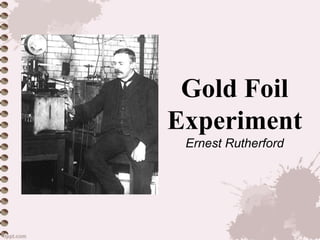
Ernest Rutherford
Ernest
Rutherford
 He is a British physicist and
chemist and known for his
remarkable orbital theory of
the atom in his discovery of
Rutherford dispersion with his
famous Gold Foil experiment.
 He is also known as the “father
of nuclear physics”.
 He was honored with a Nobel
Prize in Chemistry in 1908 for
his exploration into the
disintegration of the elements,
and the chemistry of
radioactive substances.
Gold foil Experiment
 helped describe the nuclear structure of the atom.
The deflection of alpha particles implied the
existence of a dense, positively charged central
region containing most of the atomic mass.
 Rutherford's Gold Foil Experiment proved the
existence of a small massive center to atoms, which
would later be known as the nucleus of an atom.
What is the purpose?
 The purpose of the experiment
is to test the Plum-Pudding
model of J.J. Thomson
Hypothesis of the Experiment
If Thomson’s model is correct, high velocity of
alpha particles should pass through the foil in
straight line because:
1. The mass of the atom is spread out trough
the atom .
2. Very little deflection of the beam of
positively charged particle will result from
the repulsion of the positively-charge
material; and
3. Slight deflection due to collision with
other atom.
Illustration of Gold Foil
• Most of the alpha particles went straight through and
a very small number / a few bounced back / were
reflected.
• Some of the alpha particles were deflected
What did Rutherford do in the
experiment?
 Rutherford and his companions (Hans Geiger,
a German physicist and Ernest Marsden, an
English physicist) hammered a gold foil to a
thin sheet approximately 8.6 x 10^(-6)
centimeters thick.
 The experiment was performed in complete
darkness in order for the light of the alpha
particles to be observed.
Observations:
About 99.9% of the alpha particles passed through
the foil in straight lines
Some were slightly deflected from expected path
Few of the alpha particles were deflected at a right
angles and few were reversed in direction.
Conclusions:
 Most of the atom was empty space because most
of the alpha particles went straight through.
 The nucleus was positively charged because the positive
nucleus repelled the positively charged alpha particles.
 The mass of the atom was concentrated in the
nucleus / the nucleus is very dense (not “large or
heavy”) because the alpha particles were repelled
straight back / at large angles
.

Gold Foil Experiment

  • 1.
  • 2.
    Ernest Rutherford  He isa British physicist and chemist and known for his remarkable orbital theory of the atom in his discovery of Rutherford dispersion with his famous Gold Foil experiment.  He is also known as the “father of nuclear physics”.  He was honored with a Nobel Prize in Chemistry in 1908 for his exploration into the disintegration of the elements, and the chemistry of radioactive substances.
  • 3.
    Gold foil Experiment helped describe the nuclear structure of the atom. The deflection of alpha particles implied the existence of a dense, positively charged central region containing most of the atomic mass.  Rutherford's Gold Foil Experiment proved the existence of a small massive center to atoms, which would later be known as the nucleus of an atom.
  • 4.
    What is thepurpose?  The purpose of the experiment is to test the Plum-Pudding model of J.J. Thomson
  • 5.
    Hypothesis of theExperiment If Thomson’s model is correct, high velocity of alpha particles should pass through the foil in straight line because: 1. The mass of the atom is spread out trough the atom . 2. Very little deflection of the beam of positively charged particle will result from the repulsion of the positively-charge material; and 3. Slight deflection due to collision with other atom.
  • 6.
    Illustration of GoldFoil • Most of the alpha particles went straight through and a very small number / a few bounced back / were reflected. • Some of the alpha particles were deflected
  • 7.
    What did Rutherforddo in the experiment?  Rutherford and his companions (Hans Geiger, a German physicist and Ernest Marsden, an English physicist) hammered a gold foil to a thin sheet approximately 8.6 x 10^(-6) centimeters thick.  The experiment was performed in complete darkness in order for the light of the alpha particles to be observed.
  • 8.
    Observations: About 99.9% ofthe alpha particles passed through the foil in straight lines Some were slightly deflected from expected path Few of the alpha particles were deflected at a right angles and few were reversed in direction.
  • 9.
    Conclusions:  Most ofthe atom was empty space because most of the alpha particles went straight through.  The nucleus was positively charged because the positive nucleus repelled the positively charged alpha particles.  The mass of the atom was concentrated in the nucleus / the nucleus is very dense (not “large or heavy”) because the alpha particles were repelled straight back / at large angles .