ELECTRONIC
STRUCTURE OF
THE ATOM
SECOND QUARTER
ENABLING COMPETENCY
Describe how Bohr’s Model of the atom
improved Rutherford’s Atomic Model.
00
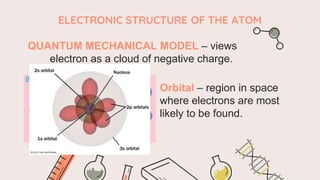
QUANTUM MECHANICAL MODEL – views
electron as a cloud of negative charge.
Orbital – region in space
where electrons are most
likely to be found.
Specifically, the Quantum Mechanical Model
states the following:
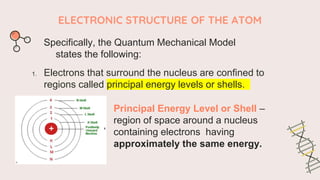
1. Electrons that surround the nucleus are confined to
regions called principal energy levels or shells.
Principal Energy Level or Shell –
region of space around a nucleus
containing electrons having
approximately the same energy.
Specifically, the Quantum Mechanical Model
states the following:
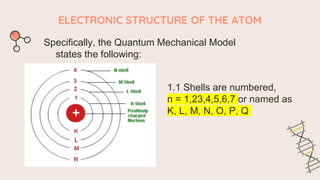
1.1 Shells are numbered,
n = 1,23,4,5,6,7 or named as
K, L, M, N, O, P, Q
Specifically, the Quantum Mechanical Model
states the following:
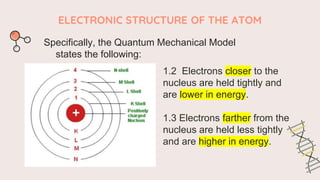
1.2 Electrons closer to the
nucleus are held tightly and
are lower in energy.
1.3 Electrons farther from the
nucleus are held less tightly
and are higher in energy.
Specifically, the Quantum Mechanical Model
states the following:
1.4 It takes an energy to
move an electron away from
the nucleus to an outer circle.
Specifically, the Quantum Mechanical Model
states the following:
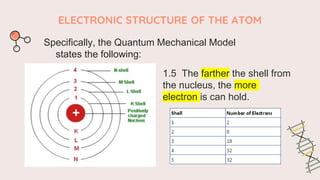
1.5 The farther the shell from
the nucleus, the more
electron is can hold.
Specifically, the Quantum Mechanical Model
states the following:
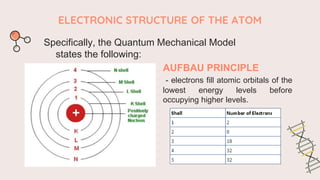
AUFBAU PRINCIPLE
- electrons fill atomic orbitals of the
lowest energy levels before
occupying higher levels.
Specifically, the Quantum Mechanical Model
states the following:
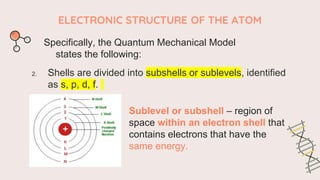
2. Shells are divided into subshells or sublevels, identified
as s, p, d, f.
Sublevel or subshell – region of
space within an electron shell that
contains electrons that have the
same energy.
Specifically, the Quantum Mechanical Model
states the following:
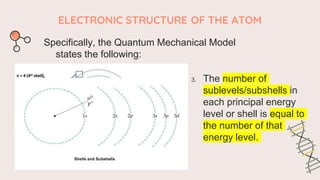
3. The number of
sublevels/subshells in
each principal energy
level or shell is equal to
the number of that
energy level.
Specifically, the Quantum Mechanical Model
states the following:
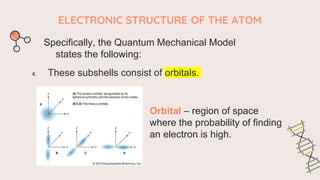
4. These subshells consist of orbitals.
Orbital – region of space
where the probability of finding
an electron is high.
Specifically, the Quantum Mechanical Model
states the following:
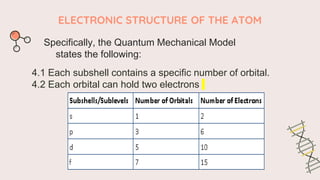
4.1 Each subshell contains a specific number of orbital.
4.2 Each orbital can hold two electrons
Specifically, the Quantum Mechanical Model
states the following:
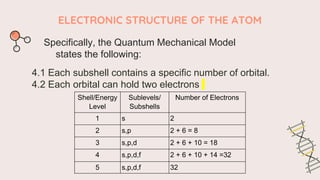
4.1 Each subshell contains a specific number of orbital.
4.2 Each orbital can hold two electrons
Shell/Energy
Level
Sublevels/
Subshells
Number of Electrons
1 s 2
2 s,p 2 + 6 = 8
3 s,p,d 2 + 6 + 10 = 18
4 s,p,d,f 2 + 6 + 10 + 14 =32
5 s,p,d,f 32

Electronic-Structure-of-Atom-Part-I (2).pptx

  • 2.
  • 3.
    SECOND QUARTER ENABLING COMPETENCY Describehow Bohr’s Model of the atom improved Rutherford’s Atomic Model. 00
  • 4.
    QUANTUM MECHANICAL MODEL– views electron as a cloud of negative charge. Orbital – region in space where electrons are most likely to be found.
  • 5.
    Specifically, the QuantumMechanical Model states the following: 1. Electrons that surround the nucleus are confined to regions called principal energy levels or shells. Principal Energy Level or Shell – region of space around a nucleus containing electrons having approximately the same energy.
  • 6.
    Specifically, the QuantumMechanical Model states the following: 1.1 Shells are numbered, n = 1,23,4,5,6,7 or named as K, L, M, N, O, P, Q
  • 7.
    Specifically, the QuantumMechanical Model states the following: 1.2 Electrons closer to the nucleus are held tightly and are lower in energy. 1.3 Electrons farther from the nucleus are held less tightly and are higher in energy.
  • 8.
    Specifically, the QuantumMechanical Model states the following: 1.4 It takes an energy to move an electron away from the nucleus to an outer circle.
  • 9.
    Specifically, the QuantumMechanical Model states the following: 1.5 The farther the shell from the nucleus, the more electron is can hold.
  • 10.
    Specifically, the QuantumMechanical Model states the following: AUFBAU PRINCIPLE - electrons fill atomic orbitals of the lowest energy levels before occupying higher levels.
  • 11.
    Specifically, the QuantumMechanical Model states the following: 2. Shells are divided into subshells or sublevels, identified as s, p, d, f. Sublevel or subshell – region of space within an electron shell that contains electrons that have the same energy.
  • 12.
    Specifically, the QuantumMechanical Model states the following: 3. The number of sublevels/subshells in each principal energy level or shell is equal to the number of that energy level.
  • 13.
    Specifically, the QuantumMechanical Model states the following: 4. These subshells consist of orbitals. Orbital – region of space where the probability of finding an electron is high.
  • 14.
    Specifically, the QuantumMechanical Model states the following: 4.1 Each subshell contains a specific number of orbital. 4.2 Each orbital can hold two electrons
  • 15.
    Specifically, the QuantumMechanical Model states the following: 4.1 Each subshell contains a specific number of orbital. 4.2 Each orbital can hold two electrons Shell/Energy Level Sublevels/ Subshells Number of Electrons 1 s 2 2 s,p 2 + 6 = 8 3 s,p,d 2 + 6 + 10 = 18 4 s,p,d,f 2 + 6 + 10 + 14 =32 5 s,p,d,f 32