NEPHELOMETRY
AND
TURBIDIMETRY
(Nepheloturbidimetry)
By
Mrs. T. A. Mandhare
NEPHELOMETRYAND
TURBIDIMETRY
INTRODUCTION:
When electromagnetic radiation (light) strikes on a particle
in solution(suspension), some part of the light will be absorbed by
the particle, some will be transmitted through the solution and
some of the light will be scattered or reflected.
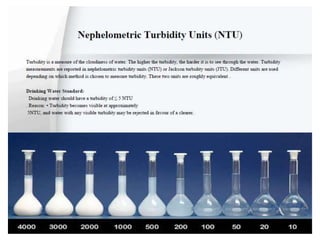
Both nephelometry and turbidimetry are based on the
scattering of light by non-transparent particles suspended in
solution.
The amount of light scattered is proportional to the
concentration of insoluble particle.
However, the two techniques differ only in the manner of
measuring the scattered radiation.
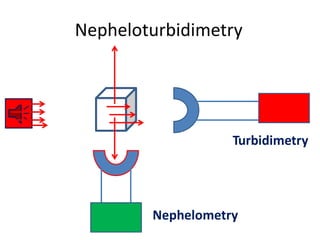
Turbidimetry:
Measurement of the intensity of the transmitted
light as a function of the concentration of
suspended particles.
Nephelometry:
Measurement of the intensity of the scattered
light as a function of the concentration of the
dispersed phase.
THEORY
 Turbidimetry deals with measurement of
Intensity of transmitted light .
 Nephelometry deals with measurement of
Intensity of scattered light.
 Turbidometric measurements are made at
180o from the incident lightbeam.
 In Nephelometry, the intensity of the
scattered light is measured, usually at right
angles to the incident light beam.
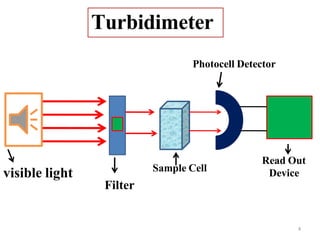
visible light
4
Read Out
Device
Turbidimeter
Filter
Sample Cell
Photocell Detector
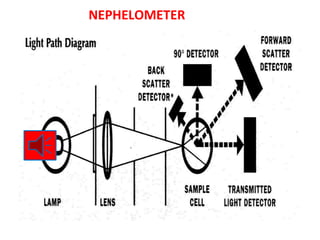
NEPHELOMETER
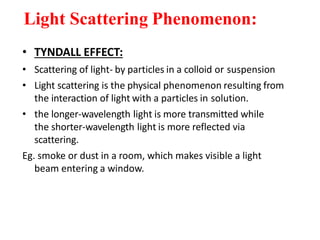
Light Scattering Phenomenon:
• TYNDALL EFFECT:
• Scattering of light- by particles in a colloid or suspension
• Light scattering is the physical phenomenon resulting from
the interaction of light with a particles in solution.
• the longer-wavelength light is more transmitted while
the shorter-wavelength light is more reflected via
scattering.
Eg. smoke or dust in a room, which makes visible a light
beam entering a window.
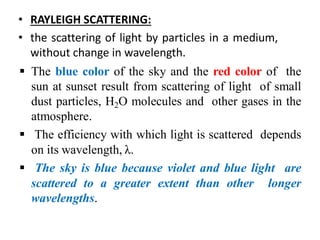
• RAYLEIGH SCATTERING:
• the scattering of light by particles in a medium,
without change in wavelength.
 The blue color of the sky and the red color of the
sun at sunset result from scattering of light of small
dust particles, H2O molecules and other gases in the
atmosphere.
 The efficiency with which light is scattered depends
on its wavelength, λ.
 The sky is blue because violet and blue light are
scattered to a greater extent than other longer
wavelengths.
Turbidimetry
Nephelometry
Nepheloturbidimetry
Factors affecting on scattering of
light:
 Concentration of particles
 Particle size
 Wavelength
 Distance of observation,
 MW of particles
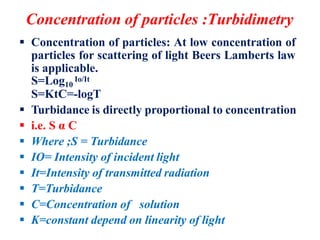
Concentration of particles :Turbidimetry
 Concentration of particles: At low concentration of
particles for scattering of light Beers Lamberts law
is applicable.
S=Log10
Io/It
S=KtC=-logT
 Turbidance is directly proportional to concentration
 i.e. S α C
 Where ;S = Turbidance
 IO= Intensity of incident light
 It=Intensity of transmitted radiation
 T=Turbidance
 C=Concentration of solution
 K=constant depend on linearity of light
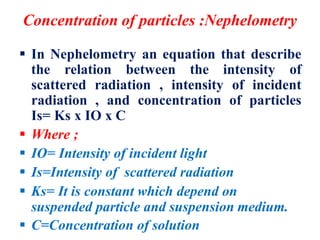
Concentration of particles :Nephelometry
 In Nephelometry an equation that describe
the relation between the intensity of
scattered radiation , intensity of incident
radiation , and concentration of particles
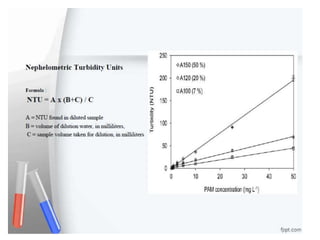
Is= Ks x IO x C
 Where ;
 IO= Intensity of incident light
 Is=Intensity of scattered radiation
 Ks= It is constant which depend on
suspended particle and suspension medium.
 C=Concentration of solution
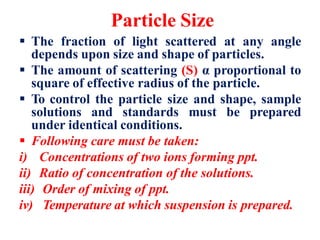
Particle Size
 The fraction of light scattered at any angle
depends upon size and shape of particles.
 The amount of scattering (S) α proportional to
square of effective radius of the particle.
 To control the particle size and shape, sample
solutions and standards must be prepared
under identical conditions.
 Following care must be taken:
i) Concentrations of two ions forming ppt.
ii) Ratio of concentration of the solutions.
iii) Order of mixing of ppt.
iv) Temperature at which suspension is prepared.
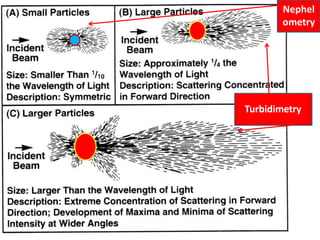
Turbidimetry
Nephel
ometry
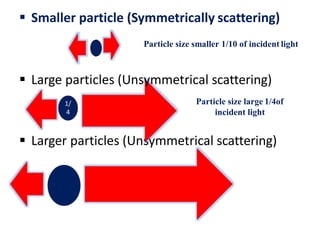
 Larger particles (Unsymmetrical scattering)
1/
4
 Smaller particle (Symmetrically scattering)
Particle size smaller 1/10 of incident light
 Large particles (Unsymmetrical scattering)
Particle size large 1/4of
incident light
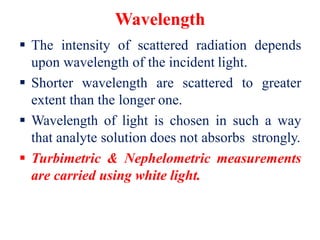
Wavelength
 The intensity of scattered radiation depends
upon wavelength of the incident light.
 Shorter wavelength are scattered to greater
extent than the longer one.
 Wavelength of light is chosen in such a way
that analyte solution does not absorbs strongly.
 Turbimetric & Nephelometric measurements
are carried using white light.
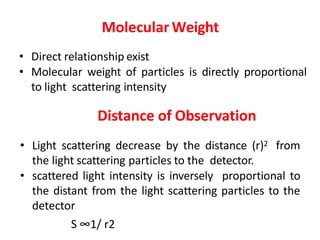
Molecular Weight
• Direct relationship exist
• Molecular weight of particles is directly proportional
to light scattering intensity
Distance of Observation
• Light scattering decrease by the distance (r)2 from
the light scattering particles to the detector.
• scattered light intensity is inversely proportional to
the distant from the light scattering particles to the
detector
S ∞1/ r2
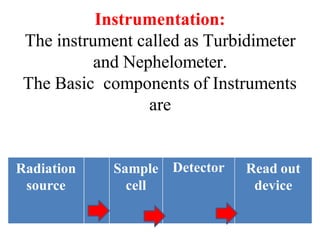
Instrumentation:
The instrument called as Turbidimeter
and Nephelometer.
The Basic components of Instruments
are
Radiation
source
Sample
cell
Detector Read out
device
Instrumentation
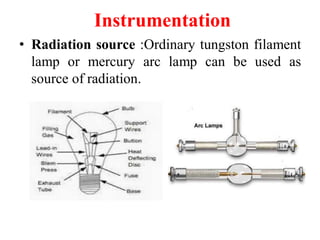
• Radiation source :Ordinary tungston filament
lamp or mercury arc lamp can be used as
source of radiation.
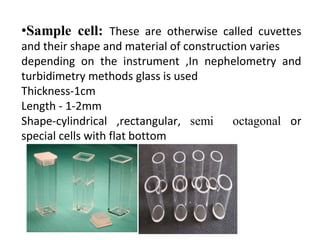
•Sample cell: These are otherwise called cuvettes
and their shape and material of construction varies
depending on the instrument ,In nephelometry and
turbidimetry methods glass is used
Thickness-1cm
Length - 1-2mm
Shape-cylindrical ,rectangular, semi octagonal or
special cells with flat bottom
CHOICE OF THE METHOD
 Choice Of The Method depends upon the
amount of light scattered by suspended
particles present in solution.
- high concentrated TURBIDIMETRY
suspensions.
 NEPHELOMETRY - low concentrated
suspensions - more accurate results
APPLICATION:
• Analysis of water: clarity, conc. of ions
• Determination of CO2
• Determination of inorganic substances:
– Sulphate – barium chloride
– Ammonia – Nesslers reagent
– Phosphorus – Strychine molybedate
• Biochemical Analysis- growth of bacterium, determination of proteins
• Quantitative Analysis – (ppm level)
• Miscellaneous: water treatment plants, sewage work, refineries, paper industry
• Atmospheric pollution: Smokes & fogs
• Determination of molecular Weight of high polymers
• Phase titration.
• Determination of impurities or particulate matter in pharmaceuticals
(injections).
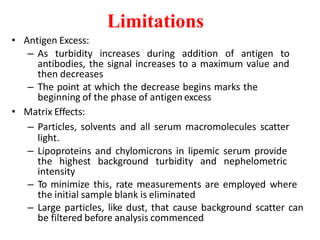
Limitations
• Antigen Excess:
– As turbidity increases during addition of antigen to
antibodies, the signal increases to a maximum value and
then decreases
– The point at which the decrease begins marks the
beginning of the phase of antigen excess
• Matrix Effects:
– Particles, solvents and all serum macromolecules scatter
light.
– Lipoproteins and chylomicrons in lipemic serum provide
the highest background turbidity and nephelometric
intensity
– To minimize this, rate measurements are employed where
the initial sample blank is eliminated
– Large particles, like dust, that cause background scatter can
be filtered before analysis commenced
REFERENCES
1. Instrumental methods of Analysis by Scoog.
2. Instrumental methods of Chemical Analysis
by G.R. Chatwal.
THANK YOU…..

Nephelometryandturbidimetry --

  • 1.
  • 2.
    NEPHELOMETRYAND TURBIDIMETRY INTRODUCTION: When electromagnetic radiation(light) strikes on a particle in solution(suspension), some part of the light will be absorbed by the particle, some will be transmitted through the solution and some of the light will be scattered or reflected. Both nephelometry and turbidimetry are based on the scattering of light by non-transparent particles suspended in solution. The amount of light scattered is proportional to the concentration of insoluble particle. However, the two techniques differ only in the manner of measuring the scattered radiation.
  • 3.
    Turbidimetry: Measurement of theintensity of the transmitted light as a function of the concentration of suspended particles. Nephelometry: Measurement of the intensity of the scattered light as a function of the concentration of the dispersed phase.
  • 4.
    THEORY  Turbidimetry dealswith measurement of Intensity of transmitted light .  Nephelometry deals with measurement of Intensity of scattered light.  Turbidometric measurements are made at 180o from the incident lightbeam.  In Nephelometry, the intensity of the scattered light is measured, usually at right angles to the incident light beam.
  • 5.
  • 6.
  • 7.
    Light Scattering Phenomenon: •TYNDALL EFFECT: • Scattering of light- by particles in a colloid or suspension • Light scattering is the physical phenomenon resulting from the interaction of light with a particles in solution. • the longer-wavelength light is more transmitted while the shorter-wavelength light is more reflected via scattering. Eg. smoke or dust in a room, which makes visible a light beam entering a window.
  • 8.
    • RAYLEIGH SCATTERING: •the scattering of light by particles in a medium, without change in wavelength.  The blue color of the sky and the red color of the sun at sunset result from scattering of light of small dust particles, H2O molecules and other gases in the atmosphere.  The efficiency with which light is scattered depends on its wavelength, λ.  The sky is blue because violet and blue light are scattered to a greater extent than other longer wavelengths.
  • 9.
  • 10.
    Factors affecting onscattering of light:  Concentration of particles  Particle size  Wavelength  Distance of observation,  MW of particles
  • 11.
    Concentration of particles:Turbidimetry  Concentration of particles: At low concentration of particles for scattering of light Beers Lamberts law is applicable. S=Log10 Io/It S=KtC=-logT  Turbidance is directly proportional to concentration  i.e. S α C  Where ;S = Turbidance  IO= Intensity of incident light  It=Intensity of transmitted radiation  T=Turbidance  C=Concentration of solution  K=constant depend on linearity of light
  • 12.
    Concentration of particles:Nephelometry  In Nephelometry an equation that describe the relation between the intensity of scattered radiation , intensity of incident radiation , and concentration of particles Is= Ks x IO x C  Where ;  IO= Intensity of incident light  Is=Intensity of scattered radiation  Ks= It is constant which depend on suspended particle and suspension medium.  C=Concentration of solution
  • 13.
    Particle Size  Thefraction of light scattered at any angle depends upon size and shape of particles.  The amount of scattering (S) α proportional to square of effective radius of the particle.  To control the particle size and shape, sample solutions and standards must be prepared under identical conditions.  Following care must be taken: i) Concentrations of two ions forming ppt. ii) Ratio of concentration of the solutions. iii) Order of mixing of ppt. iv) Temperature at which suspension is prepared.
  • 14.
  • 15.
     Larger particles(Unsymmetrical scattering) 1/ 4  Smaller particle (Symmetrically scattering) Particle size smaller 1/10 of incident light  Large particles (Unsymmetrical scattering) Particle size large 1/4of incident light
  • 16.
    Wavelength  The intensityof scattered radiation depends upon wavelength of the incident light.  Shorter wavelength are scattered to greater extent than the longer one.  Wavelength of light is chosen in such a way that analyte solution does not absorbs strongly.  Turbimetric & Nephelometric measurements are carried using white light.
  • 17.
    Molecular Weight • Directrelationship exist • Molecular weight of particles is directly proportional to light scattering intensity Distance of Observation • Light scattering decrease by the distance (r)2 from the light scattering particles to the detector. • scattered light intensity is inversely proportional to the distant from the light scattering particles to the detector S ∞1/ r2
  • 18.
    Instrumentation: The instrument calledas Turbidimeter and Nephelometer. The Basic components of Instruments are Radiation source Sample cell Detector Read out device
  • 19.
    Instrumentation • Radiation source:Ordinary tungston filament lamp or mercury arc lamp can be used as source of radiation.
  • 20.
    •Sample cell: Theseare otherwise called cuvettes and their shape and material of construction varies depending on the instrument ,In nephelometry and turbidimetry methods glass is used Thickness-1cm Length - 1-2mm Shape-cylindrical ,rectangular, semi octagonal or special cells with flat bottom
  • 23.
    CHOICE OF THEMETHOD  Choice Of The Method depends upon the amount of light scattered by suspended particles present in solution. - high concentrated TURBIDIMETRY suspensions.  NEPHELOMETRY - low concentrated suspensions - more accurate results
  • 24.
    APPLICATION: • Analysis ofwater: clarity, conc. of ions • Determination of CO2 • Determination of inorganic substances: – Sulphate – barium chloride – Ammonia – Nesslers reagent – Phosphorus – Strychine molybedate • Biochemical Analysis- growth of bacterium, determination of proteins • Quantitative Analysis – (ppm level) • Miscellaneous: water treatment plants, sewage work, refineries, paper industry • Atmospheric pollution: Smokes & fogs • Determination of molecular Weight of high polymers • Phase titration. • Determination of impurities or particulate matter in pharmaceuticals (injections).
  • 27.
    Limitations • Antigen Excess: –As turbidity increases during addition of antigen to antibodies, the signal increases to a maximum value and then decreases – The point at which the decrease begins marks the beginning of the phase of antigen excess • Matrix Effects: – Particles, solvents and all serum macromolecules scatter light. – Lipoproteins and chylomicrons in lipemic serum provide the highest background turbidity and nephelometric intensity – To minimize this, rate measurements are employed where the initial sample blank is eliminated – Large particles, like dust, that cause background scatter can be filtered before analysis commenced
  • 28.
    REFERENCES 1. Instrumental methodsof Analysis by Scoog. 2. Instrumental methods of Chemical Analysis by G.R. Chatwal.
  • 29.