ATHEROSCLEROSIS
PRESENTED BY,
S.SHRUTHI
Dr.NGP ARTS AND SCIENCE COLLEGE
COIMBATORE
ATHEROSCLEROSIS
• Disease of cardiovascular system affecting vessel
wall (medium sized muscular arteries and large
elastic arteries).
• It leads to the narrowing of arteries or complete
blockage.
• Its main components are endothelial
dysfunction, lipid deposition, inflammatory
reaction in the vascular wall.
• Remodeling of vessel wall.
• Intense cross-talk between Endothelial Cells,
Vascular Smooth Muscle Cells, plasma-derived
inflammatory cells, lymphocytes
(involves array of chemokines, cytokines, growth
factors).
• Attraction of cells to the sites of atherosclerotic
lesion.
• Migration, proliferation, apoptosis, excess
production of extracellular matrix.
Non modifiable
• Age
• Male Sex,
• Genetic -
Hypercholesterolemia
• Family history
Potentially Modifiable
• Hyperlipidemia – HDL/LDL
ratio.
• Hypertension.
• Smoking.
• Diabetes.
• Life style – sedentary
• Obesity
• Oral contraceptives
RISK FACTORS FOR ATHEROSCLEROSIS
Lesser, or Non quantitated risk
factors
• Obesity
• Physical inactivity
• Stress
• Postmenopausal estrogen deficiency
• High carbohydrate intake
• Alcohol
• Lipoprotein A
• Hardened unsaturated fat intake
• Chlamydia pneumoniae
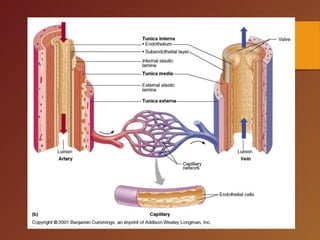
ARTERIAL WALL
• Normally arterial endothelium repels cells and inhibits
blood clotting.
• The lumen of healthy arterial wall is lined by confluent
layer of endothelial cells. There are Three layers:
1. Intima (sub endothelial layer)
2. Media (middle layer) with smooth muscle cells
3. Adventitia (outer layer) with connective tissue and
nerves
• Endothelium controls important function:
1. the ability of blood vessels to dilatate (vasodilatation)
2. the ability of blood vessels to constrict
(vasoconstriction)
• Endothelium regulates tissue and organ blood flow.
• Endothelium releases variety of substances to control
vasomotor tone:
• prostacyclines
• hyperpolarizing factor
• endothelin
• Nitric Oxide
• Exercise is an important mechanical stimulus
mediated by shear stress to increased blood flow.
• Shear stress –represents the frictional force that the
flow of blood exerts at the endothelial surface of the
vessel wall. The flow-dependent dilatation of pre-
capillary resistance as well as conductance allows
blood flow to increase according metabolic demands.
• In the case of intact endothelium, the stimulus for
vasodilatation:
• mechanical stimulation by  blood flow
• Other factors: catecholamines, bradykinin,
platelets-released serotonin stimulate specific
receptors
• In the case of endothelium dysfunction:
• No vasodilator effect
• this action leads to paradoxical
vasoconstriction
(Hypercholesterolemia and other cardiovascular
risk factors are associated with endothelial
dysfunction).
THE DEVELOPMENT OF
ATHEROSCLEROSIS
• The key event – damage to the endothelium caused by
excess of lipoproteins, hypertension, diabetes,
components of cigarette smoke.
• Endothelium becomes more permeable to lipoproteins.
• Lipoproteins move below the endothelial layer (to
intima).
• Endothelium loses its cell-repellent quality.
MAIN FEATURES OF THE INJURY
HYPOTHESIS:
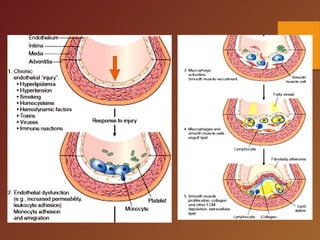
1. Chronic endothelial injury.
2. Insudation of lipoproteins into the vessel wall mainly LDL with high
cholestrol content then oxidation of lesional lipoprotein.
3. Adhesion of blood monocytes & other leukocytes to the endothelium ,
& their migration into the intima & their transformation into
macrophages & foam cells.
4. Adhesion of platelets.
5. Release of factors from activated platelets , macrophages or vascular
endothelial cells that cause migration of Smooth Muscle Cells (SMCs)
from media into the intima.
6. Proliferation of SMCs in the intima , elaboration of extracellular
matrix, leading to accumulation of collagen & proteoglycans.
7. Enhanced accumulation of lipids within macrophages & SMCs &
extracellularly
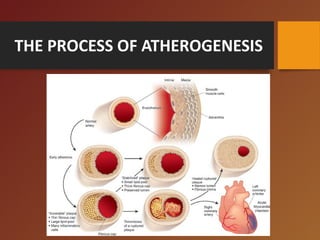
THE PROCESS OF ATHEROGENESIS
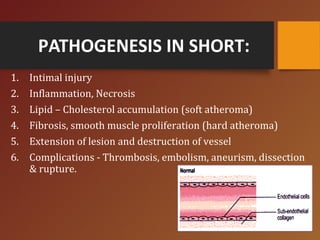
PATHOGENESIS IN SHORT:
1. Intimal injury
2. Inflammation, Necrosis
3. Lipid – Cholesterol accumulation (soft atheroma)
4. Fibrosis, smooth muscle proliferation (hard atheroma)
5. Extension of lesion and destruction of vessel
6. Complications - Thrombosis, embolism, aneurism, dissection
& rupture.
MORPHOLOGY OF ATHEROMA
Atheromatous plaque consists of:
• A raised focal lesion, soft , yellow core of lipids
(mainly cholesterol & cholesterol esters), covered by
a firm, white fibrous cap.
• 0.3-1.5 cms in diameter, sometimes combine to form
larger lesions.
• Involve partial circumference of arterial wall
(eccentric), patchy & variable along the length of
vessel.
• First the patches are focal & sparse then gradually
increase in size & become diffuse
1. Fatty dots
• Not raised , so do not cause obstruction to the flow
• Multiple, yellow , flat spots < than 1mm in diameter
• Composed of lipid laden foam cells
2. Fatty streaks = Combination of multiple fatty dots
• Elongated, 1 cms longer or more
• Contain T- lymphocytes & extracellular lipid < than plaques
• Appear in aorta in some children younger than 1 year & all
children older than 10 years
3. Fatty streaks may be precursor of plaque but not all fatty
streaks are converted into fibrous plaque or more advanced
lesions
COMPONENTS OF ATHEROMATOUS
PLAQUE (MP)
1. Superficial fibrous cap is composed of SMCs & relatively
dense collagen
2. Cellular zone containing, SMCs , macrophages,
Lymphocytes (T cells) Foam cells : Foam cells are
monocytes derived from blood & SMCs can also become
foam cells
3. Deep to the fibrous cap is central necrotic core:
containing a disorganized mass of lipids (cholesterol &
cholesterol esters) cholesterol clefts, debris from dead
cells, foam cells, fibrin
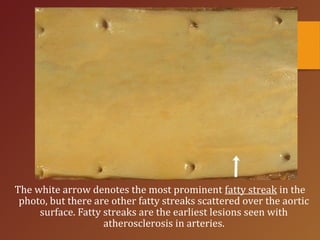
The white arrow denotes the most prominent fatty streak in the
photo, but there are other fatty streaks scattered over the aortic
surface. Fatty streaks are the earliest lesions seen with
atherosclerosis in arteries.
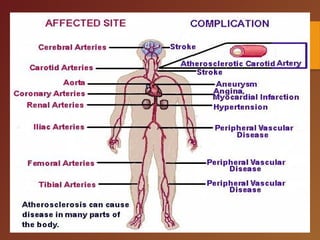
COMPLICATIONS & CLINICAL
SIGNIFICANCE
ATH mostly involves arteries supplying the heart , brain,
Kidneys & lower extremities
1. Myocardial infarction (heart attack)
2. Cerebral infarction (stroke)
3. Chronic Ischemic Heart Disease (reduced blood flow)
4. Ischemic encephalopathy (reduced blood flow)
5. Aortic aneurysms
6. Peripheral vascular disease (gangrene of the legs)
7. Mesenteric occlusion (reduced blood flow)
8. Sudden cardiac death
cardiovascular risk and its
assessment
• Plasma concentration of lipoproteins (LDL-cholesterol, HDL-
cholesterol, and triacylglycerols) –  5.2 mmol/L (200 mg/dL)
increases the risk.
• Optimal level of LDL-cholesterol - 2.6 mmol/L (100 mg/dL)
Thank you!

Atherosclerosis

  • 1.
  • 2.
    ATHEROSCLEROSIS • Disease ofcardiovascular system affecting vessel wall (medium sized muscular arteries and large elastic arteries). • It leads to the narrowing of arteries or complete blockage. • Its main components are endothelial dysfunction, lipid deposition, inflammatory reaction in the vascular wall. • Remodeling of vessel wall.
  • 3.
    • Intense cross-talkbetween Endothelial Cells, Vascular Smooth Muscle Cells, plasma-derived inflammatory cells, lymphocytes (involves array of chemokines, cytokines, growth factors). • Attraction of cells to the sites of atherosclerotic lesion. • Migration, proliferation, apoptosis, excess production of extracellular matrix.
  • 4.
    Non modifiable • Age •Male Sex, • Genetic - Hypercholesterolemia • Family history Potentially Modifiable • Hyperlipidemia – HDL/LDL ratio. • Hypertension. • Smoking. • Diabetes. • Life style – sedentary • Obesity • Oral contraceptives RISK FACTORS FOR ATHEROSCLEROSIS
  • 5.
    Lesser, or Nonquantitated risk factors • Obesity • Physical inactivity • Stress • Postmenopausal estrogen deficiency • High carbohydrate intake • Alcohol • Lipoprotein A • Hardened unsaturated fat intake • Chlamydia pneumoniae
  • 6.
    ARTERIAL WALL • Normallyarterial endothelium repels cells and inhibits blood clotting. • The lumen of healthy arterial wall is lined by confluent layer of endothelial cells. There are Three layers: 1. Intima (sub endothelial layer) 2. Media (middle layer) with smooth muscle cells 3. Adventitia (outer layer) with connective tissue and nerves
  • 8.
    • Endothelium controlsimportant function: 1. the ability of blood vessels to dilatate (vasodilatation) 2. the ability of blood vessels to constrict (vasoconstriction) • Endothelium regulates tissue and organ blood flow. • Endothelium releases variety of substances to control vasomotor tone: • prostacyclines • hyperpolarizing factor • endothelin • Nitric Oxide
  • 9.
    • Exercise isan important mechanical stimulus mediated by shear stress to increased blood flow. • Shear stress –represents the frictional force that the flow of blood exerts at the endothelial surface of the vessel wall. The flow-dependent dilatation of pre- capillary resistance as well as conductance allows blood flow to increase according metabolic demands. • In the case of intact endothelium, the stimulus for vasodilatation: • mechanical stimulation by  blood flow • Other factors: catecholamines, bradykinin, platelets-released serotonin stimulate specific receptors
  • 10.
    • In thecase of endothelium dysfunction: • No vasodilator effect • this action leads to paradoxical vasoconstriction (Hypercholesterolemia and other cardiovascular risk factors are associated with endothelial dysfunction).
  • 11.
    THE DEVELOPMENT OF ATHEROSCLEROSIS •The key event – damage to the endothelium caused by excess of lipoproteins, hypertension, diabetes, components of cigarette smoke. • Endothelium becomes more permeable to lipoproteins. • Lipoproteins move below the endothelial layer (to intima). • Endothelium loses its cell-repellent quality.
  • 13.
    MAIN FEATURES OFTHE INJURY HYPOTHESIS: 1. Chronic endothelial injury. 2. Insudation of lipoproteins into the vessel wall mainly LDL with high cholestrol content then oxidation of lesional lipoprotein. 3. Adhesion of blood monocytes & other leukocytes to the endothelium , & their migration into the intima & their transformation into macrophages & foam cells. 4. Adhesion of platelets. 5. Release of factors from activated platelets , macrophages or vascular endothelial cells that cause migration of Smooth Muscle Cells (SMCs) from media into the intima. 6. Proliferation of SMCs in the intima , elaboration of extracellular matrix, leading to accumulation of collagen & proteoglycans. 7. Enhanced accumulation of lipids within macrophages & SMCs & extracellularly
  • 14.
    THE PROCESS OFATHEROGENESIS
  • 15.
    PATHOGENESIS IN SHORT: 1.Intimal injury 2. Inflammation, Necrosis 3. Lipid – Cholesterol accumulation (soft atheroma) 4. Fibrosis, smooth muscle proliferation (hard atheroma) 5. Extension of lesion and destruction of vessel 6. Complications - Thrombosis, embolism, aneurism, dissection & rupture.
  • 16.
    MORPHOLOGY OF ATHEROMA Atheromatousplaque consists of: • A raised focal lesion, soft , yellow core of lipids (mainly cholesterol & cholesterol esters), covered by a firm, white fibrous cap. • 0.3-1.5 cms in diameter, sometimes combine to form larger lesions. • Involve partial circumference of arterial wall (eccentric), patchy & variable along the length of vessel. • First the patches are focal & sparse then gradually increase in size & become diffuse
  • 17.
    1. Fatty dots •Not raised , so do not cause obstruction to the flow • Multiple, yellow , flat spots < than 1mm in diameter • Composed of lipid laden foam cells 2. Fatty streaks = Combination of multiple fatty dots • Elongated, 1 cms longer or more • Contain T- lymphocytes & extracellular lipid < than plaques • Appear in aorta in some children younger than 1 year & all children older than 10 years 3. Fatty streaks may be precursor of plaque but not all fatty streaks are converted into fibrous plaque or more advanced lesions
  • 18.
    COMPONENTS OF ATHEROMATOUS PLAQUE(MP) 1. Superficial fibrous cap is composed of SMCs & relatively dense collagen 2. Cellular zone containing, SMCs , macrophages, Lymphocytes (T cells) Foam cells : Foam cells are monocytes derived from blood & SMCs can also become foam cells 3. Deep to the fibrous cap is central necrotic core: containing a disorganized mass of lipids (cholesterol & cholesterol esters) cholesterol clefts, debris from dead cells, foam cells, fibrin
  • 19.
    The white arrowdenotes the most prominent fatty streak in the photo, but there are other fatty streaks scattered over the aortic surface. Fatty streaks are the earliest lesions seen with atherosclerosis in arteries.
  • 21.
    COMPLICATIONS & CLINICAL SIGNIFICANCE ATHmostly involves arteries supplying the heart , brain, Kidneys & lower extremities 1. Myocardial infarction (heart attack) 2. Cerebral infarction (stroke) 3. Chronic Ischemic Heart Disease (reduced blood flow) 4. Ischemic encephalopathy (reduced blood flow) 5. Aortic aneurysms 6. Peripheral vascular disease (gangrene of the legs) 7. Mesenteric occlusion (reduced blood flow) 8. Sudden cardiac death
  • 22.
    cardiovascular risk andits assessment • Plasma concentration of lipoproteins (LDL-cholesterol, HDL- cholesterol, and triacylglycerols) –  5.2 mmol/L (200 mg/dL) increases the risk. • Optimal level of LDL-cholesterol - 2.6 mmol/L (100 mg/dL)
  • 23.