
MICROBES FOR
BIOGOODS
PRESENTED BY,
Mrs.S.KOKILA (HOD)
S.SHRUTHI
R.PRIYANKA
DR.N.G.P ARTS AND SCIENCE COLLEGE
COIMBATORE
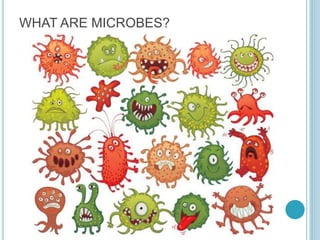
WHAT ARE MICROBES?
A TINY
LITTLE
CREATURE?
SO WHAT ARE THESE TINY LITTLE
CRAETURES?
 There are five main groups of microbes populating our
earth.
 These include BACTERIA, VIRUSES, FUNGI, ALGAE
and PROTOZOA.
 Many of us have a NEGATIVE ASSOCIATION with the
thought of bacteria and viruses.
 When stricken with Stomach Flu, Common Cold,
Infections And Other Ailments, we start to point
fingers at these tiny culprits.
GOOD MICROBES:
 “Good” bacteria, also known as BENEFICIAL BACTERIA, are
defined as any bacteria that are beneficial to the body and
enhance health.
 Of the total bacteria in our bodies, a healthy balance is 85%
Good Bacteria and 15% Bad Bacteria.
 Bacteria can survive in the Harshest Conditions and they are
everywhere; throughout our environment, on our Skin, in our
Mouth and in our Gut.
 Around 100 Trillion Good Bacteria live in and on our bodies.
Many of these bacteria reside in our gut, helping our body
Break Down Food and Absorb Nutrients. Not only do we
live in harmony with these good bacteria, but they
are Essential To Our Survival.
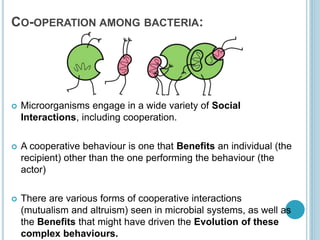
CO-OPERATION AMONG BACTERIA:
 Microorganisms engage in a wide variety of Social
Interactions, including cooperation.
 A cooperative behaviour is one that Benefits an individual (the
recipient) other than the one performing the behaviour (the
actor)
 There are various forms of cooperative interactions
(mutualism and altruism) seen in microbial systems, as well as
the Benefits that might have driven the Evolution of these
complex behaviours.
 Probiotics - Digestive System.
 Lactobacillus Acidophilus - Treat Lactose Intolerance.
 Lactobacillus Rhamnosus - Prevention of Diarrhea.
 Bacillus Coagulans - Prevention of Diarrhea.
 Bifid bacterium Animalis - GI and Urinary tract
 Escherichia Coli - Healthy intestinal tract
 Lactococcus Lactis - Butter milk and cheese
 Lactobacillus Reuteri - Anti-Inflammatory drugs
THESE FUNKY MICROBES MAKE YOUR
FAVOURITE FOODS MORE DELICIOUS:
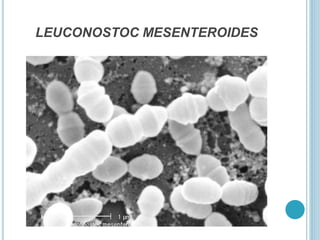
LEUCONOSTOC MESENTEROIDES
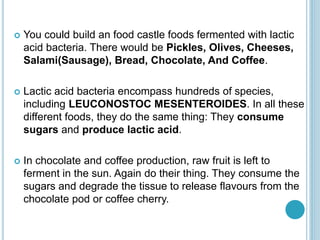
 You could build an food castle foods fermented with lactic
acid bacteria. There would be Pickles, Olives, Cheeses,
Salami(Sausage), Bread, Chocolate, And Coffee.
 Lactic acid bacteria encompass hundreds of species,
including LEUCONOSTOC MESENTEROIDES. In all these
different foods, they do the same thing: They consume
sugars and produce lactic acid.
 In chocolate and coffee production, raw fruit is left to
ferment in the sun. Again do their thing. They consume the
sugars and degrade the tissue to release flavours from the
chocolate pod or coffee cherry.
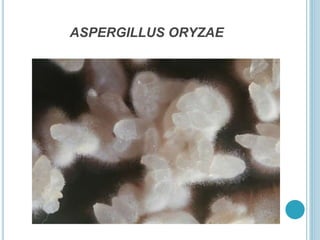
ASPERGILLUS ORYZAE
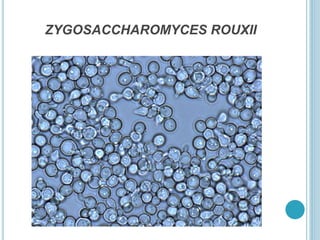
ZYGOSACCHAROMYCES ROUXII
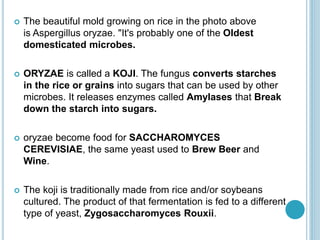
 The beautiful mold growing on rice in the photo above
is Aspergillus oryzae. "It's probably one of the Oldest
domesticated microbes.
 ORYZAE is called a KOJI. The fungus converts starches
in the rice or grains into sugars that can be used by other
microbes. It releases enzymes called Amylases that Break
down the starch into sugars.
 oryzae become food for SACCHAROMYCES
CEREVISIAE, the same yeast used to Brew Beer and
Wine.
 The koji is traditionally made from rice and/or soybeans
cultured. The product of that fermentation is fed to a different
type of yeast, Zygosaccharomyces Rouxii.
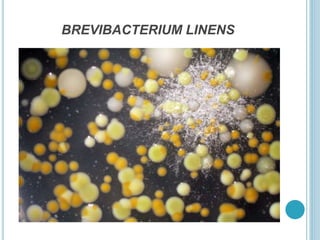
BREVIBACTERIUM LINENS
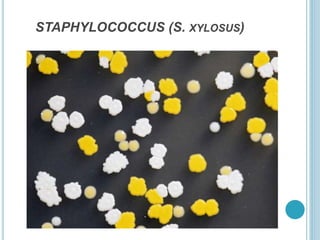
STAPHYLOCOCCUS (S. XYLOSUS)
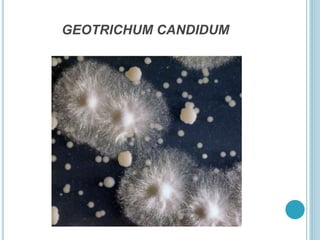
GEOTRICHUM CANDIDUM
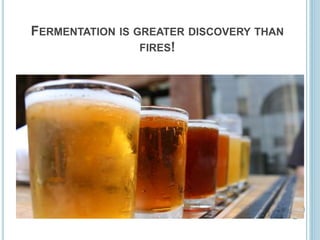
FERMENTATION IS GREATER DISCOVERY THAN
FIRES!
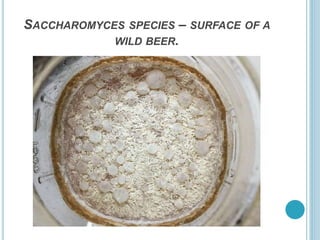
SACCHAROMYCES SPECIES – SURFACE OF A
WILD BEER.
 If microbes had titles, this yeast would be “CHIEF
WINEMAKER". Though other yeasts can help to get the
process moving, S. cerevisiae does the brunt of the work
in virtually all fermentation.
 S. cerevisiae is present in Very Small Amounts, if at all,
on grapes in the vineyard.
 The same species of yeast is used both for Winemaking
and for Leavening Yeast Bread.
 Saccharomyces literally means “SUGAR FUNGUS”.
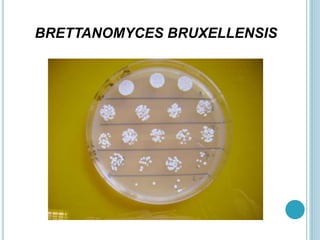
BRETTANOMYCES BRUXELLENSIS
 European brewers have been making Sour Beers for centuries
by allowing whatever microbes happen to blow in through the
brewery windows to have a go at their fermenting grains.
 These beers range from the Slightly sour and funky.
 Lately the trend seems to be taking off in the U.S. "It's a cool
place for brewers to experiment.
 There are many Styles Of Sour Beers, but what they all share
in common is the ADDITION OF MICROBES other than the
standard brewer's yeast, Saccharomyces cerevisiae.
 Most of the sourness comes from lactic acid produced by the
addition of bacteria such
as LACTOBACILLUS and PEDIOCOCCUS.
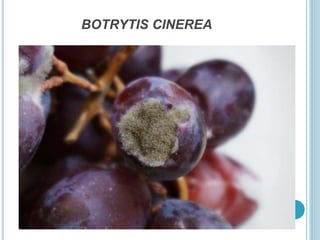
BOTRYTIS CINEREA
 NOBLE ROT, this mold grows on grapes and
essentially turns them into Raisins, Dehydrating
Them and Increasing the sugar concentration.
 "It looks like ROTTEN GRAPES, but it makes these
beautiful wines that are Super Expensive.
 wines are the classic example of an Intensely
Fruity And Aromatic "Botrytized" wine. Craft
brewers have been experimenting with moldy
grapes too:
 DOGFISH HEAD'S NOBLE ROT is one interesting
example. They bill it as combining the best aspects
of Both Wine And Beer.
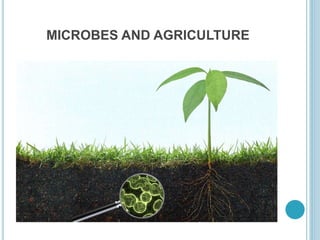
MICROBES AND AGRICULTURE
 Soil fertility depends on three major interacting
components:
Biological,
Chemical
Physical fertility.
 Soil organisms Improve Soil Fertility by performing a
number of functions that are beneficial for plants.
 Some Management Practices may help improve and
maintain the biological fertility of soil.
RELEASING NUTRIENTS FROM ORGANIC
MATTER
 Soil microorganisms are responsible for most of the
Nutrient Release from organic matter.
 When microorganisms decompose organic matter,
they use the Carbon And Nutrients in the organic
matter for their own growth.
 They release Excess Nutrients into the soil where
they can be Taken Up By Plants.
 If the organic matter has a low nutrient content,
micro-organisms will take nutrients from the soil to
meet their requirements.
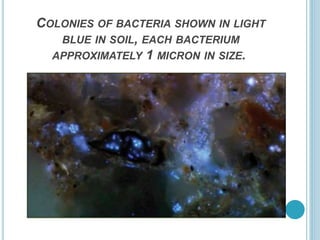
COLONIES OF BACTERIA SHOWN IN LIGHT
BLUE IN SOIL, EACH BACTERIUM
APPROXIMATELY 1 MICRON IN SIZE.
FIXING ATMOSPHERIC NITROGEN
 Symbiotic Nitrogen Fixation is a significant source of
nitrogen for Australian agriculture and may account
for up to 80% of total nitrogen inputs.
 In the symbiosis, Rhizobia or Bradyrhizobia fix
nitrogen gas from the atmosphere and make it available
to the legume.
 In exchange, they Receive Carbon from the legume.
 The symbiosis is Highly Specific and particular species
of Rhizobia and Bradyrhizobia are required for each
legume.
INCREASING PHOSPHORUS AVAILABILITY
 Most agricultural plants (except Lupins and Canola) form a
symbiosis with ARBUSCULAR MYCORRHIZAL (AM) fungi that
can increase phosphorus uptake by the plant.
 The Hyphal strands of AM fungi extend from plant roots into soil
and have access to phosphorus that plant roots cannot reach.
 The AM fungi can Provide Phosphorus to plants and in return they
Receive The Carbon they need to grow.
 Importantly, this symbiosis is only Beneficial for plants when
Available Phosphorus In Soil Is Insufficient For The Plant’s
Requirements.
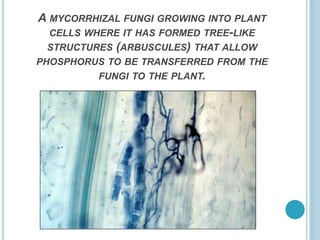
A MYCORRHIZAL FUNGI GROWING INTO PLANT
CELLS WHERE IT HAS FORMED TREE-LIKE
STRUCTURES (ARBUSCULES) THAT ALLOW
PHOSPHORUS TO BE TRANSFERRED FROM THE
FUNGI TO THE PLANT.
DEGRADING PESTICIDES
 The degradation of agricultural pesticides in soil is
primarily performed by microorganisms.
 Some microorganisms in soil produce enzymes
that can break down agricultural pesticides or
other toxic substances added to soil.
 The length of time these substances remain in soil
is related to how easily they are degraded by
microbial enzymes.
CONTROLLING PATHOGENS
 Some microorganisms and soil animals Infect
Plants And Decrease Plant Yield. However many
organisms in the soil Control the spread of
pathogens.
 For example, the occurrence of some pathogenic
fungi in soil is decreased by certain protozoa that
Consume The Pathogenic Fungi.
 The soil Food Web contains many relationships
like this that Decrease the abundance of plant
pathogens.
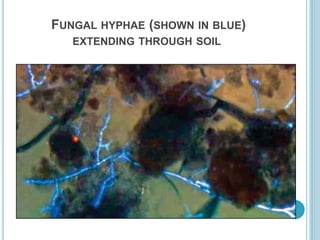
FUNGAL HYPHAE (SHOWN IN BLUE)
EXTENDING THROUGH SOIL
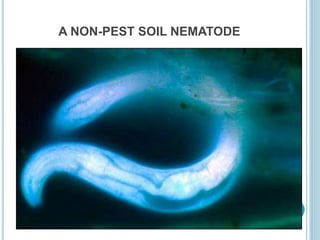
A NON-PEST SOIL NEMATODE
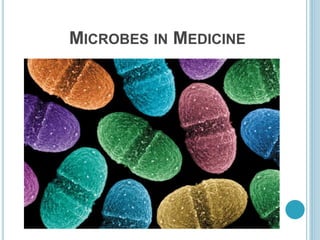
MICROBES IN MEDICINE
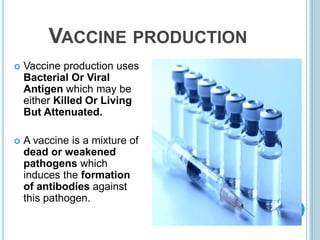
VACCINE PRODUCTION
 Vaccine production uses
Bacterial Or Viral
Antigen which may be
either Killed Or Living
But Attenuated.
 A vaccine is a mixture of
dead or weakened
pathogens which
induces the formation
of antibodies against
this pathogen.
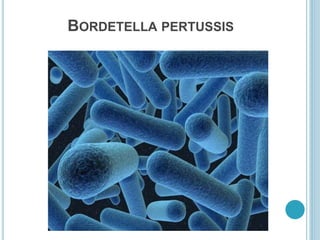
BORDETELLA PERTUSSIS
 Pertussis vaccine is a vaccine that protects against WHOOPING
COUGH
 There are two main types: WHOLE-CELL VACCINES and
ACellular vaccines.
 The whole-cell vaccine is about 78% EFFECTIVE while the
acellular vaccine is 71–85% EFFECTIVE.
 The effectiveness of the vaccines appears to decrease by
between 2 and 10% per year with a more Rapid Decrease with
the acellular vaccines.
 Vaccinating during Pregnancy may protect the baby.
 The vaccine is estimated to have saved over half a million lives
in 2002.The vaccine produced is DPT Vaccine.
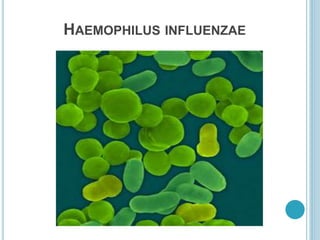
HAEMOPHILUS INFLUENZAE
 Haemophilus influenzae type b (Hib) is one of the leading
causes of Invasive Bacterial Infection in young children
worldwide.
 Because the highest rates of disease occur in the first 2 years of
life, efficacious Hib vaccines have been designed by covalently
linking the PRP capsule to a carrier protein that recruits T-cell
help for the polysaccharide immune response and induces anti-
PRP antibody production even in the first 6 months of life.
 Introduction of Hib protein–polysaccharide conjugate vaccines
into many industrialized countries over the past 15 years has
resulted in the virtual elimination of invasive Hib disease.
 It acts against Epiglottis, meningitis and pneumonia.
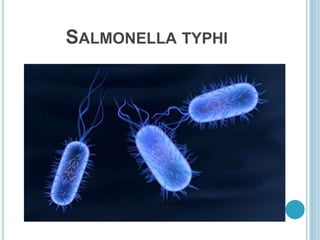
SALMONELLA TYPHI
 Ty21a and Vi capsular polysaccharide vaccine are
effective in Reducing Typhoid Fever with low rates
of adverse effects.
 Newer vaccines such as Vi-rEPA seem promising.
 The oral Ty21a vaccine prevented one-third to one-
half of typhoid cases in the first two years after
vaccination, but had no benefit in the third year.
 The injectable Vi polysaccharide vaccine prevented
about two-thirds of typhoid cases in the first year and
had a cumulative efficacy of 55% by the third year.
Neither vaccine is effective in children under 5 years
old.
 It acts against TYPHOID FEVER.
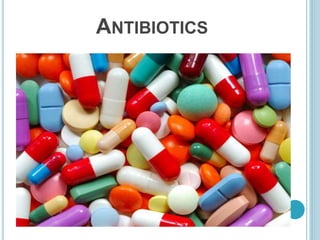
ANTIBIOTICS
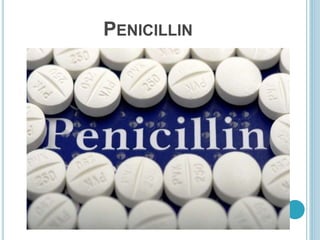
PENICILLIN
 Fleming had devoted much of his career to finding
methods for treating wound infections, and
immediately recognized the importance of a fungal
metabolite that might be used to control bacteria.
 The substance was named penicillin, because the
fungal contaminant was identified as Penicillium
notatum.
 Fleming found that it was effective against many
GRAM POSITIVE BACTERIA in laboratory
conditions, and he even used locally applied, crude
preparations of this substance, from culture filtrates,
to control eye infections.
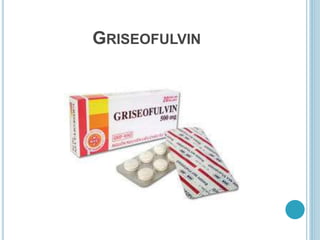
GRISEOFULVIN
 Griseofulvin (from Penicillium, Griseofulvin and
related species) which is used to Treat althlete's
foot and related fungal infections of the skin.
 Griseofulvin is a secondary metabolite produced
from fungal species that have morphology suitable
for solid-state fermentation (SSF).
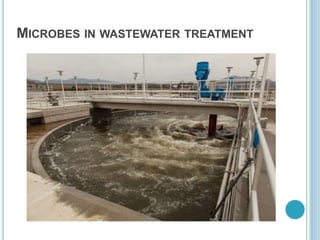
MICROBES IN WASTEWATER TREATMENT
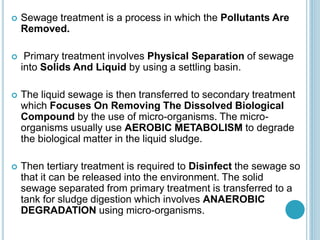
 Sewage treatment is a process in which the Pollutants Are
Removed.
 Primary treatment involves Physical Separation of sewage
into Solids And Liquid by using a settling basin.
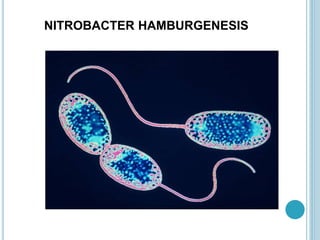
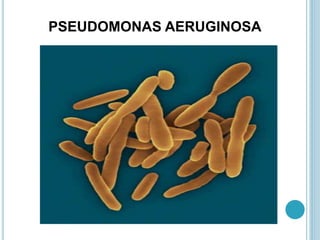
 The liquid sewage is then transferred to secondary treatment
which Focuses On Removing The Dissolved Biological
Compound by the use of micro-organisms. The micro-
organisms usually use AEROBIC METABOLISM to degrade
the biological matter in the liquid sludge.
 Then tertiary treatment is required to Disinfect the sewage so
that it can be released into the environment. The solid
sewage separated from primary treatment is transferred to a
tank for sludge digestion which involves ANAEROBIC
DEGRADATION using micro-organisms.
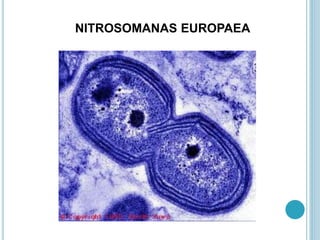
NITROSOMANAS EUROPAEA
NITROBACTER HAMBURGENESIS
PSEUDOMONAS AERUGINOSA
MICROBES IN BIOFUELS
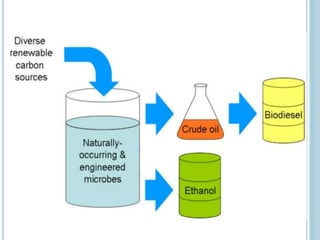
 BIOFUELS are made from living things or the waste
that they produce. One of the most common biofuels,
ETHANOL, is produced from plants.
 The plant material used is the edible part of the plant
such as Sugar Cane (Brazil) and Sugar Beet (France)
or Corn Kernels (USA) because it can Easily Be
Broken Down To Sugar (glucose).
 The sugar can then be Fermented (broken down) to
Ethanol by microbes such as the yeast
Saccharomyces cerevisiae.
 A company in Canada has Harnessed The Microbes
ability to Convert Straw Into Glucose.
 The company genetically Modified The Fungus so that
it produces even Larger quantities of cellulase.
 A staggering 75 % of the straw fibre is converted into
sugar.
 The left over woody matter, lignin, is dried and then
pressed into burnable cakes. The glucose is then
fermented with yeast to produce the Biofuel Ethanol.
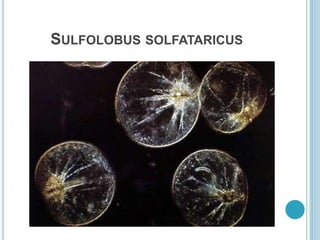
SULFOLOBUS SOLFATARICUS
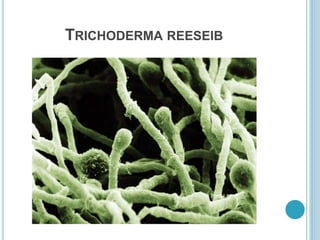
TRICHODERMA REESEIB
 Another common wood digester is the fungus
Trichoderma reesei.
 It is found in nearly all soils and Secretes huge
quantities of cellulase.
 The fungus was originally Discovered by the United
States army during the SECOND World War.
 It was responsible for breaking down the cellulose in
the soldiers’ canvas tents and uniforms which meant
they became very holey. It was known as ‘jungle rot’.
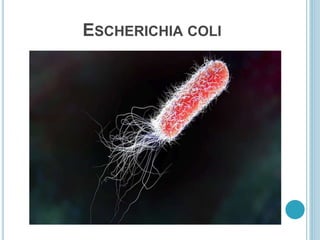
ESCHERICHIA COLI
 E. coli is another Potentially Useful microbe for
Ethanol production.
 This is because E. coli is well known for its ability to
Consume A Wide Variety Of Sugars (unlike Z.
mobilis), and the well-known bacterium is already
very Well Established As an industrial tool.
 E. coli also has the advantage of being the ideal
candidate bacterium for experimentation with
metabolic engineering because it has been so
extensively studied as a Model organism.
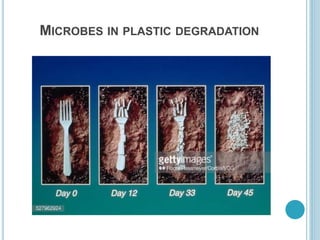
MICROBES IN PLASTIC DEGRADATION
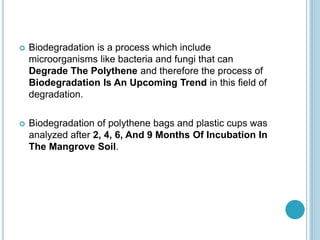
 Biodegradation is a process which include
microorganisms like bacteria and fungi that can
Degrade The Polythene and therefore the process of
Biodegradation Is An Upcoming Trend in this field of
degradation.
 Biodegradation of polythene bags and plastic cups was
analyzed after 2, 4, 6, And 9 Months Of Incubation In
The Mangrove Soil.
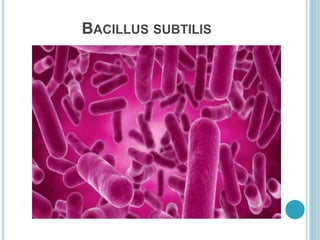
BACILLUS SUBTILIS
 BACILLUS SUBTILIS – was tested for its potential in utilizing
Polyethylene As Their Sole Carbon Source.
 The microbial species produced Surface Active
Compounds (Biosurfactants) That Enhance The
Degradation Process.
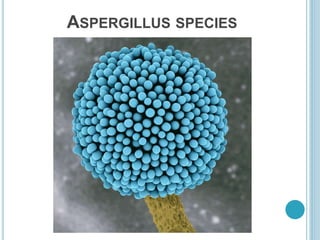
ASPERGILLUS SPECIES
 Moreover, mangrove soil from Niger Delta was also
studied for plastic degrading microbe population.
 Two Aspergillus Species Were Isolated which were
studied for degradation of Low-density polyethylene
(LDPE) and high-density polyethylene (HDPE) films.
 The results obtained showed that the carbon source for
the two Aspergillus species (Aspergillus japonicus and
Aspergillus terreus) was polyethylene films.
 Thus, the results proved that fungi isolated form
mangrove soil of Niger delta can be used for
biodegradation of PE films. LDPE is the most common
solid waste and Accounts for 60% of total plastic
production.
REFERENCE:
 https://www.wired.com/2013/08/microbes-food-
beer/
 http://www.soilquality.org.au/factsheets/soil-
biological-fertility
 https://www.ncbi.nlm.nih.gov/pubmed/15162769
 https://www.ncbi.nlm.nih.gov/pubmedhealth/PMHT0
025078/
THANK YOU!

Microbes for biogoods

  • 1.
    MICROBES FOR BIOGOODS PRESENTED BY, Mrs.S.KOKILA(HOD) S.SHRUTHI R.PRIYANKA DR.N.G.P ARTS AND SCIENCE COLLEGE COIMBATORE
  • 2.
    WHAT ARE MICROBES? ATINY LITTLE CREATURE?
  • 3.
    SO WHAT ARETHESE TINY LITTLE CRAETURES?  There are five main groups of microbes populating our earth.  These include BACTERIA, VIRUSES, FUNGI, ALGAE and PROTOZOA.  Many of us have a NEGATIVE ASSOCIATION with the thought of bacteria and viruses.  When stricken with Stomach Flu, Common Cold, Infections And Other Ailments, we start to point fingers at these tiny culprits.
  • 4.
    GOOD MICROBES:  “Good”bacteria, also known as BENEFICIAL BACTERIA, are defined as any bacteria that are beneficial to the body and enhance health.  Of the total bacteria in our bodies, a healthy balance is 85% Good Bacteria and 15% Bad Bacteria.  Bacteria can survive in the Harshest Conditions and they are everywhere; throughout our environment, on our Skin, in our Mouth and in our Gut.  Around 100 Trillion Good Bacteria live in and on our bodies. Many of these bacteria reside in our gut, helping our body Break Down Food and Absorb Nutrients. Not only do we live in harmony with these good bacteria, but they are Essential To Our Survival.
  • 5.
    CO-OPERATION AMONG BACTERIA: Microorganisms engage in a wide variety of Social Interactions, including cooperation.  A cooperative behaviour is one that Benefits an individual (the recipient) other than the one performing the behaviour (the actor)  There are various forms of cooperative interactions (mutualism and altruism) seen in microbial systems, as well as the Benefits that might have driven the Evolution of these complex behaviours.
  • 6.
     Probiotics -Digestive System.  Lactobacillus Acidophilus - Treat Lactose Intolerance.  Lactobacillus Rhamnosus - Prevention of Diarrhea.  Bacillus Coagulans - Prevention of Diarrhea.  Bifid bacterium Animalis - GI and Urinary tract  Escherichia Coli - Healthy intestinal tract  Lactococcus Lactis - Butter milk and cheese  Lactobacillus Reuteri - Anti-Inflammatory drugs
  • 7.
    THESE FUNKY MICROBESMAKE YOUR FAVOURITE FOODS MORE DELICIOUS:
  • 8.
  • 9.
     You couldbuild an food castle foods fermented with lactic acid bacteria. There would be Pickles, Olives, Cheeses, Salami(Sausage), Bread, Chocolate, And Coffee.  Lactic acid bacteria encompass hundreds of species, including LEUCONOSTOC MESENTEROIDES. In all these different foods, they do the same thing: They consume sugars and produce lactic acid.  In chocolate and coffee production, raw fruit is left to ferment in the sun. Again do their thing. They consume the sugars and degrade the tissue to release flavours from the chocolate pod or coffee cherry.
  • 10.
  • 11.
  • 12.
     The beautifulmold growing on rice in the photo above is Aspergillus oryzae. "It's probably one of the Oldest domesticated microbes.  ORYZAE is called a KOJI. The fungus converts starches in the rice or grains into sugars that can be used by other microbes. It releases enzymes called Amylases that Break down the starch into sugars.  oryzae become food for SACCHAROMYCES CEREVISIAE, the same yeast used to Brew Beer and Wine.  The koji is traditionally made from rice and/or soybeans cultured. The product of that fermentation is fed to a different type of yeast, Zygosaccharomyces Rouxii.
  • 13.
  • 14.
  • 15.
  • 16.
    FERMENTATION IS GREATERDISCOVERY THAN FIRES!
  • 17.
    SACCHAROMYCES SPECIES –SURFACE OF A WILD BEER.
  • 18.
     If microbeshad titles, this yeast would be “CHIEF WINEMAKER". Though other yeasts can help to get the process moving, S. cerevisiae does the brunt of the work in virtually all fermentation.  S. cerevisiae is present in Very Small Amounts, if at all, on grapes in the vineyard.  The same species of yeast is used both for Winemaking and for Leavening Yeast Bread.  Saccharomyces literally means “SUGAR FUNGUS”.
  • 19.
  • 20.
     European brewershave been making Sour Beers for centuries by allowing whatever microbes happen to blow in through the brewery windows to have a go at their fermenting grains.  These beers range from the Slightly sour and funky.  Lately the trend seems to be taking off in the U.S. "It's a cool place for brewers to experiment.  There are many Styles Of Sour Beers, but what they all share in common is the ADDITION OF MICROBES other than the standard brewer's yeast, Saccharomyces cerevisiae.  Most of the sourness comes from lactic acid produced by the addition of bacteria such as LACTOBACILLUS and PEDIOCOCCUS.
  • 21.
  • 22.
     NOBLE ROT,this mold grows on grapes and essentially turns them into Raisins, Dehydrating Them and Increasing the sugar concentration.  "It looks like ROTTEN GRAPES, but it makes these beautiful wines that are Super Expensive.  wines are the classic example of an Intensely Fruity And Aromatic "Botrytized" wine. Craft brewers have been experimenting with moldy grapes too:  DOGFISH HEAD'S NOBLE ROT is one interesting example. They bill it as combining the best aspects of Both Wine And Beer.
  • 23.
  • 24.
     Soil fertilitydepends on three major interacting components: Biological, Chemical Physical fertility.  Soil organisms Improve Soil Fertility by performing a number of functions that are beneficial for plants.  Some Management Practices may help improve and maintain the biological fertility of soil.
  • 25.
    RELEASING NUTRIENTS FROMORGANIC MATTER  Soil microorganisms are responsible for most of the Nutrient Release from organic matter.  When microorganisms decompose organic matter, they use the Carbon And Nutrients in the organic matter for their own growth.  They release Excess Nutrients into the soil where they can be Taken Up By Plants.  If the organic matter has a low nutrient content, micro-organisms will take nutrients from the soil to meet their requirements.
  • 26.
    COLONIES OF BACTERIASHOWN IN LIGHT BLUE IN SOIL, EACH BACTERIUM APPROXIMATELY 1 MICRON IN SIZE.
  • 27.
    FIXING ATMOSPHERIC NITROGEN Symbiotic Nitrogen Fixation is a significant source of nitrogen for Australian agriculture and may account for up to 80% of total nitrogen inputs.  In the symbiosis, Rhizobia or Bradyrhizobia fix nitrogen gas from the atmosphere and make it available to the legume.  In exchange, they Receive Carbon from the legume.  The symbiosis is Highly Specific and particular species of Rhizobia and Bradyrhizobia are required for each legume.
  • 28.
    INCREASING PHOSPHORUS AVAILABILITY Most agricultural plants (except Lupins and Canola) form a symbiosis with ARBUSCULAR MYCORRHIZAL (AM) fungi that can increase phosphorus uptake by the plant.  The Hyphal strands of AM fungi extend from plant roots into soil and have access to phosphorus that plant roots cannot reach.  The AM fungi can Provide Phosphorus to plants and in return they Receive The Carbon they need to grow.  Importantly, this symbiosis is only Beneficial for plants when Available Phosphorus In Soil Is Insufficient For The Plant’s Requirements.
  • 29.
    A MYCORRHIZAL FUNGIGROWING INTO PLANT CELLS WHERE IT HAS FORMED TREE-LIKE STRUCTURES (ARBUSCULES) THAT ALLOW PHOSPHORUS TO BE TRANSFERRED FROM THE FUNGI TO THE PLANT.
  • 30.
    DEGRADING PESTICIDES  Thedegradation of agricultural pesticides in soil is primarily performed by microorganisms.  Some microorganisms in soil produce enzymes that can break down agricultural pesticides or other toxic substances added to soil.  The length of time these substances remain in soil is related to how easily they are degraded by microbial enzymes.
  • 31.
    CONTROLLING PATHOGENS  Somemicroorganisms and soil animals Infect Plants And Decrease Plant Yield. However many organisms in the soil Control the spread of pathogens.  For example, the occurrence of some pathogenic fungi in soil is decreased by certain protozoa that Consume The Pathogenic Fungi.  The soil Food Web contains many relationships like this that Decrease the abundance of plant pathogens.
  • 32.
    FUNGAL HYPHAE (SHOWNIN BLUE) EXTENDING THROUGH SOIL
  • 33.
  • 34.
  • 35.
    VACCINE PRODUCTION  Vaccineproduction uses Bacterial Or Viral Antigen which may be either Killed Or Living But Attenuated.  A vaccine is a mixture of dead or weakened pathogens which induces the formation of antibodies against this pathogen.
  • 36.
  • 37.
     Pertussis vaccineis a vaccine that protects against WHOOPING COUGH  There are two main types: WHOLE-CELL VACCINES and ACellular vaccines.  The whole-cell vaccine is about 78% EFFECTIVE while the acellular vaccine is 71–85% EFFECTIVE.  The effectiveness of the vaccines appears to decrease by between 2 and 10% per year with a more Rapid Decrease with the acellular vaccines.  Vaccinating during Pregnancy may protect the baby.  The vaccine is estimated to have saved over half a million lives in 2002.The vaccine produced is DPT Vaccine.
  • 38.
  • 39.
     Haemophilus influenzaetype b (Hib) is one of the leading causes of Invasive Bacterial Infection in young children worldwide.  Because the highest rates of disease occur in the first 2 years of life, efficacious Hib vaccines have been designed by covalently linking the PRP capsule to a carrier protein that recruits T-cell help for the polysaccharide immune response and induces anti- PRP antibody production even in the first 6 months of life.  Introduction of Hib protein–polysaccharide conjugate vaccines into many industrialized countries over the past 15 years has resulted in the virtual elimination of invasive Hib disease.  It acts against Epiglottis, meningitis and pneumonia.
  • 40.
  • 41.
     Ty21a andVi capsular polysaccharide vaccine are effective in Reducing Typhoid Fever with low rates of adverse effects.  Newer vaccines such as Vi-rEPA seem promising.  The oral Ty21a vaccine prevented one-third to one- half of typhoid cases in the first two years after vaccination, but had no benefit in the third year.  The injectable Vi polysaccharide vaccine prevented about two-thirds of typhoid cases in the first year and had a cumulative efficacy of 55% by the third year. Neither vaccine is effective in children under 5 years old.  It acts against TYPHOID FEVER.
  • 42.
  • 43.
  • 44.
     Fleming haddevoted much of his career to finding methods for treating wound infections, and immediately recognized the importance of a fungal metabolite that might be used to control bacteria.  The substance was named penicillin, because the fungal contaminant was identified as Penicillium notatum.  Fleming found that it was effective against many GRAM POSITIVE BACTERIA in laboratory conditions, and he even used locally applied, crude preparations of this substance, from culture filtrates, to control eye infections.
  • 45.
  • 46.
     Griseofulvin (fromPenicillium, Griseofulvin and related species) which is used to Treat althlete's foot and related fungal infections of the skin.  Griseofulvin is a secondary metabolite produced from fungal species that have morphology suitable for solid-state fermentation (SSF).
  • 47.
  • 48.
     Sewage treatmentis a process in which the Pollutants Are Removed.  Primary treatment involves Physical Separation of sewage into Solids And Liquid by using a settling basin.  The liquid sewage is then transferred to secondary treatment which Focuses On Removing The Dissolved Biological Compound by the use of micro-organisms. The micro- organisms usually use AEROBIC METABOLISM to degrade the biological matter in the liquid sludge.  Then tertiary treatment is required to Disinfect the sewage so that it can be released into the environment. The solid sewage separated from primary treatment is transferred to a tank for sludge digestion which involves ANAEROBIC DEGRADATION using micro-organisms.
  • 49.
  • 50.
  • 51.
  • 52.
  • 53.
     BIOFUELS aremade from living things or the waste that they produce. One of the most common biofuels, ETHANOL, is produced from plants.  The plant material used is the edible part of the plant such as Sugar Cane (Brazil) and Sugar Beet (France) or Corn Kernels (USA) because it can Easily Be Broken Down To Sugar (glucose).  The sugar can then be Fermented (broken down) to Ethanol by microbes such as the yeast Saccharomyces cerevisiae.
  • 55.
     A companyin Canada has Harnessed The Microbes ability to Convert Straw Into Glucose.  The company genetically Modified The Fungus so that it produces even Larger quantities of cellulase.  A staggering 75 % of the straw fibre is converted into sugar.  The left over woody matter, lignin, is dried and then pressed into burnable cakes. The glucose is then fermented with yeast to produce the Biofuel Ethanol.
  • 56.
  • 57.
  • 58.
     Another commonwood digester is the fungus Trichoderma reesei.  It is found in nearly all soils and Secretes huge quantities of cellulase.  The fungus was originally Discovered by the United States army during the SECOND World War.  It was responsible for breaking down the cellulose in the soldiers’ canvas tents and uniforms which meant they became very holey. It was known as ‘jungle rot’.
  • 59.
  • 60.
     E. coliis another Potentially Useful microbe for Ethanol production.  This is because E. coli is well known for its ability to Consume A Wide Variety Of Sugars (unlike Z. mobilis), and the well-known bacterium is already very Well Established As an industrial tool.  E. coli also has the advantage of being the ideal candidate bacterium for experimentation with metabolic engineering because it has been so extensively studied as a Model organism.
  • 61.
  • 62.
     Biodegradation isa process which include microorganisms like bacteria and fungi that can Degrade The Polythene and therefore the process of Biodegradation Is An Upcoming Trend in this field of degradation.  Biodegradation of polythene bags and plastic cups was analyzed after 2, 4, 6, And 9 Months Of Incubation In The Mangrove Soil.
  • 63.
  • 64.
     BACILLUS SUBTILIS– was tested for its potential in utilizing Polyethylene As Their Sole Carbon Source.  The microbial species produced Surface Active Compounds (Biosurfactants) That Enhance The Degradation Process.
  • 65.
  • 66.
     Moreover, mangrovesoil from Niger Delta was also studied for plastic degrading microbe population.  Two Aspergillus Species Were Isolated which were studied for degradation of Low-density polyethylene (LDPE) and high-density polyethylene (HDPE) films.  The results obtained showed that the carbon source for the two Aspergillus species (Aspergillus japonicus and Aspergillus terreus) was polyethylene films.  Thus, the results proved that fungi isolated form mangrove soil of Niger delta can be used for biodegradation of PE films. LDPE is the most common solid waste and Accounts for 60% of total plastic production.
  • 67.
    REFERENCE:  https://www.wired.com/2013/08/microbes-food- beer/  http://www.soilquality.org.au/factsheets/soil- biological-fertility https://www.ncbi.nlm.nih.gov/pubmed/15162769  https://www.ncbi.nlm.nih.gov/pubmedhealth/PMHT0 025078/
  • 68.