1
Product
Product is defined as a goods, a service, an idea, or any combination of these. Considerations—
brand name, packaging, labeling, trademark, warranties. Or product is the item offered for sale.
A product can be a service or an item. It can be physical or in virtual or cyber form. Every
product is made at a cost and each is sold at a price.
Q. Described products life cycle & how marketing strategy change during the products life
cycle?
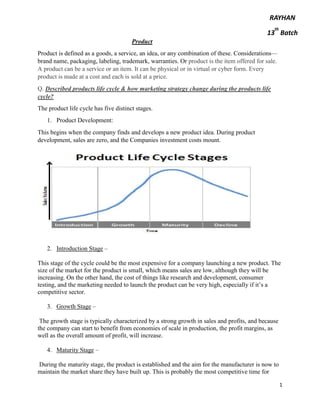
The product life cycle has five distinct stages.
1. Product Development:
This begins when the company finds and develops a new product idea. During product
development, sales are zero, and the Companies investment costs mount.
2. Introduction Stage –
This stage of the cycle could be the most expensive for a company launching a new product. The
size of the market for the product is small, which means sales are low, although they will be
increasing. On the other hand, the cost of things like research and development, consumer
testing, and the marketing needed to launch the product can be very high, especially if it’s a
competitive sector.
3. Growth Stage –
The growth stage is typically characterized by a strong growth in sales and profits, and because
the company can start to benefit from economies of scale in production, the profit margins, as
well as the overall amount of profit, will increase.
4. Maturity Stage –
During the maturity stage, the product is established and the aim for the manufacturer is now to
maintain the market share they have built up. This is probably the most competitive time for
RAYHAN
13
th
Batch
2
most products and businesses need to invest wisely in any marketing they undertake. They also
need to consider any product modifications or improvements to the production process which
might give them a competitive advantage.
5. Decline Stage –
This is the period when sales fall off and profits drop.
Q. Describe major steps in the new product development stages process?
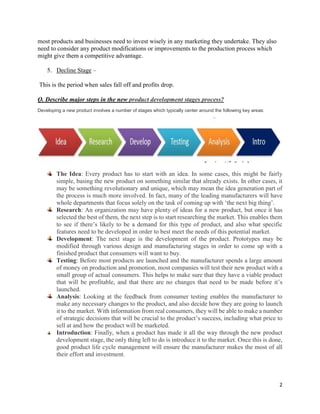
Developing a new product involves a number of stages which typically center around the following key areas:
The Idea: Every product has to start with an idea. In some cases, this might be fairly
simple, basing the new product on something similar that already exists. In other cases, it
may be something revolutionary and unique, which may mean the idea generation part of
the process is much more involved. In fact, many of the leading manufacturers will have
whole departments that focus solely on the task of coming up with ‘the next big thing’.
Research: An organization may have plenty of ideas for a new product, but once it has
selected the best of them, the next step is to start researching the market. This enables them
to see if there’s likely to be a demand for this type of product, and also what specific
features need to be developed in order to best meet the needs of this potential market.
Development: The next stage is the development of the product. Prototypes may be
modified through various design and manufacturing stages in order to come up with a
finished product that consumers will want to buy.
Testing: Before most products are launched and the manufacturer spends a large amount
of money on production and promotion, most companies will test their new product with a
small group of actual consumers. This helps to make sure that they have a viable product
that will be profitable, and that there are no changes that need to be made before it’s
launched.
Analysis: Looking at the feedback from consumer testing enables the manufacturer to
make any necessary changes to the product, and also decide how they are going to launch
it to the market. With information from real consumers, they will be able to make a number
of strategic decisions that will be crucial to the product’s success, including what price to
sell at and how the product will be marketed.
Introduction: Finally, when a product has made it all the way through the new product
development stage, the only thing left to do is introduce it to the market. Once this is done,
good product life cycle management will ensure the manufacturer makes the most of all
their effort and investment.
3
Q. What is brand executive? Write down the job responsibility of brand executive in
pharmaceutical company?
The Brand Executive implements plans and initiatives relating to the brand, customer experience
and loyalty in order to drive the organization's brand equity. This individual conducts market
research to forecast emerging market needs relevant to the organization. The role works in a fast-
paced and dynamic environment, and requires a person who can ensure compliance of the brand
identity throughout the organization.
Job responsibility of brand executive in pharmaceutical company given below:
Plan, develop and direct marketing efforts for his/her brand
Create tactics and strategies to take advantage of market opportunities
Analyze sales data to update a brand portfolio
Training field staff
Conducting cycle /briefing meetings at regular intervals
Ensure that his/her brands resonate with current prescribers and potential prescribers
Do a regular brand audit
Have an in-depth knowledge of competition
Develop, and execute marketing initiatives and activities for his/her brand
Develop P&L
Interpret data correctly and convert into information
The correctness of customers list for the brand
Driving market growth & Return on investment
The desired market share – leadership
The desired growth of the brand & The bottom-line
Classification of Products
1. Consumer Products:
A product bought by final consumers for personal consumption. Marketers usually
classify these product are as follows:-
i. Convenience Products
ii. Shopping Products
iii. Specialty Products
i. Convenience Product: These products consumer usually buy frequently, immediately,
and with minimal comparison and buying effort. Examples: Toothpaste, magazines,
detergent.
ii. Shopping Products: These products are less frequently purchased consumer products
and services that consumers compare carefully on suitability, price, quality and style.
Examples: Televisions, Furniture, Clothing.
iii. Specialty products: A consumer product with unique characteristics or brand
identification for which a significant group of buyers is willing to make a special
purchase efforts. Examples: Luxury goods (Ornaments).
4
2. Industrial Products:
A product brought by individuals and organizations for further processing or for
use in conducting a business.
There are three groups of industrial products such as:-
i. Materials and Parts: Cotton, Iron, Cement.
ii. Capital Items: Generators, Elevators, Fax.
iii. Supplies and services: Paper, Coal, Lubricants, Paints.
Q. Objectives of products management department?
I. Right quality-The quality of product is established based upon the customers needs. The
right quality is not necessarily best quality. It is determined by the cost of the product and
the technical characteristics as suited to the specific requirements.
II. Right quantity-The manufacturing organization should produce the products in right
number. If they are produced in excess of demand the capital will block up in the form of
inventory and if the quantity is produced in short of demand, leads to shortage of
products.
III. Right time -Timeliness of delivery is one of the important parameter to judge the
effectiveness of production department. So, the production department has to make the
optimal utilization of input resources to achieve its objective.
IV. Right manufacturing cost-Manufacturing costs are established before the product is
actually manufactured. Hence, all attempts should be made to produce the products at
pre-established cost, so as to reduce the variation between actual and the standard (pre-
established) cost.

Product PDF

  • 1.
    1 Product Product is definedas a goods, a service, an idea, or any combination of these. Considerations— brand name, packaging, labeling, trademark, warranties. Or product is the item offered for sale. A product can be a service or an item. It can be physical or in virtual or cyber form. Every product is made at a cost and each is sold at a price. Q. Described products life cycle & how marketing strategy change during the products life cycle? The product life cycle has five distinct stages. 1. Product Development: This begins when the company finds and develops a new product idea. During product development, sales are zero, and the Companies investment costs mount. 2. Introduction Stage – This stage of the cycle could be the most expensive for a company launching a new product. The size of the market for the product is small, which means sales are low, although they will be increasing. On the other hand, the cost of things like research and development, consumer testing, and the marketing needed to launch the product can be very high, especially if it’s a competitive sector. 3. Growth Stage – The growth stage is typically characterized by a strong growth in sales and profits, and because the company can start to benefit from economies of scale in production, the profit margins, as well as the overall amount of profit, will increase. 4. Maturity Stage – During the maturity stage, the product is established and the aim for the manufacturer is now to maintain the market share they have built up. This is probably the most competitive time for RAYHAN 13 th Batch
  • 2.
    2 most products andbusinesses need to invest wisely in any marketing they undertake. They also need to consider any product modifications or improvements to the production process which might give them a competitive advantage. 5. Decline Stage – This is the period when sales fall off and profits drop. Q. Describe major steps in the new product development stages process? Developing a new product involves a number of stages which typically center around the following key areas: The Idea: Every product has to start with an idea. In some cases, this might be fairly simple, basing the new product on something similar that already exists. In other cases, it may be something revolutionary and unique, which may mean the idea generation part of the process is much more involved. In fact, many of the leading manufacturers will have whole departments that focus solely on the task of coming up with ‘the next big thing’. Research: An organization may have plenty of ideas for a new product, but once it has selected the best of them, the next step is to start researching the market. This enables them to see if there’s likely to be a demand for this type of product, and also what specific features need to be developed in order to best meet the needs of this potential market. Development: The next stage is the development of the product. Prototypes may be modified through various design and manufacturing stages in order to come up with a finished product that consumers will want to buy. Testing: Before most products are launched and the manufacturer spends a large amount of money on production and promotion, most companies will test their new product with a small group of actual consumers. This helps to make sure that they have a viable product that will be profitable, and that there are no changes that need to be made before it’s launched. Analysis: Looking at the feedback from consumer testing enables the manufacturer to make any necessary changes to the product, and also decide how they are going to launch it to the market. With information from real consumers, they will be able to make a number of strategic decisions that will be crucial to the product’s success, including what price to sell at and how the product will be marketed. Introduction: Finally, when a product has made it all the way through the new product development stage, the only thing left to do is introduce it to the market. Once this is done, good product life cycle management will ensure the manufacturer makes the most of all their effort and investment.
  • 3.
    3 Q. What isbrand executive? Write down the job responsibility of brand executive in pharmaceutical company? The Brand Executive implements plans and initiatives relating to the brand, customer experience and loyalty in order to drive the organization's brand equity. This individual conducts market research to forecast emerging market needs relevant to the organization. The role works in a fast- paced and dynamic environment, and requires a person who can ensure compliance of the brand identity throughout the organization. Job responsibility of brand executive in pharmaceutical company given below: Plan, develop and direct marketing efforts for his/her brand Create tactics and strategies to take advantage of market opportunities Analyze sales data to update a brand portfolio Training field staff Conducting cycle /briefing meetings at regular intervals Ensure that his/her brands resonate with current prescribers and potential prescribers Do a regular brand audit Have an in-depth knowledge of competition Develop, and execute marketing initiatives and activities for his/her brand Develop P&L Interpret data correctly and convert into information The correctness of customers list for the brand Driving market growth & Return on investment The desired market share – leadership The desired growth of the brand & The bottom-line Classification of Products 1. Consumer Products: A product bought by final consumers for personal consumption. Marketers usually classify these product are as follows:- i. Convenience Products ii. Shopping Products iii. Specialty Products i. Convenience Product: These products consumer usually buy frequently, immediately, and with minimal comparison and buying effort. Examples: Toothpaste, magazines, detergent. ii. Shopping Products: These products are less frequently purchased consumer products and services that consumers compare carefully on suitability, price, quality and style. Examples: Televisions, Furniture, Clothing. iii. Specialty products: A consumer product with unique characteristics or brand identification for which a significant group of buyers is willing to make a special purchase efforts. Examples: Luxury goods (Ornaments).
  • 4.
    4 2. Industrial Products: Aproduct brought by individuals and organizations for further processing or for use in conducting a business. There are three groups of industrial products such as:- i. Materials and Parts: Cotton, Iron, Cement. ii. Capital Items: Generators, Elevators, Fax. iii. Supplies and services: Paper, Coal, Lubricants, Paints. Q. Objectives of products management department? I. Right quality-The quality of product is established based upon the customers needs. The right quality is not necessarily best quality. It is determined by the cost of the product and the technical characteristics as suited to the specific requirements. II. Right quantity-The manufacturing organization should produce the products in right number. If they are produced in excess of demand the capital will block up in the form of inventory and if the quantity is produced in short of demand, leads to shortage of products. III. Right time -Timeliness of delivery is one of the important parameter to judge the effectiveness of production department. So, the production department has to make the optimal utilization of input resources to achieve its objective. IV. Right manufacturing cost-Manufacturing costs are established before the product is actually manufactured. Hence, all attempts should be made to produce the products at pre-established cost, so as to reduce the variation between actual and the standard (pre- established) cost.