The
polymerase
chain reaction
Prepared By:
Ravindra Kumar Kachhap Oraon
Education Qualification: B.Sc. (H) Biotechnology, M.Sc. Biotechnology
Biotechnologist, Researcher, Entrepreneur
Basic
Introduction
ABOUT
PCR
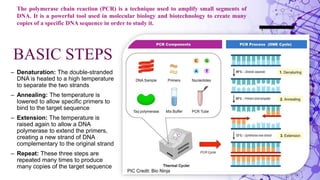
BASIC STEPS
– Denaturation: The double-stranded
DNA is heated to a high temperature
to separate the two strands
– Annealing: The temperature is
lowered to allow specific primers to
bind to the target sequence
– Extension: The temperature is
raised again to allow a DNA
polymerase to extend the primers,
creating a new strand of DNA
complementary to the original strand
– Repeat: These three steps are
repeated many times to produce
many copies of the target sequence
PIC Credit: Bio Ninja
The polymerase chain reaction (PCR) is a technique used to amplify small segments of
DNA. It is a powerful tool used in molecular biology and biotechnology to create many
copies of a specific DNA sequence in order to study it.
Applications of PCR include
the detection and diagnosis
of disease, genetic
engineering, forensic science,
and evolutionary biology.
Here are some additional
details on PCR techniques
and applications:
Real-time PCR : This technique is used to measure the amount of amplified DNA as the reaction
is ongoing
Reverse transcription PCR : This technique is used to amplify RNA, for example for the study of
gene expression
Long PCR: This technique is used to amplify longer segments of DNA than is possible with
standard PCR
Multiplex PCR: This technique is used to amplify multiple target sequences in a single reaction
High-Fidelity PCR: This technique is used to minimize errors in the amplified DNA, such as
insertion, deletion or substitution mutations, this technique is particularly useful for cloning or
sequencing applications
In situ PCR: This technique is used to amplify DNA or RNA within a cell or tissue sample
APPLICATIONS
– PCR-based Diagnostics: It's widely
used in Clinical Microbiology and
infectious diseases to detect the
presence or absence of specific
microorganisms in a patient sample
– Cloning and Library Construction:
PCR is a crucial step in the molecular
cloning of genes, also creating cDNA
libraries and Genomic libraries
PCR Protocol
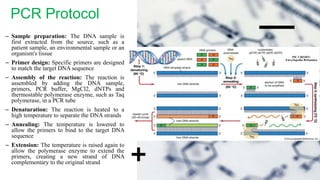
– Sample preparation: The DNA sample is
first extracted from the source, such as a
patient sample, an environmental sample or an
organism's tissue
– Primer design: Specific primers are designed
to match the target DNA sequence
– Assembly of the reaction: The reaction is
assembled by adding the DNA sample,
primers, PCR buffer, MgCl2, dNTPs and
thermostable polymerase enzyme, such as Taq
polymerase, in a PCR tube
– Denaturation: The reaction is heated to a
high temperature to separate the DNA strands
– Annealing: The temperature is lowered to
allow the primers to bind to the target DNA
sequence
– Extension: The temperature is raised again to
allow the polymerase enzyme to extend the
primers, creating a new strand of DNA
complementary to the original strand
PIC CREDIT:
Encyclopedia Britannica
PCR Protocol
– Repeat: These three steps are
repeated many times to produce
many copies of the target
sequence
– Analysis: The amplified DNA can
be analyzed by various methods
such as gel electrophoresis,
PCR-based diagnostic tests,
NGS or other methods
ADVANTAGES
High sensitivity and specificity: PCR can detect and amplify
very small amounts of DNA, making it useful for the detection
and diagnosis of disease, as well as for the study of ancient or
degraded DNA samples
Amplification: PCR allows for the rapid and efficient
amplification of specific DNA sequences, making it useful for
many applications, such as genetic engineering, forensics,
and evolutionary biology
Versatility: PCR can be adapted to a wide range of
applications, such as detection of microorganisms, genetic
mutations, or gene expression, by using different primers,
enzymes, or protocols
Speed: PCR is a relatively fast method for amplifying DNA
and can produce results in a matter of hours, rather than days
or weeks
DISADVANTAGES
Inaccuracies: PCR can introduce errors into the amplified DNA, such as
insertion, deletion, or substitution mutations
Sample preparation: PCR requires that the DNA sample be of high quality
and free of contaminants such as salts, proteins, or other nucleic acids
False positives: In PCR-based diagnostic tests, false positives can occur due
to contamination of the reagents, which can lead to false diagnoses
Cost: Some of the newer versions of PCR such as Digital PCR or RT-qPCR
require specialized equipments and reagents which are quite costly
High-throughput: Some of the newer versions of PCR like NGS can generate
large amount of data, which can be difficult to manage, analyze and interpret
Polymerase chain reaction (PCR) is a powerful
technique with a wide range of applications in
molecular biology and biotechnology. Some of
the most notable applications of PCR are:
– Medical diagnostics: PCR is widely used in
clinical microbiology and infectious disease to
detect the presence or absence of specific
microorganisms in patient samples
– Genetic engineering: PCR is used to amplify
specific DNA sequences for use in genetic
engineering
– Forensics: PCR is widely used in forensic
science to detect and analyze DNA samples
obtained from crime scenes
– Environmental monitoring: PCR is used to
detect and quantify the presence of specific
microorganisms in environmental samples
– Evolutionary biology: PCR is used to amplify
and study ancient DNA samples, such as DNA
from extinct species
Cont.…
Pharmaceuticals: PCR is used in the production of biologic
drugs, including monoclonal antibodies and recombinant
proteins, by enabling the expression of the target gene in host
cells
Personalized Medicine : PCR along with Next-Generation
Sequencing is used for targeted cancer therapy, also known as
precision medicine
Research: PCR is widely used in basic research to study gene
expression, regulation, and function, as well as to identify
genetic variations between different individuals or populations
The polymerase chain reaction.pptx

The polymerase chain reaction.pptx

  • 1.
    The polymerase chain reaction Prepared By: RavindraKumar Kachhap Oraon Education Qualification: B.Sc. (H) Biotechnology, M.Sc. Biotechnology Biotechnologist, Researcher, Entrepreneur Basic Introduction ABOUT PCR
  • 2.
    BASIC STEPS – Denaturation:The double-stranded DNA is heated to a high temperature to separate the two strands – Annealing: The temperature is lowered to allow specific primers to bind to the target sequence – Extension: The temperature is raised again to allow a DNA polymerase to extend the primers, creating a new strand of DNA complementary to the original strand – Repeat: These three steps are repeated many times to produce many copies of the target sequence PIC Credit: Bio Ninja The polymerase chain reaction (PCR) is a technique used to amplify small segments of DNA. It is a powerful tool used in molecular biology and biotechnology to create many copies of a specific DNA sequence in order to study it.
  • 3.
    Applications of PCRinclude the detection and diagnosis of disease, genetic engineering, forensic science, and evolutionary biology. Here are some additional details on PCR techniques and applications: Real-time PCR : This technique is used to measure the amount of amplified DNA as the reaction is ongoing Reverse transcription PCR : This technique is used to amplify RNA, for example for the study of gene expression Long PCR: This technique is used to amplify longer segments of DNA than is possible with standard PCR Multiplex PCR: This technique is used to amplify multiple target sequences in a single reaction High-Fidelity PCR: This technique is used to minimize errors in the amplified DNA, such as insertion, deletion or substitution mutations, this technique is particularly useful for cloning or sequencing applications In situ PCR: This technique is used to amplify DNA or RNA within a cell or tissue sample
  • 4.
    APPLICATIONS – PCR-based Diagnostics:It's widely used in Clinical Microbiology and infectious diseases to detect the presence or absence of specific microorganisms in a patient sample – Cloning and Library Construction: PCR is a crucial step in the molecular cloning of genes, also creating cDNA libraries and Genomic libraries
  • 5.
    PCR Protocol – Samplepreparation: The DNA sample is first extracted from the source, such as a patient sample, an environmental sample or an organism's tissue – Primer design: Specific primers are designed to match the target DNA sequence – Assembly of the reaction: The reaction is assembled by adding the DNA sample, primers, PCR buffer, MgCl2, dNTPs and thermostable polymerase enzyme, such as Taq polymerase, in a PCR tube – Denaturation: The reaction is heated to a high temperature to separate the DNA strands – Annealing: The temperature is lowered to allow the primers to bind to the target DNA sequence – Extension: The temperature is raised again to allow the polymerase enzyme to extend the primers, creating a new strand of DNA complementary to the original strand PIC CREDIT: Encyclopedia Britannica
  • 6.
    PCR Protocol – Repeat:These three steps are repeated many times to produce many copies of the target sequence – Analysis: The amplified DNA can be analyzed by various methods such as gel electrophoresis, PCR-based diagnostic tests, NGS or other methods
  • 7.
    ADVANTAGES High sensitivity andspecificity: PCR can detect and amplify very small amounts of DNA, making it useful for the detection and diagnosis of disease, as well as for the study of ancient or degraded DNA samples Amplification: PCR allows for the rapid and efficient amplification of specific DNA sequences, making it useful for many applications, such as genetic engineering, forensics, and evolutionary biology Versatility: PCR can be adapted to a wide range of applications, such as detection of microorganisms, genetic mutations, or gene expression, by using different primers, enzymes, or protocols Speed: PCR is a relatively fast method for amplifying DNA and can produce results in a matter of hours, rather than days or weeks
  • 8.
    DISADVANTAGES Inaccuracies: PCR canintroduce errors into the amplified DNA, such as insertion, deletion, or substitution mutations Sample preparation: PCR requires that the DNA sample be of high quality and free of contaminants such as salts, proteins, or other nucleic acids False positives: In PCR-based diagnostic tests, false positives can occur due to contamination of the reagents, which can lead to false diagnoses Cost: Some of the newer versions of PCR such as Digital PCR or RT-qPCR require specialized equipments and reagents which are quite costly High-throughput: Some of the newer versions of PCR like NGS can generate large amount of data, which can be difficult to manage, analyze and interpret
  • 9.
    Polymerase chain reaction(PCR) is a powerful technique with a wide range of applications in molecular biology and biotechnology. Some of the most notable applications of PCR are: – Medical diagnostics: PCR is widely used in clinical microbiology and infectious disease to detect the presence or absence of specific microorganisms in patient samples – Genetic engineering: PCR is used to amplify specific DNA sequences for use in genetic engineering – Forensics: PCR is widely used in forensic science to detect and analyze DNA samples obtained from crime scenes – Environmental monitoring: PCR is used to detect and quantify the presence of specific microorganisms in environmental samples – Evolutionary biology: PCR is used to amplify and study ancient DNA samples, such as DNA from extinct species
  • 10.
    Cont.… Pharmaceuticals: PCR isused in the production of biologic drugs, including monoclonal antibodies and recombinant proteins, by enabling the expression of the target gene in host cells Personalized Medicine : PCR along with Next-Generation Sequencing is used for targeted cancer therapy, also known as precision medicine Research: PCR is widely used in basic research to study gene expression, regulation, and function, as well as to identify genetic variations between different individuals or populations