1
Pricing
Q. What is price? List five other words that mean same think as price?
Price:
Price is the quantity of payment or compensation given by one party to another in return for one
unit of goods or services.
Pricing: Pricing is the process whereby a business sets the price at which it will sell its products
and services, and may be part of the business's marketing plan.
Five other words that mean same think as price:
1. Cost
The amount of money that is needed in order to buy, pay for, or do something.
2. Charge
An amount of money that you have to pay, especially when you visit a place or when
someone does something for you.
3. Bill
The amount of money you have to pay for something
4. Fee
Money that you pay to a professional person or institution for their work.
5. Expense
An amount of money that you spend in order to buy or do something.
Q. Factors to be considered while setting price? Or, Discuses internal and external
considerations besides cost and customers perceptions value that affect pricing decisions?
Ans:
A company’s pricing decisions are affected by both internal and external environmental factors.
Internal Factors
1. Marketing Objectives:
Before setting a price, the company must decide on its strategy for the product. If the company has
selected its target market and positioning carefully, then its marketing mix strategy, including
price, will be fairly straightforward. For example, when Honda and Toyota decided to develop
their Acura and Lexus brands to compete with European luxury-performance cars in the higher
income segment, this required charging a high price.
2. Marketing mix strategies
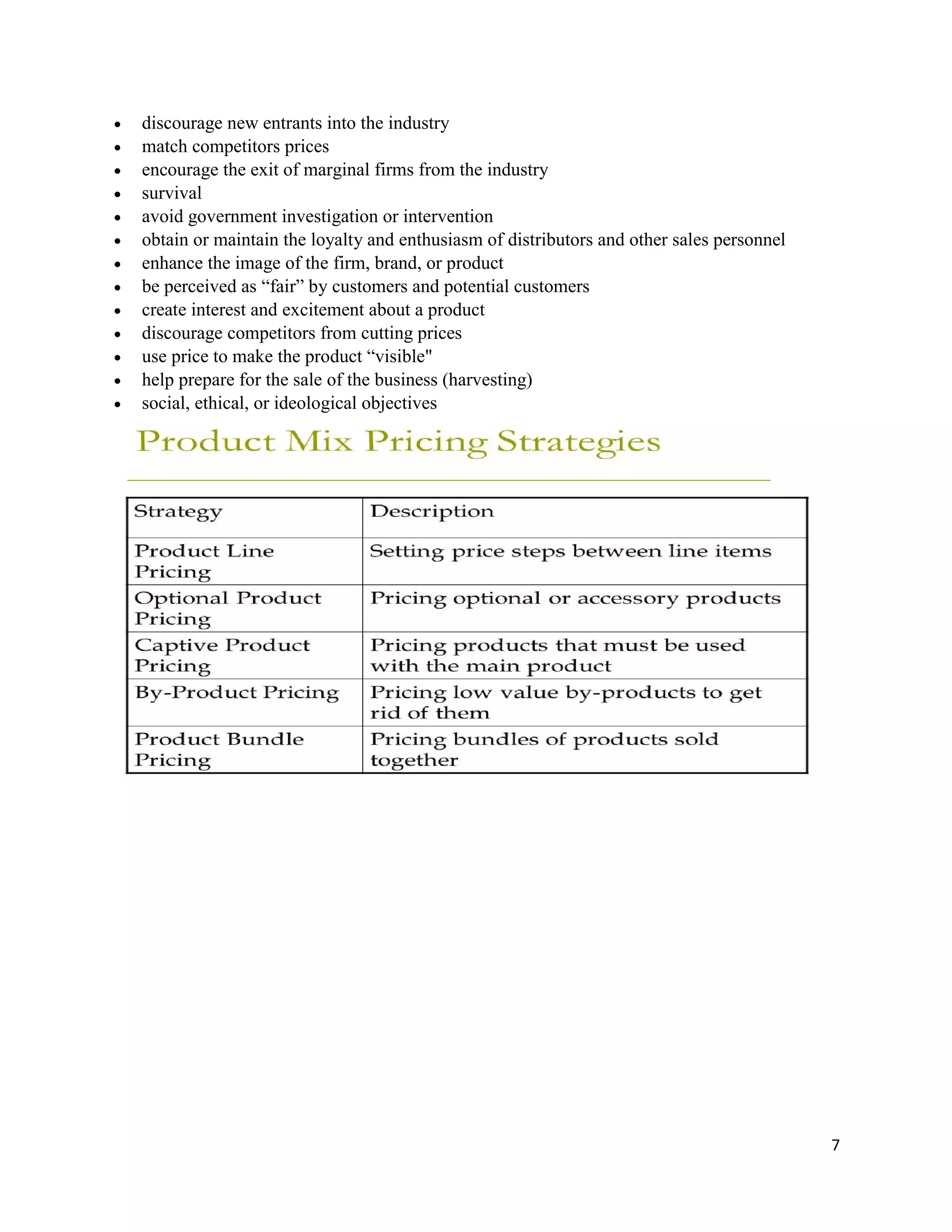
• Pricing must be carefully coordinated with the other marketing mix elements
RAYHAN
13
th
Batch
2
• Target costing is often used to support product positioning strategies based on price
3. Costs:
Costs set the floor for the price that the company can charge. The company wants to charge a price
that both covers all its cost for producing, distributing, and selling the product and delivers a fair
rate of return for its effort and risk. A company’s costs may be an important element in its pricing
strategy.
4. Organizational Considerations:
Management must decide who within the organization should set prices. Companies handle pricing
in a variety of ways. In small companies, prices are often set by top management rather then by
the marketing or sales departments. In large companies, price is typically handled by divisional or
product line managers. In industrial markets, salespeople may be allowed to negotiate with
customers with a certain price ranges. Even so, top management sets the pricing objective and
policies, and often approves the prices proposed by lower-level-management or salespeople.
External Factors
1. The Market and Demand:
The seller’s freedom varies with different types of markets. Economists recognize four types of
markets, each presenting a different pricing challenge.
 Pure competition, the market consists of many buyers and sellers trading in a uniform
commodity such as wheat, copper of financial securities.
 Monopolistic competition, the market consists of many buyers and sellers who trade over a
range of prices rather than a single market price. A range of prices occurs because sellers can
differentiate their offers to buyers.
 Oligopolistic competition, the market consists of a few sellers who are highly sensitive to each
other’s pricing and marketing strategies. The product can be uniform (steel, aluminum) or non-
uniform (computers, cars).
 Pure monopoly, the market consists of one seller. The seller may be a government monopoly
(the US postal service), a private regulated monopoly (a power company), or a private non-
regulated monopoly. Pricing is handled differently in each case. A government monopoly can
pursue a variety of pricing objectives.
2. Consumer Perception of Price and Value:
In the end, the consumer will decide whether a product’s price is right. Pricing decisions, like other
marketing mix decisions, must be buyer-oriented. When consumers buy a product, they exchange
something of value (the price) to get something of value (the benefits of having or using the
product).
3. Competitors’ Costs, Prices, and offers:
Another external factor affecting the company’s pricing decisions is competitors’ cost and prices
and possible competitor reactions to the company’s own pricing moves. A consumer who is
3
considering the purchase of a Canon camera will evaluate Canon’s price and value against the
prices and values of comparable products made by Nikon, Minolta, Pentax, and others. If canon
follows a high-price, high -margin strategy, it may attract competition. A low-price, low-margin
strategy, however, may stop competitors or drive them out of the market.
4. Other External Factors:
When setting prices, the company also must consider other factors in its external
environment. Economic conditions can have a strong impact on the firm’s pricing strategies.
Economic factors such as boom or recession, inflation, and interest rates affect pricing decisions
because they affect both the cost of producing a product and consumer perception of the product’s
price and value.
Pricing methods/pricing strategies
An organization has various options for selecting a pricing method. Prices are based on three
dimensions that are cost, demand, and competition.
1. Cost-based Pricing: (Q.Described one type of cost-based pricing method?)
Cost-based pricing refers to a pricing method in which some percentage of desired profit margins
is added to the cost of the product to obtain the final price. In other words, cost-based pricing can
be defined as a pricing method in which a certain percentage of the total cost of production is
added to the cost of the product to determine its selling price. Cost-based pricing can be of two
types, namely, cost-plus pricing and markup pricing.
These two types of cost-based pricing are as follows:
i. Cost-plus Pricing:
Refers to the simplest method of determining the price of a product. In cost-plus pricing method,
a fixed percentage, also called mark-up percentage, of the total cost (as a profit) is added to the
total cost to set the price. For example, XYZ organization bears the total cost of Rs. 100 per unit
4
for producing a product. It adds Rs. 50 per unit to the price of product as’ profit. In such a case,
the final price of a product of the organization would be Rs. 150.Cost-plus pricing is also known
as average cost pricing. This is the most commonly used method in manufacturing organizations.
In economics, the general formula given for setting price in case of cost-plus pricing is as
follows:
P = AVC + AVC (M).
AVC= Average Variable Cost, M = Mark-up percentage
The advantages of cost-plus pricing:
I. Requires minimum information
II. Involves simplicity of calculation
III. Insures sellers against the unexpected changes in costs
The disadvantages of cost-plus pricing:
I. Ignores price strategies of competitors
II. Ignores the role of customers.
ii. Markup Pricing:
Refers to a pricing method in which the fixed amount or the percentage of cost of the product is
added to product’s price to get the selling price of the product. Markup pricing is more common
in retailing in which a retailer sells the product to earn profit. For example, if a retailer has taken a
product from the wholesaler for Rs. 100, then he/she might add up a markup of Rs. 20 to gain
profit.
2. Demand-based Pricing:
Demand-based pricing refers to a pricing method in which the price of a product is finalized
according to its demand. If the demand of a product is more, an organization prefers to set high
prices for products to gain profit; whereas, if the demand of a product is less, the low prices are
charged to attract the customers.
3. Competition-based Pricing:
Competition-based pricing refers to a method in which an organization considers the prices of
competitors’ products to set the prices of its own products. The organization may charge higher,
lower, or equal prices as compared to the prices of its competitors.
4. Other Pricing Methods:
In addition to the pricing methods, there are other methods that are discussed as follows:
i. Value Pricing:
5
Implies a method in which an organization tries to win loyal customers by charging low prices
for their high- quality products. The organization aims to become a low cost producer without
sacrificing the quality..
ii. Target Return Pricing:
Helps in achieving the required rate of return on investment done for a product. In other words,
the price of a product is fixed on the basis of expected profit.
iii. Going Rate Pricing:
Implies a method in which an organization sets the price of a product according to the prevailing
price trends in the market. Thus, the pricing strategy adopted by the organization can be same or
similar to other organizations.
iv. Transfer Pricing:
Involves selling of goods and services within the departments of the organization. It is done to
manage the profit and loss ratios of different departments within the organization.
Q. Short note on “Break even pricing”?
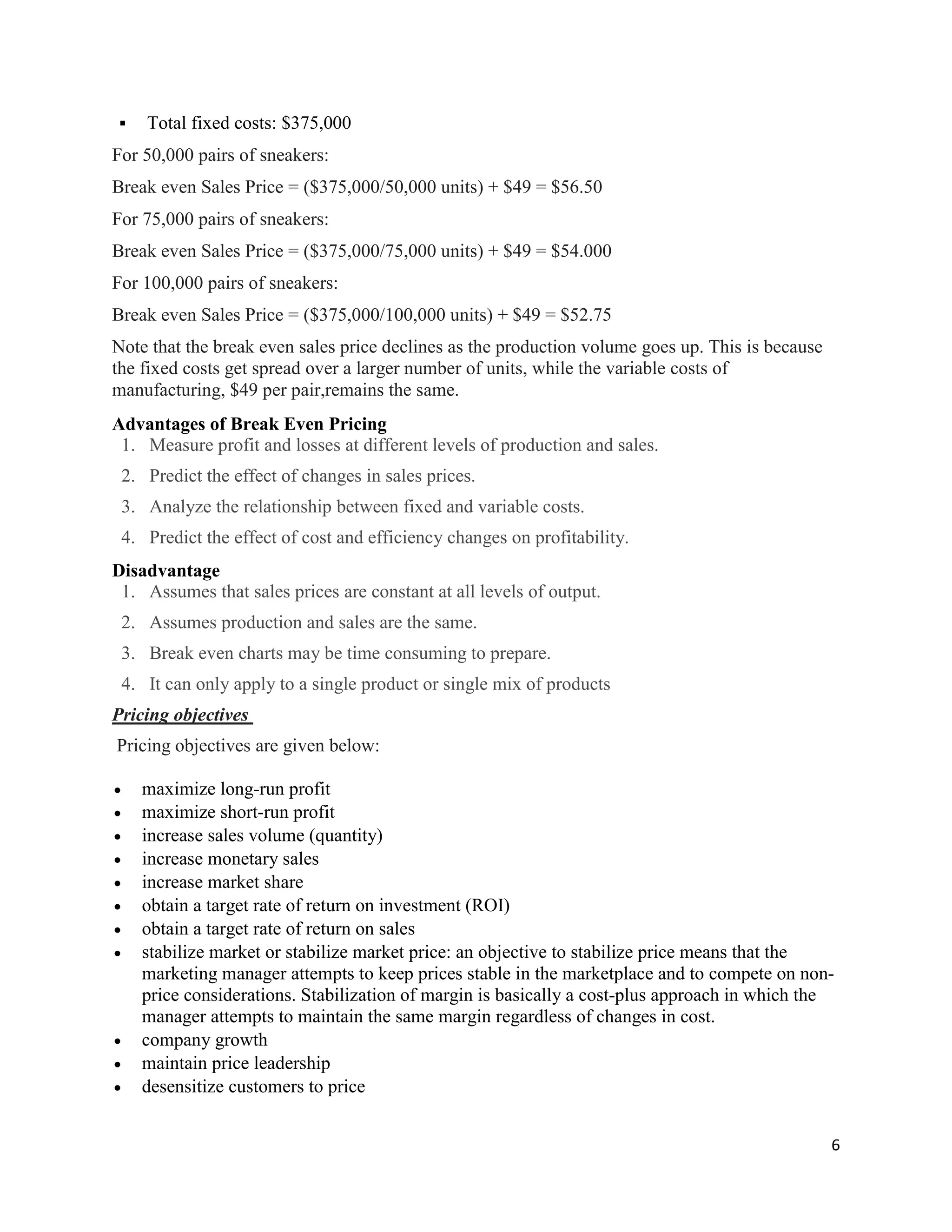
The break-even point (BEP) in economics, business—and specifically cost accounting—is the
point at which total cost and total revenue are equal. There is no net loss or gain, and one has
"broken even," though opportunity costs have been paid and capital has received the risk-adjusted,
expected return. In short, all costs that must be paid are paid, and there is neither profit nor loss.
The formula is:
Break Even Sales Price = (Total Fixed Costs/Production Volume) + Variable Cost per Unit
Example
The Hasty Rabbit Corporation makes sneakers for quick-footed rabbits and would like to
introduce a new model called Swifty Feet. The corporate accountant has calculated the following
costs:
 Cost of materials: $18
 Direct labor: $23
 Manufacturing supplies: $8
 Cost per pair of sneakers: $49
6
 Total fixed costs: $375,000
For 50,000 pairs of sneakers:
Break even Sales Price = ($375,000/50,000 units) + $49 = $56.50
For 75,000 pairs of sneakers:
Break even Sales Price = ($375,000/75,000 units) + $49 = $54.000
For 100,000 pairs of sneakers:
Break even Sales Price = ($375,000/100,000 units) + $49 = $52.75
Note that the break even sales price declines as the production volume goes up. This is because
the fixed costs get spread over a larger number of units, while the variable costs of
manufacturing, $49 per pair,remains the same.
Advantages of Break Even Pricing
1. Measure profit and losses at different levels of production and sales.
2. Predict the effect of changes in sales prices.
3. Analyze the relationship between fixed and variable costs.
4. Predict the effect of cost and efficiency changes on profitability.
Disadvantage
1. Assumes that sales prices are constant at all levels of output.
2. Assumes production and sales are the same.
3. Break even charts may be time consuming to prepare.
4. It can only apply to a single product or single mix of products
Pricing objectives
Pricing objectives are given below:
 maximize long-run profit
 maximize short-run profit
 increase sales volume (quantity)
 increase monetary sales
 increase market share
 obtain a target rate of return on investment (ROI)
 obtain a target rate of return on sales
 stabilize market or stabilize market price: an objective to stabilize price means that the
marketing manager attempts to keep prices stable in the marketplace and to compete on non-
price considerations. Stabilization of margin is basically a cost-plus approach in which the
manager attempts to maintain the same margin regardless of changes in cost.
 company growth
 maintain price leadership
 desensitize customers to price
7
 discourage new entrants into the industry
 match competitors prices
 encourage the exit of marginal firms from the industry
 survival
 avoid government investigation or intervention
 obtain or maintain the loyalty and enthusiasm of distributors and other sales personnel
 enhance the image of the firm, brand, or product
 be perceived as “fair” by customers and potential customers
 create interest and excitement about a product
 discourage competitors from cutting prices
 use price to make the product “visible"
 help prepare for the sale of the business (harvesting)
 social, ethical, or ideological objectives

Pricing Pdf

  • 1.
    1 Pricing Q. What isprice? List five other words that mean same think as price? Price: Price is the quantity of payment or compensation given by one party to another in return for one unit of goods or services. Pricing: Pricing is the process whereby a business sets the price at which it will sell its products and services, and may be part of the business's marketing plan. Five other words that mean same think as price: 1. Cost The amount of money that is needed in order to buy, pay for, or do something. 2. Charge An amount of money that you have to pay, especially when you visit a place or when someone does something for you. 3. Bill The amount of money you have to pay for something 4. Fee Money that you pay to a professional person or institution for their work. 5. Expense An amount of money that you spend in order to buy or do something. Q. Factors to be considered while setting price? Or, Discuses internal and external considerations besides cost and customers perceptions value that affect pricing decisions? Ans: A company’s pricing decisions are affected by both internal and external environmental factors. Internal Factors 1. Marketing Objectives: Before setting a price, the company must decide on its strategy for the product. If the company has selected its target market and positioning carefully, then its marketing mix strategy, including price, will be fairly straightforward. For example, when Honda and Toyota decided to develop their Acura and Lexus brands to compete with European luxury-performance cars in the higher income segment, this required charging a high price. 2. Marketing mix strategies • Pricing must be carefully coordinated with the other marketing mix elements RAYHAN 13 th Batch
  • 2.
    2 • Target costingis often used to support product positioning strategies based on price 3. Costs: Costs set the floor for the price that the company can charge. The company wants to charge a price that both covers all its cost for producing, distributing, and selling the product and delivers a fair rate of return for its effort and risk. A company’s costs may be an important element in its pricing strategy. 4. Organizational Considerations: Management must decide who within the organization should set prices. Companies handle pricing in a variety of ways. In small companies, prices are often set by top management rather then by the marketing or sales departments. In large companies, price is typically handled by divisional or product line managers. In industrial markets, salespeople may be allowed to negotiate with customers with a certain price ranges. Even so, top management sets the pricing objective and policies, and often approves the prices proposed by lower-level-management or salespeople. External Factors 1. The Market and Demand: The seller’s freedom varies with different types of markets. Economists recognize four types of markets, each presenting a different pricing challenge.  Pure competition, the market consists of many buyers and sellers trading in a uniform commodity such as wheat, copper of financial securities.  Monopolistic competition, the market consists of many buyers and sellers who trade over a range of prices rather than a single market price. A range of prices occurs because sellers can differentiate their offers to buyers.  Oligopolistic competition, the market consists of a few sellers who are highly sensitive to each other’s pricing and marketing strategies. The product can be uniform (steel, aluminum) or non- uniform (computers, cars).  Pure monopoly, the market consists of one seller. The seller may be a government monopoly (the US postal service), a private regulated monopoly (a power company), or a private non- regulated monopoly. Pricing is handled differently in each case. A government monopoly can pursue a variety of pricing objectives. 2. Consumer Perception of Price and Value: In the end, the consumer will decide whether a product’s price is right. Pricing decisions, like other marketing mix decisions, must be buyer-oriented. When consumers buy a product, they exchange something of value (the price) to get something of value (the benefits of having or using the product). 3. Competitors’ Costs, Prices, and offers: Another external factor affecting the company’s pricing decisions is competitors’ cost and prices and possible competitor reactions to the company’s own pricing moves. A consumer who is
  • 3.
    3 considering the purchaseof a Canon camera will evaluate Canon’s price and value against the prices and values of comparable products made by Nikon, Minolta, Pentax, and others. If canon follows a high-price, high -margin strategy, it may attract competition. A low-price, low-margin strategy, however, may stop competitors or drive them out of the market. 4. Other External Factors: When setting prices, the company also must consider other factors in its external environment. Economic conditions can have a strong impact on the firm’s pricing strategies. Economic factors such as boom or recession, inflation, and interest rates affect pricing decisions because they affect both the cost of producing a product and consumer perception of the product’s price and value. Pricing methods/pricing strategies An organization has various options for selecting a pricing method. Prices are based on three dimensions that are cost, demand, and competition. 1. Cost-based Pricing: (Q.Described one type of cost-based pricing method?) Cost-based pricing refers to a pricing method in which some percentage of desired profit margins is added to the cost of the product to obtain the final price. In other words, cost-based pricing can be defined as a pricing method in which a certain percentage of the total cost of production is added to the cost of the product to determine its selling price. Cost-based pricing can be of two types, namely, cost-plus pricing and markup pricing. These two types of cost-based pricing are as follows: i. Cost-plus Pricing: Refers to the simplest method of determining the price of a product. In cost-plus pricing method, a fixed percentage, also called mark-up percentage, of the total cost (as a profit) is added to the total cost to set the price. For example, XYZ organization bears the total cost of Rs. 100 per unit
  • 4.
    4 for producing aproduct. It adds Rs. 50 per unit to the price of product as’ profit. In such a case, the final price of a product of the organization would be Rs. 150.Cost-plus pricing is also known as average cost pricing. This is the most commonly used method in manufacturing organizations. In economics, the general formula given for setting price in case of cost-plus pricing is as follows: P = AVC + AVC (M). AVC= Average Variable Cost, M = Mark-up percentage The advantages of cost-plus pricing: I. Requires minimum information II. Involves simplicity of calculation III. Insures sellers against the unexpected changes in costs The disadvantages of cost-plus pricing: I. Ignores price strategies of competitors II. Ignores the role of customers. ii. Markup Pricing: Refers to a pricing method in which the fixed amount or the percentage of cost of the product is added to product’s price to get the selling price of the product. Markup pricing is more common in retailing in which a retailer sells the product to earn profit. For example, if a retailer has taken a product from the wholesaler for Rs. 100, then he/she might add up a markup of Rs. 20 to gain profit. 2. Demand-based Pricing: Demand-based pricing refers to a pricing method in which the price of a product is finalized according to its demand. If the demand of a product is more, an organization prefers to set high prices for products to gain profit; whereas, if the demand of a product is less, the low prices are charged to attract the customers. 3. Competition-based Pricing: Competition-based pricing refers to a method in which an organization considers the prices of competitors’ products to set the prices of its own products. The organization may charge higher, lower, or equal prices as compared to the prices of its competitors. 4. Other Pricing Methods: In addition to the pricing methods, there are other methods that are discussed as follows: i. Value Pricing:
  • 5.
    5 Implies a methodin which an organization tries to win loyal customers by charging low prices for their high- quality products. The organization aims to become a low cost producer without sacrificing the quality.. ii. Target Return Pricing: Helps in achieving the required rate of return on investment done for a product. In other words, the price of a product is fixed on the basis of expected profit. iii. Going Rate Pricing: Implies a method in which an organization sets the price of a product according to the prevailing price trends in the market. Thus, the pricing strategy adopted by the organization can be same or similar to other organizations. iv. Transfer Pricing: Involves selling of goods and services within the departments of the organization. It is done to manage the profit and loss ratios of different departments within the organization. Q. Short note on “Break even pricing”? The break-even point (BEP) in economics, business—and specifically cost accounting—is the point at which total cost and total revenue are equal. There is no net loss or gain, and one has "broken even," though opportunity costs have been paid and capital has received the risk-adjusted, expected return. In short, all costs that must be paid are paid, and there is neither profit nor loss. The formula is: Break Even Sales Price = (Total Fixed Costs/Production Volume) + Variable Cost per Unit Example The Hasty Rabbit Corporation makes sneakers for quick-footed rabbits and would like to introduce a new model called Swifty Feet. The corporate accountant has calculated the following costs:  Cost of materials: $18  Direct labor: $23  Manufacturing supplies: $8  Cost per pair of sneakers: $49
  • 6.
    6  Total fixedcosts: $375,000 For 50,000 pairs of sneakers: Break even Sales Price = ($375,000/50,000 units) + $49 = $56.50 For 75,000 pairs of sneakers: Break even Sales Price = ($375,000/75,000 units) + $49 = $54.000 For 100,000 pairs of sneakers: Break even Sales Price = ($375,000/100,000 units) + $49 = $52.75 Note that the break even sales price declines as the production volume goes up. This is because the fixed costs get spread over a larger number of units, while the variable costs of manufacturing, $49 per pair,remains the same. Advantages of Break Even Pricing 1. Measure profit and losses at different levels of production and sales. 2. Predict the effect of changes in sales prices. 3. Analyze the relationship between fixed and variable costs. 4. Predict the effect of cost and efficiency changes on profitability. Disadvantage 1. Assumes that sales prices are constant at all levels of output. 2. Assumes production and sales are the same. 3. Break even charts may be time consuming to prepare. 4. It can only apply to a single product or single mix of products Pricing objectives Pricing objectives are given below:  maximize long-run profit  maximize short-run profit  increase sales volume (quantity)  increase monetary sales  increase market share  obtain a target rate of return on investment (ROI)  obtain a target rate of return on sales  stabilize market or stabilize market price: an objective to stabilize price means that the marketing manager attempts to keep prices stable in the marketplace and to compete on non- price considerations. Stabilization of margin is basically a cost-plus approach in which the manager attempts to maintain the same margin regardless of changes in cost.  company growth  maintain price leadership  desensitize customers to price
  • 7.
    7  discourage newentrants into the industry  match competitors prices  encourage the exit of marginal firms from the industry  survival  avoid government investigation or intervention  obtain or maintain the loyalty and enthusiasm of distributors and other sales personnel  enhance the image of the firm, brand, or product  be perceived as “fair” by customers and potential customers  create interest and excitement about a product  discourage competitors from cutting prices  use price to make the product “visible"  help prepare for the sale of the business (harvesting)  social, ethical, or ideological objectives