1
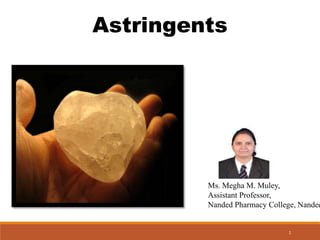
Astringents
Ms. Megha M. Muley,
Assistant Professor,
Nanded Pharmacy College, Nanded
2
INTRODUCTION-
 “Astringent” is derived from
Latin word ‘Adstringere’
which means ‘to bind fast’.
 Astringents a substances that
cause the contraction or
shrinkage of tissue, and dry
up secretion. E.g. Aluminium
sulphate, Alum, Zinc
Sulphate, Zinc Chloride.
3
 Astringents are topical agents that cause the
precipitation of proteins.
It will cause constriction / Shrinkage of soft
tissues due to the precipitation of surface
proteins.
These agents only precipitate surface proteins
locally and do not affect the host tissues,
because they have limited power of penetration
and lacking a deeper effect
They are applied on damaged skin and
mucous membranes.
4
Mechanism Of Action of Astringents
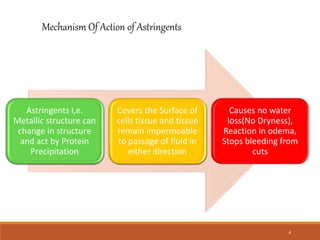
Astringents i,e.
Metallic structure can
change in structure
and act by Protein
Precipitation
Covers the Surface of
cells tissue and tissue
remain impermeable
to passage of fluid in
either direction
Causes no water
loss(No Dryness),
Reaction in odema,
Stops bleeding from
cuts
5
Application or uses of Astringents
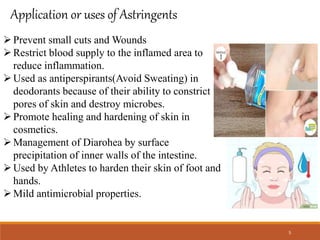
Prevent small cuts and Wounds
Restrict blood supply to the inflamed area to
reduce inflammation.
Used as antiperspirants(Avoid Sweating) in
deodorants because of their ability to constrict
pores of skin and destroy microbes.
Promote healing and hardening of skin in
cosmetics.
Management of Diarohea by surface
precipitation of inner walls of the intestine.
Used by Athletes to harden their skin of foot and
hands.
Mild antimicrobial properties.
6
Potash Alum
Molecular formula - KAl(SO₄)₂·12H₂O
Double sulphate salts, AM (SO₄)₂ ·12H₂O
where, A is monovalent cation Potassium
or Ammonium and M is trivalent metal
ion Aluminium or Chromium
IUPAC
Name
Aluminium potassium sulfate dodecahydrate
Molar Mass 258.192 g/mol (anhydrous)
474.37 g/mol (dodecahydrate)
Density 1.725 g/cm
3
Melting
Point
92 to 95 °C (198 to 203 °F; 365 to 368 K)
Boiling Point 200 °C (392 °F; 473 K)
7
Preparation Of Potash Alum
crystallizing the alum from a concentrated solution containing
equimolar amounts of potassium sulfate and aluminum
The chemical reaction is given below.
K2SO4(aq) + Al2(SO4)3(aq) → K2SO4. Al2(SO4)3.24H2O(s)
Properties of Potash Alum-
 Transparent Colourless crystals
 White granules or powder, Sweetish strongly astringents taste.
 Freely dissolve in water but slowly dissolve in glycerine and
insoluble in alcohol
 The aqueous solutionis acidic to litmus.
 Melts on heating.
 loss the water of crystalisation below 2000c , forming a white residue
of anahydrous aluminium and potassium sulphate.
8
Uses of Potash Alum
1. It is powerful Astringent
2. It is used as haemostatic as mouth washes or gargles.
3. It is also used for preserving skin and purification of water
4. Used as Pharmaceutical aid.
5. It is also used ingredients in toothpaste and tooth powder
6. Used in many vaccine as a adjuvant to enhance the body’s
response to immunogen.
e.g. hepatitis A, Hepatitis B, DTAP.
7. Used by pet owners to stem bleeding associated with injuries
caused by improper nail clipping.
8. It is widely used in vaginal cleaning and deodorant properties.
9. It is used in making douches and lotion.
9
Zinc Sulphate (White vitriol)
Chemical formula – ZnSO4 Molecular weight – 287.54
Preparation –
It is prepared by boiling metallic zinc with dilute sulphuric acid. A slight excess of
Zinc metal is used and the reaction is allowed to continue until hydrogen gas
evolves out.
Zn + H2SO4 ZnSO4 + H2
It may also prepared by the action of dilute sulphuric acid on zinc oxide.
ZnO + H2SO4 ZnSO4 + H2O
Properties-
 Colorless, Transparent crystals or crystalline powder.
 Odorless ,Taste is astringent and metallic.
 Very soluble in water and freely soluble in glycerin .
 Efflorescence in dry air.
10
 Widely used as an astringent and in emetic (induce vomiting).
 Used as reflex emetic especially in narcotic Poisoning (opium alkaloid
poisoning).
 zinc deficiency.
 Externally, it is used as astringent in variety of skin condition and in eye
drops.
 Use together with oral rehydration therapy for children who
have diarrhoea.
Uses of zinc sulphate
11
Thank You…..!

Astringent.pptx

  • 1.
    1 Astringents Ms. Megha M.Muley, Assistant Professor, Nanded Pharmacy College, Nanded
  • 2.
    2 INTRODUCTION-  “Astringent” isderived from Latin word ‘Adstringere’ which means ‘to bind fast’.  Astringents a substances that cause the contraction or shrinkage of tissue, and dry up secretion. E.g. Aluminium sulphate, Alum, Zinc Sulphate, Zinc Chloride.
  • 3.
    3  Astringents aretopical agents that cause the precipitation of proteins. It will cause constriction / Shrinkage of soft tissues due to the precipitation of surface proteins. These agents only precipitate surface proteins locally and do not affect the host tissues, because they have limited power of penetration and lacking a deeper effect They are applied on damaged skin and mucous membranes.
  • 4.
    4 Mechanism Of Actionof Astringents Astringents i,e. Metallic structure can change in structure and act by Protein Precipitation Covers the Surface of cells tissue and tissue remain impermeable to passage of fluid in either direction Causes no water loss(No Dryness), Reaction in odema, Stops bleeding from cuts
  • 5.
    5 Application or usesof Astringents Prevent small cuts and Wounds Restrict blood supply to the inflamed area to reduce inflammation. Used as antiperspirants(Avoid Sweating) in deodorants because of their ability to constrict pores of skin and destroy microbes. Promote healing and hardening of skin in cosmetics. Management of Diarohea by surface precipitation of inner walls of the intestine. Used by Athletes to harden their skin of foot and hands. Mild antimicrobial properties.
  • 6.
    6 Potash Alum Molecular formula- KAl(SO₄)₂·12H₂O Double sulphate salts, AM (SO₄)₂ ·12H₂O where, A is monovalent cation Potassium or Ammonium and M is trivalent metal ion Aluminium or Chromium IUPAC Name Aluminium potassium sulfate dodecahydrate Molar Mass 258.192 g/mol (anhydrous) 474.37 g/mol (dodecahydrate) Density 1.725 g/cm 3 Melting Point 92 to 95 °C (198 to 203 °F; 365 to 368 K) Boiling Point 200 °C (392 °F; 473 K)
  • 7.
    7 Preparation Of PotashAlum crystallizing the alum from a concentrated solution containing equimolar amounts of potassium sulfate and aluminum The chemical reaction is given below. K2SO4(aq) + Al2(SO4)3(aq) → K2SO4. Al2(SO4)3.24H2O(s) Properties of Potash Alum-  Transparent Colourless crystals  White granules or powder, Sweetish strongly astringents taste.  Freely dissolve in water but slowly dissolve in glycerine and insoluble in alcohol  The aqueous solutionis acidic to litmus.  Melts on heating.  loss the water of crystalisation below 2000c , forming a white residue of anahydrous aluminium and potassium sulphate.
  • 8.
    8 Uses of PotashAlum 1. It is powerful Astringent 2. It is used as haemostatic as mouth washes or gargles. 3. It is also used for preserving skin and purification of water 4. Used as Pharmaceutical aid. 5. It is also used ingredients in toothpaste and tooth powder 6. Used in many vaccine as a adjuvant to enhance the body’s response to immunogen. e.g. hepatitis A, Hepatitis B, DTAP. 7. Used by pet owners to stem bleeding associated with injuries caused by improper nail clipping. 8. It is widely used in vaginal cleaning and deodorant properties. 9. It is used in making douches and lotion.
  • 9.
    9 Zinc Sulphate (Whitevitriol) Chemical formula – ZnSO4 Molecular weight – 287.54 Preparation – It is prepared by boiling metallic zinc with dilute sulphuric acid. A slight excess of Zinc metal is used and the reaction is allowed to continue until hydrogen gas evolves out. Zn + H2SO4 ZnSO4 + H2 It may also prepared by the action of dilute sulphuric acid on zinc oxide. ZnO + H2SO4 ZnSO4 + H2O Properties-  Colorless, Transparent crystals or crystalline powder.  Odorless ,Taste is astringent and metallic.  Very soluble in water and freely soluble in glycerin .  Efflorescence in dry air.
  • 10.
    10  Widely usedas an astringent and in emetic (induce vomiting).  Used as reflex emetic especially in narcotic Poisoning (opium alkaloid poisoning).  zinc deficiency.  Externally, it is used as astringent in variety of skin condition and in eye drops.  Use together with oral rehydration therapy for children who have diarrhoea. Uses of zinc sulphate
  • 11.