ASTIGMATISM
 Term astigmatism (from a, meaning
"privativate" or "lacking," and stigma,
meaning "a point") was suggested to
describe this anomaly by Dr. William
Whewell (1794-1866)
 The refractive power of the astigmatic
eye varies in different meridians.
 The image is formed as a Sturm's
conoid
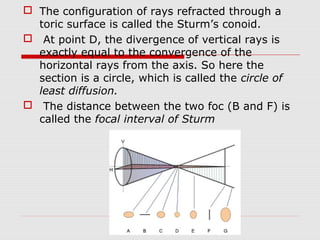
 The configuration of rays refracted through a
toric surface is called the Sturm’s conoid.
 At point D, the divergence of vertical rays is
exactly equal to the convergence of the
horizontal rays from the axis. So here the
section is a circle, which is called the circle of
least diffusion.
 The distance between the two foc (B and F) is
called the focal interval of Sturm
 Astigmatism may be classified as
follows:
 As regular or irregular
 With respect to the contributing
ocular component
 By orientation
 With respect to the refractive error
 If the principal meridians are at 90°
to each other, this is called regular
astigmatism.
 If the principal meridians are at 90°
to each other but do not lie at or near
90° and 180°, the term oblique
astigmatism is used.
 If the principal meridians are not at
90° to each other, this is called
irregular astigmatism
 Corneal astigmatism is the result of abnormalities
of curvature of cornea. It constitutes the most common
cause of astigmatism.
 Lenticular astigmatism is rare. It may be:
 i. Curvatural due to abnormalities of curvature of lens as
seen in lenticonus.
 ii. Positional due to tilting or oblique placement of lens
as seen in subluxation.
 iii. Index astigmatism may occur rarely due to variable
refractve index of lens in different meridia.
 Retinal astigmatism due to oblique placement of
macula may also be seen occasionally
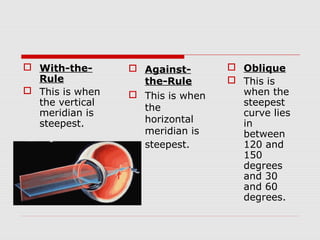
 With-theRule
 This is when
the vertical
meridian is
steepest.

 Againstthe-Rule
 This is when
the
horizontal
meridian is
steepest.

 Oblique
 This is
when the
steepest
curve lies
in
between
120 and
150
degrees
and 30
and 60
degrees.
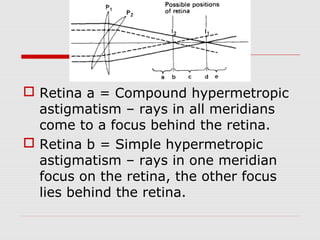
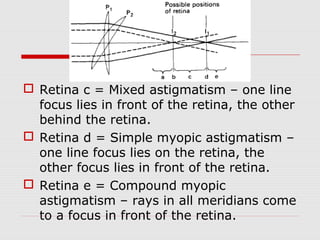
 Retina a = Compound hypermetropic
astigmatism – rays in all meridians
come to a focus behind the retina.
 Retina b = Simple hypermetropic
astigmatism – rays in one meridian
focus on the retina, the other focus
lies behind the retina.
 Retina c = Mixed astigmatism – one line
focus lies in front of the retina, the other
behind the retina.
 Retina d = Simple myopic astigmatism –
one line focus lies on the retina, the
other focus lies in front of the retina.
 Retina e = Compound myopic
astigmatism – rays in all meridians come
to a focus in front of the retina.
Symptoms




Blurring of vision
Asthenopic symptoms
Tilting of the headSquinting
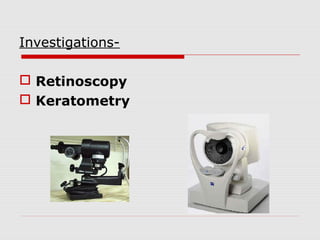
Investigations Retinoscopy
 Keratometry
 Jackson cross cylinder test Used to confirm the cylinder power & for
refining axis of the cylinder
 Combination of two cylinders of equal
strength, but with opposite sign placed
with their axis at right angles to each
other and mounted in a handle
 Commonly used cross cylinders are of
±0.25 and ±0.50D
 Following steps are used in cross
cylinder refraction:
i. Adjust the sphere to the most plus
or least minus that gives the best
visual acuity
ii. Discovering the astigmatism
iii.Refinement of the axis
iv.Refinement of cylindrical power
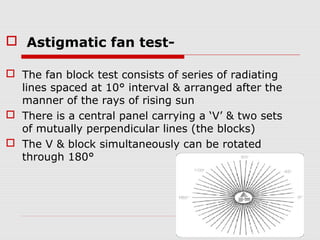
 Astigmatic fan test The fan block test consists of series of radiating
lines spaced at 10° interval & arranged after the
manner of the rays of rising sun
 There is a central panel carrying a ‘V’ & two sets
of mutually perpendicular lines (the blocks)
 The V & block simultaneously can be rotated
through 180°
 Steps of fan & block technique:
-Obtain best visual acuity using sphere only
-Add positive sphere equal to half of estimated
amount of astigmatism
-Refer patient to fan chart, ask which group of
lines appear clearest & darkest
-Directing attention to maddox arrow
-Directing attention now to blocks, add negative
cylinder at appropriate axis until both blocks
equally clear
Treatment Optical treatment
-comprises prescribing the appropriate
cylindrical lens, discovering after
accurate refraction
-correction may be in the form of
spectacles, hard contact lenses, toric
contact lenses
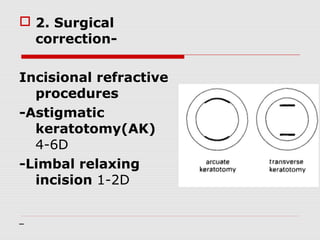
 2. Surgical
correctionIncisional refractive
procedures
-Astigmatic
keratotomy(AK)
4-6D
-Limbal relaxing
incision 1-2D
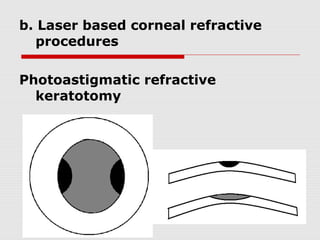
b. Laser based corneal refractive
procedures
Photoastigmatic refractive
keratotomy
 Astigmatic epi-LASIK (epipolis
laser in situ keratomileusis)
 Astigmatic LASIK
 Astigmatic C-LASIK
Irregular astigmatism
 characterized by an irregular change of
refractive power in different meridian
 There are multiple meridian which
admit no geometric analysis
Aetiological types Corneal irregular astigmatism found in patients
with extensive corneal scars or keratoconus
 Lenticular irregular astigmatism seen due to
variable refractive index in different parts of
crystalline lens & rarely during maturation of
cataract
 Retinal irregular astigmatism due to distortion
of macular area due to- scarring or tumours of
retina and choroid pushing macular area
Symptoms Defective vision, distortion of objects and
polyopia
Treatment Optical treatment consists of prescribing
contact lens which replaces the anterior surface
of the cornea for refraction
 Surgical treatment
-indicated in extensive corneal scarring (when
vision does not improve with contact lenses)
-consists of penetrating keratoplasty

Astigmatism

  • 1.
  • 2.
     Term astigmatism(from a, meaning "privativate" or "lacking," and stigma, meaning "a point") was suggested to describe this anomaly by Dr. William Whewell (1794-1866)  The refractive power of the astigmatic eye varies in different meridians.  The image is formed as a Sturm's conoid
  • 3.
     The configurationof rays refracted through a toric surface is called the Sturm’s conoid.  At point D, the divergence of vertical rays is exactly equal to the convergence of the horizontal rays from the axis. So here the section is a circle, which is called the circle of least diffusion.  The distance between the two foc (B and F) is called the focal interval of Sturm
  • 4.
     Astigmatism maybe classified as follows:  As regular or irregular  With respect to the contributing ocular component  By orientation  With respect to the refractive error
  • 5.
     If theprincipal meridians are at 90° to each other, this is called regular astigmatism.  If the principal meridians are at 90° to each other but do not lie at or near 90° and 180°, the term oblique astigmatism is used.  If the principal meridians are not at 90° to each other, this is called irregular astigmatism
  • 6.
     Corneal astigmatismis the result of abnormalities of curvature of cornea. It constitutes the most common cause of astigmatism.  Lenticular astigmatism is rare. It may be:  i. Curvatural due to abnormalities of curvature of lens as seen in lenticonus.  ii. Positional due to tilting or oblique placement of lens as seen in subluxation.  iii. Index astigmatism may occur rarely due to variable refractve index of lens in different meridia.  Retinal astigmatism due to oblique placement of macula may also be seen occasionally
  • 7.
     With-theRule  Thisis when the vertical meridian is steepest.  Againstthe-Rule  This is when the horizontal meridian is steepest.  Oblique  This is when the steepest curve lies in between 120 and 150 degrees and 30 and 60 degrees.
  • 8.
     Retina a= Compound hypermetropic astigmatism – rays in all meridians come to a focus behind the retina.  Retina b = Simple hypermetropic astigmatism – rays in one meridian focus on the retina, the other focus lies behind the retina.
  • 9.
     Retina c= Mixed astigmatism – one line focus lies in front of the retina, the other behind the retina.  Retina d = Simple myopic astigmatism – one line focus lies on the retina, the other focus lies in front of the retina.  Retina e = Compound myopic astigmatism – rays in all meridians come to a focus in front of the retina.
  • 10.
    Symptoms    Blurring of vision Asthenopicsymptoms Tilting of the headSquinting
  • 11.
  • 12.
     Jackson crosscylinder test Used to confirm the cylinder power & for refining axis of the cylinder  Combination of two cylinders of equal strength, but with opposite sign placed with their axis at right angles to each other and mounted in a handle  Commonly used cross cylinders are of ±0.25 and ±0.50D
  • 13.
     Following stepsare used in cross cylinder refraction: i. Adjust the sphere to the most plus or least minus that gives the best visual acuity ii. Discovering the astigmatism iii.Refinement of the axis iv.Refinement of cylindrical power
  • 14.
     Astigmatic fantest The fan block test consists of series of radiating lines spaced at 10° interval & arranged after the manner of the rays of rising sun  There is a central panel carrying a ‘V’ & two sets of mutually perpendicular lines (the blocks)  The V & block simultaneously can be rotated through 180°
  • 15.
     Steps offan & block technique: -Obtain best visual acuity using sphere only -Add positive sphere equal to half of estimated amount of astigmatism -Refer patient to fan chart, ask which group of lines appear clearest & darkest -Directing attention to maddox arrow -Directing attention now to blocks, add negative cylinder at appropriate axis until both blocks equally clear
  • 16.
    Treatment Optical treatment -comprisesprescribing the appropriate cylindrical lens, discovering after accurate refraction -correction may be in the form of spectacles, hard contact lenses, toric contact lenses
  • 17.
     2. Surgical correctionIncisionalrefractive procedures -Astigmatic keratotomy(AK) 4-6D -Limbal relaxing incision 1-2D
  • 18.
    b. Laser basedcorneal refractive procedures Photoastigmatic refractive keratotomy
  • 19.
     Astigmatic epi-LASIK(epipolis laser in situ keratomileusis)  Astigmatic LASIK  Astigmatic C-LASIK
  • 20.
    Irregular astigmatism  characterizedby an irregular change of refractive power in different meridian  There are multiple meridian which admit no geometric analysis
  • 21.
    Aetiological types Cornealirregular astigmatism found in patients with extensive corneal scars or keratoconus  Lenticular irregular astigmatism seen due to variable refractive index in different parts of crystalline lens & rarely during maturation of cataract  Retinal irregular astigmatism due to distortion of macular area due to- scarring or tumours of retina and choroid pushing macular area
  • 22.
    Symptoms Defective vision,distortion of objects and polyopia Treatment Optical treatment consists of prescribing contact lens which replaces the anterior surface of the cornea for refraction  Surgical treatment -indicated in extensive corneal scarring (when vision does not improve with contact lenses) -consists of penetrating keratoplasty