UVEITIS
INVESTIGATIONS
&
TREATMENT
References
• AIOS CME Series no. 20 “uveitis made simple work up and
management ” by S.R Rathinam.
• Basic and Clinical Science Course Section 9 intraocular
inflammation and uveitis (AAO).
• Uveitis Fundamentals And Clinical Practice by Robert B.
Nussenblatt & Scott M. Whitcup
• Ophthalmology By Yanoff & Duker
• Postgraduate ophthalmology by Zia Chaudhuri & M Vanithi
• Clinical Review: Investigation and management of uveitis by
Catherine M Guly & John V Forrester
• Principles and Pra/ctice of Ophthalmology by Albert and Jakobiec
Uveitis
• Inflammation of the uvea.
• To explain cause of poor vision.
• Rule out masquerade
syndromes/infections.
• For academic and research purposes.
INDICATIONS FOR
INVESTIGATIONS
Investigations can lead you somewhere, anywhere or nowhere
Which INVESTIGATION to do
???
This depends on :
• Age, Sex and ethnicity.
• Type of uveitis
(anterior/intermediate/posterior)
• Associated ocular and extraocular
signs/symptoms.
• Nature of uveitis (acute/chronic;
unilateral/bilateral; active/healed)
General Investigations
• Complete Blood count- CBC
• ESR/ C Reactive Protein
• Syphilis Serology- TPHA, VDRL
• Blood sugar & Urine analysis (Diabetes
Mellitus)
• Kidney and Liver function tests
Local
• Hot compress – 3-4 times/day :
soothing , increases the circulation
• Use dark glasses
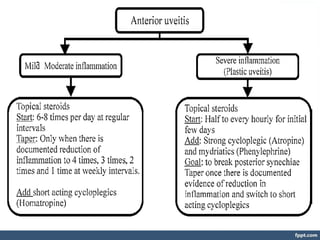
Anterior Uveitis:
Treatment of Intermediate
Uveitis (IU)
Nonsteroidal anti-inflammatory
agents
• Inhibits cyclooxygenase and reduce
prostaglandin synthesis.
• Indicated in
– Postoperative inflammation and CME
– Chronic iridocyclitis of JIA
– Allows maintaining patient on a lower
dose of topical corticosteroid when used
as an adjunct.
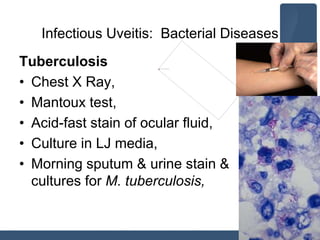
Infectious Uveitis: Bacterial Diseases
Tuberculosis
• Chest X Ray,
• Mantoux test,
• Acid-fast stain of ocular fluid,
• Culture in LJ media,
• Morning sputum & urine stain &
cultures for M. tuberculosis,
• Gamma interferon assays
• Quantiferon TB Gold and
• Enzyme-linked immunospot (ELISPOT)
test.
• PCR
• FFA & ICG: CNVM
– Early hypofluorescence, late
hyperfluorescence : active choroiditis
– Ring of fire : sub retinal abscess &
choroidal granuloma
• OCT
• Contact sign & hyper reflective
inflammatory cells
• B scan
• Differentiate subretinal abscess and
neoplasia.
Rx
Leprosy
• Slit smear test or other tissue biopsy
Corneal scraping
acid-fast bacilli
AC tap acid-fast
bacilli globi
skin biopsy Fite stain
Rx
• Multidrug treatment including rifampicin,
dapsone, and clofazimine for a period of
6–12 months.
• Topical corticosteroids and oral
corticosteroids.
• Phenylepherine is the drug of choice to
keep pupils mobile in leprosy patients
Syphilis
• Dark-field
microscopy/immunofluorescent staining
• Nontreponemal tests: (detect antibody to
cardiolipin cholesterol antigen)
– Venereal Disease Research Laboratory
(VDRL)
– Rapid plasma reagin (RPR)
– (CSF)-VDRL
• Treponemal tests:(detect antibodies
against treponemal antigens)
– Treponema pallidum immobilization test
– Fluorescent treponemal antibody
absorption tests (FTA-ABS)
– Hemagglutination treponemal test for
syphilis
– Hemagglutination assay for T. pallidum
– Microhemagglutination tests
Syphilis
Leptospirosis
• Microagglutination test
• ELISA for Leptospira antigens
• PCR
Rx
Lyme disease
• Borrelia burgdorferi by ELISA and
Western blot
• Culture from peripheral blood, skin rash,
and CSF.
• PCR
• ELISA and indirect immunofluorescent
antibody (IFA) can detect IgM & IgG.
• Lymphocyte antigen stimulation,
antibody capture enzyme immunoassay,
and detection of antibodies in urine
Rx
B. Parasitic Diseases
Toxoplasmosis
• ELISA for Toxoplasmosis Serum anti-
Toxoplasma IgG and IgM,
• Toxoplasmosis: IgM is important in neonates,
while it is rising IgG in adults
• Skull X Ray for calcification, if congenital
Toxoplasmosis,
• HIV if bilateral Toxoplasmosis,
• CT/MRI if HIV positive and symptomatic
Toxoplasmosis
Goldmann-Witmer (GW)
coefficient
• Compares the levels of intraocular
antibody production to that of serum,
as measured by ELISA.
• GW ratio > 4 is diagnostic of local
antibody production to a specific
microbial pathogen.
Ophthalmology 2005 Nov;112(11):1876-82
• Clindamycin
• Subconjunctival injection 50mg
• Intravitreal, +/- systemic Rx
– Weekly (or monthly in pregnancy) til quiet
• Lasave et al, Ophth 2010;117:1831-1838
Cysticercosis
• B-scan ultrasound (USG), ultrasound Bio
Microscope (UBM) of eye to distinguish
from choroidal melanoma.
• CT and MRI of body tissues of brain,
muscle
Rx
• Vitrectomy to remove larva from vitreous.
• In subretinal lesions via sclerotomy site,
and repair of detachment with scleral
buckling.
• Albendazole can be used.
Toxocariasis
• ELISA for Serum anti-Toxocara canis
IgG and IgM
• Eosinophils in aqueous/vitreous
Viral diseases : HIV
• Tridot
• Western blot
• ELISA
Rx
• HAART is a combination of two drug
categories: two or more reverse
transcriptase inhibitors, such as
zidovudine (a nucleoside analog) or
nevirapine (a non-nucleoside reverse
transcriptase inhibitor)
• With one or more viral protease inhibitor,
such as indinavir or ritonavir
Herpes simplex virus &
Herpes varicella-zoster virus
• Aqueous and vitreous fluid for PCR
(polymerase chain reaction),
• Goldmann-Witmer quotient
Rx
• Intravenous acyclovir is given at 1500
mg/m2 every 8 hours for about 7 days.
• Followed by several weeks of oral
acyclovir.
• Retinal detachment: prophylactic laser
demarcation
• ARN-associated retinal detachments:
vitrectomy, endolaser, and silicone oil
techniques.
Cytomegalovirus
• Congenital
• Viral inclusion bodies in urine, saliva,
intraocular fluid
• Complement fixation test useful @ 5-24
mos
– after loss of maternal antibodies
• Acquired: Usually clinical diagnosis
– PCR of aqueous/vitreous
– Culture urine, saliva, lymphocytes
– Giant cells with inclusions - retina, RPE
• Nuclear inclusions eosinophilic
• Cytoplasmic inclusions basophilic
Disease HLA Typing
Tubulointerstitial nephritis and uveitis
syndrome
DRB1
Birdshot retinochoroidopathy A29
Behcet’s disease B51, B5
Reactive arthritis B27
Anterior uveitis (AS) B27, DR8
Vogt-Koyanagi-Harada disease DR4
Sympathetic ophthalmia DR4
Panuveitis DR4
Intermediate uveitis B8, B51, DR3; DR2
Chronic iridocyclitis (IJA) DR5; DQ3 (7.5)
Retinal vasculitis B44
Multiple sclerosis B7, -DR2
Sarcoidosis B8, B13
JIA B27, A2,DR5, DR 8, DR 11
HLA ASSOCIATION
Juvenile idiopathic arthritis
• ANA
• RA factor
• X Ray
II. Non Infectious Uveitis
• Treatment
– AC cells (do not treat flare):
– Topical or periocular steroids
– NSAIDS
– Immunosuppressives
• Methotrexate
• Biologics: Infliximab; Adalimumab
• Band keratopathy: EDTA chelation
• Glaucoma: meds/surgery
• Cataracts: quiet 3 months
– anterior vs. pars plana approach
HLA-B27 related
Anterior Uveitis
• HLA-B27 typing
• X-ray sacroiliac joints (2 yearly
Sacroiliac joint X rays in males if initial
X ray normal)
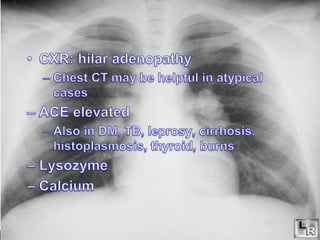
• Definitive diagnosis: biopsy
– Non-caseating epithelioid granulomas
– Conjunctiva, lacrimal gland, skin,
transbronchial,mediastinal
Sarcoidosis
• Gallium scan:
– Increased uptake in lacrimal & salivary
glands (panda sign), lungs
• Pulmonary Function Tests
• Diffusing capacity of the lung for
carbon monoxide (DLCO)
• Skin testing
– Anergy
– Kveim test
Rx
• Indications:
– Uveitis
– Symptomatic pulmonary disease
• Corticosteroids
– Local
• Topical, periocular, intravitreal (injection / implant)
– Systemic
• Other immunosuppressives
– Cyclosporine, methotrexate, chlorambucil,
azathioprine, mycophenolate mofetil
• Cataract surgery
– Eye quiet 3 mos pre-op
– High doses systemic steroids perioperatively
– Pars plana vs. anterior approach
Wegener’s granulomatosis
• Chest radiography,
• Sinus x-ray film,
• cANCA (antinuclear cytoplasmic
antibodies),
• Urinalysis,
• Tissue biopsy
Rx
• Treatment: corticosteroids,
• cyclophosphamide
– Decreases 1-year mortality from 90% to
10%
Polyarteritis nodosa (PAN)
• Serum eosinophils,
• p ANCA,
• Angiography
Rx
• Treatment: corticosteroids,
cyclophosphamide
– Decreases 5-year mortality from 90% to
20%
Behcet’s syndrome
• Fundus Fluorescein Angiography (FFA)
– Capillary dropout, vascular remodeling
– Vascular & disc leakage, NV
• HLA-B51 and B52,
• Pathergy on skin testing
Rx
Vogt-Koyanagi-Harada
syndrome (VKH)
• USG, (ultrasonogram)
• FFA
– Early phase numerous hyperfluorescent dots at level of RPE.
gradually enlarge & accumulates in the subretinal space
– Chronic phase, diffusely scattered dots of hyperfluorescence
due to the window defects at evel of the RPE.
Rx
Steroids Oral or
IVPrednisone 1.5-2
mg/kg With tropical
steroids and
cycloplegics
Cytotoxic and/or
immunosuppres
sive eg.
azathioprine,
mycophenolate
mofetil,
cyclophosphami
de, and
ciclosporin
Chronic phase
require both
cytotoxic agents
and
corticosteroids
Sympathetic ophthalmia
• USG, ( ultrasonogram)
• FFA
• Enucleation of the blind eye and
histopathology
Enucleation
of the injured
eye within 2
weeks of
injury
Rx
Steroids
Prednisone
1.5-2 mg/kg
Cytotoxic and/or
immunosuppressive eg.
azathioprine,
mycophenolate mofetil,
cyclophosphamide, and
ciclosporin
Fuchs’ heterochromic
iridocyclitis
• Based on the clinical presentation
• Treatment
– Topical steroids (often unnecessary)
– Cataract surgery – usually do well
– Glaucoma may be difficult to control
Birdshot
• FA & ICG
• Retinal lesions often silent on FA
– Hypofluorescent lesions early
– Hyperfluorescent late
• Hyperpermeability of retinal capillaries
• CME
• Disc hyperfluorescence/leakage
• Hypofluorescent lesions on ICG
• HLA-A29
– 7% population
– 50-80% birdshot
• Strongest association of all HLA associated
diseases
• Response to retinal S Antigen
(arrestin) in 90%
• Abnormal dark adaptation
• Chronic visual field loss and
progressive nyctalopia
• ERG may be reduced
– 30 Hz flicker implicit time
– Bright scotopic response amplitude
• Useful for monitoring treatment
response
Rx
• Corticosteroids – may help in ~ 50%
• Other immunosuppressives
• Kiss et al, Ophth 2005 112: 1066-1071
– Mycophenolate (start 1g/d to 3g/d)
– Cyclosporine (start 3mg/kg to 5mg/kg/d)
– Monitor ERG q 6 mos
– Quiescent 2 yrs then slow taper
• 5 year follow-up
• 50% maintained 20/50 or better
• Visual acuity loss due to CME (63%)
• Other causes of decreased vision: ERM,
CNV, macular scars, cataract
Intraocular lymphoma
• Vitreous biopsy for cytology, immuno
histochemist(CD-20 cells)
• MRI,
• lumbar puncture,
• CSF cytology
OZURDEX®
• Dexamethasone 0.7mg intravitreal
implant
• Indicated in macular edema following
branch retinal vein occlusion (BRVO)
or central retinal vein occlusion
(CRVO) and non-infectious uveitis.
Uveitis

Uveitis

  • 1.
  • 2.
    References • AIOS CMESeries no. 20 “uveitis made simple work up and management ” by S.R Rathinam. • Basic and Clinical Science Course Section 9 intraocular inflammation and uveitis (AAO). • Uveitis Fundamentals And Clinical Practice by Robert B. Nussenblatt & Scott M. Whitcup • Ophthalmology By Yanoff & Duker • Postgraduate ophthalmology by Zia Chaudhuri & M Vanithi • Clinical Review: Investigation and management of uveitis by Catherine M Guly & John V Forrester • Principles and Pra/ctice of Ophthalmology by Albert and Jakobiec
  • 3.
  • 4.
    • To explaincause of poor vision. • Rule out masquerade syndromes/infections. • For academic and research purposes. INDICATIONS FOR INVESTIGATIONS
  • 5.
    Investigations can leadyou somewhere, anywhere or nowhere
  • 6.
    Which INVESTIGATION todo ??? This depends on : • Age, Sex and ethnicity. • Type of uveitis (anterior/intermediate/posterior) • Associated ocular and extraocular signs/symptoms. • Nature of uveitis (acute/chronic; unilateral/bilateral; active/healed)
  • 7.
    General Investigations • CompleteBlood count- CBC • ESR/ C Reactive Protein • Syphilis Serology- TPHA, VDRL • Blood sugar & Urine analysis (Diabetes Mellitus) • Kidney and Liver function tests
  • 10.
    Local • Hot compress– 3-4 times/day : soothing , increases the circulation • Use dark glasses
  • 12.
  • 13.
  • 14.
    Nonsteroidal anti-inflammatory agents • Inhibitscyclooxygenase and reduce prostaglandin synthesis. • Indicated in – Postoperative inflammation and CME – Chronic iridocyclitis of JIA – Allows maintaining patient on a lower dose of topical corticosteroid when used as an adjunct.
  • 15.
    Infectious Uveitis: BacterialDiseases Tuberculosis • Chest X Ray, • Mantoux test, • Acid-fast stain of ocular fluid, • Culture in LJ media, • Morning sputum & urine stain & cultures for M. tuberculosis,
  • 17.
    • Gamma interferonassays • Quantiferon TB Gold and • Enzyme-linked immunospot (ELISPOT) test. • PCR
  • 18.
    • FFA &ICG: CNVM – Early hypofluorescence, late hyperfluorescence : active choroiditis – Ring of fire : sub retinal abscess & choroidal granuloma • OCT • Contact sign & hyper reflective inflammatory cells • B scan • Differentiate subretinal abscess and neoplasia.
  • 20.
  • 21.
    Leprosy • Slit smeartest or other tissue biopsy Corneal scraping acid-fast bacilli AC tap acid-fast bacilli globi skin biopsy Fite stain
  • 22.
    Rx • Multidrug treatmentincluding rifampicin, dapsone, and clofazimine for a period of 6–12 months. • Topical corticosteroids and oral corticosteroids. • Phenylepherine is the drug of choice to keep pupils mobile in leprosy patients
  • 23.
    Syphilis • Dark-field microscopy/immunofluorescent staining •Nontreponemal tests: (detect antibody to cardiolipin cholesterol antigen) – Venereal Disease Research Laboratory (VDRL) – Rapid plasma reagin (RPR) – (CSF)-VDRL
  • 24.
    • Treponemal tests:(detectantibodies against treponemal antigens) – Treponema pallidum immobilization test – Fluorescent treponemal antibody absorption tests (FTA-ABS) – Hemagglutination treponemal test for syphilis – Hemagglutination assay for T. pallidum – Microhemagglutination tests
  • 25.
  • 26.
    Leptospirosis • Microagglutination test •ELISA for Leptospira antigens • PCR
  • 27.
  • 28.
    Lyme disease • Borreliaburgdorferi by ELISA and Western blot • Culture from peripheral blood, skin rash, and CSF. • PCR • ELISA and indirect immunofluorescent antibody (IFA) can detect IgM & IgG. • Lymphocyte antigen stimulation, antibody capture enzyme immunoassay, and detection of antibodies in urine
  • 29.
  • 30.
    B. Parasitic Diseases Toxoplasmosis •ELISA for Toxoplasmosis Serum anti- Toxoplasma IgG and IgM, • Toxoplasmosis: IgM is important in neonates, while it is rising IgG in adults • Skull X Ray for calcification, if congenital Toxoplasmosis, • HIV if bilateral Toxoplasmosis, • CT/MRI if HIV positive and symptomatic Toxoplasmosis
  • 31.
    Goldmann-Witmer (GW) coefficient • Comparesthe levels of intraocular antibody production to that of serum, as measured by ELISA. • GW ratio > 4 is diagnostic of local antibody production to a specific microbial pathogen.
  • 32.
  • 33.
    • Clindamycin • Subconjunctivalinjection 50mg • Intravitreal, +/- systemic Rx – Weekly (or monthly in pregnancy) til quiet • Lasave et al, Ophth 2010;117:1831-1838
  • 34.
    Cysticercosis • B-scan ultrasound(USG), ultrasound Bio Microscope (UBM) of eye to distinguish from choroidal melanoma. • CT and MRI of body tissues of brain, muscle
  • 35.
    Rx • Vitrectomy toremove larva from vitreous. • In subretinal lesions via sclerotomy site, and repair of detachment with scleral buckling. • Albendazole can be used.
  • 36.
    Toxocariasis • ELISA forSerum anti-Toxocara canis IgG and IgM • Eosinophils in aqueous/vitreous
  • 38.
    Viral diseases :HIV • Tridot • Western blot • ELISA
  • 39.
    Rx • HAART isa combination of two drug categories: two or more reverse transcriptase inhibitors, such as zidovudine (a nucleoside analog) or nevirapine (a non-nucleoside reverse transcriptase inhibitor) • With one or more viral protease inhibitor, such as indinavir or ritonavir
  • 40.
    Herpes simplex virus& Herpes varicella-zoster virus • Aqueous and vitreous fluid for PCR (polymerase chain reaction), • Goldmann-Witmer quotient
  • 41.
    Rx • Intravenous acycloviris given at 1500 mg/m2 every 8 hours for about 7 days. • Followed by several weeks of oral acyclovir. • Retinal detachment: prophylactic laser demarcation • ARN-associated retinal detachments: vitrectomy, endolaser, and silicone oil techniques.
  • 42.
    Cytomegalovirus • Congenital • Viralinclusion bodies in urine, saliva, intraocular fluid • Complement fixation test useful @ 5-24 mos – after loss of maternal antibodies
  • 43.
    • Acquired: Usuallyclinical diagnosis – PCR of aqueous/vitreous – Culture urine, saliva, lymphocytes – Giant cells with inclusions - retina, RPE • Nuclear inclusions eosinophilic • Cytoplasmic inclusions basophilic
  • 45.
    Disease HLA Typing Tubulointerstitialnephritis and uveitis syndrome DRB1 Birdshot retinochoroidopathy A29 Behcet’s disease B51, B5 Reactive arthritis B27 Anterior uveitis (AS) B27, DR8 Vogt-Koyanagi-Harada disease DR4 Sympathetic ophthalmia DR4 Panuveitis DR4 Intermediate uveitis B8, B51, DR3; DR2 Chronic iridocyclitis (IJA) DR5; DQ3 (7.5) Retinal vasculitis B44 Multiple sclerosis B7, -DR2 Sarcoidosis B8, B13 JIA B27, A2,DR5, DR 8, DR 11 HLA ASSOCIATION
  • 46.
    Juvenile idiopathic arthritis •ANA • RA factor • X Ray II. Non Infectious Uveitis
  • 47.
    • Treatment – ACcells (do not treat flare): – Topical or periocular steroids – NSAIDS – Immunosuppressives • Methotrexate • Biologics: Infliximab; Adalimumab • Band keratopathy: EDTA chelation • Glaucoma: meds/surgery • Cataracts: quiet 3 months – anterior vs. pars plana approach
  • 48.
    HLA-B27 related Anterior Uveitis •HLA-B27 typing • X-ray sacroiliac joints (2 yearly Sacroiliac joint X rays in males if initial X ray normal)
  • 49.
    • Definitive diagnosis:biopsy – Non-caseating epithelioid granulomas – Conjunctiva, lacrimal gland, skin, transbronchial,mediastinal Sarcoidosis
  • 51.
    • Gallium scan: –Increased uptake in lacrimal & salivary glands (panda sign), lungs • Pulmonary Function Tests • Diffusing capacity of the lung for carbon monoxide (DLCO) • Skin testing – Anergy – Kveim test
  • 52.
    Rx • Indications: – Uveitis –Symptomatic pulmonary disease • Corticosteroids – Local • Topical, periocular, intravitreal (injection / implant) – Systemic • Other immunosuppressives – Cyclosporine, methotrexate, chlorambucil, azathioprine, mycophenolate mofetil
  • 53.
    • Cataract surgery –Eye quiet 3 mos pre-op – High doses systemic steroids perioperatively – Pars plana vs. anterior approach
  • 54.
    Wegener’s granulomatosis • Chestradiography, • Sinus x-ray film, • cANCA (antinuclear cytoplasmic antibodies), • Urinalysis, • Tissue biopsy
  • 55.
    Rx • Treatment: corticosteroids, •cyclophosphamide – Decreases 1-year mortality from 90% to 10%
  • 56.
    Polyarteritis nodosa (PAN) •Serum eosinophils, • p ANCA, • Angiography
  • 57.
    Rx • Treatment: corticosteroids, cyclophosphamide –Decreases 5-year mortality from 90% to 20%
  • 58.
    Behcet’s syndrome • FundusFluorescein Angiography (FFA) – Capillary dropout, vascular remodeling – Vascular & disc leakage, NV • HLA-B51 and B52, • Pathergy on skin testing
  • 59.
  • 60.
    Vogt-Koyanagi-Harada syndrome (VKH) • USG,(ultrasonogram) • FFA – Early phase numerous hyperfluorescent dots at level of RPE. gradually enlarge & accumulates in the subretinal space – Chronic phase, diffusely scattered dots of hyperfluorescence due to the window defects at evel of the RPE.
  • 61.
    Rx Steroids Oral or IVPrednisone1.5-2 mg/kg With tropical steroids and cycloplegics Cytotoxic and/or immunosuppres sive eg. azathioprine, mycophenolate mofetil, cyclophosphami de, and ciclosporin Chronic phase require both cytotoxic agents and corticosteroids
  • 62.
    Sympathetic ophthalmia • USG,( ultrasonogram) • FFA • Enucleation of the blind eye and histopathology
  • 63.
    Enucleation of the injured eyewithin 2 weeks of injury Rx Steroids Prednisone 1.5-2 mg/kg Cytotoxic and/or immunosuppressive eg. azathioprine, mycophenolate mofetil, cyclophosphamide, and ciclosporin
  • 64.
  • 65.
    • Treatment – Topicalsteroids (often unnecessary) – Cataract surgery – usually do well – Glaucoma may be difficult to control
  • 66.
    Birdshot • FA &ICG • Retinal lesions often silent on FA – Hypofluorescent lesions early – Hyperfluorescent late • Hyperpermeability of retinal capillaries • CME • Disc hyperfluorescence/leakage • Hypofluorescent lesions on ICG
  • 67.
    • HLA-A29 – 7%population – 50-80% birdshot • Strongest association of all HLA associated diseases • Response to retinal S Antigen (arrestin) in 90% • Abnormal dark adaptation • Chronic visual field loss and progressive nyctalopia
  • 68.
    • ERG maybe reduced – 30 Hz flicker implicit time – Bright scotopic response amplitude • Useful for monitoring treatment response
  • 69.
    Rx • Corticosteroids –may help in ~ 50% • Other immunosuppressives • Kiss et al, Ophth 2005 112: 1066-1071 – Mycophenolate (start 1g/d to 3g/d) – Cyclosporine (start 3mg/kg to 5mg/kg/d) – Monitor ERG q 6 mos – Quiescent 2 yrs then slow taper
  • 70.
    • 5 yearfollow-up • 50% maintained 20/50 or better • Visual acuity loss due to CME (63%) • Other causes of decreased vision: ERM, CNV, macular scars, cataract
  • 71.
    Intraocular lymphoma • Vitreousbiopsy for cytology, immuno histochemist(CD-20 cells) • MRI, • lumbar puncture, • CSF cytology
  • 73.
    OZURDEX® • Dexamethasone 0.7mgintravitreal implant • Indicated in macular edema following branch retinal vein occlusion (BRVO) or central retinal vein occlusion (CRVO) and non-infectious uveitis.

Editor's Notes

  • #16 unifocal or multifocal choroiditis
  • #57 Small vessel vasculitis
  • #61 :(A) Fundus fluorescein angiography of the right eye showing staining of the optic disc in the early arteriovenous phase with multiple pinpoint hyperfluorescence. (B) Fundus fluorescein angiography of the right eye showing staining of the optic disc with pooling of dye in the subretinal space in the late arteriovenous phase