The Brain and
The New Learning Environment


           Mark Miller
         VP of Marketing
What % of companies are using
       virtual teams?
    25%, 38%, 46%, 60%
67
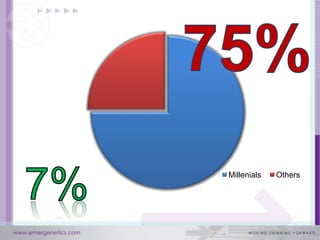
400   MILLION
Millenials   Others
Neuroplasticity
How Do We Lead
1.   Relevancy
2.   Efficiency and Speed
3.   Application
4.   Connection
• Individual learners more clearly and
  distinctively
• Multiple learning styles built in and
  reinforced deliberately
User-Generated Content
“Your learners want to explore new
     concepts and experience
   the value for themselves.”
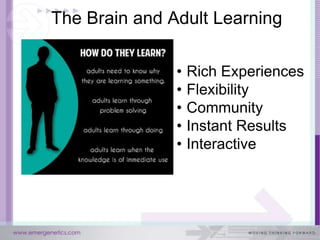
The Brain and Adult Learning

               •   Rich Experiences
               •   Flexibility
               •   Community
               •   Instant Results
               •   Interactive
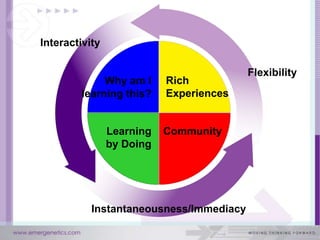
Interactivity

                                         Flexibility
             Why am I      Rich
        learning this?     Experiences


                Learning   Community
                by Doing


           Instantaneousness/Immediacy
PROBLEM SOLVING

   RESULTS
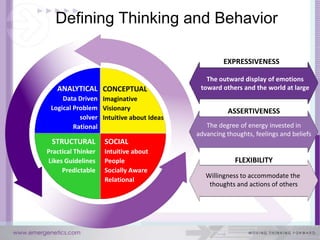
Defining Thinking and Behavior

                                                   EXPRESSIVENESS

                                             The outward display of emotions
   ANALYTICAL CONCEPTUAL                   toward others and the world at large
     Data Driven Imaginative
 Logical Problem Visionary                          ASSERTIVENESS
           solver Intuitive about Ideas
         Rational                            The degree of energy invested in
                                          advancing thoughts, feelings and beliefs
 STRUCTURAL         SOCIAL
Practical Thinker   Intuitive about
Likes Guidelines    People                             FLEXIBILITY
     Predictable    Socially Aware
                                             Willingness to accommodate the
                    Relational
                                              thoughts and actions of others
PROBLEM SOLVING

   RESULTS
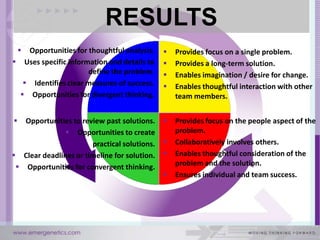
RESULTS
    
    Opportunities for thoughtful analysis.       Provides focus on a single problem.
 Uses specific information and details to       Provides a long-term solution.
                      define the problem.        Enables imagination / desire for change.
    Identifies clear measures of success.       Enables thoughtful interaction with other
   Opportunities for divergent thinking.         team members.


  Opportunities to review past solutions.       Provides focus on the people aspect of the
                Opportunities to create          problem.
                       practical solutions.      Collaboratively involves others.
 Clear deadlines or timeline for solution.      Enables thoughtful consideration of the
  Opportunities for convergent thinking.         problem and the solution.
                                                 Ensures individual and team success.
Defining Thinking and Behavior

                EXPRESSIVENESS
Quiet/Internal Processor   Gregarious/External Processor

                 ASSERTIVENESS
      Amiable                               Driving

                     FLEXIBILITY
Definition                          Adaptability/Change
Putting It Together
           Your User
        Rich        Impact
 Experiences


Relevancy                 Community


            Flexibility
Putting It Together
              Your Platform
                  Video        Learning
Online Guided
                               Communities


                                   Mobile

  Online Self
                                   User
                                 Generated
                Gamification
• What is the best vehicle to deliver content
  and meet outcomes?
• How will it be rolled out?
• Success Metrics
• Sustainability and Learner Follow-up
• Learning Styles – How does train link?
• Focus – What will generate more clarity?
• User Input – Is it Active?
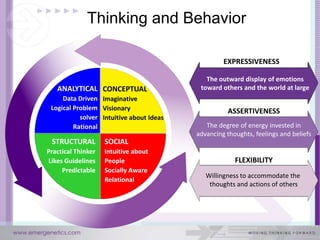
Thinking and Behavior

                                                   EXPRESSIVENESS

                                             The outward display of emotions
   ANALYTICAL CONCEPTUAL                   toward others and the world at large
     Data Driven Imaginative
 Logical Problem Visionary                          ASSERTIVENESS
           solver Intuitive about Ideas
         Rational                            The degree of energy invested in
                                          advancing thoughts, feelings and beliefs
 STRUCTURAL         SOCIAL
Practical Thinker   Intuitive about
Likes Guidelines    People                             FLEXIBILITY
     Predictable    Socially Aware
                                             Willingness to accommodate the
                    Relational
                                              thoughts and actions of others
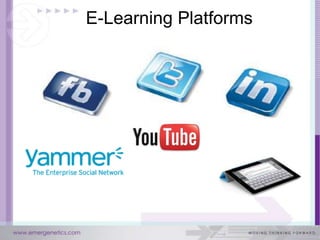
E-Learning Platforms

ASTD NY - Tailoring e-learning using Neuroscience and Work Styles

  • 1.
    The Brain and TheNew Learning Environment Mark Miller VP of Marketing
  • 2.
    What % ofcompanies are using virtual teams? 25%, 38%, 46%, 60%
  • 6.
    67 400 MILLION
  • 7.
  • 10.
  • 11.
    How Do WeLead 1. Relevancy 2. Efficiency and Speed 3. Application 4. Connection
  • 12.
    • Individual learnersmore clearly and distinctively • Multiple learning styles built in and reinforced deliberately
  • 13.
    User-Generated Content “Your learnerswant to explore new concepts and experience the value for themselves.”
  • 14.
    The Brain andAdult Learning • Rich Experiences • Flexibility • Community • Instant Results • Interactive
  • 15.
    Interactivity Flexibility Why am I Rich learning this? Experiences Learning Community by Doing Instantaneousness/Immediacy
  • 16.
  • 17.
    Defining Thinking andBehavior EXPRESSIVENESS The outward display of emotions ANALYTICAL CONCEPTUAL toward others and the world at large Data Driven Imaginative Logical Problem Visionary ASSERTIVENESS solver Intuitive about Ideas Rational The degree of energy invested in advancing thoughts, feelings and beliefs STRUCTURAL SOCIAL Practical Thinker Intuitive about Likes Guidelines People FLEXIBILITY Predictable Socially Aware Willingness to accommodate the Relational thoughts and actions of others
  • 18.
  • 19.
    RESULTS  Opportunities for thoughtful analysis.  Provides focus on a single problem.  Uses specific information and details to  Provides a long-term solution. define the problem.  Enables imagination / desire for change.  Identifies clear measures of success.  Enables thoughtful interaction with other  Opportunities for divergent thinking. team members.  Opportunities to review past solutions.  Provides focus on the people aspect of the  Opportunities to create problem. practical solutions.  Collaboratively involves others.  Clear deadlines or timeline for solution.  Enables thoughtful consideration of the  Opportunities for convergent thinking. problem and the solution.  Ensures individual and team success.
  • 21.
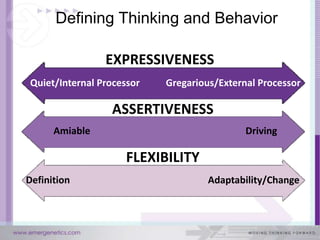
    Defining Thinking andBehavior EXPRESSIVENESS Quiet/Internal Processor Gregarious/External Processor ASSERTIVENESS Amiable Driving FLEXIBILITY Definition Adaptability/Change
  • 22.
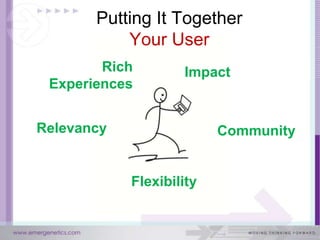
    Putting It Together Your User Rich Impact Experiences Relevancy Community Flexibility
  • 23.
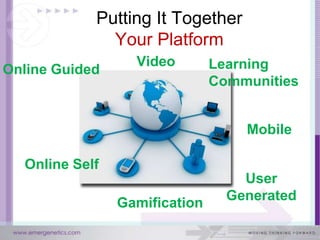
    Putting It Together Your Platform Video Learning Online Guided Communities Mobile Online Self User Generated Gamification
  • 24.
    • What isthe best vehicle to deliver content and meet outcomes? • How will it be rolled out? • Success Metrics • Sustainability and Learner Follow-up • Learning Styles – How does train link? • Focus – What will generate more clarity? • User Input – Is it Active?
  • 25.
    Thinking and Behavior EXPRESSIVENESS The outward display of emotions ANALYTICAL CONCEPTUAL toward others and the world at large Data Driven Imaginative Logical Problem Visionary ASSERTIVENESS solver Intuitive about Ideas Rational The degree of energy invested in advancing thoughts, feelings and beliefs STRUCTURAL SOCIAL Practical Thinker Intuitive about Likes Guidelines People FLEXIBILITY Predictable Socially Aware Willingness to accommodate the Relational thoughts and actions of others
  • 26.

Editor's Notes

  • #2 The learning environment is changing. I want to start with a story of one of our master trainers who was doing a training with Microsoft. We were conducting a teambuilding session for one of their product development teams. This team was spread throughout multiple locations. Chris was in the same city and actually could use their very high-tech video conferencing and interactive tools. Conducted training and then since it was a 3-hour course, held breaks. At one break she walked out of the room only to literally run into 2 of the participants who were on the call. In the same building.This is the nature of work today – we are tethered to our desks. Defined by being a global team. Part of a structure that dictates in many cases how we interact and receive training.
  • #3 Insert Poll Anywhere46% of companies are using virtual teams according to SHRM- http://www.shrm.org/hrdisciplines/orgempdev/articles/Pages/VirtualTeamsUsedMostbyGlobalOrganizations,SurveySays.aspx
  • #4 Poll Anywhere – Using mobile polling creates a distinct connection for learners who enjoy the atypical. It also heightens interactivity and stimulates the brain early in the presentation.Using mobile polling/technology additionally focuses on a Millennial workforce.
  • #5 So why does learning look like this? So we have greater connectivity than ever before, a growing workforce of connected learners and priming for explosion of additional workers who fit this groupBut formal, instructor led training still comprises a huge part of training time and budget – ask for guesses how much? State of the Industry Report from ASTD – http://www.astd.org/Publications/Magazines/TD/TD-Archive/2012/11/ASTD-2012-State-of-the-Industry-Report - 60% of learning is still ILT - Only 28% is either instructor led or self-paced online learningUnfortunately we are simply keeping up with the times – L&D and Training needs to lead the initiative
  • #6 And only 1.4% of companies are using mobile learning.
  • #7 Clearly there is a disconnect between where the trends are pointing and where much of the industry is still at. According to Forbes, there are stunning statistics around mobile usage - http://www.forbes.com/sites/markfidelman/2012/05/02/the-latest-infographics-mobile-business-statistics-for-2012/ - 67 million iPads in the first 2 years of being on the market – 40% of the time it took to sell that many iPods- 400 million more mobile devices than people on earth today. 7.4 billion mobile devices by 2014 – total population 7 billionWhy were so many more iPads sold? Why are there more devices than people? Everyone is connected all the time. Everyone wants to be connected and everyone needs to be connected. What does that mean for organizations? It’s a new world for training
  • #8 What this means for training is that learning is changing – According to Gen Y and Millennial Consulting Firm, Millennial Branding’s study - http://millennialbranding.com/2012/01/millennial-branding-gen-y-facebook-study/ Right now only 7% of corporate America is Millennials. Over the next 12 years that will rise to 75%This generation and any new employees are the connected generation.It isn’t part of the way they learn, it IS the way they learn. It isn’t a new way of learning, it is simply learning.So the issue is that we have a workforce growing rapidly that is accustomed to technology. A huge proliferation of global organizations and virtual teams and a capacity to deliver training in new ways that translate to greater cost efficiency and stronger ability to deliver content.But there is also another challenge to overcome.
  • #9 GreatKarnac/David Blaine Experiment – Predictive Exercise:Predictive ability from facilitator goes directly to the brain – The way we’re wired creates definitive patterns in the way we work and think.From the American Marketing Association - http://www.marketingpower.com/ResourceLibrary/Pages/White%20Papers/Marketing_and_Neuroscience.aspx
  • #10 Take a look at this brain image.In addition to just being cool, the colors truly paint the picture of the massive networks of neurons that make up the brain (over 100 billion).The great thing about this exercise is that it clearly demonstrates a few key points related directly to the e-learning role. There’s good news and bad news.Bad news – Nearly all said Red, Blue or something you sit in, is because of neural pathways. These are essentially habits and they are also what causes you to go to your first instinct. I confounded your brain with numbers but what became of this is that your brain hit on already heavily established neural pathways.So, how does that translate into the new learning environment? Technology comes before adoption. Mobile app development is 4:1 over native PC development projects in training (ASTD State of the Industry Report) by 2015. It also means that although everyone accesses mobile technology and online/e-learning, companies are still heavily invested in ILT and users are accustomed to that.Good News – Next slide.
  • #11 The good news is that there is constant neuroplasticity at work. These habits, while hard to change are changeable. We are wired to learn new things constantly, which translates into big things in the learning environment.The trends are clearly pointing toward a bigger focus on e-learning and mobile learning. Going back to the trend of employing more younger workers, guess what the biggest benefit that millenials are looking for: More training (40% would ask for more training) http://www.recruiter.com/i/trends-of-the-global-workforce/As learning leaders, we’re at the point where we can shift our thinking and we can utilize a new way to train employees that match the way people actually think and perform best.
  • #12 Its content, content, content. What content makes the most sense to learners and how can it be delivered most effectively and most efficiently?Relevancy – Training is obviously geared to business objectives but how granular are we getting? Needs to be relevant on a team and individual level. There are more tools (Twitter, Self-paced, videos, Second life, gamification) which necessitates creating more options.Efficiency – Training budgets are up but organizations are forced to deliver more kinds of content to a more diverse audience.Speed – necessity for training to get to the hands of learners quickly and at all times is becoming more critical. Workers have less and less time now (average of only 31 hours of training each year) - http://www.astd.org/Publications/Magazines/TD/TD-Archive/2012/11/ASTD-2012-State-of-the-Industry-ReportOn-demand Learning – Think about a technician fixing a subway line. With instant learning available on a smartphone, there’s no need for recall solutions and ways of doing things are at one’s fingertipsPoll – How many of your companies or clients have a remote workforce? More than 25%? More than 50%?Application – E-learning goes beyond skills and beyond a traditional ability to train. Go from jam-packed ILTs to short bursts of content that applies directly to each kind of worker.Research: “Game Based Learning: Present and Future State of the Field,” Kurt Squire, Ph.D., writes, “Successful companies no longer only train employees in skills; they motivate employees to adopt the perspectives and goals of the company, and empower employees to work creatively for the company.” - http://www-935.ibm.com/services/us/imc/pdf/gw510-6396-on-demand-learning.pdf Connection – Teaming is the norm, according to the Center for Creative Leadership, 91% of companies use teamwork. We are surrounded by connectivity, and e-learning and mobile learning provide a community element previously unable to be developed.http://www.ccl.org/leadership/pdf/research/StateOfTeams.pdf
  • #13 The planning has to be done in a way that different styles are offered different learning methods.http://hlab.ee.tut.fi/video/bme/evicab/astore/delivera/wp4style.pdf - Researcg Study: TampereUniversity, Finland
  • #14 http://www-935.ibm.com/services/us/imc/pdf/gw510-6396-on-demand-learning.pdf
  • #15 Sources:http://flirtingwelearning.wordpress.com/2011/09/25/infographic-an-overview-of-the-principles-of-adult-learning/http://www-935.ibm.com/services/us/imc/pdf/gw510-6396-on-demand-learning.pdfThese are by no means the end-all/be-all but this represents a cross-section of research (IBM) and theory research (HR Blogger Nicole LeGault), This is a helpful way to begin looking at your community.What other tendencies have you seen?
  • #16 Source: Emergenetics Profile and Methodology - http://www.emergenetics.com/whatisThese cover the brain – how we think coincides with the way your community wants to learn. Not shockingly, the aspects of the way we learn in a corporate setting are spread throughout four common quadrants of thinking and three common behavioral elements. Notice what wasn’t on this list from the previous slide: Problem Solving – why not? Problem solving is an end skill that you need employees to develop. Same with results – It delivers on every part of the brain and every aspect of training.The image covers the following: Our research has indicated that we have four recognizable tendencies of thinking. Analytical, Structural, Social and Conceptual. These key components of adult learning need to be then translated into the kinds of offerings that employees will receive.
  • #17 Notice what wasn’t on this list from the previous slide: Problem Solving – Why not? Problem solving is an end skill that you need employees to develop – this takes into account all aspects of the brain. Same with Results – Every part of the brain and every aspect of adult learning needs to be focused on driving an actual business need.
  • #18 Here are the characteristics of learning, thinking and behavior. These are the way that our Profile measures the way a person thinks and behaves, and there are other measures, but these have been proven to be accurate and reflective. This can also be a strong starting point for looking at how e-learning (and learning in general) can be more effective.- http://www.emergenetics.com/whatis/sample-profilesExplain attributes - Exercise
  • #19 In an e-learning environment – we’ll take the top form of e-learning which is a webinar and conduct an exercise based on the most important factors and results an audience would want to receive from a Results perspective.
  • #20 In an e-learning environment – we’ll take the top form of e-learning which is a webinar:In your groups, take 5 minutes to discuss the way you should optimally present information in an onboarding webinar for a new employee.How would each kind of thinker look at results? What would be most important to a learner from a results perspective from a course that they would take via a webinar?Did you get these types of answers? What was happening in your brain in this regard? Connection with othersThe ability to develop new ideasThe ability to analyze a problemDevelopment of a clear end-point for learning
  • #21 Connection – just because they are working within your e-learning space or your LMS does not mean they’re engaged.Here’s the issue with only looking at what appeals to employees and learners on a thinking perspective – you miss out on the way employees naturally act and interact. And you miss out on the way that they prefer to receive feedback and interaction and the way that they prefer to provide feedback and interaction.
  • #22 Think about engagement from the perspective of three behavioral sets. Expressiveness:The outward display of emotions toward others and the world at largeAssertiveness: The degree of energy invested in advancing thoughts, feelings and beliefsFlexibility:Willingness to accommodate thethoughts and actions of othersExample: In an e-learning rollout,using an onboarding webinar and web tutorial training guide: What is an effective way to elicit engagement from someone on either side of the Expressiveness spectrum?Quiet: Email questions; provide time before the session if they’re expected to contribute; this actually could be an ideal training scenario for a person with this behavioral tendency.Gregarious: Chat functionality; ability to contribute; blended learning; connect to Twitter or other instant-access and instant-feedback item; ask for inputWhat is an effective way to elicit engagement from someone on either side of the Assertiveness spectrum?Amiable: create clear ways/times to go forward and go through course; course can be led by the program or instructor (these people will follow what they’re supposed to do – especially if they have a structural preference)Driving: Allow self-paced and self-directed option and cheer them for it (they’ll do it anyway); create ways to lead interactions; ensure clear path moving forward from courseWhat is an effective way to elicit engagement from someone on either side of the Flexibility spectrum?Defined: Provide context – how this fits into overall learning and connection to any other blended learning; have a defined way to go through training; not inflexible – but need rationale for how training fits and where they can take it.Adabtable/Change Centric: Different outlets for learning; different and frequent change-ups to the tutorial – videos/games/etc.; customization elements
  • #23 Adult Learners are not so different, even generationally – According to Emergenetics research (http://www.emergenetics.com/whatis/our-science) those who prefer to think in a Social way who are 25 are very similar in the WAY they work than those who think that way and are 55. The same findings apply across thinking and behavioral characteristics in terms of cultural differences. There are key factors that research has shown that adult learners value – particularly this growing cadre of employees. Spherion conducted a survey of workers and the new workforce (more Millenialsand GenX and less Baby-boomers) were trending in these categories. - http://www.emergingworkforcestudy.com/ Multi-layered Connections:Rich Experiences – Its an active involvement with learning and its tied to clear ideas on what and why training is happeningRelevancy – This is obviously critical to you as learning leaders. You need learning to clearly tie to a business objective and a goal. Its also critical to this audience - They are goal-driven and think about training as a way to advance what they can do for the organization.Flexibility – Clear benefit of a nontraditional training method and e-learning, but approach from the perspective of the end goal of learning: Flexible measures of success are needed so that this group can hone in on what matters to them (make all the content relevant for boosting the organizational need and allow your participants the ability to flex how they achieve that end goal).Community – This is one of the biggest challenges of e-learning, though its getting easier (internal networks like Yammer, Facebook, Twitter, video chat) but nonetheless, this group, more than any other in history craves community and connection. They like the freedom and flexibility of working remotely, but they need to feel connected.Impact – Speaks to the immediacy of learning – your workforce is accustomed to instantaneous results.Example: How many of you have responded to an email during this presentation? How many have wanted to or felt like you should? We are all used to getting results instantly, so why should training be any different.
  • #24 These are by no means the end-all be-all of e-learning, but they are some of the biggest. What do you notice about this?Both user-based and taughtAll of this needs to be again focused on optimal learning outcomes – First and foremost, training needs to accomplish a business objective and create tangible benefits.
  • #25 Blended learning is likely a tactic to be used.The key is meshing delivery methods with key audience drivers and distinctive approaches to learning.
  • #26 Overview of characteristics of learning, thinking and behavior. - A starting point for looking at how e-learning (and learning in general can be more effective.
  • #27 When rolling E-learning out, the key is to make sure that your employees understand the breadth of different platforms. Your job as learning leaders is to make the connection between E-learning platforms and how employees learn (brains and behavior as well as the things that motivate them). Learning in the workplace also ties into the other elements of what employees are doing throughout their lives.Hyper connection is not necessarily the way everyone does things as related to a social preference – but Connected learning is becoming the norm so training needs to match.Good tools cover more than one if not all attributes:Example - Yammer:Social (Connection)Expressiveness/Assertiveness (Receiver of content/driver of content)Analytical (Search for data/answers)Structural (1 clear place to get info; schedule; etc.)Conceptual (New ideas and way to gain information)Flexibility (User generated and fluid content)