Applications of
Storytelling in Knowledge
Management
Eric D. Brown
Amit Deokar
Presentation for INFS 838
March 25 2009
LIST OF ARTICLES
M. Bhardwaj and J. Monin, "Tacit to explicit: an interplay shaping
organization knowledge," Journal of Knowledge Management, vol. 10, p.
72, 2006.
W. Swap, D. Leonard, M. Shields, and L. Abrams, "Using mentoring and
storytelling to transfer knowledge in the workplace," Journal of
Management Information Systems, vol. 18, p. 95, 2001.
L. Nielsen and S. Madsen, "Using Storytelling to Reflect on IT Projects,"
JITTA : Journal of Information Technology Theory and Application, vol. 7, p.
35, 2006.
STORYTELLING
Stories have been used to pass along
knowledge for thousands of years
Every culture has a history of
storytelling
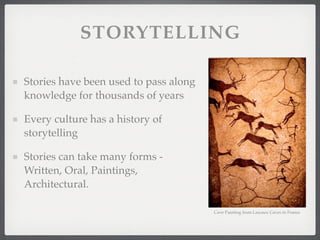
Stories can take many forms -
Written, Oral, Paintings,
Architectural.
Cave Painting from Lascaux Caves in France
STORIES - WHAT ARE
THEY GOOD FOR?
Sole and Wilson (2002)*:
Sharing Knowledge
Sharing Values
Developing Trust & Commitment
Generating Emotional Connection
* D. Sole and D. G. Wilson, "Storytelling in Organizations: The power and traps of using stories to share knowledge in organizations," Harvard Graduate School of
Education, 2002.
SHARING KNOWLEDGE
Stories allow tacit knowledge to be
shared more easily
Stories provide context and focus
A good story will provide laser-
like focus on issues relevant to the
listener
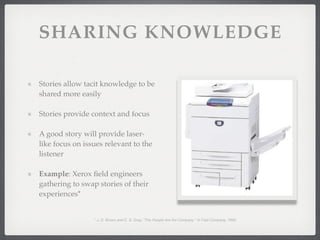
Example: Xerox field engineers
gathering to swap stories of their
experiences*
* J. S. Brown and E. S. Gray, "The People Are the Company " in Fast Company, 1995.
SHARING VALUES
Stories help convey values, ethics
and morals
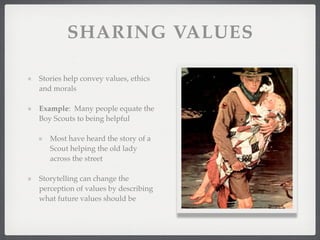
Example: Many people equate the
Boy Scouts to being helpful
Most have heard the story of a
Scout helping the old lady
across the street
Storytelling can change the
perception of values by describing
what future values should be
DEVELOPING TRUST &
COMMITMENT
Stories help describe organizational
competencies and/or commitments.
Stories can highlight the good (and
bad) things that people/organizations
do
By building trust, you can address
issues
Example: The Public Conversations
Project help people/organizations
address issues of conflict through
stories.
GENERATE EMOTIONAL
CONNECTION
Stories have the ability to connect
with our emotions
Unexpected twists and turns can
grab a person’s attention and
generate connection
Emotional connection can generate
‘stickiness’
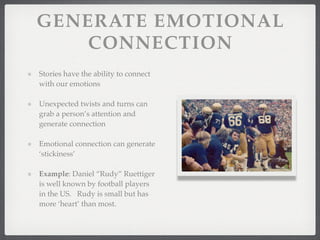
Example: Daniel “Rudy” Ruettiger
is well known by football players
in the US. Rudy is small but has
more ‘heart’ than most.
TACIT TO EXPLICIT: AN
INTERPLAY SHAPING
ORGANIZATION
KNOWLEDGE
M. BHARDWAJ AND J. MONIN
EXPLICIT KNOWLEDGE
Explicit knowledge is the ‘know-
what’ of an organization
Explicit knowledge is the ‘visible’
knowledge
Explicit knowledge has been
defined by Polanyi (1967) as:
knowledge that can be
communicated using
formalized language
M. Polanyi, The Tacit Dimension. London: Routledge & Kegan Paul,
1967.
TACIT KNOWLEDGE
Tacit Knowledge is the ‘know-
how’ of an organization.
Tacit Knowledge is the ‘invisible’
knowledge
According to Takeuchi (1998)* tacit
knowledge is:
deeply rooted in an
individuals actions and
experiences as well as in the
ideals, values or emotions
that the person embraces
* H. Takeuchi, "Beyond knowledge management: lessons from Japan," 1998.
CAPTURING / SHARING
KNOWLEDGE
Current technology is perfect for capturing explicit knowledge
Tacit knowledge must be transformed to explicit knowledge
Tacit knowledge can be shared using informal social processes
Through storytelling, tacit knowledge can be embedded in narratives and
shared
TACIT KNOWLEDGE
THEMES
Literature review performed by Bhardwaj & Monin
suggest four themes in the field:
Overall tacit knowledge management
Mobilization of organization tacit knowledge
Role of tacit knowledge in problem solving
Tacit knowledge and decision making
These four themes were used as the basis for research
by Bhardwaj & Monin
RESEARCH METHOD
Bhardwaj & Monin interviewed 8 HR Professionals in
8 different knowledge intensive organizations.
Interviews were performed using open ended
questions to encourage the use of narratives by the
interviewee’s
The resulting narratives were deconstructed to gather
information on how the four themes are addressed
RESULTS
Bhardwaj & Monin found that tacit knowledge
interacts with six important subsystems of an
organization.
These subsystems are:
Psychological
Intellectual
Knowledge
Functional
Social
Cultural
RESULTS
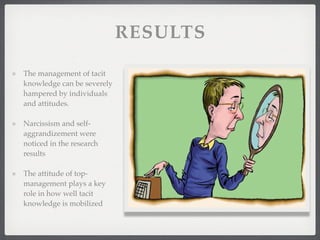
The management of tacit
knowledge can be severely
hampered by individuals
and attitudes.
Narcissism and self-
aggrandizement were
noticed in the research
results
The attitude of top-
management plays a key
role in how well tacit
knowledge is mobilized
FUTURE RESEARCH
How can an organization reduce the risk of
dependency on tacit knowledge ‘maintained’ by a
few employees?
How can an organization activate tacit knowledge
that resides within employees for the betterment of
the organization?
USING MENTORING AND
STORYTELLING TO
TRANSFER KNOWLEDGE
IN THE WORKPLACE
W. SWAP, D. LEONARD, M. SHIELDS, AND L. ABRAMS
STORYTELLING &
MENTORING
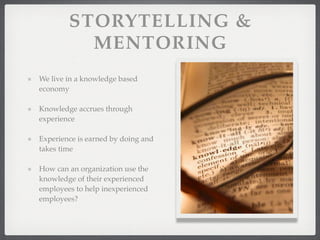
We live in a knowledge based
economy
Knowledge accrues through
experience
Experience is earned by doing and
takes time
How can an organization use the
knowledge of their experienced
employees to help inexperienced
employees?
EXPERTISE AND
KNOWLEDGE TRANSFER
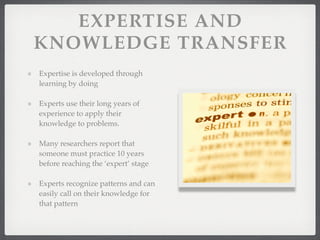
Expertise is developed through
learning by doing
Experts use their long years of
experience to apply their
knowledge to problems.
Many researchers report that
someone must practice 10 years
before reaching the ‘expert’ stage
Experts recognize patterns and can
easily call on their knowledge for
that pattern
EXPERTISE AND
KNOWLEDGE TRANSFER
The two characteristics of expertise:
Pattern recognition - patterns are used to know
when/how to use knowledge.
10 year rule - to be an ‘expert’, you must practice
for 10 years (10,000 hours).
Both characteristics are intrinsic and difficult to share
explicitly
EXPERTISE AND
KNOWLEDGE TRANSFER
Two methods of sharing tacit knowledge (Nonaka &
Takeuchi - 1995)*:
1. Internalization - Learning by Doing. Defined as:
“a process of embodying explicit knowledge into
tacit knowledge”
2. Socialization - Learning by Sharing. Defined as “a
process of sharing experiences and thereby
creating tacit knowledge”
* I. Nonaka and H. Takeuchi, The Knowledge-Creating Company: How Japanese Companies Create the Dynamics of Innovation: Oxford University Press, 1995.
METHODS
Formal teaching methods cannot be used for tacit
knowledge without first transforming tacit
knowledge to explicit knowledge
Informal methods are a better fit for tacit knowledge
(Nonaka & Takeuchi - 1995)
Internalization and Socialization can be addressed
with mentoring and storytelling
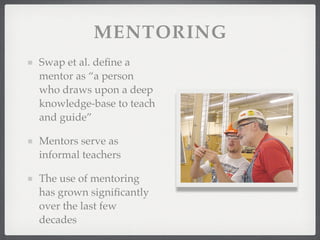
MENTORING
Swap et al. define a
mentor as “a person
who draws upon a deep
knowledge-base to teach
and guide”
Mentors serve as
informal teachers
The use of mentoring
has grown significantly
over the last few
decades
MENTORING
Swap et al.’s literature review shows evidence that
mentoring provides:
Skills transfer
Managerial Systems transfer
Values transfer
Mentoring has been shown to play a role in building
up an organization’s capabilities
Mentoring process provides both the socialization
and internalization aspect of tacit knowledge transfer
STORYTELLING
Swap et al. use the term ‘Organizational Story”.
An organizational story is defined as:
a narrative of past management actions,
employee interactions or other events that are
communicated informally within the
organization.
STORYTELLING
Organizational stories are generated internally and
reflect the organizations values and culture.
Stories must have context and focus.
Stories must be memorable to be effective.
STORYTELLING
Stories are better used to share values, managerial
systems and tacit knowledge.
Stories are not good methods of sharing critical skills
You wouldn’t want your doctor or pilot learning
their job by listening to or reading stories
LEARNING VIA STORIES
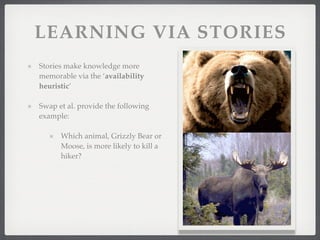
Stories make knowledge more
memorable via the ‘availability
heuristic’
Swap et al. provide the following
example:
Which animal, Grizzly Bear or
Moose, is more likely to kill a
hiker?
LEARNING VIA STORIES
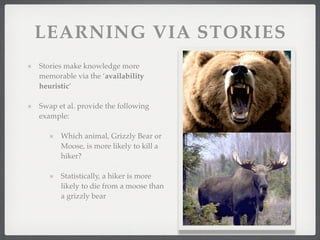
Stories make knowledge more
memorable via the ‘availability
heuristic’
Swap et al. provide the following
example:
Which animal, Grizzly Bear or
Moose, is more likely to kill a
hiker?
Statistically, a hiker is more
likely to die from a moose than
a grizzly bear
LEARNING VIA STORIES
Stories help people remember knowledge via
elaboration.
People remember things easier if they can build a
vivid image from their own experience.
Stories can be memorable by being clear or dramatic
and by providing context that the listener
understands and relates to.
LEARNING VIA STORIES
If developed and shared correctly, stories can tap into
the episodic memory of individuals.
Episodic memory is memory gained from direct
experience and is more easily accessed for retrieval.
If the story and storyteller can create a vivid account
so that the listener can experience the story, research
suggests that this will be stored in episodic memory.
SUMMARY
Organizations can use mentoring and storytelling to
share values, transfer skills and share tacit
knowledge
Calling someone a ‘mentor’ isn’t enough...formal
mentoring programs must be implemented
Stories must be memorable, be focused and have
relevant context to be useful
SUMMARY
Organizations & Managers must be careful to not
devalue the concept of ‘water-cooler talk’.
What may look like gossip to one person may be co-
workers sharing extremely important organizational
knowledge through the use of stories
USING STORYTELLING
TO REFLECT ON IT
PROJECTS
L. NIELSEN AND S. MADSEN
PAPER INTRODUCTION
Paper provides a model that uses storytelling to
capture tacit knowledge upon the completion of an IT
Project.
Similar to project postmortems but includes non-
project team members from areas throughout the
organization
SHARING KNOWLEDGE
IN PROJECTS
Systems development literature suggests two
methods of learning from, and sharing one’s own and
other’s project experiences:
Learning Experience - learn by doing. Great way
to gain tacit knowledge
Written Documentation - lessons learned,
postmortems
WRITTEN
DOCUMENTATION
The use of formal, written documentation is a
wonderful way to capture explicit knowledge
Does not capture tacit knowledge
Examples: Lessons Learned Documents, Project
Postmortems
ORGANIZATION VS
INDIVIDUAL
Organizational knowledge is actionable knowledge
Individual knowledge is internal knowledge
Individual knowledge is required to create
organizational knowledge
We must find a way to shift from individual (tacit) to
organizational (explicit).
ORGANIZATIONAL
LEARNING
Three mechanisms for learning
Experience accumulation - learning by doing
Verbal knowledge articulation - describing to
others
Written Knowledge codification - converting
tacit knowledge to explicit knowledge
An organization’s (or individual’s) knowledge is only
useful if a base level of shared knowledge exists
STORYTELLING
Storytelling is suggested as a means to build a shared
knowledge-base for organizations
Storytelling can be used to
Build a shared understanding
Make sense of past actions
Provide for future vision
RESEARCH
Nielsen & Madsen worked with AstraZeneca
Held a project reflection workshop to interview
employees on the outcomes of IT projects
Goal was to develop methods to “improve
AstraZeneca’s IT development practices and avoid
future failure of IT Projects”.
WORKSHOP
Purpose of the workshop:
Create a shared understanding of what might go
wrong in IT projects,
Create a shared understanding of when and why
projects succeed
Collect experiences into a manual for use on
future IT Projects
Ten employees were interviewed. Interviews were
filmed and transcribed
WORKSHOP
The workshop used oral storytelling to tell different
versions of project stories
These different versions of the story provided
different outlooks on the project
The stories that resonated the most with people were
the ones with context, detail and provided methods
for the listener to ‘feel’ the story
USING THE WORKSHOP
The research provides a model for using the
workshop for Project knowledge sharing.
There are four steps in this model:
Conversion of experience into stories - Crafting
the Story
Articulation of stories - Telling the Story
Collective understanding of stories -
Internalizing the Story
Codification of Explanations - Documenting the
Story
CRAFTING THE STORY
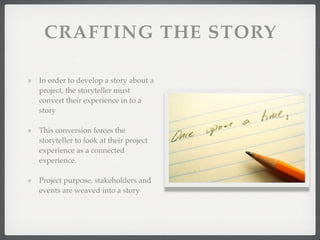
In order to develop a story about a
project, the storyteller must
convert their experience in to a
story
This conversion forces the
storyteller to look at their project
experience as a connected
experience.
Project purpose, stakeholders and
events are weaved into a story
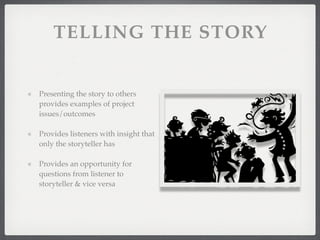
TELLING THE STORY
Presenting the story to others
provides examples of project
issues/outcomes
Provides listeners with insight that
only the storyteller has
Provides an opportunity for
questions from listener to
storyteller & vice versa
INTERNALIZING THE
STORY
Storyteller’s must be sure that the
listeners understand and
internalize the story
The workshop attendees reported
that they liked the oral stories but
needed help to internalizing the
stories
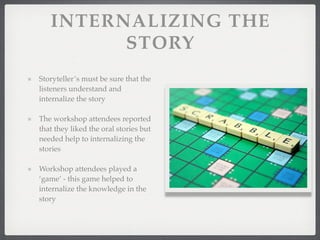
Workshop attendees played a
‘game’ - this game helped to
internalize the knowledge in the
story
DOCUMENTING THE
STORY
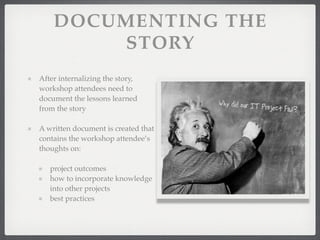
After internalizing the story,
workshop attendees need to
document the lessons learned
from the story
A written document is created that
contains the workshop attendee’s
thoughts on:
project outcomes
how to incorporate knowledge
into other projects
best practices
USING THE WORKSHOP
MODEL
The workshop model helps convert tacit knowledge
to explicit knowledge
Oral storytelling is the foundation for sharing
knowledge
Workshop attendees should be project team members
from various projects and different parts of the
organization
USING THE WORKSHOP
MODEL
The result of the workshop is:
Documented stories about projects
Best Practices for use in future projects
Knowledge sharing about past, current and future
projects
ADDITIONAL
RESOURCES
ADDITIONAL
RESOURCES
M. E. Boyce, "Organizational story and storytelling: a critical review,"
Journal of Organizational Change Management, vol. 9, p. 5, 1996.
D. Sole and D. G. Wilson, "Storytelling in Organizations: The power and
traps of using stories to share knowledge in organizations," Harvard
Graduate School of Education, 2002.
P. K. J. Tobin and R. Snyman, "Storytelling and Knowledge Management:
What's the story so far?," Mousaion, vol. 22, pp. 34-51, 2004.

Storytelling & Knowledge Management

  • 1.
    Applications of Storytelling inKnowledge Management Eric D. Brown Amit Deokar Presentation for INFS 838 March 25 2009
  • 2.
    LIST OF ARTICLES M.Bhardwaj and J. Monin, "Tacit to explicit: an interplay shaping organization knowledge," Journal of Knowledge Management, vol. 10, p. 72, 2006. W. Swap, D. Leonard, M. Shields, and L. Abrams, "Using mentoring and storytelling to transfer knowledge in the workplace," Journal of Management Information Systems, vol. 18, p. 95, 2001. L. Nielsen and S. Madsen, "Using Storytelling to Reflect on IT Projects," JITTA : Journal of Information Technology Theory and Application, vol. 7, p. 35, 2006.
  • 3.
    STORYTELLING Stories have beenused to pass along knowledge for thousands of years Every culture has a history of storytelling Stories can take many forms - Written, Oral, Paintings, Architectural. Cave Painting from Lascaux Caves in France
  • 4.
    STORIES - WHATARE THEY GOOD FOR? Sole and Wilson (2002)*: Sharing Knowledge Sharing Values Developing Trust & Commitment Generating Emotional Connection * D. Sole and D. G. Wilson, "Storytelling in Organizations: The power and traps of using stories to share knowledge in organizations," Harvard Graduate School of Education, 2002.
  • 5.
    SHARING KNOWLEDGE Stories allowtacit knowledge to be shared more easily Stories provide context and focus A good story will provide laser- like focus on issues relevant to the listener Example: Xerox field engineers gathering to swap stories of their experiences* * J. S. Brown and E. S. Gray, "The People Are the Company " in Fast Company, 1995.
  • 6.
    SHARING VALUES Stories helpconvey values, ethics and morals Example: Many people equate the Boy Scouts to being helpful Most have heard the story of a Scout helping the old lady across the street Storytelling can change the perception of values by describing what future values should be
  • 7.
    DEVELOPING TRUST & COMMITMENT Storieshelp describe organizational competencies and/or commitments. Stories can highlight the good (and bad) things that people/organizations do By building trust, you can address issues Example: The Public Conversations Project help people/organizations address issues of conflict through stories.
  • 8.
    GENERATE EMOTIONAL CONNECTION Stories havethe ability to connect with our emotions Unexpected twists and turns can grab a person’s attention and generate connection Emotional connection can generate ‘stickiness’ Example: Daniel “Rudy” Ruettiger is well known by football players in the US. Rudy is small but has more ‘heart’ than most.
  • 9.
    TACIT TO EXPLICIT:AN INTERPLAY SHAPING ORGANIZATION KNOWLEDGE M. BHARDWAJ AND J. MONIN
  • 10.
    EXPLICIT KNOWLEDGE Explicit knowledgeis the ‘know- what’ of an organization Explicit knowledge is the ‘visible’ knowledge Explicit knowledge has been defined by Polanyi (1967) as: knowledge that can be communicated using formalized language M. Polanyi, The Tacit Dimension. London: Routledge & Kegan Paul, 1967.
  • 11.
    TACIT KNOWLEDGE Tacit Knowledgeis the ‘know- how’ of an organization. Tacit Knowledge is the ‘invisible’ knowledge According to Takeuchi (1998)* tacit knowledge is: deeply rooted in an individuals actions and experiences as well as in the ideals, values or emotions that the person embraces * H. Takeuchi, "Beyond knowledge management: lessons from Japan," 1998.
  • 12.
    CAPTURING / SHARING KNOWLEDGE Currenttechnology is perfect for capturing explicit knowledge Tacit knowledge must be transformed to explicit knowledge Tacit knowledge can be shared using informal social processes Through storytelling, tacit knowledge can be embedded in narratives and shared
  • 13.
    TACIT KNOWLEDGE THEMES Literature reviewperformed by Bhardwaj & Monin suggest four themes in the field: Overall tacit knowledge management Mobilization of organization tacit knowledge Role of tacit knowledge in problem solving Tacit knowledge and decision making These four themes were used as the basis for research by Bhardwaj & Monin
  • 14.
    RESEARCH METHOD Bhardwaj &Monin interviewed 8 HR Professionals in 8 different knowledge intensive organizations. Interviews were performed using open ended questions to encourage the use of narratives by the interviewee’s The resulting narratives were deconstructed to gather information on how the four themes are addressed
  • 15.
    RESULTS Bhardwaj & Moninfound that tacit knowledge interacts with six important subsystems of an organization. These subsystems are: Psychological Intellectual Knowledge Functional Social Cultural
  • 16.
    RESULTS The management oftacit knowledge can be severely hampered by individuals and attitudes. Narcissism and self- aggrandizement were noticed in the research results The attitude of top- management plays a key role in how well tacit knowledge is mobilized
  • 17.
    FUTURE RESEARCH How canan organization reduce the risk of dependency on tacit knowledge ‘maintained’ by a few employees? How can an organization activate tacit knowledge that resides within employees for the betterment of the organization?
  • 18.
    USING MENTORING AND STORYTELLINGTO TRANSFER KNOWLEDGE IN THE WORKPLACE W. SWAP, D. LEONARD, M. SHIELDS, AND L. ABRAMS
  • 19.
    STORYTELLING & MENTORING We livein a knowledge based economy Knowledge accrues through experience Experience is earned by doing and takes time How can an organization use the knowledge of their experienced employees to help inexperienced employees?
  • 20.
    EXPERTISE AND KNOWLEDGE TRANSFER Expertiseis developed through learning by doing Experts use their long years of experience to apply their knowledge to problems. Many researchers report that someone must practice 10 years before reaching the ‘expert’ stage Experts recognize patterns and can easily call on their knowledge for that pattern
  • 21.
    EXPERTISE AND KNOWLEDGE TRANSFER Thetwo characteristics of expertise: Pattern recognition - patterns are used to know when/how to use knowledge. 10 year rule - to be an ‘expert’, you must practice for 10 years (10,000 hours). Both characteristics are intrinsic and difficult to share explicitly
  • 22.
    EXPERTISE AND KNOWLEDGE TRANSFER Twomethods of sharing tacit knowledge (Nonaka & Takeuchi - 1995)*: 1. Internalization - Learning by Doing. Defined as: “a process of embodying explicit knowledge into tacit knowledge” 2. Socialization - Learning by Sharing. Defined as “a process of sharing experiences and thereby creating tacit knowledge” * I. Nonaka and H. Takeuchi, The Knowledge-Creating Company: How Japanese Companies Create the Dynamics of Innovation: Oxford University Press, 1995.
  • 23.
    METHODS Formal teaching methodscannot be used for tacit knowledge without first transforming tacit knowledge to explicit knowledge Informal methods are a better fit for tacit knowledge (Nonaka & Takeuchi - 1995) Internalization and Socialization can be addressed with mentoring and storytelling
  • 24.
    MENTORING Swap et al.define a mentor as “a person who draws upon a deep knowledge-base to teach and guide” Mentors serve as informal teachers The use of mentoring has grown significantly over the last few decades
  • 25.
    MENTORING Swap et al.’sliterature review shows evidence that mentoring provides: Skills transfer Managerial Systems transfer Values transfer Mentoring has been shown to play a role in building up an organization’s capabilities Mentoring process provides both the socialization and internalization aspect of tacit knowledge transfer
  • 26.
    STORYTELLING Swap et al.use the term ‘Organizational Story”. An organizational story is defined as: a narrative of past management actions, employee interactions or other events that are communicated informally within the organization.
  • 27.
    STORYTELLING Organizational stories aregenerated internally and reflect the organizations values and culture. Stories must have context and focus. Stories must be memorable to be effective.
  • 28.
    STORYTELLING Stories are betterused to share values, managerial systems and tacit knowledge. Stories are not good methods of sharing critical skills You wouldn’t want your doctor or pilot learning their job by listening to or reading stories
  • 29.
    LEARNING VIA STORIES Storiesmake knowledge more memorable via the ‘availability heuristic’ Swap et al. provide the following example: Which animal, Grizzly Bear or Moose, is more likely to kill a hiker?
  • 30.
    LEARNING VIA STORIES Storiesmake knowledge more memorable via the ‘availability heuristic’ Swap et al. provide the following example: Which animal, Grizzly Bear or Moose, is more likely to kill a hiker? Statistically, a hiker is more likely to die from a moose than a grizzly bear
  • 31.
    LEARNING VIA STORIES Storieshelp people remember knowledge via elaboration. People remember things easier if they can build a vivid image from their own experience. Stories can be memorable by being clear or dramatic and by providing context that the listener understands and relates to.
  • 32.
    LEARNING VIA STORIES Ifdeveloped and shared correctly, stories can tap into the episodic memory of individuals. Episodic memory is memory gained from direct experience and is more easily accessed for retrieval. If the story and storyteller can create a vivid account so that the listener can experience the story, research suggests that this will be stored in episodic memory.
  • 33.
    SUMMARY Organizations can usementoring and storytelling to share values, transfer skills and share tacit knowledge Calling someone a ‘mentor’ isn’t enough...formal mentoring programs must be implemented Stories must be memorable, be focused and have relevant context to be useful
  • 34.
    SUMMARY Organizations & Managersmust be careful to not devalue the concept of ‘water-cooler talk’. What may look like gossip to one person may be co- workers sharing extremely important organizational knowledge through the use of stories
  • 35.
    USING STORYTELLING TO REFLECTON IT PROJECTS L. NIELSEN AND S. MADSEN
  • 36.
    PAPER INTRODUCTION Paper providesa model that uses storytelling to capture tacit knowledge upon the completion of an IT Project. Similar to project postmortems but includes non- project team members from areas throughout the organization
  • 37.
    SHARING KNOWLEDGE IN PROJECTS Systemsdevelopment literature suggests two methods of learning from, and sharing one’s own and other’s project experiences: Learning Experience - learn by doing. Great way to gain tacit knowledge Written Documentation - lessons learned, postmortems
  • 38.
    WRITTEN DOCUMENTATION The use offormal, written documentation is a wonderful way to capture explicit knowledge Does not capture tacit knowledge Examples: Lessons Learned Documents, Project Postmortems
  • 39.
    ORGANIZATION VS INDIVIDUAL Organizational knowledgeis actionable knowledge Individual knowledge is internal knowledge Individual knowledge is required to create organizational knowledge We must find a way to shift from individual (tacit) to organizational (explicit).
  • 40.
    ORGANIZATIONAL LEARNING Three mechanisms forlearning Experience accumulation - learning by doing Verbal knowledge articulation - describing to others Written Knowledge codification - converting tacit knowledge to explicit knowledge An organization’s (or individual’s) knowledge is only useful if a base level of shared knowledge exists
  • 41.
    STORYTELLING Storytelling is suggestedas a means to build a shared knowledge-base for organizations Storytelling can be used to Build a shared understanding Make sense of past actions Provide for future vision
  • 42.
    RESEARCH Nielsen & Madsenworked with AstraZeneca Held a project reflection workshop to interview employees on the outcomes of IT projects Goal was to develop methods to “improve AstraZeneca’s IT development practices and avoid future failure of IT Projects”.
  • 43.
    WORKSHOP Purpose of theworkshop: Create a shared understanding of what might go wrong in IT projects, Create a shared understanding of when and why projects succeed Collect experiences into a manual for use on future IT Projects Ten employees were interviewed. Interviews were filmed and transcribed
  • 44.
    WORKSHOP The workshop usedoral storytelling to tell different versions of project stories These different versions of the story provided different outlooks on the project The stories that resonated the most with people were the ones with context, detail and provided methods for the listener to ‘feel’ the story
  • 45.
    USING THE WORKSHOP Theresearch provides a model for using the workshop for Project knowledge sharing. There are four steps in this model: Conversion of experience into stories - Crafting the Story Articulation of stories - Telling the Story Collective understanding of stories - Internalizing the Story Codification of Explanations - Documenting the Story
  • 46.
    CRAFTING THE STORY Inorder to develop a story about a project, the storyteller must convert their experience in to a story This conversion forces the storyteller to look at their project experience as a connected experience. Project purpose, stakeholders and events are weaved into a story
  • 47.
    TELLING THE STORY Presentingthe story to others provides examples of project issues/outcomes Provides listeners with insight that only the storyteller has Provides an opportunity for questions from listener to storyteller & vice versa
  • 48.
    INTERNALIZING THE STORY Storyteller’s mustbe sure that the listeners understand and internalize the story The workshop attendees reported that they liked the oral stories but needed help to internalizing the stories Workshop attendees played a ‘game’ - this game helped to internalize the knowledge in the story
  • 49.
    DOCUMENTING THE STORY After internalizingthe story, workshop attendees need to document the lessons learned from the story A written document is created that contains the workshop attendee’s thoughts on: project outcomes how to incorporate knowledge into other projects best practices
  • 50.
    USING THE WORKSHOP MODEL Theworkshop model helps convert tacit knowledge to explicit knowledge Oral storytelling is the foundation for sharing knowledge Workshop attendees should be project team members from various projects and different parts of the organization
  • 51.
    USING THE WORKSHOP MODEL Theresult of the workshop is: Documented stories about projects Best Practices for use in future projects Knowledge sharing about past, current and future projects
  • 52.
  • 53.
    ADDITIONAL RESOURCES M. E. Boyce,"Organizational story and storytelling: a critical review," Journal of Organizational Change Management, vol. 9, p. 5, 1996. D. Sole and D. G. Wilson, "Storytelling in Organizations: The power and traps of using stories to share knowledge in organizations," Harvard Graduate School of Education, 2002. P. K. J. Tobin and R. Snyman, "Storytelling and Knowledge Management: What's the story so far?," Mousaion, vol. 22, pp. 34-51, 2004.