Are We
There Yet?
A Communications Evaluation Guide


                                    Your journey
                                    to high-impact
                                                     YOU ARE HERE


                                    communications
                                    STARTS HERE


Prepared by Asibey Consulting for


  a   ARE WE THERE YET?
Table of Contents
About this Guide                                           1
Why Evaluate Communications?                               2
Step 1: Determine What You Will Evaluate                   4
Step 2: Define Your Goal                                   6
Step 3: State Your Objective                               10
Step 4: Identify Your Audience                             13
Step 5: Establish Your Baseline                            15
Step 6: Pose Your Evaluation Questions                     17
Step 7: Draft Your Measurements                            22
Step 8: Select Your Evaluation Techniques                  26
Step 9: Estimate Your Budget                               29
Welcome to Your Evaluation Strategy!                       31
Evaluation Strategy Worksheet                              32
Appendix: Useful Resources for Communications Evaluation   35


i   ARE WE THERE YET?
Acknowledgments
We would like to thank the following individuals for their time, insight and       Are We There Yet? was created
valuable input, all of which helped to shape this guide:                           for the Communications Network
                                                                                   by Asibey Consulting. It was written
Claire Baralt Doris Duke Charitable Foundation                                     jointly by Edith Asibey, Toni Parras
                                                                                   and Justin van Fleet.
Kevin Bolduc Center for Effective Philanthropy
David Brotherton Brotherton Strategies                                             The Communications Network provides
Eric Brown The William and Flora Hewlett Foundation                                resources, guidance and leadership to
Susan O. Conner Lumina Foundation for Education                                    advance the strategic practice of com-
                                                                                   munications in philanthropy. For more
David Devlin-Foltz Continuous Progress Strategic Services at The Aspen Institute
                                                                                   information, or to download additional
Chris DeCardy The David and Lucile Packard Foundation                              copies of Are We There Yet?, visit
Julia Coffman Harvard Family Research Project                                      www.comnetwork.org.
David C. Colby The Robert Wood Johnson Foundation
Lori Dorfman Berkley Media Studies Group                                           Asibey Consulting develops com-
                                                                                   munication and advocacy strategies
Marc Fest John S. and James L. Knight Foundation
                                                                                   and provides clients with the tools to
Kristen Grimm Spitfire Strategies                                                  measure their effectiveness. For more
Lucas B. Held The Wallace Foundation                                               information, visit www.asibey.com.
David J. Morse The Robert Wood Johnson Foundation
                                                                                   This guide was produced with gener-
Rich Neimand Neimand Collaborative
                                                                                   ous support from the David and Lucile
Grant Oliphant The Pittsburgh Foundation                                           Packard Foundation.
Joy Portella Mercy Corps
Barry Scholl The Commonwealth Fund
Mark Sedway Philanthropy Awareness Initiative
Spencer Sherman California HealthCare Foundation
Daniel Silverman James Irvine Foundation
Heidi Sinclair The Bill & Melinda Gates Foundation
Jenny Sorensen The Bill & Melinda Gates Foundation
Nik Steinberg Independent Consultant
Phil Sparks Communication Consortium Media Center
Bruce Trachtenberg The Communications Network
Jill Yegian California HealthCare Foundation


ii   ARE WE THERE YET?
About This Guide
Who this guide is for                                                               A Fundamental Distinction
We designed this guide for philanthropic organizations and nonprofits that
                                                                                    COMMUNICATION VS.
want to be more effective with their communications. Whether you are using
                                                                                    COMMUNICATIONS
communications to instill healthy nutrition habits in a community or promoting
a national energy policy, an effective evaluation strategy can help you keep your
                                                                                    The terms ‘communication’ and
communications on track and use your limited resources effectively.
                                                                                    ‘communications’ are often used
                                                                                    interchangeably, as if they have
In putting together this guide, we surveyed more than 80 experts in foundation
                                                                                    the same meaning. They do not.
and nonprofit communications, conducted 20 in-depth interviews and carried
out an extensive review of existing resources and reports. Our research uncov-
                                                                                    Communication is the act of communi-
ered current practices in evaluating communications as well as the challenges
                                                                                    cating. It is the exchange of thoughts,
faced by today’s professionals. This guide offers solutions in an easy-to-use
                                                                                    information and feelings between
format, which you can adapt to the needs of your organization.
                                                                                    individuals or groups. It is the art and
                                                                                    technique of expressing ideas effec-
When to use this guide
                                                                                    tively. Foundations and nonprofits use
This guide helps you gather input at the beginning of your activities to shape
                                                                                    communication as a strategy to advance
your communication strategy. It also gives you the tools to monitor progress and
                                                                                    their missions.
make corrections during implementation. It was not designed as a means for
looking back on past work to determine if it was successful. Instead, the idea
                                                                                    Communications are the different
is to prepare up front and evaluate as you go along, so that you may adjust your
                                                                                    methods used for communicating,
tactics to ensure success.
                                                                                    such as person-to-person engagement,
                                                                                    email, reports, and radio, television and
This guide is an evaluation strategy tool – not a communication planning tool.
                                                                                    web-based campaigns. It refers to the
It will be most useful for those who already have a communication plan in place
                                                                                    channels and messages used to
with clear objectives, messages, strategies and tactics. However, even if you
                                                                                    communicate.
are still in the beginning stages of designing a communication plan, it is never
too early to start thinking about evaluation. We’ve suggested a communication
                                                                                    Throughout this guide, you will see both
planning tool and other resources in the Appendix that may be helpful as a
                                                                                    terms. See if you can make out the dif-
precursor or supplement to this guide.
                                                                                    ference, and start employing the proper
                                                                                    usage in your own communication (and
How this guide works
                                                                                    communications)!
This guide presents a step-by-step process for developing an evaluation
strategy. After reading each section, you will be directed to the Evaluation
Strategy Worksheet at the back of this guide, where you will complete the
corresponding step. We recommend that you fill out each section of the work-
sheet as you go through the guide and, when possible, share your thoughts with
colleagues for immediate feedback. After you’ve completed all the steps, you
will have an evaluation strategy that you can begin implementing immediately.

Evaluating traditional and new media communications
Although the examples featured in this guide primarily reflect experiences with
more established communications such as print, television and some forms of
online communications, this approach is also applicable to evaluating social
media such as blogs and social networking sites. In future versions of this
guide, we will feature examples of social media evaluations as more foundations
and nonprofits share their experiences using these tactics.


1   ARE WE THERE YET?
?
                                         Why Evaluate
                                         Communications?

                                                                                                      No one wants to travel a long distance, spend
                                                                                                      money and somehow end up in the wrong plac
                                                                                                      Evaluating your communications along the wa
                        No one wants to travel a long distance, spend a lot of                        help you to stay on track and reach your de
                        money and somehow end up in the wrong place. Evaluating
                        your communications along the way can help you to stay
                        on course and reach your destination.


                          YOU ARE HERE


                        Have you ever wondered if the money you                   “Our initial strategy to invest in high-
                                                                                  quality publications has apparently
                        spent on producing a report for policy-                   paid off. We get critical feedback on
                        makers paid off? Or if your online strategy               our publications every year, and we
                                                                                  look at what area we need to evaluate
                        is helping you reach your audience(s)?                    this year and make adjustments.
                        Do your key constituencies perceive your                  For example, to produce content for
                                                                                  our e-newsletter, we commissioned
                        organization the way you want them to?                    freelancers to write feature articles.
                        Evaluation can help you answer these                      We didn’t get great feedback on
                                                                                  those stories; our readers were more
                        questions and more.
                                                                                  interested in the research we were
                                                                                  publicizing than in the feature stories.
                                                                                  So we cut back on the features, which
                                                                                  were a heavy investment.” —Susan O.
                                                                                  Conner, former EVP for Impact Strategy,
                                                                                  Lumina Foundation for Education


2   ARE WE THERE YET?
WHY EVALUATE COMMUNICATIONS?


Evaluation improves the effectiveness of your communications                             “We found out that we can do better
Developing a smart communication plan is an essential first step. But without a          in terms of clarity in communicating
thoughtful evaluation strategy, you have no way of knowing if your plan is working or    what we do and what we fund. We
whether you need to make adjustments. Knowing the effect of your communication           also found that there’s an opportunity
activities and fine-tuning those areas that need improvement will help you reach the     to be more customer service oriented.
outcomes you seek.                                                                       Like in business – you get a phone
                                                                                         call later to see how the service was.”
Evaluation can help you effectively engage with your audience                            —Marc Fest, Director of
How do you identify and connect with your audiences and ensure that your messages        Communications, John S. and James
are resonating with them? Evaluation is key. Baseline research conducted at              L. Knight Foundation
the beginning will help you understand your audiences’ priorities and values.
Throughout implementation, evaluation can help you find ways to gather feedback
from your audiences and learn how they are responding to your messages.

Situations change – strategies and tactics may need to change as well                    “Assessing communications goes
In working to generate social change, you will inevitably face unexpected events,        well beyond assessing the formal
opportunities and threats that affect your work. Evaluation helps you collect            communications; it is also about the
valuable information at these critical moments so that you can make tactical             one-on-one interactions with grantees.”
and strategic adjustments. It can also help you determine whether your changes           —Kevin Bolduc, Vice President –
are putting you back on the path to success.                                             Assessment Tools, Center for Effective
                                                                                         Philanthropy
Evaluation helps you allocate resources wisely
All foundations and nonprofits work with limited human and financial resources.
Evaluation can help determine whether your communication investments could be
redistributed more effectively to achieve the desired results.


EVALUATION IN ACTION

Know How To Go
www.KnowHow2Go.org

“The hypothesis going into the Ad Council campaign was             how to apply for college or how to apply for financial aid. They
that we needed to create a campaign that would convince low-       thought that if they got good grades in school and didn’t get
income kids in high school that they needed to go to college.      into trouble with the law, a letter would come in the mail one
We questioned if that was the right message and objective.         day inviting them to go to college and that it would be paid
The Ad Council subscribes to formative research at the             for. The adults said that they are supportive of their kids’
beginning of any campaign. They did a nationwide survey of         dream to go to college, but they said they had no idea how
low-income families and found that over 90 percent actually        to help them do it because they had never been to college.
already planned to go to college. So we saved what would have      Therefore, it was up to the kids to figure out how to do it.
been $2M spent on that message and changed our direction.
                                                                   “Going in, we thought it would be a campaign directed at
“Subsequent focus groups with high school students and             adults and how they would help their kids go to college, but,
their households revealed the problem to be that they don’t        based on this research, the campaign had to be directed at kids.”
know how to go to college. They’re not enrolling in freshman       —Susan O. Conner, former EVP for Impact Strategy,
algebra, they’re not taking the PSAT or SAT (and don’t know        Lumina Foundation for Education
what those are), they don’t know how to find a suitable college,


3   ARE WE THERE YET?
1
                                     Determine What
                                     You Will Evaluate
                                               Start by making a choice about which aspect of
                                               your communications is most important to evaluate.
                                                This step requires focus, to ensure an effective
                                                use of your resources.


                        Select your journey. Focusing on one site will make your
                        trip much more manageable.


                                                                                                      Start by making a choice about which aspect of your comm
                                                                                                      nications is most important to evaluate. This step requires
                                                                                                      focus, to ensure an effective use of your resources.


                        In this step, you need to identify exactly what                             “At the macro level, we
                                                                                                    choose some portion of our
                        you plan to evaluate. It is very difficult to                               communications program to
                        evaluate every aspect of your work. If you have                             evaluate each year. Early on, we
                                                                                                    evaluated our web design. We will
                        a comprehensive communication strategy,                                     revisit that evaluation this year
                        select the components that are most critical                                to measure the response to our
                                                                                                    redesign.” —Susan O. Conner,
                        to its success. Or, you may choose to evaluate                              former EVP for Impact Strategy,
                        a tactic that your organization is using for the                            Lumina Foundation for Education
                        first time. You could also pick the area where
                        you are making the biggest communication
                        investments. The key is to keep the evaluation
                        focused so that you can manage it alongside
                        your other responsibilities and apply lessons
                        learned to other areas.


4   ARE WE THERE YET?
1. DETERMINE WHAT YOU WILL EVALUATE


Here are some examples of what you could evaluate:

Strategic initiatives
•	 Communication initiative for behavior change
   Example: Encouraging communities to recycle

•	 Communication initiative for policy change
   Example: Securing policymakers’ support for safer landfills

•	 Repositioning effort (organization decides to change focus or add a major
   program area)
   Example: Growing from an organization that focuses only on reducing water
   pollution to one that focuses on reducing air pollution as well

•	 Brand awareness (how key audiences perceive your organization)
   Example: Earning the reputation of being the premier global warming think tank

Tactical efforts
•	 Message dissemination (how well your messages are
   spread by the media or adopted by key audiences)
   Example: Get your strategies for cleaner energy sources          EVALUATION IN ACTION
   discussed on public radio
                                                                    The Wallace Foundation
•	 Media relations                                                  www.wallacefoundation.org
   Examples: Interaction with journalists, effectiveness of
   spokespeople, coverage in print and on television
                                                                    “As an example of front-end research, we conducted a
•	 Quality of communication exchanges with your audience            survey that found that our audiences perceived The
   Example: Audience’s satisfaction with direct communi-            Wallace Foundation as being smart and knowing a lot –
   cations with staff members                                       but that the knowledge wasn’t always getting out. This
                                                                    was crucial information for our rebranding effort, be-
•	 Print, video, online and new media communications                cause such efforts are most successful when they build
   Examples: Newsletters, short documentaries, blogs,               on existing perceptions of strength and don’t try to do
   webinars                                                         the implausible. Using data on external perceptions of
                                                                    Wallace, and internal aspirations, we mapped out a
This is not a comprehensive list, just some ideas to get you        brand identity focusing on knowledge that included a
thinking. You should work with your communications team             new look and a tagline.
and colleagues in program development and administration
to identify your evaluation priorities. To help you weigh           “We carried this through our communications efforts,
                                                                    including our website, which we completely redesigned
your choices, keep in mind that the broader the scope
                                                                    to foreground useful lessons for both grantees and
of the evaluation, the more resource-intensive and time-
                                                                    non-grantees in such areas as strengthening leadership
consuming it will be to carry out.
                                                                    in public education, expanding arts participation and
                                                                    improving out-of-school-time programs for children. As
                                                                    a result of the research and marketing efforts, we have
                                                                    been able to lift our visitors from 50,000 to more than a
       Now go to the worksheet and enter the aspect                 million in a year while downloads have risen from several
       of your communications that you will evaluate.               thousand a year to 100,000 per year.” —Lucas B. Held,
                                                                    Director of Communications, The Wallace Foundation


5   ARE WE THERE YET?
2                                     Define Your Goal


                        Where is the finish line? State your ultimate destination
                        to ensure an effective journey.


                        What do you want your communications to achieve in the long run?
                        Goals represent the end aim of your effort. A goal is the ideal
                        outcome – the improvement your organization strives to achieve
                        in a community, region or sector. Goals are typically long term –
                        five to ten years in scope – and should reflect your organization’s
                        mission and theory of change. Think of the big picture. Whether
                        your communications are designed to support a goal for a specific
                        program or a larger institutional goal, evaluation is essential to
                        success. But first you need to clearly define the goal that your
                        communication initiatives are supporting, as this will help you
                        determine your evaluation approach.


6   ARE WE THERE YET?
2. DEFINE YOUR GOAL


                   Figure 1.
                   A goal is the change
                   you want to achieve in            PROGRAM INITIATIVES
                   a five-to-ten-year time
                   frame. Communication                                                                  PROGRAM OR
                   efforts work in tandem
                   with program initiatives          COMMUNICATION INITIATIVES                          INSTITUTIONAL
                   and other supporting
                   activities to reach                                                                       GOAL
                   a goal.
                                                     SUPPORTING ACTIVITIES


                                                                                                                   0
                                                                                                                -1
                                         1
                                        AR


                                                                                                             S5
                                     YE


                                                                                                            AR
                                                                                                           YE
                   Figure 2.
                   Objectives are the
                   intermediate steps                                Types of goals
                   toward your goal.                                 Chances are there are several types of change that you are pursuing at once.

                                                                                                                       GOAL
                                        OBJECTIVE
                                                                     Your organization may OBJECTIVE
                                                                      OBJECTIVE              be working to generate broad social change, such as

                                             1                          2                      3
                                                                     revamping a national healthcare system. Or you may be pursuing narrower
                                                                     goals, such as investing in a specific kind of medical research. The goals that
          “The central question to ask for any                       organizations pursue are diverse, but most of them can be divided into two
          communication evaluation is quite                          categories: “policy” goals and “behavior” goals. Your organization may be work-
          simple: what contribution toward                           ing toward both types of goals, as they can be complementary; or you may be
          our program goals do we expect to                          focusing on one more than the other. We suggest that you review the list below
                                                                                                                            0
                                                                                                                          -1
                                        1


                                                                                                                        S5

          gain from this communication effort,                       and select the type of goal that your communications are contributing toward in
                                    AR
                                   YE


                                                                                                                       AR
                                                                                                                   YE


          and how can we tell whether we                             the next five to ten years. It’s okay if your goal is not within these categories; we
          are making progress? The planning,                         have listed them to help get you thinking.
          implementation and evaluation of a
              Figure 4.
          communication initiative can become                        Policy Goals
              Milestones are
          quite elaborate, but it helpsMILESTONES
              checkpoints that          to stay                        In the public arena, the ultimate goal is usually a positive change in govern-
          focused on this from question.”
              show progress core                                       ment policy, such as increasing funding for education. Some of these goals can
              the baseline toward                                                    OBJECTIVE      OBJECTIVE
                                                                       take decades to achieve; others may be reached in a shorter time. For evalua-
                                          BASELINE


          —Jill Yegian, Director of Research
                                                                                                                             GOAL
                                                                    OBJECTIVE
              your objective.
          and Evaluation, California HealthCare                        1                2              3
                                                                       tion purposes, you should focus on the goal you hope to achieve in a five-to-ten-
          Foundation                                                   year period.

                                                                     •	 Awareness The initial stage for most policy work is making people aware
                                                                        of an issue and why it matters. By raising awareness among key audiences,
                                                                        you lay the groundwork for long-term change. For example, to build
                                                                                                                             10
                                                                1


                                                                                                                            5-
                                                               RA


                                                                                                                             S
                                                             YE


                                                                        support for stopping the genocide in Darfur, campaigners must start
                                                                                                                          AR
                                                                                                                       YE


                                                                        by educating the general public about the place and the conflict.

                                                                     •	 Champions/Supporters Cultivating champions or supporters builds upon
                                                                        awareness to create strategic advocates for your issue. The aim is to identify
                                                                        and convince key individuals to fight for your cause and win over others.
                                                                        Such champions may be policymakers themselves or people in a position
                                                                        to influence them. Supporters of children’s health insurance programs, for
                                                                        instance, look for state legislators who will speak out for their cause and
                                                                        convince peers to support favorable policies.
COMMUNICATIONS
TARGET AUDIENCE

          7   ARE WE THERE YET?
      AUXILIARY
      EVALUATION
2. DEFINE YOUR GOAL


•	 Constituency Building Constituency building is about developing a broad-based network of
   supporters who can work together. These partners might be fellow nonprofits, segments of the
   general public or grassroots groups. For instance, the constituency for climate change brings
   together high school students, faith-based groups and even celebrities.

•	 Public Will Public will gives an issue a sense of urgency and makes change happen. Public will
   is what ensures that your issue grows in prominence and action is taken. After World War II, public
   will across the world paved the way for the emergence of international human rights standards.

•	 Policy Change Your ultimate goal – and the most difficult one to reach – is to change a policy. It
   can be attained, but typically not without the previous steps. So if your goal is to have the U.S.
   government significantly increase its funding for universal preschool, you first have to raise aware-
   ness, cultivate champions, build constituencies and foster public will.

Behavior Goals
Behavior goals reflect desired changes in the way people act in certain aspects of their lives. From
eating habits to recycling, these are changes that are made at an individual level. And like policy
goals, some of these changes may take a long time to be realized. For your evaluation, choose the
goal that best describes what you expect to achieve in a five-to-ten-year period.

•	 Awareness As with a policy goal, your aim is to make the audience aware of your issue and why it
   matters. This is the first step in changing attitudes and behavior. Awareness is especially crucial
   when your audience has never heard about your issue, or if your core messages conflict with your
   audience’s currently held beliefs.

•	 Salience It’s not always enough for your audience to be aware of an issue. They have to believe
   in its importance. Salience refers to increasing the weight of your issue and creating a sense of
   urgency. For instance, people may be aware of the health risks associated with childhood obesity,
   but your organization must give those problems a higher level of visibility relative to other issues.

•	 Attitudes/Beliefs If your efforts to build awareness and salience are succeeding, you can start
   working to change the way your audience thinks about an issue. Say your organization aims to
   address global warming. Once you have raised awareness about climate change and demonstrated
   that it is a pressing problem, you may start to convince people that it is a real and urgent trend,
   and not merely a theory.

•	 Self-Efficacy This goal refers to an individual’s belief about his or her own capabilities. For
   instance, your communication initiative could aim to reassure people living with diabetes that
   they are capable of effectively monitoring their sugar levels on their own.

•	 Social Norms This refers to the way a broad group of people think about what is the right kind
   of behavior. For example, it used to be common for people to smoke in airplanes, restaurants
   and public buildings. Today, that’s considered unacceptable to a majority of people in the United
   States. This creates a supportive environment for banning smoking in public places.

•	 Behavioral Intention This reflects the willingness or intention of people to do things differently.
   For instance, when a person says, “From now on, I am going to practice safe sex,” he or she is
   signaling that the message has been received and internalized.


8   ARE WE THERE YET?
2. DEFINE YOUR GOAL


•	 Behavior Change When people start behaving differently, you have reached your goal. For
   instance, as more and more children exercise regularly and make healthy nutritional choices,
   there will be a decrease in the percentage of overweight children – and the associated medical
   ailments – over time.


What if I am only interested in evaluating a communication tactic such as a newly
created blog? Do I still need a long-term goal?
Yes, you do. This will put your communications and your evaluation in the context of what your
organization is trying to achieve. As a result, you will be better able to analyze whether your tactics
are helping you achieve that overarching goal.

What if my goal is simply to raise awareness about my organization, as opposed to a
specific issue? Do I select ‘awareness’ as my goal?
Many communicators are tasked with this general goal. However, it may be more effective to think
of ‘awareness of an organization’ as an intermediate objective on the path to achieving a larger goal.
Ask yourself, “Why do I want people to know about my organization? What is the change my organization
is pursuing over five to ten years?” That change is your goal.


                                                                        EVALUATION IN ACTION

                                                                        Cover the Uninsured
     Now go to the worksheet and write down the                         www.covertheuninsured.org
     goal that best represents the change you want to
     achieve. Select only one goal; this is important
                                                                        “[W]e’ve focused on increasing the salience and the
     to help you stay focused.
                                                                        political and economic unacceptability of 47+ million
                                                                        uninsured in America. For several years, we have
                                                                        mounted a series of Cover the Uninsured campaigns with
                                                                        our partners…and a group of sometimes strange bedfel-
                                                                        lows ranging from the U.S. Chamber of Commerce to
                                                                        the AFL-CIO. We have been working to help change the
                                                                        frame – the perceptive boundary – in which the public,
                                                                        opinion leaders and policymakers know and understand
                                                                        who the uninsured are, and thus increase the salience of
                                                                        who they are and the propensity of policymakers to act.
                                                                        We’ve done market research, conducted polls and focus
                                                                        groups, tested and re-tested messages, done pre- and
                                                                        post-campaign analyses. Since beginning these cam-
                                                                        paigns, the dominant frame has changed. The research
                                                                        tells us that the public no longer sees the uninsured
                                                                        as the downtrodden looking for a handout, but rather
                                                                        people like us – 80 percent of them parents and kids in
                                                                        working families, your close relatives, your neighbors and
                                                                        friends – who aren’t uninsured by choice, but because
                                                                        they or their employer can’t afford it.” —David Morse,
                                                                        Vice President for Communications, The Robert Wood
                                                                        Johnson Foundation, from “Musings on Measurement” in
                                                                        The Firm Voice, June 18, 2008.


9   ARE WE THERE YET?
3
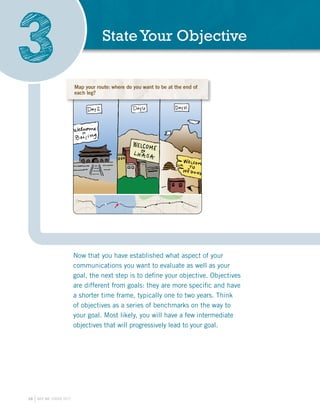
                                          Map your route: what do you want to accomplish at
                                          the end of each leg?


                                                  State Your Objective
                                   PORT
                            PASS


                                                                                   Map your route: Where do you want to be at the end
                                                                                   of each leg?


                         Map your route: where to travelend up distance,to belot of the end of
                                       No one wants
                                                     do you wantwrong place.at
                                       money and somehow
                                                           a long
                                                                  in the
                                                                           spend a

                         each leg?     Evaluating your communications along the way can
                                                         PORT
                                                  PASS
                                                                help you to stay on track and reach your destination.


                         Now that you have established what aspect of your
                         communications you want to evaluate as well as your
                         goal, the next step is to define your objective. Objectives
                         are different from goals: they are more specific and have
                         a shorter time frame, typically one to two years. Think
                         of objectives as a series of benchmarks on the way to
                         your goal. Most likely, you will have a few intermediate
                         objectives that will progressively lead to your goal.


10   ARE WE THERE YET?
efforts work in tandem
                  with program initiatives          COMMUNICATION INITIATIVES                    INSTITUTIONAL
                  and other supporting
           3. STATE YOUR OBJECTIVE
                  activities to reach                                                                 GOAL
                  a goal.
                                                    SUPPORTING ACTIVITIES


                                                                                                             0
                                                                                                          -1
                                        1
                                       AR


                                                                                                      S5
                                    YE


                                                                                                     AR
                                                                                                     YE
                  Figure 2.
                  Objectives are the
                  intermediate steps
                  toward your goal.

                                       OBJECTIVE

                                            1
                                                                 OBJECTIVE

                                                                     2
                                                                                   OBJECTIVE

                                                                                     3                           GOAL


                                                                                                                     0
                                                                                                                  -1
                                       1


                                                                                                                 S5
                                   AR
                                  YE


                                                                                                                 AR
                                                                                                             YE
                  Well-defined objectives are crucial to guiding your communications evaluation. If you are clear
                  Figure 4.what results you want to achieve in the short term,
                   about                                                   it will be easier to assess whether
                  Milestones are
                   your communications are leading to your long-term goal.
                  checkpoints that         MILESTONES
                  show progress from
                  the baseline toward                                  OBJECTIVE         OBJECTIVE
                                         BASELINE


                                                                                                                      GOAL
                                                       OBJECTIVE
                  your objective.
                                                                 1           2             3
                  Example of Goals and Objectives
                  Five-year Goal
                  Consumers in coastal states demand and purchase sustainable seafood on a regular basis.             0
                                                                                                                      -1
                                                             1


                                                                                                                  S5
                                                            AR
                                                            YE


                                                                                                                 AR
                                                                                                                 YE


                  Intermediate Objective 1:
                  By the end of year one, increase by 50 percent the presence of messages about sustainable seafood
                  choices in media outlets in coastal states.

                  Intermediate Objective 2:
                  By the end of year two, double the constituency of advocates for sustainable seafood choices
                  in coastal states.


                  Five-year Goal
COMMUNICATIONS    Secure a decade’s worth of new funding for children’s education in the world’s poorest countries.
TARGET AUDIENCE

                 Intermediate Objective 1:
      AUXILIARY By the end of year one, produce a report on the dire state of education in the world’s poorest countries
      EVALUATION that will serve as a critical resource for policymakers, government agencies and education NGOs.
      AUDIENCES

                  Intermediate Objective 2:
                  By the end of year two, secure public support of three members of Congress, who will put forward
                  legislation to increase U.S. government funding for education in poor countries.


           11     ARE WE THERE YET?
3. STATE YOUR OBJECTIVE


                                                  Is my Objective SMART?
                                                  A good objective should be SMART: Specific, Measurable, Attainable,
                                                  Result-focused and Time-specific. Once you’ve come up with your objective,
                                                  ask yourself, “Does this pass at least four of the five SMART criteria?” If not, it
                                                  may be time to revise your objective. Let’s take a look at the SMART scores for
                                                  two of the preceding sample objectives.


                                                                                                            RESULT-         TIME-
                           OBJECTIVE                               SPECIFIC   MEASURABLE    ATTAINABLE
                                                                                                            FOCUSED        SPECIFIC

 By the end of year one, increase by 50 percent the presence
 of messages about sustainable seafood choices in media
 outlets in coastal states.
                                                                     ✓           ✓             ✓              ✓              ✓
 By the end of year one, produce a report on the dire state of
 education in the world’s poorest countries that will serve as a
 critical resource for policymakers, government agencies and         ✓                         ✓              ✓              ✓
 education NGOs.


“If you have very clear objectives,               We can easily see that the first objective passes all five criteria, provided you
whether they be for your                          have baseline data against which to compare your efforts over time. On the
communications or your program,                   other hand, the second objective only meets four of five criteria. It doesn’t pass
then it’s a lot easier to measure them.           the “measurable” test because it does not define what is meant by “critical
‘Change the world’ objectives are                 resource.” To meet this criterion, we would have to assign a specific meaning
very hard to measure. But it is not               to “critical resource.” For instance, it could mean that the report contains the
hard to measure one of our project                latest research data and expert consensus on an issue, and policymakers cite at
objectives, which is to get 100 digital           least one of the report’s findings in their public statements or on their websites.
retinopathy cameras up and running
across the state, and get 100,000                 Can I evaluate progress on several objectives at once?
people screened.” —Spencer                        The worksheet is designed to evaluate one objective at a time. This will help you
Sherman, Director of Publishing                   stay focused. However, if you decide to evaluate multiple objectives at the same
and Communications, California                    time, make copies of the worksheet and fill one out for each objective. Later on,
HealthCare Foundation                             you may select an evaluation technique (such as a survey) to gather data for assess-
                                                  ing multiple objectives. (Step 8 will cover evaluation techniques.)

                                                  What’s the best way to pick the objective I want to evaluate?
                                                  Your objective should directly address the program or institutional goal you are
                                                  pursuing. Avoid objectives that focus solely on you and your team, like “develop
                                                  a communications plan” or “launch a website.” Always think in terms of your
                                                  audience. Your objectives should be focused on the results you want to achieve
                                                  with your audience on the way to your goal: advancing an issue with policymakers,
                                                  changing people’s attitudes, securing new funding streams from donors and so on.


      Now go to the worksheet, write down your objective and run it through the SMART test. If it passes four of the
      five criteria, you’re ready to move on.


12   ARE WE THERE YET?
4                                    Identify Your Audience
                                      Who are the people who will have the answers to
                                      your evaluation questions? Where can you find them?
                                      Be specific in your selection of audiences.


                         Who can help you find the information you are looking
                         for? Where can you find them?


                                                                                            Who are the people who will have the answers to your
                                                                                            evaluation questions? Where can you find them? Be specific
                                                                                            in your selection of audiences.


                         Now that you’ve articulated your desired goal and
                         objective, you need to pinpoint the audience(s) that
                         will be the focus of your evaluation. Organizations
                         often measure what’s easy to count, such as how
                         many publications they have sent out or how many
                         people have visited their website. However, most
                         communications are ultimately trying to move an
                         audience; therefore, getting feedback from the right
                         source is crucial for a good evaluation.


13   ARE WE THERE YET?
4. IDENTIFY YOUR AUDIENCE


                                                                                                   1
                                                                                              AR
                                                                                             YE
Knowing which audiences to include in the evaluation will depend on your goal4.
                                                                             Figure
                                                                             Milestones are
and objective. For instance, if you are evaluating an initiative to get people in
                                                                             checkpoints that                 MILESTONES
your state to buy more sustainable seafood, you might concentrate on the show progress from
                                                                             the baseline toward                                           OBJECTIVE


                                                                                                   BASELINE
individuals who make household purchasing decisions.                                                                           OBJECTIVE
                                                                             your objective.
                                                                                                                       1                     2
                                                                                         “The really critical need is for
While the audience for your evaluation will likely be the same audience that you         foundations to do a better job of
are targeting with your communication efforts, you may also evaluate additional          researching their target audiences.
audiences. For example, if your objective is to secure policymaker support for           Sounds like common sense, but
improving fisheries management, your audience may include seafood consum-                evidently most foundations don’t
ers in a particular district. These consumers’ opinions and choices will likely          do this often and many don’t do


                                                                                                                           1
                                                                                                                       AR
                                                                                                                      YE
affect the decisions of policymakers who represent them. Thus, your evaluation           it at all. For example, a recent
should include both your communications target audience (the seafood con-                study found that few of the largest
sumers) and the auxiliary evaluation audience (the policymakers responsible for          foundations do surveys of target
fisheries management) to determine whether and how your communications are               readers of their annual reports,
influencing these different players.                                                     which can be pretty expensive
                                                                                         communications investments. You’d
                                                                                         think foundations would want to know
                                                                                         whether they’re getting a return on
                                                                                         those investments.” —Mark Sedway,
                                                                                         Philanthropy Awareness Initiative
      Figure 3.                                                  COMMUNICATIONS
      The audience for                                           TARGET AUDIENCE
      your evaluation
      should include both
      the audience you
      targeted for your                                                AUXILIARY
      communication                                                    EVALUATION
      activities and any                                               AUDIENCES
      others who may
      influence your goals                                                               “I’ll give you one example of how
      and outcomes.
                                                                                         evaluation is having an impact in our
                                                                                         work. We had to put together a list of
                                                                                         the people we wanted to influence so
                                                                                         they could be surveyed for a baseline
                                                                                         Stakeholder Perception Report, a
                                                                                         total of about 500 people. Just the
                                                                                         act of doing that really focused my
                                                                                         group’s attention to who our primary
Be specific when identifying your audience. Selecting ‘policymakers,’ the                audience is. This has helped to give
‘general public,’ ‘young people’ or ‘women’ will not give you much insight into          us tremendous focus.”
where your communications are effective – these categories are far too broad.            —Spencer Sherman, Director of
Narrow your audience to a well-defined group: ‘senior members of the Senate              Publishing and Communications,
Foreign Relations Committee’ or ‘25-to-34-year-old Hispanic professional                 California HealthCare Foundation
women living in the Tri-state area.’ The more narrowly you define your audience,
the more effective your evaluation will be, as you will know exactly whom to
call, survey, observe and solicit feedback from.


     Now go to the worksheet and enter your audience(s) for the evaluation. Remember to consider the target audience
     of your communication activities as well as any auxiliary audiences that may inform your evaluation.


14    ARE WE THERE YET?
5                                     Establish Your Baseline

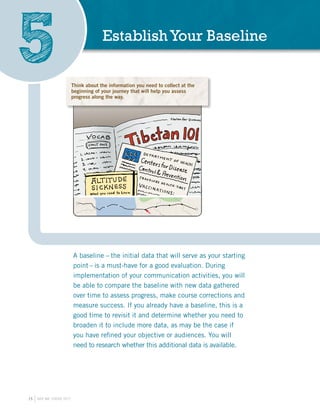
                         Think about the information you need to collect at the
                         beginning of your journey that will help you assess
                         progress along the way.
                                                                                                AN
                                                                                          TI BET 1
                                                                                               10
                                                                                                     Think about t
                                                                                                     the beginning
                                                                                                      assess prog


                         A baseline – the initial data that will serve as your starting
                         point – is a must-have for a good evaluation. During
                         implementation of your communication activities, you will
                         be able to compare the baseline with new data gathered
                         over time to assess progress, make course corrections and
                         measure success. If you already have a baseline, this is a
                         good time to revisit it and determine whether you need to
                         broaden it to include more data, as may be the case if
                         you have refined your objective or audiences. You will
                         need to research whether this additional data is available.


15   ARE WE THERE YET?
5. ESTABLISH YOUR BASELINE


Here are some examples of the types of information used to determine baselines:

•	 Audience knowledge of and attitudes toward your organization and/or issue

•	 Common misconceptions and misinformation about your issue

•	 Audience values that directly affect your issue

•	 An analysis of organizations, issues or messages that could compete for your audience
   and media attention

•	 An analysis of how your issue has been presented or framed in traditional or social media

•	 A list of ‘influentials’ who support and oppose your issue

What if I am well into implementing my communication activities and didn’t establish
a baseline early on?
If you are in the early or middle stages of your communication activities and never collected baseline
information, don’t worry – it’s not too late. It is still possible – and recommended – to establish a
baseline now. Look at your goal and objective to decide what information will tell you whether your
communications are working, then set about gathering that information. Think of ways to assess con-
ditions prior to your communications in order to establish a retroactive baseline. For instance, you
could analyze media coverage from the time before you started your work, or compare records of past
membership levels, or web or blog traffic. Feedback or requests that your organization received via
email, letters or phone calls can also be helpful in establishing retroactive baselines. Additionally,
look for publicly available information such as public opinion surveys, past reports released by peer
organizations or interviews given by relevant spokespeople before you started implementation.


     Now go to the worksheet and enter what information you need to set your baseline. In Step 8, you will select
     the evaluation techniques best suited to gathering this data going forward.


16   ARE WE THERE YET?
6
                                      Pose Your
                                      Evaluation Questions

                         Don’t be afraid to ask questions along the way. These                       Dont be afraid to ask questions along t
                         questions will help you challenge your assumptions and                      These questions will help you challenge
                         check on your progress.                                                     assumptions and check on your progress

                                                                                        TRAVELER’S
                                                                                        JOURNAL


                         Now that you have selected your goal,                    “We need to learn how to
                                                                                  prioritize our evaluation
                         objective and audiences, and have established            questions. Rarely are the
                         a baseline, it’s time to formulate the questions         resources available to collect
                                                                                  data on every aspect of a
                         that will guide your evaluation. The answers             communications strategy. And
                         to these questions will reveal strengths and             such a comprehensive approach
                                                                                  usually is unnecessary anyway.
                         weaknesses in your communication strategy,               Given the choice between
                         such as your choice of audiences, messages or            collecting a little information
                                                                                  on a lot of questions versus
                         tactics. Keep in mind that the more questions
                                                                                  collecting deeper information on
                         you ask, the more work your evaluation will              one or two questions, the latter
                                                                                  often is the more useful choice.
                         require and the more it will cost. Realizing
                                                                                  A ‘less is more approach’ can be
                         that you have limited resources, try to pick             wise when identifying both what
                         questions that, when answered, will help you             to evaluate and how.”
                                                                                  —Julia Coffman, Harvard Family
                         determine whether you are on track toward                Research Project
                         reaching your objective and long-term goal.
17   ARE WE THERE YET?
6. POSE YOUR EVALUATION QUESTIONS


     The kinds of questions you pose will depend on how far you have progressed in your communication
     activities. To help you tailor your questions to the stage your work is in, we’ve divided the questions
     into three categories: early, mid-course and advanced stages. See which questions best apply to
     where you currently are with your communication initiative.


     Early Stages
     During the early stages, you are developing your communication plan or starting implementation.
     You may be working in a relatively new field or in an area in which you have little experience. These
     situations require some degree of trial and error, as well as an effort to establish a baseline
     assessment. At this point, an evaluation strategy can help you determine some of the larger strategic
     directions of your activities and establish a series of milestones to help you reach your intermediate
     objective and long-term goal.

     Examples of communication efforts in the early stages:
     •	 You are launching a campaign to fight childhood obesity by promoting healthier lifestyles. You
        have connected with potential spokespeople who are willing to be messengers for the importance
        of healthier nutritional choices and exercise for children.

     •	 You are designing a communication strategy to position your organization as an expert in
        improving education services for new immigrants in your state. The launch of your first report
        on the topic has been well-received in the press and among experts.

     Sample questions:
     •	 Have I tested my messages with a sample group that is representative of my audience? Has their
        reaction matched or exceeded my expectations? What adjustments do the responses tell me that
        I need to make?

     •	 What is the audience’s initial response to my spokespeople? Are these spokespeople the right
        messengers? Do I need to make adjustments?

     •	 Where have my messages first appeared? Local press? Websites? Word of mouth? Are these the
        outlets I was aiming for? Could a different outlet be a better one for my messages?

     •	 Are my messages and messengers suited for the communication channels that I selected?

     •	 How is the audience responding to my choice of communication tactics (for example, a YouTube
        video about your organization)? Do I need to make adjustments?

     •	 What evidence do I have that my messages are being absorbed by my audience?


18    ARE WE THERE YET?
6. POSE YOUR EVALUATION QUESTIONS


     Mid-Course
     If you are mid-course in your communication activities, you probably have established a baseline,
     identified the major players and chosen to invest in certain strategies and tactics. At this point, your
     evaluation questions can help you determine whether you are on track for achieving your objectives.
     The answers you receive may lead you to make course corrections or even revisit the original objec-
     tives you established. This is the time to learn from what you have achieved so far, to separate what
     has worked and what has not and to further hone your communications.

     Examples of communication efforts in the mid-course stages:
     •	 Your program to develop healthier lifestyles for children in suburban communities is generating
        substantial news coverage and has succeeded in getting parents to walk their children to school.
        However, the initial excitement has dissipated after the first year, and most parents have gone
        back to driving their kids to school.

     •	 After three years of working on education issues for new immigrants, your organization has earned
        recognition from peers, the educational community and policymakers. Yet the media rarely
        consult your reports or seek your opinion when covering the topic, and coverage continues
        to portray the issue negatively.

     Sample questions:
     •	 Is my audience more informed about the issue? What evidence do I have? If this information
        is not publicly available, how else can I obtain it?

     •	 Is my audience more engaged with the issue? If not, does my data indicate possible reasons
        for the low engagement?

     •	 Based on audience response, do I need to change my audience?

     •	 Based on audience response, do I need to make changes in my messages or messengers?

     •	 Has media coverage of the issue or debate changed since I started working on it? If so, is the
        change favorable to my objective?

     •	 Are my messages gaining visibility in the media I have targeted? If not, what can I do to bring
        more visibility?

     •	 Did I target the right media outlets for the objectives I am pursuing? If not, what outlets
        should I be targeting?

     •	 Have there been unexpected events, news or societal shifts that may affect my progress? If so,
        do these changes require that I make adjustments to my objectives or communication tactics?

     •	 Can I make a valid claim of having contributed to the changes I observe on my issue? How?
        If this information is not publicly available, how else can I obtain it?


19   ARE WE THERE YET?
6. POSE YOUR EVALUATION QUESTIONS


     Advanced Stages
     In the advanced stages of a communication effort, you have been working on an issue for a signifi-
     cant period of time and have probably made several positive, measurable steps toward reaching your
     goal. At the same time, there may be new challenges that you could not have anticipated during ear-
     lier stages. You might need to expand your audiences or even focus on new ones. Or you may need
     to consider new tactics, partners, adversaries or changes in your general environment. At this point,
     evaluation provides an opportunity to assess what results you have achieved so far and the lessons
     learned, as well as sharpen your goals and lay out a path for the future.

     Examples of communication efforts in the advanced stages:
     •	 Over the last few years, you have made substantial contributions to promoting healthier lifestyles
        for children and their families. Recently, a new player has entered the scene: a prominent organi-
        zation has just announced that it will focus on fighting childhood obesity. Because of its high
        profile, this organization is likely to rapidly gain more visibility than yours. You are weighing your
        options for how to continue garnering support for your work on this issue.

     •	 You are well-established in the field of education services for new immigrants. You have observed
        some results in increased access to education for this population, and you believe that these
        results are significantly due to your work over the past several years.

     Sample questions:
     •	 Have my messages become more widely accepted than opposing or competing messages in the media?

     •	 Have my messages become part of the public discourse? What evidence do I have?

     •	 Are there any observable policy results? Can I make a plausible case for having contributed to
        these results? If this information is not publicly available, how else can I obtain it?

     •	 Are there signs of change in behavioral intention or behavior change? Can I make a plausible case
        for having contributed to these results?

     •	 Do I have reliable data that can help me make the case for continued support to my activities?

     •	 Does my data indicate a need to change my communication strategy or tactics at this advanced stage?

     •	 Have I achieved my objective and goal? If so, does my organization have a role going forward?

     •	 What lessons have I learned? Have I documented them?

     •	 With whom do I plan to share my lessons learned: Colleagues within my organization? My board?
        Peers? Funders (or grantees)?


20   ARE WE THERE YET?
6. POSE YOUR EVALUATION QUESTIONS


It’s important to recognize that some questions may be easier to obtain answers for than others. If
you are working on a sensitive or controversial topic that your audience may not be comfortable dis-
cussing – such as teen pregnancy – it may be difficult to get the information you are looking for. This
can be addressed to some extent by reassuring members of your audience that their feedback will be
treated confidentially, or by using information gathering methods that do not reveal their identity (an
anonymous online survey, for example). But you may also need to account for times when audience
members conceal values or refuse to participate. To find the answers to your questions, you may
need to rely on multiple sources of information and/or using more than one evaluation technique.


     Now go to the worksheet and enter the questions you have selected. Try to limit yourself to five questions.
     The next sections will help you obtain answers by guiding you through drafting concrete measurements
     of progress and choosing evaluation techniques.


                                            EVALUATION IN ACTION

                                            Education Reform
                                            from Nuts to Soup

                                            “We looked at how education advocate grantees were communicating and whether or
                                            not what they were communicating created value for the program. For example, with
                                            the California K-12 Program, grantees were using the phrase ‘adequacy movement’
                                            to describe their push for ‘equitable and adequate funding to provide every child
                                            with a quality education, regardless of school district.’ While the term ‘adequacy’
                                            was understood by the grantees to mean more and more equitable funding, the
                                            term meant something else to parents and the engaged public – a call for uniformly
                                            adequate education. The public didn’t want ‘adequate’ education; they wanted
                                            ‘excellent’ education. There was clearly a language problem that necessitated the
                                            grantees moving away from their jargon to language that was more connective with
                                            outside stakeholders whose support they needed for success.

                                            “We used values-based research among all stakeholder groups to develop a message
                                            framework that helped advocates focus on what they need to talk about, and what
                                            they didn’t. We aligned what grantees valued with what policymakers valued and
                                            then aligned the message to the most commonly held value among parents –
                                            education that would prepare children to become successful adults.

                                            “The important thing is to align stakeholders around a common value and constantly
                                            communicate the valued outcome – focus on the outcome. The details fall into
                                            place once you have everyone tuned into the guiding principle.”
                                            —Rich Neimand, President/Creative Director, Neimand Collaborative (in reference
                                            to an evaluation of the messaging being used by the Hewlett Foundation’s California
                                            K-12 Public Education Grantees)


21    ARE WE THERE YET?
7                                     Draft Your Measurements

                         How do you know if you’re headed in the right direction?
                         There are signs that will help you determine whether
                         course corrections are needed.


                         You are now clear on what your communications              “A lot of what you evaluate are
                                                                                    really proxies for measures of
                         are expected to achieve. You have defined your             success. So, for example, raw
                         goal and objective, identified your evaluation             numbers of media mentions are
                                                                                    not particularly useful. While it’s
                         audience, selected information to serve as a               gratifying to go from 400 to 1,400
                         baseline and developed a list of questions to be           mentions, if those placements
                                                                                    are not in publications read by
                         answered. The next step is to draft measurements           your target audience, this result
                         of progress toward your objective.                         doesn’t say much. But tracking
                                                                                    placements in key outlets that
                                                                                    are important voices in shaping
                                                                                    the policy debate, that is a more
                                                                                    meaningful measure to us.”
                                                                                    —Barry Scholl, Vice President for
                                                                                    Communications and Publishing,
                                                                                    The Commonwealth Fund


22   ARE WE THERE YET?
a goal.
                                                SUPPORTING ACTIVITIES

         7. DRAFT YOUR MEASUREMENTS


                                                                                                                  0
                                                                                                               -1
                                     1
                                    AR


                                                                                                           S5
                                YE


                                                                                                          AR
                                                                                                          YE
            Figure 2.
            Objectives are the
            intermediate steps
         Mark your milestones
            toward your goal.
         Milestones are “progress checkpoints” that take you from your baseline to your
                              OBJECTIVE              OBJECTIVE             OBJECTIVE
         objective. For example, if your objective is to “position the foundation’s report
                                         1                               2
         on the state of education as a critical resource for policymakers, government    3                           GOAL
         agencies and NGOs by the end of year one,” then a milestone could be “by
         the end of month six, policymakers who have attended the report briefings are
         quoted using data from the report.” You will measure the milestone by monitor-
         ing and collecting newspaper articles or speeches in which policymakers are


                                                                                                                          0
         citing the report. You should aim to draft about three milestones per objective.


                                                                                                                       -1
                                    1


                                                                                                                      S5
                               AR
                              YE


                                                                                                                      AR
                                                                                                                  YE
              Figure 4.
              Milestones are
              checkpoints that                   MILESTONES
              show progress from
              the baseline toward                                             OBJECTIVE       OBJECTIVE
                                     BASELINE


                                                                                                                           GOAL
                                                                  OBJECTIVE
              your objective.
                                                                    1           2               3


                                                                                                                           0
                                                                                                                           -1
                                                              1


                                                                                                                       S5
                                                          AR
                                                         YE


                                                                                                                      AR
                                                                                                                      YE


         How to develop meaningful milestones                                                                     “Meaningful milestones do not mean
         1. With your baseline, objective and evaluation questions in mind, ask yourself,                         setting the easiest measures possible.
         “What kind of intermediate results would demonstrate progress from my baseline                           The milestones should represent the
         to my objective? What will tell me along the way whether I’m on track?” Write                            ambitiousness of your undertaking,
         down your ideas.                                                                                         make the organization stretch to
                                                                                                                  achieve them, and, most important,
         2. Review the milestones by asking yourself:                                                             serve as an inspiration to succeed
COMMUNICATIONS
             •	Do	they	represent	meaningful	signs	of	progress?	
TARGET AUDIENCE
                                                                                                                  – not serve as a threat of possible
             •	Are	they	stated	as	results?                                                                        failure.” —Kristen Grimm, President,
             •	Are	they	realistically	measurable?	How?                                                            Spitfire Strategies
     AUXILIARY
             •	Can	I	assign	a	deadline	by	which	they	should	be	reached?	
     EVALUATION
             •	Do	they	help	me	answer	my	evaluation	questions?
     AUDIENCES


         3. Share your milestones with colleagues and see whether they agree with
            your choices.


         23   ARE WE THERE YET?
7. DRAFT YOUR MEASUREMENTS


Keep in mind that milestones are not measures of your activities. Rather, they are the preliminary
achievements resulting from your communications. This is an important distinction. Say you have
distributed 1,000 copies of a publication; this is an activity (also called an output). The milestone
that you want to measure is the response you expect from the readers – a certain percentage of them
wrote to request more information or subscribed to your quarterly e-newsletter (the outcome of your
communications). You want to track the outcomes, not the outputs.

How to measure your milestones
Look for simple measures that show whether you are reaching your milestones. For example, say your
milestone is “a 50 percent increase in the visibility of the term ‘undocumented immigrant’ instead
of ‘illegal immigrant’ in the media within six months.” You would first need to measure the number
of times the respective terms are used in the media at the beginning of your activities; this is your
baseline. Then you need to measure the number of times that the preferred term was used by the
media after six months of your communication activities, and compare that number to your baseline.

A measure can be quantitative or qualitative. While quantitative measures provide a numerical
measure of your communications results, qualitative measures reveal more about their effects. For
example, the number of newspaper articles mentioning your organization is a quantitative measure,
while the content (positive or negative tone or framing of the issue) of the articles is a qualitative
measure. Qualitative measures are often more helpful in determining what is working and what can
be improved. Sometimes you may choose a combination of quantitative and qualitative measures.
For example, if you are evaluating audience awareness of your organization’s work, knowing what
percentage of your audience has heard of your organization – a quantitative measure – tells only part
of the story. Discovering that they can also identify at least one issue that your organization is work-
ing on – a qualitative measure – provides a more meaningful indication of increased awareness.

Identify one to three measures per milestone. Remember: your work will quickly become overwhelm-
ing if you are tracking too much data, so be strategic in choosing the measures that will best show
whether you are reaching your milestone.

How to develop sound measurements
1. Review each milestone. Ask yourself, “How can I concretely measure progress on this milestone?
   Is it a quantitative or a qualitative measure?” Write down your ideas.

2. Review the measures and eliminate the ones that are least relevant to your milestone or
   impossible to measure.

3. Share your measures with colleagues and discuss whether they agree with your choices.

How do I collect data that will show whether I’ve achieved my milestones?
There are many tools at your disposal to help you collect the data you need: website analytic ser-
vices, online surveys and polls, news databases and so on. But don’t be tempted by easy measures.
Quantitative measures that count emails sent, reports downloaded or media hits garnered can be
informative, but these measures may not be as useful as looking at some qualitative measures. What
actions resulted from the emails sent? When users downloaded a publication from your site, what
did they do with it? How was your organization characterized when it was mentioned in newspaper
articles? Step 8 will help you select the right tools for collecting the data you need.


24   ARE WE THERE YET?
7. DRAFT YOUR MEASUREMENTS


What if I find I’m going in the wrong direction?                                      “As the adage warns, if you find
If the data shows positive results, you are on the right track. If you have not       yourself in a hole, the first thing
reached a milestone or if your data is not what you expected, you may need to         to do is stop digging. So too when
adjust your communication tactics or even your strategy. Alternatively, you may       a mid-course evaluation shows
consider revisiting the milestone. Was it realistic in the given time frame? Is it    that your campaign is heading off
a good indication of whether you are moving toward your objective? Flexibility        track. It is never too late to tweak
is vital to the success of most communications. If, for instance, the visibility of   your tactics and make needed
your messages in the media is not increasing at the pace you expected, you may        adjustments in strategy. In fact,
decide to: 1) reallocate resources to the outreach tactic that is generating the      it is the only responsible thing to
most placements; 2) start reaching out to different media targets; or 3) extend       do. Often, the difference between
the deadline of your milestone and continue to closely monitor progress. The          failure and success might be as
important thing is to not lose track of your objective. The process of mid-course     simple as recasting the message,
adjustments is a learning experience – the more you do it, the better you will        utilizing new spokespersons or
get at it.                                                                            targeting a different segment of your
                                                                                      audience. But if you keep shoveling
                                                                                      dirt when that hole is getting
                                                                                      deeper, you’ll eventually dig your
Examples of Objectives, Milestones and Measures                                       own grave.” —David Brotherton,
                                                                                      Brotherton Strategies
Objective Secure the support of a senior member of the Senate Foreign
Operations Committee to increase funding for combating malaria by the
end of year one.

Milestone By the end of month six, receive an invitation to meet with a senior
member after sending a policy briefing on combating malaria to his or her office.

Qualitative measures
•	 You have made contacts in the senior member’s office
•	 You have obtained sample briefs from the member’s office to better tailor
   your brief to their commonly used formats

Objective Position your organization as a credible source of information on
childhood obesity with key media outlets by the end of year two.

Milestone Establish a relationship with journalists from key media outlets
by the end of year one.

Quantitative/qualitative measures
•	 Communication exchanges indicate increased interest by journalists
•	 Organization’s spokesperson is quoted at least twice in key media outlets
•	 Organization’s blog is referenced in at least one key media outlet


        Now go to the worksheet and enter your milestones and the measures you will use to track them.


25   ARE WE THERE YET?
8
                                      Select Your
                                      Evaluation Techniques

                         The right tools will help you find your way. Each journey
                         is unique; decide which tools are right for you.


                         It’s time to choose the techniques you will use to collect
                         data to establish your baseline and track your milestones.
                         Keep in mind that the techniques you pick will also
                         impact your evaluation costs. Depending on the resources
                         you have available for the evaluation, you may choose
                         techniques that are less costly or that can help you
                         monitor several milestones at once. You should also note
                         that some of these techniques may require working with
                         professional evaluators or training your staff to ensure
                         proper application and accurate data interpretation.


26   ARE WE THERE YET?
8. SELECT YOUR EVALUATION TECHNIQUES


Some common evaluation techniques include:

Interviews Interviewing consists of selecting a handful of individuals who represent the base of
your audience and asking targeted yet open-ended questions. This will allow you to receive better
insight into how people are responding to your communication activities.
When to use At any stage of planning or implementation. For example, you are about to draft a new
institutional communication plan, but first you want to know how your key stakeholders and audiences
view your organization and its leadership, contributions, successes and failures. Interviews with
representative constituents will give you insight into these areas.

Focus Groups You may want to bring together a group of people from your audience to test
new messages or have a directed group discussion about your communication activities. Unlike
interviews, focus groups are moderated by a facilitator and allow people to bounce ideas off one another,
building a richer set of data. There are professionals who specialize in conducting focus groups who
can help you design one or more sessions tailored to your needs, as well as to analyze the results.
When to use During planning, early implementation or when you are ready to advance to a new
phase of your communication efforts. Focus groups are also especially useful when you want to test
a specific message, tactic or approach. For instance, you are planning a three-year campaign to gen-
erate support for medical treatment for children living with HIV/AIDS. You have come up with two
different creative approaches and are not sure which one would better speak to your audience.

Surveys – Online and In-Person Using simple and inexpensive technology, you can administer
an online survey consisting primarily of multiple-choice questions. While you may be able to ask
some open-ended questions, surveys are best for “checkbox” answers that garner quantitative data.
Surveys can also be administered in person, allowing you to also observe the respondent and gather
additional data based on his or her reactions to the questions. There are several tactics for selecting
participants for surveys:
•	 Pre-determined population (for example, a group of 10 policymakers)
•	 Sample from the general public (for instance, random users who enter your website or phone calls
   to people living in a particular congressional district)
•	 Snowball sampling As you survey one person, you ask if he or she knows someone else to survey
   (for example, you are conducting a phone survey about endangered species; you would ask a
   respondent if they know a friend who would be interested in taking the survey)
•	 Intercept survey “Intercepting” members of your audience at a particular location appropriate to
   your communication activities and surveying them on the spot (for example, asking shoppers at
   the seafood counter of a local grocery store about sustainable seafood choices)
When to use In the planning stages and during implementation. Surveys are useful for categorizing and
comparing data at a given point in time as well as over a period of time. For this reason, they can be very
helpful in establishing baselines as well as for monitoring progress. However, keep in mind that you may
secure higher response rates and more revealing data once your audience has developed a connection to
your organization. For example, you have hosted a series of monthly webinars over the last year that have
attracted 250 participants. You want to learn more about their motives for participating and how they are
using the information, as well as what has been less useful. A survey of these participants will help you to
design and improve future webinars, engage and retain attendees’ interest and attract new participants.


27   ARE WE THERE YET?
8. SELECT YOUR EVALUATION TECHNIQUES


Observation You may want to observe individuals or groups to see how they are responding to
certain messages. This is particularly useful with communication initiatives that involve participatory
discussions, public forums and debates.
When to use During implementation. For instance, your organization offers a training program on
environmental issues for high school students. After the training, the students are expected to return
to their schools and conduct their own awareness campaigns. You are interested in learning more
about how the students are doing back in school, and whether the messages they are using are
effectively reaching their peers. A trained observer could visit a sample of schools and witness how
the students organize their peers to take action on Earth Day.

Quantitative Data Collection Websites, blogs and other social networks allow you to collect
useful data. For instance, on a website, you can track the number of daily or monthly visitors and
page views. For blogs and social networks, you can track number of subscribers and number
of comments left by visitors. Additionally, you can refer to online services that rank blogs’ popularity
and use these ratings to compare your blog to others in the field.
When to use At any stage of planning or implementation. You want to know if your readership is
growing or whether the number of comments is rising.

Quantitative Data Analysis While it may sound daunting, you can use the data collected from
web tracking or media monitoring services to conduct statistical analysis of the possible relation-
ships between your communication activities and external changes.
When to use During planning and at any stage of implementation. For example, after six months of
launching your blog, you want to test whether there is a connection between increase in comments
and the ranking of your blog. Does the number of weekly posts relate to the frequency in which your
blog is referenced by others? Statistical analysis can explore these relationships.

Content Analysis To assess the quality and tone of your media coverage, or to review the content
of specific programming that reaches your audience, this technique can provide powerful insights.
However, the process is often time-consuming and the people carrying out the analysis need to be
well-trained in the technique to ensure objectivity and consistency.
When to use Early stages and throughout implementation. For example, media coverage for your
issue has increased, but you sense that negative coverage is dominating the air and radio waves.
You want to find out if this is the case, so you turn to content analysis.

This list of various evaluation techniques is not comprehensive, but something to get you started.
For more information on measurement tools, see the Appendix: Useful Resources for Communica-
tions Evaluation.


     Now go to the worksheet and select which evaluation technique is best suited to establishing your baseline,
     answering your questions and tracking each of your milestones and measurements. As always, discuss with your
     colleagues and see if they agree with the techniques selected.


28   ARE WE THERE YET?
9                                     Estimate Your Budget

                         Your budget will determine how you go about your
                         journey. Keeping it in mind will ensure that you get
                         from start to finish.                                        You will need resources for an effective e
                                                                                      Be sure to plan your budget at the beginn
                                                                                      check your expenses as you go.


                         After you have selected your evaluation techniques, it’s
                         time to estimate your budget. A rule of thumb is that the
                         evaluation budget should be at least five to seven percent
                         of the total budget of your communication program. This
                         is a generalization and of course will vary, but the cost
                         should not dip below this level.


29   ARE WE THERE YET?
9. ESTIMATE YOUR BUDGET


The main budget items to consider are:                                              “The evaluation has to recognize the
                                                                                    size, the scope and the maturity of
                                                                                    the [communications] campaign.
Staff time Full-time staff, interns and volunteers. Identify the evaluation         Policy change takes years or decades
tasks that can be conducted internally, and estimate the time that will be          to happen. Most organizations lack
required of each individual.                                                        funding to do evaluations over that
                                                                                    period of time. You must recognize
External consultant fees Evaluation experts, facilitators, phone and field          that when you are coming into it.
interviewers, etc. Explore the possibility of working with trained evaluators       What is the scope – is this a state,
experienced in the type of evaluation you are interested in. Ask them to provide    local, regional, national or worldwide
an estimated budget. If your resources are very limited, consider contacting        campaign? What is the size – is it a
graduate students who have sound expertise in evaluation.                           $25,000 campaign or a $2.5 million
                                                                                    campaign? Expectations have to be
Cost of selected evaluation techniques Note that several of the tech-               commensurate with money available.”
niques we mention in this guide are often available at no cost, such as online      —Phil Sparks, Executive Vice
surveys or web analytics. On the other hand, if you plan to hire a professional     President and Co-Founder,
firm to conduct focus groups or surveys, obtain an estimated budget.                Communication Consortium Media
                                                                                    Center (CCMC)
Travel and incidentals Make sure to include travel costs for both your staff
and consultants.

Editing, design, production and dissemination costs We encourage you
to document, publish and share your evaluation findings. This will help build
the practice of communications evaluation.

As you consider costs of the evaluation, you should also talk about roles and
responsibilities. The budgeting process may also help you make decisions about
what to prioritize in the evaluation. Over time, as you gain more experience with
evaluation, your budget estimates will become more accurate.


        Now go to the worksheet and draft your budget in the space provided.


30   ARE WE THERE YET?
Welcome to Your
Evaluation Strategy!

Congratulations! If you’ve followed the steps outlined in this guide,
you have successfully crafted your communications evaluation
strategy. Your strategy will be the Evaluation Strategy Worksheet that
you filled out during each step. Now you’ll want to review each entry
and fine tune if necessary. Determine whether anything needs to be
further revised by sharing the strategy with colleagues and getting
their feedback. Review the budget and determine whether you have
the resources to monitor the questions, milestones and measures
utilizing the techniques you have chosen.


One last piece of advice: communicate your findings!

We strongly encourage you to share what you have learned with others. Who will benefit from
what you are learning through your evaluation? Your team? Your board? Your colleagues through-
out the organization? Your peers in other nonprofits and foundations? Should you share the same
information internally and externally? These are important questions that need to be answered
before you share your findings.

In the Appendix, we suggest a web resource where you can publish the findings of your evalua-
tion and read about what others have learned through their own evaluations.

We wish you the best of luck in your endeavor to evaluate your communication efforts and hope
that you will share with us the experiences you had when using this tool – what worked, what
didn’t and what can be done to improve it. Please contact us at info@asibey.com – we value
your feedback!


31   ARE WE THERE YET?
Evaluation Strategy Worksheet


STEP 1. Determine What You Will Evaluate
What are you evaluating? A strategic initiative? A tactical effort? Something else? Be specific.


STEP 2. Define Your Goal
What type of outcome are you pursuing?
What is the change your organization is trying to achieve over five to ten years?


STEP 3. State Your Objective
What is your SMART objective? Run your objective through the SMART test below.
[Note: If you have more than one objective, you need to fill out a separate worksheet for each one.]

                   OBJECTIVE                  SPECIFIC   MEASURABLE      ATTAINABLE   RESULT-FOCUSED      TIME-SPECIFIC


SMART Score (out of 5):
Your SMART score should be at least 4. If your score is 3 or less, go back and refine your objective.


STEP 4. Identify Your Audience
Who are the target audiences for your communication activities? Are there any auxiliary audiences who can
also provide valuable insight for your evaluation? Write them down below.


Communication Target Audience(s)                                       Auxiliary Evaluation Audience(s)


1                                                              1


2                                                              2


3                                                              3


32   ARE WE THERE YET?
Evaluation Strategy Worksheet


STEP 5. Establish Your Baseline
What information do you need to establish your baseline – the starting point against which you will measure your activities?

 1


 2


 3


 4


STEP 6: Pose Your Evaluation Questions
What stage is your communication initiative in (check one): __Early     __Mid-course __Advanced
Write down your evaluation questions based on that stage:

 1


 2


 3


 4


 5


STEP 7. Draft Your Measurements
What are the most meaningful milestones that will demonstrate progress toward your objective?
How will you measure them? Remember, you want to track outcomes, not outputs.


             Milestone A                      Milestone B                             Milestone C
 OBJECTIVE


             Measures                         Measures                                Measures

             1.                               1.                                      1.

             2.                               2.                                      2.

             3.                               3.                                      3.


33     ARE WE THERE YET?
Step 8: Select Your Evaluation Techniques
                    Select the techniques you will use to measure each item from the blue column on the left. Remember, some techniques can be used to measure more than one item
                    (baseline information, evaluation questions, milestones), so there may be some overlap. Use a separate chart for each objective.


34
                                                                                        Focus    Survey:    Survey:                   Quantitative     Quantitative    Content      Other       Other     Other
                     Briefly recap your answers from the worksheet here:   Interviews                                  Observation
                                                                                        Groups   Online    In-Person                 Data Collection   Data Analysis   Analysis   Technique   Technique Technique
                     Objective
                        Baseline Info 1
                        Baseline Info 2
                        Baseline Info 3


ARE WE THERE YET?
                        Baseline Info 4
                        Question 1
                        Question 2
                        Question 3
                        Question 4
                        Question 5
                        Milestone A
                            Measure 1
                            Measure 2
                            Measure 3
                        Milestone B
                            Measure 1
                            Measure 2
                            Measure 3
                        Milestone C
                            Measure 1
                            Measure 2
                            Measure 3


                    Step 9: Estimate Your Budget
                    Now, based on the techniques you have chosen above, estimate your line items below.
                    You may enter estimated hours or dollar amounts needed. You will need to convert hours to dollars to get your total.
                                                                                        Focus    Survey:    Survey:                   Quantitative     Quantitative    Content      Other       Other     Other
                     Budget Line Items:                                    Interviews                                  Observation
                                                                                        Groups   Online    In-Person                 Data Collection   Data Analysis   Analysis   Technique   Technique Technique
                     Staff Time
                     External Consultant Fees
                     Evaluation Technique Cost
                     Travel and Incidentals
                     Editing, Design,Production and Dissemination Costs
                     Other Cost
                     Other Cost
                     Sub -Total

                     GRAND TOTAL                                                                                                                 $
Appendix: Useful Resources for Communications Evaluation


The following resources may be useful to support your evaluation work:

Communication Planning
With a good communication plan, evaluation is much easier and more productive. Consult these
resources to help you create a strong communication plan that you can connect to your evaluation
strategy.

•	 Smart Chart 3.0: An Interactive Tool to Help Nonprofits Make Smart Communications Choices
   Spitfire Strategies, 2008
   http://www.smartchart.org/
   The Smart Chart is a step-by-step planning tool that helps nonprofits make smart choices and
   develop high-impact communications strategies.

•	 Foundation Communications: The Grantee Perspective
   Center for Effective Philanthropy, February 2006
   http://www.effectivephilanthropy.org/images/pdfs/CEP_Foundation_Communications.pdf
   This report presents the results of a research study surveying grantees on foundation communications,
   revealing what types of communications are most important to grantees. It also identifies some of
   the best practices common to foundations that are highly rated for the clarity of their communications.
   This report may be useful to read before embarking on any new communication initiatives, as well
   as to improve existing ones.

Evaluation Methods and Techniques
To learn more about the pros and cons of different evaluation methods and techniques, consult
these resources.

•	 W.K. Kellogg Foundation Kellogg Evaluation Handbook
   W.K. Kellogg Foundation, 1998
   http://www.wkkf.org/Pubs/Tools/Evaluation/Pub770.pdf
   This handbook provides a framework for thinking about evaluation as a relevant and useful
   program tool. It also offers a blueprint for planning, designing and conducting project-level
   evaluation.

•	 Qualitative Research and Evaluation Methods, Edition 3
   Michael Quinn Patton, Sage Publications, 2002
   This book provides an overview of conceptual elements of qualitative research and concrete steps
   for designing, collecting and analyzing qualitative data.

•	 Introductory Statistics, 8th Edition (a general introduction to quantitative methods)
   Neil A. Weiss, Addison Wesley, 2007
   For those unfamiliar with statistics, this textbook provides a general overview of simple statistical
   procedures and guidance on how to use them to inform evaluation.

•	 Focus Groups: A practical guide for applied research, 3rd Edition
   Richard A. Krueger and Mary Anne Casey, Sage Publications, 2000
   This is a practical guide on how to design and conduct focus groups, including developing
   questions, selecting participants, moderating focus group discussions and analyzing results.


35   ARE WE THERE YET?
•	 Using Online Surveys in Evaluation
   Valerie M. Sue and Lois A. Ritter, Jossey-Bass and the American Evaluation Association, 2007
   This publication provides a general introduction to the use of online surveys for evaluation
   purposes, including how to select samples, develop questions for online surveys, conduct
   an online survey and manage online survey data.

•	 Writing a Media Analysis
   Prepared for the Communications Consortium Media Center by Douglas Gould and Company,
   October 2004
   http://www.mediaevaluationproject.org/WorkingPaper2.pdf
   This brief report contains specific methodology on how to conduct a media analysis, including
   spokesperson and framing analysis.

Miscellaneous
The following are some good general resources pertaining to evaluation and organizational effectiveness.

•	 Center for Effective Philanthropy
   www.effectivephilanthropy.org
   The mission of the Center for Effective Philanthropy (CEP) is to provide data and create insight
   so that philanthropic funders can better define, assess and improve their effectiveness and impact.
   CEP offers individual foundations the opportunity to assess performance on key dimensions
   relative to other foundations. Tools include the Grantee Perception Report and the Stakeholder
   Perception Report.

•	 2008 eNonprofit Benchmarks Study:
   An Analysis of Online Messaging, Fundraising and Advocacy Metrics for Nonprofit Organizations
   M+R Strategic Services and Nonprofit Technology Network, 2008
   http://www.e-benchmarksstudy.com
   This study analyzed online messaging, fundraising and advocacy data from 21 leading nonprofit
   organizations. It provides new data to aid in establishing benchmarks for email messaging, email
   list size, online fundraising and online advocacy.

•	 Speaking for Themselves: Advocates’ Perspectives on Evaluation
   Innovation Network, September 2008
   http://www.innonet.org/client_docs/File/advocacy/speaking_for_themselves_web_enhanced.pdf
   This report, written as part of the Innovation Network’s Advocacy Evaluation Project with support
   from the Annie E. Casey Foundation and Atlantic Philanthropies, provides information garnered
   from a survey of 200 participants from across the nonprofit sector to develop practical recommen-
   dations for nonprofit staff, evaluators and funders on how to evaluate advocacy efforts.

•	 When and How to Use External Evaluators
   Tracey A. Rutnik of the Association of Baltimore Area Grantmakers
   and Marty Campbell of The James Irvine Foundation, 2002
   http://www.irvine.org/assets/pdf/evaluation/when_how_external_evaluator.pdf
   This brief paper is intended to serve as a resource to program officers to inform decisions about
   their allocation of resources and use of external consultants for program evaluations.

•	 IssueLab
   www.issuelab.org
   IssueLab is an online publishing forum for nonprofit research whose mission is to more effectively
   archive, distribute and promote the extensive and diverse body of work being produced by
   the third sector. To review evaluation reports published by peer organizations, access relevant
   publications on evaluation or post your own evaluation reports, visit the IssueLab website.

36   ARE WE THERE YET?
Asibey Consulting | www.asibey.com
Communications Network | www.comnetwork.org


Copyright ©2008 Communications Network and Asibey Consulting

ARE WE THERE YET?

  • 1.
    Are We There Yet? ACommunications Evaluation Guide Your journey to high-impact YOU ARE HERE communications STARTS HERE Prepared by Asibey Consulting for a ARE WE THERE YET?
  • 2.
    Table of Contents Aboutthis Guide 1 Why Evaluate Communications? 2 Step 1: Determine What You Will Evaluate 4 Step 2: Define Your Goal 6 Step 3: State Your Objective 10 Step 4: Identify Your Audience 13 Step 5: Establish Your Baseline 15 Step 6: Pose Your Evaluation Questions 17 Step 7: Draft Your Measurements 22 Step 8: Select Your Evaluation Techniques 26 Step 9: Estimate Your Budget 29 Welcome to Your Evaluation Strategy! 31 Evaluation Strategy Worksheet 32 Appendix: Useful Resources for Communications Evaluation 35 i ARE WE THERE YET?
  • 3.
    Acknowledgments We would liketo thank the following individuals for their time, insight and Are We There Yet? was created valuable input, all of which helped to shape this guide: for the Communications Network by Asibey Consulting. It was written Claire Baralt Doris Duke Charitable Foundation jointly by Edith Asibey, Toni Parras and Justin van Fleet. Kevin Bolduc Center for Effective Philanthropy David Brotherton Brotherton Strategies The Communications Network provides Eric Brown The William and Flora Hewlett Foundation resources, guidance and leadership to Susan O. Conner Lumina Foundation for Education advance the strategic practice of com- munications in philanthropy. For more David Devlin-Foltz Continuous Progress Strategic Services at The Aspen Institute information, or to download additional Chris DeCardy The David and Lucile Packard Foundation copies of Are We There Yet?, visit Julia Coffman Harvard Family Research Project www.comnetwork.org. David C. Colby The Robert Wood Johnson Foundation Lori Dorfman Berkley Media Studies Group Asibey Consulting develops com- munication and advocacy strategies Marc Fest John S. and James L. Knight Foundation and provides clients with the tools to Kristen Grimm Spitfire Strategies measure their effectiveness. For more Lucas B. Held The Wallace Foundation information, visit www.asibey.com. David J. Morse The Robert Wood Johnson Foundation This guide was produced with gener- Rich Neimand Neimand Collaborative ous support from the David and Lucile Grant Oliphant The Pittsburgh Foundation Packard Foundation. Joy Portella Mercy Corps Barry Scholl The Commonwealth Fund Mark Sedway Philanthropy Awareness Initiative Spencer Sherman California HealthCare Foundation Daniel Silverman James Irvine Foundation Heidi Sinclair The Bill & Melinda Gates Foundation Jenny Sorensen The Bill & Melinda Gates Foundation Nik Steinberg Independent Consultant Phil Sparks Communication Consortium Media Center Bruce Trachtenberg The Communications Network Jill Yegian California HealthCare Foundation ii ARE WE THERE YET?
  • 4.
    About This Guide Whothis guide is for A Fundamental Distinction We designed this guide for philanthropic organizations and nonprofits that COMMUNICATION VS. want to be more effective with their communications. Whether you are using COMMUNICATIONS communications to instill healthy nutrition habits in a community or promoting a national energy policy, an effective evaluation strategy can help you keep your The terms ‘communication’ and communications on track and use your limited resources effectively. ‘communications’ are often used interchangeably, as if they have In putting together this guide, we surveyed more than 80 experts in foundation the same meaning. They do not. and nonprofit communications, conducted 20 in-depth interviews and carried out an extensive review of existing resources and reports. Our research uncov- Communication is the act of communi- ered current practices in evaluating communications as well as the challenges cating. It is the exchange of thoughts, faced by today’s professionals. This guide offers solutions in an easy-to-use information and feelings between format, which you can adapt to the needs of your organization. individuals or groups. It is the art and technique of expressing ideas effec- When to use this guide tively. Foundations and nonprofits use This guide helps you gather input at the beginning of your activities to shape communication as a strategy to advance your communication strategy. It also gives you the tools to monitor progress and their missions. make corrections during implementation. It was not designed as a means for looking back on past work to determine if it was successful. Instead, the idea Communications are the different is to prepare up front and evaluate as you go along, so that you may adjust your methods used for communicating, tactics to ensure success. such as person-to-person engagement, email, reports, and radio, television and This guide is an evaluation strategy tool – not a communication planning tool. web-based campaigns. It refers to the It will be most useful for those who already have a communication plan in place channels and messages used to with clear objectives, messages, strategies and tactics. However, even if you communicate. are still in the beginning stages of designing a communication plan, it is never too early to start thinking about evaluation. We’ve suggested a communication Throughout this guide, you will see both planning tool and other resources in the Appendix that may be helpful as a terms. See if you can make out the dif- precursor or supplement to this guide. ference, and start employing the proper usage in your own communication (and How this guide works communications)! This guide presents a step-by-step process for developing an evaluation strategy. After reading each section, you will be directed to the Evaluation Strategy Worksheet at the back of this guide, where you will complete the corresponding step. We recommend that you fill out each section of the work- sheet as you go through the guide and, when possible, share your thoughts with colleagues for immediate feedback. After you’ve completed all the steps, you will have an evaluation strategy that you can begin implementing immediately. Evaluating traditional and new media communications Although the examples featured in this guide primarily reflect experiences with more established communications such as print, television and some forms of online communications, this approach is also applicable to evaluating social media such as blogs and social networking sites. In future versions of this guide, we will feature examples of social media evaluations as more foundations and nonprofits share their experiences using these tactics. 1 ARE WE THERE YET?
  • 5.
    ? Why Evaluate Communications? No one wants to travel a long distance, spend money and somehow end up in the wrong plac Evaluating your communications along the wa No one wants to travel a long distance, spend a lot of help you to stay on track and reach your de money and somehow end up in the wrong place. Evaluating your communications along the way can help you to stay on course and reach your destination. YOU ARE HERE Have you ever wondered if the money you “Our initial strategy to invest in high- quality publications has apparently spent on producing a report for policy- paid off. We get critical feedback on makers paid off? Or if your online strategy our publications every year, and we look at what area we need to evaluate is helping you reach your audience(s)? this year and make adjustments. Do your key constituencies perceive your For example, to produce content for our e-newsletter, we commissioned organization the way you want them to? freelancers to write feature articles. Evaluation can help you answer these We didn’t get great feedback on those stories; our readers were more questions and more. interested in the research we were publicizing than in the feature stories. So we cut back on the features, which were a heavy investment.” —Susan O. Conner, former EVP for Impact Strategy, Lumina Foundation for Education 2 ARE WE THERE YET?
  • 6.
    WHY EVALUATE COMMUNICATIONS? Evaluationimproves the effectiveness of your communications “We found out that we can do better Developing a smart communication plan is an essential first step. But without a in terms of clarity in communicating thoughtful evaluation strategy, you have no way of knowing if your plan is working or what we do and what we fund. We whether you need to make adjustments. Knowing the effect of your communication also found that there’s an opportunity activities and fine-tuning those areas that need improvement will help you reach the to be more customer service oriented. outcomes you seek. Like in business – you get a phone call later to see how the service was.” Evaluation can help you effectively engage with your audience —Marc Fest, Director of How do you identify and connect with your audiences and ensure that your messages Communications, John S. and James are resonating with them? Evaluation is key. Baseline research conducted at L. Knight Foundation the beginning will help you understand your audiences’ priorities and values. Throughout implementation, evaluation can help you find ways to gather feedback from your audiences and learn how they are responding to your messages. Situations change – strategies and tactics may need to change as well “Assessing communications goes In working to generate social change, you will inevitably face unexpected events, well beyond assessing the formal opportunities and threats that affect your work. Evaluation helps you collect communications; it is also about the valuable information at these critical moments so that you can make tactical one-on-one interactions with grantees.” and strategic adjustments. It can also help you determine whether your changes —Kevin Bolduc, Vice President – are putting you back on the path to success. Assessment Tools, Center for Effective Philanthropy Evaluation helps you allocate resources wisely All foundations and nonprofits work with limited human and financial resources. Evaluation can help determine whether your communication investments could be redistributed more effectively to achieve the desired results. EVALUATION IN ACTION Know How To Go www.KnowHow2Go.org “The hypothesis going into the Ad Council campaign was how to apply for college or how to apply for financial aid. They that we needed to create a campaign that would convince low- thought that if they got good grades in school and didn’t get income kids in high school that they needed to go to college. into trouble with the law, a letter would come in the mail one We questioned if that was the right message and objective. day inviting them to go to college and that it would be paid The Ad Council subscribes to formative research at the for. The adults said that they are supportive of their kids’ beginning of any campaign. They did a nationwide survey of dream to go to college, but they said they had no idea how low-income families and found that over 90 percent actually to help them do it because they had never been to college. already planned to go to college. So we saved what would have Therefore, it was up to the kids to figure out how to do it. been $2M spent on that message and changed our direction. “Going in, we thought it would be a campaign directed at “Subsequent focus groups with high school students and adults and how they would help their kids go to college, but, their households revealed the problem to be that they don’t based on this research, the campaign had to be directed at kids.” know how to go to college. They’re not enrolling in freshman —Susan O. Conner, former EVP for Impact Strategy, algebra, they’re not taking the PSAT or SAT (and don’t know Lumina Foundation for Education what those are), they don’t know how to find a suitable college, 3 ARE WE THERE YET?
  • 7.
    1 Determine What You Will Evaluate Start by making a choice about which aspect of your communications is most important to evaluate. This step requires focus, to ensure an effective use of your resources. Select your journey. Focusing on one site will make your trip much more manageable. Start by making a choice about which aspect of your comm nications is most important to evaluate. This step requires focus, to ensure an effective use of your resources. In this step, you need to identify exactly what “At the macro level, we choose some portion of our you plan to evaluate. It is very difficult to communications program to evaluate every aspect of your work. If you have evaluate each year. Early on, we evaluated our web design. We will a comprehensive communication strategy, revisit that evaluation this year select the components that are most critical to measure the response to our redesign.” —Susan O. Conner, to its success. Or, you may choose to evaluate former EVP for Impact Strategy, a tactic that your organization is using for the Lumina Foundation for Education first time. You could also pick the area where you are making the biggest communication investments. The key is to keep the evaluation focused so that you can manage it alongside your other responsibilities and apply lessons learned to other areas. 4 ARE WE THERE YET?
  • 8.
    1. DETERMINE WHATYOU WILL EVALUATE Here are some examples of what you could evaluate: Strategic initiatives • Communication initiative for behavior change Example: Encouraging communities to recycle • Communication initiative for policy change Example: Securing policymakers’ support for safer landfills • Repositioning effort (organization decides to change focus or add a major program area) Example: Growing from an organization that focuses only on reducing water pollution to one that focuses on reducing air pollution as well • Brand awareness (how key audiences perceive your organization) Example: Earning the reputation of being the premier global warming think tank Tactical efforts • Message dissemination (how well your messages are spread by the media or adopted by key audiences) Example: Get your strategies for cleaner energy sources EVALUATION IN ACTION discussed on public radio The Wallace Foundation • Media relations www.wallacefoundation.org Examples: Interaction with journalists, effectiveness of spokespeople, coverage in print and on television “As an example of front-end research, we conducted a • Quality of communication exchanges with your audience survey that found that our audiences perceived The Example: Audience’s satisfaction with direct communi- Wallace Foundation as being smart and knowing a lot – cations with staff members but that the knowledge wasn’t always getting out. This was crucial information for our rebranding effort, be- • Print, video, online and new media communications cause such efforts are most successful when they build Examples: Newsletters, short documentaries, blogs, on existing perceptions of strength and don’t try to do webinars the implausible. Using data on external perceptions of Wallace, and internal aspirations, we mapped out a This is not a comprehensive list, just some ideas to get you brand identity focusing on knowledge that included a thinking. You should work with your communications team new look and a tagline. and colleagues in program development and administration to identify your evaluation priorities. To help you weigh “We carried this through our communications efforts, including our website, which we completely redesigned your choices, keep in mind that the broader the scope to foreground useful lessons for both grantees and of the evaluation, the more resource-intensive and time- non-grantees in such areas as strengthening leadership consuming it will be to carry out. in public education, expanding arts participation and improving out-of-school-time programs for children. As a result of the research and marketing efforts, we have been able to lift our visitors from 50,000 to more than a Now go to the worksheet and enter the aspect million in a year while downloads have risen from several of your communications that you will evaluate. thousand a year to 100,000 per year.” —Lucas B. Held, Director of Communications, The Wallace Foundation 5 ARE WE THERE YET?
  • 9.
    2 Define Your Goal Where is the finish line? State your ultimate destination to ensure an effective journey. What do you want your communications to achieve in the long run? Goals represent the end aim of your effort. A goal is the ideal outcome – the improvement your organization strives to achieve in a community, region or sector. Goals are typically long term – five to ten years in scope – and should reflect your organization’s mission and theory of change. Think of the big picture. Whether your communications are designed to support a goal for a specific program or a larger institutional goal, evaluation is essential to success. But first you need to clearly define the goal that your communication initiatives are supporting, as this will help you determine your evaluation approach. 6 ARE WE THERE YET?
  • 10.
    2. DEFINE YOURGOAL Figure 1. A goal is the change you want to achieve in PROGRAM INITIATIVES a five-to-ten-year time frame. Communication PROGRAM OR efforts work in tandem with program initiatives COMMUNICATION INITIATIVES INSTITUTIONAL and other supporting activities to reach GOAL a goal. SUPPORTING ACTIVITIES 0 -1 1 AR S5 YE AR YE Figure 2. Objectives are the intermediate steps Types of goals toward your goal. Chances are there are several types of change that you are pursuing at once. GOAL OBJECTIVE Your organization may OBJECTIVE OBJECTIVE be working to generate broad social change, such as 1 2 3 revamping a national healthcare system. Or you may be pursuing narrower goals, such as investing in a specific kind of medical research. The goals that “The central question to ask for any organizations pursue are diverse, but most of them can be divided into two communication evaluation is quite categories: “policy” goals and “behavior” goals. Your organization may be work- simple: what contribution toward ing toward both types of goals, as they can be complementary; or you may be our program goals do we expect to focusing on one more than the other. We suggest that you review the list below 0 -1 1 S5 gain from this communication effort, and select the type of goal that your communications are contributing toward in AR YE AR YE and how can we tell whether we the next five to ten years. It’s okay if your goal is not within these categories; we are making progress? The planning, have listed them to help get you thinking. implementation and evaluation of a Figure 4. communication initiative can become Policy Goals Milestones are quite elaborate, but it helpsMILESTONES checkpoints that to stay In the public arena, the ultimate goal is usually a positive change in govern- focused on this from question.” show progress core ment policy, such as increasing funding for education. Some of these goals can the baseline toward OBJECTIVE OBJECTIVE take decades to achieve; others may be reached in a shorter time. For evalua- BASELINE —Jill Yegian, Director of Research GOAL OBJECTIVE your objective. and Evaluation, California HealthCare 1 2 3 tion purposes, you should focus on the goal you hope to achieve in a five-to-ten- Foundation year period. • Awareness The initial stage for most policy work is making people aware of an issue and why it matters. By raising awareness among key audiences, you lay the groundwork for long-term change. For example, to build 10 1 5- RA S YE support for stopping the genocide in Darfur, campaigners must start AR YE by educating the general public about the place and the conflict. • Champions/Supporters Cultivating champions or supporters builds upon awareness to create strategic advocates for your issue. The aim is to identify and convince key individuals to fight for your cause and win over others. Such champions may be policymakers themselves or people in a position to influence them. Supporters of children’s health insurance programs, for instance, look for state legislators who will speak out for their cause and convince peers to support favorable policies. COMMUNICATIONS TARGET AUDIENCE 7 ARE WE THERE YET? AUXILIARY EVALUATION
  • 11.
    2. DEFINE YOURGOAL • Constituency Building Constituency building is about developing a broad-based network of supporters who can work together. These partners might be fellow nonprofits, segments of the general public or grassroots groups. For instance, the constituency for climate change brings together high school students, faith-based groups and even celebrities. • Public Will Public will gives an issue a sense of urgency and makes change happen. Public will is what ensures that your issue grows in prominence and action is taken. After World War II, public will across the world paved the way for the emergence of international human rights standards. • Policy Change Your ultimate goal – and the most difficult one to reach – is to change a policy. It can be attained, but typically not without the previous steps. So if your goal is to have the U.S. government significantly increase its funding for universal preschool, you first have to raise aware- ness, cultivate champions, build constituencies and foster public will. Behavior Goals Behavior goals reflect desired changes in the way people act in certain aspects of their lives. From eating habits to recycling, these are changes that are made at an individual level. And like policy goals, some of these changes may take a long time to be realized. For your evaluation, choose the goal that best describes what you expect to achieve in a five-to-ten-year period. • Awareness As with a policy goal, your aim is to make the audience aware of your issue and why it matters. This is the first step in changing attitudes and behavior. Awareness is especially crucial when your audience has never heard about your issue, or if your core messages conflict with your audience’s currently held beliefs. • Salience It’s not always enough for your audience to be aware of an issue. They have to believe in its importance. Salience refers to increasing the weight of your issue and creating a sense of urgency. For instance, people may be aware of the health risks associated with childhood obesity, but your organization must give those problems a higher level of visibility relative to other issues. • Attitudes/Beliefs If your efforts to build awareness and salience are succeeding, you can start working to change the way your audience thinks about an issue. Say your organization aims to address global warming. Once you have raised awareness about climate change and demonstrated that it is a pressing problem, you may start to convince people that it is a real and urgent trend, and not merely a theory. • Self-Efficacy This goal refers to an individual’s belief about his or her own capabilities. For instance, your communication initiative could aim to reassure people living with diabetes that they are capable of effectively monitoring their sugar levels on their own. • Social Norms This refers to the way a broad group of people think about what is the right kind of behavior. For example, it used to be common for people to smoke in airplanes, restaurants and public buildings. Today, that’s considered unacceptable to a majority of people in the United States. This creates a supportive environment for banning smoking in public places. • Behavioral Intention This reflects the willingness or intention of people to do things differently. For instance, when a person says, “From now on, I am going to practice safe sex,” he or she is signaling that the message has been received and internalized. 8 ARE WE THERE YET?
  • 12.
    2. DEFINE YOURGOAL • Behavior Change When people start behaving differently, you have reached your goal. For instance, as more and more children exercise regularly and make healthy nutritional choices, there will be a decrease in the percentage of overweight children – and the associated medical ailments – over time. What if I am only interested in evaluating a communication tactic such as a newly created blog? Do I still need a long-term goal? Yes, you do. This will put your communications and your evaluation in the context of what your organization is trying to achieve. As a result, you will be better able to analyze whether your tactics are helping you achieve that overarching goal. What if my goal is simply to raise awareness about my organization, as opposed to a specific issue? Do I select ‘awareness’ as my goal? Many communicators are tasked with this general goal. However, it may be more effective to think of ‘awareness of an organization’ as an intermediate objective on the path to achieving a larger goal. Ask yourself, “Why do I want people to know about my organization? What is the change my organization is pursuing over five to ten years?” That change is your goal. EVALUATION IN ACTION Cover the Uninsured Now go to the worksheet and write down the www.covertheuninsured.org goal that best represents the change you want to achieve. Select only one goal; this is important “[W]e’ve focused on increasing the salience and the to help you stay focused. political and economic unacceptability of 47+ million uninsured in America. For several years, we have mounted a series of Cover the Uninsured campaigns with our partners…and a group of sometimes strange bedfel- lows ranging from the U.S. Chamber of Commerce to the AFL-CIO. We have been working to help change the frame – the perceptive boundary – in which the public, opinion leaders and policymakers know and understand who the uninsured are, and thus increase the salience of who they are and the propensity of policymakers to act. We’ve done market research, conducted polls and focus groups, tested and re-tested messages, done pre- and post-campaign analyses. Since beginning these cam- paigns, the dominant frame has changed. The research tells us that the public no longer sees the uninsured as the downtrodden looking for a handout, but rather people like us – 80 percent of them parents and kids in working families, your close relatives, your neighbors and friends – who aren’t uninsured by choice, but because they or their employer can’t afford it.” —David Morse, Vice President for Communications, The Robert Wood Johnson Foundation, from “Musings on Measurement” in The Firm Voice, June 18, 2008. 9 ARE WE THERE YET?
  • 13.
    3 Map your route: what do you want to accomplish at the end of each leg? State Your Objective PORT PASS Map your route: Where do you want to be at the end of each leg? Map your route: where to travelend up distance,to belot of the end of No one wants do you wantwrong place.at money and somehow a long in the spend a each leg? Evaluating your communications along the way can PORT PASS help you to stay on track and reach your destination. Now that you have established what aspect of your communications you want to evaluate as well as your goal, the next step is to define your objective. Objectives are different from goals: they are more specific and have a shorter time frame, typically one to two years. Think of objectives as a series of benchmarks on the way to your goal. Most likely, you will have a few intermediate objectives that will progressively lead to your goal. 10 ARE WE THERE YET?
  • 14.
    efforts work intandem with program initiatives COMMUNICATION INITIATIVES INSTITUTIONAL and other supporting 3. STATE YOUR OBJECTIVE activities to reach GOAL a goal. SUPPORTING ACTIVITIES 0 -1 1 AR S5 YE AR YE Figure 2. Objectives are the intermediate steps toward your goal. OBJECTIVE 1 OBJECTIVE 2 OBJECTIVE 3 GOAL 0 -1 1 S5 AR YE AR YE Well-defined objectives are crucial to guiding your communications evaluation. If you are clear Figure 4.what results you want to achieve in the short term, about it will be easier to assess whether Milestones are your communications are leading to your long-term goal. checkpoints that MILESTONES show progress from the baseline toward OBJECTIVE OBJECTIVE BASELINE GOAL OBJECTIVE your objective. 1 2 3 Example of Goals and Objectives Five-year Goal Consumers in coastal states demand and purchase sustainable seafood on a regular basis. 0 -1 1 S5 AR YE AR YE Intermediate Objective 1: By the end of year one, increase by 50 percent the presence of messages about sustainable seafood choices in media outlets in coastal states. Intermediate Objective 2: By the end of year two, double the constituency of advocates for sustainable seafood choices in coastal states. Five-year Goal COMMUNICATIONS Secure a decade’s worth of new funding for children’s education in the world’s poorest countries. TARGET AUDIENCE Intermediate Objective 1: AUXILIARY By the end of year one, produce a report on the dire state of education in the world’s poorest countries EVALUATION that will serve as a critical resource for policymakers, government agencies and education NGOs. AUDIENCES Intermediate Objective 2: By the end of year two, secure public support of three members of Congress, who will put forward legislation to increase U.S. government funding for education in poor countries. 11 ARE WE THERE YET?
  • 15.
    3. STATE YOUROBJECTIVE Is my Objective SMART? A good objective should be SMART: Specific, Measurable, Attainable, Result-focused and Time-specific. Once you’ve come up with your objective, ask yourself, “Does this pass at least four of the five SMART criteria?” If not, it may be time to revise your objective. Let’s take a look at the SMART scores for two of the preceding sample objectives. RESULT- TIME- OBJECTIVE SPECIFIC MEASURABLE ATTAINABLE FOCUSED SPECIFIC By the end of year one, increase by 50 percent the presence of messages about sustainable seafood choices in media outlets in coastal states. ✓ ✓ ✓ ✓ ✓ By the end of year one, produce a report on the dire state of education in the world’s poorest countries that will serve as a critical resource for policymakers, government agencies and ✓ ✓ ✓ ✓ education NGOs. “If you have very clear objectives, We can easily see that the first objective passes all five criteria, provided you whether they be for your have baseline data against which to compare your efforts over time. On the communications or your program, other hand, the second objective only meets four of five criteria. It doesn’t pass then it’s a lot easier to measure them. the “measurable” test because it does not define what is meant by “critical ‘Change the world’ objectives are resource.” To meet this criterion, we would have to assign a specific meaning very hard to measure. But it is not to “critical resource.” For instance, it could mean that the report contains the hard to measure one of our project latest research data and expert consensus on an issue, and policymakers cite at objectives, which is to get 100 digital least one of the report’s findings in their public statements or on their websites. retinopathy cameras up and running across the state, and get 100,000 Can I evaluate progress on several objectives at once? people screened.” —Spencer The worksheet is designed to evaluate one objective at a time. This will help you Sherman, Director of Publishing stay focused. However, if you decide to evaluate multiple objectives at the same and Communications, California time, make copies of the worksheet and fill one out for each objective. Later on, HealthCare Foundation you may select an evaluation technique (such as a survey) to gather data for assess- ing multiple objectives. (Step 8 will cover evaluation techniques.) What’s the best way to pick the objective I want to evaluate? Your objective should directly address the program or institutional goal you are pursuing. Avoid objectives that focus solely on you and your team, like “develop a communications plan” or “launch a website.” Always think in terms of your audience. Your objectives should be focused on the results you want to achieve with your audience on the way to your goal: advancing an issue with policymakers, changing people’s attitudes, securing new funding streams from donors and so on. Now go to the worksheet, write down your objective and run it through the SMART test. If it passes four of the five criteria, you’re ready to move on. 12 ARE WE THERE YET?
  • 16.
    4 Identify Your Audience Who are the people who will have the answers to your evaluation questions? Where can you find them? Be specific in your selection of audiences. Who can help you find the information you are looking for? Where can you find them? Who are the people who will have the answers to your evaluation questions? Where can you find them? Be specific in your selection of audiences. Now that you’ve articulated your desired goal and objective, you need to pinpoint the audience(s) that will be the focus of your evaluation. Organizations often measure what’s easy to count, such as how many publications they have sent out or how many people have visited their website. However, most communications are ultimately trying to move an audience; therefore, getting feedback from the right source is crucial for a good evaluation. 13 ARE WE THERE YET?
  • 17.
    4. IDENTIFY YOURAUDIENCE 1 AR YE Knowing which audiences to include in the evaluation will depend on your goal4. Figure Milestones are and objective. For instance, if you are evaluating an initiative to get people in checkpoints that MILESTONES your state to buy more sustainable seafood, you might concentrate on the show progress from the baseline toward OBJECTIVE BASELINE individuals who make household purchasing decisions. OBJECTIVE your objective. 1 2 “The really critical need is for While the audience for your evaluation will likely be the same audience that you foundations to do a better job of are targeting with your communication efforts, you may also evaluate additional researching their target audiences. audiences. For example, if your objective is to secure policymaker support for Sounds like common sense, but improving fisheries management, your audience may include seafood consum- evidently most foundations don’t ers in a particular district. These consumers’ opinions and choices will likely do this often and many don’t do 1 AR YE affect the decisions of policymakers who represent them. Thus, your evaluation it at all. For example, a recent should include both your communications target audience (the seafood con- study found that few of the largest sumers) and the auxiliary evaluation audience (the policymakers responsible for foundations do surveys of target fisheries management) to determine whether and how your communications are readers of their annual reports, influencing these different players. which can be pretty expensive communications investments. You’d think foundations would want to know whether they’re getting a return on those investments.” —Mark Sedway, Philanthropy Awareness Initiative Figure 3. COMMUNICATIONS The audience for TARGET AUDIENCE your evaluation should include both the audience you targeted for your AUXILIARY communication EVALUATION activities and any AUDIENCES others who may influence your goals “I’ll give you one example of how and outcomes. evaluation is having an impact in our work. We had to put together a list of the people we wanted to influence so they could be surveyed for a baseline Stakeholder Perception Report, a total of about 500 people. Just the act of doing that really focused my group’s attention to who our primary Be specific when identifying your audience. Selecting ‘policymakers,’ the audience is. This has helped to give ‘general public,’ ‘young people’ or ‘women’ will not give you much insight into us tremendous focus.” where your communications are effective – these categories are far too broad. —Spencer Sherman, Director of Narrow your audience to a well-defined group: ‘senior members of the Senate Publishing and Communications, Foreign Relations Committee’ or ‘25-to-34-year-old Hispanic professional California HealthCare Foundation women living in the Tri-state area.’ The more narrowly you define your audience, the more effective your evaluation will be, as you will know exactly whom to call, survey, observe and solicit feedback from. Now go to the worksheet and enter your audience(s) for the evaluation. Remember to consider the target audience of your communication activities as well as any auxiliary audiences that may inform your evaluation. 14 ARE WE THERE YET?
  • 18.
    5 Establish Your Baseline Think about the information you need to collect at the beginning of your journey that will help you assess progress along the way. AN TI BET 1 10 Think about t the beginning assess prog A baseline – the initial data that will serve as your starting point – is a must-have for a good evaluation. During implementation of your communication activities, you will be able to compare the baseline with new data gathered over time to assess progress, make course corrections and measure success. If you already have a baseline, this is a good time to revisit it and determine whether you need to broaden it to include more data, as may be the case if you have refined your objective or audiences. You will need to research whether this additional data is available. 15 ARE WE THERE YET?
  • 19.
    5. ESTABLISH YOURBASELINE Here are some examples of the types of information used to determine baselines: • Audience knowledge of and attitudes toward your organization and/or issue • Common misconceptions and misinformation about your issue • Audience values that directly affect your issue • An analysis of organizations, issues or messages that could compete for your audience and media attention • An analysis of how your issue has been presented or framed in traditional or social media • A list of ‘influentials’ who support and oppose your issue What if I am well into implementing my communication activities and didn’t establish a baseline early on? If you are in the early or middle stages of your communication activities and never collected baseline information, don’t worry – it’s not too late. It is still possible – and recommended – to establish a baseline now. Look at your goal and objective to decide what information will tell you whether your communications are working, then set about gathering that information. Think of ways to assess con- ditions prior to your communications in order to establish a retroactive baseline. For instance, you could analyze media coverage from the time before you started your work, or compare records of past membership levels, or web or blog traffic. Feedback or requests that your organization received via email, letters or phone calls can also be helpful in establishing retroactive baselines. Additionally, look for publicly available information such as public opinion surveys, past reports released by peer organizations or interviews given by relevant spokespeople before you started implementation. Now go to the worksheet and enter what information you need to set your baseline. In Step 8, you will select the evaluation techniques best suited to gathering this data going forward. 16 ARE WE THERE YET?
  • 20.
    6 Pose Your Evaluation Questions Don’t be afraid to ask questions along the way. These Dont be afraid to ask questions along t questions will help you challenge your assumptions and These questions will help you challenge check on your progress. assumptions and check on your progress TRAVELER’S JOURNAL Now that you have selected your goal, “We need to learn how to prioritize our evaluation objective and audiences, and have established questions. Rarely are the a baseline, it’s time to formulate the questions resources available to collect data on every aspect of a that will guide your evaluation. The answers communications strategy. And to these questions will reveal strengths and such a comprehensive approach usually is unnecessary anyway. weaknesses in your communication strategy, Given the choice between such as your choice of audiences, messages or collecting a little information on a lot of questions versus tactics. Keep in mind that the more questions collecting deeper information on you ask, the more work your evaluation will one or two questions, the latter often is the more useful choice. require and the more it will cost. Realizing A ‘less is more approach’ can be that you have limited resources, try to pick wise when identifying both what questions that, when answered, will help you to evaluate and how.” —Julia Coffman, Harvard Family determine whether you are on track toward Research Project reaching your objective and long-term goal. 17 ARE WE THERE YET?
  • 21.
    6. POSE YOUREVALUATION QUESTIONS The kinds of questions you pose will depend on how far you have progressed in your communication activities. To help you tailor your questions to the stage your work is in, we’ve divided the questions into three categories: early, mid-course and advanced stages. See which questions best apply to where you currently are with your communication initiative. Early Stages During the early stages, you are developing your communication plan or starting implementation. You may be working in a relatively new field or in an area in which you have little experience. These situations require some degree of trial and error, as well as an effort to establish a baseline assessment. At this point, an evaluation strategy can help you determine some of the larger strategic directions of your activities and establish a series of milestones to help you reach your intermediate objective and long-term goal. Examples of communication efforts in the early stages: • You are launching a campaign to fight childhood obesity by promoting healthier lifestyles. You have connected with potential spokespeople who are willing to be messengers for the importance of healthier nutritional choices and exercise for children. • You are designing a communication strategy to position your organization as an expert in improving education services for new immigrants in your state. The launch of your first report on the topic has been well-received in the press and among experts. Sample questions: • Have I tested my messages with a sample group that is representative of my audience? Has their reaction matched or exceeded my expectations? What adjustments do the responses tell me that I need to make? • What is the audience’s initial response to my spokespeople? Are these spokespeople the right messengers? Do I need to make adjustments? • Where have my messages first appeared? Local press? Websites? Word of mouth? Are these the outlets I was aiming for? Could a different outlet be a better one for my messages? • Are my messages and messengers suited for the communication channels that I selected? • How is the audience responding to my choice of communication tactics (for example, a YouTube video about your organization)? Do I need to make adjustments? • What evidence do I have that my messages are being absorbed by my audience? 18 ARE WE THERE YET?
  • 22.
    6. POSE YOUREVALUATION QUESTIONS Mid-Course If you are mid-course in your communication activities, you probably have established a baseline, identified the major players and chosen to invest in certain strategies and tactics. At this point, your evaluation questions can help you determine whether you are on track for achieving your objectives. The answers you receive may lead you to make course corrections or even revisit the original objec- tives you established. This is the time to learn from what you have achieved so far, to separate what has worked and what has not and to further hone your communications. Examples of communication efforts in the mid-course stages: • Your program to develop healthier lifestyles for children in suburban communities is generating substantial news coverage and has succeeded in getting parents to walk their children to school. However, the initial excitement has dissipated after the first year, and most parents have gone back to driving their kids to school. • After three years of working on education issues for new immigrants, your organization has earned recognition from peers, the educational community and policymakers. Yet the media rarely consult your reports or seek your opinion when covering the topic, and coverage continues to portray the issue negatively. Sample questions: • Is my audience more informed about the issue? What evidence do I have? If this information is not publicly available, how else can I obtain it? • Is my audience more engaged with the issue? If not, does my data indicate possible reasons for the low engagement? • Based on audience response, do I need to change my audience? • Based on audience response, do I need to make changes in my messages or messengers? • Has media coverage of the issue or debate changed since I started working on it? If so, is the change favorable to my objective? • Are my messages gaining visibility in the media I have targeted? If not, what can I do to bring more visibility? • Did I target the right media outlets for the objectives I am pursuing? If not, what outlets should I be targeting? • Have there been unexpected events, news or societal shifts that may affect my progress? If so, do these changes require that I make adjustments to my objectives or communication tactics? • Can I make a valid claim of having contributed to the changes I observe on my issue? How? If this information is not publicly available, how else can I obtain it? 19 ARE WE THERE YET?
  • 23.
    6. POSE YOUREVALUATION QUESTIONS Advanced Stages In the advanced stages of a communication effort, you have been working on an issue for a signifi- cant period of time and have probably made several positive, measurable steps toward reaching your goal. At the same time, there may be new challenges that you could not have anticipated during ear- lier stages. You might need to expand your audiences or even focus on new ones. Or you may need to consider new tactics, partners, adversaries or changes in your general environment. At this point, evaluation provides an opportunity to assess what results you have achieved so far and the lessons learned, as well as sharpen your goals and lay out a path for the future. Examples of communication efforts in the advanced stages: • Over the last few years, you have made substantial contributions to promoting healthier lifestyles for children and their families. Recently, a new player has entered the scene: a prominent organi- zation has just announced that it will focus on fighting childhood obesity. Because of its high profile, this organization is likely to rapidly gain more visibility than yours. You are weighing your options for how to continue garnering support for your work on this issue. • You are well-established in the field of education services for new immigrants. You have observed some results in increased access to education for this population, and you believe that these results are significantly due to your work over the past several years. Sample questions: • Have my messages become more widely accepted than opposing or competing messages in the media? • Have my messages become part of the public discourse? What evidence do I have? • Are there any observable policy results? Can I make a plausible case for having contributed to these results? If this information is not publicly available, how else can I obtain it? • Are there signs of change in behavioral intention or behavior change? Can I make a plausible case for having contributed to these results? • Do I have reliable data that can help me make the case for continued support to my activities? • Does my data indicate a need to change my communication strategy or tactics at this advanced stage? • Have I achieved my objective and goal? If so, does my organization have a role going forward? • What lessons have I learned? Have I documented them? • With whom do I plan to share my lessons learned: Colleagues within my organization? My board? Peers? Funders (or grantees)? 20 ARE WE THERE YET?
  • 24.
    6. POSE YOUREVALUATION QUESTIONS It’s important to recognize that some questions may be easier to obtain answers for than others. If you are working on a sensitive or controversial topic that your audience may not be comfortable dis- cussing – such as teen pregnancy – it may be difficult to get the information you are looking for. This can be addressed to some extent by reassuring members of your audience that their feedback will be treated confidentially, or by using information gathering methods that do not reveal their identity (an anonymous online survey, for example). But you may also need to account for times when audience members conceal values or refuse to participate. To find the answers to your questions, you may need to rely on multiple sources of information and/or using more than one evaluation technique. Now go to the worksheet and enter the questions you have selected. Try to limit yourself to five questions. The next sections will help you obtain answers by guiding you through drafting concrete measurements of progress and choosing evaluation techniques. EVALUATION IN ACTION Education Reform from Nuts to Soup “We looked at how education advocate grantees were communicating and whether or not what they were communicating created value for the program. For example, with the California K-12 Program, grantees were using the phrase ‘adequacy movement’ to describe their push for ‘equitable and adequate funding to provide every child with a quality education, regardless of school district.’ While the term ‘adequacy’ was understood by the grantees to mean more and more equitable funding, the term meant something else to parents and the engaged public – a call for uniformly adequate education. The public didn’t want ‘adequate’ education; they wanted ‘excellent’ education. There was clearly a language problem that necessitated the grantees moving away from their jargon to language that was more connective with outside stakeholders whose support they needed for success. “We used values-based research among all stakeholder groups to develop a message framework that helped advocates focus on what they need to talk about, and what they didn’t. We aligned what grantees valued with what policymakers valued and then aligned the message to the most commonly held value among parents – education that would prepare children to become successful adults. “The important thing is to align stakeholders around a common value and constantly communicate the valued outcome – focus on the outcome. The details fall into place once you have everyone tuned into the guiding principle.” —Rich Neimand, President/Creative Director, Neimand Collaborative (in reference to an evaluation of the messaging being used by the Hewlett Foundation’s California K-12 Public Education Grantees) 21 ARE WE THERE YET?
  • 25.
    7 Draft Your Measurements How do you know if you’re headed in the right direction? There are signs that will help you determine whether course corrections are needed. You are now clear on what your communications “A lot of what you evaluate are really proxies for measures of are expected to achieve. You have defined your success. So, for example, raw goal and objective, identified your evaluation numbers of media mentions are not particularly useful. While it’s audience, selected information to serve as a gratifying to go from 400 to 1,400 baseline and developed a list of questions to be mentions, if those placements are not in publications read by answered. The next step is to draft measurements your target audience, this result of progress toward your objective. doesn’t say much. But tracking placements in key outlets that are important voices in shaping the policy debate, that is a more meaningful measure to us.” —Barry Scholl, Vice President for Communications and Publishing, The Commonwealth Fund 22 ARE WE THERE YET?
  • 26.
    a goal. SUPPORTING ACTIVITIES 7. DRAFT YOUR MEASUREMENTS 0 -1 1 AR S5 YE AR YE Figure 2. Objectives are the intermediate steps Mark your milestones toward your goal. Milestones are “progress checkpoints” that take you from your baseline to your OBJECTIVE OBJECTIVE OBJECTIVE objective. For example, if your objective is to “position the foundation’s report 1 2 on the state of education as a critical resource for policymakers, government 3 GOAL agencies and NGOs by the end of year one,” then a milestone could be “by the end of month six, policymakers who have attended the report briefings are quoted using data from the report.” You will measure the milestone by monitor- ing and collecting newspaper articles or speeches in which policymakers are 0 citing the report. You should aim to draft about three milestones per objective. -1 1 S5 AR YE AR YE Figure 4. Milestones are checkpoints that MILESTONES show progress from the baseline toward OBJECTIVE OBJECTIVE BASELINE GOAL OBJECTIVE your objective. 1 2 3 0 -1 1 S5 AR YE AR YE How to develop meaningful milestones “Meaningful milestones do not mean 1. With your baseline, objective and evaluation questions in mind, ask yourself, setting the easiest measures possible. “What kind of intermediate results would demonstrate progress from my baseline The milestones should represent the to my objective? What will tell me along the way whether I’m on track?” Write ambitiousness of your undertaking, down your ideas. make the organization stretch to achieve them, and, most important, 2. Review the milestones by asking yourself: serve as an inspiration to succeed COMMUNICATIONS • Do they represent meaningful signs of progress? TARGET AUDIENCE – not serve as a threat of possible • Are they stated as results? failure.” —Kristen Grimm, President, • Are they realistically measurable? How? Spitfire Strategies AUXILIARY • Can I assign a deadline by which they should be reached? EVALUATION • Do they help me answer my evaluation questions? AUDIENCES 3. Share your milestones with colleagues and see whether they agree with your choices. 23 ARE WE THERE YET?
  • 27.
    7. DRAFT YOURMEASUREMENTS Keep in mind that milestones are not measures of your activities. Rather, they are the preliminary achievements resulting from your communications. This is an important distinction. Say you have distributed 1,000 copies of a publication; this is an activity (also called an output). The milestone that you want to measure is the response you expect from the readers – a certain percentage of them wrote to request more information or subscribed to your quarterly e-newsletter (the outcome of your communications). You want to track the outcomes, not the outputs. How to measure your milestones Look for simple measures that show whether you are reaching your milestones. For example, say your milestone is “a 50 percent increase in the visibility of the term ‘undocumented immigrant’ instead of ‘illegal immigrant’ in the media within six months.” You would first need to measure the number of times the respective terms are used in the media at the beginning of your activities; this is your baseline. Then you need to measure the number of times that the preferred term was used by the media after six months of your communication activities, and compare that number to your baseline. A measure can be quantitative or qualitative. While quantitative measures provide a numerical measure of your communications results, qualitative measures reveal more about their effects. For example, the number of newspaper articles mentioning your organization is a quantitative measure, while the content (positive or negative tone or framing of the issue) of the articles is a qualitative measure. Qualitative measures are often more helpful in determining what is working and what can be improved. Sometimes you may choose a combination of quantitative and qualitative measures. For example, if you are evaluating audience awareness of your organization’s work, knowing what percentage of your audience has heard of your organization – a quantitative measure – tells only part of the story. Discovering that they can also identify at least one issue that your organization is work- ing on – a qualitative measure – provides a more meaningful indication of increased awareness. Identify one to three measures per milestone. Remember: your work will quickly become overwhelm- ing if you are tracking too much data, so be strategic in choosing the measures that will best show whether you are reaching your milestone. How to develop sound measurements 1. Review each milestone. Ask yourself, “How can I concretely measure progress on this milestone? Is it a quantitative or a qualitative measure?” Write down your ideas. 2. Review the measures and eliminate the ones that are least relevant to your milestone or impossible to measure. 3. Share your measures with colleagues and discuss whether they agree with your choices. How do I collect data that will show whether I’ve achieved my milestones? There are many tools at your disposal to help you collect the data you need: website analytic ser- vices, online surveys and polls, news databases and so on. But don’t be tempted by easy measures. Quantitative measures that count emails sent, reports downloaded or media hits garnered can be informative, but these measures may not be as useful as looking at some qualitative measures. What actions resulted from the emails sent? When users downloaded a publication from your site, what did they do with it? How was your organization characterized when it was mentioned in newspaper articles? Step 8 will help you select the right tools for collecting the data you need. 24 ARE WE THERE YET?
  • 28.
    7. DRAFT YOURMEASUREMENTS What if I find I’m going in the wrong direction? “As the adage warns, if you find If the data shows positive results, you are on the right track. If you have not yourself in a hole, the first thing reached a milestone or if your data is not what you expected, you may need to to do is stop digging. So too when adjust your communication tactics or even your strategy. Alternatively, you may a mid-course evaluation shows consider revisiting the milestone. Was it realistic in the given time frame? Is it that your campaign is heading off a good indication of whether you are moving toward your objective? Flexibility track. It is never too late to tweak is vital to the success of most communications. If, for instance, the visibility of your tactics and make needed your messages in the media is not increasing at the pace you expected, you may adjustments in strategy. In fact, decide to: 1) reallocate resources to the outreach tactic that is generating the it is the only responsible thing to most placements; 2) start reaching out to different media targets; or 3) extend do. Often, the difference between the deadline of your milestone and continue to closely monitor progress. The failure and success might be as important thing is to not lose track of your objective. The process of mid-course simple as recasting the message, adjustments is a learning experience – the more you do it, the better you will utilizing new spokespersons or get at it. targeting a different segment of your audience. But if you keep shoveling dirt when that hole is getting deeper, you’ll eventually dig your Examples of Objectives, Milestones and Measures own grave.” —David Brotherton, Brotherton Strategies Objective Secure the support of a senior member of the Senate Foreign Operations Committee to increase funding for combating malaria by the end of year one. Milestone By the end of month six, receive an invitation to meet with a senior member after sending a policy briefing on combating malaria to his or her office. Qualitative measures • You have made contacts in the senior member’s office • You have obtained sample briefs from the member’s office to better tailor your brief to their commonly used formats Objective Position your organization as a credible source of information on childhood obesity with key media outlets by the end of year two. Milestone Establish a relationship with journalists from key media outlets by the end of year one. Quantitative/qualitative measures • Communication exchanges indicate increased interest by journalists • Organization’s spokesperson is quoted at least twice in key media outlets • Organization’s blog is referenced in at least one key media outlet Now go to the worksheet and enter your milestones and the measures you will use to track them. 25 ARE WE THERE YET?
  • 29.
    8 Select Your Evaluation Techniques The right tools will help you find your way. Each journey is unique; decide which tools are right for you. It’s time to choose the techniques you will use to collect data to establish your baseline and track your milestones. Keep in mind that the techniques you pick will also impact your evaluation costs. Depending on the resources you have available for the evaluation, you may choose techniques that are less costly or that can help you monitor several milestones at once. You should also note that some of these techniques may require working with professional evaluators or training your staff to ensure proper application and accurate data interpretation. 26 ARE WE THERE YET?
  • 30.
    8. SELECT YOUREVALUATION TECHNIQUES Some common evaluation techniques include: Interviews Interviewing consists of selecting a handful of individuals who represent the base of your audience and asking targeted yet open-ended questions. This will allow you to receive better insight into how people are responding to your communication activities. When to use At any stage of planning or implementation. For example, you are about to draft a new institutional communication plan, but first you want to know how your key stakeholders and audiences view your organization and its leadership, contributions, successes and failures. Interviews with representative constituents will give you insight into these areas. Focus Groups You may want to bring together a group of people from your audience to test new messages or have a directed group discussion about your communication activities. Unlike interviews, focus groups are moderated by a facilitator and allow people to bounce ideas off one another, building a richer set of data. There are professionals who specialize in conducting focus groups who can help you design one or more sessions tailored to your needs, as well as to analyze the results. When to use During planning, early implementation or when you are ready to advance to a new phase of your communication efforts. Focus groups are also especially useful when you want to test a specific message, tactic or approach. For instance, you are planning a three-year campaign to gen- erate support for medical treatment for children living with HIV/AIDS. You have come up with two different creative approaches and are not sure which one would better speak to your audience. Surveys – Online and In-Person Using simple and inexpensive technology, you can administer an online survey consisting primarily of multiple-choice questions. While you may be able to ask some open-ended questions, surveys are best for “checkbox” answers that garner quantitative data. Surveys can also be administered in person, allowing you to also observe the respondent and gather additional data based on his or her reactions to the questions. There are several tactics for selecting participants for surveys: • Pre-determined population (for example, a group of 10 policymakers) • Sample from the general public (for instance, random users who enter your website or phone calls to people living in a particular congressional district) • Snowball sampling As you survey one person, you ask if he or she knows someone else to survey (for example, you are conducting a phone survey about endangered species; you would ask a respondent if they know a friend who would be interested in taking the survey) • Intercept survey “Intercepting” members of your audience at a particular location appropriate to your communication activities and surveying them on the spot (for example, asking shoppers at the seafood counter of a local grocery store about sustainable seafood choices) When to use In the planning stages and during implementation. Surveys are useful for categorizing and comparing data at a given point in time as well as over a period of time. For this reason, they can be very helpful in establishing baselines as well as for monitoring progress. However, keep in mind that you may secure higher response rates and more revealing data once your audience has developed a connection to your organization. For example, you have hosted a series of monthly webinars over the last year that have attracted 250 participants. You want to learn more about their motives for participating and how they are using the information, as well as what has been less useful. A survey of these participants will help you to design and improve future webinars, engage and retain attendees’ interest and attract new participants. 27 ARE WE THERE YET?
  • 31.
    8. SELECT YOUREVALUATION TECHNIQUES Observation You may want to observe individuals or groups to see how they are responding to certain messages. This is particularly useful with communication initiatives that involve participatory discussions, public forums and debates. When to use During implementation. For instance, your organization offers a training program on environmental issues for high school students. After the training, the students are expected to return to their schools and conduct their own awareness campaigns. You are interested in learning more about how the students are doing back in school, and whether the messages they are using are effectively reaching their peers. A trained observer could visit a sample of schools and witness how the students organize their peers to take action on Earth Day. Quantitative Data Collection Websites, blogs and other social networks allow you to collect useful data. For instance, on a website, you can track the number of daily or monthly visitors and page views. For blogs and social networks, you can track number of subscribers and number of comments left by visitors. Additionally, you can refer to online services that rank blogs’ popularity and use these ratings to compare your blog to others in the field. When to use At any stage of planning or implementation. You want to know if your readership is growing or whether the number of comments is rising. Quantitative Data Analysis While it may sound daunting, you can use the data collected from web tracking or media monitoring services to conduct statistical analysis of the possible relation- ships between your communication activities and external changes. When to use During planning and at any stage of implementation. For example, after six months of launching your blog, you want to test whether there is a connection between increase in comments and the ranking of your blog. Does the number of weekly posts relate to the frequency in which your blog is referenced by others? Statistical analysis can explore these relationships. Content Analysis To assess the quality and tone of your media coverage, or to review the content of specific programming that reaches your audience, this technique can provide powerful insights. However, the process is often time-consuming and the people carrying out the analysis need to be well-trained in the technique to ensure objectivity and consistency. When to use Early stages and throughout implementation. For example, media coverage for your issue has increased, but you sense that negative coverage is dominating the air and radio waves. You want to find out if this is the case, so you turn to content analysis. This list of various evaluation techniques is not comprehensive, but something to get you started. For more information on measurement tools, see the Appendix: Useful Resources for Communica- tions Evaluation. Now go to the worksheet and select which evaluation technique is best suited to establishing your baseline, answering your questions and tracking each of your milestones and measurements. As always, discuss with your colleagues and see if they agree with the techniques selected. 28 ARE WE THERE YET?
  • 32.
    9 Estimate Your Budget Your budget will determine how you go about your journey. Keeping it in mind will ensure that you get from start to finish. You will need resources for an effective e Be sure to plan your budget at the beginn check your expenses as you go. After you have selected your evaluation techniques, it’s time to estimate your budget. A rule of thumb is that the evaluation budget should be at least five to seven percent of the total budget of your communication program. This is a generalization and of course will vary, but the cost should not dip below this level. 29 ARE WE THERE YET?
  • 33.
    9. ESTIMATE YOURBUDGET The main budget items to consider are: “The evaluation has to recognize the size, the scope and the maturity of the [communications] campaign. Staff time Full-time staff, interns and volunteers. Identify the evaluation Policy change takes years or decades tasks that can be conducted internally, and estimate the time that will be to happen. Most organizations lack required of each individual. funding to do evaluations over that period of time. You must recognize External consultant fees Evaluation experts, facilitators, phone and field that when you are coming into it. interviewers, etc. Explore the possibility of working with trained evaluators What is the scope – is this a state, experienced in the type of evaluation you are interested in. Ask them to provide local, regional, national or worldwide an estimated budget. If your resources are very limited, consider contacting campaign? What is the size – is it a graduate students who have sound expertise in evaluation. $25,000 campaign or a $2.5 million campaign? Expectations have to be Cost of selected evaluation techniques Note that several of the tech- commensurate with money available.” niques we mention in this guide are often available at no cost, such as online —Phil Sparks, Executive Vice surveys or web analytics. On the other hand, if you plan to hire a professional President and Co-Founder, firm to conduct focus groups or surveys, obtain an estimated budget. Communication Consortium Media Center (CCMC) Travel and incidentals Make sure to include travel costs for both your staff and consultants. Editing, design, production and dissemination costs We encourage you to document, publish and share your evaluation findings. This will help build the practice of communications evaluation. As you consider costs of the evaluation, you should also talk about roles and responsibilities. The budgeting process may also help you make decisions about what to prioritize in the evaluation. Over time, as you gain more experience with evaluation, your budget estimates will become more accurate. Now go to the worksheet and draft your budget in the space provided. 30 ARE WE THERE YET?
  • 34.
    Welcome to Your EvaluationStrategy! Congratulations! If you’ve followed the steps outlined in this guide, you have successfully crafted your communications evaluation strategy. Your strategy will be the Evaluation Strategy Worksheet that you filled out during each step. Now you’ll want to review each entry and fine tune if necessary. Determine whether anything needs to be further revised by sharing the strategy with colleagues and getting their feedback. Review the budget and determine whether you have the resources to monitor the questions, milestones and measures utilizing the techniques you have chosen. One last piece of advice: communicate your findings! We strongly encourage you to share what you have learned with others. Who will benefit from what you are learning through your evaluation? Your team? Your board? Your colleagues through- out the organization? Your peers in other nonprofits and foundations? Should you share the same information internally and externally? These are important questions that need to be answered before you share your findings. In the Appendix, we suggest a web resource where you can publish the findings of your evalua- tion and read about what others have learned through their own evaluations. We wish you the best of luck in your endeavor to evaluate your communication efforts and hope that you will share with us the experiences you had when using this tool – what worked, what didn’t and what can be done to improve it. Please contact us at info@asibey.com – we value your feedback! 31 ARE WE THERE YET?
  • 35.
    Evaluation Strategy Worksheet STEP1. Determine What You Will Evaluate What are you evaluating? A strategic initiative? A tactical effort? Something else? Be specific. STEP 2. Define Your Goal What type of outcome are you pursuing? What is the change your organization is trying to achieve over five to ten years? STEP 3. State Your Objective What is your SMART objective? Run your objective through the SMART test below. [Note: If you have more than one objective, you need to fill out a separate worksheet for each one.] OBJECTIVE SPECIFIC MEASURABLE ATTAINABLE RESULT-FOCUSED TIME-SPECIFIC SMART Score (out of 5): Your SMART score should be at least 4. If your score is 3 or less, go back and refine your objective. STEP 4. Identify Your Audience Who are the target audiences for your communication activities? Are there any auxiliary audiences who can also provide valuable insight for your evaluation? Write them down below. Communication Target Audience(s) Auxiliary Evaluation Audience(s) 1 1 2 2 3 3 32 ARE WE THERE YET?
  • 36.
    Evaluation Strategy Worksheet STEP5. Establish Your Baseline What information do you need to establish your baseline – the starting point against which you will measure your activities? 1 2 3 4 STEP 6: Pose Your Evaluation Questions What stage is your communication initiative in (check one): __Early __Mid-course __Advanced Write down your evaluation questions based on that stage: 1 2 3 4 5 STEP 7. Draft Your Measurements What are the most meaningful milestones that will demonstrate progress toward your objective? How will you measure them? Remember, you want to track outcomes, not outputs. Milestone A Milestone B Milestone C OBJECTIVE Measures Measures Measures 1. 1. 1. 2. 2. 2. 3. 3. 3. 33 ARE WE THERE YET?
  • 37.
    Step 8: SelectYour Evaluation Techniques Select the techniques you will use to measure each item from the blue column on the left. Remember, some techniques can be used to measure more than one item (baseline information, evaluation questions, milestones), so there may be some overlap. Use a separate chart for each objective. 34 Focus Survey: Survey: Quantitative Quantitative Content Other Other Other Briefly recap your answers from the worksheet here: Interviews Observation Groups Online In-Person Data Collection Data Analysis Analysis Technique Technique Technique Objective Baseline Info 1 Baseline Info 2 Baseline Info 3 ARE WE THERE YET? Baseline Info 4 Question 1 Question 2 Question 3 Question 4 Question 5 Milestone A Measure 1 Measure 2 Measure 3 Milestone B Measure 1 Measure 2 Measure 3 Milestone C Measure 1 Measure 2 Measure 3 Step 9: Estimate Your Budget Now, based on the techniques you have chosen above, estimate your line items below. You may enter estimated hours or dollar amounts needed. You will need to convert hours to dollars to get your total. Focus Survey: Survey: Quantitative Quantitative Content Other Other Other Budget Line Items: Interviews Observation Groups Online In-Person Data Collection Data Analysis Analysis Technique Technique Technique Staff Time External Consultant Fees Evaluation Technique Cost Travel and Incidentals Editing, Design,Production and Dissemination Costs Other Cost Other Cost Sub -Total GRAND TOTAL $
  • 38.
    Appendix: Useful Resourcesfor Communications Evaluation The following resources may be useful to support your evaluation work: Communication Planning With a good communication plan, evaluation is much easier and more productive. Consult these resources to help you create a strong communication plan that you can connect to your evaluation strategy. • Smart Chart 3.0: An Interactive Tool to Help Nonprofits Make Smart Communications Choices Spitfire Strategies, 2008 http://www.smartchart.org/ The Smart Chart is a step-by-step planning tool that helps nonprofits make smart choices and develop high-impact communications strategies. • Foundation Communications: The Grantee Perspective Center for Effective Philanthropy, February 2006 http://www.effectivephilanthropy.org/images/pdfs/CEP_Foundation_Communications.pdf This report presents the results of a research study surveying grantees on foundation communications, revealing what types of communications are most important to grantees. It also identifies some of the best practices common to foundations that are highly rated for the clarity of their communications. This report may be useful to read before embarking on any new communication initiatives, as well as to improve existing ones. Evaluation Methods and Techniques To learn more about the pros and cons of different evaluation methods and techniques, consult these resources. • W.K. Kellogg Foundation Kellogg Evaluation Handbook W.K. Kellogg Foundation, 1998 http://www.wkkf.org/Pubs/Tools/Evaluation/Pub770.pdf This handbook provides a framework for thinking about evaluation as a relevant and useful program tool. It also offers a blueprint for planning, designing and conducting project-level evaluation. • Qualitative Research and Evaluation Methods, Edition 3 Michael Quinn Patton, Sage Publications, 2002 This book provides an overview of conceptual elements of qualitative research and concrete steps for designing, collecting and analyzing qualitative data. • Introductory Statistics, 8th Edition (a general introduction to quantitative methods) Neil A. Weiss, Addison Wesley, 2007 For those unfamiliar with statistics, this textbook provides a general overview of simple statistical procedures and guidance on how to use them to inform evaluation. • Focus Groups: A practical guide for applied research, 3rd Edition Richard A. Krueger and Mary Anne Casey, Sage Publications, 2000 This is a practical guide on how to design and conduct focus groups, including developing questions, selecting participants, moderating focus group discussions and analyzing results. 35 ARE WE THERE YET?
  • 39.
    • Using OnlineSurveys in Evaluation Valerie M. Sue and Lois A. Ritter, Jossey-Bass and the American Evaluation Association, 2007 This publication provides a general introduction to the use of online surveys for evaluation purposes, including how to select samples, develop questions for online surveys, conduct an online survey and manage online survey data. • Writing a Media Analysis Prepared for the Communications Consortium Media Center by Douglas Gould and Company, October 2004 http://www.mediaevaluationproject.org/WorkingPaper2.pdf This brief report contains specific methodology on how to conduct a media analysis, including spokesperson and framing analysis. Miscellaneous The following are some good general resources pertaining to evaluation and organizational effectiveness. • Center for Effective Philanthropy www.effectivephilanthropy.org The mission of the Center for Effective Philanthropy (CEP) is to provide data and create insight so that philanthropic funders can better define, assess and improve their effectiveness and impact. CEP offers individual foundations the opportunity to assess performance on key dimensions relative to other foundations. Tools include the Grantee Perception Report and the Stakeholder Perception Report. • 2008 eNonprofit Benchmarks Study: An Analysis of Online Messaging, Fundraising and Advocacy Metrics for Nonprofit Organizations M+R Strategic Services and Nonprofit Technology Network, 2008 http://www.e-benchmarksstudy.com This study analyzed online messaging, fundraising and advocacy data from 21 leading nonprofit organizations. It provides new data to aid in establishing benchmarks for email messaging, email list size, online fundraising and online advocacy. • Speaking for Themselves: Advocates’ Perspectives on Evaluation Innovation Network, September 2008 http://www.innonet.org/client_docs/File/advocacy/speaking_for_themselves_web_enhanced.pdf This report, written as part of the Innovation Network’s Advocacy Evaluation Project with support from the Annie E. Casey Foundation and Atlantic Philanthropies, provides information garnered from a survey of 200 participants from across the nonprofit sector to develop practical recommen- dations for nonprofit staff, evaluators and funders on how to evaluate advocacy efforts. • When and How to Use External Evaluators Tracey A. Rutnik of the Association of Baltimore Area Grantmakers and Marty Campbell of The James Irvine Foundation, 2002 http://www.irvine.org/assets/pdf/evaluation/when_how_external_evaluator.pdf This brief paper is intended to serve as a resource to program officers to inform decisions about their allocation of resources and use of external consultants for program evaluations. • IssueLab www.issuelab.org IssueLab is an online publishing forum for nonprofit research whose mission is to more effectively archive, distribute and promote the extensive and diverse body of work being produced by the third sector. To review evaluation reports published by peer organizations, access relevant publications on evaluation or post your own evaluation reports, visit the IssueLab website. 36 ARE WE THERE YET?
  • 40.
    Asibey Consulting |www.asibey.com Communications Network | www.comnetwork.org Copyright ©2008 Communications Network and Asibey Consulting