
B…..P….P….V….
 BPPV is a clinical syndrome characterized by brief
recurrent episodes of vertigo triggered by changes in
head position with respect to gravity.
 BPPV is the most common cause of recurrent vertigo,
with a lifetime prevalence of 2.4%.
 The duration, frequency, and intensity of symptoms of
BPPV vary, and spontaneous recovery occurs
frequently.
 30% of peripheral vestibular disease
 Twice ménière's
 Mean age fifth decades
 Increases with age.
 Women:men 1.6:1
 Primary or idiopathic (50%–70%)
 Secondary (30%–50%)
▪ Viral labyrinthitis (15%)
▪Head trauma (10%)
▪ Ménière’s disease (5%)
▪ Migraines (< 5%)
▪ Inner ear surgery (< 1%)
 Schuknecht 1969 (Cupulolithiasis)
loose otoconia from the utricle
PSCC
 McClure -1979
Canalithiasis mechanism
Pathophysiology
Degenerative debris from utricle (otoconia)
Canalithiasis Theory -Floating freely in the
endolymph
Cupulolithiasis Theory- Adhering to the cupula
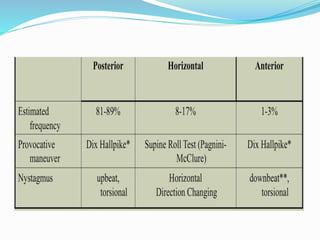
 Classic post SCC – geotropic rotatory nystagmus
 Horizontal SCC – purely horizontal nystagmus
 Non-fatiguing nystagmus – cupulolithiasis >
canalithiasis
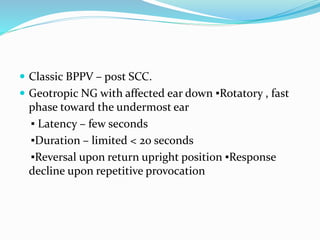
 Classic BPPV – post SCC.
 Geotropic NG with affected ear down ▪Rotatory , fast
phase toward the undermost ear
▪ Latency – few seconds
▪Duration – limited < 20 seconds
▪Reversal upon return upright position ▪Response
decline upon repetitive provocation
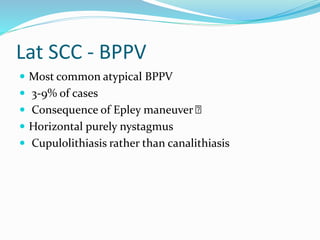
Lat SCC - BPPV
 Most common atypical BPPV
 3-9% of cases
 Consequence of Epley maneuver
 Horizontal purely nystagmus
 Cupulolithiasis rather than canalithiasis
Sup SCC - BPPV
 Rare – 2%
 Down-beating /torsional NG for the opposite ear on
Dix-Hallpike maneuver
Why posterior SCC common?
THANK YOU…….

BPPV

  • 1.
  • 2.
     BPPV isa clinical syndrome characterized by brief recurrent episodes of vertigo triggered by changes in head position with respect to gravity.  BPPV is the most common cause of recurrent vertigo, with a lifetime prevalence of 2.4%.  The duration, frequency, and intensity of symptoms of BPPV vary, and spontaneous recovery occurs frequently.
  • 3.
     30% ofperipheral vestibular disease  Twice ménière's  Mean age fifth decades  Increases with age.  Women:men 1.6:1
  • 4.
     Primary oridiopathic (50%–70%)  Secondary (30%–50%) ▪ Viral labyrinthitis (15%) ▪Head trauma (10%) ▪ Ménière’s disease (5%) ▪ Migraines (< 5%) ▪ Inner ear surgery (< 1%)
  • 5.
     Schuknecht 1969(Cupulolithiasis) loose otoconia from the utricle PSCC  McClure -1979 Canalithiasis mechanism
  • 6.
    Pathophysiology Degenerative debris fromutricle (otoconia) Canalithiasis Theory -Floating freely in the endolymph Cupulolithiasis Theory- Adhering to the cupula
  • 7.
     Classic postSCC – geotropic rotatory nystagmus  Horizontal SCC – purely horizontal nystagmus  Non-fatiguing nystagmus – cupulolithiasis > canalithiasis
  • 8.
     Classic BPPV– post SCC.  Geotropic NG with affected ear down ▪Rotatory , fast phase toward the undermost ear ▪ Latency – few seconds ▪Duration – limited < 20 seconds ▪Reversal upon return upright position ▪Response decline upon repetitive provocation
  • 9.
    Lat SCC -BPPV  Most common atypical BPPV  3-9% of cases  Consequence of Epley maneuver  Horizontal purely nystagmus  Cupulolithiasis rather than canalithiasis
  • 10.
    Sup SCC -BPPV  Rare – 2%  Down-beating /torsional NG for the opposite ear on Dix-Hallpike maneuver
  • 11.
  • 41.