Evaluation of
vertigo
Dr Krishna Koirala
2020-06- 22
Questions
• Define vertigo. Classify vertigo according to its
duration.
• Write down the characteristics of peripheral vertigo.
• How will you investigate peripheral vertigo?
• How do you differentiate BPPV from central vertigo?
Introduction
• Illusion of motion of self or the surrounding
• Mostly a symptom of vestibular lesion
• Vertigo
– Rotatory : Vestibular lesion
– Tilt / Drop : Otolith dysfunction
– Unsteadiness : Miscellaneous
•Types of vertigo
–Objective : the patient has the sensation
that objects in the environment are moving
–Subjective : the patient feels as if he or she
is moving
–Pseudovertigo : an intensive sensation of
rotation inside the patient's head
• Vertigo must not be confused with
– Dizziness
– Light Headedness
– Blackouts
– Fainting xzcvbn,m
– BGiddiness
– Disequilibrium
• Dizziness occurs due to CNS, CVS , ANS, GIT ,
Psychiatric disorders etc.
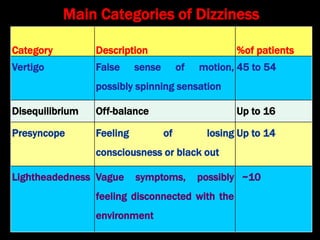
Main Categories of Dizziness
Category Description %of patients
Vertigo False sense of motion,
possibly spinning sensation
45 to 54
Disequilibrium Off-balance Up to 16
Presyncope Feeling of losing
consciousness or black out
Up to 14
Lightheadedness Vague symptoms, possibly
feeling disconnected with the
environment
~10
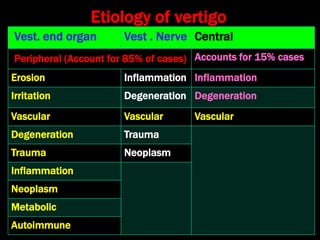
Etiology of vertigo
Vest. end organ Vest . Nerve Central
Peripheral (Account for 85% of cases) Accounts for 15% cases
Erosion Inflammation Inflammation
Irritation Degeneration Degeneration
Vascular Vascular Vascular
Degeneration Trauma
Trauma Neoplasm
Inflammation
Neoplasm
Metabolic
Autoimmune
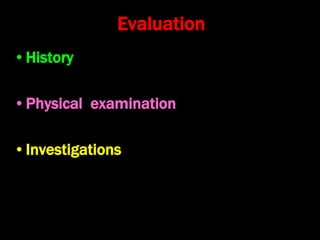
Evaluation
•History
•Physical examination
•Investigations
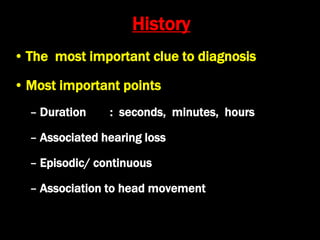
History
• The most important clue to diagnosis
• Most important points
– Duration : seconds, minutes, hours
– Associated hearing loss
– Episodic/ continuous
– Association to head movement
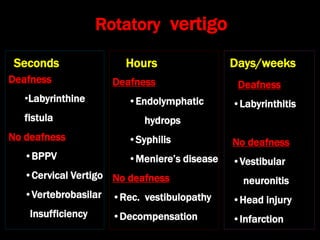
Rotatory vertigo
Seconds Hours Days/weeks
Deafness
•Labyrinthine
fistula
No deafness
•BPPV
•Cervical Vertigo
•Vertebrobasilar
Insufficiency
Deafness
•Endolymphatic
hydrops
•Syphilis
•Meniere’s disease
No deafness
•Rec. vestibulopathy
•Decompensation
Deafness
•Labyrinthitis
No deafness
•Vestibular
neuronitis
•Head injury
•Infarction
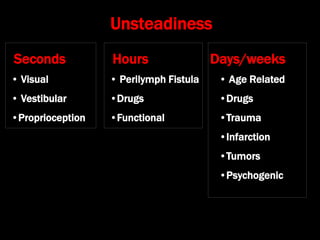
Unsteadiness
Seconds Hours Days/weeks
• Visual
• Vestibular
•Proprioception
• Perilymph Fistula
•Drugs
•Functional
• Age Related
•Drugs
•Trauma
•Infarction
•Tumors
•Psychogenic
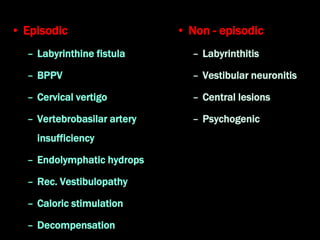
• Episodic
– Labyrinthine fistula
– BPPV
– Cervical vertigo
– Vertebrobasilar artery
insufficiency
– Endolymphatic hydrops
– Rec. Vestibulopathy
– Caloric stimulation
– Decompensation
• Non - episodic
– Labyrinthitis
– Vestibular neuronitis
– Central lesions
– Psychogenic
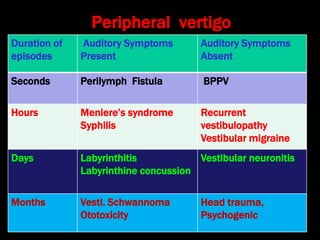
Peripheral vertigo
Duration of
episodes
Auditory Symptoms
Present
Auditory Symptoms
Absent
Seconds Perilymph Fistula BPPV
Hours Meniere’s syndrome
Syphilis
Recurrent
vestibulopathy
Vestibular migraine
Days Labyrinthitis
Labyrinthine concussion
Vestibular neuronitis
Months Vesti. Schwannoma
Ototoxicity
Head trauma,
Psychogenic
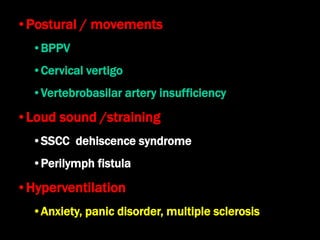
•Postural / movements
•BPPV
•Cervical vertigo
•Vertebrobasilar artery insufficiency
•Loud sound /straining
•SSCC dehiscence syndrome
•Perilymph fistula
•Hyperventilation
•Anxiety, panic disorder, multiple sclerosis
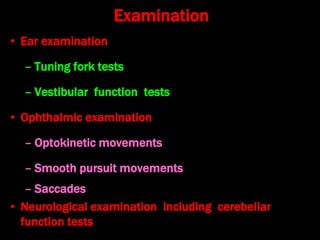
Examination
• Ear examination
– Tuning fork tests
– Vestibular function tests
• Ophthalmic examination
– Optokinetic movements
– Smooth pursuit movements
– Saccades
• Neurological examination including cerebellar
function tests
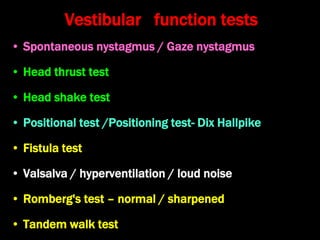
Vestibular function tests
• Spontaneous nystagmus / Gaze nystagmus
• Head thrust test
• Head shake test
• Positional test /Positioning test- Dix Hallpike
• Fistula test
• Valsalva / hyperventilation / loud noise
• Romberg's test – normal / sharpened
• Tandem walk test
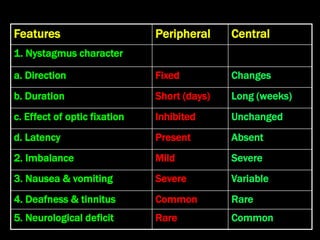
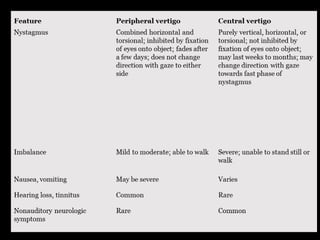
Features Peripheral Central
1. Nystagmus character
a. Direction Fixed Changes
b. Duration Short (days) Long (weeks)
c. Effect of optic fixation Inhibited Unchanged
d. Latency Present Absent
2. Imbalance Mild Severe
3. Nausea & vomiting Severe Variable
4. Deafness & tinnitus Common Rare
5. Neurological deficit Rare Common
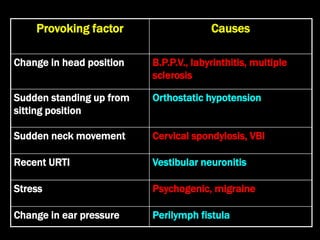
Provoking factor Causes
Change in head position B.P.P.V., labyrinthitis, multiple
sclerosis
Sudden standing up from
sitting position
Orthostatic hypotension
Sudden neck movement Cervical spondylosis, VBI
Recent URTI Vestibular neuronitis
Stress Psychogenic, migraine
Change in ear pressure Perilymph fistula
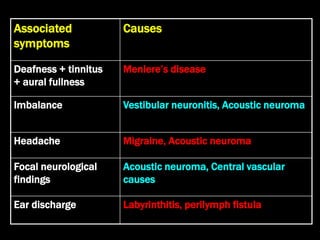
Associated
symptoms
Causes
Deafness + tinnitus
+ aural fullness
Meniere’s disease
Imbalance Vestibular neuronitis, Acoustic neuroma
Headache Migraine, Acoustic neuroma
Focal neurological
findings
Acoustic neuroma, Central vascular
causes
Ear discharge Labyrinthitis, perilymph fistula
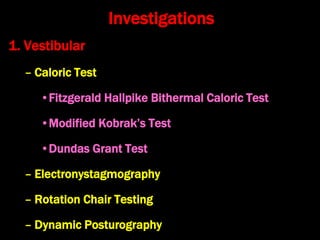
Investigations
1. Vestibular
– Caloric Test
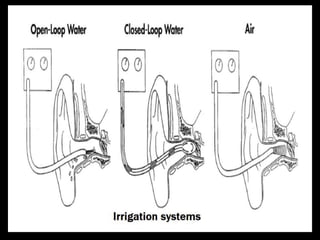
•Fitzgerald Hallpike Bithermal Caloric Test
•Modified Kobrak’s Test
•Dundas Grant Test
– Electronystagmography
– Rotation Chair Testing
– Dynamic Posturography
Investigations
2. Audiological
– PTA, Glycerol Dehydration Test
– ECoG
– BERA
3. Radiological
– X Ray Cervical Spine
– Doppler USG Carotico -Vertebral System
– HRCT Temporal Bone
– MRI Brain
4. Serological : TPHA, Autoantibodies
Caloric test
• Basic Vestibular function test
• Principle:
– On irrigation of EAC with warm/cold water
temperature changes in labyrinth which causes
convection current formation in inner ear fluids
– Endolymph moves under convection current
influence and stimulates the labyrinth
– Nystagmus is seen
Fitzgerald - Hallpike
• Bithermal Caloric Test
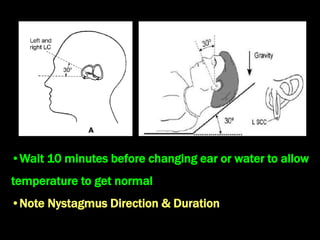
• Patient kept supine with head elevated 30o (Makes
HSCC vertical & more sensitive)
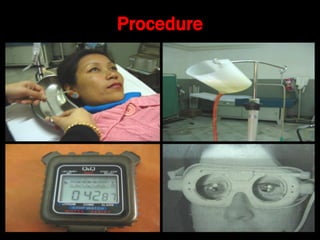
• Each ear is irrigated with both warm & cold water
(Warm water : 44o C, Cold water : 30o C)
• Rate of Irrigation : 500ml/ min
• Duration of Irrigation : 60-90 sec or when nystagmus
occurs whichever is early.
• Amount of Irrigation usually: 300- 350 ml.
•Wait 10 minutes before changing ear or water to allow
temperature to get normal
•Note Nystagmus Direction & Duration
Procedure
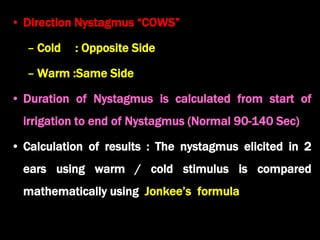
• Direction Nystagmus “COWS”
– Cold : Opposite Side
– Warm :Same Side
• Duration of Nystagmus is calculated from start of
irrigation to end of Nystagmus (Normal 90-140 Sec)
• Calculation of results : The nystagmus elicited in 2
ears using warm / cold stimulus is compared
mathematically using Jonkee’s formula
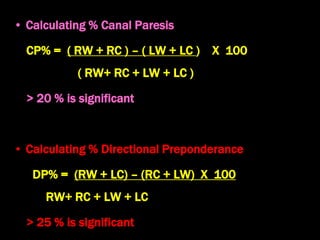
• Calculating % Canal Paresis
CP% = ( RW + RC ) – ( LW + LC ) X 100
( RW+ RC + LW + LC )
> 20 % is significant
• Calculating % Directional Preponderance
DP% = (RW + LC) – (RC + LW) X 100
RW+ RC + LW + LC
> 25 % is significant
Evaluation of vertigo

Evaluation of vertigo

  • 1.
  • 2.
    Questions • Define vertigo.Classify vertigo according to its duration. • Write down the characteristics of peripheral vertigo. • How will you investigate peripheral vertigo? • How do you differentiate BPPV from central vertigo?
  • 3.
    Introduction • Illusion ofmotion of self or the surrounding • Mostly a symptom of vestibular lesion • Vertigo – Rotatory : Vestibular lesion – Tilt / Drop : Otolith dysfunction – Unsteadiness : Miscellaneous
  • 4.
    •Types of vertigo –Objective: the patient has the sensation that objects in the environment are moving –Subjective : the patient feels as if he or she is moving –Pseudovertigo : an intensive sensation of rotation inside the patient's head
  • 5.
    • Vertigo mustnot be confused with – Dizziness – Light Headedness – Blackouts – Fainting xzcvbn,m – BGiddiness – Disequilibrium • Dizziness occurs due to CNS, CVS , ANS, GIT , Psychiatric disorders etc.
  • 6.
    Main Categories ofDizziness Category Description %of patients Vertigo False sense of motion, possibly spinning sensation 45 to 54 Disequilibrium Off-balance Up to 16 Presyncope Feeling of losing consciousness or black out Up to 14 Lightheadedness Vague symptoms, possibly feeling disconnected with the environment ~10
  • 7.
    Etiology of vertigo Vest.end organ Vest . Nerve Central Peripheral (Account for 85% of cases) Accounts for 15% cases Erosion Inflammation Inflammation Irritation Degeneration Degeneration Vascular Vascular Vascular Degeneration Trauma Trauma Neoplasm Inflammation Neoplasm Metabolic Autoimmune
  • 8.
  • 9.
    History • The mostimportant clue to diagnosis • Most important points – Duration : seconds, minutes, hours – Associated hearing loss – Episodic/ continuous – Association to head movement
  • 10.
    Rotatory vertigo Seconds HoursDays/weeks Deafness •Labyrinthine fistula No deafness •BPPV •Cervical Vertigo •Vertebrobasilar Insufficiency Deafness •Endolymphatic hydrops •Syphilis •Meniere’s disease No deafness •Rec. vestibulopathy •Decompensation Deafness •Labyrinthitis No deafness •Vestibular neuronitis •Head injury •Infarction
  • 11.
    Unsteadiness Seconds Hours Days/weeks •Visual • Vestibular •Proprioception • Perilymph Fistula •Drugs •Functional • Age Related •Drugs •Trauma •Infarction •Tumors •Psychogenic
  • 12.
    • Episodic – Labyrinthinefistula – BPPV – Cervical vertigo – Vertebrobasilar artery insufficiency – Endolymphatic hydrops – Rec. Vestibulopathy – Caloric stimulation – Decompensation • Non - episodic – Labyrinthitis – Vestibular neuronitis – Central lesions – Psychogenic
  • 13.
    Peripheral vertigo Duration of episodes AuditorySymptoms Present Auditory Symptoms Absent Seconds Perilymph Fistula BPPV Hours Meniere’s syndrome Syphilis Recurrent vestibulopathy Vestibular migraine Days Labyrinthitis Labyrinthine concussion Vestibular neuronitis Months Vesti. Schwannoma Ototoxicity Head trauma, Psychogenic
  • 14.
    •Postural / movements •BPPV •Cervicalvertigo •Vertebrobasilar artery insufficiency •Loud sound /straining •SSCC dehiscence syndrome •Perilymph fistula •Hyperventilation •Anxiety, panic disorder, multiple sclerosis
  • 15.
    Examination • Ear examination –Tuning fork tests – Vestibular function tests • Ophthalmic examination – Optokinetic movements – Smooth pursuit movements – Saccades • Neurological examination including cerebellar function tests
  • 16.
    Vestibular function tests •Spontaneous nystagmus / Gaze nystagmus • Head thrust test • Head shake test • Positional test /Positioning test- Dix Hallpike • Fistula test • Valsalva / hyperventilation / loud noise • Romberg's test – normal / sharpened • Tandem walk test
  • 17.
    Features Peripheral Central 1.Nystagmus character a. Direction Fixed Changes b. Duration Short (days) Long (weeks) c. Effect of optic fixation Inhibited Unchanged d. Latency Present Absent 2. Imbalance Mild Severe 3. Nausea & vomiting Severe Variable 4. Deafness & tinnitus Common Rare 5. Neurological deficit Rare Common
  • 18.
    Provoking factor Causes Changein head position B.P.P.V., labyrinthitis, multiple sclerosis Sudden standing up from sitting position Orthostatic hypotension Sudden neck movement Cervical spondylosis, VBI Recent URTI Vestibular neuronitis Stress Psychogenic, migraine Change in ear pressure Perilymph fistula
  • 19.
    Associated symptoms Causes Deafness + tinnitus +aural fullness Meniere’s disease Imbalance Vestibular neuronitis, Acoustic neuroma Headache Migraine, Acoustic neuroma Focal neurological findings Acoustic neuroma, Central vascular causes Ear discharge Labyrinthitis, perilymph fistula
  • 21.
    Investigations 1. Vestibular – CaloricTest •Fitzgerald Hallpike Bithermal Caloric Test •Modified Kobrak’s Test •Dundas Grant Test – Electronystagmography – Rotation Chair Testing – Dynamic Posturography
  • 22.
    Investigations 2. Audiological – PTA,Glycerol Dehydration Test – ECoG – BERA 3. Radiological – X Ray Cervical Spine – Doppler USG Carotico -Vertebral System – HRCT Temporal Bone – MRI Brain 4. Serological : TPHA, Autoantibodies
  • 23.
    Caloric test • BasicVestibular function test • Principle: – On irrigation of EAC with warm/cold water temperature changes in labyrinth which causes convection current formation in inner ear fluids – Endolymph moves under convection current influence and stimulates the labyrinth – Nystagmus is seen
  • 25.
    Fitzgerald - Hallpike •Bithermal Caloric Test • Patient kept supine with head elevated 30o (Makes HSCC vertical & more sensitive) • Each ear is irrigated with both warm & cold water (Warm water : 44o C, Cold water : 30o C) • Rate of Irrigation : 500ml/ min • Duration of Irrigation : 60-90 sec or when nystagmus occurs whichever is early. • Amount of Irrigation usually: 300- 350 ml.
  • 26.
    •Wait 10 minutesbefore changing ear or water to allow temperature to get normal •Note Nystagmus Direction & Duration
  • 27.
  • 28.
    • Direction Nystagmus“COWS” – Cold : Opposite Side – Warm :Same Side • Duration of Nystagmus is calculated from start of irrigation to end of Nystagmus (Normal 90-140 Sec) • Calculation of results : The nystagmus elicited in 2 ears using warm / cold stimulus is compared mathematically using Jonkee’s formula
  • 29.
    • Calculating %Canal Paresis CP% = ( RW + RC ) – ( LW + LC ) X 100 ( RW+ RC + LW + LC ) > 20 % is significant • Calculating % Directional Preponderance DP% = (RW + LC) – (RC + LW) X 100 RW+ RC + LW + LC > 25 % is significant